
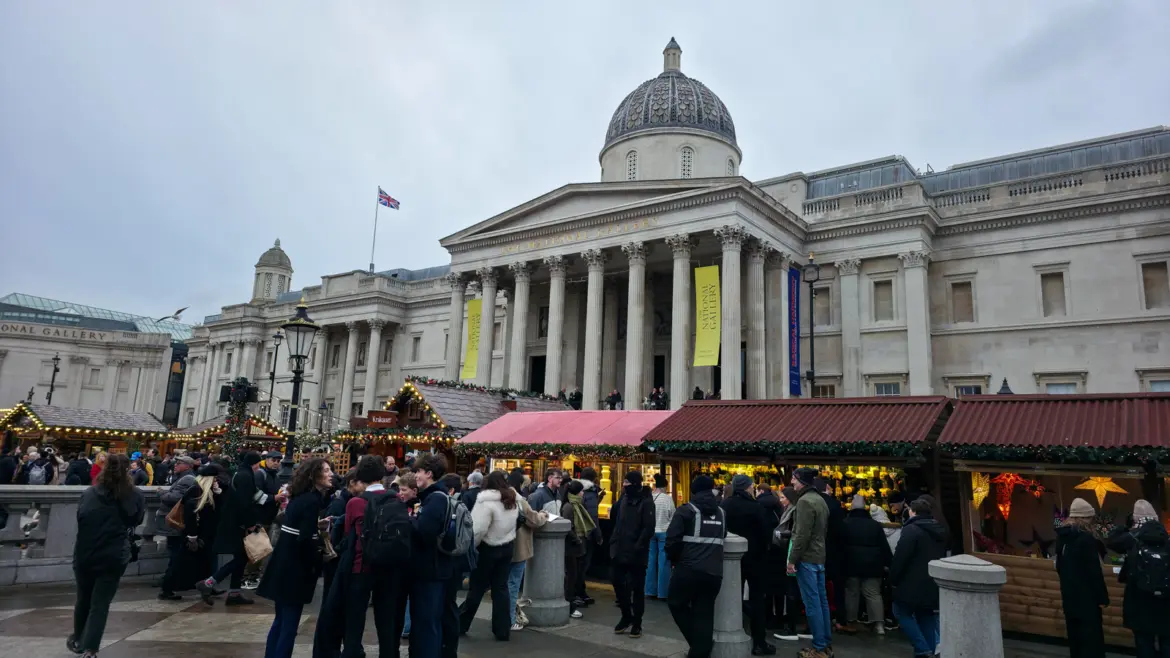
Trafalgar Square sits at the heart of London, and in early December it runs cold and bright, with the fountains going and a row of wooden chalets set up along the north edge for the Christmas market. Behind the stalls sits the long stone front of the National Gallery, its dome above the portico and the Union flag over the roofline. Roasted almonds, mulled wine, stalls hung with ornaments, and then the steps up to one of the great painting collections in the world, free to walk into. That contrast is half the fun of going in winter.
I went for the Sunflowers. I will admit that up front. I am a Van Gogh devotee, the sort who owns the LEGO version of the Sunflowers and hangs it on the wall without a trace of shame. The painting lives at the far eastern end of the building, which I did not know on my first visit, and that is the small confession at the heart of this post. The National Gallery holds well over two thousand paintings, and even with around forty per cent on show at any time, that is still more than a thousand pictures across two linked buildings. The first time I walked in without a plan and drifted. The second time I carried the map and did far better, though I still think an hour with a guide would have served me best of all.
The National Gallery at a Glance
📍 Where · Trafalgar Square, central London, WC2N 5DN. Since May 2025 the main entrance is the Sainsbury Wing, on the western side of the frontage, and it is the step-free way in.
💷 Entry · Free to the permanent collection. Booking a free timed ticket gives fast-track entry. A few special exhibitions are ticketed.
🕙 Hours · Daily 10am to 6pm, and until 9pm on Fridays. Closed 24 to 26 December and 1 January, so 361 days a year.
🧭 Layout · One long chronological route, west to east. It starts with 13th-century panels in the Sainsbury Wing and ends with the Post-Impressionists at the far eastern end. Follow the room numbers above the doorways.
🖼️ Don’t miss · Leonardo’s Virgin of the Rocks, Stubbs’s Whistlejacket, Van Gogh’s Sunflowers, and the dedicated Titian, Rembrandt and Monet rooms.
⏱️ Time needed · About three hours for the highlights at a steady pace.
🚇 Getting there · Charing Cross and Leicester Square are the nearest Tube stations, both a few minutes’ walk.
The new front door
Part of my confusion was bad timing of a happy kind. The gallery spent its two hundredth birthday rearranging itself. Founded by Parliament in 1824, it marked the bicentenary by reopening the Sainsbury Wing on 10 May 2025 as its new main entrance, after a two-year refurbishment. The old side doors and queues are gone. Visitors now arrive into a tall, pale stone foyer with clear glazing and a lot more daylight than the wing used to allow.
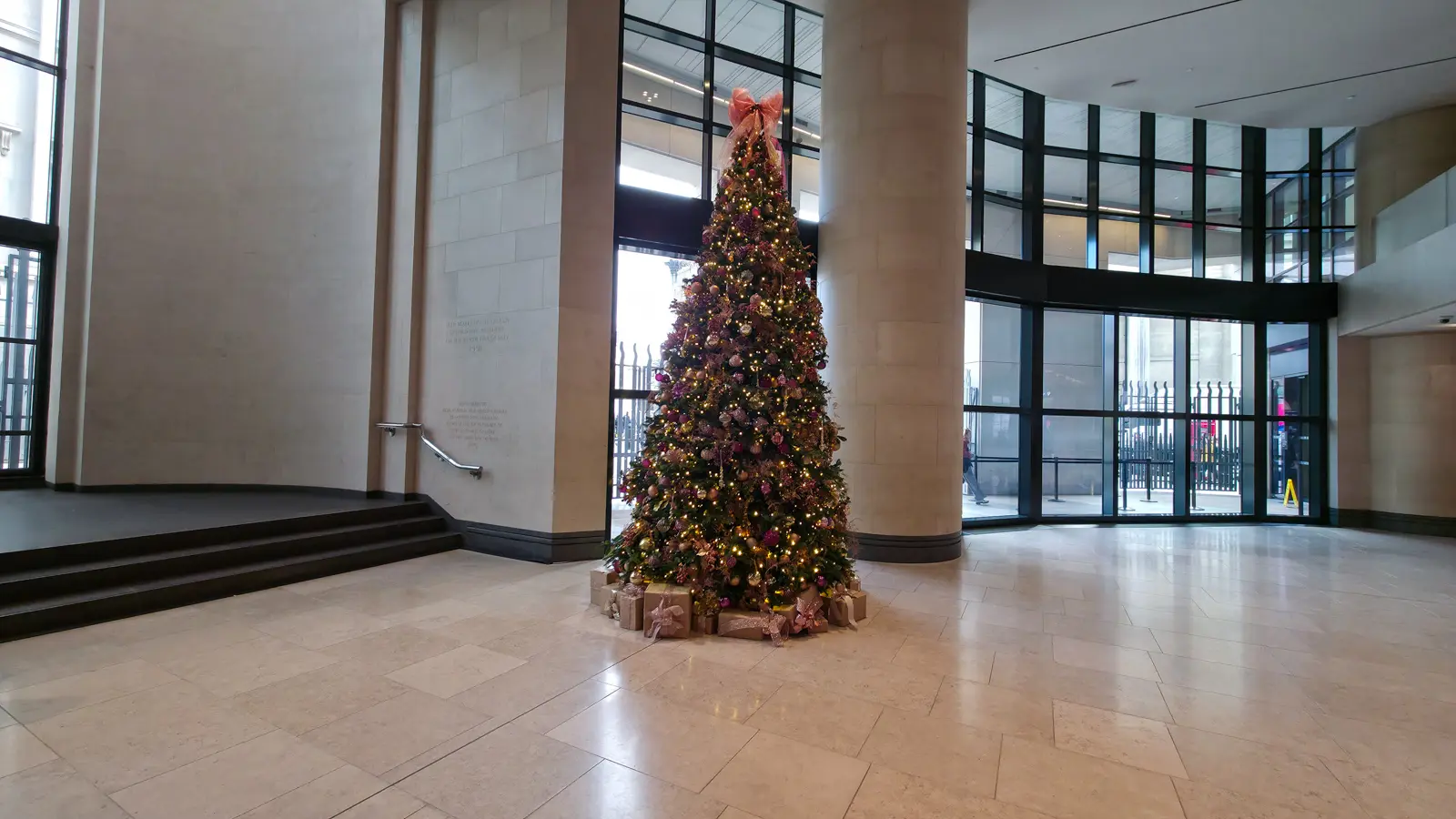
From the foyer, the wing’s grand staircase climbs to the galleries at the top. This is where the collection begins, with its earliest paintings, so the route starts at the head of those stairs.
How it is laid out
The 2025 reopening came with the first full rearrangement of the collection since 1991, titled C C Land: The Wonder of Art. The logic is chronological and runs roughly west to east. The Sainsbury Wing holds the earliest work, late medieval and early Renaissance. The original building picks up the sixteenth and seventeenth centuries through the central hall, and the route ends with the Impressionists and Post-Impressionists at the eastern end. Van Gogh, in other words, is the finish line.
Here is the honest part, and the thing no one mentions at the door. There is no single loop through both buildings. To see it all in order, the route runs into the Sainsbury Wing first, then doubles back to cross into the main building. Room numbers are painted above the doorways, which is the detail that rescued my second visit. Follow them and the chronology makes sense. Ignore them and it is easy to end up, as I did the first time, standing in front of Dutch portraits wondering where the early Italians had gone. Allow about three hours, pick up the printed map, and if a guided tour is on offer, take it.
The Sainsbury Wing
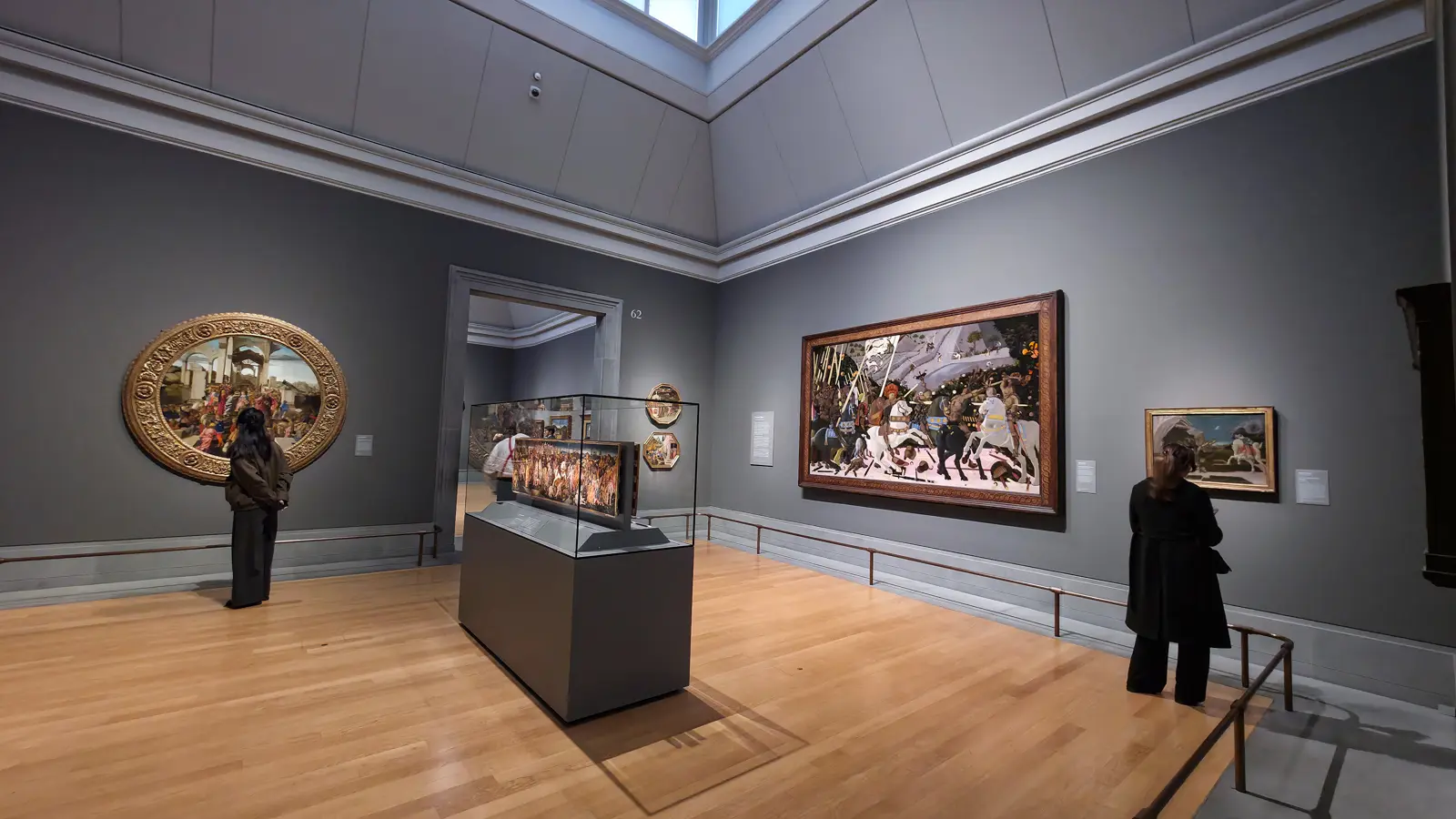
The Sainsbury Wing galleries are calm and grey-walled, lit from above, and they suit the gold-ground altarpieces and early Renaissance panels they hold. This is where the collection starts, with early Italian and Northern Renaissance painting, some of the panels dating back to the thirteenth century. One of the show-stoppers here is Paolo Uccello‘s Battle of San Romano, a tangle of lances, armour and tumbling horses that looks almost like a tournament toy until you notice the fallen soldier laid out in careful perspective along the ground.
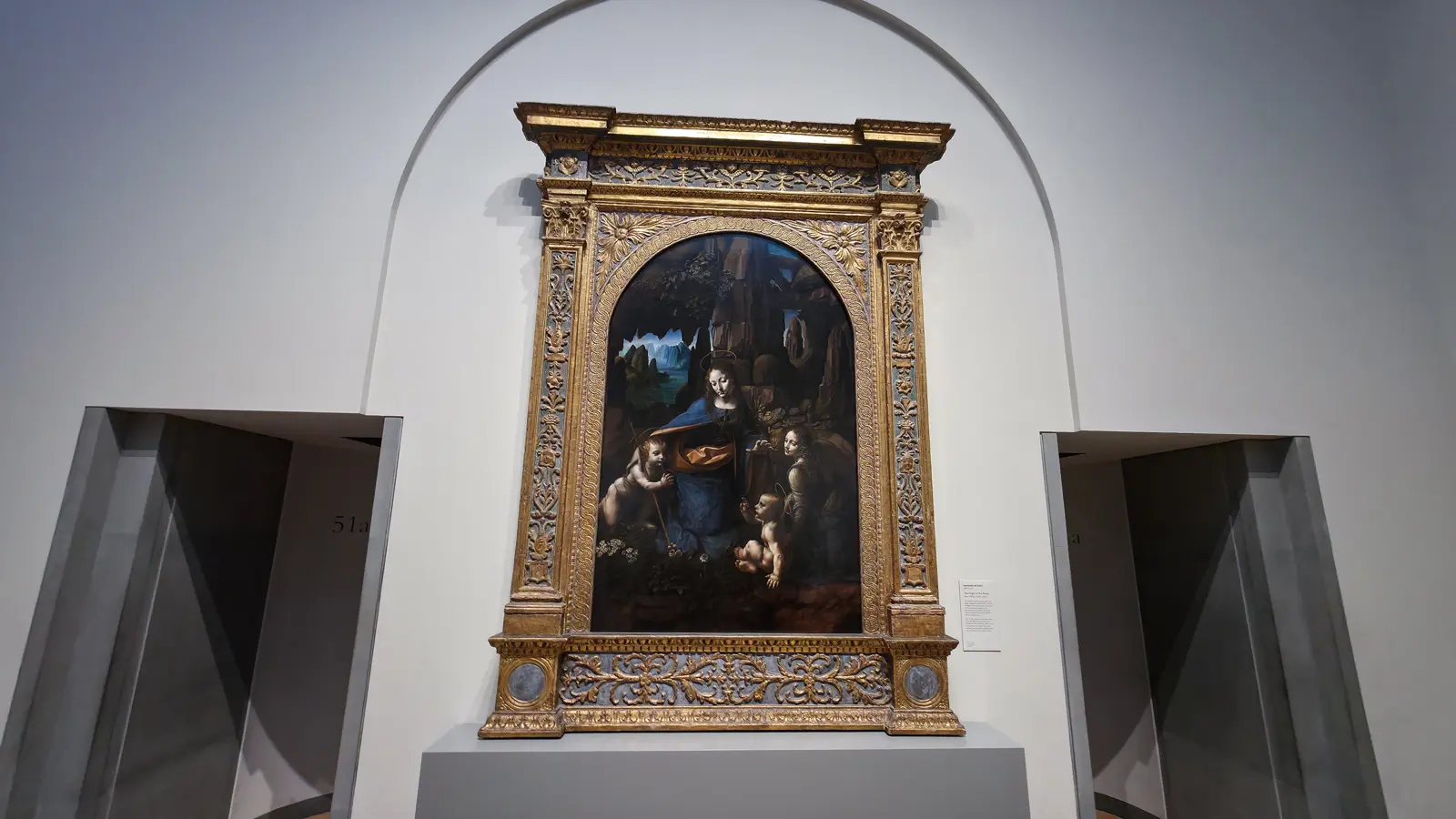
A few rooms on, set into an arched bay of its own, is Leonardo da Vinci‘s The Virgin of the Rocks. The dark grotto, the pointing angel, the strange blue light behind the rocks. People cluster, photograph it and move on, but it rewards a longer look than most give it.
The grand rooms
Across in the original Wilkins building, the mood changes. The ceilings lift, the walls turn deep green and red, and the skylit rooms grow grand. The Wohl Room is one of these, hung with large sixteenth-century Italian canvases. The enormous painting along one wall is Veronese‘s The Family of Darius before Alexander, an opulent piece of Venetian theatre in which in which the mother of the defeated Persian king kneels to the wrong man, mistaking Alexander’s friend for the conqueror.
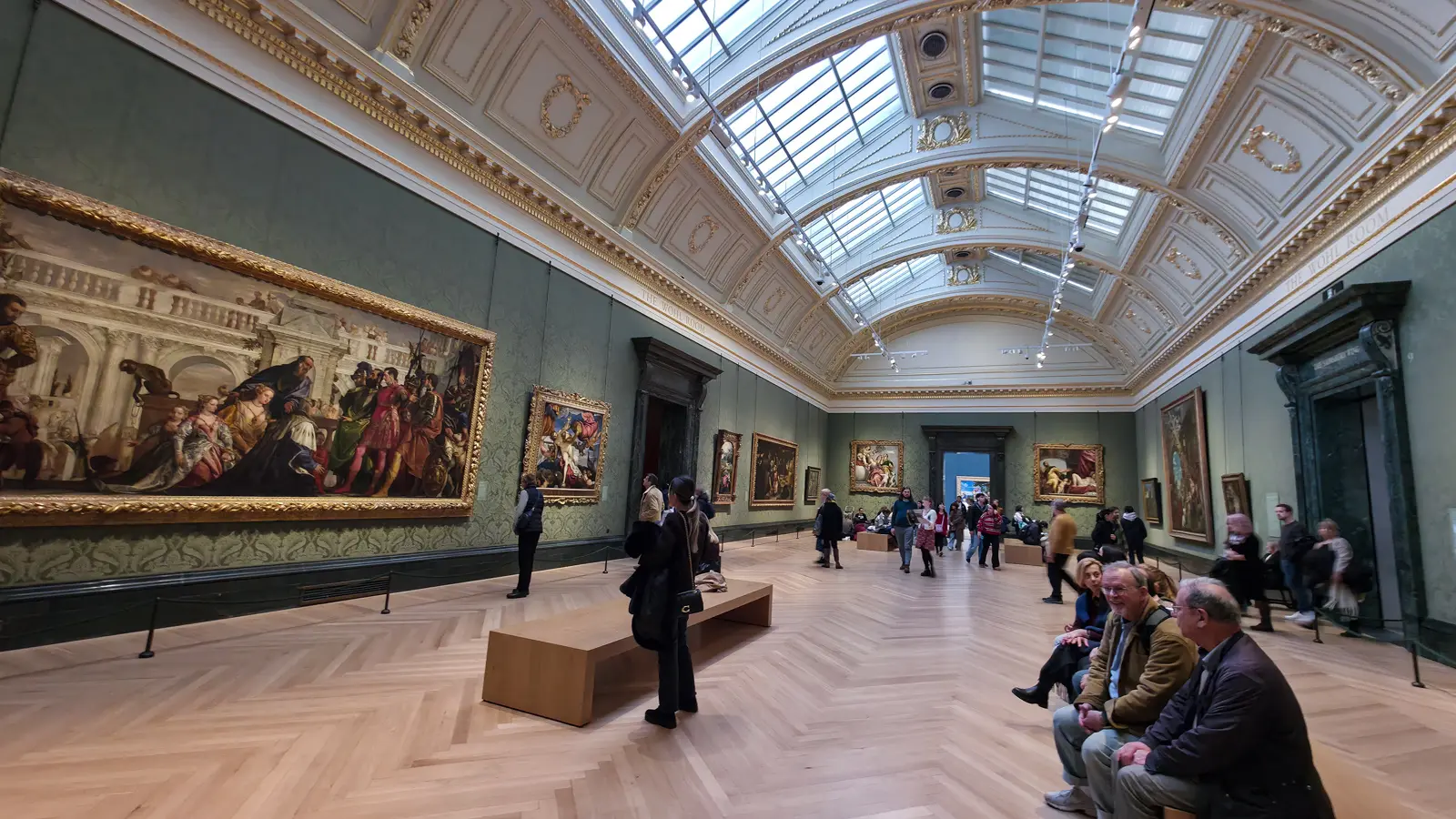
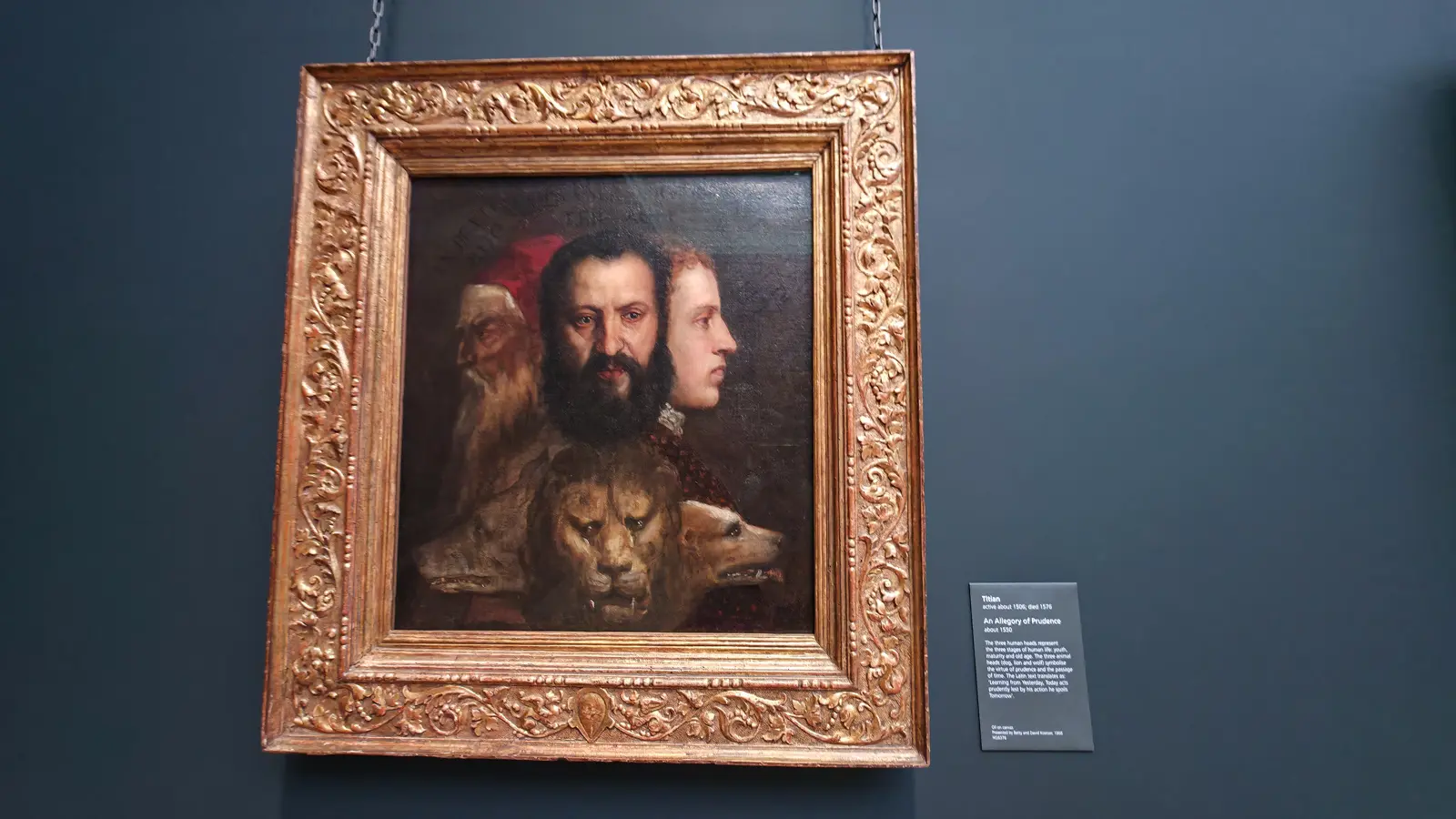
Nearby hangs a small, strange Titian, An Allegory of Prudence. Three human faces look in three directions above three animal heads. It is a quiet puzzle of a picture, and Titian is one of three artists the rearrangement chose to honour with a room of their own. The other two are Rembrandt and Monet.
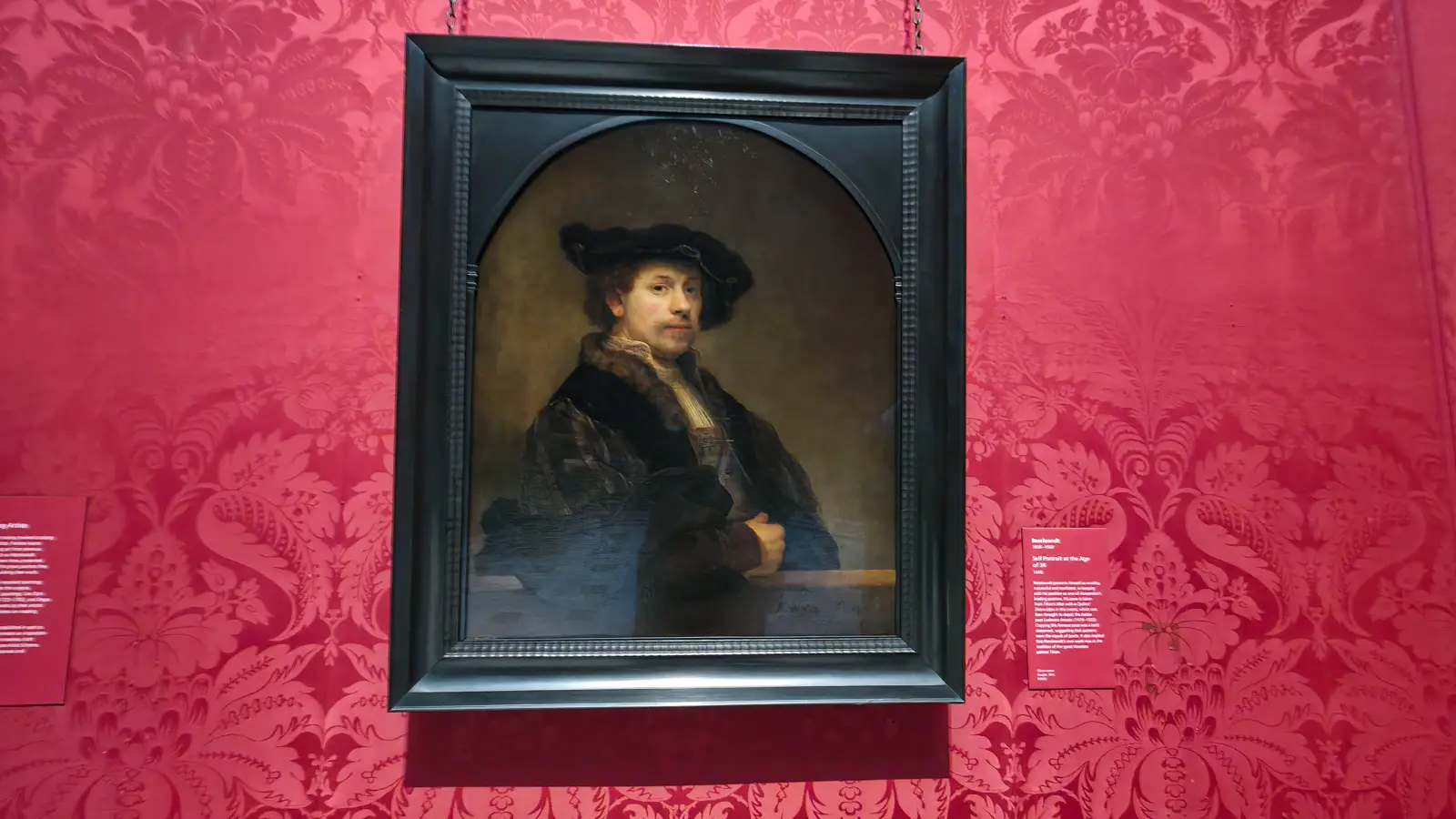
The Rembrandt room is a highlight on its own. He painted himself again and again across his career, and the gallery uses that to powerful effect, hanging the confident younger man against deep red damask not far from the worn, honest face of his final years.
Whistlejacket
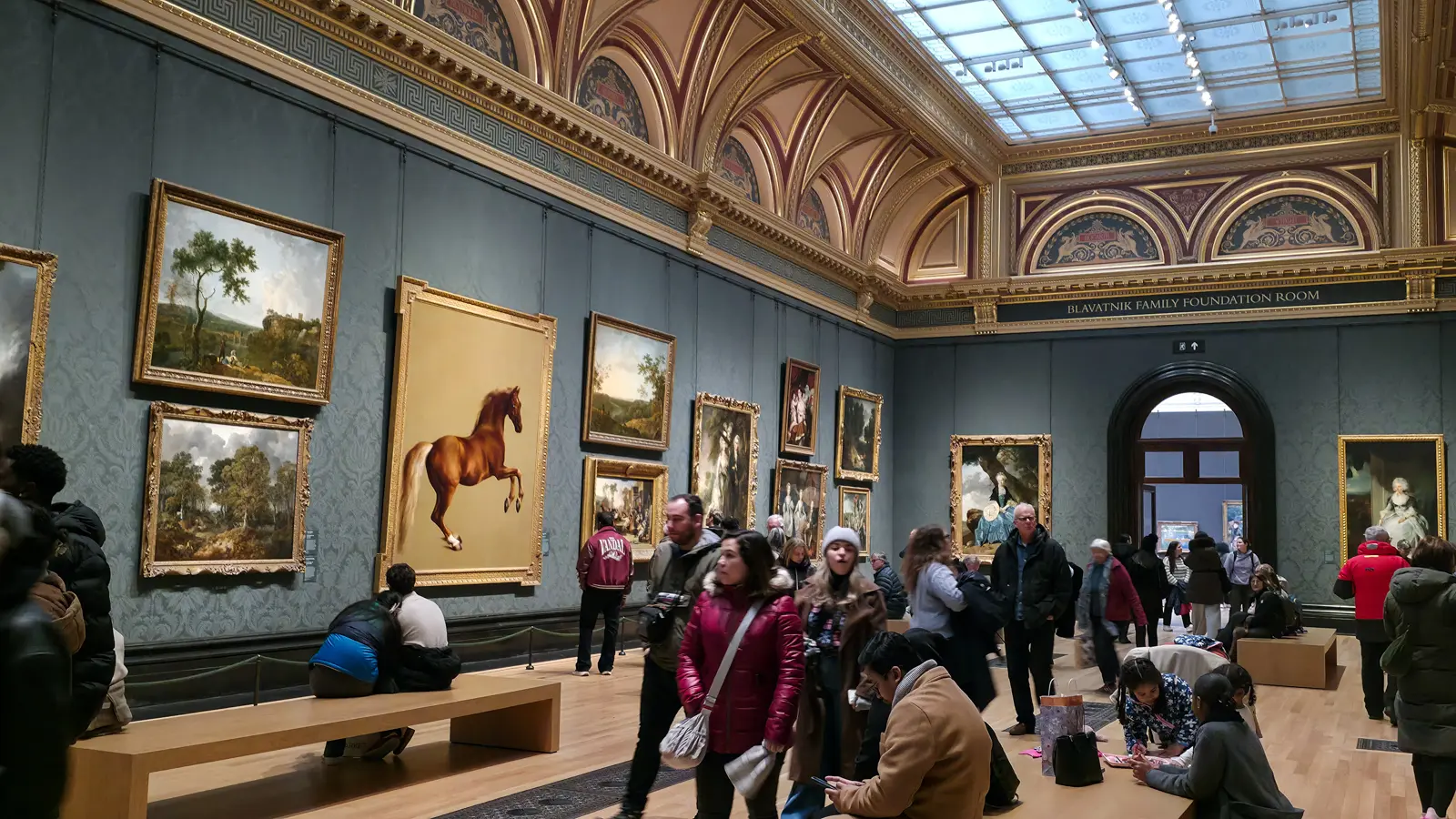
Further on are the British rooms, where the single most arresting thing is a horse. George Stubbs’s Whistlejacket is a life-size chestnut racehorse, rearing against a plain background with no rider, no saddle and no landscape at all. The rearrangement places it on the building’s central axis, lined up so it can be seen through a run of doorways from rooms away. It doubles, usefully, as a landmark: when in doubt, head for the horse.
The Impressionists and Post-Impressionists
The eastern end is where the nineteenth century takes over, and where most first-time visitors are quietly heading whether they admit it or not. These last rooms hold two overlapping generations. First the Impressionists, with Monet given a room of his own and Renoir and the others close by. Then the Post-Impressionists who came just after and pushed past them, Cézanne, Seurat and Van Gogh among them.
Monet has a room to himself, and the walls nearby carry the loose, light-filled brushwork of Renoir and the Impressionists, the point where the collection turns modern after starting, several buildings back, with gold-ground medieval panels.
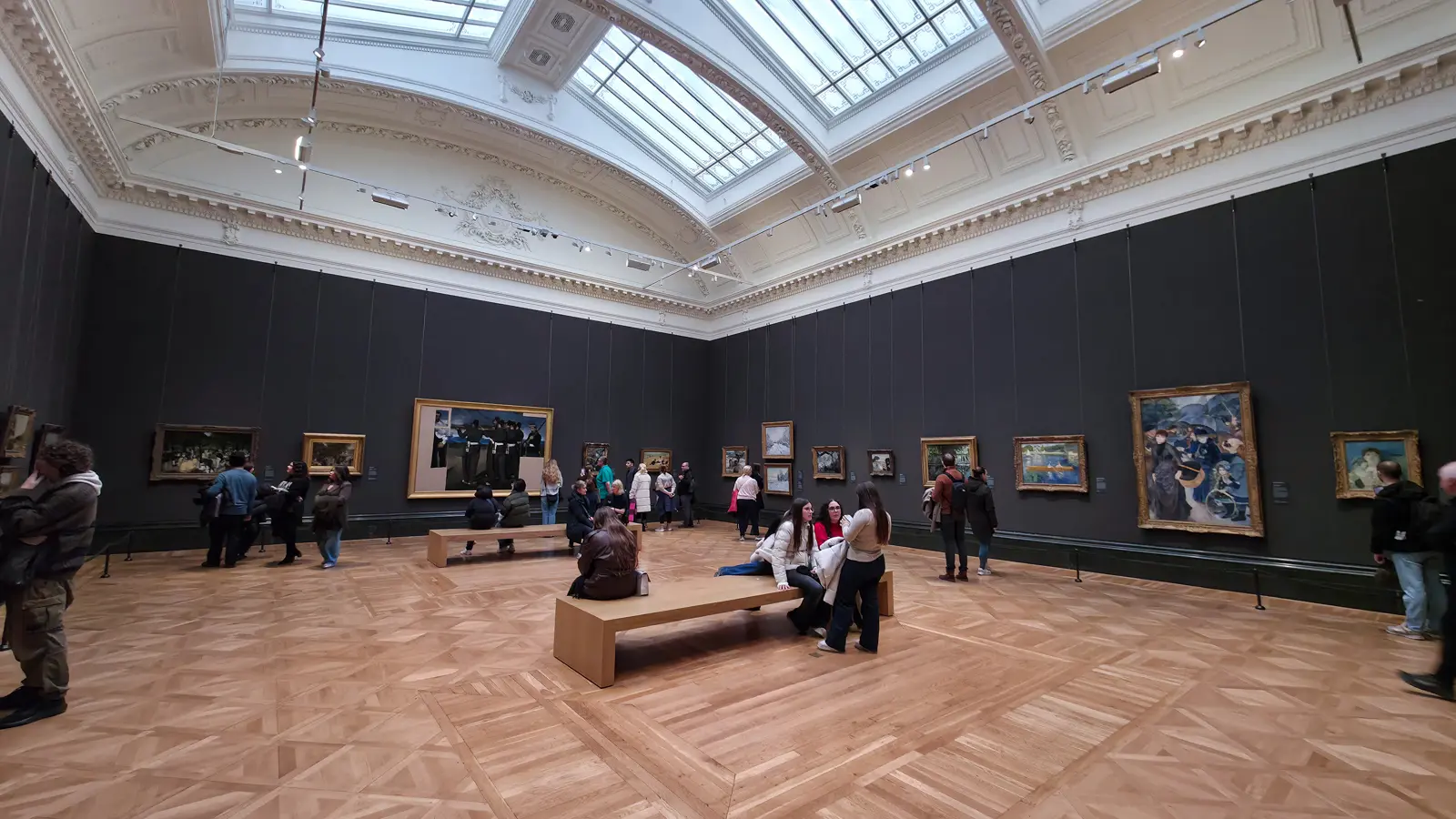
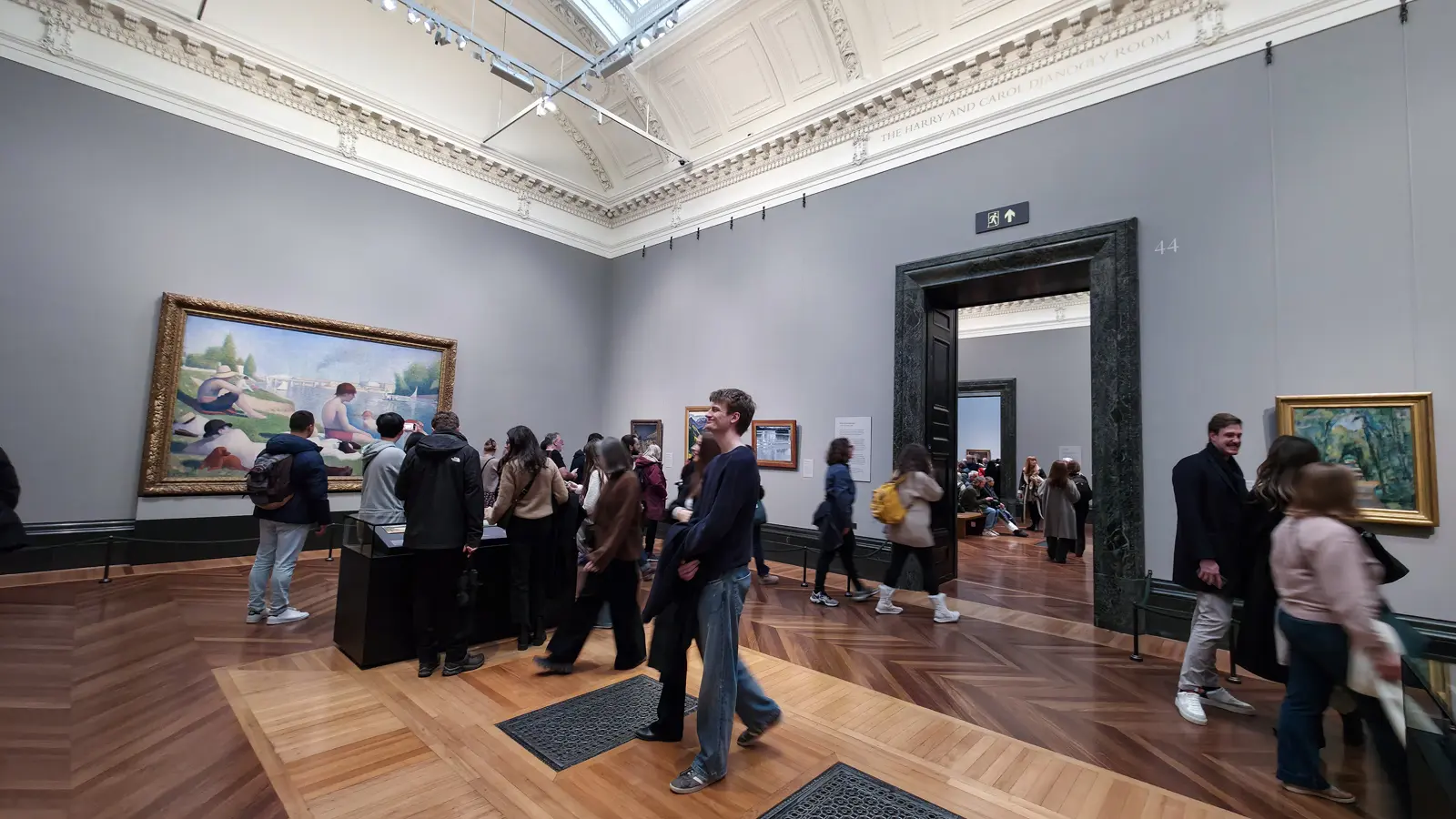
Then come the painters who broke from them. Georges Seurat’s Bathers at Asnières is a great calm canvas of young men by the Seine, big enough to fill a wall. Seurat was no Impressionist; he built his pictures from small, separate touches of colour, the method that became known as pointillism. The room numbers above the doorways are clearest around here, a sign of being near the end of the chronological run.
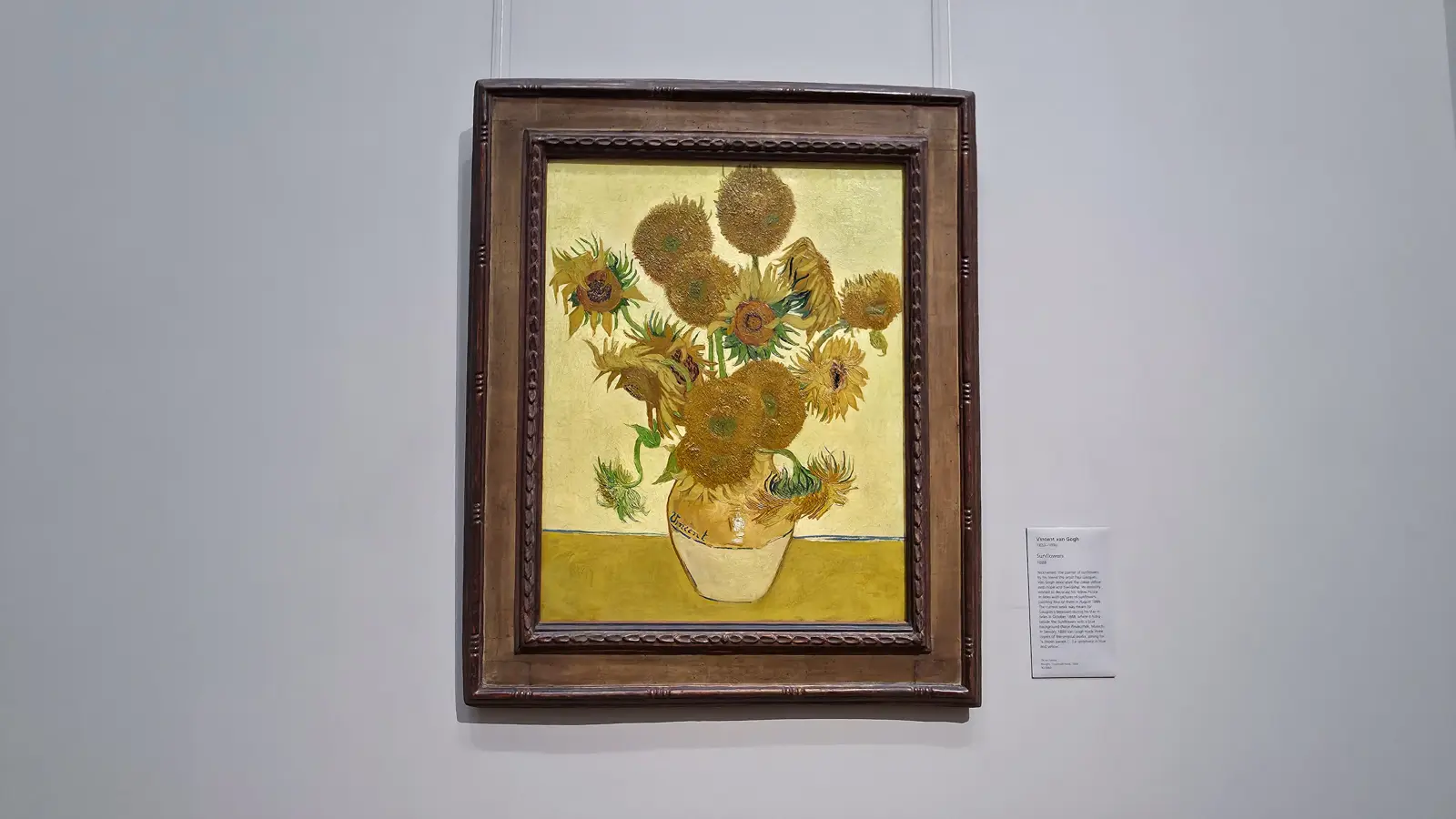
And then, the reason I came. Van Gogh’s Sunflowers. He belongs to this later generation too, though his thick, burning colour looks nothing like Monet’s soft light. He painted it in Arles in 1888, in the rented Yellow House, while waiting for Paul Gauguin to come and paint alongside him. The flowers were meant as a welcome. Fifteen blooms in a plain vase, yellow laid on yellow, the thick paint built up so heavily that the seed heads almost stand off the canvas. It is smaller than expected and brighter than any print, and it now sits behind glass. I stood in front of it longer than was reasonable, and I would do it again.
The way out
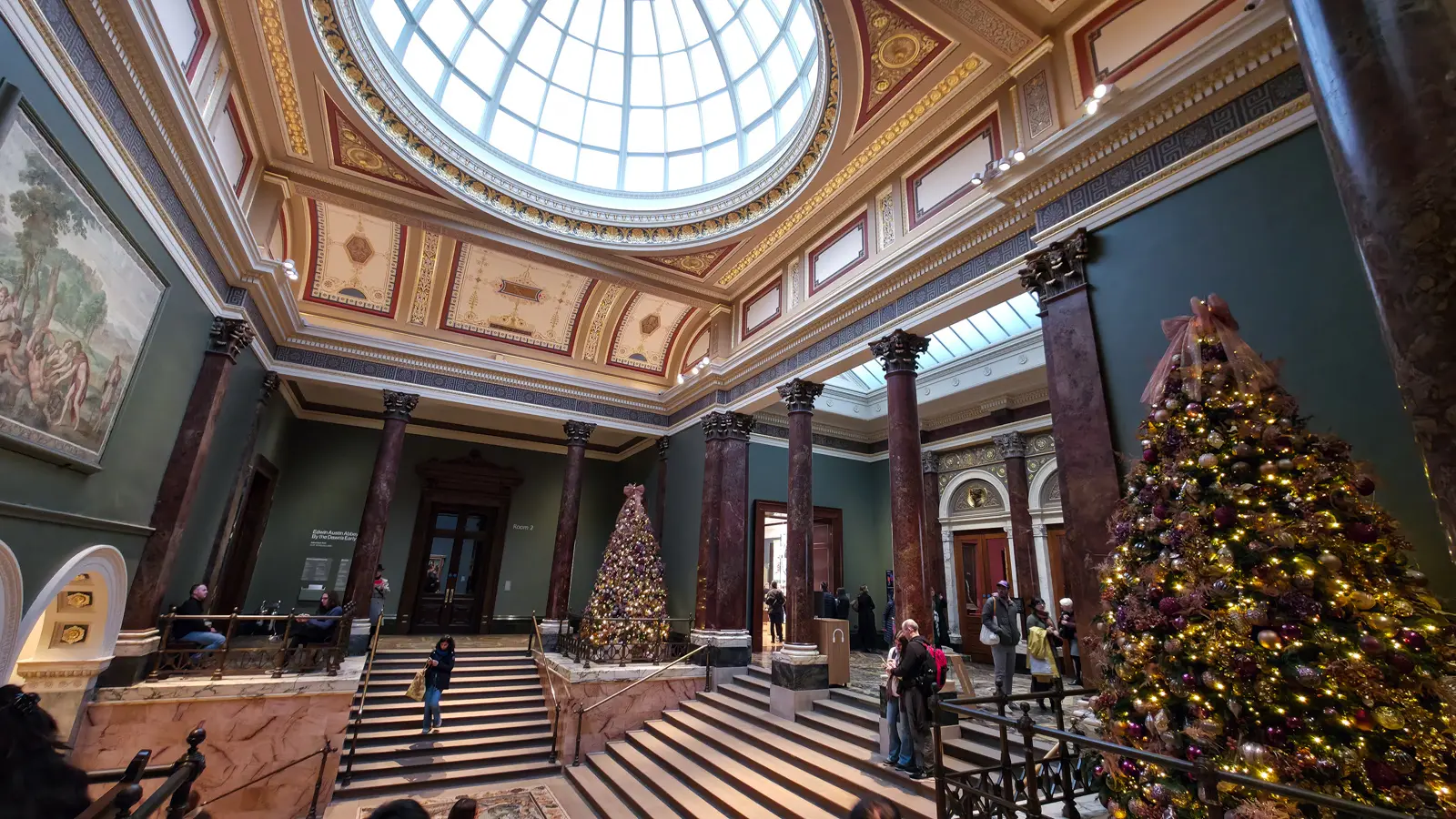
By the time I reached the Sunflowers I had walked almost the length of both buildings. The way out led back through the middle of the original building, under the glass dome of the central hall, where the gallery had set two tall Christmas trees in gold and dusky pink. It is a grand, quiet place to end on before the doors.
Bubbly Tips
- Come in through the Sainsbury Wing. Since May 2025 this has been the main entrance, on the western side of the Trafalgar Square frontage, and it is the step-free way in. The central portico steps are no longer the main door.
- Pick up the map, or plan a route before you go. The two buildings do not form a single loop, so it is easy to miss whole centuries. Five minutes with the map at the start saves an hour of backtracking later.
- Follow the room numbers above the doorways. They run in chronological order. If the numbers are climbing, you are moving forward in time, from medieval panels towards Van Gogh.
- Head straight for the dedicated rooms. The new layout gives Titian, Rembrandt and Monet rooms of their own. If your time is short, these three are the most concentrated rewards.
- If you came for the Sunflowers, go east first. It hangs at the far eastern end, and these eastern rooms draw the biggest crowds. Reaching them early means fewer shoulders between you and the painting.
- Entry is free, but book a timed ticket. General admission costs nothing. A free pre-booked slot gives you fast-track entry, though walk-up is also possible.
- Use the Friday late opening. The gallery stays open until 9pm on Fridays, and the evening hours tend to be calmer than weekend afternoons.
- Give yourself about three hours. That is enough for the highlights at a steady pace. There are benches in most rooms, and the domed central hall is a good spot to rest.
- Photography is fine, within limits. You may take photos for personal use without flash. Tripods and selfie sticks are not allowed.
Final Thoughts
What the 2025 rearrangement does best is turn the National Gallery into a single long walk through time. It starts with gold-backed saints painted before perspective was fully worked out, and it ends, a few hundred metres and six centuries later, in front of a vase of sunflowers that still looks like it was painted yesterday. The building finally tells that story in order, which is exactly what I needed and did not have on my first visit.
Go for one painting if that is the plan. I went for the Sunflowers and have no regrets. Just know that the one thing sits at the end of a very long and very good road, and that the road itself, from Uccello’s horses to Rembrandt’s tired face to Stubbs’s rearing chestnut, is the real reason to spend an afternoon here. Bring the map. Follow the horse.
Until next time!

🌟 Everything You Need to Plan Your Dream Trip in 2026
- 🌟 Luxury Hotels - Find premium stays with Booking.com & Hotels.com
- 🏡 Vacation Rentals - Discover unique properties on VRBO
- 🏞️ Guided Tours - Explore with Viator or GetYourGuide
- 🎫 Attraction Tickets - Skip the lines with Tiqets
- 🚢 Ocean Cruises - Set sail with Cruise Direct
- 📱 International SIMs - Stay connected with Saily
- 🚗 Car Rentals - Budget-friendly options from Discover Cars
- 🌐 Secure VPNs - Browse safely with NordVPN
- 💶 Currency Exchange - Best rates with Wise
- 🗣️ Learn Languages - Master the local language with Babbel and Rosetta Stone