
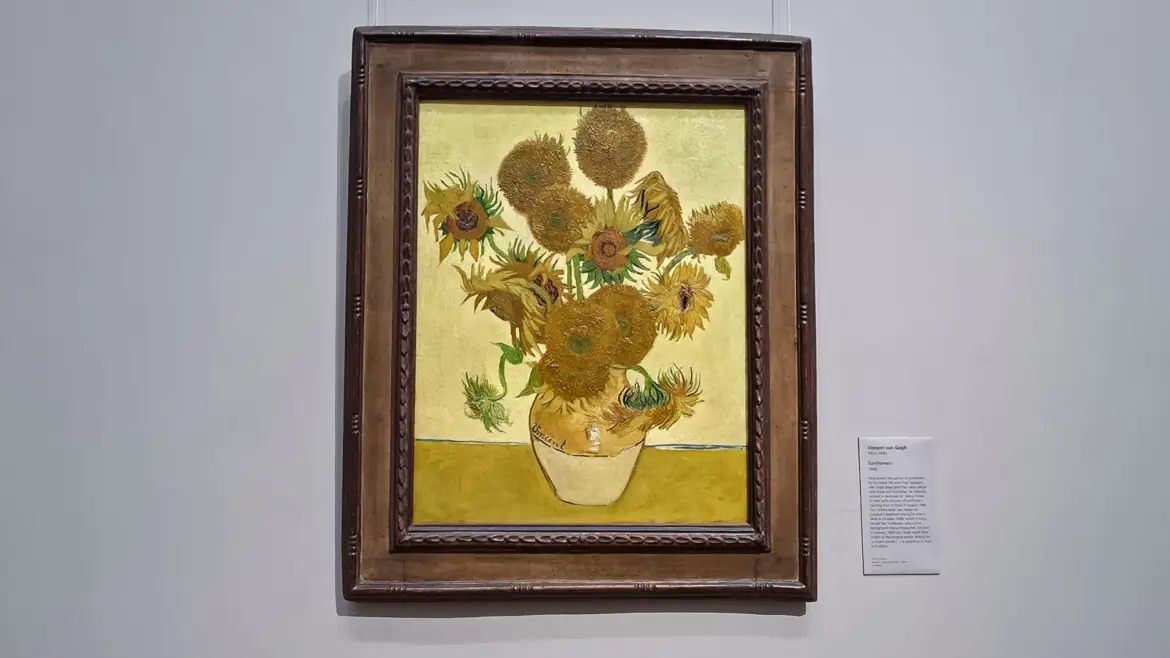
Everything else at the National Gallery was, if I am honest, a warm-up. I had come for one painter. Van Gogh has pulled at me for years, and with a trip to the Van Gogh Museum in Amsterdam booked for the spring, I wanted a first look at what London holds.
What London holds turned out to be five paintings, and they are not a greatest-hits set. One is a world-famous showstopper. The others are quieter, stranger, and in a couple of cases genuinely surprising, and together they trace Van Gogh across the last, hardest years of his life. One of them, as it happens, has been leaning against my wall at home in LEGO form for months.
Van Gogh at the National Gallery at a Glance
🖼️ Eight works, one room · The National Gallery holds eight paintings by Vincent van Gogh. Seven of them hang together in Room 43 on Level 2. The eighth, Head of a Peasant Woman, is not currently on display.
🌻 The Sunflowers is away · London’s 1888 Sunflowers is on loan to the Philadelphia Museum of Art until 11 October 2026. Check the Gallery website before you plan a day around it.
🏛️ Owned and borrowed · The Gallery owns the Sunflowers, Van Gogh’s Chair, A Wheatfield with Cypresses and Long Grass with Butterflies. Two Crabs and Landscape with Ploughman are private loans. Farms near Auvers belongs to Tate.
🎟️ Free to walk in · General admission costs nothing. A free timed ticket gets you through faster. Open daily 10am to 7pm, Fridays until 9pm.
💡 Tip · Room 43 is busiest around midday. Come at opening or in the last hour, and the quieter four Van Goghs will often be yours alone.
Through the Christmas crowds
The National Gallery was dressed for Christmas the day I went, with tall lit trees under the great glass dome and what seemed like half of London moving through the rooms. I threaded my way up through the marble hall and towards the Post-Impressionists, where the crowd only thickened. The Van Gogh room was the busiest of the lot, and it was not hard to guess which painting was pulling everyone in.
The Sunflowers
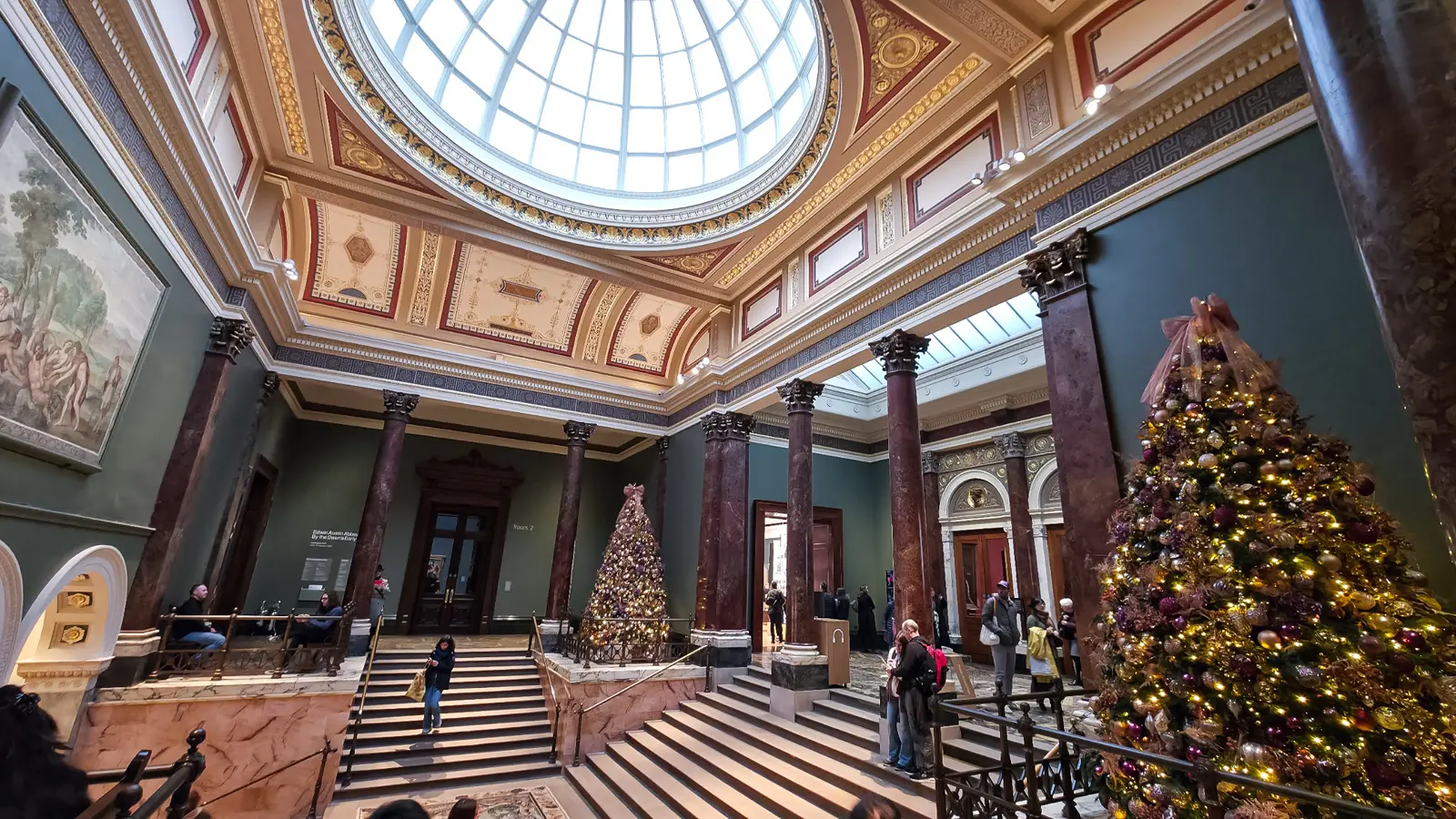
The Sunflowers is the painting everyone comes for, and the crowd in front of it proved the point. I waited my turn, behind a row of raised phones, to reach the front. It is smaller than the reproductions suggest and far more alive up close, the petals built up in thick ridges of paint that stand off the canvas and catch the light.
Van Gogh painted it in Arles in August 1888, in a burst of hope. Gauguin had agreed to come and stay at the Yellow House, and Van Gogh wanted the walls covered in sunflowers to welcome him. He dreamed of a whole series, as many as a dozen panels, the effect of the room “a symphony in blue and yellow”, and he hung the best of them in the little room his guest would use. He was proud enough of this one to sign it, “Vincent”, in blue on the belly of the vase. The optimism did not survive the winter. Within a couple of months the two men had fallen out badly and Gauguin had gone, but the flowers still carry the warmth of the autumn they were painted in.
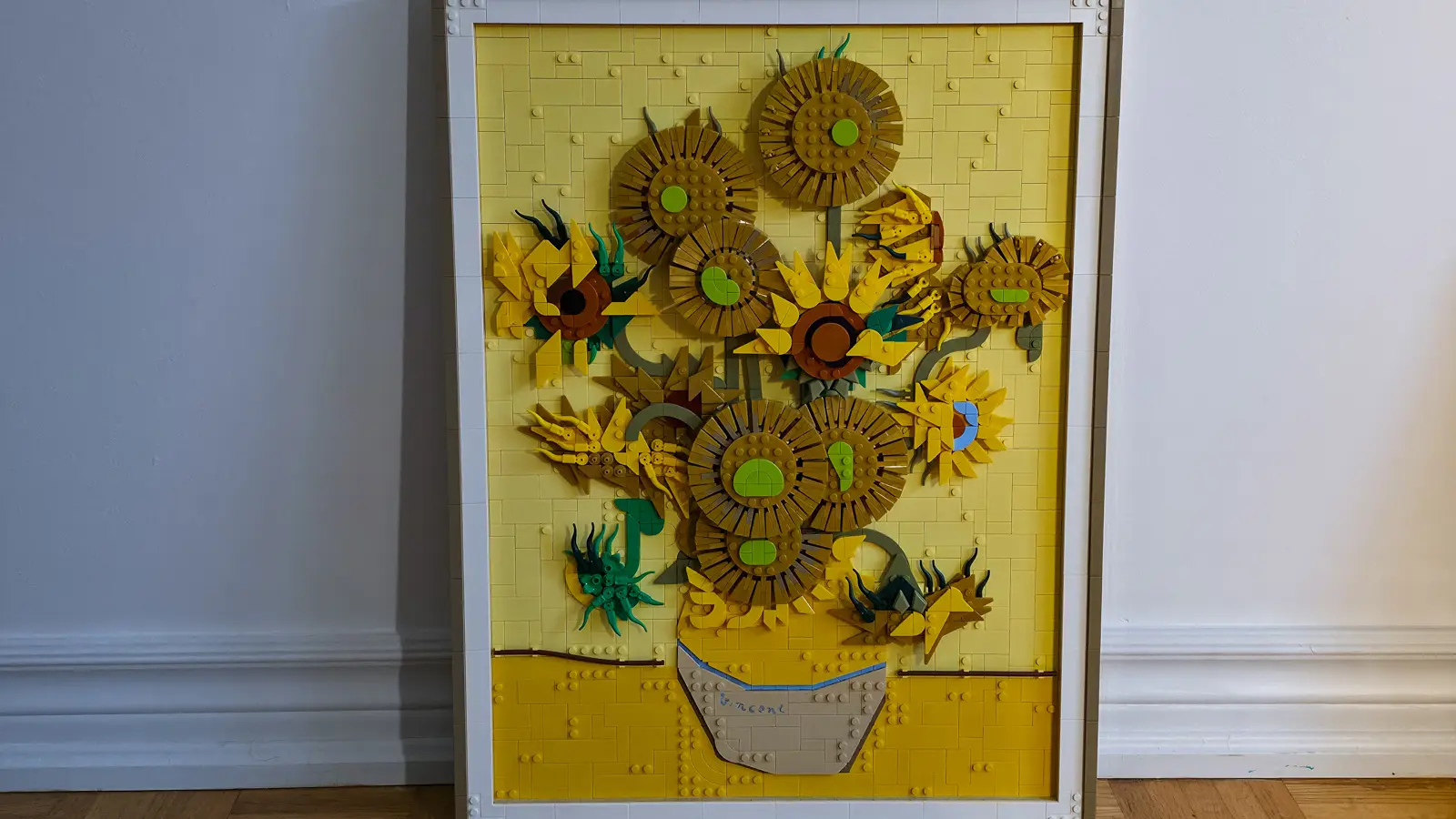
It is also the painting I know best, because a LEGO version of it has been leaning against my wall at home for months.
There is one catch worth knowing for anyone planning a visit around it. The Sunflowers is not always in London. At the time of writing it is away on loan to the Philadelphia Museum of Art, so it is worth checking what is actually on the wall before making a special trip.
Two Crabs
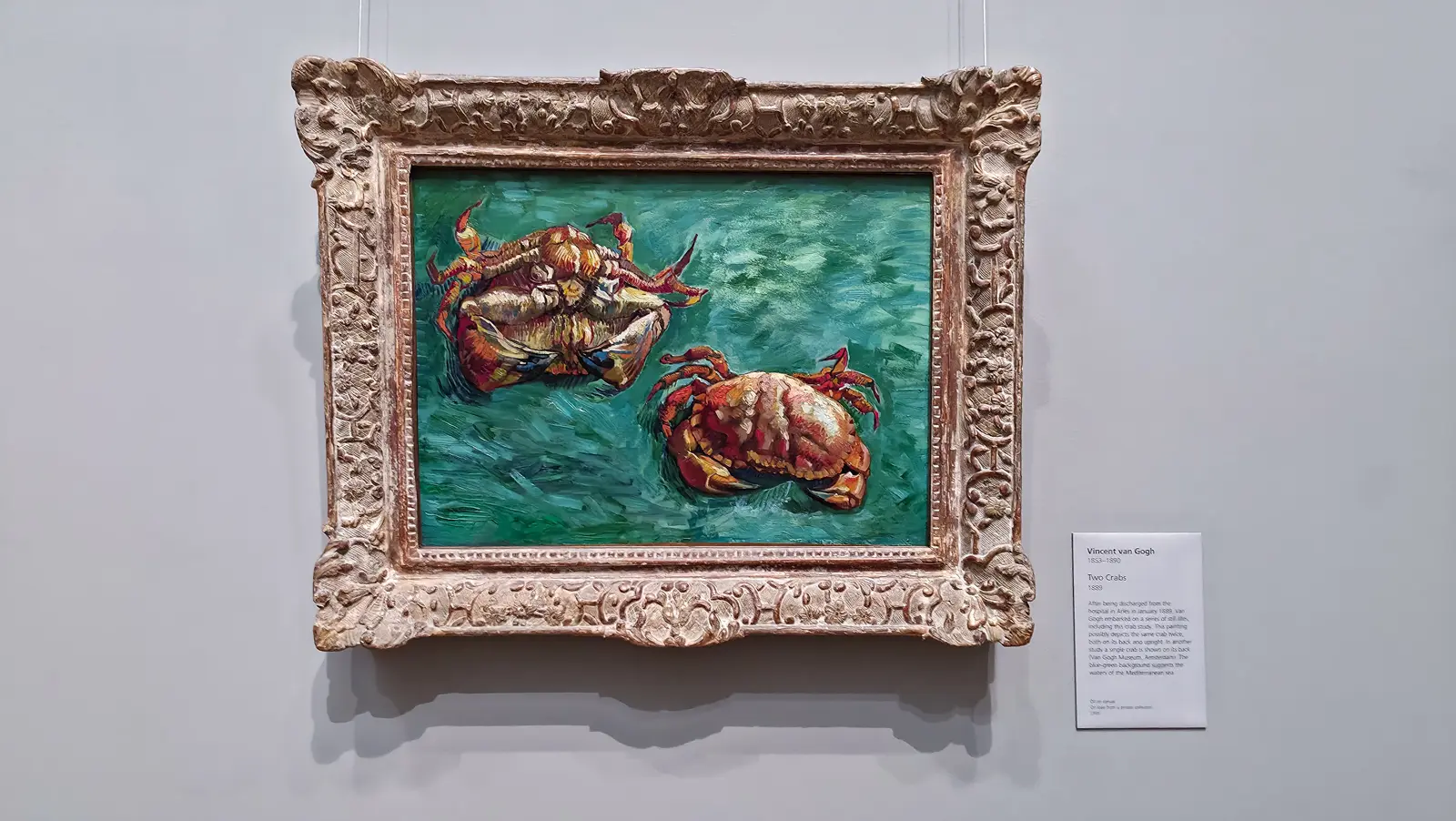
The real surprise of the room was two crabs. I had no idea Van Gogh ever painted crabs, and there they were, one flipped on its back with its pale underside and legs in the air, the other upright, both set against a churning green ground. It held me longer than almost anything else in the room.
He painted the study in the first weeks of 1889, back in Arles, just after a spell in hospital. That was the winter he had cut off part of his ear, in the crisis that ended the Gauguin experiment, and coming out the other side he wrote to his brother Theo that he would ease himself back into work with a still life or two. The crabs were among the first things he made.
The title is a little misleading. The two are near-identical, and a companion painting of a single crab on its back hangs in the Van Gogh Museum in Amsterdam, clearly of a piece with this one. There is even a small mystery about the date: the National Gallery places this canvas in Arles in 1889, while the Amsterdam museum dates its version to Paris two years earlier, and the specialists have not fully settled it. What is not in doubt is the debt to the Japanese prints Van Gogh collected obsessively. He had admired a crab print by Hokusai, and the flat colour and springing black outlines here owe a great deal to it, with a nod as well to the animal studies of old European masters like Dürer.
Some people read a mood into the upturned crab, helpless on its back so soon after his breakdown. It is a tempting line, though Van Gogh left no such note himself, and it is easy to load his work with more meaning than he ever intended.
Landscape with Ploughman
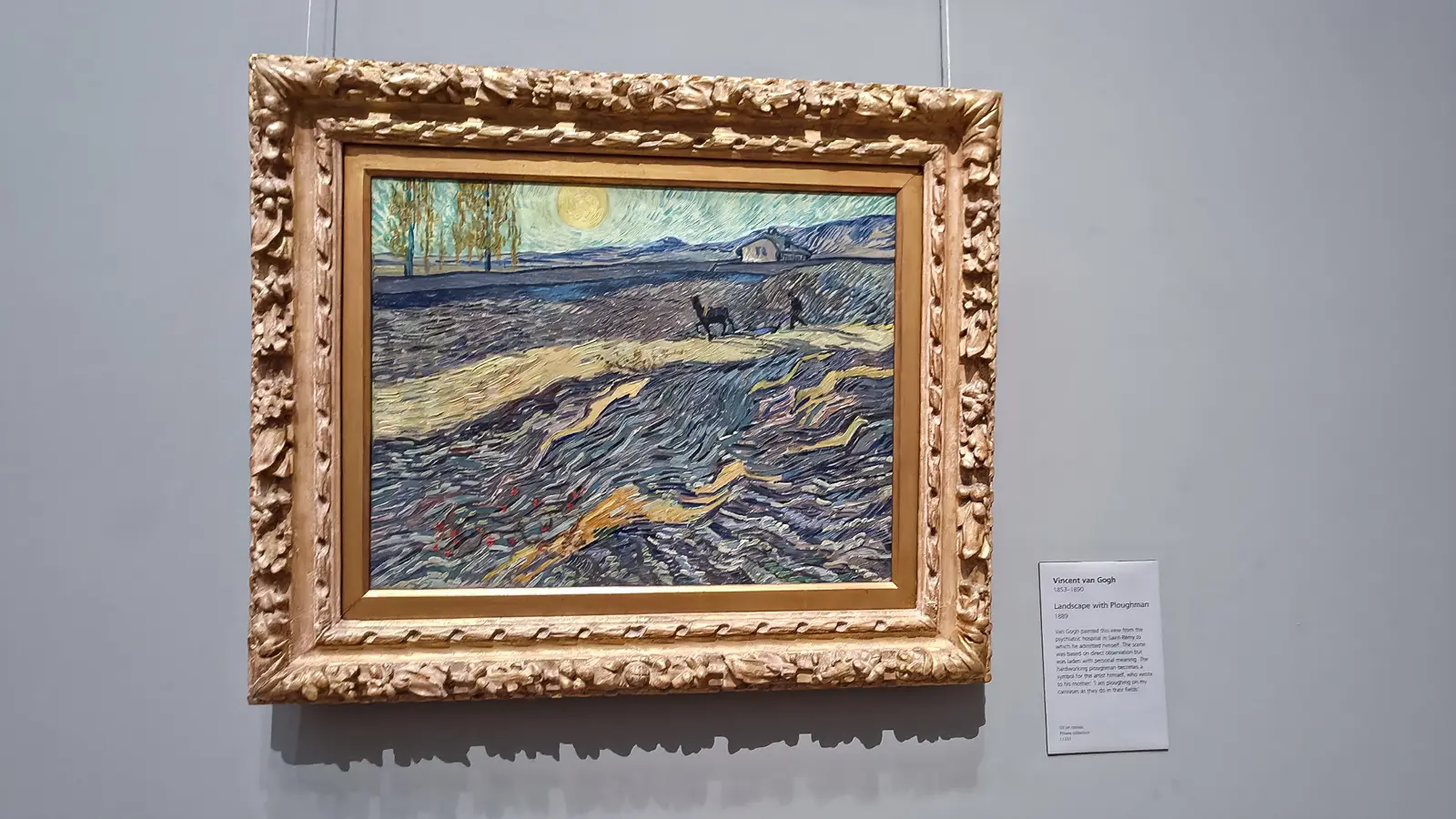
A few steps along, the mood changes completely. Landscape with Ploughman is a small, dense field scene from Saint-Rémy, in Provence, where Van Gogh spent the year after Arles. In May 1889, worn down by his breakdowns, he had checked himself into the psychiatric hospital there of his own accord. This is the view from his window: a farmer and horse turning dark furrows at dawn, a house and pale hills beyond, the whole field ridged with the same restless strokes as the sky above it.
He saw himself in the labourer. That autumn he wrote to his mother that he was “ploughing on my canvases as they do in their fields”, and the hardworking figure bent to the soil reads plainly as a portrait of the painter at his own easel. Fields and farm workers run all through his late work, but here the connection is unusually direct, a man tied to the turning of the seasons, making something out of hard ground.
Van Gogh’s Chair
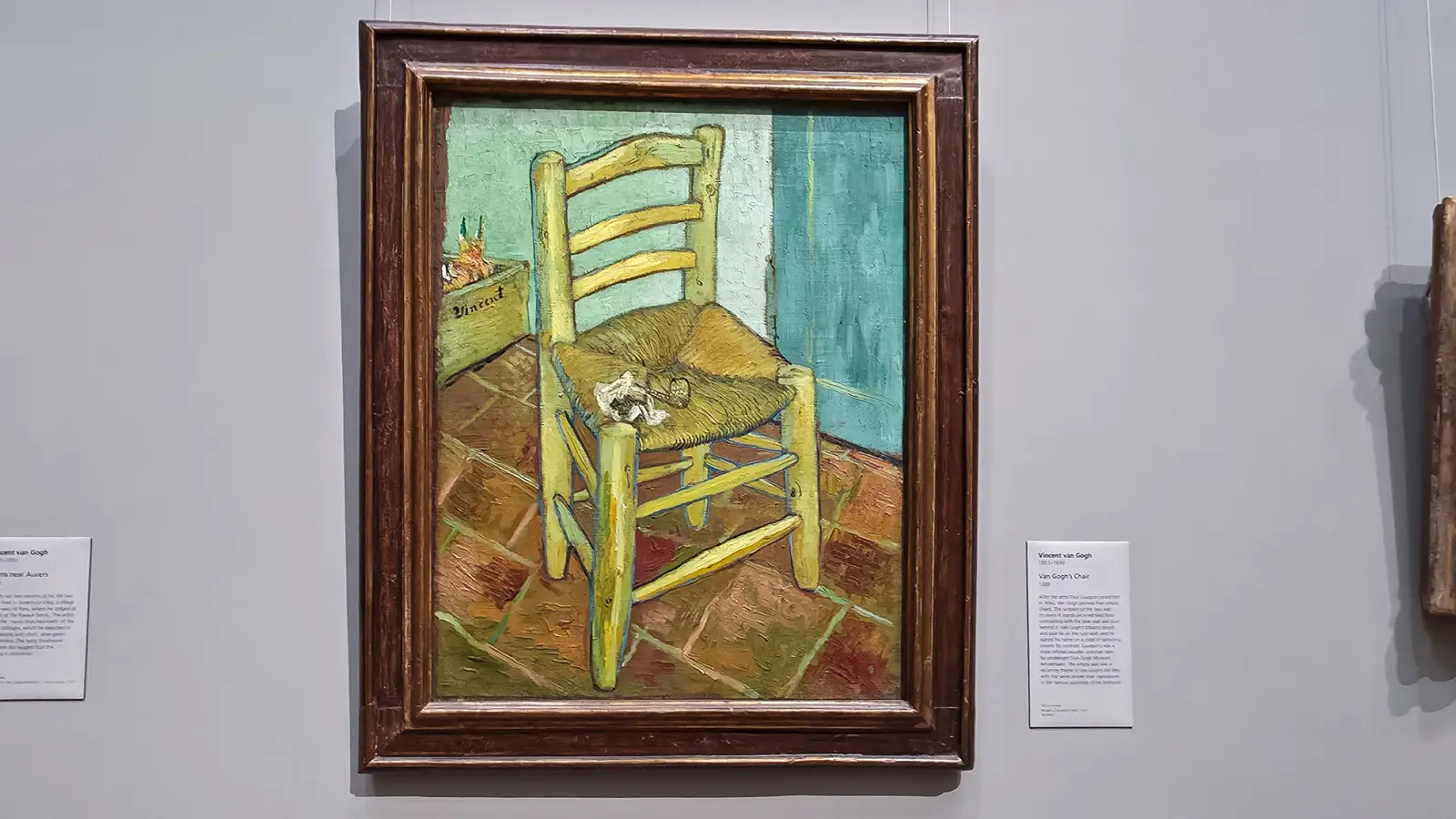
Van Gogh’s Chair is one of only two paintings in this group the Gallery owns rather than borrows, and the pairing is a neat one: it and the Sunflowers were the first two Van Goghs the National Gallery ever bought, acquired together in 1924. The other three here are all loans. The Chair is also the quietest of the five, and in some ways the saddest: a single empty chair. It is plain wood painted yellow, with a rush seat and slightly crooked legs, standing on red floor tiles against a blue-green wall. On the seat sit Van Gogh’s pipe and a twist of tobacco. Behind it, a low box of sprouting onions carries his signature, “Vincent”.
He painted it in late 1888, in the weeks he was sharing the Yellow House with Gauguin, and it was one of a pair. Alongside his own humble chair he painted Gauguin’s: a grander, curved armchair, set not in daylight but at night, lit by candle and gaslight, with two novels on the seat. The two were meant to hang together as stand-ins for the two men, the simple beside the ornate, the plain-living northerner beside the worldly Parisian. Van Gogh even painted his chair on a length of the coarse canvas Gauguin had brought south with him.
The empty seat was an image he came back to; the same rush-seated chair turns up in his famous paintings of his bedroom in Arles. The pair did not stay together, though. Gauguin’s chair passed down through the family and eventually reached the Van Gogh Museum in Amsterdam, while Van Gogh’s chair found its way to London. So two chairs, painted side by side in one small house, now sit in different countries.
Farms near Auvers
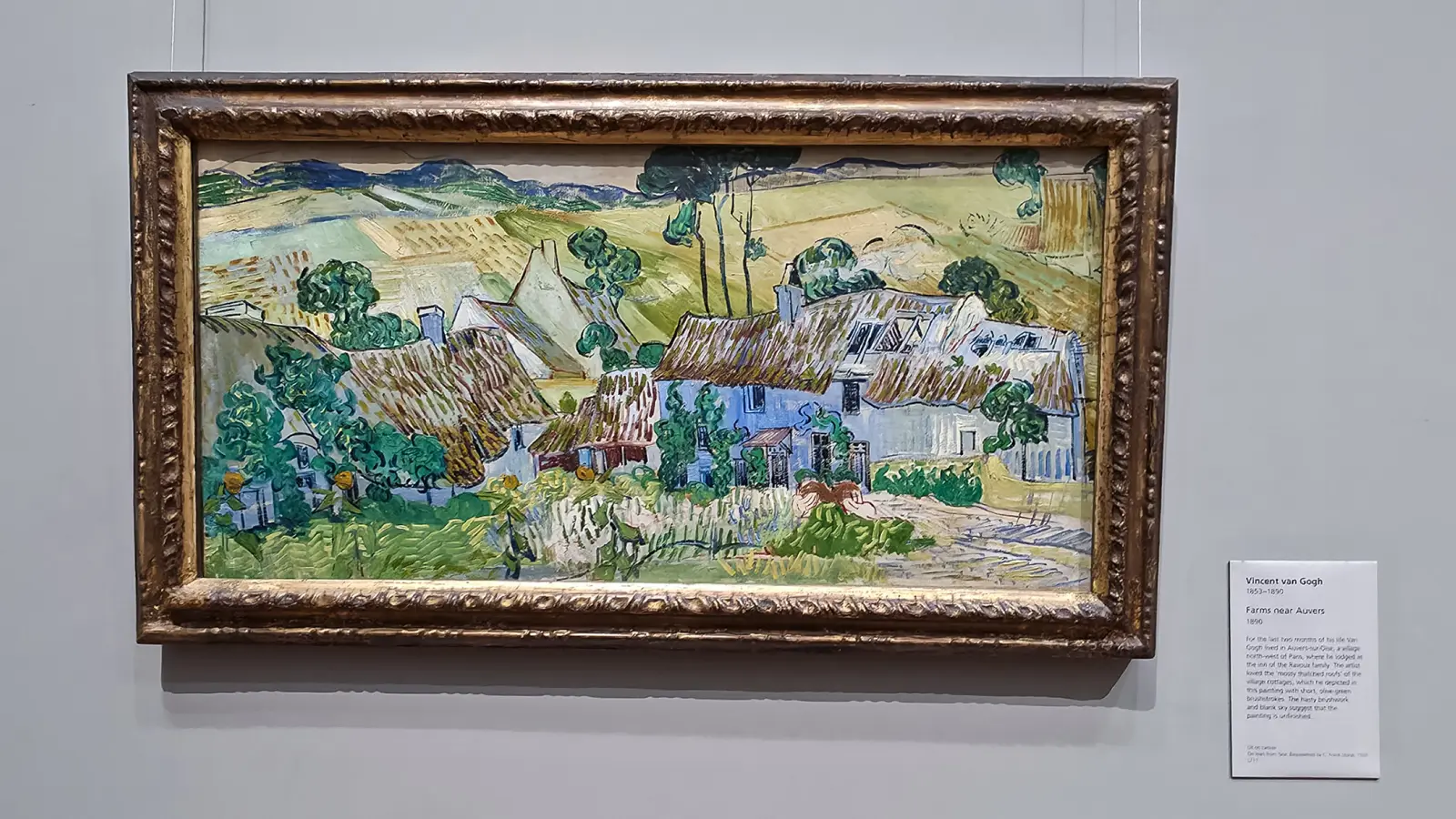
The last of the five is also the last chapter of his life. By the summer of 1890 Van Gogh had left the south altogether and settled at Auvers-sur-Oise, a village just north of Paris, lodging in a small room above the local inn. He had two months left. Farms near Auvers is a view of the village edge: a huddle of old cottages with steep thatched and tiled roofs, backed by rising green fields, everything built up in short, hurried, olive-and-blue strokes.
At the top of the canvas there are bare, unpainted patches of sky. The picture was very likely never finished, and that, with the speed of the brushwork, places it right at the end. It is often listed among the very last things Van Gogh painted before his death in July 1890. After the crowds and the heat of the Sunflowers, it is a subdued and rather moving note to close on.
Bubbly Tips
- Check what is actually on show before a special trip. Three of the five Van Goghs here are private loans, and the Sunflowers itself travels. At the time of writing it is away in Philadelphia, so look at the National Gallery website before you build your day around one painting.
- Entry is free. The National Gallery does not charge admission. You can walk straight in, though a free timed ticket booked online can save queueing at the busiest times.
- Go early or late for the Sunflowers. The Van Gogh room is one of the busiest in the building. First thing in the morning, or the last hour before closing, gives you the best shot at the front of the crowd.
- Give the quieter four their due. Everyone stops at the Sunflowers, but Two Crabs, Landscape with Ploughman, Van Gogh’s Chair and Farms near Auvers sit in the same part of the Gallery and often have breathing room. They are worth as much time.
- Look for the signatures. Van Gogh signed the Sunflowers vase and the onion box in Van Gogh’s Chair, both just “Vincent”. Spotting them is half the fun.
- Pair it with Amsterdam if you can. Several of the “other halves” live in the Van Gogh Museum: Gauguin’s chair, a single crab on its back, and a repetition of the Sunflowers. Seeing London first makes Amsterdam richer.
- Photography is allowed, but mind the glare. Non-flash photos are fine in the permanent collection. The paintings catch the light, so shoot at a slight angle to cut the reflections.
- Christmas is pretty but packed. In December the domed halls with their trees are lovely, but the crowds are heavier. Weekday mornings are the calmer window.
Final Thoughts
Five paintings is not many, and yet they hold a whole life: the hopeful Sunflowers painted for a friend’s arrival, the crabs made to coax himself back to work after a breakdown, the ploughman he read as a portrait of himself, the empty chair standing in for the man, and the unfinished cottages of his final weeks. I came for one painting and left having met the artist across two of his hardest years, which is a rare thing to get from a single room.
And I am not done with him. The Van Gogh Museum in Amsterdam is next, where several of these paintings have their other halves waiting: Gauguin’s chair, a second crab, a twin set of sunflowers. Seeing the London pictures first has only made me more impatient for it. Until then, I have my own small version leaning against the wall at home, sunflowers in brick, signed Vincent.
Until next time!

🌟 Everything You Need to Plan Your Dream Trip in 2026
- 🌟 Luxury Hotels - Find premium stays with Booking.com & Hotels.com
- 🏡 Vacation Rentals - Discover unique properties on VRBO
- 🏞️ Guided Tours - Explore with Viator or GetYourGuide
- 🎫 Attraction Tickets - Skip the lines with Tiqets
- 🚢 Ocean Cruises - Set sail with Cruise Direct
- 📱 International SIMs - Stay connected with Saily
- 🚗 Car Rentals - Budget-friendly options from Discover Cars
- 🌐 Secure VPNs - Browse safely with NordVPN
- 💶 Currency Exchange - Best rates with Wise
- 🗣️ Learn Languages - Master the local language with Babbel and Rosetta Stone