
The word post-Impressionism was invented in London, by an Englishman, about a group of French painters who never once used it themselves.
In November 1910 the critic Roger Fry took an open slot at the Grafton Galleries in Mayfair and put on a show called Manet and the Post-Impressionists. He needed a label for a set of painters who had nothing in common except that they came after Monet, and he admitted from the start that it described no single style. It was, essentially, a brush-off. The exhibition scandalised London and drew more than 25,000 people through the door, and the shrug stuck. It is still the term we use.
Fry hung 21 Cézannes, 22 Van Goghs and 46 Gauguins. He left Seurat out, and later admitted he had been wrong to. A century on, all four hang about a mile from the Grafton Galleries, in the rooms at the top of the National Gallery, and they are free to walk in and see. What follows is what I found there on a December afternoon.
The Post-Impressionists at a Glance
🏷️ The word · Coined in London by Roger Fry for his 1910 Grafton Galleries show, a label he admitted described no single style.
🖼️ The show · Fry hung 21 Cézannes, 22 Van Goghs and 46 Gauguins, scandalised the press, and drew more than 25,000 visitors.
🪨 Cézanne · Quarries, hillsides and the great Bathers, worked on for over a decade, with not a drop of water in it.
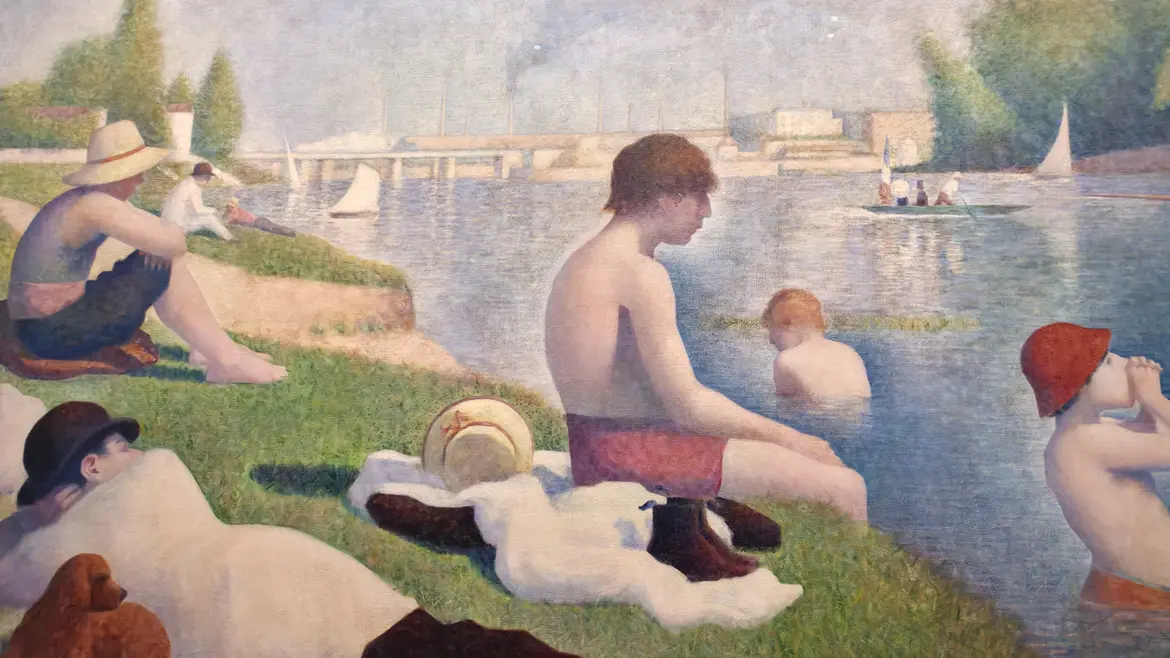
🔴 Seurat · Bathers at Asnières came before the dots; the clearest pointillist patch is the red hat, added afterwards.
🌻 Van Gogh · The Sunflowers were painted to welcome Gauguin to Arles, whose own still life now hangs a few steps away.
🆓 The cost · All of it hangs in the permanent collection, free, at the top of the National Gallery.
Cézanne, the touchstone
Fry built the whole idea around Cézanne. He had seen two of his paintings in London in 1906 and reorganised his thinking around them, and for Fry and his Bloomsbury circle, Cézanne became the measure of everything.
Cézanne himself had painted alongside the Impressionists and exhibited with them, then walked away. His ambition, as he put it, was to make of Impressionism something solid and durable, like the art of the museums. He spent the rest of his life in Provence trying to build landscapes rather than catch them.
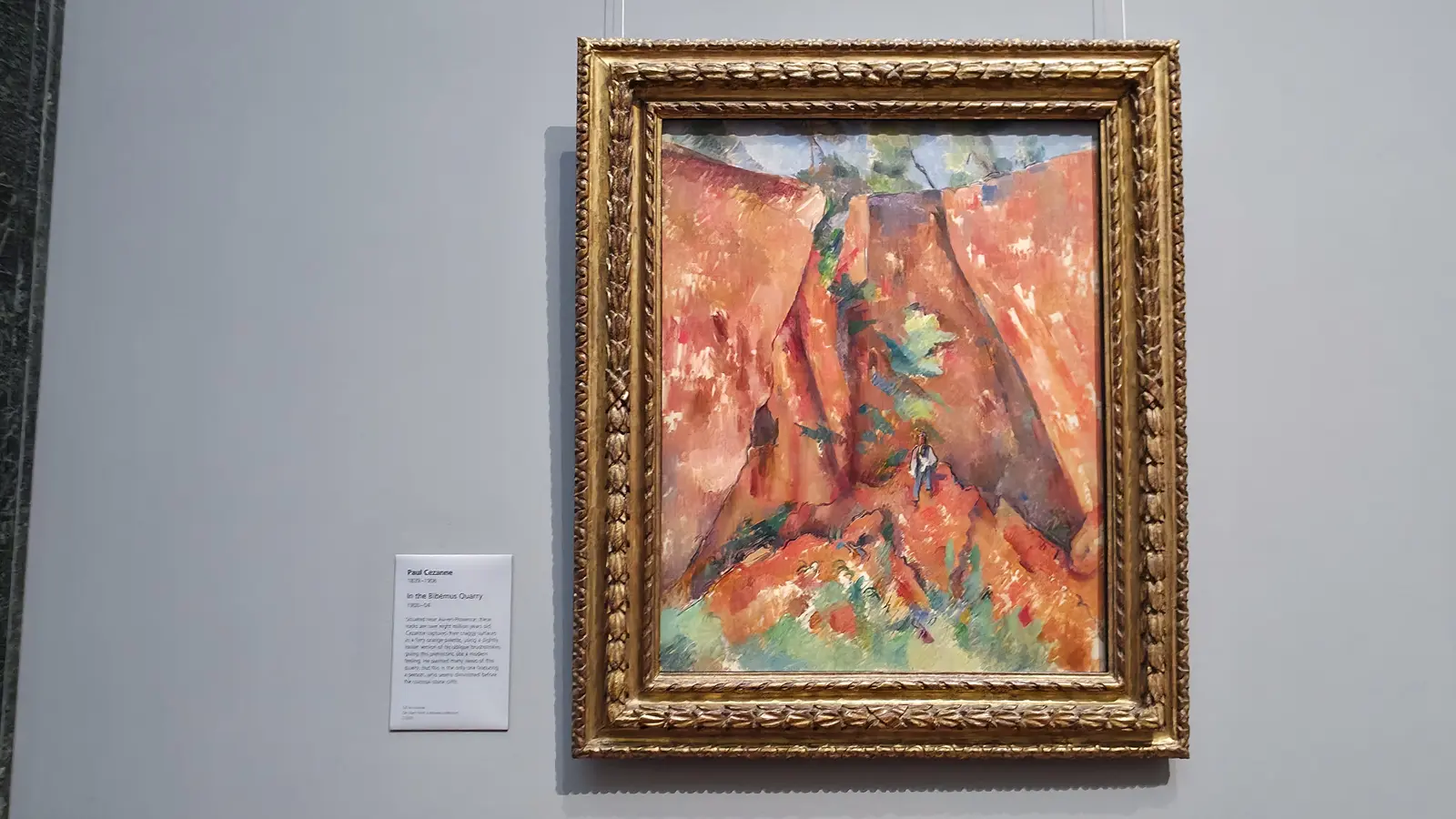
The rock in that painting is between eight and ten million years old, and Cézanne knew it. He once wrote to a friend that in order to paint a landscape well, he first needed to discover its geological foundations. Nothing about that sentence sounds like Monet.
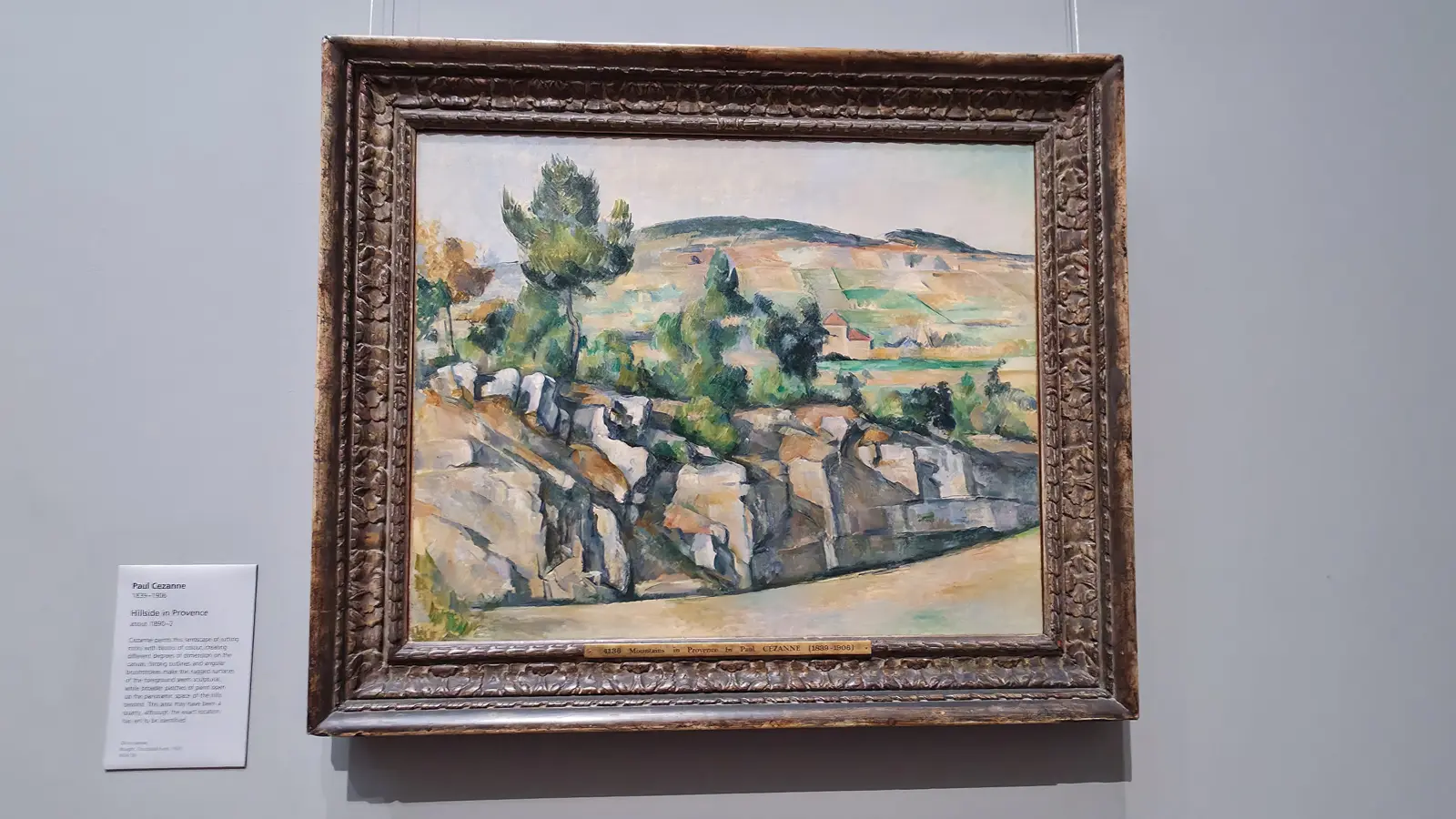
The same instinct runs through the Provence hillside hanging near it, all angular strata and jutting planes.
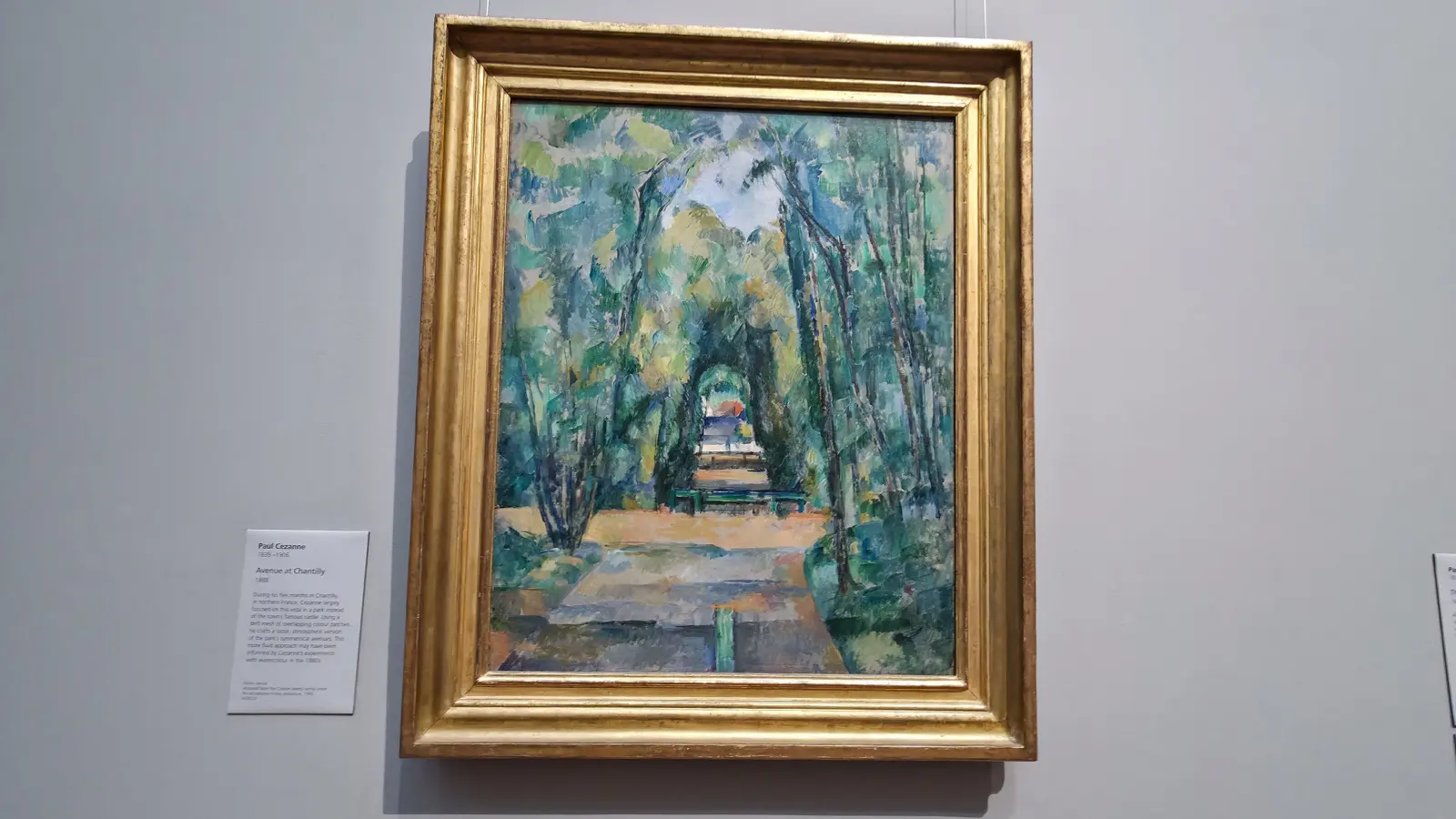
He did leave Provence occasionally. In the summer of 1888 he spent five months at Chantilly, north of Paris, and painted the park rather than the famous château.
And then there are the bathers. Around 200 of Cézanne’s works show nude figures in a landscape, and in the last decade of his life he made three enormous ones. This is the National Gallery’s.
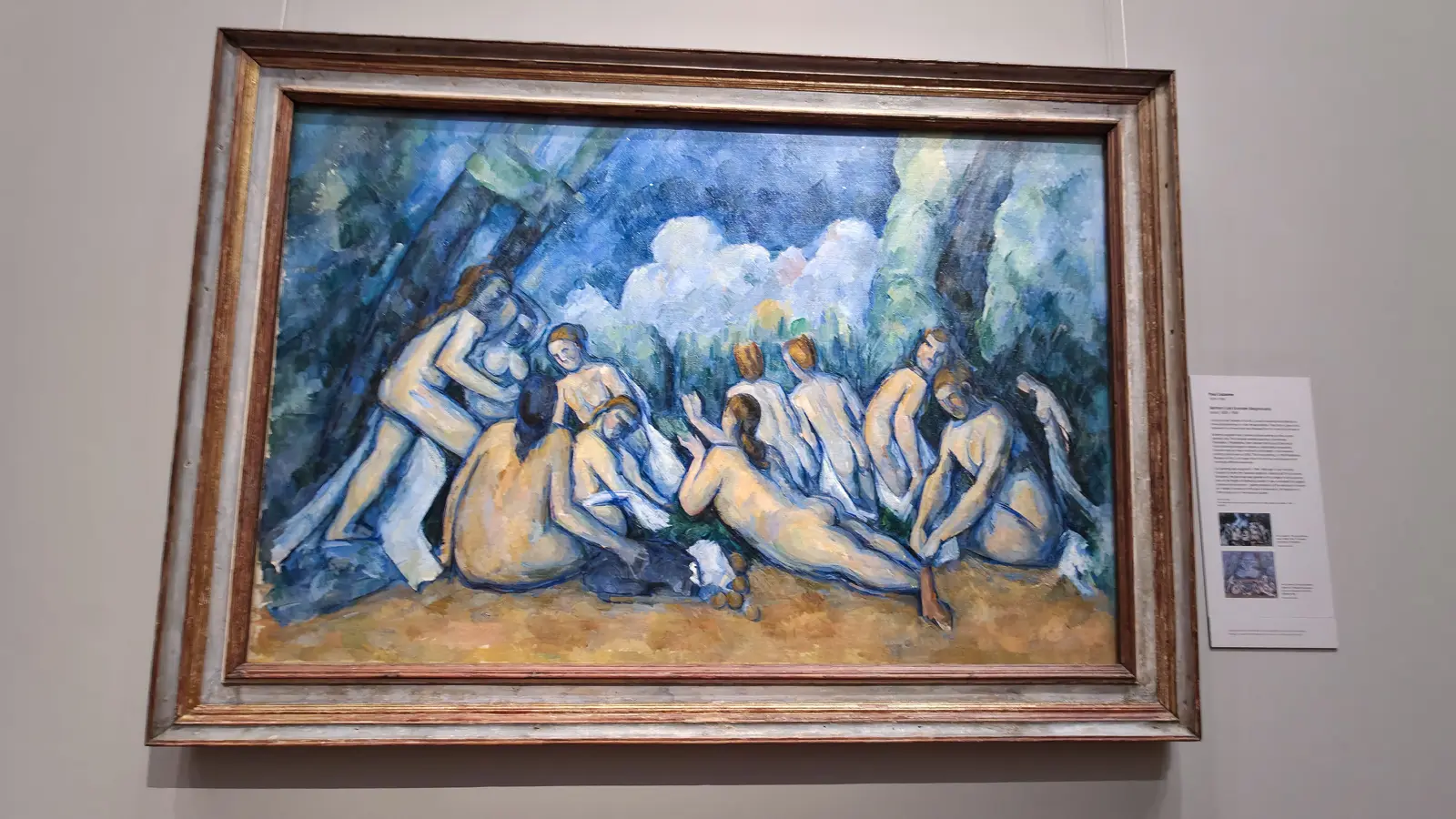
Nobody is bathing. There is no water in the picture at all.
Seurat, and the dots that came later
Seurat is the one Fry forgot, and he is also the one most people think they can summarise in a word: dots. It is worth standing in front of Bathers at Asnières to see how wrong that is.
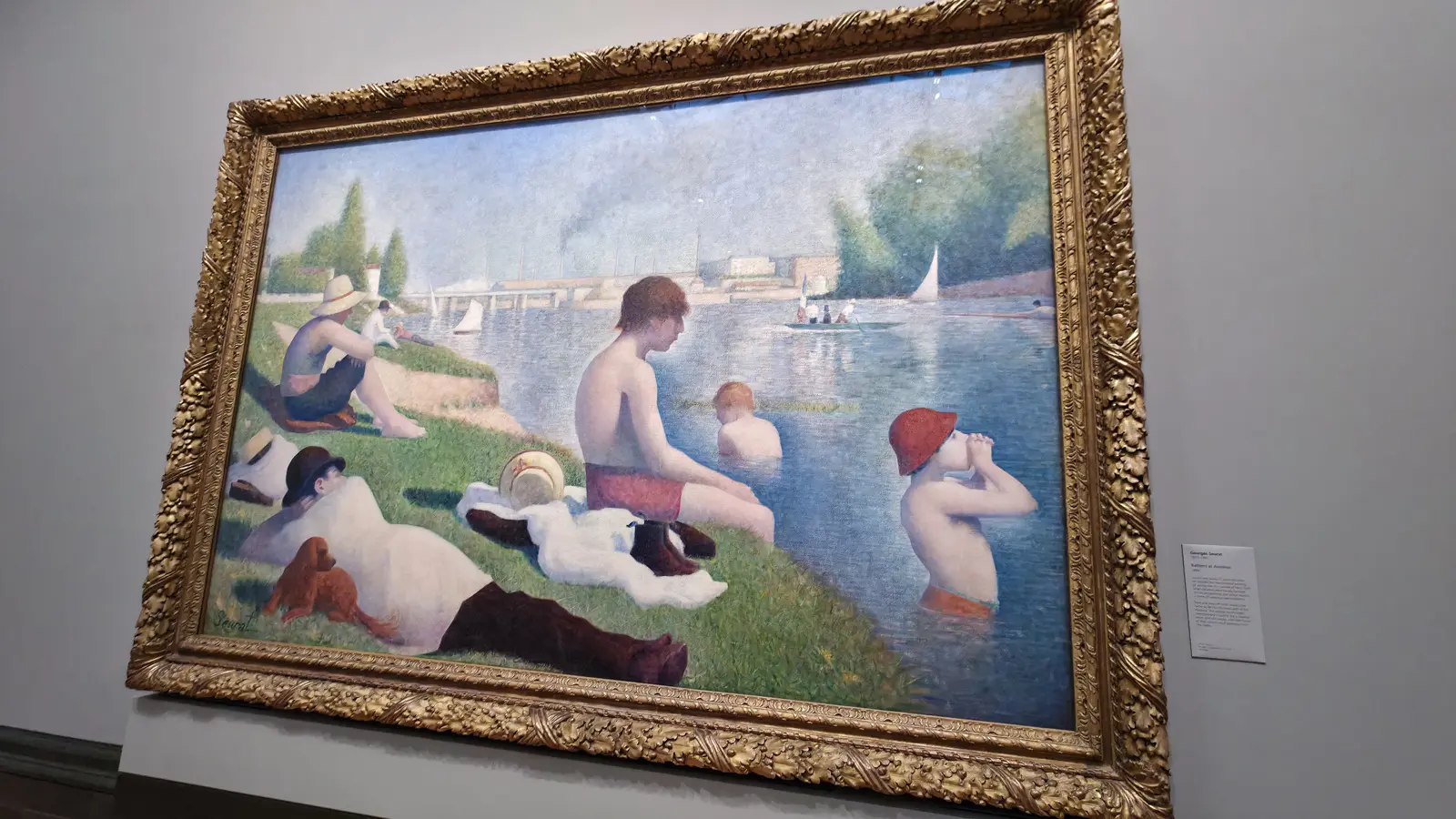
He painted it in 1884, before he turned twenty-five, and it was his first major work. He sized it for the Salon and the Salon rejected it. It was shown instead at the first exhibition of the breakaway Indépendants, where it was hung in the beer hall.
The dots are barely there. Seurat had not yet fully developed pointillism when he began, and touches of pure separated colour appear only in patches, most visibly in the red hat of the boy calling out across the water. The rest is built from long crosshatched strokes. The technique everyone remembers arrived afterwards.
Gauguin, and what the label says
Gauguin was a stockbroker until he was thirty-five. He did well enough in the 1880s to collect paintings, and he bought six Cézannes. His favourite, a still life of fruit in a dish, he called an exceptional pearl, the apple of his eye. When he left his wife and children in Copenhagen he took it with him, and he refused to sell it until he was destitute at the end of his life.
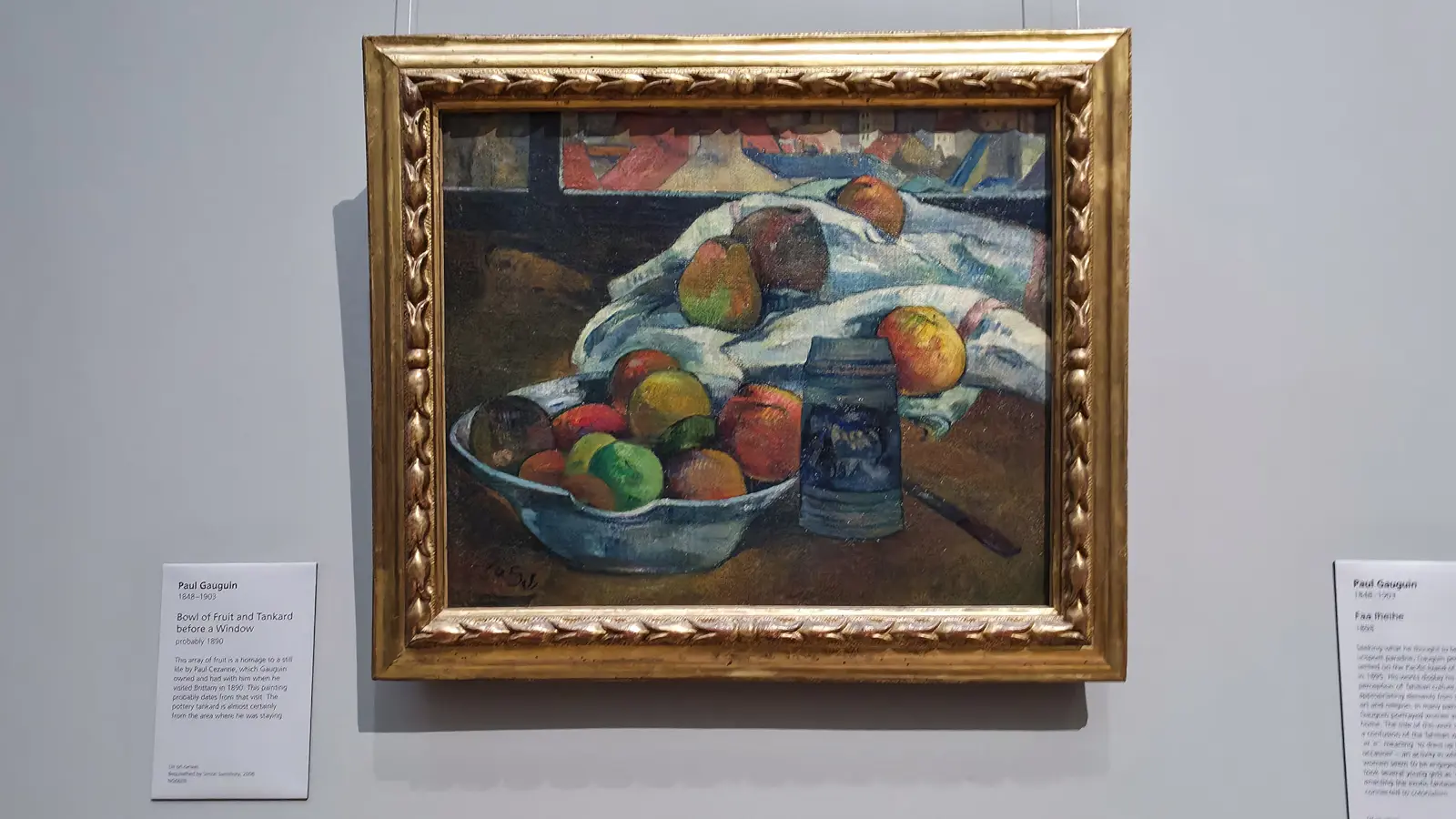
Then he went to the Pacific. He sailed for Tahiti in 1891, returned to Paris, went back in 1895, moved on to the Marquesas, and died there in 1903. The paintings from those years are the ones he is famous for, and the gallery hangs one of them, Faa Iheihe, beside this still life.
They are beautiful, and the circumstances of their making are not. The National Gallery does not skirt it. Its own wall label beside Faa Iheihe states plainly that Gauguin took several young girls as “wives”, exploiting the fantasies that came with colonisation. The youngest were around thirteen. The gallery says this on the wall, next to the picture, and a reader standing in that room deserves to know it too.
What to do with that is a question the painting does not answer, and neither will I. But looking at Faa Iheihe without knowing it is a kind of pretending, and looking at it while knowing it is the only honest way to look.
Van Gogh, briefly
Van Gogh gets a post of his own here soon, so this is a nod rather than a chapter. Two of his paintings hang in these rooms, and together they bracket the last two years of his life. One comes from the hopeful start of it. The other comes from the very end.
The first is the Sunflowers.
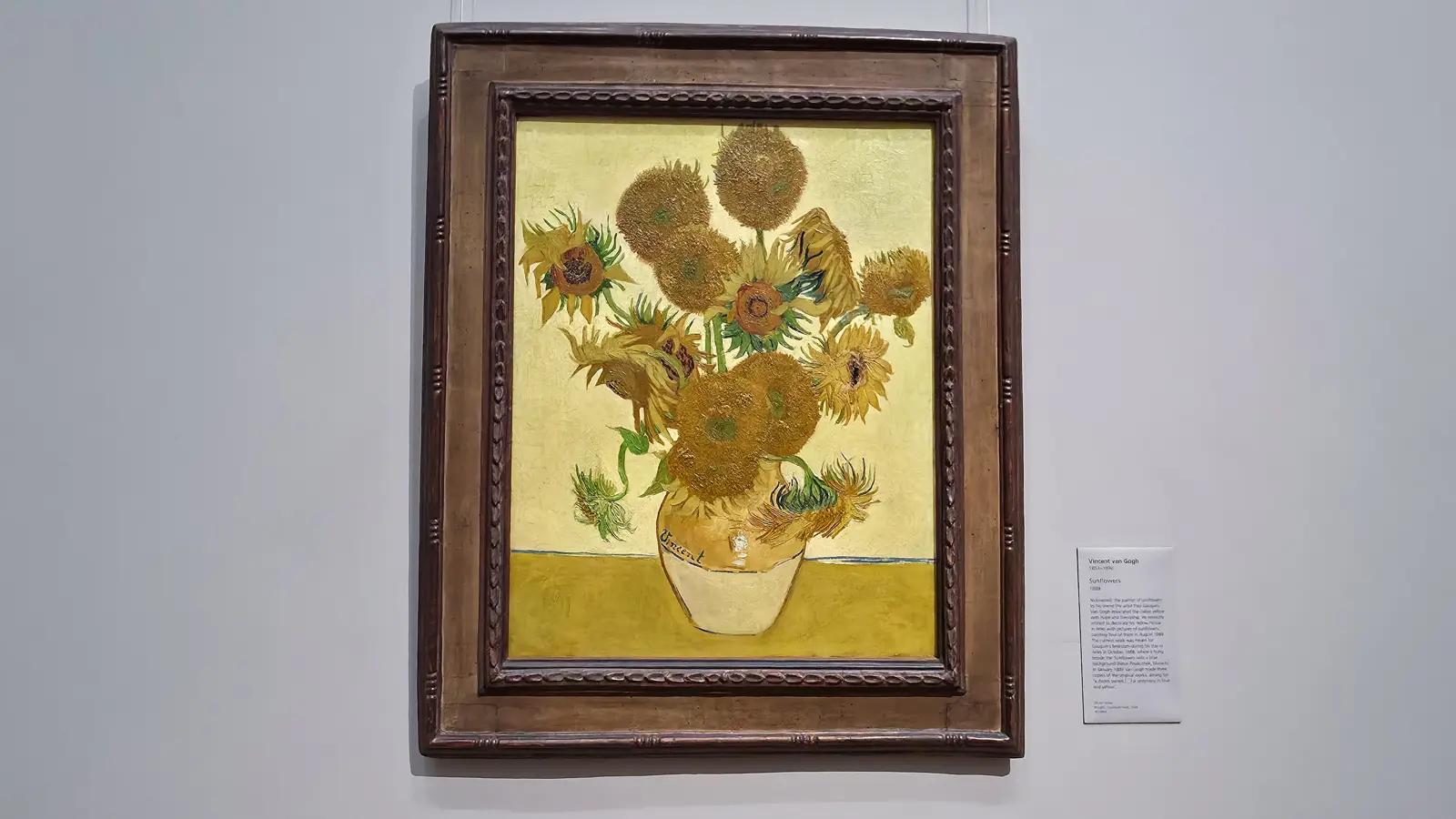
He painted them to greet Paul Gauguin, who was coming to stay at the Yellow House in Arles. Van Gogh hung this canvas, with a second version, in the room his guest would use. He had hoped to fill the walls with a dozen of them, a symphony in blue and yellow. There is a quiet edge to that now, because Gauguin has a still life of his own in the same room: the sunflowers were painted to welcome the very man whose work now hangs a few steps away. The two lasted about nine weeks together before their friendship collapsed, at the end of December 1888, in the crisis that cost Van Gogh part of his ear.
The other painting is from the very end. By the summer of 1890 Van Gogh had left the south and settled at Auvers-sur-Oise, a village north of Paris, lodging above the inn there. Farms near Auvers dates from those last weeks.
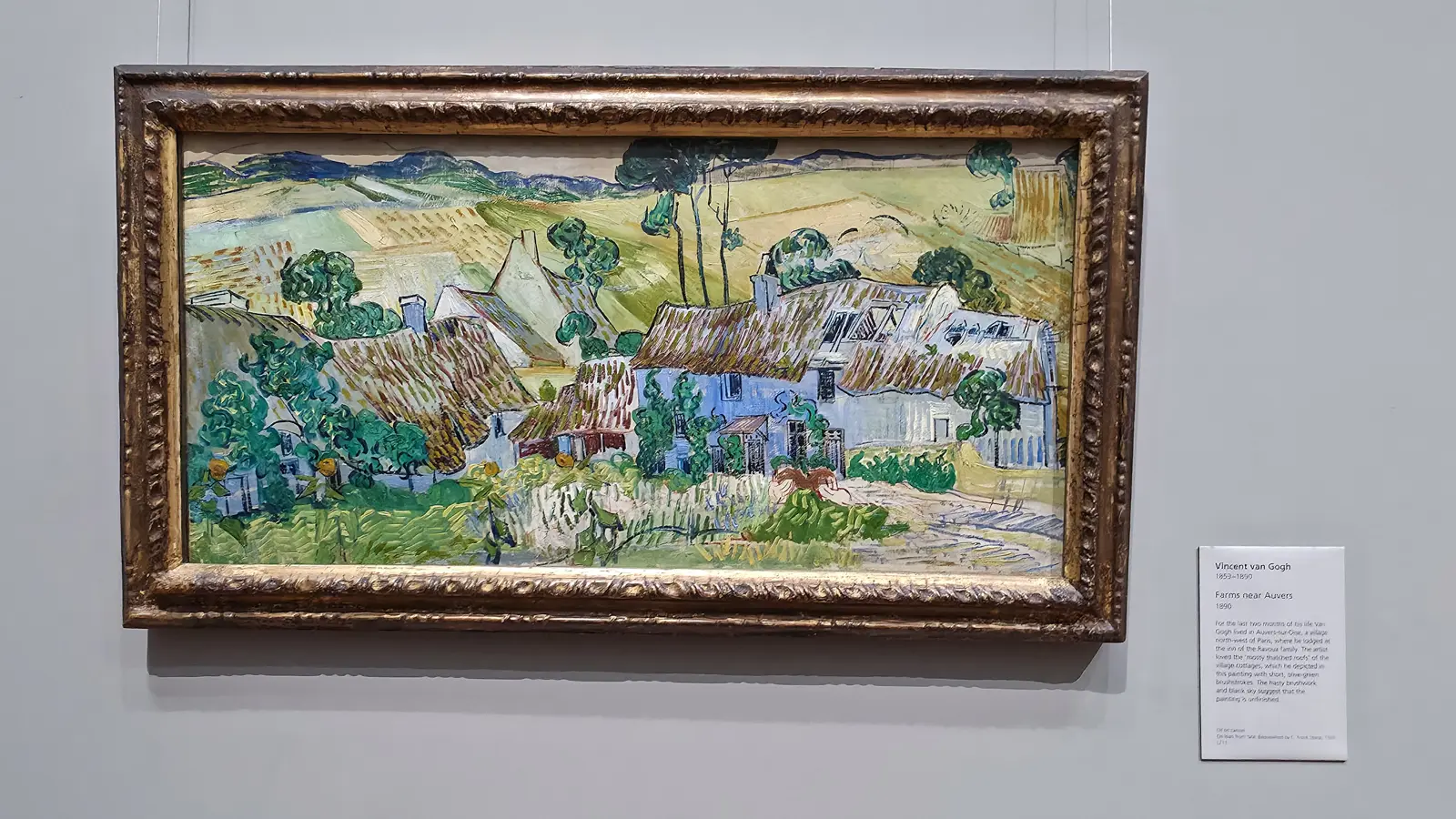
It appears unfinished. The sky is bare canvas in places and the brushwork is quick. Some scholars count it among the very last things he painted, perhaps the second to last, made only days before his death on 29 July 1890.
Bubbly Tips
- It costs nothing. The National Gallery has never charged admission, and the post-Impressionists hang in the permanent collection. Walk in from Trafalgar Square, no ticket required.
- Head straight upstairs and to the back. These rooms sit at the far end of Level 2, past the Renaissance galleries. Grab a floor plan at the door or ask a warden, or you will wander for twenty minutes.
- Expect a crowd at the Sunflowers. It is the picture most people come for, and there is usually a scrum. A weekday morning or the last hour before closing gives you room to stand back from it.
- Read the labels here, properly. The gallery has rewritten several of them to address Gauguin’s conduct in Tahiti directly. They are short, and they change what you are looking at.
- Get close to the Cézannes. The patches of bare canvas he left unpainted only show up from a foot away. Step back afterwards and watch the whole thing resolve into a hillside.
- Find the red hat in the Seurat. It is the clearest patch of pointillist dots in a painting that otherwise predates the technique. Bottom right, on the boy in the water.
- Photography is allowed. No flash, in the permanent collection. Rules differ for loans and paid exhibitions, so check the signs at the door of each room.
- Pair it with the Courtauld. A fifteen-minute walk east along the Strand, the Courtauld Gallery holds more Cézanne and Gauguin, and its collection includes the poster from Fry’s 1910 exhibition that started all of this.
- Allow an hour, not twenty minutes. These are five or six rooms of dense work. Rushing them is worse than skipping them.
Final Thoughts
The thing I keep turning over is how arbitrary the label is. Roger Fry needed a word in a hurry, chose one that means little more than “after”, and it has held for over a century. Cézanne, Seurat, Gauguin and Van Gogh had wildly different aims, disliked one another’s work at times, and would not have recognised themselves as a group.
But stand in those rooms and the connections are physical, not theoretical. Gauguin’s fruit bowl is a copy of a Cézanne he owned and would not sell. Van Gogh’s sunflowers were painted for the bedroom Gauguin was about to sleep in. Pissarro taught all of them and outlived half of them. Fry’s shrug of a word turns out to describe something real after all, and it happened here, a mile from where the paintings now hang.
Until next time!

🌟 Everything You Need to Plan Your Dream Trip in 2026
- 🌟 Luxury Hotels - Find premium stays with Booking.com & Hotels.com
- 🏡 Vacation Rentals - Discover unique properties on VRBO
- 🏞️ Guided Tours - Explore with Viator or GetYourGuide
- 🎫 Attraction Tickets - Skip the lines with Tiqets
- 🚢 Ocean Cruises - Set sail with Cruise Direct
- 📱 International SIMs - Stay connected with Saily
- 🚗 Car Rentals - Budget-friendly options from Discover Cars
- 🌐 Secure VPNs - Browse safely with NordVPN
- 💶 Currency Exchange - Best rates with Wise
- 🗣️ Learn Languages - Master the local language with Babbel and Rosetta Stone