
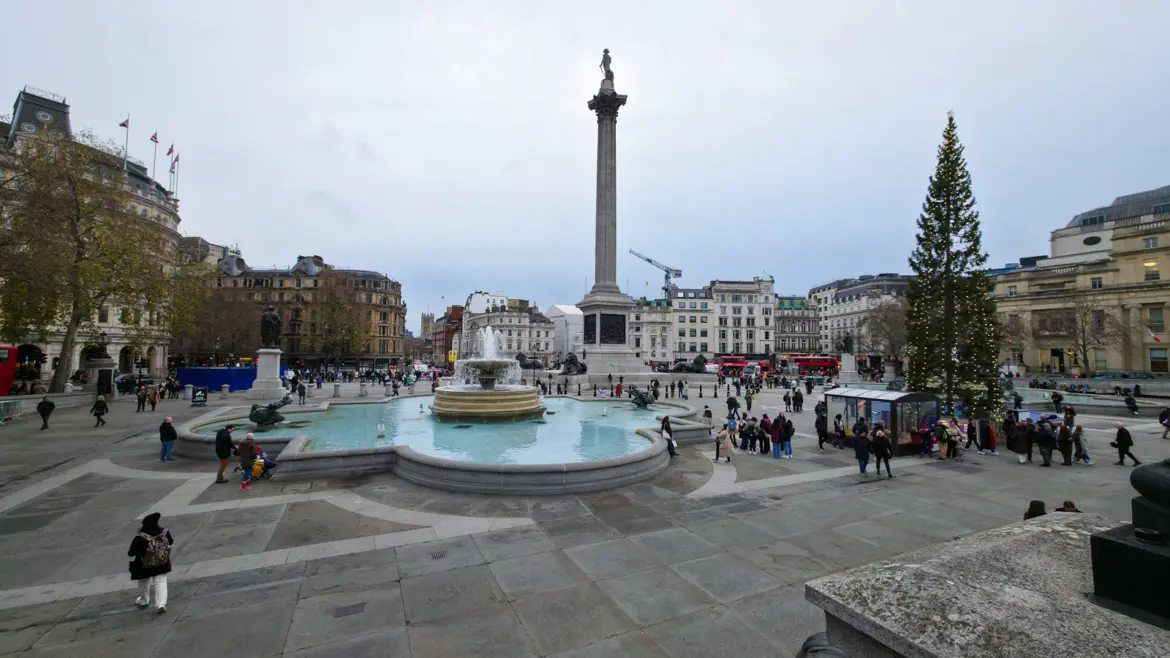
Trafalgar Square in December is a different place than Trafalgar Square in July. The Christmas tree is lit. The carol singers are gathered around its base. The lions at the foot of Nelson’s Column are holding their usual quiet court at all four corners. The light is fading by 4pm, the office workers are walking home through the square, and the tourists are everywhere, but the square doesn’t feel like a tourist trap. It feels like the centre of something.
London comes here when it has something to say or something to celebrate, and on a December afternoon in the warmth of the tree lights, the something being celebrated is just that the year is ending and the city is still here. I had visited Trafalgar Square before, in daylight, in summer, in passing. None of those visits prepared me for the square in December. The Norwegian Christmas tree changes the whole shape of the space. The cold makes the fountains glow differently. The Christmas market just up the road draws people in from the south, and the National Gallery‘s windows stay lit by mid-afternoon.
Trafalgar Square at a Glance
📍 Location · Westminster, central London. Bordered by the National Gallery (north), Whitehall (south), Cockspur Street/Pall Mall East (west), and the Strand (east). Nearest tube: Charing Cross (2 min) or Leicester Square (3 min).
🏛️ What it is · London’s main civic and ceremonial square, completed by Charles Barry in 1844 on the site of the old King’s Mews. Named after the 1805 naval Battle of Trafalgar at which Vice-Admiral Lord Nelson died. The square has been the nation’s gathering place for political demonstrations, royal celebrations, and public mourning ever since.
⚓ Nelson’s Column · 52 metres tall (about 169 feet). Built 1840–1843 by architect William Railton, with a 5.5-metre Craigleith-sandstone statue of Nelson by Edward Hodges Baily. The four bronze panels at the base, cast from captured French cannon, depict Cape St Vincent (1797), the Nile (1798), Copenhagen (1801), and Trafalgar (1805).
🦁 The lions · The four bronze recumbent lions guarding the column’s base were designed by the painter Sir Edwin Landseer and cast by Baron Carlo Marochetti in his Kensington studio. Unveiled on 31 January 1867 — twenty-four years after the column itself was finished.
⛲ The fountains · The two cusped quatrefoil basins date from Charles Barry’s original 1845 design. Sir Edwin Lutyens remodelled the central fountains in 1939; the bronze mermaid, triton, and dolphin groups by Sir Charles Wheeler and William McMillan were installed in 1948 as a joint memorial to Admirals Jellicoe (west fountain) and Beatty (east fountain), commanders of the Grand Fleet at the Battle of Jutland.
🪖 The Fourth Plinth · The empty plinth in the northwest corner was originally intended for an equestrian statue of King William IV; the money ran out. Since 1999 it has held a rotating contemporary art commission, currently Teresa Margolles’s Mil Veces un Instante through September 2026.
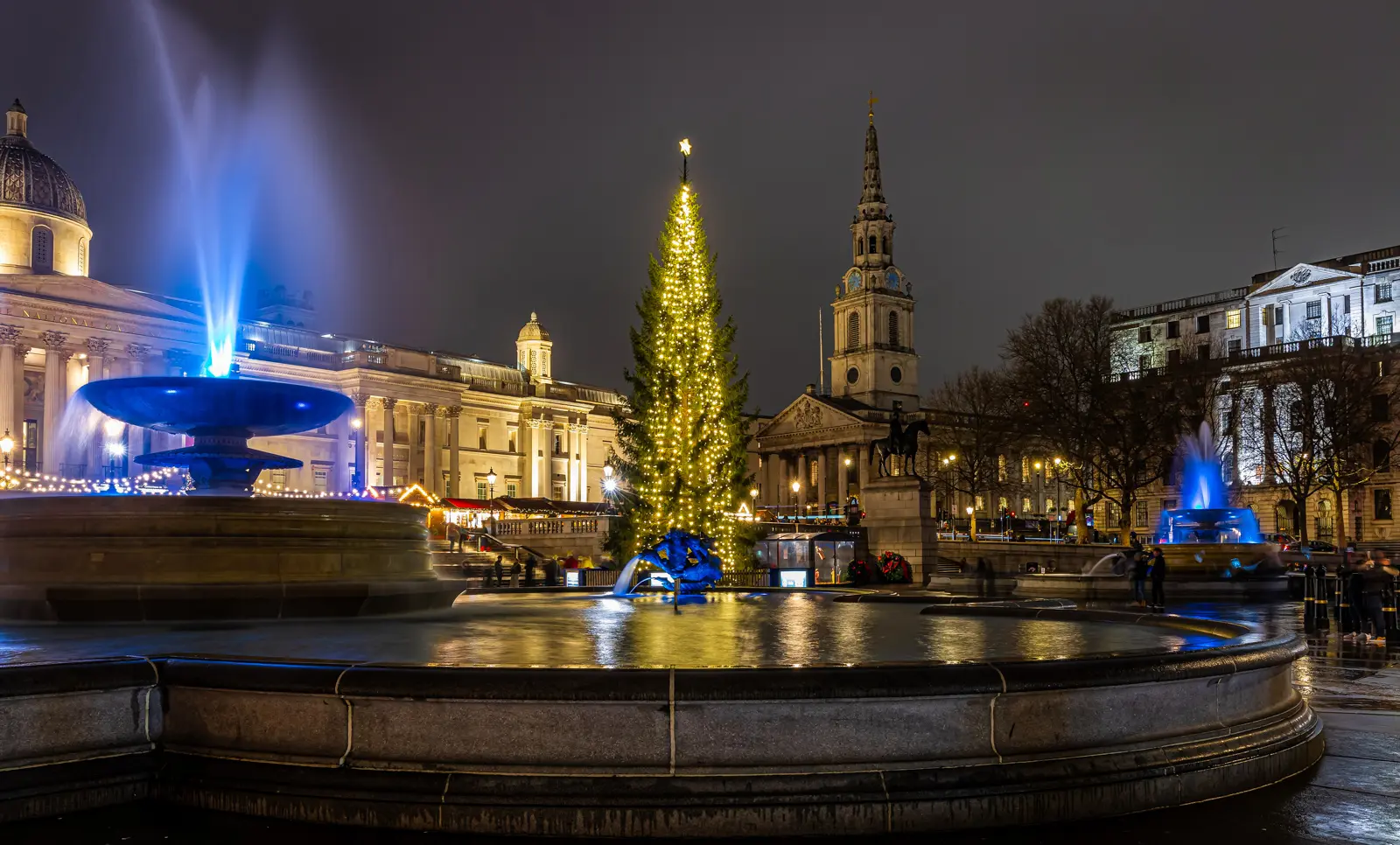
🎄 The Norwegian Christmas tree · Gifted to London by the City of Oslo every December since 1947, as thanks for British support during the Second World War. Always a Norway spruce, 50–60 years old, over 20 metres tall, decorated in vertical strings of warm white lights. Lighting ceremony on the first Thursday of December. Stays until Twelfth Night (6 January).
💡 Tip · Visit at dusk in December. The Christmas tree, the lit National Gallery façade, and the fountains all reach peak presence around 4–6 pm. Earlier in the day the square reads as a transit point; after dark it reads as a destination.
A Quick History of the Square
The land where Trafalgar Square sits was once the King’s Mews, the royal stables that served Whitehall Palace for nearly four centuries. In the 1820s the Prince Regent (later George IV) commissioned the architect John Nash to clear the area as part of his broader plan to remake central London. Nash died in 1835 with the work barely begun. Two more architects passed through before Charles Barry, the man who designed the Houses of Parliament, took over in 1840 and completed the square in 1844.
The naming was an afterthought of sorts. The original plan was to call it King William the Fourth’s Square, but a writer named George Ledwell Taylor suggested commemorating the 1805 naval victory off the coast of Spain that had killed Admiral Nelson and broken Napoleon‘s plans to invade Britain. The name stuck. The square that now defines central London was named for a battle fought 1,500 miles away, by a man who had been dead for nearly forty years when his column was finished.
The square was always meant to be more than decorative. Charles Barry designed it with two levels separated by a grand staircase, with the upper terrace serving the National Gallery and the lower square serving as a public gathering space. Some historians have suggested Barry added the two fountains specifically to reduce the available standing space for political demonstrations. If that was the intention, it failed spectacularly. Trafalgar Square has hosted nearly every major British political gathering of the past 180 years, from the 1848 Chartist demonstrations to the suffragette rallies to the V-J Day celebrations to the 2003 Iraq War march, when over one million people gathered here in a single afternoon. The square refuses to be just a square. It is where Britain comes when it has something to say.
Nelson’s Column
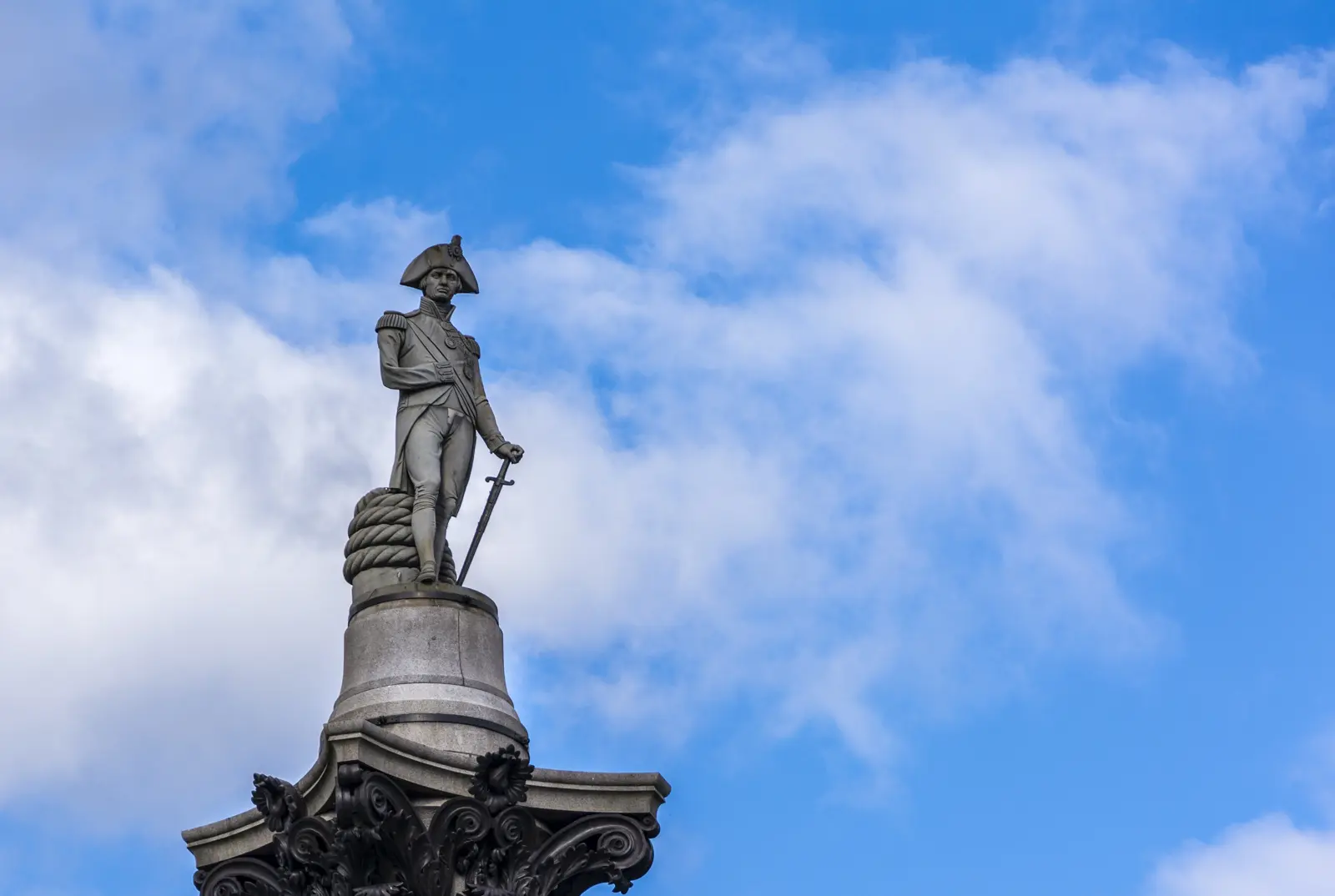
Nelson’s Column was built between 1840 and 1843, designed by William Railton and topped with a 5.5-metre sandstone statue of Nelson sculpted by Edward Hodges Baily. The column itself is built from Dartmoor granite in the Corinthian order, and the whole monument stands 52 metres tall (about 169 feet). It cost £47,000 at the time, the equivalent of around £5 million today. Public donations ran out at £25,000, and the government quietly took over the funding to make sure it was finished.
There is a small detail worth knowing about the column. Look closely at the square pedestal at the base. The four bronze panels around it depict Nelson’s four greatest naval victories: the Battle of Cape St Vincent (1797), the Battle of the Nile (1798), the Battle of Copenhagen (1801), and the Battle of Trafalgar (1805), where he was killed. The bronze used to cast these panels came from captured French cannon taken during those very battles. The bronze used at the very top of the column, the Corinthian capital, was cast from cannon salvaged from the wreck of HMS Royal George at the Woolwich Arsenal foundry — British metal, this time. The metal Nelson defeated his enemies with is now part of the metal that commemorates his victories. There are few monuments in London with a tighter loop of meaning than this one.
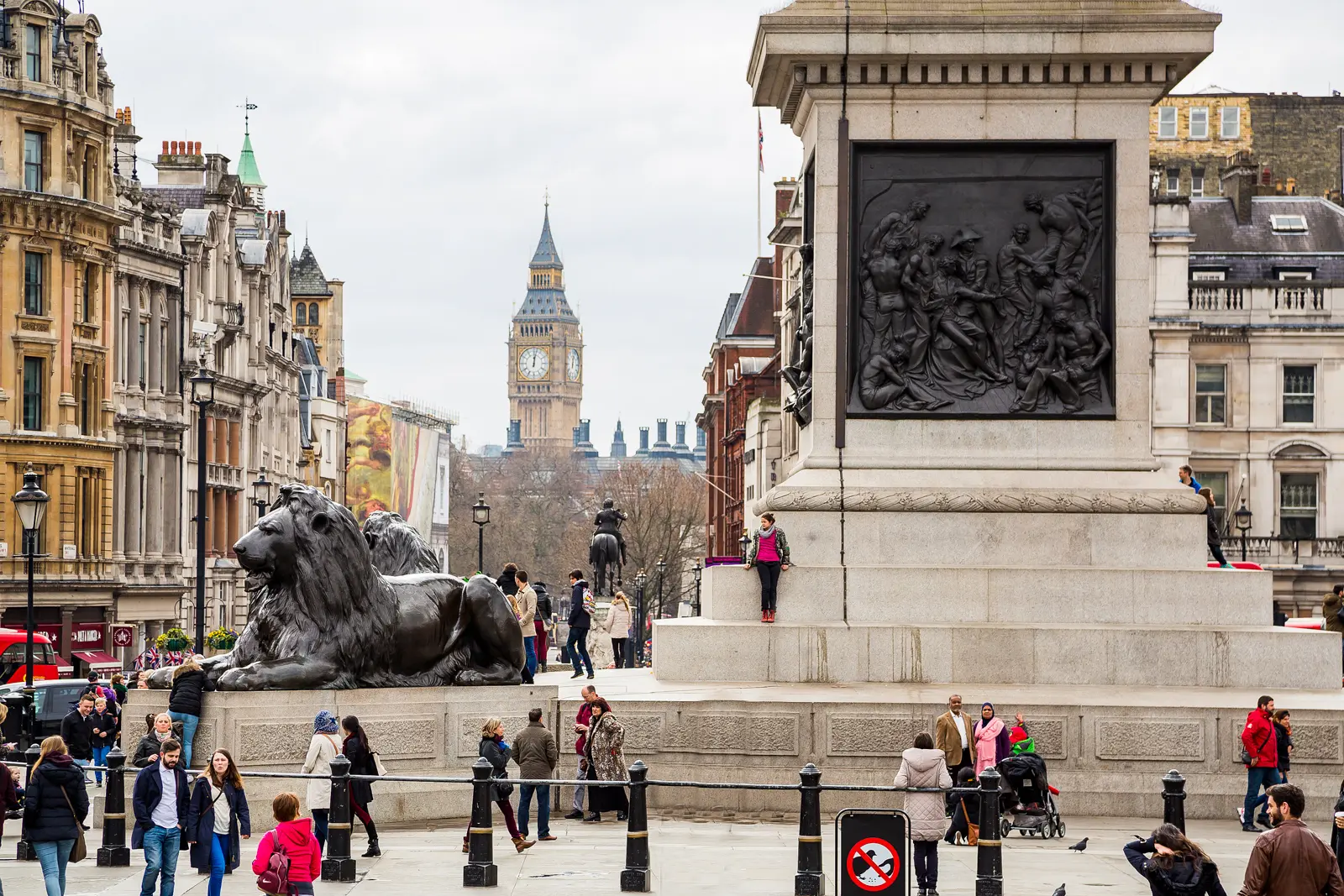
Charles Barry, who completed the square, did not actually want Nelson’s Column to be built at all. He worried it would distract attention from his National Gallery behind it. Unfortunately for him, the foundations had already been laid by the time he took over the project, and there was nothing he could do.
Nelson faces south, looking toward the Admiralty and the Mall, where his old ships are symbolically represented at the tops of the flagpoles along the route. If you visit the crypt of St Paul’s Cathedral, you can stand beneath the sarcophagus where his body actually rests. The column commemorates him publicly. The crypt holds him privately. Britain remembers him in two places, the public square and the private cathedral, one above the city and one beneath it.
The Lions
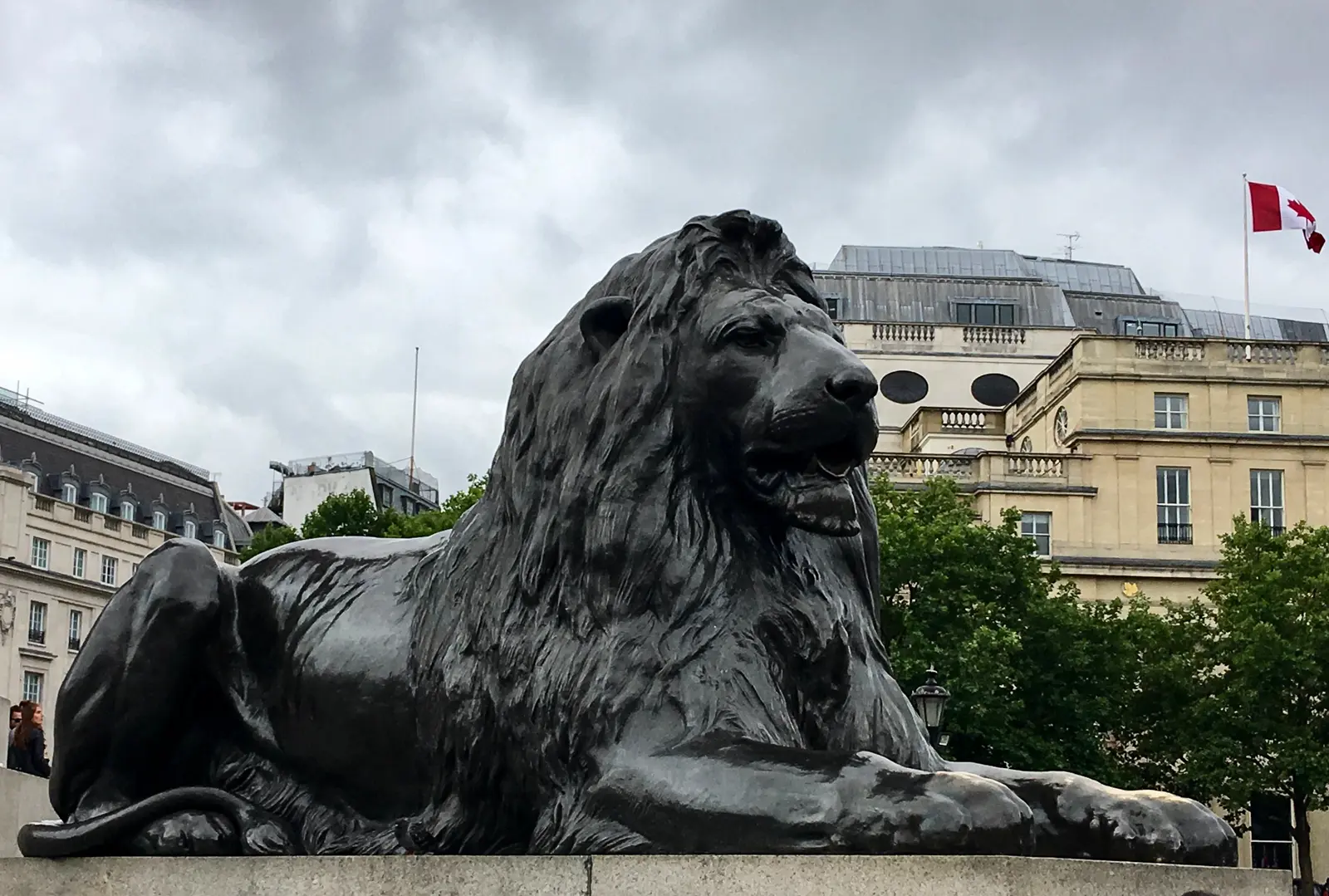
The four bronze lions that guard the base of Nelson’s Column are some of the most photographed sculptures in London. They were added in 1867, twenty-four years after the column itself was finished. The story of how they came to look the way they look is one of the strangest commissions in British public sculpture.
The job was given to Edwin Landseer, who was at the time the most famous animal painter in Britain and a personal favourite of Queen Victoria, who had knighted him in 1850. There was one problem. Landseer had never made a sculpture in his life. Not one. The committee gave him the job anyway. He wrote at the time that the government had “turned a lion loose on me”, and he spent years struggling with the colossal clay models.
To work from a real lion, Landseer requested a plaster cast of a stone lion from Turin. It took six years to arrive. While he waited, he sketched living lions at London Zoo, but live lions move and great painters need stillness. Eventually, the corpse of a dead lion was delivered from Regent’s Park for him to use as a model. By the time he was ready to sculpt the paws, the corpse had decomposed beyond use. So Landseer modelled the paws on those of a domestic cat.
Look closely at the lions next time you walk past them. The backs are slightly concave rather than convex, which is anatomically wrong. The paws are sphinx-like and visibly feline rather than leonine. They look, as more than one critic has said over the years, slightly more like enormous dogs than lions. Bronze casting was carried out by Baron Carlo Marochetti, who was an actual sculptor, in his London studio. When the four lions were finally unveiled in January 1867, the satirical magazine Punch greeted the first one with the line: “The first lion intended for the Nelson Monument has broken from its distinguished keeper, Sir Edwin Landseer, and is now at large, in fact, very large, in Trafalgar Square”.
They are also genuinely magnificent. Each lion is 20 feet long, 11 feet high, and weighs 7 tonnes. They face out at the cardinal directions, identical except for tiny variations in their manes. Children climb on them every single day. People take photographs sitting between their paws. They have been there for 159 years now, and they have become one of the most-loved details of the city, anatomically incorrect or otherwise. Sometimes art is good because it is accurate. Sometimes it is good because it has been loved for a long time. Landseer’s lions are the second kind.
The Fountains and the Fourth Plinth
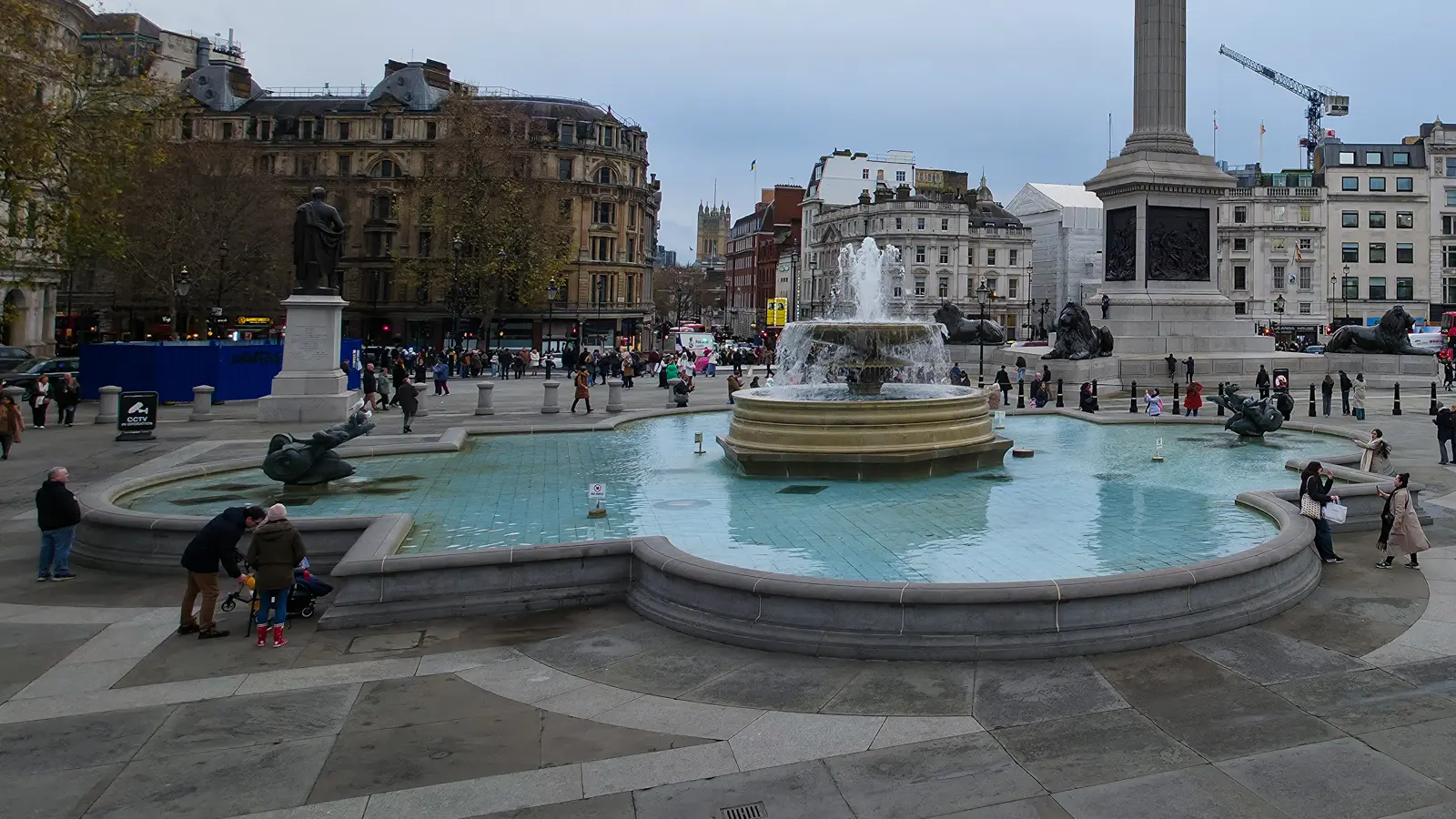
The two fountains were originally added by Charles Barry in 1845, though the current basins and the mermaids, dolphins, and tritons that decorate them date from a major redesign by Edwin Lutyens in 1939. Lutyens is best known as the architect of the Cenotaph at Whitehall and the British Embassy in Washington, but he also designed New Delhi. His Trafalgar Square fountains are quieter work, less grand, made for a public square rather than a national memorial. In December afternoon light, the pale blue tile of the basins picks up the colour of the winter sky.
Around the corners of the square stand four plinths, originally intended to hold equestrian statues of British kings and military heroes. Three of them filled up as planned. The plinth in the northwest corner of the square was supposed to hold a statue of King William IV, the king for whom the square was almost named. The money for it ran out. The plinth stayed empty for over 150 years.
In 1999, the Royal Society of Arts proposed using the empty plinth to display contemporary art, with each piece staying for two years before being replaced. The result, now called simply the Fourth Plinth, has become the most-discussed contemporary art space in the country. Past commissions have included Antony Gormley’s One and Other in 2009, which invited 2,400 ordinary members of the public to stand on the plinth one at a time for an hour each, around the clock for 100 days, and Yinka Shonibare’s Nelson’s Ship in a Bottle from 2010 to 2012, a giant model of HMS Victory inside a glass bottle, sails made from African-printed fabric.
The current installation, on the plinth from September 2024 until 2026, is Teresa Margolles’s Mil Veces un Instante (A Thousand Times an Instant). From a distance it looks like a square block of weathered stone. Up close, it is made of 726 plaster casts of the faces of trans, non-binary, and gender non-conforming people from Mexico City, Juárez, and London, cast over more than a thousand hours by the artist herself. Each face presses outward from the surface of the block, eyes closed, expressions still. The casts were made by applying plaster directly to the faces of participants, which means the work contains traces of their skin cells and hair.
It is the kind of artwork the Fourth Plinth was built for. The next plinth installation, Lady in Blue by Tschabalala Self, will arrive in September 2026.
The National Gallery and the Cultural Square
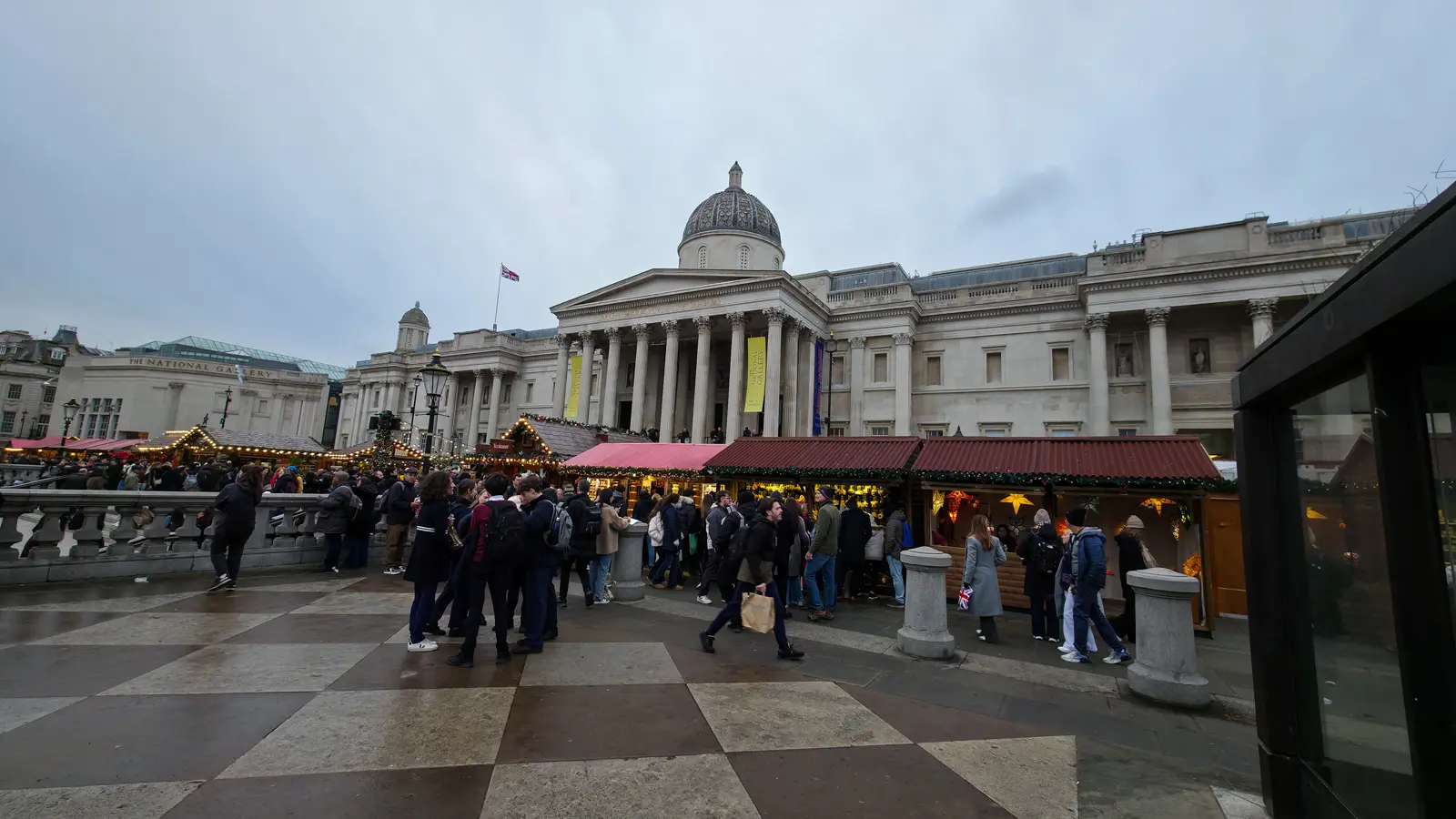
Trafalgar Square is bordered on three sides by some of London’s most significant cultural institutions. The National Gallery runs along the entire north side, its broad neoclassical façade looking down on the square. It opened in 1838 and houses over 2,300 paintings, from medieval altarpieces to Impressionist masterworks. It has been free to enter for almost its entire existence. Behind the National Gallery sits the National Portrait Gallery, with its collection of paintings of every significant British figure from the Tudors to the present day, also free.
To the east of the square is St Martin-in-the-Fields, the parish church with the Corinthian portico and the spire rising behind the trees. The current building dates from 1726, designed by James Gibbs. The church runs a famous concert programme and the café in its crypt is one of the great quiet meal spots in central London, though “quiet” in this case means “not Trafalgar Square”.
To the south of the square, beyond the fountains and across the road, is Whitehall, the broad ceremonial avenue running down to Parliament. Walk south for ten minutes and you arrive at Downing Street. Walk north from the square and you reach Leicester Square in five minutes and Covent Garden in ten. Trafalgar Square is not just a destination on its own. It is the geometric centre of central London’s tourist and cultural districts. Most visitors don’t realise quite how central it is until they look at a map.
The Norwegian Tree and the December Market
Now the part of the post that mattered most when I was actually standing there.
In the centre of the upper terrace of Trafalgar Square, just below the steps to the National Gallery, stands the Norwegian Christmas tree. It is enormous, decorated in vertical strings of warm white lights rather than the more conventional horizontal pattern used elsewhere in the city. It is always a Norwegian spruce, always over 20 metres tall, always between 50 and 60 years old. And it has been given to London by the city of Oslo every year since 1947.
The story is worth telling in full.
In April 1940, Nazi Germany invaded Norway. King Haakon VII, his son Crown Prince Olav, and the entire Norwegian government were forced to flee. They sought refuge in Britain. The Norwegian government-in-exile spent the entire Second World War based in London, running the Norwegian resistance from offices in Kingston House while Norwegian sailors, soldiers, and intelligence officers fought alongside the British war effort. Late in 1942, a Norwegian commando named Mons Urangsvåg felled two Norway spruces during a resistance raid on an island off the Norwegian west coast and smuggled them back to Britain. One was intended as a gift for King Haakon in exile. The other ended up in Trafalgar Square, erected late one night after a wartime dinner at the Savoy Hotel by a group of Norwegian commandos and British naval intelligence officers — one of whom was Commander Ian Fleming, the future creator of James Bond. They used aircraft flares in place of fairy lights and toasted the liberation of Norway with a bottle of Aquavit at the foot of the tree.
After the war ended, Norway wanted to thank London. In 1947 they started sending a tree every year. The plaque at the base reads: This tree is given by the city of Oslo as a token of Norwegian gratitude to the people of London for their assistance during the years 1940-45. A tree has been given annually since 1947.
Seventy-eight years later, the tradition is still going. The 2025 tree, called Ever Oslo, was selected by public vote in Oslo and felled in early November by the Lord Mayor of Westminster and the Mayor of Oslo, who took ceremonial first cuts before the forestry team finished with chainsaws. The lighting ceremony took place on 4 December, attended by both mayors, by the Salvation Army band, and by thousands of Londoners and visitors. The tree stays until Twelfth Night on 6 January, when it is taken down, chipped, and composted into mulch for London’s public gardens. Then a new tree comes the next December. It has happened, without fail, for 79 years.
Standing in the square at night, looking up at the lights stretched vertically against the dark, with carol singers in the cold and Nelson far above on his column, I was genuinely in awe. There are bigger Christmas displays in the city. The lights on Regent Street are flashier. The Christmas markets at Southbank and Hyde Park have more food. But Trafalgar Square has the tree, and the tree has a meaning none of the others have. It is a gift, given without obligation, from one country to another, year after year, for almost a century, because of something that happened in the 1940s that neither country has forgotten. In a world that often forgets quickly, that is something worth standing in front of for a few minutes.
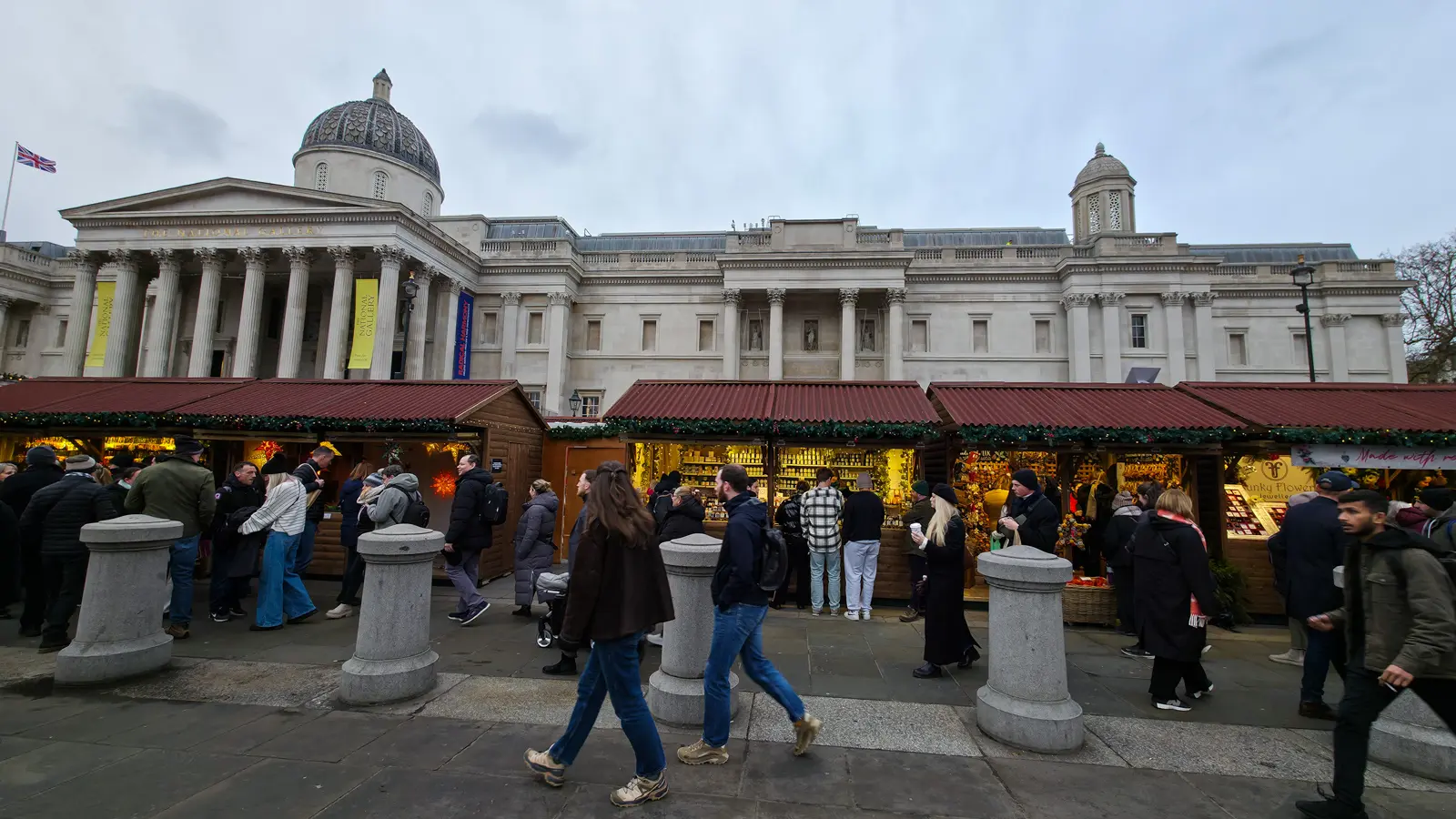
Around the tree, on the upper terrace, runs the Trafalgar Square Christmas Market. About forty wooden alpine-style chalets line the steps of the National Gallery, decorated with evergreen garlands and warm yellow string lights. The stalls sell mulled wine, roasted chestnuts, raclette, bratwurst, churros, gingerbread, Norwegian knitwear, handmade ornaments, and Christmas decorations in every form. Some stalls have illuminated stars hanging in the window. Others have rows of tiny lit-up reindeer or wooden nativity figures. The whole row glows.
What I liked best was watching the people. The market draws an unusual mix. London office workers in suits stopping for a cup of mulled wine on the way home. Tourists from every country posing in front of the stalls for photographs. Families with small children pulled along by the smell of bratwurst. Norwegian visitors picking through the knitwear with the slightly critical eye of people who know real Norwegian knitwear when they see it. Carol singers in choir robes finishing one set and queuing for hot chocolate before the next.
The market runs from early November until early January. Stalls open at 10 am and stay open until 10 pm, every day except Christmas Day. From 9 to 23 December, a daily choir performs at the foot of the tree, with weekend brass bands and Christmas carollers throughout the season. Carolling groups raise money for various charities throughout the month.
Larger Christmas markets at Leicester Square and Southbank Centre are a short walk away if you want to combine them in one evening.
Bubbly Tips for Visiting Trafalgar Square
- Visit at dusk in December. This is when the square is at its best. The lights of the Christmas tree, the National Gallery’s lit windows, and the fountains all reach their peak presence around 4 to 6 pm in winter. Earlier in the day the square reads as a transit point. After dark it reads as a destination.
- The Christmas tree lighting ceremony is the first Thursday of December. If you can plan a visit around it, do. It is free, attended by both the Lord Mayor of Westminster and the Mayor of Oslo, and features carol singers and brass band performances.
- Walk up to the National Gallery steps for the best photograph. The view of the square from above, with Nelson’s Column rising at the centre and the Christmas tree in the foreground, is the iconic Trafalgar Square shot. You can take it standing on the gallery steps, which are above the square’s upper terrace.
- The lions are climbable, but be careful. Children love them and adults love taking photographs sitting between their paws. The bronze gets slippery in rain and frost, and the heights involve real falls. Watch your footing.
- Look at the Fourth Plinth. Most visitors miss it entirely because they are looking up at Nelson. The Fourth Plinth in the northwest corner of the square is hosting some of the most discussed contemporary art in the country. The current installation, Teresa Margolles’s Mil Veces un Instante, will be on the plinth until September 2026.
- Read the Christmas tree plaque. It is small, at the base of the tree, and most people walk past it without noticing. The wording is exactly the same every year since 1947. It is worth two minutes of your time.
- Combine with the National Gallery. The gallery is free, vast, and directly above the square. Even a short visit (one or two paintings) is worth the detour. The Sainsbury Wing has Renaissance masterpieces. The main building has Turners, Van Goghs, and a Velázquez Venus that has been attacked by suffragettes in its history.
- The square is a major transit junction. Charing Cross station is two minutes walk south. Leicester Square Tube is three minutes north. Embankment is five minutes south. If you’re moving through central London, Trafalgar Square is almost always on the way to somewhere else.
Final Thoughts
There is a phrase in British public life called “the country comes to Trafalgar Square”. It applies to the V-J Day crowds in 1945, when thousands gathered here spontaneously when news of the Japanese surrender reached London. It applies to the 1953 Coronation. It applies to every general election victory speech delivered from the National Gallery steps. It applies to the Iraq War protests of 2003, the Black Lives Matter rallies of 2020, the climate marches, the suffragette demonstrations, and the New Year’s Eve gatherings that fill the square every 31 December.
What I noticed when I stood there in December is that this same square also does a quieter kind of national gathering. Not for protest or celebration, but for the simple practice of being in public, in the cold, together, looking at a tree. The carol singers were there. The children were climbing the lions. The Norwegian flag was waving slightly above the tree, alongside the Union Jack. Tourists were taking photographs. Office workers were on their way home. And underneath it all, Nelson was looking south from his column toward the Admiralty, as he has done since 1843.
I had thought, before this visit, that Trafalgar Square was a square. It is more than that. It is a record of how a country chooses to remember things and how it chooses to live with the memory afterwards. The 1805 victory is in the column. The 1867 lions hold its base. The 1947 gift from Norway lights up every December. The Fourth Plinth, since 1999, has shown the country what art is for. The fountains, the gallery, the church, the markets, the carol singers, the protesters. All of it sits in one square, and the square just keeps going.
After January, the tree comes down. The carol singers go home. The protests resume. But for one month a year, on a December evening, the heart of London is a 60-year-old Norwegian spruce, lit in the dark, sent across the North Sea by people who have not forgotten. Stand in front of it for a few minutes. You will see what I mean.
Until next time!

🌟 Everything You Need to Plan Your Dream Trip in 2026
- 🌟 Luxury Hotels - Find premium stays with Booking.com & Hotels.com
- 🏡 Vacation Rentals - Discover unique properties on VRBO
- 🏞️ Guided Tours - Explore with Viator or GetYourGuide
- 🎫 Attraction Tickets - Skip the lines with Tiqets
- 🚢 Ocean Cruises - Set sail with Cruise Direct
- 📱 International SIMs - Stay connected with Saily
- 🚗 Car Rentals - Budget-friendly options from Discover Cars
- 🌐 Secure VPNs - Browse safely with NordVPN
- 💶 Currency Exchange - Best rates with Wise
- 🗣️ Learn Languages - Master the local language with Babbel and Rosetta Stone