
I went to Tate Modern for one thing, and it was not a painting. It was a spider. Louise Bourgeois’s giant Maman is one of my favourite sculptures anywhere, and Tate owns the original. By the time I arrived on a wet December afternoon, the spider had already been and gone, and I was left with a former power station full of art I knew almost nothing about.
The first thing that stopped me was a telephone with a lobster for a handset. Salvador Dalí made it, and it is exactly as silly and as serious as that sounds. It also jogged a memory. I had stood in front of Dalí’s dreamlike paintings once before, in Madrid, at the modern museum in that city’s golden triangle of art. One rainy afternoon in London had already reached back to a sunnier one in Spain, and I had barely started.
I will be honest. I am not a connoisseur of modern art. Abstract painting is usually the part of a gallery I walk through quickly on the way to something older and more obviously beautiful. So I did not expect the afternoon that followed. I read the labels, I slowed down, and I kept bumping into works that tied back to other cities I have stood in. This is a post for the traveller who loves a good museum but finds modern art a bit baffling. I was one of them.
Modern Art at Tate Modern at a Glance
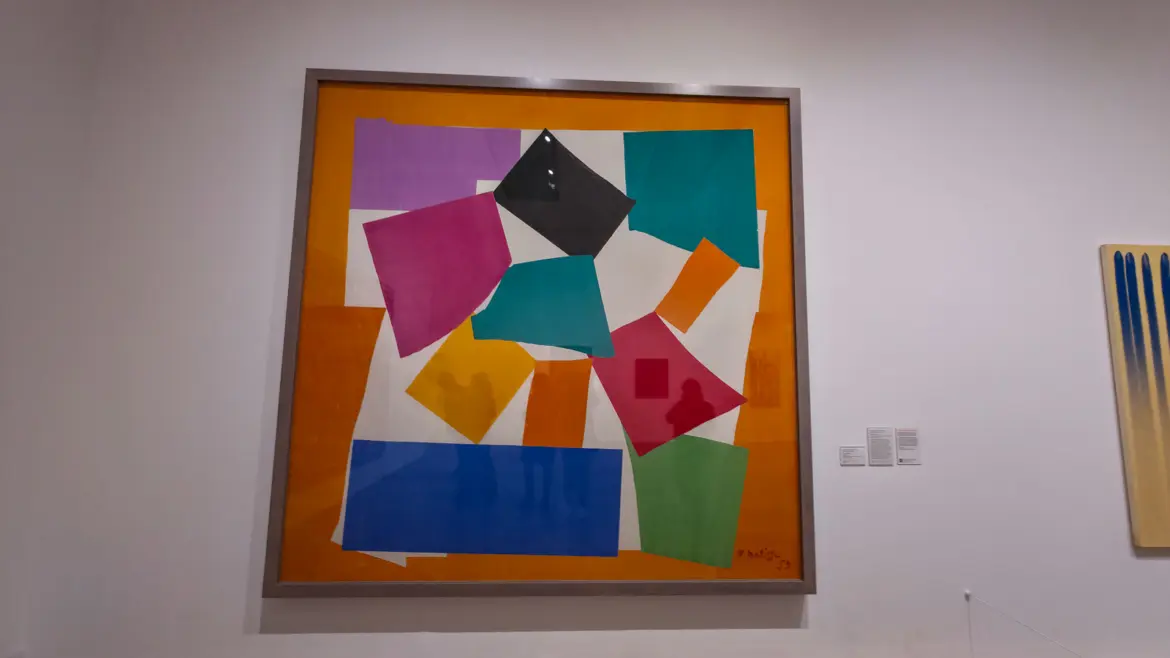
🐌 Matisse’s The Snail · A three-metre spiral of torn coloured paper from 1953, made when the artist was too ill to paint. His “drawing with scissors”.
👩 Warhol’s Marilyn Diptych · Fifty silkscreened Marilyn Monroes, bright colour fading to grey, made in the weeks after her death in 1962.
🔲 The abstraction rooms · Mondrian’s grids, Malevich’s Suprematism, Pevsner’s line-built bronze. The wall labels are where they open up.
🎟️ Cost · The collection is free, no booking. Open late, until 10pm, on Fridays and Saturdays.
💡 Tip · If a work looks like nothing to you, read the label. It lets you borrow the artist’s point of view before forming your own.
Starting with the snail
The work that turned the afternoon around was a snail made of paper.
Matisse made The Snail in 1953, near the end of his life. After 1948 his health kept him in bed and he could no longer paint at an easel, so he worked with colour a different way. Assistants painted sheets of paper in flat gouache, Matisse cut and tore the shapes with shears, and the pieces were pinned and pasted into place under his direction. He called it drawing with scissors. The spiral of blocks here is his idea of a snail’s shell, pulled apart into pure colour.
Standing in front of it, I did not need any of that to like it. It is big, it is bright, and it is cheerful in a way that does not ask for a degree. That was the first thing Tate taught me that day. Some of this work simply wants to be looked at.
Next to the grown-up label was a second card, part of a series Tate ran for its 25th birthday, printed with a comment from a seven-year-old called Riley. He worked out that if the painting fell on him he would be flattened like a pancake. It was the best piece of art criticism I read all day, and it made me laugh out loud in a quiet room.
The grid I kept seeing
A few rooms on, I recognised something.
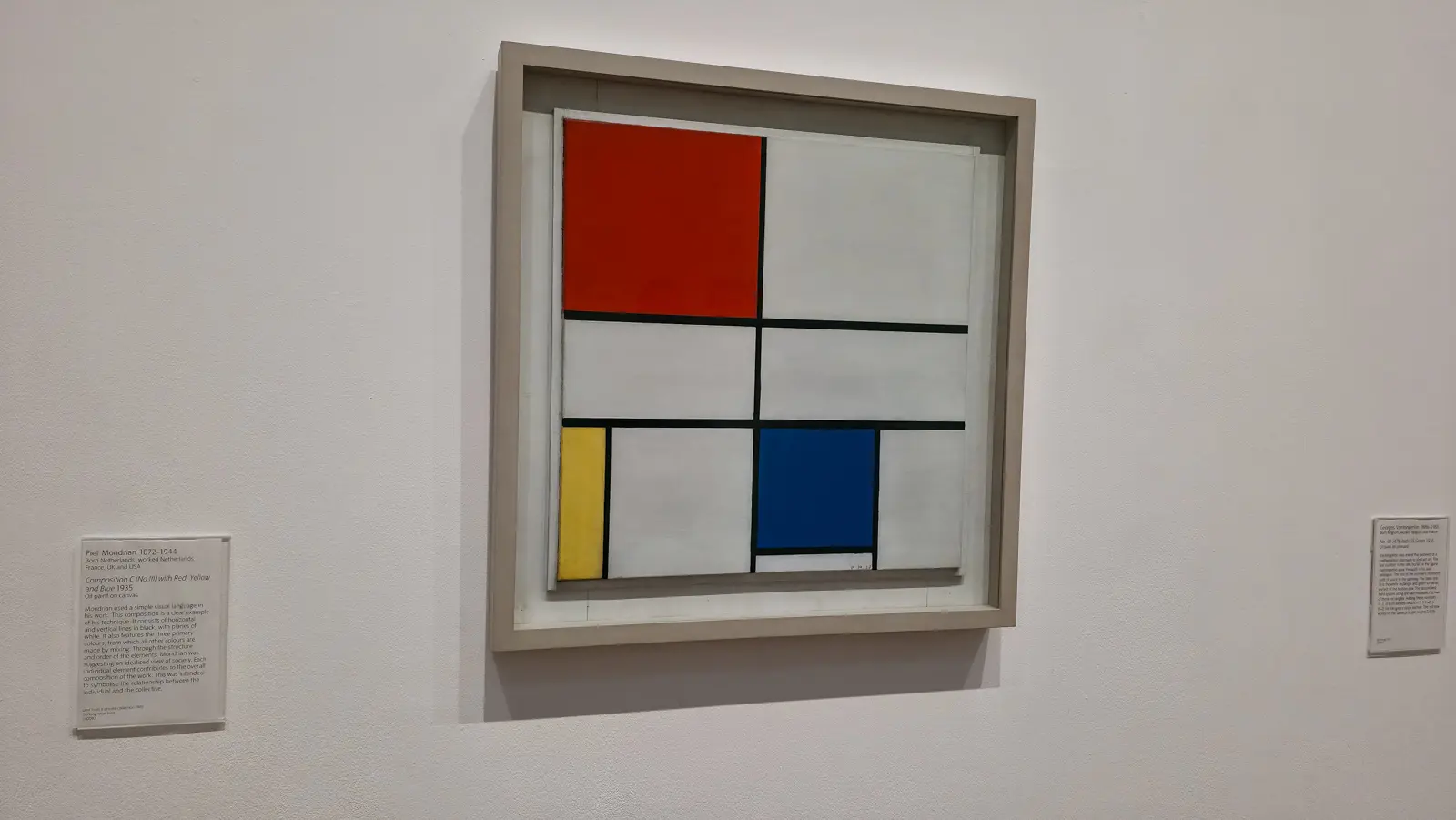
Piet Mondrian’s grids of black lines and primary-colour blocks are the kind of thing most people recognise before they know the name. I had seen this exact language a few months earlier, on mugs, tote bags and fridge magnets, in half the souvenir shops in Amsterdam. Standing in front of the real 1935 painting at Tate, I finally connected the gift-shop pattern to the man who invented it. The largest collection of his work, as it turns out, is an hour away in The Hague, not in Amsterdam at all.
That is the thing a museum does that a postcard cannot. It put me in the room with the original and let the rest of my travels click into place around it.
The room that made no sense at first
Then came the sort of room I would once have walked straight through: geometric abstraction. Shapes, lines, flat colour, no people, no landscape, nothing to hold on to.
I made myself stop and read.
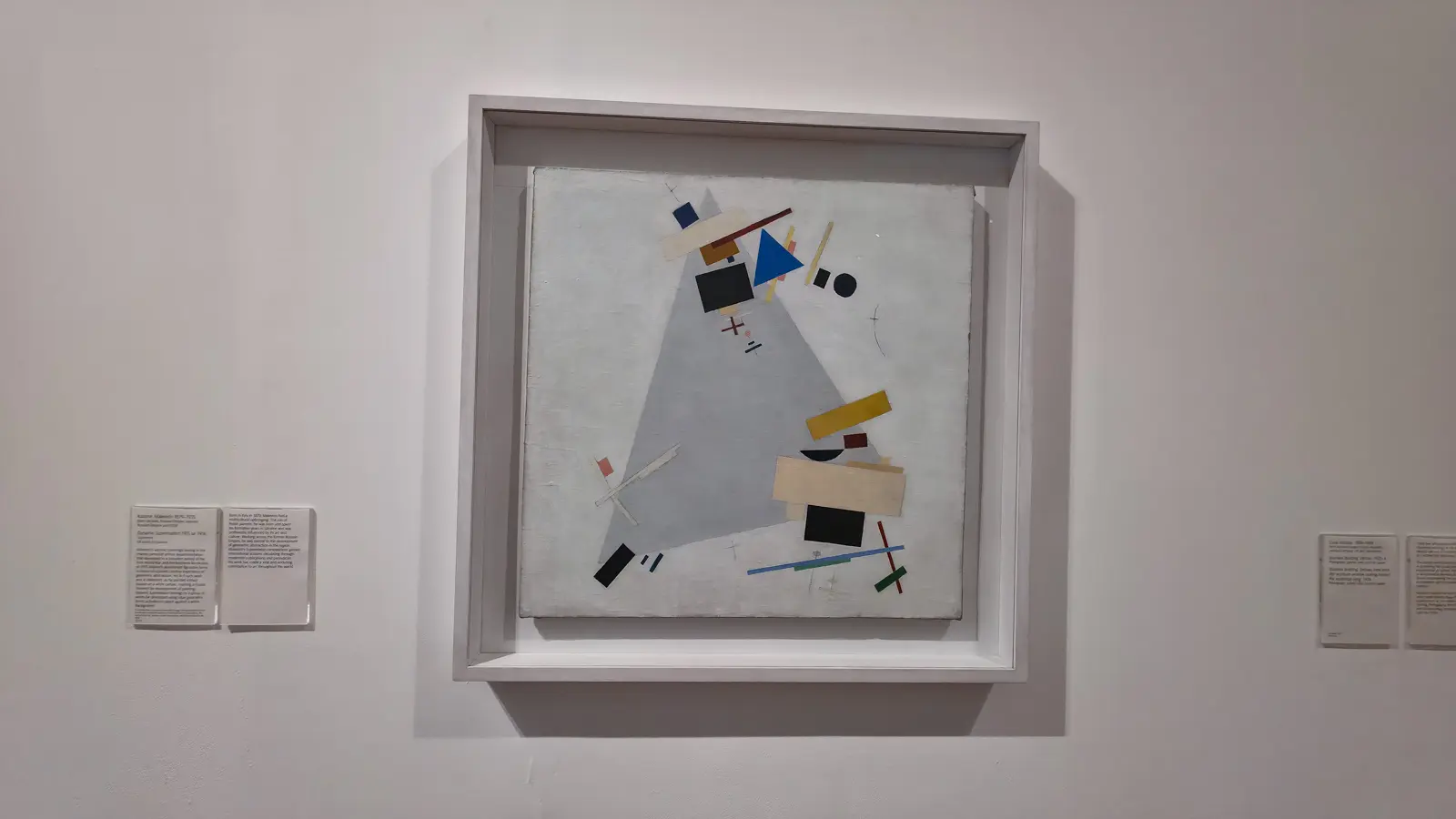
Kazimir Malevich’s Dynamic Suprematism is a scatter of coloured shapes that seem to drift and tilt across a pale ground. The label explained that he had deliberately thrown out recognisable subjects to build a new visual language from squares, bars and triangles. Knowing that did not make me love it, but it did make me see it as a choice rather than a puzzle.
The piece that held me longest was not a painting at all.
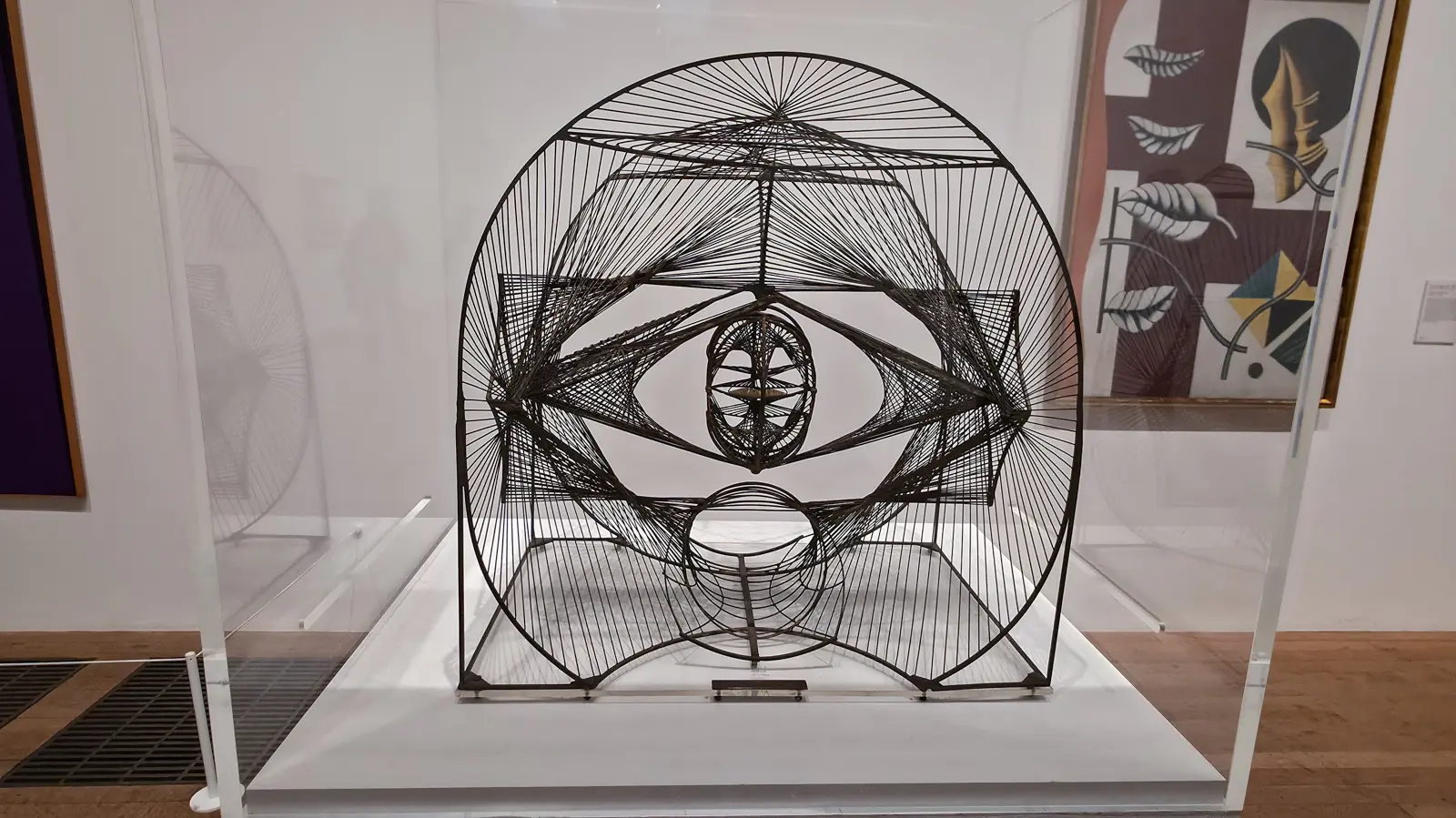
Antoine Pevsner’s bronze is a cage of fine lines that curve into the shape of an eye, or a cell, depending on the angle. It was a model for a 1952 competition in London for a monument to the unknown political prisoner. Reading that, the delicate metalwork turned into something heavier: a form built to look like a prison from every direction. I walked around it twice.
There were others in the room I liked without fully understanding. Ben Nicholson’s carved, chalky still life. Georges Vantongerloo’s painting titled with a string of numbers. A Uruguayan artist, Carmelo Arden Quín, who worked in Argentina and France and cut his canvas into an irregular shape so it stopped being a neat rectangle on the wall. I did not leave an expert. I left curious, which is further than I usually get.
A face I recognised
If the abstraction rooms made me work, the next one handed me an easy win.
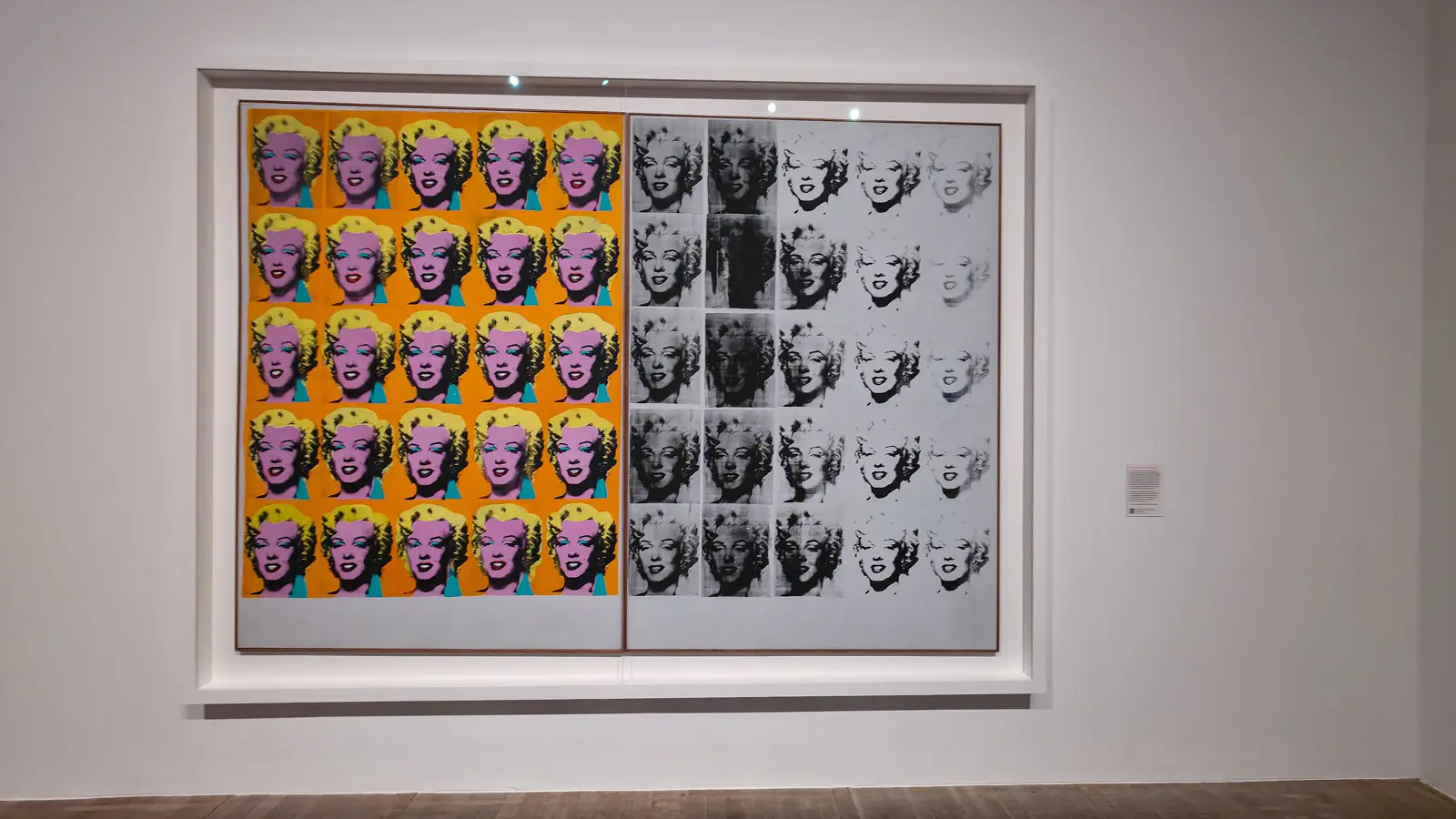
Everyone knows the Warhol Marilyns, and there they were. Fifty Marilyn Monroes, bright and lipsticked on the left, smudging into grey on the right. Warhol made it in the weeks after Monroe died, using the same publicity photo over and over. The colour side and the fading side sitting together did something a single portrait could not. Even I could read it: fame on one side, mortality on the other.
The strangest one had the best story
The work I understood least turned out to be the one that stayed with me longest.
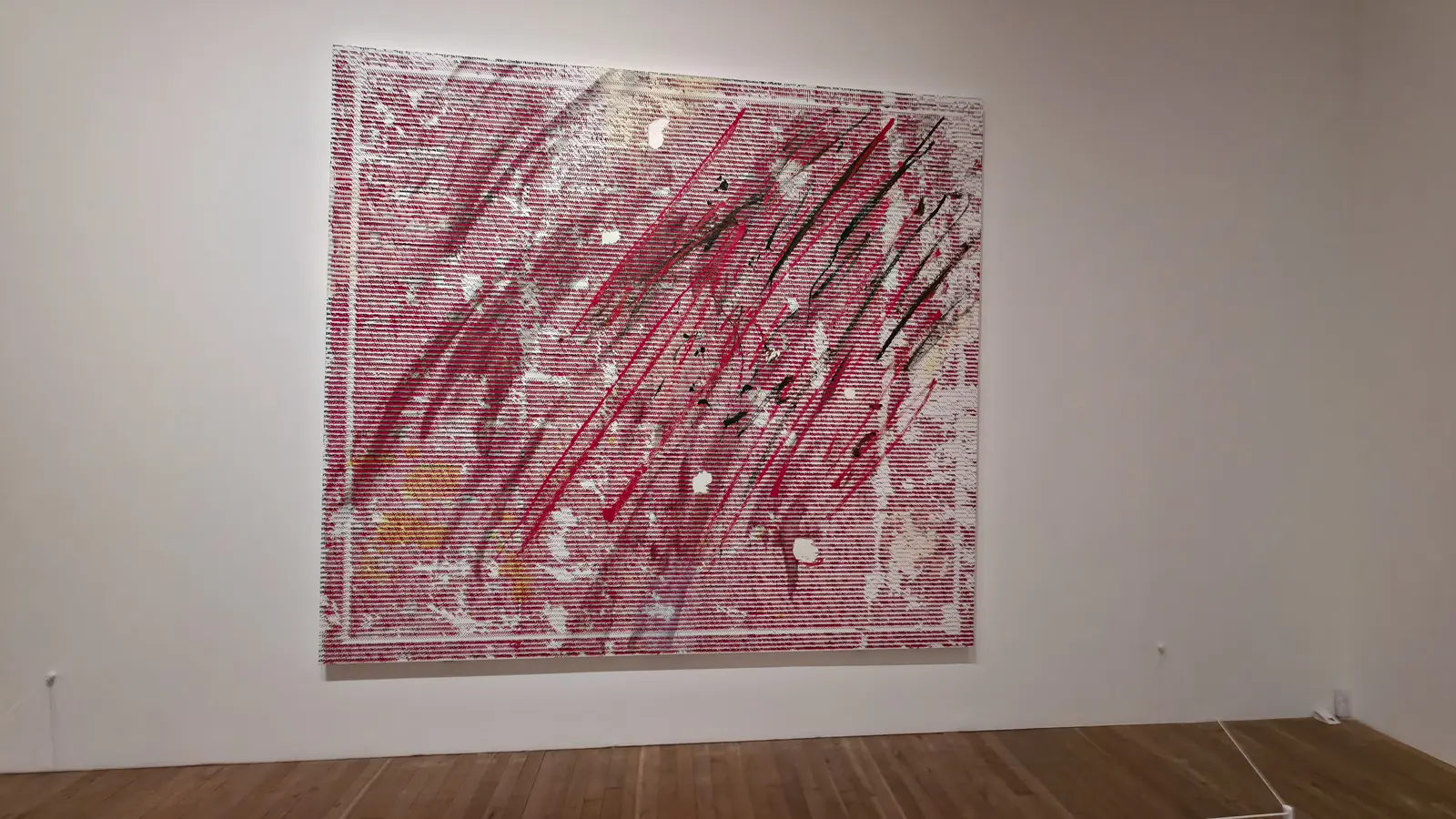
From across the room, Jacqueline Humphries’s canvas looks like a wall of red static. Up close, the static is row after row of tiny characters, and the story on the label is the good part. She photographed one of her own earlier paintings, had it turned into computer code made from seven symbols, laser-cut that code into a rubber stencil, and printed it across the canvas in black and red before slashing long strokes of paint over the top by hand. Machine and hand, in the same picture. I would have walked past it a year ago. I stood there for five minutes.
Bubbly Tips
- The collection is free, so treat it like a drop-in. Entry to Tate Modern’s permanent collection costs nothing and needs no booking. You do not have to see it all in one heroic visit. Come in for an hour, see a few rooms, and return another day.
- Check the hours before a late visit. Tate Modern opens daily from 10am, closing at 6pm Sunday to Thursday and staying open until 10pm on Friday and Saturday. It closes on 24, 25 and 26 December and opens on 1 January.
- Skip the Turbine Hall queue. On busy days the main Turbine Hall entrance can back up. The riverside Blavatnik Building entrance a few steps along is usually quieter and gets you inside just as fast.
- Read the labels, and the children’s cards. If a work looks like nothing to you, the wall text is where it opens up. On the 25th-anniversary displays, look for the comment cards written by local schoolchildren. Riley, age 7, was funnier than most critics.
- There is no single correct way to read an abstract painting. Each one works differently depending on who is standing in front of it, so give yourself permission to respond however you respond. The wall texts are worth your time, because they let you borrow the artist’s point of view before you form your own.
- Take the free tour if you are new to this. Tate runs free guided tours of the collection through the day, no booking needed. Check the board at the information desk when you arrive. For a first-timer, having someone point out what to notice is worth the hour.
- Photography is fine, within reason. You can take photos for personal use in the collection displays without flash. Tripods and selfie sticks are not allowed, and some temporary exhibitions set their own rules, so check the signs.
- Arrive by river if you can. The Tate to Tate boat runs along the Thames between Tate Britain and Tate Modern every 30 minutes, which turns the trip between the two into part of the day. Southwark and Blackfriars are the nearest Tube stations, and the walk across the Millennium Bridge from St Paul‘s brings you in from the north bank.
- Pair it with the South Bank. The gallery sits on a stretch of riverside walk that runs past Shakespeare’s Globe toward Borough Market, so it slots neatly into a wider day rather than a single stop.
Final Thoughts
I came to Tate Modern to stand under a spider, and the spider was not there. What I got instead was an afternoon of small connections. A Matisse that needed no explaining. A Mondrian that tied back to a hundred Amsterdam gift shops. A Dalí that sent me back to a museum in Madrid. A Warhol I already half-knew. And a few abstract rooms that I finally slowed down enough to read.
None of it turned me into an art historian. I still cannot say why one abstract canvas is a masterpiece and another leaves me cold. But I understand now that certainty was never the point. Reading the story on the wall, standing still a little longer than usual, and letting the work do its work: that was enough.
Two things stayed with me on the way out. The rooms were full of schoolchildren on gallery visits, sketchbooks open, arguing about what they saw, and there is something hopeful about meeting this art at seven rather than at thirty-seven. And the staff, when they caught me squinting at a label, actually asked whether I would like anything explained. Nobody treated me as out of place for not knowing.
I came for one sculpture and left seeing art everywhere: in a gift shop in Amsterdam, in a museum in Madrid, on a telephone shaped like a lobster. The spider can wait. I will be back for her, and next time I will know where to look.
Until next time!

🌟 Everything You Need to Plan Your Dream Trip in 2026
- 🌟 Luxury Hotels - Find premium stays with Booking.com & Hotels.com
- 🏡 Vacation Rentals - Discover unique properties on VRBO
- 🏞️ Guided Tours - Explore with Viator or GetYourGuide
- 🎫 Attraction Tickets - Skip the lines with Tiqets
- 🚢 Ocean Cruises - Set sail with Cruise Direct
- 📱 International SIMs - Stay connected with Saily
- 🚗 Car Rentals - Budget-friendly options from Discover Cars
- 🌐 Secure VPNs - Browse safely with NordVPN
- 💶 Currency Exchange - Best rates with Wise
- 🗣️ Learn Languages - Master the local language with Babbel and Rosetta Stone