
For a long time I thought the Renaissance was an Italian story, and mostly a Florentine one. Botticelli, Michelangelo, the great dome over Florence Cathedral. It was only once I began visiting museums abroad that I came across the Northern Renaissance, the parallel flowering that happened in the Low Countries and in Germany. I had quietly assumed it arrived later, a northern echo of something Italy had already done and done first. The real picture turned out to be more interesting than that. While Florence had its early pioneers in the opening decades of the fifteenth century, painters in Bruges and Ghent were making their own breakthroughs at much the same time, and they were heading somewhere quite different.
The difference that struck me first was the paint. In Italy, artists mostly worked in fresco and in egg tempera, building bright, clear, idealised figures drawn from classical sculpture, with the new mathematics of perspective opening deep space behind them. In the north, painters had taken up oil and pushed it further than anyone before them. Worked in thin, glowing layers, oil let them record the visible world in tiny detail: the nap of velvet, the shine on a brass chandelier, single strands of hair, the cloudy curve of a convex mirror. Where Italian art reached for the ideal, northern art chased the real, and tucked its deeper meaning inside ordinary objects.
On my most recent visit, I spent a long and happy stretch in the National Gallery‘s rooms of early Netherlandish and German painting, newly rehung in the transformed Sainsbury Wing. Here are five works that, taken together, tell the story of what the Northern Renaissance was, and why it deserves to stand beside its Italian cousin rather than behind it.
The Northern Renaissance at the National Gallery at a Glance
📍 Where · The Sainsbury Wing, in the rooms of early Netherlandish and German painting, reopened and rehung in 2025.
🖼️ Five to find · Van Eyck’s Arnolfini Portrait, Marmion’s St Bertin shutters, Gossaert’s Adoration of the Kings, the 2025 mystery altarpiece, and Cranach’s St Catherine shutter-backs.
🆓 Entry · Free. Only the big temporary exhibitions are ticketed.
🎨 What makes it different · Oil instead of fresco, observed detail instead of classical ideals, meaning tucked inside ordinary objects.
🔍 How to look · Get close for the detail, the Arnolfini mirror or the nailed steps of the mystery altarpiece, then step back for the whole.
🆕 Don’t miss · The £16.4 million mystery altarpiece, unseen in public for over sixty years, with its painter still unknown.
⏰ Go early or late · The rooms are quietest in the first hour after opening and the last before closing.
Paint like a jeweller
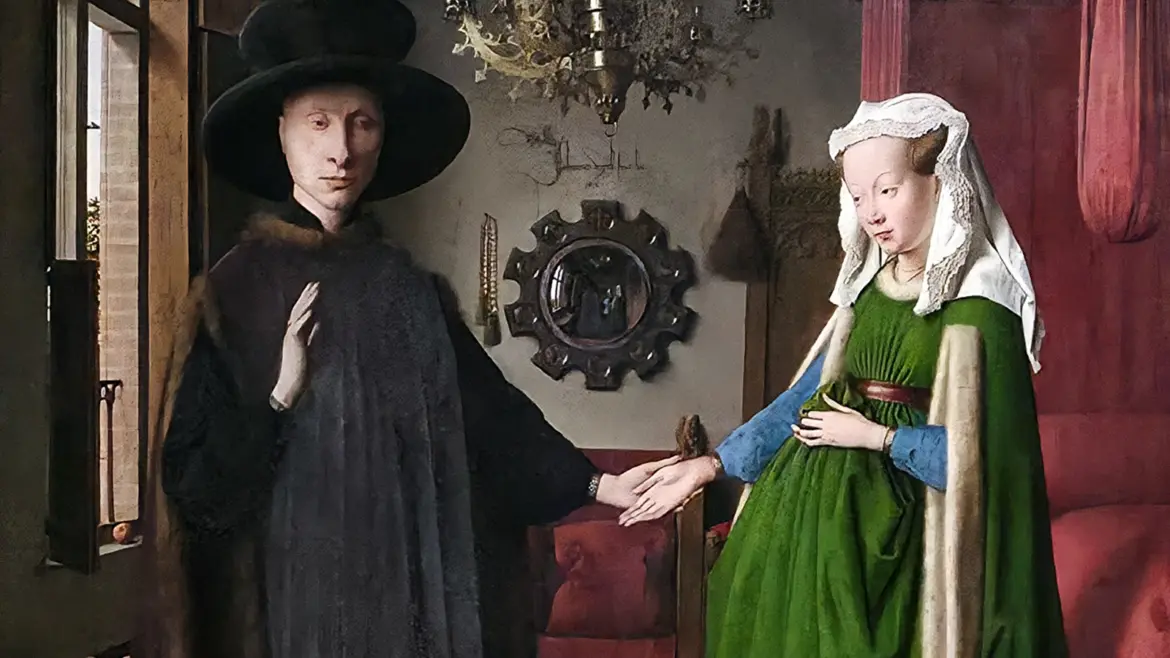
There is no better place to begin than the most famous northern painting in the building. Jan van Eyck finished the Arnolfini Portrait in 1434, and almost six centuries later it still stops people in their tracks. A richly dressed man and woman stand in a private room, hands almost touching. They are probably Giovanni di Nicolao Arnolfini, an Italian merchant working in Bruges, and his wife, whose identity is unknown.
What van Eyck does with oil paint here had not been done before. Every surface has its own truth: the soft pile of fur, the cold gleam of brass, the worn wood of the clogs left on the floor, the beads of a rosary catching the light. Van Eyck was one of the earliest masters of the medium, and he used layered glazes to make colour glow from within.
At the very centre hangs a small convex mirror, scarcely larger than a coin, and it behaves like a second painting. Its curved glass gathers up the whole room and shows the couple from behind, along with two more figures standing in the doorway. One of them may be van Eyck himself. Around the mirror’s frame run ten tiny scenes from the Passion of Christ, each one painted at a scale that should not be legible and somehow is. Above the mirror, in looping script, the artist wrote a line that reads almost like graffiti: “Johannes de eyck fuit hic”, Jan van Eyck was here, and the date, 1434. Whether the painting records a marriage, a memorial, or simply a display of wealth, scholars still argue. That it changed what paint could do is beyond dispute.
A soul lifted to heaven
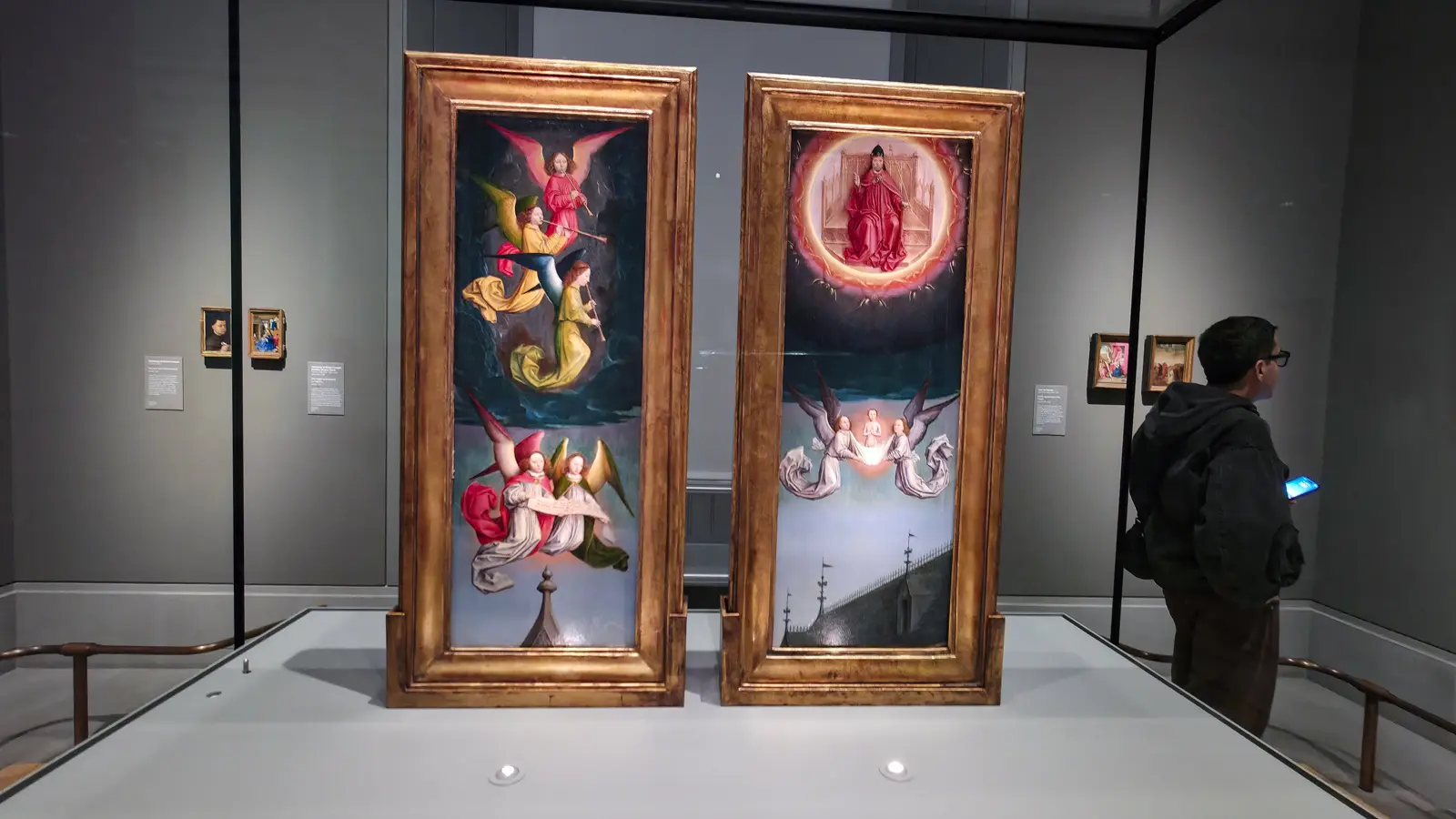
A few steps on, two tall panels by Simon Marmion show the same northern love of glittering surface turned to a tender subject. Painted around 1459, they are fragments of the shutters from a great altarpiece made for the powerful Abbey of Saint-Bertin in Saint-Omer, in northern France. The wings once told the life of Saint Bertin, the abbey’s founding saint.
These two surviving sections come from the tops of the shutters, and they carry the story to its close. On one panel, angels in white lift the small, pale soul of Saint Bertin up towards heaven, over the spires of a Gothic church. Above, God sits enthroned within a ring of fire. On the other, angels make music to welcome the soul home, one of them reading from a sheet held open in the air. Marmion trained the patient hand of a goldsmith on every fold and feather, and the result has the worked brilliance of a jewel rather than a wall.
The North meets Rome
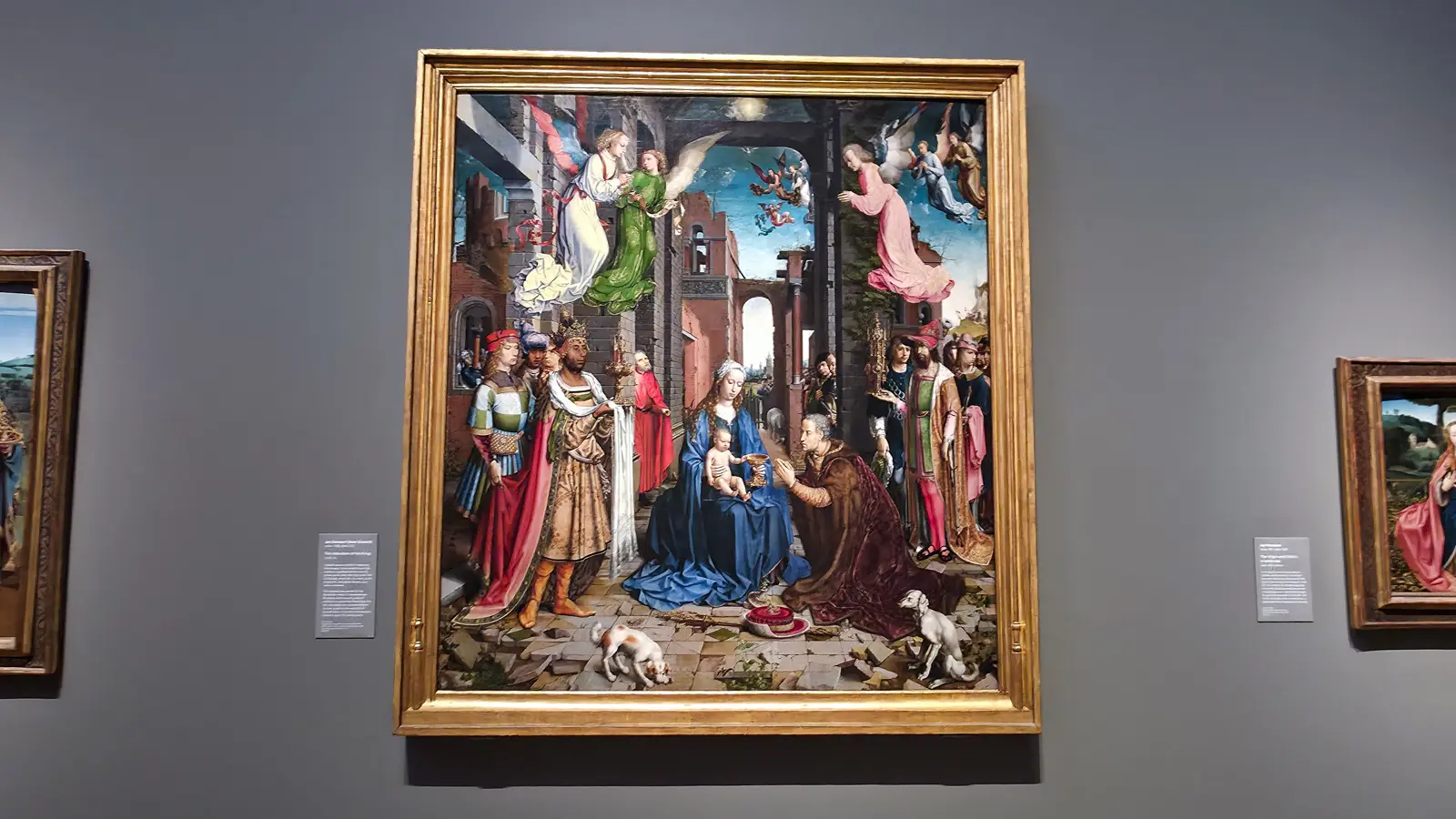
If the first two works are pure north, Jan Gossaert’s Adoration of the Kings is the moment the two Renaissances begin to meet. Painted between about 1510 and 1515, it is a showpiece, crammed with kings, courtiers, animals and angels gathered to worship the infant Christ on his mother’s lap.
The eldest king, Caspar, kneels at the front, offering a golden goblet of coins with his name inscribed on the lid. Melchior stands behind him, and to the left stands Balthasar, the Black king, with his attendant. The setting is the clue to what is changing. The holy family sit not in a humble stable but in a grand classical palace, now fallen into ruin, with round Roman arches and marble columns. Gossaert had travelled to Rome, and the architecture of antiquity has entered his northern world. Yet his instincts stay northern to the core. He signed the painting twice, once on Balthasar’s crown and once on the silver collar of Balthasar’s attendant, and he borrowed his two foreground dogs straight from prints by Albrecht Dürer and Martin Schongauer. The whole composition looks back to an earlier Netherlandish giant, Hugo van der Goes, while opening up a vast distant landscape that is entirely Gossaert’s own.
The mystery on the wall
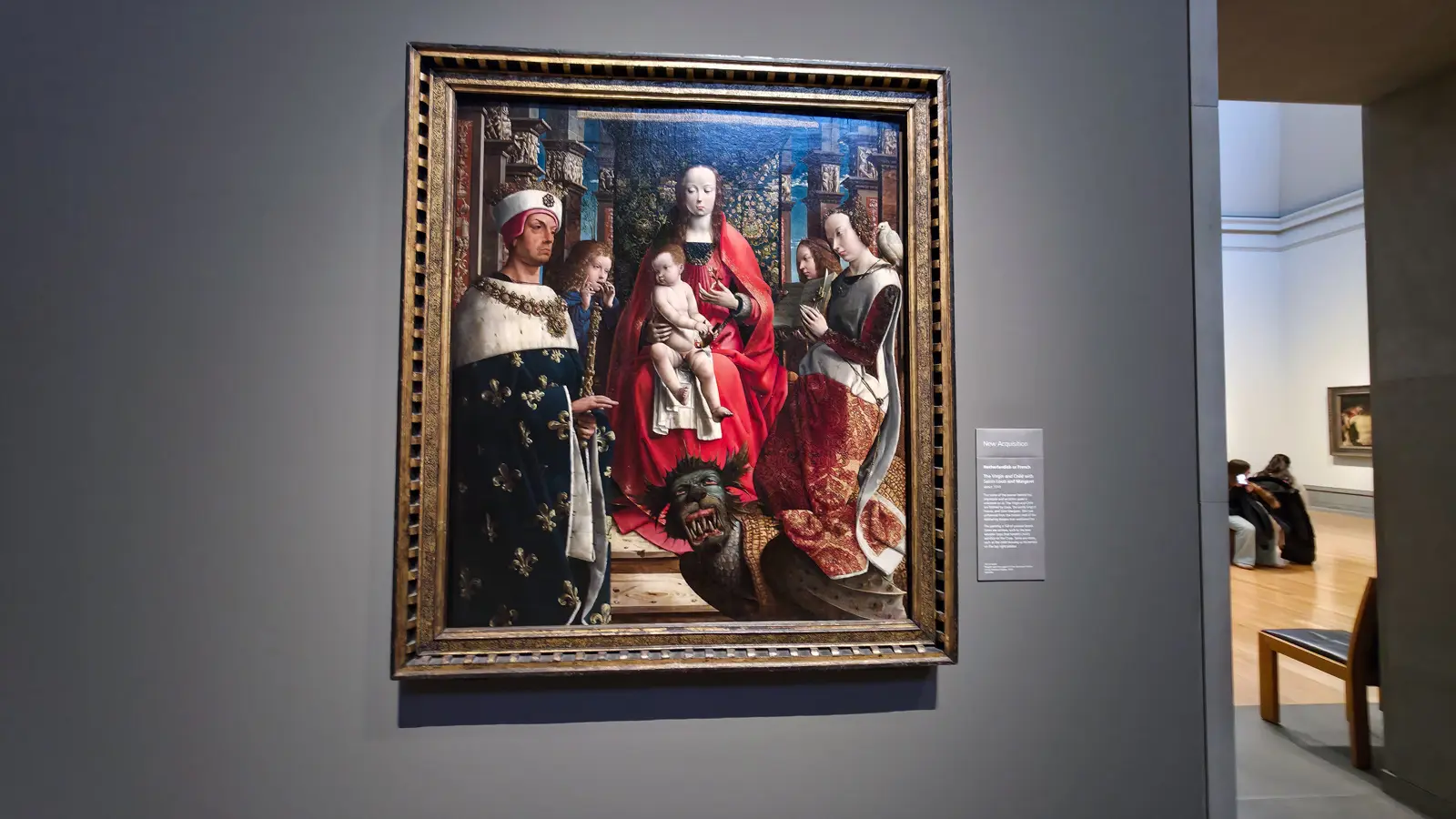
The newest arrival in these rooms is also the most mysterious, and it carries a story that made headlines. In 2025, as part of its two hundredth anniversary, the National Gallery bought an altarpiece that had not been seen in public for more than sixty years, paying £16.4 million for it. The painting was first recorded in 1602 at the priory of Drongen, near Ghent, and yet nobody knows who made it. The label settles only on “Netherlandish or French”, and dates it to about 1510.
What it lacks in a name it makes up for in invention. The Virgin and Child sit enthroned in an open-air chapel, flanked by Saint Louis, the canonised king Louis IX of France in robes embroidered with the fleur-de-lis, and by Saint Margaret, who rises calmly and unharmed from the broken shell of the dragon that had swallowed her. Look around the edges and the painter’s wit comes out. One angel plays a jaw harp, a twanging folk sound that no one would mistake for celestial music. A small child cheekily bares its backside from the top of a column. A flight of bare wooden steps, studded with nails, quietly foretells the Crucifixion to come. That a work of this quality can hang here with its author unknown is a reminder of how much of this period still waits to be understood.
Saints in their Sunday best
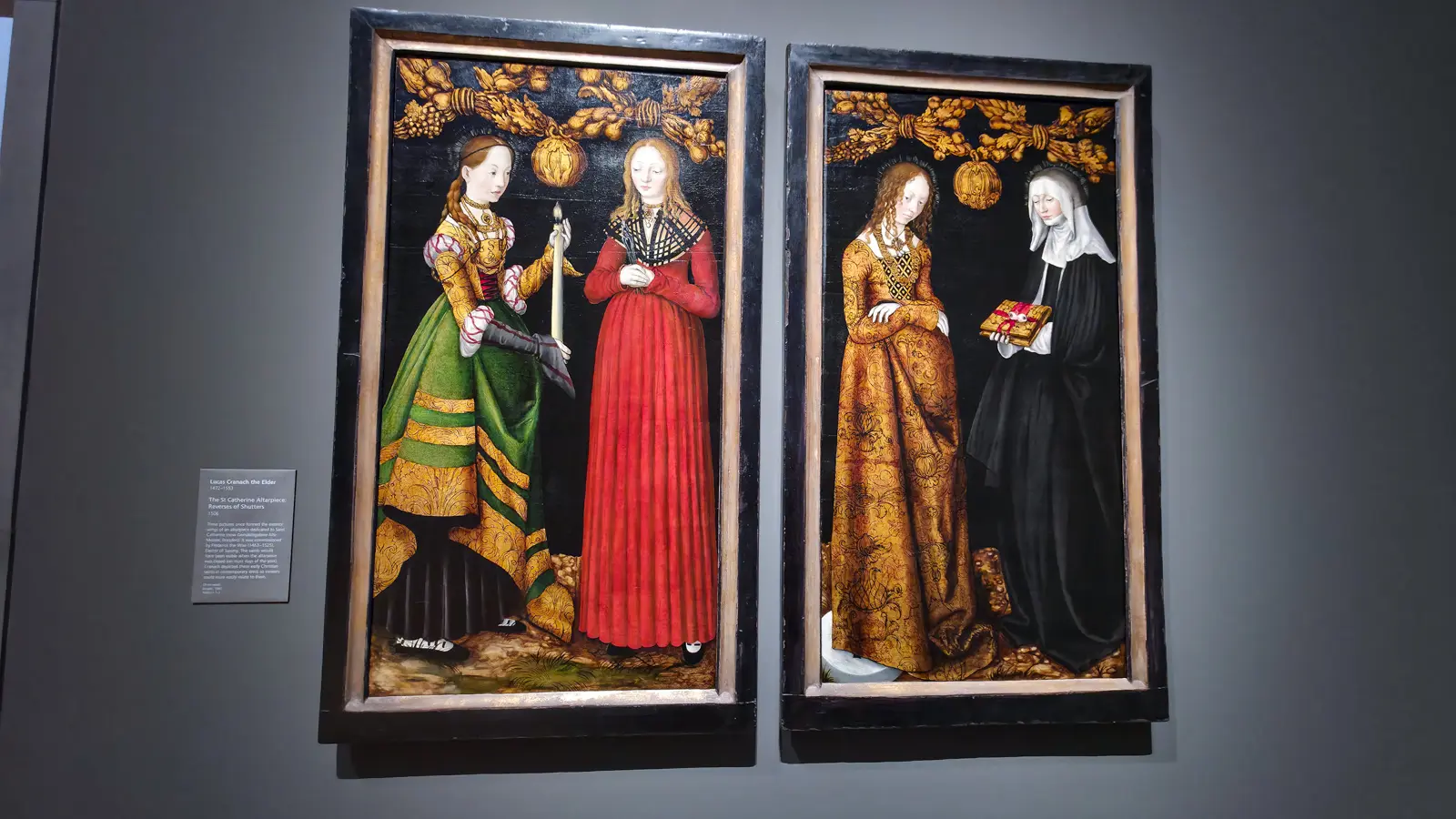
The last work takes the story east into Germany. These two panels by Lucas Cranach the Elder are the outer faces of the shutters of his St Catherine Altarpiece, painted in 1506. The centre of that altarpiece, showing the martyrdom of Saint Catherine, and the inner faces of its wings are now in Dresden, so what hangs in London is, in effect, the back of a door. They count among the first things Cranach produced after he entered the service of Frederick the Wise, Elector of Saxony, at Wittenberg in 1505, a post he would hold for most of his long career.
Four female saints stand in pairs against dark grounds, beneath swags of golden fruit. On the left wing, Saint Genevieve of Paris holds the candle that, by her account, the devil blew out and heaven relit, while Saint Apollonia stands beside her. On the right wing, Saint Christina of Bolsena, who survived being tied to a millstone and thrown into a lake because the stone floated, stands next to Saint Ottilia, a Benedictine nun. What makes the panels so human is their clothing. Cranach dressed these early Christian women in the height of fashionable German dress of around 1500, so that the people praying in front of them would see their own neighbours, their own market square, their own world reflected back. The sacred, once again, made entirely at home in the everyday.
Bubbly Tips
- Start in the Sainsbury Wing. The early Netherlandish and German paintings live here, and the whole wing was reopened and rehung in 2025, so even regular visitors will find the layout fresh. Pick up a free map at the entrance and head for the early rooms first.
- Entry is free. General admission to the National Gallery costs nothing, which makes it one of the best-value mornings in London. Only the big temporary exhibitions are ticketed, so you can wander the Renaissance rooms as often as you like.
- Get close, then step back. Northern oil painting is built to reward a long, slow look. Lean in to find the figures hidden in the Arnolfini mirror or the nails in the wooden steps of the mystery altarpiece, then step back to take in the whole. The detail is the point.
- Hunt down the mystery altarpiece. The 2025 acquisition, The Virgin and Child with Saints Louis and Margaret, is one of the newest things in the building. Ask a gallery assistant if you cannot find it, and look for the slobbering dragon at the Virgin’s feet.
- Pair it with the early Italian rooms. Seeing the northern works alongside their Italian contemporaries makes both sharper. If you want a guide to the symbols in the early Italian paintings, my National Gallery iconography post is the companion to this one.
- Photography is usually fine. You can take photos for personal use in the permanent collection, but no flash and no tripods. Check the signs near any loaned works, since those rules can differ.
- Go early or late. The galleries are quietest in the first hour after opening and the last hour before closing. The middle of the day, especially at weekends and in school holidays, is much busier.
- Give it half a day. Five paintings sounds modest, but northern detail eats time in the best way. Build in a coffee stop and let yourself linger rather than rushing the rooms.
Final Thoughts
What I took away from that December afternoon was a corrected idea. The Northern Renaissance is not a delayed copy of the Italian one, and it was never confined to a single country. It was a twin, born around the same years and raised on different ideas: oil instead of fresco, observed detail instead of classical ideals, the divine smuggled into mirrors and brocade and the backs of altarpiece doors. Van Eyck in the 1430s, Marmion at mid-century, Gossaert and the anonymous master around 1510, Cranach in Germany, together they trace a whole world of painting that I am still discovering.
And the story is not finished. The fact that the National Gallery could add a mystery masterpiece to these walls in 2025, with its painter still unnamed, tells me there is more wonder in these rooms than any one visit can hold. I will be going back.
Until next time!

🌟 Everything You Need to Plan Your Dream Trip in 2026
- 🌟 Luxury Hotels - Find premium stays with Booking.com & Hotels.com
- 🏡 Vacation Rentals - Discover unique properties on VRBO
- 🏞️ Guided Tours - Explore with Viator or GetYourGuide
- 🎫 Attraction Tickets - Skip the lines with Tiqets
- 🚢 Ocean Cruises - Set sail with Cruise Direct
- 📱 International SIMs - Stay connected with Saily
- 🚗 Car Rentals - Budget-friendly options from Discover Cars
- 🌐 Secure VPNs - Browse safely with NordVPN
- 💶 Currency Exchange - Best rates with Wise
- 🗣️ Learn Languages - Master the local language with Babbel and Rosetta Stone