
I am a LEGO person. I have the Sunflowers set on a wall at home, I have been counting down to the Klimt one, and a city with a flagship LEGO store was never going to see me walk past it.
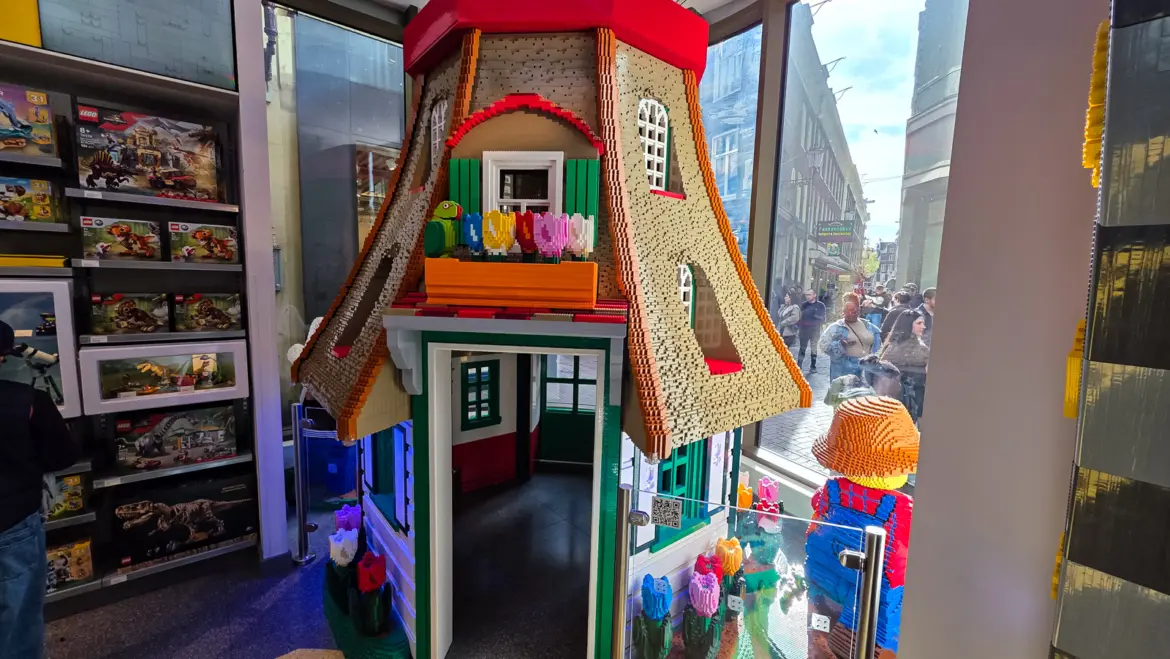
The first thing inside is a canal house built at close to walking scale, with a stepped gable, green shutters, a window box of brick tulips and a parrot sitting among them. It has a door that opens, and there was a queue of people waiting to be photographed standing in it.
What I did not expect was to spend an hour treating a toy shop as a small museum of Dutch art and engineering. That is what this one is. The company has built the store around Amsterdam rather than dropping a standard shop into a Dutch postcode, and the difference is the whole point.
The LEGO Store Amsterdam at a Glance
🧱 What it is · LEGO’s Dutch flagship store, opened 2019, built around Amsterdam itself rather than a standard shop.
🗼 The models · A brick Munttoren by the door, a 3.35-metre windmill in the window, a canal under the floor, all free to see and none for sale.
🎨 The art · An M.C. Escher staircase and brick versions of Rembrandt, Vermeer, Frans Hals and Van Gogh spread through the store.
📍 Where · On Kalverstraat, the pedestrian shopping street south of Dam Square, two minutes from the real Munttoren.
💡 Tip · Take the stairs, not the lift. The Escher stairwell is the best thing in the building, and the lift skips it entirely.
Finding It
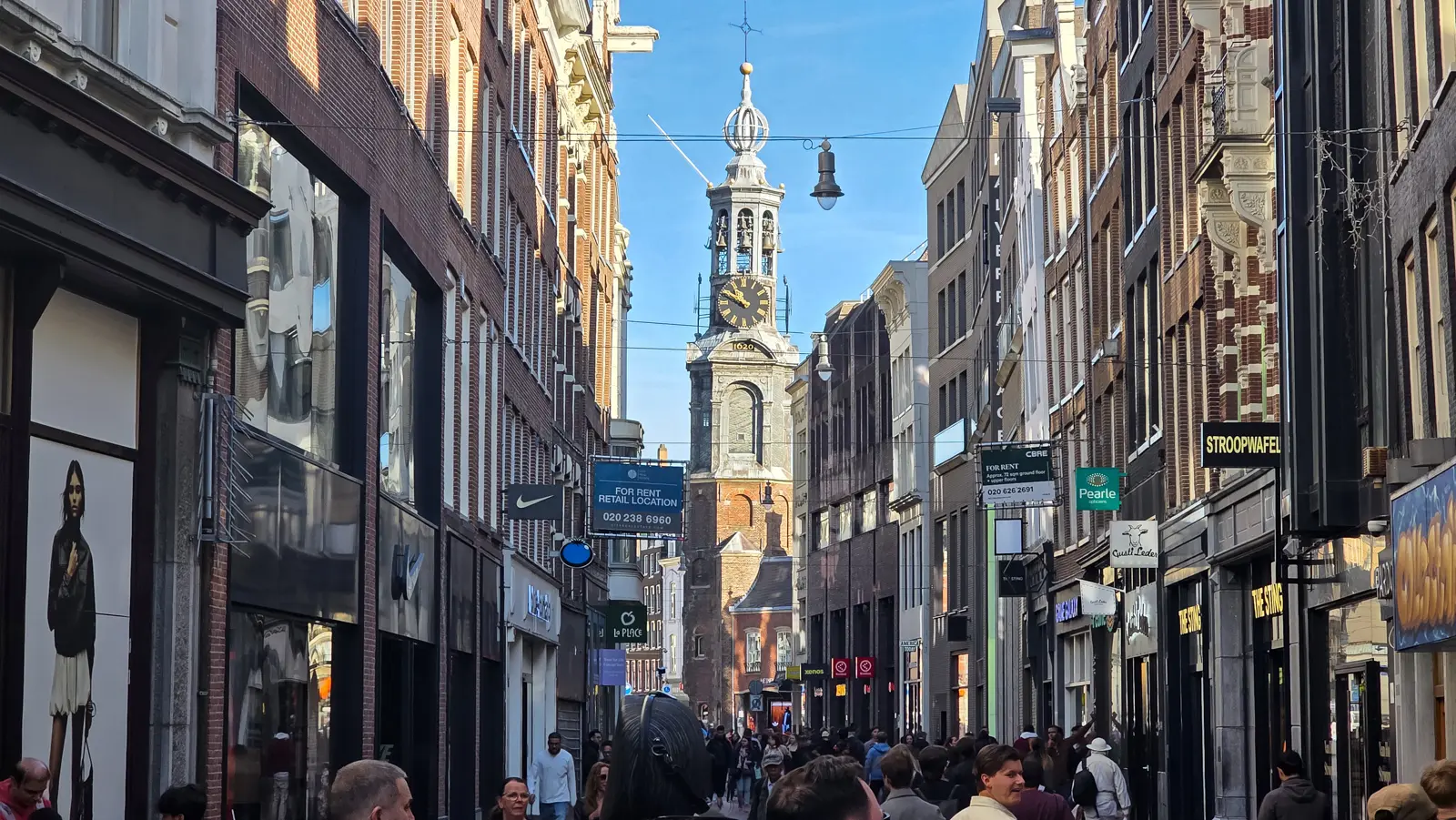
The store sits on Kalverstraat, the long pedestrian shopping street that runs south from Dam Square. It is the busiest shopping street in the city and it is not subtle, but it has one great advantage as an address: walk to the far end and the Munttoren closes the view straight ahead.
That matters here more than it sounds, because the first thing inside the store is the same tower rebuilt in bricks.
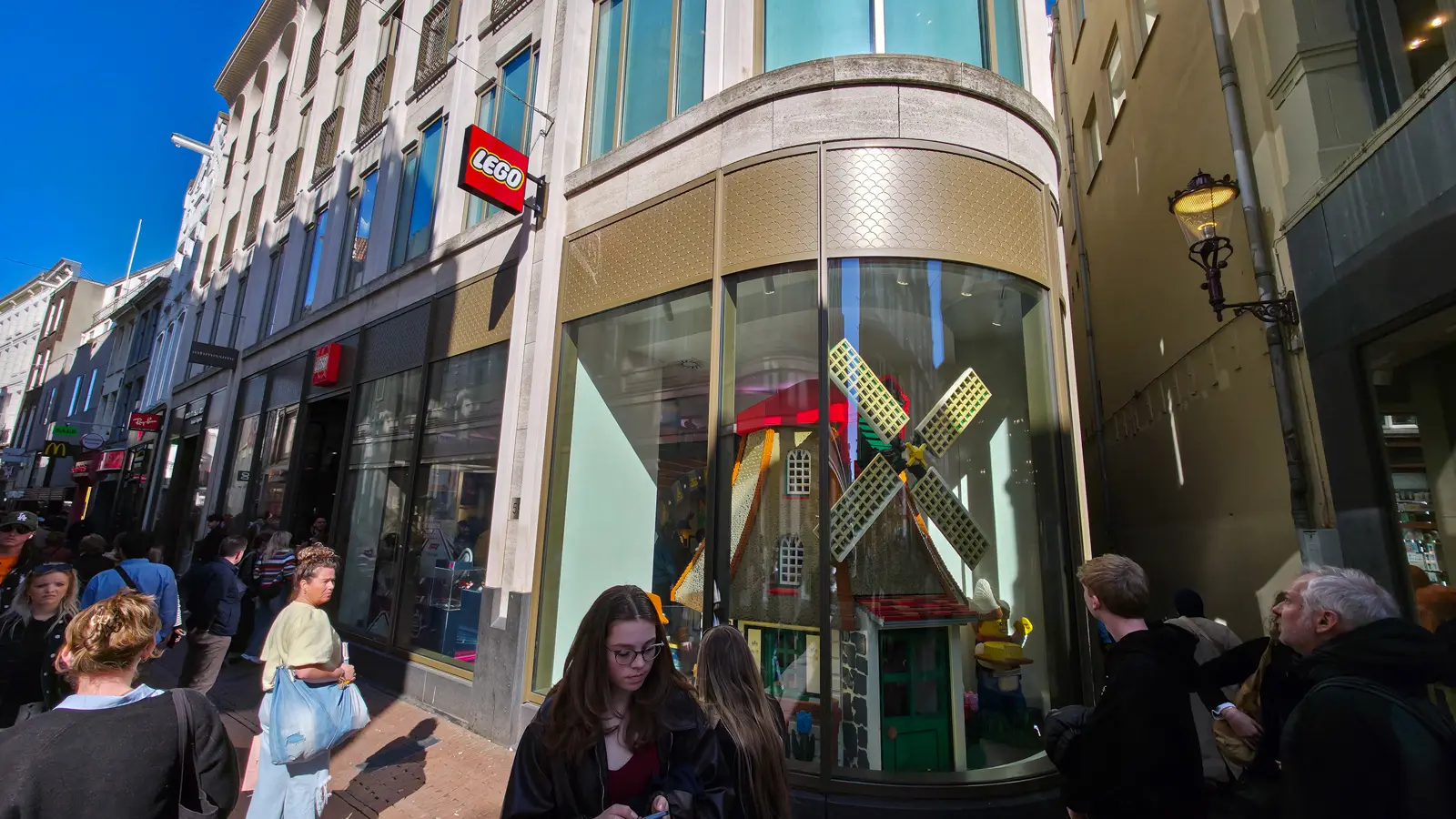
The shopfront itself is easy to miss in that crowd, which is a strange thing to say about a company with a logo that recognisable. The clue is the corner window, where a brick windmill stands behind the glass with its sails up.
A Store Built About Amsterdam
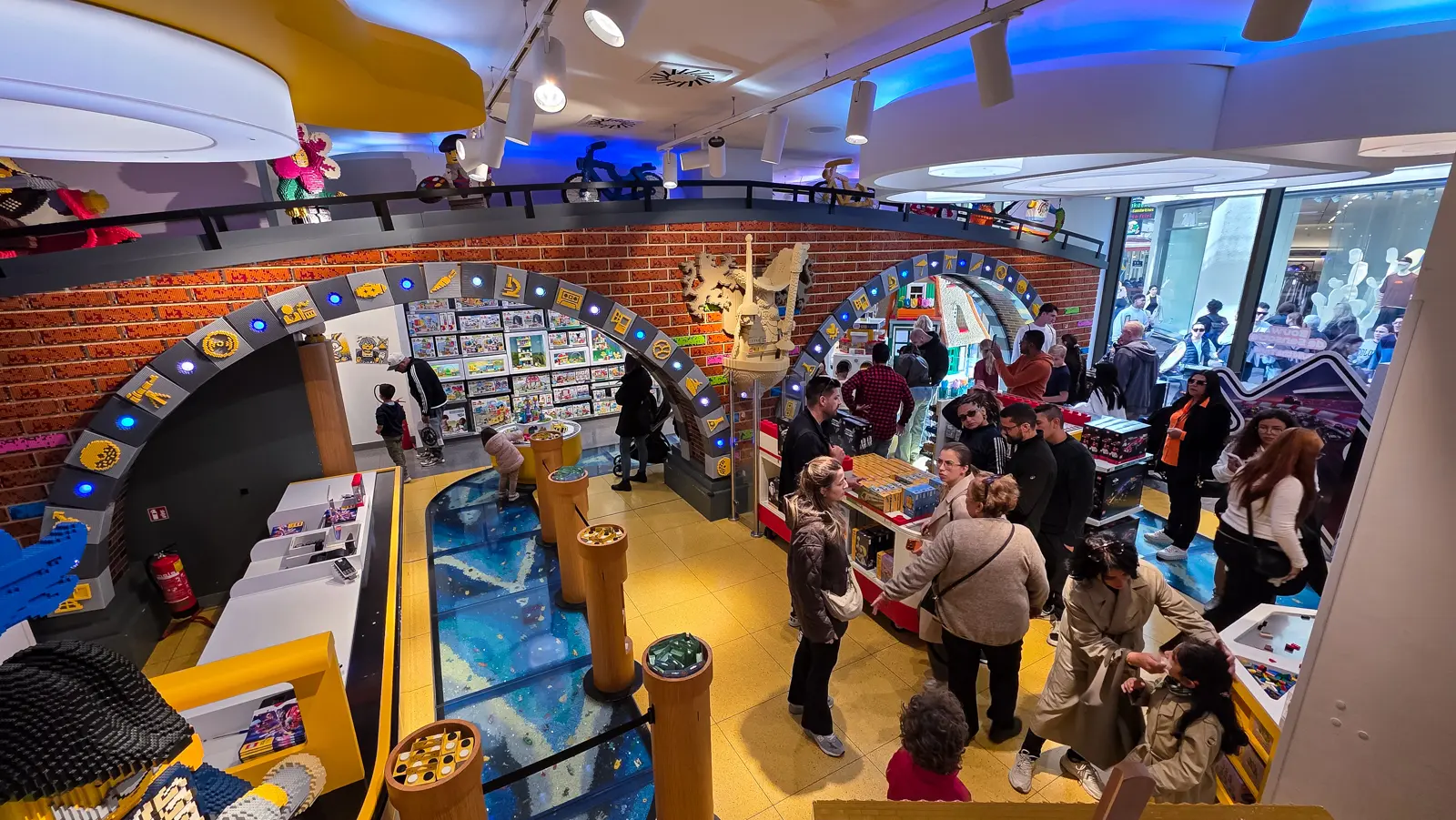
Walk in and the Munttoren is there, brick-built and lit, standing on a plinth in the middle of the ground floor. The plinth itself is a work surface, with loose bricks set out on it for children to build small boats.
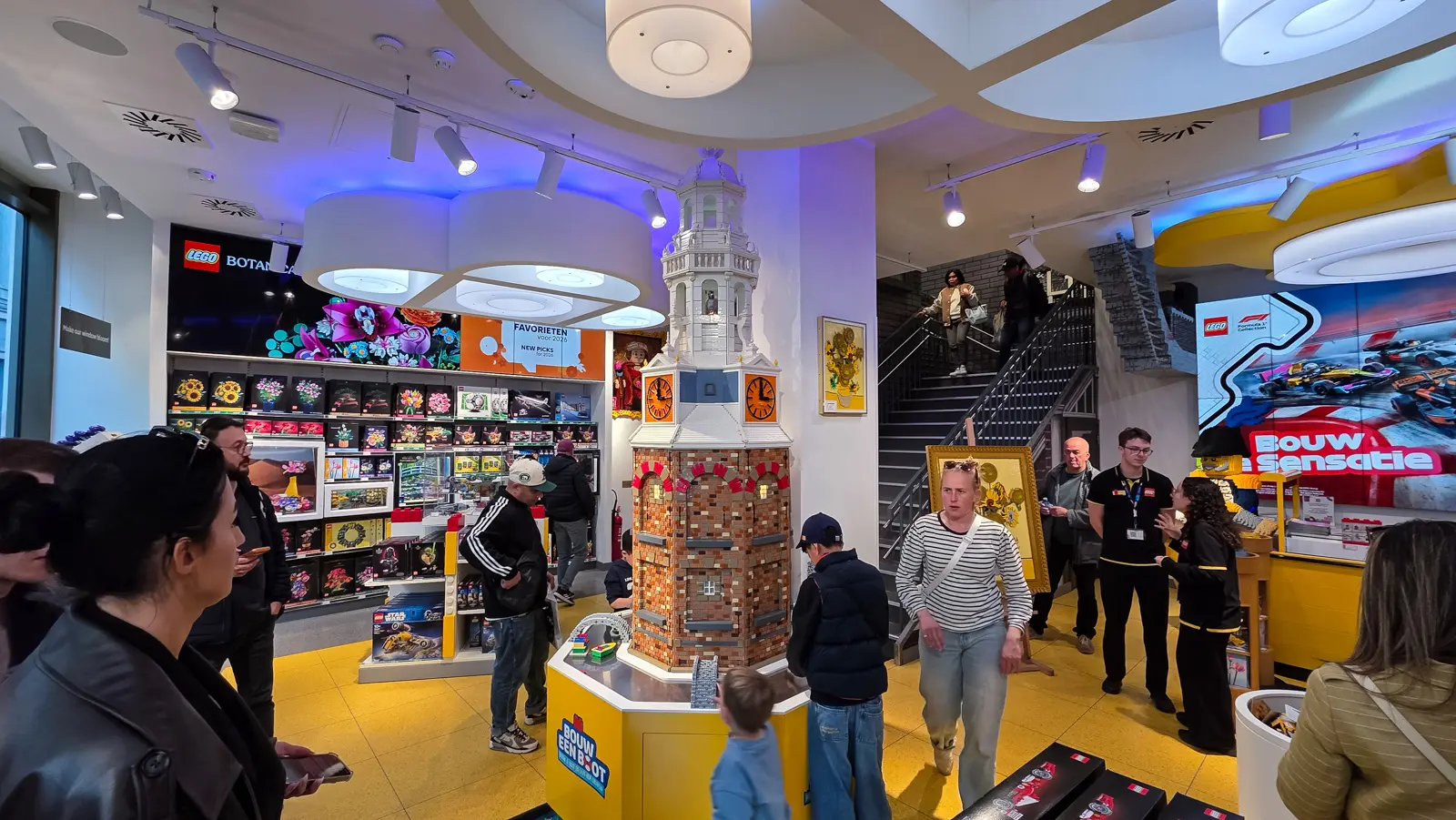
That is the tone of the place, and none of the water in it is wet. A canal runs across the ground floor, built in brick beneath a glazed panel, with fish in it. A bridge spans the store overhead carrying Dutch inventions rendered in brick, among them the cassette tape, the microscope and the artificial heart. None of it is for sale. All of it is there to make an argument about the city the shop happens to be in.
The Staircase
The best thing in the building is the way upstairs.
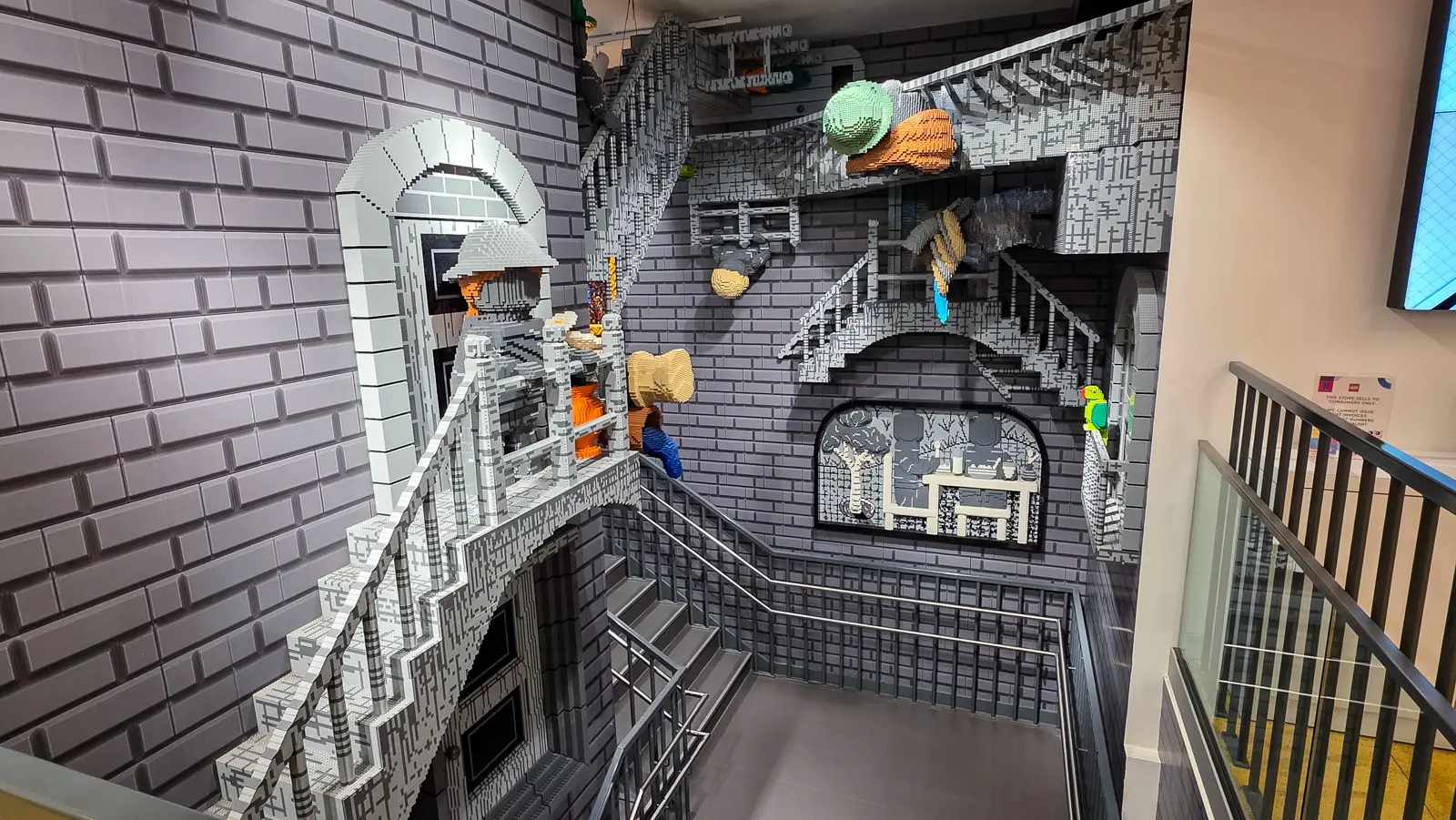
The stairwell has been built as a homage to M.C. Escher, the Dutch graphic artist whose drawings of impossible architecture are probably the most famous optical puzzles ever made. Flights of brick stairs run up the walls at angles that cannot coexist. Some are upside down. Hats, parrots and small objects sit on treads that face the wrong way, so the eye keeps trying to work out which surface is the floor and failing.
LEGO describes it as taking visitors from the bottom of the store to the top. In practice everybody stops halfway and looks up.
The Dutch Masters in Brick
The paintings are not gathered into one room. They are spread through the whole store, on the ground floor beside the stairs, along the stairwell, and across the walls of the upper level, so the gallery is something the shop keeps handing back rather than a single stop. They are LEGO versions of Dutch masterpieces, built as relief mosaics in gilt brick frames, and each one has been given a minifigure face. It should be terrible. It is not, because the building underneath is serious.
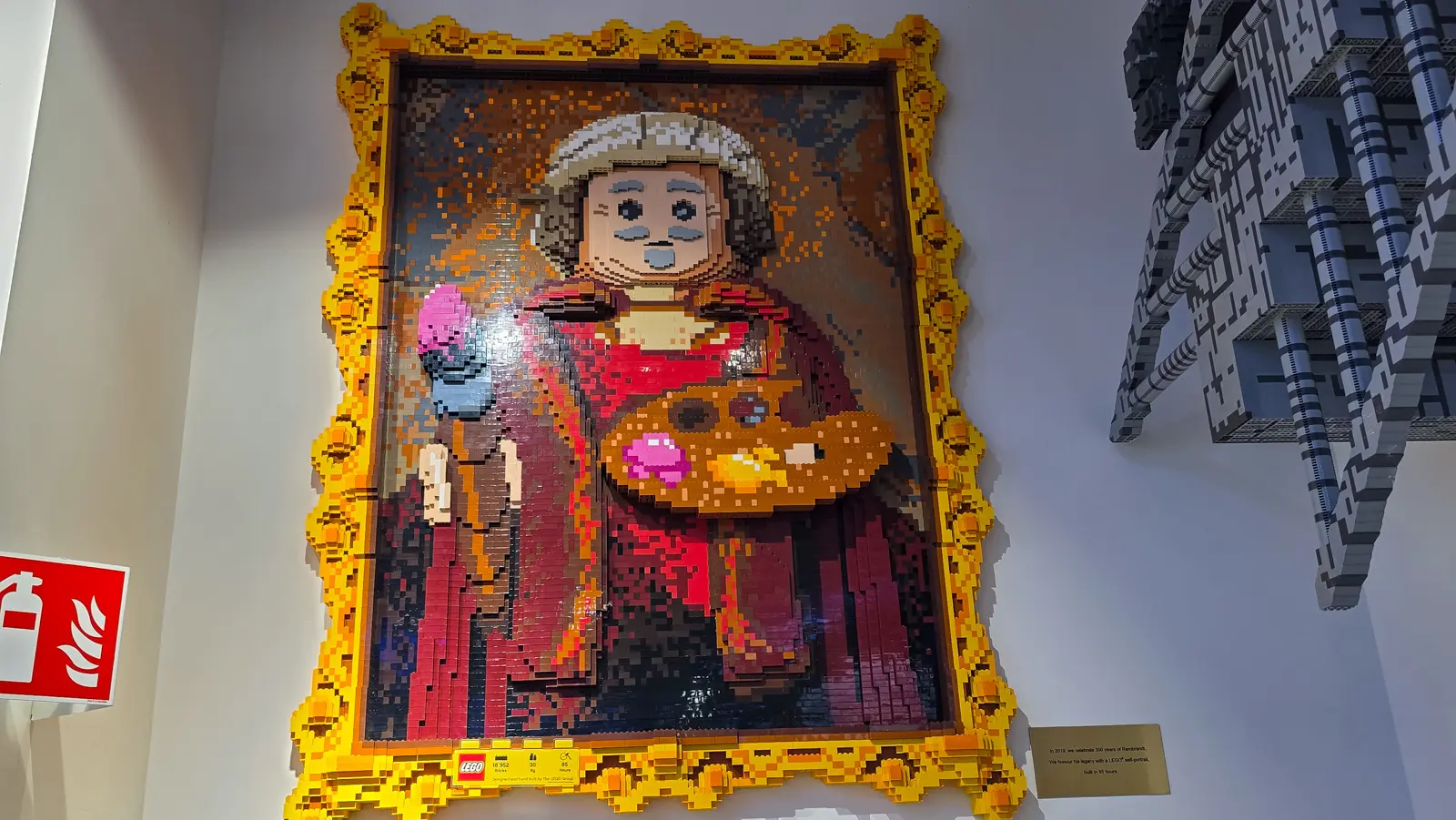
The Rembrandt is a self-portrait, and it comes with numbers. A plaque on the frame records 18,952 bricks, 30 kilograms and 85 hours of building, and a second plaque on the wall explains that it was made in 2019 to mark 350 years since his death.
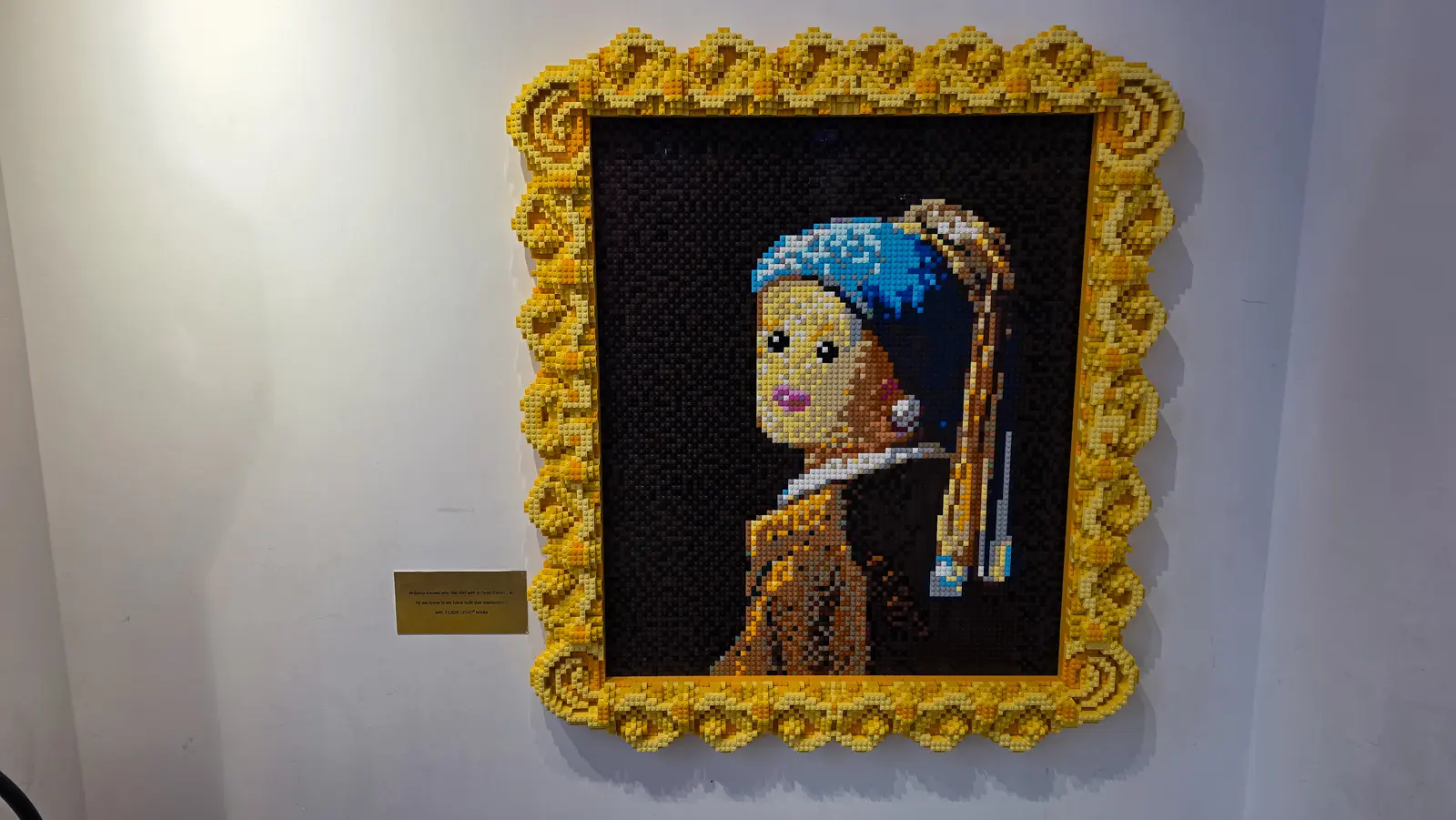
Next along is the Vermeer, the Girl with a Pearl Earring, and the plaque beside this one is the best piece of writing in the shop. It notes that nobody knows who the girl was, and adds that what they do know is that they built her out of 13,829 bricks.
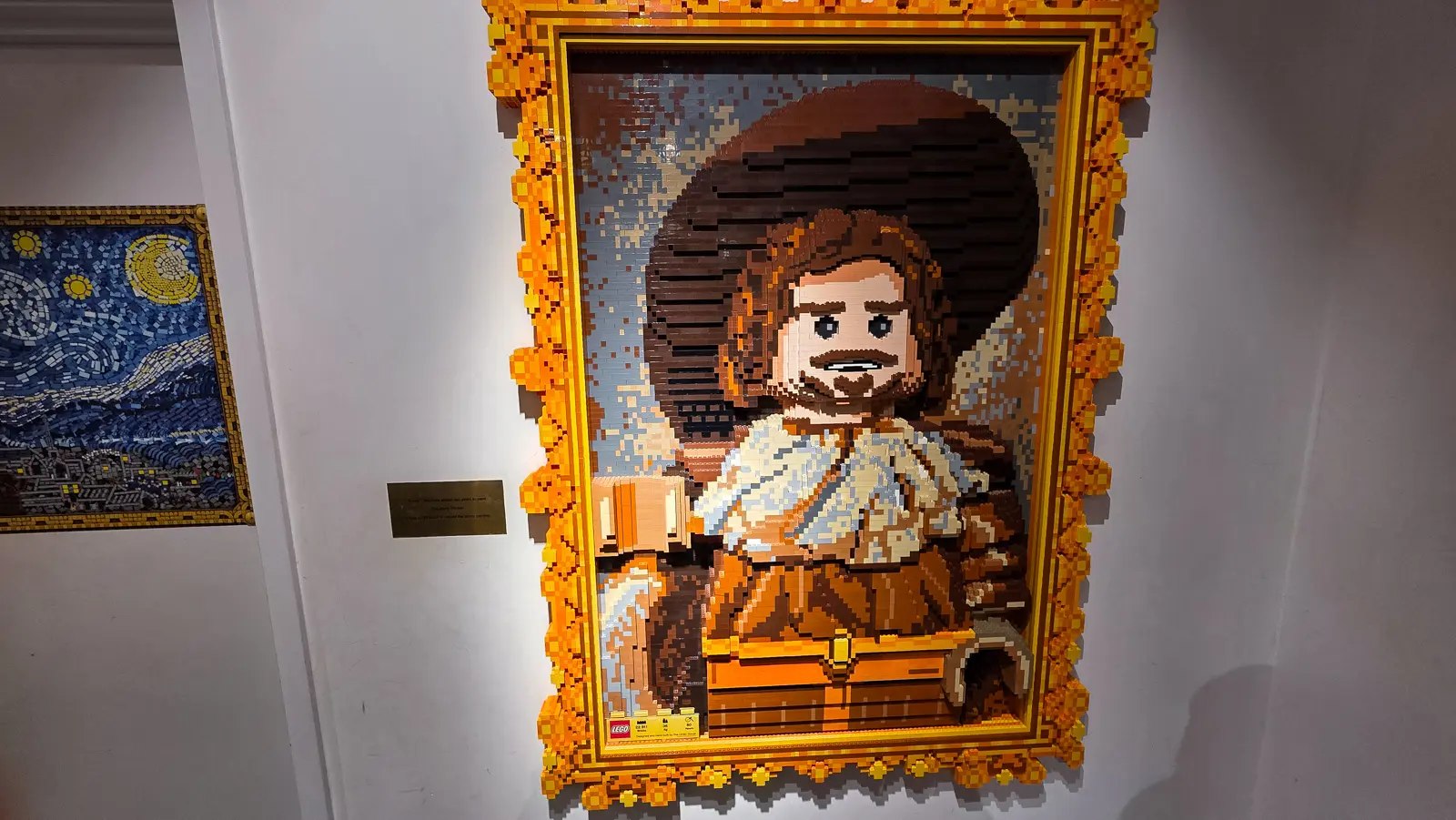
The third is Frans Hals, The Merry Drinker, with his hat and his glass and a grin that survives the translation into brick better than any of the others. The plaque claims the painting took Hals close to two years and the rebuild took eighty hours.
The Sunflowers
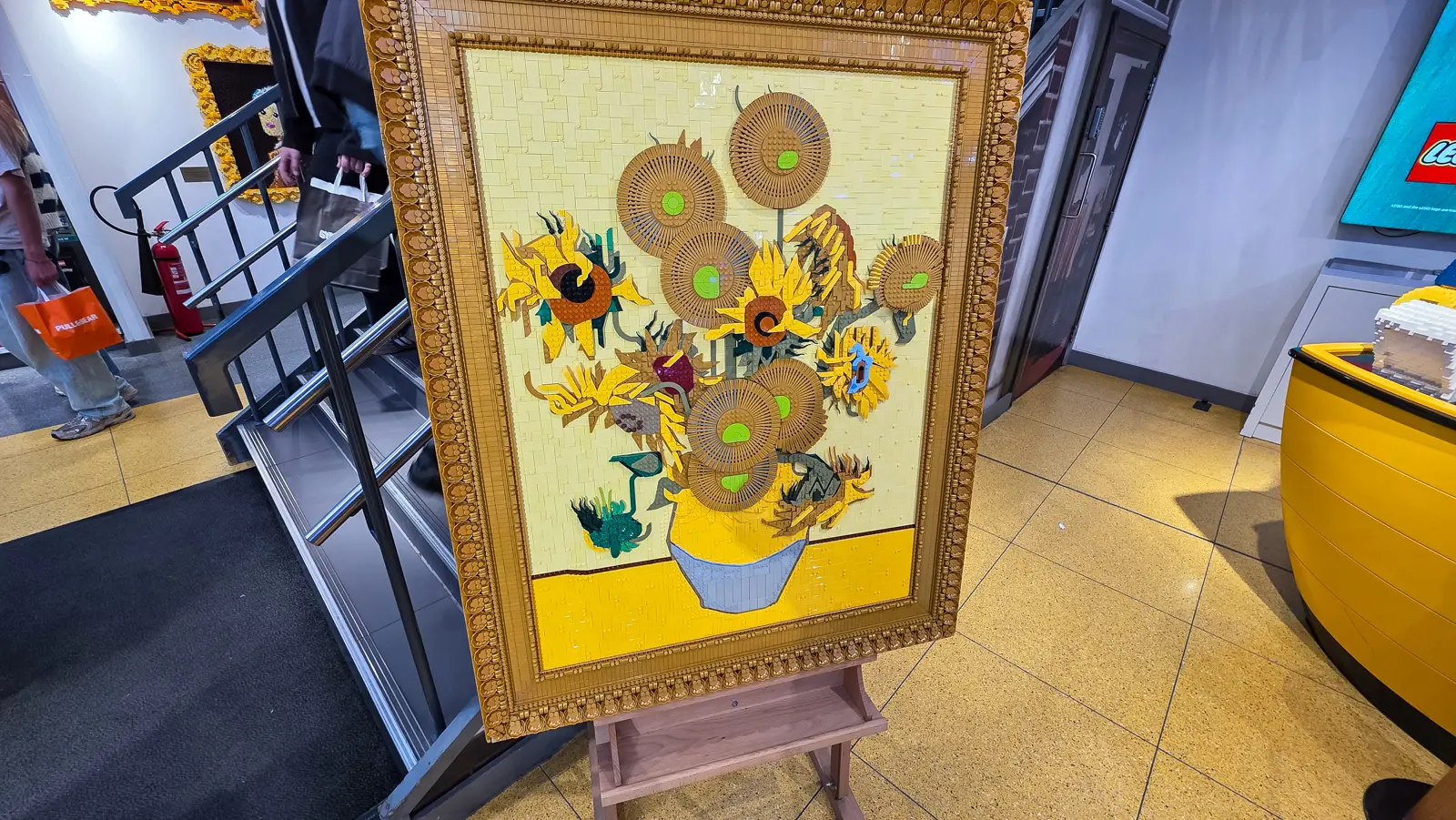
The one that stopped me was the Sunflowers, standing on a wooden easel rather than hanging, built as a proper three-dimensional relief with the flower heads raised off the surface.
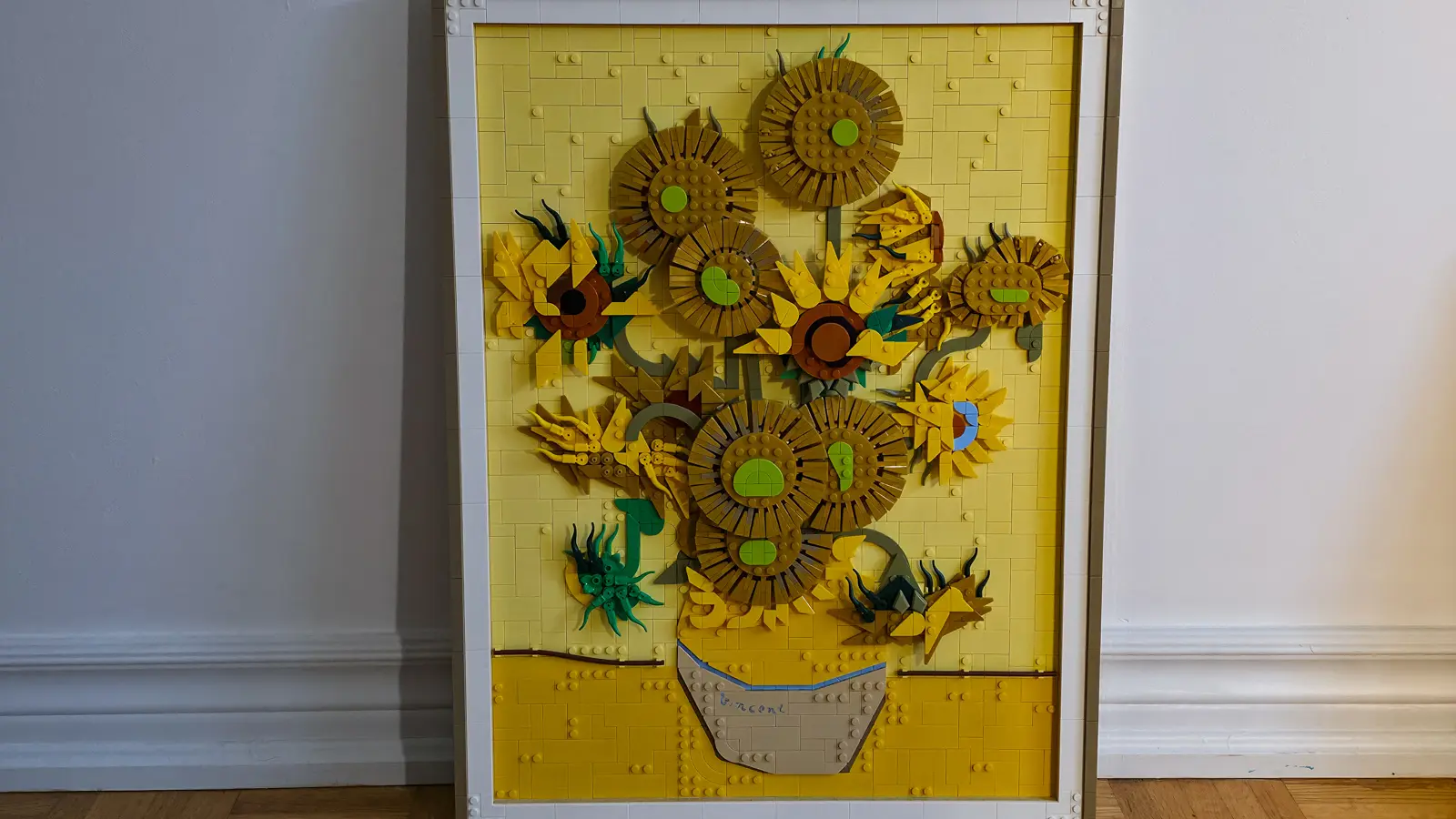
I have this one at home. It is the LEGO Art set, 2,615 pieces, made with the Van Gogh Museum, and it follows the museum’s own canvas rather than the London version. Building it took me more days than I want to write down, and standing in front of the shop’s larger display version was a slightly odd sensation, like meeting a bigger relative of something on my wall.
Here is mine, finished and framed.
Machines That Make Souvenirs
Two machines in the store turn visitors into the product, and both were busy the whole time I was there.
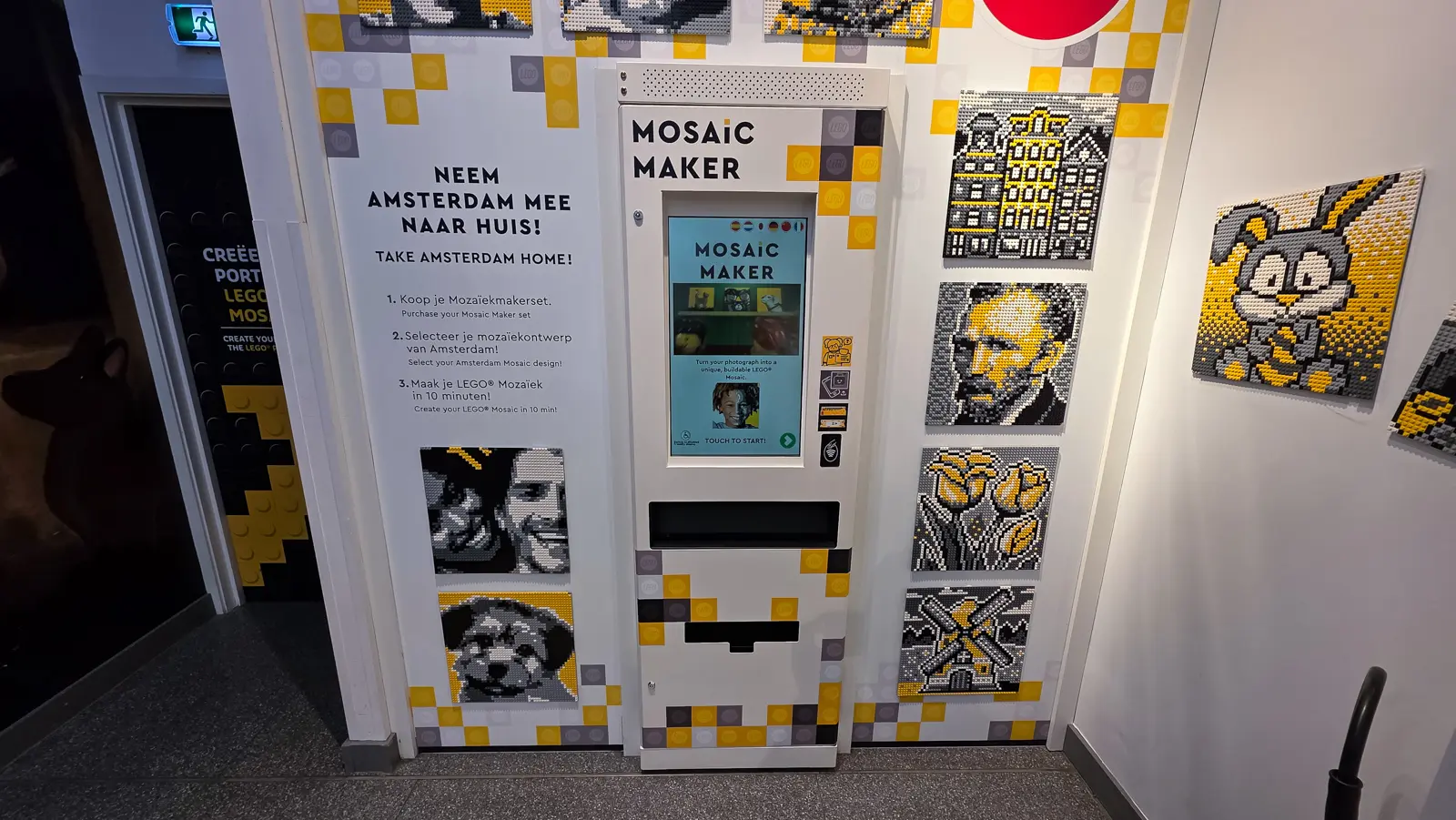
The Mosaic Maker photographs the customer and converts the image into a brick portrait, supplied as a kit to be built at home. The panel beside it advertises the local version of the idea, offering Amsterdam designs rather than a face: canal houses, tulips, a windmill, Van Gogh. It promises a ten minute build.
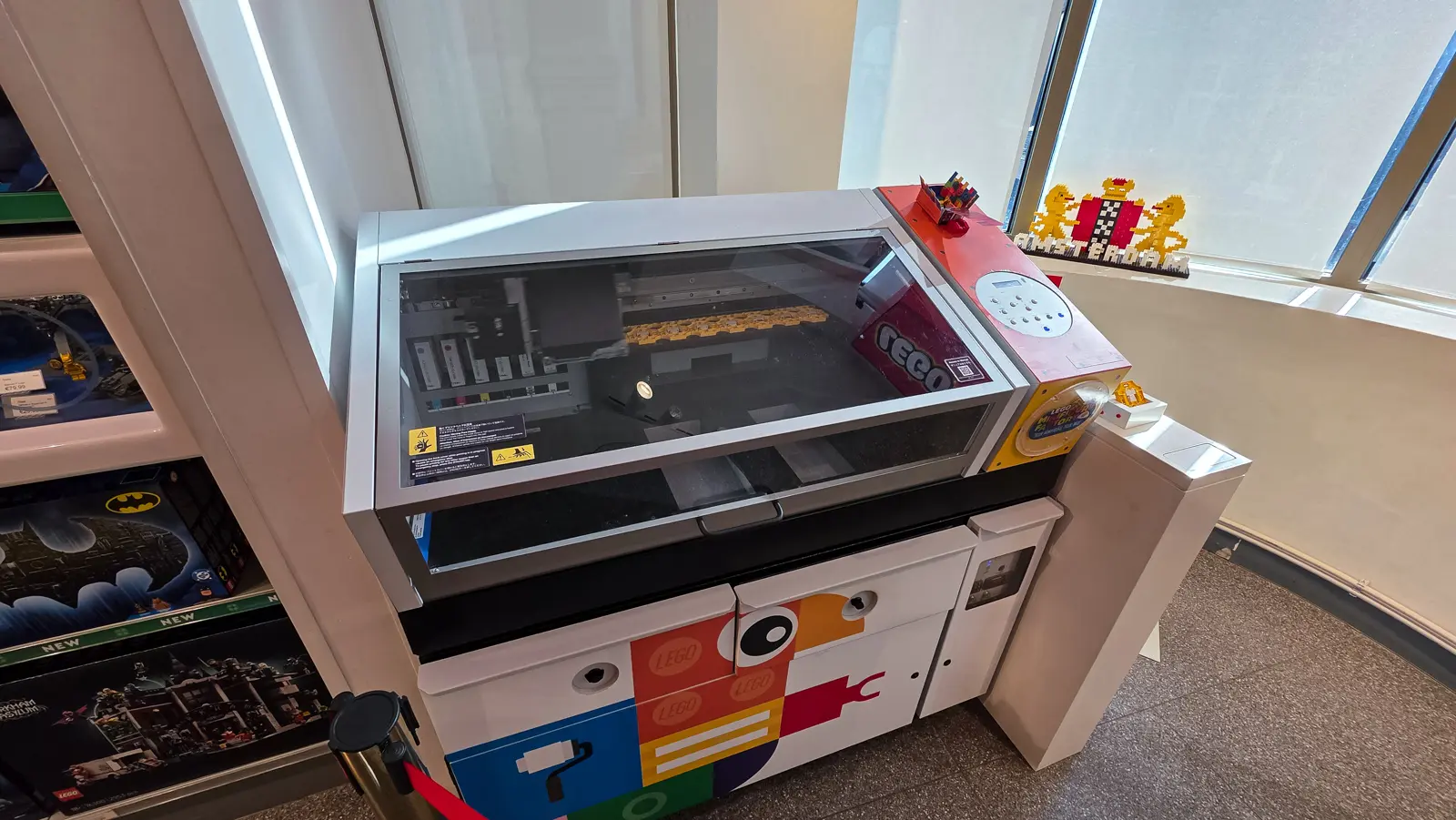
The Minifigure Factory does the smaller version. Pick a body, a head, a hairpiece and a design, and the machine prints a custom torso on the spot. As souvenirs go it beats most of what Kalverstraat sells, and it takes up no space in a suitcase.
The Business Story Behind the Shop
I studied this company at university, in management and marketing classes, as a case study in near-death and recovery. Standing in the middle of a store like this one, it is worth remembering how close it came to not existing.
In 2003 LEGO reported a pre-tax loss of 1.4 billion Danish kroner, with sales of play material falling by close to thirty per cent in a year. By early 2004 it was carrying around 800 million dollars of debt. The company had spread itself into theme parks, clothing, video games and publishing, and the range had swollen to roughly thirteen thousand product lines.
The board appointed Jørgen Vig Knudstorp as chief executive in 2004. He was thirty-five, a former McKinsey consultant, and the first person from outside the founding family to run the business in twenty-five years. What he did was mostly subtraction. The product range came down from about thirteen thousand lines to seven thousand. The Legoland parks were sold to Merlin Entertainments, with LEGO keeping the licensing and getting out of running them. Everything that was not the brick was cut, outsourced or sold.
What came back afterwards was licensing done the other way round, bringing other people’s worlds onto the brick rather than taking the brick into other businesses. That is the reason a shop like this can hold a four-year-old and a forty-year-old at the same time.
The stores are the visible end of that. This one is not a shop with some models in it. It is a small exhibition that happens to sell things, and it works because somebody decided the Amsterdam branch should be about Amsterdam.
Bubbly Tips
- Go for the building, not the shopping. The models, the staircase and the brick paintings are free to look at and none of them are for sale. Treat it as a twenty minute attraction and buy nothing if you like.
- Go early or late on a weekday. Kalverstraat is the busiest shopping street in Amsterdam and the store fills up accordingly. Mid-afternoon at a weekend is the worst of it.
- Take the stairs, not the lift. The Escher stairwell is the best thing in the building and the lift skips it entirely. Look up when you reach the half landing.
- Read the small plaques. The brick paintings each carry a plaque with the piece count and build hours, and the wall texts beside them are funnier than they need to be.
- Allow time for the Minifigure Factory. Designing and printing a custom minifigure takes longer than expected once there is a queue, and it makes a far better souvenir than a fridge magnet.
- The Mosaic Maker is a kit, not a finished picture. You take home a box and build it yourself, so factor in an evening at the other end rather than expecting a framed portrait on the spot.
- Bring children to the boat tables. The build-and-sail water around the Munttoren is genuinely designed for them, and it buys the adults ten minutes to look at the paintings.
- Pair it with the Munttoren and the flower market. The real tower is a two minute walk from the door, and the floating flower market runs along the Singel just beyond it.
- Ask about the store’s exclusive sets. Flagship stores stock things the smaller branches do not, and the staff will tell you which items are worth buying here rather than at home.
Final Thoughts
I went in for the reason anybody goes into a LEGO store, which is that I have never really stopped liking the things. What kept me there was the decision somebody made about what this particular branch should be. A windmill in the window, a canal under the floor, a Mint Tower by the door, Escher up the stairwell, and Rembrandt, Vermeer, Hals and Van Gogh along the wall upstairs.
None of that had to be there. A shop on the busiest street in the city would have sold the same boxes with plain white walls. Somebody argued for the harder version, and the result is the only toy shop I have ever left thinking about art history.
Until next time!

🌟 Everything You Need to Plan Your Dream Trip in 2026
- 🌟 Luxury Hotels - Find premium stays with Booking.com & Hotels.com
- 🏡 Vacation Rentals - Discover unique properties on VRBO
- 🏞️ Guided Tours - Explore with Viator or GetYourGuide
- 🎫 Attraction Tickets - Skip the lines with Tiqets
- 🚢 Ocean Cruises - Set sail with Cruise Direct
- 📱 International SIMs - Stay connected with Saily
- 🚗 Car Rentals - Budget-friendly options from Discover Cars
- 🌐 Secure VPNs - Browse safely with NordVPN
- 💶 Currency Exchange - Best rates with Wise
- 🗣️ Learn Languages - Master the local language with Babbel and Rosetta Stone