
Migration is not only a Greek story, or an Italian one. It belongs to everyone, everywhere, and it always has: the leaving, the packing of a whole life into one suitcase, and the arriving as a stranger somewhere new. That is what I kept turning over in a small room at Tate Modern in London, in front of the work of an artist I had never heard of, whose entire subject was that experience.
His name was Vlassis Caniaris, a Greek who spent much of his life in exile and made his most important work about migrants: people who leave with almost nothing and build a life out of it. I stood there far longer than I meant to, because I was not only looking at art. I was looking at my mother.
Caniaris’s Migrant Rooms at a Glance
🧳 The artist · Vlassis Caniaris (1928–2011), a Greek who lived much of his life in exile and made his best-known work about migrants and guest workers.
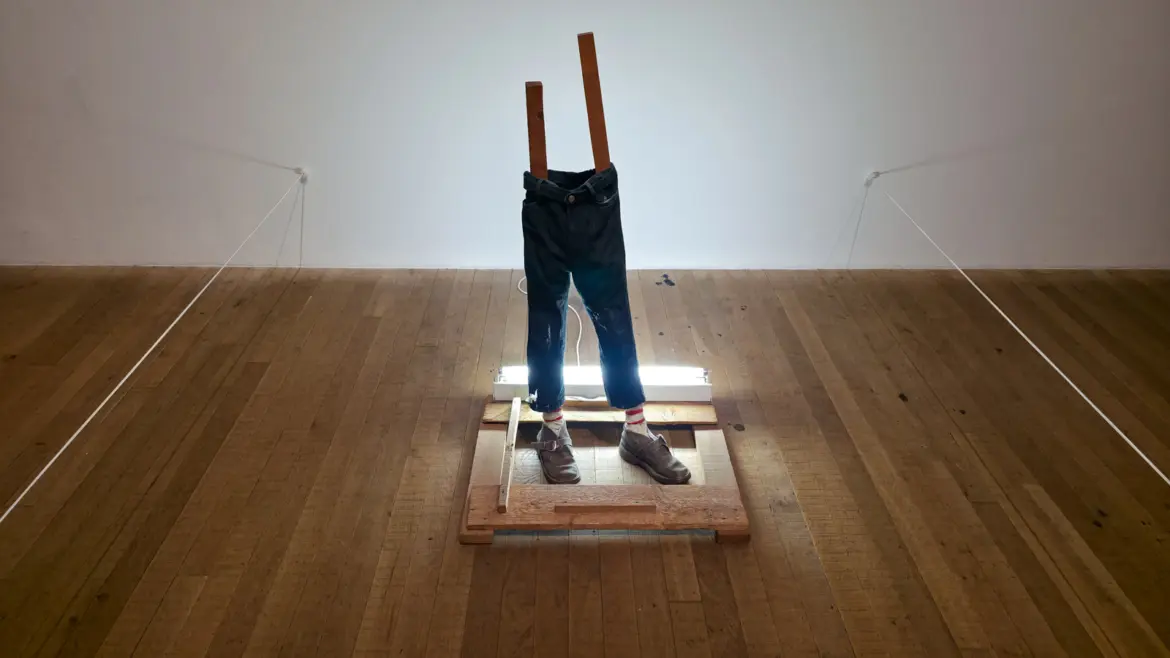
👤 The figures · Life-size, faceless people made from wood, wire, plaster and worn clothes, reduced on arrival to what they wear and what they can do.
🏠 The rooms · Whole migrant environments built from newspapers, packing cases, battered suitcases, and a child’s toys under plastic sheeting.
🎟️ Cost · Free, part of Tate Modern’s Artist and Society collection displays. No ticket, no booking. Displays rotate, so this room may not always be up.
💡 Note · A quiet corner most visitors walk past, not a headline attraction. That is part of its gift.
The artist who lived it
Caniaris knew displacement from the inside. Born in Athens in 1928, he trained first in medicine and then in art, and from the late 1950s he lived between Rome and Paris. When a military junta, the Colonels, seized power in Greece in 1967, he went home and made furious work against it, everyday objects cast in plaster and wrapped in barbed wire. Before long, the censorship and surveillance of the regime made staying and working impossible, and he left once more. In the mid-1970s, on a scholarship in West Berlin, he began the work he is best remembered for: the Gastarbeiter, the guest workers.
These were the millions who moved from southern Europe to the north after the Second World War, invited under labour agreements to take the jobs the recovering economies could not fill. Greeks, Italians, Spaniards, Portuguese, Turks. They arrived as needed hands and were often regarded as little more than that. Caniaris, an exile himself, made room after room about their lives. He settled back in Greece for good only in 1976, two years after the junta fell.
What the rooms hold
The first thing I saw was a figure with no face.
Caniaris made his migrants life-size, from wood and wire and plaster. This one is barely a body at all: a pair of worn corduroy trousers and scuffed shoes, standing upright on a board, lit from beneath. No head, no hands, no face. And yet it is unmistakably a person, because a person is exactly what it is: someone reduced, on arrival, to what they are wearing and what they can do. Someone not yet given a name, or a language, or a place. I have rarely seen the plain fact of arriving somewhere new put so directly.
Nearby, he built the room such a person might come home to.
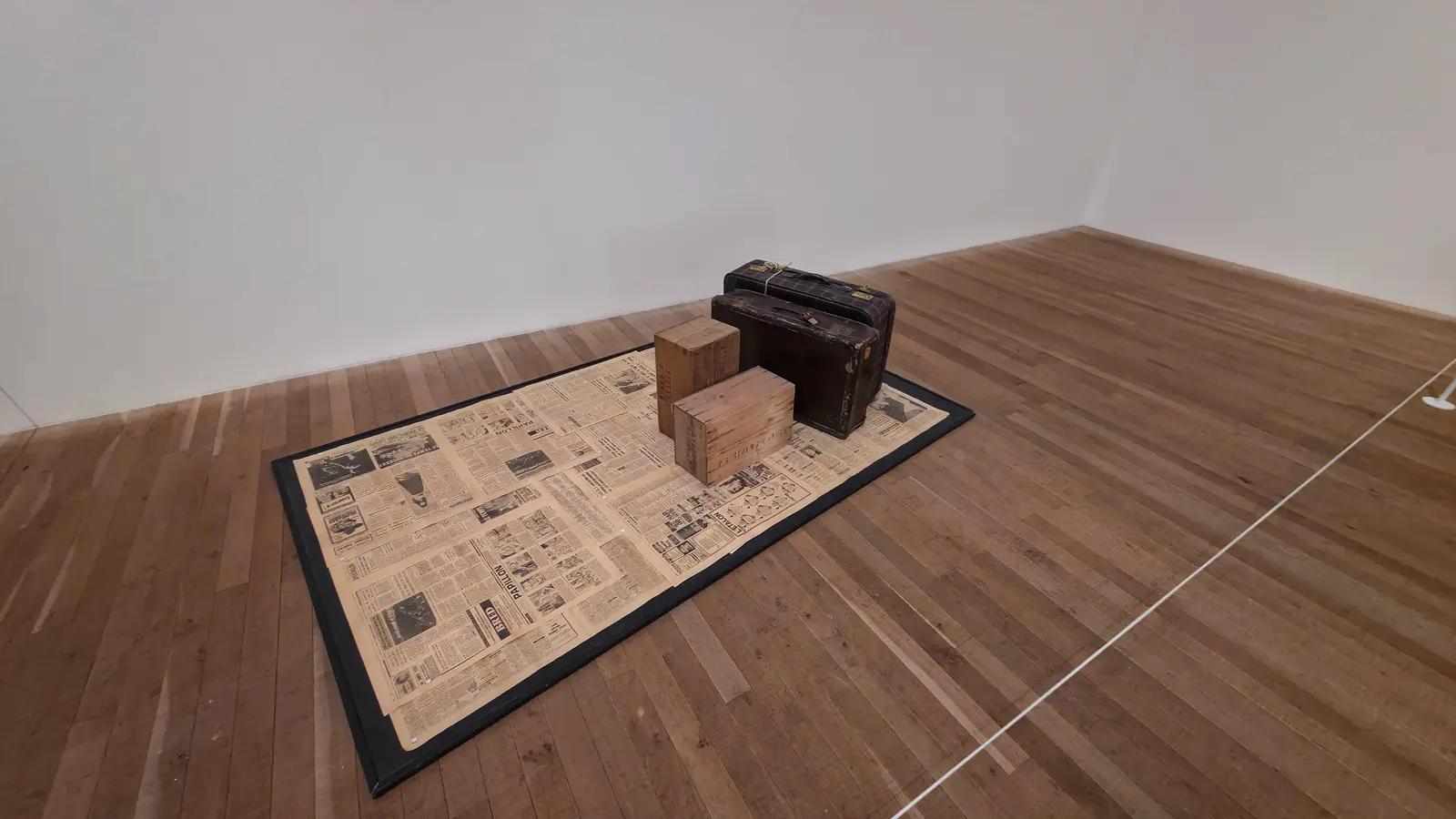
Newspapers spread across the floor in place of a carpet. Wooden packing cases for chairs. Two battered suitcases. It is a whole life assembled from whatever was to hand, which is exactly how these lives were assembled.
And in the largest piece, the provisional world of the guest worker spreads out under sheets of plastic.
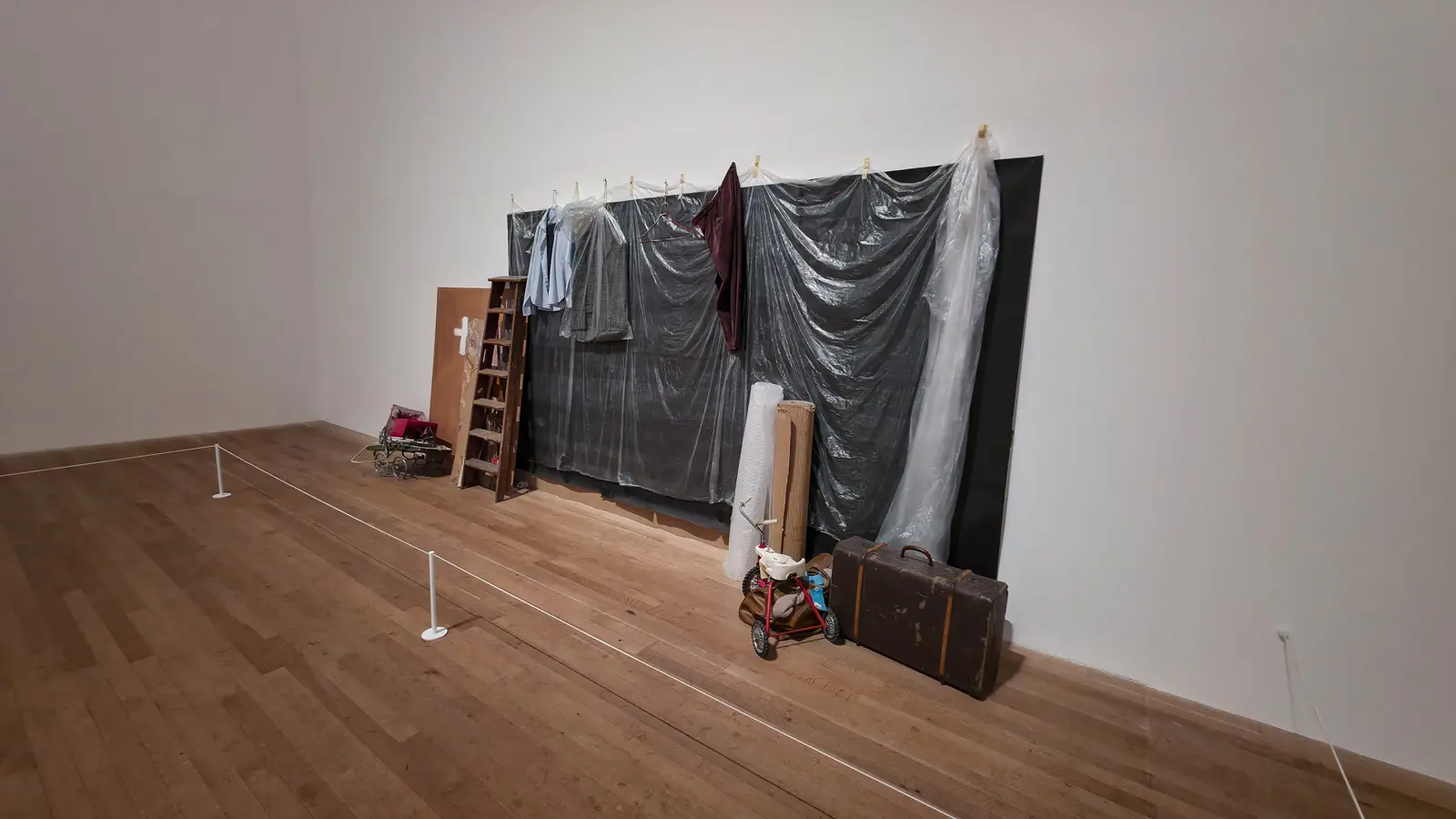
Clothes hang on a black board, half-covered in polythene, as if everything were still in transit and might be packed away again at any moment. A stepladder. A suitcase. And, quietly, the toys: a child’s tricycle, a doll’s pram. Because migrants rarely arrive alone. They bring children, or send for them, and the next generation grows up in this half-settled place, under the plastic, between one country and the next.
My mother’s suitcase
This is where the room stopped being about strangers.
My mother left Greece as a young woman, with her siblings, for the reason almost everyone leaves: the promise of something better. Their parents followed a few years later. They were part of a great wave of Greeks, and Italians alongside them, who crossed to North America in those decades, and she has always counted herself fortunate to have had the chance.
But fortunate does not mean easy. She arrived, like Caniaris’s figures, with very little, and without the language. Work is hard to find without the words for it, and harder still to build into anything lasting. Everything had to be made from almost nothing, and made anyway, so that the family who came after her, so that I, would have more than she began with.
That is why these rooms undid me a little. Caniaris left his figures faceless on purpose, and standing there I understood why. A face would have made them one particular person, from one particular place. Without it, they are everyone: the Turkish worker in Berlin, the Italian in Toronto, my Greek mother arriving with her suitcase and her few words, and whoever is arriving somewhere new, frightened and hopeful, today.
Practical notes
Caniaris’s work sits in Tate Modern’s free collection displays, in the Artist and Society wing, so there is no ticket and no booking. As with all the collection rooms, the displays change over time, so this particular one may not always be up, and the Tate website lists what is currently on show. It is a quiet corner rather than a headline attraction, which is part of its gift.
Final Thoughts
I came to Tate Modern for the colour and the famous names, and I found them. But this quiet room is the one I carried home.
Caniaris understood something a great deal of louder art misses: that the largest histories are made of the smallest things. A suitcase. A pair of shoes. A newspaper on the floor. A child’s tricycle in a room still wrapped in plastic. He turned migration from a statistic into a person, or rather into a person-shaped space that almost any of us can step into, because almost all of us, a generation or two back, came from somewhere else.
I admire my mother more than I know how to say, for the leaving and the arriving and the long years of building from very little. Standing in front of that faceless figure, her journey came closer to me than it ever had, and I walked out more grateful for it. That is what art like this can do, and it is reason enough to seek out the rooms most people walk straight past.
Until next time,

🌟 Everything You Need to Plan Your Dream Trip in 2026
- 🌟 Luxury Hotels - Find premium stays with Booking.com & Hotels.com
- 🏡 Vacation Rentals - Discover unique properties on VRBO
- 🏞️ Guided Tours - Explore with Viator or GetYourGuide
- 🎫 Attraction Tickets - Skip the lines with Tiqets
- 🚢 Ocean Cruises - Set sail with Cruise Direct
- 📱 International SIMs - Stay connected with Saily
- 🚗 Car Rentals - Budget-friendly options from Discover Cars
- 🌐 Secure VPNs - Browse safely with NordVPN
- 💶 Currency Exchange - Best rates with Wise
- 🗣️ Learn Languages - Master the local language with Babbel and Rosetta Stone