
I have loved Botticelli since I was a girl. Long before I understood anything about the Renaissance, I knew those faces: the tilt of a head, the pale gold hair, the calm that sits over even his busiest paintings. The two pictures that did it were the Birth of Venus and Primavera, and years later I stood in front of both of them at the Uffizi in Florence.
What I did not expect was how much of the Botticelli story is told in London. The third of his great mythologies, Venus and Mars, never went to the Uffizi at all. It has hung in the National Gallery since 1874. And London holds something Florence cannot offer in quite the same way: the second half of his life, when the painter of pagan beauty turned grave and strange under the preaching of a Dominican friar. So this is the Botticelli post about everything that came after the seashell: the marriage panels, the saints, and the apocalypse over Florence.
Botticelli at the National Gallery at a Glance
📍 Where · Sainsbury Wing, National Gallery, Trafalgar Square, London WC2N 5DN. The Botticellis hang with the early Italian Renaissance pictures.
💷 Entry · Free, like the rest of the permanent collection. Book a free timed ticket for fast-track entry.
🖼️ Key works · Venus and Mars, the circular Adoration of the Kings, Portrait of a Young Man, the Mystic Nativity, and two Saint Zenobius panels.
⭐ Don’t miss · The Mystic Nativity of 1500, the only painting Botticelli ever signed, with a Greek inscription running along the top.
🇮🇹 Pair with Florence · Venus and Mars lives here. The Birth of Venus and Primavera are in the Uffizi. Together they are his three great mythologies.
🕙 Quietest time · Friday evenings, when the gallery stays open until 9pm and the Florentine rooms empty out.
⏱️ Time needed · About an hour for the Botticellis alone, longer for the rest of the collection.
The mythology that stayed in London
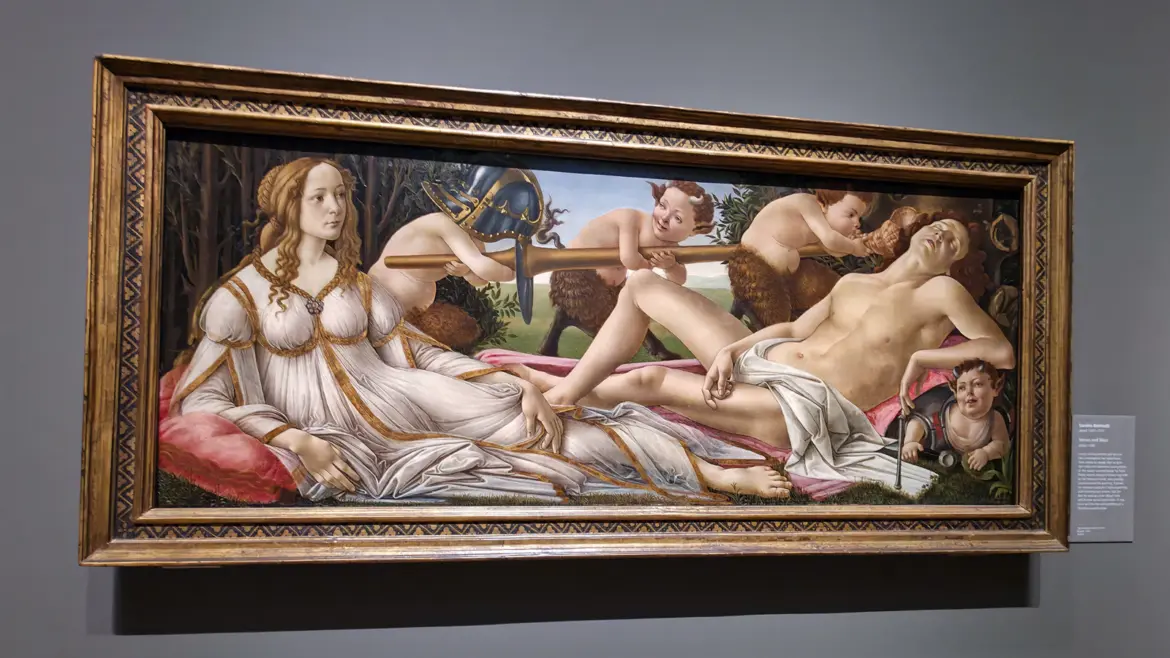
Venus and Mars hangs in the Sainsbury Wing among the other Florentine pictures. Venus reclines on the left, awake, dressed and composed. Mars sprawls opposite her, fast asleep, having clearly lost whatever contest just took place. Four baby satyrs play with his abandoned armour. One has wriggled inside his breastplate, one shoulders his enormous lance, and one blows a conch shell straight into his ear without waking him. A swarm of wasps hovers by his head. It is comic and a little bawdy, but also tender, which is part of why it was probably painted to celebrate a marriage. Panels of this long, low shape were set into the panelling or furniture of a bedchamber, and the myrtle behind Venus was a traditional symbol of marriage.
The National Gallery dates it to around 1485. The wasps may be a private joke: the Italian word for wasp is vespa, and the Vespucci family, neighbours of Botticelli and possibly his patrons, took their name from them. What struck me, having come to it straight from my memory of the Birth of Venus, is how different this Venus looks. She is not a classical nude rising from the sea but a contemporary Florentine woman, fully clothed, her hair threaded into the fabric of her dress. The same artist, the same goddess, an entirely worldlier mood.
The establishment painter
To understand why his later turn is so surprising, it helps to know how completely Botticelli belonged to the ruling world of Florence. He trained under Fra Filippo Lippi, whose own Seven Saints hangs a few rooms away, joined the painters’ confraternity in 1472, and spent most of his career working for the Medici and their circle. In 1481 the Pope summoned him to Rome to help paint the walls of the Sistine Chapel.
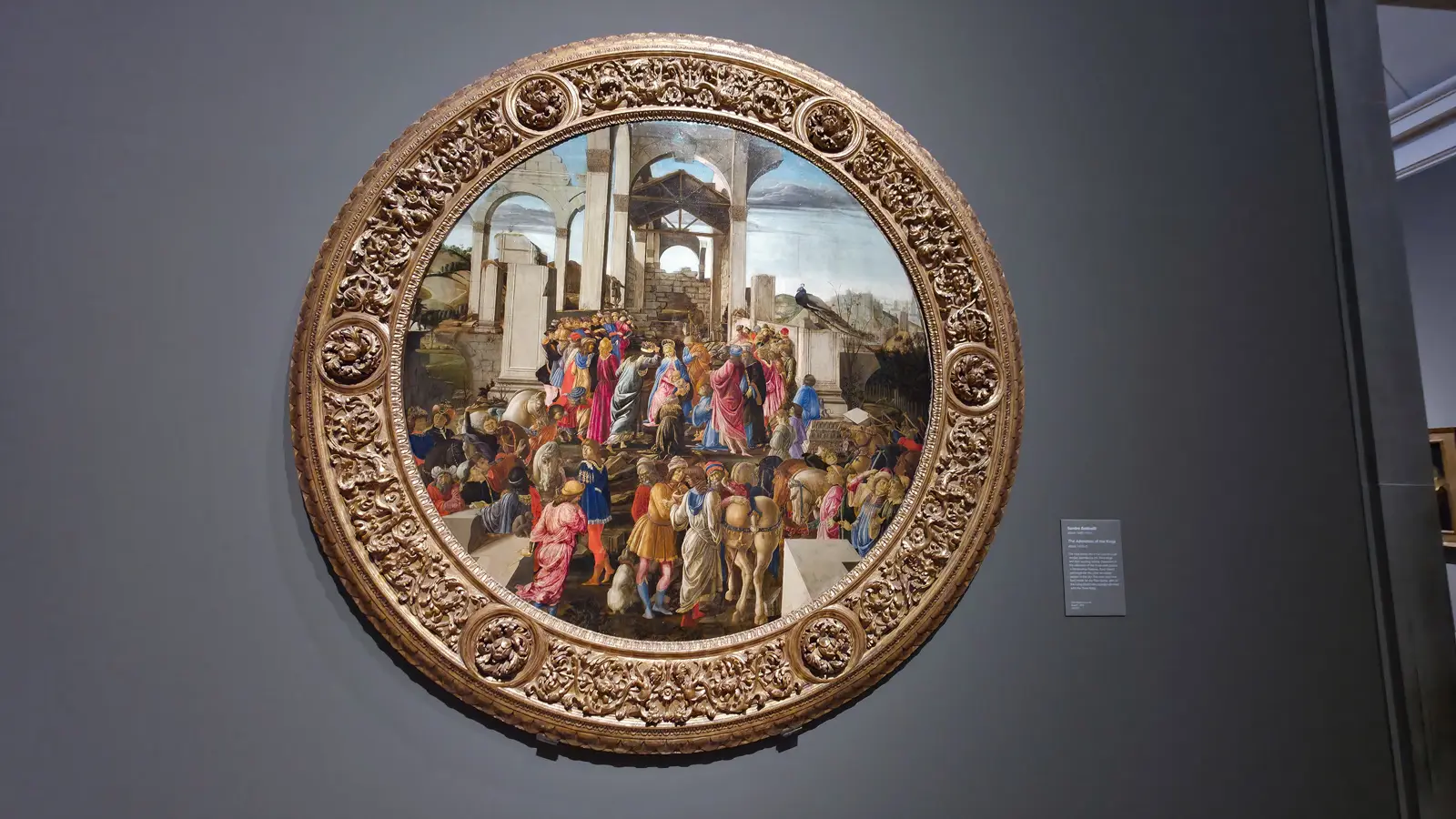
The National Gallery’s circular Adoration of the Kings, painted around 1470 to 1475, shows him at his most ambitious in that role. The format is a tondo, a round panel, and Botticelli fills it with a great crowd turning inward towards the Virgin and Child, who are raised on a rock so that the whole company, and the visitor standing in front of it, look up to them. Behind them a grand classical building lies in ruins, a common Renaissance shorthand for the old pagan world giving way to the new Christian one. The picture may once have belonged to the Pucci family, and it nods to the Medici, who loved the subject of the three kings and identified with them. The famous version crowded with Medici portraits is the one in the Uffizi; this London tondo is a different, earlier picture.
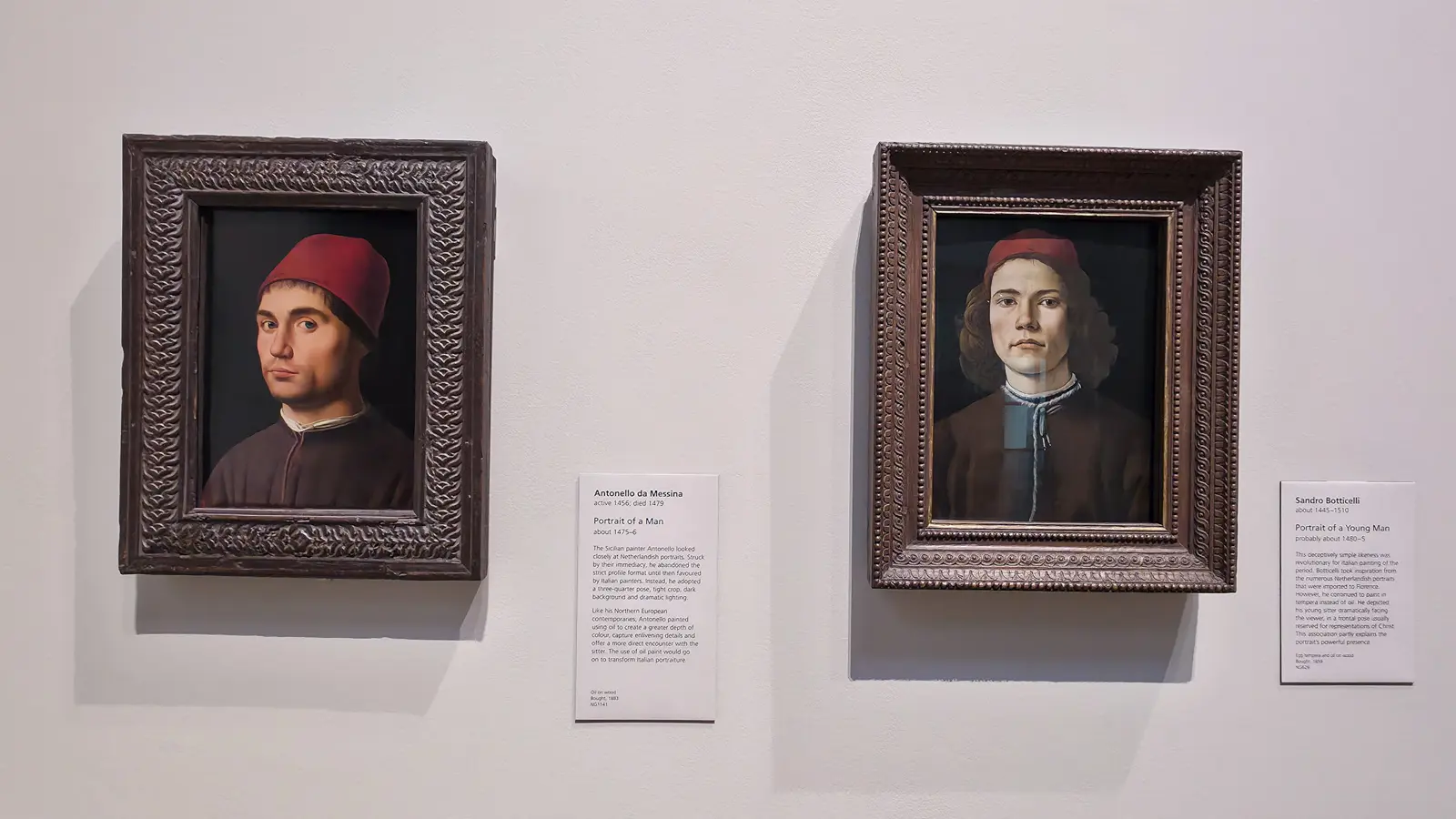
A few steps away is a quieter triumph. Hung beside a portrait by the Sicilian painter Antonello da Messina, Botticelli’s Portrait of a Young Man, from about 1480 to 1485, shows an unknown youth looking straight out of the frame. That full, forward-facing pose was unusual. It was the pose normally kept for images of Christ, and it lends the young man a directness and presence beyond his years. Botticelli had clearly studied the Netherlandish portraits arriving in Florence, though he kept working in egg tempera, while Antonello, right next to him, had taken up the new oil technique from the North. Two answers to the same foreign influence, side by side on one wall.
When the city turned
Then Florence changed. In 1494 the Medici were driven out, a French army marched through Italy, and into the vacuum stepped Girolamo Savonarola, a Dominican friar whose sermons drew enormous crowds to the cathedral. He told Florentines that their luxuries and their art were sins, and that the city could become a new Jerusalem if it repented. His followers, nicknamed the piagnoni, or weepers, gathered up mirrors, fine clothes, books and paintings and burned them in the Bonfire of the Vanities in 1497. Savonarola’s rule did not last. He made powerful enemies, was excommunicated, and in 1498 he was hanged and his body burned in the very square where the bonfire had stood.
According to Vasari, the sixteenth-century biographer of artists, Botticelli became a devoted follower of Savonarola, gave up painting, and fell into poverty. Modern scholars are more cautious. Botticelli kept working well into the 1500s, and his brother Simone was the more committed follower of the friar. The old tale that Botticelli threw his own pagan pictures onto the bonfire is just that, a tale, and not one Vasari actually tells. What is not in doubt is that something in his painting changed.
The late paintings
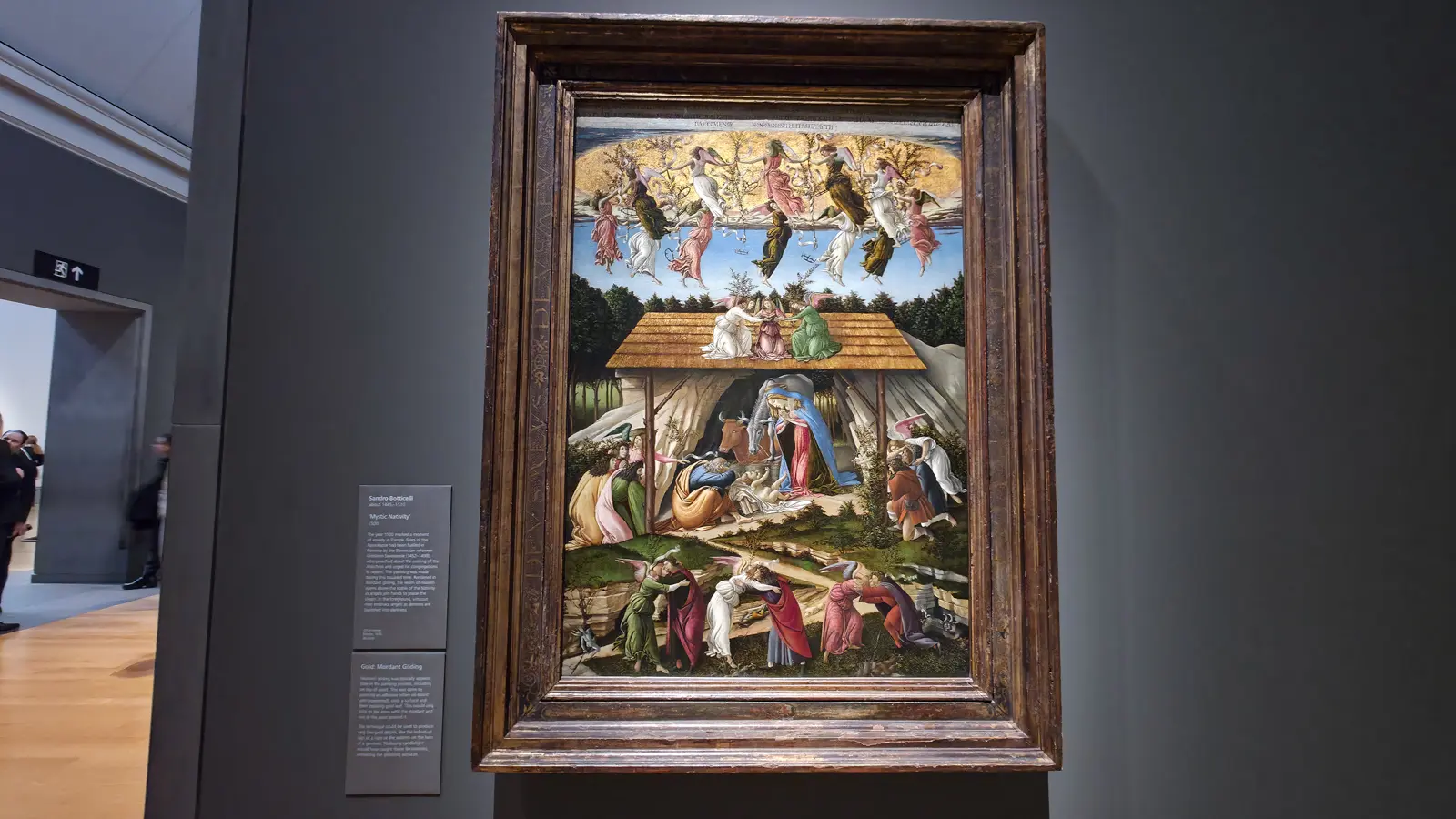
The pictures Botticelli made around 1500 are smaller in spirit and graver in mood than the mythologies, and the most ambitious of them hangs in the same wing. The Mystic Nativity, dated 1500, is the only painting he ever signed. Across the top runs a Greek inscription in which he names himself, “I, Alessandro”, and ties the work to “the troubles of Italy”, reading the chaos around him through the Book of Revelation and its account of the devil loosed upon the world before his final binding. Twelve angels wheel around the opened gold dome of heaven, carrying olive branches. At the bottom, three pairs of angels and men embrace while small horned devils scuttle away into cracks in the rock. It is a Nativity and an apocalypse at the same time, painted by a man who seems to have believed he was living at the end of the world. The link to Savonarola’s preaching is hard to miss.
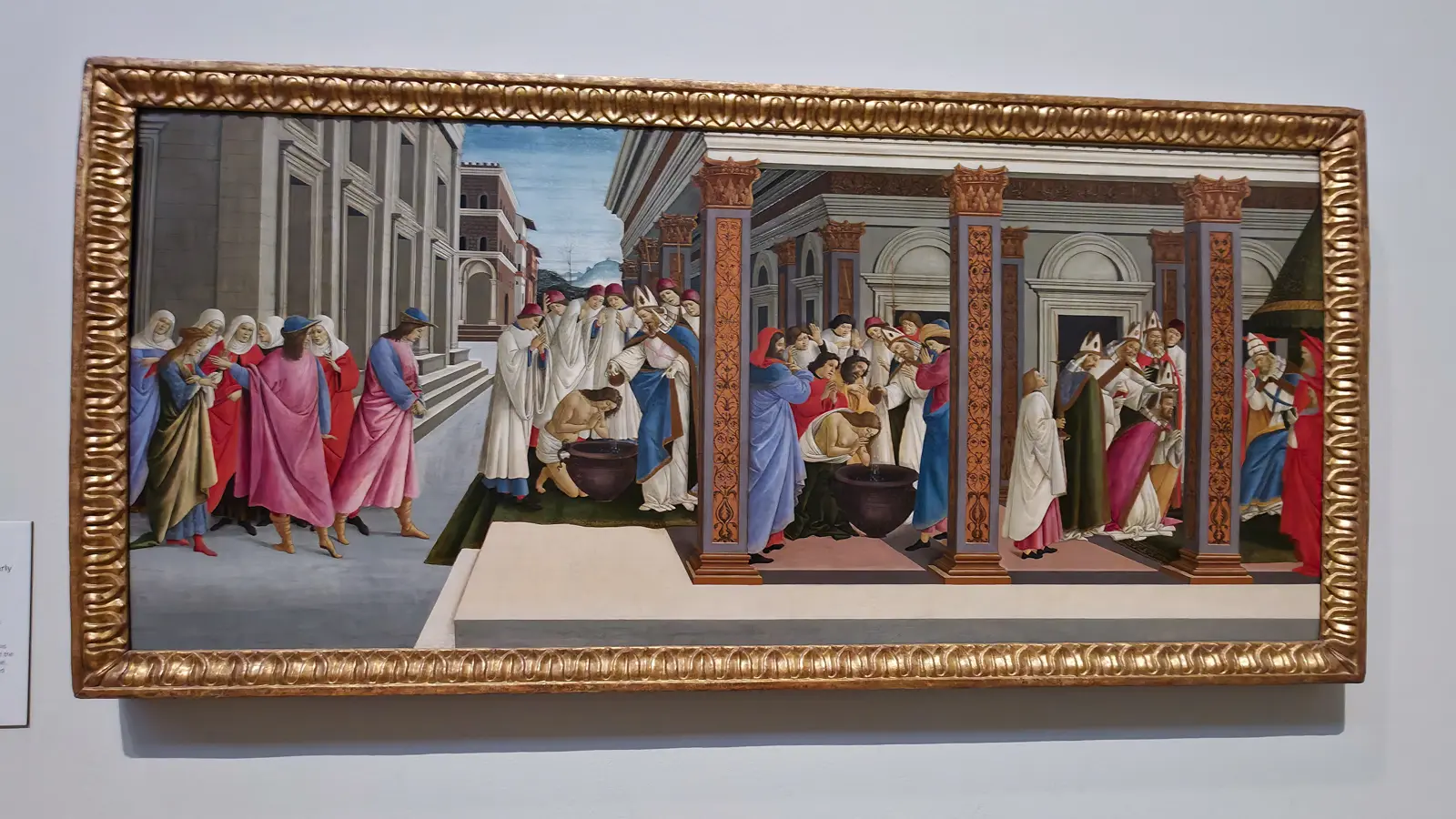
In the same group of Florentine rooms hang two panels from a series on Saint Zenobius, a fourth-century bishop and one of the patron saints of Florence. The first tells four scenes from his early life, read left to right like a comic strip: the young Zenobius turning away from the bride his parents had chosen, his baptism, his mother’s baptism, and his consecration as bishop. Botticelli sets it all against the streets of an idealised Florence, cleaner and wider than the real city ever was.
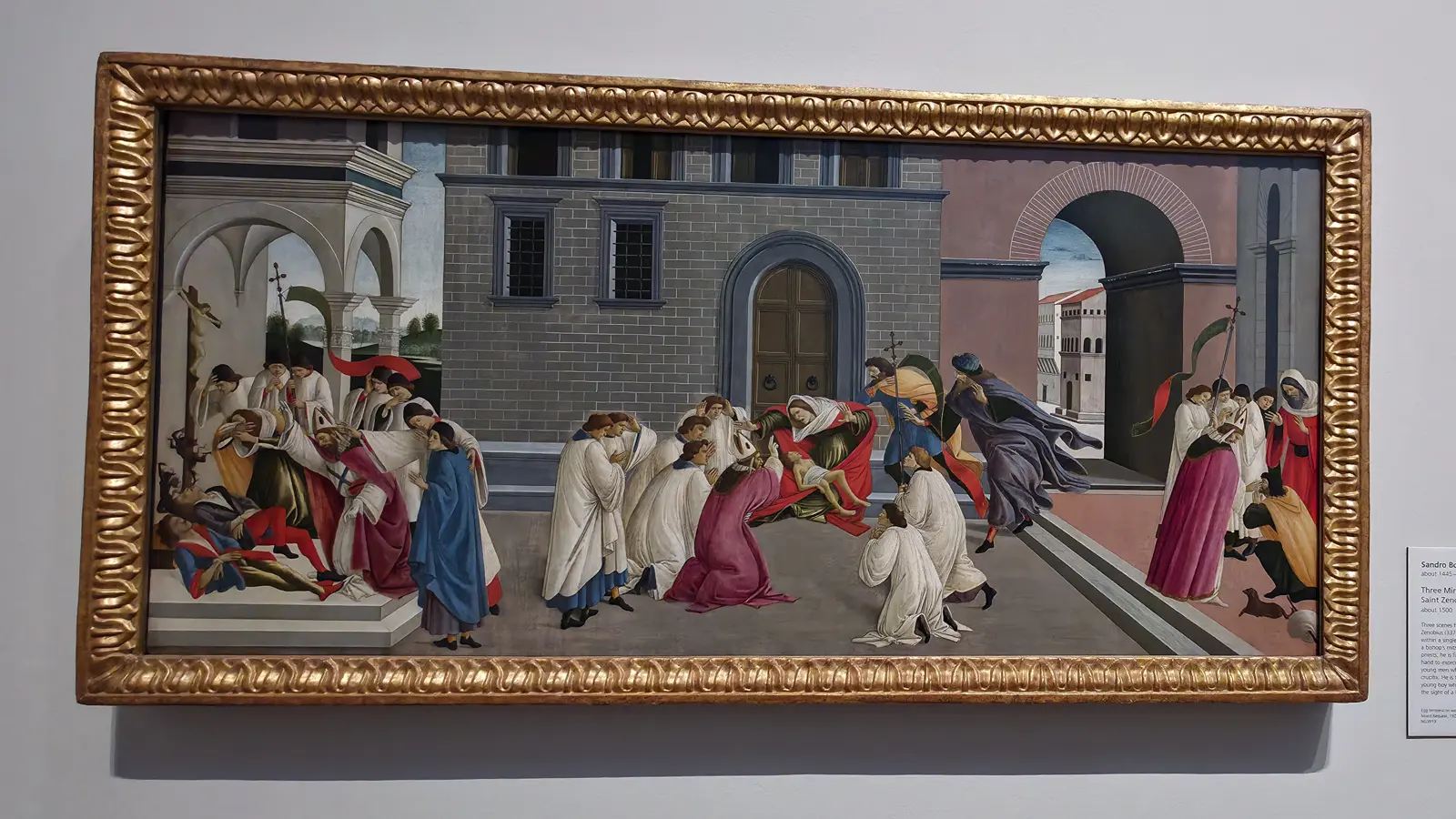
The second London panel shows three of the saint’s miracles within a single piazza: on the left he exorcises two young men beneath a tall crucifix, in the centre he brings a dead boy back to life, and on the right he restores a blind man’s sight. The handling is starker than his earlier work, the figures more urgent and strained. These were among the last things he painted. The full series ran to four panels, now divided between the National Gallery, which holds these two, the Metropolitan Museum in New York, and the Gemäldegalerie in Dresden.
The long silence, and the rediscovery
For roughly three centuries after his death in 1510, Botticelli was largely forgotten. Vasari’s portrait of a broken old follower of Savonarola did him no favours, and taste moved on to the High Renaissance giants who came after him: Leonardo, Michelangelo, Raphael. The Birth of Venus and Primavera sat quietly in a Medici villa. The Mystic Nativity changed hands cheaply, bought in Rome around the turn of the nineteenth century by an English collector and later sold at auction for under eighty pounds.
His revival, when it came, happened partly in England. When the Mystic Nativity went on show at the great Art Treasures exhibition in Manchester in 1857, a wide public saw it for the first time, and the Pre-Raphaelites fell for him hard. Dante Gabriel Rossetti and Edward Burne-Jones borrowed from him, and the critic John Ruskin helped give the Mystic Nativity its name. By the 1880s Botticelli was a cult figure, and he has not gone out of fashion since. There is a pleasing symmetry in standing in front of the very painting that helped bring him back, in the country where that rescue began.
Bubbly Tips for Botticelli at the National Gallery
- Head for the Sainsbury Wing. The Botticellis hang with the early Italian Renaissance paintings in the Sainsbury Wing, which is now the gallery’s main entrance on Trafalgar Square. Start there rather than in the central halls.
- Find Venus and Mars first. It is one of the pictures most visitors look for, and it rewards a slow look. Spot the four satyrs making off with Mars’s armour and the wasps’ nest tucked into the tree.
- Look for the signature on the Mystic Nativity. It runs along the very top in Greek. This is the only work Botticelli ever signed, so it is worth getting close enough to see it.
- Don’t rush past the Zenobius panels. They read like comic strips. Give each one a minute and follow the saint’s story from left to right, and you will get far more out of them.
- Pair London with Florence if you can. Venus and Mars lives here, the Birth of Venus and Primavera live in the Uffizi. Seen together they make up the complete set of his great mythologies.
- Photography is allowed without flash. You can capture the gold of the Mystic Nativity, though be ready for the glazing to throw back a reflection or two.
- Go on a Friday evening for a calmer visit. The gallery stays open late that night, and the Florentine rooms are far quieter than at a weekend lunchtime.
- It costs nothing. Like the rest of the National Gallery’s permanent collection, all of these paintings are free to see.
Final Thoughts
Botticelli is the painter who gave us those serene, sensual mythologies and then, at the end of his life, turned to saints, signatures and the end of the world. Florence will always own the Birth of Venus, and rightly so. But London quietly holds the rest of the story, from the marriage panel to the apocalypse, all of it within a single afternoon’s walk. Having carried his pictures around in my head since childhood, I found that a quietly emotional thing to do.
Until next time!

🌟 Everything You Need to Plan Your Dream Trip in 2026
- 🌟 Luxury Hotels - Find premium stays with Booking.com & Hotels.com
- 🏡 Vacation Rentals - Discover unique properties on VRBO
- 🏞️ Guided Tours - Explore with Viator or GetYourGuide
- 🎫 Attraction Tickets - Skip the lines with Tiqets
- 🚢 Ocean Cruises - Set sail with Cruise Direct
- 📱 International SIMs - Stay connected with Saily
- 🚗 Car Rentals - Budget-friendly options from Discover Cars
- 🌐 Secure VPNs - Browse safely with NordVPN
- 💶 Currency Exchange - Best rates with Wise
- 🗣️ Learn Languages - Master the local language with Babbel and Rosetta Stone