
I went to Tate Modern in London to see a spider, and the spider was gone.
That is the short version. The longer one is that Louise Bourgeois’s Maman is one of my favourite objects in the world, all nine metres of her, and I had been looking forward to standing under the original for years. Instead I arrived on a wet December afternoon to a Turbine Hall full of something else entirely, and spent the next four hours finding out that the building had a great deal more to offer than the one thing I had come for.
This is a post about the consolation prize turning out to be the prize.
Tate Modern at a Glance
🕷️ The spider · Louise Bourgeois’s Maman, the unique steel-and-marble original, greeted visitors when Tate Modern opened in 2000 and returned briefly for the gallery’s 25th birthday in 2025. Six bronze casts stand around the world, from Ottawa to Bilbao.
🏭 The Turbine Hall · The former engine room of Bankside Power Station holds one huge commission a year. It changes each autumn, so the space is different on every visit.
🎟️ Cost · The collection is free. No ticket, no timed slot. Only the big temporary exhibitions are paid.
☕ The view · Level 10 at the top of the Blavatnik Building has a free viewing gallery over the Thames towards St Paul’s, and a café with genuinely good cake.
💡 Tip · Do not assume a famous work is on show. Tate rotates and lends heavily, so search the website for your one must-see before you travel. Learn from my spider.
The Spider Who Wasn’t There
Here is the part that makes the disappointment sting a little more sweetly. Tate owns the original. Maman is a unique steel and marble sculpture, made in 1999, and every other version in the world is one of six bronzes cast from it afterwards. She was the first thing to greet the public when Tate Modern opened in 2000, as part of Bourgeois’s inaugural Turbine Hall commission, and Tate acquired her permanently in 2008 as a gift from the artist and an anonymous benefactor.
She had come home in May 2025 for the gallery’s 25th birthday, displayed on the bridge overlooking the Turbine Hall, exactly where she stood a quarter of a century earlier. By the time I got there in December, that display had ended.
The joke is that I know her well. Bronze casts stand permanently outside the Guggenheim in Bilbao, the Samsung Museum of Art in Seoul, the Mori Art Center in Tokyo, and the National Gallery of Canada in Ottawa, and I have stood under the Ottawa one more times than I can count.
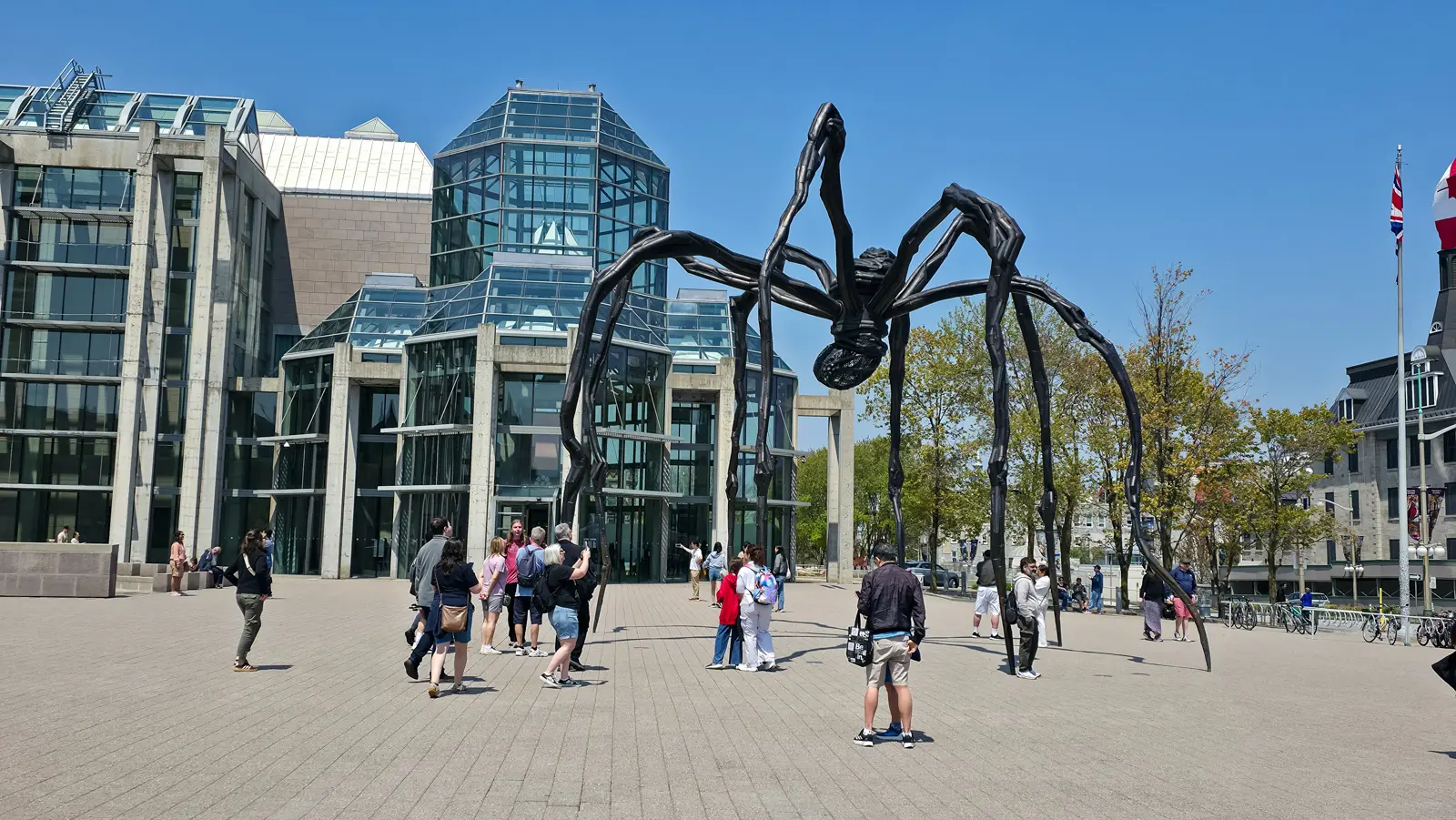
So I have met the daughters and missed the mother. Bourgeois once said that the spider is a repairer: bash into her web and she does not get angry, she weaves and repairs it. I have decided to take that personally and go back.
The Turbine Hall: Máret Ánne Sara
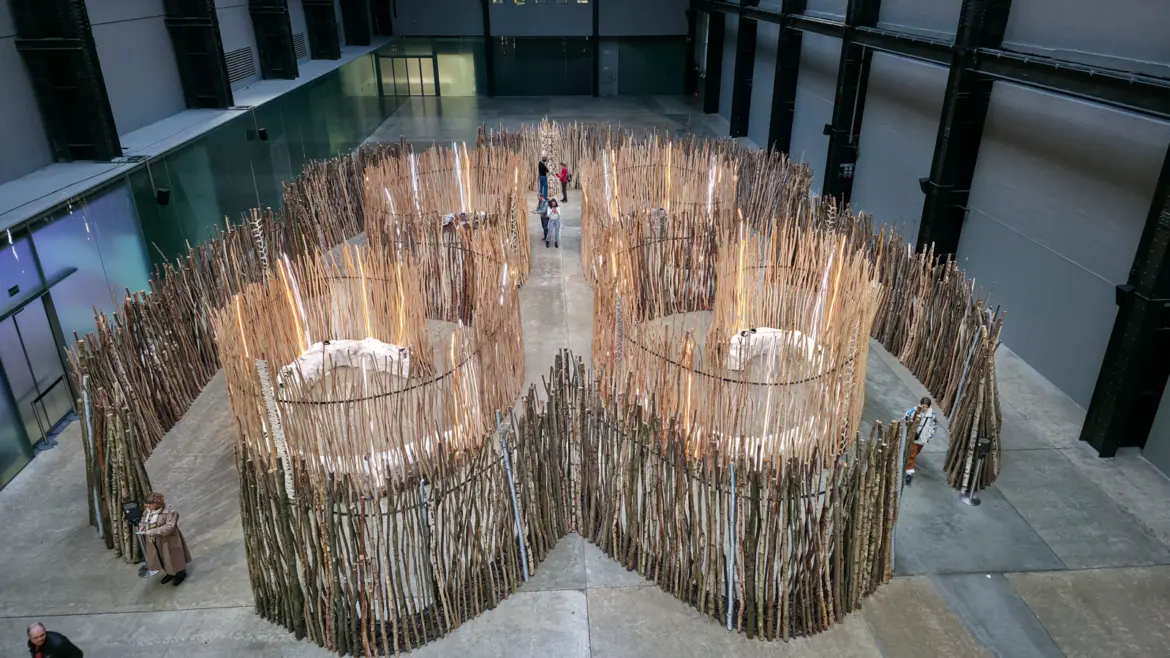
What stood in the hall instead was Goavve-Geabbil, the tenth Hyundai Commission, by the Northern Sámi artist Máret Ánne Sara. It ran from 14 October 2025 to 6 April 2026, and it was the first major work she had made in the UK.
Sara comes from a reindeer herding family in Guovdageaidnu in Norway, and the work is built from the materials of that life: hides and bones from traditional herding practice, combined with wood, industrial materials, sound and scent. The result is a set of vast circular enclosures made of upright poles, lit from inside, with pale hides laid at their centres. Visitors walk the channels between them. Tate Modern sits inside a former power station, and Sara’s response to that history is to propose a different idea of power altogether, one rooted in the relationship between the Sámi people, the reindeer and the land.
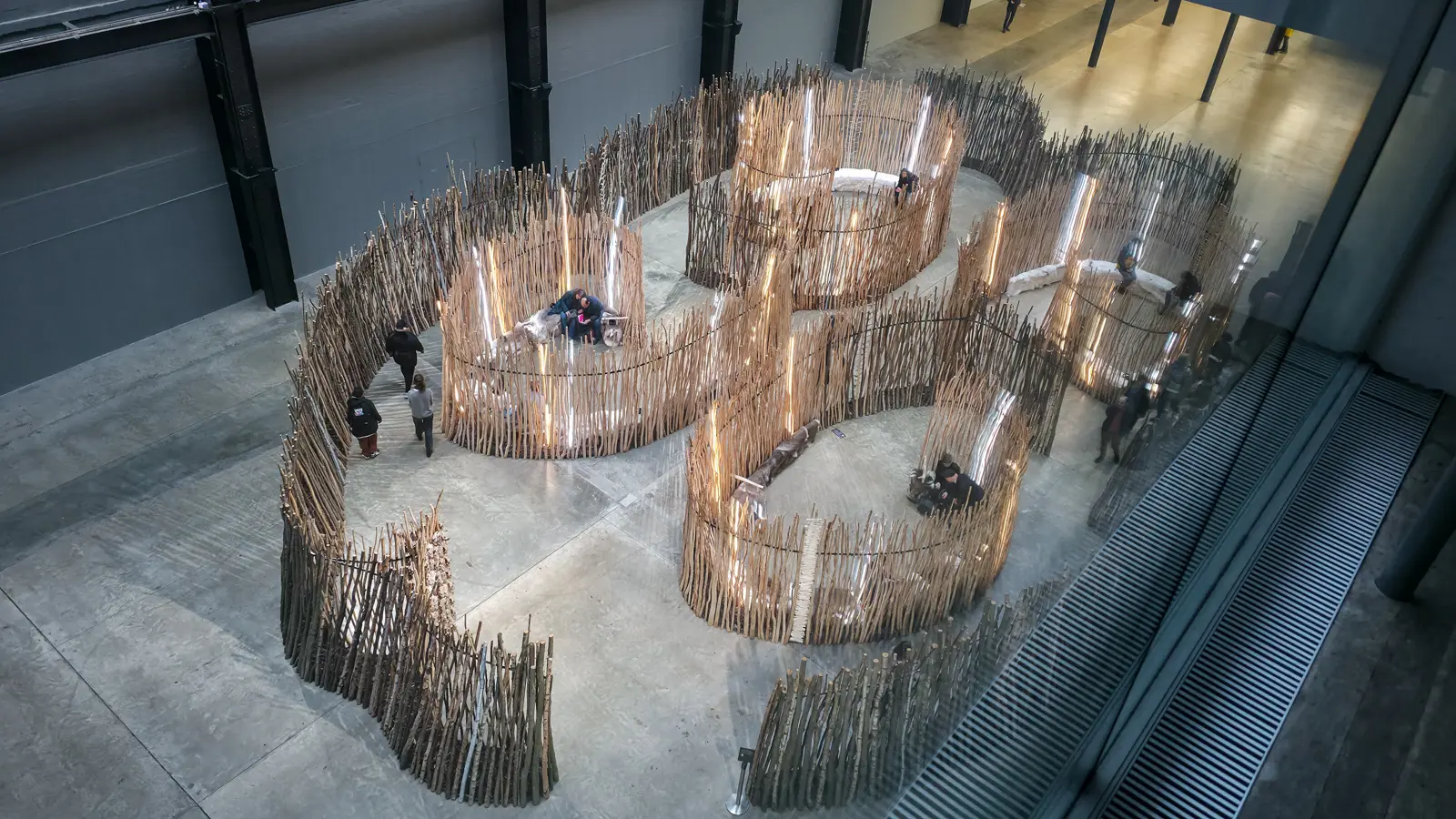
Standing on the bridge looking down into it, I was standing in the exact spot where Maman had been a few months before. I did not know that at the time. I found it out later, and it improved the whole afternoon retrospectively.
Stones, Mud and Walking: Richard Long
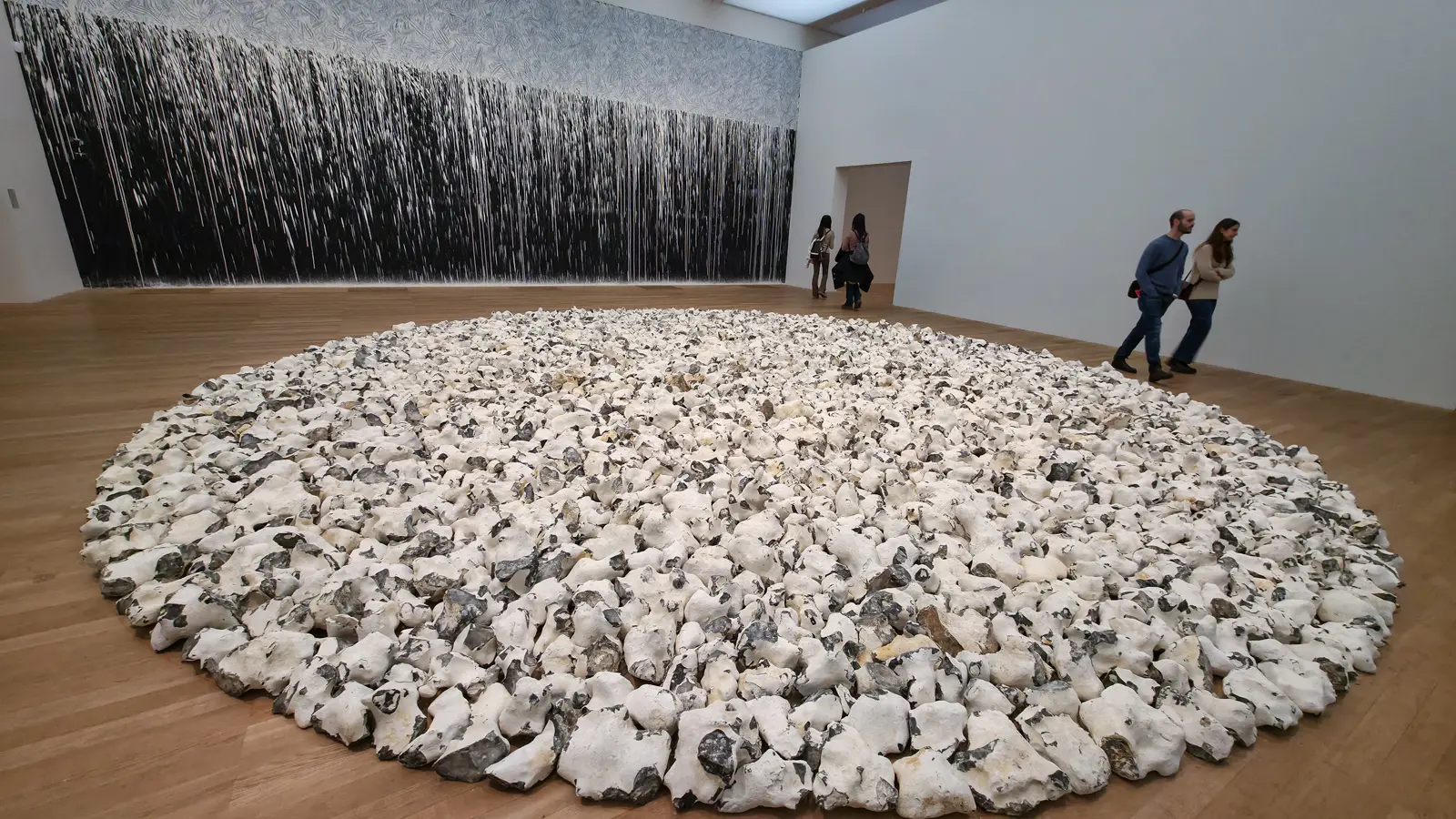
Upstairs, the room that stopped me longest was ARTIST ROOMS: Richard Long. Long has been making art by walking since the late 1960s, treating the act of moving through a landscape as the sculpture itself, and recording what he does along the way through photographs, maps and text. Water poured on a rock. A path trodden into the earth. Stones and sticks rearranged.
His indoor works follow the same logic in gallery form, made from natural materials like stones or tidal mud applied with his hands and feet. In the room I walked into, a great circle of white stones lay on the floor, with a dark poured wall piece rising behind it. His own summary of his interests is the best label anyone could write: stones, water, mud, hands, days, symmetry, gravity.
Surrealism, Mondrian, and a Room With Handprints
The collection at Tate Modern is arranged by theme rather than date, which means the walk through it keeps producing odd neighbours, and that is much of the pleasure.
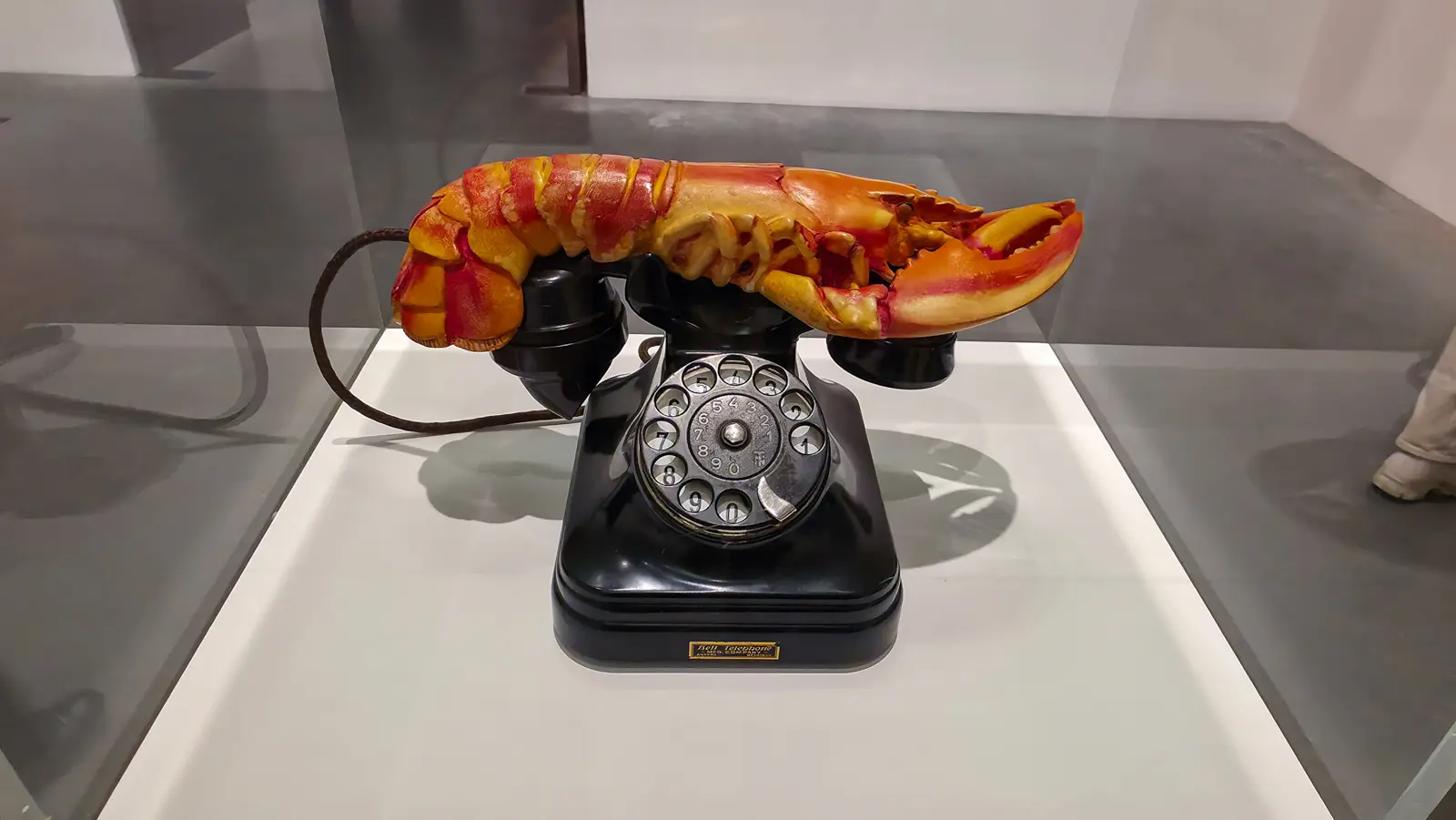
Salvador Dalí’s Lobster Telephone is smaller than expected and funnier in person: a plaster lobster lying across the handset of a working black telephone. Dalí made it in 1936 for the English poet and collector Edward James, who had eleven of the lobster receivers made to fit the telephones in his London and Sussex houses. Seven were painted white and four red. Tate bought its red one in 1981. Dalí’s own explanation, in his 1942 autobiography, was that he could never understand why, when he ordered a grilled lobster in a restaurant, he was never served a boiled telephone instead.
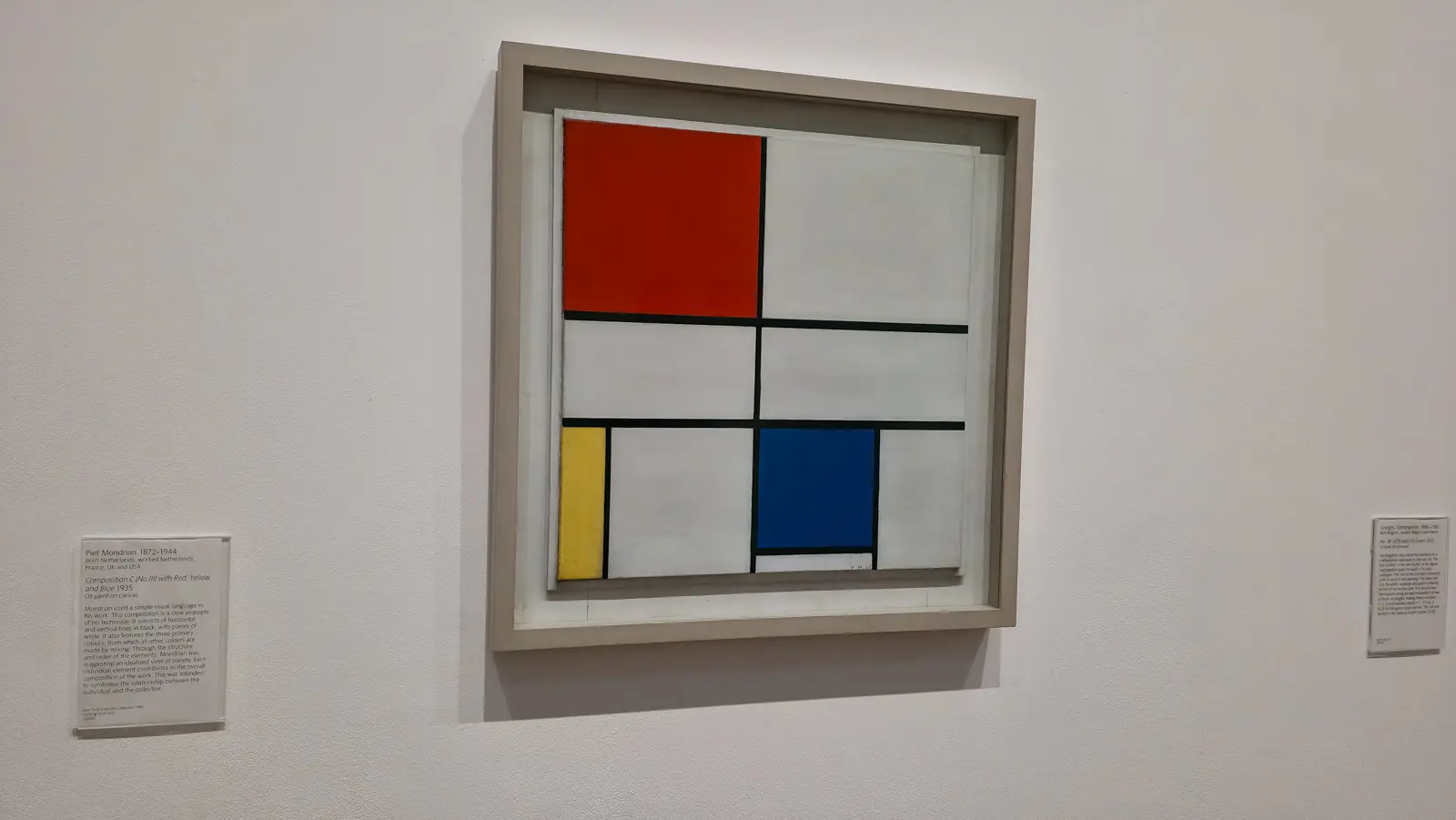
A few rooms away hangs Piet Mondrian’s Composition C (No.III) with Red, Yellow and Blue, painted in 1935: black horizontals and verticals, planes of white, and the three primary colours from which every other colour is mixed. The gallery label makes a point I had not considered before, that the structure was meant to suggest an idealised society, with each individual element contributing to the whole.
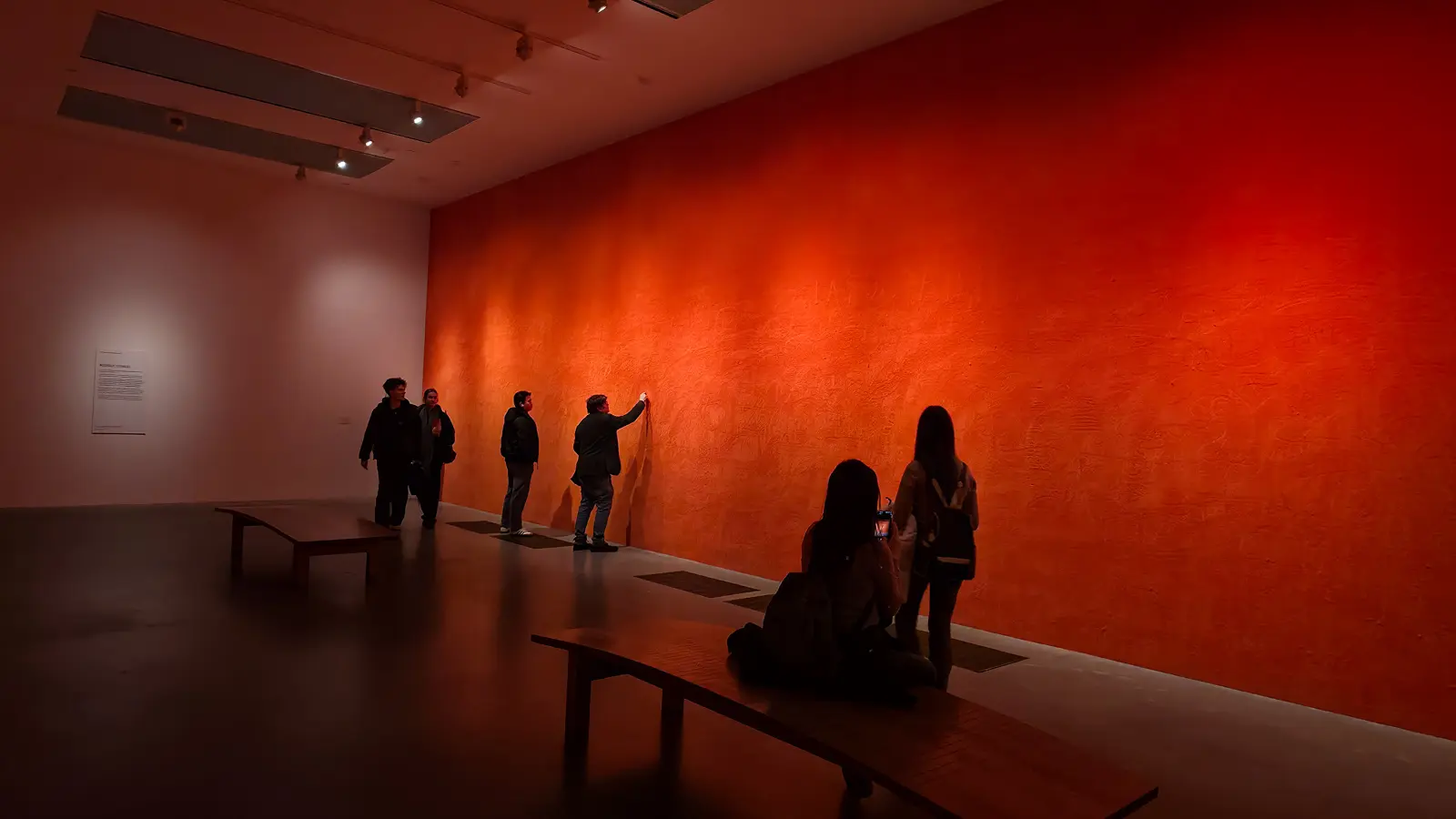
Then there is Rudolf Stingel’s Untitled from 1993, which is a wall covered entirely in orange carpet, and which visitors are invited to touch. Every hand leaves a temporary mark in the pile, so the surface is a painting that never settles. Stingel has said he was interested in the monochrome experience of an orange carpet and was not looking for the traces people would leave, but once the carpet went on the wall everyone started writing on it, and he welcomed it. Watching a room full of strangers reach up and draw on a wall in a national gallery is a small joy.
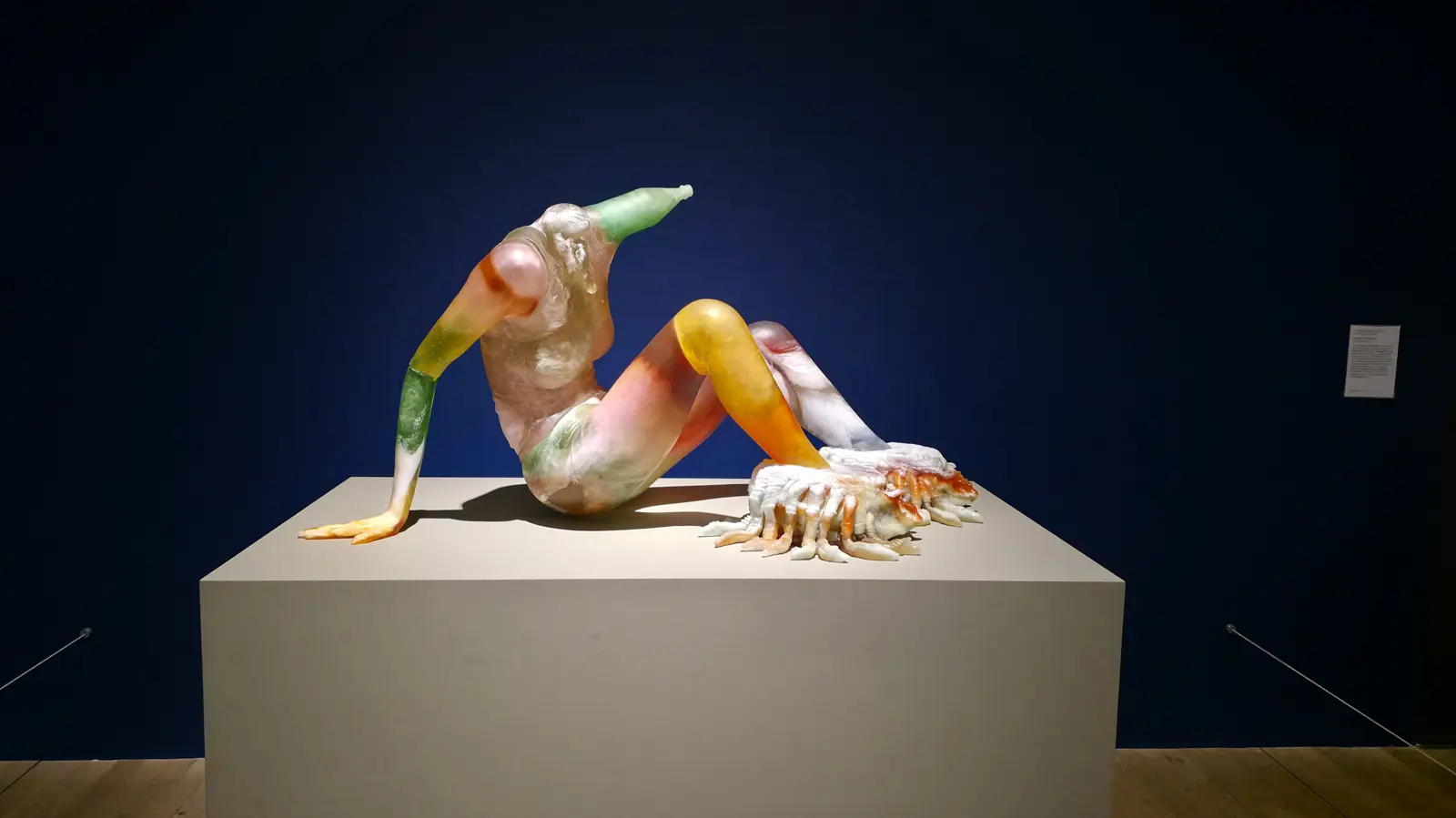
Andra Ursuța’s Predators ‘R Us is the one I keep thinking about. A life-sized reclining figure cast in multicoloured lead crystal glass, headless, with a bottle where an arm should be and slippers on its feet borrowed from the aliens in the Predator films. Most of the body is modelled from 3D scans of the artist’s own. Ursuța has said she returns to the body because it represents an obstacle, vulnerability, decay and shame, the thing that is impossible to transcend.
LOVE, Beside the Gift Shop
And then, on the way out, the thing that made me laugh.
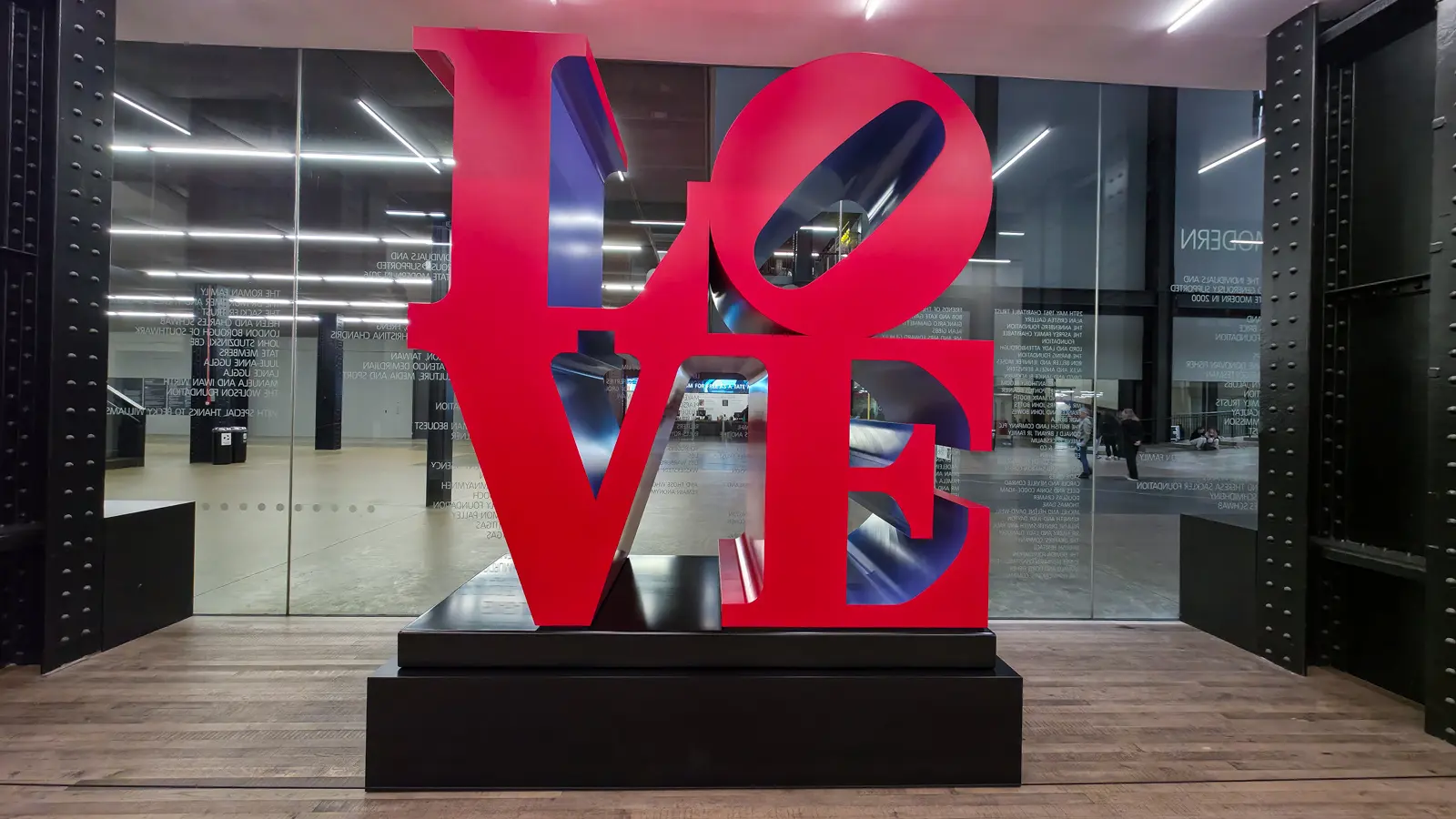
Robert Indiana’s LOVE stands in red steel with blue interior faces, the tilted O exactly as every version of it has been since 1964. In North America this sculpture is a pilgrimage site. People queue. It has its own postcode in the social media sense. At Tate Modern it sits beside the shop, on a low black plinth against a glass wall, and the crowd flows past it towards the exit.
There was almost no merchandise either, which surprised me more than the placement.
The history behind that is genuinely sad. Indiana designed the image for a Museum of Modern Art Christmas card in 1965, and under the copyright law then in force he needed to attach a copyright notice when the work was published. He did not. LOVE fell into the public domain and was reproduced everywhere, on everything, without permission or payment to him. He called it the great disappointment and said that everybody assumed he was getting terribly wealthy while the rip-offs multiplied. He regained some rights after the law changed in 1976, and the ownership of LOVE has been fought over in court for years since.
Tea and Cake With a View
By four o’clock it was properly raining, so we went up to Level 10, at the top of the Blavatnik Building, for coffee and something sweet, and I fully expected the standard museum-café experience.
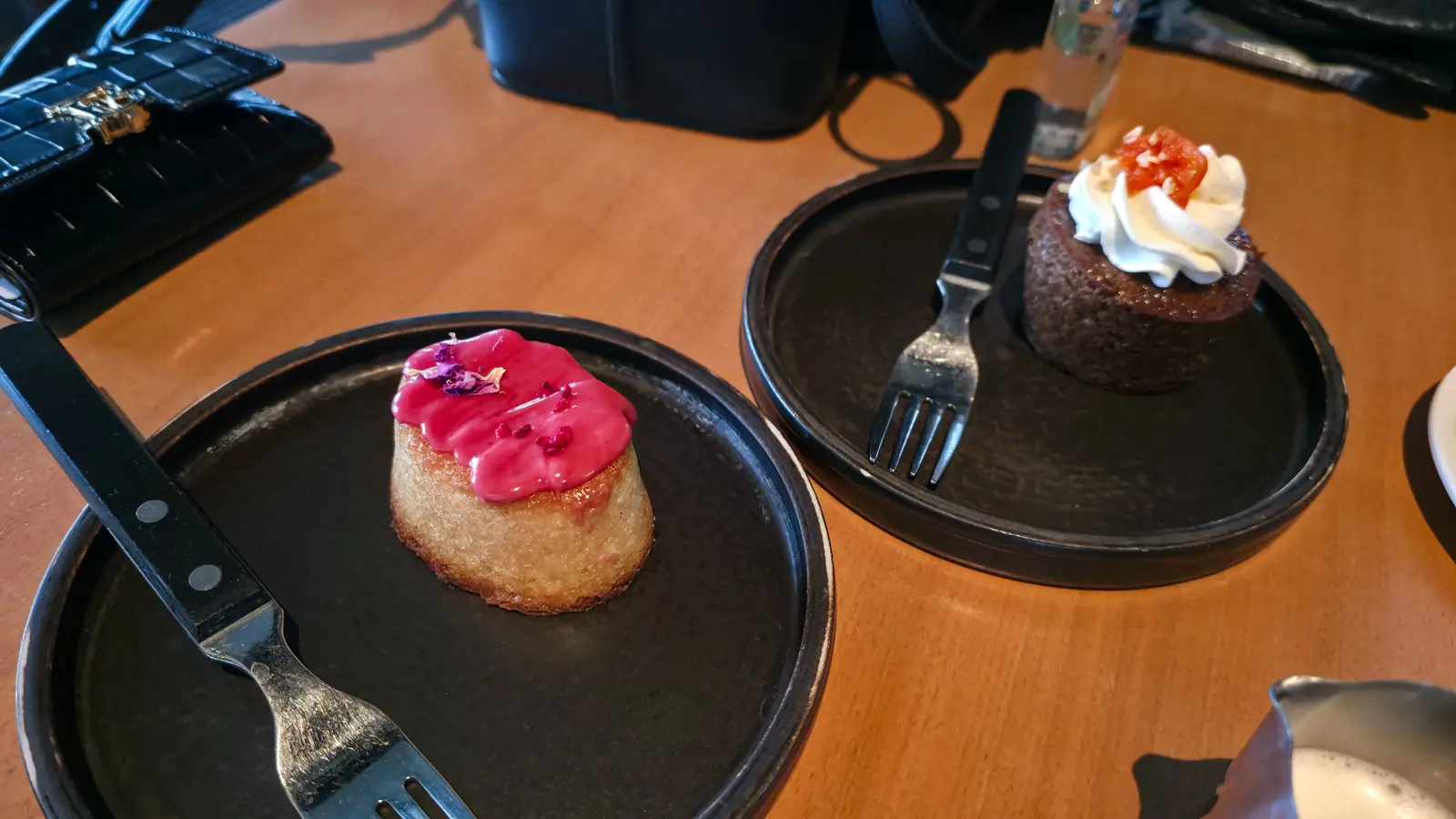
It was not that. The raspberry cake was excellent, the cupcake was excellent, and the view over the Thames while eating them was the sort of thing London gives away for the price of a coffee. I have had considerably worse in restaurants that take themselves far more seriously.
Bubbly Tips for Tate Modern
- Entry to the collection is free. No ticket and no timed slot are needed to walk in and see the permanent displays. Only the big temporary exhibitions are paid.
- Check what is in the Turbine Hall before going. The annual commission changes each autumn and runs to the following spring, so the space is completely different from one visit to the next, and there are stretches between commissions when the hall is empty. The Tate website lists what is currently installed.
- Do not assume a famous work is on show. Tate rotates its collection constantly and lends heavily. If there is one thing you have travelled to see, search for it on the Tate website first. Learn from my spider.
- Go on a Friday or Saturday evening. The gallery opens later at the end of the week, and the last couple of hours are far calmer than a weekend afternoon. Check current times before setting out, as they do shift.
- Walk in over the Millennium Bridge. Coming from St Paul’s Cathedral on foot gives you the whole south front of the building as you approach, and it costs nothing.
- Take the lift up before you take the stairs down. Start at the top for the views and work downwards through the galleries. It saves your legs and the upper floors are quieter early.
- Touch the orange wall. Stingel’s carpet piece is meant to be handled, and it is one of the very few works in any national collection where that is true. Read the label first so you know you are allowed.
- Leave time for Level 10. The café at the top of the Blavatnik Building has a proper view over the Thames, and the cakes are genuinely good, which is not something I say about museum cafés often. It is reached by a separate lift, so allow a few minutes for the queue.
Final Thoughts
I still have not stood underneath the original Maman, and I am oddly glad about it. If she had been in the Turbine Hall that afternoon I would have photographed her, marvelled for twenty minutes, and probably given the rest of the building a fraction of the attention it turned out to deserve.
Instead I got Sara’s enclosures, Long’s circle of stones, a wall of orange carpet covered in the handprints of strangers, a glass woman with a bottle for an arm, and a small pop culture giant sitting quietly next to a gift shop. Plus cake.
The spider is a repairer, apparently. She weaves and repairs. I will be back for her.
Until next time!

🌟 Everything You Need to Plan Your Dream Trip in 2026
- 🌟 Luxury Hotels - Find premium stays with Booking.com & Hotels.com
- 🏡 Vacation Rentals - Discover unique properties on VRBO
- 🏞️ Guided Tours - Explore with Viator or GetYourGuide
- 🎫 Attraction Tickets - Skip the lines with Tiqets
- 🚢 Ocean Cruises - Set sail with Cruise Direct
- 📱 International SIMs - Stay connected with Saily
- 🚗 Car Rentals - Budget-friendly options from Discover Cars
- 🌐 Secure VPNs - Browse safely with NordVPN
- 💶 Currency Exchange - Best rates with Wise
- 🗣️ Learn Languages - Master the local language with Babbel and Rosetta Stone