
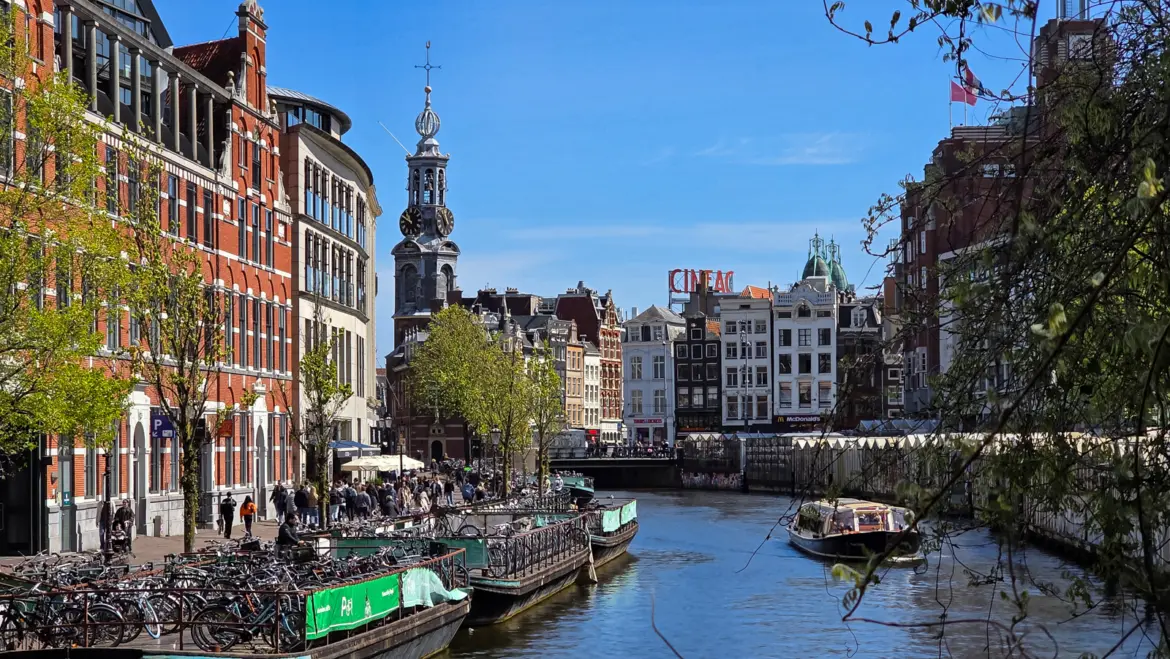
I went to Amsterdam for two things. Tulips, because I had wanted to see them properly for years, and Van Gogh, because a museum devoted to one painter is a rare thing and I wanted to know whether it lived up to the idea of it. I came home with a list of everything I had not managed to do.
A little over a week, and it was not enough. That is the honest headline of this trip. Amsterdam is a small city that hides a great deal of art, and the more of it I saw, the more obvious it became that I had planned the week around two subjects when I could have planned it around ten. This post is the overview, the shape of the week and what surprised me. The individual places will get their own posts as I work through the photographs.
Amsterdam in Spring at a Glance
🌷 Tulips · The free Tulp Festival puts flowers in 100+ public spots through April, and Keukenhof, 40km away in Lisse, opens roughly mid-March to mid-May.
🎨 The Museum Quarter · The Rijksmuseum, Van Gogh Museum, Stedelijk and Moco all face Museumplein. Give it two days, not one.
👑 King’s Day · 27 April, the King’s birthday. The whole country wears orange and fills the canals with boats. Book accommodation early.
🍪 Stroopwafels · Warm, syrup-filled, and better bought in tins for the journey home.
💡 Tip · Late April overlaps King’s Day with peak tulip season, the busiest and priciest week of the Dutch year. Wonderful, but book ahead.
The Museum Quarter Deserves More Than an Afternoon
The Museum Quarter is where Amsterdam keeps most of its art, and Museumplein is the green rectangle it all faces. The Rijksmuseum sits at one end, the Van Gogh Museum and the Stedelijk along one side, and the Moco Museum in a villa on the corner. Anyone treating this as a single afternoon is going to end up rushing, which is what I nearly did.
What made it easier was staying nearby and going back. Vondelpark runs alongside the quarter, and in April the city fills its public spaces with tulips as part of the Amsterdam Tulip Festival, known locally as the Tulp Festival, which is free and spread across more than a hundred locations. In Vondelpark the display sits on the pond itself, planted in trays that float. I walked past it in the early evening with the light going gold and the whole thing doubled in the water.
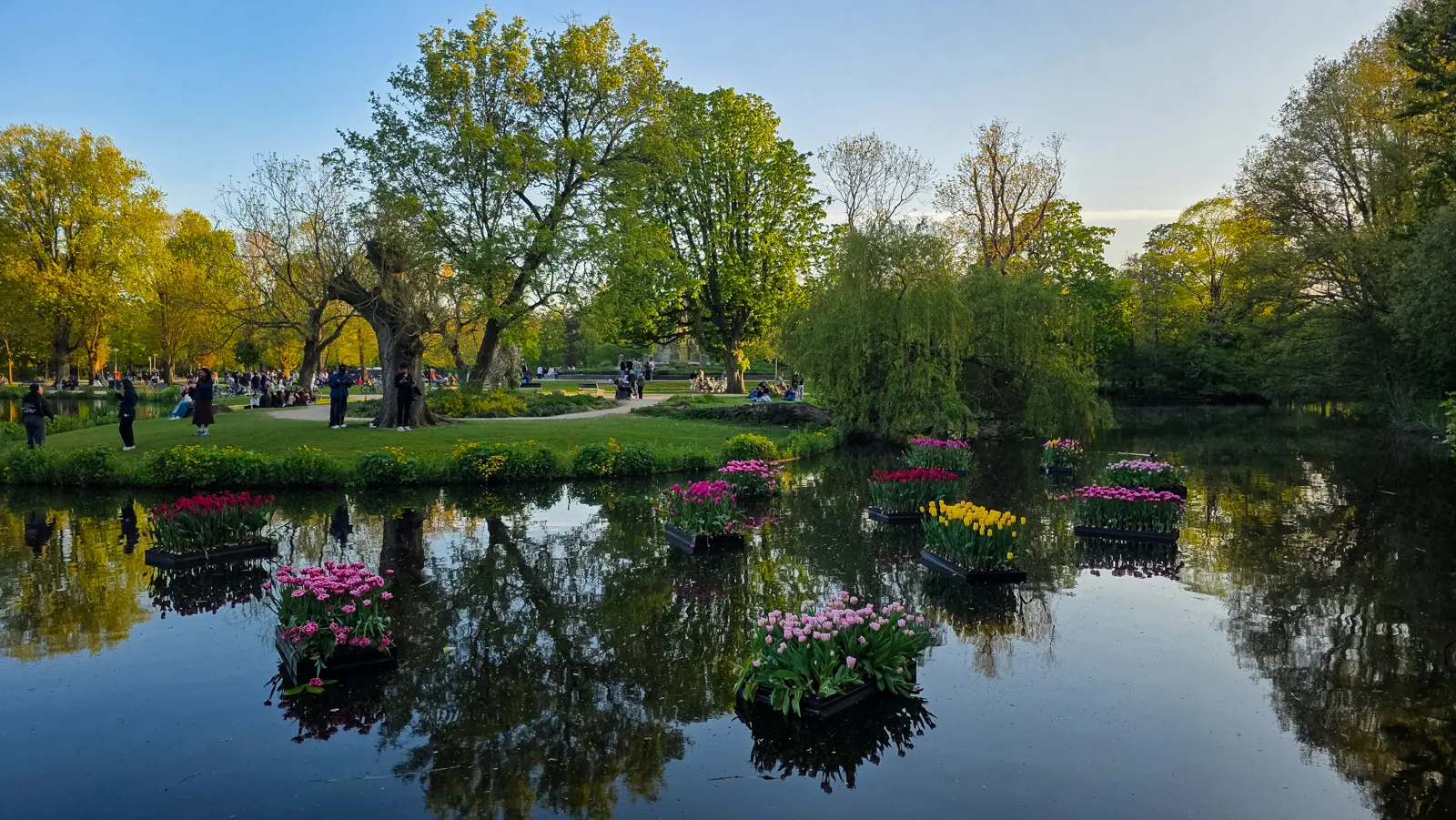
That is the argument for slowing down in this part of the city. The art is indoors, but the walk between one museum and the next is worth having time for.
Van Gogh, Up Close
The Van Gogh Museum does something most galleries cannot. It tells the life alongside the work, in order, so that the paintings arrive attached to the years that produced them. I had seen his canvases before, scattered across other collections. Here I understood the shape of him: the late start, the speed, the illness, the brother who kept paying for it all.
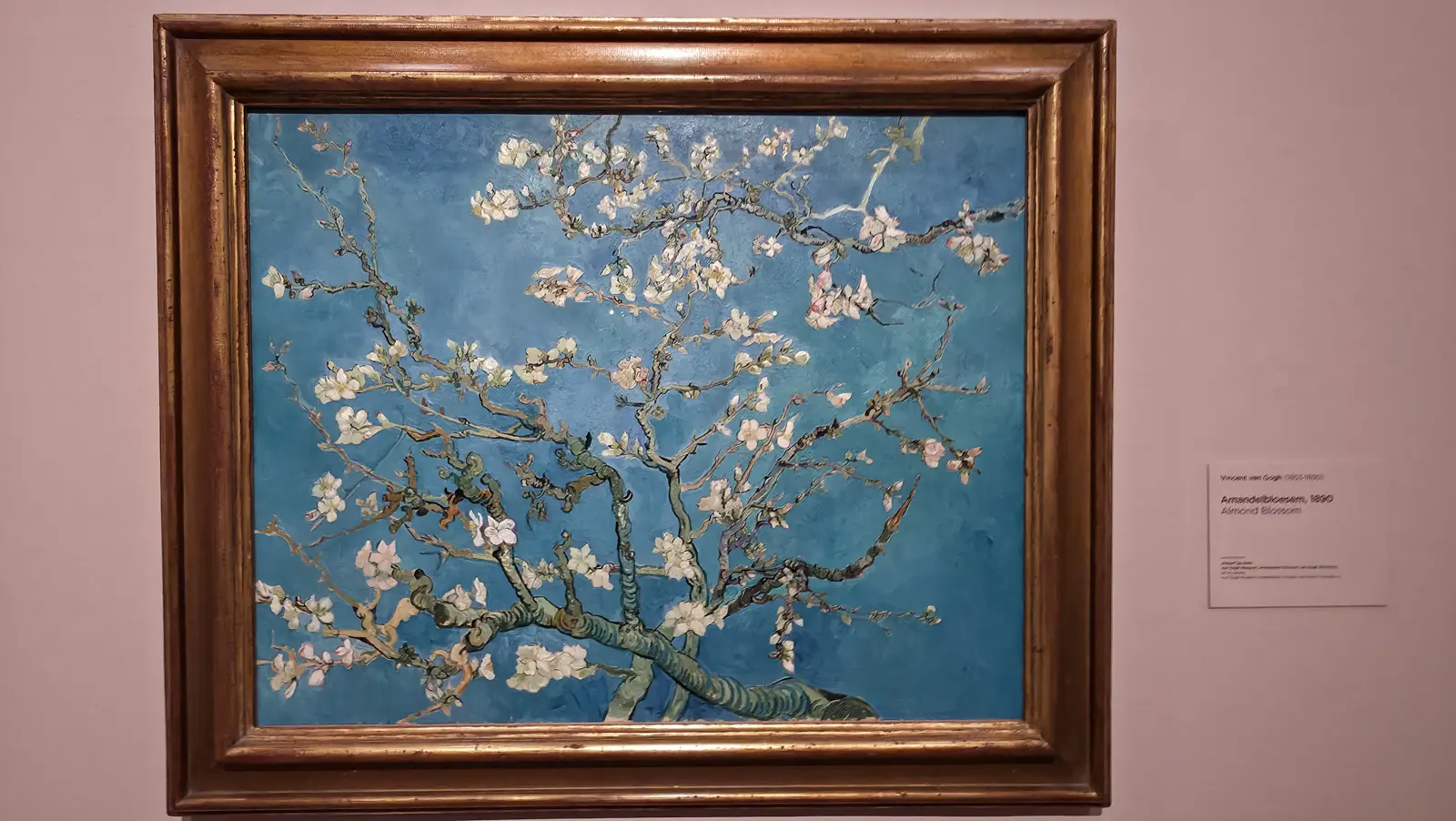
The painting that stopped me was Almond Blossom. Theo and his wife Jo had a son at the end of January 1890 and named him Vincent, after his uncle. Van Gogh wrote back that the news gave him more pleasure than he could put into words, and he started painting almost immediately: white blossom on bare branches against a wide blue sky, made as a gift for a baby. It hung above the piano in Theo and Jo’s living room. Years later, after Theo died and Jo moved to Bussum, it hung in the bedroom she shared with the boy. That child grew up to found this museum.
Painting a nursery picture for a nephew he would meet only a handful of times, from the asylum at Saint-Rémy where he had admitted himself the year before, is about the most generous thing I can imagine a person doing in that condition.
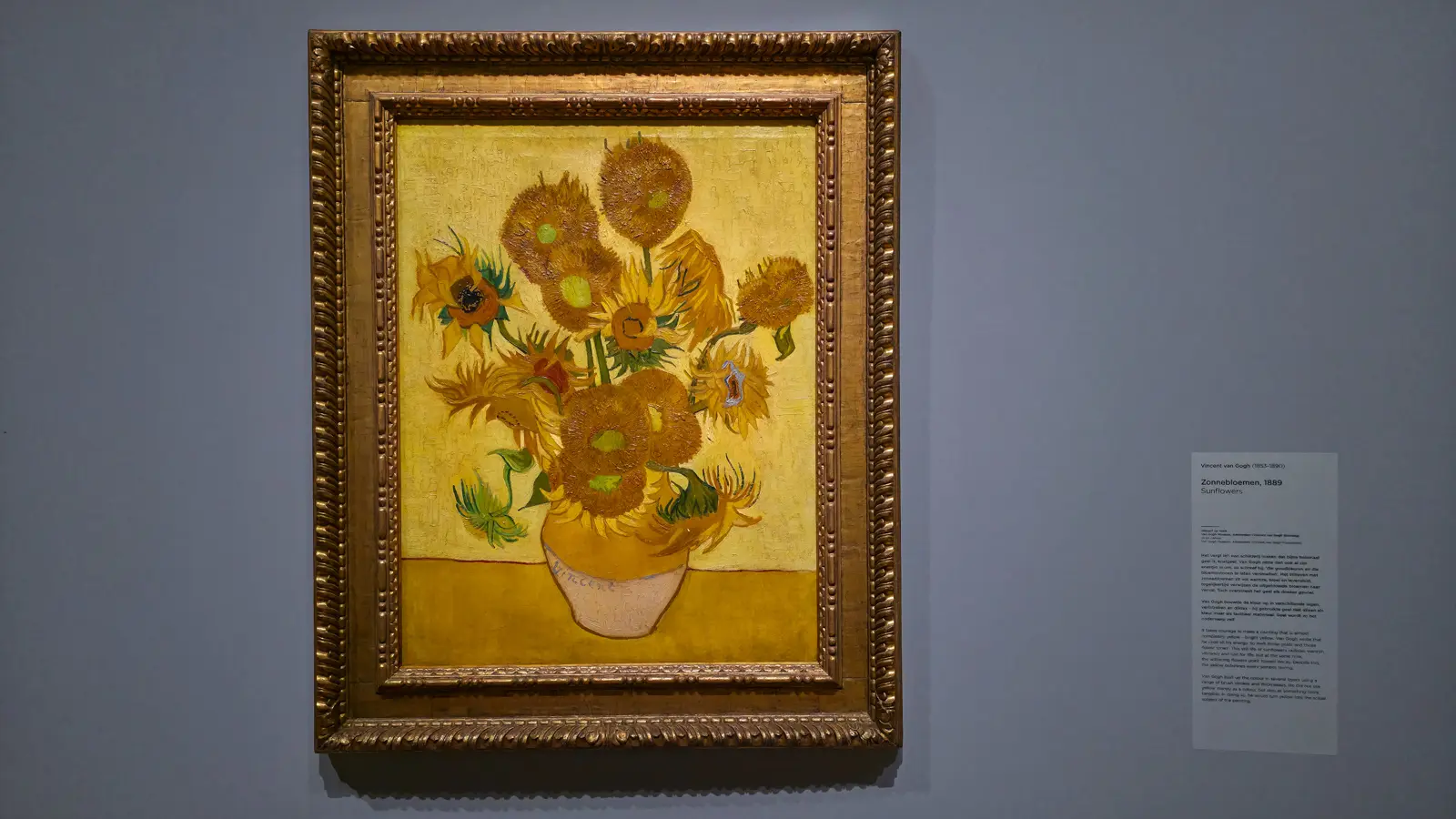
The other reunion was more personal to me. I queued for the Sunflowers at the National Gallery in London, and here was a Sunflowers again, close enough to be the same painting and not quite. It is not a copy by someone else. Van Gogh painted it himself in January 1889, a repetition of the London canvas, one of seven sunflower pictures he made in Arles across two years. Standing in front of the second one, months after the first, was the closest thing to a private joke the trip gave me.
Moco, in a Villa on Museumplein
Moco Museum was the surprise of the week. I had it down as the small one, the museum to fit in if there was time, and it turned out to be the one I most want to go back to. It is modern and contemporary work, street art alongside pop, in a building that could not be less suited to it and somehow is.
Villa Alsberg was designed in 1904 by Eduard Cuypers, nephew of the Pierre Cuypers who built the Rijksmuseum and Amsterdam Centraal. It is a brick and timbered house with turrets and stained glass, and the museum has put bold, loud, argumentative art inside it. Moco opened here in April 2016. Ninety minutes is the usual estimate for a visit and I could have used longer.

King’s Day, Booked by Accident
I did not plan this. I booked the week for the tulips, worked out afterwards that it covered King’s Day, and spent a little while regretting it. Every guide warns about the crowds, the prices and the closures, and all of that is true.
It was also the best day of the trip.
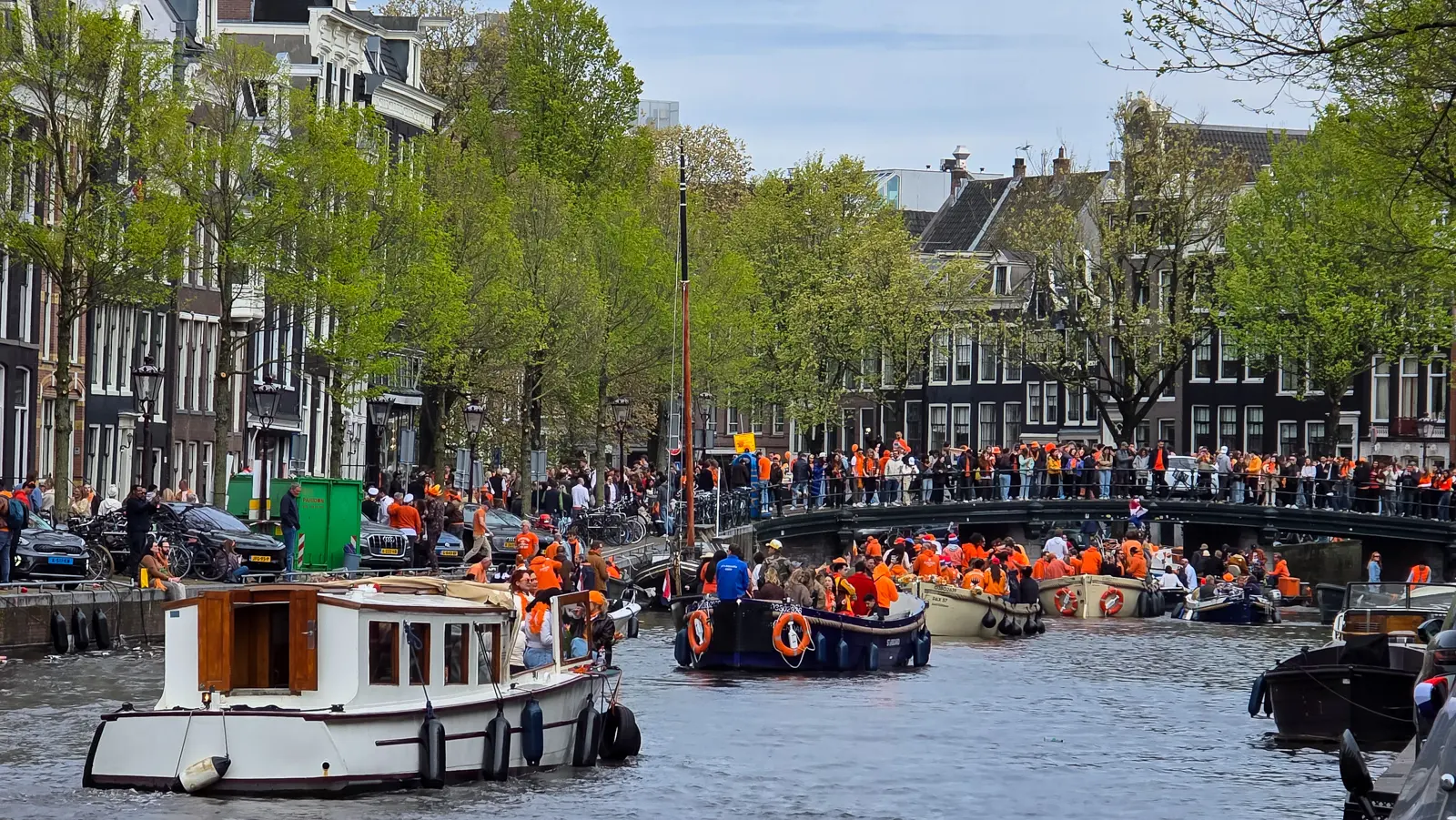
King’s Day falls on 27 April, the birthday of King Willem-Alexander. Before 2014 it was Queen’s Day and fell on 30 April, and the country simply moved it when Beatrix abdicated and her son took the throne. Orange is not in the Dutch flag, which is red, white and blue. It comes from the House of Orange-Nassau, and on this one day the whole country wears it.
Here is what I did not expect. The Netherlands is not a country that spends much time being sentimental about its monarchy. And yet people came in from all over the country, filled the canals with boats, packed the bridges, and let go completely. Something about it works precisely because it is not solemn. Nobody was standing to attention. They were on the water in orange shirts with music going, and it read as a national day off that everyone genuinely wanted.
Keukenhof, the Day Trip to Build the Week Around
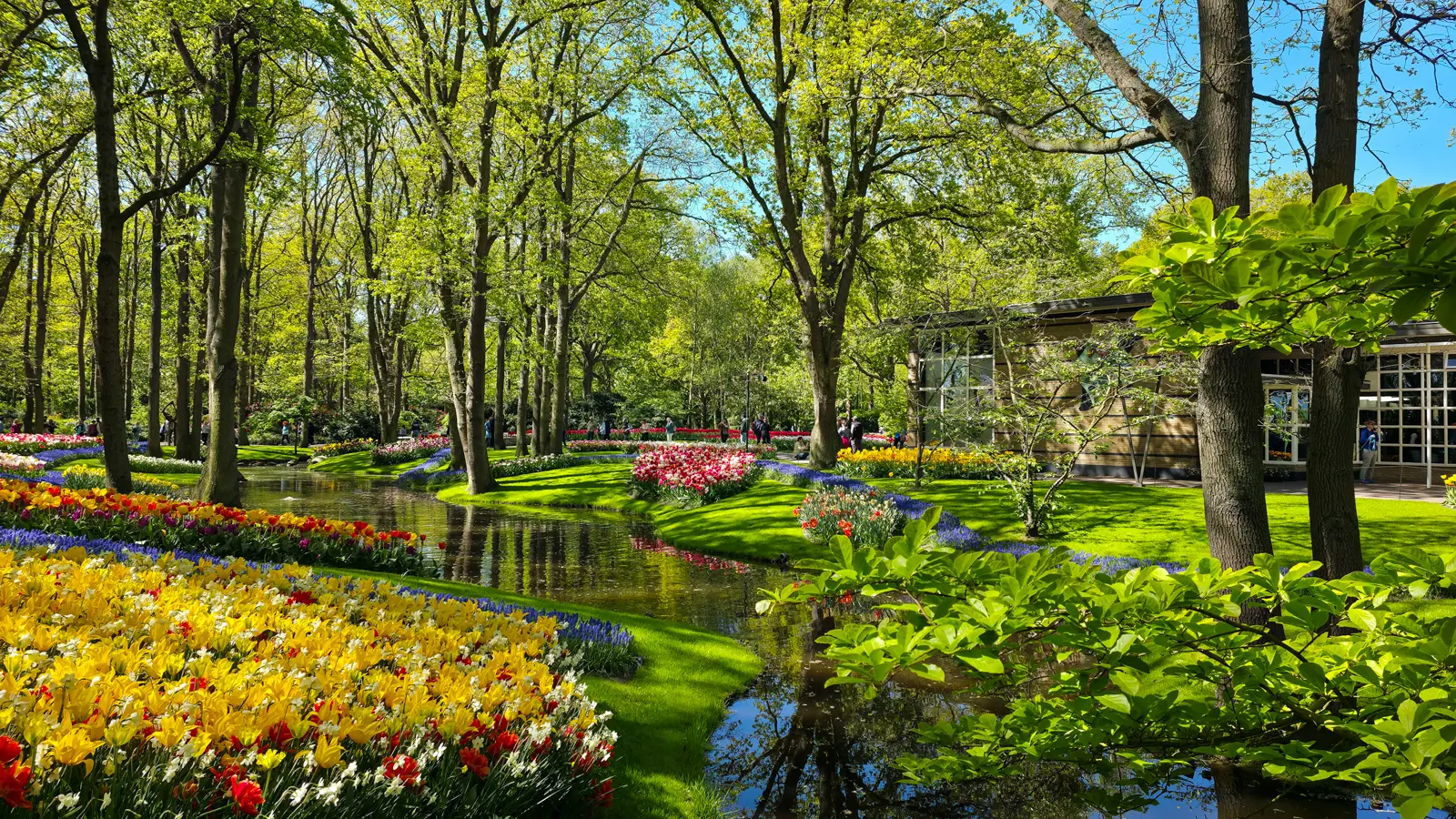
Keukenhof is not in Amsterdam. It is in Lisse, about 40 kilometres away in the bulb-growing region, and it is only open for around eight weeks in spring. In 2026 the season ran from 19 March to 10 May. If a trip lands inside those dates, this is the day trip to make room for.
The scale is what the photographs never quite carry. Seven million bulbs across 32 hectares, with something like 800 varieties of tulip alone, plus daffodils, hyacinths and blossom. The planting is done so that different varieties come up in sequence, which means the garden changes across the season rather than peaking once. There are streams cutting between the lawns, and the beds run right up to the water.
The Heineken Experience, From Someone Who Does Not Drink Beer
I am not a beer drinker. I booked the Heineken Experience anyway, on the VIP ticket, and it turned out to be one of the better decisions of the week.
The building is the company’s old Amsterdam brewery on Stadhouderskade. Gerard Adriaan Heineken bought the brewery that stood here in 1864 and incorporated the business as Heineken’s Bierbrouwerij Maatschappij in 1873, which is the year on the branding. Brewing stopped on this site in 1988 when production outgrew it. What is there now is a visitor attraction rather than a working brewery, and it is worth knowing that going in. The VIP version comes with a guide, covers parts of the building the general ticket does not reach, and ends in a private tasting bar with craft beers and Dutch bites. That tasting is where it earned its keep for me. I tried variations I have not been able to find at home, which is not something I expected to be writing about a brand I could buy in any supermarket in Montreal.
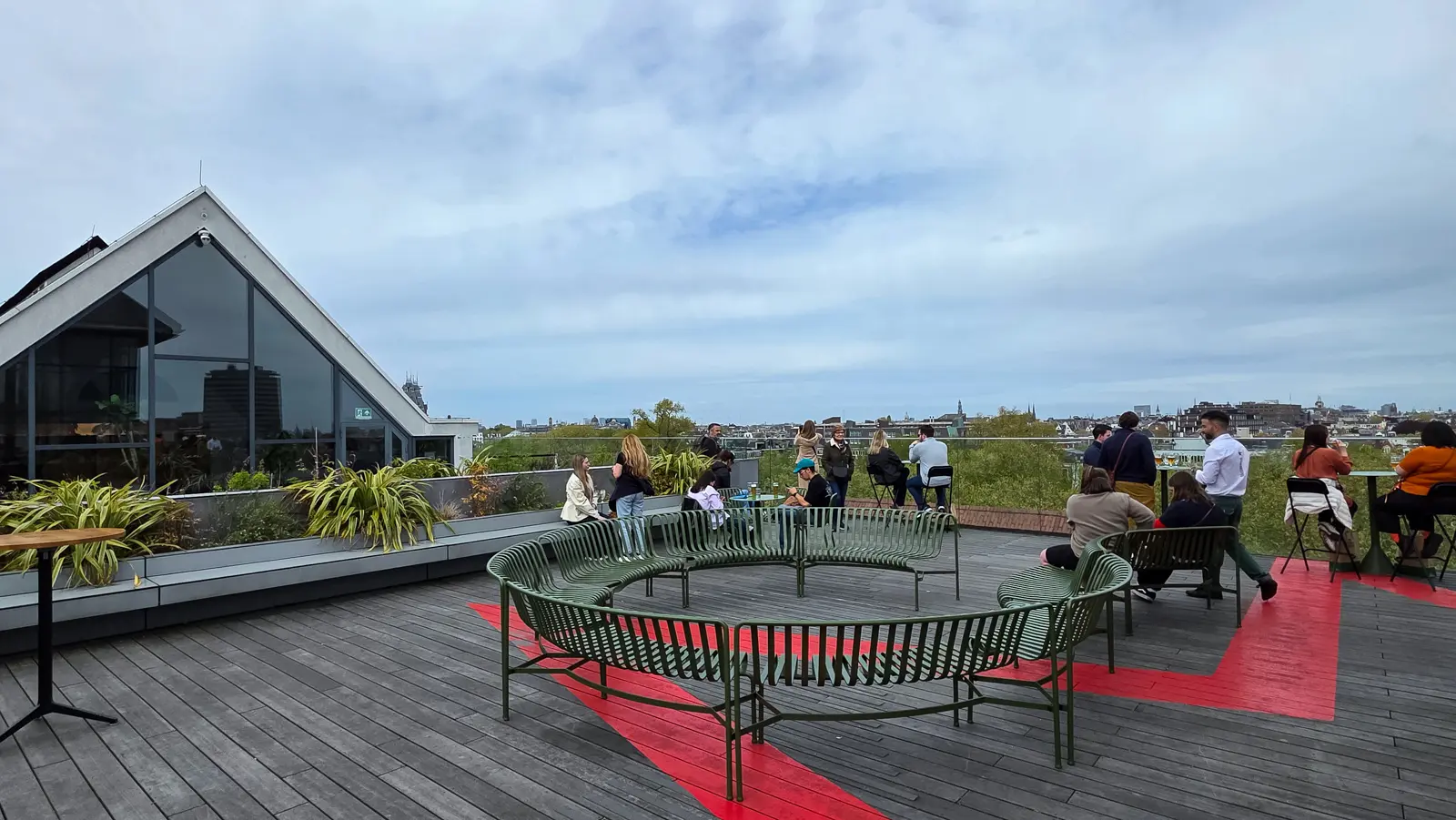
The rooftop is the other reason to go. It is open decking with the city spread out beyond it, and it is a good place to stop before walking back into town.
Stroopwafels, and a Food Scene I Underestimated
I had one real weakness in Amsterdam and it was the stroopwafel. Two thin waffle layers pressed in an iron, cut through while still warm and filled with syrup. Warm, they bend. I could have eaten them all day, and after averaging more than 20,000 steps I decided a few of them had been earned.
The one I kept going back to was Hans Egstorf, on the Singel. The bakery dates its founding to 1898 and now has several branches around the centre, and the corner site is the sort of shop that pulls people in off the street because they can watch the irons working through the window.
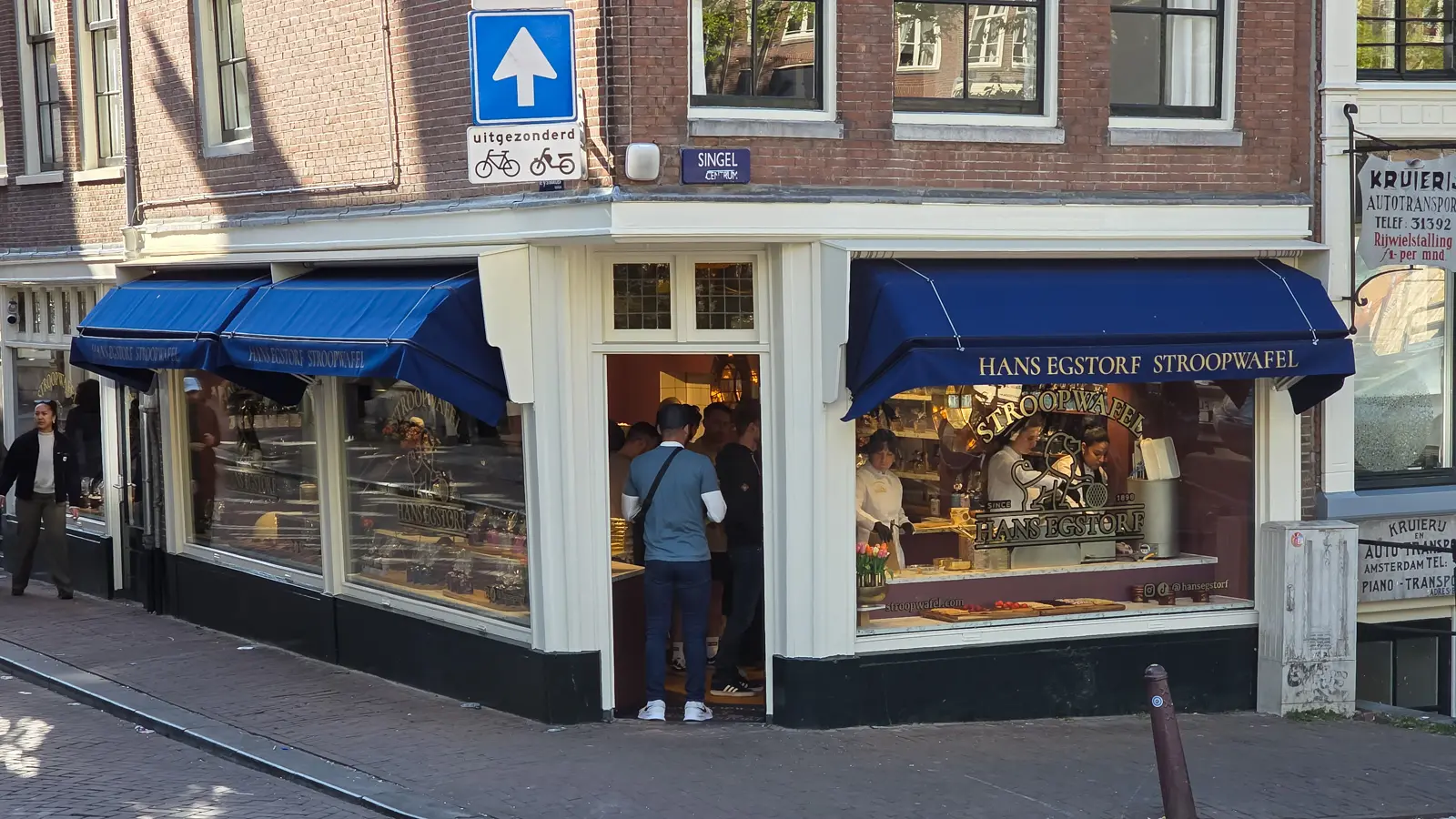
Inside, the counter is stacked with them, tied in cellophane with navy ribbons, and there are painted tins and jars if the plan is to take some home. Which it should be, because they travel well and they make better gifts than a fridge magnet.

The wider food scene was better than I had been led to expect, and much more international. I had gone in assuming a week of pancakes, cheese and chips with mayonnaise. What I found was a city that eats from everywhere, with Indonesian cooking woven in so long ago that it counts as Dutch, and a lot of small kitchens doing careful work. It is a real reason to go back, which is not something I would have predicted before arriving.
Bubbly Tips
- Give the Museum Quarter two days, not one. The Rijksmuseum, the Van Gogh Museum, the Stedelijk and Moco are within a few minutes of each other, and trying to do them in a single day means rushing all four. Split them and use Vondelpark as the break in between.
- Book museum tickets with a time slot before you travel. The Van Gogh Museum and Moco both sell out, and Moco is a small building that gets crowded fast. Early morning or late afternoon slots are the quieter ones.
- Moco is not wheelchair accessible. The villa is a listed building and the museum has not been permitted to fit lifts, so there are stairs only. Wheelchair users are admitted to the ground floor free of charge, but plan around it.
- If your dates cover King’s Day, check opening hours individually. Many shops and some museums close or shorten hours and transport is disrupted, but not everything shuts. The Heineken Experience and the Moco Museum were both open when I went. Book ahead where you can, because the places that do open get busy.
- Book accommodation early for late April. King’s Day and peak tulip season overlap, and that combination pushes prices up and availability down more than any other week in the Dutch calendar.
- For Keukenhof, go early and buy a combined ticket. The gardens open at 8am, the first hour is the calm one, and the bus from Amsterdam RAI takes about 35 minutes. Buying entry and transport together saves queueing twice.
- Check the Tulp Festival map if you cannot get to Lisse. Through April the city puts tulips in more than a hundred public spots, all free to see. Vondelpark, Museumplein and the Rijksmuseum gardens are the easy ones to combine on foot.
- Take the VIP option at the Heineken Experience if you are going at all. The standard ticket is self-guided. The VIP tour adds a guide, access to parts of the old brewery that are otherwise closed, and a private tasting bar at the end. Note that children are not admitted at all.
- Buy stroopwafels in tins for the journey home. Loose ones break. The packed tins and jars survive a suitcase, and they are easier to hand out than anything else you will find in a souvenir shop.
Final Thoughts
I arrived with two items on the list and left with about fifteen. The Rijksmuseum, the Stedelijk, Anne Frank House, the Jordaan properly rather than in passing, a day out to the windmills, and a return to Moco, which I had written off as the small one and which turned out to be the one I keep thinking about.
What stays with me is Almond Blossom. Not because it is the famous painting in that building, but because of what it was for: a man in an asylum hearing that his brother’s new son had been given his name, and answering with white flowers on a blue sky for a baby’s wall. A week in a city, and the thing I brought home was that.
Until next time!

🌟 Everything You Need to Plan Your Dream Trip in 2026
- 🌟 Luxury Hotels - Find premium stays with Booking.com & Hotels.com
- 🏡 Vacation Rentals - Discover unique properties on VRBO
- 🏞️ Guided Tours - Explore with Viator or GetYourGuide
- 🎫 Attraction Tickets - Skip the lines with Tiqets
- 🚢 Ocean Cruises - Set sail with Cruise Direct
- 📱 International SIMs - Stay connected with Saily
- 🚗 Car Rentals - Budget-friendly options from Discover Cars
- 🌐 Secure VPNs - Browse safely with NordVPN
- 💶 Currency Exchange - Best rates with Wise
- 🗣️ Learn Languages - Master the local language with Babbel and Rosetta Stone