
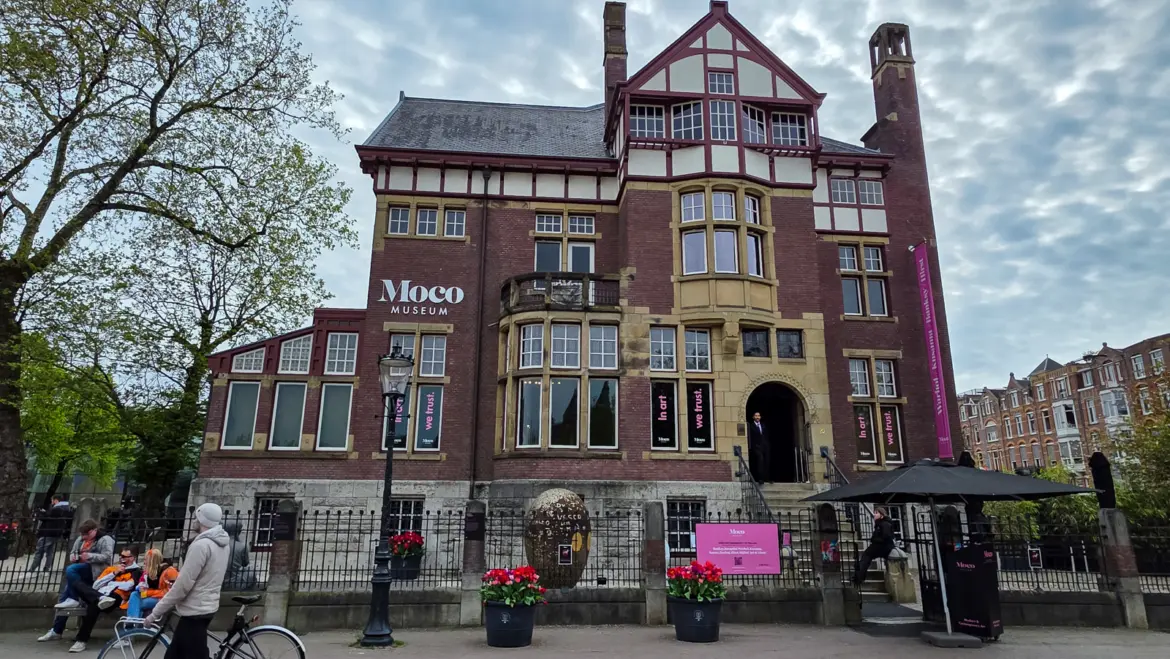
The question I kept asking myself on the way out was why I had waited so long. I have been to Barcelona. I have been to London. Moco has a museum in both, and I walked past the idea of it every time.
What I got in Amsterdam was not just an enjoyable couple of hours. Something clicked. I have spent a lot of time in galleries being respectful and slightly bored, and this is the first place where contemporary art stopped being a thing I was supposed to admire and became a thing I actually understood.
Moco Museum at a Glance
🎨 What it is · A modern and contemporary art museum on Museumplein, heavy on street art and Banksy, in a 1904 villa.
🖼️ The draws · Banksy’s Flower Thrower and Girl with Balloon, two Damien Hirsts, and Studio Irma’s mirrored Diamond Matrix downstairs.
🏛️ The setting · Villa Alsberg, built 1904 for a banker. The art hangs in panelled rooms with fireplaces, not white cubes.
🌿 The garden · Included with the ticket and full of sculpture. Leave real time for it; most people rush it.
💡 Tip · Book a timed slot before you travel. Moco is small, popular, stairs-only, and has no café.
A Villa Full of Street Art
The building is the joke and the argument at the same time. Villa Alsberg was designed in 1904 by Eduard Cuypers, nephew of the Pierre Cuypers who built the Rijksmuseum and Amsterdam Centraal, as a private house for a banker. Brick, timbered gables, turrets, stained glass, panelled rooms. It is exactly the sort of building the people in Banksy‘s work would have been kept out of.
Since April 2016 it has been full of street art. Nobody has stripped the interior to make a white cube of it. The stencils and screenprints hang on papered walls in rooms with cornices and fireplaces, and the friction between the two is the point rather than an accident.
Banksy
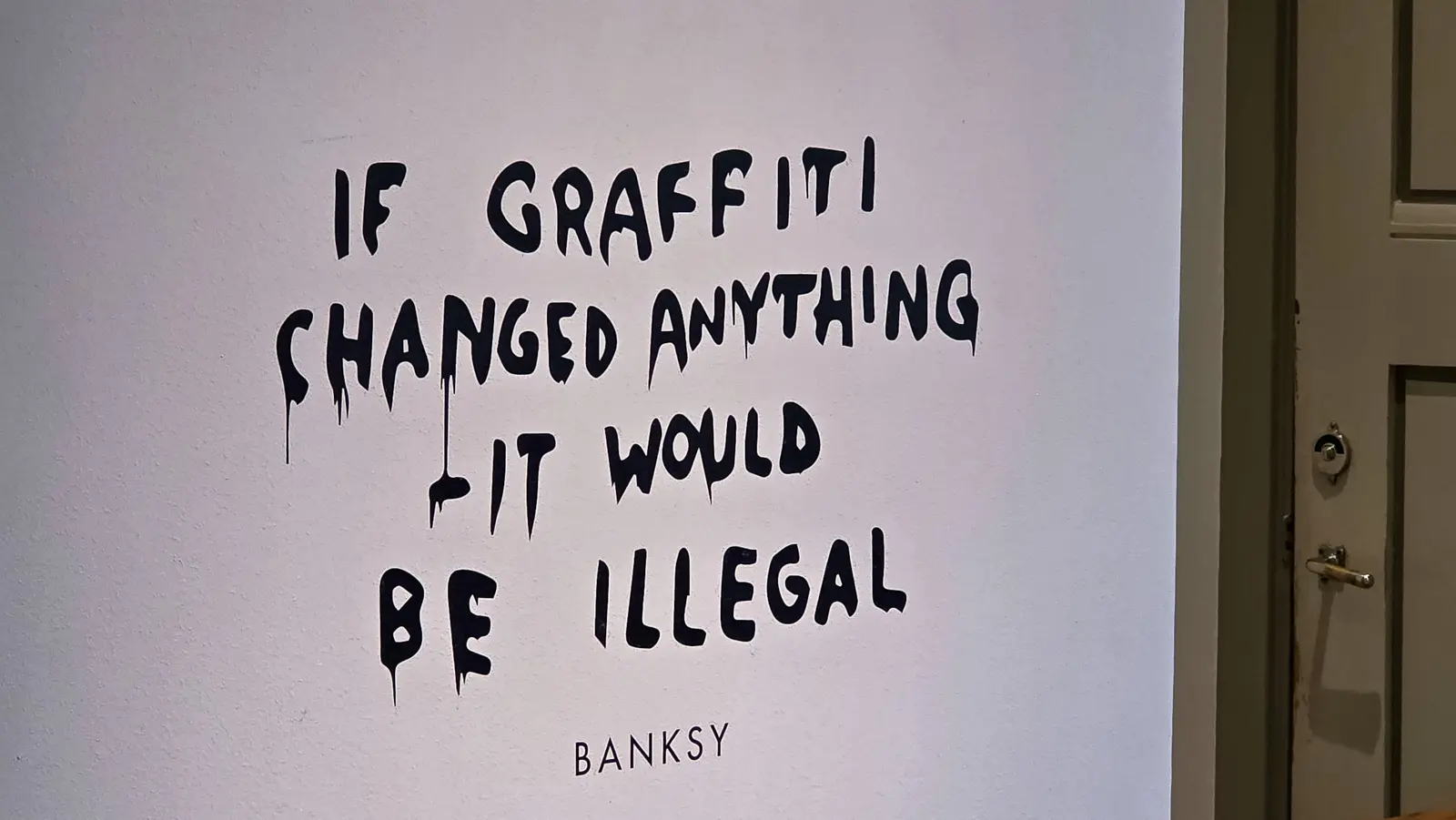
The Banksy holding is the reason most people come, and the museum is upfront about the fact that Banksy has nothing to do with it. His name is on the wall in his own handwriting, in a line about graffiti that manages to be both a joke and a defence.
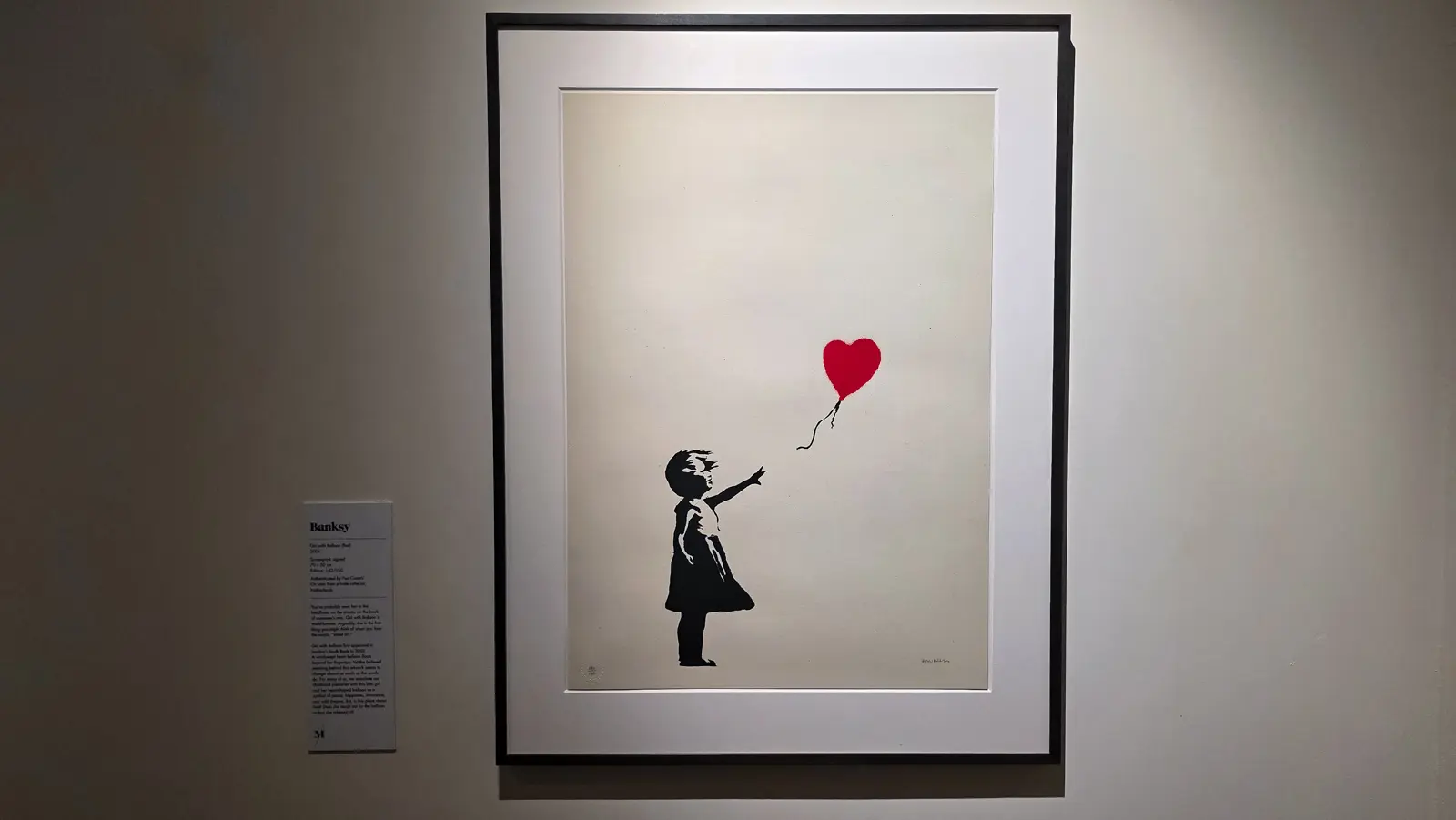
Girl with Balloon is the one everybody recognises before they know they recognise it. The version here is a signed screenprint from 2004, and the wall text asks the question that makes the image worth stopping for: whether she is reaching for the balloon or has just let it go.
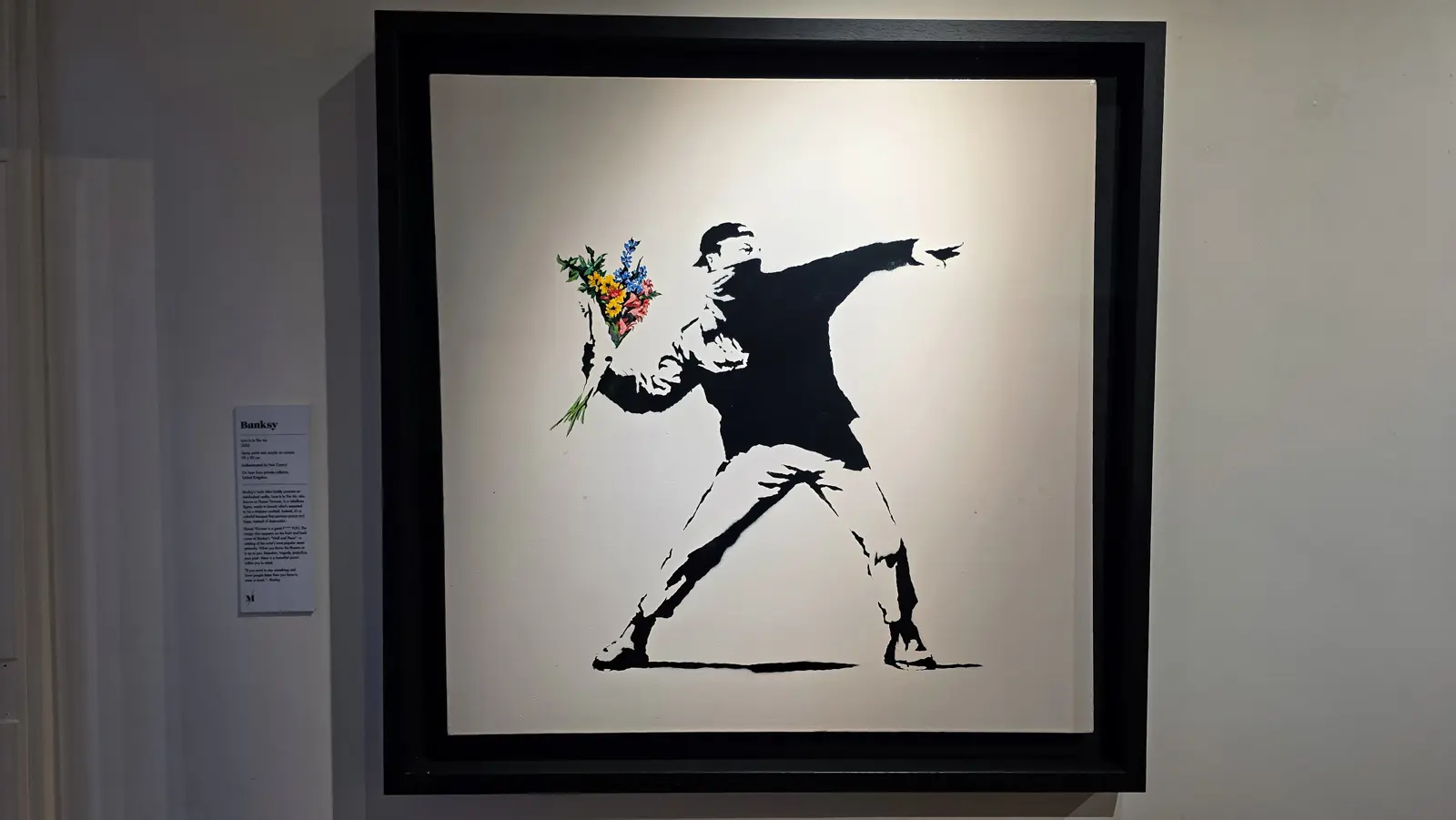
Next to it is Love Is In The Air, better known as the Flower Thrower. A masked figure winds up to throw, and what he is throwing is a bunch of flowers. It works because the body knows exactly what a petrol bomb throw looks like, and then the hand is full of chrysanthemums.
Arrow Head
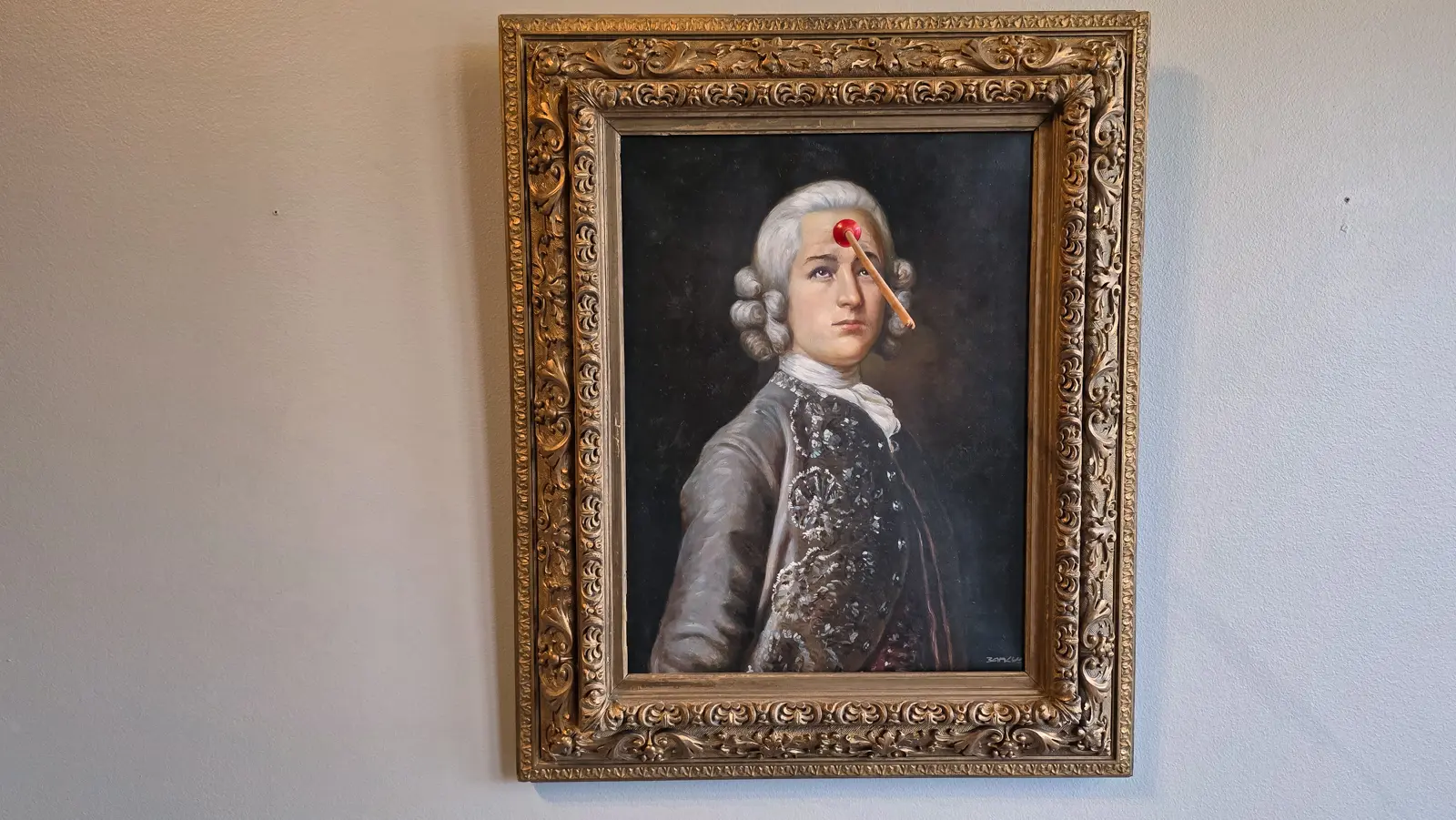
The one that made me laugh out loud is Arrow Head, and it belongs to Banksy’s Crude Oil series, in which he buys old oil paintings from car boot sales and junkyards and then does something to them.
Here the something is an arrow. An eighteenth-century gentleman in a powdered wig and an embroidered coat sits for his portrait exactly as he was painted to, and a toy arrow with a red sucker is stuck to his forehead. It is three-dimensional, projecting out of the canvas. The target is not really the man. It is the whole tradition of hanging wealthy white men on walls and calling it art history.
The Grin Reaper
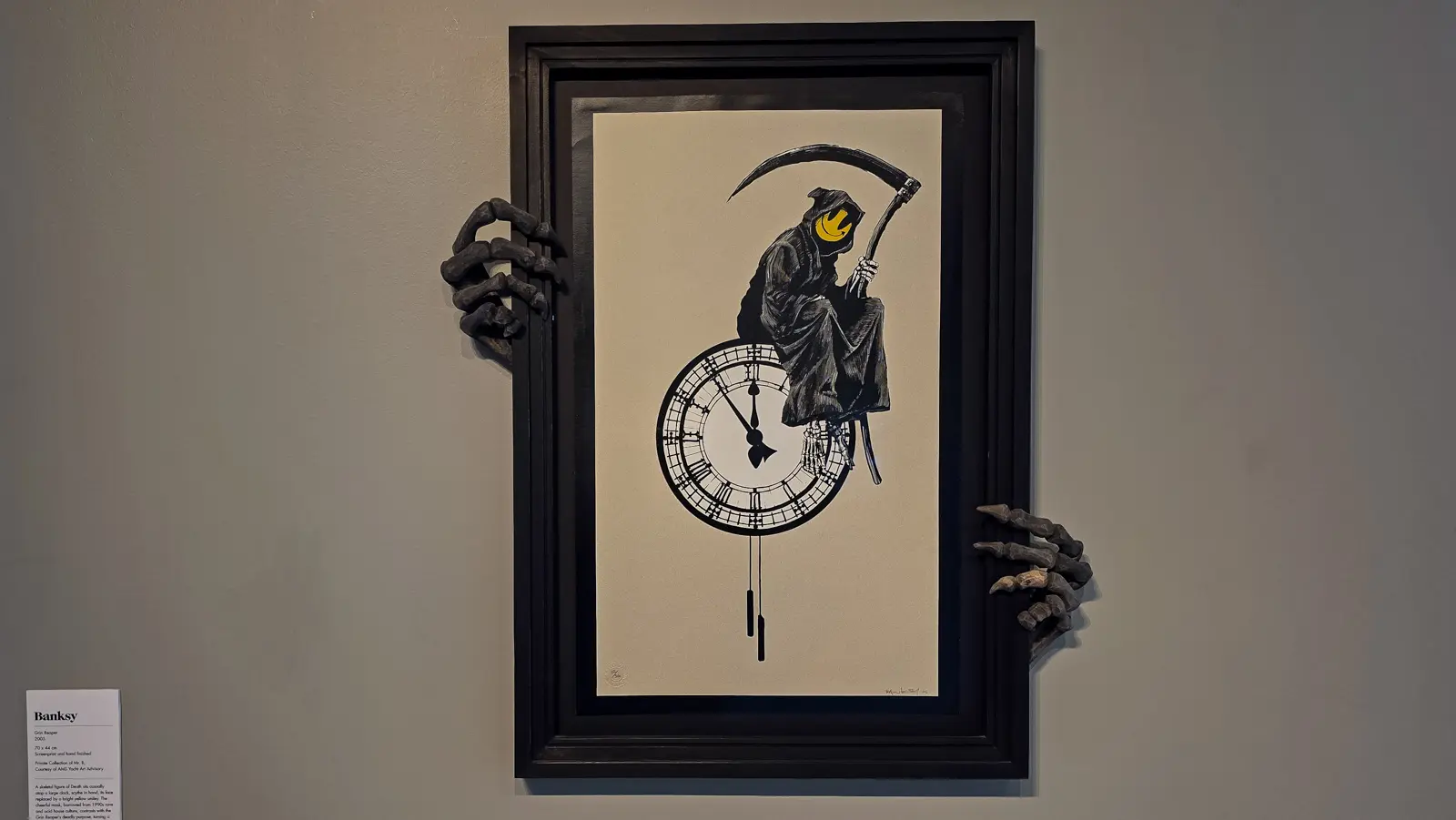
The best piece of staging in the building is a screenprint from 2005 called Grin Reaper. Death sits on a clock face with a scythe, hooded, and where the skull should be there is a yellow acid house smiley.
What makes it is what the museum has done around it. Skeletal hands have been mounted on the wall either side, gripping the frame from outside, so the picture appears to be held up by the thing inside it.
Rebel With A Cause
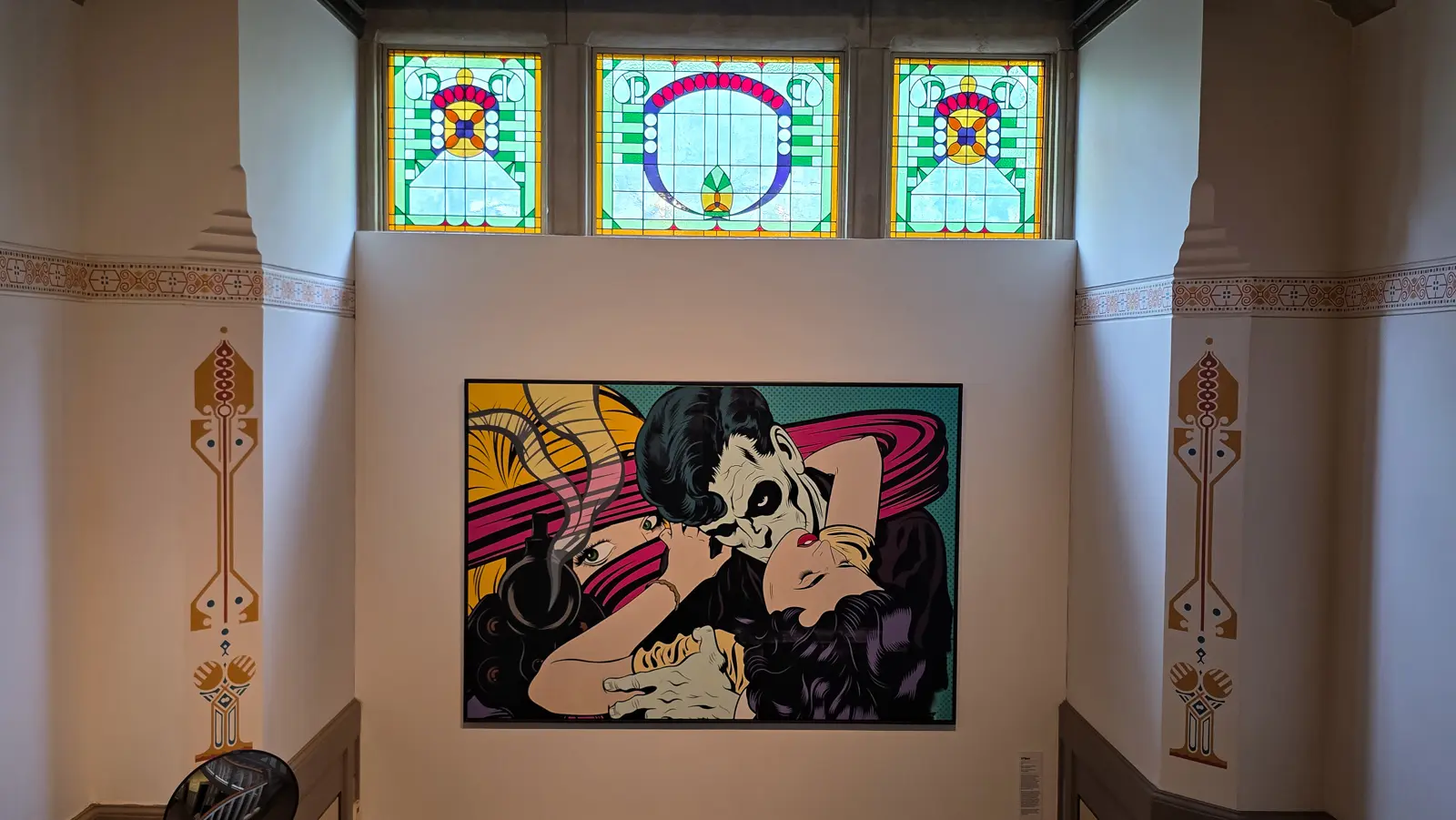
On the stairs, where the villa still has its original stained glass spelling out POP above the landing, hangs Rebel With A Cause by the British street artist D*Face.
It reads at first as a panel from a romance comic, a couple mid-kiss in flat colour with halftone dots. Then the face resolves and the man is a skull. It is the same trick as the flowers in the Flower Thrower, running the other way: something familiar and sweet with the rot showing through.
Contemporary Masters
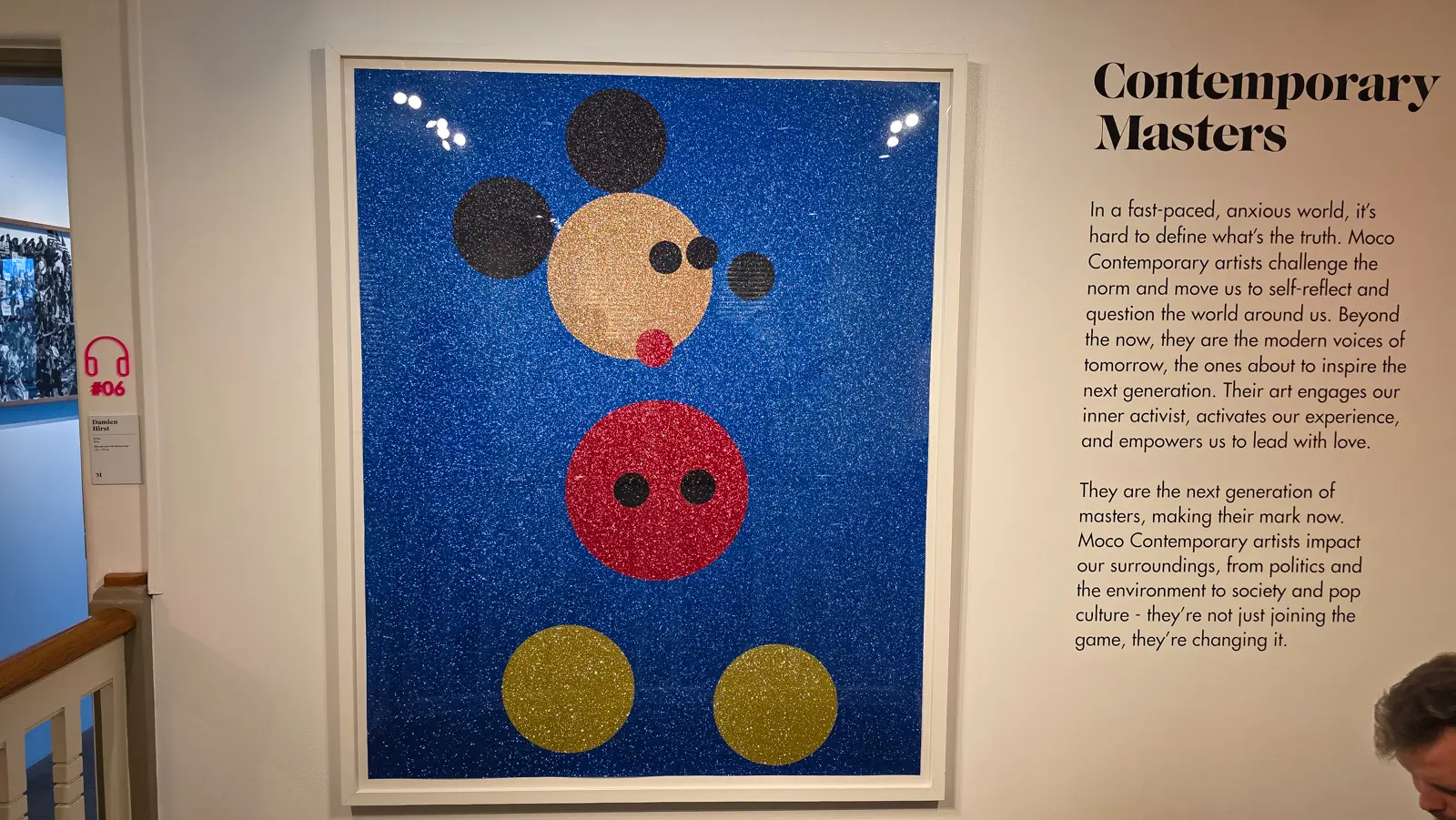
Upstairs the collection widens out under a heading the museum calls Contemporary Masters, and the two Damien Hirsts are where I stopped longest.
The first is Mickey, from 2016, which reduces the most recognisable character on earth to seven circles on a field of glitter and loses nothing. It is a test of how little information a symbol needs, and the answer is almost none.
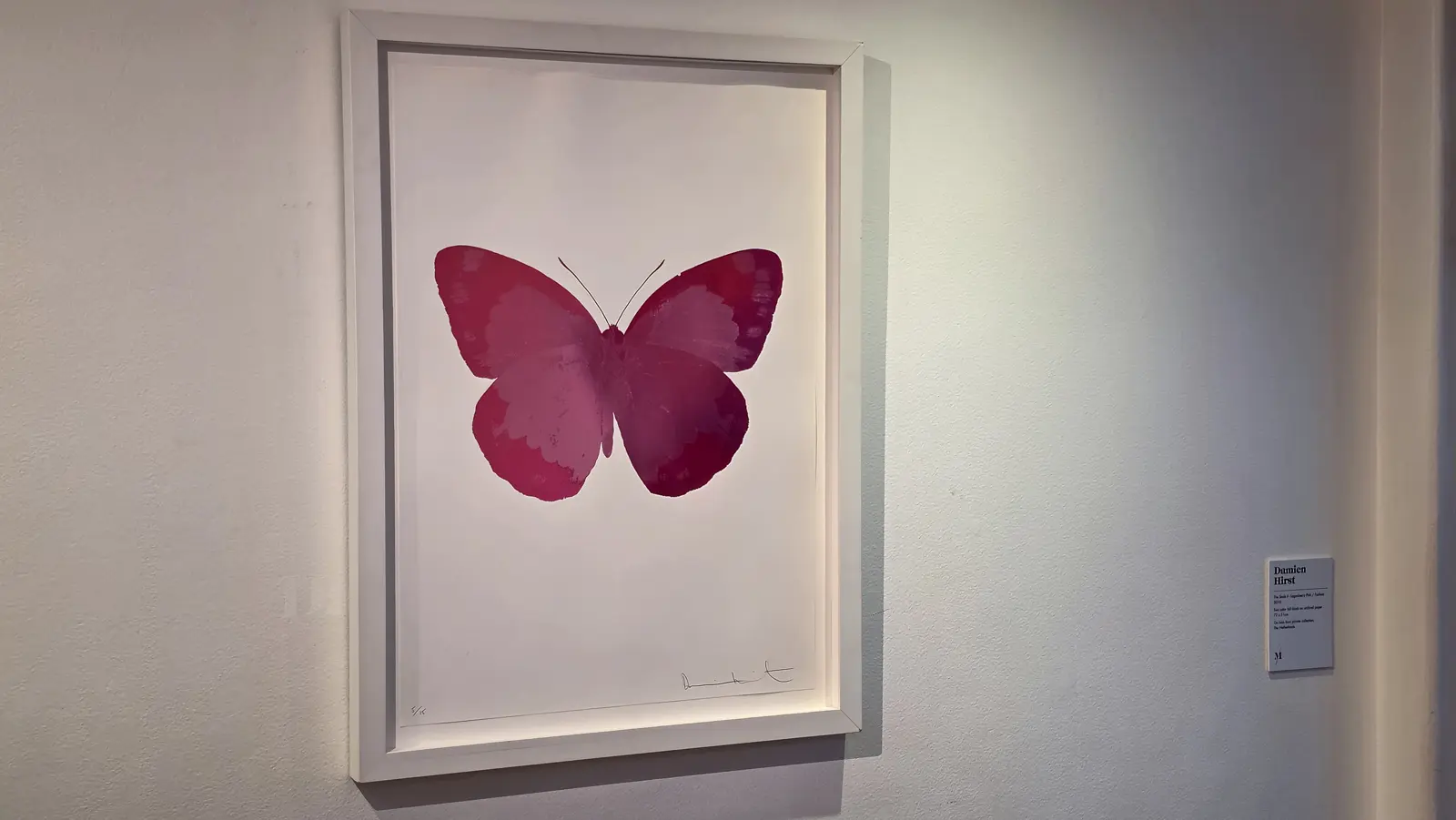
The second was the surprise. I have seen Hirst’s butterflies in galleries before and never expected to meet one here, in a townhouse off Museumplein, hung quietly on a white wall in a room with a fireplace.
Diamond Matrix
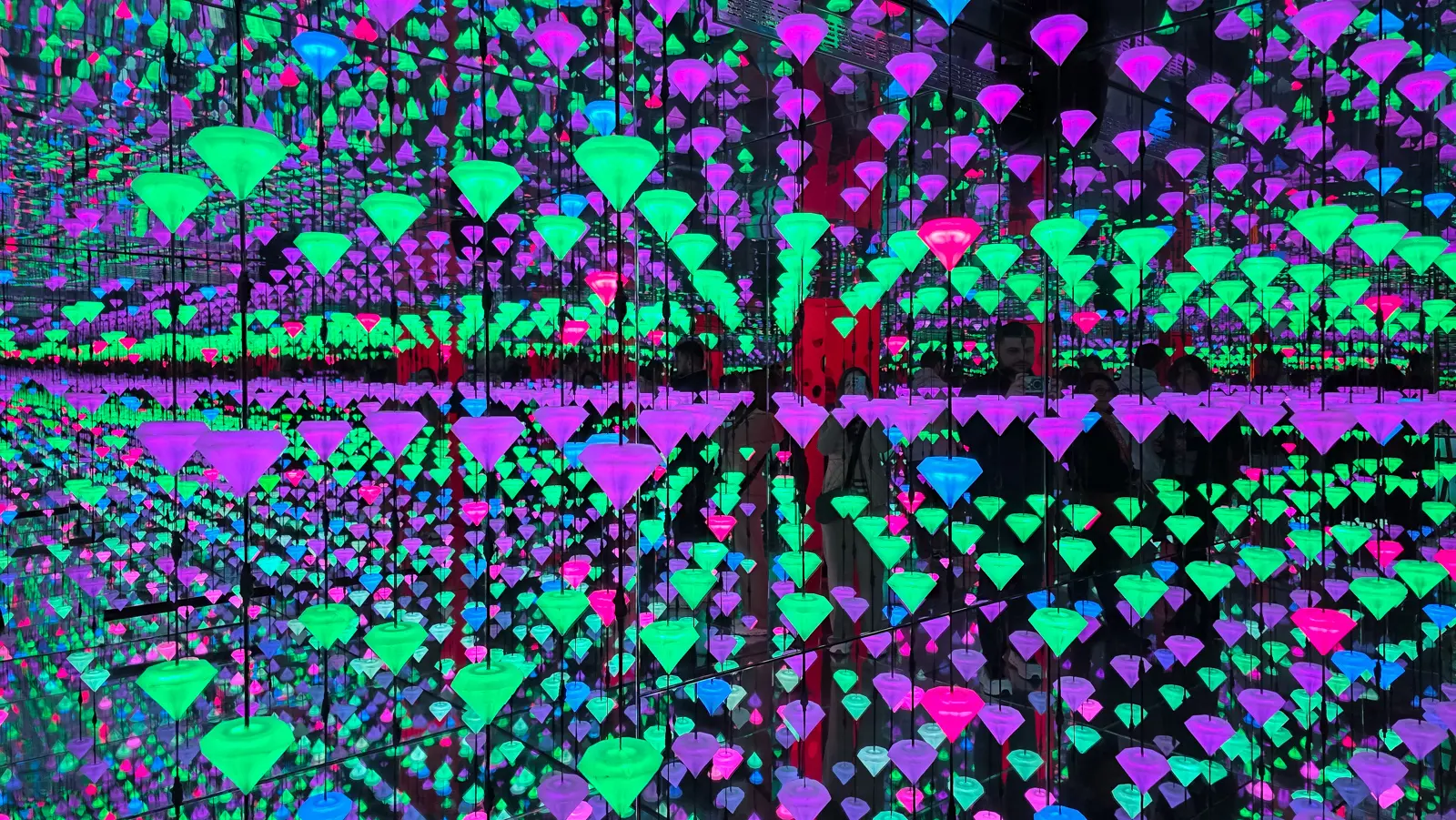
Downstairs is something else entirely. The lower ground floor holds Reflecting Forward, a permanent installation by Studio Irma, and the room people queue for is Diamond Matrix.
It is a mirrored room hung with hundreds of light-up diamonds in green, magenta, violet and blue, with mirrors on every surface so the diamonds repeat away in all directions and there is no edge to the space. The idea underneath it is not decorative. Carbon becomes diamond only under enormous pressure, and the room is built as an argument about what strain produces.
The Garden
The garden is included with the ticket and it is not an afterthought, which is the thing I most want people to know before they go. Leave time for it.
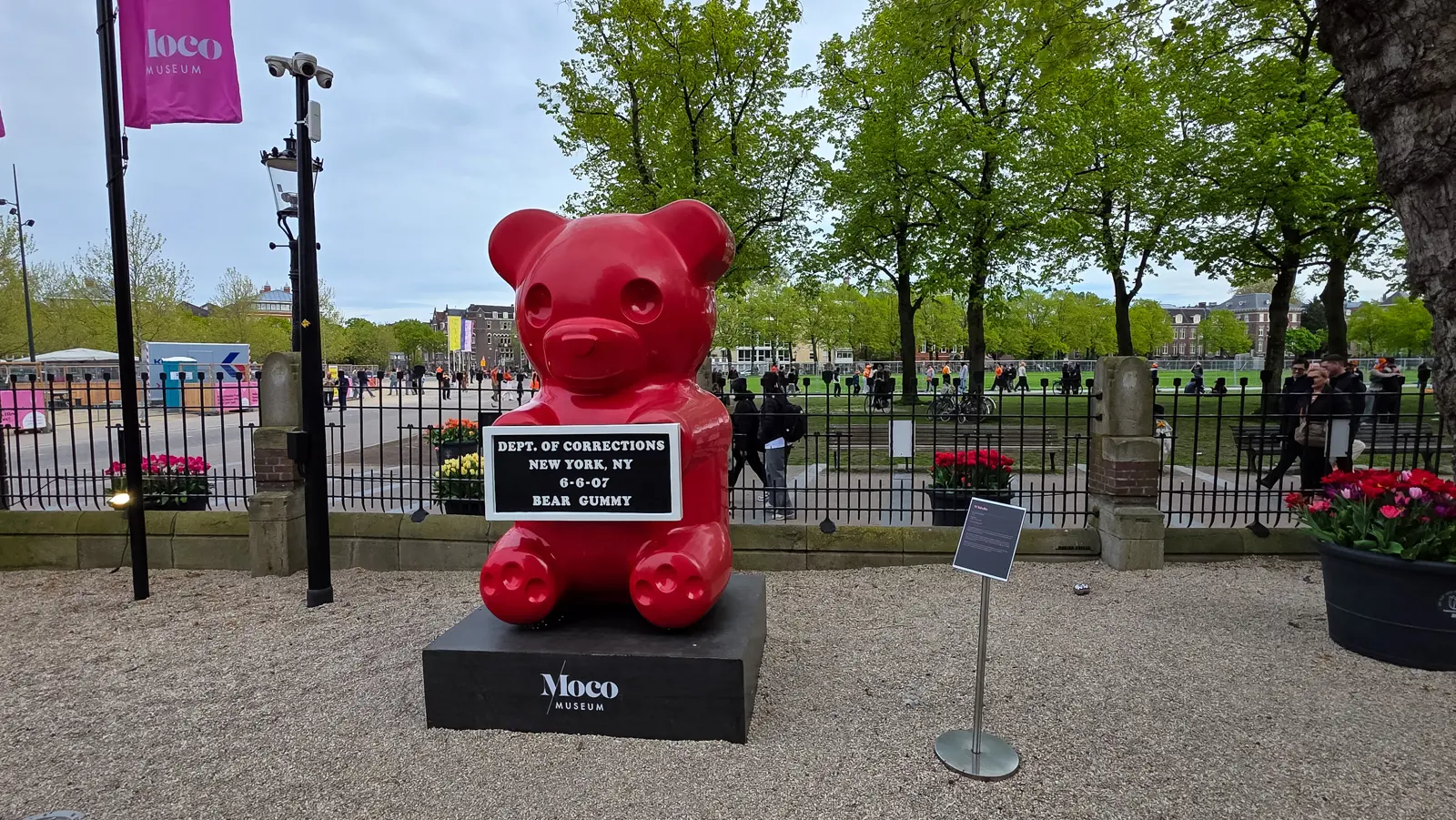
Sitting on the gravel is a large red gummy bear holding a prison mugshot board. It is Vandal Gummy by WhIsBe, and it does a lot with very little: the sweet shape of childhood holding up a booking card from the Department of Corrections.
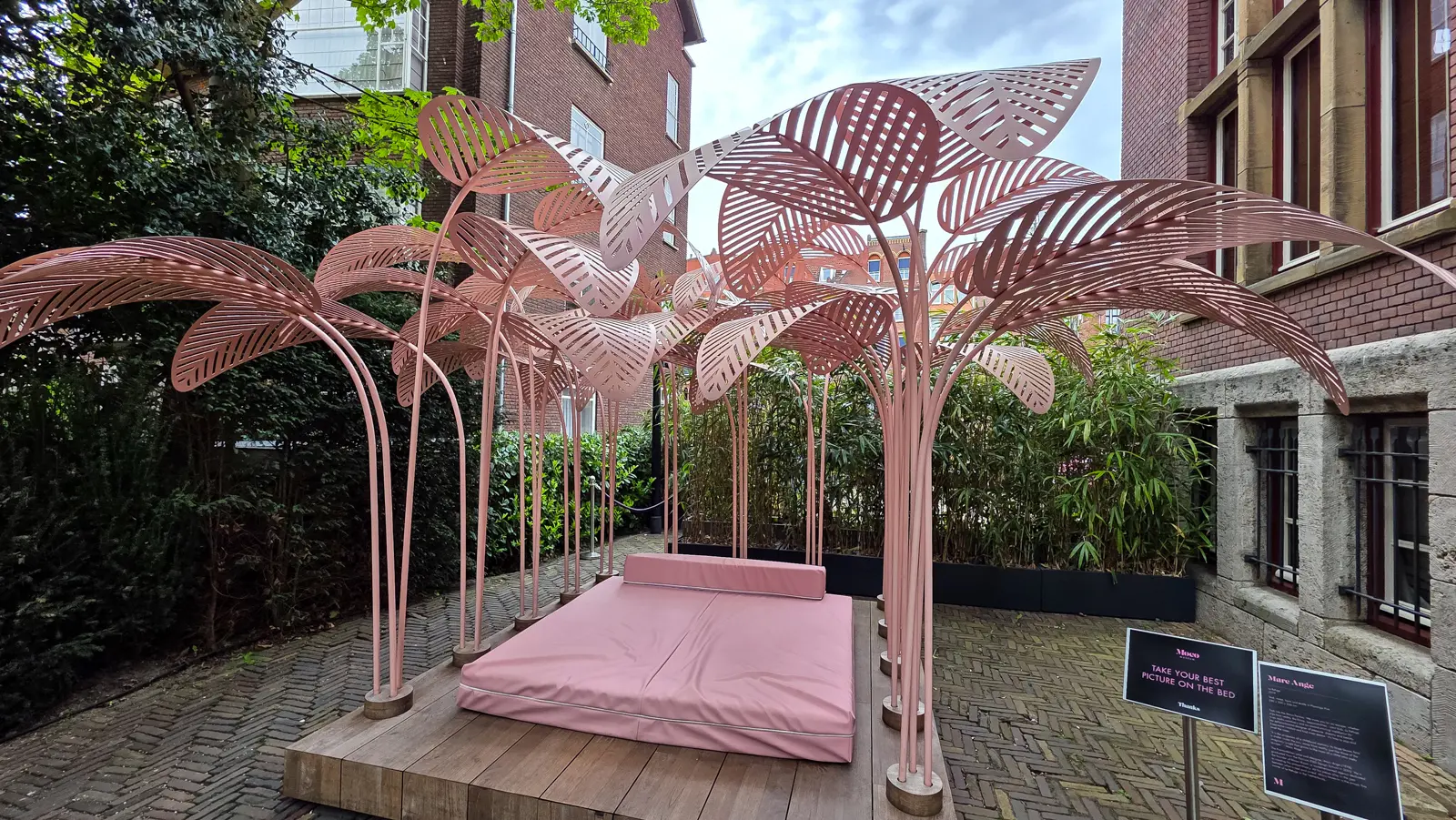
Further in is Le Refuge by Marc Ange, a canopy of oversized pink metal leaves arching over a pink daybed. Visitors are invited to lie on it, and the perforated leaves throw striped shadows down across whoever does.
The Shop
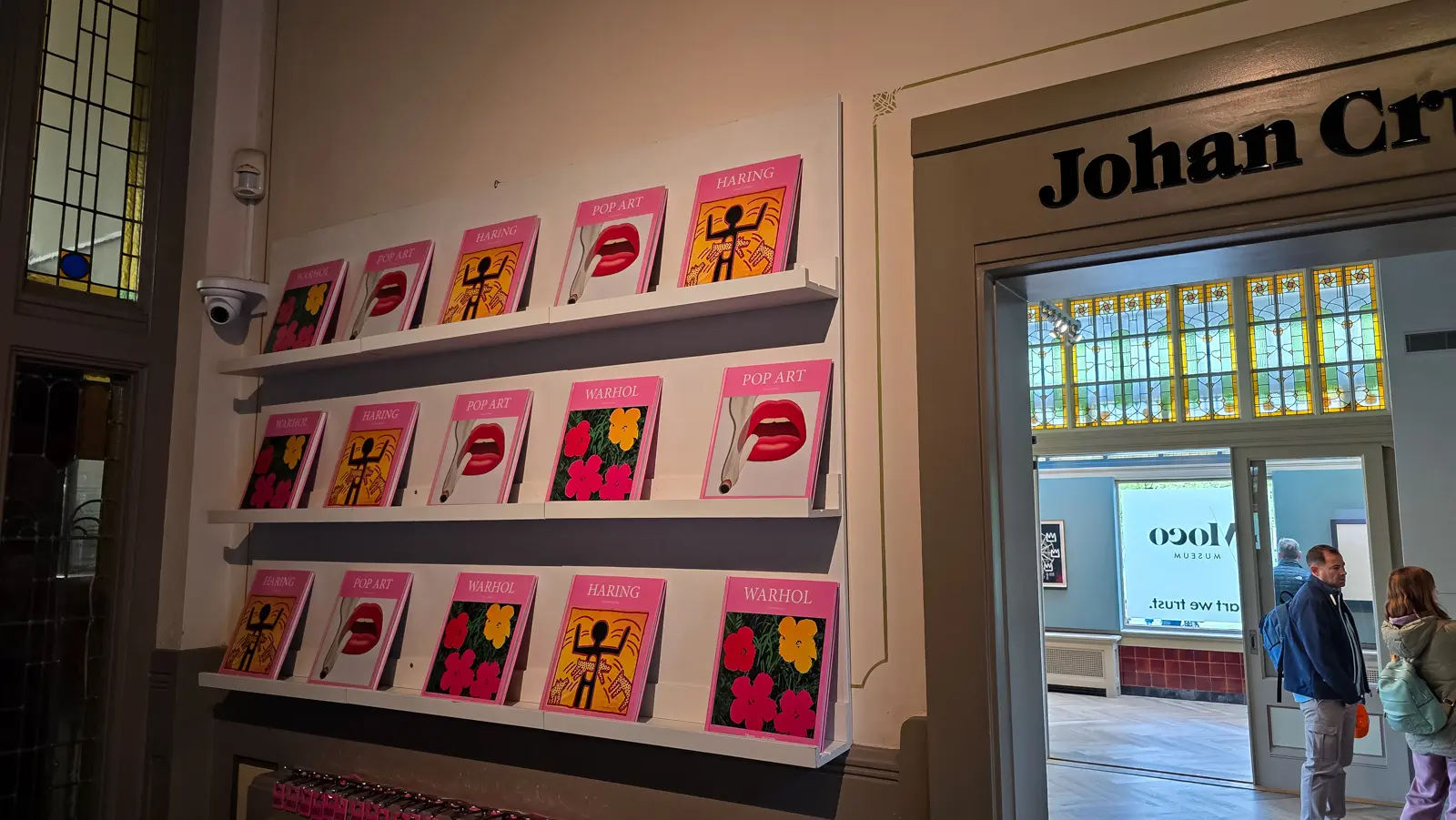
The shop sits on the lower ground floor and is better than most museum shops, mainly because the collection lends itself to print. There is no café on site, so plan food elsewhere.
Bubbly Tips
- Book a time slot before you travel. Moco is small and popular, and walk-up tickets are not a reliable plan, particularly at weekends or on a public holiday.
- Go at opening or late in the afternoon. The middle of the day is when the rooms are tightest, and several of the works need space in front of them to be seen properly.
- It is not wheelchair accessible. The villa is a listed building and the museum has not been permitted to fit lifts, so access is by stairs only. Pushchairs cannot be brought in either.
- Leave a proper half hour for the garden. It is included with your ticket, it is full of sculpture, and most people rush it because they think the museum ended at the door.
- Read the wall texts, especially on the Banksys. They explain provenance, editions and authentication, and they are the reason the collection reads as serious rather than as posters.
- Go downstairs even if immersive art is not your thing. Diamond Matrix takes a couple of minutes and it is the piece everyone in my group talked about afterwards.
- Photography is fine, so take your time. Reflective rooms and glazed frames are difficult, so turn the flash off and let the exposure settle rather than firing straight at the glass.
- There is no café. Eat before or after. Museumplein has options a few minutes away in any direction.
- Pair it with the Van Gogh Museum, not the Rijksmuseum. Moco is a ninety-minute museum and the Van Gogh is a two-hour one, which fits in a day. Adding the Rijksmuseum does not.
Final Thoughts
I went in expecting to enjoy the Banksys and to find the rest pleasant enough. What actually happened is that a museum in a banker’s villa taught me something about how contemporary art works, which is that most of it is a familiar image with one thing wrong. Flowers instead of a petrol bomb. A smiley instead of a skull. An arrow in a gentleman’s forehead. A gummy bear holding a charge sheet.
Once that lands, the whole floor makes sense at once, and a lot of art I had previously walked past politely started to look like something I could actually read.
Which brings me back to Barcelona and London, both of which I visited without going in. Next time I am going in.
Until next time!

🌟 Everything You Need to Plan Your Dream Trip in 2026
- 🌟 Luxury Hotels - Find premium stays with Booking.com & Hotels.com
- 🏡 Vacation Rentals - Discover unique properties on VRBO
- 🏞️ Guided Tours - Explore with Viator or GetYourGuide
- 🎫 Attraction Tickets - Skip the lines with Tiqets
- 🚢 Ocean Cruises - Set sail with Cruise Direct
- 📱 International SIMs - Stay connected with Saily
- 🚗 Car Rentals - Budget-friendly options from Discover Cars
- 🌐 Secure VPNs - Browse safely with NordVPN
- 💶 Currency Exchange - Best rates with Wise
- 🗣️ Learn Languages - Master the local language with Babbel and Rosetta Stone