
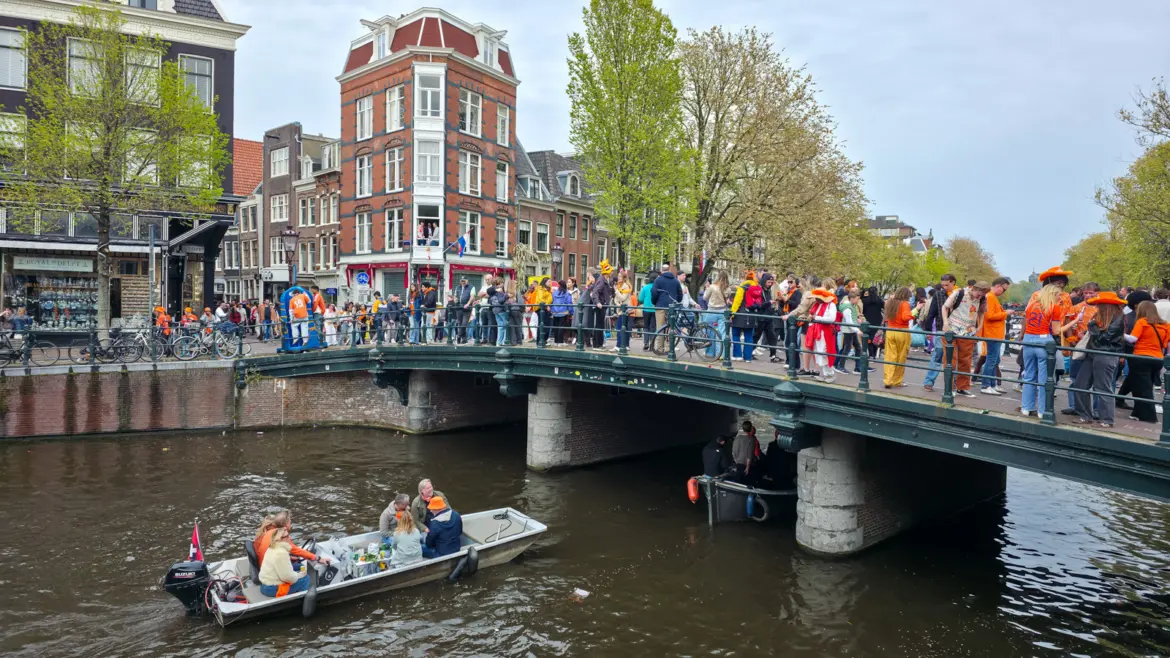
I did not book my Amsterdam trip for King’s Day. I booked it for the tulips, worked out later that the dates covered 27 April, and spent a while wishing they did not.
Everything I read beforehand said much the same thing. The centre would be impossible. Hotels would cost double what they cost a fortnight either side. Museums would close, trams would stop running, and the whole city would turn into one continuous crowd. I looked at whether the dates could move, decided the tulips mattered more, and made peace with losing a day.
None of those warnings were wrong, incidentally. Prices were high, transport did stop, and the crowd was as dense as advertised.
It was still the best day of the trip, and for a reason I had not anticipated. What makes King’s Day worth staying for is not the scale of the party. It is watching an entire country take the same day off, put on the same colour, go outside, and enjoy itself thoroughly without any of it turning sour.
King’s Day in Amsterdam at a Glance
📅 When · 27 April, King Willem-Alexander’s birthday. The country’s biggest national party. King’s Night is the evening before, on the 26th.
📍 Where it happens · On and along the canals, and around Leidseplein, Rembrandtplein and the Jordaan. The Museum Quarter stays quiet.
🧡 Orange · Not on the flag, but the colour of the royal House of Orange-Nassau. By mid-morning the whole city wears it.
🚤 On the water · Boats fill the canals under strict rules (under 10m, 6 km/h, 12 people plus a skipper). Watch from a bridge if you have no boat.
💡 Tip · Book accommodation as early as you can. King’s Day and peak tulip season overlap, the priciest week of the Dutch year.
Where It Actually Happens
This is the thing I wish someone had told me in advance. I was staying near the Museum Quarter for part of the trip, and if that had been my only reference point I would have concluded that King’s Day was mostly a rumour. It was quiet there. Pleasant, ordinary, barely marked.
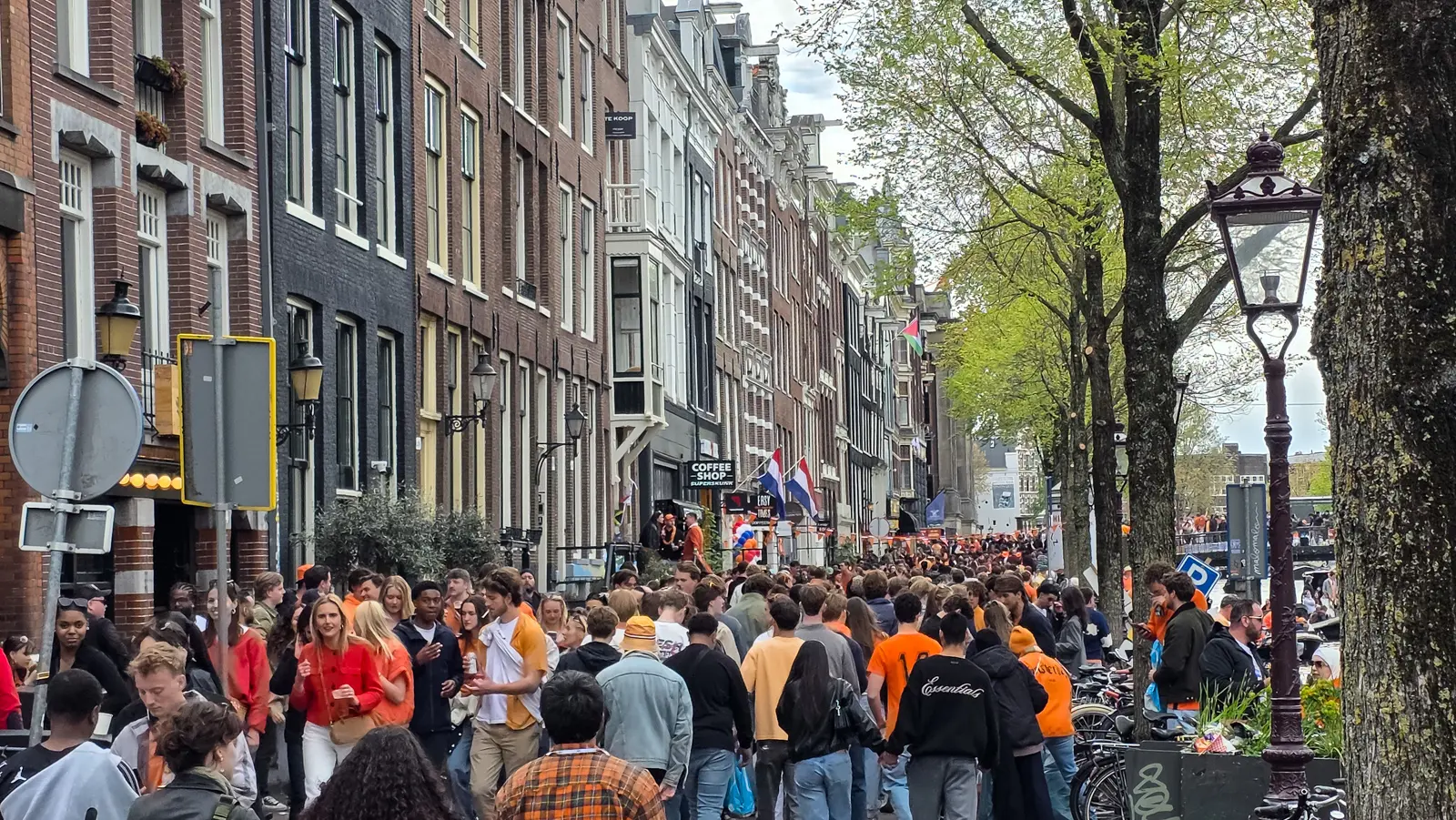
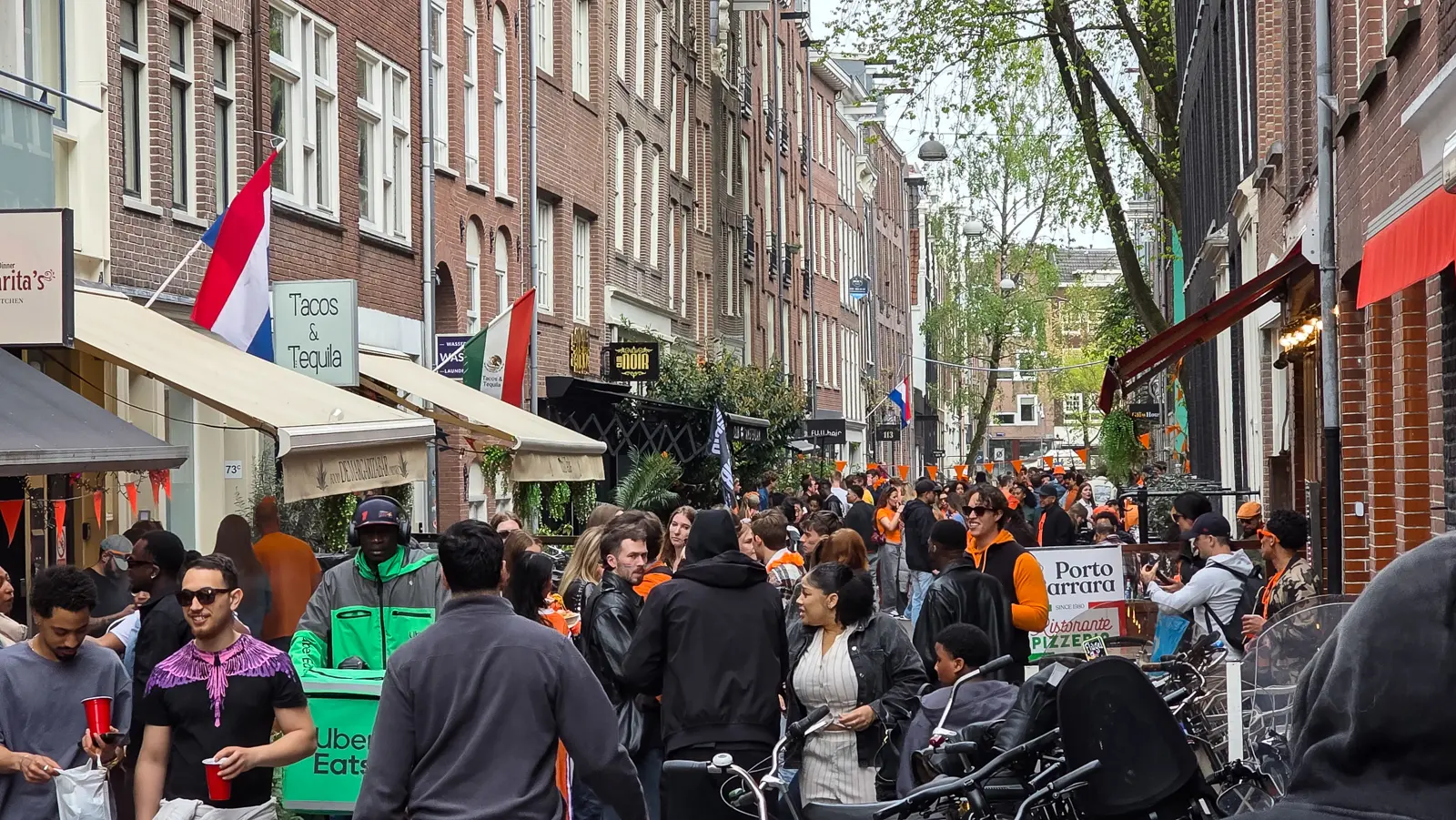
The day happens on the water and along it. The canals, the bridges over them, and the streets where the bars and restaurants front onto the quays. Walk fifteen minutes north and east from Museumplein and the change is total: bunting across the streets, flags out of upper windows, crowds thick enough that walking becomes shuffling.
The rough geography is worth knowing before setting out. The canal belt is the centre of gravity, and the density builds towards Leidseplein and Rembrandtplein, which take the biggest crowds and the loudest bars. The Jordaan runs a huge street market and gets so tight that the city advises against bringing small children through parts of it. Further out, the residential districts do a gentler version, more household clear-out than party. The Museum Quarter, in between, more or less opts out.
That last point is the practical one. Somebody staying near Museumplein could plausibly spend King’s Day wondering what the fuss was about, which is roughly what I did until I walked out of it.
Why Everyone Is in Orange
Orange is not on the Dutch flag. That flag is red, white and blue. The colour belongs to the royal house, Orange-Nassau, and it has become the national colour by association rather than by design.
What struck me is that nobody treats it as fancy dress. It is not a costume, and there is no self-consciousness about it. People put on an orange shirt the way anyone puts on a shirt, and by mid-morning the streets have turned a single colour. There is real national pride on display, and it is warm rather than solemn. Nobody is standing to attention.
The date belongs to King Willem-Alexander, whose birthday is 27 April. Until 2013 the holiday was Queen’s Day, held on 30 April for Queen Juliana’s birthday and kept on that date by her daughter Beatrix even though it was not her own. When Beatrix abdicated and her son took the throne, the country moved the holiday to his birthday and renamed it. The tradition itself is older still, going back to a day set aside in the 1880s for the young Princess Wilhelmina.
The Squares
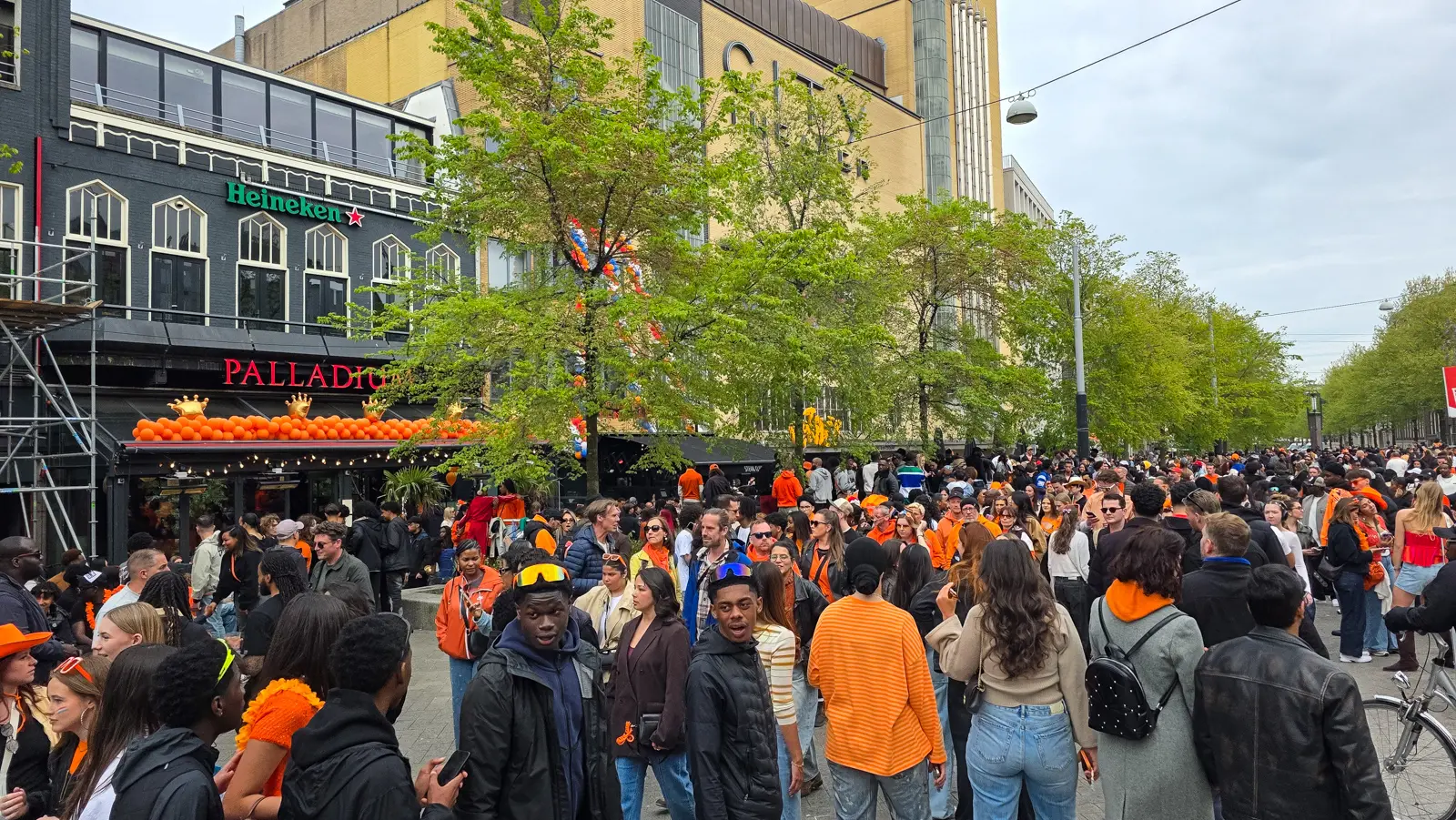
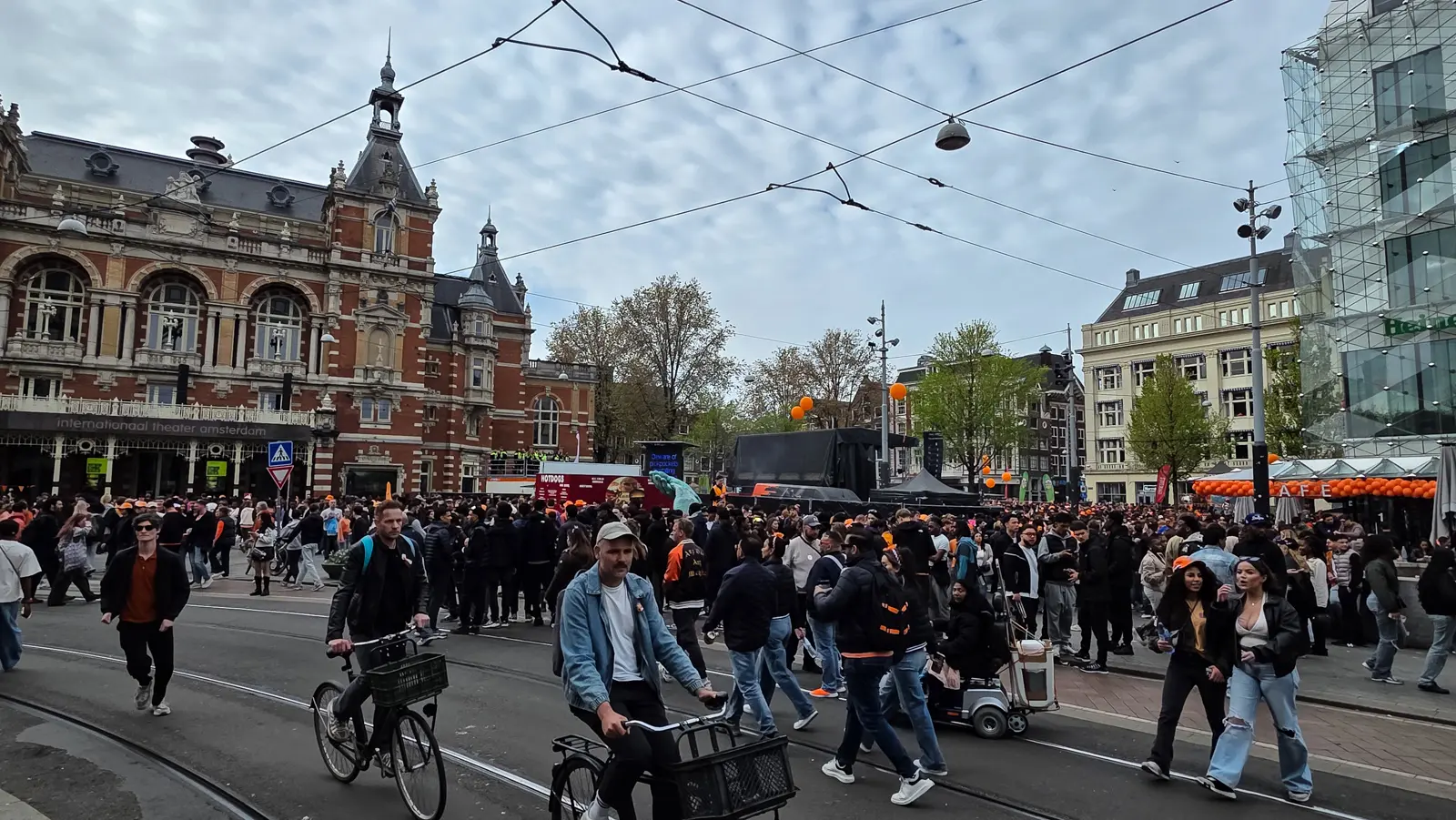
Leidseplein is one of the places the day concentrates. The square sits in front of the Internationaal Theater Amsterdam, in the old Stadsschouwburg building, and on the day it fills with food trucks, temporary bars and a crowd that moves slowly in every direction at once. Police watch it from a raised platform. Balloon arches go up over doorways.
There was also a stage in the square, with music carrying right across it. That is more regulated than it looks. Every stage on King’s Day needs an event permit, licensed events may run from eleven in the morning until eight at night, and the music cannot start before noon. Inside the city centre the permits go only to small events, under two thousand people at the busiest moment, which have to be open to the public and free to walk into. What the city prohibits is the unlicensed version, somebody wheeling a sound system into a public space and switching it on.
That eight o’clock limit applies to the permitted events, not to the day. Bars and their terraces run on their own licences, and a few of the larger ticketed events at the edges of the city hold permits until ten, staggered deliberately so that the crowds can actually get home on the evening’s trains.
The Side Streets and the Vrijmarkt
Off the squares, the narrow streets carry the other half of the day. Orange bunting runs building to building, flags hang from the upper floors, and every bar has put its speakers by the open door.
This is also where the vrijmarkt happens, the free market that gives King’s Day its other character. For one day, people can sell second-hand goods on the street almost anywhere in the city, without a permit and without paying for a pitch. Households put a blanket on the pavement and clear out their cupboards. Children sell toys, or set up games, or play an instrument badly for coins. In residential areas it starts not long after dawn.
On the Water
The canals are the part that looks best in photographs, and the part that is hardest to explain to anyone who has not seen it. Boats fill the water end to end, most of them small and open, all of them carrying more people in orange than seems structurally advisable. They move at a crawl because they have to. Every bridge is lined three or four deep with people watching them go under.
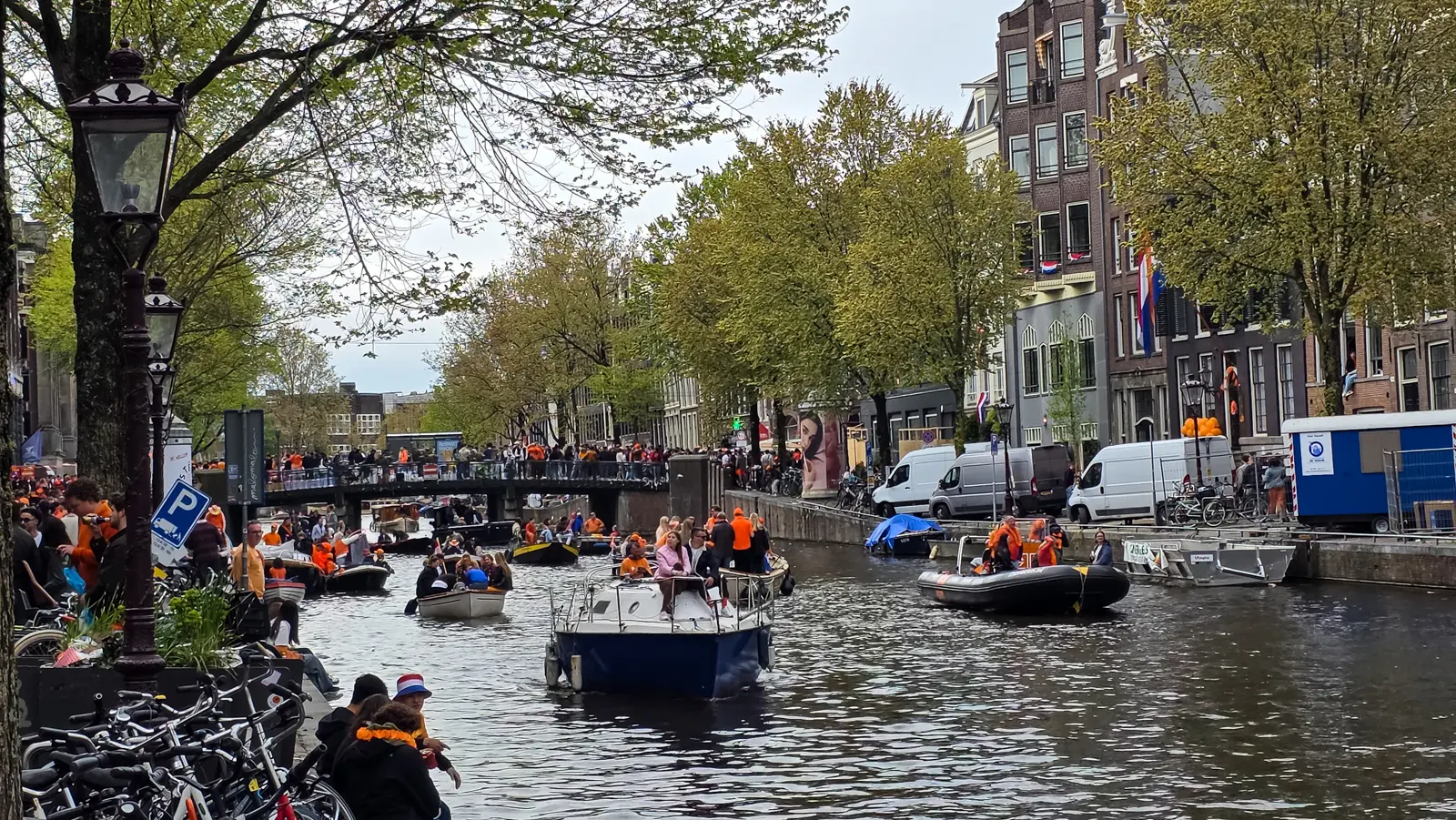
What keeps it orderly is a set of rules the city has tightened over the years. Only boats shorter than ten metres may sail in the city centre at all, nothing may exceed six kilometres per hour, and a boat may carry no more than twelve people plus a skipper. The city made no exceptions to that passenger limit in 2026 beyond two: licensed cruise operators sit outside it, and it does not apply on the wider through-routes such as the Amstel. That is why plenty of boats out there are legitimately carrying far more than twelve. Amplified music is not permitted on open boats. Many canals run one way for the day. The effect is a waterway that is completely full and still functioning, which is not the impression the photographs give.
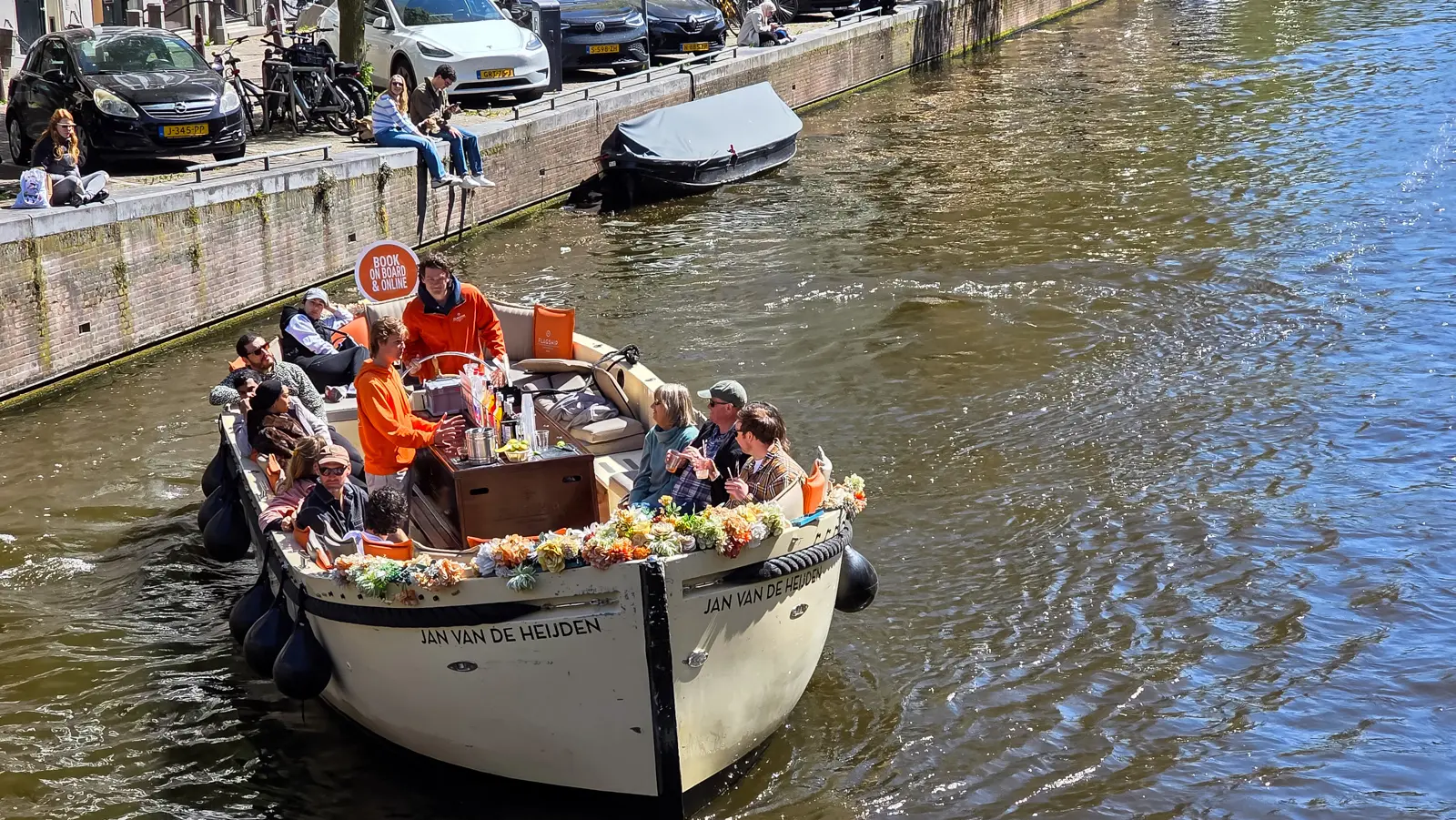
Getting on the water without access to a private boat means booking, and booking early, because the organised cruises go months ahead. The one below was out on the canals the afternoon before the holiday, decorated and running a bar on board, which gives a fair idea of what the operators lay on.
What Was Open
The standard advice is that the city shuts and there is no point planning anything. That was not quite my experience, and the accurate version is more useful.
Plenty was closed, and public transport through the centre was gone. But the Heineken Experience was open, and so was the Moco Museum, and I got to both. What that means in practice is that a blanket assumption in either direction is unreliable. The thing to do is check each place individually, book where booking is possible, and allow for a queue where it is not.
How It Actually Behaves
I stayed out late without staying out all night, and what I saw was a large, cheerful, extremely crowded party that never tipped into anything worse. People were drinking and nobody was menacing. The crowd was mixed in age. Families were out in the daytime, the tone shifted younger after dark, and at no point did I want to be somewhere else.
That is worth saying plainly, because the warnings about King’s Day tend to make it sound like something to survive. It is not. It is a country enjoying itself in public, and being a visitor in the middle of it is a privilege rather than an intrusion.
Bubbly Tips
- Head for the canals, not the museum district. The Museum Quarter stays quiet. The celebration concentrates along the canal belt, on the bridges and outside the bars fronting the water. If the day seems disappointing, you are in the wrong postcode.
- Wear orange. It costs a few euros from any street stall and it changes the day. Standing in black in the middle of that crowd marks you out as a spectator rather than a participant.
- Plan to walk everywhere. Trams and buses through the centre stop or divert, cars cannot get through, and cycling in that crowd is not realistic. Wear shoes you can cover distance in.
- Check individual opening hours rather than assuming. Some museums and attractions stay open. The Heineken Experience and the Moco Museum both were. Book a slot in advance where you can.
- Carry coins for the vrijmarkt. The Netherlands is otherwise close to cashless, but the street market runs on small change, and a card is no use for a child selling toys off a blanket.
- Find your toilet plan early. Public facilities are scarce and the queues are long. Buying a drink somewhere with a bathroom is worth the price of the drink.
- Book a boat months ahead or accept the bridges. Organised cruises sell out well in advance. Watching from a bridge is free, and the view of the boats going under is arguably better than being on one.
- Do not take small children into the Jordaan. The city itself advises against it around Westerstraat because of crowd density. There are family-focused vrijmarkt areas elsewhere that are much easier going.
- Book accommodation as early as you possibly can. King’s Day and tulip season overlap, and that combination does more to prices and availability than any other week in the Dutch calendar.
Final Thoughts
I came to Amsterdam for flowers and paintings, and the day I had most wanted to avoid is the one I would go back for.
There is something particular about a national holiday that nobody is performing. No parade to watch from behind a barrier, no ceremony to attend, no anthem, no obligation to be moved by anything. The King himself spends the day somewhere else, visiting a different town each year, which leaves the capital to get on with it unsupervised. What is left is a whole country in the same colour, out on the water, in no hurry, with the bridges full of people watching other people go past slowly.
The closures are real and the crowds are real. Neither turned out to be the point.
Next time the date will be the reason for the trip rather than an accident of it.
Until next time!

🌟 Everything You Need to Plan Your Dream Trip in 2026
- 🌟 Luxury Hotels - Find premium stays with Booking.com & Hotels.com
- 🏡 Vacation Rentals - Discover unique properties on VRBO
- 🏞️ Guided Tours - Explore with Viator or GetYourGuide
- 🎫 Attraction Tickets - Skip the lines with Tiqets
- 🚢 Ocean Cruises - Set sail with Cruise Direct
- 📱 International SIMs - Stay connected with Saily
- 🚗 Car Rentals - Budget-friendly options from Discover Cars
- 🌐 Secure VPNs - Browse safely with NordVPN
- 💶 Currency Exchange - Best rates with Wise
- 🗣️ Learn Languages - Master the local language with Babbel and Rosetta Stone