
Before this trip, every stroopwafel I had eaten came out of a supermarket packet. Sealed, room temperature, perfectly fine. I went to Amsterdam wanting to find out what the thing was supposed to taste like when it had not travelled across an ocean in a box.
I should say up front what I do not know. There are certainly bakers in this city that only locals could point me to, and there may well be a street stall somewhere making a better one for half the price. I picked a shop that looked serious, and looking serious is a thing a business can buy. Whether the packaging and the pink walls did some of the persuading, I honestly could not rule out. What I can report is that I tried three and they were very good, and that the history behind the name turns out to be more interesting than the marketing makes it.
Hans Egstorf Stroopwafels at a Glance
🍪 What it is · A stroopwafel is a syrup waffle: two thin waffle layers with a warm caramel filling, from Gouda, best eaten fresh and soft.
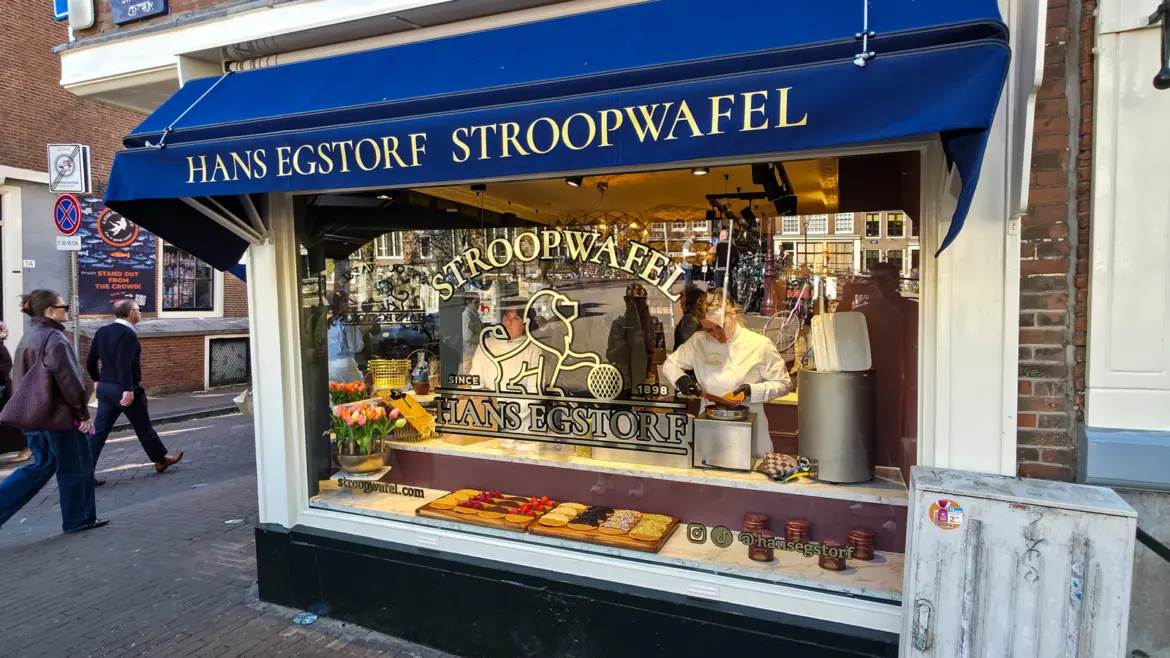
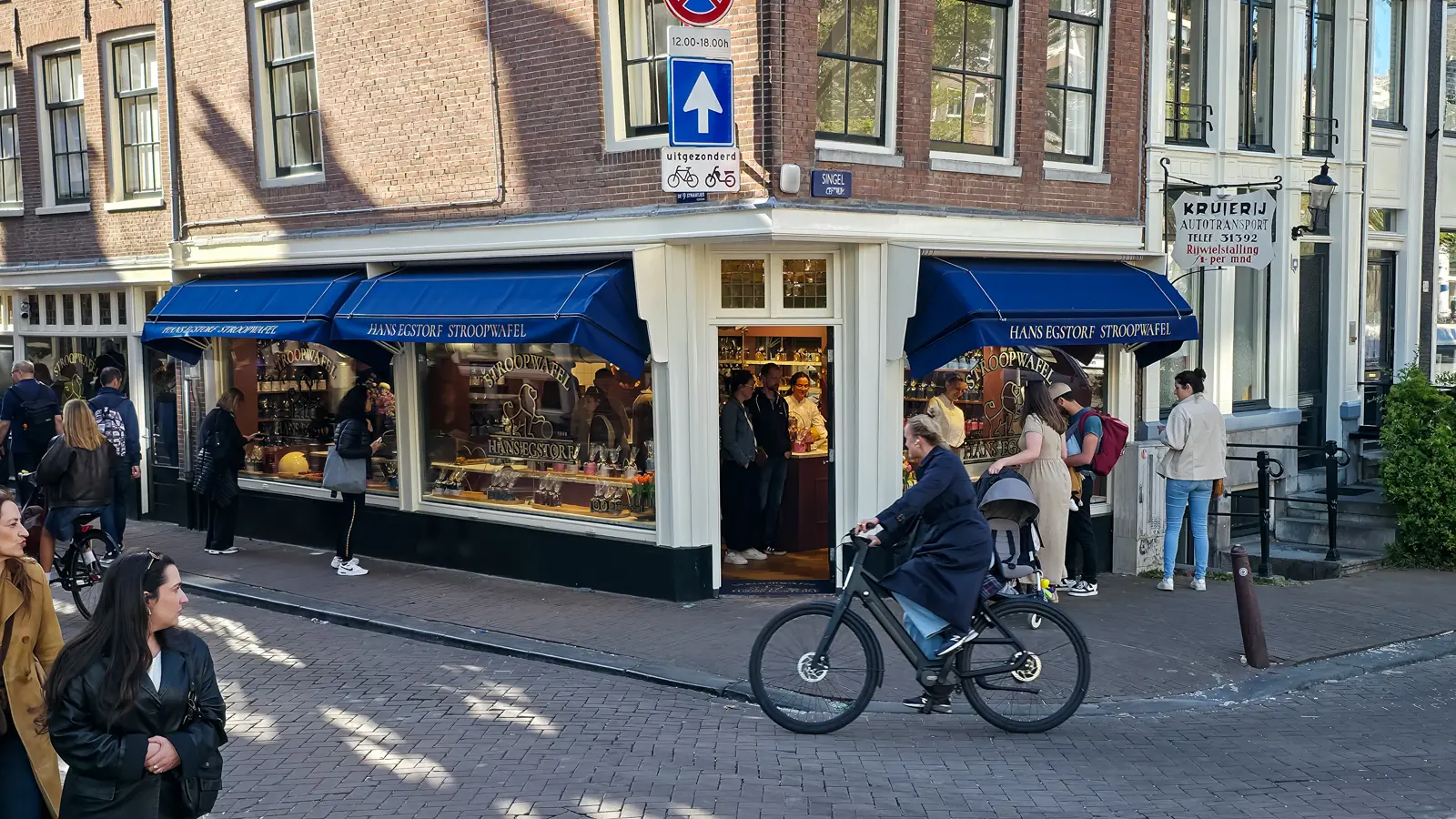
📍 Where · A corner shop on the Singel in De 9 Straatjes (the Nine Streets), with the irons working in the window.
🏛️ The 1898 · That date belongs to the firm’s historic bakery building at Spuistraat 274, a listed monument, not to this branch or the Egstorf name.
🥇 What to order · The plain chocolate one first: nothing to hide behind, and the best of the three I tried.
💡 Tip · Buy a tin for the journey home. Loose waffles break; the tins survive a suitcase and beat any fridge magnet.
What a Stroopwafel Actually Is
The word does the explaining. Stroop is syrup, wafel is waffle, so a stroopwafel is a syrup waffle: two paper-thin waffle layers held together with a caramel filling.
It comes from Gouda, the cheese town about sixty kilometres south of Amsterdam, and it started as thrift. Bakers finished the day with crumbs and scraps of dough, and rather than throw them out they pressed them flat in a waffle iron and stuck the results together with syrup. It was cheap enough to earn the nickname armenkoek, the poor people’s cookie. Accounts put the invention anywhere from the late eighteenth century to the early nineteenth.
The method has not changed much. A ball of dough goes into a hot iron and comes out as a thin round. While it is still hot and pliable, the baker splits it horizontally and spreads the warm stroop across one half before pressing the two back together. Everything depends on speed, because a cooled waffle snaps instead of slicing.
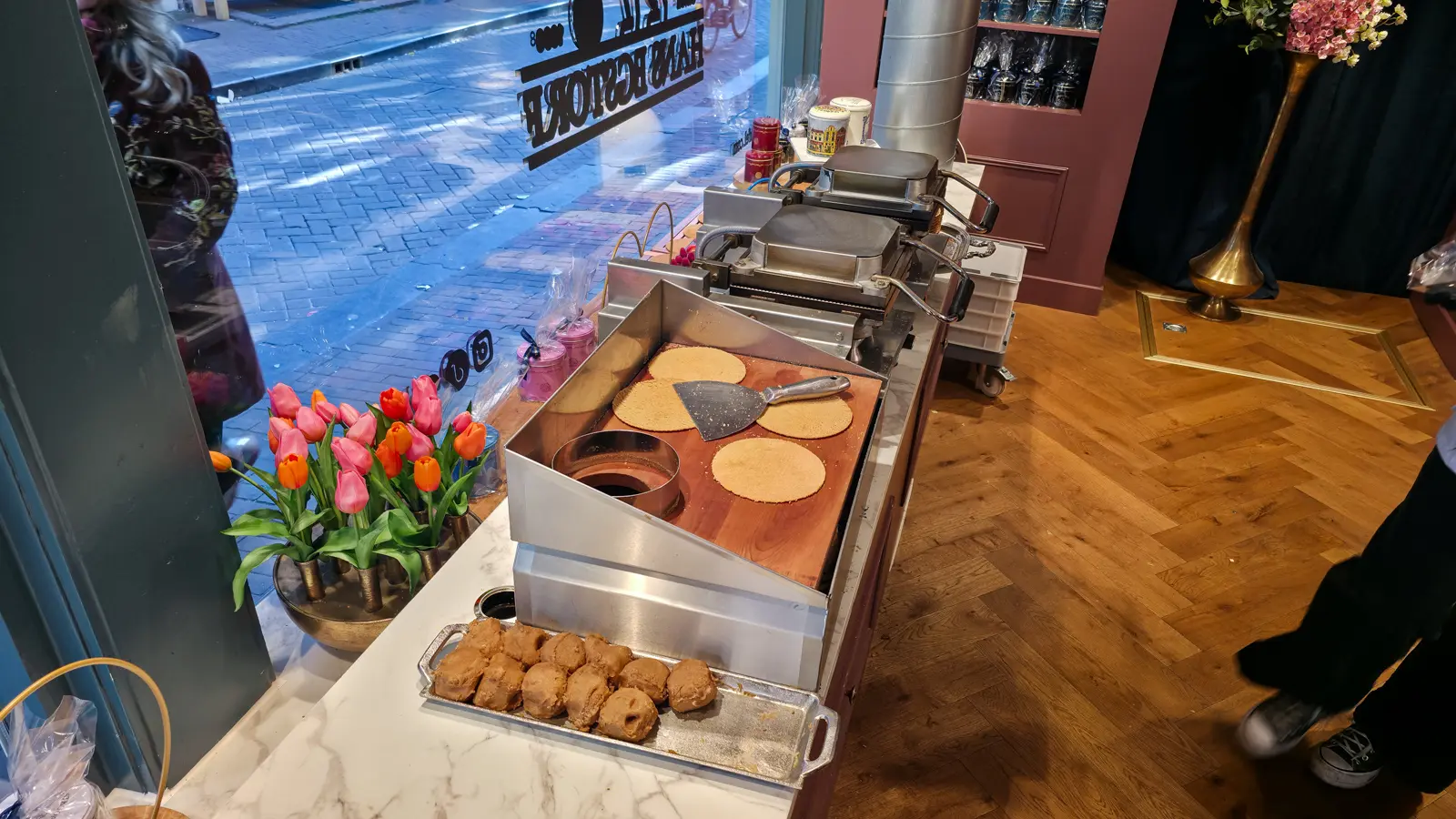
That is the difference the supermarket version cannot deliver. A packet stroopwafel is engineered to survive a shelf. A fresh one bends.
The Shop in De 9 Straatjes
The branch I went to sits on a corner of the Singel, in the district known as De 9 Straatjes, the Nine Streets. These are nine short cross streets threading between four of the main canals, and the area is all small independent shops rather than chains, which makes it one of the more pleasant parts of the centre to walk through without a destination.
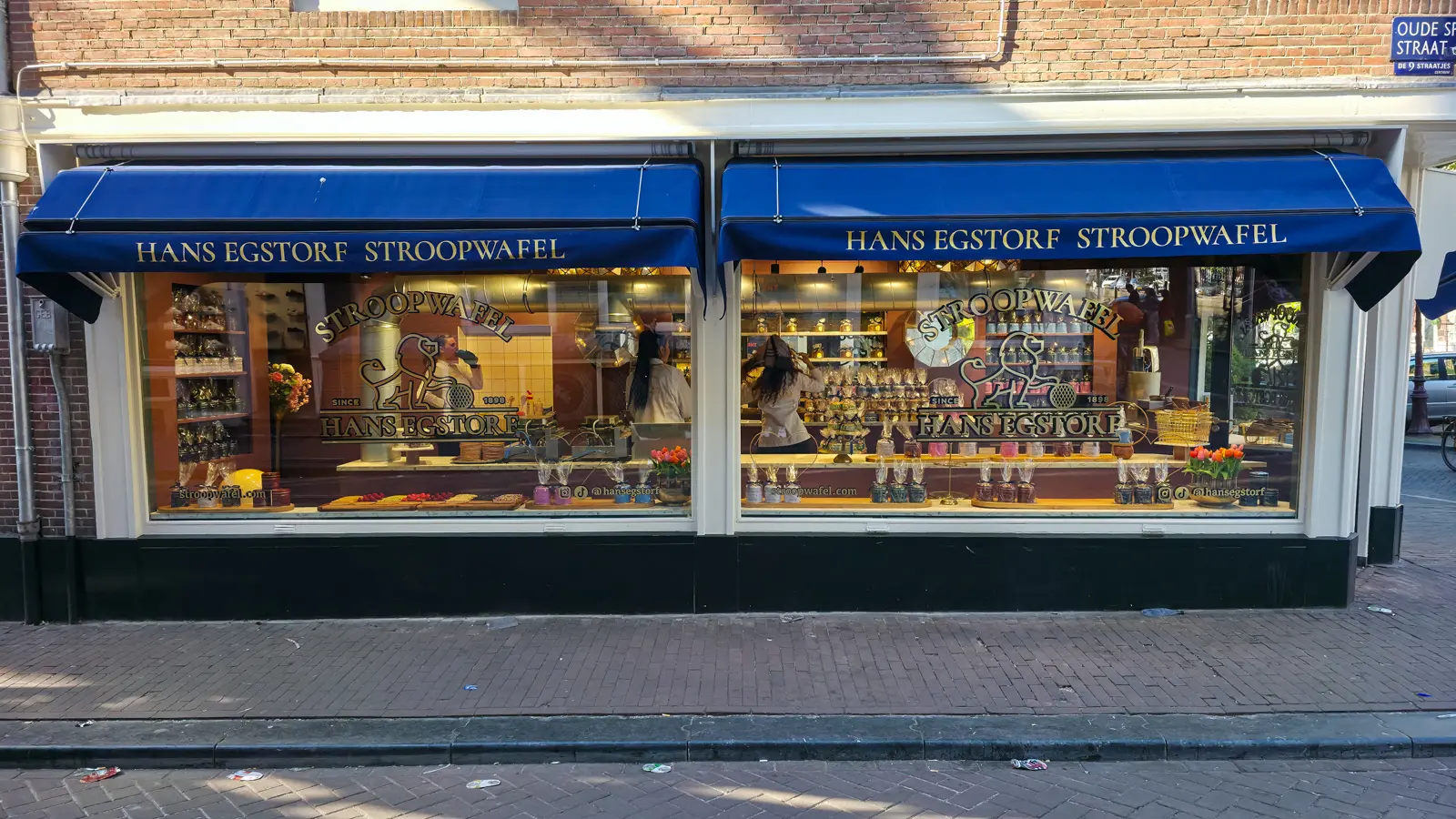
The shop is built around its window. The irons face the street, the toppings sit out on a board at pavement level, and there is usually a small crowd on the cobbles watching the process. That is not an accident of layout, it is the whole shopfront strategy, and it works. I stopped because other people had stopped.
Since 1898, and What That Actually Means
The logo says 1898, and the date is real, but it does not attach to the thing most people assume.
The original bakery is not this shop. It stands at Spuistraat 274, on the corner of Raamsteeg, about ten minutes away. In 1898 the architect Gerrit van Arkel designed the facade for a baker called D.C. Stähle, in the restrained Dutch version of Art Nouveau. A newspaper report that July called the new premises a model bakery and went through the fittings admiringly: tiles from the Roozenburg pottery, copper display cases, a counter made of onyx. The building is now a protected national monument, and the interior still carries tile panels showing the stages of breadmaking, from sowing through to the horn blown to announce that the bread was ready.
Bakers have worked in that building continuously ever since. Stähle, then Rekers, then Van Eijk. Hans Egstorf worked there for about a decade under the previous owner before taking it over himself around 1990.
So 1898 is the age of the premises and of the trade carried on inside them, not the age of the Egstorf name. The claim to be the oldest still-operating bakery in Amsterdam comes from the company. Nobody independent certifies that sort of thing, so it is worth taking as a claim rather than a fact.
None of that bothers me, and I want to be clear about why. A bakery that has been baking in the same listed building for over 125 years, under a succession of named owners, is a genuinely old bakery. It just is not a family dynasty, and the difference is worth knowing when the shop looks as polished as this one does. From that single site the business has since grown to several shops around the centre, with a separate production facility behind them and an online operation shipping abroad.
Inside
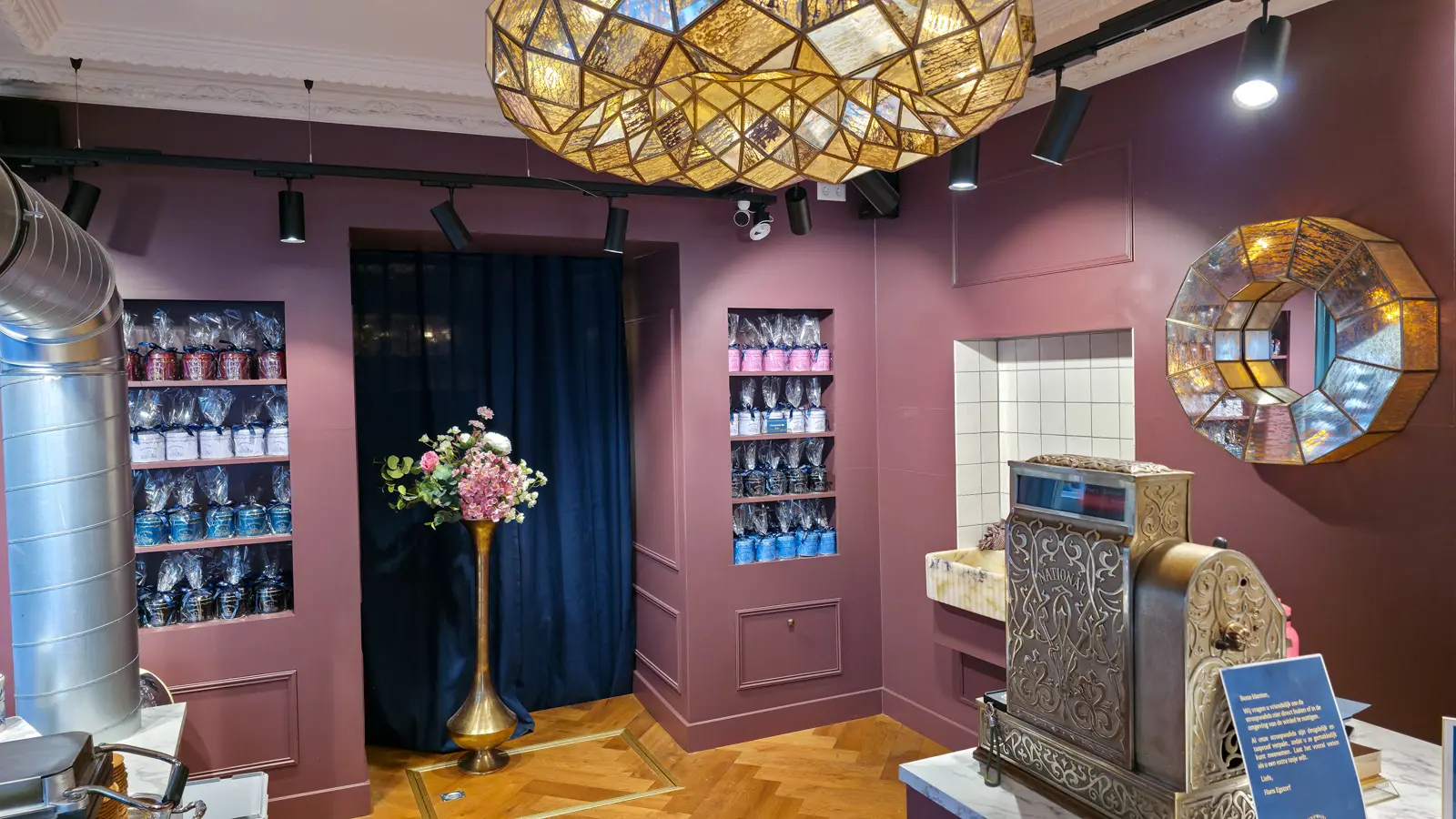
The interior is a long way from a bakery. Dusty pink walls, gilded pendant lights, alcoves of tins arranged by colour, a faceted mirror, and an antique brass National till sitting on the marble like an ornament. It is a very well art-directed room.
A card by the till asks customers not to eat their stroopwafels immediately outside, in the streets around the shop, and points out that everything is packed to be carried. It offers an extra bag to anyone who wants one. No reason is given for the request. It is worth knowing, though, that these particular streets have had a difficult few years with queues outside viral food shops, and that residents and neighbouring traders have complained about blocked pavements and litter. Whatever prompted the card, the packaging genuinely does travel, so the request costs nothing to honour.
Three Flavours
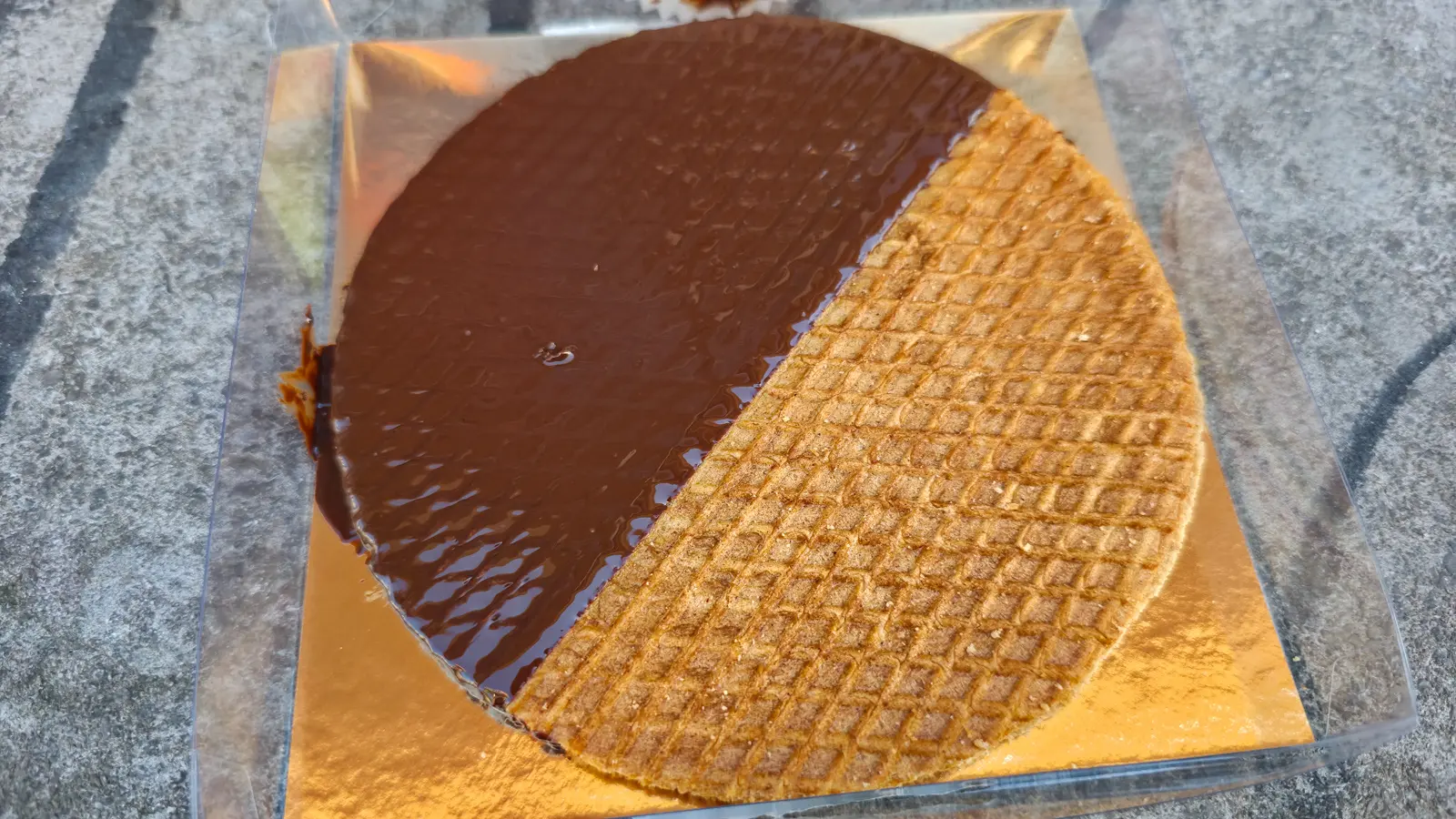
I tried three, and the plain one is the one to judge a shop by. Chocolate across half the surface, nothing else, so there is nowhere for a mediocre waffle to hide. It was the best of the three, and if I were buying one thing here it would be this.
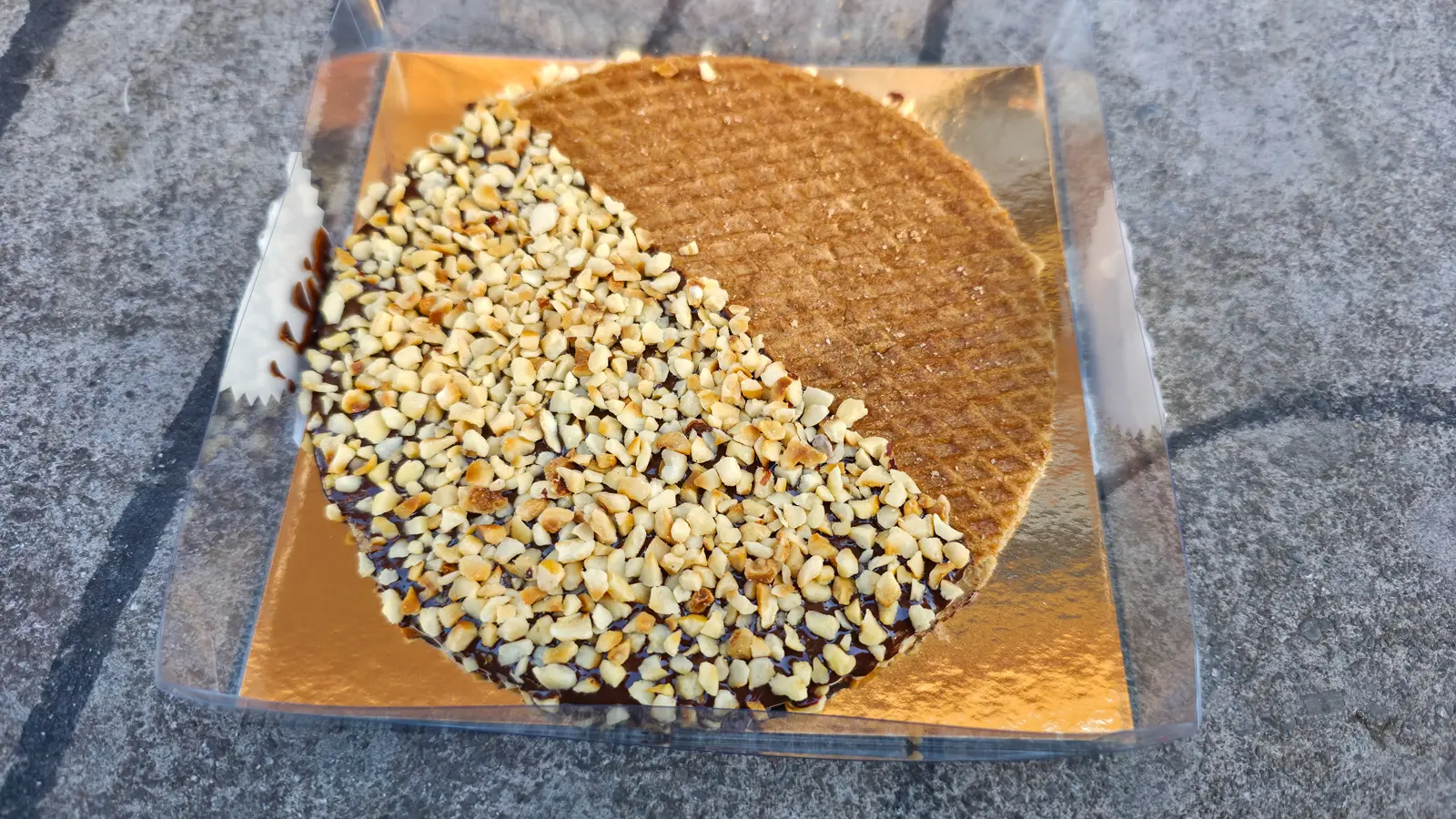
The second added chopped hazelnuts over the chocolate, which changes the texture more than the taste. A stroopwafel is soft and sticky the whole way through, so the nuts give it something to push back with.
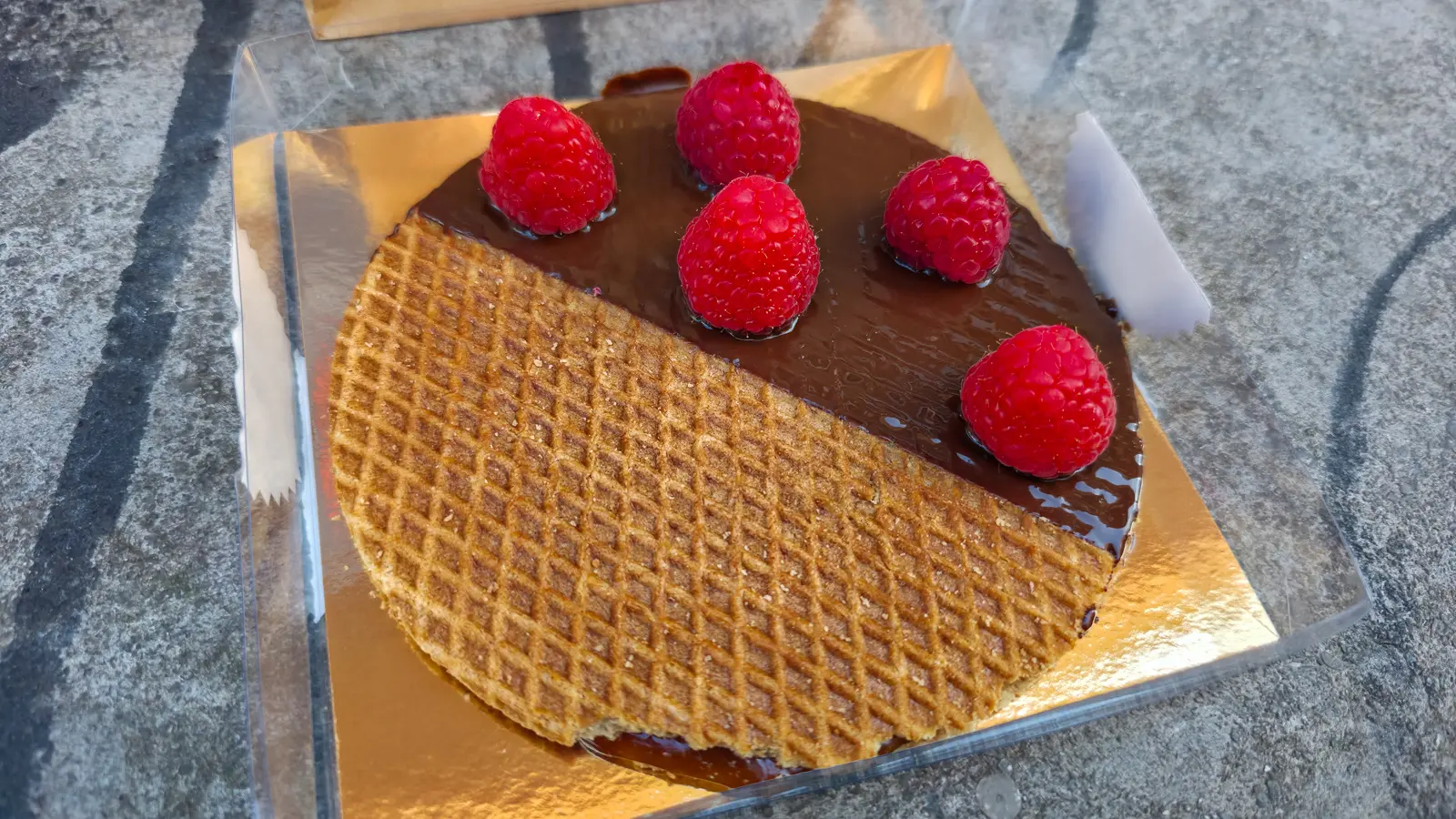
The third came under chocolate with five fresh raspberries pressed into it. This is the photogenic one, and the sharpness of the fruit does cut through the syrup, though it also turns a portable snack into something that needs a plate and a fork.
The Tins
I bought a tin, and I would do it again. Loose stroopwafels break in a suitcase. The packed tins survive, they last, and the empty tin is still on a shelf at home doing the job a fridge magnet never quite manages. It is also a more honest souvenir than most. It is a thing the city actually makes, bought from a shop that actually bakes, rather than something screen-printed with a canal house.

Bubbly Tips
- Order the plain chocolate first. The toppings are good, but a plain one tells you whether the waffle underneath is worth the money. Judge the shop on that, then experiment.
- Buy tins, not loose waffles, for the journey home. Loose ones break in transit. The tins survive a suitcase and make better gifts than anything in a souvenir shop.
- Go to Spuistraat 274 if you want the historic building. The corner of Spuistraat and Raamsteeg is where the 1898 Van Arkel facade and the breadmaking tile panels are. The other branches are shops rather than monuments.
- Combine it with the Nine Streets rather than making a special trip. The district is compact, entirely walkable, and full of independent shops, so the stroopwafel becomes a stop rather than an errand.
- Eat it warm and eat it there. The whole point is the soft one. Waiting until you are back at the hotel gets you something close to the supermarket version.
- Do not eat it right outside the door. There is a sign asking customers not to, and the packaging is made for carrying. Walk to a canal bridge and eat it there instead.
- Watch the window before you order. The irons face the street and the process takes under a minute, which is the most useful thing about the shop being designed the way it is.
- Assume a queue at weekends and on holidays. The corner site is small and gets busy. Mid-morning on a weekday is the calm slot.
- Check the toppings board before you commit. What is on offer changes, and the display at pavement level shows the actual current options rather than a printed menu.
Final Thoughts
I went looking for the real version of something I had only met in a packet, and I found a very good one in a very well-designed shop. I still cannot say it is the best stroopwafel in Amsterdam. Anyone making that claim, after one afternoon and three waffles, is guessing.
What I did not expect was that the interesting part would be the address I never visited. A bakery on the corner of Spuistraat and Raamsteeg, built in 1898 for a baker whose name almost nobody remembers, with tiles on the wall showing how bread got made, and an unbroken line of bakers working there ever since. The shop with the pink walls sells the waffles. That building is where the 1898 came from.
Until next time!

🌟 Everything You Need to Plan Your Dream Trip in 2026
- 🌟 Luxury Hotels - Find premium stays with Booking.com & Hotels.com
- 🏡 Vacation Rentals - Discover unique properties on VRBO
- 🏞️ Guided Tours - Explore with Viator or GetYourGuide
- 🎫 Attraction Tickets - Skip the lines with Tiqets
- 🚢 Ocean Cruises - Set sail with Cruise Direct
- 📱 International SIMs - Stay connected with Saily
- 🚗 Car Rentals - Budget-friendly options from Discover Cars
- 🌐 Secure VPNs - Browse safely with NordVPN
- 💶 Currency Exchange - Best rates with Wise
- 🗣️ Learn Languages - Master the local language with Babbel and Rosetta Stone