
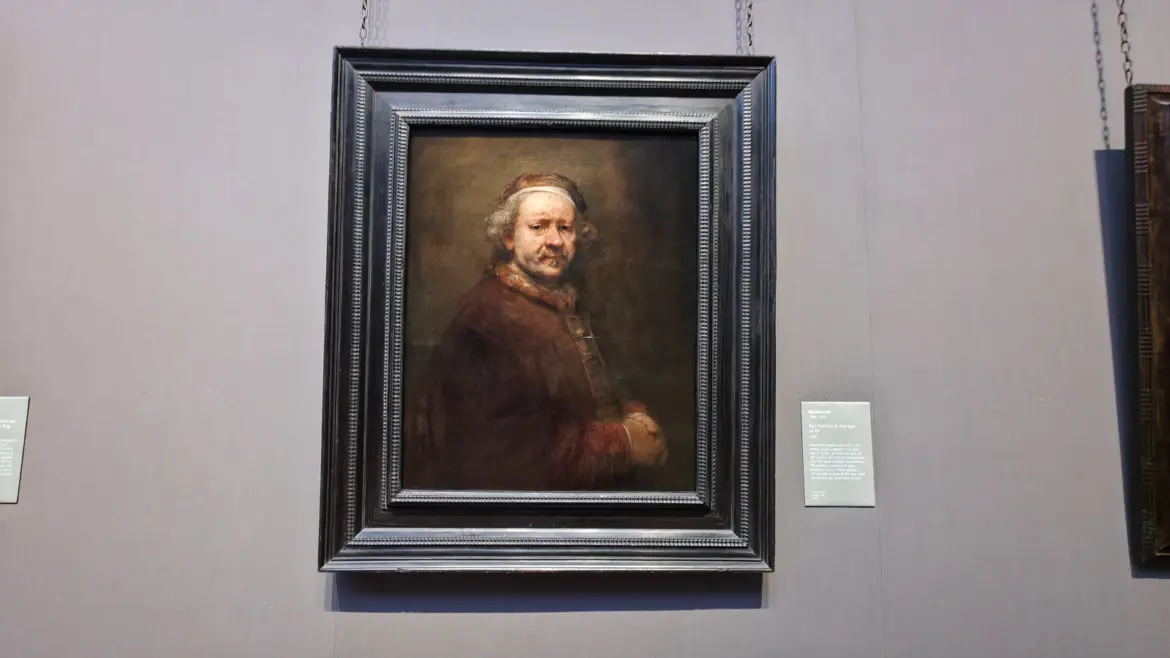
What I have always respected about Rembrandt is that he told the truth. Where so many painters flattered, smoothed and arranged, he set down what was in front of him, including his own face as it aged, without softening it. There are no filters here, none of the polite improvements other artists reached for. That is the Rembrandt most of us carry in our heads, and the National Gallery in London holds the painting that seems to prove it: an old man in his last year, looking back at us without a scrap of vanity.
But the same building holds a second painting, by the same hand, made nearly thirty years earlier, that complicates the story in the best way. Set the two side by side and something richer than a saint of honesty emerges: a man who learned, slowly and the hard way, to stop performing.
On a December afternoon I spent a long time with six of his paintings here, spread across the Dutch rooms. Together they trace that arc, from a young artist dressed up in borrowed finery to an old one in his own worn skin, with stops along the way for biblical theatre, two quiet studies in grey, and one picture that fooled the experts for decades.
Rembrandt at the National Gallery at a Glance
🖼️ Where · The seventeenth-century Dutch rooms, recently rehung as part of the Gallery’s bicentenary refresh.
👴 The pair to see · Two self portraits thirty years apart, age 34 in fur and jewels, age 63 in a plain coat in the year he died.
🔥 The showpiece · Belshazzar’s Feast, the king recoiling from the glowing writing on the wall.
🌫️ The quiet ones · Two small grisailles in grey, Ecce Homo and the Lamentation, easy to walk past.
🔍 The puzzle · A scholar once sold as a Rembrandt, now labelled “Follower of Rembrandt.”
🎟️ Entry · Free. The permanent collection costs nothing; only the big temporary shows are ticketed.
🕒 Best time · The first hour after opening or the last before closing, when the central rooms are calmest.
Two faces, thirty years apart
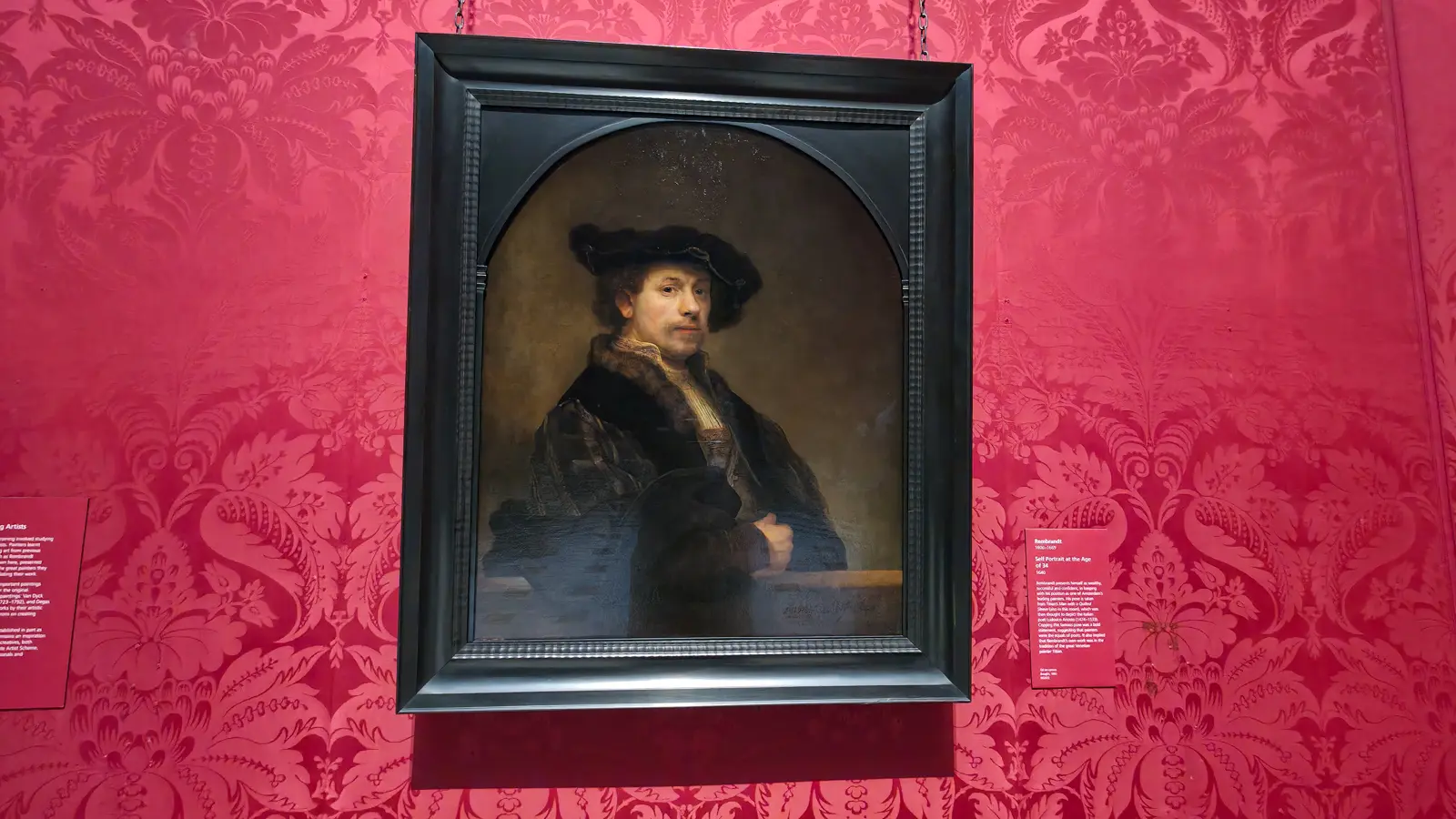
In 1640 Rembrandt was thirty-four and riding high. Amsterdam was the centre of the European art trade, his workshop was busy, and the rich and fashionable wanted to be painted by him. The self portrait he made that year shows exactly the man his clients wanted: assured, faintly amused, dressed in fur and velvet with a jewelled hat, one elbow resting on a ledge as he leans forward.
Look closer, though, and the honesty wobbles. The clothes are fancy dress. They belong not to the 1640s but to a gentleman of the 1520s, a full century out of date, and his contemporaries would have clocked that at once. The relaxed pose, the arm on the ledge, is borrowed almost exactly from a portrait by Titian that, by a happy accident, now hangs in this same gallery, with further echoes of Raphael and Dürer. By dressing as a Renaissance gentleman and quoting the great masters, Rembrandt is making a claim: that an artist deserves the status of a gentleman, and that he stands level with Titian and Raphael themselves. He even smooths out his usual loose brushwork to match their polish. This is not a man recording the truth. This is a man building an image, with great skill and full intent.
Now cross the rooms to the painting at the top of this post. Here he is again, in 1669, aged sixty-three, in the last year of his life. The fur and jewels are gone. He wears a plain dark coat and a simple cap, his hands folded in front of him, and he looks straight out with tired, steady eyes. The skin sags, the nose is bulbous, the forehead is mottled, and none of it is hidden. There is one detail that says everything: an X-ray shows that he first painted himself holding a brush and palette, the tools of his trade, then painted them out. He chose to stand before us not as a celebrated artist but simply as a man, claiming no special dignity beyond the kind anyone is owed.
It would be easy to call this the moment Rembrandt finally told the truth, and the late picture has been read for centuries as exactly that, an unflinching reckoning with age and death. It is worth a small note of caution: he was also a working painter endlessly fascinated by the textures of skin, and seventeenth-century ideas about the self were not ours. His honesty is real, but it is the honesty of an artist, reached through choices, not the blank stare of a mirror. What changed between thirty-four and sixty-three was not that he discovered truth. It was that he stopped needing the costume.
The showman
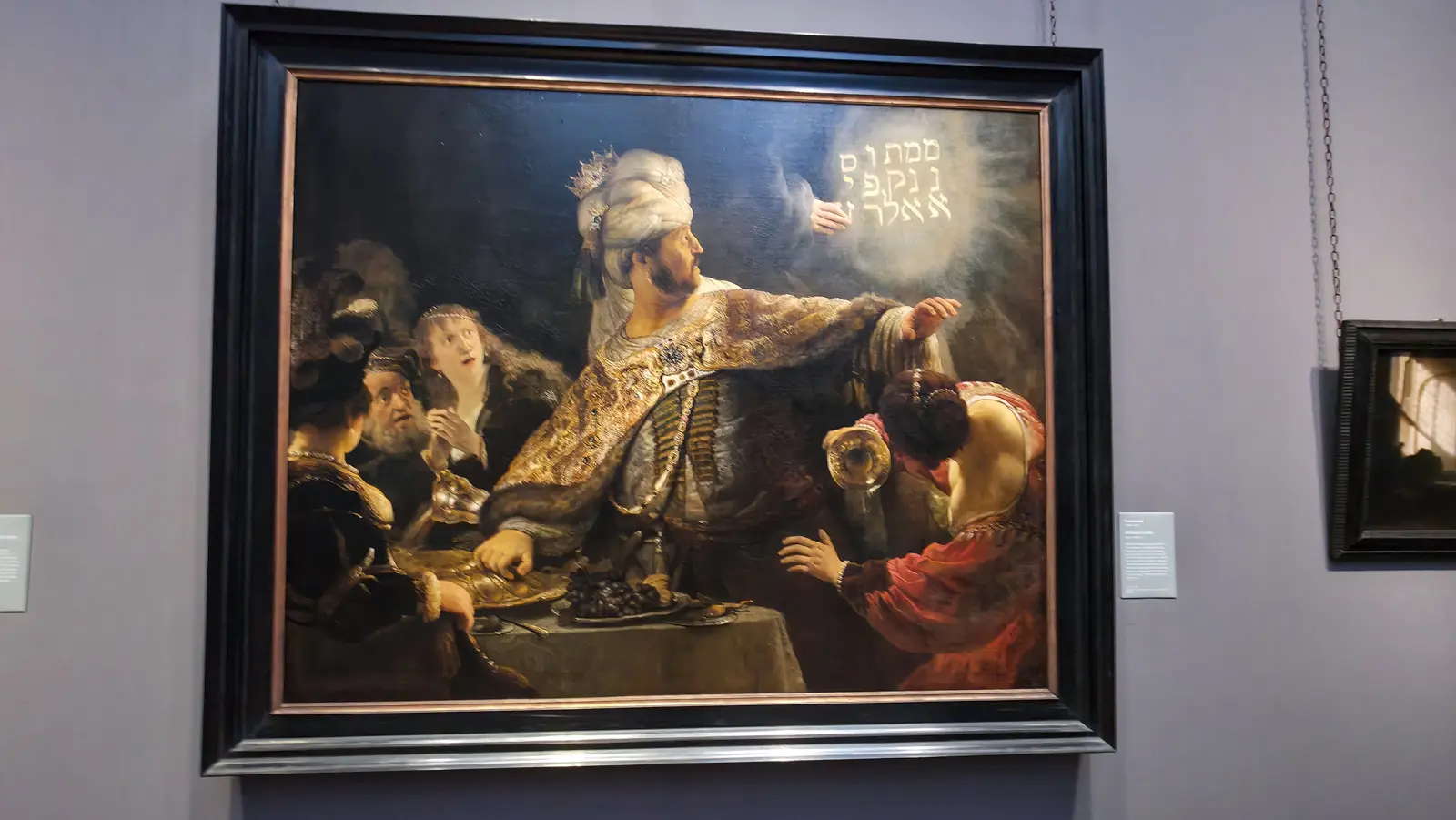
If the self portraits suggest a painter of plain truths, Belshazzar’s Feast is here to remind us he could also stage pure spectacle. The story comes from the Book of Daniel. Belshazzar, King of Babylon, throws a banquet using sacred vessels looted from the Temple in Jerusalem, and at the height of the feast a divine hand appears and writes his doom on the wall. Rembrandt catches the exact instant of shock: the king lurching backwards, the goblets tipping, the wine flying, a woman frozen mid-spill.
The glowing letters are a lovely piece of detail. They are set out in vertical columns rather than the usual right-to-left rows, a layout Rembrandt took from his neighbour, the Jewish scholar Menasseh ben Israel, and that odd arrangement is the painting’s own explanation for why, in the story, the king’s wise men cannot read the message. None of this is plain truth-telling. It is theatre, carefully built, with friends dressed up in costume to play the guests. The point worth holding onto is that Rembrandt’s honesty was never the absence of drama or invention. His truth is psychological, not photographic. He could stage a thunderclap when he wanted one.
Faith worked out in shadow
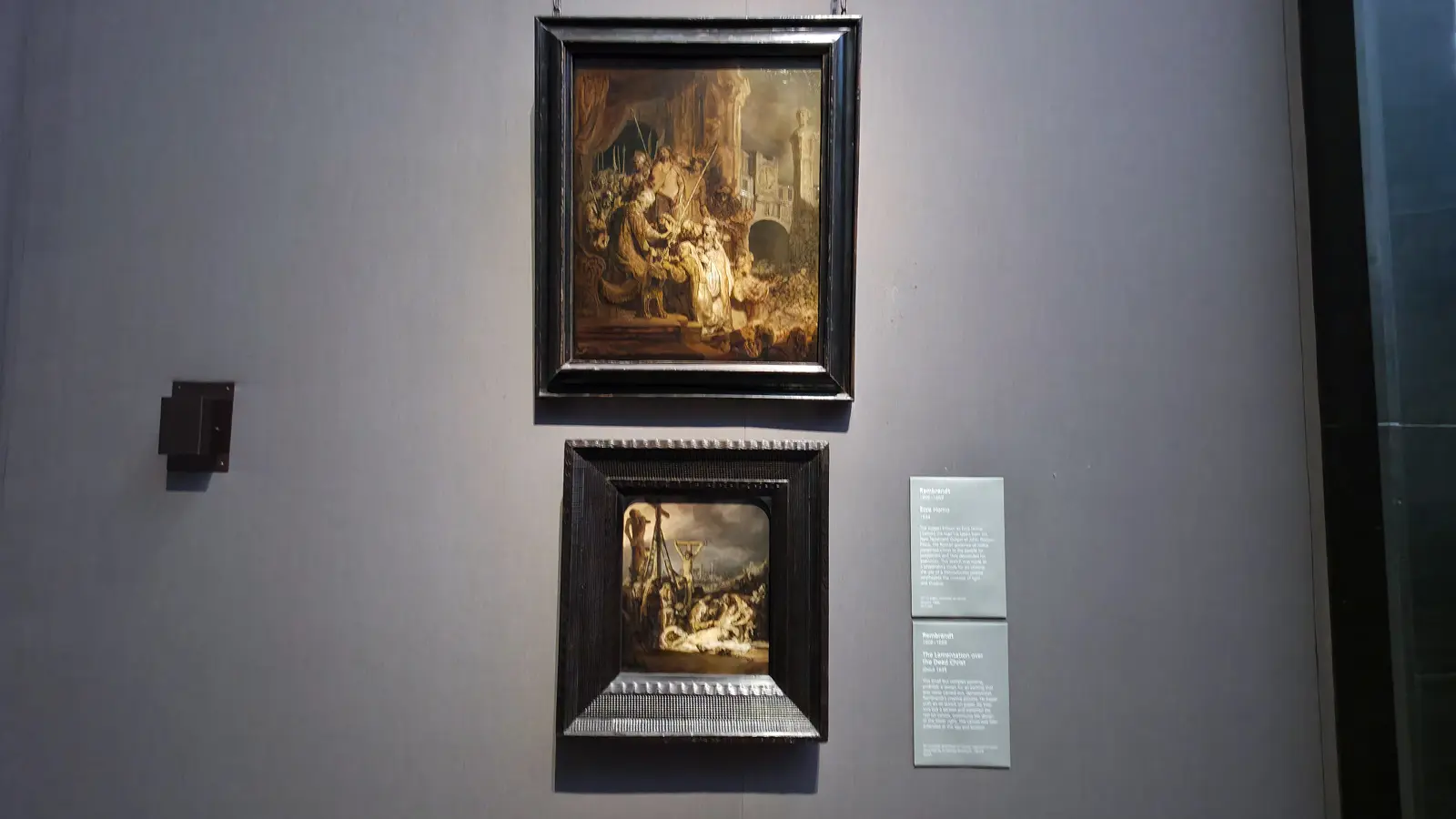
These two small pictures are a different thing again, and they show the workshop side of him, the part the public was never really meant to see. Both are grisailles, painted only in black, white and grey, and both were working studies for prints. In Ecce Homo, Pilate presents the bound Christ to the crowd with the words “Behold the man”. In The Lamentation over the Dead Christ, the body has just come down from the Cross, the Virgin has fainted, and Mary Magdalene clings to his feet, the whole grief lit so that the pale figures glow out of the dark.
Stripped of colour, these are about structure, light and emotion, not display. They are the sound of a painter thinking on the panel, trying the composition out before committing it to copper. For an artist whose churches back home were kept deliberately plain, this is faith handled quietly, in private, as a problem to be worked through rather than a show to be put on. The honesty here is the honesty of labour, of someone willing to do the unglamorous part properly.
An ordinary man, closely looked at
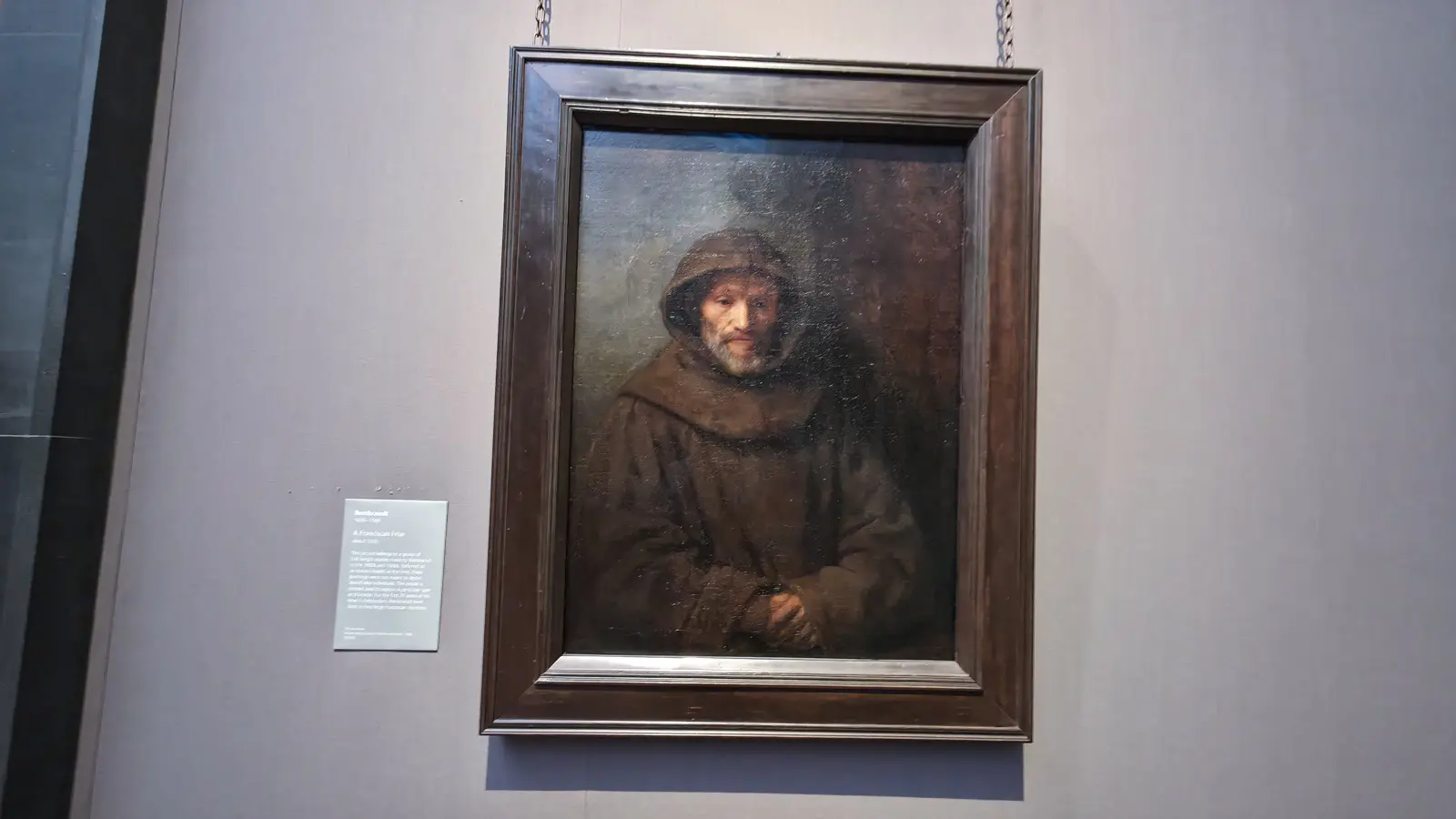
This, for me, is where his refusal to embellish comes through most plainly. An old man in a rough brown habit stands with his eyes lowered, lost in his own thoughts. He is almost certainly not a particular named person but a study of a type, and yet Rembrandt gives him the close, patient attention most painters saved for dukes. Every line of the worn face and the coarse cloth is set down with care and not a trace of flattery.
The picture also sits close to Rembrandt’s own hardest years. He painted it around the middle of the 1650s, and in 1656 he was declared bankrupt and would later have to give up his fine house for a smaller one across the city. A subject built on poverty, simplicity and inward calm may have spoken to a man whose own fortunes were collapsing. Whatever drew him to it, the result is a portrait of nobody in particular treated as though he were worth everything. That is the whole argument of his art in one quiet face.
So good it fooled the experts
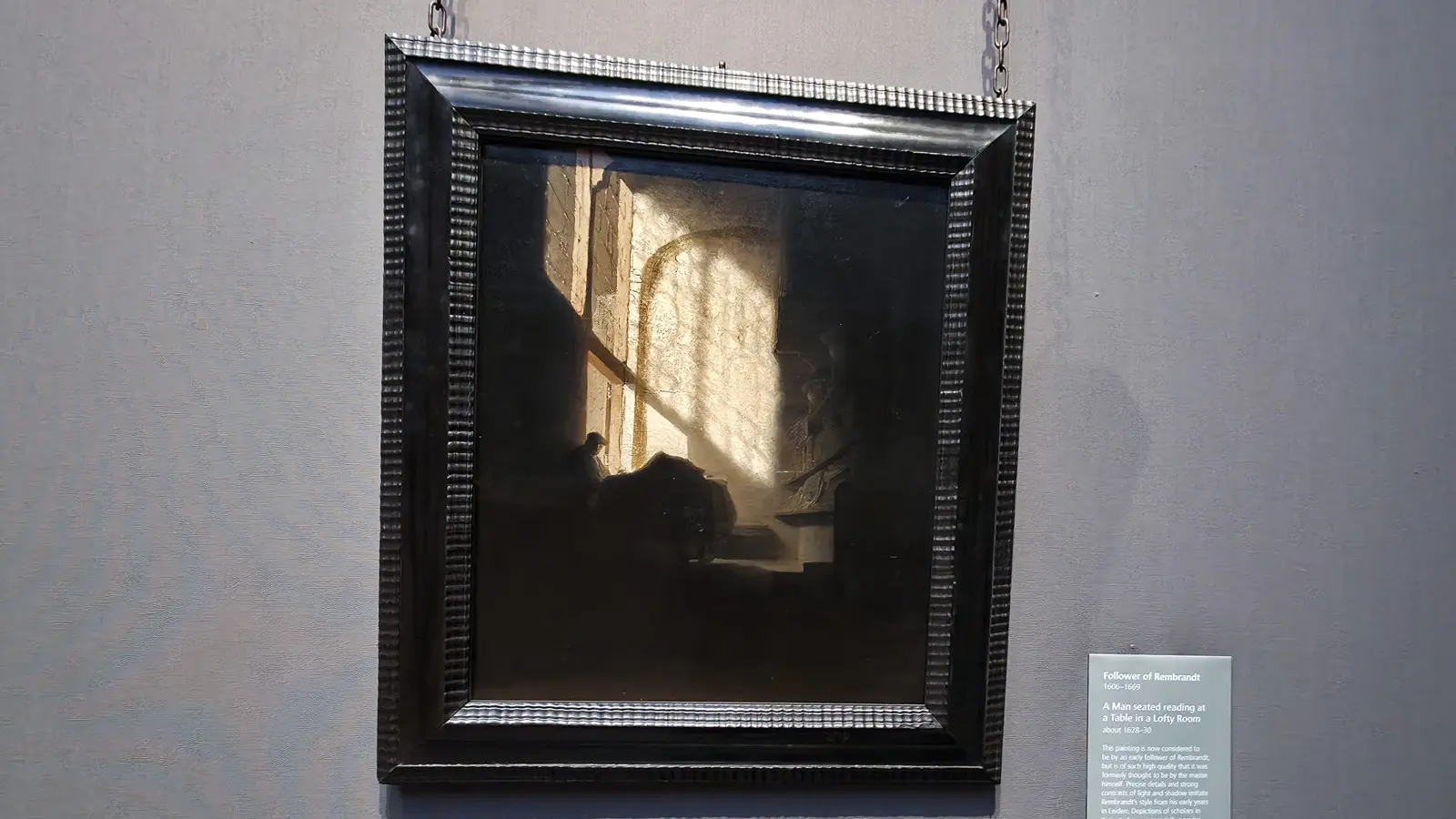
I want to end on this one, because it turns the whole question of authenticity back on itself. A lone scholar sits at a table in a high, dim room, a huge book open before him, while hard sunlight pours through the window and breaks across the wall. It is a beautiful, moody thing.
When the National Gallery bought it in 1917, it was hung proudly as an early Rembrandt and even given the title “A Philosopher”. It is no longer thought to be by him. Closer study reattributed it to an unknown follower, someone who knew his work intimately and could paint light and shadow almost as well as the master himself. The Gallery has simply changed the label and kept the picture on the wall, honest about its own uncertainty. There is something fitting in that. A post about a painter prized above all for being genuine ends in front of a painting whose great quality is precisely that it is so hard to be sure. It is a useful reminder that “a real Rembrandt” was never only a matter of the signature.
Bubbly Tips
- Find the Rembrandts in the Dutch rooms. His paintings hang together in the seventeenth-century Dutch galleries, recently rehung as part of the Gallery’s bicentenary refresh. Pick up a free map at the entrance, or ask an assistant to point you to the Rembrandt wall.
- Entry is free. The National Gallery charges nothing for its permanent collection, so you can drop in for half an hour just to see the self portraits and come back another day for the rest. Only the big temporary exhibitions are ticketed.
- See the two self portraits as a pair. The whole story is in the gap between them, age thirty-four and age sixty-three. They are not always side by side, so it is worth walking between the two and looking properly at what thirty years did.
- Stand close to the late face. Get near the 1669 self portrait and the skin dissolves into thick, loaded dabs of paint. The sagging pouch under the eye is a single swirl of the brush. Step back and it snaps into a living face again.
- Do not rush past the grey ones. The two small grisailles, Ecce Homo and the Lamentation, are quiet and easy to overlook beside the big set pieces. They are some of the most personal things in the room, so give them a minute.
- Read the labels on attribution. The “Follower of Rembrandt” reading scholar is a small lesson in how museums change their minds. The wall text is candid about why it is no longer called a Rembrandt, which is half the interest.
- Pair it with the Dutch Golden Age room next door. Vermeer, de Hooch and the cityscape painters sit close by and make a natural second half to the visit. The contrast with Rembrandt’s darker, rougher honesty is the whole point.
- Go early or late for quiet. The first hour after opening and the last before closing are calmest. Weekends and school holidays fill the central rooms quickly.
Final Thoughts
The thing I keep coming back to is that gap of thirty years. At thirty-four, Rembrandt borrowed Titian’s pose and a gentleman’s wardrobe to tell the world how he wished to be seen. At sixty-three, in the year he died, he painted out the very brush that marked him as an artist and simply stood there, an ageing man with folded hands and a steady gaze. The honesty in his late work was not a gift he was born with. It was something he arrived at, by living long enough and losing enough to stop dressing the part.
That is what makes him worth the journey across these rooms. Not that he never performed, because Belshazzar’s Feast is proof he loved a bit of theatre, but that he knew the difference between the costume and the face beneath it, and in the end he chose the face. For a painter, and maybe for the rest of us too, that is a hard and honest thing to manage.
Until next time!

🌟 Everything You Need to Plan Your Dream Trip in 2026
- 🌟 Luxury Hotels - Find premium stays with Booking.com & Hotels.com
- 🏡 Vacation Rentals - Discover unique properties on VRBO
- 🏞️ Guided Tours - Explore with Viator or GetYourGuide
- 🎫 Attraction Tickets - Skip the lines with Tiqets
- 🚢 Ocean Cruises - Set sail with Cruise Direct
- 📱 International SIMs - Stay connected with Saily
- 🚗 Car Rentals - Budget-friendly options from Discover Cars
- 🌐 Secure VPNs - Browse safely with NordVPN
- 💶 Currency Exchange - Best rates with Wise
- 🗣️ Learn Languages - Master the local language with Babbel and Rosetta Stone