
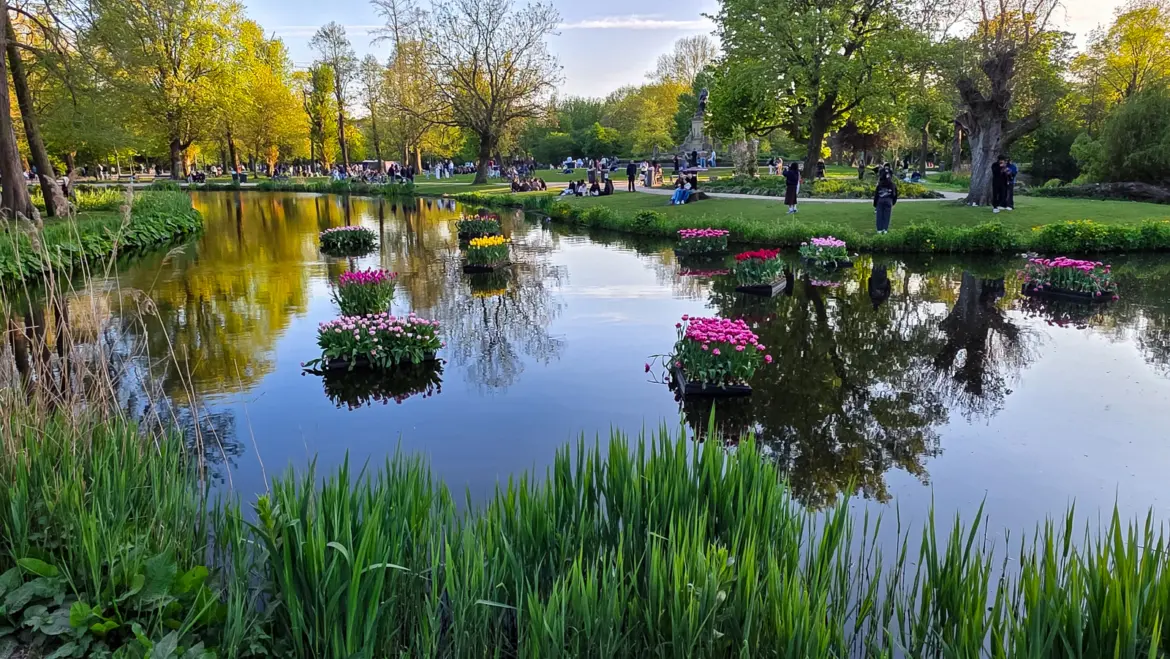
Amsterdam was full when I was there. Not busy in the ordinary way a capital city is busy, but full, with the whole country apparently in town at once and the canals hosting a party. So walking into Vondelpark and finding lawns, water and space to stand still was the useful surprise of the trip.
It is the largest park in Amsterdam, 47 hectares of it, sitting immediately west of Museumplein. Anyone doing the Museum Quarter properly is going to pass one of its entrances, and the case for going in is straightforward: it is free, it is open around the clock, and it is the closest thing the centre has to somewhere to breathe.
Vondelpark at a Glance
🌳 What it is · Amsterdam’s largest park, 47 hectares just west of Museumplein. Free, open around the clock.
🌷 In spring · Floating tulip beds sit on the pond in April, part of the free city-wide Tulp Festival.
🍽️ The pavilion · The 1881 Vondelpark Paviljoen houses Café Vertigo, with a broad terrace over the water.
🚲 Watch the lanes · Cycle paths are separate from footpaths and carry fast, real traffic. Do not stop in a bike lane.
💡 Tip · Walk ten or fifteen minutes past the entrance lawns and the crowds thin out fast. Zocher designed it that way.
A Park Built by Subscription
Vondelpark did not come from the city. In 1864 a group of Amsterdam citizens led by the banker Christiaan Pieter van Eeghen set up an association with a wonderfully literal name, the Vereeniging tot Aanleg van een Rij- en Wandelpark, meaning the association for laying out a park for riding and walking. They bought grassland and marsh on what was then the edge of town, and hired the landscape architect Jan David Zocher to design it.
Zocher worked in the English landscape style, which means the winding paths, the scattered clumps of trees and the irregular ponds are all deliberate. None of it is natural. It is nineteenth-century stagecraft, built to give city residents the impression of open country without leaving Amsterdam. His son Louis Paul Zocher designed the final section between 1875 and 1877, which brought the park to the size it is today.
It opened in 1865 as the Nieuwe Park, the New Park. The current name came in 1867, when a statue of the seventeenth-century poet and playwright Joost van den Vondel was placed inside it, and the name stuck so firmly that the original one vanished.
Tulips on the Water
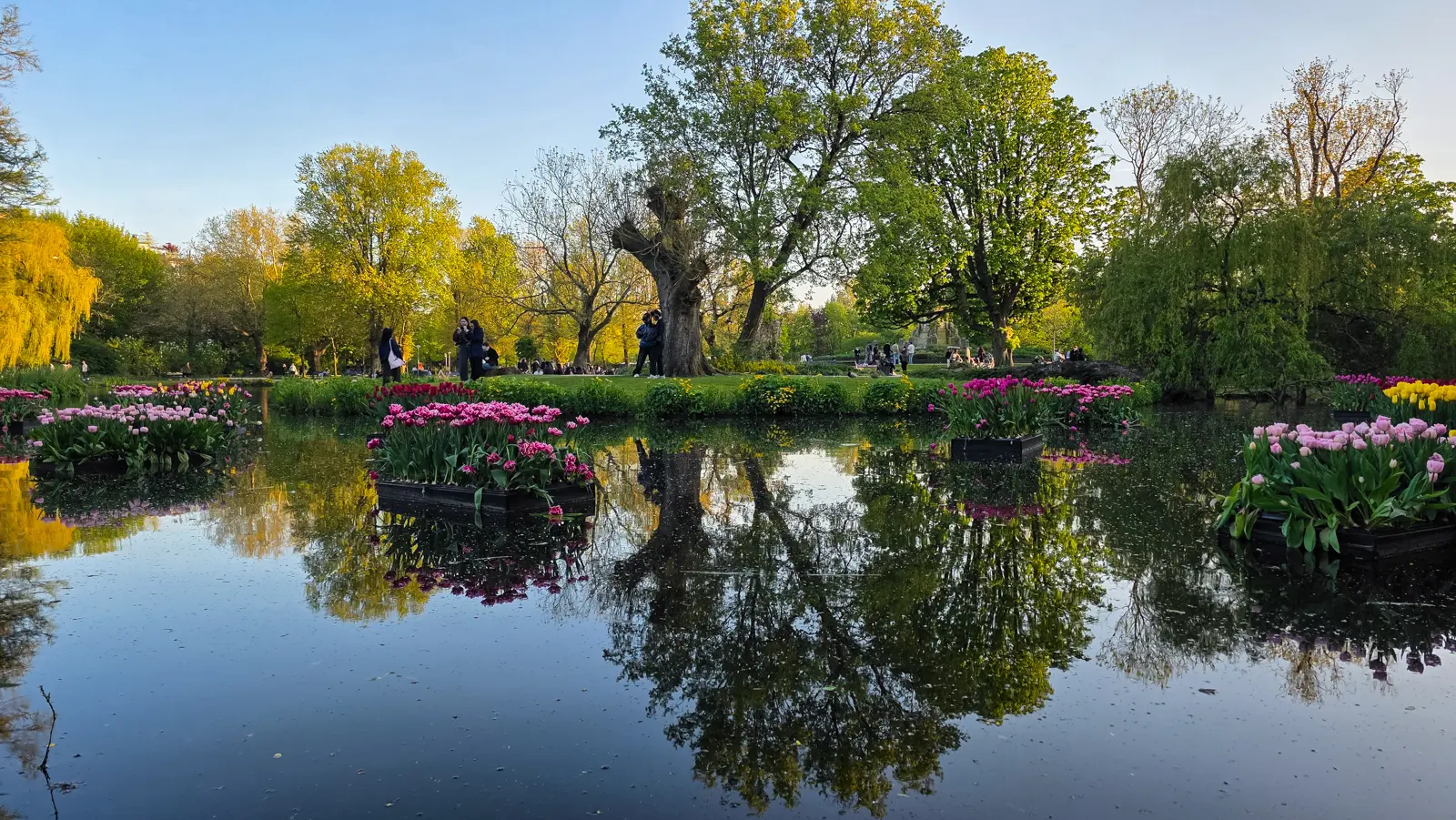
The thing I had not expected was the tulips, and not in beds along the paths where I would have looked for them. They were on the pond. Trays of them, planted up and set out on the surface, so the flowers sit at water level with their own reflection directly underneath. Pink, red, yellow and deep magenta, spaced out across the water like stepping stones.
They are part of a city-wide tulip display that runs through April, and the pond arrangement is the version Vondelpark gets. In the early evening, with the low sun behind the trees on the far bank, the water goes almost black and the flowers sit on top of it.
Walkers, Joggers and Cyclists
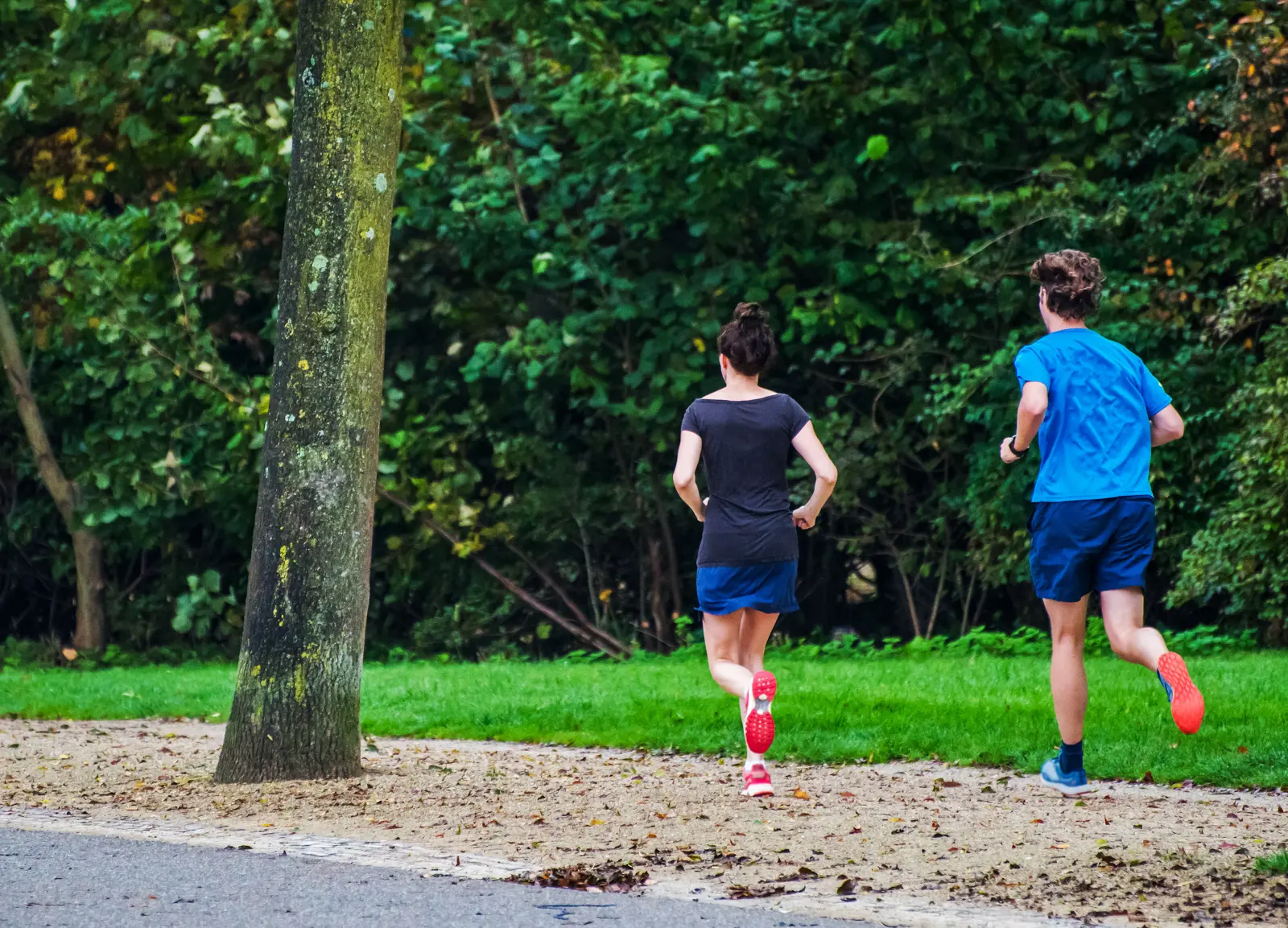
The paths in Vondelpark are shared, and they are shared according to a system. There are routes for people on foot, routes for people running, and a cycle path that carries genuine traffic. Around ten million visits a year go through this park, and a good share of them are people using it as a through route to get somewhere else.
I will be honest about how I learned this. I wandered into the cycle path, and I was told about it, loudly, by a cyclist who had every right to be there and no interest in discussing it. Amsterdam cyclists move fast, they do not slow down for people who have stopped to look at something, and the bike lane is a road rather than a decorative strip. Once I understood that, the rest of the week was much easier.
The Pavilion, and Café Vertigo
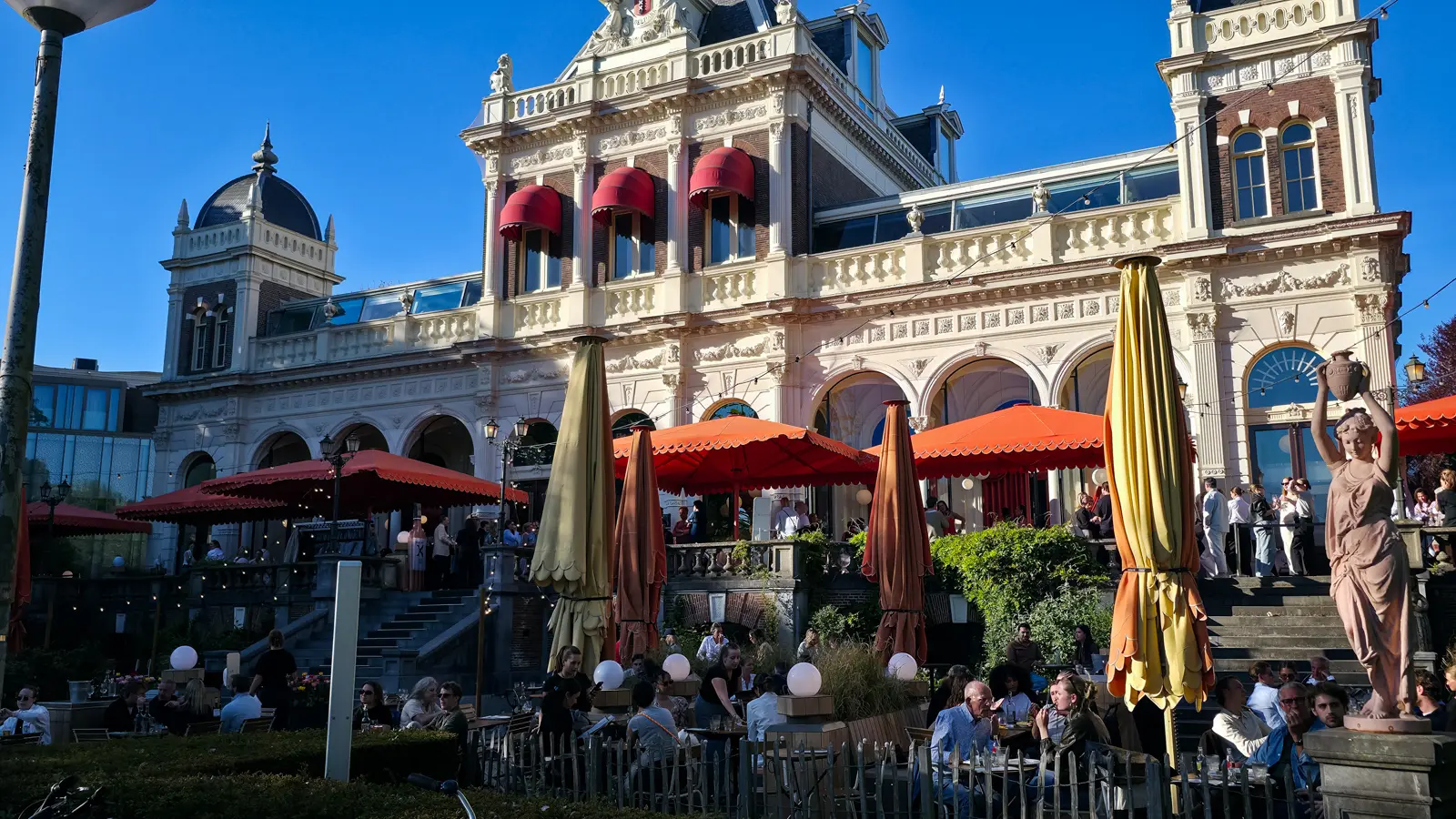
At the northwest corner of the park stands a building that looks like it belongs to a spa town rather than a public garden. The Vondelpark Paviljoen went up between 1879 and 1881 to a design by W. Hamer, in Italian Renaissance style, with domed turrets, arched windows and a broad terrace facing the water. The carved decoration was supplied by the Quellinus school, the applied arts school founded by Pierre Cuypers, whose nephew Eduard designed the villa that now houses the Moco Museum a few minutes away.
The café on the terrace is Vertigo, named after the Hitchcock film. It has been here since the late 1980s and was redesigned in 2025. The terrace looks straight out over the water, and on a clear evening it is a good place to stop.
They Are Not Ducks
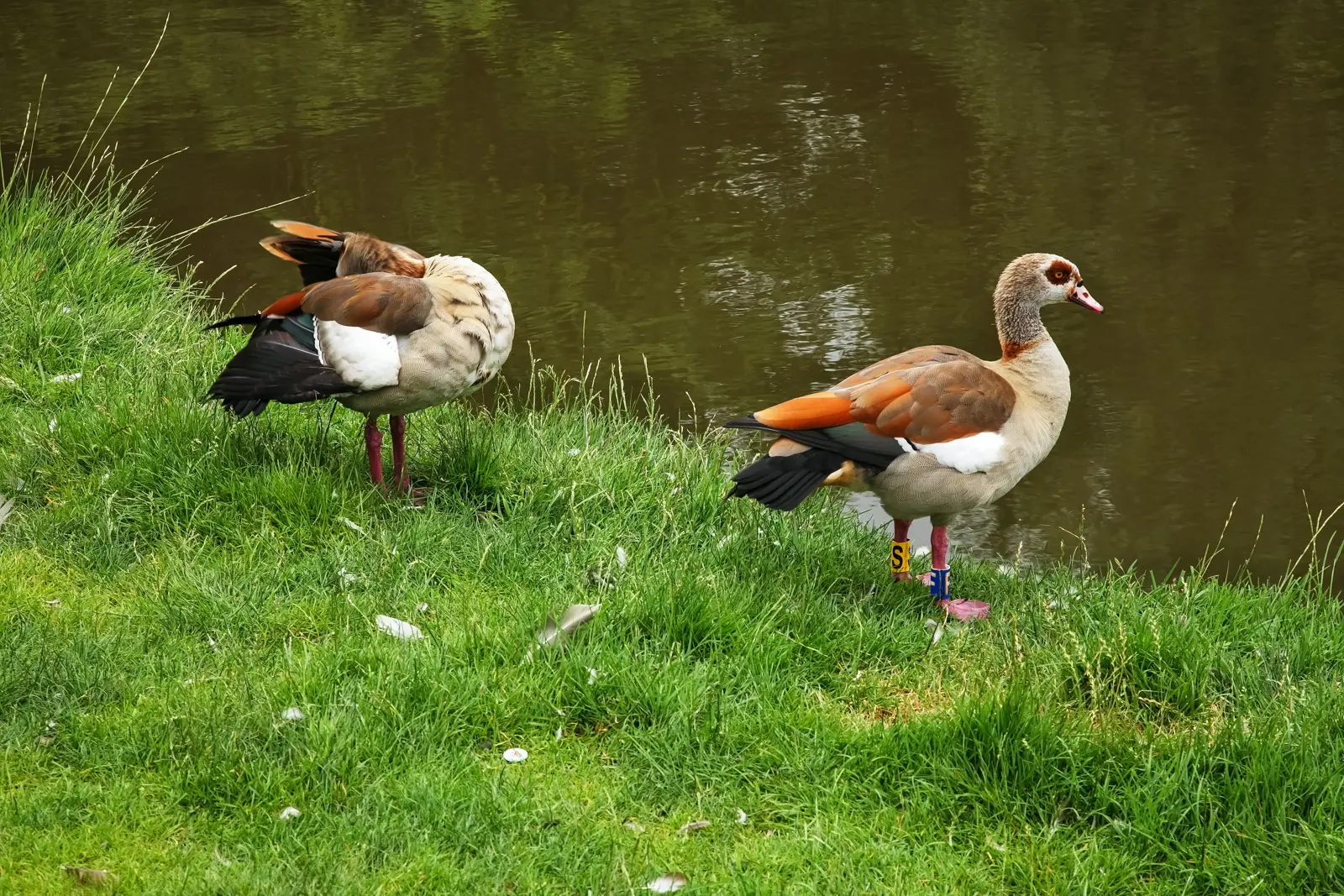
The birds patrolling the banks look like large, showy ducks and they are not ducks at all. They are Egyptian geese, and they are not supposed to be here.
The species was brought to Dutch parks in the twentieth century as an ornamental bird, kept for its colouring. Birds escaped, and from 1967 they began breeding in the wild. They have since spread across the country and into Belgium and Germany, and they have done well enough that the European Union added them to its list of invasive alien species in 2017. Some of the birds in Amsterdam parks carry coloured leg rings, which means they have been individually marked so their movements and survival can be tracked.
Bridges and Quiet Corners
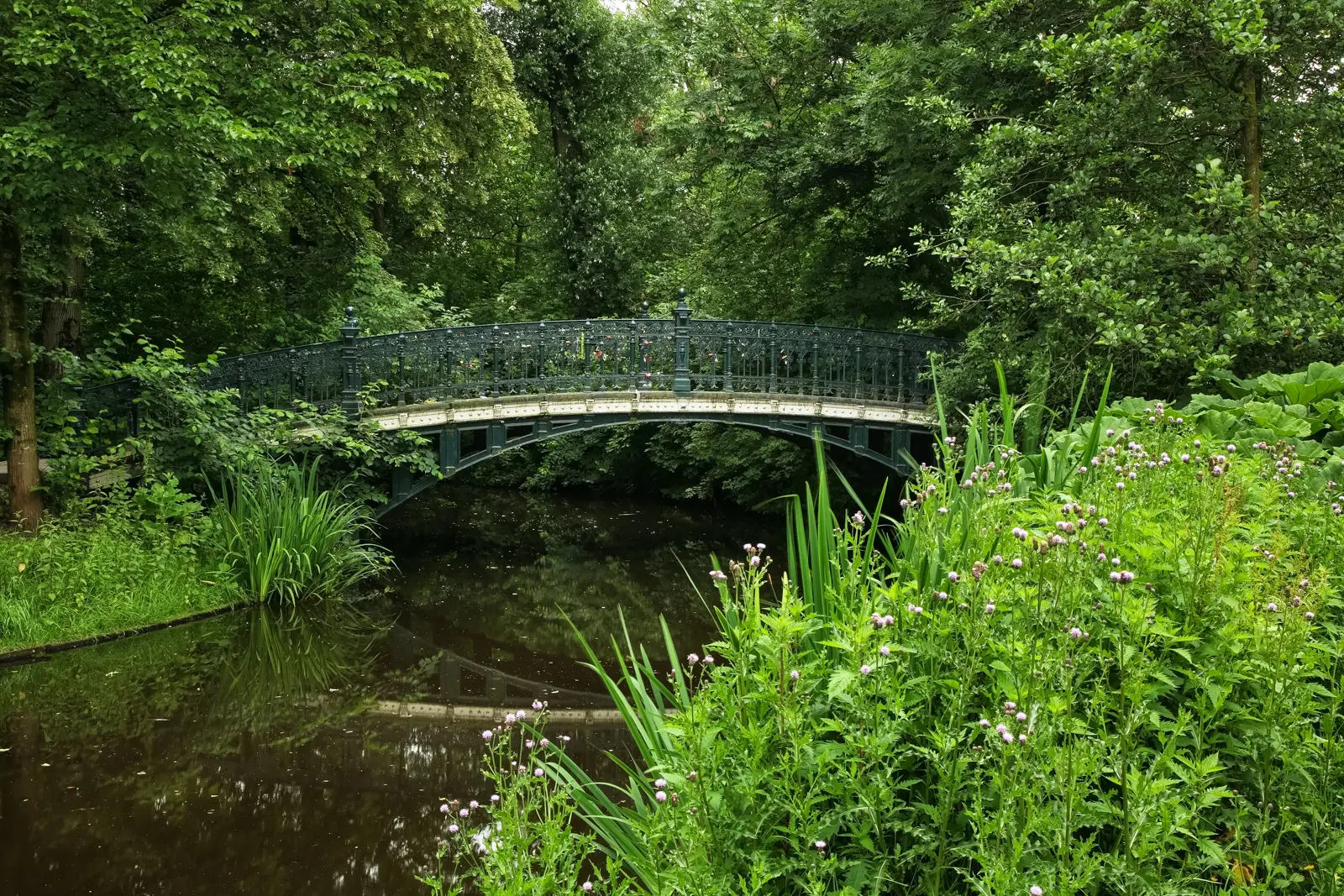
The other thing worth knowing is that the busy parts of Vondelpark are busy and the rest of it is not. The lawns near the main entrances fill up. Walk further in, and the paths narrow, the planting closes over, and the cast-iron footbridges cross water that barely moves.
This is where Zocher’s design does its work. The bends in the paths are there so that no single view runs all the way through, which means the park keeps producing corners that read as private even with several thousand people inside it.
Bubbly Tips
- Learn the lanes before you wander. Cycle paths in Vondelpark are separate from footpaths and carry real traffic at real speed. Riders will not slow down for you, and stopping in a bike lane to take a photograph is the fastest way to get shouted at. Check what surface you are standing on before you stop.
- Go in from Van Baerlestraat if you are coming from the museums. It is the closest entrance to the Museum Quarter, two or three minutes from the Van Gogh Museum, and it drops you into the park away from the busiest lawns.
- Come in the early evening for the pond. The floating tulip beds photograph best in the last couple of hours of light, when the far bank goes into shadow and the water darkens behind the flowers.
- Walk further in than you think you need to. The lawns nearest the entrances fill up first. Ten or fifteen minutes deeper along the paths and the crowd thins out noticeably.
- Book a table at Vertigo rather than turning up. The terrace is small relative to demand and fills quickly on a fine evening, particularly around a public holiday.
- The open-air theatre is free. The Openluchttheater programmes music, comedy and dance across the summer months and costs nothing to attend, though arriving early matters for a decent spot.
- The park never closes. There are no gates locked at night and no admission, which makes it useful if your museum day has run long and you want somewhere to sit afterwards.
- Trams 1, 2, 3, 5 and 12 all stop near an entrance. There are entrances on every side, so check which one suits your route rather than defaulting to the busy Stadhouderskade end near Leidseplein.
- Do not drive. Parking around Oud-Zuid is expensive and awkward, and the park is a short walk from Museumplein anyway.
Final Thoughts
What surprised me about Vondelpark is that none of it is accidental. The winding paths, the ponds, the way a view stops just short of the whole park, all of it was drawn on paper in the 1860s by a man building a countryside illusion for people who could not get to the countryside. It has been doing that job for over 160 years, and on a weekend when the rest of Amsterdam was standing shoulder to shoulder, it was still doing it.
I had an hour or two here and wanted a day. The rose garden, the open-air theatre, the sculptures scattered through the grounds and the quieter western end all went unvisited. Next time I am building an afternoon around it rather than passing through.
Until next time!

🌟 Everything You Need to Plan Your Dream Trip in 2026
- 🌟 Luxury Hotels - Find premium stays with Booking.com & Hotels.com
- 🏡 Vacation Rentals - Discover unique properties on VRBO
- 🏞️ Guided Tours - Explore with Viator or GetYourGuide
- 🎫 Attraction Tickets - Skip the lines with Tiqets
- 🚢 Ocean Cruises - Set sail with Cruise Direct
- 📱 International SIMs - Stay connected with Saily
- 🚗 Car Rentals - Budget-friendly options from Discover Cars
- 🌐 Secure VPNs - Browse safely with NordVPN
- 💶 Currency Exchange - Best rates with Wise
- 🗣️ Learn Languages - Master the local language with Babbel and Rosetta Stone