
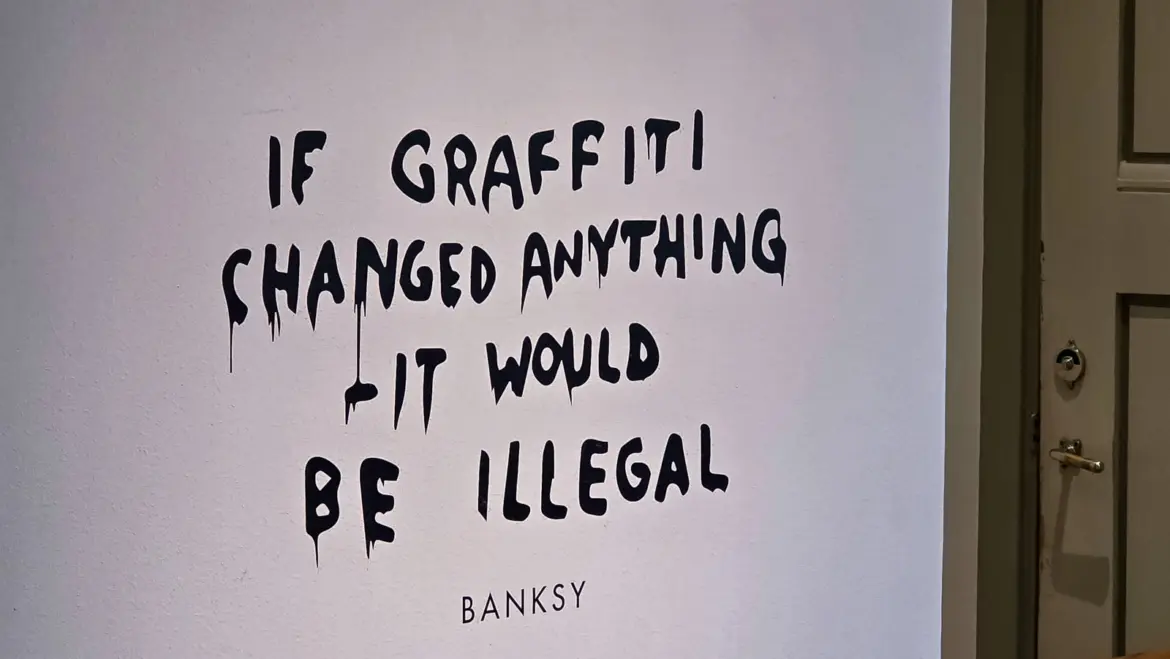
There is a line painted on the wall at Moco in Amsterdam, in dripping letters imitating Banksy’s stencil style, that says if graffiti changed anything it would be illegal. He did not paint it. The museum did, quoting him.
It is a joke and a defence at the same time, and it explains why he gets a post of his own rather than a section inside one. The work is provocative and it is funny, which is a difficult combination, and it goes at authority in a way most artists either avoid or do badly.
There is also the mystique, and the mystique had been dismantled six weeks before I walked in.
What follows is what is actually on the walls at Moco, taken from the labels beside each piece.
Banksy at the Moco Museum at a Glance
🐀 The motifs · Four Gangsta Rats, three monkeys, a riot copper, Girl with Balloon, the Flower Thrower, and the Grin Reaper.
🖼️ Whose art · Almost all on loan from private collectors in the Netherlands, the UK and Monaco. The museum owns little of it.
✅ Authentication · Every label cites Pest Control, Banksy’s own verification office, or a lender, usually both.
⚠️ Unauthorised · Banksy has no involvement; he has publicly said the recent exhibitions are not consensual. Moco says so too.
💡 Tip · Read every label. The dates, dimensions, lenders and the Pest Control line are the most interesting text in the building.
The Anonymity, and What Happened to It
On 13 March 2026, Reuters published an investigation naming Banksy as Robin Gunningham, a man from Bristol who they report legally changed his name around 2008. Their evidence runs to a signed confession from an arrest in New York in September 2000, immigration records, and an interview with his former manager, who told them he arranged the name change himself.
Banksy has not confirmed it. His lawyer told Reuters that his client does not accept that many of the details are correct, without confirming or denying. Pest Control said the artist had decided to say nothing. The same name had been reported by a British newspaper as far back as 2008 and treated by much of the art world as an open secret ever since.
I visited on 27 April, six weeks after the investigation ran, and nothing in the building had changed. The labels still lean on the anonymity. The rooms still work.
Authenticating an Artist Who Will Not Speak
Every label in the Banksy rooms says one of two things. Either the work is authenticated by Pest Control, or it is on loan from a private collector, and usually both.
Pest Control is the office Banksy set up to verify his own work. It issues certificates for genuine pieces, which is the only reason a market in his art can function when the artist declines to comment on anything. It does not vet exhibitions. That distinction matters, and it comes back at the end of this post.
Almost everything here is borrowed. The labels name private collectors in the Netherlands, the United Kingdom and Monaco. This is not a collection the museum owns.
The Rats
The rat is the motif he has used longest, and Moco has four versions of the same image hanging together, in blue, red, green and grey.
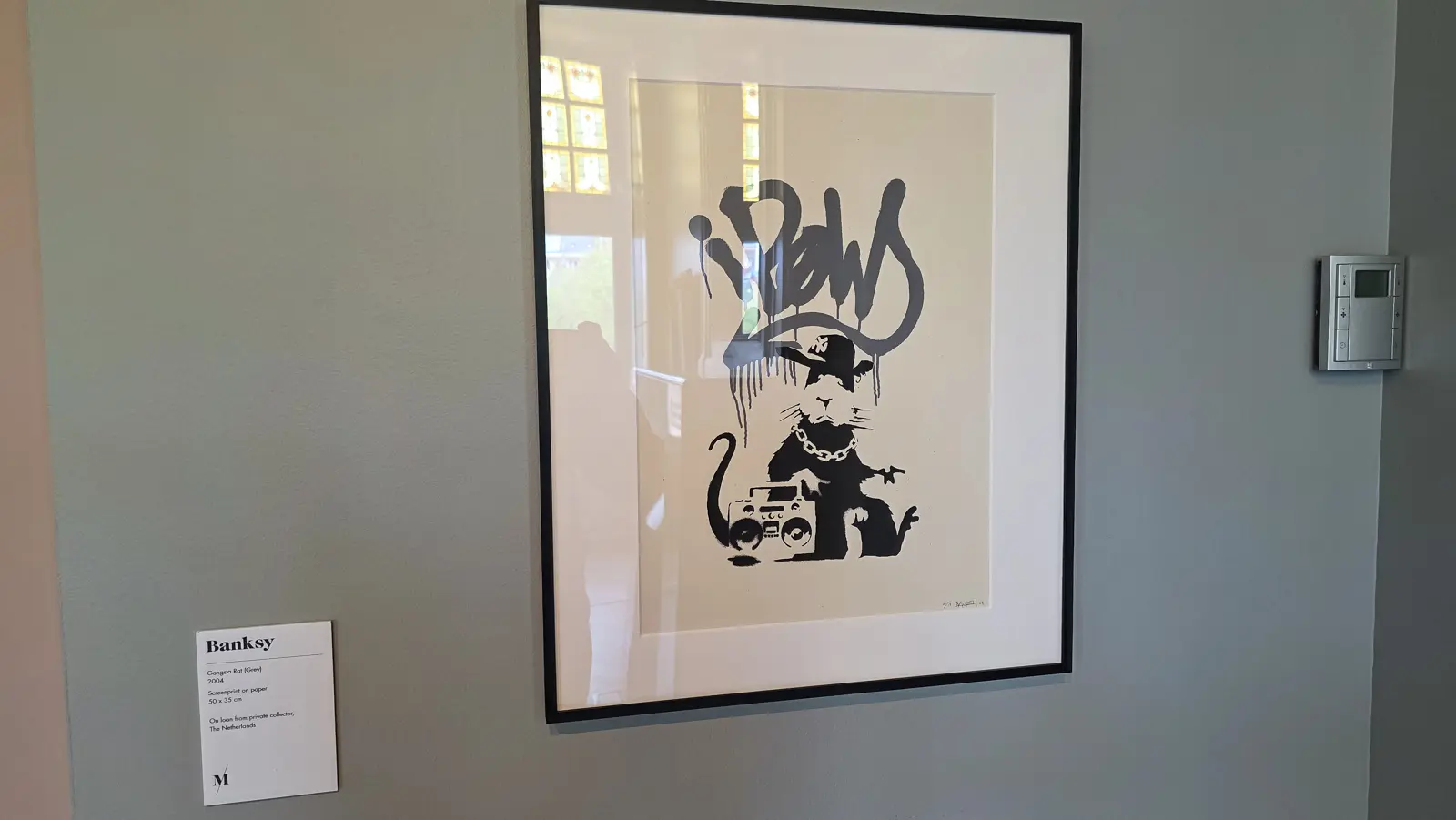
Gangsta Rat gives the animal a baseball cap, a chain and a boombox, with a tag sprayed above it. The rat is Banksy’s stand-in for the graffiti writer: unloved, everywhere, impossible to get rid of, and operating at night in places nobody is looking.
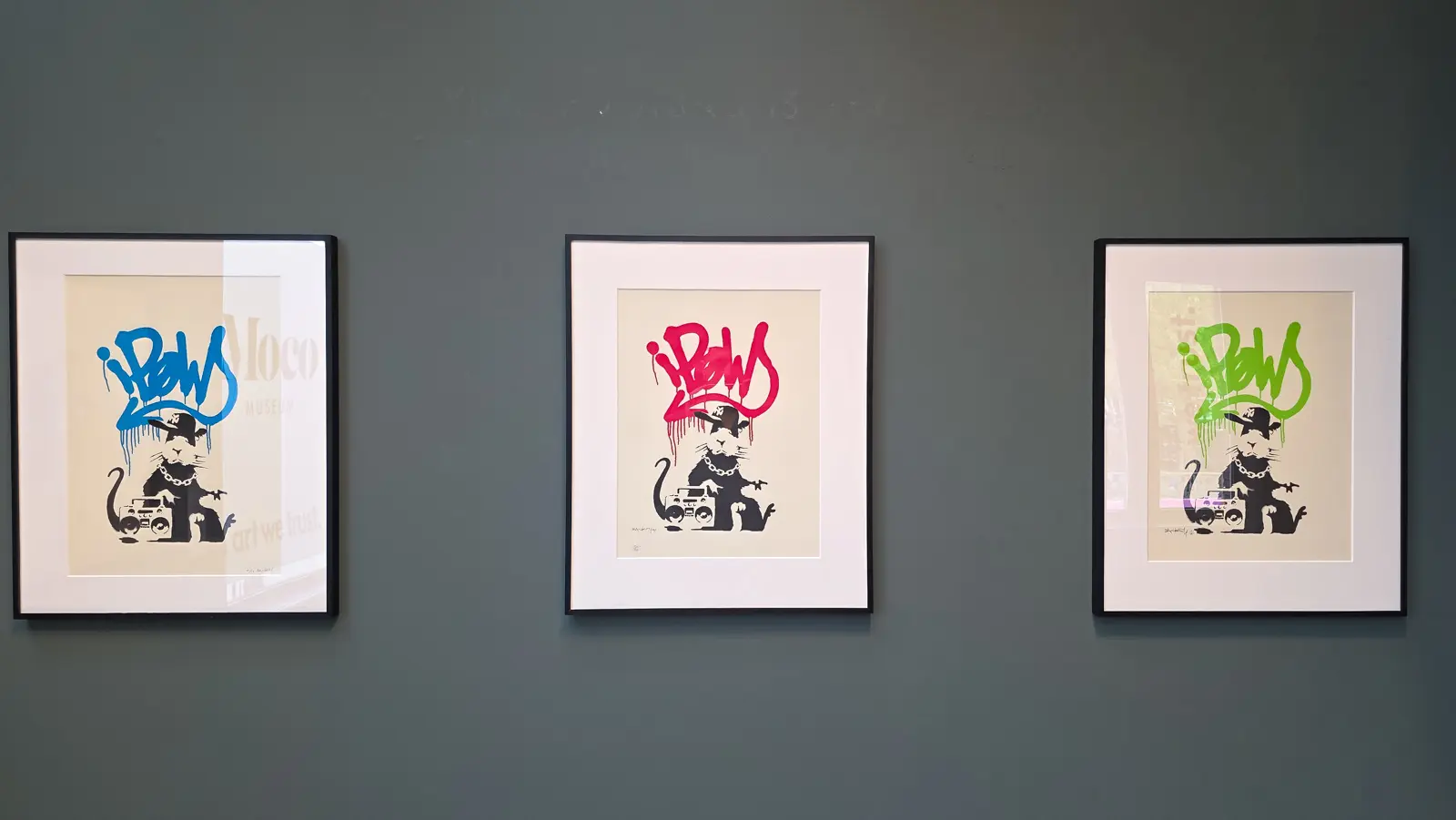
Seeing three of them in a row does something the single image does not. A rat sprayed once on a wall is vandalism. The same rat in an edition, framed and lit, is an asset. Both things are true at once, and the museum has hung them in a way that makes the contradiction hard to miss.
The fourth hangs by itself on a different wall, in grey, and reads differently again. On its own it is a picture of a rat.
He did not invent the motif. Blek le Rat, the French stencil artist, began spraying rats across Paris in 1981, and Banksy has said that every time he thinks he has done something original he discovers Blek got there twenty years earlier.
The Monkeys
If the rat is the vandal, the monkey is us.
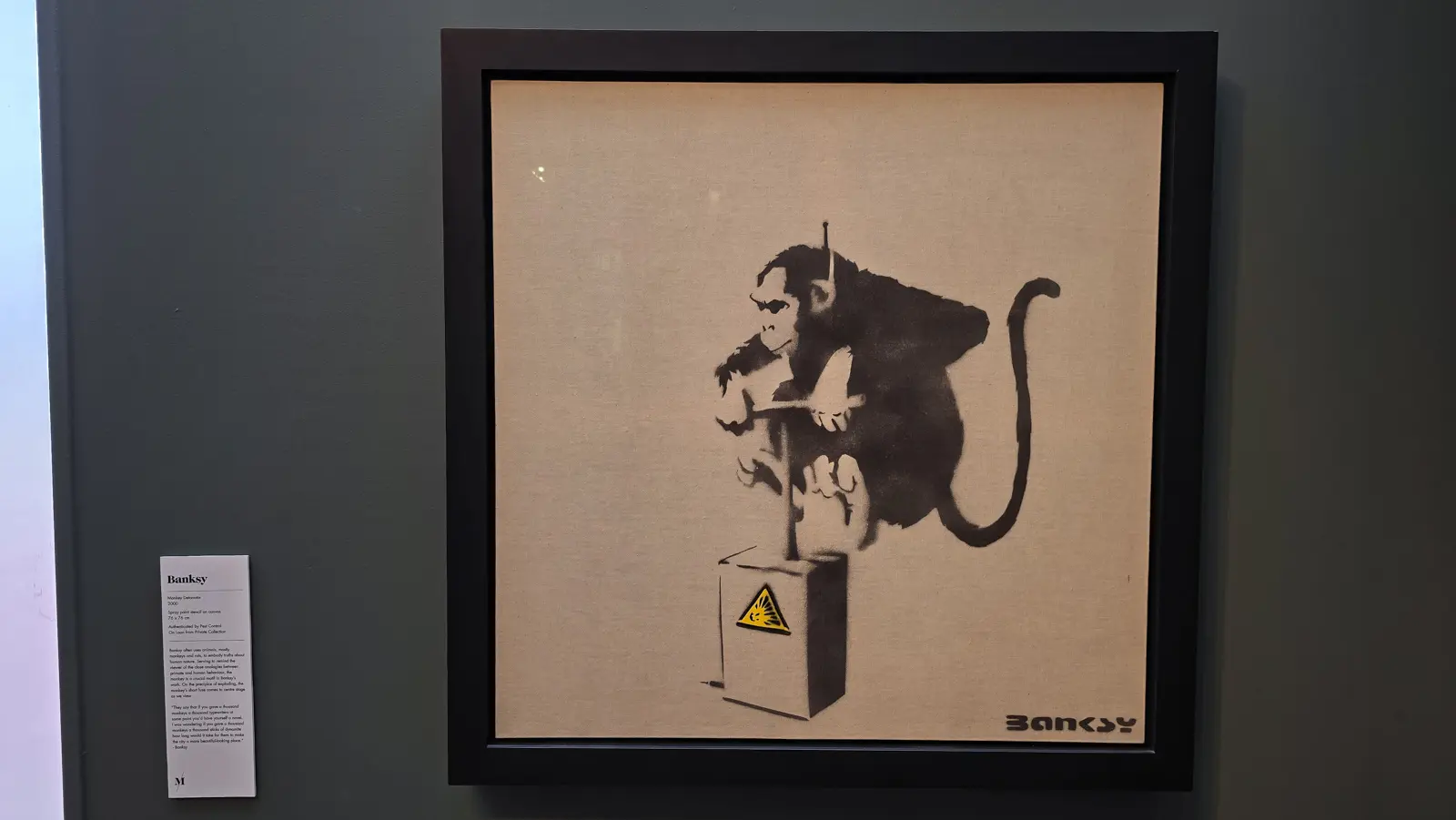
Monkey Detonator is the earliest work in the room, from 2000. A chimpanzee sits on a detonator box marked with an explosion warning, holding the plunger. The wall text carries a line of Banksy’s own about giving a thousand monkeys a thousand sticks of dynamite and wondering how long it would take them to improve the look of a city.
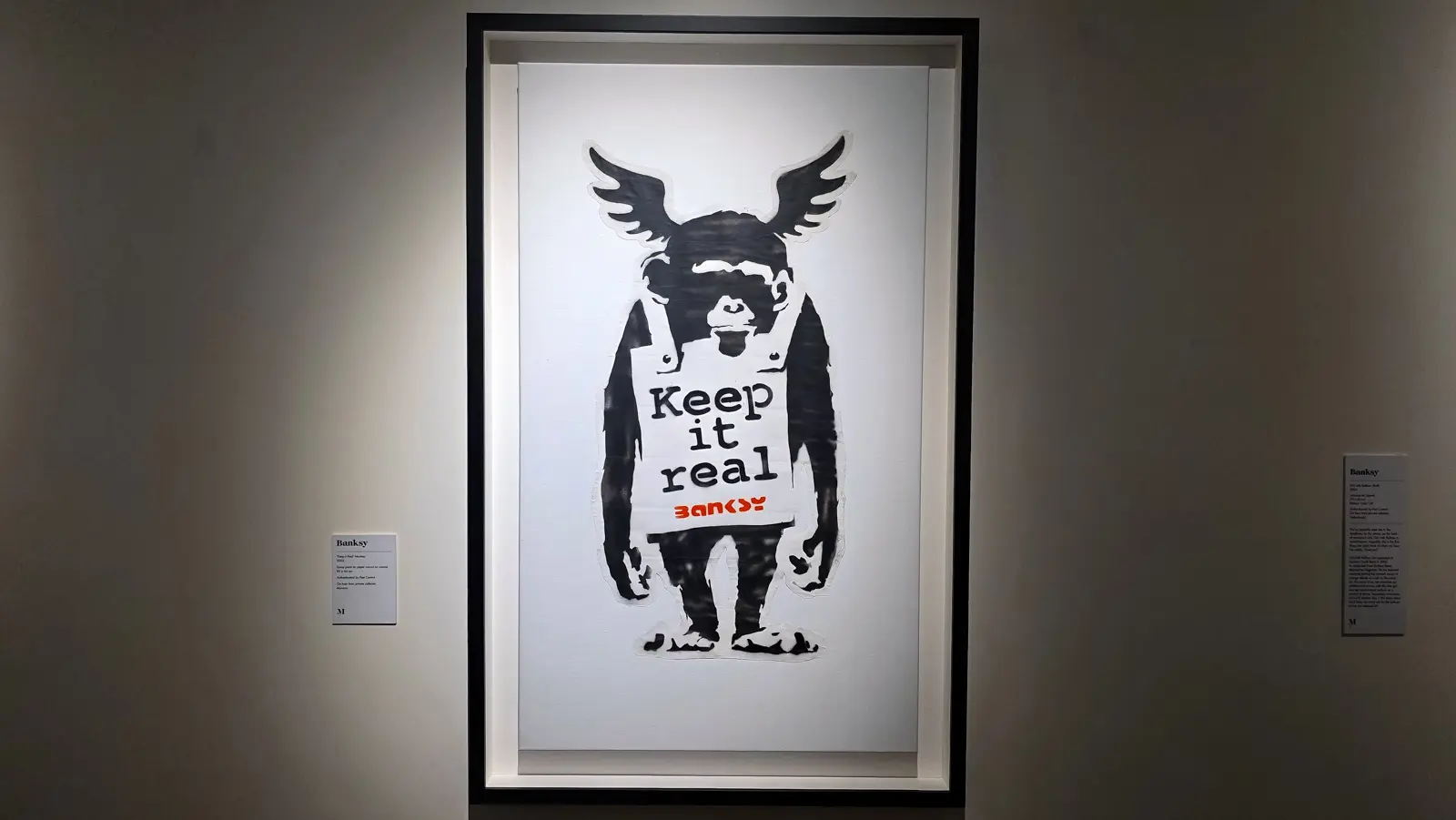
Keep It Real gives a winged monkey a sandwich board bearing the phrase, with his tag printed below it in orange. The wings are the joke: an animal being asked to be authentic while wearing a costume.
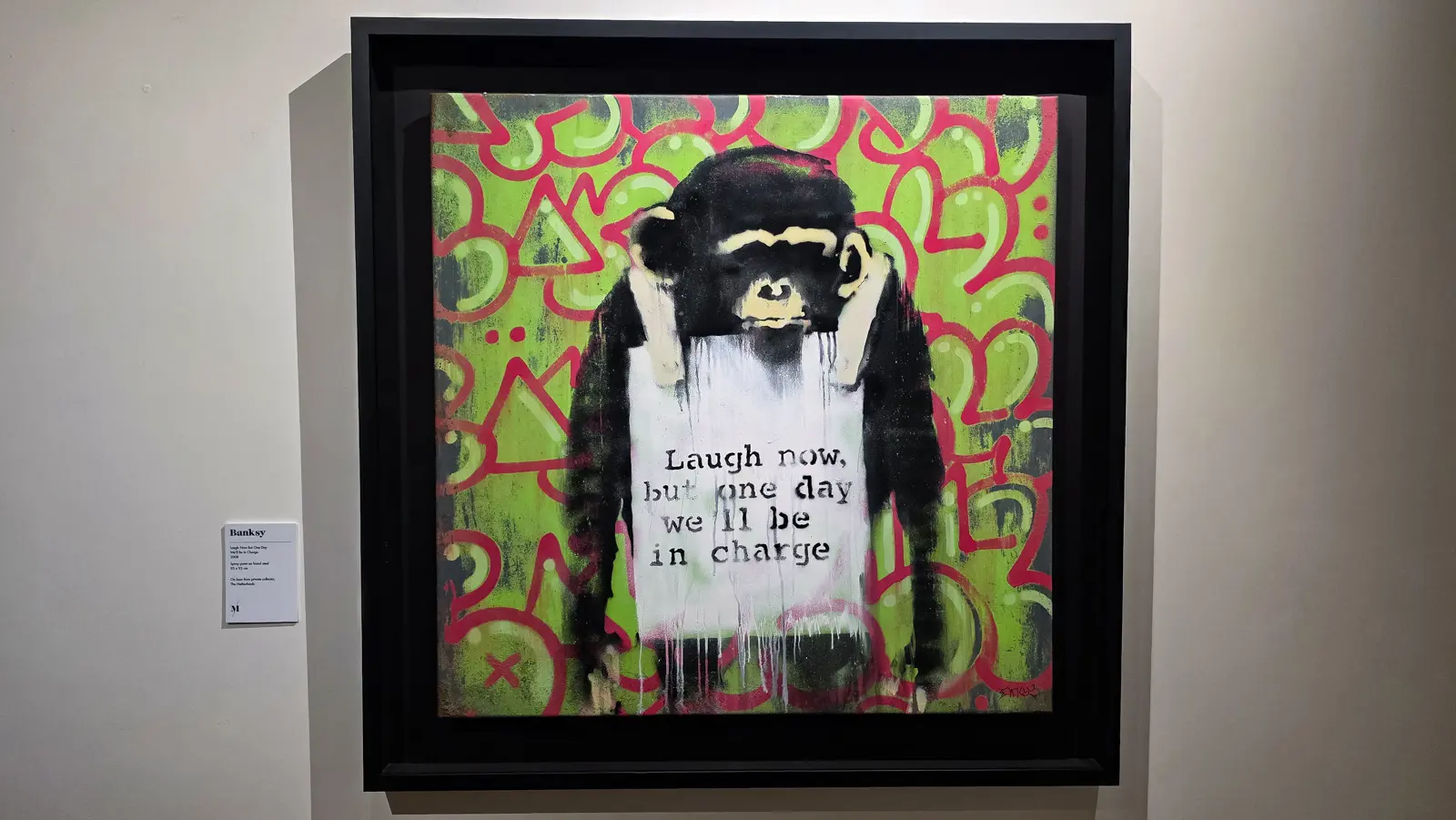
The best of the three is Laugh Now But One Day We’ll Be In Charge, from 2008, sprayed onto a found sheet of steel with a green and pink graffiti background already on it. The monkey wears the sign and stares out from under its own eyebrows, and the sentence does all the work.
The Police
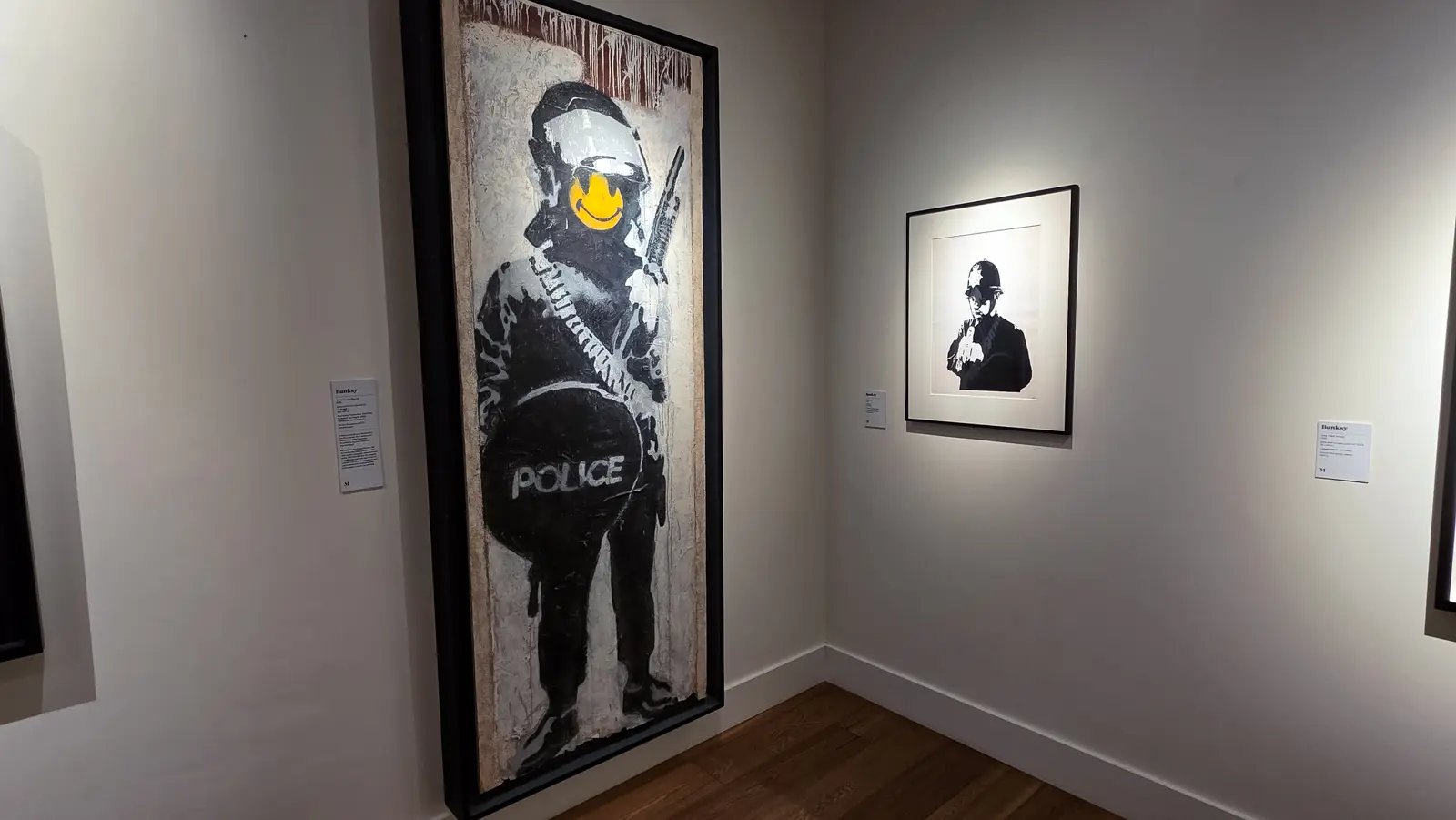
The largest thing in the Banksy rooms is a riot officer, close to life size, in full kit with a shield marked POLICE, and a yellow acid house smiley where the face should be.
Moco’s own listing names it Smiling Copper (Panel B). Round a corner from it hangs a much smaller framed print of a British constable, and the pairing works: the enormous one is the threat, the small one is the everyday version of the same authority.
The Two Everybody Knows
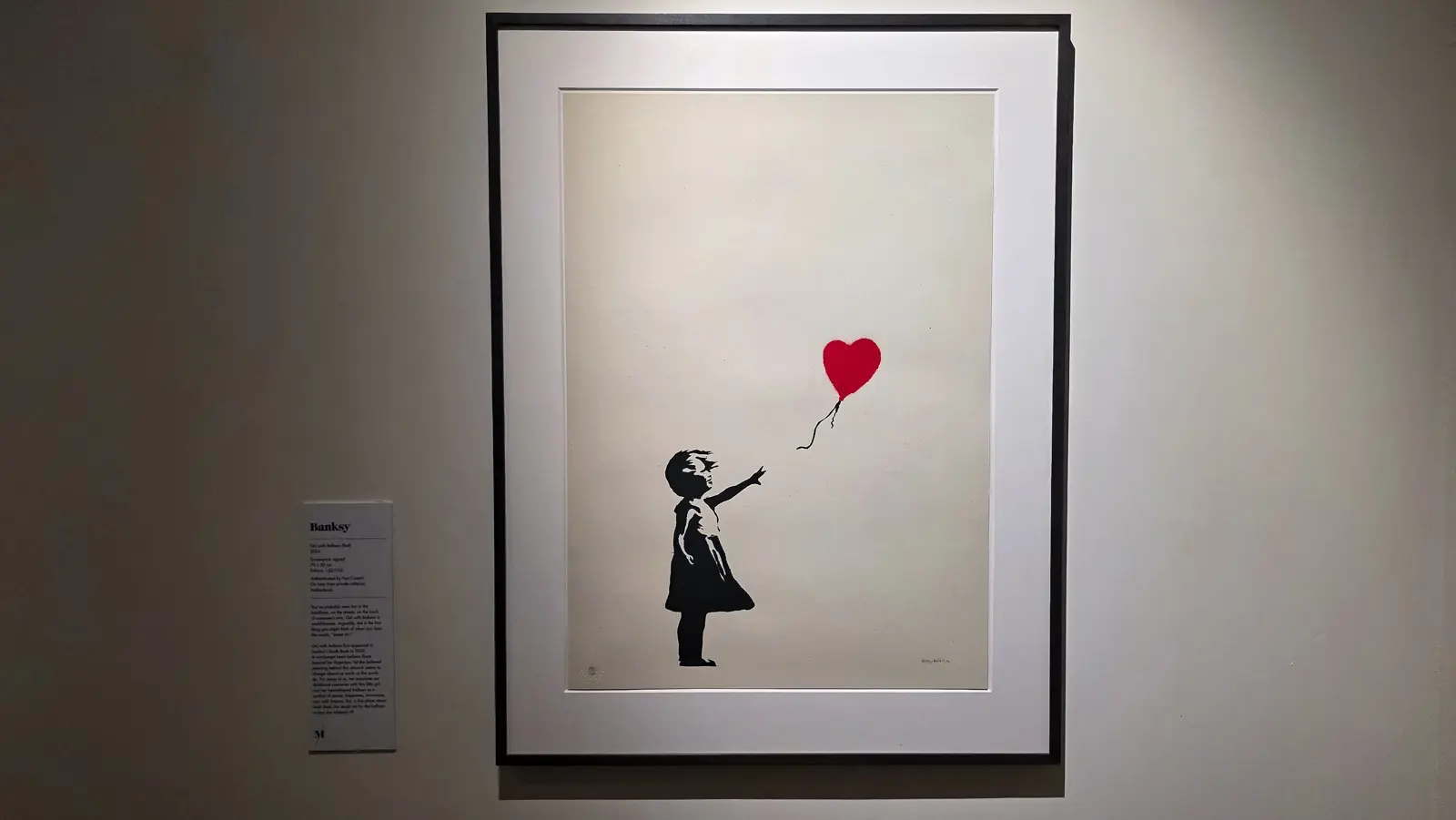
Girl with Balloon is the image that made him famous, and the wall text asks the right question about it: whether she is reaching for the balloon or has just let it go. The picture does not settle it.
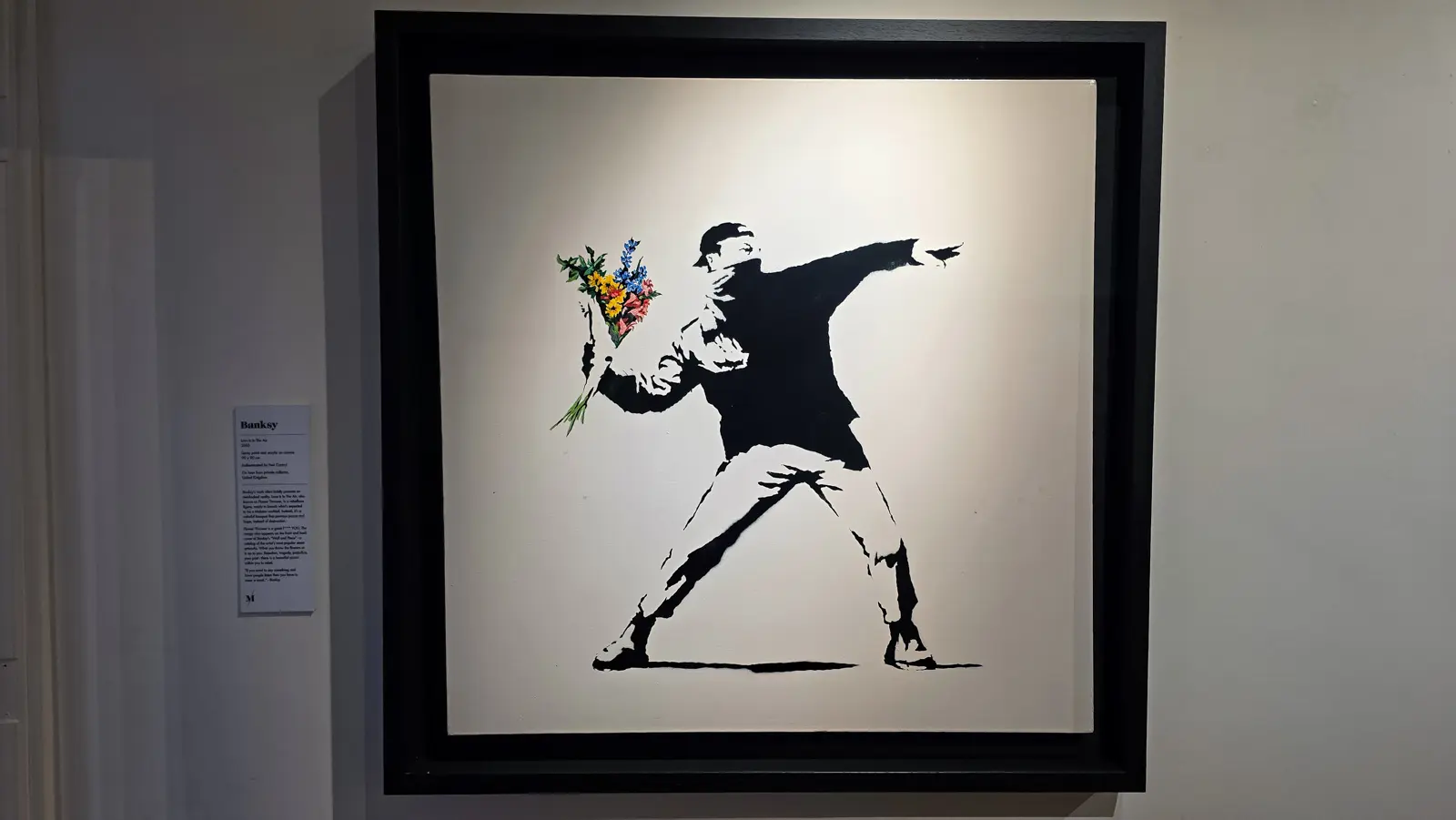
Love Is In The Air, the Flower Thrower, is the other one. A masked figure winds up in the posture of somebody about to throw a petrol bomb, and his hand is full of flowers. The whole thing rests on the body knowing that stance before the eye reaches the bouquet.
Found Things
A recurring habit here is that he does not start with a blank surface. He starts with something somebody else has already used.
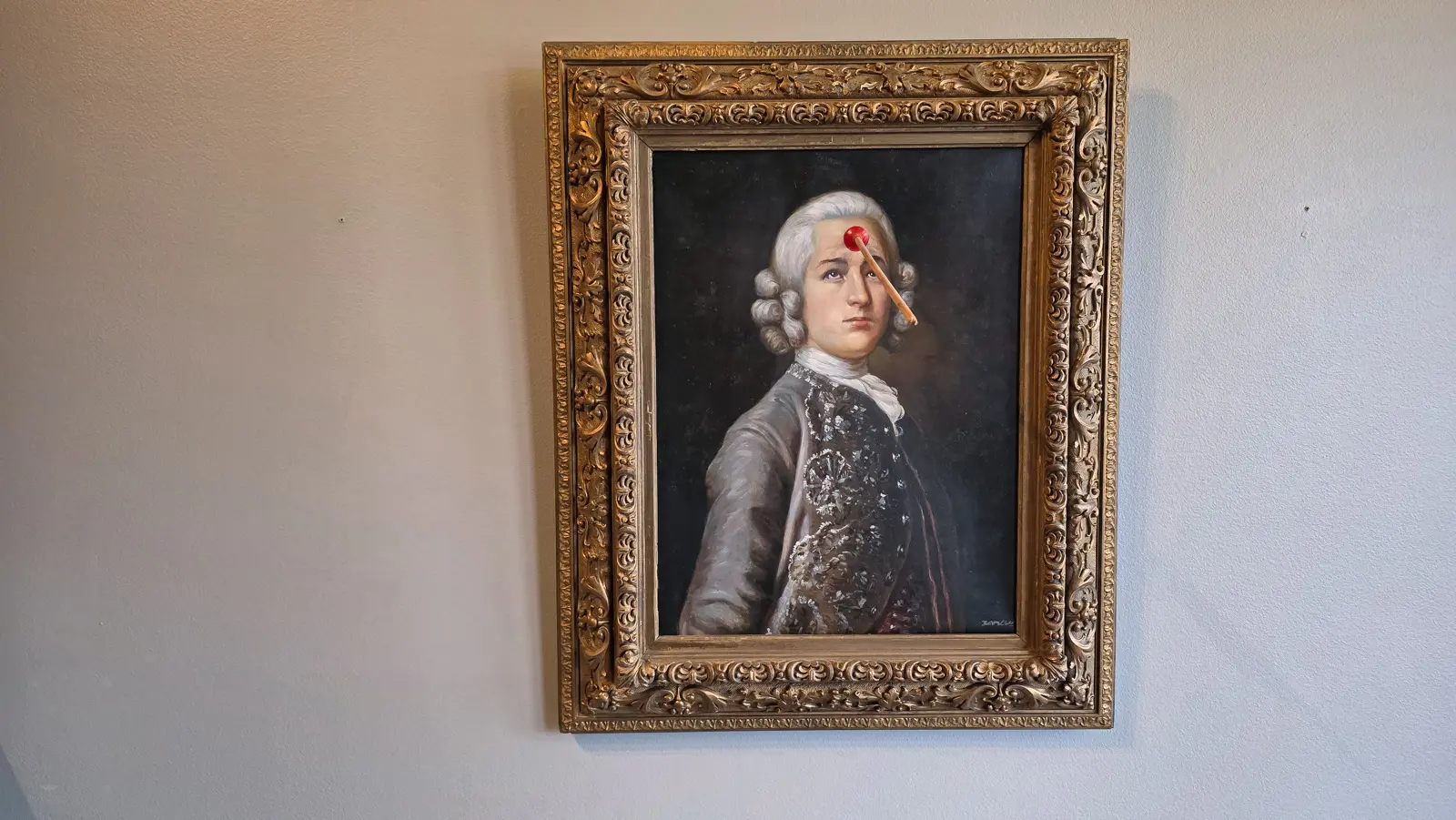
Arrow Head belongs to his Crude Oil series, made from old oil paintings bought secondhand at car boot sales and junkyards. An eighteenth-century gentleman sits for his portrait in a powdered wig and an embroidered coat, and a toy arrow with a red rubber sucker is stuck to his forehead, projecting out of the canvas.
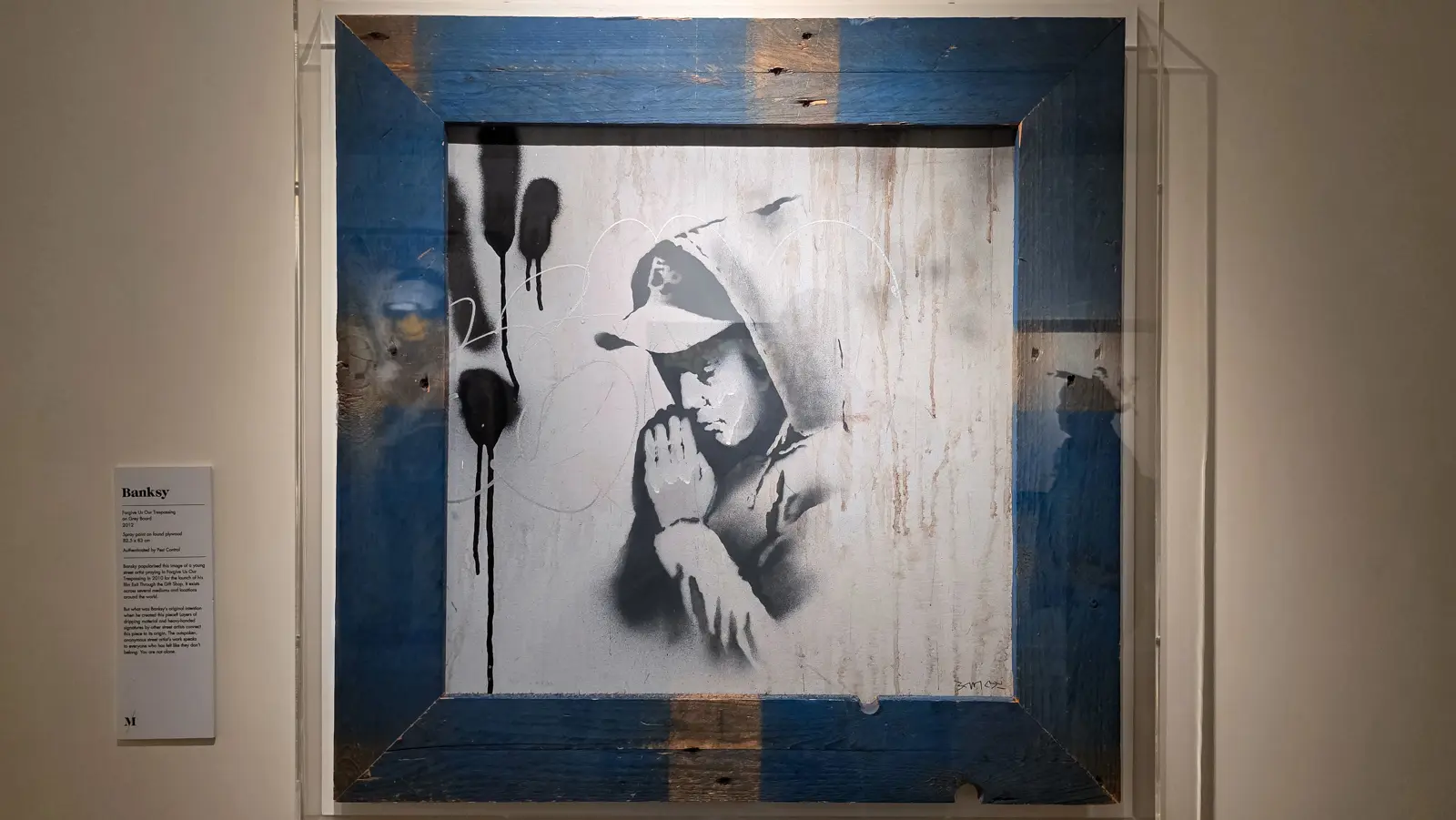
Forgive Us Our Trespassing is sprayed onto found plywood, still stained and marked, framed in the blue-painted boards it came with. A hooded figure kneels with hands pressed together. Other people’s tags and drips run across it, and the wall text makes the point that those marks are part of the piece rather than damage to it.
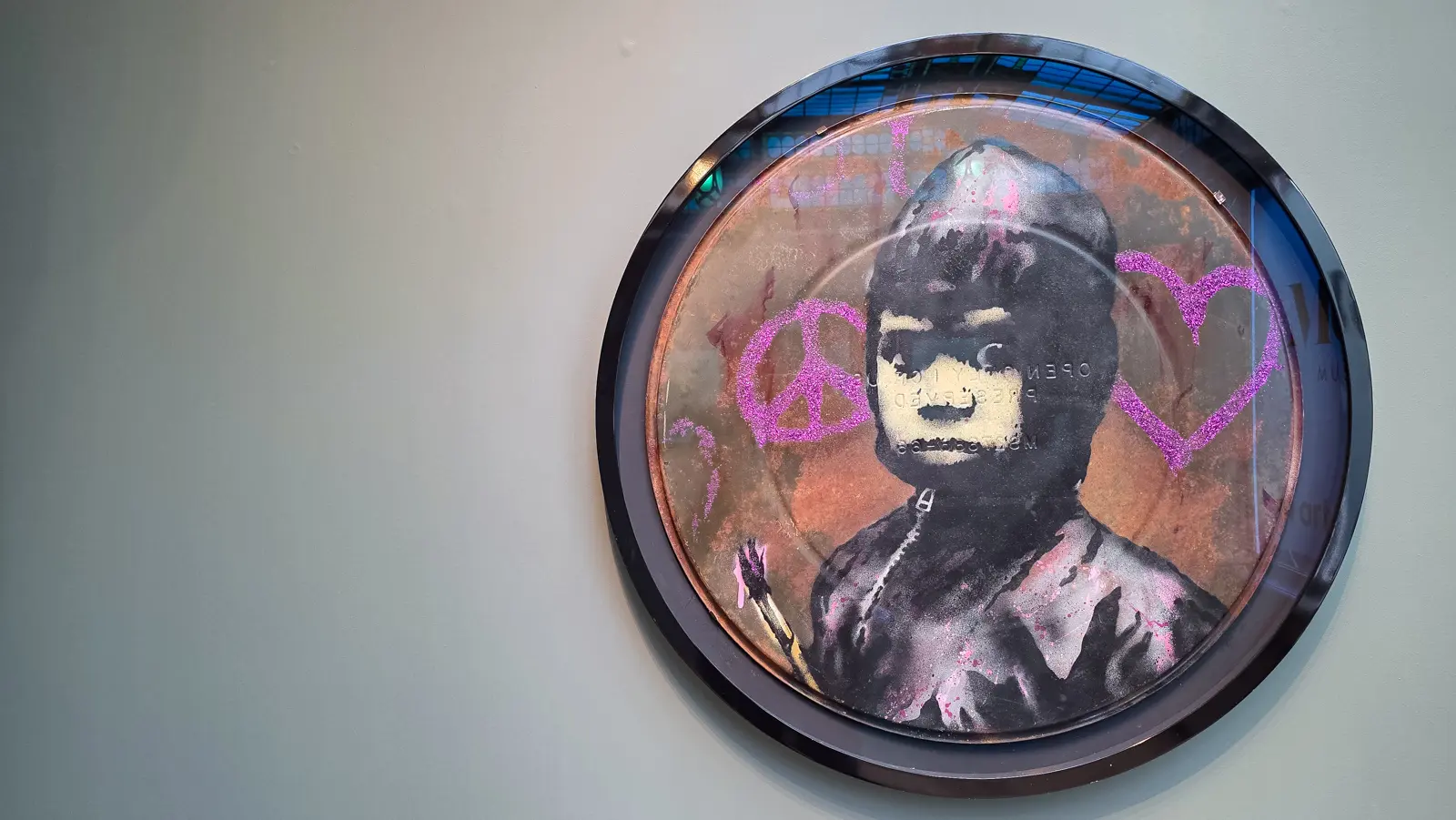
The last of the found objects is round. A circular sheet of salvaged metal, rusted, with a balaclava-wearing figure stencilled onto it and a pink glitter peace sign and heart sprayed either side. Whatever it was before, it was not a canvas.
Banksquiat
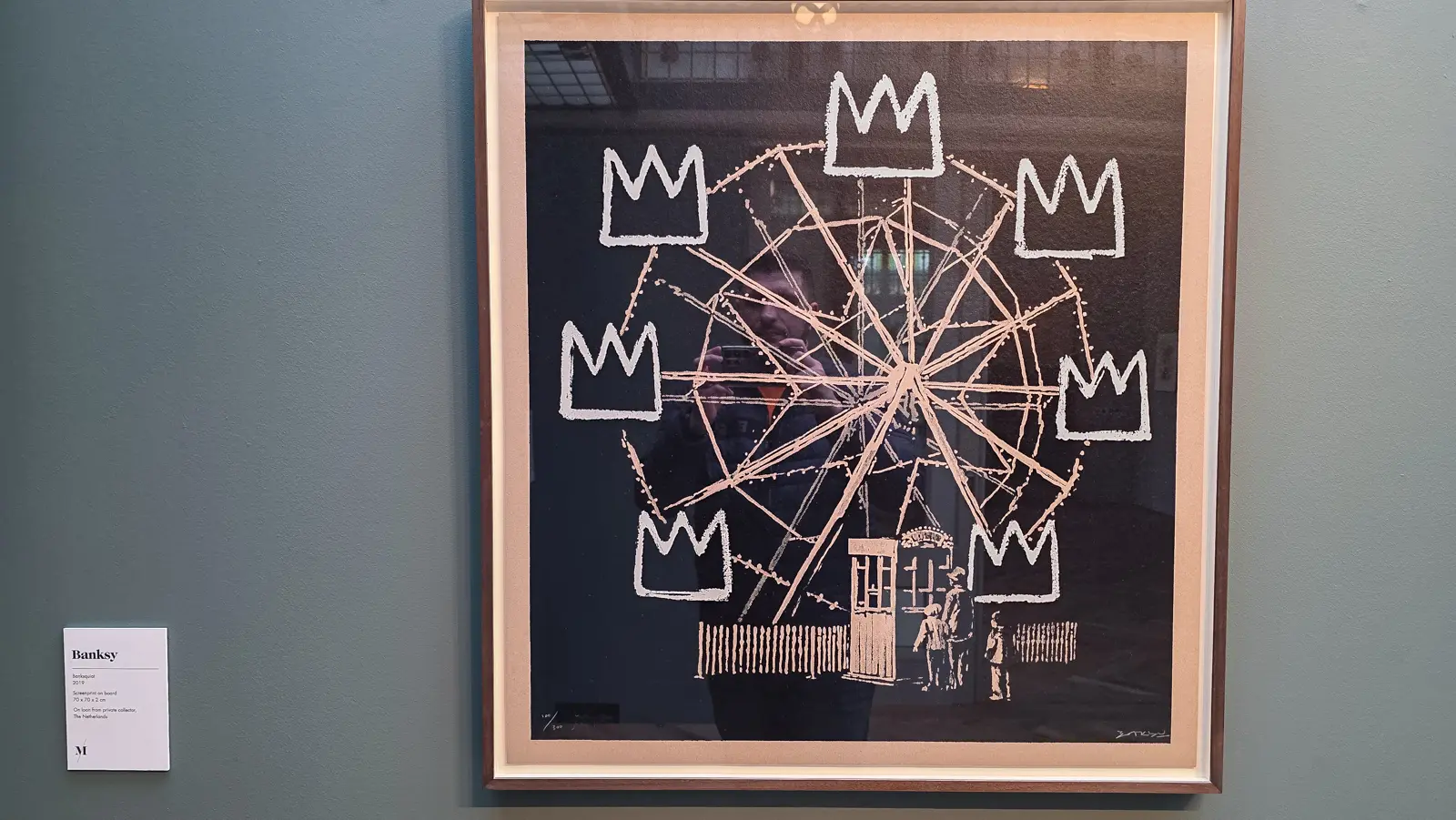
The one that rewards knowing something is Banksquiat, from 2019. A Ferris wheel drawn in rough pale strokes, with eight crowns floating around it and a queue of small figures at a turnstile below.
The crown is the motif most associated with Jean-Michel Basquiat, and the title fuses the two names. The joke is about admission: an artist who worked on the street, memorialised by an institution that charges people to queue up and look.
The Thing the Museum Says Itself
Here is the part that cannot be left out of a post like this.
Banksy has stated publicly, on his own website, that the recent run of Banksy exhibitions is not consensual and was organised without his knowledge or involvement. Pest Control certifies the individual works but does not endorse shows. Moco describes its own Banksy exhibition as unauthorised.
So an artist whose entire method depends on refusing permission is hanging on the walls of a private museum, on loan from collectors, behind a ticket barrier, and he wants nothing to do with it.
None of that makes the work less good, and it is not an argument against going. But it is the tension the building is built on, and a post that admired the anti-establishment streak while pretending the arrangement did not exist would be worth very little.
The Grin Reaper
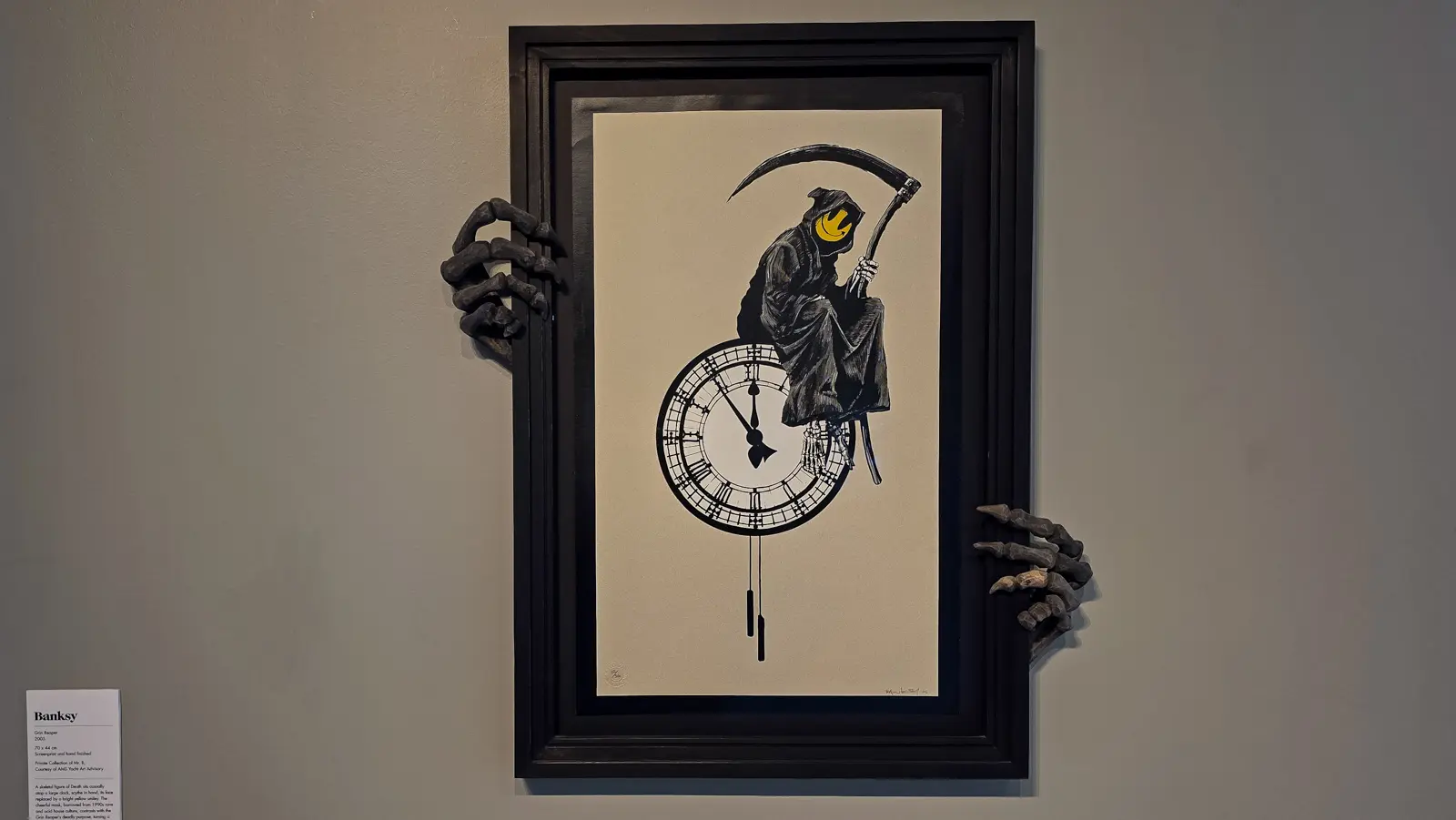
The last one is the best staged. A hooded figure of Death sits on a clock face with a scythe, and where the skull should be there is a yellow smiley. Skeletal hands have been mounted on the wall on either side, gripping the frame from outside, so the picture appears to be held up by the thing inside it.
Bubbly Tips
- Read every label. The dates, the dimensions, the collectors and the Pest Control line are the most interesting text in the building, and they take about ten seconds each.
- Book a time slot in advance. The Banksy rooms are the busiest part of a small museum, and the larger works need standing room to be seen properly.
- Go early or late. Mid-afternoon is when the rooms fill up. First or last entry gives space in front of the big canvases.
- Look at the frames, not just the pictures. The Grin Reaper’s sculptural hands and the found plywood surround on Forgive Us Our Trespassing are part of what is on display.
- Turn the flash off. Everything is glazed and lit, and a flash puts your own reflection in the middle of the picture. Let the exposure settle instead.
- Spot the found surfaces. Several works are sprayed onto steel, plywood or old oil paintings. Once you start looking for what was there first, the room reads differently.
- Give the Moco garden half an hour afterwards. It is included with the ticket, it is full of sculpture, and most visitors walk straight past it.
- It is stairs only. The villa is a listed building and no lifts have been permitted, so the Banksy rooms on the upper floors are not reachable by wheelchair or pushchair.
Final Thoughts
What makes the work last is not the politics, which anyone can agree or disagree with. It is that almost every piece is a familiar image with one thing changed. A rat given a chain. A monkey given a sign. A rioter given flowers. Death given a smiley.
Change one element in something people already recognise and the whole picture argues with itself. That is a very old trick and he does it better than anyone currently working.
It also survives being named. Whatever Reuters found in a New York court file, the rat on the wall still does what it did before, and the museum sold just as many tickets the week after.
Whether it belongs on a wall in a banker’s villa, on loan from a collector, behind a ticket desk, is a question he has already answered and the answer is no. Go anyway, and hold both thoughts at once.
Until next time!

🌟 Everything You Need to Plan Your Dream Trip in 2026
- 🌟 Luxury Hotels - Find premium stays with Booking.com & Hotels.com
- 🏡 Vacation Rentals - Discover unique properties on VRBO
- 🏞️ Guided Tours - Explore with Viator or GetYourGuide
- 🎫 Attraction Tickets - Skip the lines with Tiqets
- 🚢 Ocean Cruises - Set sail with Cruise Direct
- 📱 International SIMs - Stay connected with Saily
- 🚗 Car Rentals - Budget-friendly options from Discover Cars
- 🌐 Secure VPNs - Browse safely with NordVPN
- 💶 Currency Exchange - Best rates with Wise
- 🗣️ Learn Languages - Master the local language with Babbel and Rosetta Stone