
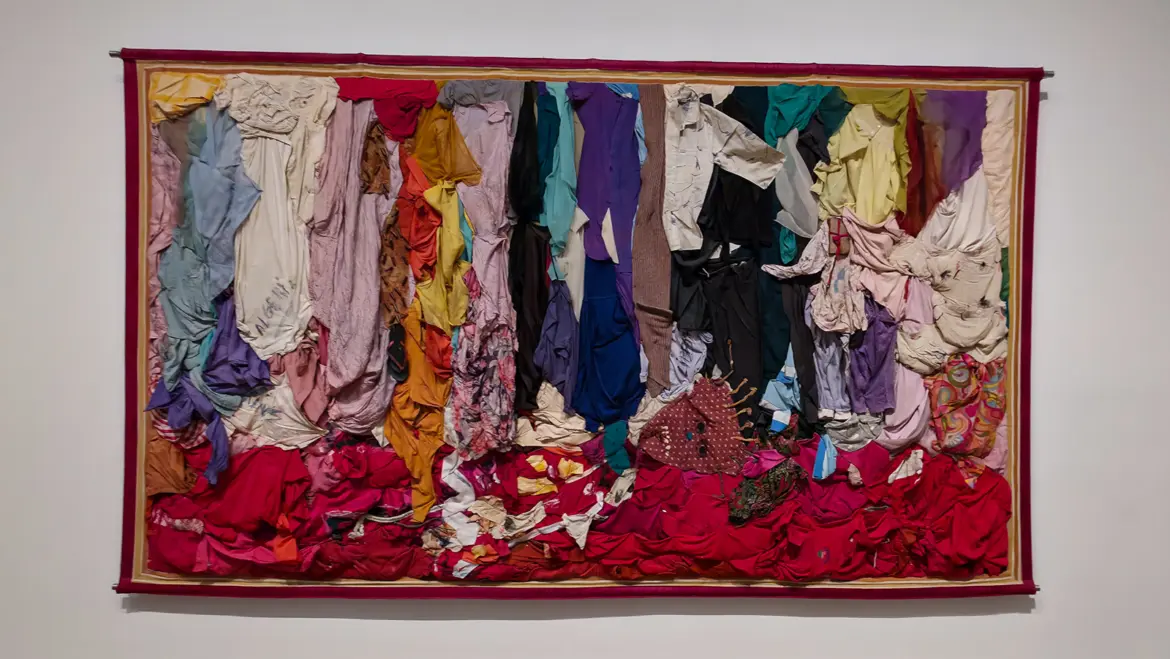
Travel is not only palaces and pastries. Part of why I travel is to understand places, and understanding a place means meeting its history, including the parts that are hard to look at. Some of the most affecting time I have spent in any museum was in two quiet rooms at Tate Modern, given over to art made in response to political violence. I came to Tate for the famous names. I stayed longest here, in front of work by people who lived through things I cannot imagine, and who turned that experience into something the rest of us can stand before and remember.
The two rooms belong to Tate’s Artist and Society displays. One is called Civil War, the other Witnesses. Between them they hold work about Spain, Greece, Algeria, Rwanda and Indonesia: five conflicts across six decades and three continents. What follows is not a cheerful post. It is, I think, a necessary one, and it is the clearest answer I can give to why a gallery like this is worth returning to.
Art as Witness at Tate Modern at a Glance
🕯️ Two rooms · Part of Tate Modern’s free Artist and Society displays: one titled Civil War, the other Witnesses.
🌍 Five conflicts · Between them they hold work about Spain, Greece, Algeria, Rwanda and Indonesia, across six decades and three continents.
🖼️ The works · Fougeron’s Martyred Spain and Massacre at Sakiet, Peter de Francia’s The Execution of Beloyannis, Konaté’s Intolerance and Arahmaiani’s Burning Country.
🎟️ Cost · Free, no ticket, part of the collection displays. The displays rotate, so these rooms are not always on show.
💡 Note · This is heavy material. It asks for time and a little quiet rather than a quick pass.
The Civil War room
The first room finds images for the horrors of civil war, the kind of conflict that sets neighbours and families against one another.
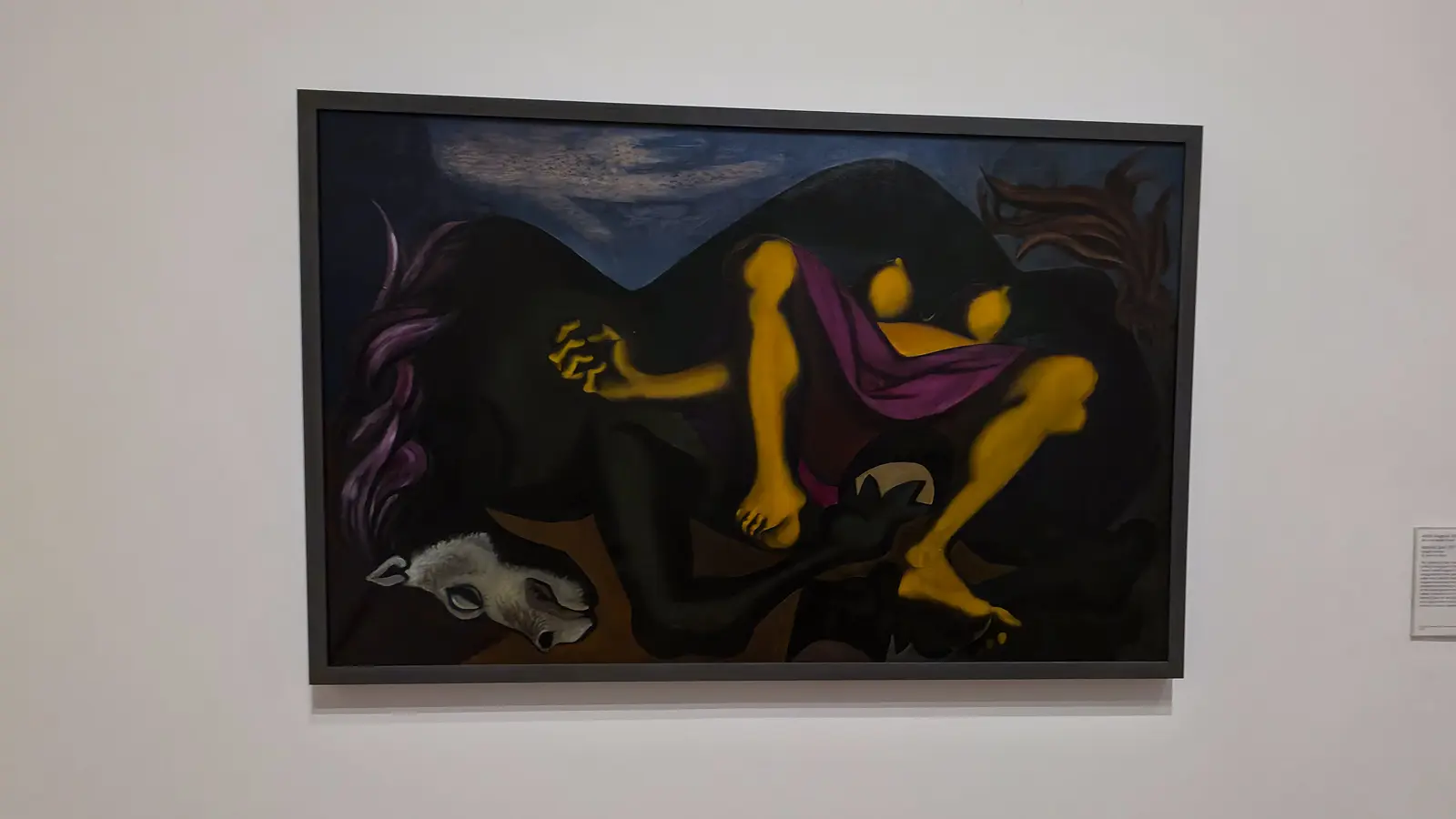
Spain comes first. André Fougeron, a French painter, thought about going to fight in the Spanish Civil War and chose instead to fight with his art. His Martyred Spain, painted in 1937 while the war still raged, sets the decaying body of a horse beside a violated woman. Not soldiers or generals, but the innocent, caught in a country tearing itself apart after General Franco’s rebellion against the elected Republic.
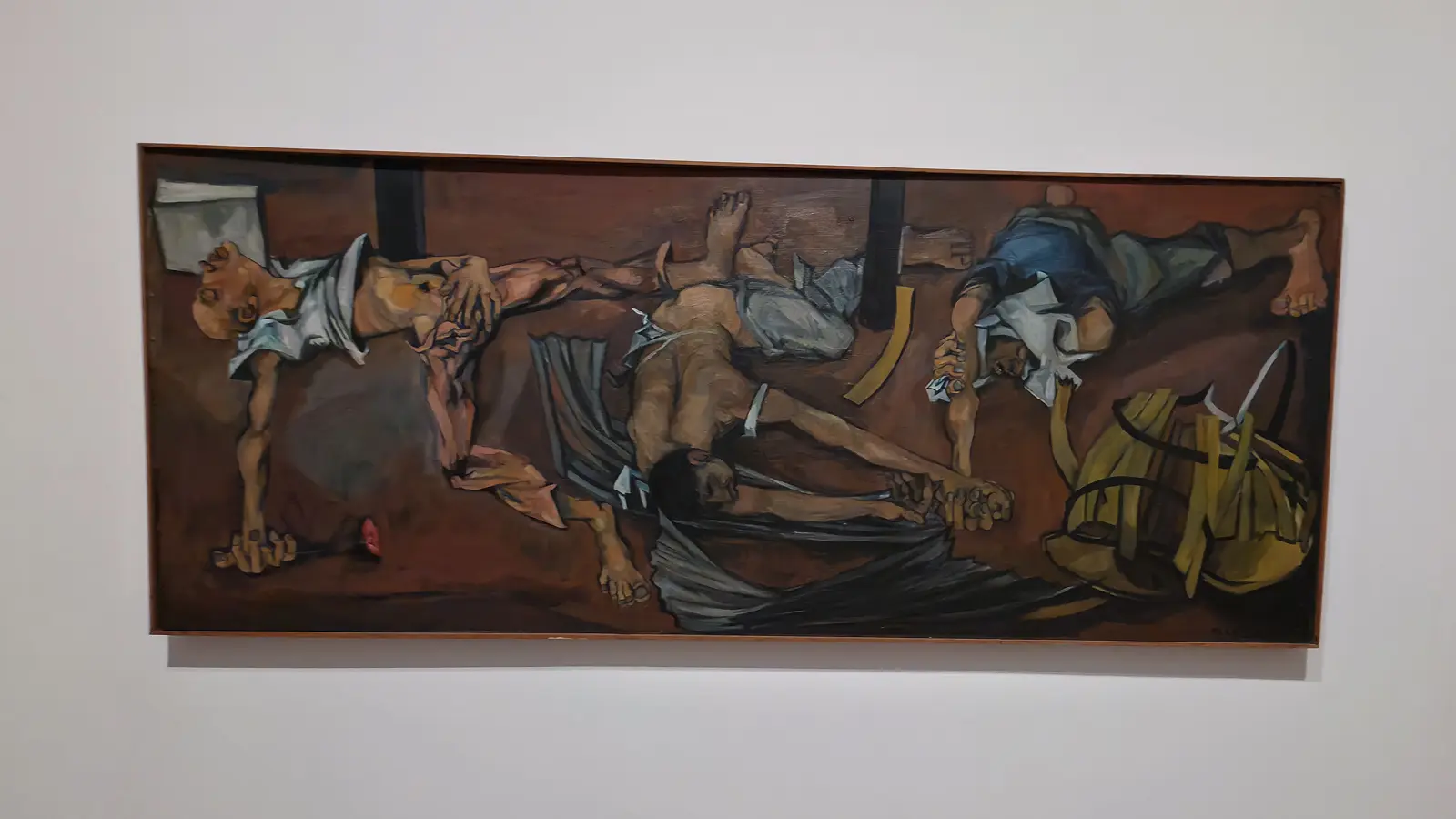
The painting I could not move away from was Greek. Peter de Francia’s The Execution of Beloyannis shows three men, bound and barefoot, shot and left on bare earth. I have Greek ancestry, and I did not expect to round a corner in a London gallery and find this. Nor did I know the story it holds. Nikos Beloyannis was a communist condemned in a show trial and shot by firing squad in 1952, despite hundreds of thousands of appeals from around the world. Picasso drew him holding a red carnation, and he became known as the man with the carnation. In de Francia’s painting, that carnation lies on the ground beside the bodies.
What the picture does, and what has stayed with me, is its viewpoint. The angle drops down to the height of the dead, so there is no looking on from a safe distance. I was in the room with them. And standing there, it did not seem to me a painting only about Greece in 1952. It seemed a painting for anyone, anywhere, still crushed by the power of a state, which is to say it has not stopped being current.
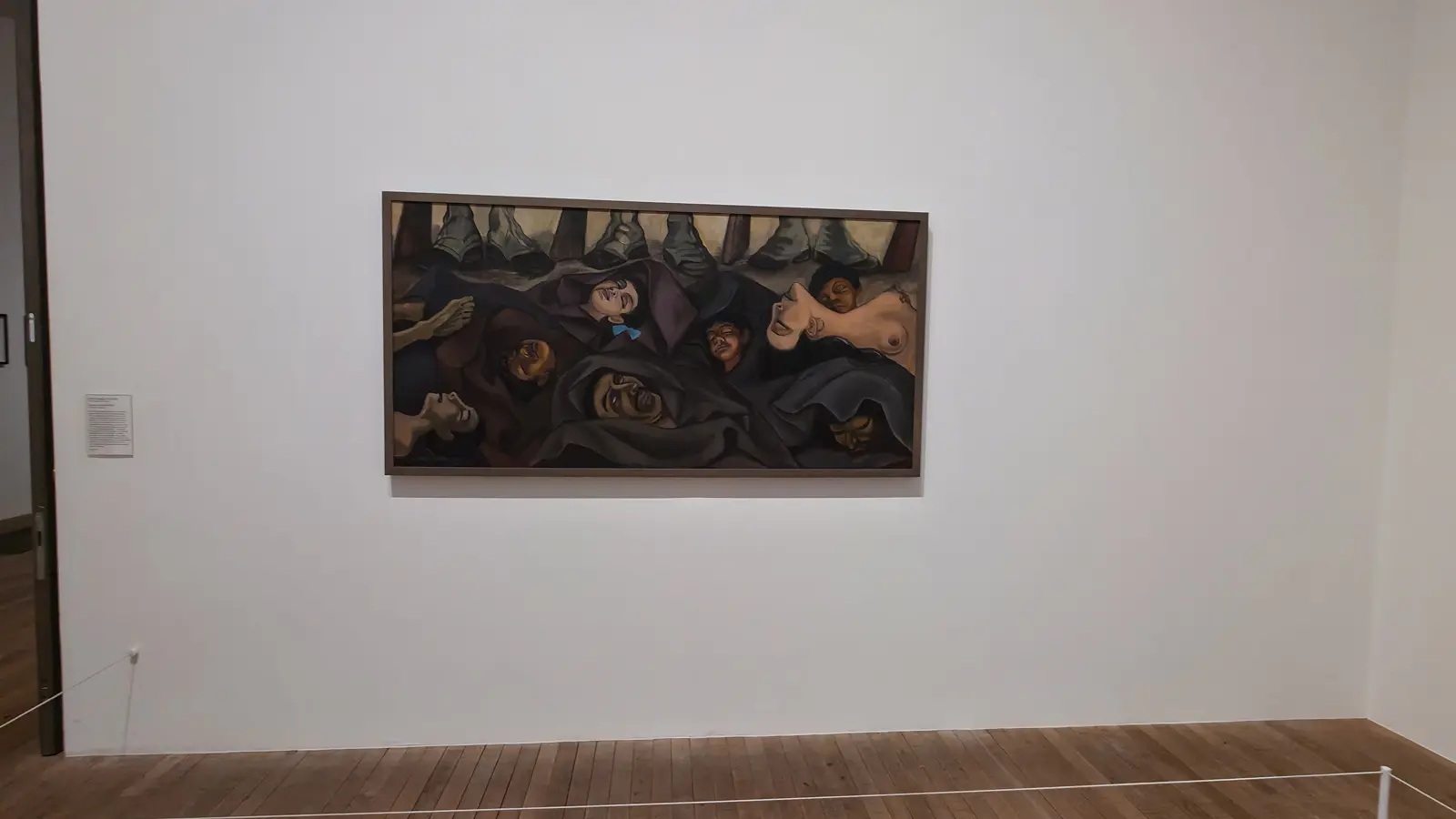
The room’s third painting moves to Algeria. Fougeron again, this time Massacre at Sakiet III, made after French aircraft bombed the Tunisian border village of Sakiet Sidi Youssef on 8 February 1958, during the Algerian war of independence. Around seventy villagers were killed on what was a market day. Fougeron paints the dead heaped together, and along the top edge, a line of military boots. The boots are the whole argument: they place the French state standing over the bodies, a responsibility still being denied at the time he painted it.
The Witnesses room
The second room is newer, and its works come from further afield. Its title, Witnesses, is also its subject: art as a way of testifying to violence, and of mourning it.
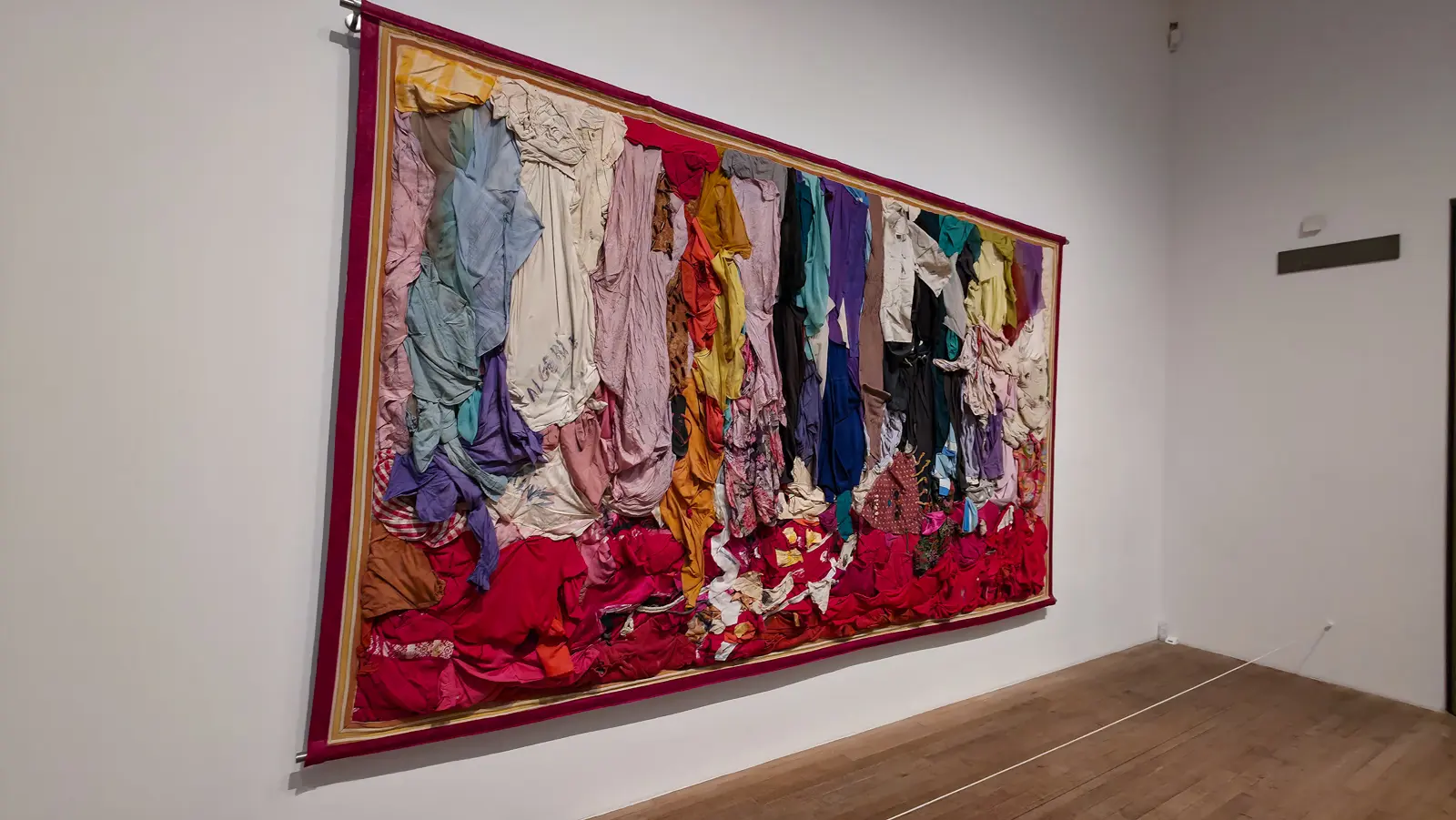
Abdoulaye Konaté’s Intolerance, the work at the top of this post, belongs here. The Malian artist stitched together shredded clothing above a rising tide of blood-red cloth, and marked the fabric with the names of African cities and countries scarred by conflict. He made it above all in response to the 1994 genocide in Rwanda, in which an estimated 800,000 people, most of them Tutsi, were killed in around a hundred days. It holds many atrocities at once, and it carries them without a single depicted body, which is part of why it lands so hard.
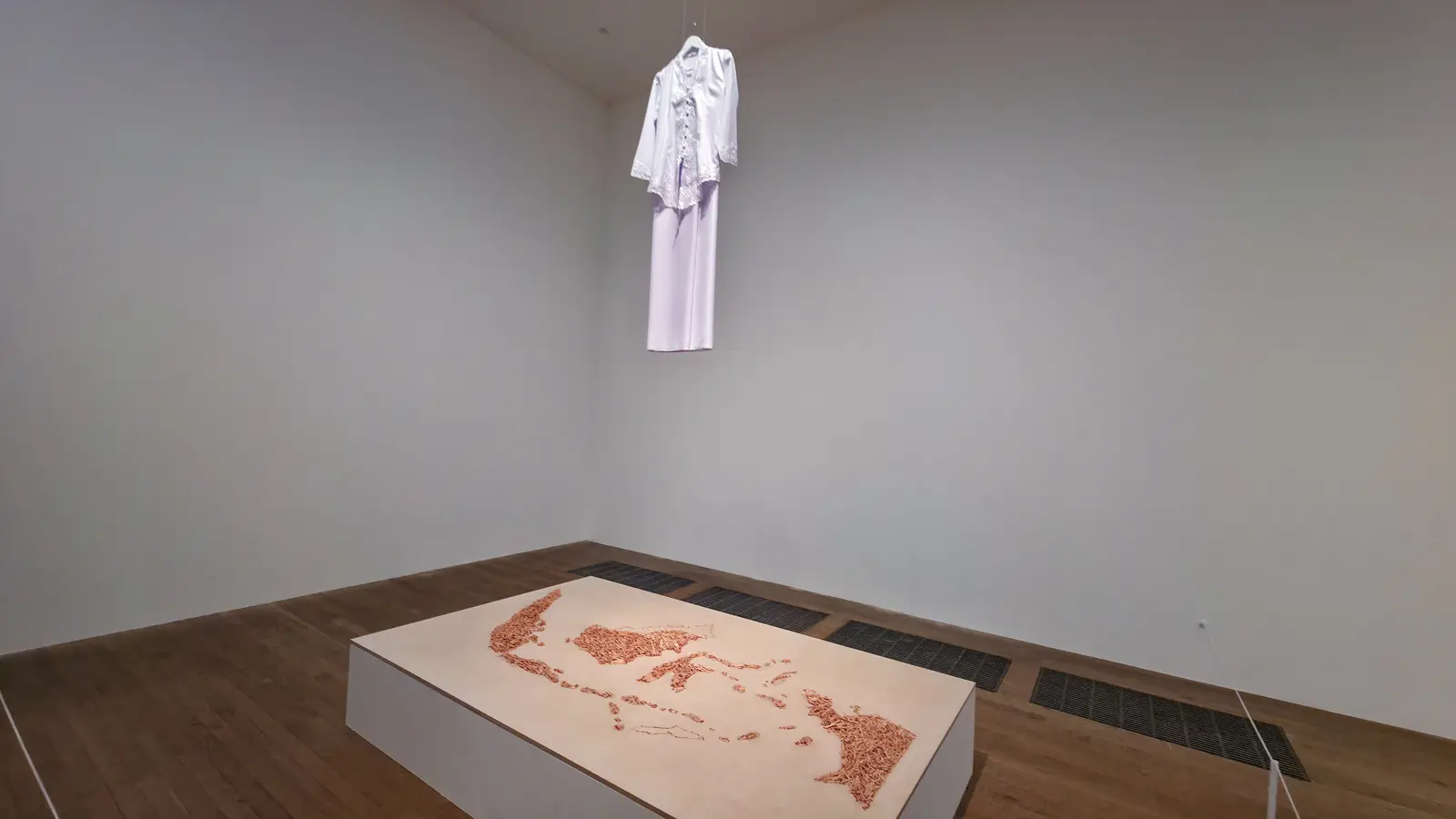
Across the room is Arahmaiani’s Burning Country. The Indonesian artist has laid out the islands of her country as a map made from matchsticks, and hung above it an emptied white dress, a body that is no longer there. The work mourns the riots of May 1998, when more than a thousand people were killed and many women of the Chinese-Indonesian minority were raped, in the violence that brought down the Suharto regime after thirty-two years. In an adjoining space she painted the women in black and white, and opened the display with a performance of protest poetry, drumming and song. She describes this kind of work as a way of coming to terms with the past.
Practical notes
Both rooms are part of Tate Modern’s free collection displays, within the Artist and Society wing, so there is no ticket and no booking. This is heavy material, and it asks for time and a little quiet rather than a quick pass. Photography without flash is allowed throughout the collection. One thing worth knowing: displays like these rotate, so these particular rooms may not always be on show, and the Tate website lists what is currently up.
Final Thoughts
None of this is why most people come to Tate Modern, and I understand why. On a short visit, the pull is toward the Matisse and the Warhol, the colour and the joy. But a great museum is not only a place to be delighted. It is also a place to be met, quietly and seriously, with what people have done to each other, and with how the artists who came through it have chosen to remember.
That is the real reason I would send anyone back to Tate more than once. The famous works will still be there. So will these rooms, and the people they speak for, in Spain and Greece and Algeria and Rwanda and Indonesia, who are owed the small act of being looked at and not forgotten. Standing in front of this work is not a comfortable way to spend half an hour. It is, I have come to think, one of the more important ones.
I walked back out into the colour and the crowds, carrying these five places with me. That, in the end, is what this kind of art asks of the rest of us: to look, and to remember.
Until next time,

🌟 Everything You Need to Plan Your Dream Trip in 2026
- 🌟 Luxury Hotels - Find premium stays with Booking.com & Hotels.com
- 🏡 Vacation Rentals - Discover unique properties on VRBO
- 🏞️ Guided Tours - Explore with Viator or GetYourGuide
- 🎫 Attraction Tickets - Skip the lines with Tiqets
- 🚢 Ocean Cruises - Set sail with Cruise Direct
- 📱 International SIMs - Stay connected with Saily
- 🚗 Car Rentals - Budget-friendly options from Discover Cars
- 🌐 Secure VPNs - Browse safely with NordVPN
- 💶 Currency Exchange - Best rates with Wise
- 🗣️ Learn Languages - Master the local language with Babbel and Rosetta Stone