
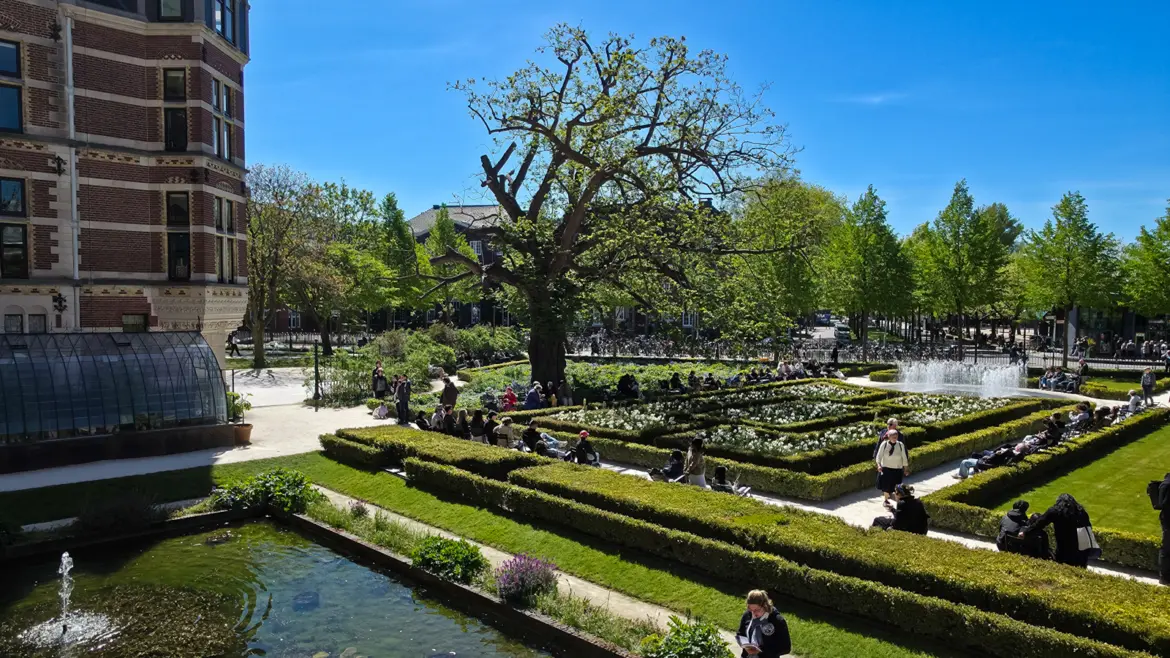
The Rijksmuseum in Amsterdam takes a few hours to get through, and by the end of mine the paintings had stopped landing. The garden outside fixed that faster than a coffee would have. It wraps around the building, it costs nothing, nobody checks a ticket at the railings, and on a warm afternoon in late April the beds and lawns were full of people.
I went in before my museum visit and again afterwards, then passed through more than once on later days. It turned into the part of the trip I kept going back to, and it took those repeat visits to work out how much is standing in it.
The Rijksmuseum Gardens at a Glance
🌳 What it is · A free, unticketed garden wrapping the Rijksmuseum, designed by Pierre Cuypers as an “outdoor museum” of clipped parterres, ponds and salvaged Dutch architecture.
🗿 What’s in it · A bronze of Mercury and Psyche (original by Adriaen de Vries, 1593, now in the Louvre), salvaged city gates, a 19th-century greenhouse, and a summer sculpture show.
⛲ The trick fountain · Jeppe Hein’s Hide and See(k) shoots walls of water from the paving; there’s a ~12-second pause between cycles to dash through dry.
⏱️ Timing · Near-empty before noon, no seat left by early afternoon on a warm day.
💡 Tip · Cross under the museum via Museumstraat to reach the other half, where the salvaged gates and fragments are; it’s easy to miss.
A Garden That Came With the Building
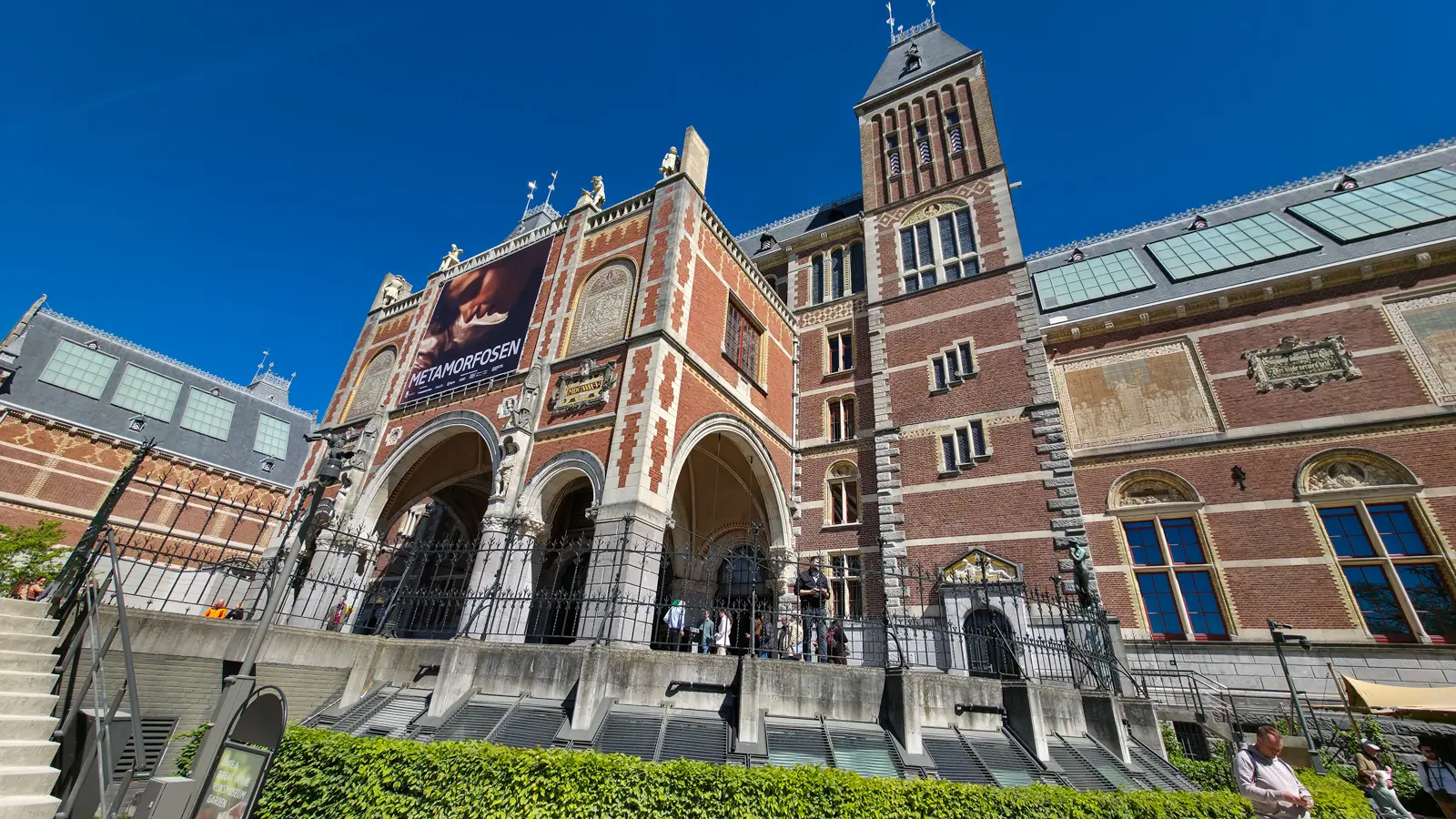
Pierre Cuypers, the Dutch architect who designed the Rijksmuseum and Amsterdam Central Station, drew the grounds as well as the building. The museum went up between 1876 and 1885. The garden, with its railings and its collection of salvaged building fragments, follows a Cuypers design of 1884 and was laid out in stages up to 1916. Garden, railings and fragments are protected together as a single entry in the national monuments register.
Cuypers meant the grounds to work as an outdoor museum. Pieces of Dutch buildings facing demolition were brought here and re-erected, including the Berg gate from Deventer and arches from the Kleine Kerk in Edam. The idea was that a visitor could walk out of the galleries and keep looking at the same national history, only in stone and in the open air.
The garden closed along with the museum for the long renovation and reopened in 2013. The Dutch firm Copijn handled the new layout, working from a later Cuypers plan of 1901. What survives from the original is the compartmented structure. Instead of one sweeping park, the space is divided into sections, each laid out in a different old Dutch garden style.
Since the reopening the garden has also carried a sculpture exhibition each summer, given over to a single twentieth-century artist. The first was devoted to the British sculptor Henry Moore, with twelve works brought across from Perry Green, the estate in Hertfordshire where he lived and worked from 1940.
Hedges, Bulbs and Straight Lines
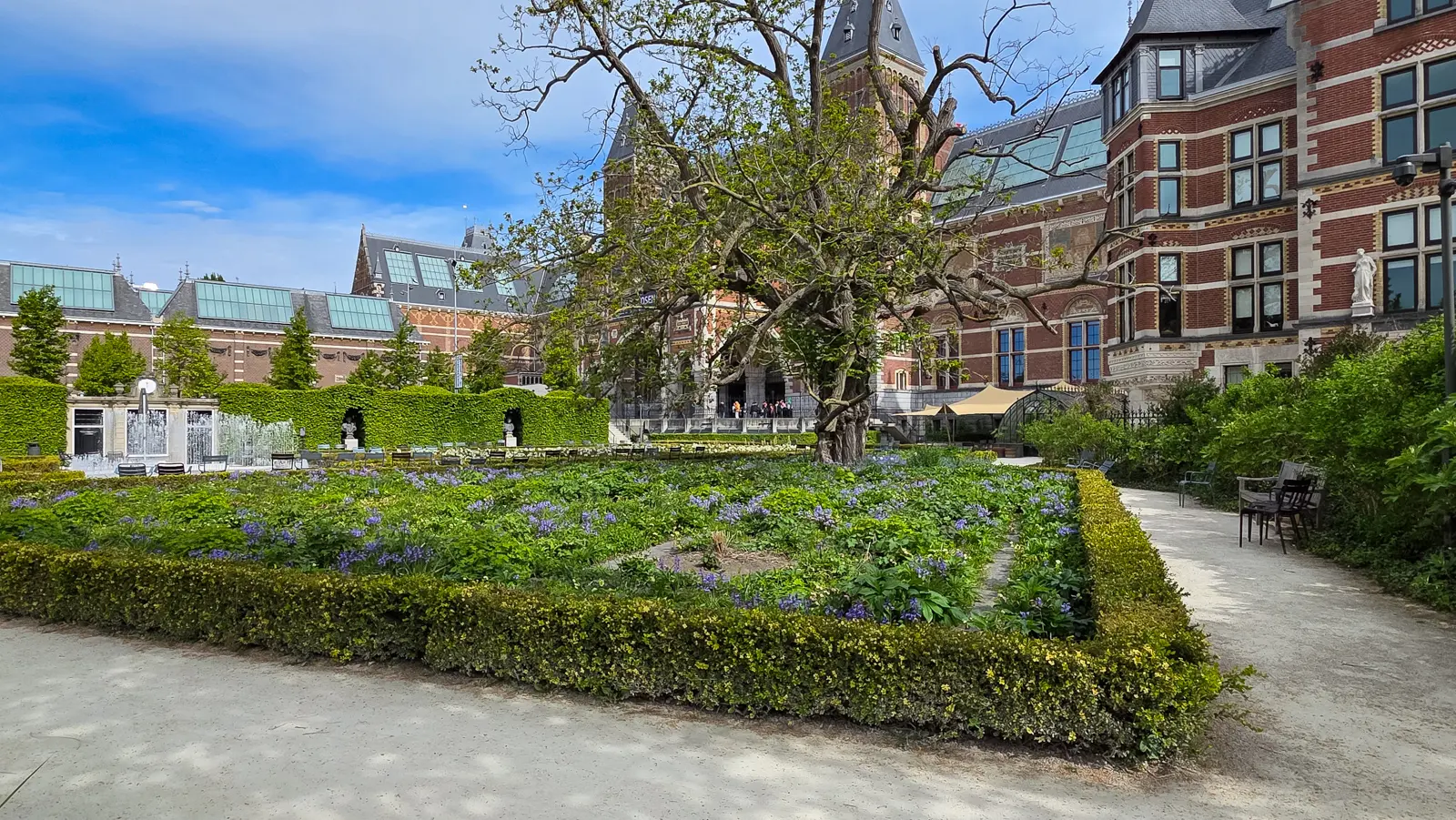
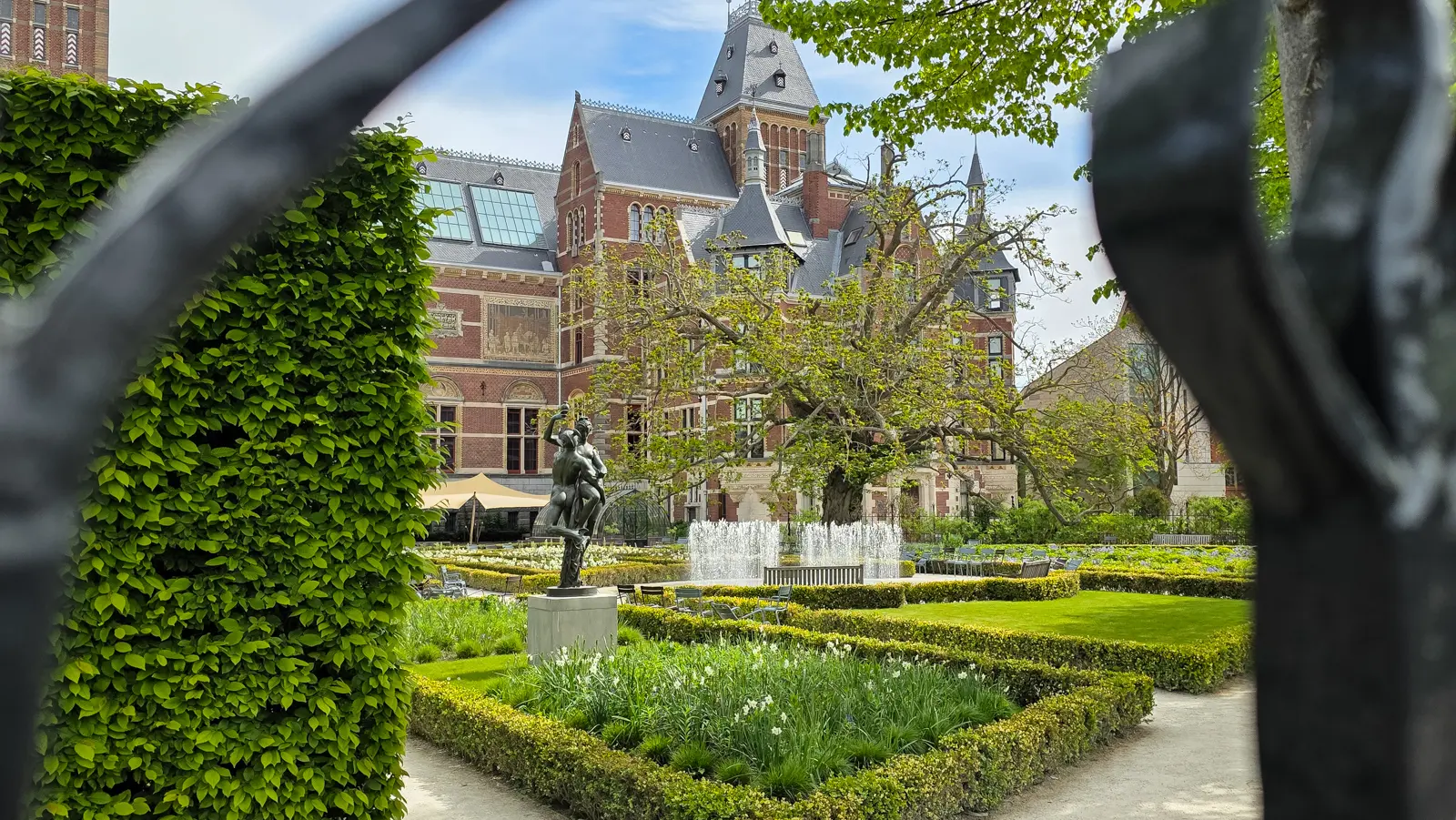
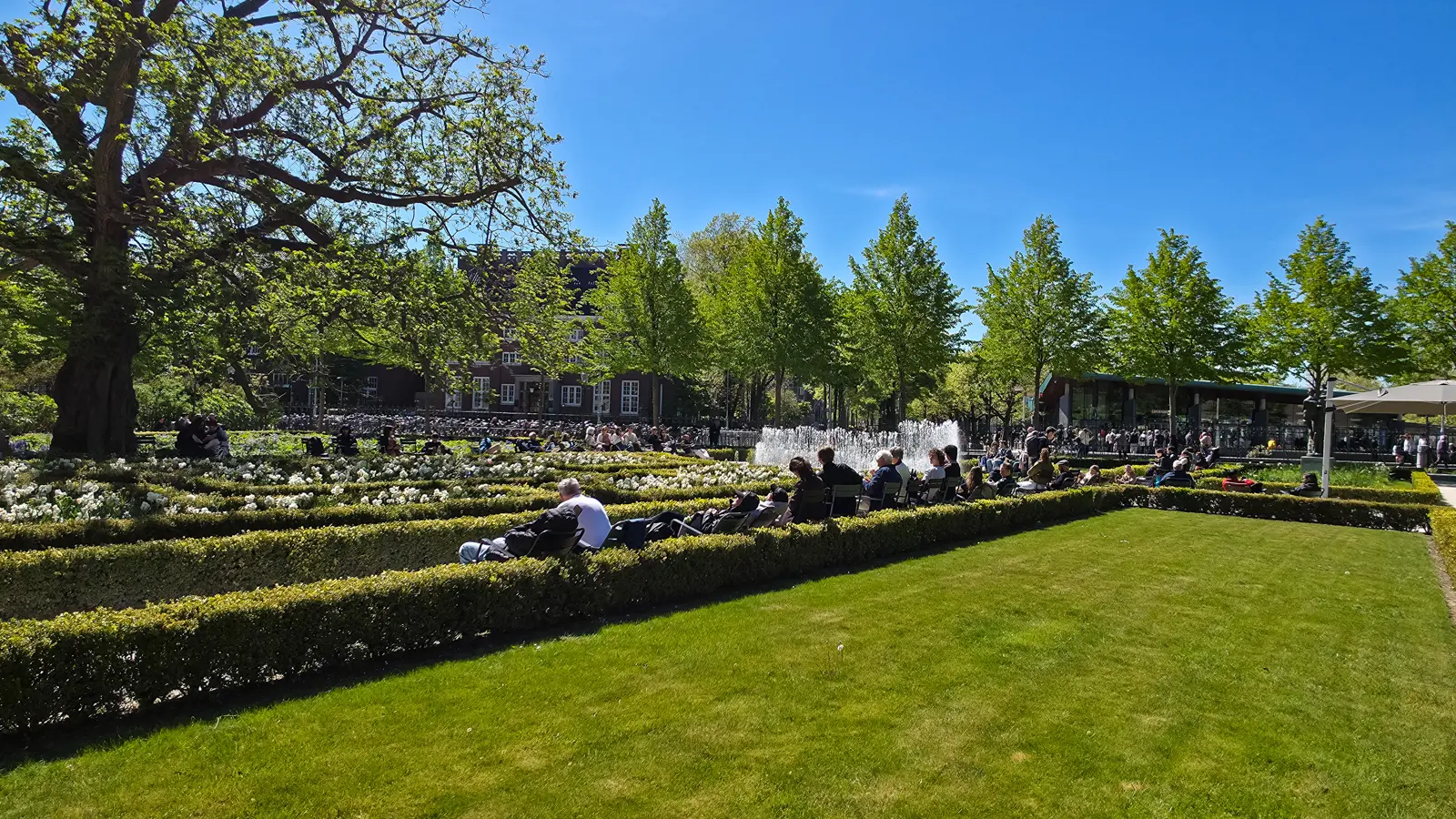
The section I spent most of my time in is laid out as a series of rectangles. Low hedges, clipped flat on top and squared at the corners, enclose beds of bulbs. Gravel paths run between them at right angles. Taller hedges rise to well above head height along one edge and shut the street out completely.
In late April the beds were doing two different things at once. One held white narcissi standing above grassy foliage, still in full flower. Another, under a large old tree with its branches barely in leaf, had gone over to blue, a low haze of it running the whole length of the bed.
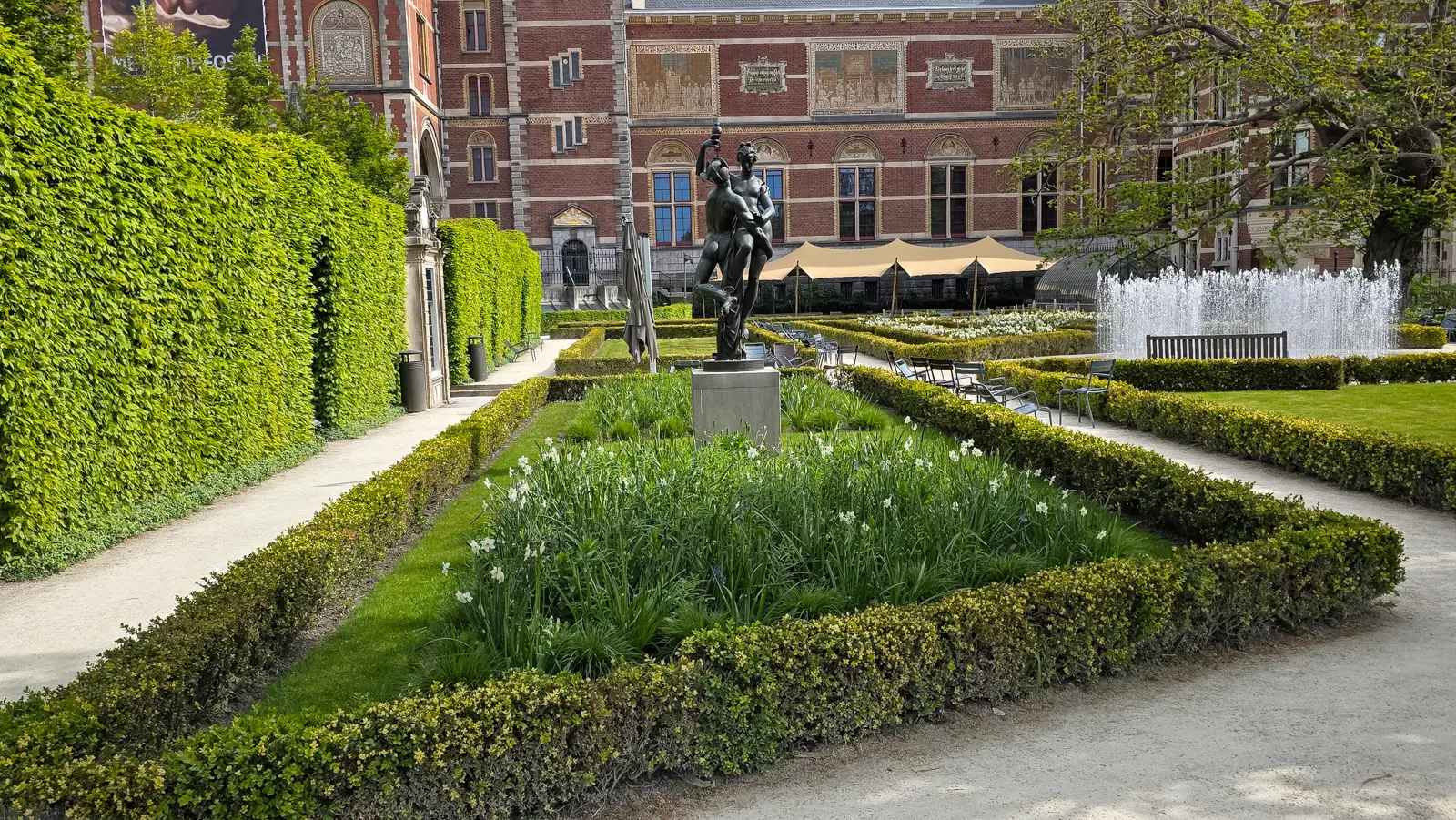
Metal chairs stand about in loose groups near the hedges, not fixed down and not arranged in rows. A garden with movable seating is a garden built for staying in rather than passing through.
Mercury and Psyche
One bronze stands on a stone plinth in the middle of a bed, high enough to be seen over the hedges from most of the garden. It shows Mercury, the messenger of the Roman gods, carrying Psyche upwards, one arm raised, one foot resting on a small support. The whole group twists as it rises.
The original was made by Adriaen de Vries in 1593 for the Emperor Rudolf II in Prague. De Vries was Dutch, trained in the workshop of the sculptor Giambologna in Italy, and spent his working life abroad, which is why so little of his output ever stayed in the Netherlands. The sculpture was carried off by Swedish troops as war booty when Prague fell in 1648, changed hands again, and ended up in the Louvre, where it remains. What stands in the garden is a bronze cast made for the museum after that original.
Two Kinds of Water
The garden runs water in two registers, and they could not be less alike.
The first is a fountain with no basin above ground. Jets rise straight out of a flat metal grating set into the paving, roughly the height of a person, forming walls of water that go up and drop away again. This is Hide and See(k), made by the Danish artist Jeppe Hein and installed in 2013. The layout is a circle nine metres across with a square of three and a half metres inside it, and the jets switch between four arrangements. There is a pause of about twelve seconds between them, which is the window for walking into the middle without getting soaked. It is a modern version of the bedriegertjes, the hidden trick fountains that seventeenth-century Dutch garden designers used to drench unsuspecting guests.
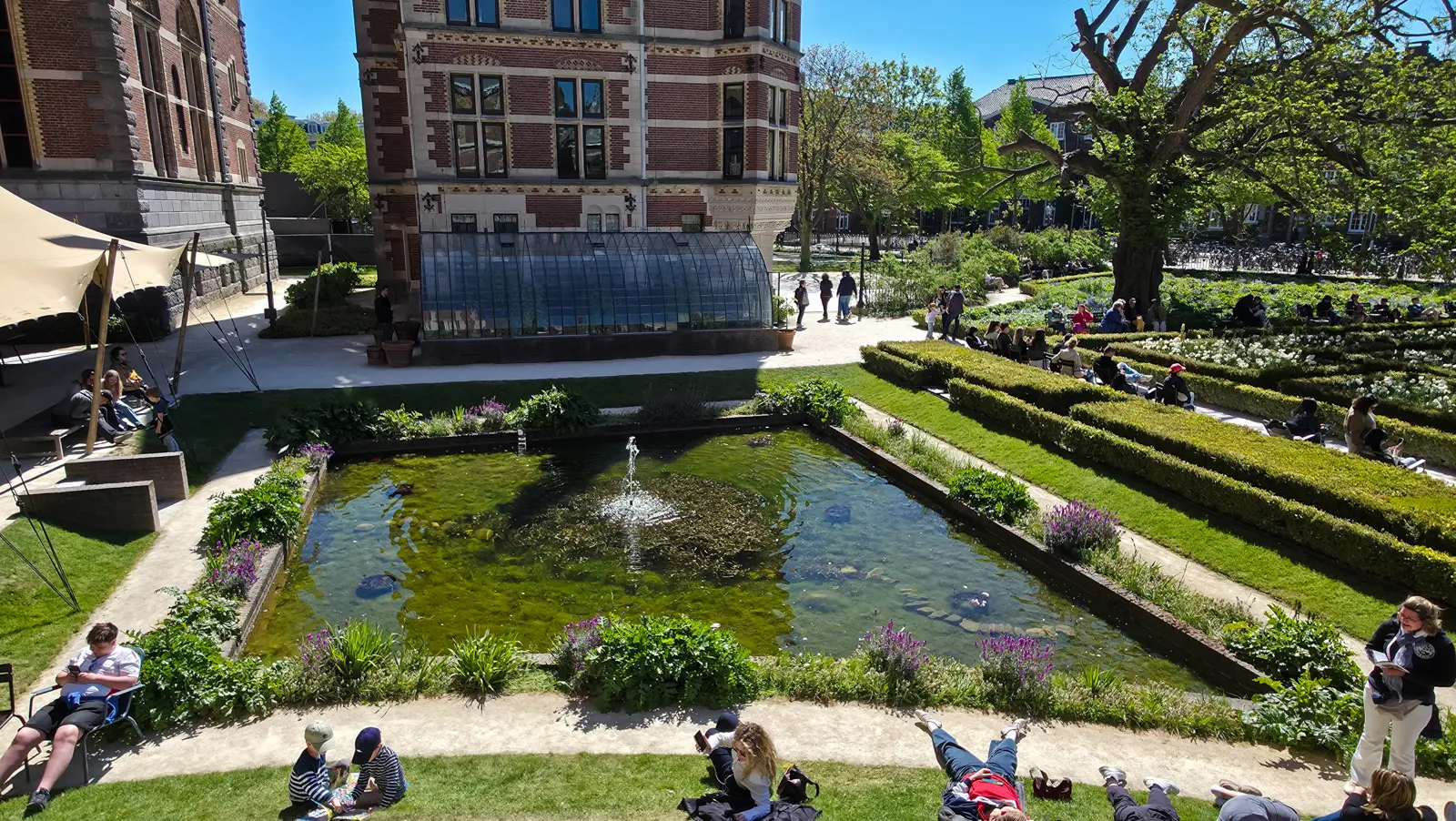
The second is older in character and completely still. A rectangular pond sits below the level of the surrounding lawn, edged in brick and stone, with one modest jet in the centre. The water had gone green, planting spilled over the edges, and the surface held the reflection of the building above it.
Full by Early Afternoon
Arrive on a warm afternoon and there is nowhere left to sit.
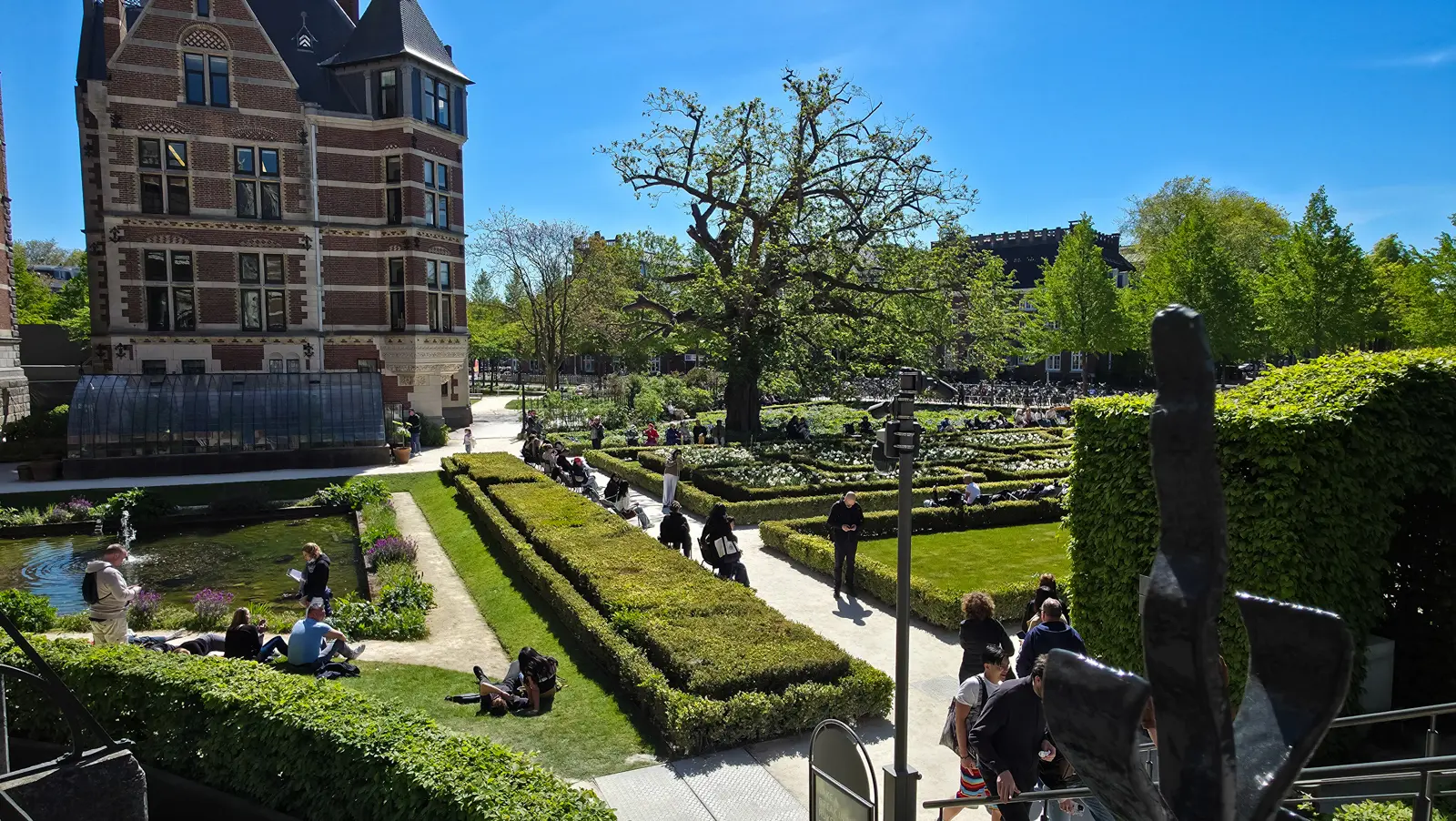
Every chair along the hedge line was taken. People had spread out on the grass beside the pond, one or two of them flat on their backs, and the paths carried a steady flow between the museum steps and the street gate. Nothing about it was unpleasant. It is just a busy garden by then.
Late morning is another garden entirely. On an earlier visit, before noon, the beds were near enough deserted, the chairs stood about unoccupied and the fountain ran to nobody at all. Two people were standing by the passage entrance and that was the extent of it. A couple of hours is all it takes.
The Half I Did Not Find
Museumstraat crosses the grounds from north to south and dives under the building through the central passage, which means the garden is not one space but two. I only ever walked in the half I entered, and I never worked out how to get across to the other one.
That was my loss. The south-west corner of the grounds is where the salvaged building fragments are gathered, along with the Fragmentengebouw, a structure assembled out of more of them. A sandstone garden pavilion of 1735 by the Amsterdam sculptor Ignatius van Logteren stands in the grounds as well, and there is a children’s playground with equipment by the Dutch architect Aldo van Eyck. Two more Cuypers buildings survive here too: the former director’s villa of 1883 and the Teekenschool, the museum’s old drawing school, of 1891.
None of that is hidden. It is simply on the other side of a street that runs under a building, which is an easier thing to miss than it sounds.
The Streets Around Museumplein
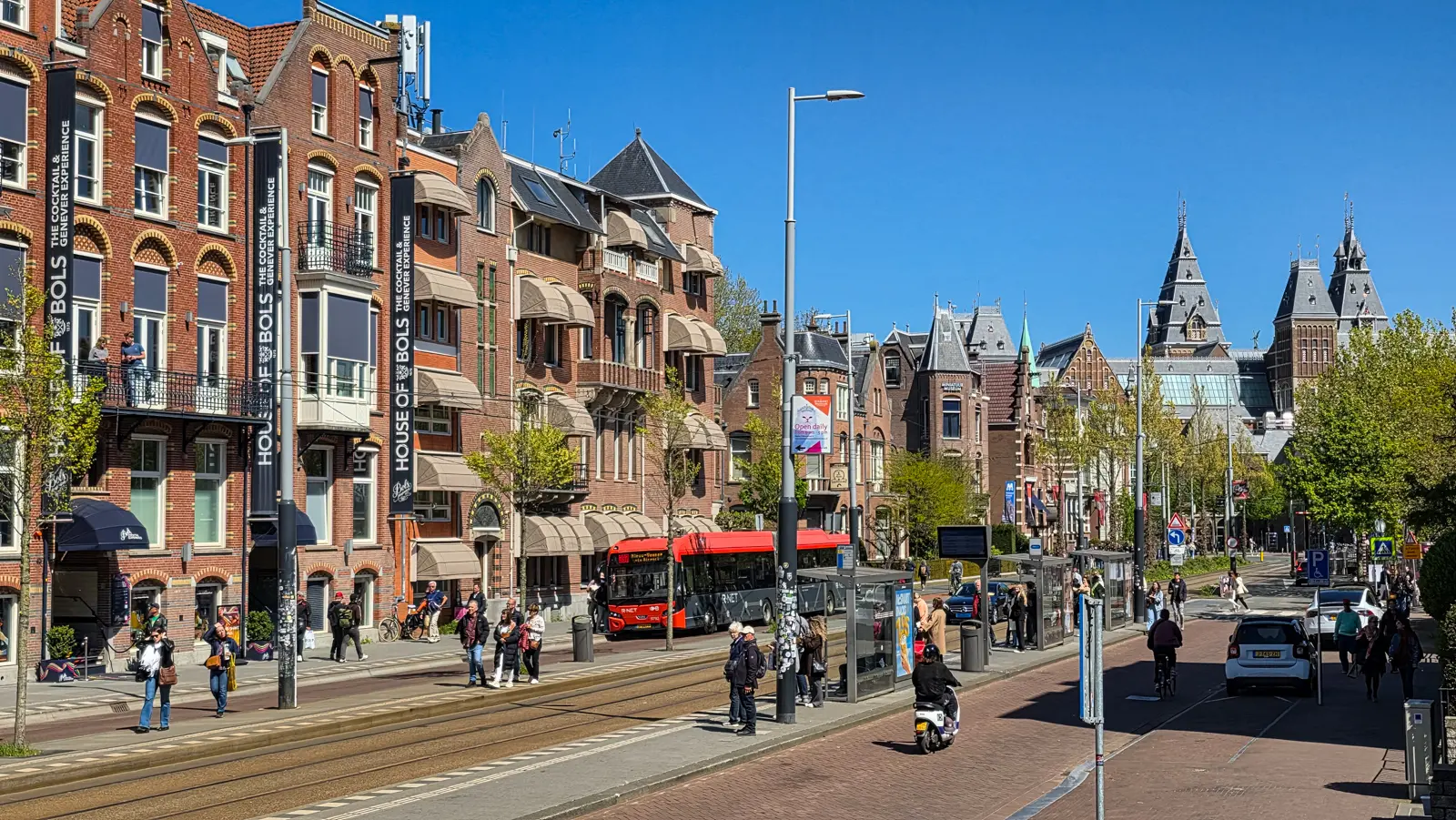
Walking away from the garden, what struck me was how residential the surrounding streets are. Ordinary flats, ordinary front doors, people carrying shopping. For a district built around three major museums and a concert hall, it is a very ordinary place to live, and it was designed that way from the start.
The expropriation law passed in 1874 cleared the ground for two things at once: the Rijksmuseum, and a smart residential quarter to sit alongside it. The housing had to wait. A royal wax candle factory occupied part of the site and did not close until 1906. The street pattern was set out from 1902, following designs Cuypers had drawn in 1891, and construction of the quarter itself began in 1907. Museumplein is bounded by Paulus Potterstraat, Stadhouderskade, Gabriel Metsustraat and Van Baerlestraat, and the streets behind those edges are where the district actually lives.
Some of those houses now hold other things. Paulus Potterstraat runs along the northern edge of the square towards the Rijksmuseum towers, and the terrace along it carries the Diamond Museum at number 8 and the House of Bols at number 14, both fitted into buildings that were put up as homes.
Bubbly Tips
- Check the opening season before you travel. The museum’s own admissions page states the gardens open only in summer, from 9am to 6pm, while other sources describe them as open year round during daylight. The gates were open when I visited in late April. Check the official Rijksmuseum site close to your trip rather than trusting a summary elsewhere.
- Go in before your museum visit, not only after. Twenty minutes in the garden first gives you a sense of the building’s exterior, its towers and tiled panels, which is hard to reconstruct once you are inside looking at paintings.
- Cross Museumstraat to reach the other half. The passage runs right under the museum. Walk through it and turn into the garden on the far side, or you will see only half of what is there, as I did.
- Look for the salvaged fragments. The Berg gate from Deventer and arches from the Kleine Kerk in Edam are among the pieces of demolished Dutch buildings re-erected in the grounds. They sit in the south-west corner.
- Time your run at the fountain. Hide and See(k) pauses for roughly twelve seconds between arrangements. That is your window to walk into the centre dry, and it is worth watching a full cycle before you commit.
- Bring your own drink outside the summer months. The garden pavilion serves refreshments seasonally. When I was there in April nothing was open outdoors, and the café I used was inside the museum, which needs a ticket before 5pm.
- Move a chair. The metal seating is not fixed. Take one into the sun or into the shade of the big tree depending on what you want.
- Photograph from the top of the steps. The raised ground by the passage entrance gives you the pond, the hedges, the glasshouse and the crowd in one frame. From ground level you get hedges and not much else.
- Visit late morning if you want it quiet. The garden was near empty before noon and busy by early afternoon on a warm day. The difference is considerable and costs nothing to plan around.
- Pair it with Museumplein and Vondelpark. Both are a short walk away and the three together make an easy half day outdoors without another admission fee.
Final Thoughts
What I liked most about this garden is how little it asks of anyone. There is no ticket, no queue and no route to follow. A visitor can walk in off the street, sit down in a chair that somebody else left in the sun, and stay as long as they like within sight of a building that holds The Night Watch. That combination is not common.
It also quietly does the job Cuypers wanted it to do. The bronze on its plinth carries a story that runs from Prague in 1593 through a Swedish army to a gallery in Paris. The stone gates and arches in the far corner were rescued from demolition sites across the Netherlands. None of it is behind glass. My only regret is the half I never found, which is as good a reason as any to go back.
Until next time!

🌟 Everything You Need to Plan Your Dream Trip in 2026
- 🌟 Luxury Hotels - Find premium stays with Booking.com & Hotels.com
- 🏡 Vacation Rentals - Discover unique properties on VRBO
- 🏞️ Guided Tours - Explore with Viator or GetYourGuide
- 🎫 Attraction Tickets - Skip the lines with Tiqets
- 🚢 Ocean Cruises - Set sail with Cruise Direct
- 📱 International SIMs - Stay connected with Saily
- 🚗 Car Rentals - Budget-friendly options from Discover Cars
- 🌐 Secure VPNs - Browse safely with NordVPN
- 💶 Currency Exchange - Best rates with Wise
- 🗣️ Learn Languages - Master the local language with Babbel and Rosetta Stone