
Maria Trip was 20 years old in 1639, from an extremely wealthy Amsterdam family, and she could afford Rembrandt. Standing in front of her portrait at the Rijksmuseum, my honest first thought was that she is not that beautiful. Not by today’s standards, anyway. Her face is pale and plain, and nobody has tidied it up.
That is exactly why Rembrandt fascinates me. He painted people accurately and did not try to idealise them. In a world where almost every face we see has been airbrushed, paintings of normal-looking people are alluring. I admire his candour.
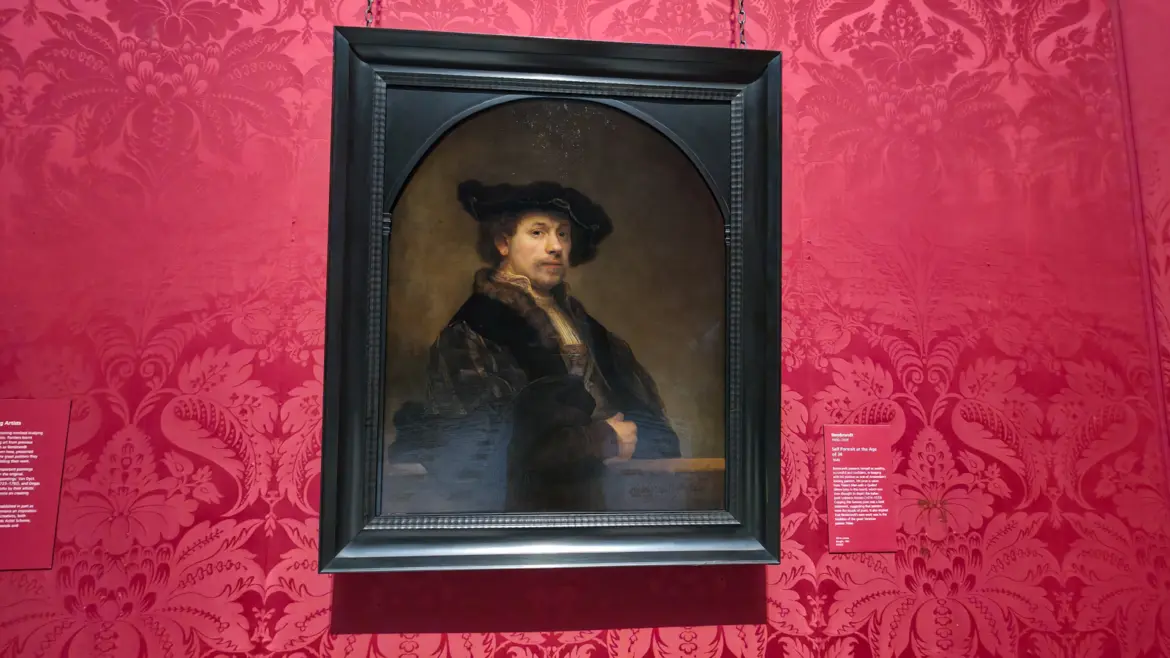
What I only learned while looking at his early portraits in Amsterdam is where the flattery went instead. It went into the clothes. He did it to himself too. In the self-portrait at the top of this post, painted at 34, the fur collar and the beret do the boasting.
My photos of his work come from two cities, London and Amsterdam, and between them they cover his whole life. So here is Rembrandt from start to finish: the miller’s son from Leiden, one of Amsterdam’s leading painters, and the man who lost his house and his collection. That last part puzzled me most. How does a painter this successful end up bankrupt?
Rembrandt at a Glance
🎨 Who · Rembrandt van Rijn (1606–1669), the Dutch Golden Age‘s greatest painter — a Leiden miller’s son who made his name in Amsterdam.
👁️ His signature · Honest faces, expensive clothes — wrinkles and tired eyes left in, with the lace, pearls and fur doing the flattering.
🖼️ The masterpiece · The Night Watch (1642), at the Rijksmuseum, now restored in public view (Operation Night Watch, begun 8 July 2019).
📉 The fall · Declared insolvent in 1656; his house and art collection were sold. He died in 1669 and is buried in the Westerkerk.
💡 Where · The Rijksmuseum in Amsterdam (Gallery of Honour) and the National Gallery in London (self-portraits at 34 and 63, Belshazzar’s Feast).
Leiden: The Miller’s Son
Rembrandt Harmenszoon van Rijn was born in Leiden on 15 July 1606, the ninth child of the miller Harmen Gerritsz van Rijn and the baker’s daughter Neeltgen van Zuytbrouck. Harmenszoon simply means son of Harmen. Hold on to that name. It turns up again in the Night Watch room.
His early paintings are already about people having a hard time. In Tobit and Anna with the Kid, from 1626, the blind Tobit sits in a torn red cloak with his hands clasped, looking up. His wife Anna leans over him holding a young goat. A small dog sits at his feet and a fire burns in the corner.
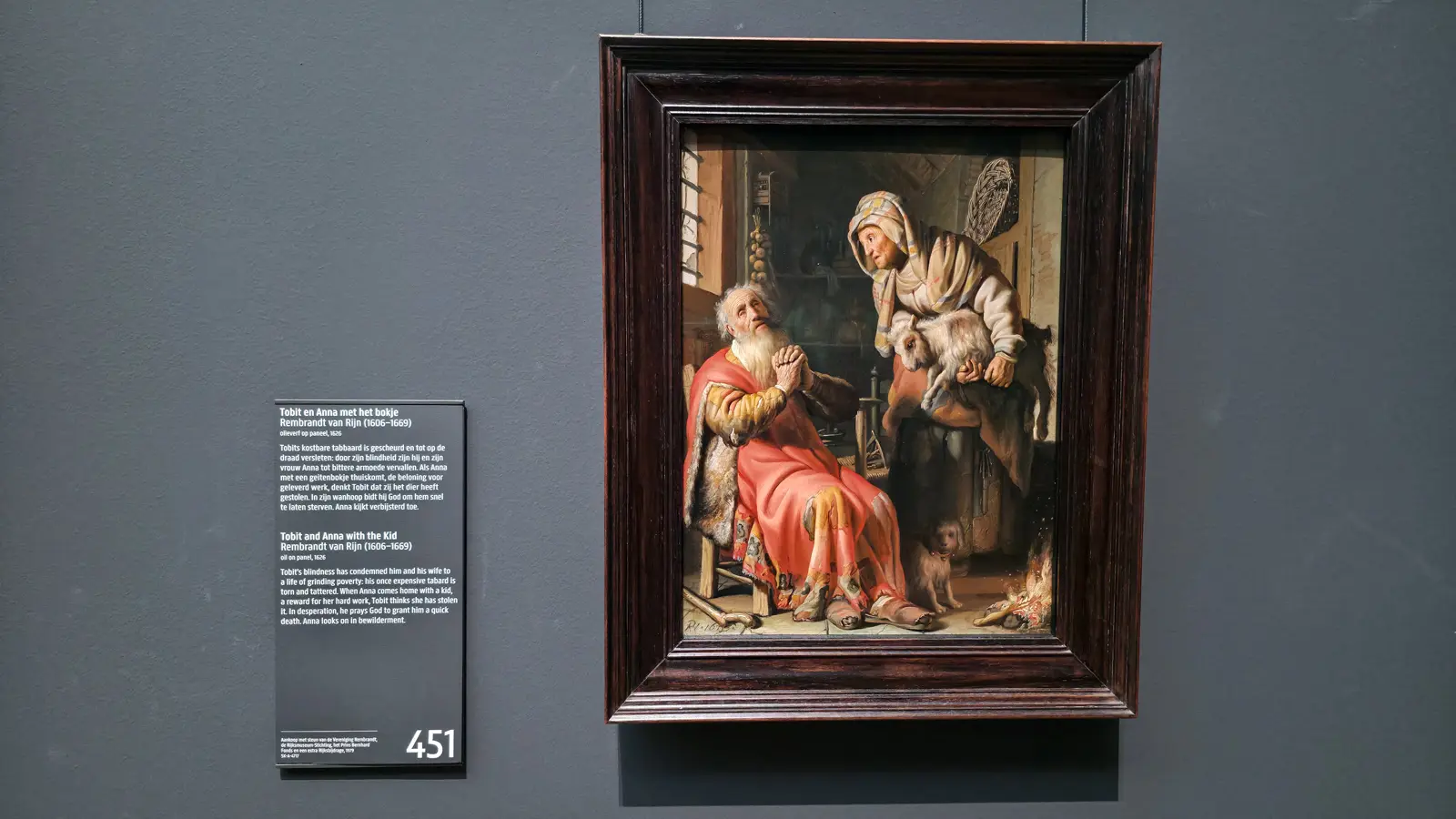
The museum’s label tells the story. Tobit’s blindness has pushed the couple into poverty, and his once expensive cloak is now in tatters. Anna has been given the goat as payment for her work, but Tobit accuses her of stealing it and prays to die. Rembrandt was about 20, and he was already painting old age without any polish: the wrinkled forehead, the straggly white beard, the worn-out shoes.
Four years later, in 1630, he painted Jeremiah Lamenting the Destruction of Jerusalem. The old prophet slumps against a rock with his head in his hand, while Jerusalem burns in the background on the left.
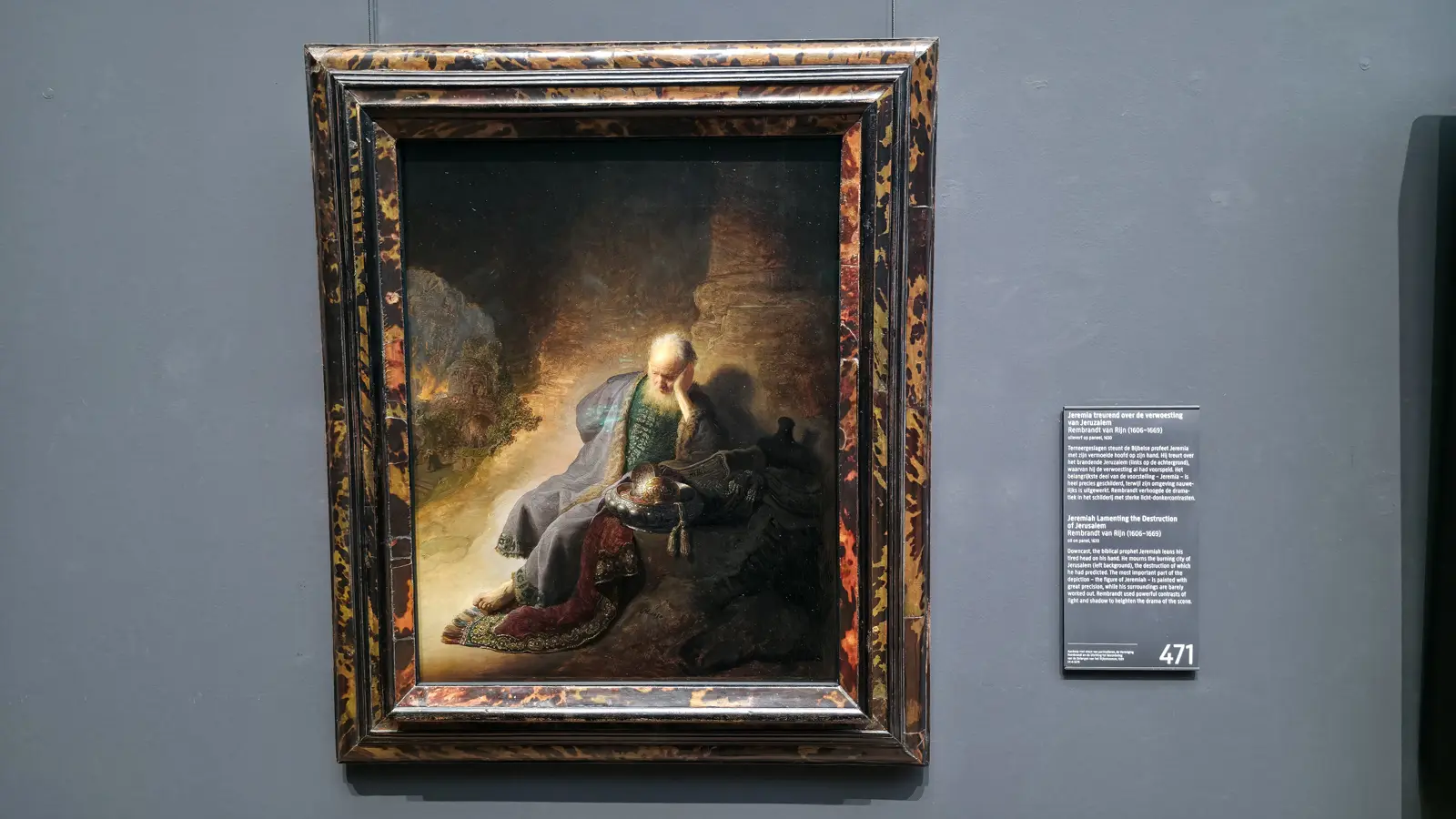
According to the label, Rembrandt painted Jeremiah himself with great precision and left the surroundings barely worked out. The detail goes where he wants us to look.
The next year he painted An Old Woman Reading. The light comes from behind her, so her face stays in shadow while the open book and her hand catch the glow.
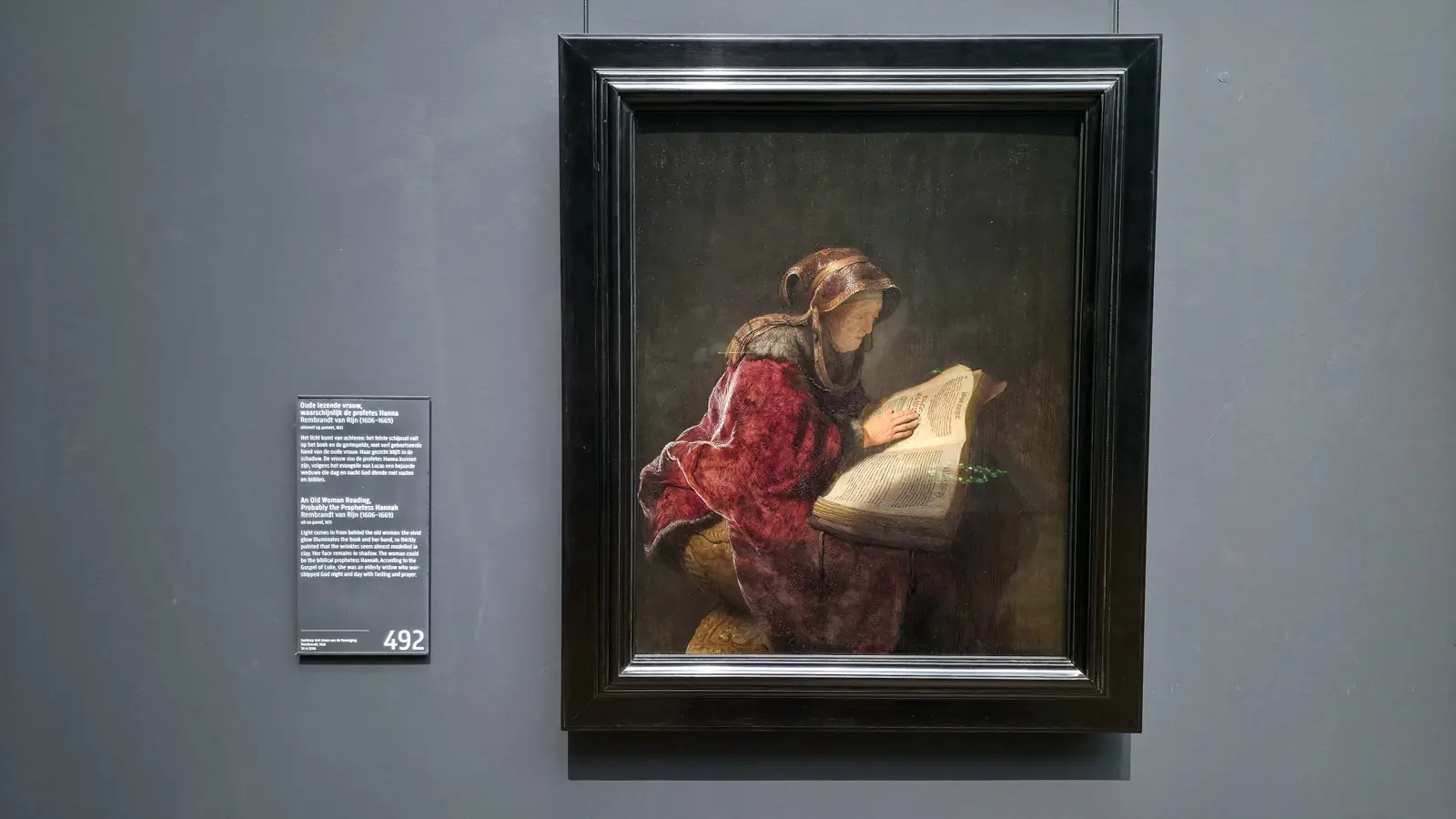
The label says the wrinkles on that hand are painted so thickly they look almost modelled in clay. He gave the brightest light in the painting to an old woman’s wrinkled hand.
His Leiden manner was copied, and copied well. In London, the National Gallery now attributes A Man seated reading at a Table in a Lofty Room, from about 1628 to 1630, to an early follower.
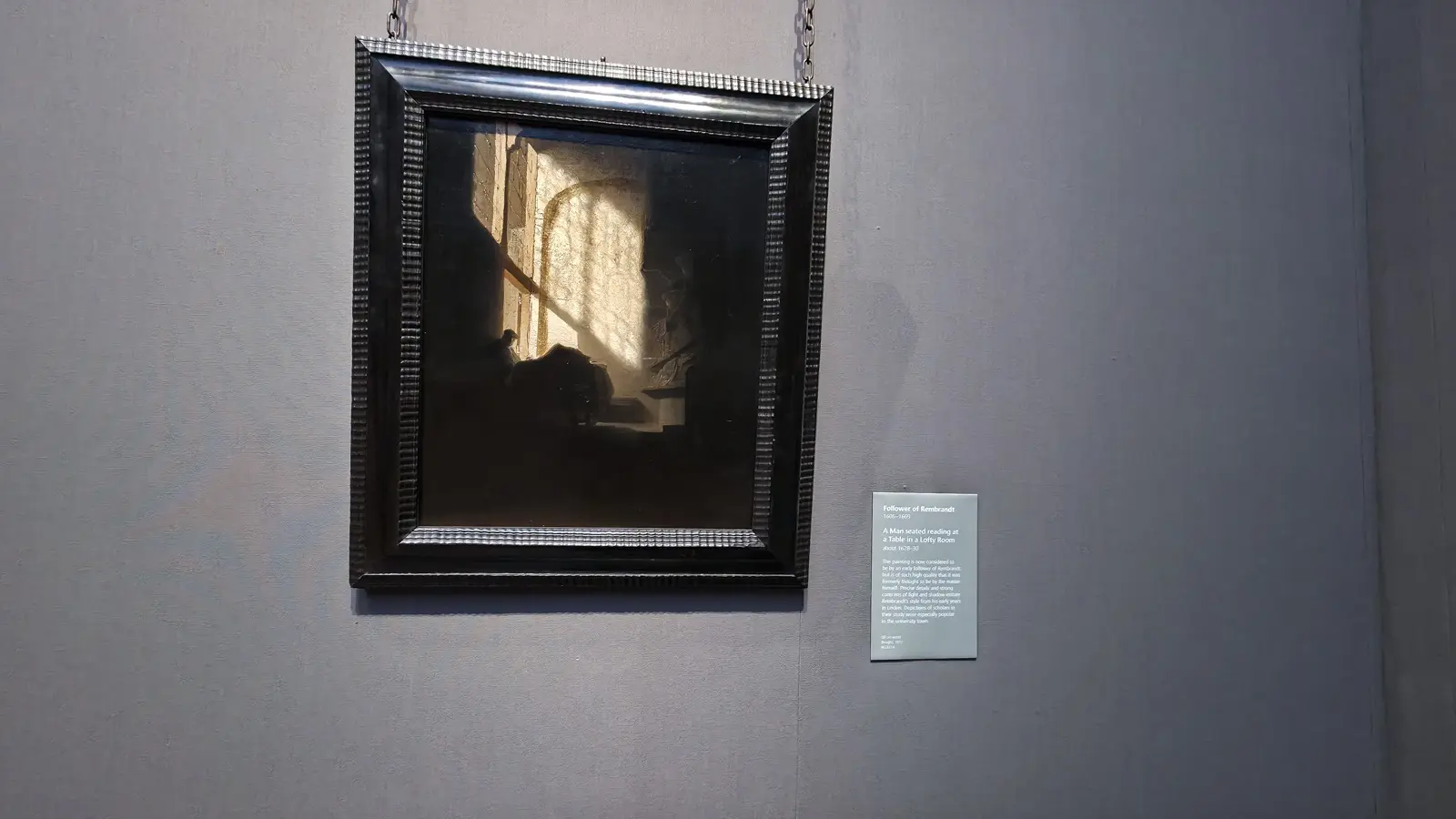
The label says the painting is of such high quality that it was once thought to be by Rembrandt himself. The sharp detail and the strong contrast of light and shadow imitate his early Leiden style.
Amsterdam: Honest Faces, Expensive Clothes
By the early 1630s Rembrandt had moved to Amsterdam. In 1634 he married Saskia Uylenburgh, a relative of the art dealer Hendrick Uylenburgh. He built his reputation on portraits, and the Amsterdam portraits are where his honesty shows best.
In 1633 he painted Johannes Wtenbogaert, a 76-year-old Remonstrant minister who had once been court chaplain to Prince Maurice. Nothing is softened. The eyes are heavy-lidded, the beard is grey and the nose is pink.
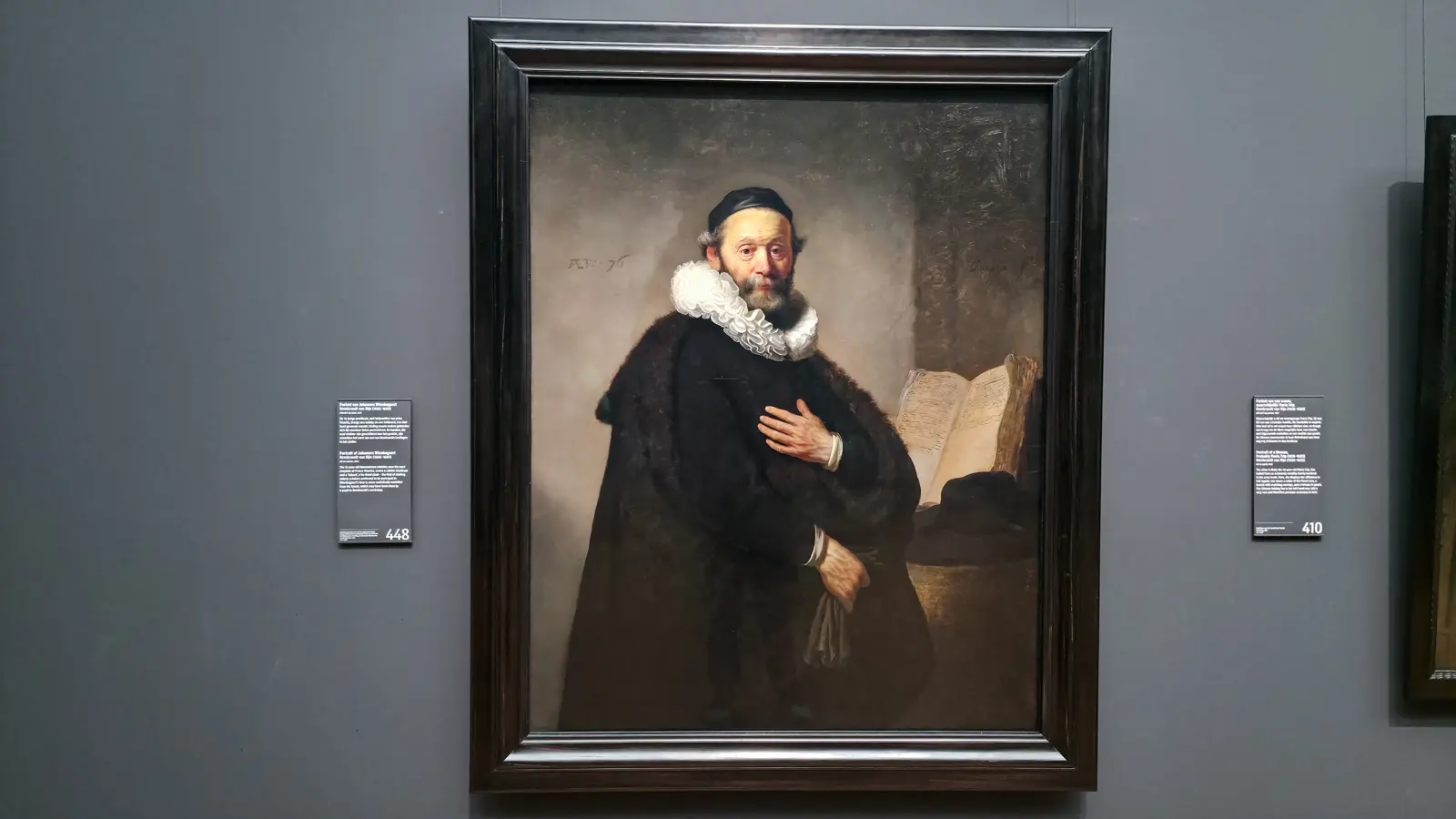
The label adds a twist. The face is modelled more realistically than the hands, which may have been painted by a pupil in Rembrandt’s workshop.
In 1634 Rembrandt travelled to Rotterdam to paint a brewing couple, Haesje van Cleyburg and her husband Dirck Pesser. Haesje van Cleyburg has a round face, flushed cheeks and a half-smile. At first glance her black dress and plain white cap look modest.
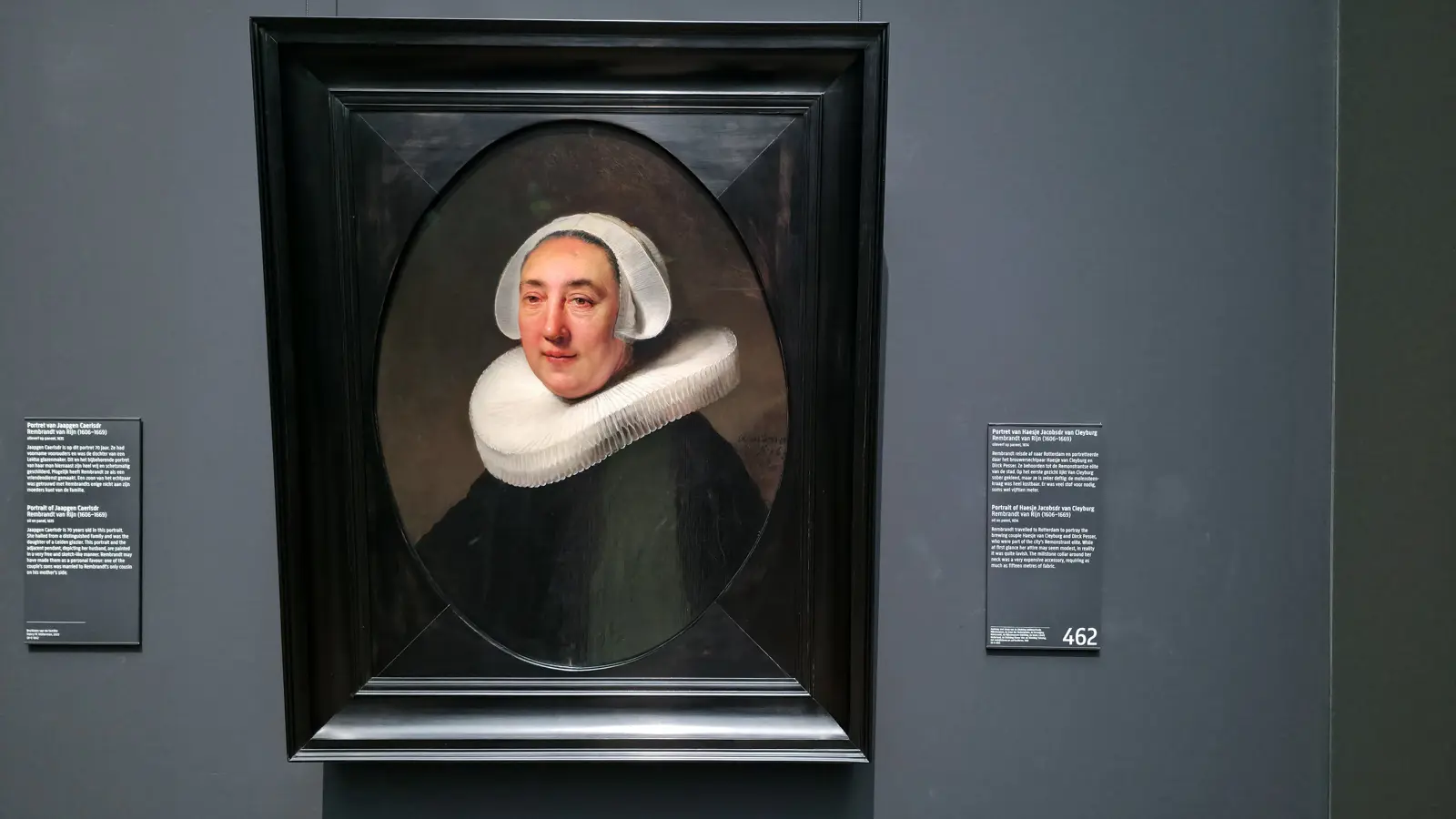
They are not. The label explains that the millstone collar around her neck was a very expensive accessory and could take as much as fifteen metres of fabric.
Five years later came Maria Trip. Her father had made a fortune trading in iron and arms, and her portrait shows it. A lace collar falls over her shoulders in scallops, and she wears a pearl necklace, pearl earrings, pearl bracelets and a jewelled brooch. In her left hand she holds a folding fan.
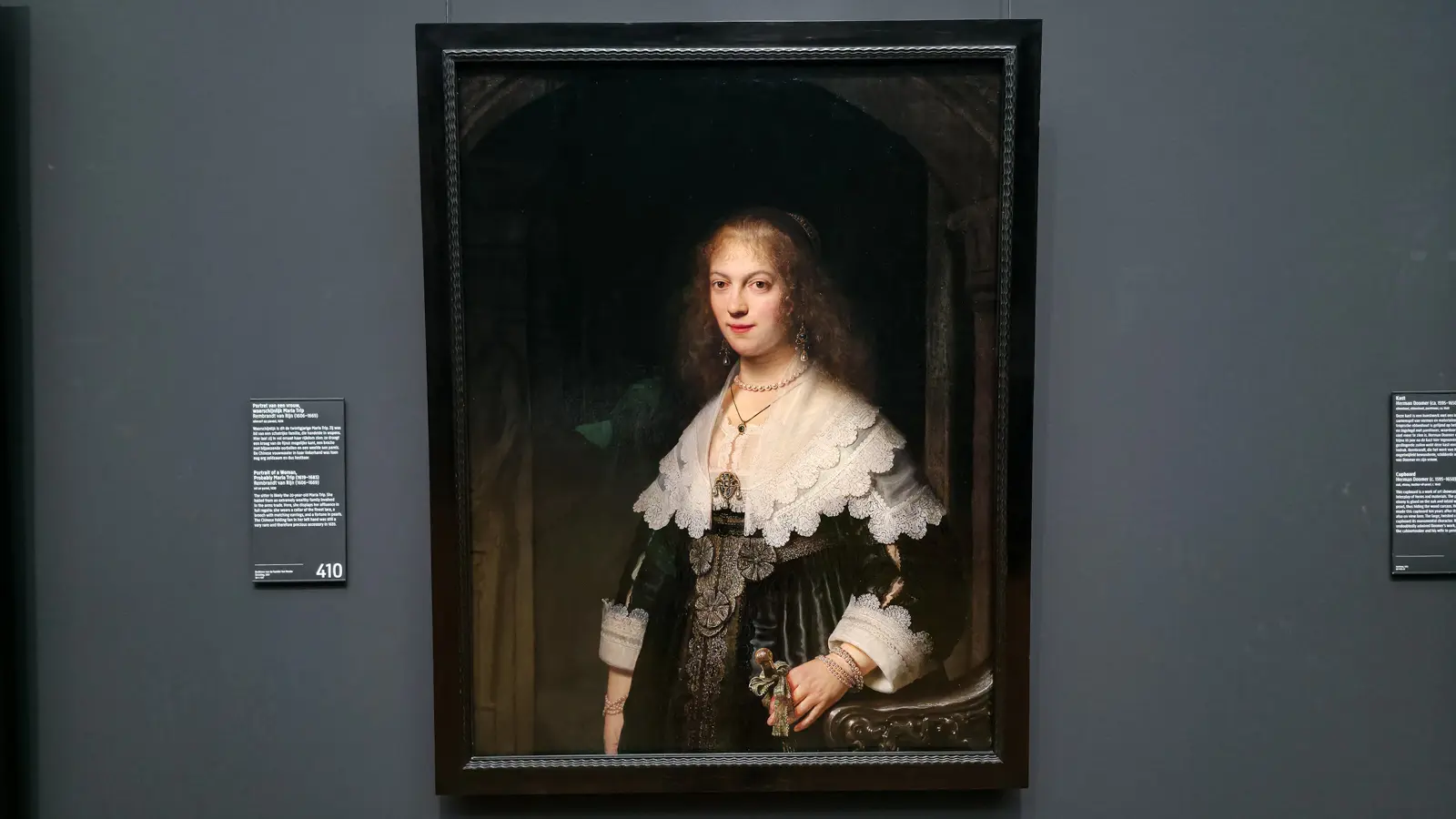
The label points out that a Chinese folding fan was still a rare and precious accessory in 1639. Her face gets no such help. This is the pattern I only noticed once I had seen several of his portraits together. Rembrandt would not improve the face, so the flattery went into the lace, the pearls and the ruff.
Success, and a House He Couldn’t Afford
Back to that self-portrait at the top of this post. He painted it in 1640, and the National Gallery’s label says he presents himself as a wealthy and successful man, one of Amsterdam’s leading painters. He rests his arm on a stone ledge, and the beret is broad and soft. For once, the flattery is in the pose as well as the clothes.
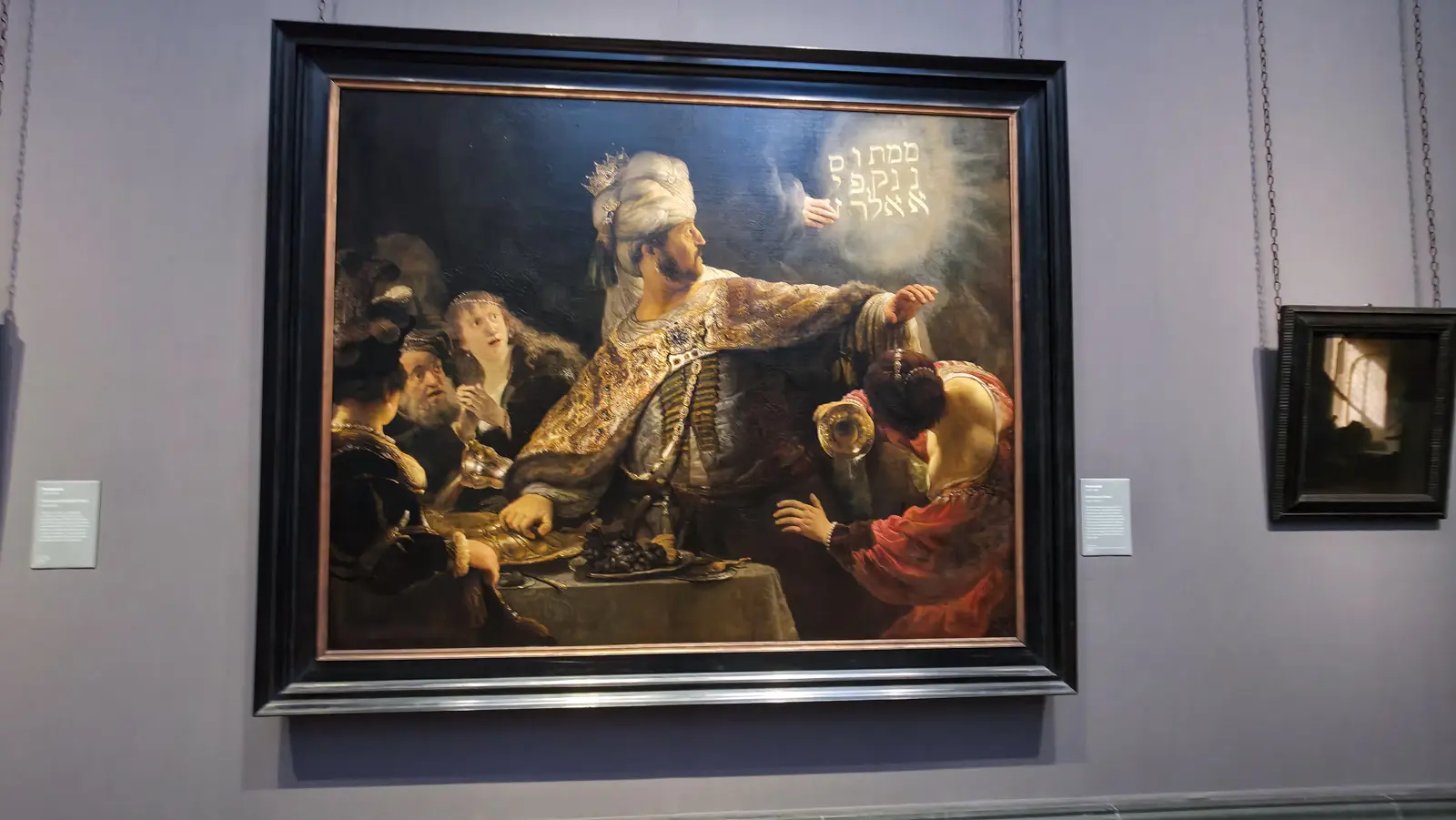
He was also painting big, theatrical history pieces. Belshazzar’s Feast, from about 1636 to 1638, shows the Babylonian king turning in shock from a hand writing glowing Hebrew letters on the wall, while a woman beside him spills her wine.
He painted only a few landscapes, and the Rijksmuseum label says most of them are imaginary mountain scenes. Landscape with a Stone Bridge, from about 1638, is built from real elements but probably shows no specific place.
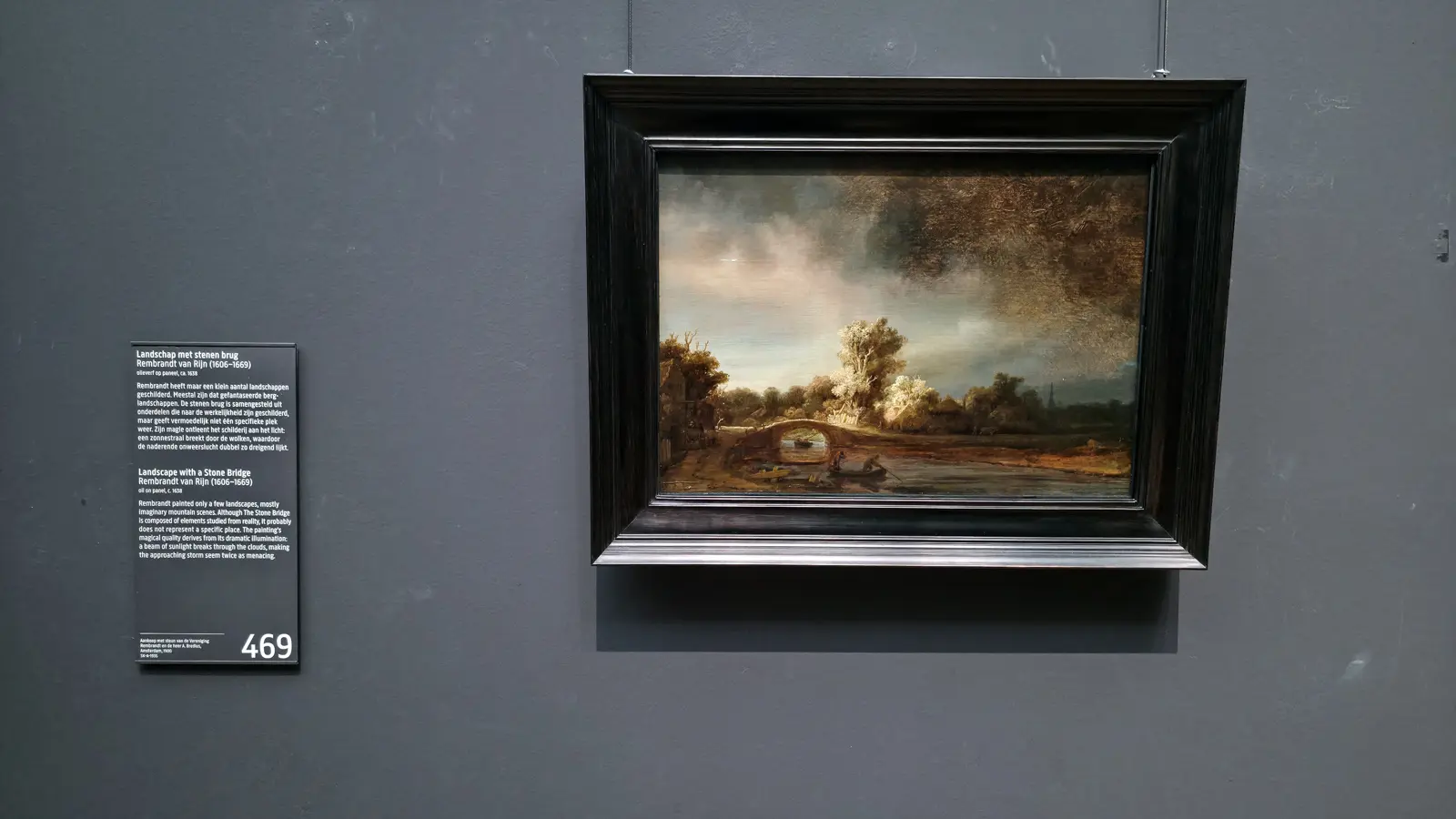
A beam of sunlight picks out a cluster of trees and the stone bridge, while storm clouds darken the rest of the sky.
In 1639, at the height of all this, Rembrandt signed a contract to buy a house on the Breestraat for 13,000 guilders, a sum he could not pay in full. He was earning a great deal of money, but he never paid off the mortgage, and that debt followed him for the next seventeen years.
The Night Watch, 1642
Rembrandt finished his most famous painting in 1642: a group portrait of Captain Frans Banninck Cocq’s militia company, now known as the Night Watch. The same year, his wife Saskia died. Of their four children, only their son Titus, born in 1641, survived infancy.
When I saw it, Operation Night Watch was under way. The painting sat behind glass, conservators in black Rijksmuseum shirts worked on a platform in front of it, and our tour group was squeezed into a room full of other visitors.
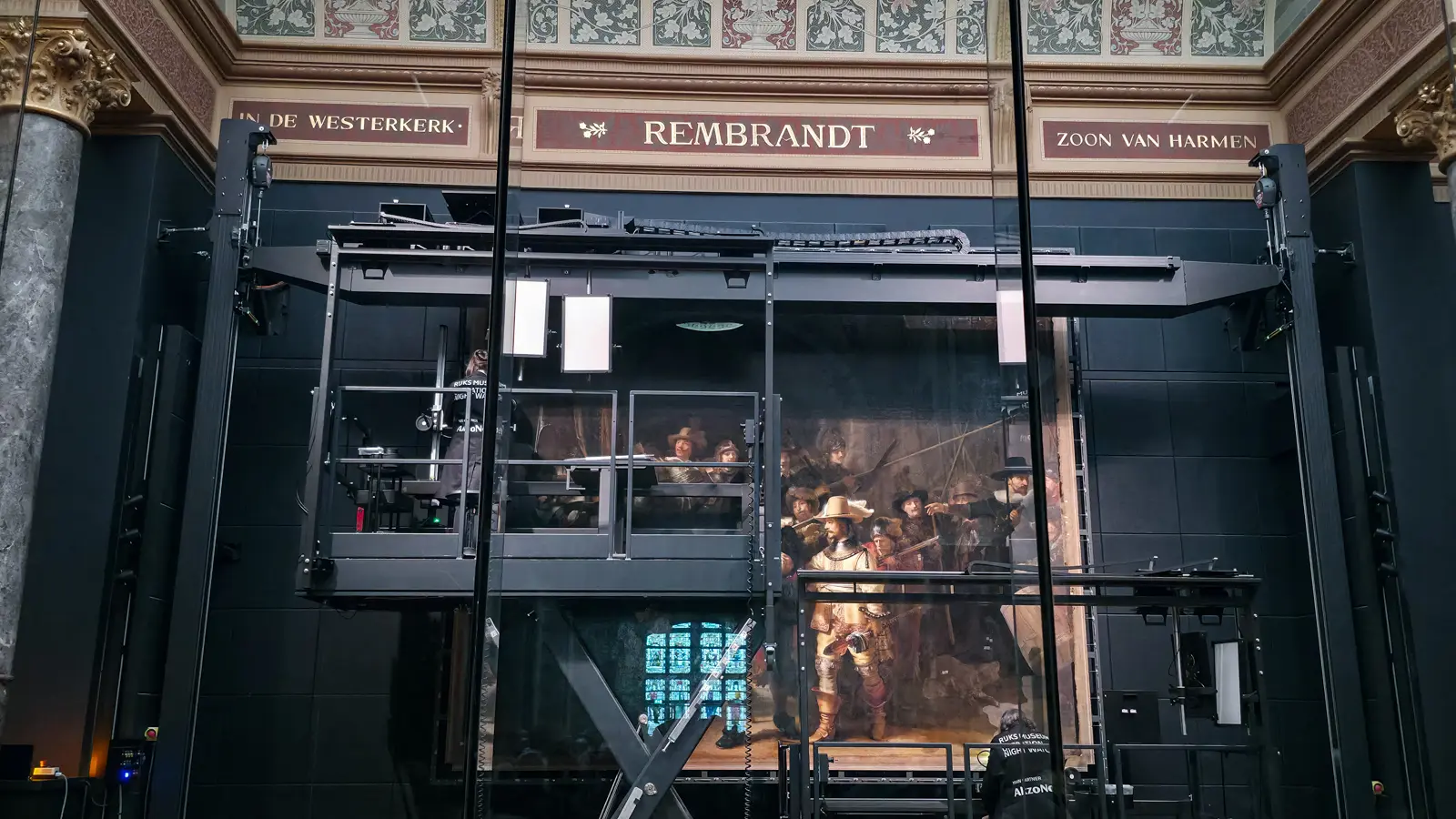
Look above the glass. The gilded frieze reads IN DE WESTERKERK, REMBRANDT, ZOON VAN HARMEN: in the Westerkerk, Rembrandt, son of Harmen. The Westerkerk is the church where he was buried.
Where the Money Went
So how does a painter this successful end up bankrupt? It was not one bad decision.
The art historian Paul Crenshaw, who wrote a book on Rembrandt’s bankruptcy, traces everything back to the unpaid debt on the house. He adds two more causes: Rembrandt’s habit of spending heavily on art for his own collection, and a run of disputes with his patrons.
His private life did not help. After Saskia’s death he never remarried, and his partner Hendrickje Stoffels received an official reprimand from the church in 1654 for living with him unmarried.
In 1656 he applied for cessio bonorum, a form of insolvency in which the city sold his possessions to pay his creditors. His house and his collection were sold, and he moved to a much smaller house on the Rozengracht.
A Franciscan Friar dates from about this time. It is a quiet, plain picture of an old friar in a brown habit, hood up, eyes lowered and hands clasped.
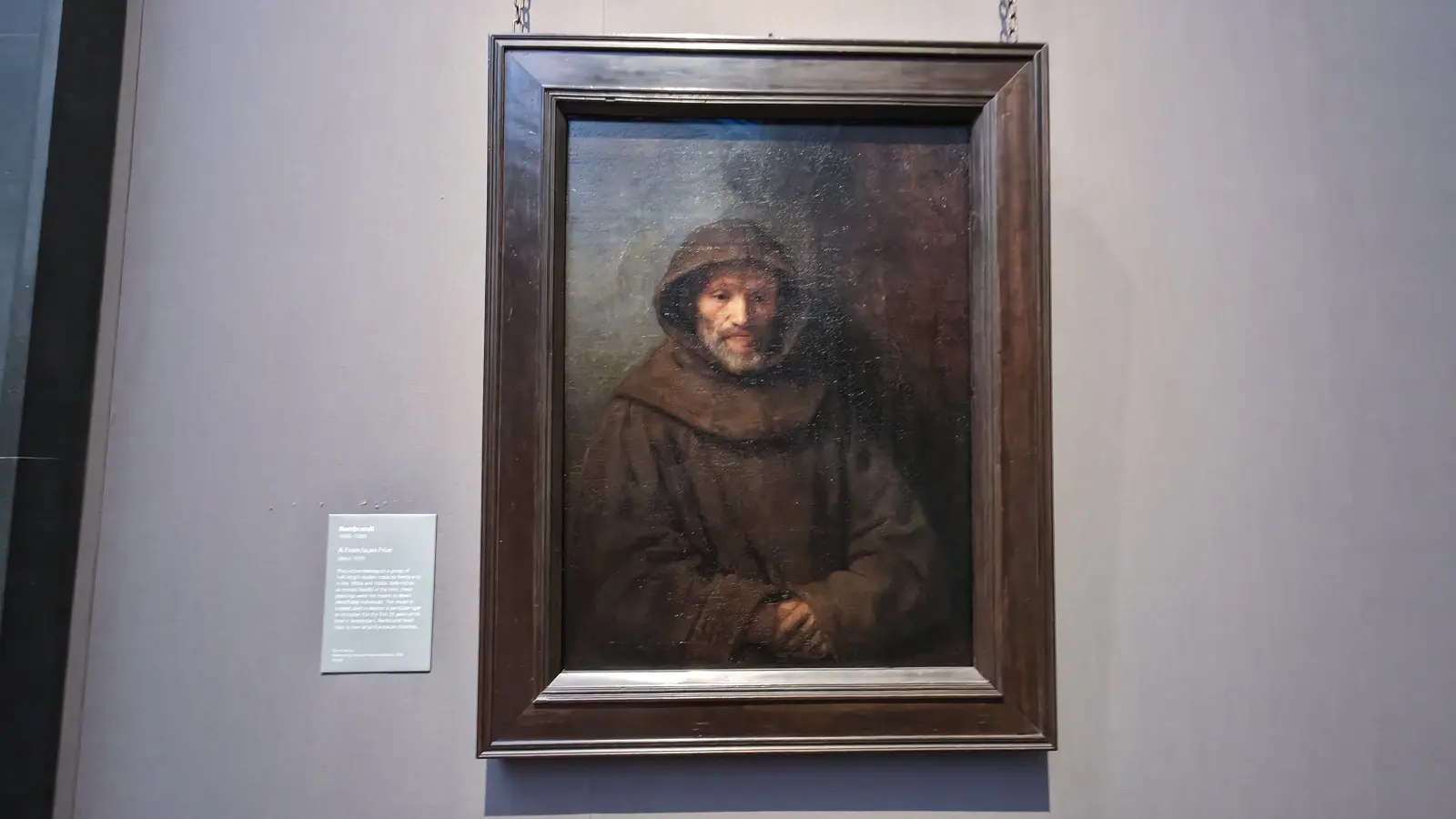
The National Gallery suggests it may be a tronie, a study of a character type rather than a portrait of a known person.
In 1660 his son Titus and his partner Hendrickje set up a business dealing in art, which protected him from further claims by his creditors. It is often said that he died penniless. That is too tidy. Historians disagree about how bad his finances stayed, and he certainly kept painting and kept getting commissions.
The Late Work
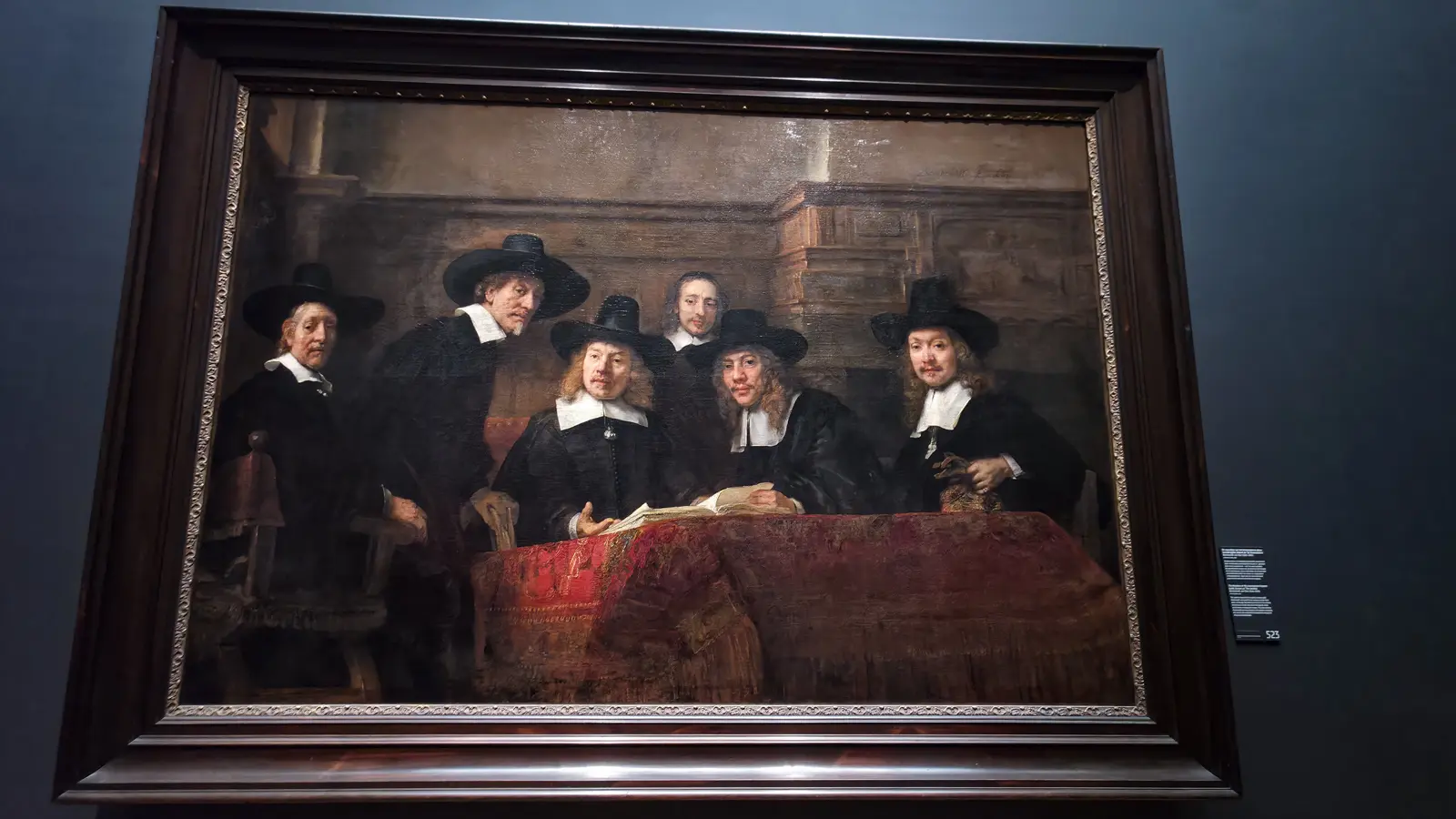
In 1662 the Amsterdam drapers’ guild had him paint its sampling officials, the men who checked the quality of cloth. The Rijksmuseum’s own description puts it simply: he remained popular. The Syndics shows five officials in black hats around a table covered with a red carpet, with the open sample book in front of them. Several of them look straight out of the canvas.
A year earlier, in 1661, he had painted himself as the Apostle Paul. The label calls it his first and only self-portrait in the guise of a biblical figure. He did not make the saint noble. He gave Paul his own face in his mid-fifties, with raised eyebrows, a creased forehead and grey curls escaping from a white headcloth.
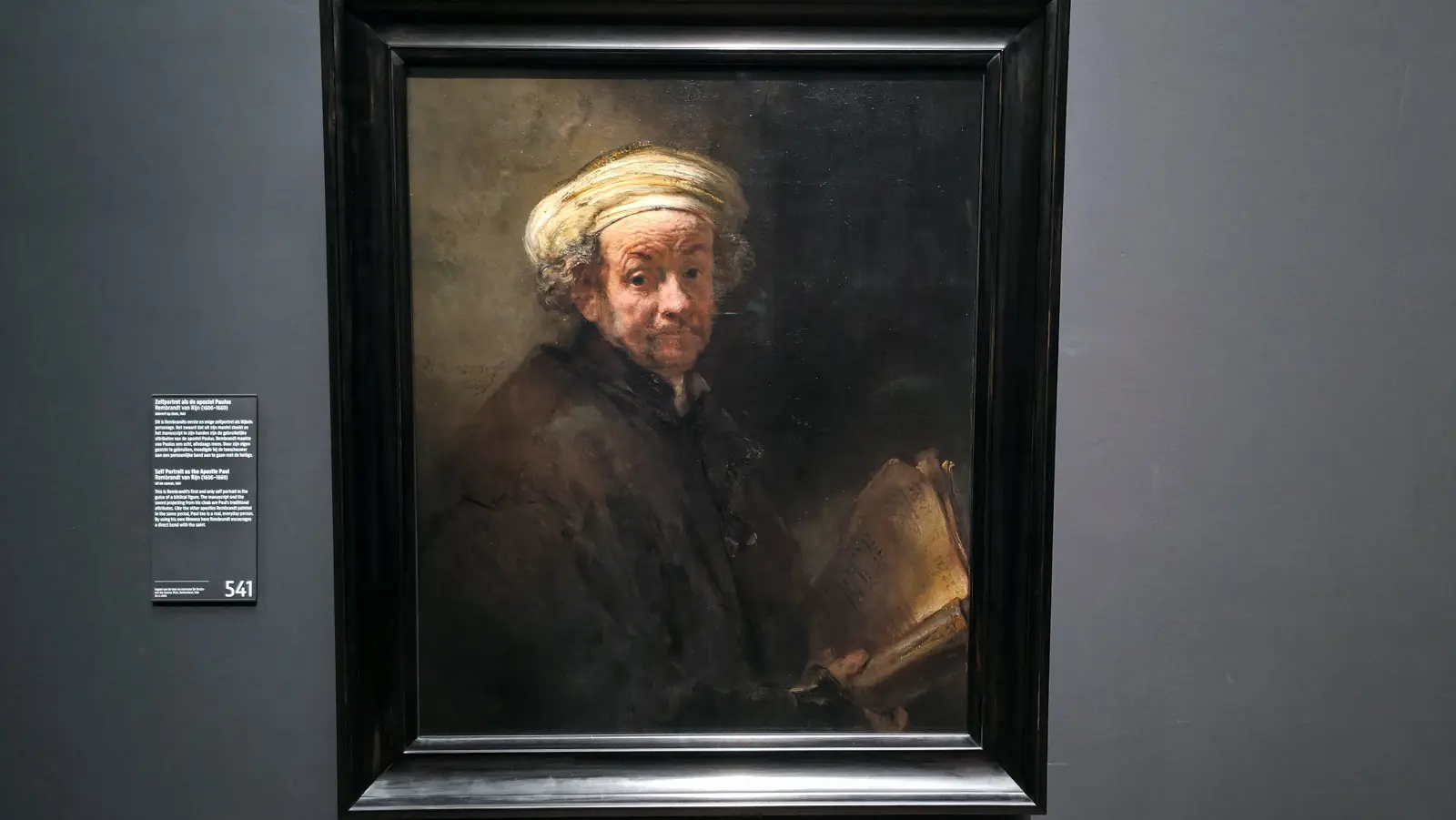
The label makes the point better than I can. Like the other apostles Rembrandt painted in this period, Paul is a real, everyday person, and using his own likeness invites a direct bond with the saint.
Then the losses came quickly. In 1663 the plague killed Hendrickje. Titus married in 1667 and died the following year.
Self Portrait at the Age of 63 is from 1669, his final year. There is no fur and no beret this time. He wears a plain cap and a reddish-brown coat, his hands are clasped, and the National Gallery’s label notes that he looks quite frail.
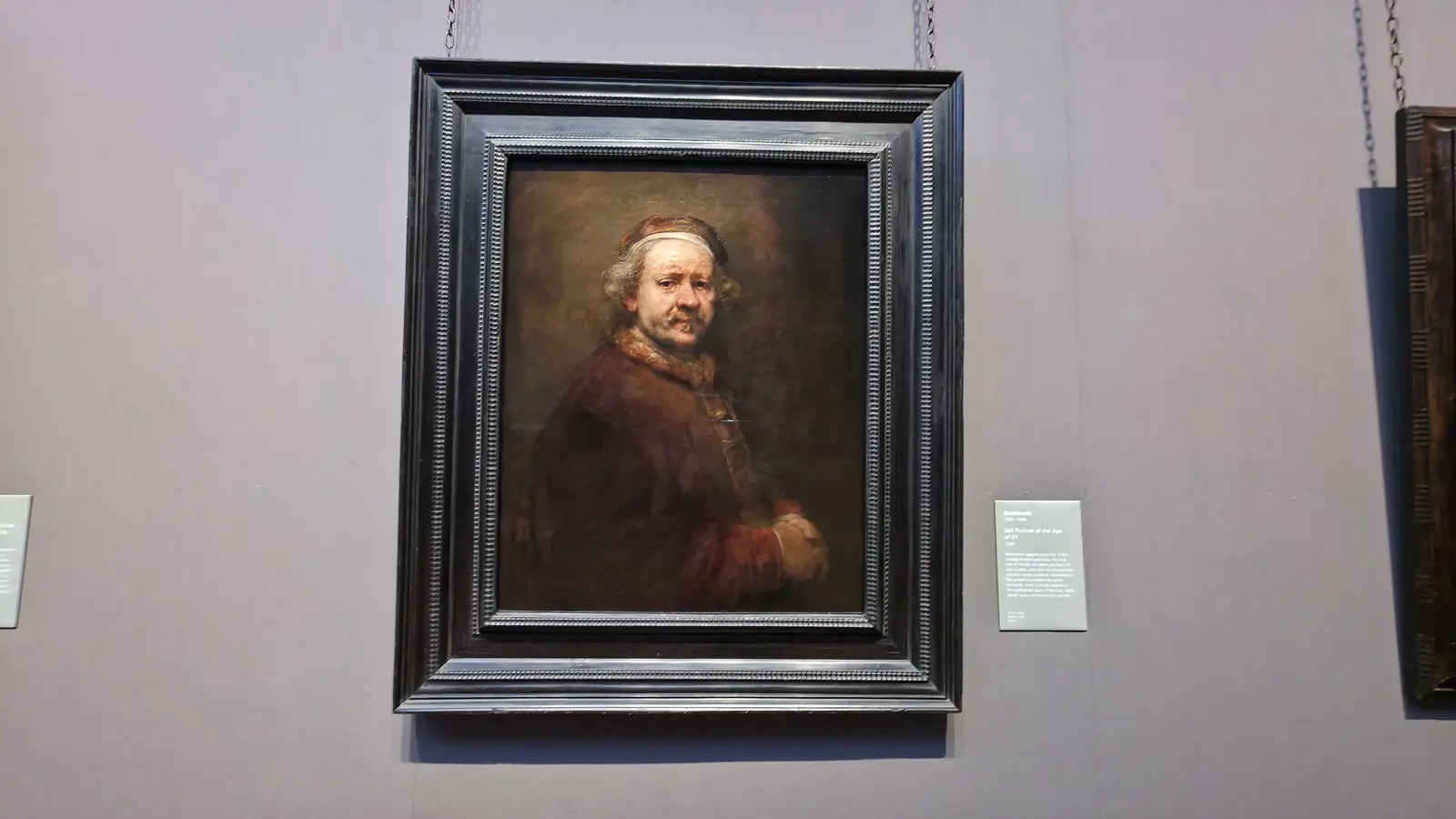
Rembrandt died on 4 October 1669. He was buried in a rented grave in the Westerkerk, and the grave has long since disappeared. That is the church named in gold on the frieze above the Night Watch.
Bubbly Tips
- Look at the face first, then the clothes. In the Amsterdam portraits, start with the face and then move down to the collar, lace and jewellery. Seen in that order, the gap between a plain face and an expensive outfit is hard to miss.
- Expect a crowd at the Night Watch. The room fills with tour groups, and while Operation Night Watch is under way the painting sits behind glass with conservators at work. Check the Rijksmuseum website before you go to see what stage the work has reached.
- Leave proper time for the Gallery of Honour. The Self Portrait as the Apostle Paul hangs there, and tour groups queue at the big names all along it. I went through the whole gallery in under 20 minutes, and my only regret is that I didn’t stop to stand and stare.
- Know the Rijksmuseum basics. At the time of writing, adult tickets cost €25, under-18s go free, and the museum is open daily from 9 am to 5 pm.
- See the London self-portraits for free. The National Gallery’s permanent collection is free to enter, and both the self-portrait at 34 and the one at 63 are here. Find them both and compare what thirty years did.
- Visit the house he lost. The house on the Breestraat, today’s Jodenbreestraat, is now the Rembrandt House Museum.
- Pass the Westerkerk. Rembrandt is buried somewhere inside, though the grave itself is lost. The church stands right next to the Anne Frank House on the Prinsengracht, and canal cruises go past it.
- Add a day in The Hague. Another self-portrait from 1669, his last year, hangs in the Mauritshuis.
Final Thoughts
In 1639 Rembrandt painted Maria Trip’s pearls and lace, and signed for a house he could not pay for. Thirty years later he was buried in a rented grave. In between, he painted a blind man’s torn cloak, a brewer’s wife’s expensive ruff and his own ageing face, and he never once tidied up the people inside the clothes.
That is what keeps me going back to him. In an airbrushed world, his faces still look like real people.
Until next time!

🌟 Everything You Need to Plan Your Dream Trip in 2026
- 🌟 Luxury Hotels - Find premium stays with Booking.com & Hotels.com
- 🏡 Vacation Rentals - Discover unique properties on VRBO
- 🏞️ Guided Tours - Explore with Viator or GetYourGuide
- 🎫 Attraction Tickets - Skip the lines with Tiqets
- 🚢 Ocean Cruises - Set sail with Cruise Direct
- 📱 International SIMs - Stay connected with Saily
- 🚗 Car Rentals - Budget-friendly options from Discover Cars
- 🌐 Secure VPNs - Browse safely with NordVPN
- 💶 Currency Exchange - Best rates with Wise
- 🗣️ Learn Languages - Master the local language with Babbel and Rosetta Stone