
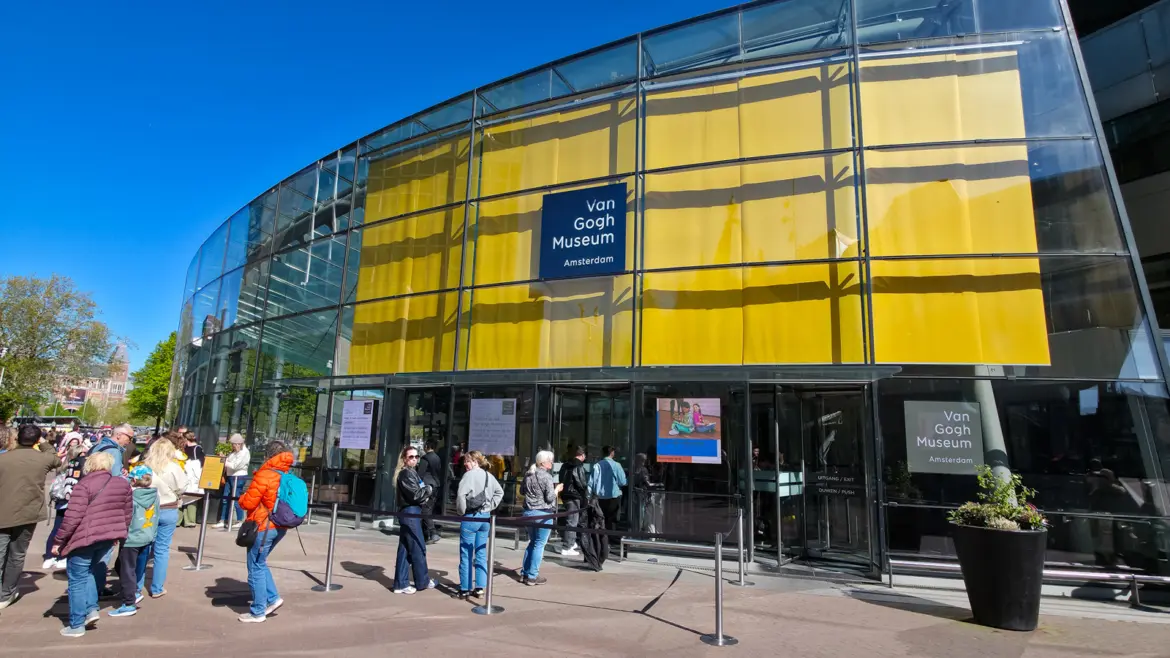
A few days earlier I had stood in front of the Night Watch at the Rijksmuseum and admitted that I had never understood it. I knew it was a Rembrandt. That was the whole of it. Four hundred fridge magnets and no idea what was happening in the picture.
Van Gogh was the opposite, and had been for years. I knew the sunflowers and I knew why they mattered. I knew the story of the ear and the asylum and the brother who paid for everything. So I came here expecting recognition rather than discovery, which is a poor frame of mind for a museum and I got caught out by it twice.
The first time was a matter of scale: there are around two hundred paintings here and perhaps eight of them are on the tea towels. The second was that the pictures which held me longest were ones I had never heard of. An overturned crab. An empty chair.
I went twice, four days apart. The first afternoon was with a guide, which is the right way to see it once. The second time I went in alone, walked straight past most of it and stood in front of the Arles paintings, the yellow ones, for as long as I liked.
That is the piece of advice this whole post is built around, so it may as well come first.
The Van Gogh Museum at a Glance
🎟️ Booking · Timed slot, online, in advance, for every visitor, Museumkaart holders included. No ticket window on the day.
🖼️ What’s here · The world’s largest Van Gogh collection: ~200 paintings, 500 drawings and almost all his letters. Sunflowers, The Bedroom, Almond Blossom, The Potato Eaters.
🚫 What’s not · The Starry Night. It’s at MoMA in New York and never has been here. People ask at the desk daily.
📸 Photos · Allowed in the permanent collection, no flash. Older guides say otherwise and are wrong.
💡 Tip · Go twice if you can (guide first, alone second), start at the bottom and go up, and don’t pair it with the Rijksmuseum on the same day.
Nobody Just Turns Up
This is the thing to understand before planning anything else in Amsterdam. Entry is by timed slot, booked online in advance, for every single visitor. There is no ticket window on the day. Even a Museumkaart, which gets Dutch residents into most things on a whim, still requires a reserved time here.
In late April the museum was full at every hour I was in it. Van Gogh is one of the reasons people come to this city at all, and the building takes over two million visitors a year with roughly eighty-five per cent of them arriving from abroad.
A Building in Three Pieces
The museum is not one structure but three, built across forty-two years, and the seams are visible to anyone looking for them.
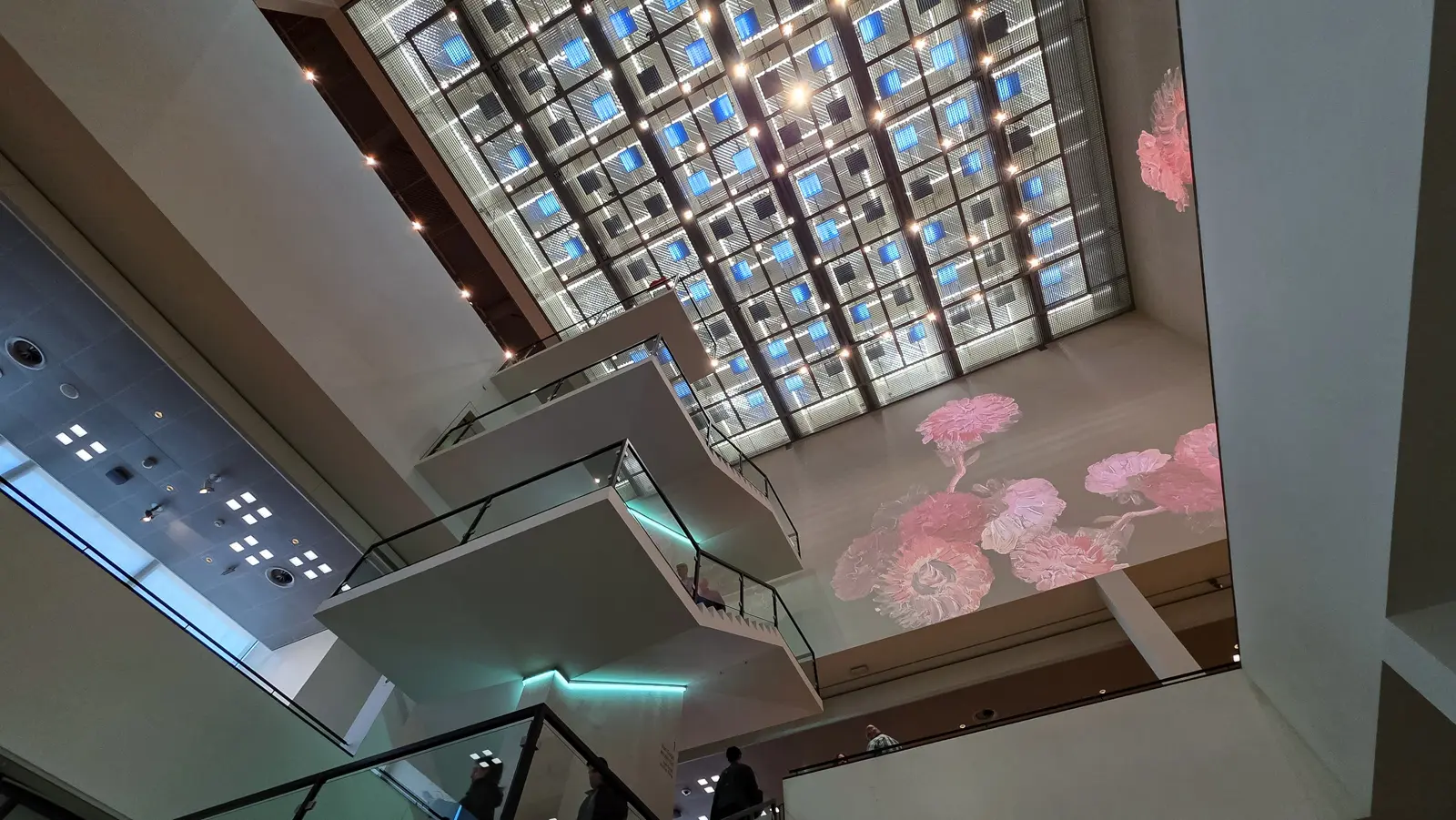
The original block on Paulus Potterstraat is by Gerrit Rietveld, a central figure in De Stijl, and opened in 1973. The elliptical wing behind it, for temporary exhibitions, is by the Japanese architect Kisho Kurokawa and opened in 1999. The glass entrance hall that now joins them opened on 5 September 2015, built by Hans van Heeswijk from a sketch Kurokawa had prepared before his death in 2007.
Standing under that skylight and looking up, with the projected flowers running along the far wall, is the only moment in the building where the architecture competes with the paintings.
Where It Starts
The route runs bottom to top and chronologically, so the first room is the darkest thing in the collection.
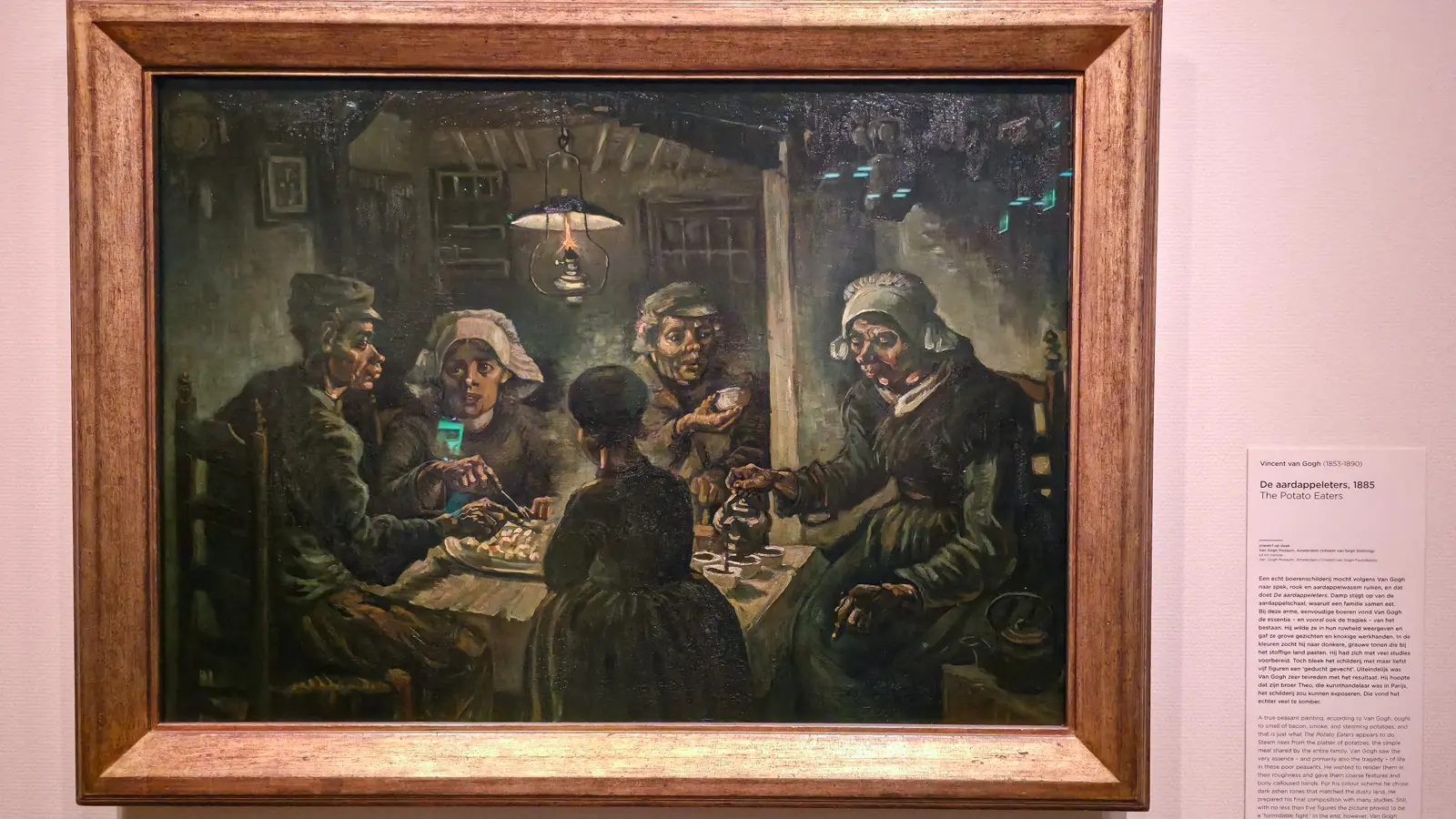
The Potato Eaters, 1885. Five figures round a table under a single hanging lamp, eating potatoes with their hands, everything in browns and greys. The wall text quotes his own standard for it: a peasant painting should smell of bacon, smoke and steaming potatoes. He chose the dusty, ashen colours deliberately to match the land the family worked.
He also said the picture, with five figures in it, had been a formidable fight. He was pleased with the result and hoped his brother Theo would show it in Paris. Theo thought it far too sombre.
Two Self-Portraits
Upstairs the colour arrives all at once, because Paris happened in between. He moved there in 1886 to live with Theo and left for Arles in February 1888, and in those two years everything changed.
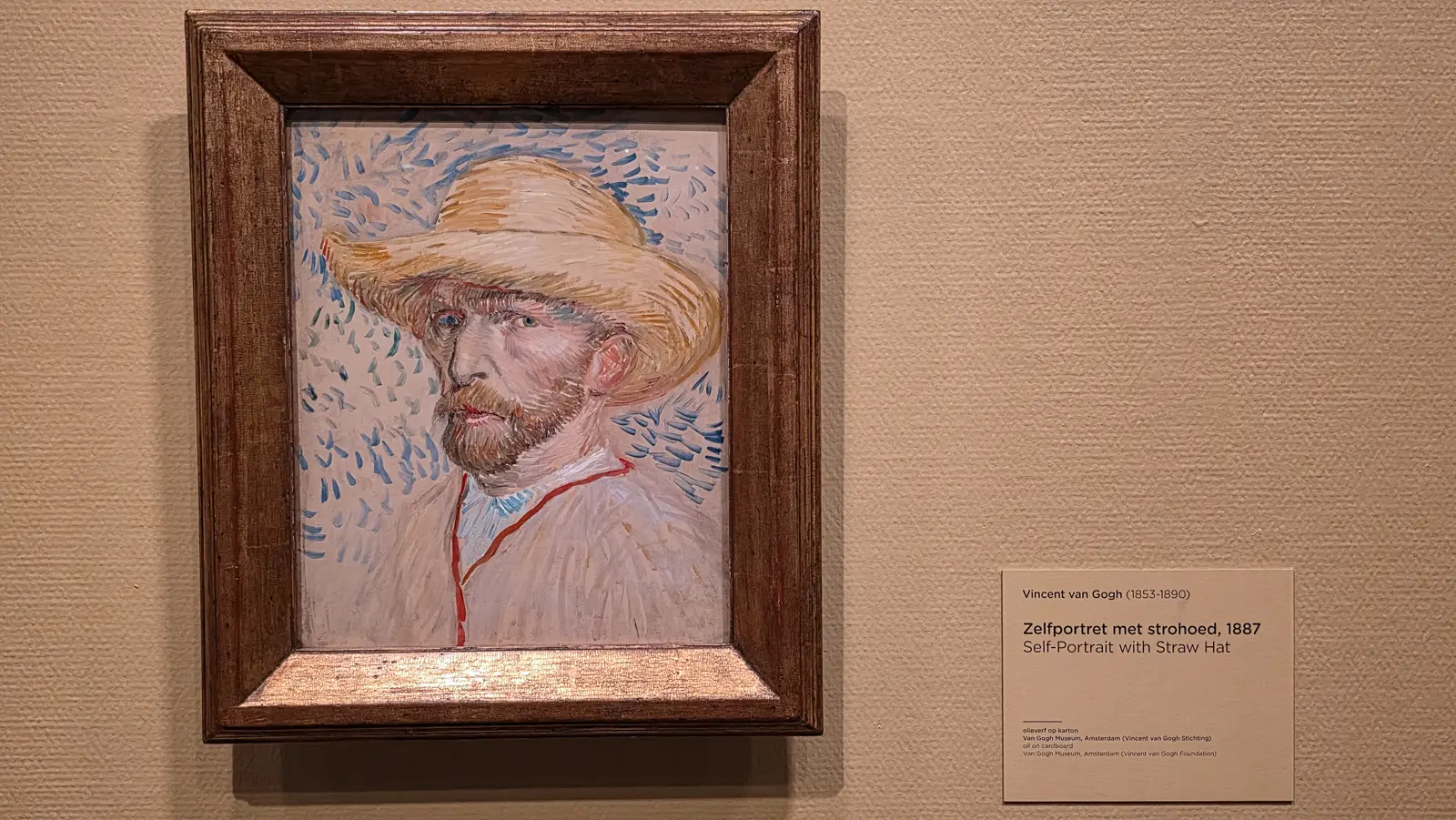
In the straw hat he is all pale blue dashes on a cream ground, the strokes radiating outwards from his head like a halo of comb marks.
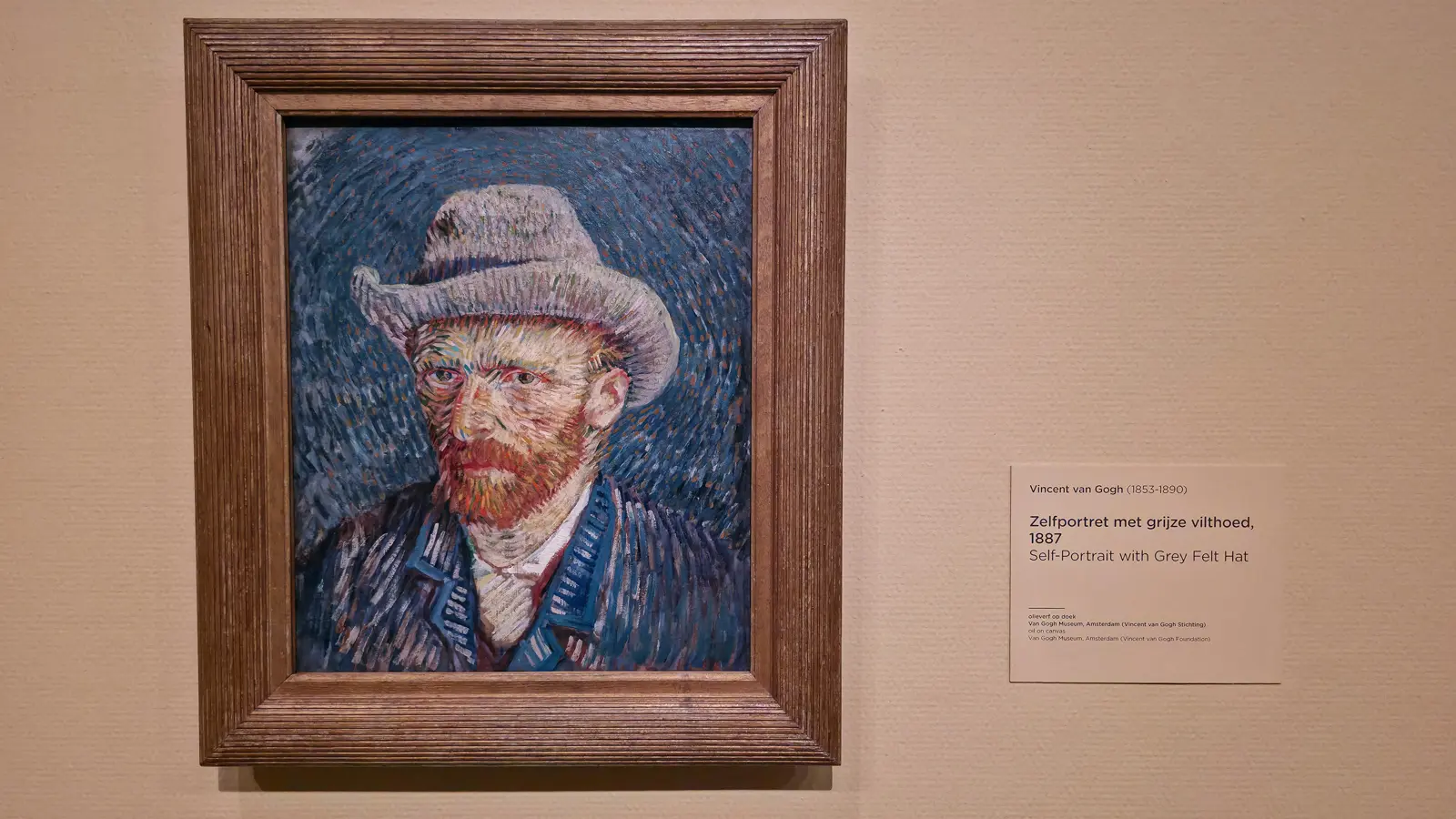
In the grey felt hat, painted the same year, the whole surface is worked in short separated strokes of orange and blue laid against each other, and the face is built out of the same marks as the background. Same man, same year, two entirely different approaches to a head.
The Bedroom
Then the room everyone recognises, and it is smaller than it looks in reproduction.
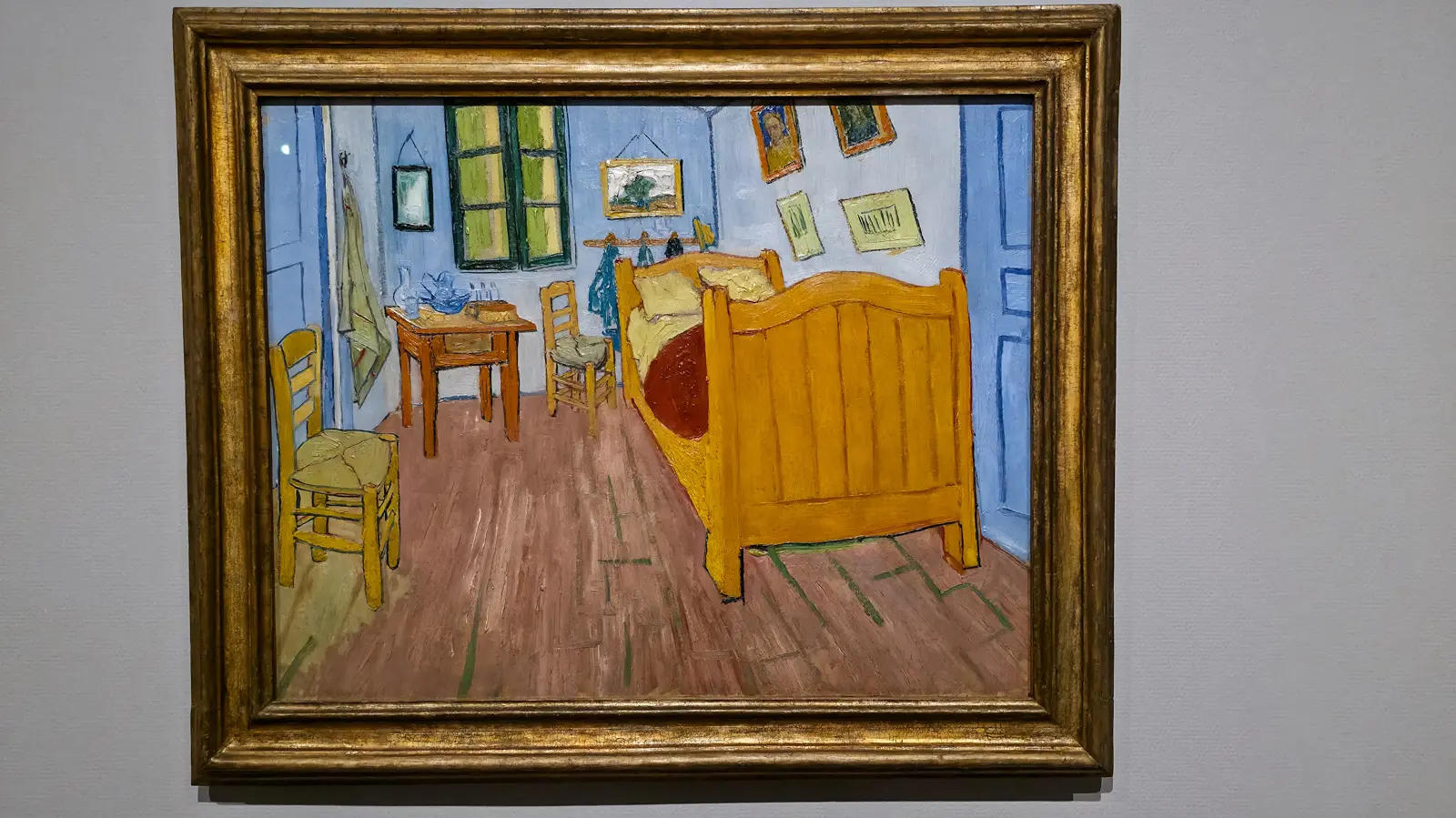
The floor tilts, the walls lean, and two of everything sits waiting: two chairs, two pillows, two pictures over the bed.
He left an account of what he was after, and this museum can draw on his own words more freely than any other, because it holds around eight hundred of his letters, very nearly everything that survives. He wanted the bright tones of the room to convey what he called utter repose, during a stretch when he was working so hard that he was anything but calm. He hoped his paintings would be a comfort to other people and not only to himself, and he was sure this one managed it. After a period of illness, looking again at his canvases, the bedroom seemed to him the best of them.
Gauguin’s Chair
Around the corner is an empty chair, and it is a portrait.
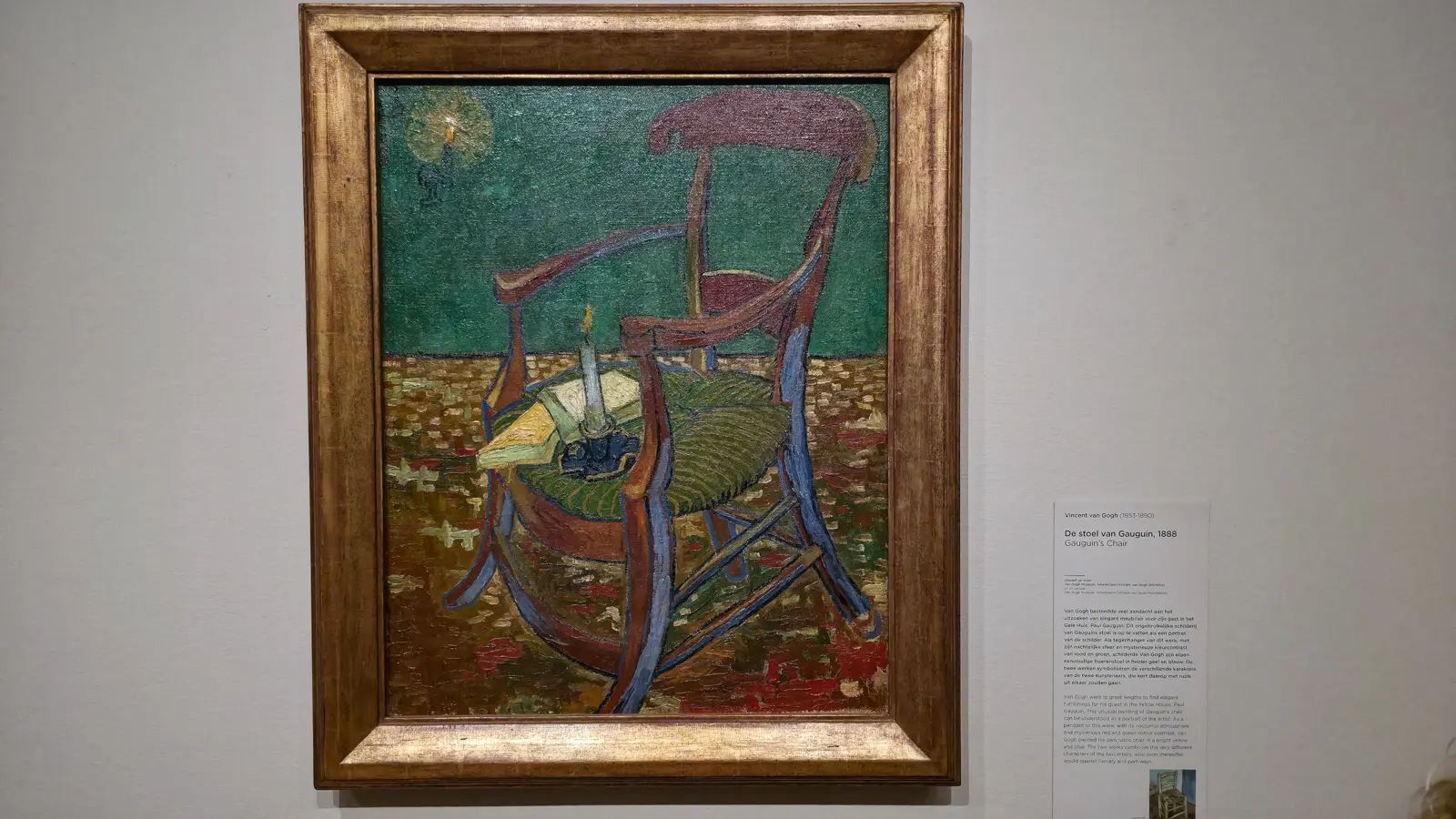
Van Gogh took trouble over the furniture he bought for Paul Gauguin‘s room in the Yellow House at Arles. This is the good armchair he chose for his guest: curved arms, a candle burning on the seat, two novels, the whole thing in reds and greens under a gas lamp at night. Against it he painted his own chair, plain and wooden, in daylight yellow and blue.
Two chairs, two characters, no people.
The two had met in Paris in 1887 and admired each other’s work. Van Gogh wanted to found what he called a Studio of the South, a house of painters in Provence with Gauguin at the head of it, and Gauguin, broke in Brittany and reluctant, came partly because Theo offered him a monthly allowance in exchange for paintings. He arrived on 23 October 1888.
It lasted sixty-three days. They painted side by side and argued constantly, much of it about whether a picture should come from what stood in front of the easel or from memory and imagination, and Gauguin kept threatening to go. On 23 December, after a confrontation between them, Van Gogh cut off part of his left ear. Gauguin returned to Paris and the two men never saw one another again, though they wrote to each other until Van Gogh’s death eighteen months later.
A Crab on its Back
This one stopped me because I had seen its sibling in London.
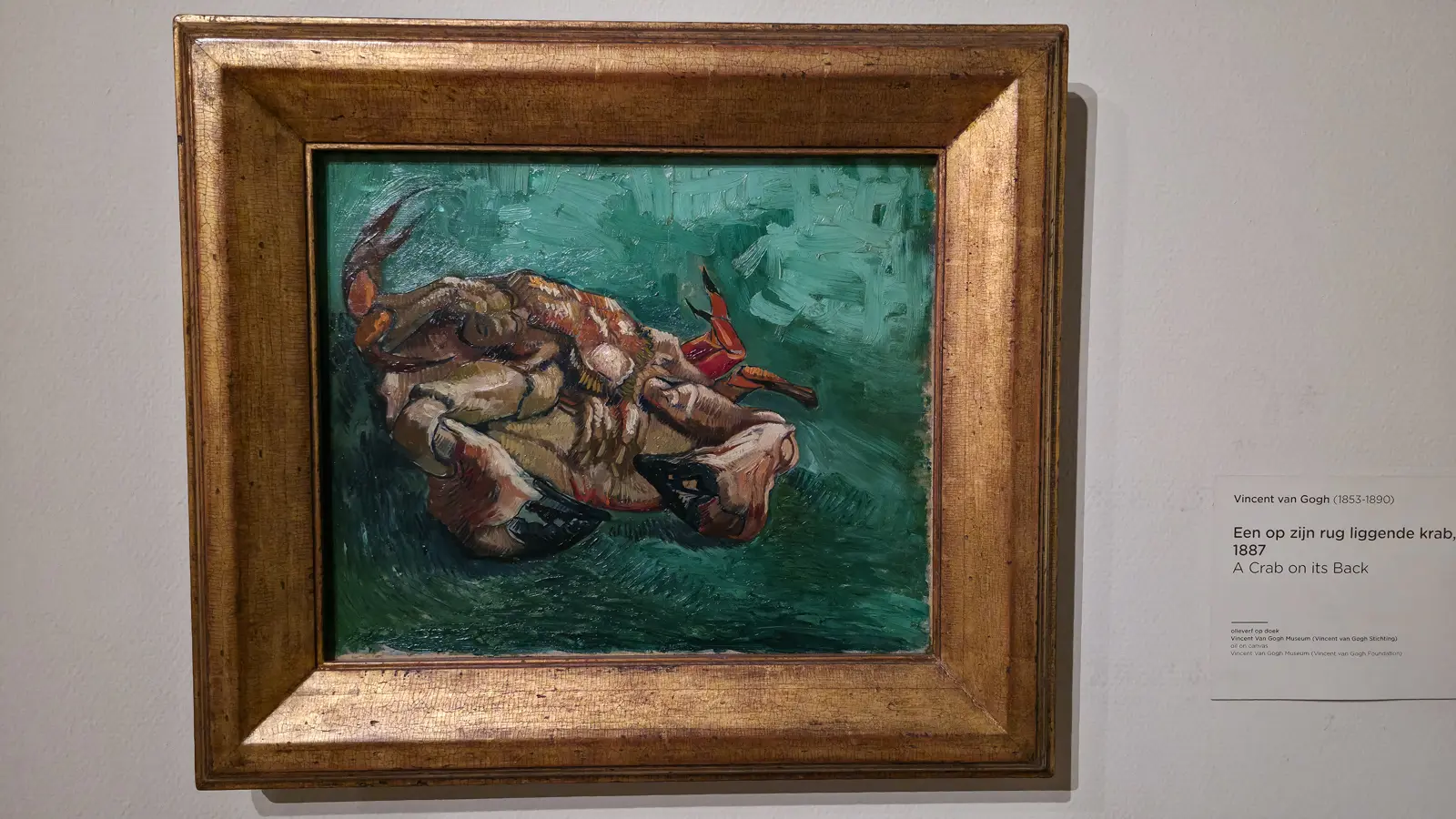
The National Gallery in London has Two Crabs, showing what is probably the same animal twice, once upright and once on its back, against the same green. Amsterdam has this one: a single crab, overturned, claws up.
Here is the part I did not expect. The two museums disagree about when they were painted. London dates its picture to January 1889 in Arles, a fortnight after Van Gogh cut off part of his ear, and some writers have read the helpless upended crab as a self-portrait of sorts. Amsterdam dates this one to Paris, August or September 1887, and the label in front of me said 1887. Sixteen months apart, and unresolved. If Amsterdam is right, the psychological reading has nothing to stand on.
Irises
On the upper floor, after the asylum years begin, a jug of flowers is set against a wall of solid yellow.
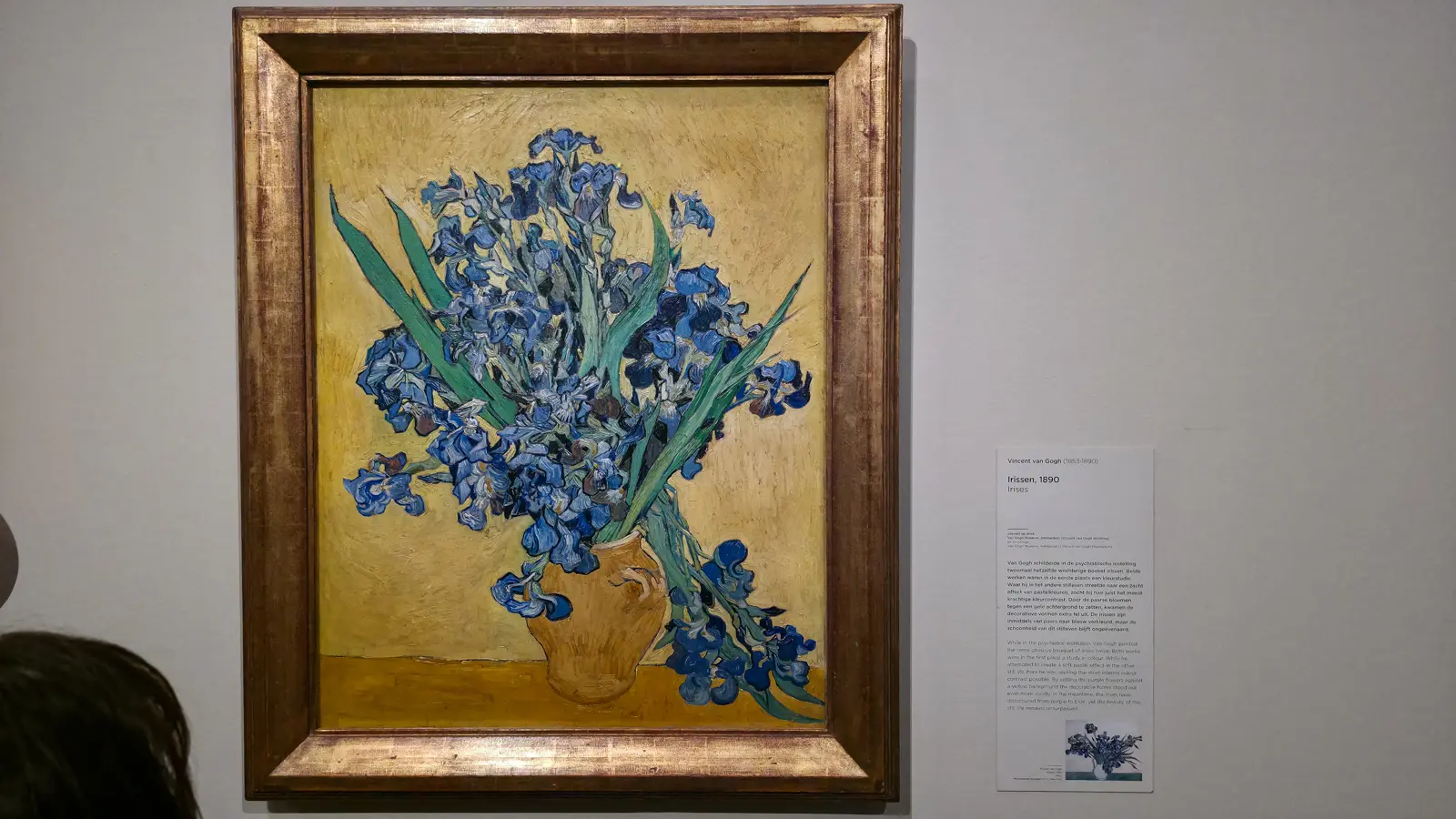
He painted this bouquet twice while he was a patient at the asylum at Saint-Rémy, and both were exercises in colour before they were anything else. In the other version he went for a soft pastel effect. Here he wanted the strongest contrast he could get, so the flowers went against a flat yellow background.
The label ends by saying the beauty of the still life remains unsurpassed, which is not the kind of sentence museums usually allow themselves.
The Pietà, Twice
One painting in the collection is unlike everything around it. Van Gogh painted almost no religious subjects, and this is the exception.
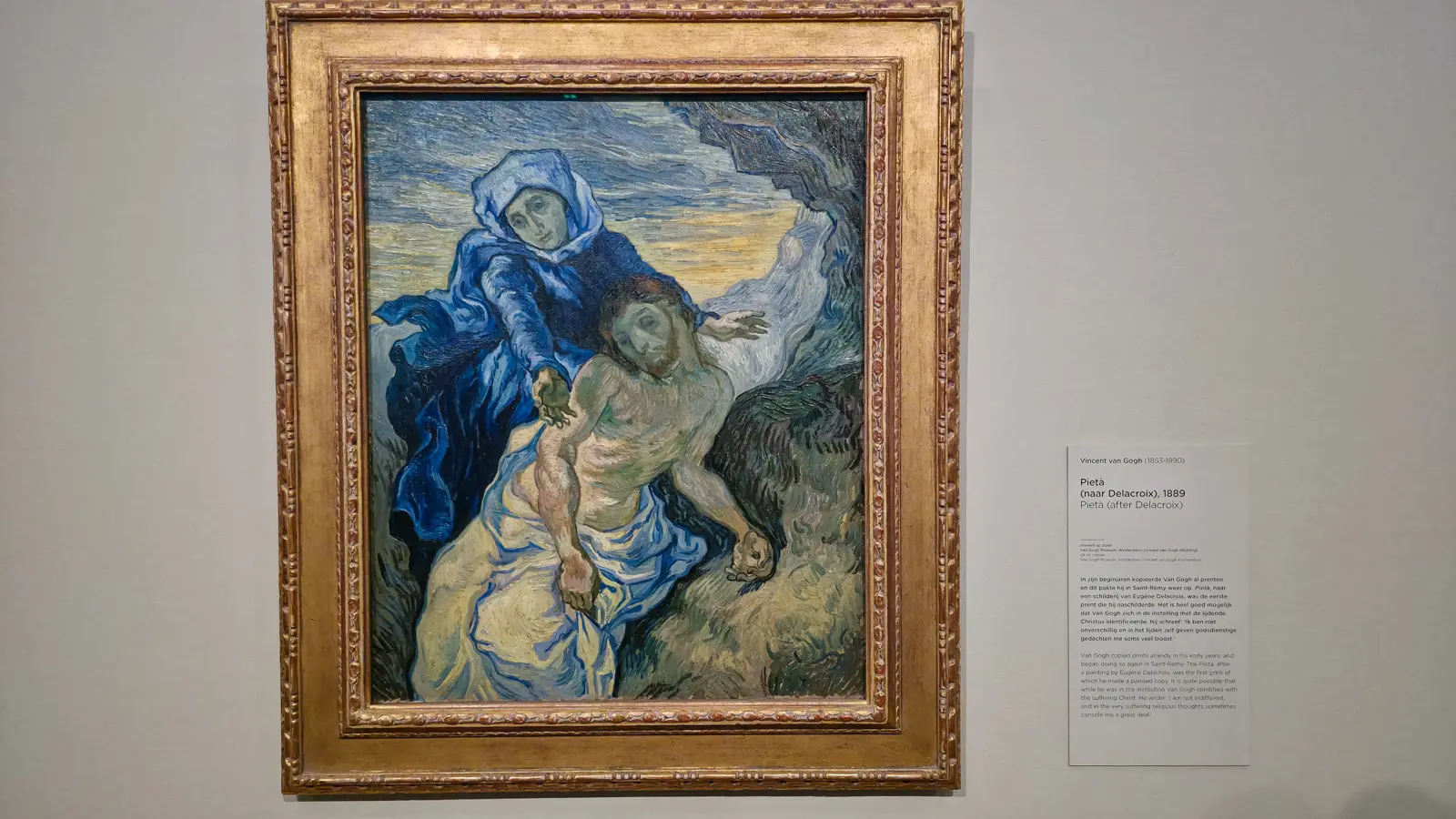
He never owned a Delacroix. What he had was a print of one: a black and white lithograph made by another artist copying Delacroix’s painting, one of a pile of such sheets he kept in his room at the asylum. In his own account to Theo, the pile fell into some oil and paint and was spoiled. He was sad about it, he wrote, and occupied himself painting it instead, this time in colour. The ruined lithograph survives in this same collection, stain and all.
The label also gives his own explanation for why the subject held him. He was not indifferent, he wrote, and in suffering itself religious thoughts sometimes consoled him a great deal. The museum suggests, carefully, that he may have identified with the Christ he was painting.
And then there are two of them. The larger canvas, made for Theo in September 1889, is this one. The smaller, painted for his sister Willemien, is in the Vatican Museums, and I had already met it there in 2018.
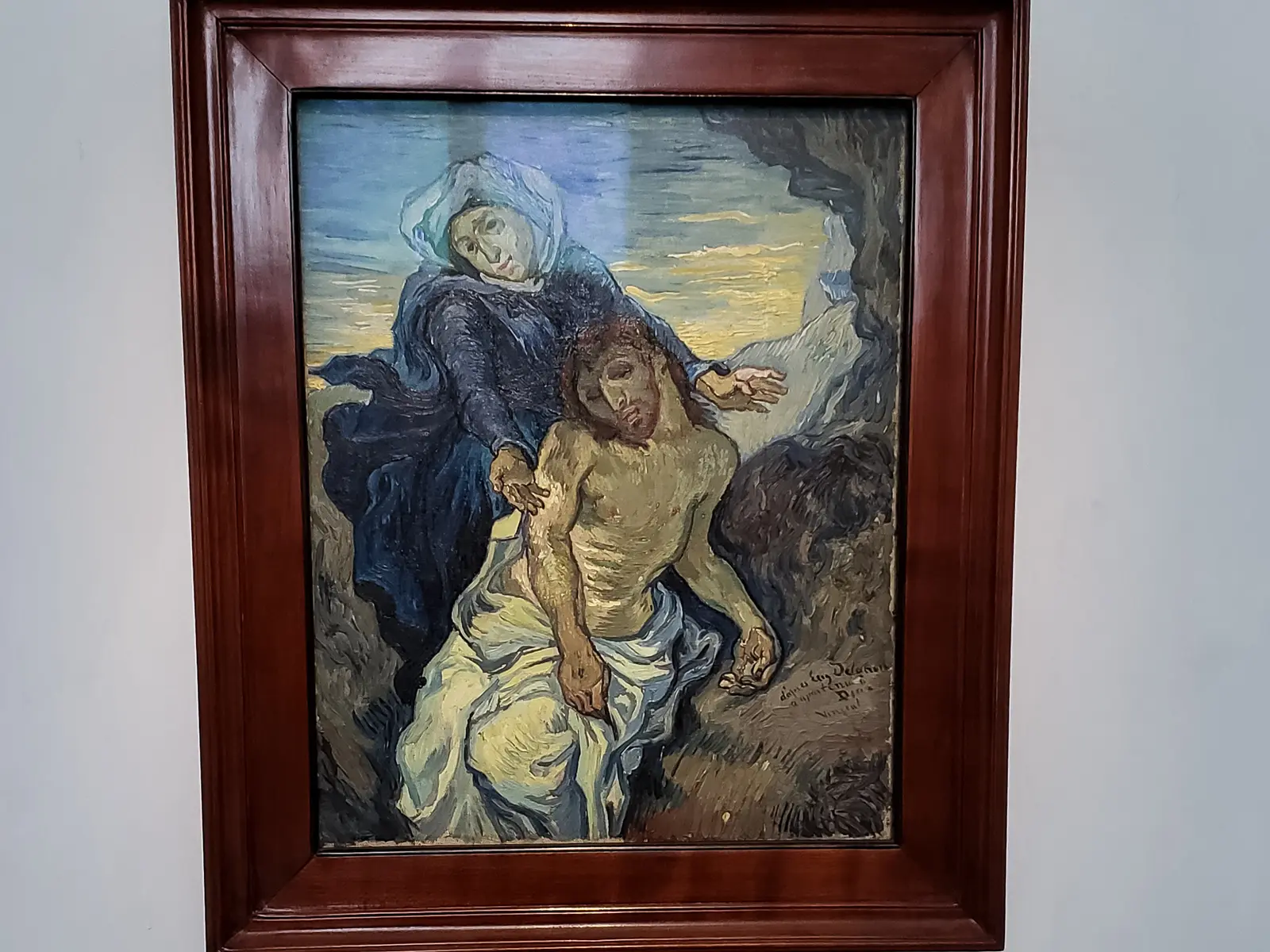
It hangs in the Collection of Modern Religious Art at the Vatican Museums, in rooms that almost nobody detours for on the way to the Sistine Chapel. Same composition, same year or thereabouts, a third of the size, in a dark mahogany frame instead of a gilt one, on a white wall instead of a cream one.
Standing in front of the Amsterdam version seven and a half years after photographing the Roman one was a strange piece of bookkeeping.
Sunflowers
And then the one that everybody came for, hanging on a plain grey wall with nothing done to make an occasion of it.
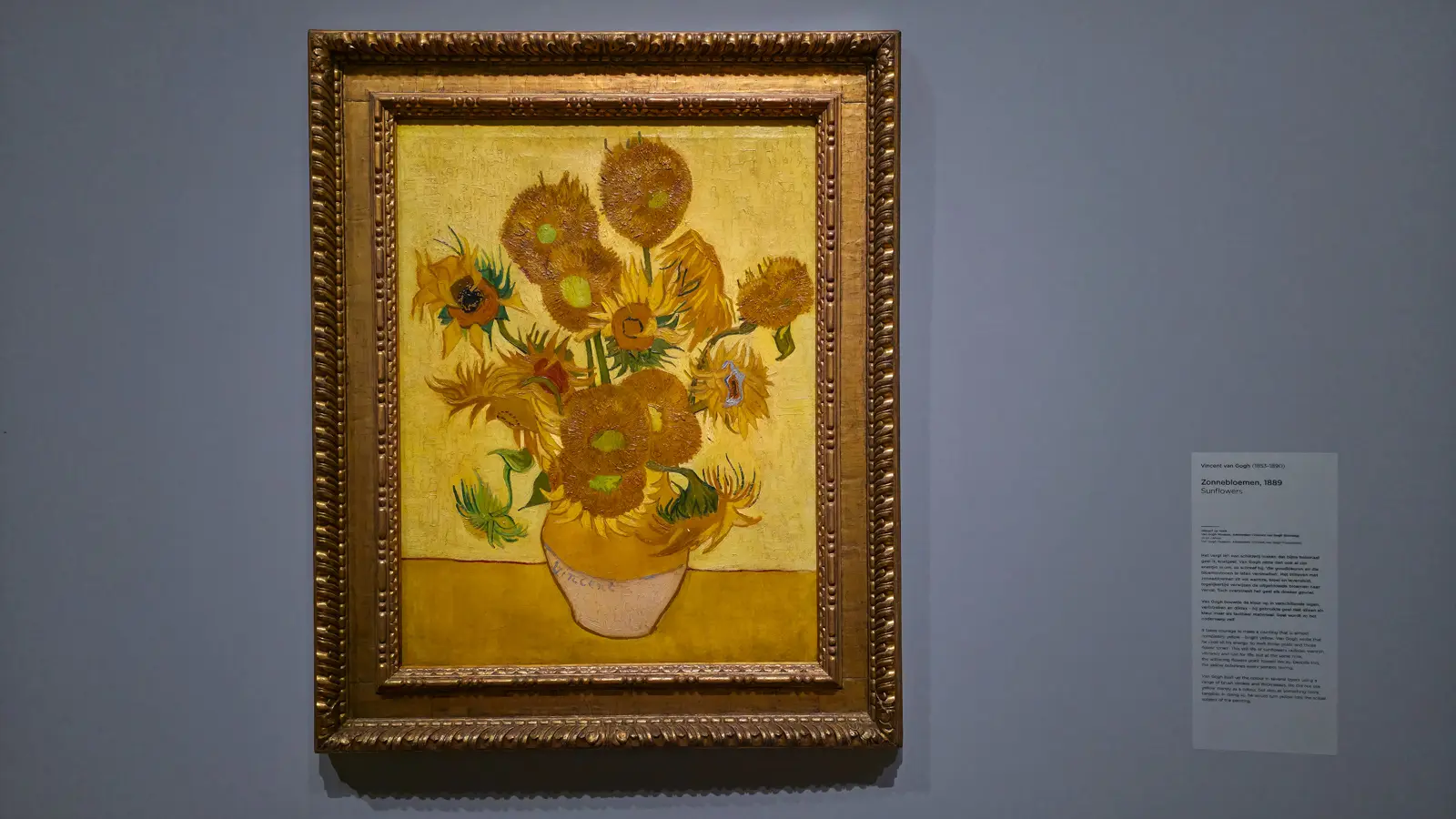
This is what most people are here for, and on my second afternoon I went straight to it.
The wall text is the best thing the museum has written. It takes courage, it says, to make a painting that is almost entirely yellow. He used every bit of himself, in his own words, to melt those golds and those flower tones together. The picture radiates warmth and appetite for life, and at the same time the flowers in it are going over: petals dropping, heads drying out, one of them already collapsing. The yellow outshines all of that anyway.
What the label points out, and what a print cannot show, is that the yellow is not only a colour here. He built it up in layers, thin in places and thick in others, so the paint itself has a surface. Yellow stops being what the painting is coloured and becomes what the painting is about.
Almond Blossom
The last room I want to talk about holds a painting I had liked for years without knowing a single thing about it.
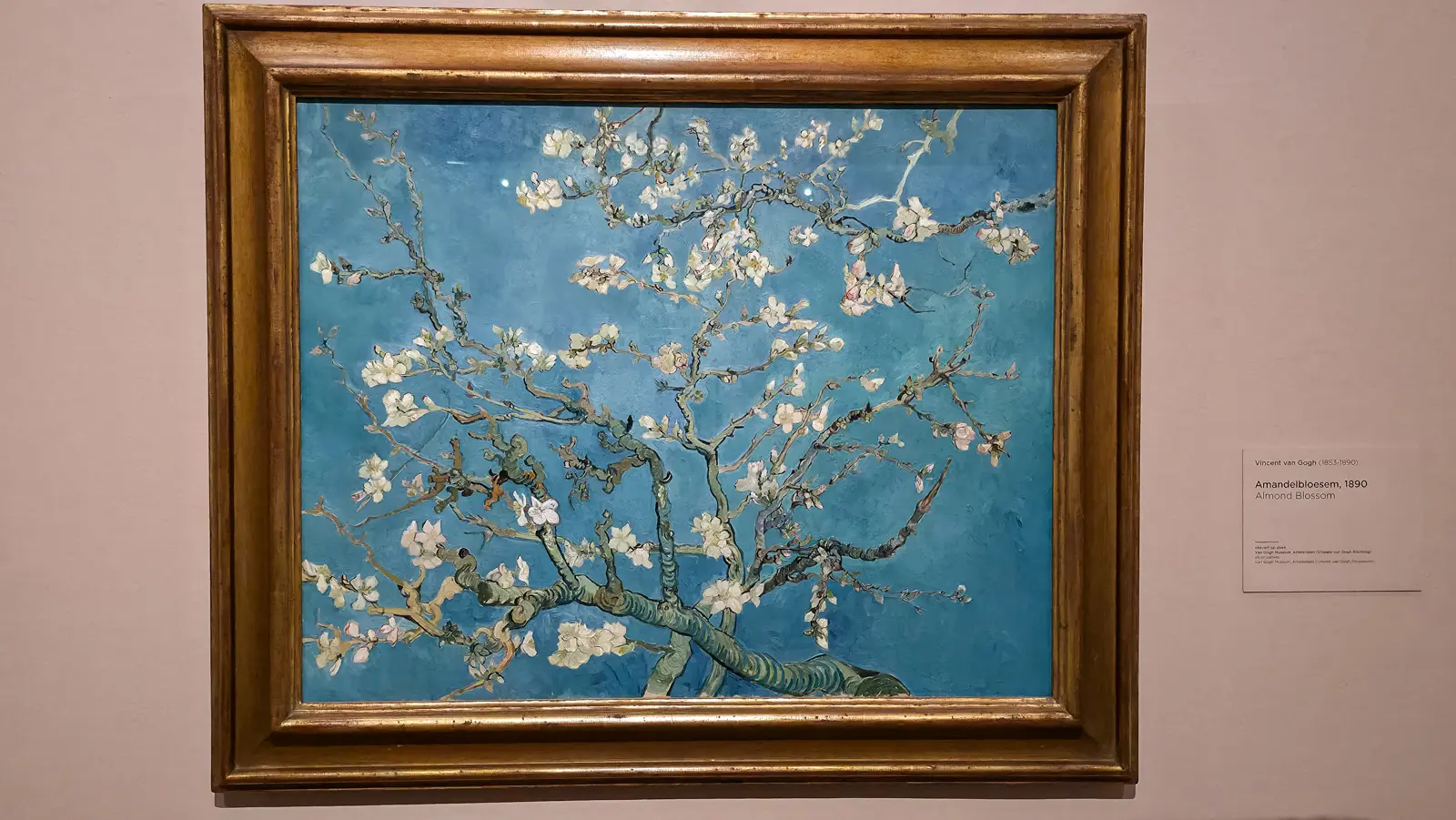
My favourite in the building, and it was before I knew why.
Theo and his wife Jo had a son on 31 January 1890 and named him Vincent Willem, after his uncle, who was also his godfather. Vincent, then a patient at Saint-Rémy, began painting immediately. He told his mother what it was for: large branches of white almond blossom against a blue sky, for the bedroom of the Paris apartment where the baby slept.
It was a present for a newborn. The branches are cut off by the edges of the canvas in the Japanese manner he had been studying, the blue is flat, and there is no ground and no horizon, just blossom coming forward from every direction.
Now the part that makes the room worth standing in. That baby grew up, inherited the collection, and in 1962 handed it to the Dutch state to be held in trust. The museum opened eleven years later. Almond Blossom hangs in an institution that exists because of the child it was painted for.
Bubbly Tips
- Book a timed slot before you book anything else. Entry is online-only with a reserved time for every visitor, Museumkaart holders included. In high season the good slots go early, and there is no queue you can join on the day.
- Go twice if your trip allows it. I did, and it was the best decision of the week. The first visit with a guide gives you the shape of his life and the argument between the rooms. The second lets you ignore all of that and stand in front of four paintings for twenty minutes each.
- Take the guide first, not second. Doing it the other way round means you spend your one unhurried visit being told things instead of looking.
- Start at the bottom and go up. The displays run chronologically by floor, so the route only makes sense in that direction. Beginning with The Potato Eaters is what makes the Paris colour land the way it should.
- Read the labels here. They quote his letters constantly, because the museum owns nearly all of them, so you are reading his own account of what he was attempting rather than a curator’s guess at it.
- Photography is allowed in the permanent collection, without flash. Older guidebooks say otherwise and are out of date.
- Do not come looking for The Starry Night. It is at the Museum of Modern Art in New York and never has been here. People ask at the desk every day.
- Pair it with the Rijksmuseum, but not on the same day. They are four minutes apart across Museumplein and both need three hours and a clear head. Doing both back to back wastes one of them.
- The afternoon slots are calmer than the mornings. Both my visits were after one o’clock, and both were busy, but the crush around the famous canvases eases considerably as the day goes on.
Final Thoughts
The building holds about two hundred paintings, and the ones people cross continents for take up perhaps ten metres of wall. What I did not expect was how much the small, unfamous things would stay with me: an overturned crab whose date two museums cannot agree on, an empty armchair standing in for a man who was about to walk out, a bedroom he painted three times because the first one got damp.
And Almond Blossom, which I liked immediately for the wrong reasons, on the strength of the blue. Then I learned it was a gift to a newborn from an uncle who was falling apart, and that the newborn is the reason the museum exists at all. Nothing in the collection is arranged to make that point. It just happens to be true, and it is hanging on the wall of a room that opens to anyone with a timed ticket on a Thursday afternoon.
Until next time!

🌟 Everything You Need to Plan Your Dream Trip in 2026
- 🌟 Luxury Hotels - Find premium stays with Booking.com & Hotels.com
- 🏡 Vacation Rentals - Discover unique properties on VRBO
- 🏞️ Guided Tours - Explore with Viator or GetYourGuide
- 🎫 Attraction Tickets - Skip the lines with Tiqets
- 🚢 Ocean Cruises - Set sail with Cruise Direct
- 📱 International SIMs - Stay connected with Saily
- 🚗 Car Rentals - Budget-friendly options from Discover Cars
- 🌐 Secure VPNs - Browse safely with NordVPN
- 💶 Currency Exchange - Best rates with Wise
- 🗣️ Learn Languages - Master the local language with Babbel and Rosetta Stone