
The Night Watch set the tone for my whole day at the Rijksmuseum, and it left me with enormous respect for the genius that was Rembrandt. So it was a surprise to find a whole room of his work away from the Gallery of Honour, and a different Rembrandt in it.
Every painting in this room dates from 1626 to 1639. Rembrandt was born in Leiden in 1606, so these are the works of a painter between about 20 and 33, years before the Night Watch of 1642. Some are biblical scenes from his Leiden years. Most are portraits of the people who paid him once he had made his name in Amsterdam.
What struck me were the faces. Wrinkles, red noses, tired eyes, a double chin: nothing is smoothed away. The clothes are another story, and they are where the flattery went.
The Early Rembrandt Room at a Glance
🖼️ What · A room of Rembrandts dated 1626 to 1639, painted between about ages 20 and 33 — years before the Night Watch of 1642.
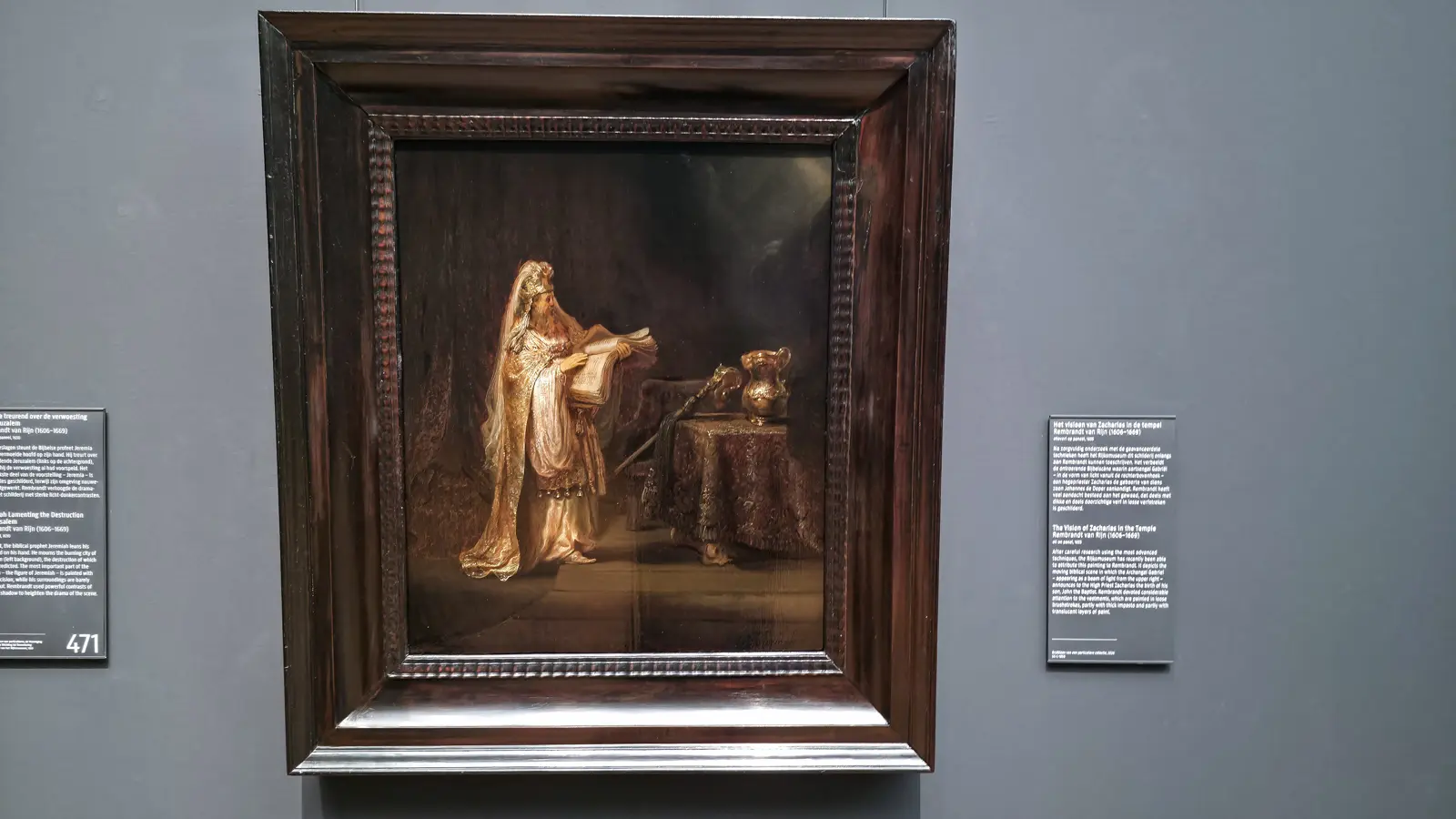
🆕 Newest · The Vision of Zacharias (1633), confirmed a genuine Rembrandt in 2026 after being struck from his work in 1960, on display since 4 March 2026.
🔍 Smallest · Two octagonal miniatures of Jan van der Pluym and his wife, each oval only ~20 cm high, bought at Christie’s in 2023 for £11m+.
👁️ The theme · Honest faces, lavish clothes — wrinkles, red noses and double chins left in; the lace and pearls doing the flattering.
💡 Tip · See this room before the Gallery of Honour; the early work makes the Night Watch and late self-portraits hit harder.
The Leiden Years
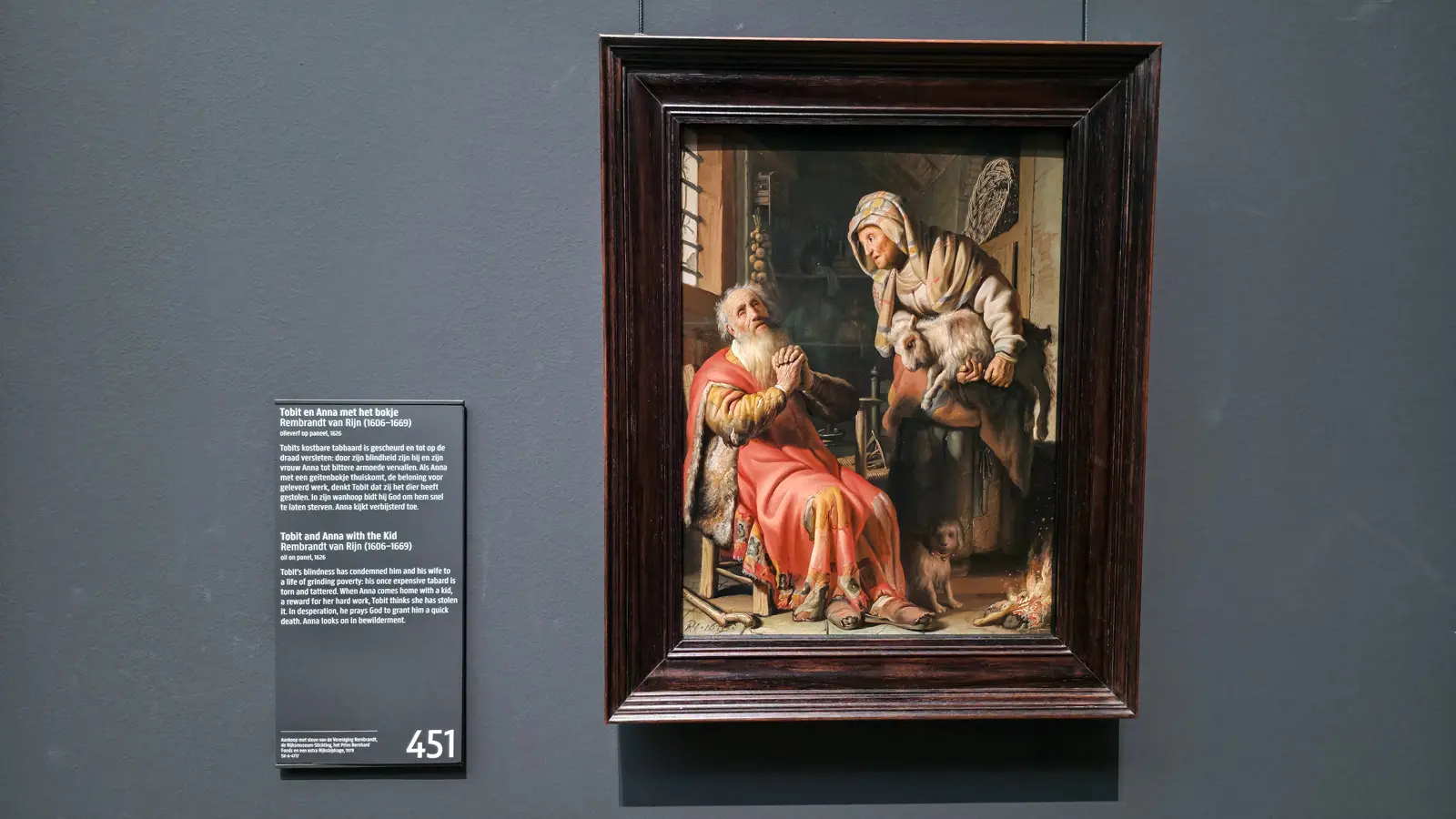
The earliest painting here is Tobit and Anna with the Kid, from 1626. Tobit is blind and poor, his once costly robe torn and tattered. His wife Anna has come home with a young goat, payment for her work, and he is sure she stole it. He prays for death while she stares at him in bewilderment. A small dog watches from the floor beside a fire.
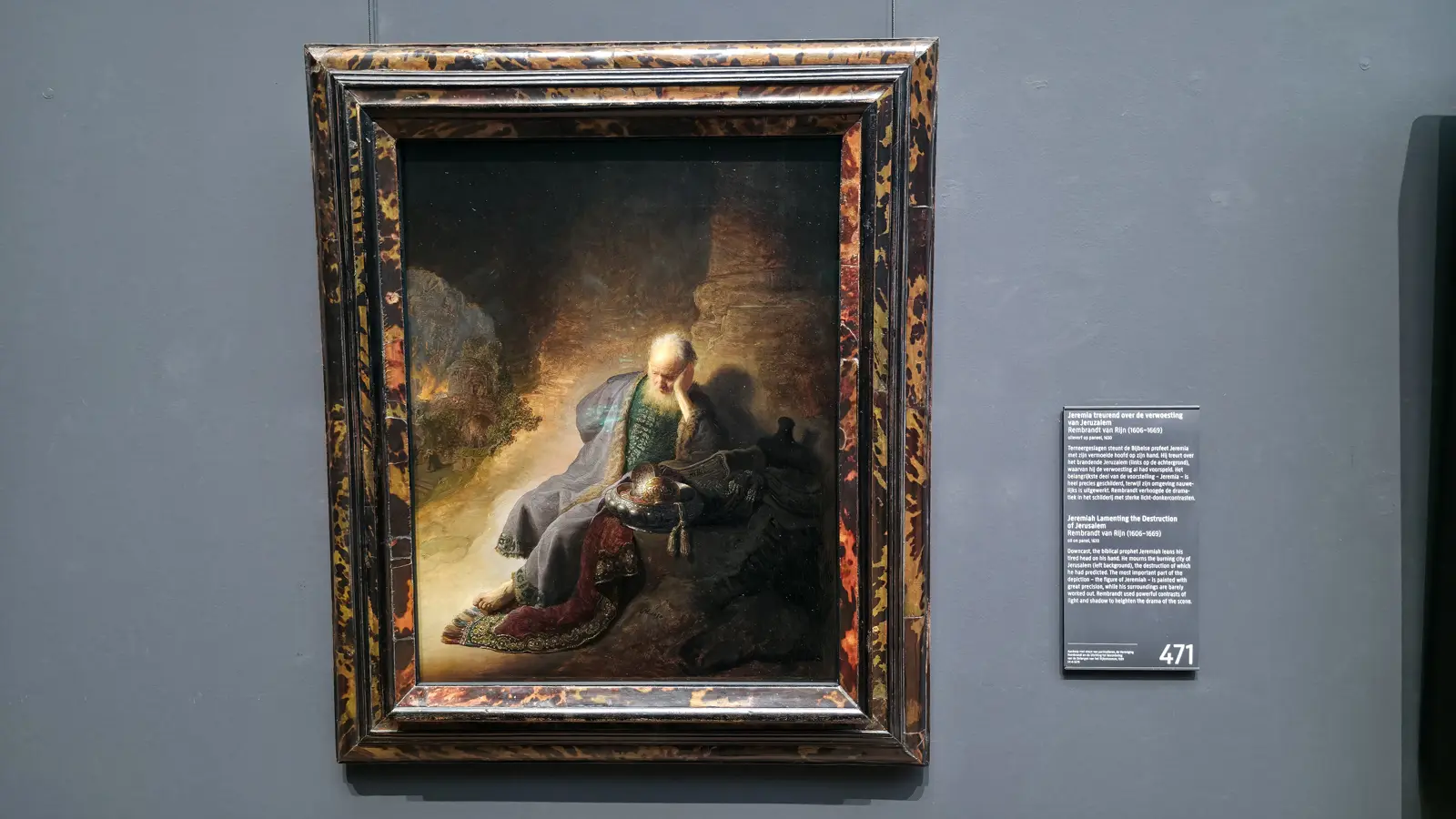
By 1630 his light was already doing the dramatic work. In Jeremiah Lamenting the Destruction of Jerusalem, the prophet leans his head on his hand while the city he warned about burns in the background at left. Rembrandt painted Jeremiah in fine detail and left the surroundings loose and barely worked out.
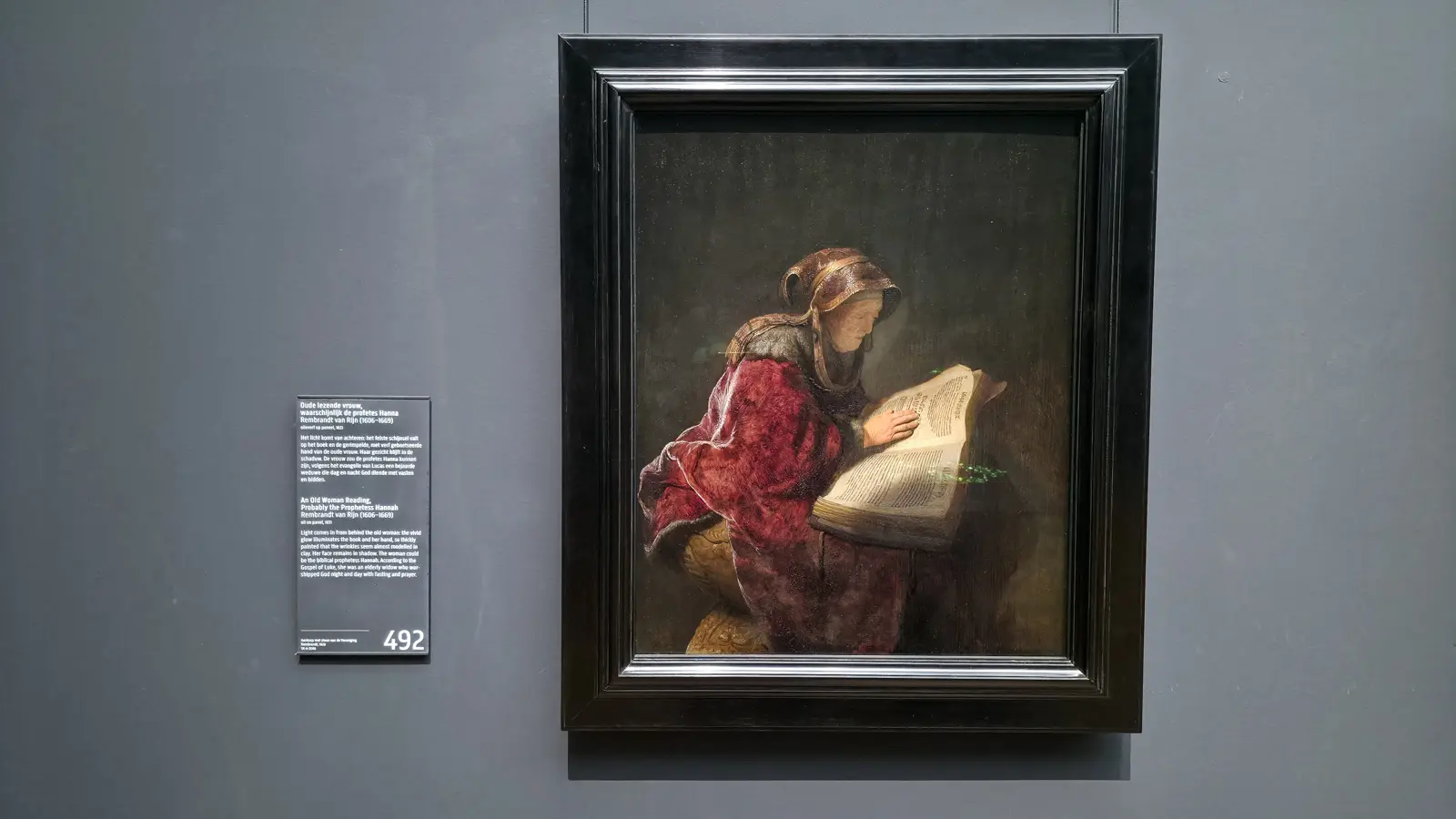
A year later came An Old Woman Reading, Probably the Prophetess Hannah. The light comes from behind her, so her face stays in shadow while the book and her hand catch the glow. The label says the hand is painted so thickly that the wrinkles look almost modelled in clay. Tradition holds that Rembrandt’s own mother posed for it.
Painting the Rich in Amsterdam
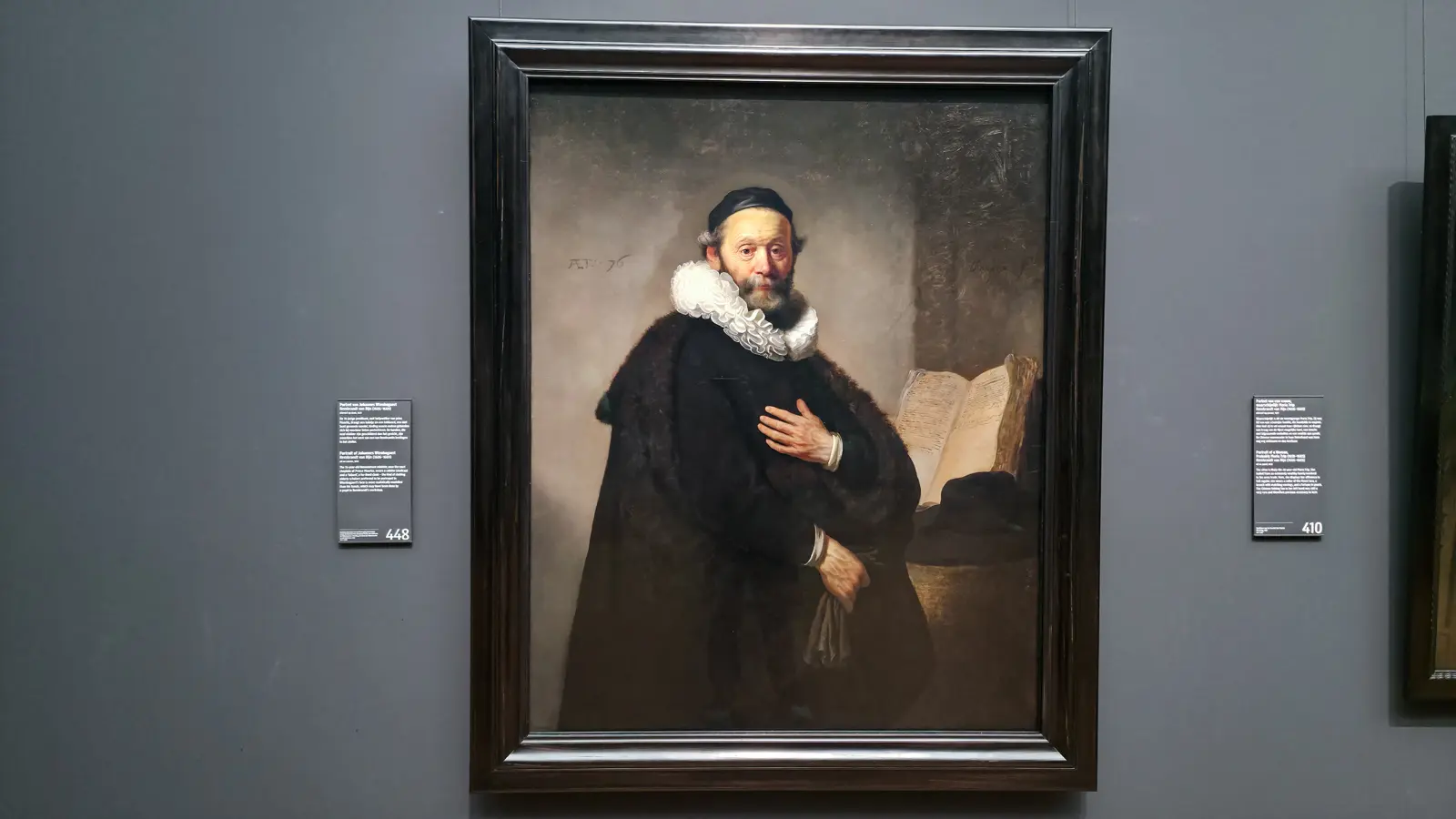
By 1633 Rembrandt was painting Amsterdam’s elite. Johannes Wtenbogaert was 76, a Remonstrant minister and once court chaplain to Prince Maurice, and the inscription at the upper left of the canvas gives his age. His face is lined and tired and entirely believable. The label adds a detail I love: his hands are less convincing than his face and may be the work of a pupil in Rembrandt’s workshop.
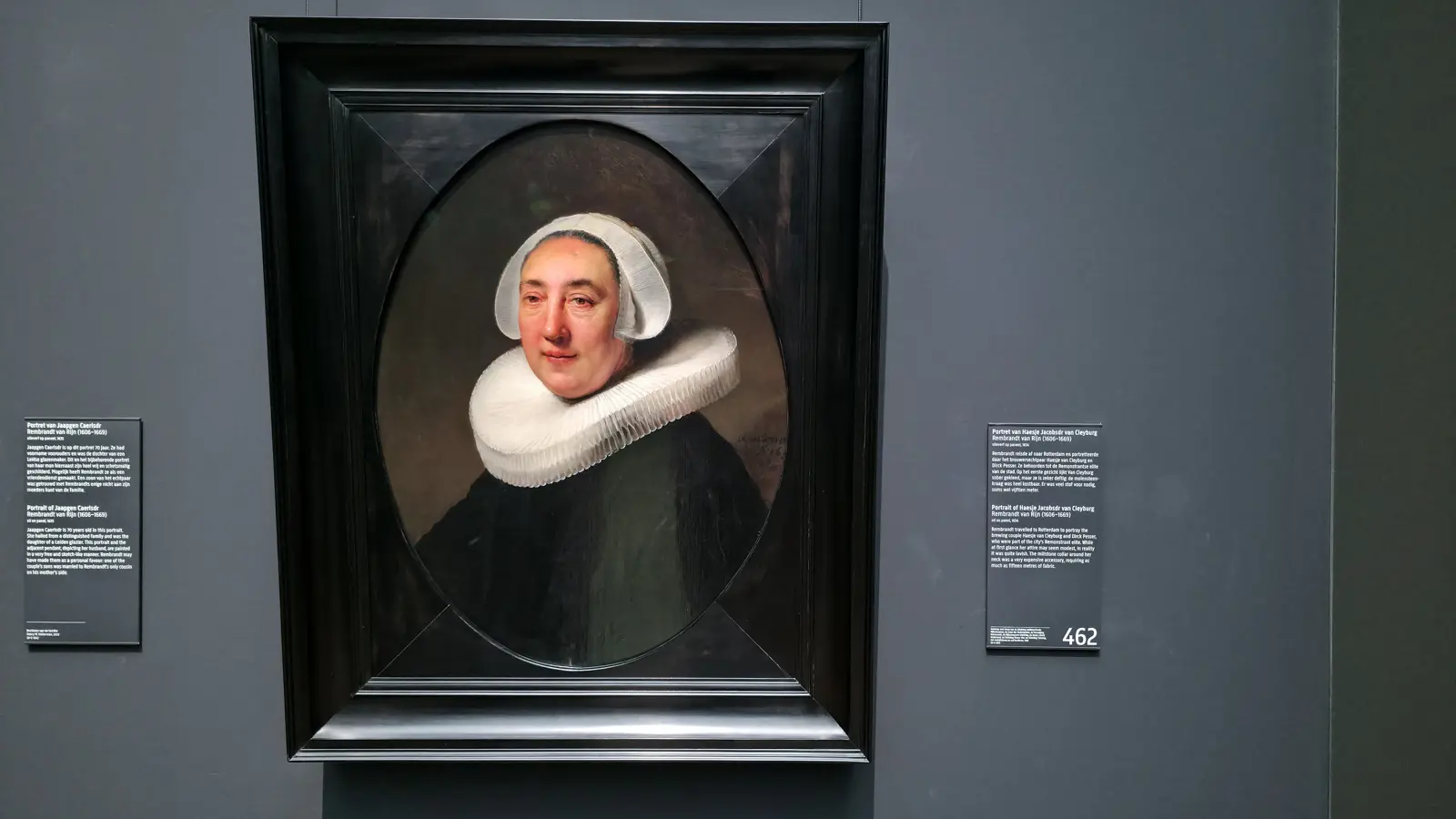
In 1634 Rembrandt travelled to Rotterdam to paint the brewer Dirck Pesser and his wife, Haesje van Cleyburg. At first glance she looks plainly dressed in black and white. The label points out what that collar cost: a millstone ruff like hers could take as much as fifteen metres of fabric. The face above it, ruddy cheeks and all, is not flattered in the slightest.
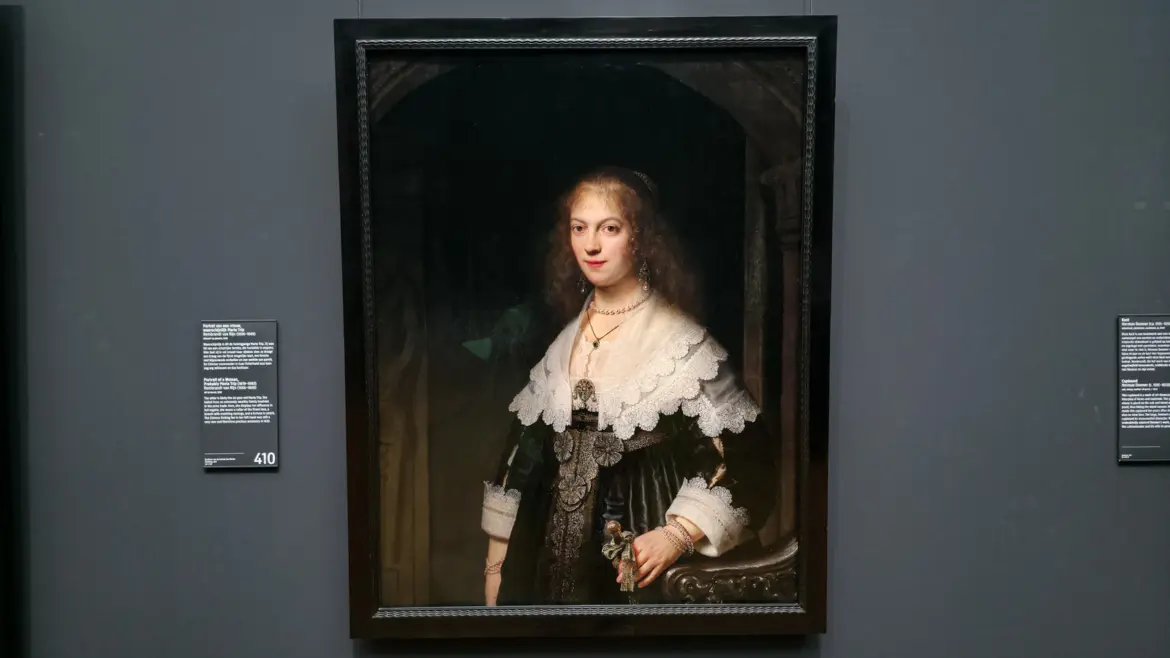
Then Maria Trip, at the top of this post. She was 20 in 1639, from a family that had grown enormously rich in the iron and arms trade. Her portrait is honest about her face and lavish about everything else: lace collar, brooch with matching earrings, pearls at her neck and both wrists, and a Chinese folding fan, which the label says was still a rare and precious accessory in 1639. If the faces in this room are the unfiltered photo, the clothes are the filter.
A Face That Is Not a Portrait
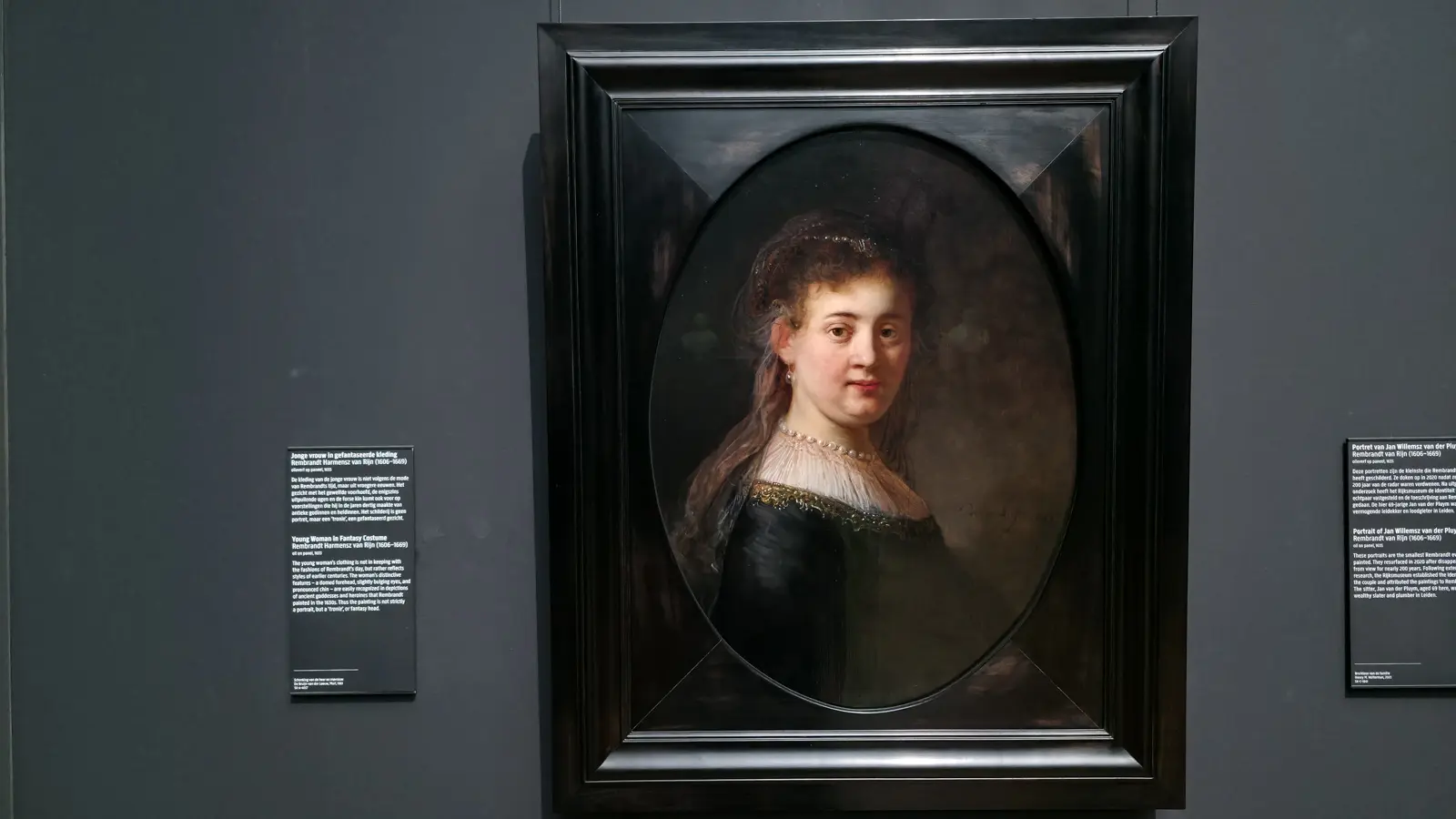
The Young Woman in Fantasy Costume, from 1633, looks like a portrait but is not one. Her dress follows no fashion of Rembrandt’s day, and the label explains that her features, a domed forehead, slightly bulging eyes and a strong chin, appear again in the goddesses and heroines he painted in the 1630s. This is a tronie, a fantasy head or study of a character, rather than a likeness of a client. Rembrandt often used family, friends or himself as models for them.
The Smallest Rembrandts
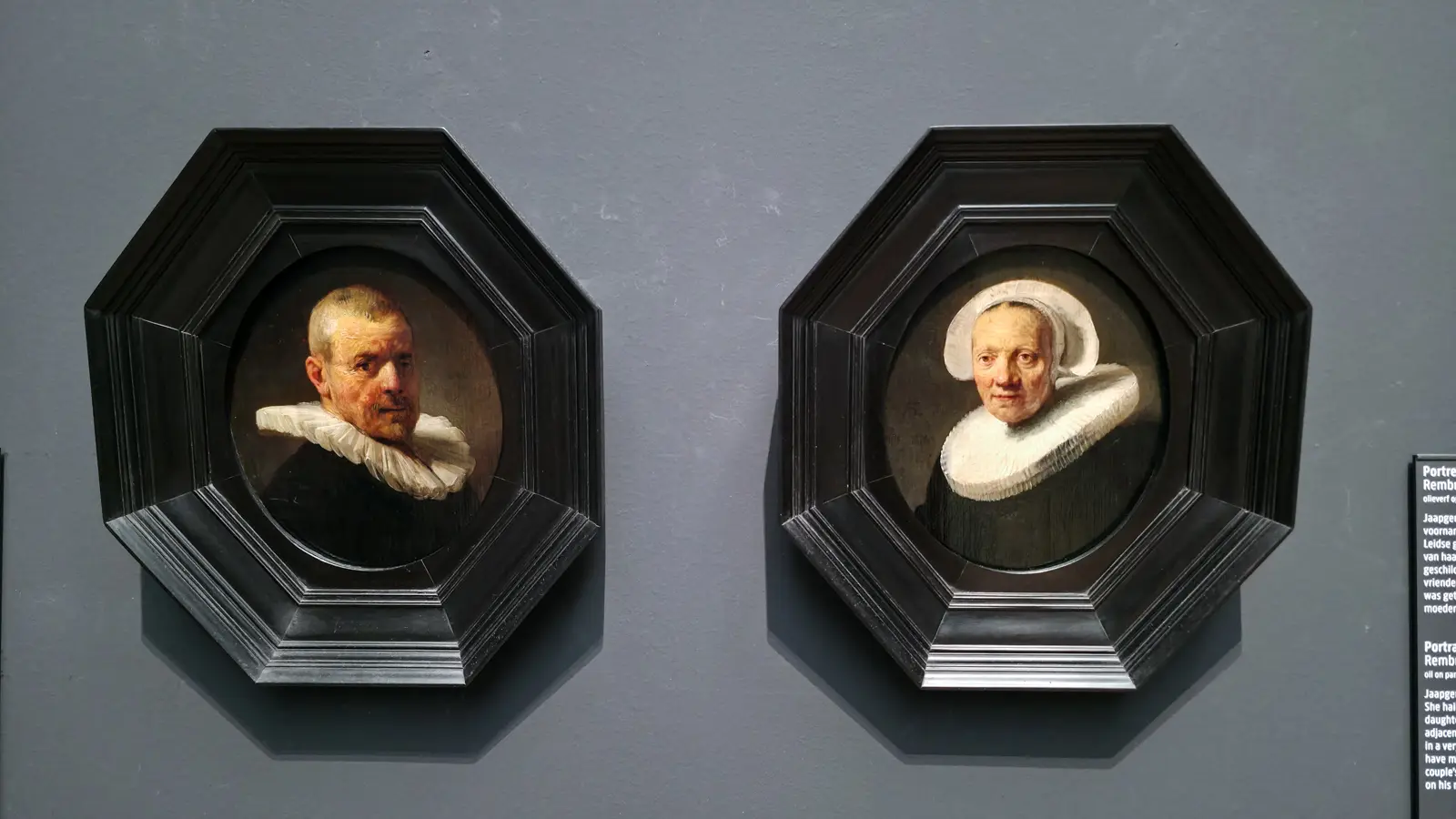
On the same wall hang two tiny octagonal frames, and inside them are the smallest portraits Rembrandt ever painted. Each oval is only about 20 centimetres high. They show Jan Willemsz van der Pluym, a wealthy slater and plumber in Leiden, and his wife Jaapgen Caerlsdr, both painted in 1635.
These two were family. Their son Dominicus married Rembrandt’s cousin on his mother’s side, and the van der Pluyms had a garden next to the one belonging to Rembrandt’s mother. The museum suggests he may have painted them as a personal favour, which would explain how freely, almost sketchily, they are done.
The Newest Rembrandt
The painting I knew least about turned out to be the newest arrival. The Vision of Zacharias in the Temple, from 1633, shows the high priest Zacharias in gold vestments, holding a book, as the Archangel Gabriel appears to him as a beam of light from the upper right.
Zacharias was shown as a Rembrandt at the big Rembrandt exhibition in Amsterdam in 1898, then struck from his work in 1960. Only recently did its owner bring it to the Rijksmuseum, where two years of research confirmed it as a Rembrandt. It went on display on 4 March 2026, so when I saw it at the end of April it had been on the wall for less than two months.
Bubbly Tips
- Book online before you go. The Rijksmuseum sells tickets online only, with time slots.
- Photograph freely, but no flash. Photography is allowed with a ticket, without tripods or extra lighting.
- See the early room before the Gallery of Honour. Seeing the 1620s and 1630s first makes the late self-portraits and the Night Watch more striking.
- Get close to the miniatures. At about 20 centimetres high, Jan and Jaapgen are easy to walk past from across the room.
- Compare Wtenbogaert’s face with his hands. The label suggests a pupil may have painted the hands, and once you know, the difference is hard to miss.
- Find the age inscription. On the Wtenbogaert portrait, the lettering at the upper left gives the sitter’s age as 76.
- Look for the signature on the Old Woman Reading. RHL 1631 sits at the bottom left of the panel.
- Stand between Jeremiah and Zacharias. The museum used Jeremiah to help confirm Zacharias, and they hang close together.
- Read Maria Trip’s accessories like a price list. Lace, pearls, a brooch, matching earrings and a Chinese fan: each one was chosen to be noticed.
Final Thoughts
I came to the Rijksmuseum for the Night Watch and left thinking about a 76-year-old minister’s tired eyes and a plumber’s wife from Leiden in a portrait barely 20 centimetres high. The famous paintings are worth the crowds. This room shows how Rembrandt got there.
His sitters chose the lace and the pearls. He chose to paint their faces exactly as they were. Almost four hundred years later, that is still what makes them look alive.
Until next time!

🌟 Everything You Need to Plan Your Dream Trip in 2026
- 🌟 Luxury Hotels - Find premium stays with Booking.com & Hotels.com
- 🏡 Vacation Rentals - Discover unique properties on VRBO
- 🏞️ Guided Tours - Explore with Viator or GetYourGuide
- 🎫 Attraction Tickets - Skip the lines with Tiqets
- 🚢 Ocean Cruises - Set sail with Cruise Direct
- 📱 International SIMs - Stay connected with Saily
- 🚗 Car Rentals - Budget-friendly options from Discover Cars
- 🌐 Secure VPNs - Browse safely with NordVPN
- 💶 Currency Exchange - Best rates with Wise
- 🗣️ Learn Languages - Master the local language with Babbel and Rosetta Stone