
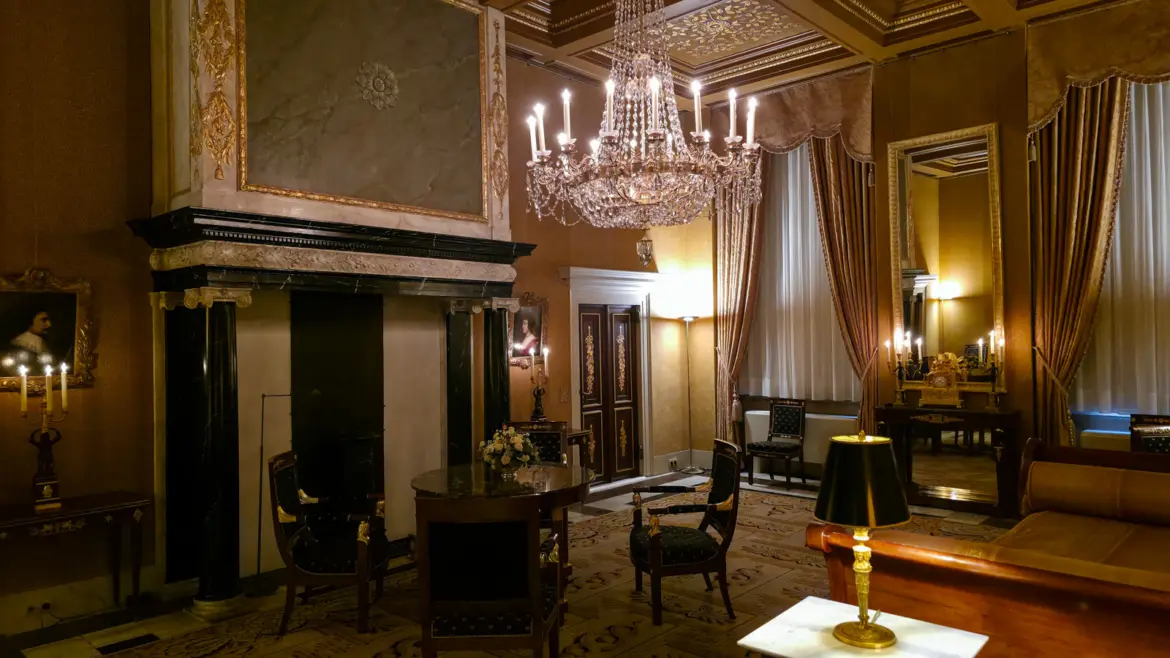
I have already written about the Royal Palace on Dam Square as the town hall it was built to be: the marble Citizens’ Hall, Atlas carrying the heavens, the Vierschaar where death sentences were read. Walking through the upper rooms, though, I kept asking myself a different question. Whose taste is all this?
The chandeliers, the gilded chairs, the canopied beds and the mahogany clocks are so ornate and so royal that they look nothing like a city hall. They belong to a king. Not Napoleon himself, as I first half remembered, but his younger brother.
Louis Bonaparte’s Rooms at a Glance
👑 Who · Louis Bonaparte, Napoleon’s younger brother, made King of Holland in 1806 — he furnished Amsterdam’s town hall as his palace in 1808.
⏳ How long · Barely two years: he entered Amsterdam on 20 April 1808 and abdicated on 1 July 1810.
🪑 What you see · The Royal Apartment and state rooms, each a single colour, filled with Empire furniture — much of it Dutch-made and still in use.
🏛️ Two layers · 17th-century town hall above (marble, carved reliefs, Golden Age paintings); 1808 palace furnishing below.
💡 Tip · Check the calendar (the palace closes for royal use), take the audio guide, and give it a few hours.
Who Was Louis Bonaparte?
In 1806 Napoleon made his brother Louis King of Holland, a new kingdom he created to strengthen France’s hold on the Netherlands. Louis lived in The Hague at first, then decided the capital of his kingdom should be Amsterdam, the country’s economic centre. He made his triumphal entry into the city on 20 April 1808, and the only building he judged fit for a palace was the town hall on Dam Square.
He did not keep it long. Louis took the side of his Dutch subjects too often for his brother’s liking, and on 1 July 1810 he abdicated. Napoleon annexed the Netherlands into the French Empire. The King of Holland had lived in his Amsterdam palace for barely two years.
The Royal Apartment
The rooms Louis meant to live in are known today as the Royal Apartment. Each one is decorated in a single colour, with the walls, curtains and upholstery all matching.
The long salon is the warmest of them: rose-brown walls, a gilded coffered ceiling, a crystal chandelier, and a carpet in a repeating pattern of squares that runs the whole length of the room. The palace closed to visitors from 2005 to 2009 while the interior was restored, which is why the colours look so fresh today.
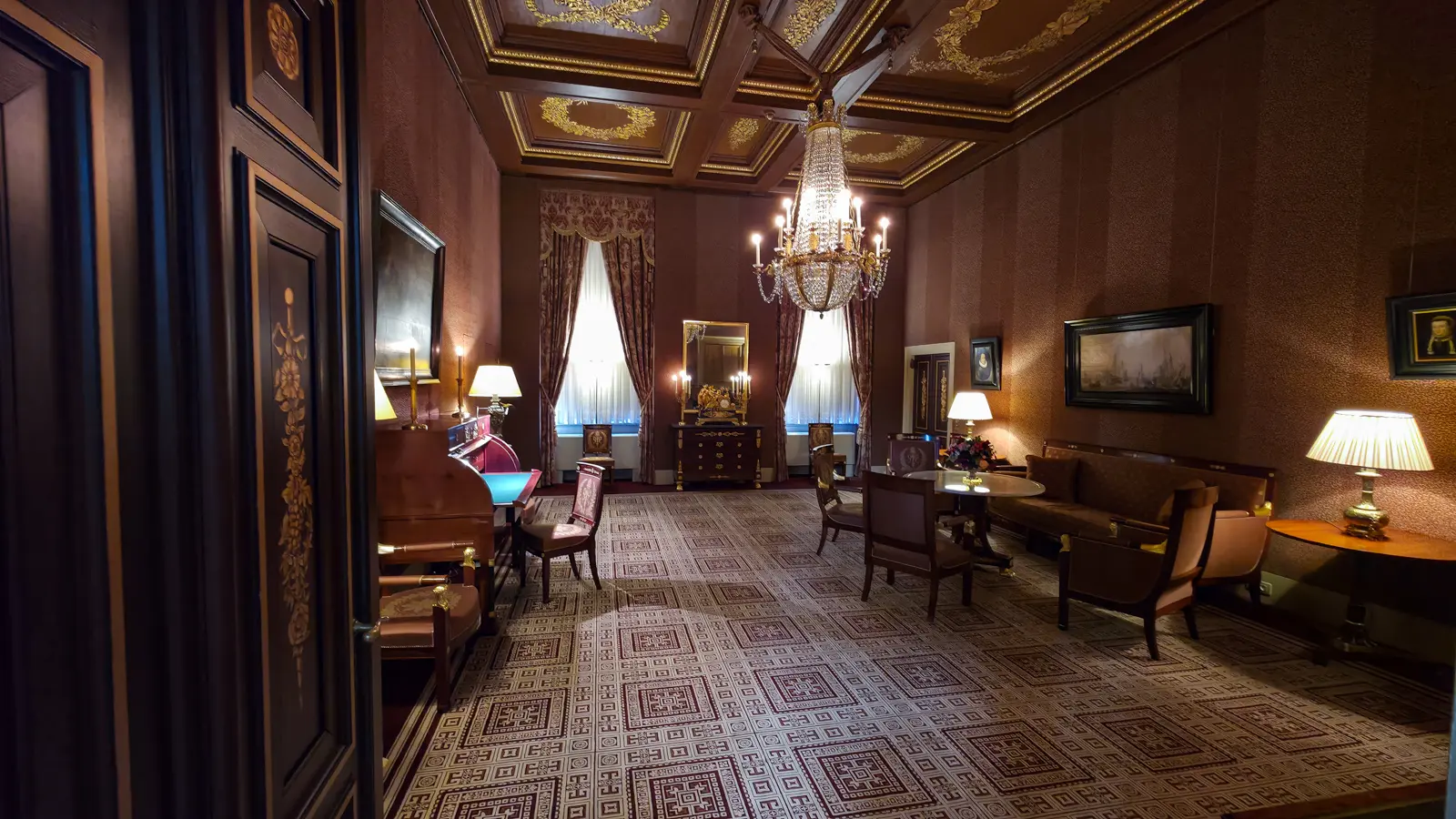
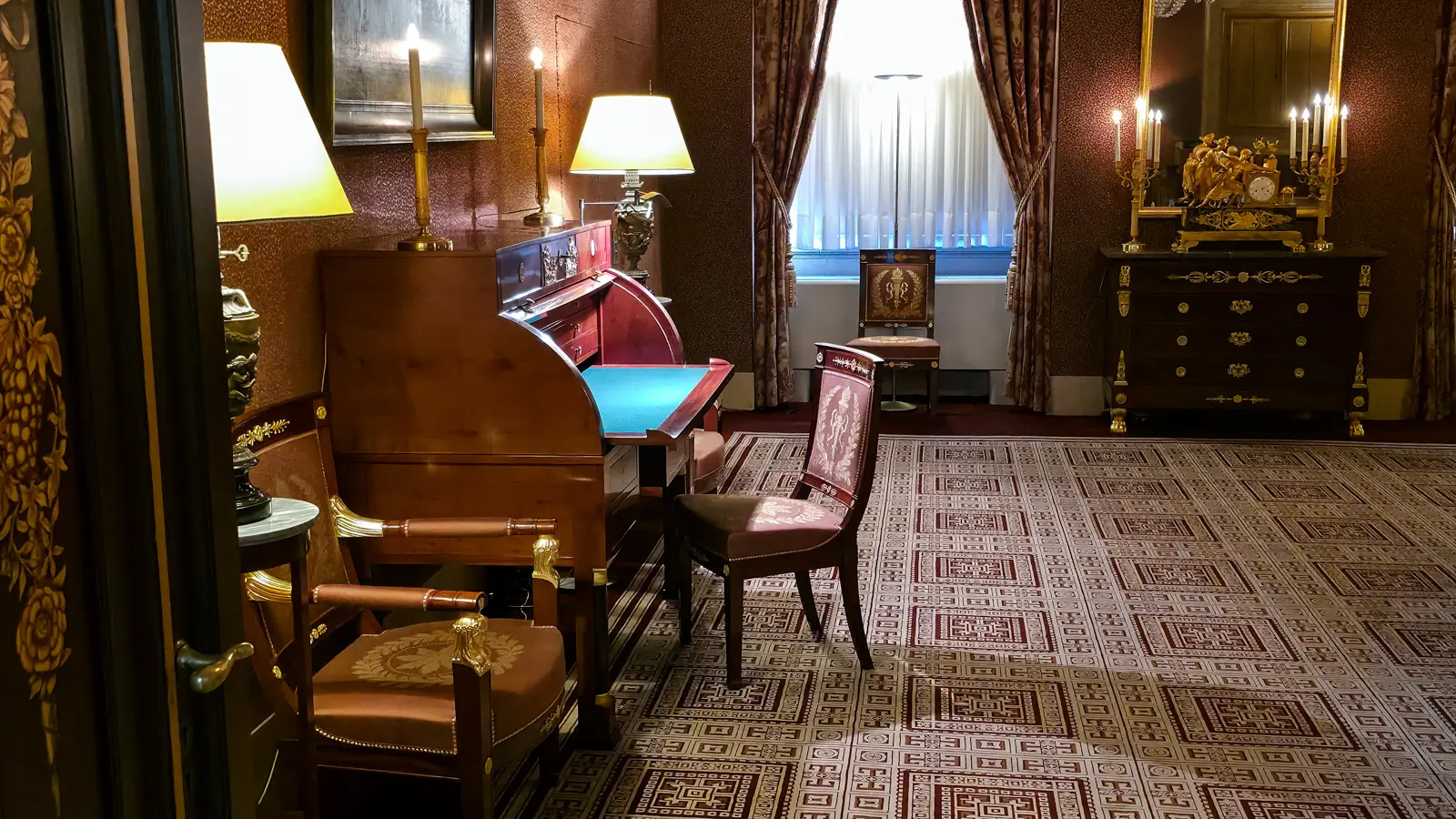
In one corner, a roll-top writing desk stands open beside a pair of candlesticks, with an armchair and side chair pulled up to it, as if someone had just stepped away.
What “Empire Style” Means
Empire style was the fashion of Napoleon’s court. It set out to revive the magnificence of the Roman emperors, which suited Napoleon perfectly, and once spotted, its motifs are everywhere in this building.
On the chairs, look for burning torches tied with ribbons inside laurel wreaths, embroidered into the upholstery. On the arms, look for carved swans’ necks. On the cabinets, look for gilt bronze sphinxes, griffins and arrows. The mahogany is dark, the mounts are gold, and the shapes are straight and solemn.
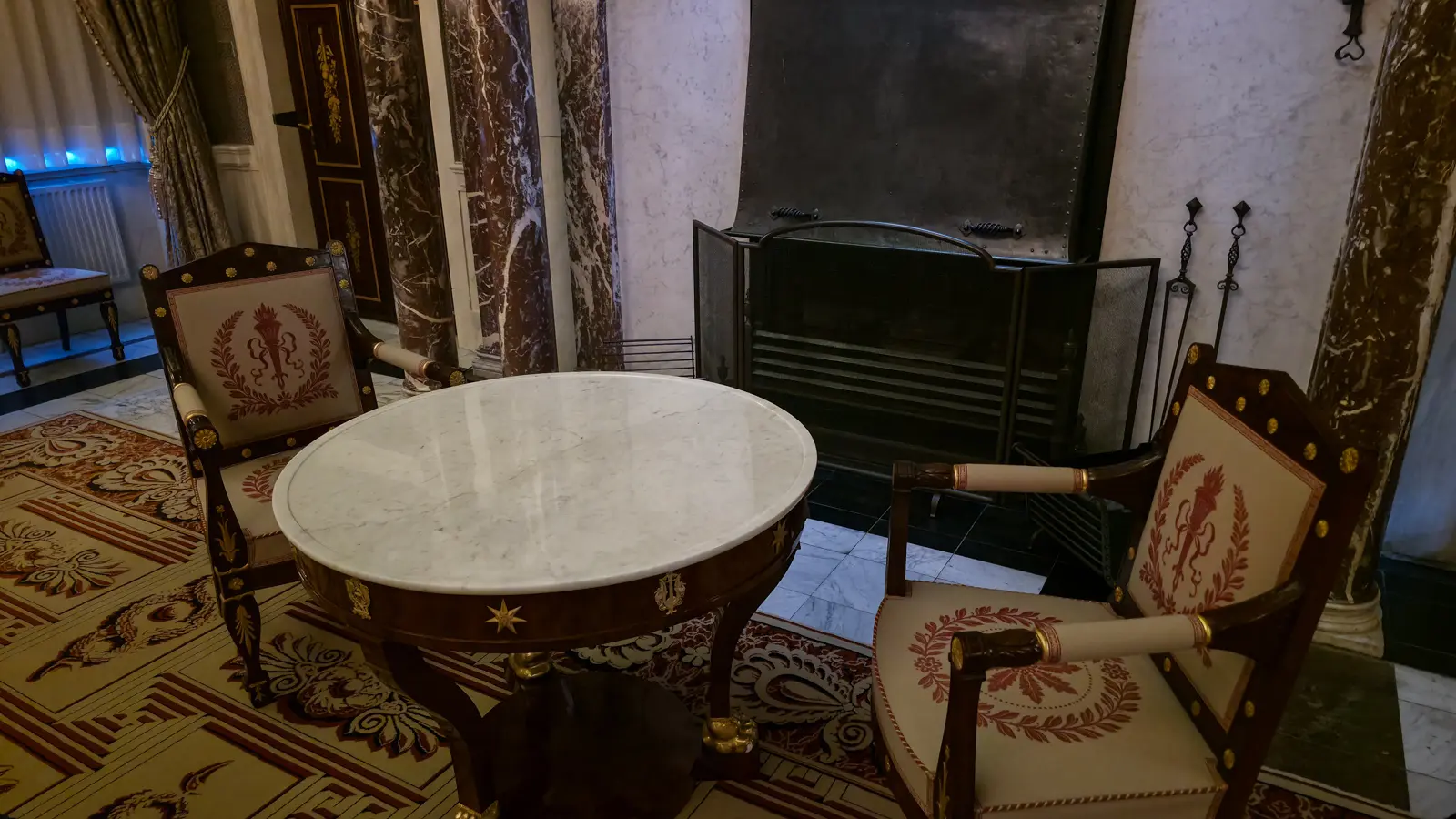
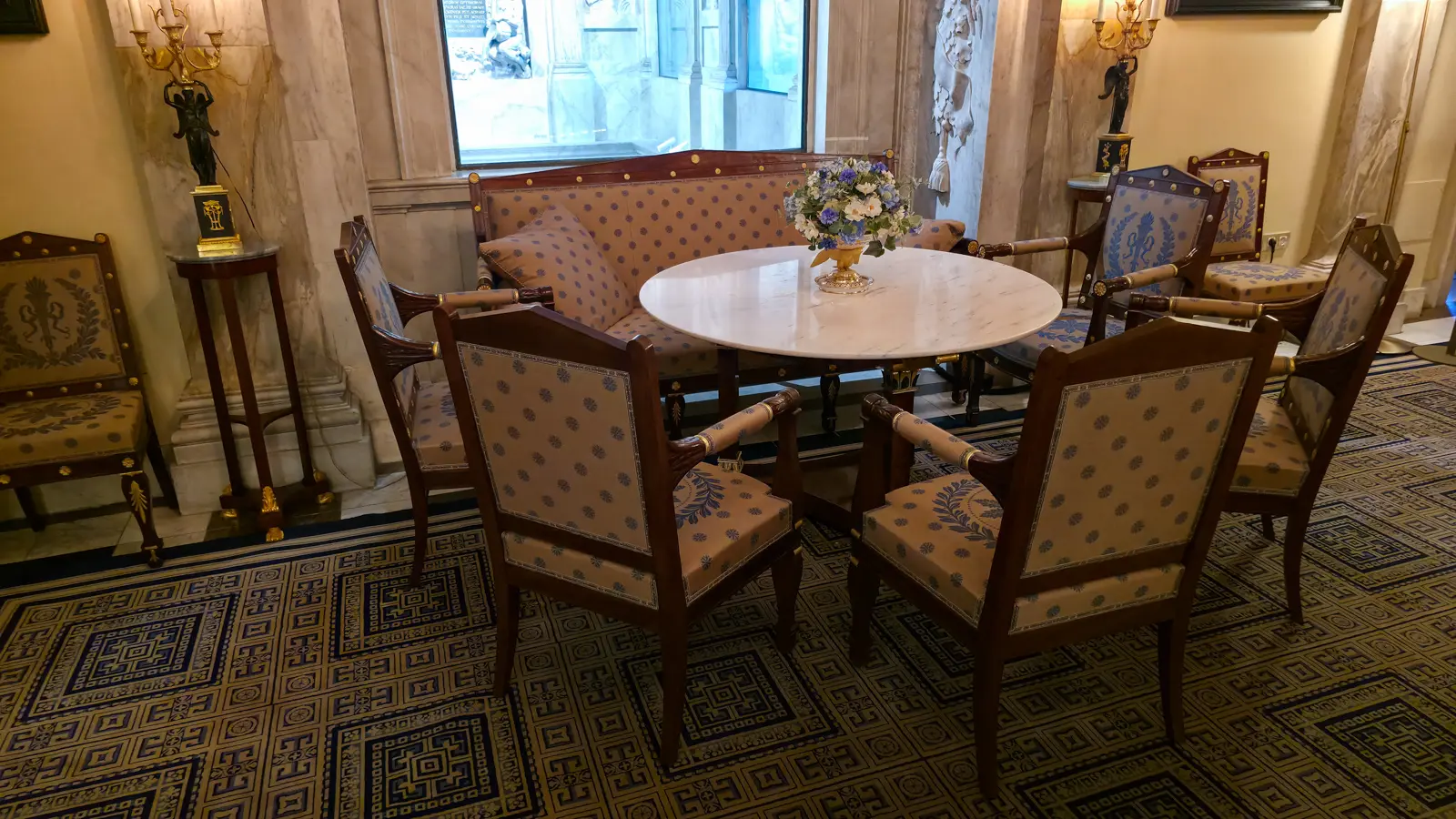
The same torch-and-laurel pattern turns up in blue as well as red, on a settee and armchairs grouped around a white marble table.
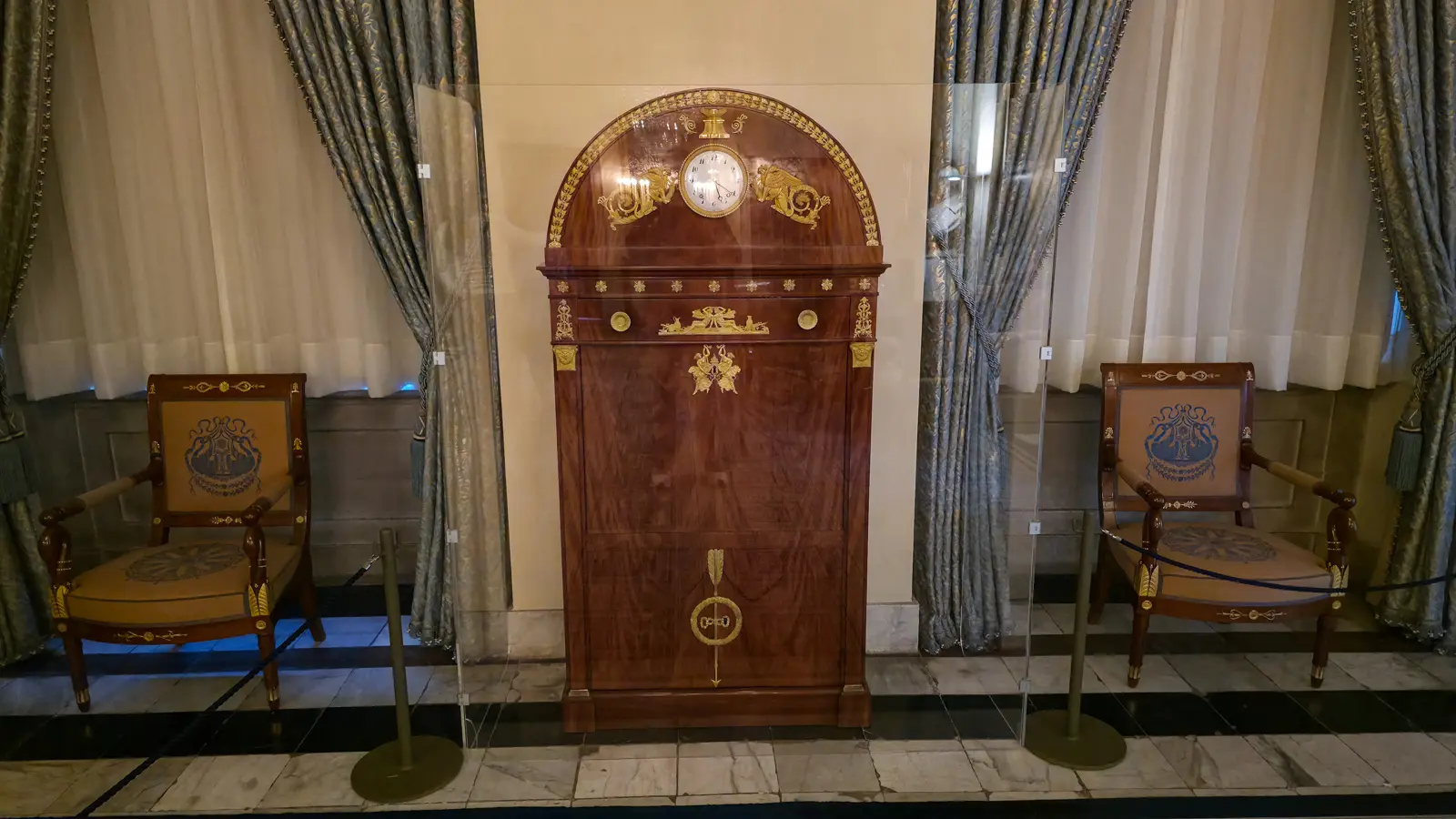
The smaller pieces are just as elaborate. A tall secretaire stands between two armchairs, its arched top crowned with a clock flanked by winged gilt creatures, and an arrow running through the keyhole below.
Golden Age Walls, French Furniture
This is the part I find most interesting. The rooms themselves are not Louis’s work. The marble chimneypieces, the carved reliefs, the painted ceilings and the huge paintings set above the fireplaces were all there when the building was Amsterdam’s town hall in the 17th century. Louis added the furniture, the curtains and the chandeliers. Every room is two layers, a century and a half apart.
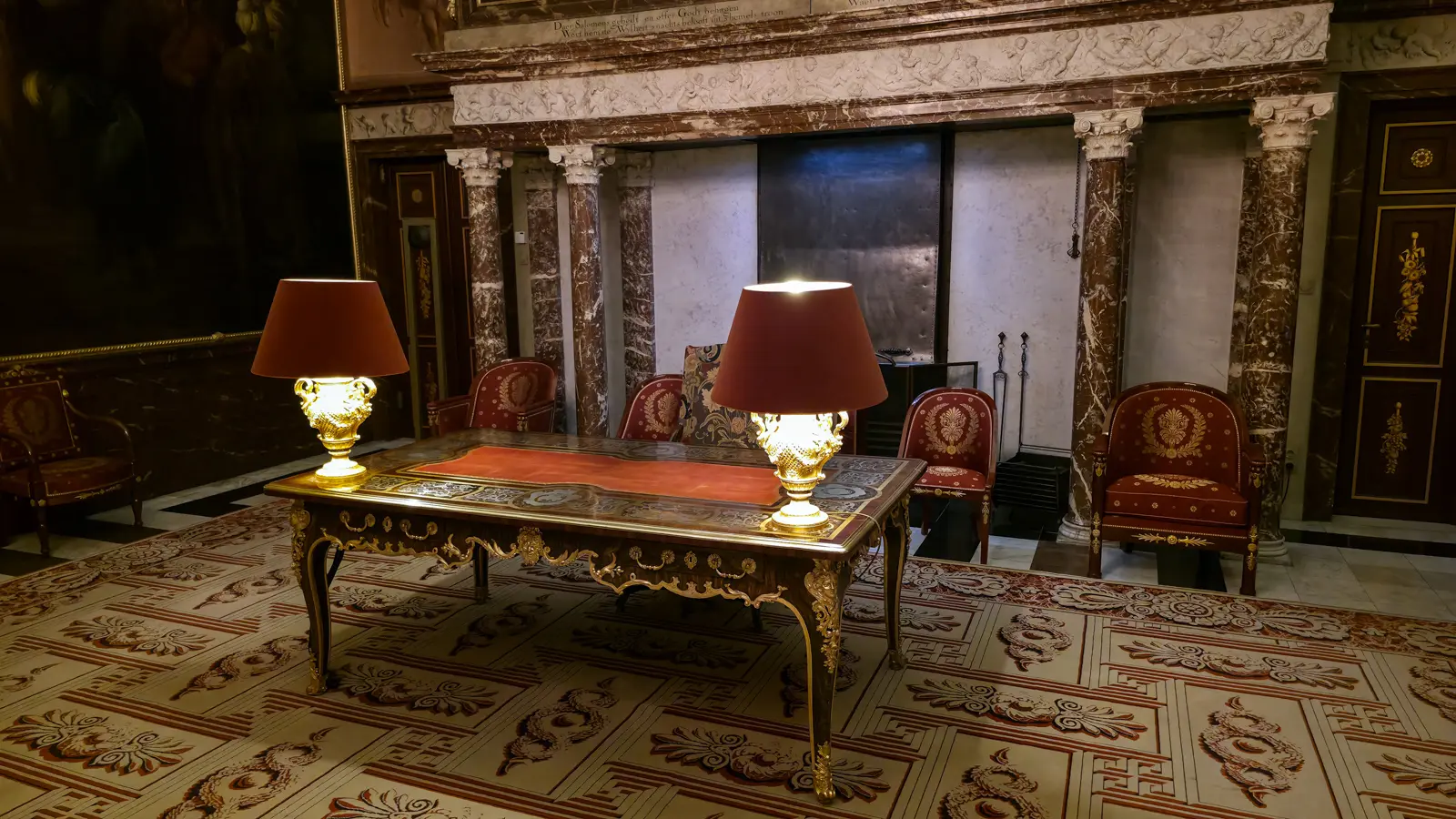
The Moses Hall shows it best. A gilt-mounted desk and rows of red Empire armchairs stand in front of a chimneypiece of red and white marble columns.
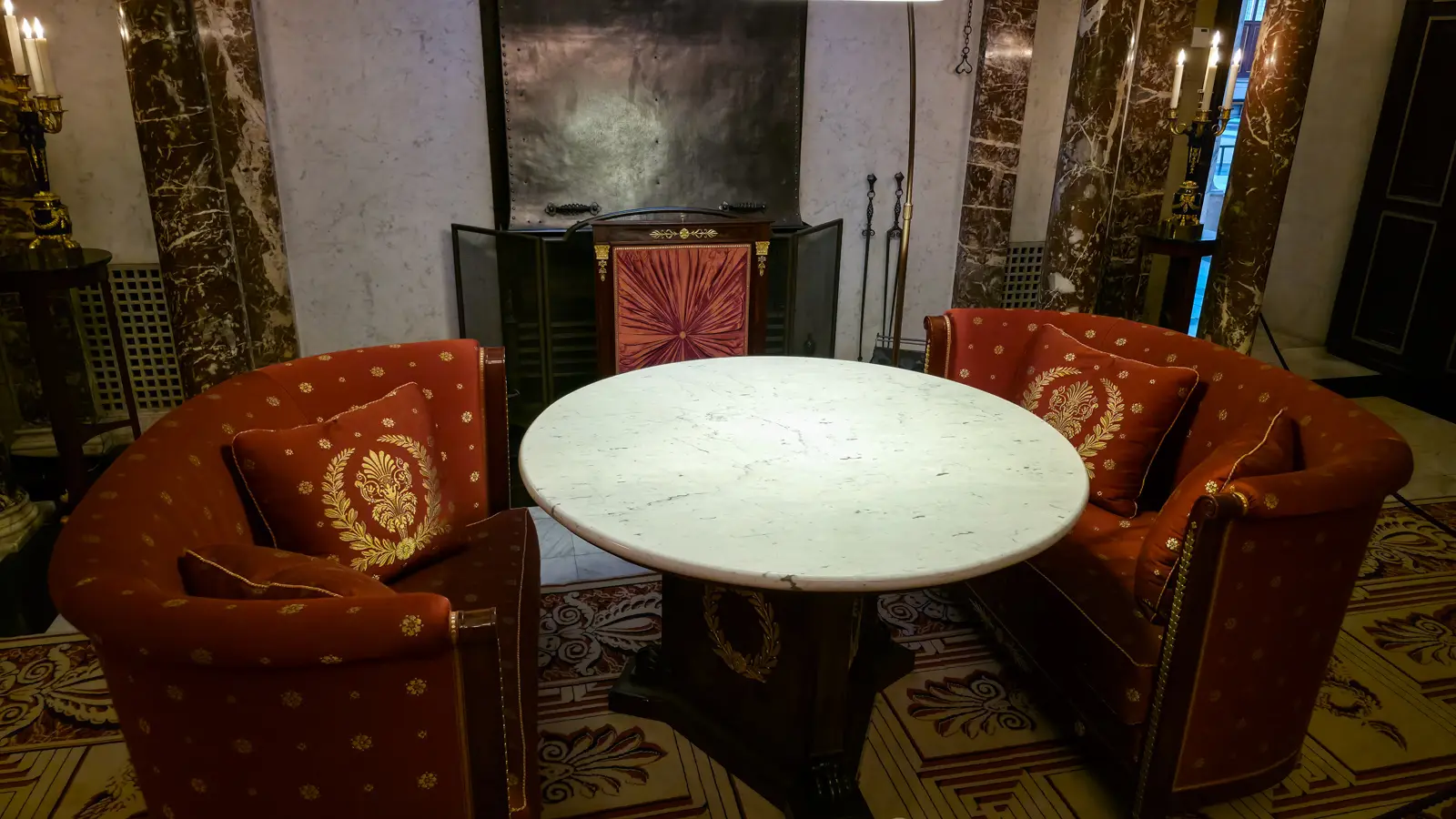
Around a white marble table by the fireplace, two red tub chairs embroidered in gold sit facing each other.
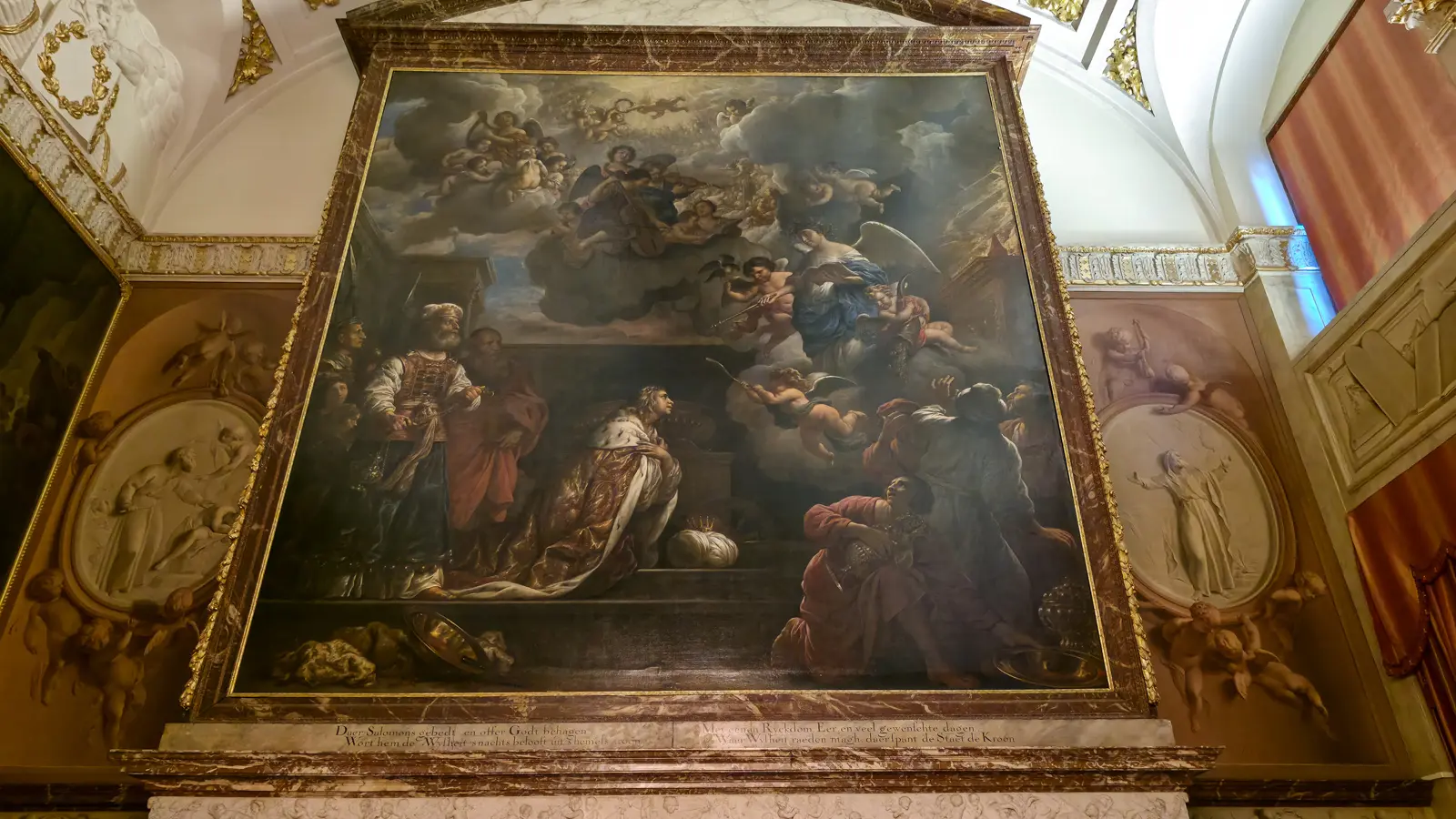
Above the fireplace hangs a painting that is pure Golden Age. Govert Flinck, a former pupil of Rembrandt, painted Solomon kneeling to pray for wisdom, with the verses beneath it in 17th-century Dutch. It was a message for the city’s rulers, who met in this room and needed wisdom too.
The Bedrooms and the Insurance Chamber
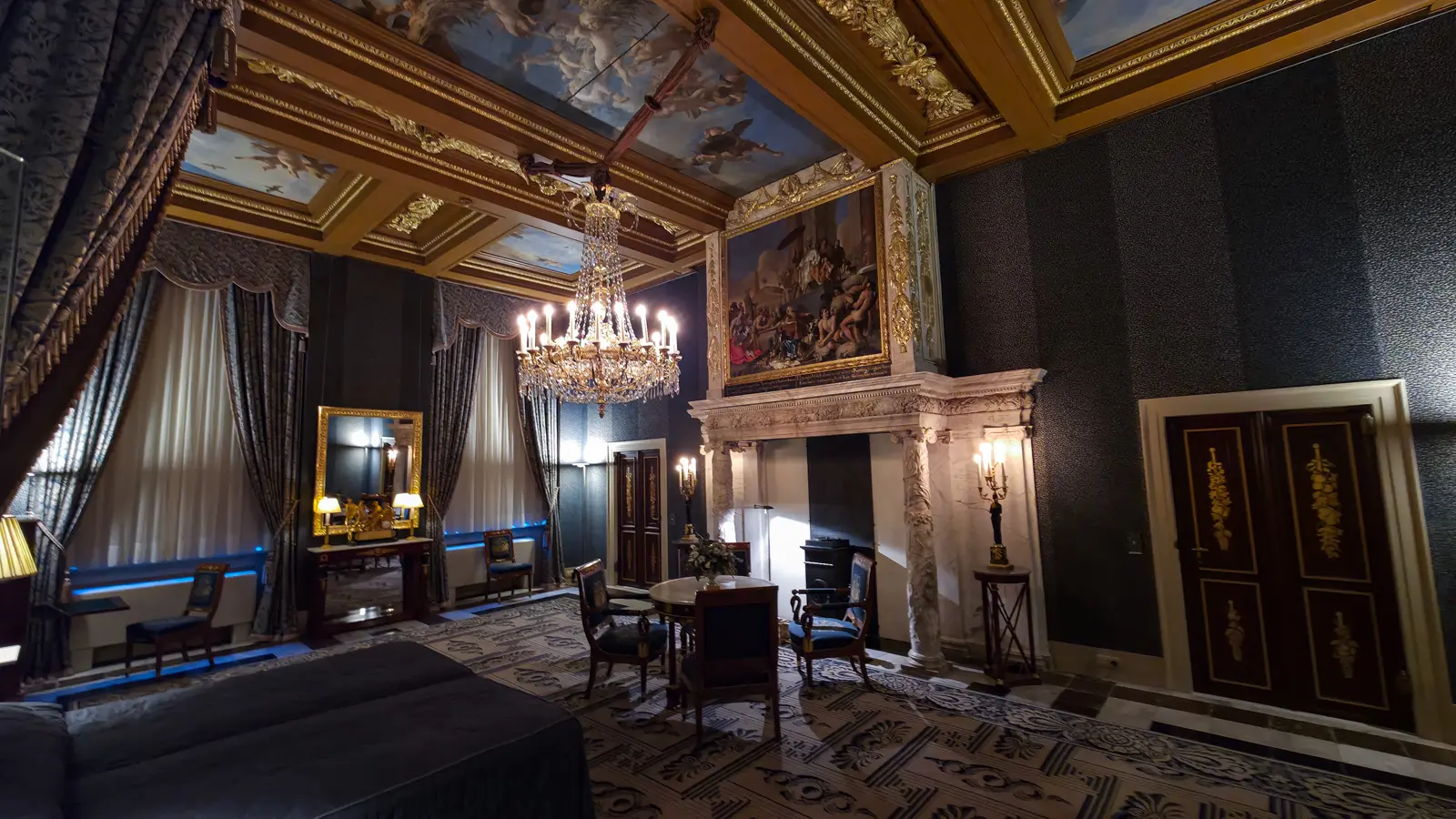
The first blue bedroom is the most dramatic room on the route. Its painted ceiling panels and its marble chimneypiece with a large painting are from the town hall years. The canopied bed, the blue and gold chairs and the crystal chandelier belong to the Empire refurnishing.
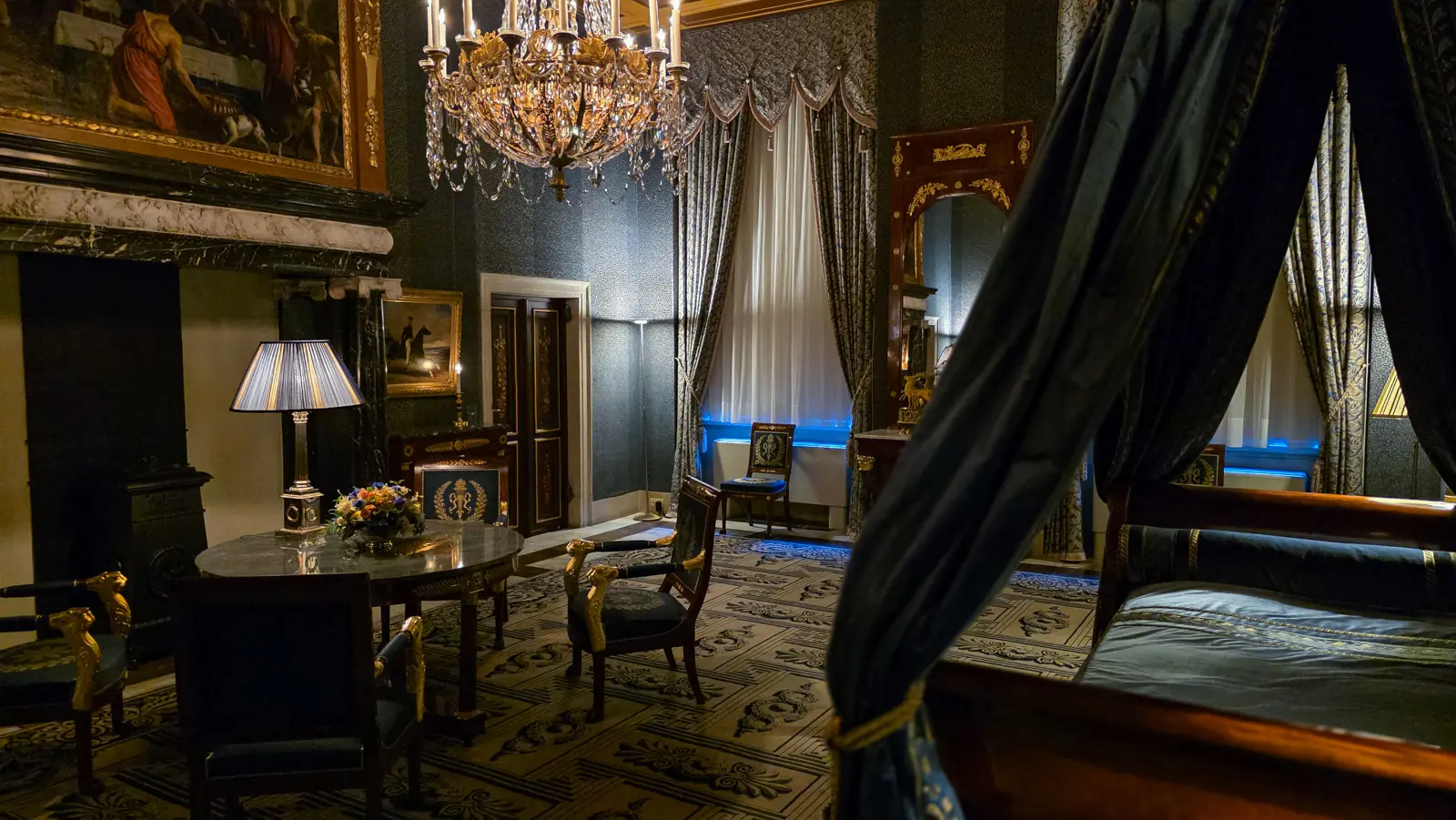
Further along the route, a second bedroom in deeper blue has its own canopied bed, its dark drapes framing a table and chairs beside a black marble fireplace.
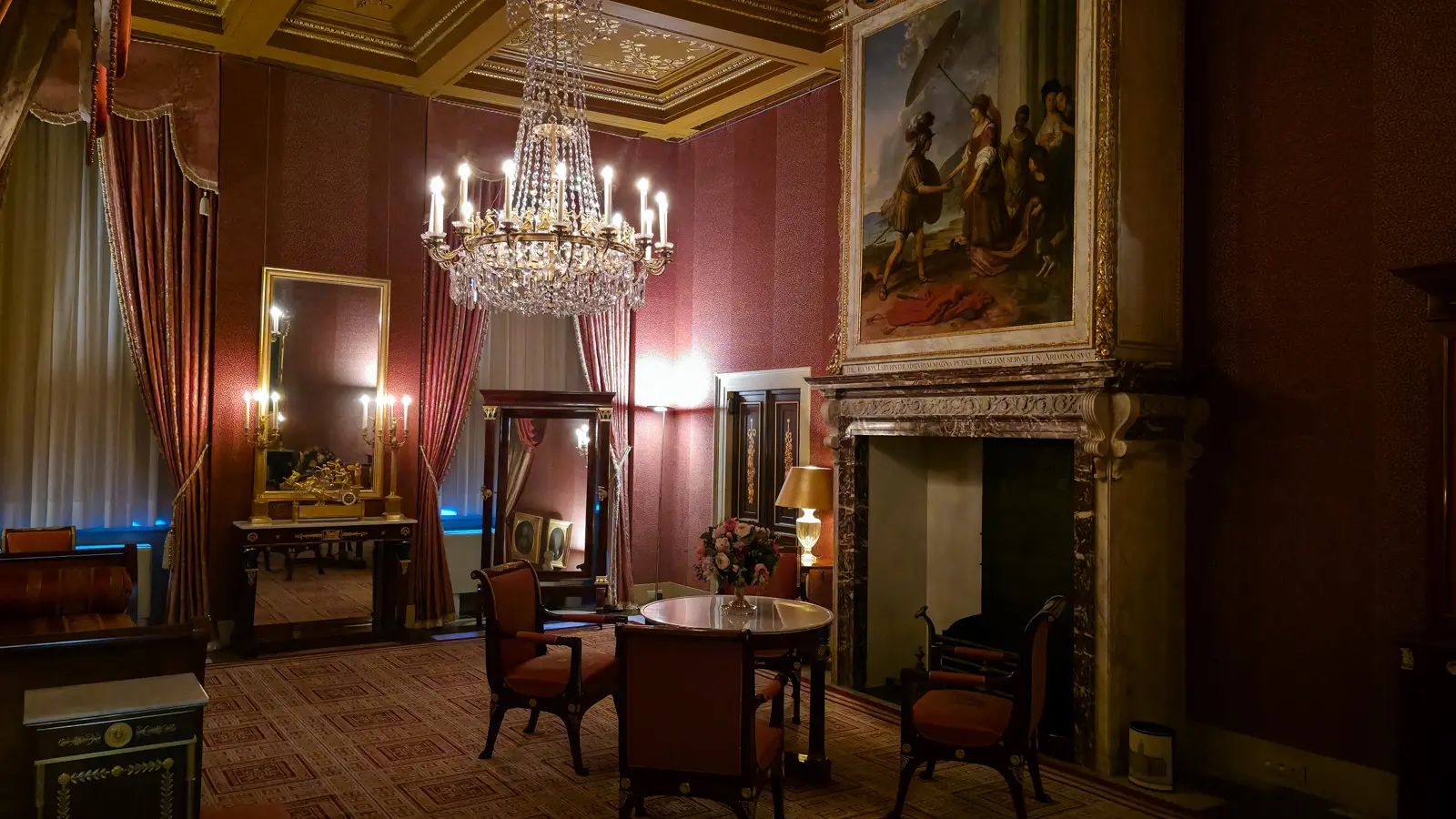
The last room on my route was in deep red, with a mirror flanked by candelabra, an Empire cheval glass and a painting set high over the fireplace. The painting is Willem Strijcker’s Theseus and Ariadne, from 1657, and it gives away what the room was before Louis arrived. Theseus is handing back the ball of thread that led him out of the labyrinth. According to the palace, it alludes to the room’s town hall role as the Insurance Chamber: the thread stands for insurance, bringing sailors and their cargoes safely home.
After Louis
So whose taste is it? The building belongs to Amsterdam’s merchants, and the furniture belongs to a French king who stayed two years. That mix is what makes it different from a palace built around a court. This one is a city hall that a king furnished, and it has never quite stopped being both.
Today the Dutch royal family does not live here. The palace is used for state visits, New Year receptions and other official occasions, and after walking through these rooms I understand why. They were built to impress visitors in 1655, and they were furnished to impress them again in 1808.
Bubbly Tips
- Check the calendar before you go. The palace closes to visitors whenever the Royal House is using it.
- Take the audio guide. The rooms are numbered on standing signs, which makes the route easy to follow.
- Read each room in two layers. Look up for the 17th-century town hall: ceilings, marble and paintings. Look down for Louis’s Empire furniture.
- Spot the Empire motifs. Torches, laurel wreaths, swans, sphinxes and arrows appear on chairs, clocks and cabinets throughout.
- Find the verses under the paintings. The Dutch inscriptions beneath the chimneypiece paintings explain the lesson each one taught the city’s rulers.
- Look out of the windows. Some of them look straight onto Dam Square.
- Pair it with the Rijksmuseum. Louis brought the national art collection to this building in 1808, long before it moved to Museumplein.
- Visit Budapest’s Museum of Applied Arts. A suite of white and gold Empire furniture there probably came from this palace.
- Give it a few hours. I spent three hours with the audio guide and could have used four.
Final Thoughts
Louis Bonaparte arrived in Amsterdam in April 1808 and was gone by the summer of 1810. In those two years he turned the city’s town hall into a palace, filled it with hundreds of pieces of Empire furniture, and brought the national art collection to Amsterdam, where it would grow into the Rijksmuseum.
The building he chose was already grand enough for a king. He simply furnished it like one.
Until next time!

🌟 Everything You Need to Plan Your Dream Trip in 2026
- 🌟 Luxury Hotels - Find premium stays with Booking.com & Hotels.com
- 🏡 Vacation Rentals - Discover unique properties on VRBO
- 🏞️ Guided Tours - Explore with Viator or GetYourGuide
- 🎫 Attraction Tickets - Skip the lines with Tiqets
- 🚢 Ocean Cruises - Set sail with Cruise Direct
- 📱 International SIMs - Stay connected with Saily
- 🚗 Car Rentals - Budget-friendly options from Discover Cars
- 🌐 Secure VPNs - Browse safely with NordVPN
- 💶 Currency Exchange - Best rates with Wise
- 🗣️ Learn Languages - Master the local language with Babbel and Rosetta Stone