
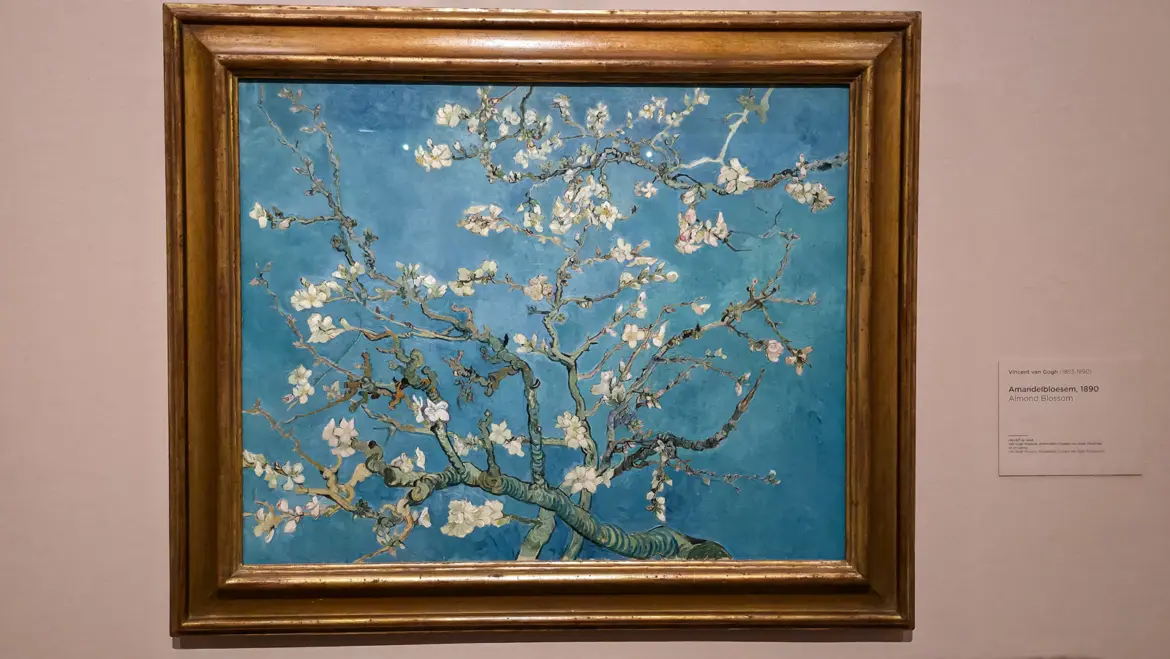
Almond Blossom is my favourite Van Gogh. I came home with it on a magnet and a coaster, because of what it stands for. Almond trees flower early in spring, and for him they were a symbol of new life. He painted it as a gift when his brother’s son was born, and that story is why it stays with me.
What I did not know, until I walked through the Van Gogh Museum in Amsterdam, was how often he painted blossom and flowers. Apart from the Irises, which I knew from mugs and other souvenirs, I had no idea he came back to them again and again. Many of them look Japanese, Almond Blossom most of all. He admired Japanese art, and it shows.
Van Gogh’s Blossoms and Flowers at a Glance
🌸 The star · Almond Blossom (1890), painted as a gift for the birth of Van Gogh’s nephew and namesake, Vincent Willem — almond trees flower early, so for him they meant new life.
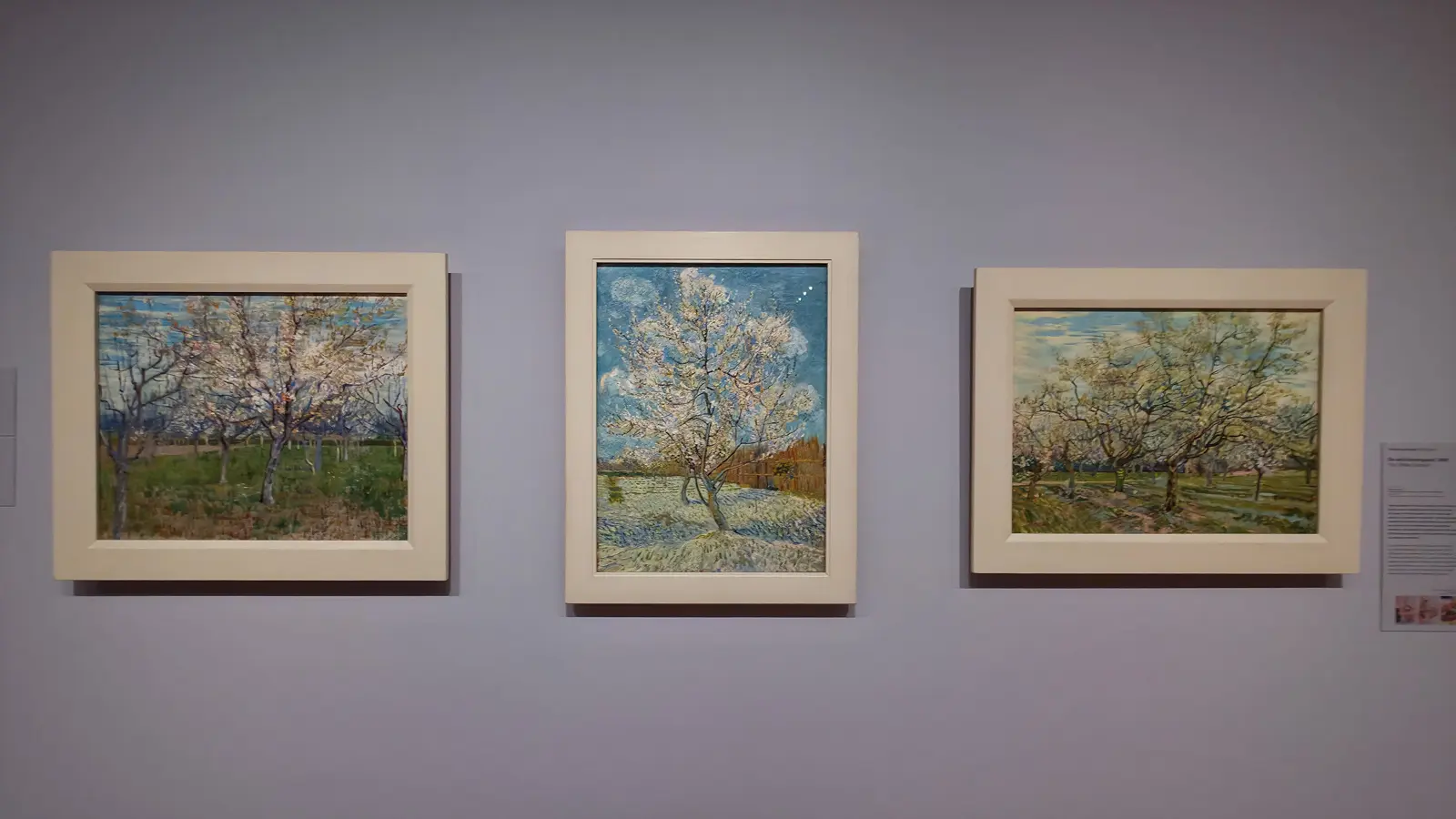
🌳 The orchards · In one month in spring 1888, newly arrived in Arles, Van Gogh painted around fourteen canvases of fruit trees in blossom. Three of them hang together as the triptych he designed.
🌼 The Irises · The 1890 bouquet looks blue, but he painted it purple — the red pigment has faded. The pastel-background version hangs at the Met in New York.
🇯🇵 The influence · Almond Blossom’s branches running off every edge, with no trunk or horizon, come straight from the Japanese prints he collected by the hundred.
💡 Tip · Stand back from the orchard wall first and take the three canvases in as one piece, the way Van Gogh sketched them.
Spring in Arles, 1888
Van Gogh arrived in Arles in February 1888. Within weeks the orchards were in flower, and in the space of a month he painted fourteen canvases of fruit trees in blossom.
The White Orchard is one of them: rows of trees in white blossom, their trunks and branches drawn in dark lines against a pale sky.
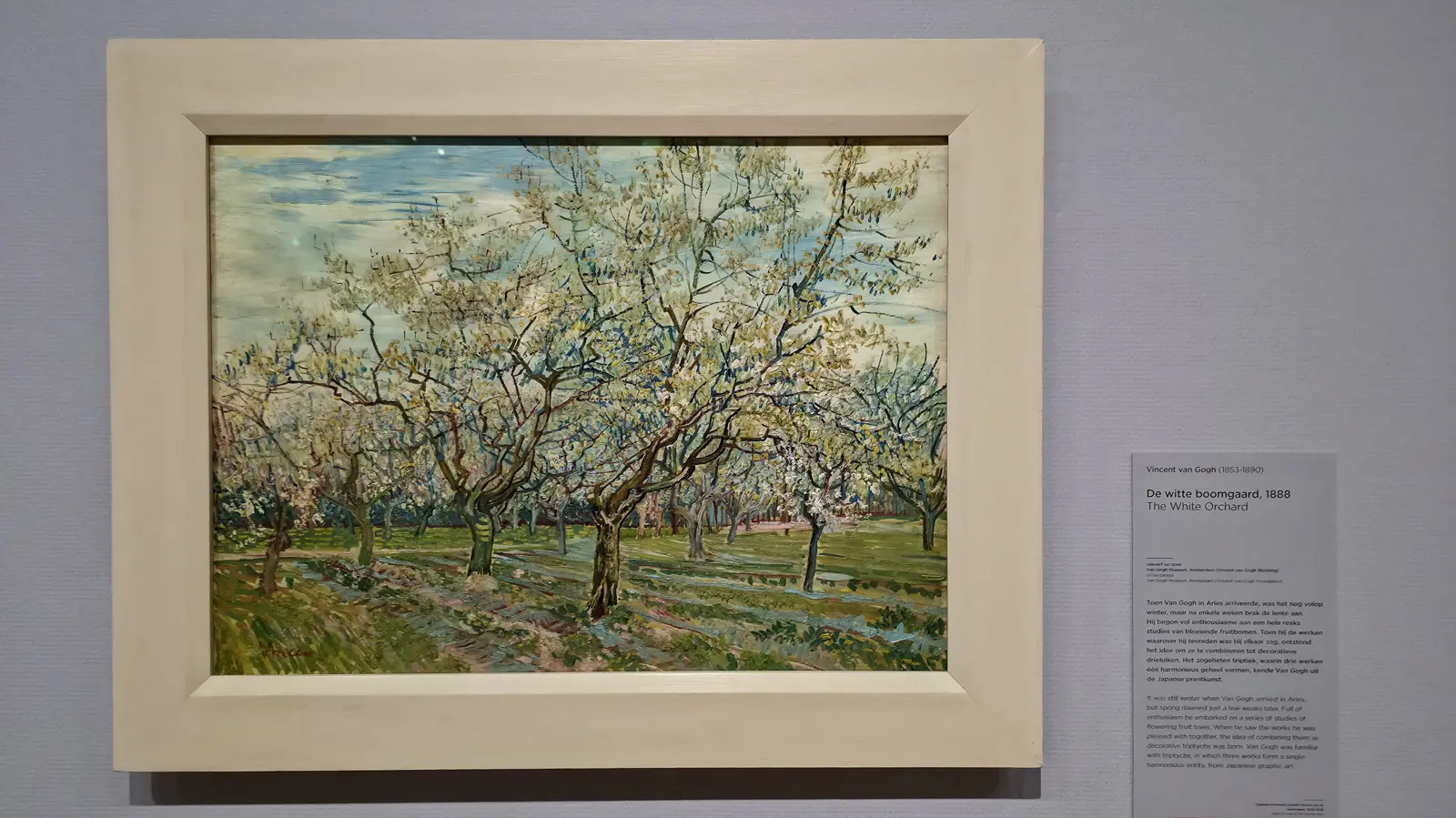
When he saw the best of them side by side, he had the idea of grouping them in threes. He knew the triptych, three works that form one whole, from Japanese prints. The museum hangs The Pink Orchard, The Pink Peach Tree and The White Orchard together on one wall. The Pink Peach Tree in the centre repeats an earlier, almost identical canvas that he dedicated to the painter Anton Mauve after hearing of his death.
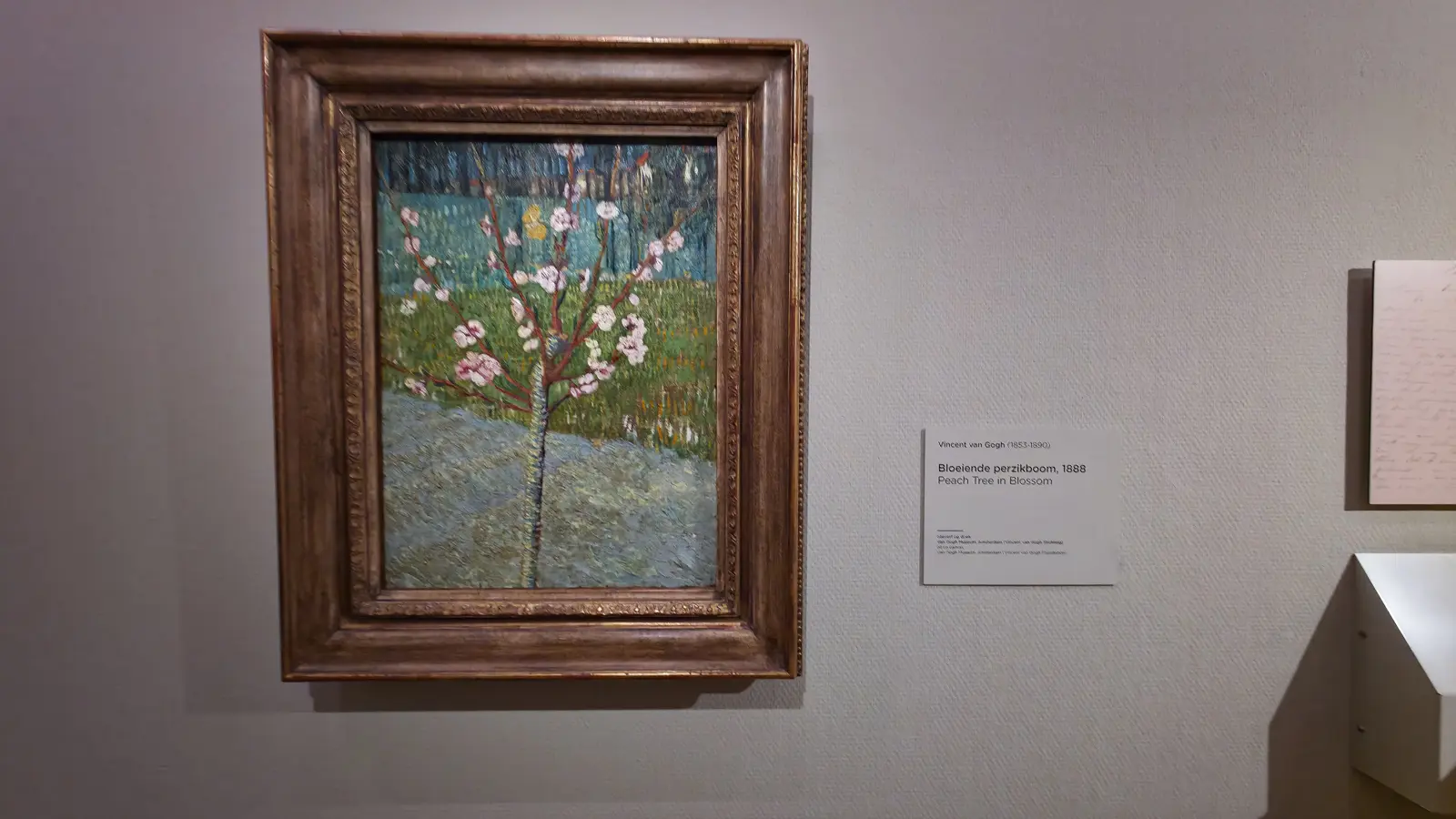
Peach Tree in Blossom, from the same spring, is smaller. It is a single young tree, pink flowers on thin red branches, set against a green field and a blue-grey path.
Another Spring, 1889
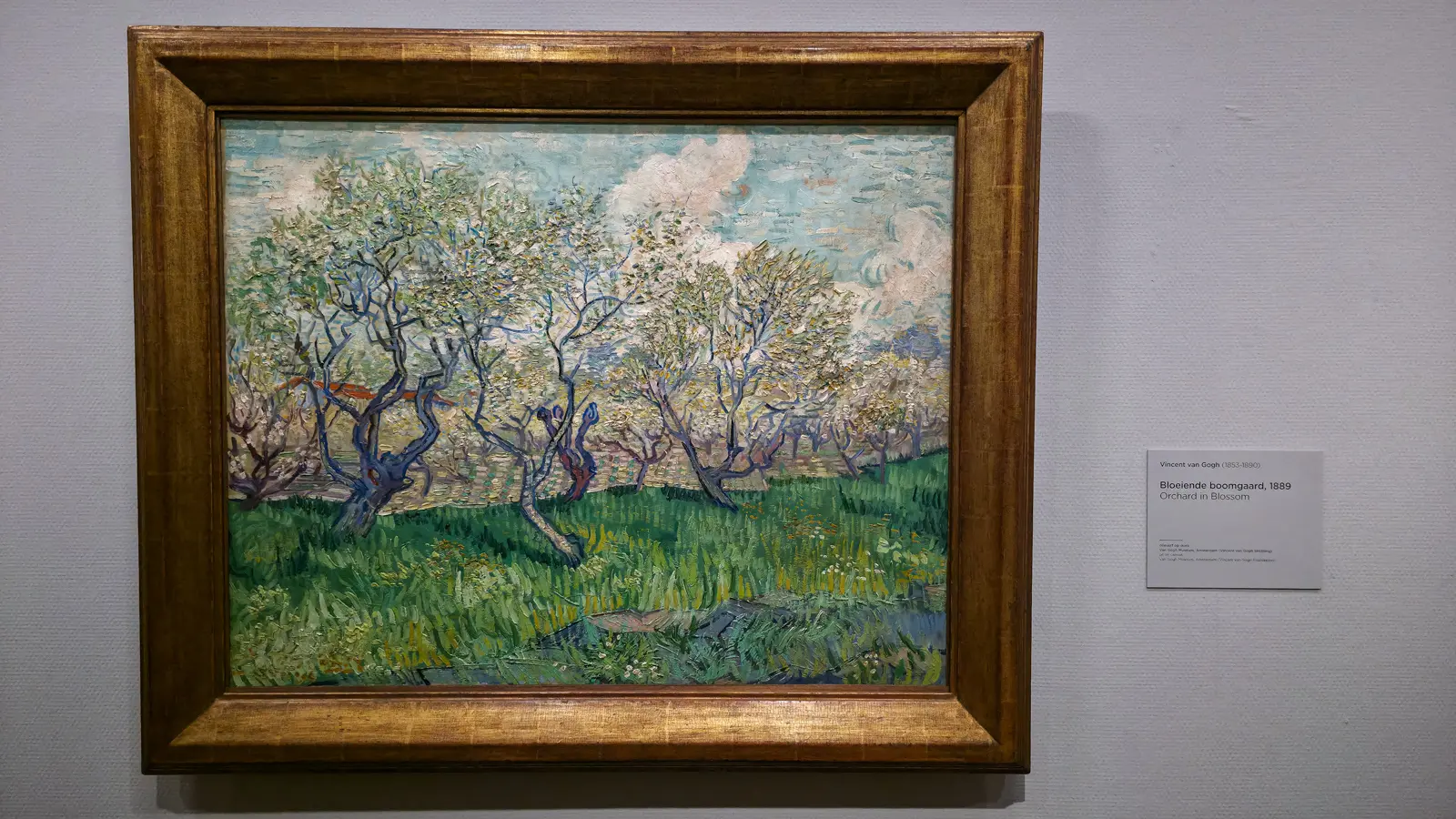
A year later he painted blossom again. Orchard in Blossom, from 1889, is from his second spring in Arles, a few weeks before he admitted himself to the asylum at Saint-Rémy in May. It is looser than the orchards of 1888: twisted blue trunks, thick white and green dabs for the flowers, and a sky full of short strokes.
The Asylum Garden, 1889 to 1890
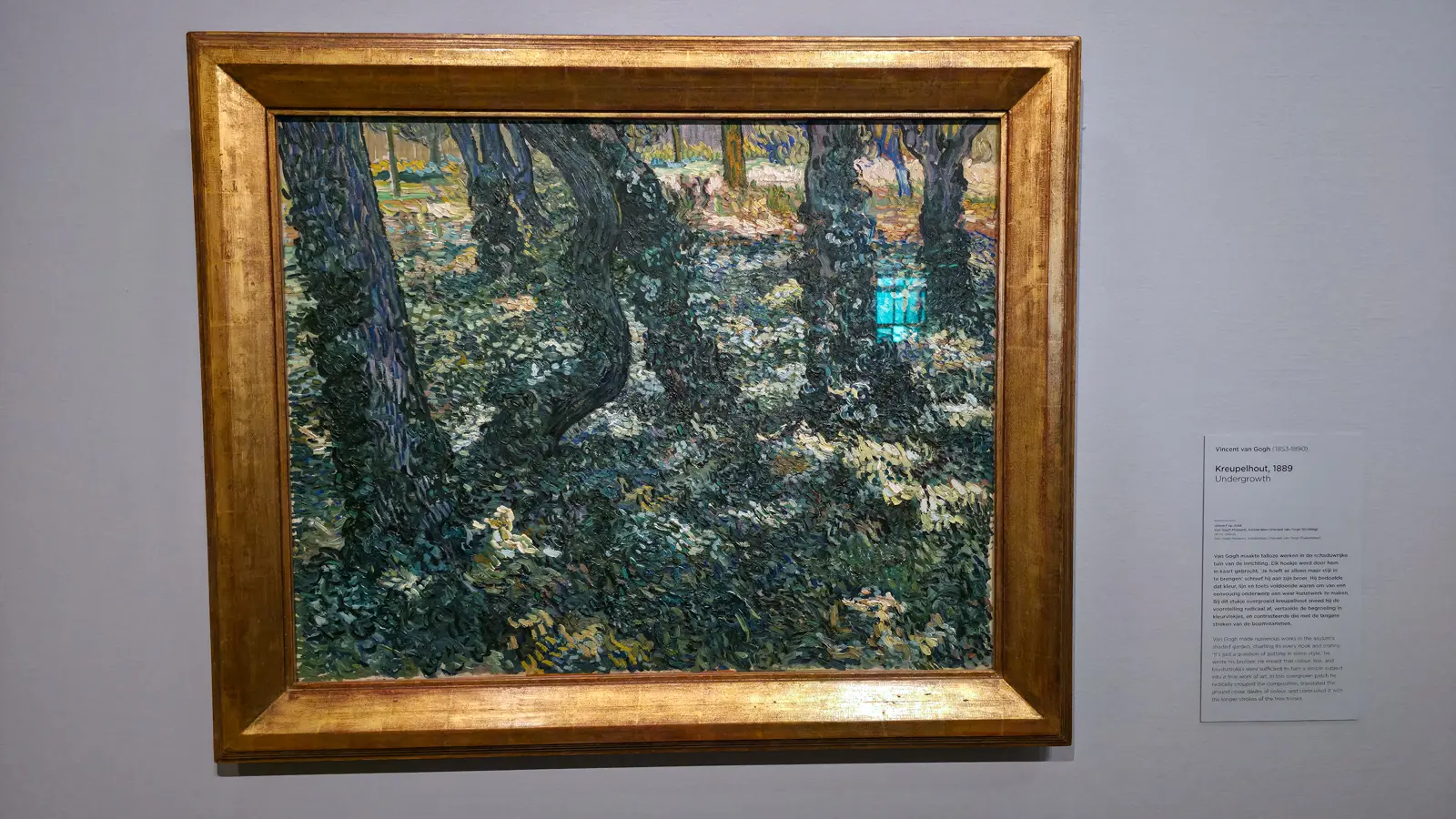
At the asylum, he painted its shaded garden again and again. Undergrowth, from 1889, is one patch of it: ivy and ground cover in daubs of green and white around dark tree trunks, cropped close.
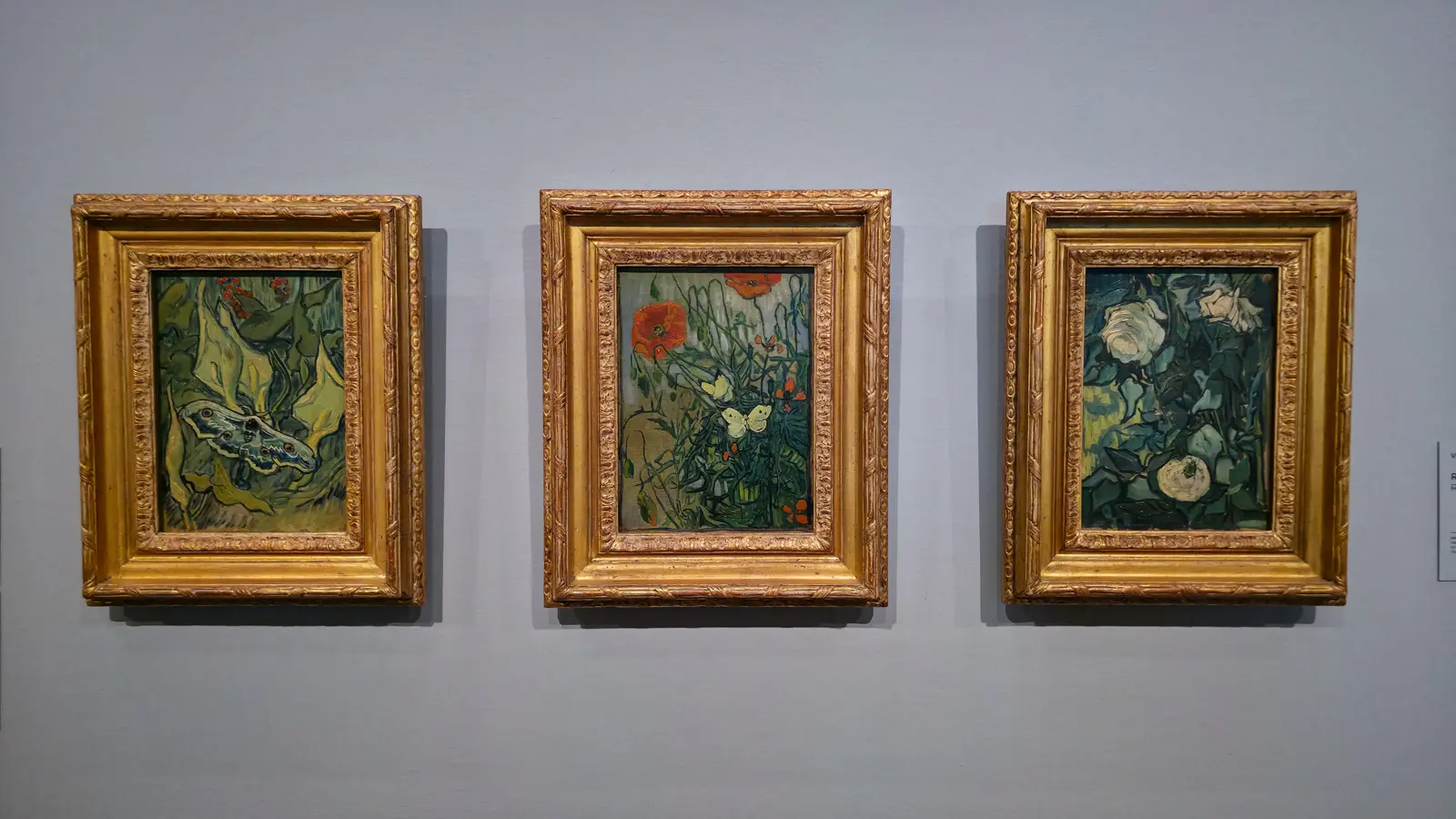
On one wall, the museum hangs three small canvases from the same garden side by side: Giant Peacock Moth, Butterflies and Poppies, and Roses. The moth sits among large pale leaves, white butterflies flutter among red poppies, and a green beetle rests on one of the white roses. Butterflies and Poppies is the most Japanese of the three, a tight close-up of flowers and insects with no horizon at all.
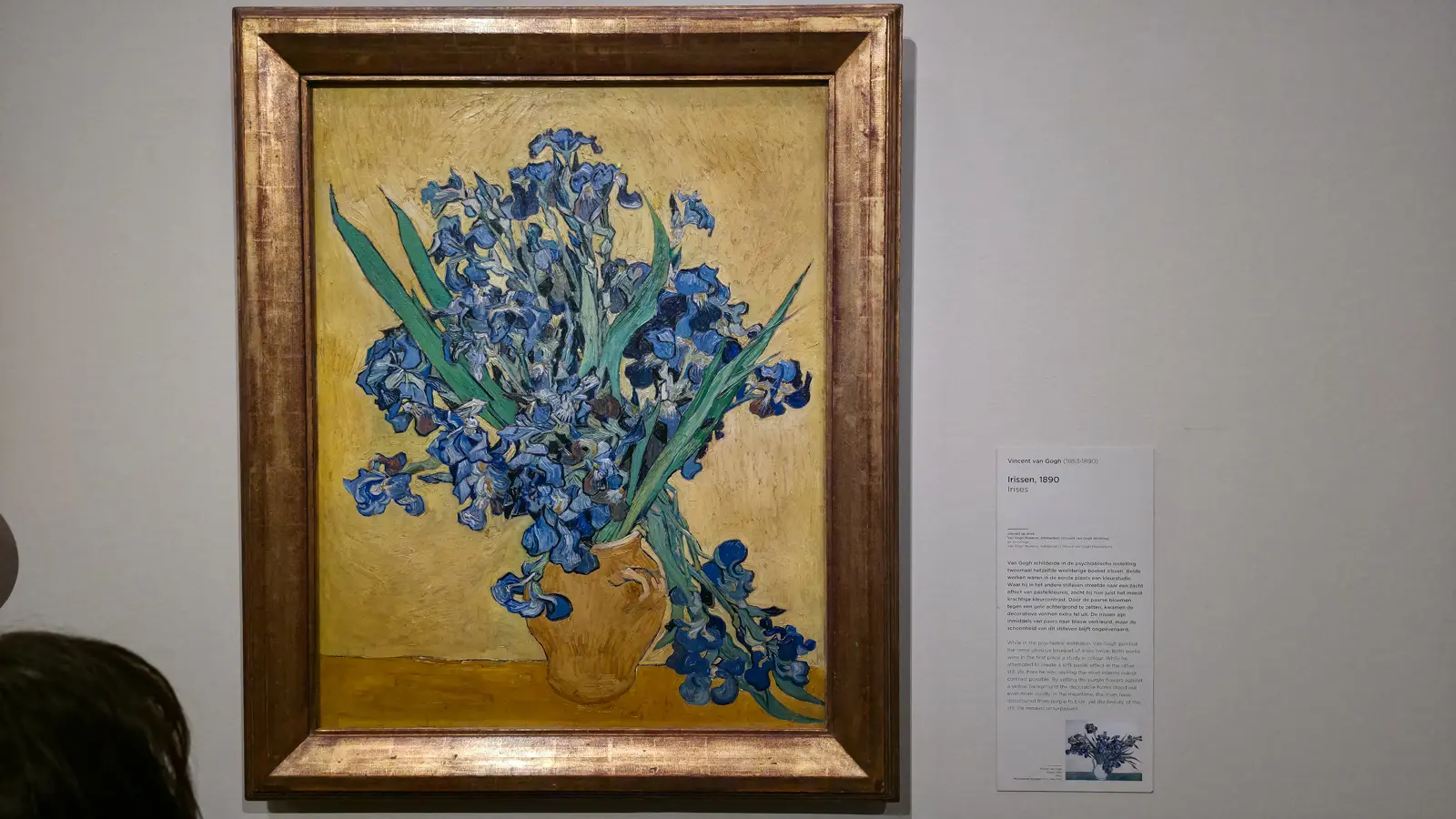
Irises, from May 1890, was one of his last paintings at the asylum. He painted the same bouquet twice, once against a soft pastel background and once, here, against yellow, for the strongest colour contrast he could find.
Almond Blossom, 1890
Almond Blossom comes from the same asylum year. Large branches of blossom against a blue sky were one of his favourite subjects, and here he took the subject, the bold outlines and the placing of the tree straight from Japanese printmaking. There is no trunk, no ground and no horizon, only branches running off the edges of the canvas.
He had been looking at Japanese art for years. In Paris in 1887 he painted his own version of a Hiroshige print of a plum tree in flower, and he collected hundreds of Japanese prints.
Auvers, 1890
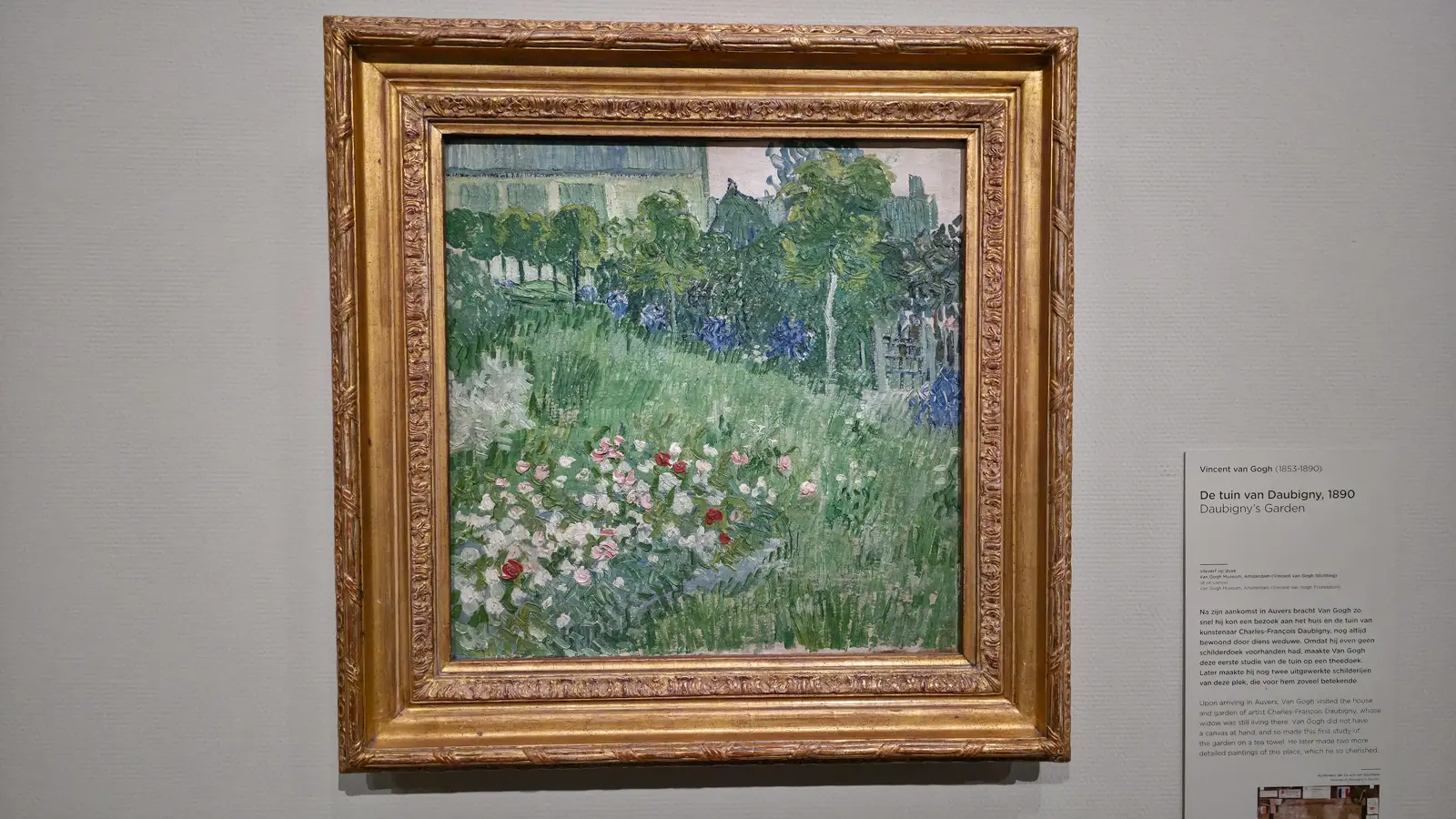
In May 1890 he moved to Auvers-sur-Oise, where the landscape painter Charles-François Daubigny had settled around 1860. Daubigny’s widow still lived in the house, and Van Gogh went to see the garden as soon as he could. He had no canvas with him, so his first painting of it, Daubigny’s Garden, is on a red and white striped tea towel.
Bubbly Tips
- Book a timed slot online. Tickets are sold online only, with a start time, and there is no ticket counter at the door.
- Go early or on a Friday evening. The museum opens at 9 AM, and on most Fridays it stays open until 9 PM. Midday is the busiest stretch.
- Stand back from the orchard wall. The three orchards hang in the arrangement Van Gogh sketched himself, so take them in as one piece before looking at each canvas.
- Look for the tea towel. In Daubigny’s Garden, the ground layer he painted on the towel shows between the brushstrokes. It was bright pink and has faded to grey.
- Find the skull on the moth. Van Gogh added a skull shape to Giant Peacock Moth because he thought it was a death’s-head moth.
- Check the colour of the irises. They look blue now, but he painted them purple. Knowing that changes how the yellow background reads.
- See the first peach tree at the Kröller-Müller. Souvenir de Mauve, the version he dedicated to Anton Mauve, hangs at the Kröller-Müller Museum in Otterlo, which is worth a day trip for Van Gogh fans.
- Photos are fine, flash is not. Personal photography is allowed, but not flash, tripods or selfie sticks.
- Leave the big bag behind. Anything larger than a small handbag goes to the cloakroom.
Final Thoughts
I came for Almond Blossom and left knowing it was one of many flowering trees, gardens and bouquets he painted in his last two and a half years: fourteen orchards in a month in Arles, a garden he painted over and over at the asylum, and a tea towel in Auvers.
It is still my favourite. Now I know where it came from.
Until next time!

🌟 Everything You Need to Plan Your Dream Trip in 2026
- 🌟 Luxury Hotels - Find premium stays with Booking.com & Hotels.com
- 🏡 Vacation Rentals - Discover unique properties on VRBO
- 🏞️ Guided Tours - Explore with Viator or GetYourGuide
- 🎫 Attraction Tickets - Skip the lines with Tiqets
- 🚢 Ocean Cruises - Set sail with Cruise Direct
- 📱 International SIMs - Stay connected with Saily
- 🚗 Car Rentals - Budget-friendly options from Discover Cars
- 🌐 Secure VPNs - Browse safely with NordVPN
- 💶 Currency Exchange - Best rates with Wise
- 🗣️ Learn Languages - Master the local language with Babbel and Rosetta Stone