
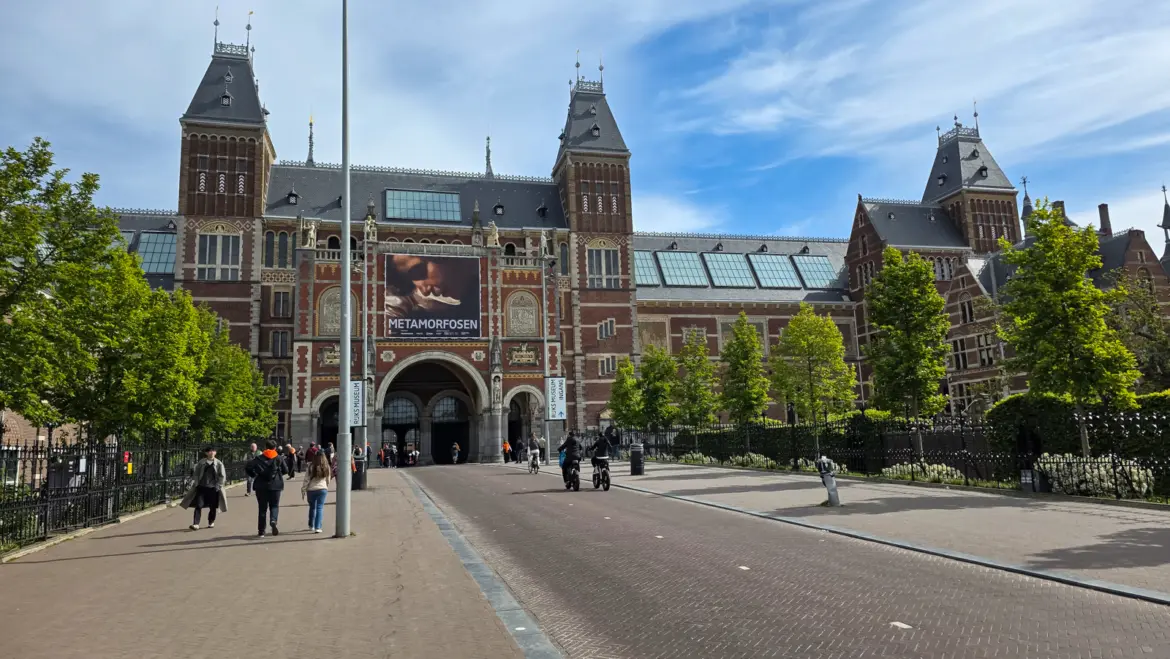
People call the Rijksmuseum the Louvre of Amsterdam, and I understand why. Both are national collections in enormous nineteenth-century buildings, both are built around one painting everybody has come to see, and both are far larger than a single visit.
But the comparison breaks in one useful place. The Louvre cannot be done. This one can, if a whole day is given to it. That is the difference between a museum that defeats a visitor and one that merely exhausts them.
I gave it most of a day and came out wanting more, which is a better outcome than it sounds.
The building is the work of Pierre Cuypers, a Dutch architect from Roermond who spent most of his career on churches and designed more than a hundred of them. He is also responsible for the two buildings almost every visitor to Amsterdam passes through: this one, opened in 1885, and Centraal Station, finished a few years later. His neo-Gothic instincts made the museum contentious while it was going up. Critics complained that a national museum had come out looking too Gothic, which in the argument of the day meant too Catholic.
The Rijksmuseum at a Glance
🏛️ What it is · The Dutch national museum, in Pierre Cuypers’ 1885 building on Museumplein, holding 800 years of Dutch art and history across around 80 galleries.
⏱️ Time needed · A full day. Unlike the Louvre, it can genuinely be seen in one; it cannot be seen in three hours.
🖼️ The headliners · Rembrandt’s Night Watch (under live restoration in a glass chamber), the William Rex ship model, Vermeer, Avercamp’s winter scene, and a small corner of Van Goghs.
🎨 The building is an exhibit · Stop in the glass-roofed atrium and look up in the old halls, where the painted vaults and stained glass are part of the collection.
💡 Tip · Book the Van Gogh Museum next door separately, but still leave time for the Van Goghs hung here that almost nobody mentions.
The gardens, which are the part nobody plans for
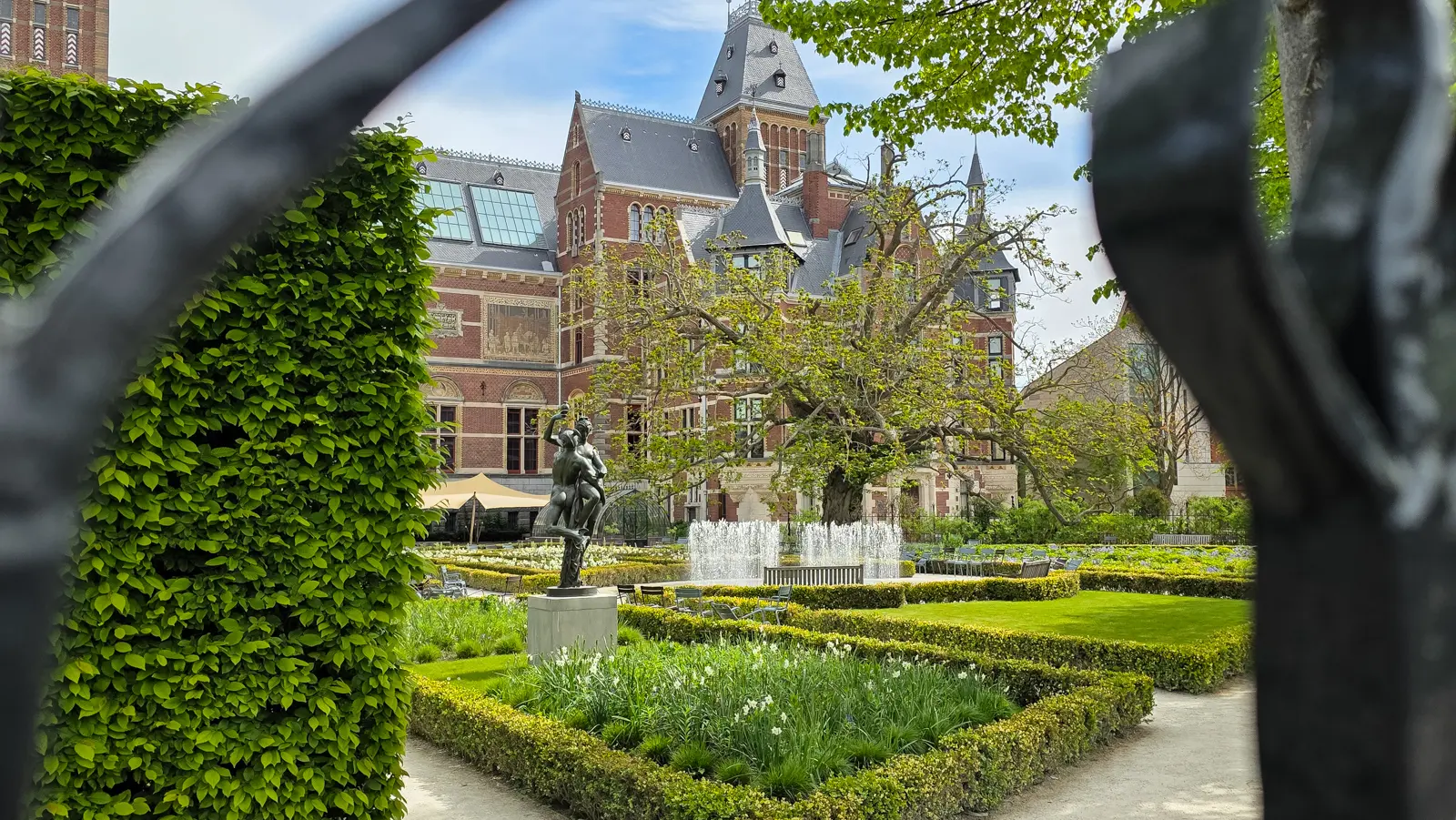
The gardens run along the side of the building and they are used, not just admired. On the morning I first walked past, people were sitting out in them with coffee, on their own, reading, the way people use a park rather than an attraction. Clipped hedges in low geometric beds, white flowers, a fountain playing, a bronze figure on a plinth, and the museum’s towers and gables rising behind the trees.
I passed the building often that week before I ever went in. That is how the gardens work. They are part of the neighbourhood rather than part of the ticket.
The atrium is the newest thing in the oldest part
I was told the atrium had been recently renovated. That is not quite right, and the true version is better.
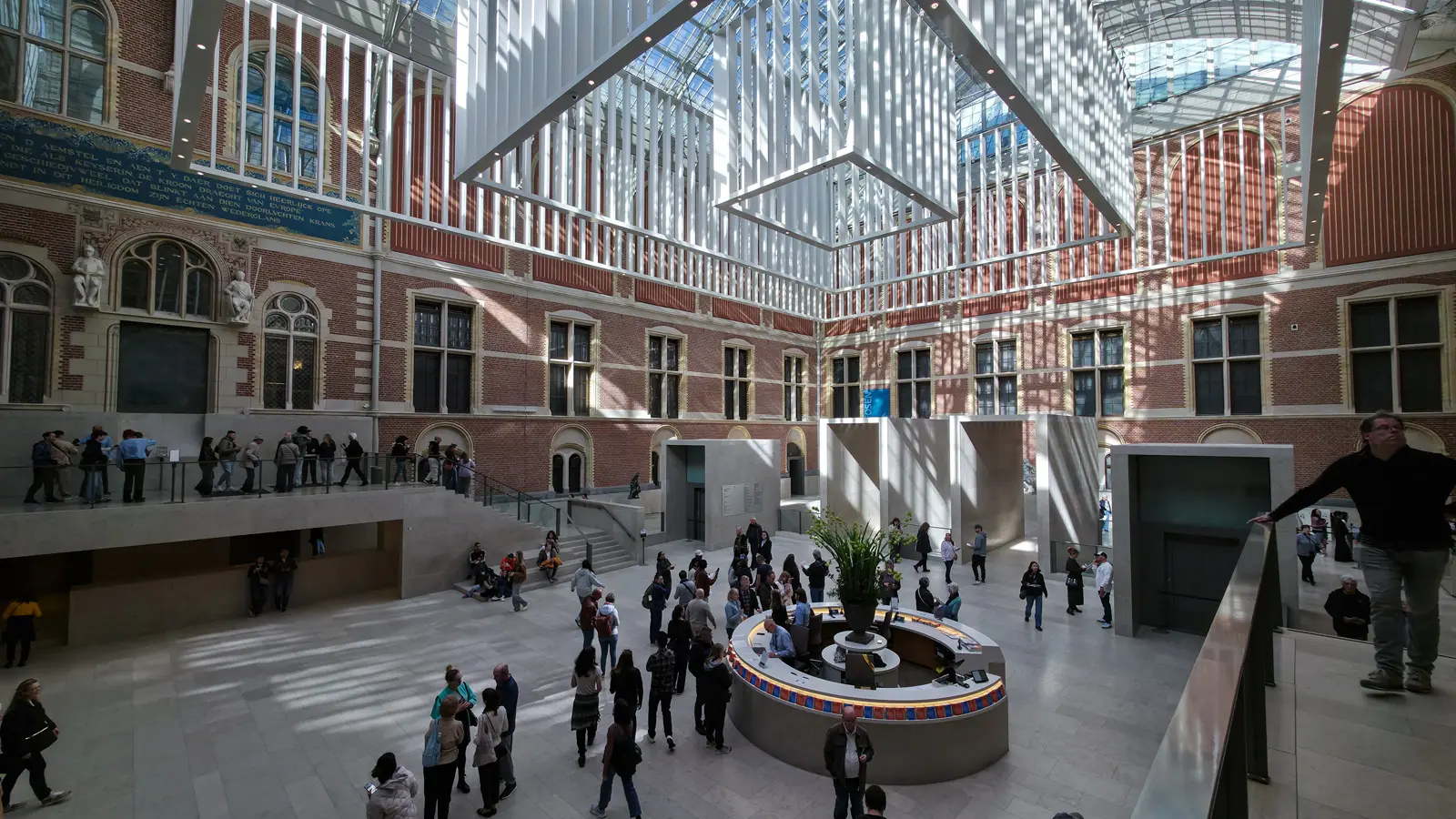
There is nothing recent about it. What there is instead is a piece of architectural sleight of hand. The two spaces either side of the central passage were open inner courtyards when Cuypers built the place. In the 1950s and 1960s they were built over with galleries. The rebuild stripped those out, dug the floor down below ground level, roofed the courtyards in glass and joined the two halves underneath the carriageway.
So the atrium is simultaneously the oldest part of the plan and the newest thing in the building. Standing in it, the original brick facades of the interior courtyards are still there, running up three storeys, with daylight coming down through the glass onto a pale stone floor. It is worth stopping in before going anywhere near a painting.
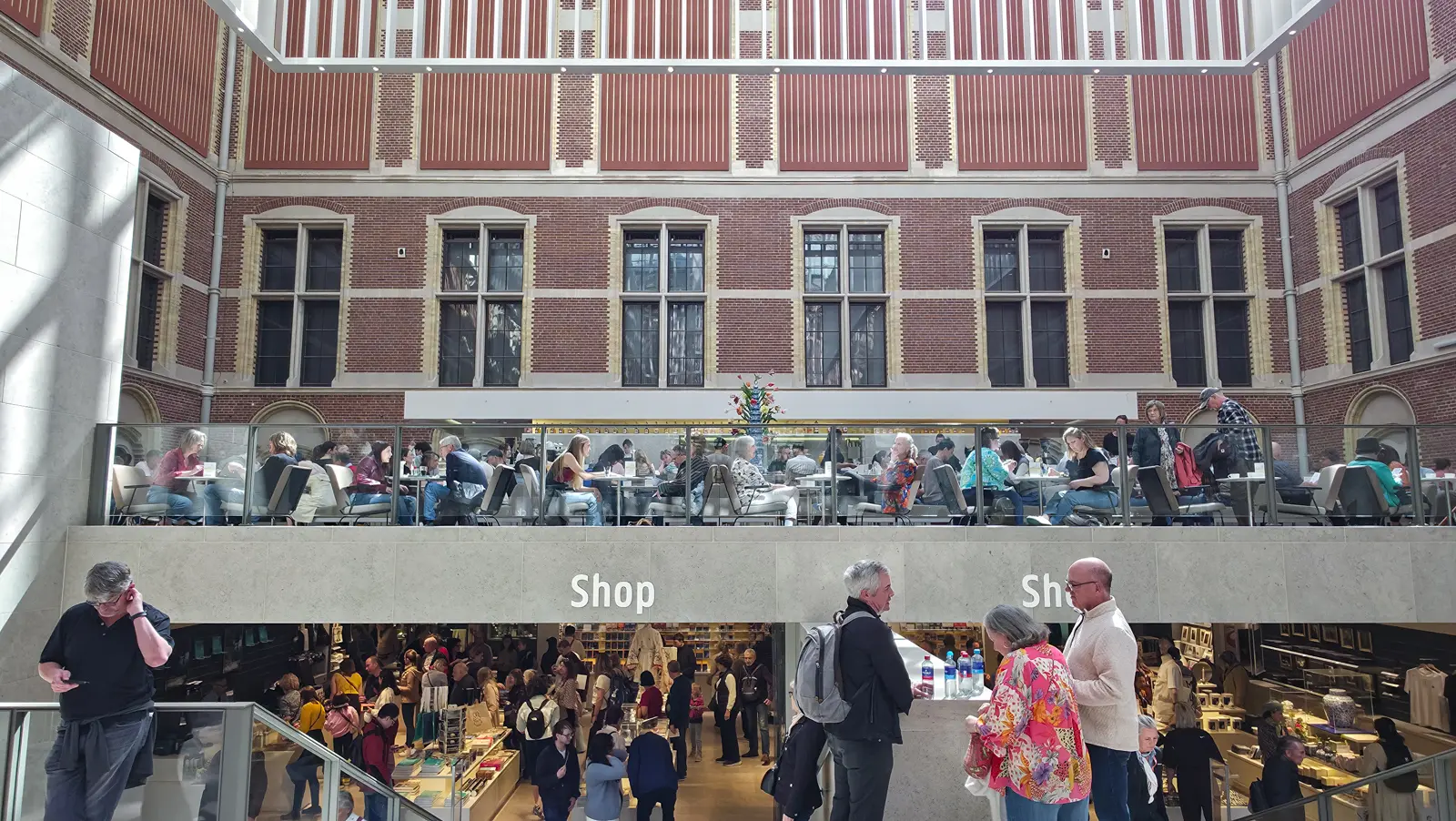
Around the edges, the practical parts of a modern museum have been slotted in without much fuss. The shop sits under a mezzanine on one side, and the café runs along the level above it, so people eating look out over people buying postcards.
The old halls, and the children painting in them
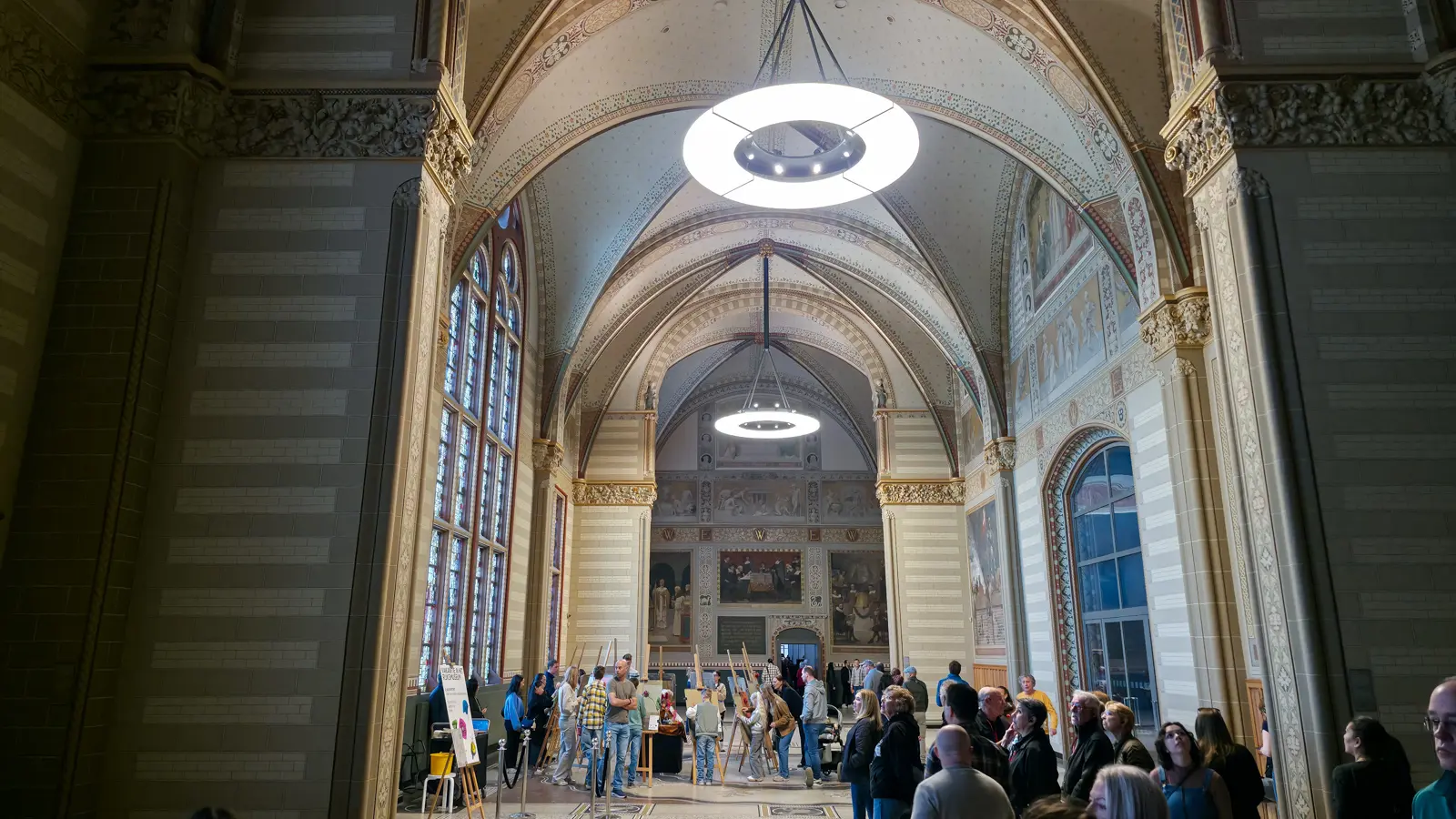
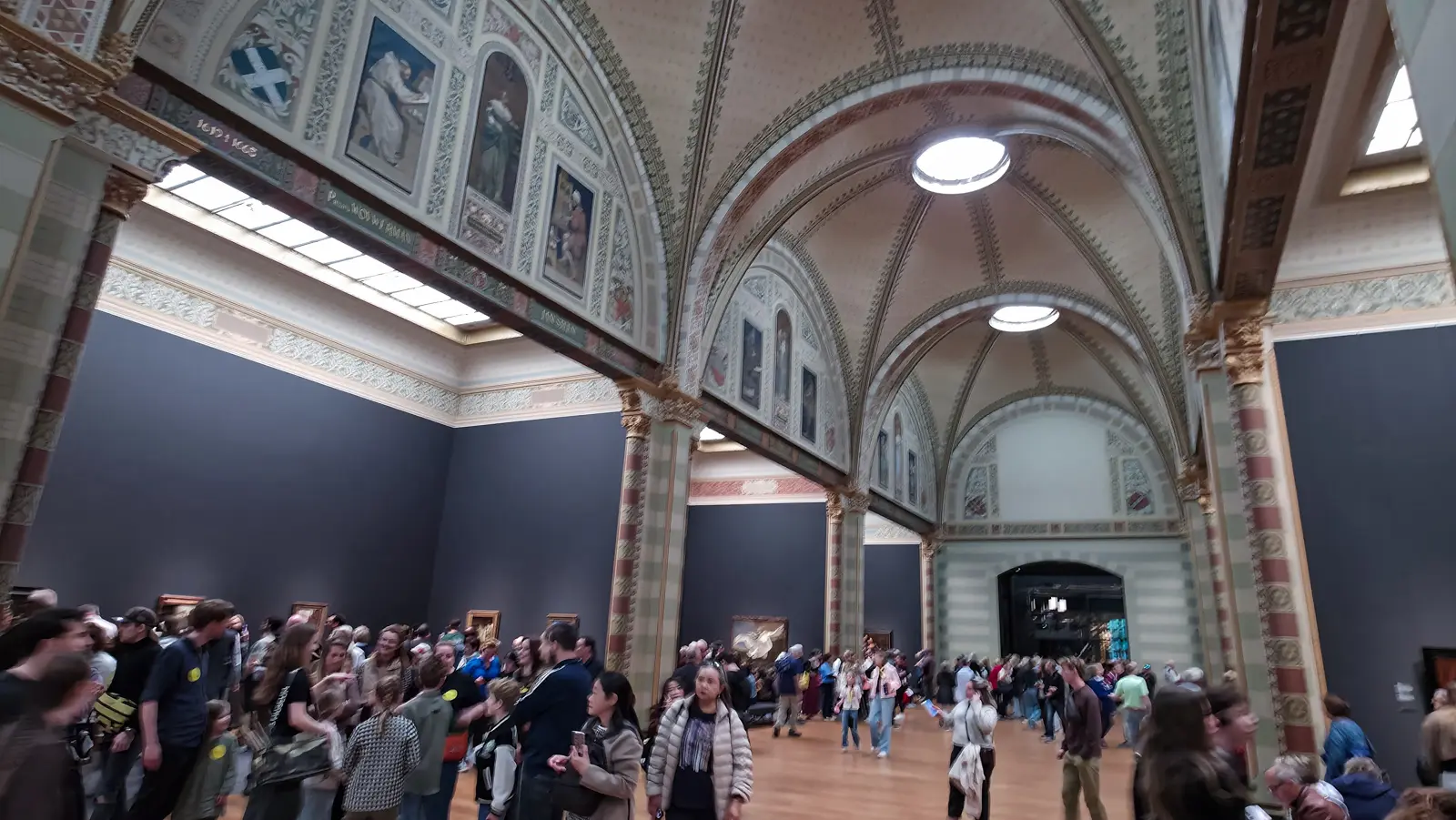
Beyond the atrium, the building goes back to being 1885. A vaulted hall runs ahead in painted stone and stencilled ornament, with two enormous ring lights hanging in the middle of it and murals set into the walls at the far end.
This is not the room with the Rembrandts in it. The Great Hall is the space visitors cross on the way, and the Gallery of Honour lies beyond it, up the stairs and through a door.
On the floor of that hall, when I walked through, there were two dozen easels set up in a loose ring around a table of props, and people painting. Adults, teenagers, and children who came up to about the height of the easel. Nobody was being quiet about it. The museum had put a still life in the middle of its grandest entrance hall and handed out boards.
That is a good thing for a national museum to do. Children who paint in a building like that stop finding it intimidating, which is most of the battle.
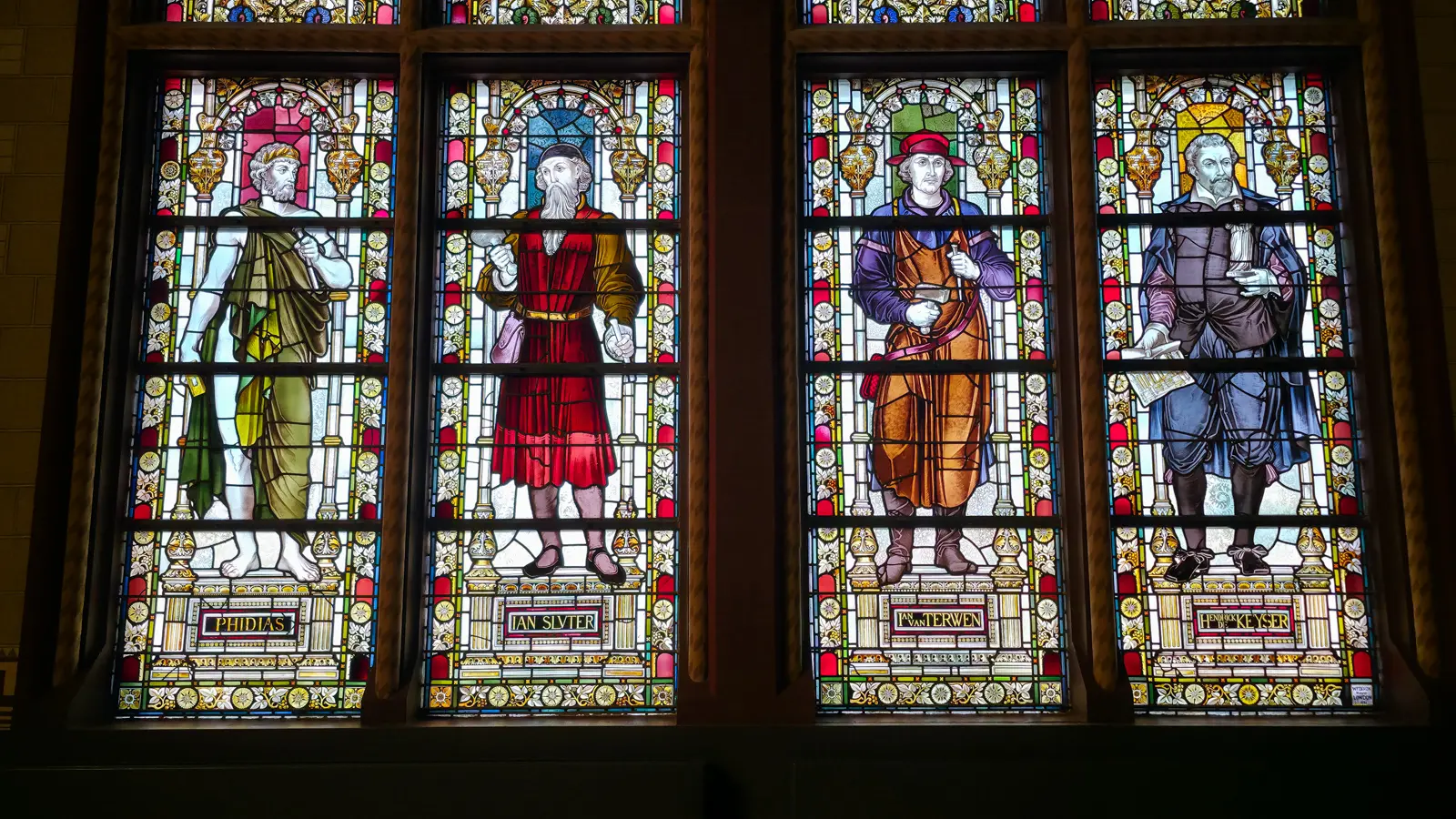
Along the side of that hall run tall stained glass windows, each panel holding a single standing figure with a name lettered on the pedestal beneath. Phidias in a green robe. Jan Sluter. Jan van Terwen. Hendrick de Keyser. Sculptors and architects, running from ancient Greece to the Dutch Golden Age, put into the fabric of the building as its own lineage.
Much of this decoration was painted over or partitioned away during the twentieth century. The rebuild put it back in three places: this hall, the Gallery of Honour upstairs, and the stairwells that link them.
Porcelain, and how it got here
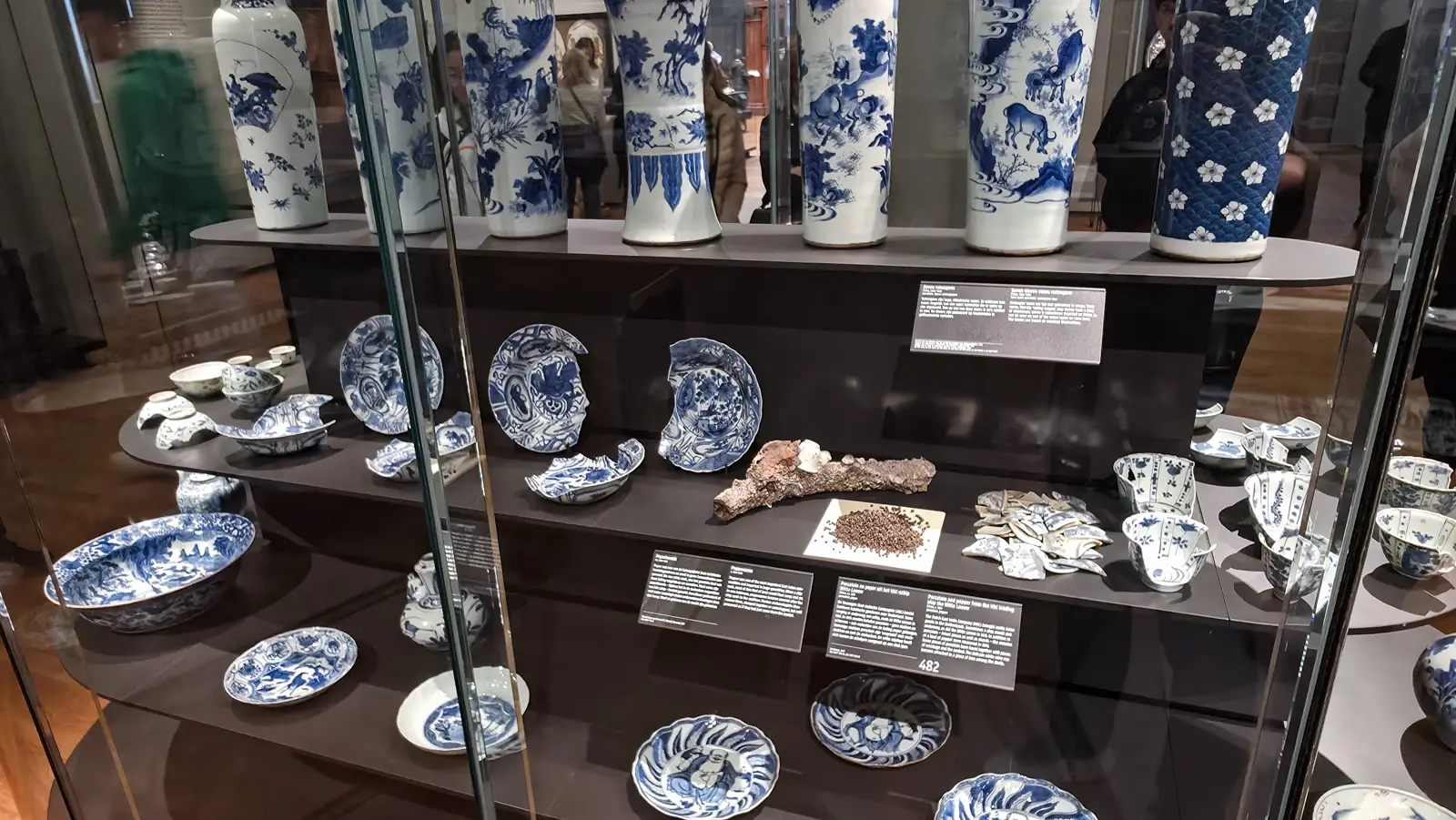
The blue-and-white cases are where the museum stops being an art gallery and starts being a history of Dutch trade.
Tall vases stand along the top of one case. Below them, plates and bowls, some of them broken clean in half, laid out alongside a lump of encrusted iron and a small square of peppercorns. The label explains that these came off a wrecked East India Company ship. Porcelain and pepper, in the same case, sunk in the same hull.
It reframes the whole room. This is not a decorative arts display. It is cargo.
My three houses
I have three pieces of Dutch porcelain at home, and standing in front of that case I was oddly pleased about it.
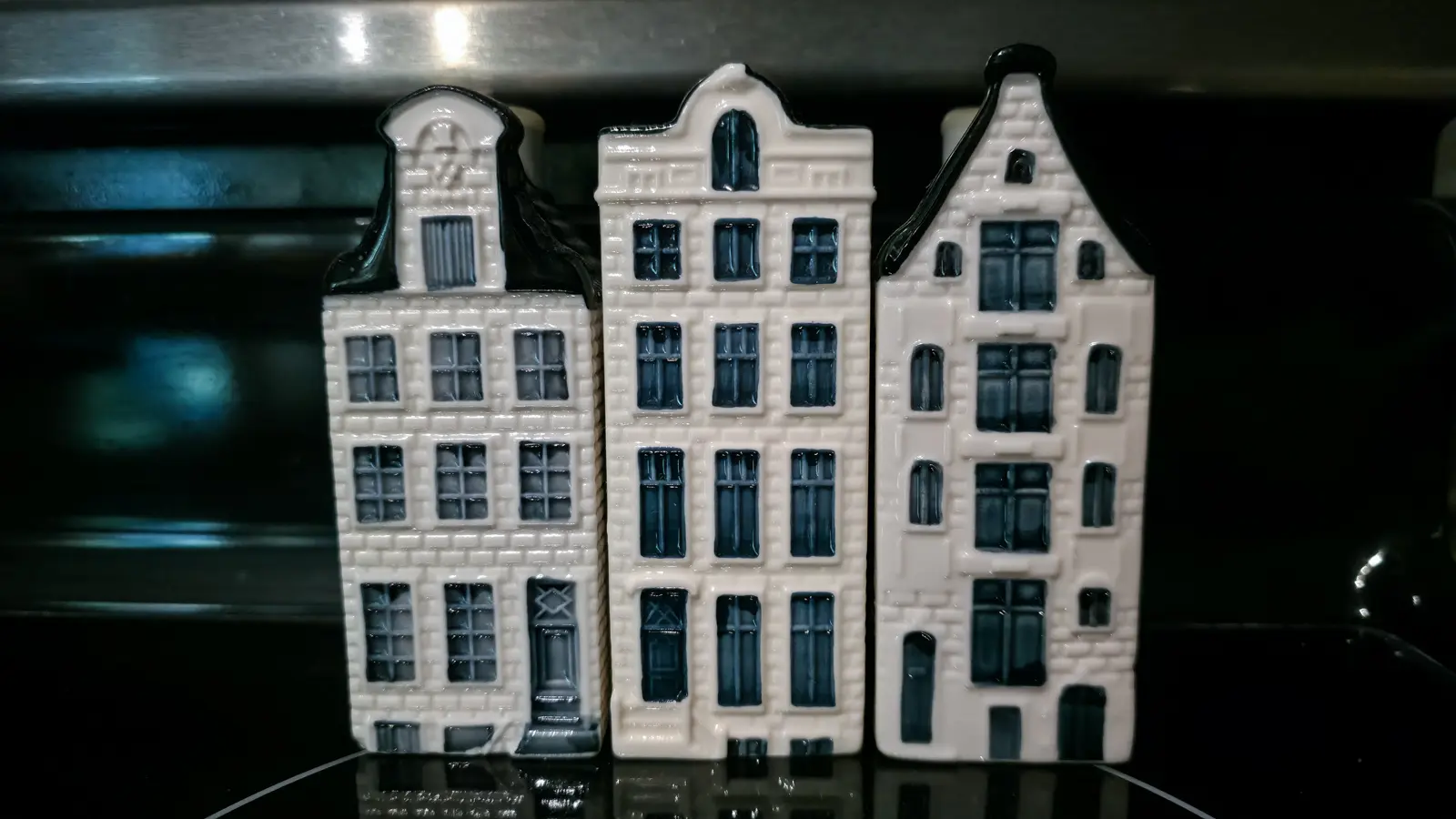
They are KLM houses. Since 1952 the airline has given a miniature Delft blue house to intercontinental passengers, originally in First Class and now in World Business Class. It started as a way around rules that stopped airlines giving passengers gifts of value: the houses are filled with Dutch genever, so they were presented not as a gift but as the last drink on the house. Every one is a replica of a real Dutch building.
Mine are numbers 59, 65 and 67. Number 59 is ‘t Hochemer Voedervat on the Herengracht, built in 1721. Number 65 is Pakhuis De Sparreboom, the Spruce Tree Warehouse, on the Keizersgracht, built in 1670. Number 67 stands on the Prinsengracht.
Herengracht, Keizersgracht, Prinsengracht. The three great canals of the ring, one from each, and I chose none of them. An airline handed them over on three separate flights and they assembled themselves into a set on my shelf.
The sea
The maritime rooms are where the Dutch Golden Age stops being about painting and starts being about ships.
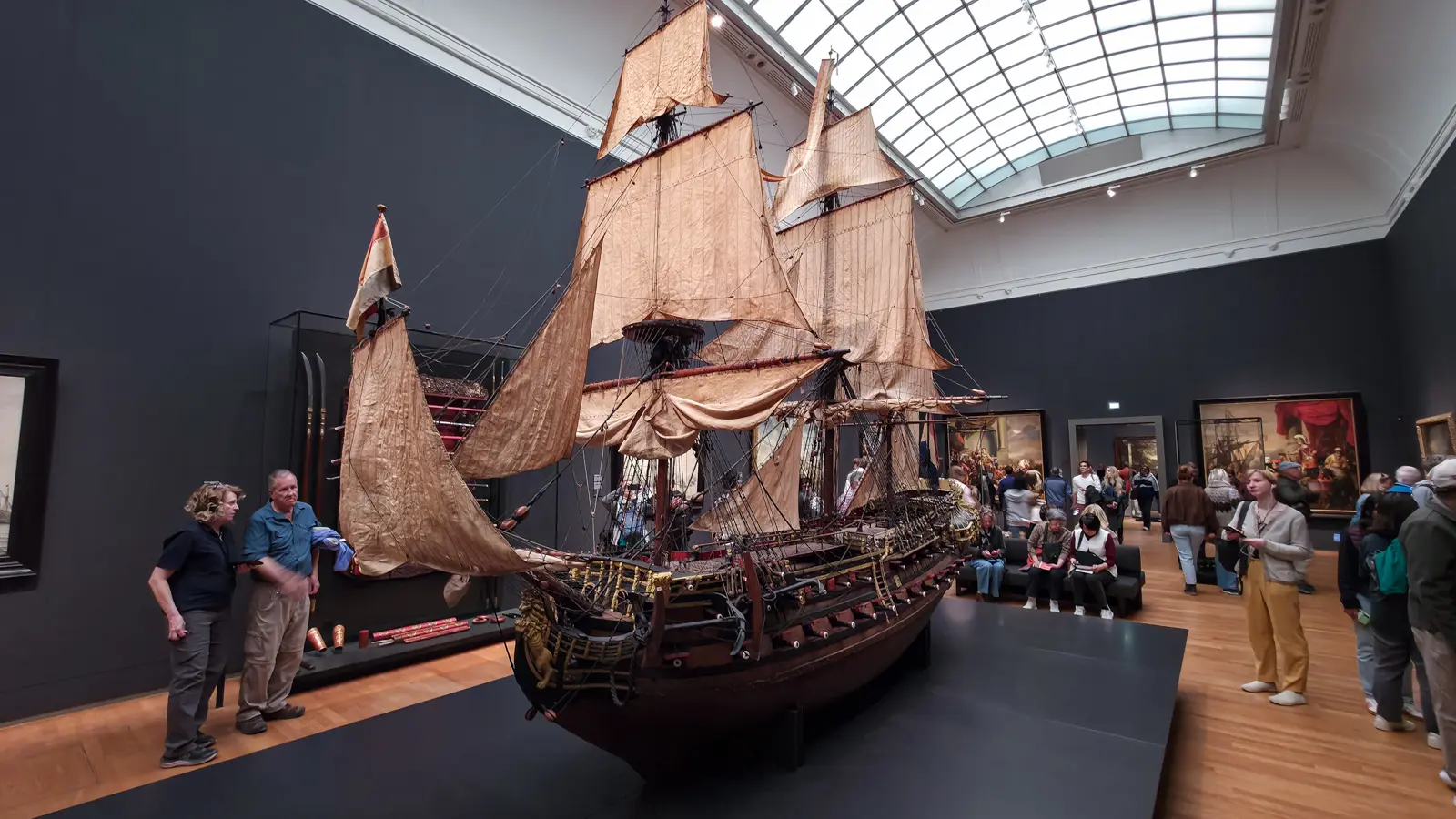
A full-rigged model stands in the middle of one gallery, tall enough that its topmasts reach most of the way to the skylight, with sails set and a Dutch flag at the stern. It stopped me, and it stopped almost everybody else. There was a slow ring of people around it the whole time I was there.
It is called the William Rex, and it is not a modern reconstruction. It was built in 1698 at the naval dockyards at Vlissingen, the same yards that built real warships, and it carries 74 guns on three decks. A real ship of that class would have been more than twelve times its size. The museum’s own catalogue makes an admission I like very much: the model cannot be convincingly matched to any actual ship. The name was attached in the nineteenth century, from monograms carved on the stern.
So it is a three-hundred-year-old object built to impersonate a warship that may never have existed, made to stand in an admiralty council chamber and impress people. Which it still does.
It is easy to forget how recently this was a naval superpower. Vlissingen, where that model was built, is called Flushing in English, and Flushing in Queens NY is named after it. Around it, on the walls, are the paintings that go with it.
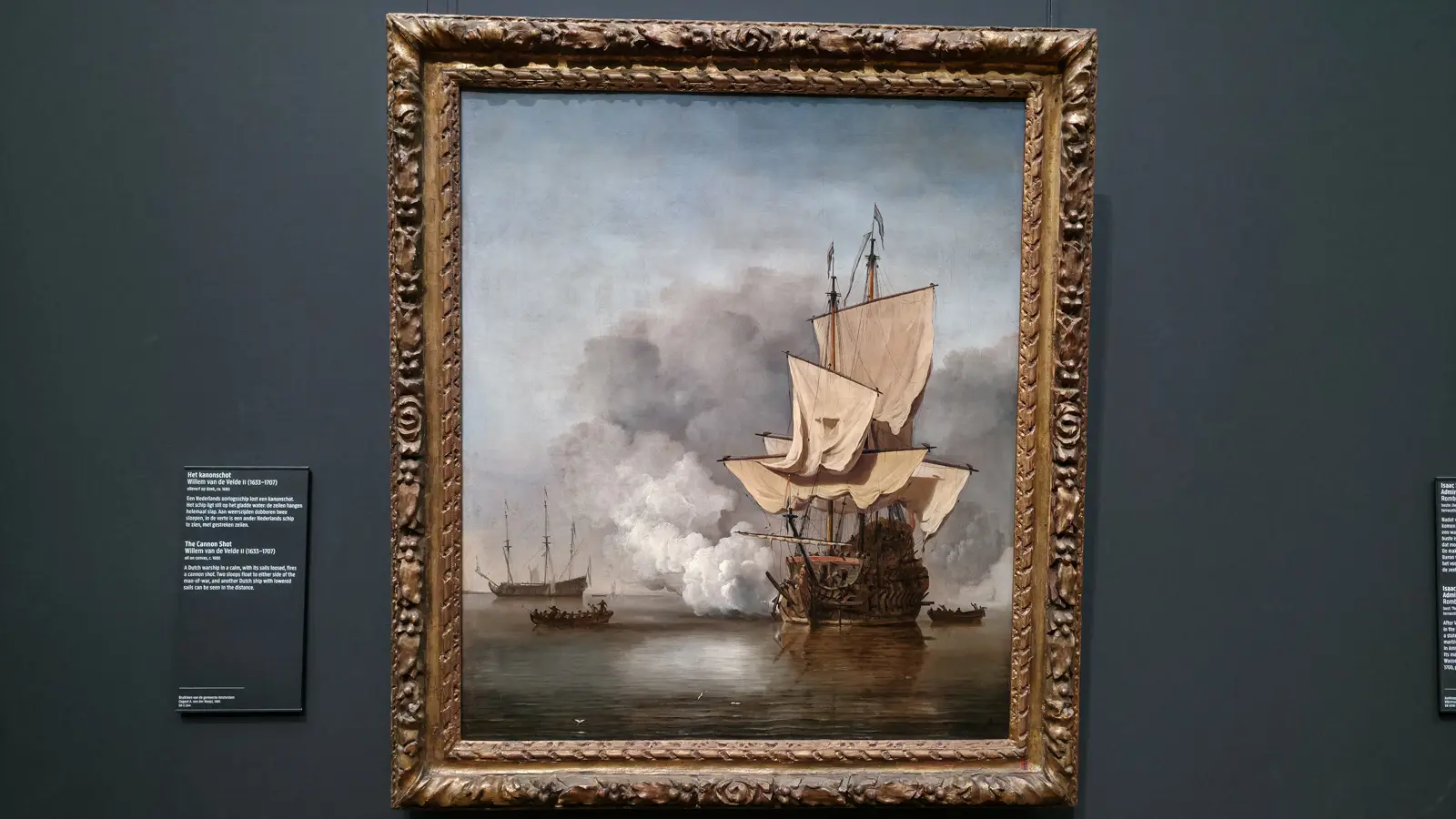
The best of those paintings is a warship in flat calm, firing a single gun. There is no battle. The sails hang slack, two small boats sit either side, and the whole event is a cloud of white smoke drifting across still water.
The Gallery of Honour
This is the room the building was designed around. A long vaulted arcade with painted ceilings and skylights, opening into bays on either side, running towards the Night Watch at the end.
It was chaos.
I had booked a guided tour for one reason, which was to learn something about the Dutch masters, and this is the room where that plan came apart. I could not hear the guide. The crowd ran continuously from one end of the arcade to the other, moving in the same direction the way people move down a nave, and at every bay there was a queue of people waiting their turn to photograph a painting.
None of that is the museum’s fault and none of it is a reason not to come. But it is worth knowing that the most beautiful room in the building is also the hardest one to learn anything in.
Rembrandt, and why he is different
I had thought before about why Rembrandt gets to me and other painters of the period do not, and this building is where the answer became obvious.
He does not correct anything.
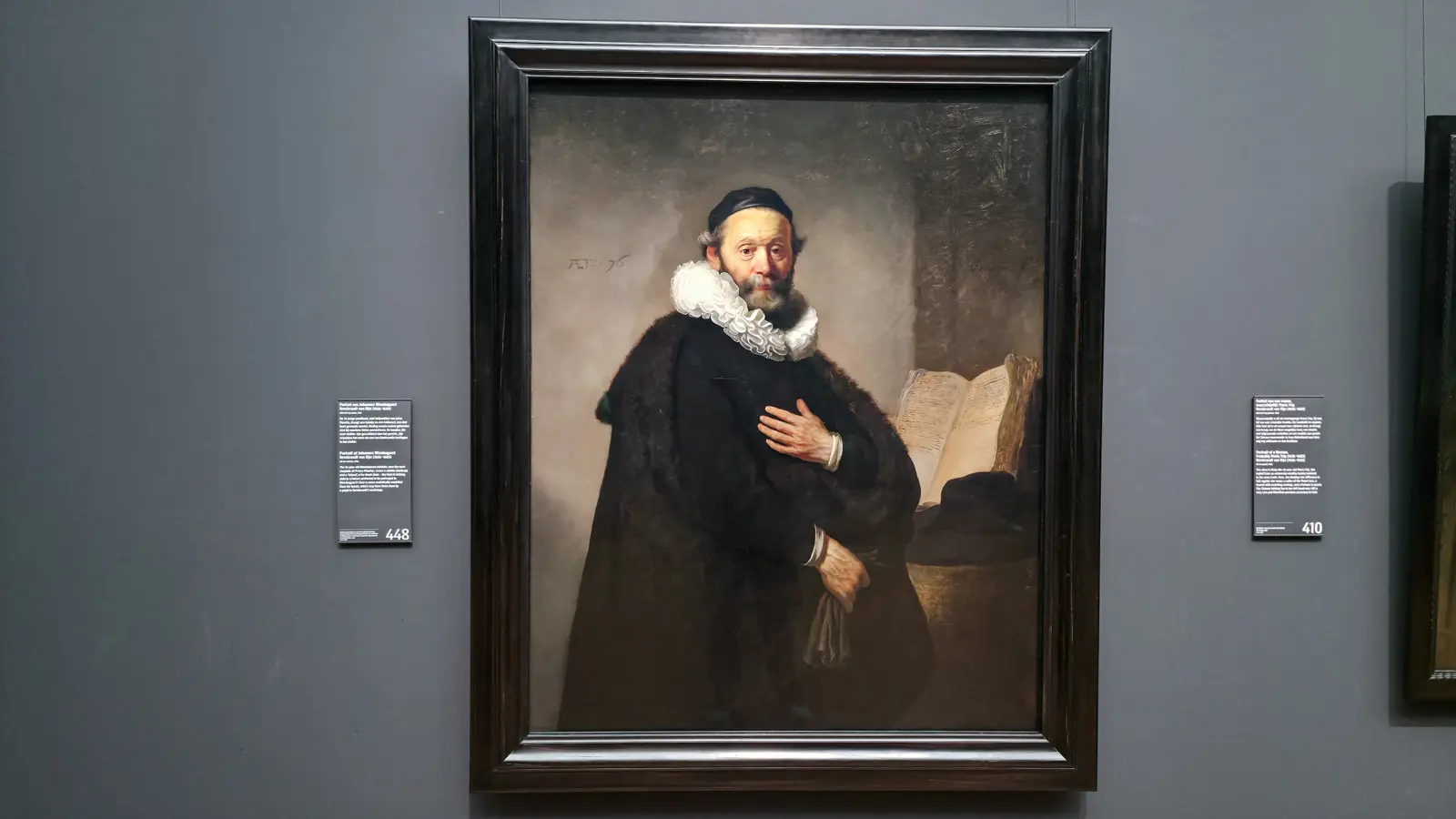
There is a portrait here of a Remonstrant minister aged seventy-six, painted in the plain black of his profession with a white ruff, one hand on his chest and an open book beside him. He looks his age. Nothing about the face has been improved.
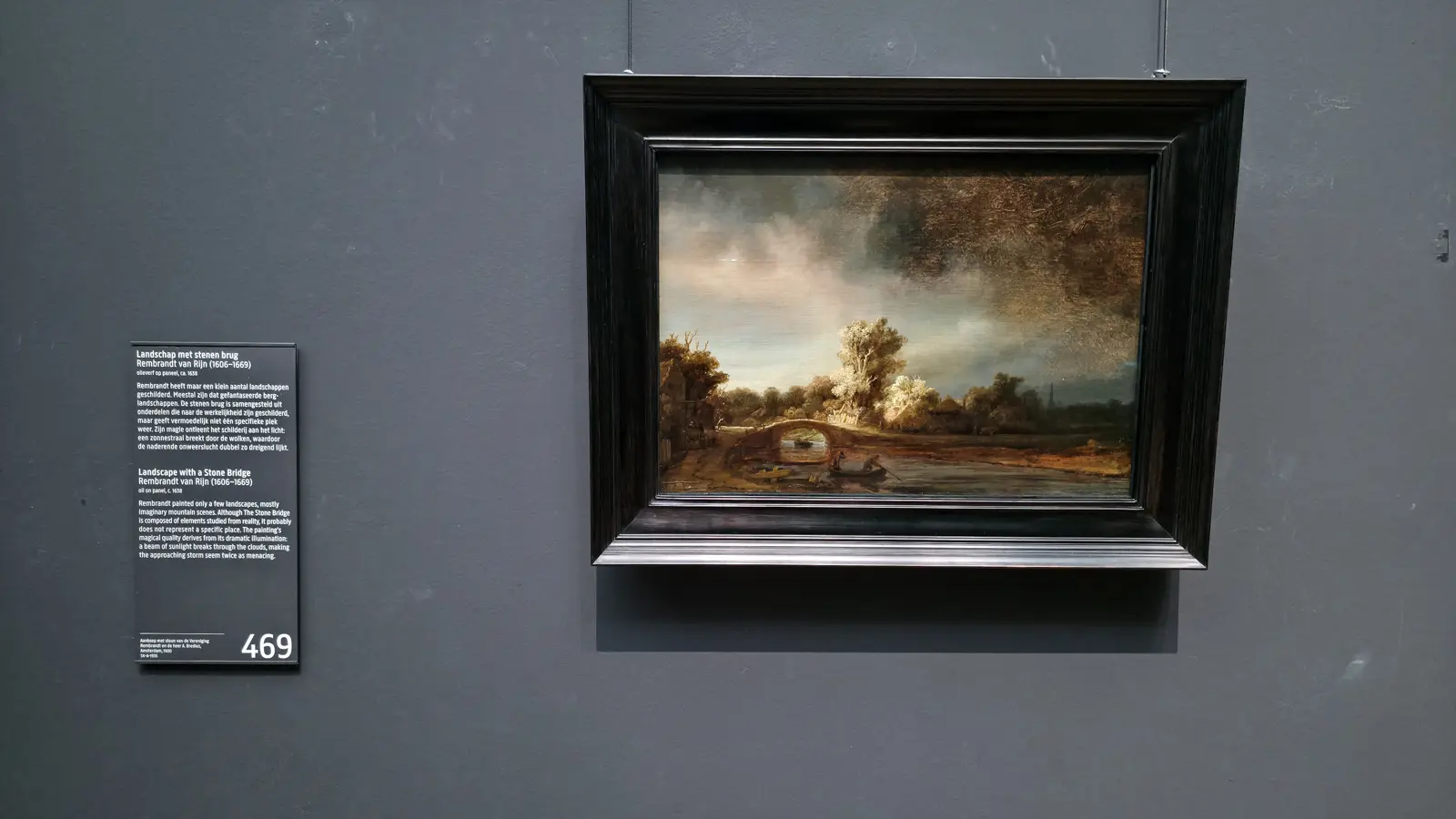
He did paint landscapes, though very few, and they are the one place where he allows himself something closer to invention.
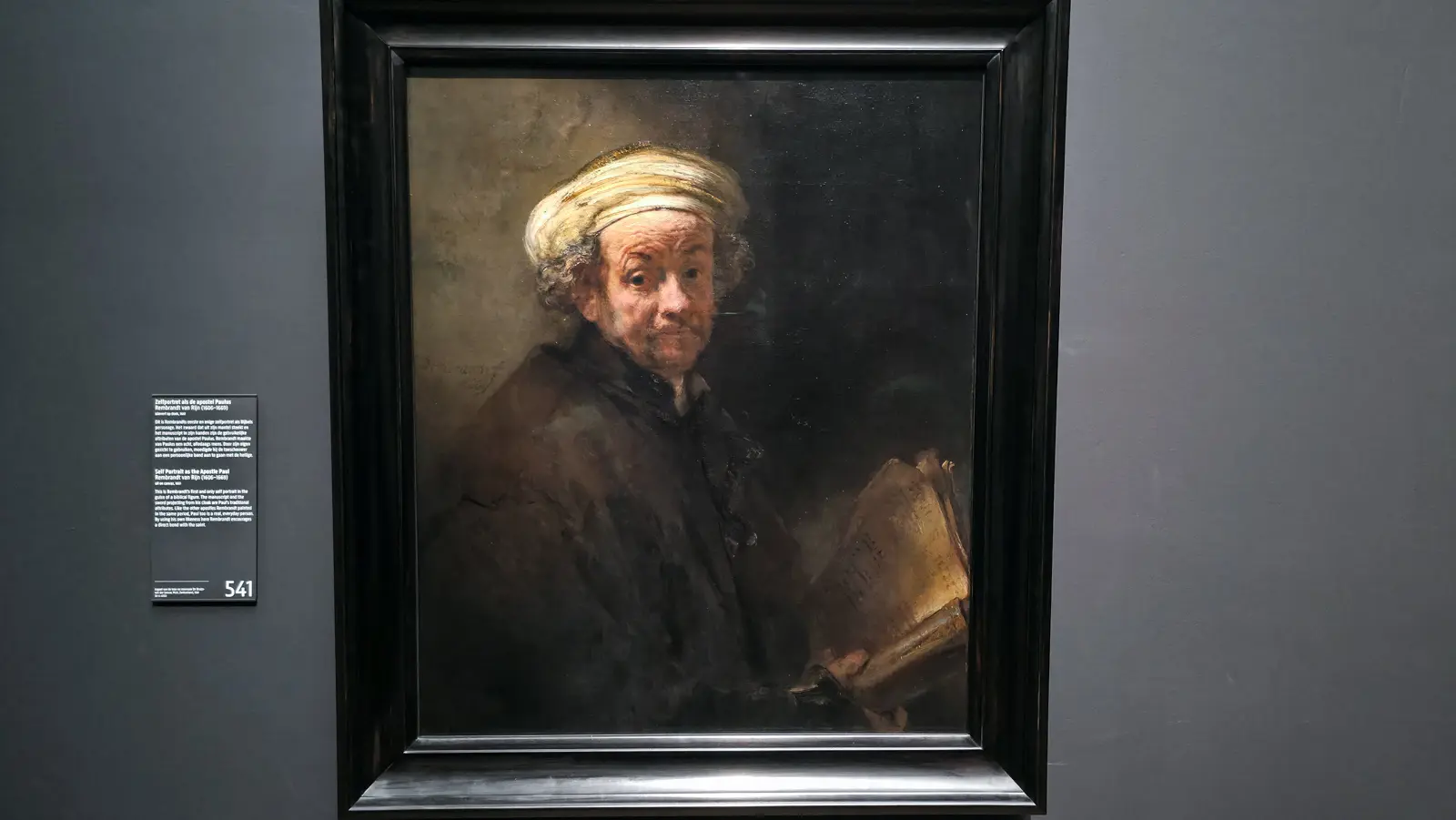
And then the self portrait, which is the whole argument in one frame. An old man in a white turban with a book, painted in the year the museum gives as 1661. The eyes are watery. The skin is not flattered. He is dressed as an apostle and he looks like a tired man in a hat.
The Night Watch, in pieces
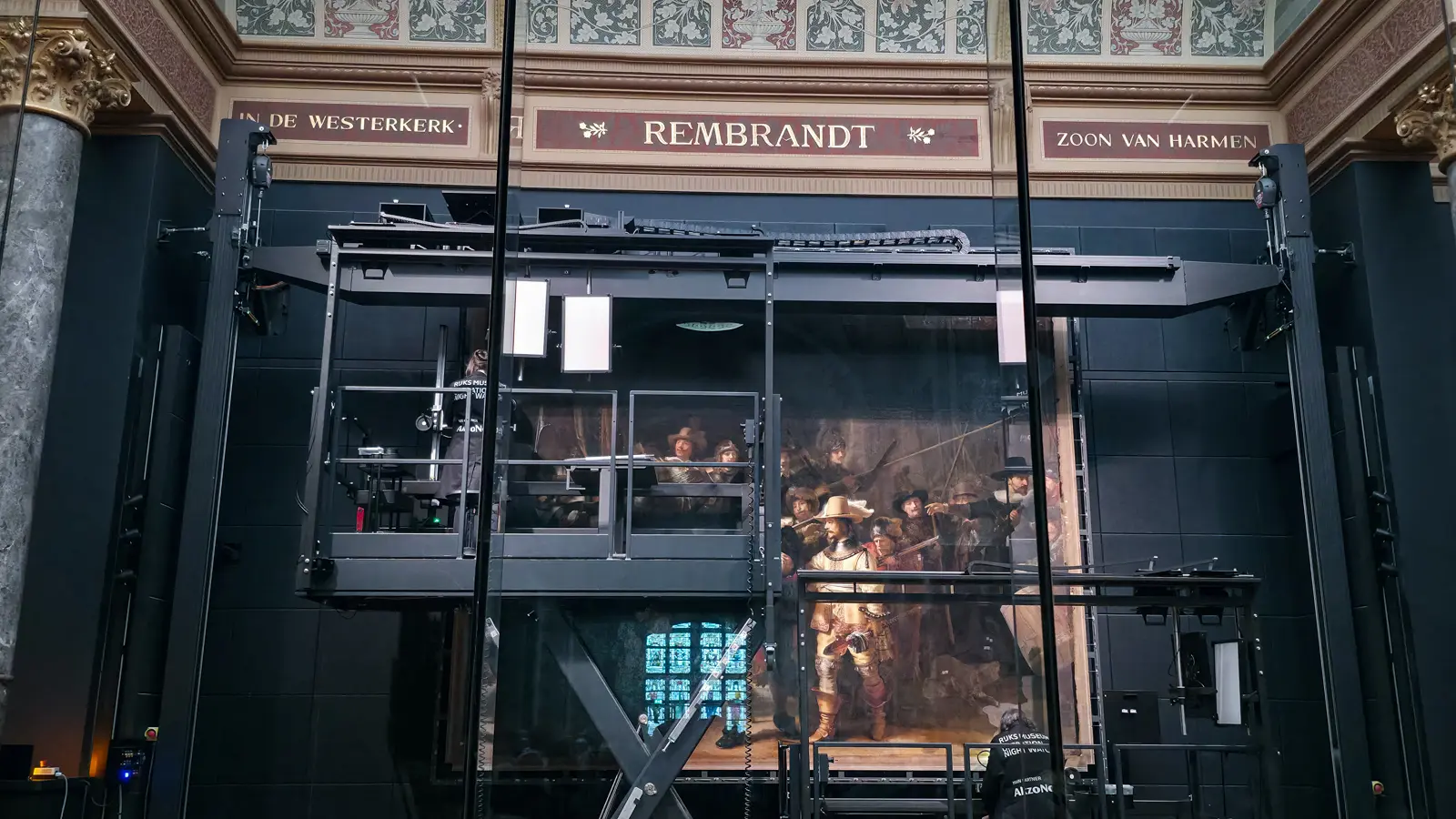
At the end of the gallery, under Rembrandt’s name lettered across the wall, the painting sits inside a glass box with a steel gantry over it.
Operation Night Watch began in 2019 and is the largest research and restoration project ever carried out on the painting. The research phase alone involved 56 separate scans, each taking twenty-four hours, and around 12,500 photographs at extremely high resolution. The old wooden stretcher from the 1970s was replaced with an aluminium one. Since late 2024 a team of conservators has been removing varnish applied during the previous restoration in the mid-1970s.
All of it happens in public, in a transparent chamber designed by the same architect who did the museum’s display cases.
This is where the guided tour earned back everything it lost in the Gallery of Honour. Standing in front of that glass box, I finally heard the story properly, and I learned something I am slightly embarrassed not to have known: that this painting functions as a symbol of Dutch art itself, in the way the Mona Lisa does for France. I had walked into the building not knowing that.
That is the case for a tour, for anyone arriving without a grounding in Dutch art. The value of it does not arrive evenly. It arrives in bursts, in the rooms where the crowd thins enough to hear.
I expected to be disappointed by the restoration. Instead the machinery made it better. A painting that normally hangs there being famous was, that morning, an object being worked on: lit from panels on rails, watched through glass, with people in branded jackets standing on a platform in front of it doing something slow and careful. It is still overwhelming. It is just overwhelming in a different way.
Not only Rembrandt
The other Dutch painters of the period are here in force, and one of them stopped me longer than any Rembrandt.
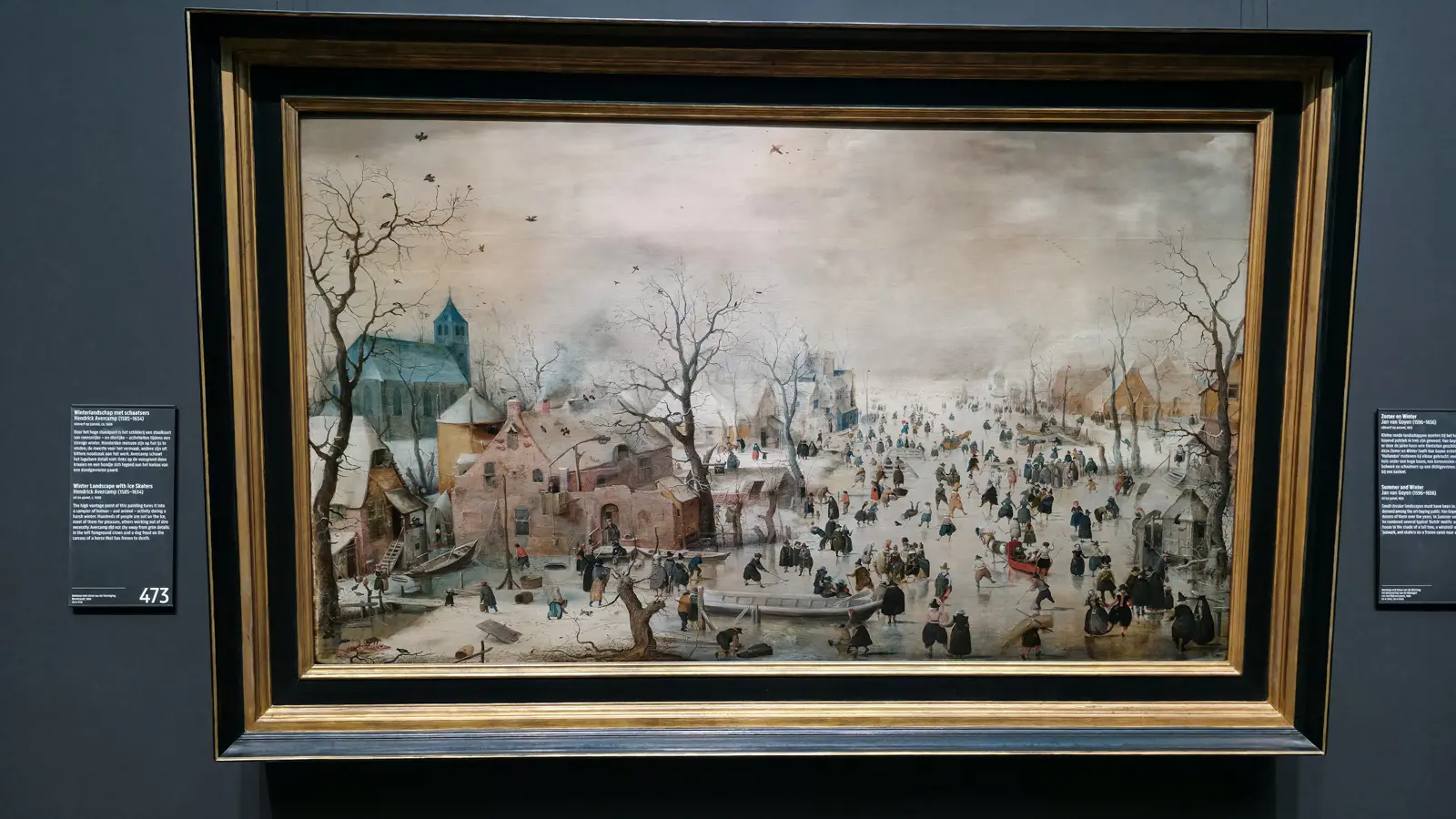
It is a winter scene, painted from a high vantage point, with hundreds of people out on frozen water. Skaters, sledges, a boat frozen into the ice, a red-roofed church.
The high viewpoint is the trick. It turns the picture into an inventory of what an entire town does when the water freezes. And the museum’s label points out the thing that changes how it reads: most of those people are out on the ice for pleasure, but some of them are working out of dire necessity. Both are in the same frame, at the same size, and nothing in the painting tells anyone which is which.
It reads as cheerful until the eye finds the bottom left corner.
The one I came for, in the wrong museum
Here is the confession this post has been working towards.
I came to Amsterdam for Van Gogh. The museum devoted to him is next door, I had booked it separately, and that was the artist I had travelled to see. I went into the Rijksmuseum without any real idea of what was in it.
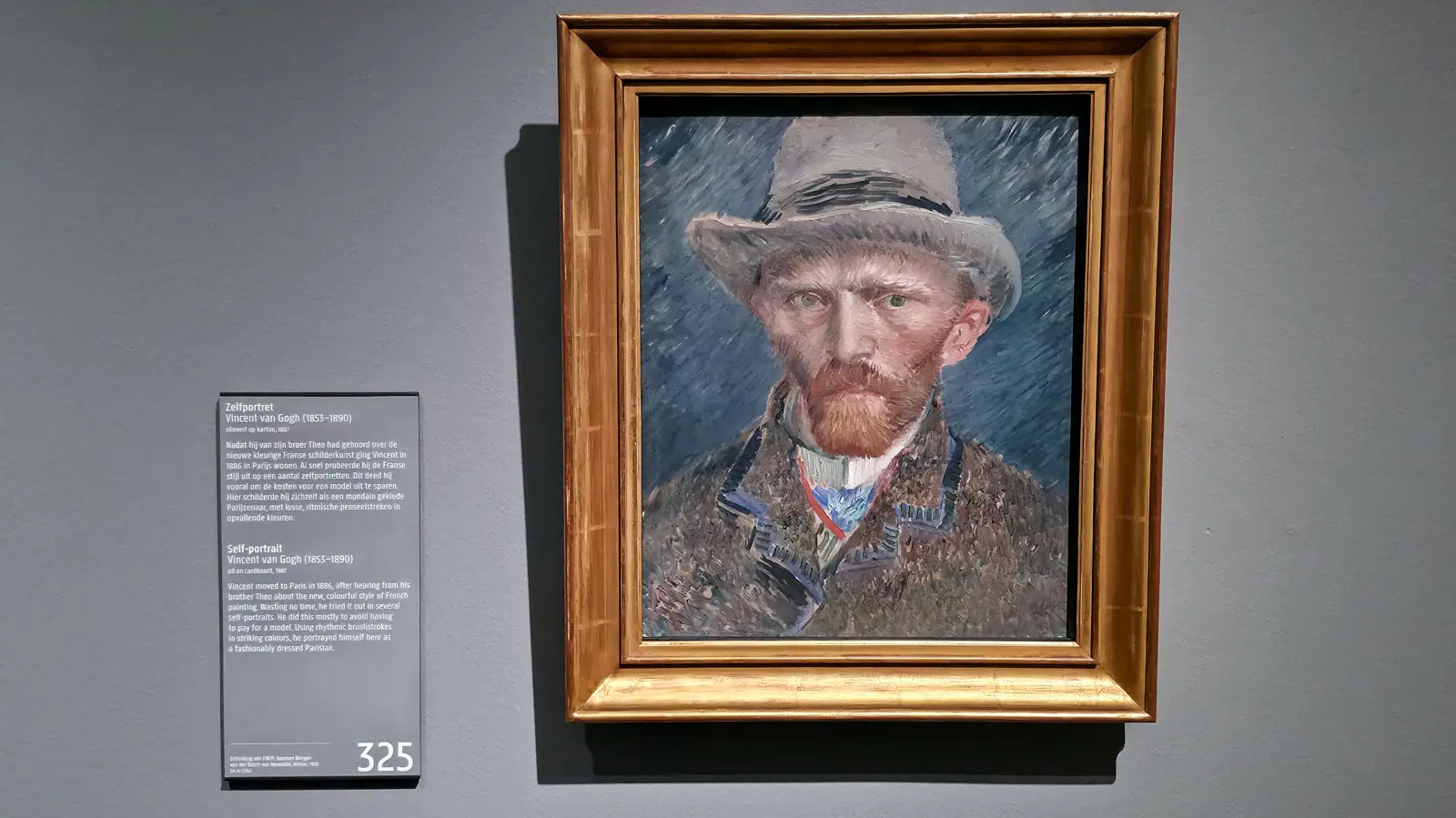
Then, near the end, I found him here as well. Not one picture but a small group of them, hung together in their own corner of the building. Nobody had mentioned that either.
The one I am showing here is the self portrait in a grey felt hat, painted in short rhythmic strokes with blue behind the head, from his Paris period. The label makes a point I would not have guessed: he painted himself as a fashionably dressed Parisian, which is not the Van Gogh most people carry around in their heads. The rest of that corner is worth a post of its own and will get one.
And by that stage in the day, finding him had stopped being the reason I was in the building. I had come for one painter and spent the morning discovering a room full of others I could not have named when I walked in.
Bubbly Tips
- Give it a full day, not an afternoon. Unlike some national collections, this one can genuinely be seen in a day. It cannot be seen in three hours.
- Stop in the atrium before going upstairs. It is the piece of architecture most visitors walk straight through on the way to the paintings.
- Use the gardens as a break, not a warm-up. They are alongside the building and they are where locals sit, which makes them the calmest place on the site.
- Walk the Gallery of Honour early or late. The crowd runs continuously down it through the middle of the day and moves in one direction.
- Do not skip the maritime rooms to get to Rembrandt. The ship models and the sea paintings explain where the money in all those portraits came from.
- Look at the porcelain labels, not just the porcelain. Several pieces came off wrecked East India Company ships, and the case includes the cargo they sank with.
- Check what stage the Night Watch restoration has reached before going. The work has run in phases since 2019 and what is visible changes.
- Look up in the old halls. The painted vaults and the stained glass are part of the collection, not the packaging around it.
- Take children to the painting sessions in the entrance hall. Easels, props and boards, set up in the grandest room in the building.
- Book the Van Gogh Museum separately, and still leave time for him here. The Rijksmuseum has a small group of Van Goghs hung together, and almost nobody mentions it.
Final Thoughts
The thing I keep returning to is the glass box. A museum could easily have taken its most famous painting off the wall, closed the room and put up a sign apologising for the inconvenience. This one built a transparent chamber in the middle of its grandest gallery and let people watch the work happen, for years.
That decision says something about what the building is for. So does putting easels in the entrance hall and letting a nine-year-old paint a still life on the floor where the murals are. So, in a much smaller way, do three miniature canal houses on a shelf in Montreal, handed over by an airline, standing in for buildings on three real Amsterdam canals I have walked along without knowing it.
Until next time!

🌟 Everything You Need to Plan Your Dream Trip in 2026
- 🌟 Luxury Hotels - Find premium stays with Booking.com & Hotels.com
- 🏡 Vacation Rentals - Discover unique properties on VRBO
- 🏞️ Guided Tours - Explore with Viator or GetYourGuide
- 🎫 Attraction Tickets - Skip the lines with Tiqets
- 🚢 Ocean Cruises - Set sail with Cruise Direct
- 📱 International SIMs - Stay connected with Saily
- 🚗 Car Rentals - Budget-friendly options from Discover Cars
- 🌐 Secure VPNs - Browse safely with NordVPN
- 💶 Currency Exchange - Best rates with Wise
- 🗣️ Learn Languages - Master the local language with Babbel and Rosetta Stone