
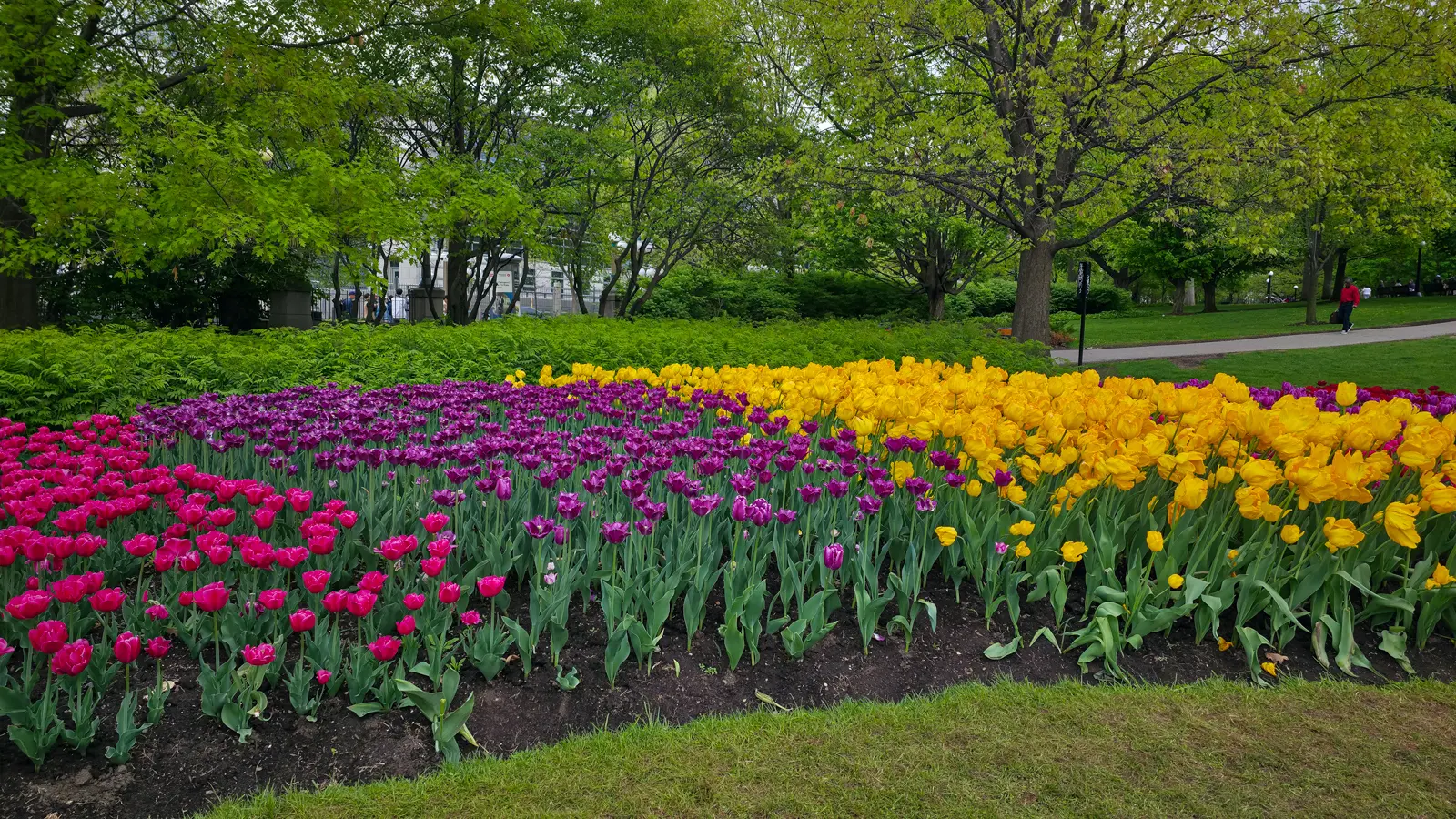
Every May I go to the Canadian Tulip Festival in Ottawa. It is a fixture of my spring, and after enough visits I thought I had a reasonable idea of what a tulip display looks like at its best.
So when I read that Keukenhof describes itself as the most beautiful spring garden in the world, I was sceptical. There is only so much a tulip can do. It comes up, it is red or yellow or pink, it lasts a couple of weeks. How many ways can anyone arrange that?
I booked half a day, which is a fair measure of how little I expected.
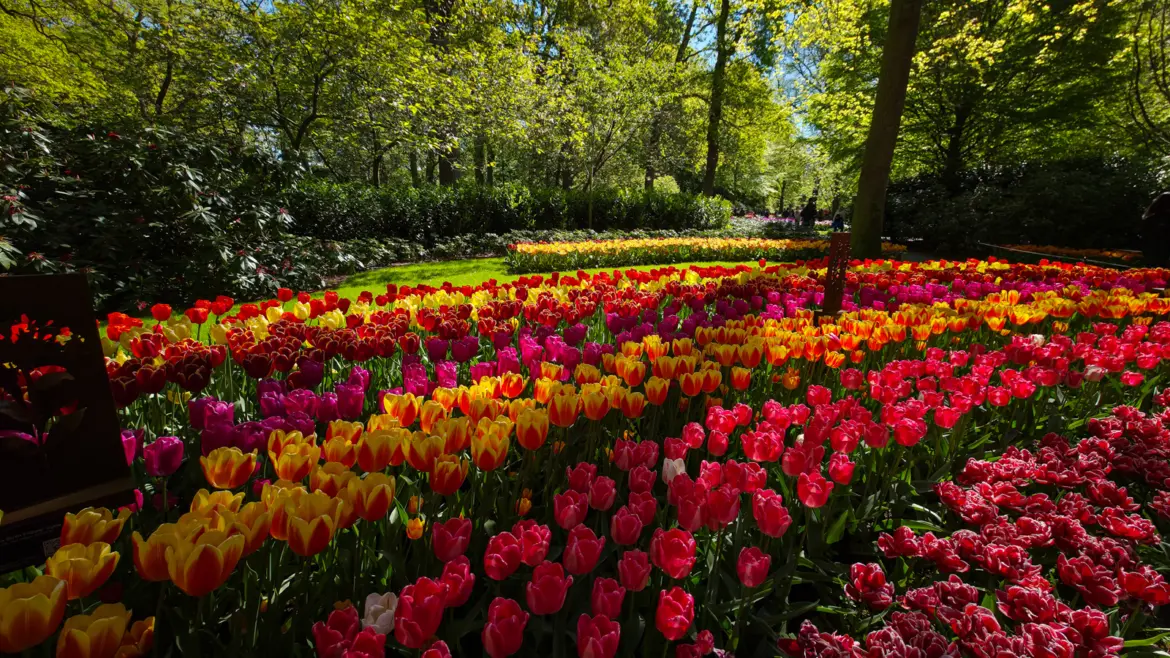
Keukenhof at a Glance
🌷 What it is · A 32-hectare spring garden in Lisse, open about eight weeks a year (19 March to 10 May in 2026), planting around 7 million bulbs in some 1,600 varieties.
🗺️ Where tulips come from · Not the Netherlands. A wild Central Asian mountain flower, bred through Ottoman gardens, first flowered in the Netherlands at Leiden in 1594.
✂️ The catch · The famous striped fields outside are often already cut (topped) by late April, exactly when the garden peaks.
⏱️ Time needed · A full day. The paths run to about 15 km, and a half-day coach tour barely scratches it.
💡 Tip · Go independently, arrive at opening, and do not pair it with a second big stop like Zaanse Schans.
Arriving
Keukenhof sits in Lisse, in the bulb-growing country south of Amsterdam. I arrived on a bright morning at the start of King’s Day week and joined a queue that stretched well back from the ticket windows.
The garden opens for roughly eight weeks a year and then shuts completely. That short window is the whole reason for the crowds. Tickets carry a time slot booked in advance, which sorts the queue into something orderly, but the volume is the volume. On the morning I arrived there were coaches unloading steadily.
The beds start before the entrance does. Purple alliums and white narcissi were already planted in the forecourt, which is a small piece of theatre and an effective one.

Where tulips actually come from
Standing in a Dutch garden looking at Dutch tulips, it is easy to assume the flower is Dutch. It is not, and it never was.
The tulip is a wild mountain plant. Its centres of diversity are the Tien Shan and Pamir-Alay ranges of Central Asia, along with the Caucasus, and the wild species there are short, small-flowered things in reds, yellows and oranges. Nothing about them suggests the vast hybrids in the beds at Lisse.
They travelled west through Persian and then Ottoman gardens, where they were bred and cultivated for centuries. My guide told me the tulip came from Turkey, and that is roughly the shape of it, though the flower was a guest in Ottoman gardens rather than a native of them.
The route into the Netherlands runs through two named people. Ogier Ghiselin de Busbecq, ambassador to the Ottoman court, arranged for bulbs to be sent to the imperial gardens in Vienna. The botanist Carolus Clusius, who had been running those gardens, took up a professorship at Leiden in 1593 and became the first keeper of its new botanical garden. His bulbs flowered there in 1594, the first recorded flowering of tulips in the Netherlands.
So the Dutch did not invent the tulip. They acquired it and then spent four centuries becoming better at growing it than anyone else. Keukenhof is the proof of the second half of that sentence.
The design
Here is where my scepticism collapsed.
Keukenhof covers 32 hectares and plants roughly seven million bulbs every year, across around 1,600 varieties supplied by about a hundred growers and exporters. Those are the numbers. They are not the point.
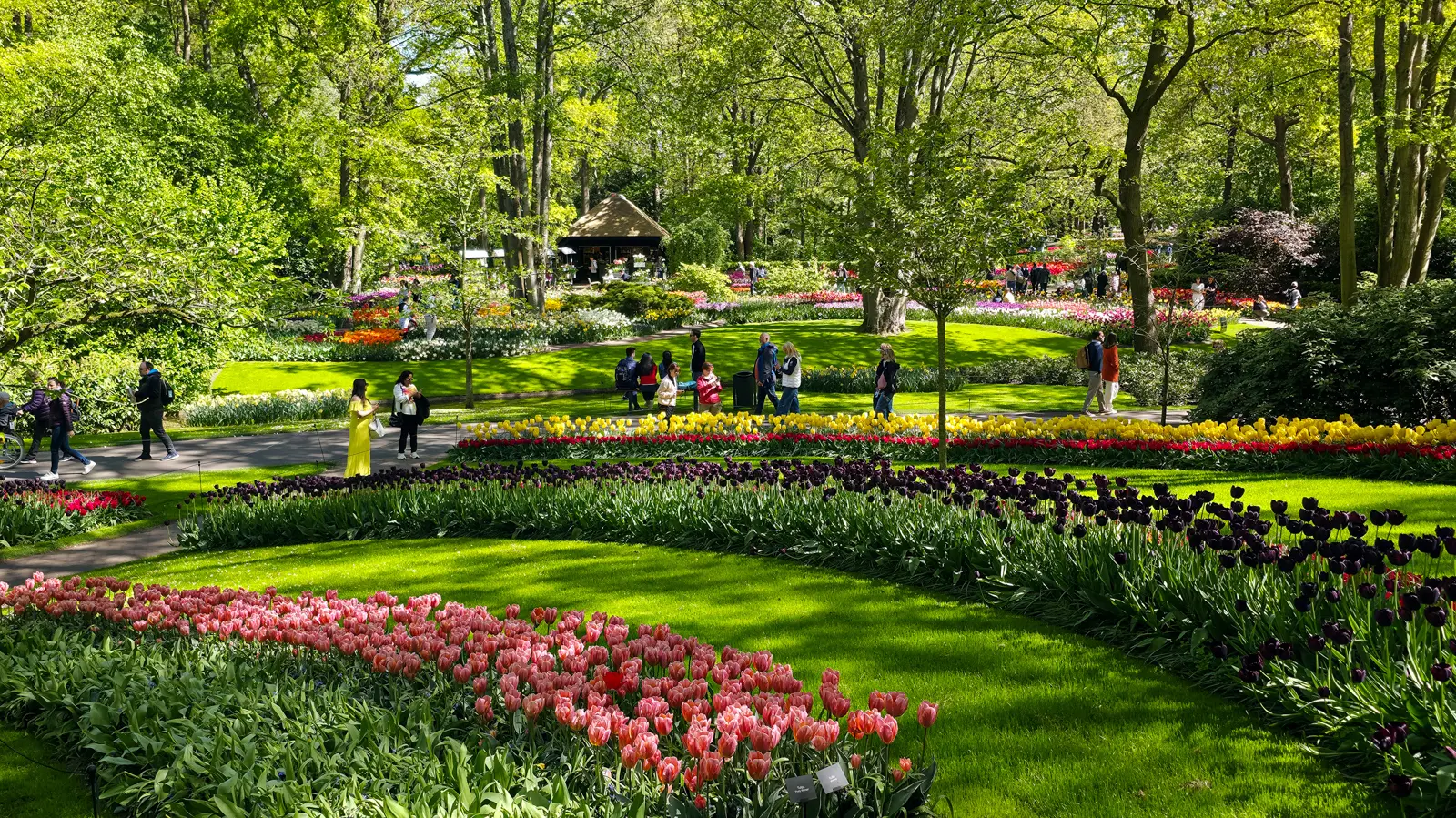
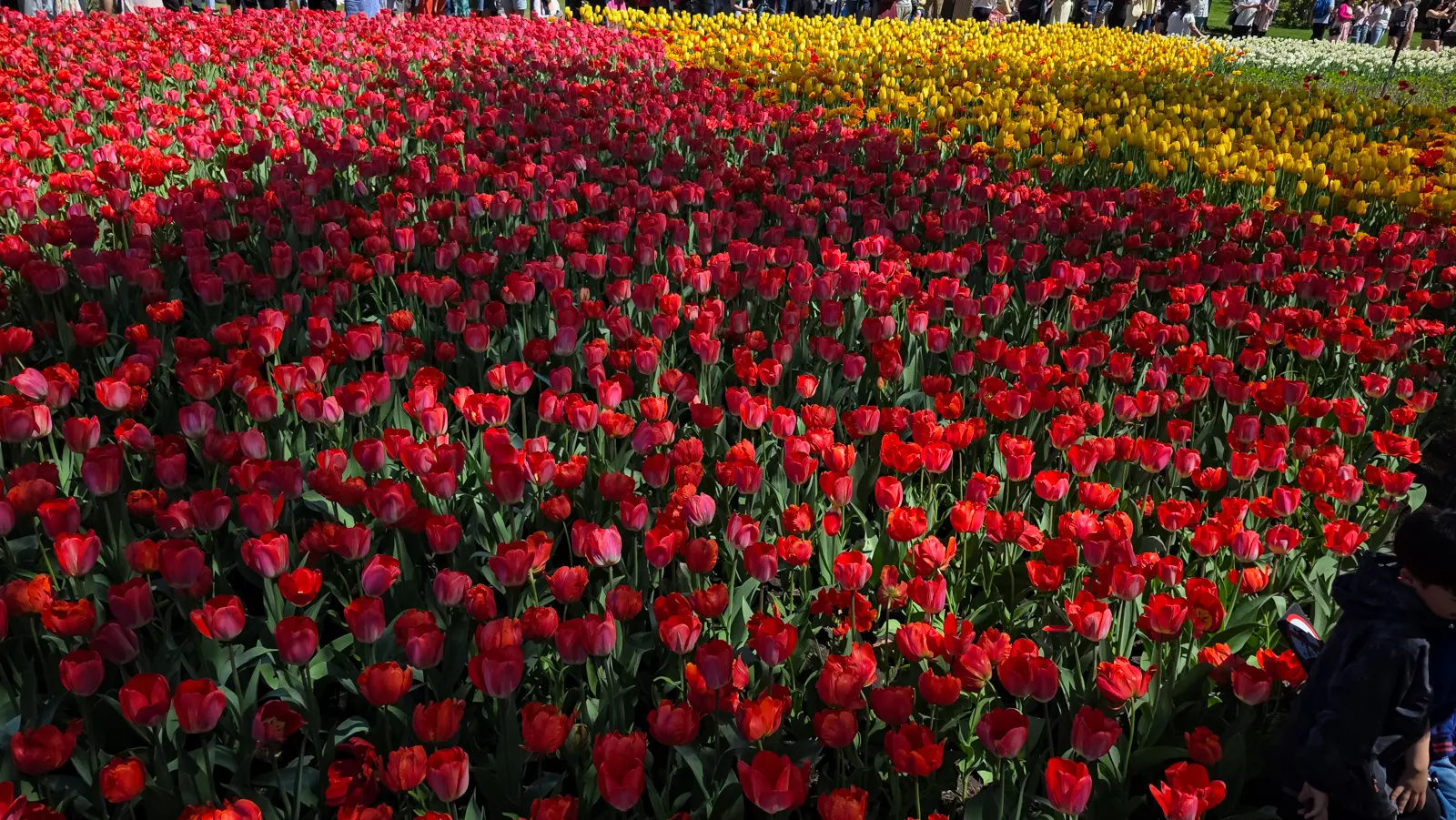
The point is that nobody plants a tulip on its own. The beds are composed. A band of pale pink sits against mown grass, which sits against a band of near-black plum, which runs into yellow. Curves are used rather than rectangles, so the eye is pulled along a bed instead of stopping at the end of it. Ribbons of low blue flowers wind between the taller plantings and hold the whole thing together.
Some beds are planted in stripes of six or seven colours running away from the path. Others are single blocks the size of a small room. The scale changes every few minutes of walking, and that variation is what stops seven million bulbs becoming monotonous.
I had asked how anyone could be creative with a tulip. The answer, it turns out, is that the tulip is the pigment and the garden is the painting.
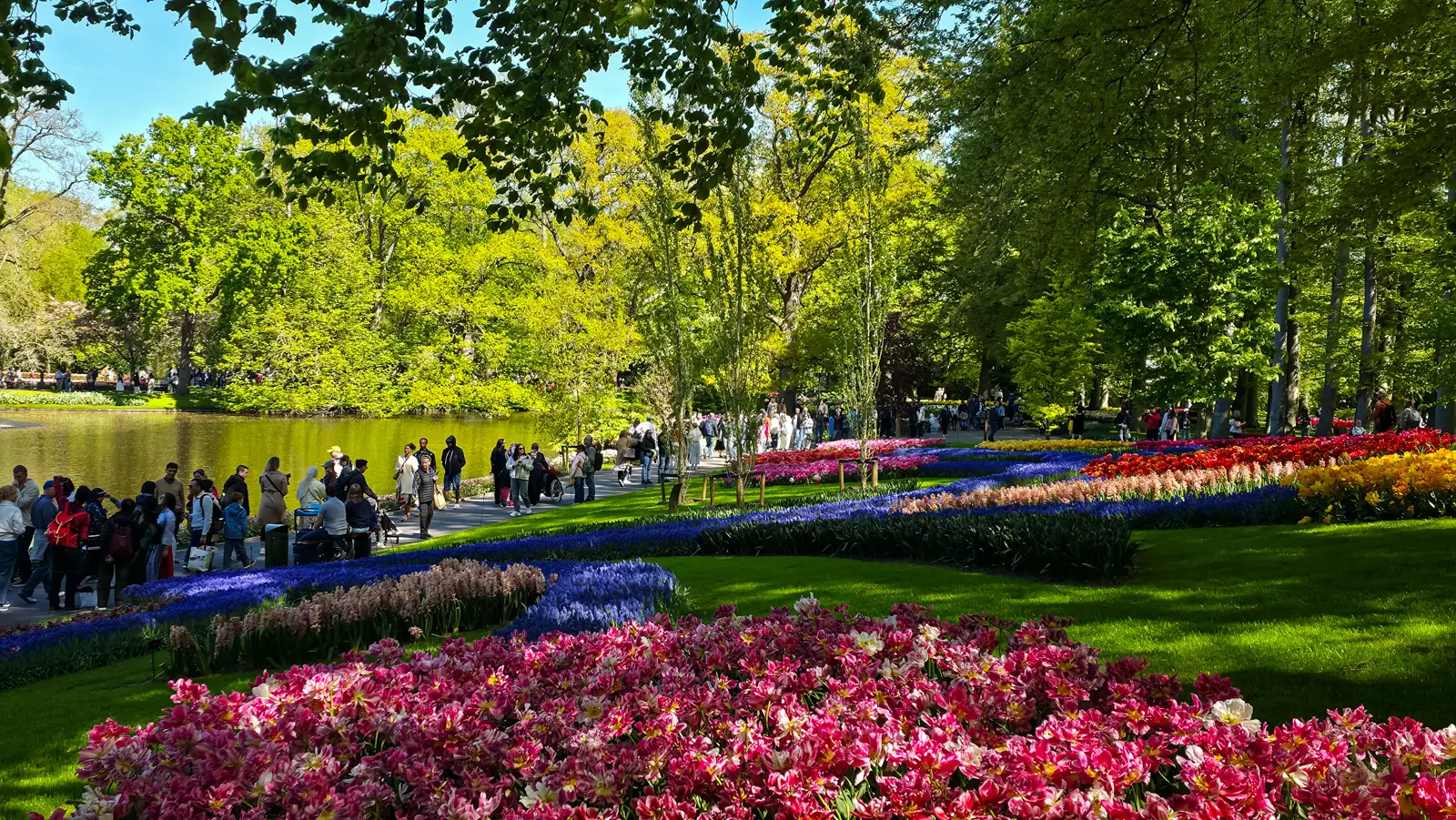
Colour is not the only tool. Height is used too, with low plantings set in front of taller ones so a bed reads as a slope of colour rather than a flat panel. Along one stretch beside the water, deep blue ran in a wide band with pale pink behind it and red and yellow beyond, each layer visible over the top of the one in front.
Water, trees and the older garden underneath
Something I had not expected: Keukenhof is a woodland.
The beds sit inside mature parkland with enormous beech and oak trunks, and streams running through the middle of it. In places the water is a natural-looking channel with stones in the bed and grass banks curving down to it. Elsewhere it is formal, a long straight rill with stone coping and tulips planted tight along both edges.
This is not a recent invention. The estate has been landscaped for far longer than the flower show has existed, and the flower beds were laid into an existing English-style park rather than the other way round. The trees are the reason the garden photographs the way it does. Light comes down through them in patches, and a bed of red tulips half in shade and half in sun does something no evenly lit bed can.
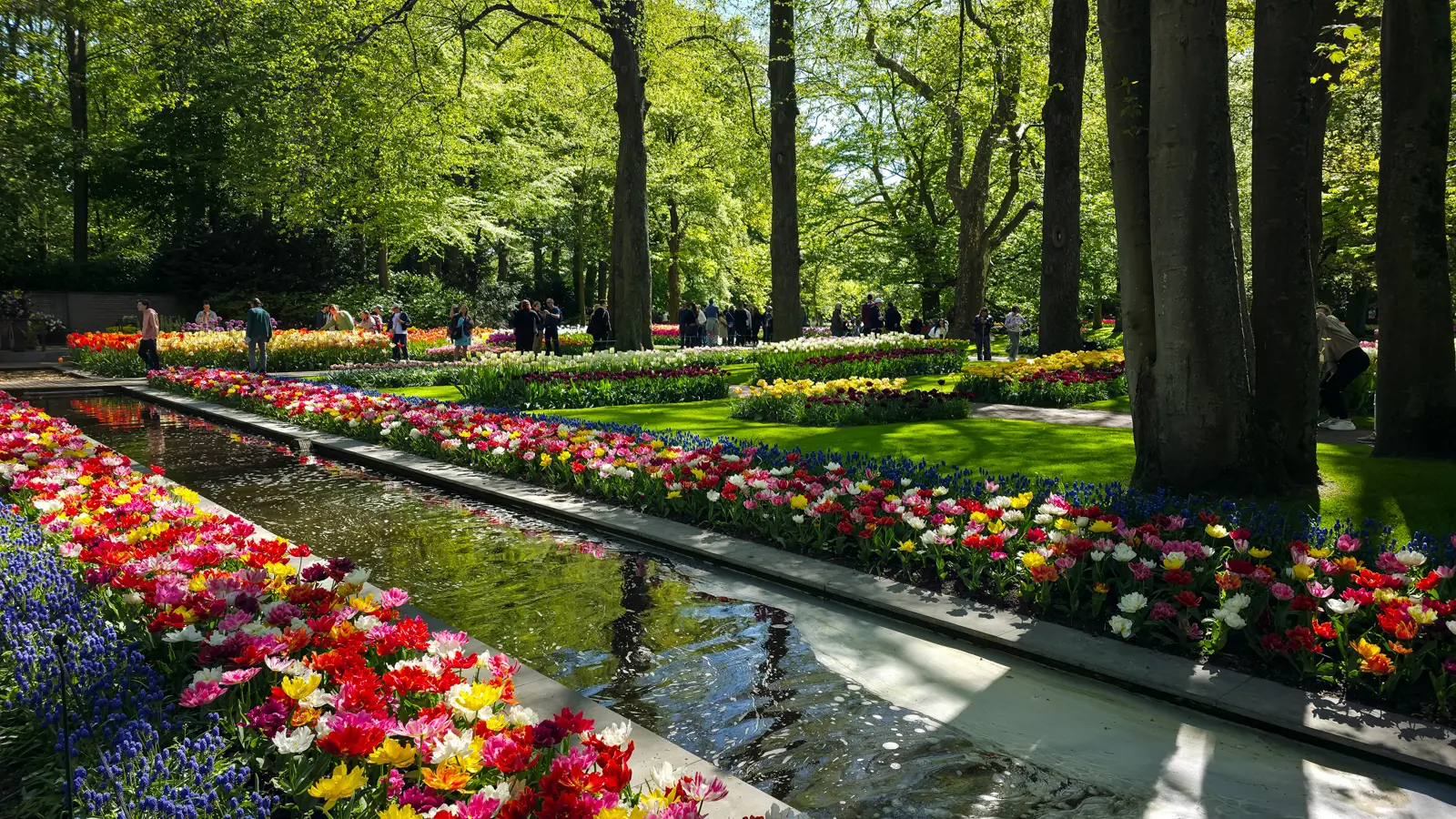
The pavilions are set among the trees rather than dominating them. The Juliana Pavilion, which holds a permanent display on the tulip’s history, sits low behind a screen of branches on the far bank.
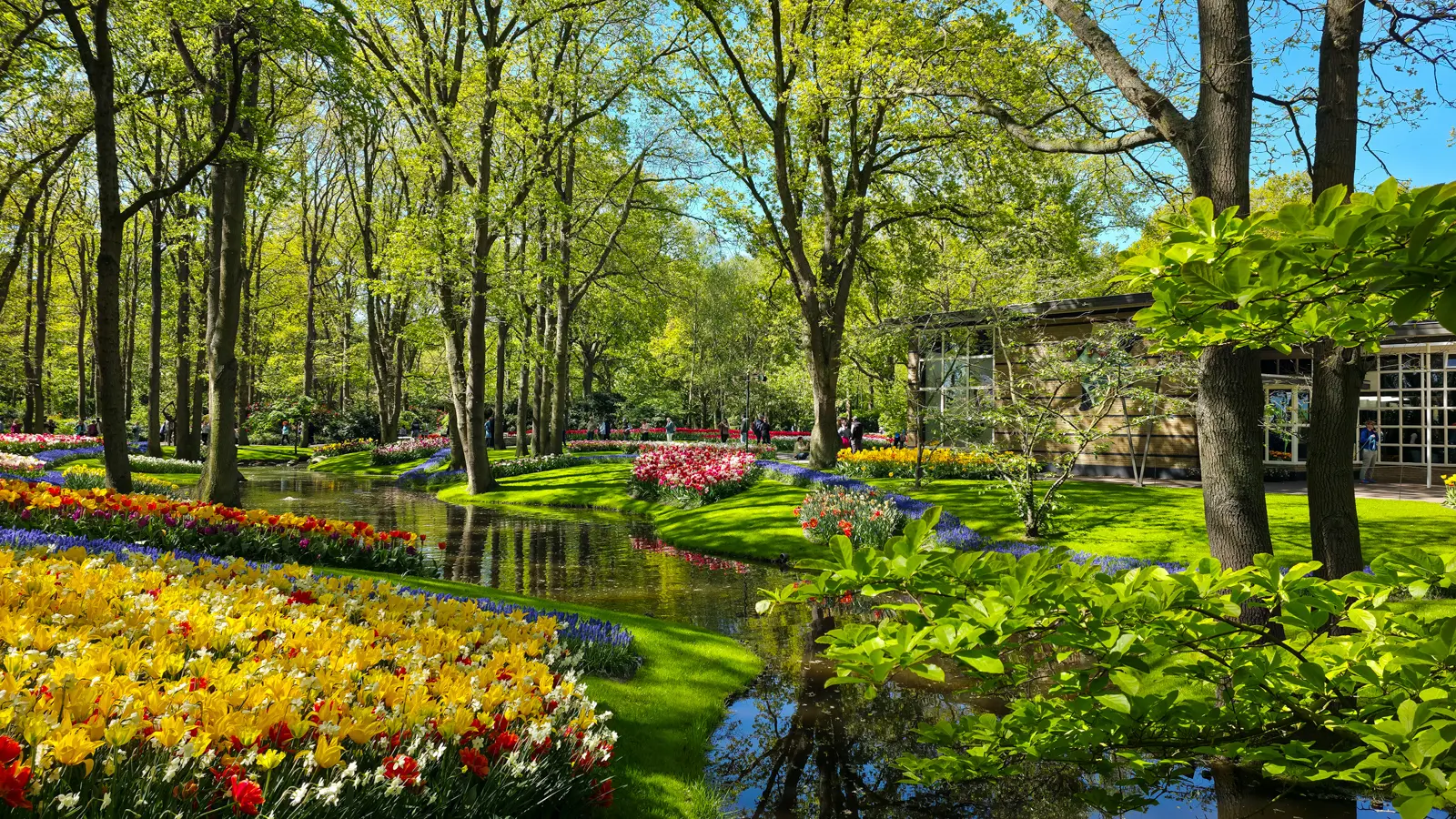
Further along, the water narrows and the planting gets quieter. Stones sit in the streambed, a low tree leans right across the channel, and the beds pull back to leave open lawn.
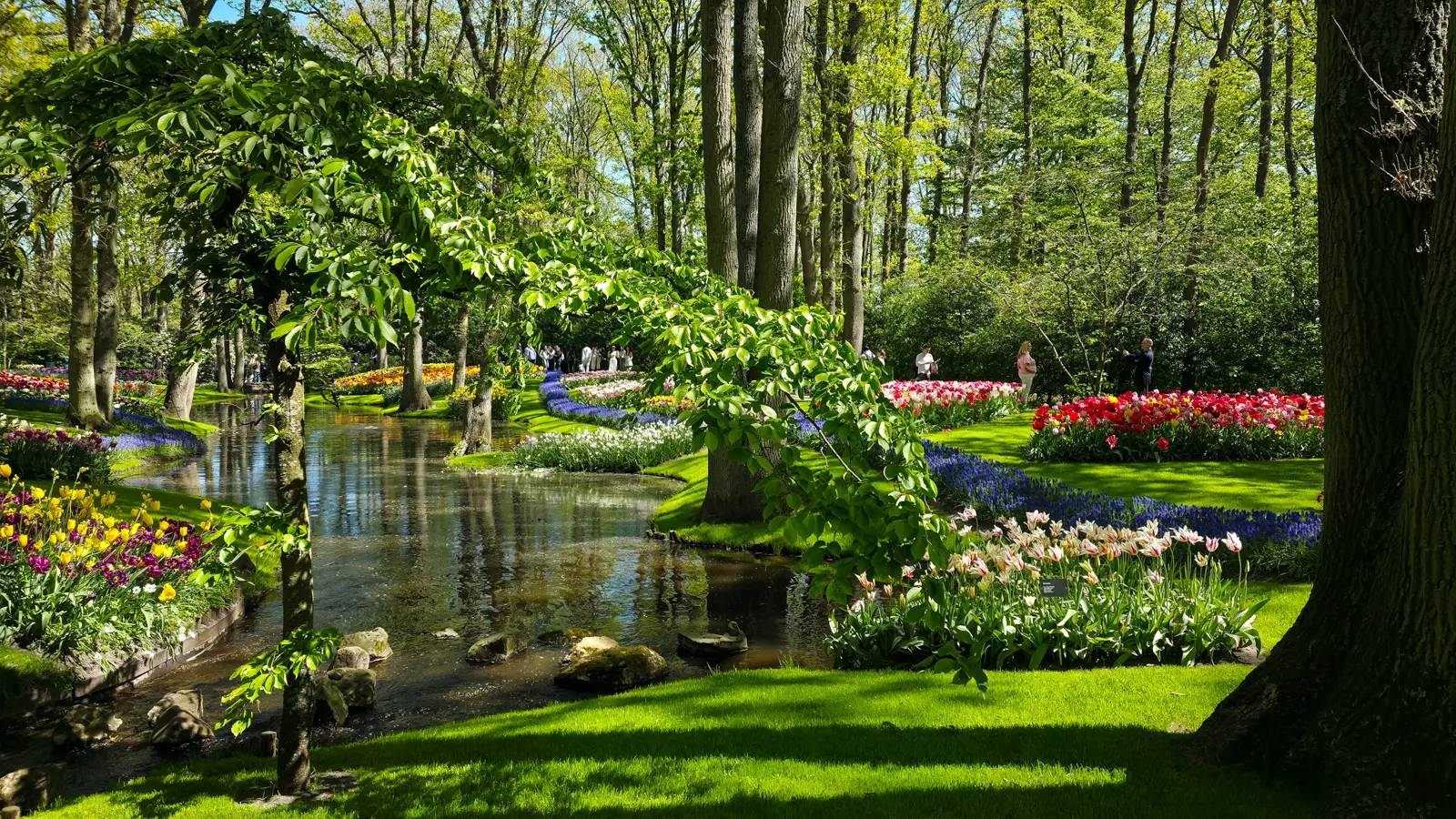
The lake, and everybody else
The lake is where the garden stops being a horticultural exhibition and starts being a day out.
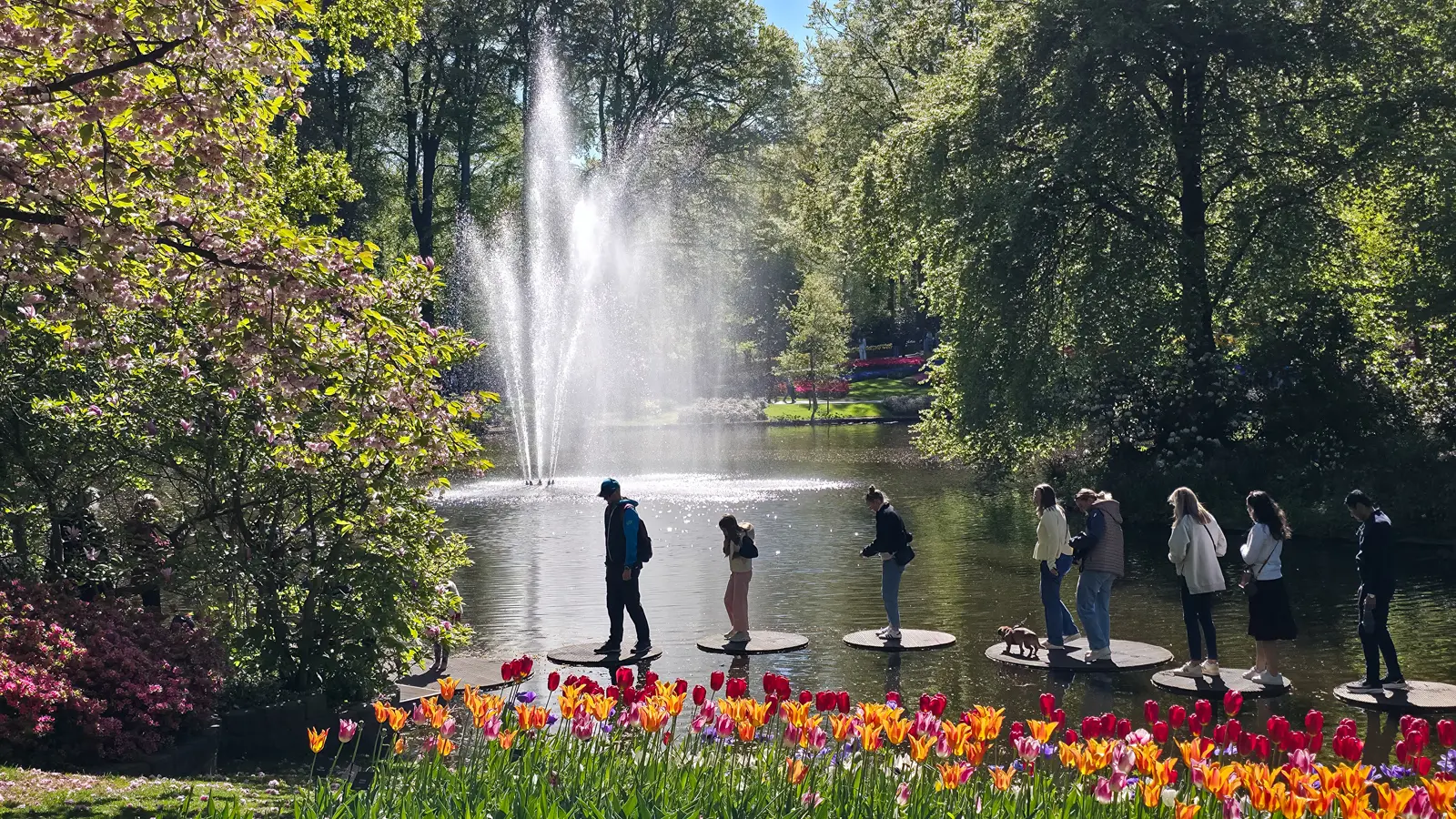
A tall fountain throws water up in the middle of it, and a line of flat circular discs crosses the water in front, low enough that people step from one to the next just above the surface. When I got there a queue had formed, and it was the best twenty minutes of the morning.
I did not cross. I watched. Children went first and fastest, with the confidence of people who have never fallen in anything. Adults went carefully, arms slightly out. One small dog trotted across without breaking stride and made everybody look worse by comparison. A cherry tree in blossom stood at the near end and half the queue was photographing that instead.
This is the part of Keukenhof nobody mentions in the marketing. It is a garden that works for a three-year-old and a serious gardener at the same time, and the second group is not being tolerated for the sake of the first.
Indoors
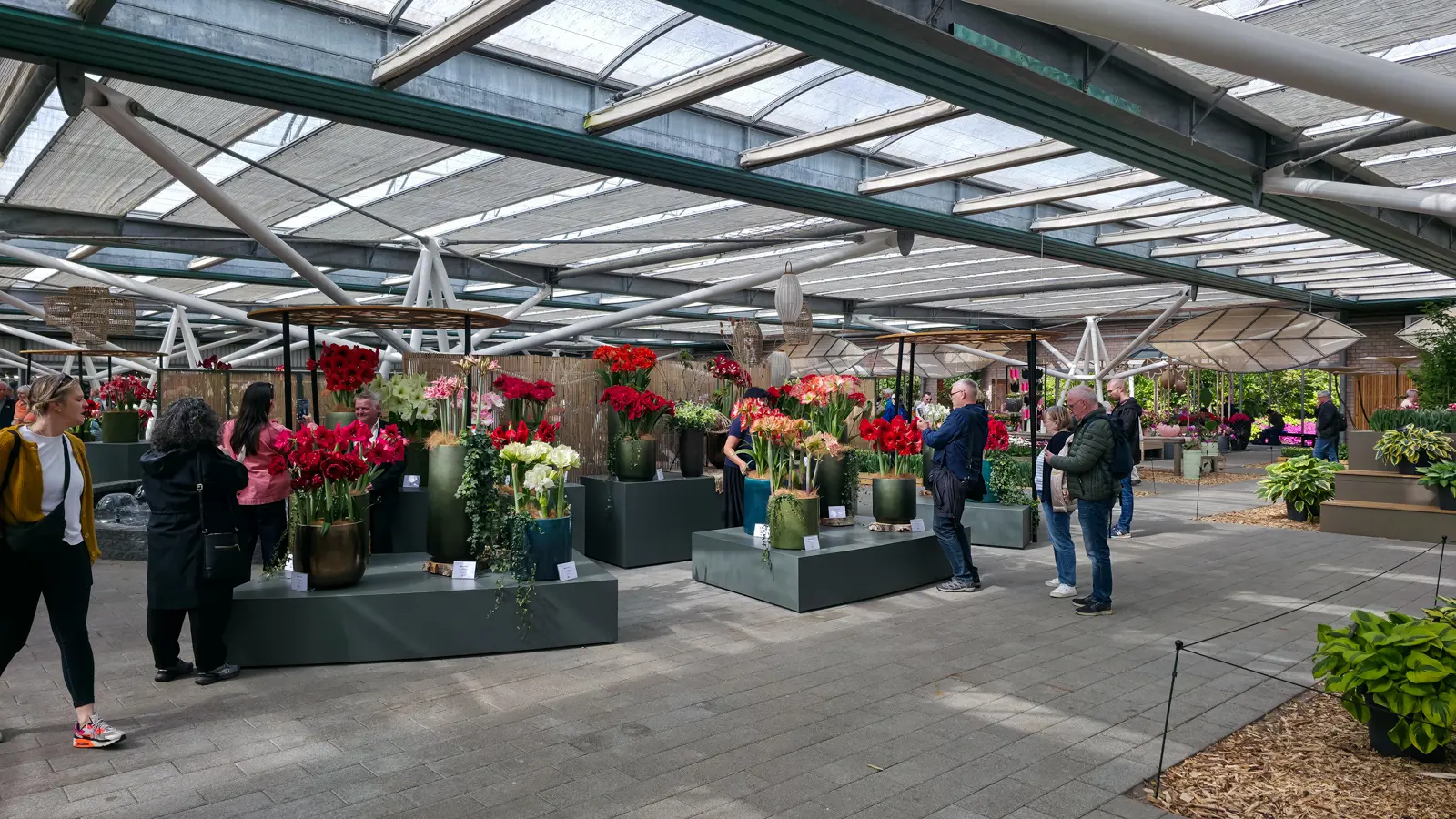
I went into the Willem-Alexander Pavilion partly to see the displays and partly because a covered space is welcome after three hours of open ground.
The staging inside is completely different from the beds outside. Flowers stand in individual pots on low green plinths, each with a printed label, lit from above through a glass roof. Alongside the tulips there were amaryllis in deep red, white and streaked pink, some of them well over half a metre tall, arranged as specimens rather than as a mass.
It reads more like a trade show than a garden, which is exactly what it is. Keukenhof was founded as a shop window for the Dutch bulb industry and it has never stopped being one. Growers stage their best material here for buyers, and the public gets to walk through the middle of it.
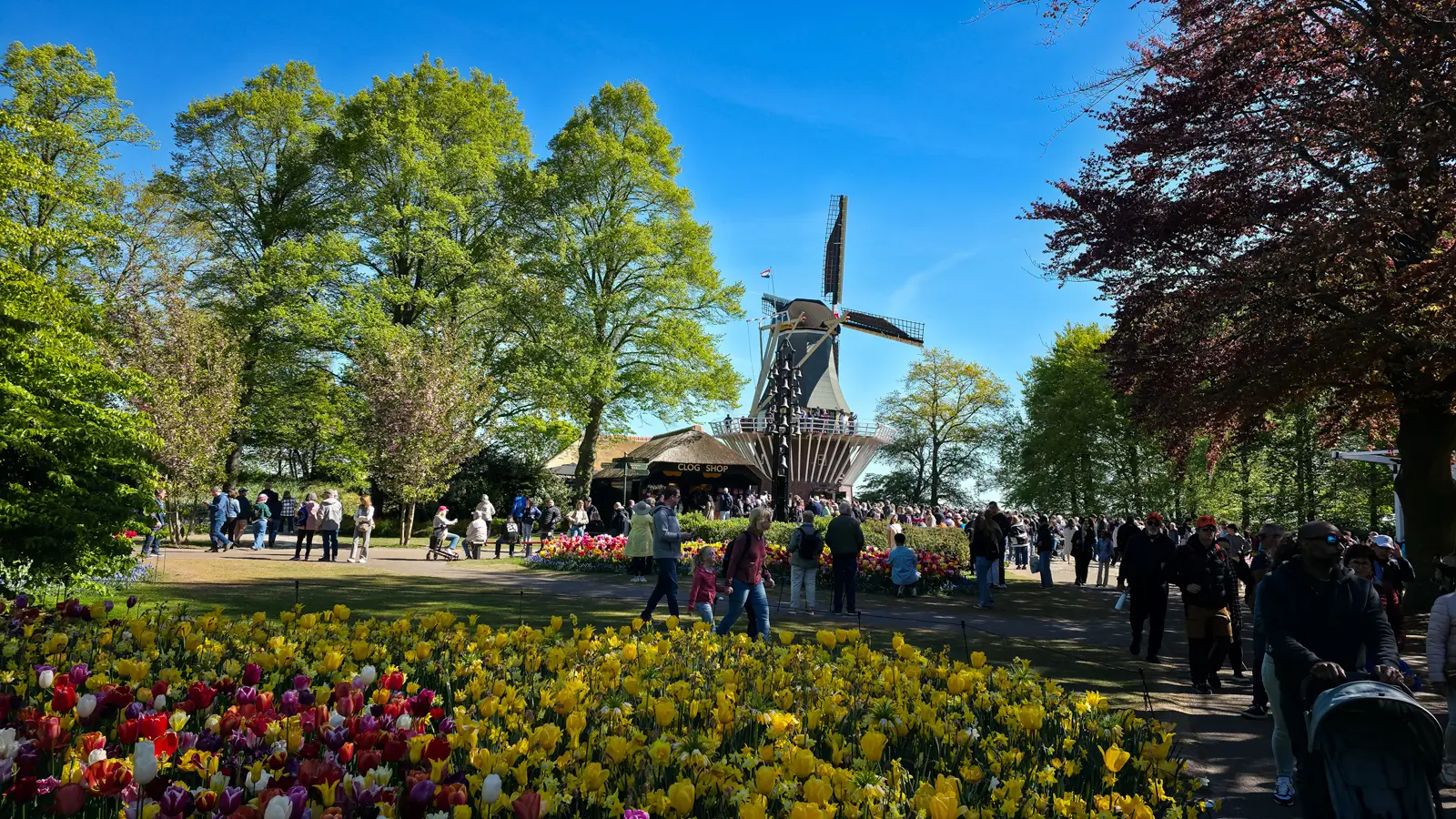
The windmill, and the fields that were already cut
There is a windmill at Keukenhof, and it is not a folly. It was built in 1892 in Scharmer, in the province of Groningen, and worked as a polder mill, pumping water off low-lying drained land. It was moved to the garden in the twentieth century and now stands above a clog shop with a viewing platform around its base.
The platform exists for one reason: to look out over the commercial bulb fields beyond the garden boundary. Those fields are the famous stripes, the ones in every photograph of the Dutch spring.
I did not climb it. By the time I reached the windmill I had already seen the fields from the road on the way in, and they had been cut.
This is called topping. Once a bulb field has flowered, growers run cutting machines through it and take the heads off, leaving the stalks and leaves standing. The flower is not the crop. The bulb is. Removing the head stops the plant putting anything into making seed, so it goes into the bulb instead, and the bulb lifted that summer is bigger and healthier for it. It happens around the end of April, which is precisely when the garden is at its peak.
Keukenhof’s own flower report for 30 April 2026 records the same process starting inside the park, beginning with the hill near the main entrance, as individual beds finished flowering. So it is not a secret or an accident. It is the season working normally.
Still, it is worth knowing before booking. The garden and the fields do not peak together, and the second half of that pairing goes first.
For the smaller visitors
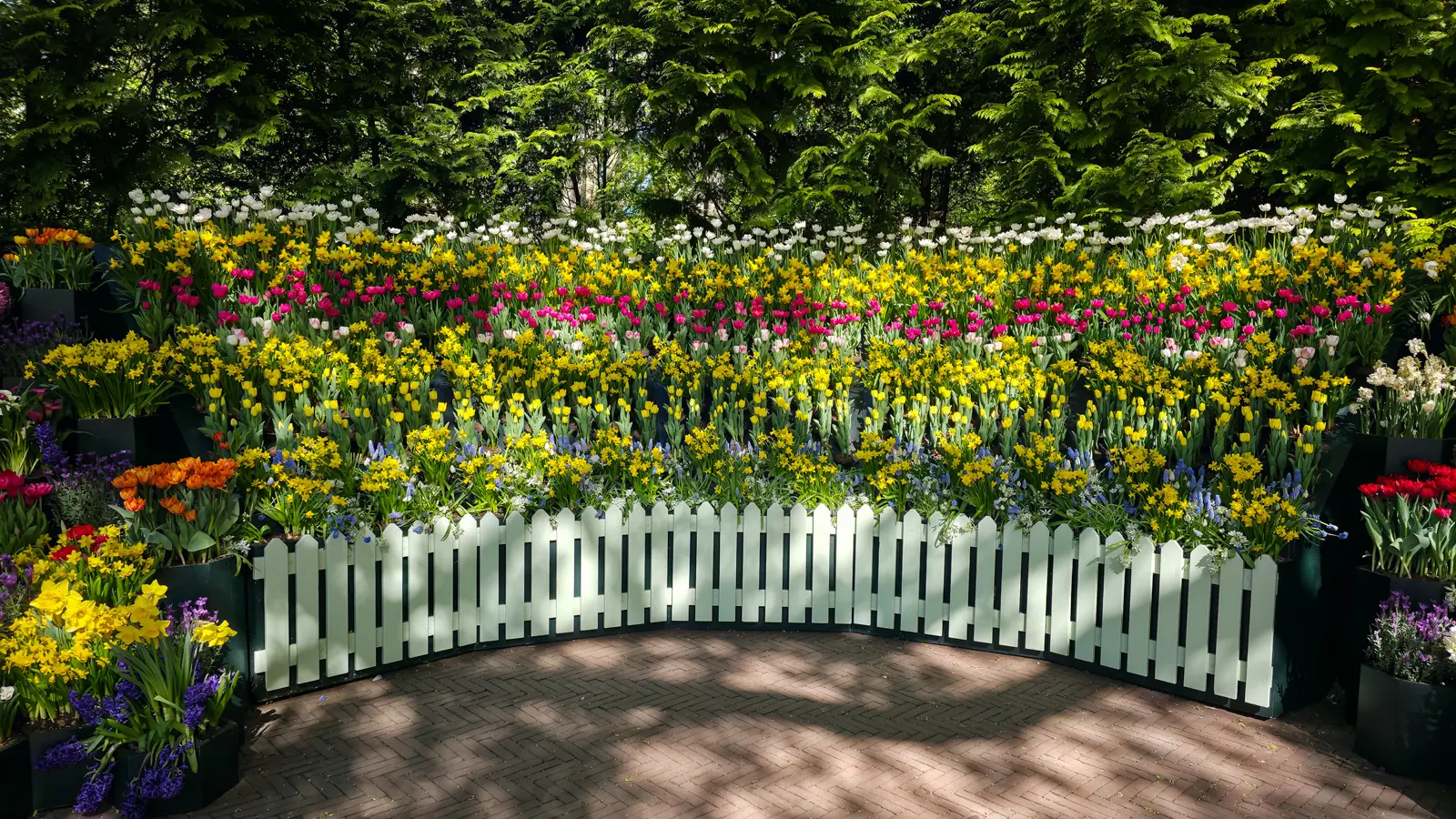
Near the windmill the planting changes character again. Instead of open beds there are staged displays: banked tiers of tulips, daffodils and low blue flowers rising behind a low white picket fence, with more in boxes on either side, set on a herringbone brick apron.
It is built at exactly the height of a small child looking over a fence, and there was a steady rotation of families being photographed in front of it. Nothing about it is accidental.
Half a day was a mistake
I had booked Keukenhof as part of a coach day that also took in the Zaanse Schans windmills and a cheese stop. Air-conditioned bus, guide, three things in one day.
As a way of seeing three things, it worked. As a way of seeing Keukenhof, it did not.
I left around the middle of the day having walked a fraction of the 15 kilometres of paths, skipped most of the pavilions, missed the boat trip through the surrounding fields entirely, and crossed nothing off the list of things I wanted to sit down and look at properly. There is a difference between visiting a garden and processing it, and I processed it.
Next time I go independently and I give it the whole day. That is not a complaint about the tour. It is a warning about the arithmetic.
Back in Ottawa, seventeen days later
I was at Commissioners Park in Ottawa on May 17th, two and a half weeks after Lisse, which is about the fairest test I could have set.
Commissioners Park is the main site of the Canadian Tulip Festival, on the shore of Dow’s Lake, and the National Capital Commission plants more than 300,000 tulips there across more than a hundred varieties. It holds the Queen Juliana Gift Bed, planted with bulbs sent from the Netherlands every year, a tradition that goes back to the gift of 100,000 bulbs after the Second World War. The festival calls itself the world’s largest free public tulip festival.
With Keukenhof still fresh, Ottawa looked lovely and it looked small. Fewer colours. Tulips spaced further apart. Above all, one design repeated rather than a dozen ideas competing across a site. The comparison is not really about numbers, though the numbers are not close. It is that Keukenhof does twenty different things with a tulip and Ottawa does one of them well.
And it is still beautiful, and I will still go every May. It is free, it is on the water, there are food trucks, and half the city turns up. Keukenhof is somewhere to travel for. Commissioners Park is somewhere to spend a Sunday. Those are different jobs.
Bubbly Tips
- Give it a full day, not half. The paths total around 15 kilometres. Half a day covers the headline beds and almost nothing else.
- Do not pair it with a second major stop. Coach tours that combine Keukenhof with Zaanse Schans work as sightseeing and fail as garden visits. Go independently if the garden is the reason for the trip.
- Book a time slot well ahead for late April. That is peak bloom and the busiest stretch of the season.
- Arrive at opening rather than mid-morning. The queue at the ticket windows was already long by ten o’clock, and the coaches keep arriving through the middle of the day.
- Expect the outside fields to be cut from late April. Growers top the commercial bulb fields once they have flowered. The garden peaks at roughly the moment the stripes disappear.
- Skip the windmill platform if the fields have gone. It exists for the view over those fields. Without them there is not much reason to queue for it.
- Use the pavilions as a weather plan. They are covered, and the displays inside are staged completely differently from the beds, so they are worth time in their own right rather than only as shelter.
- Walk the woodland and water sections in the middle of the day. The tree cover is dense enough to be a relief when the open beds are in full sun.
- The lakeside path is the pinch point. It narrows where the crowds are heaviest. Going against the flow early or late is easier than fighting through it at midday.
- Wear proper shoes. The ground is flat and well surfaced, but the distances are longer than the map suggests.
Final Thoughts
I went to Keukenhof expecting a large version of something I already knew, and got something else entirely. The thing that changed my mind was not the seven million bulbs. It was watching a single bed of pale pink run into mown grass and then into near-black plum, and understanding that somebody had chosen that, and then made two hundred more decisions like it across 32 hectares.
The half day remains the one thing I would undo. I walked out at midday with a coach to catch, having seen a fraction of a garden that only opens for eight weeks a year. Next spring I will book the day, go on my own terms, and start at the far end where everyone else finishes.
Until next time!

🌟 Everything You Need to Plan Your Dream Trip in 2026
- 🌟 Luxury Hotels - Find premium stays with Booking.com & Hotels.com
- 🏡 Vacation Rentals - Discover unique properties on VRBO
- 🏞️ Guided Tours - Explore with Viator or GetYourGuide
- 🎫 Attraction Tickets - Skip the lines with Tiqets
- 🚢 Ocean Cruises - Set sail with Cruise Direct
- 📱 International SIMs - Stay connected with Saily
- 🚗 Car Rentals - Budget-friendly options from Discover Cars
- 🌐 Secure VPNs - Browse safely with NordVPN
- 💶 Currency Exchange - Best rates with Wise
- 🗣️ Learn Languages - Master the local language with Babbel and Rosetta Stone