
I have a habit when I travel. Whatever European city I am in, I look for the Roman layer underneath it. Sometimes it is obvious. More often it is a fragment of wall behind a car park, or a hole in a shopping street with old stones at the bottom. I have chased it in Vienna and in Bath, and for years I did not realise how much of it was sitting in plain sight in London.
Rome founded this city. Londinium was established around AD 47 to 50, a trading port on the Thames, and by the second century it was the capital of Roman Britain. Then it was burnt to the ground, rebuilt, walled, abandoned, buried under a thousand years of everything that came after. What remains is scattered and easy to miss. This is where I have found it.
Roman London at a Glance
🧱 The wall · Built around AD 200 from Kentish ragstone shipped up from Maidstone, the best stretch stands free outside Tower Hill station.
🏰 The Tower connection · William the Conqueror planted his fortress on the Roman wall’s corner in 1067, and a Roman bastion still holds up the Wardrobe Tower.
🏛️ The museum · Room 49 at the British Museum holds the tomb of Classicianus, the procurator who saved Londinium after Boudica burnt it.
⛪ The mosaic · The Hinton St Mary floor there carries what is probably the earliest known mosaic portrait of Christ, found by a blacksmith in 1963.
♨️ The day trip · Bath’s Great Bath still fills from Britain’s only natural hot spring, rising at 46°C, about ninety minutes from Paddington.
🆓 The cost · Tower Hill, the Mithraeum, the amphitheatre and the British Museum are all free; only the Tower of London and Bath charge.
The wall at Tower Hill
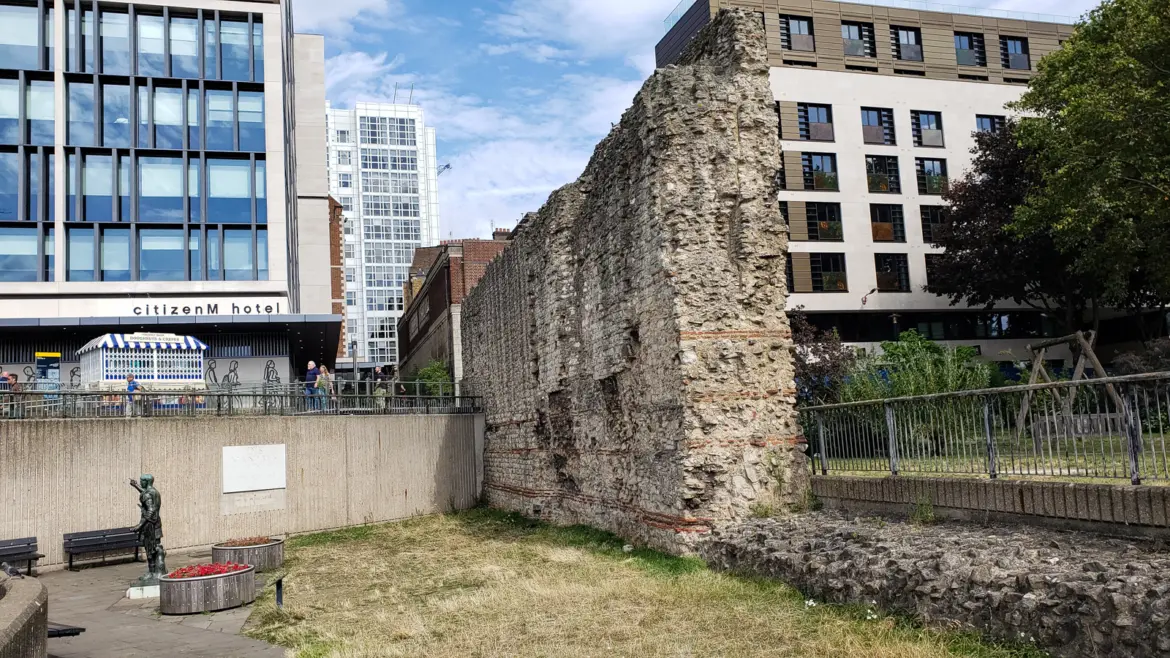
The best surviving piece stands in a sunken garden outside Tower Hill station, and most people walk straight past it to the Tower of London. Around AD 200 the Romans threw a wall around Londinium, roughly two miles of it, using something like 85,000 tons of Kentish ragstone hauled up from Kent by boat. It defined the shape of the city for the next 1,700 years.
Look at the base and the Roman work is unmistakable: squared blocks of ragstone with bands of flat red tile running through at intervals, laid in to level and strengthen the courses. Then the stonework changes. The upper two thirds are medieval, added over centuries as the wall kept being useful. It survived because builders were lazy in the best way, finding it cheaper to build onto the wall than to knock it down.
Standing in front of it is a bronze statue of the emperor Trajan, and he is a wonderful fraud. Trajan never set foot in Britain. The statue is not ancient either, but a twentieth-century cast of a Roman original found in Italy, reportedly rescued from a scrapyard in Southampton and erected here in 1980 at the request of a local vicar. Its head does not match its body.
Set into the modern wall beside him is a carved stone slab reading DIS MANIBUS, to the spirits of the departed. It is a replica. The original belongs to the tomb of Gaius Julius Alpinus Classicianus, the man Rome sent to rebuild Londinium after Boudica burnt it, and it now stands in the British Museum, which is where this walk ends up too.
Why the Tower of London is where it is
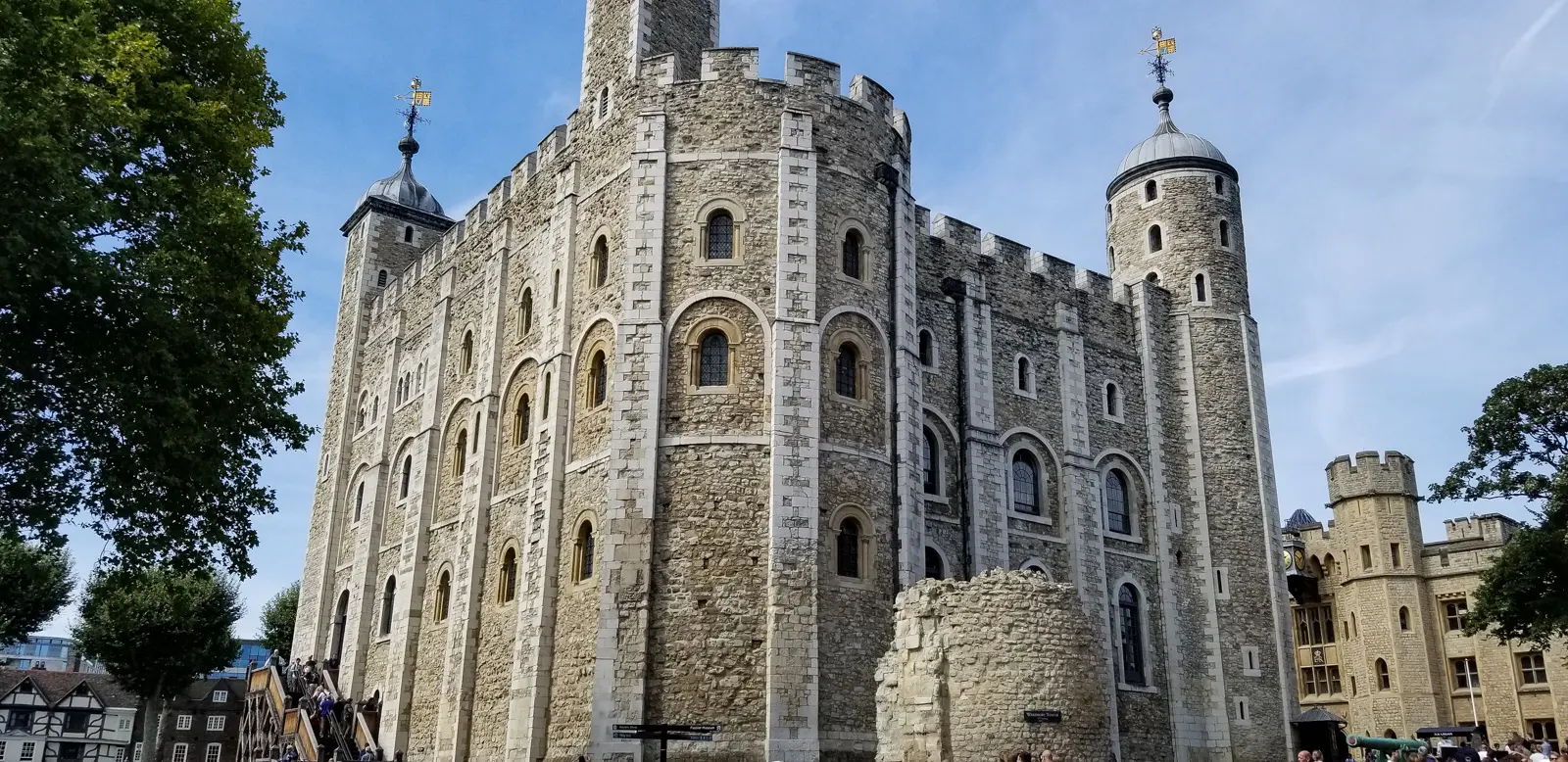
The wall explains the Tower of London. When William the Conqueror wanted a fortress to dominate the city in 1067, he built at the southeast corner of the old Roman wall and used it as his eastern defence. The castle is here because Rome put a corner here.
Two pieces of Roman work survive inside the walls. The clearest is the Wardrobe Tower, a low circular stub of masonry standing on the grass beside the White Tower. Its lowest section is built from the remains of a Roman bastion.
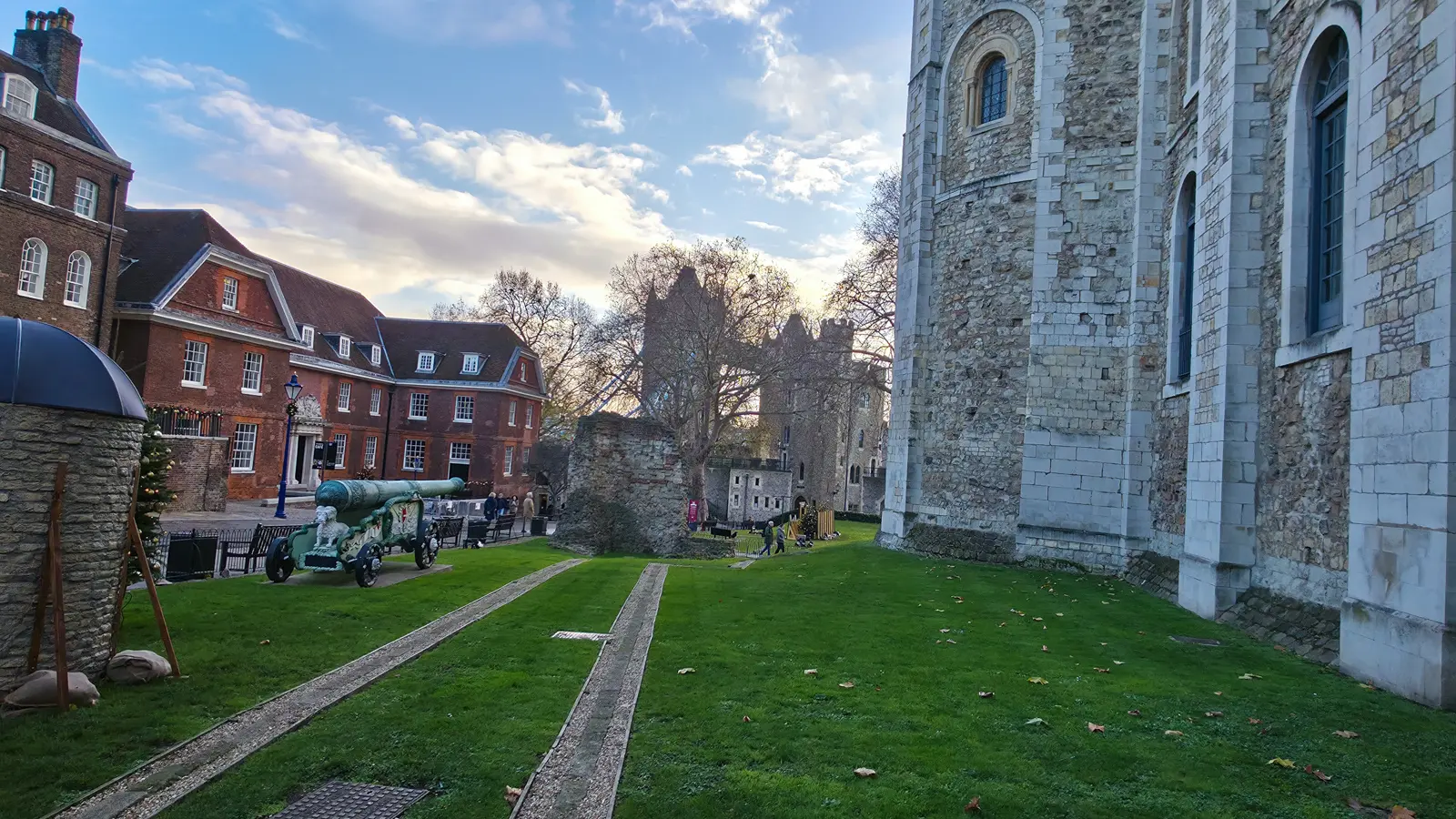
Analysis of its stonework in 2019 identified Kentish ragstone, Cotswold limestone and Roman brick in the fabric, materials carted from across the province and then reused twice over. A stretch of the Roman riverside wall also survives in the curtain between the Lanthorn and Wakefield Towers, and a line in the paving traces where the rest of it ran.
The wall in the modern City
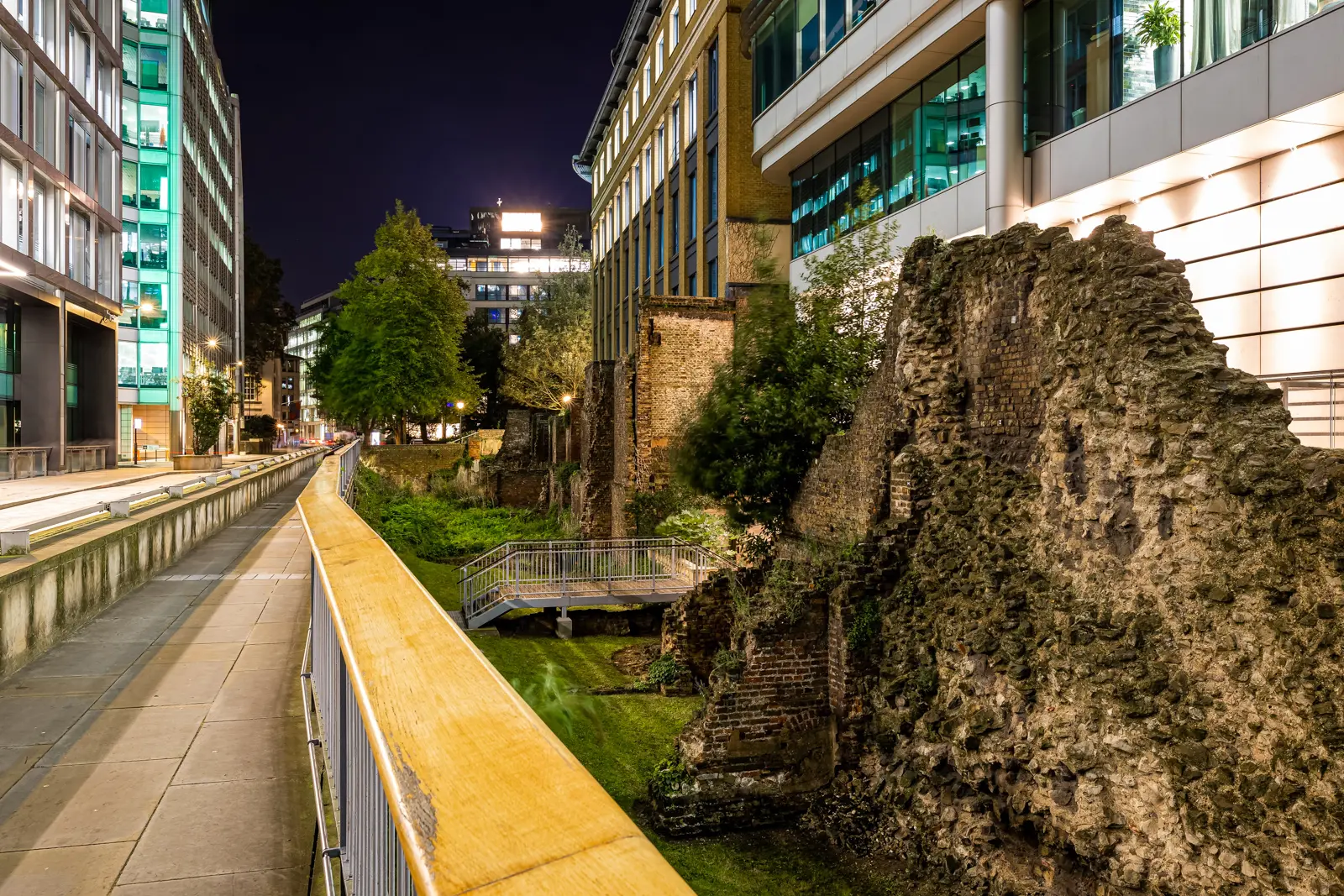
North of the Tower, the wall reappears in fragments, threading between office blocks and car parks. Some sections stand in little gardens. Others sit behind glass in basements, or under buildings that were built around them.
There is more Roman London that I have not yet stood in. The Temple of Mithras, built around AD 240, sits seven metres below Bloomberg’s headquarters on Walbrook, found in 1954 when archaeologists investigated a bombsite. The amphitheatre, where Londoners watched gladiators and executions, lies under Guildhall Art Gallery, discovered only in 1988. Both are free. Both are on my list.
Where the pieces ended up
The wall stayed. Almost everything else went to museums, and Room 49 of the British Museum, the Roman Britain gallery, is where a great deal of Londinium ended up. It is upstairs, it is free, and most visitors march past it towards the Rosetta Stone.
The first thing in it, for me, was an accident. I stopped in front of a tall stone tomb without knowing why, read the label, and realised I had photographed its twin a few years earlier without understanding what I was looking at. This is the monument of Gaius Julius Alpinus Classicianus, and the replica slab set into the wall at Tower Hill is a copy of the stone in front of me.
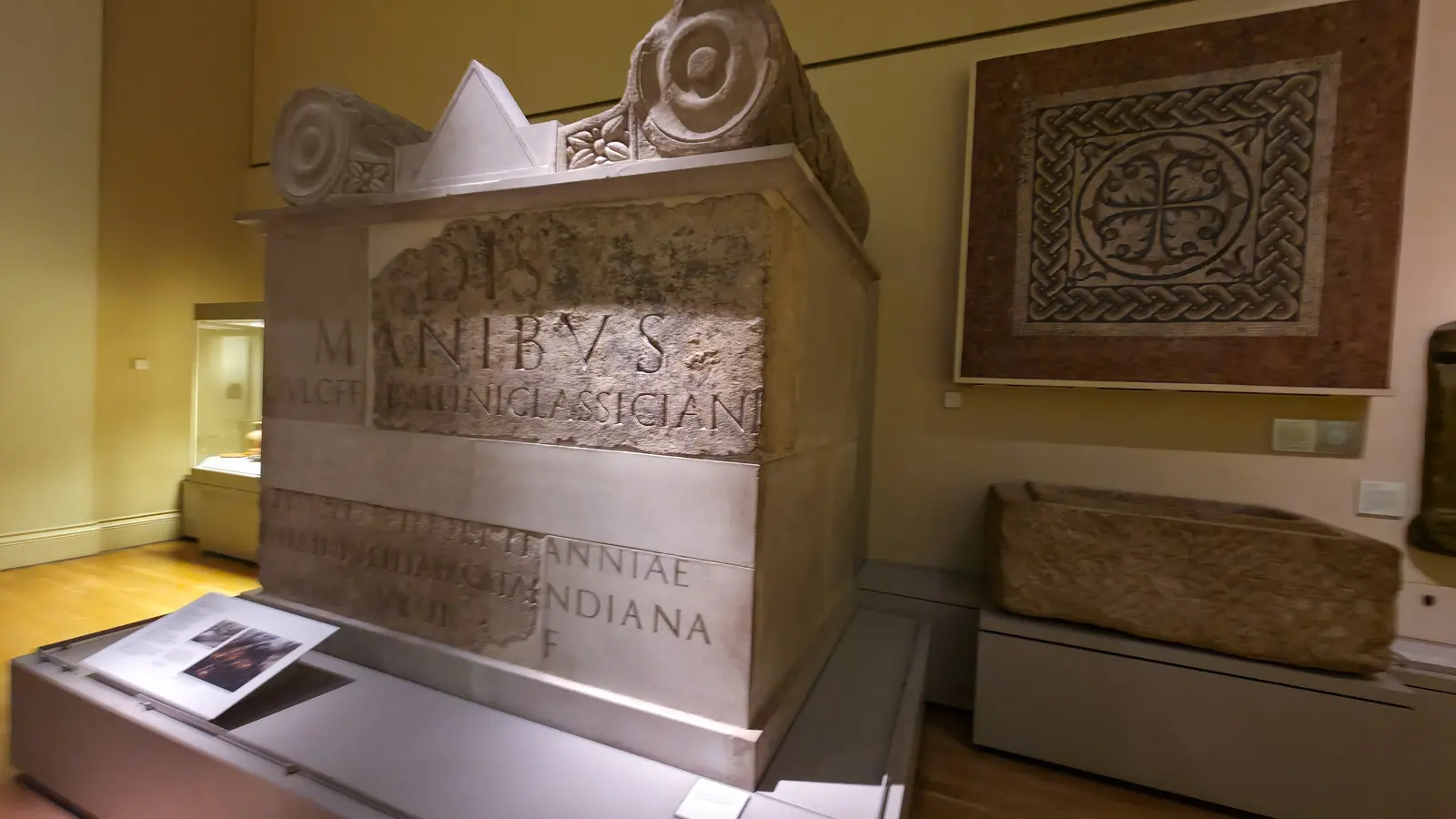
His story is the reason Londinium survived at all. In AD 61 Boudica’s army burnt the city to the ground and slaughtered its people. Rome’s governor, Suetonius Paulinus, crushed the revolt and then set about punishing the province so savagely that the countryside was being starved. Classicianus was sent out as procurator, the empire’s chief financial officer in Britain, and he did something close to unthinkable: he reported his own governor to Rome. Nero sent an official to investigate, Paulinus was eased out of his command, and the reprisals stopped. Classicianus stayed, and rebuilt the city.
He died in Britain, probably around AD 65, and was buried in a cemetery outside the city walls. Three centuries later, when the Romans were strengthening those walls, they broke his tomb into blocks and used it as rubble inside a bastion. That is where the upper half was found in 1852, and the lower half in 1935, both at Tower Hill. The man who saved Londinium ended up buried inside its defences.
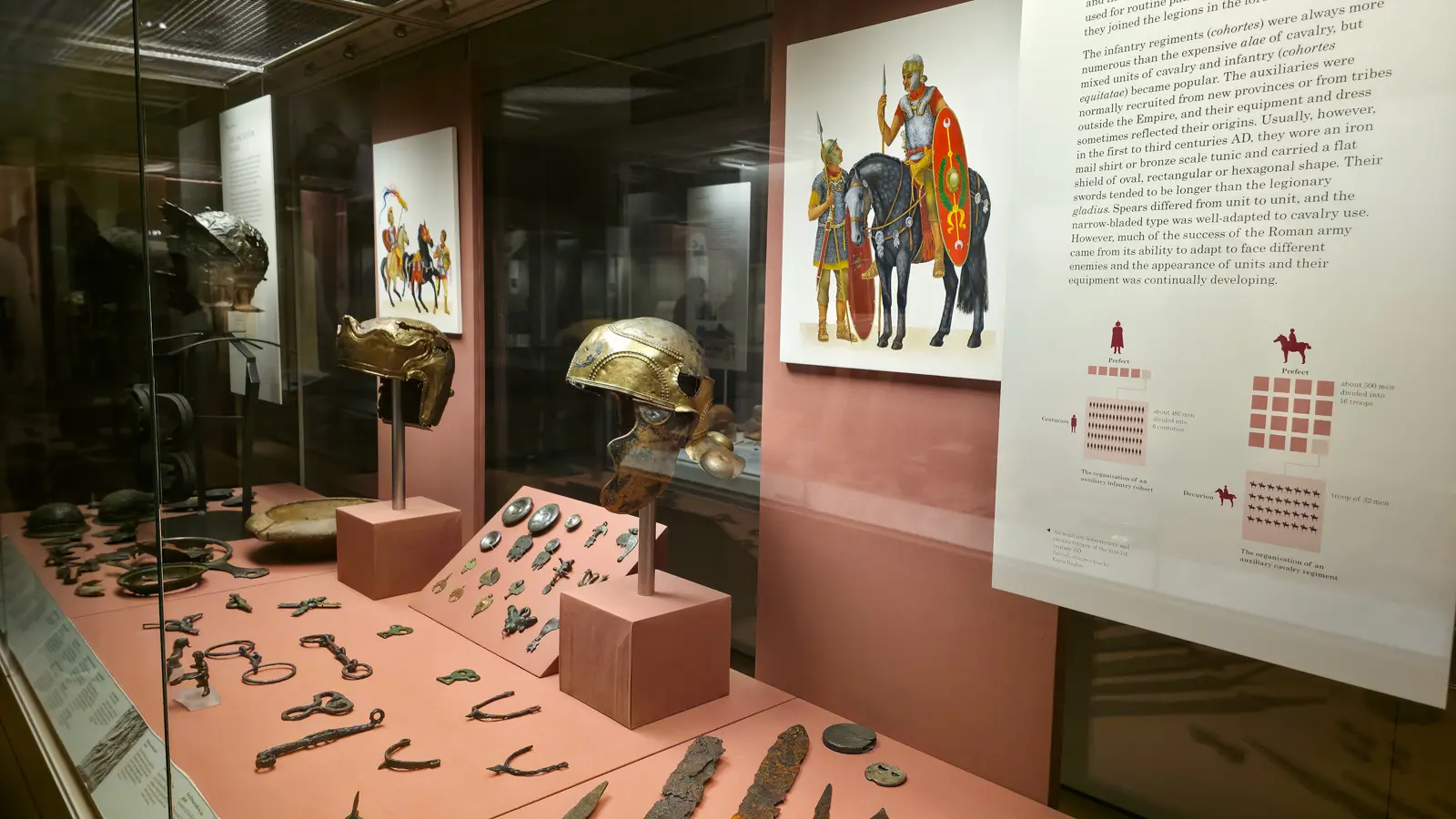
The gallery holds the everyday things too, the kit of the soldiers who held the province.
The showpiece is a mosaic floor lifted from a villa at Hinton St Mary in Dorset, laid in the fourth century. At its centre is a clean-shaven man with the Greek letters chi and rho set behind his head, the monogram of Christ.
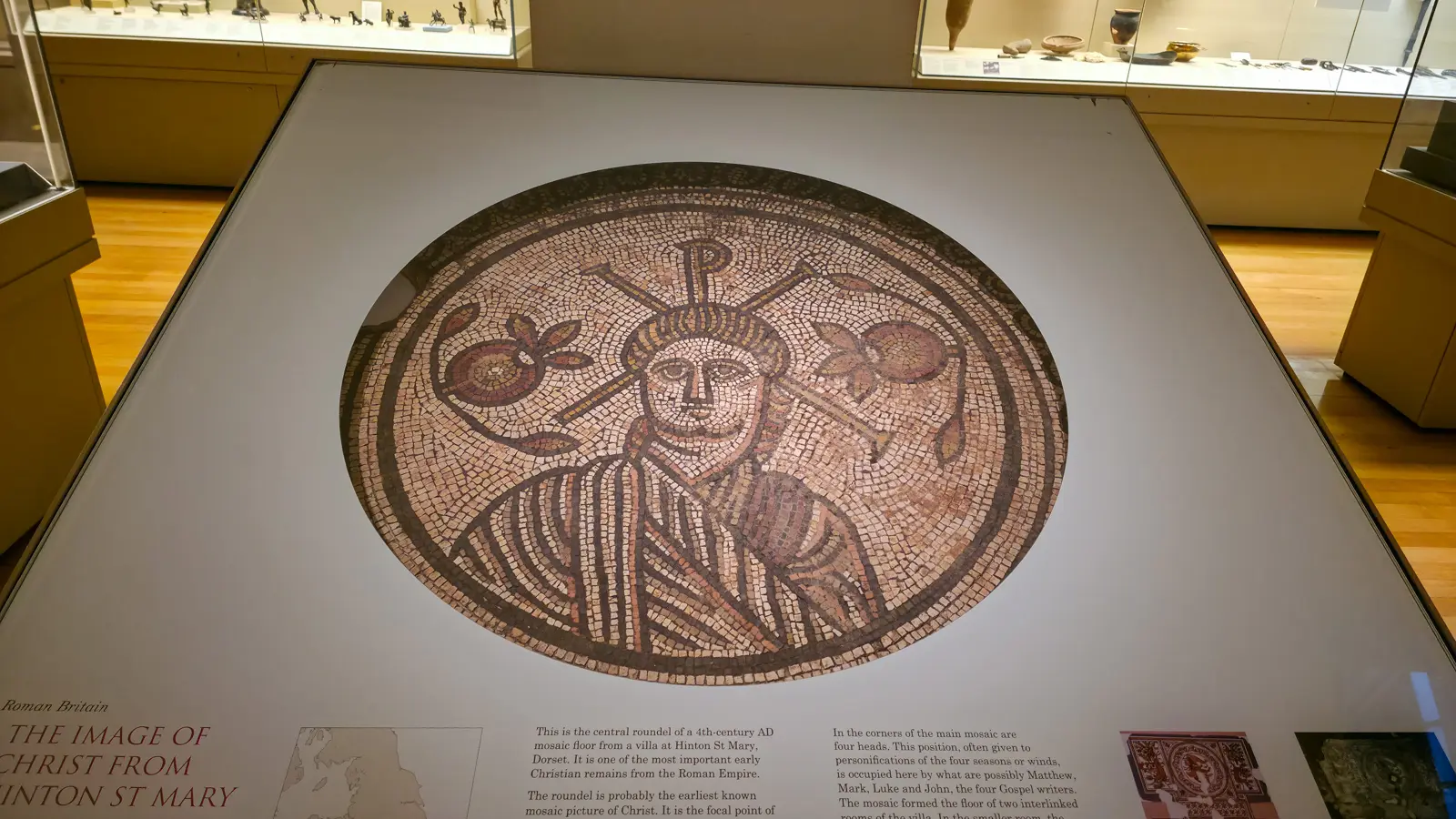
The same villa had a second floor in the room next door, showing Bellerophon on his winged horse spearing the Chimaera, straight out of Greek myth. Christ in one room, a pagan hero in the other. A household hedging its bets, or simply one that saw no contradiction in either.
Bath, or what a Roman town looked like
London gives up fragments. To understand what these people actually built, there is Bath, two hours west. The Romans called it Aquae Sulis, the waters of Sulis, after a Celtic goddess whose spring was already sacred when they arrived. Rather than replace her, they merged her with Minerva and built a temple.
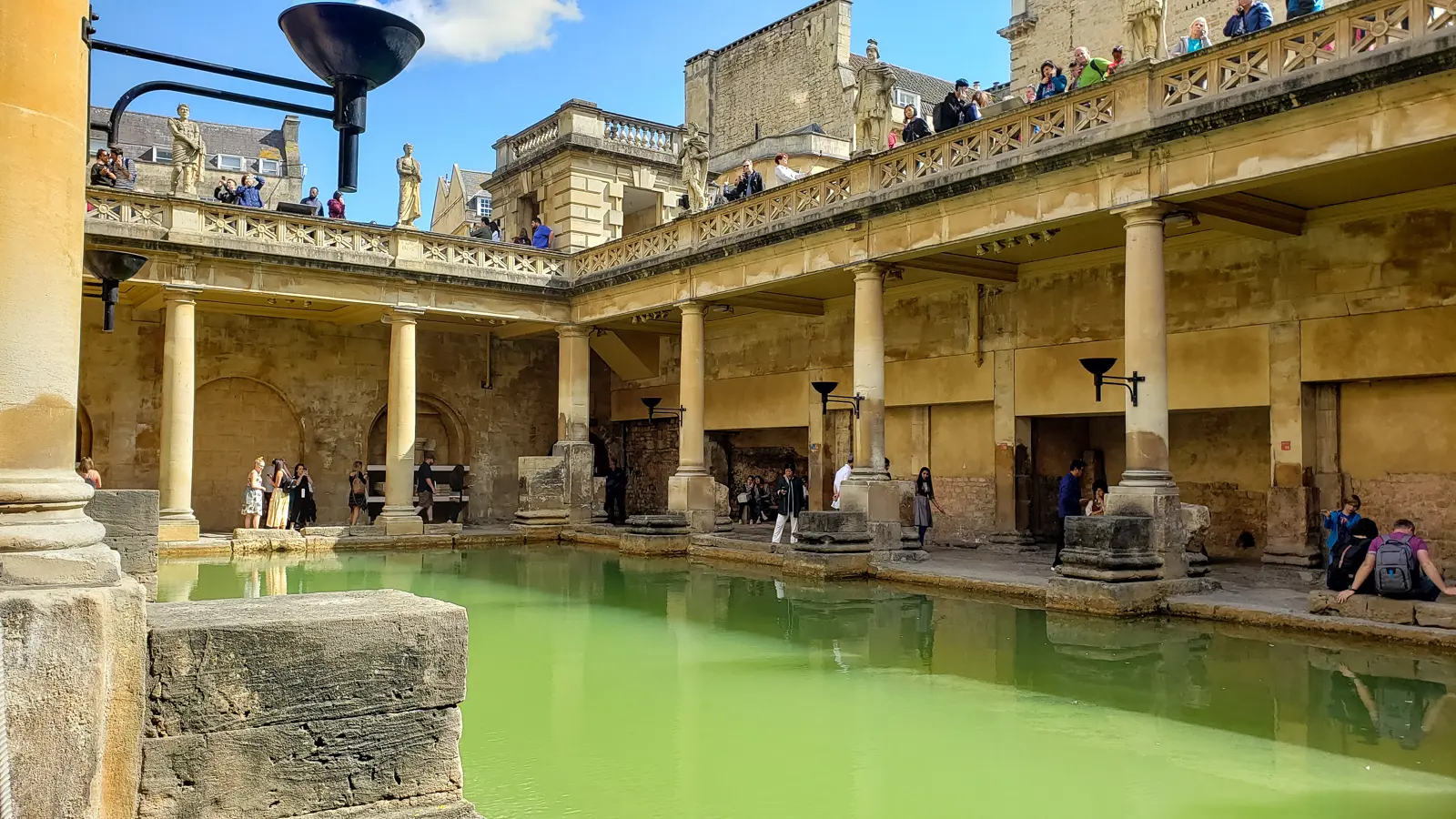
The water is green because it is open to the sky and algae grow in it. In Roman times a roof kept the light out. Around the Great Bath ran the full circuit of a Roman bathhouse, changing room, warm room, hot room, cold plunge, and the hot rooms sat on a hypocaust.
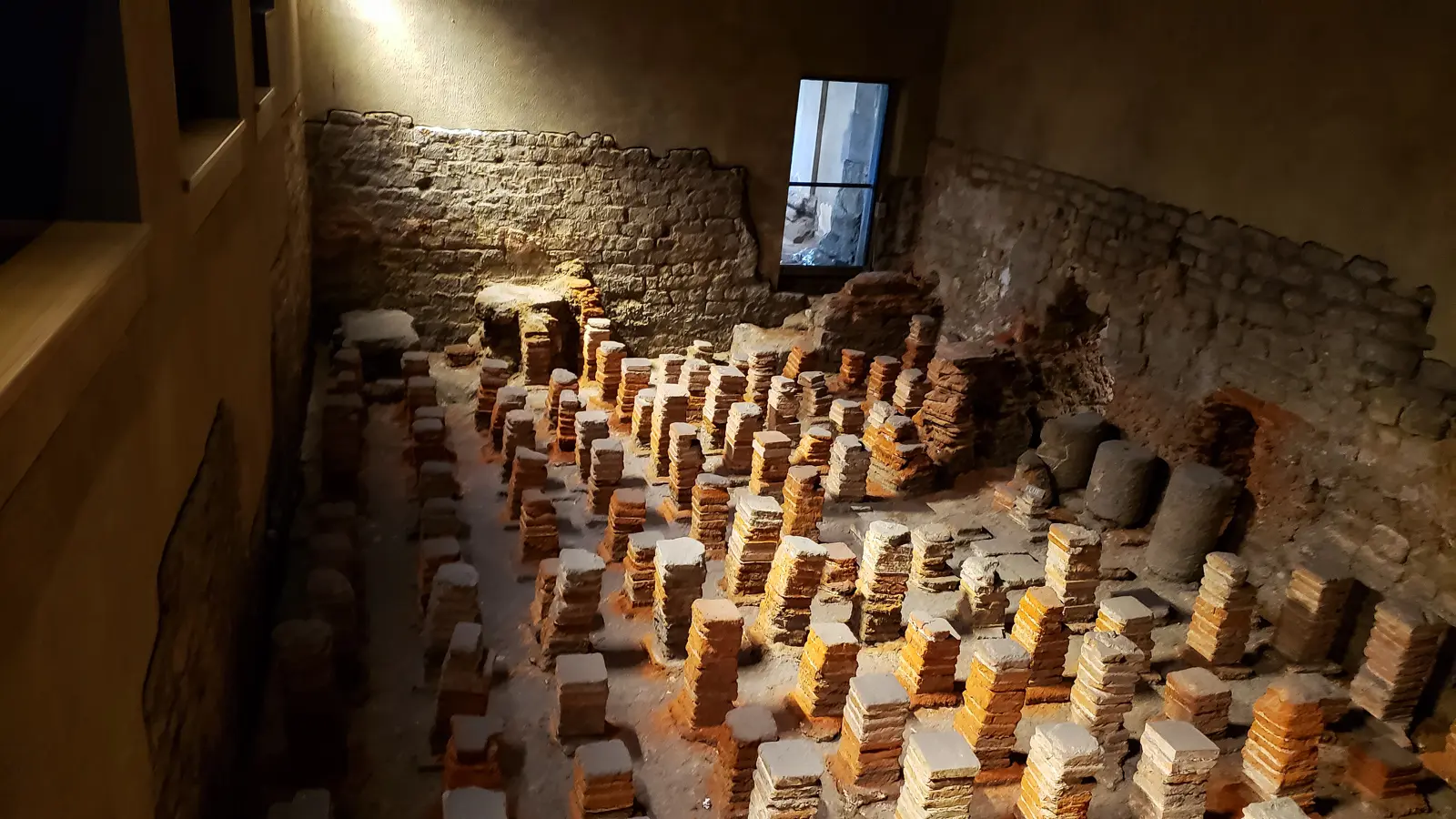
More than 12,000 coins were thrown into the sacred spring as offerings, along with over 130 curse tablets, thin sheets of lead scratched with messages to the goddess. Most are complaints about stolen clothing. Some are written backwards, so that only Sulis Minerva could read them.
Vienna, and the habit that does not stop
The last time I found Rome by accident, I was standing in the middle of Vienna, surrounded by Rolex windows and shoppers, looking down into a hole in the pavement.
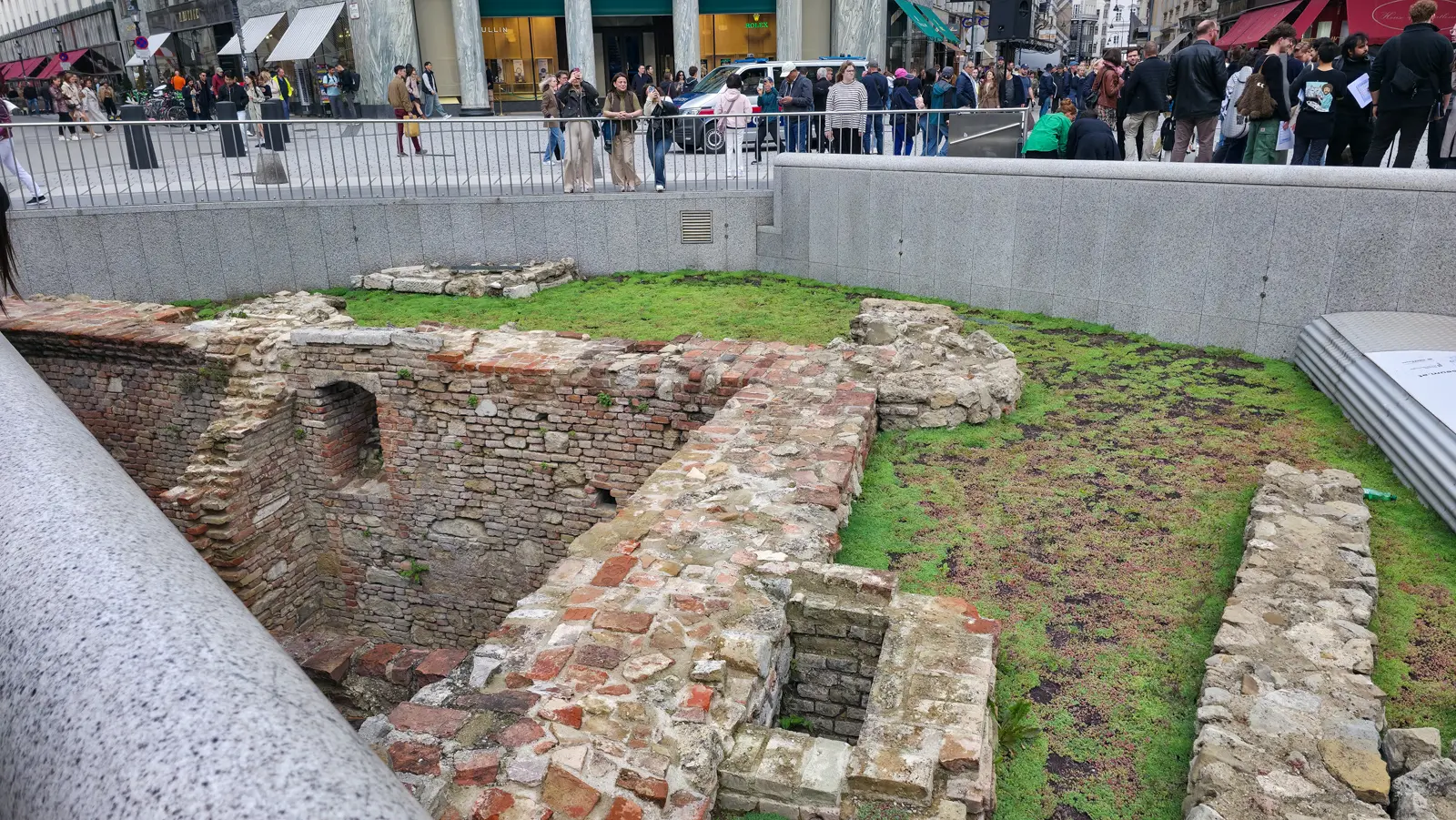
The excavation is open to the sky in the middle of Michaelerplatz, between the Hofburg and the Loos House. It was uncovered when the square was rebuilt between 1989 and 1991, and the architect Hans Hollein designed it to stay open, free, at any hour. Roughly 1,500 years of layers are stacked in it.
Vienna was Vindobona, a legionary fortress on the Danube frontier, holding around 6,000 men. Marcus Aurelius spent time here. What is in the pit is not the fortress but the town that grew up against its walls, the inns and workshops and houses, which is somehow the better thing to find.
Bubbly Tips
- Tower Hill is free and takes ten minutes. The wall stands in a sunken garden right outside the tube station. No ticket, no queue, and most of the crowd walks past it towards the Tower.
- Look for the red tile courses. They are the giveaway. Roman work below, medieval above, and the change is visible once you know to look for the flat bands of brick running through the ragstone.
- The Mithraeum and the amphitheatre are both free. The temple sits under the Bloomberg building at Walbrook and needs a booked slot. The amphitheatre is in the basement of Guildhall Art Gallery. Neither costs anything.
- Roman remains at the Tower need a ticket. The Wardrobe Tower and the riverside wall are inside the paid grounds. Pick up the free map at the entrance and ask a Yeoman Warder to point you at them.
- Do the British Museum’s Room 49 properly. Roman Britain is upstairs and easy to rush. Give it half an hour and find the Classicianus tomb, the one whose replica stands out at Tower Hill.
- Bath is a day trip from London. Trains from Paddington take about ninety minutes. Book the Roman Baths ahead in summer, and go early or late in the day to avoid the worst of the crowds.
- Do not touch the water at Bath. The Great Bath water is untreated and not safe to touch. There is a fountain in the Pump Room where you can taste the treated spa water instead.
- In any European city, look down. Squares under renovation, cathedral crypts, department store basements. Vienna’s Michaelerplatz was a building site that turned into an open excavation, and it is free at any hour.
Final Thoughts
What I like about chasing Rome is how little ceremony there is to it. In Bath you queue and pay and it is magnificent. But the pieces that stay with me are the accidental ones: the wall behind the doughnut stand at Tower Hill, the stub of bastion on a lawn beside a Norman keep, the hole in a Viennese shopping street with a soldier’s house at the bottom.
Two thousand years ago someone laid those ragstone blocks and set the red tiles in to keep the courses level. The city they walled has been burnt, abandoned, rebuilt, bombed and rebuilt again, and the wall is still there, holding up a hotel car park. That is the thing worth crossing a city for.
Until next time!

🌟 Everything You Need to Plan Your Dream Trip in 2026
- 🌟 Luxury Hotels - Find premium stays with Booking.com & Hotels.com
- 🏡 Vacation Rentals - Discover unique properties on VRBO
- 🏞️ Guided Tours - Explore with Viator or GetYourGuide
- 🎫 Attraction Tickets - Skip the lines with Tiqets
- 🚢 Ocean Cruises - Set sail with Cruise Direct
- 📱 International SIMs - Stay connected with Saily
- 🚗 Car Rentals - Budget-friendly options from Discover Cars
- 🌐 Secure VPNs - Browse safely with NordVPN
- 💶 Currency Exchange - Best rates with Wise
- 🗣️ Learn Languages - Master the local language with Babbel and Rosetta Stone