
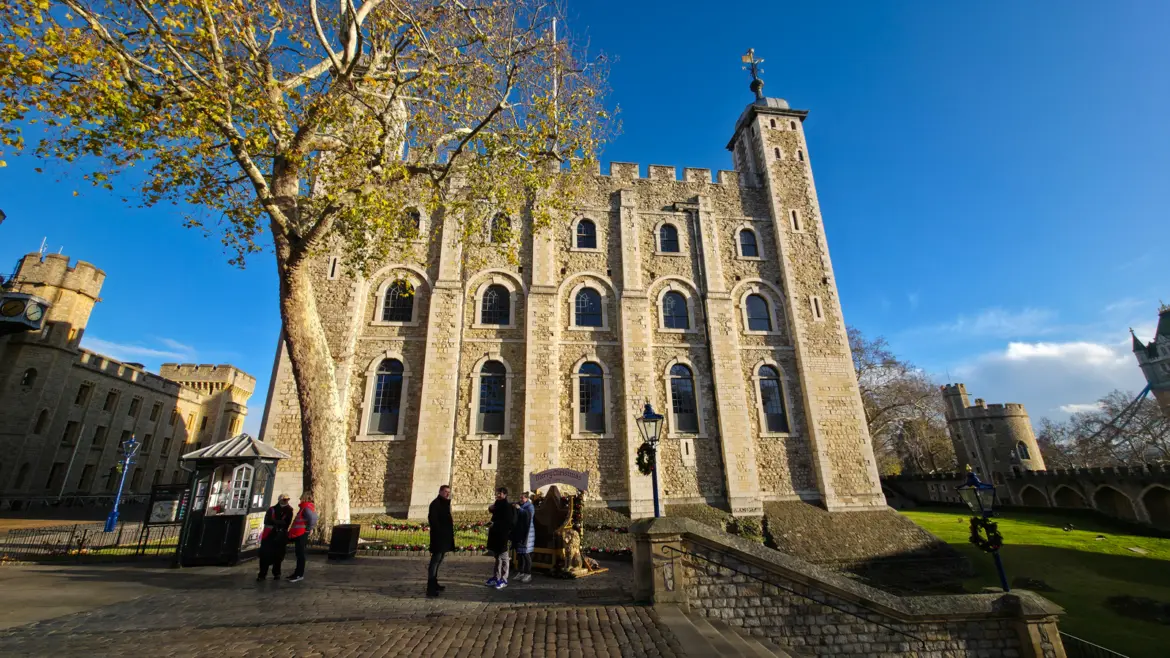
The White Tower sits at the centre of the Tower of London, both literally and architecturally. Most visitors walk past it on the way to the Crown Jewels, glance up, take a photo, and keep moving. It’s worth slowing down for. The keep has been standing on this patch of ground since around 1078, and it carries nearly a thousand years of London history in its walls.
Four storeys, four corner turrets, walls 4.6 metres thick at the base, about 27 metres tall to the top of the turrets. Those are the numbers. The character of the building is in the way it manages to be both massive and slightly ordinary up close. The proportions are so old and so right that it takes a minute to register what you’re actually looking at. This is the central keep of one of the most complete surviving Norman castles in Europe. On a December afternoon, it might be wearing Christmas wreaths on its lamp posts.
The White Tower at a Glance
🏰 Built · Begun around 1078 by William the Conqueror, with Bishop Gundulf of Rochester directing the construction.
📏 Scale · Roughly 27 metres tall with walls up to 4.6 metres thick — one of the largest Norman keeps in Europe.
🪨 Materials · Kentish ragstone for the bulk, Caen limestone shipped from Normandy for the corners and finer detail.
🤍 Why “White” · Henry III ordered the exterior whitewashed in 1240; the name stuck even after the colour faded.
⚔️ Royal Armouries · Houses Britain’s national collection of historic arms and armour, including several suits made for Henry VIII.
⛪ St John’s Chapel · The 1080s Romanesque chapel on the upper floor is the oldest complete church in London.
🎟️ Visit · Inside the Tower of London complex; entry is included with a standard Tower ticket.
The Norman Conquest and the Origins of the White Tower
The White Tower is what William the Conqueror built after winning the Battle of Hastings. He landed in 1066, defeated Harold Godwinson, took the English crown that Christmas Day at Westminster Abbey, and spent the next decade methodically locking down Norman control across England. Castles were the main tool. Most of them were quick timber-and-earth motte-and-bailey constructions, thrown up to dominate a region cheaply. London needed something more.
Construction of the White Tower began around 1078, directed by Bishop Gundulf of Rochester, the most accomplished military architect in England at the time. Gundulf was also responsible for Rochester Castle, and the same expertise shows in both buildings. The keep took roughly twenty years to finish. William himself didn’t live to see it completed; he died in 1087.
The building was deliberately made out of imported stone. Kentish ragstone, quarried in Kent and barged up the Thames, made up most of the wall mass. The corners, window dressings, and finer architectural details were cut from Caen limestone, shipped across the Channel from Normandy. Using Norman stone for the showpiece details was a political choice as much as a structural one. It told the population of London, in physical material, where its new rulers had come from.
In 1240, Henry III ordered the entire exterior whitewashed. The whitewash sealed and protected the limestone, but it also turned the keep into a single bright object visible across timber-built medieval London. The colour faded over the centuries, but the name stuck. The “White Tower” today is whitewashed in name only. The stone you actually see is the warm cream of Caen limestone and the silvery grey of Kentish ragstone.
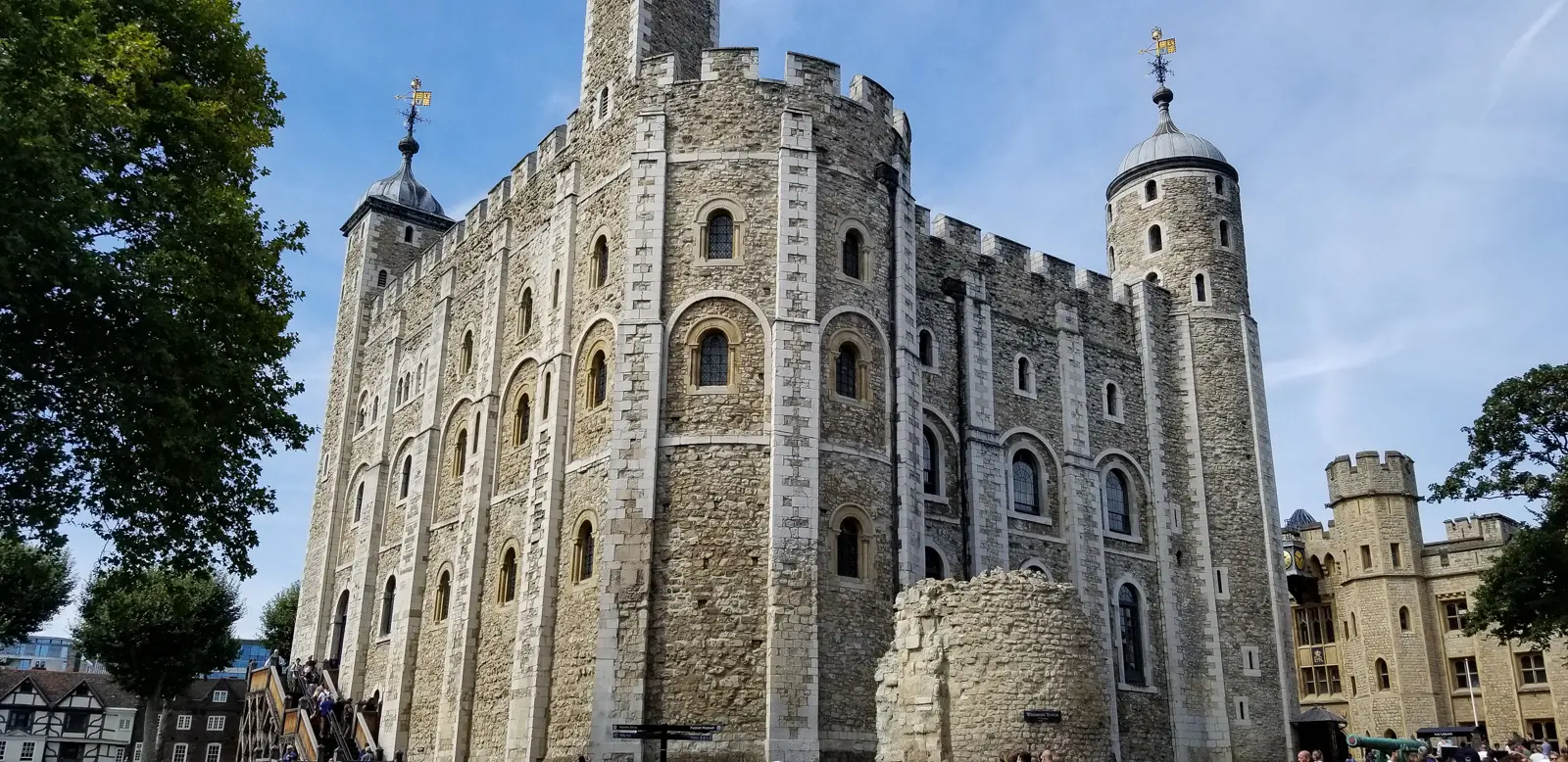
In the medieval city, the keep dominated every approach. Most of London was two-storey timber; the White Tower was four storeys of stone, painted brilliant white. Anyone arriving by river, by road, or by the Pool of London saw the same thing first.
Norman Architecture and Military Power
Norman castle design was about thickness, height, and the careful management of entrances. The White Tower takes all three to their early-medieval extreme.
The walls are 4.6 metres thick at the base. The keep is roughly square in plan, but the east face has a deliberate semi-circular bulge in the middle of the facade. That bulge is the exterior of St John’s Chapel on the upper floor, projected through the otherwise rectangular shell so the chapel’s apsidal east end could face properly east in ecclesiastical orientation. Whether you call it elegant or stubborn, it’s the keep’s most distinctive architectural feature, and once you’ve spotted it from outside you can’t unsee it.
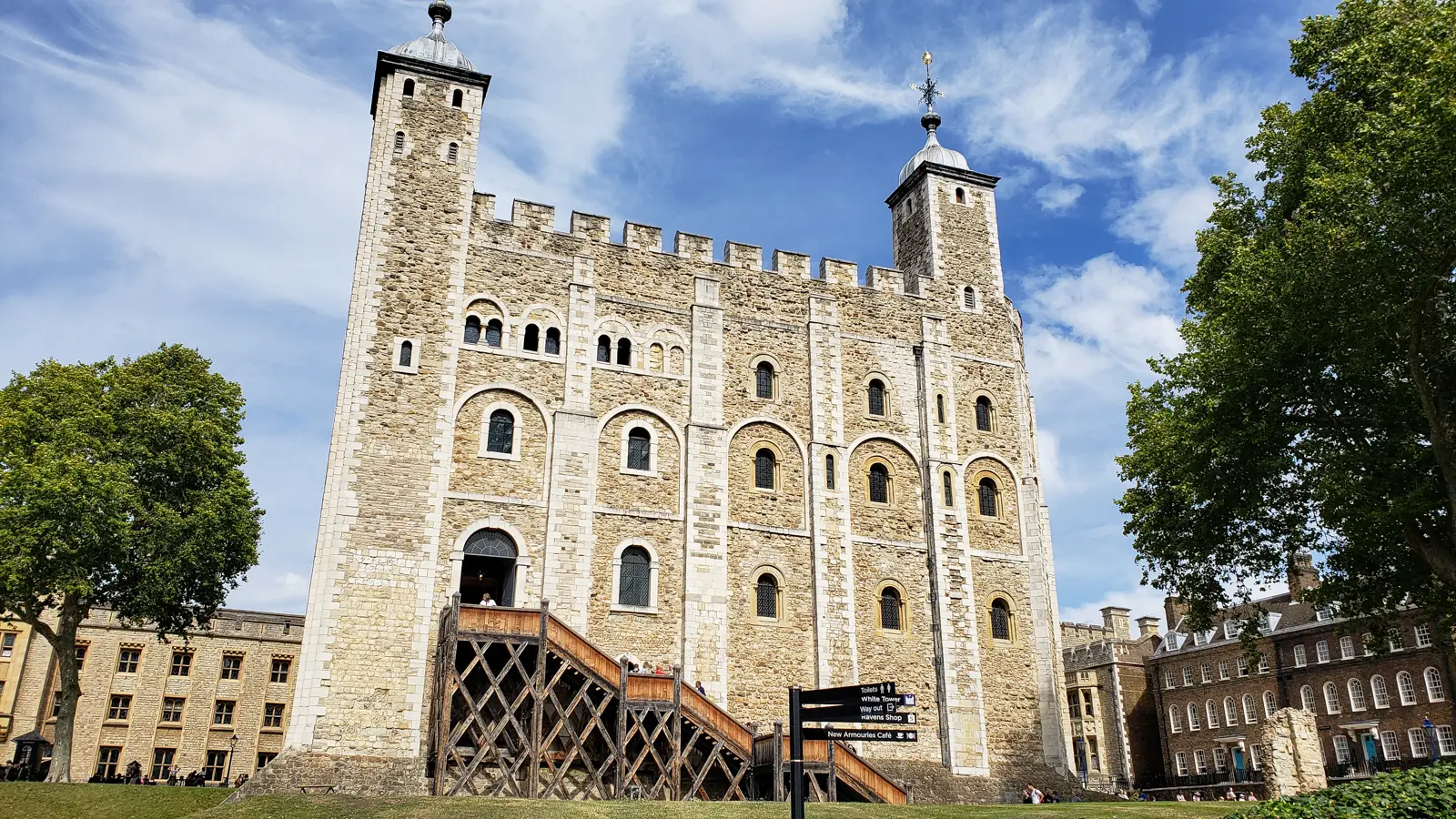
The original entrance was at first-floor level, accessible only by removable wooden stairs. If attackers ever broke through the outer walls of the wider fortress, they couldn’t simply walk through a ground-floor door. They would have to set up siege equipment under fire from above. The modern visitor staircase on the south face replaces those original wooden stairs but leads to the same original doorway.
Inside, the design follows a vertical logic. Storerooms on the ground floor. Hall and chapel on the first floor (the public floor, where visitors entered). Royal apartments above. The four corner turrets gave defenders elevated positions and held small additional rooms, including the chapel’s spiral stair at the south-east corner. Each turret was originally capped with a low Norman parapet. The bulbous lead-and-timber onion domes you see today were added in the 1530s during Henry VIII‘s reign. Tudor architectural fashion catching up with a Norman building.
Inside the White Tower
Stepping inside is a shift in atmosphere. Outside is bright and open; inside is darker, cooler, narrower. The original windows are deep slit openings designed for archers, not for natural light. The deeper rooms still hold the temperature that thick stone holds even in summer, somewhere between cool and properly cold, depending on the season.
The interior also tells a more complicated story than the exterior. The White Tower was a fortress, but it was also a royal residence, a treasury, and from the medieval period through the 19th century, the storehouse for the kingdom’s records. By the 1400s, royal accounts and state papers were piling up here so densely that some of the upper rooms were unusable. Anthony Salvin cleared most of them out during a Victorian restoration in the 1850s, reopening St John’s Chapel for public view in the process. What you walk through today is a hybrid. Original Norman stonework, a few Tudor and later modifications, and the Royal Armouries collection laid out across multiple floors.
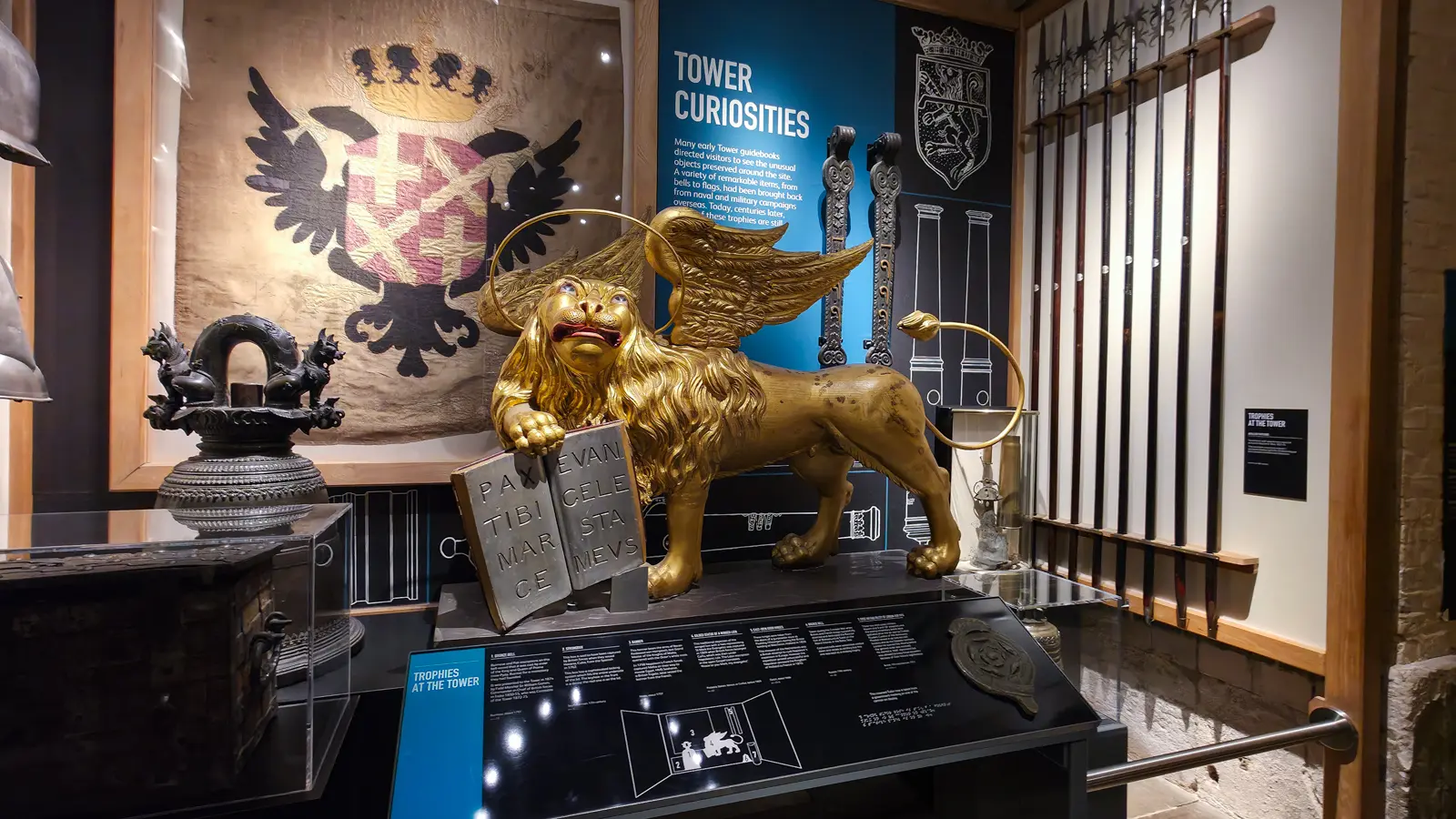
The “Trophies at the Tower” and “Tower Curiosities” displays sit on one of the lower floors, mixing captured battle flags, ceremonial objects, and oddities collected over centuries of military campaigns. A gilded Lion of St Mark anchors the case – the Latin inscription PAX TIBI MARCE EVANGELISTA MEVS (“Peace to thee, Mark, my Evangelist”) is the traditional motto on the symbol of Venice. The lion behind glass is part of the Tower’s centuries-long collection of objects brought back from royal and military expeditions abroad.
The Royal Armouries and Henry VIII’s Armour
The Royal Armouries inside the White Tower hold Britain’s national collection of historic arms and armour. They have been displayed in some form on this site since the reign of Charles II in the 17th century, making the Line of Kings one of the oldest continuously open museum displays anywhere in the world.
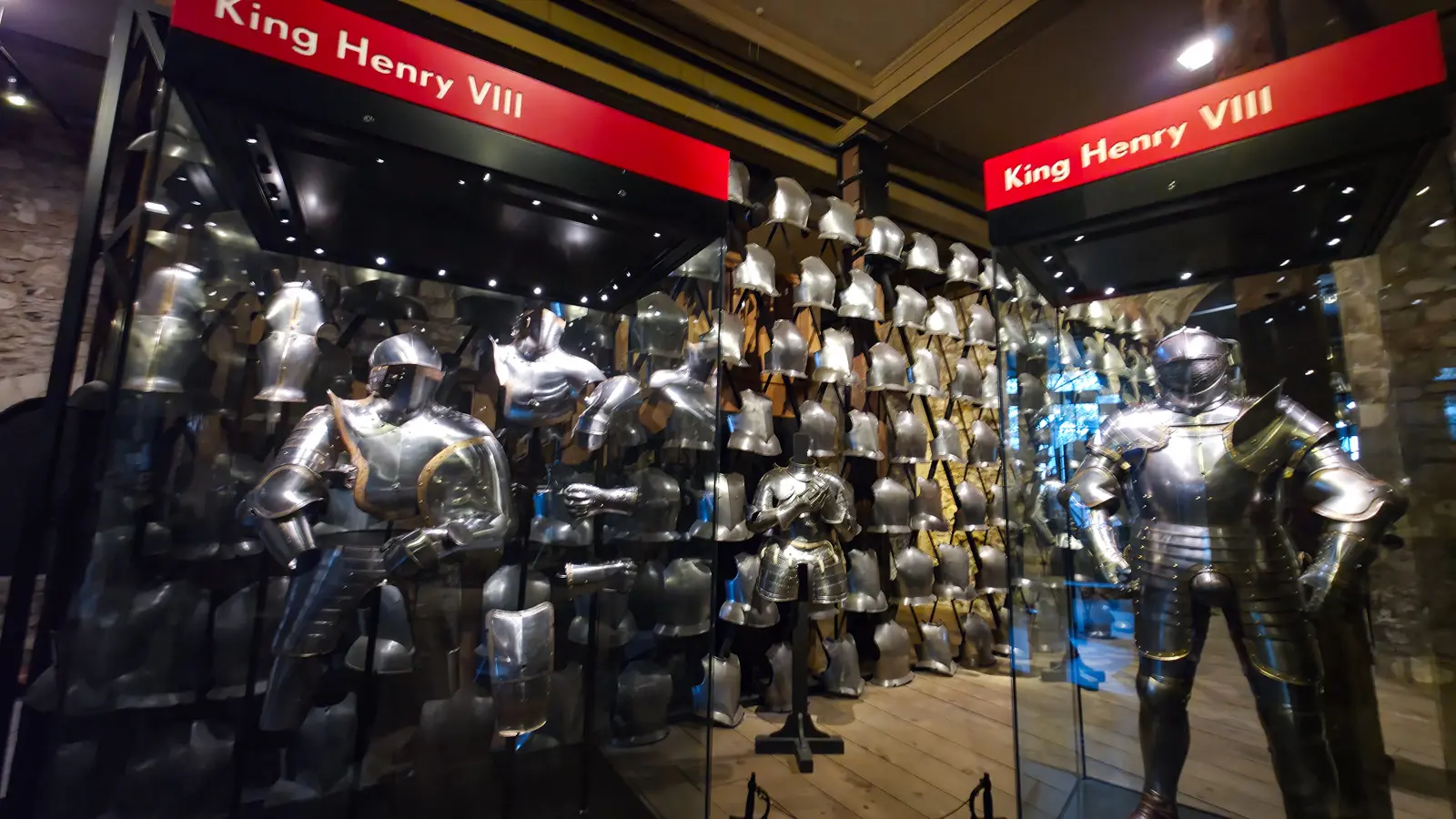
The Henry VIII display is the most famous. The Royal Armouries owns several suits made for Henry at different stages of his reign, and they chart his physical changes across roughly forty years, from the tournament-fit young king of the 1510s to the much larger figure of his final decade. A wall of stacked helmets and sallets backs the cases. The contrast between the smaller armoured figure in the middle and the massive later suits flanking it does more to make Henry’s later years vivid than any portrait.
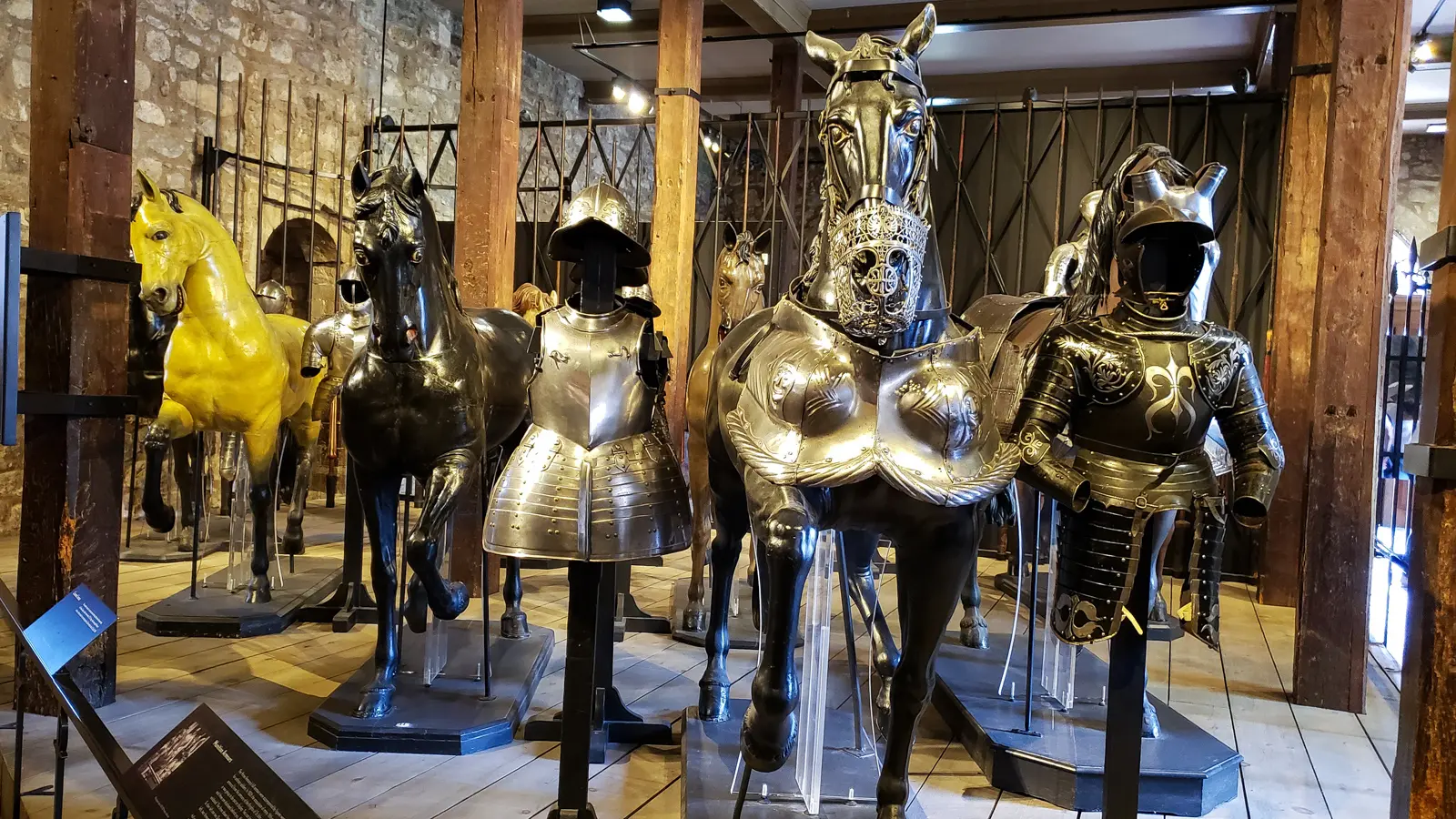
The Line of Kings display includes wooden horse mannequins from the 17th century, first carved during the reign of Charles II so royal armour could be shown to visitors on horseback. Those wooden horses are themselves the oldest part of the display, predating almost every permanent installation in any other museum in Britain. The yellow horse on the left of the image below is one of them.
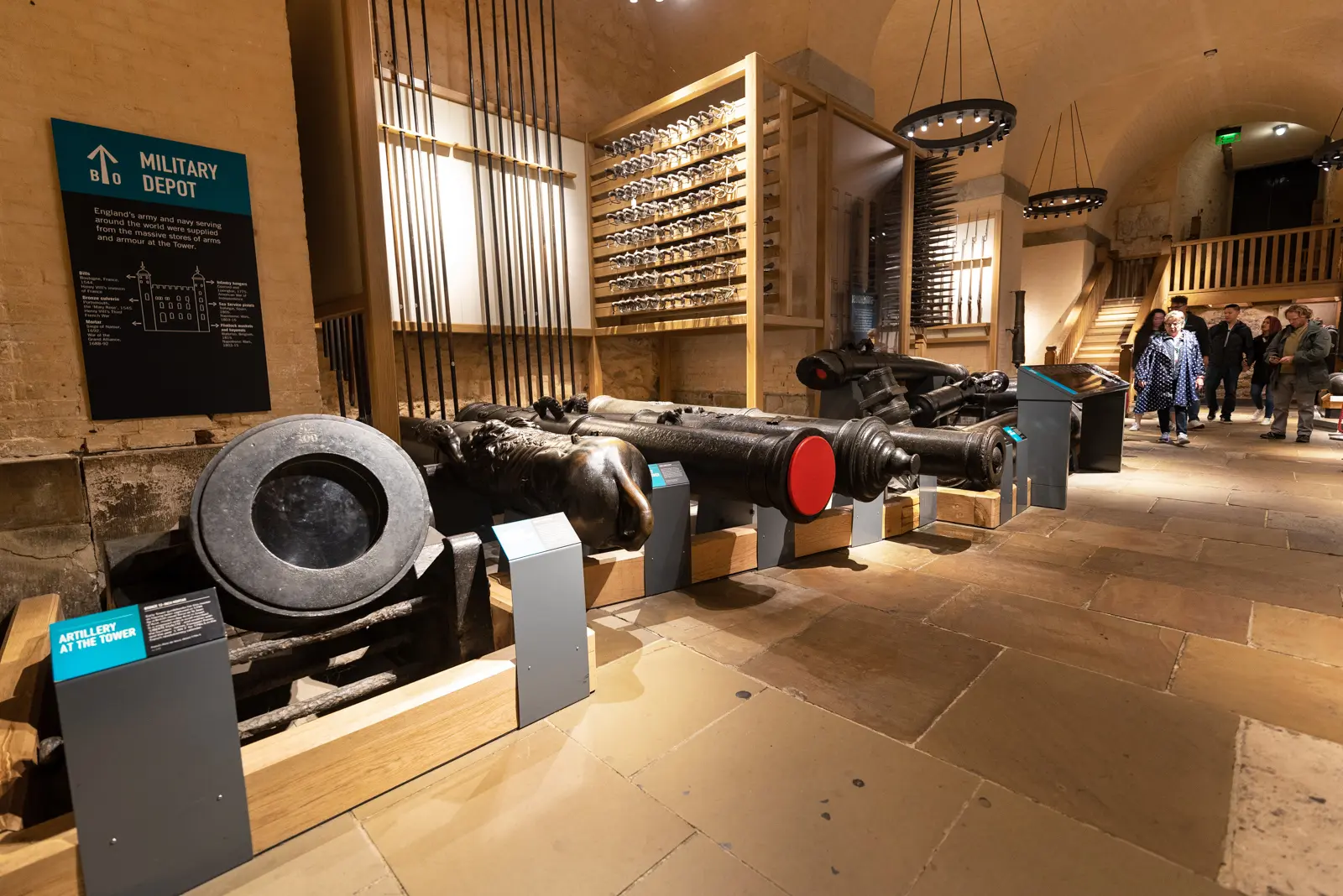
The basement-level Military Depot display holds historic cannons and a giant 17th-century mortar in the foreground. The Tower functioned as England’s main arsenal for centuries. Every musket, sword, and barrel of powder issued to the army and navy passed through stores like this one. The basement is also the least-crowded part of the visit. Most people focus on the armour upstairs and skip the lower level entirely.
St John’s Chapel: Simplicity and Spiritual Power
The upper floor holds the keep’s quietest space: St John’s Chapel, the oldest complete church in London. Construction began around 1080. The chapel was finished after William’s death in 1087.
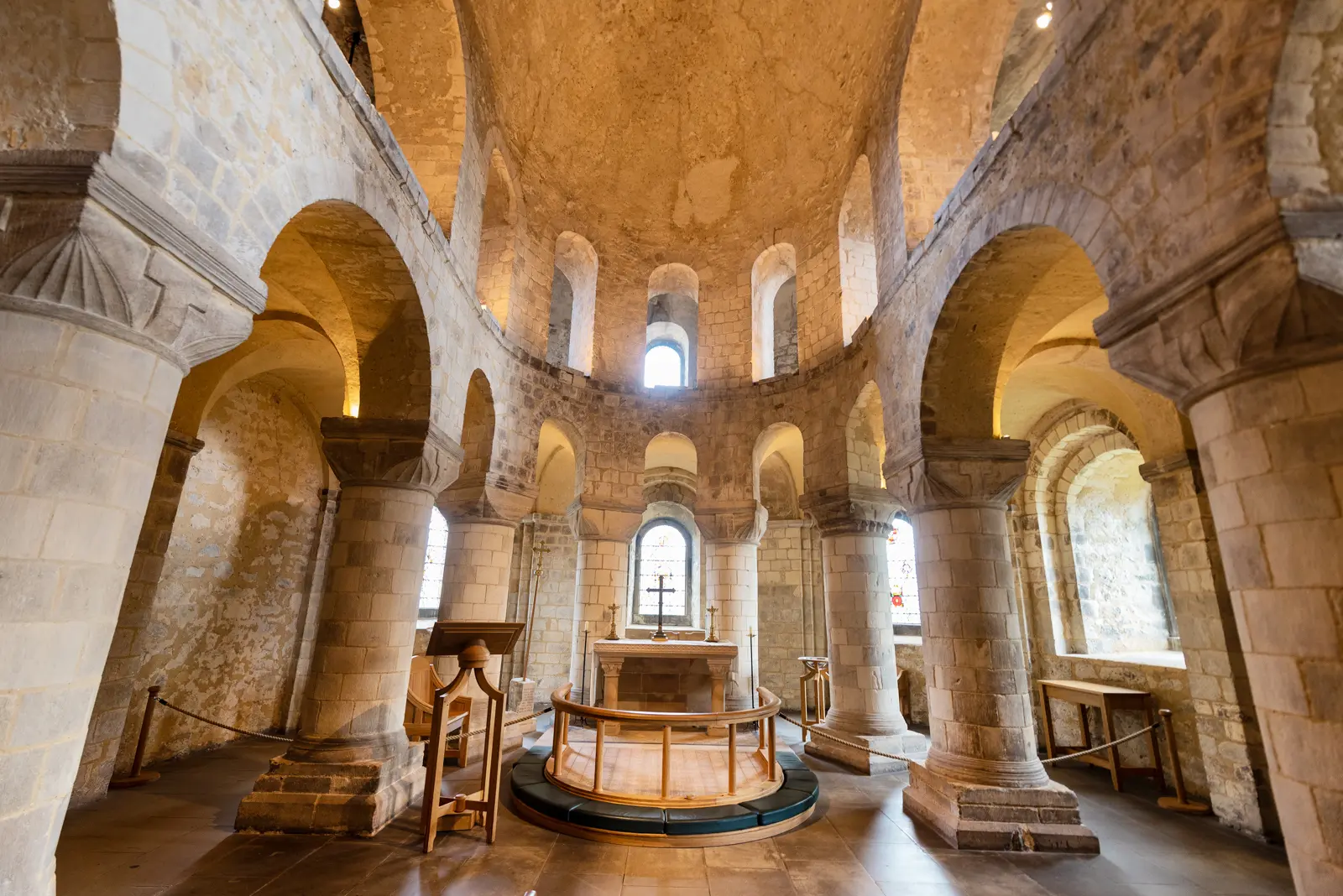
The chapel is roughly 17 metres long and 9.5 metres wide. The Norman builders set thick cylindrical columns down each side, cushion-capital tops carved with simple scallop and leaf patterns. The aisles run round to meet the apse at the east end. The same apse pushes out through the eastern wall of the keep. The barrel vaulting overhead is unmoulded and severe. There is almost no ornament anywhere.
After eight centuries of Gothic cathedrals built across Europe, St John’s looks almost shockingly plain by comparison. The plainness is its character. The Romanesque style favoured proportion over decoration, and the chapel’s atmosphere comes entirely from geometry: the regular rhythm of the columns, the half-light from the deep window openings, the curve of the apse.
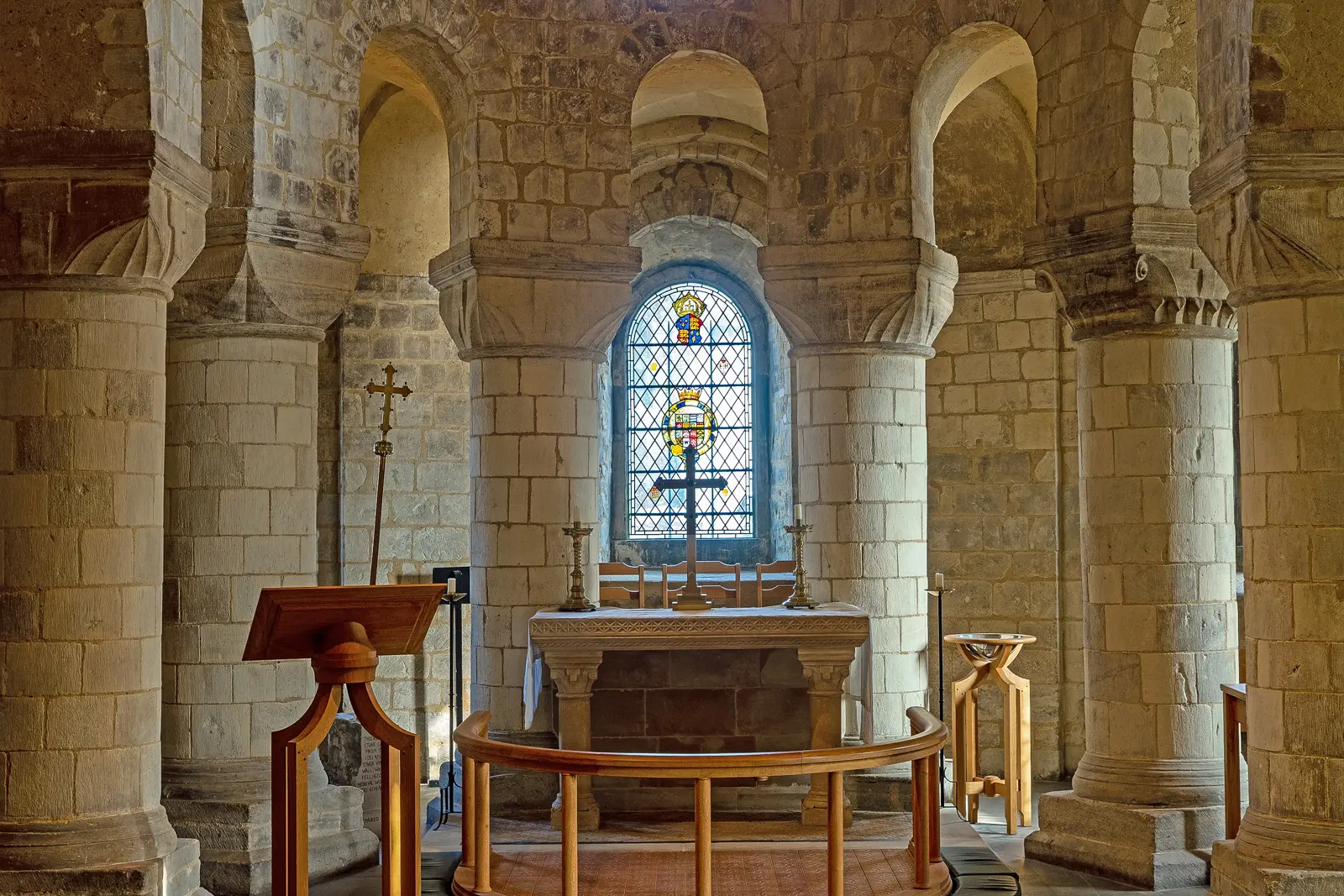
The heraldic stained glass in the apse window is a later addition. The original Norman windows would have been plain or geometrically patterned glass at most. The chapel has been a working royal chapel for nearly all its history. Medieval kings held vigils here before the Order of the Bath ceremonies (a tradition that continued from the 12th to the 16th centuries), and it remains technically a Royal Peculiar today (under the monarch directly rather than under a bishop).
The White Tower as a Symbol of Royal Authority
The White Tower was always more than a building. From the moment William commissioned it, the keep was the most physical possible statement of who now ruled England. Norman, stone, permanent, dominant. Henry III’s whitewashing in 1240 only sharpened the message. Anyone arriving in London by ship, road, or rumour saw the same first thing: an enormous, brilliant, Norman fortress that had been there since just after the Conquest and was not going anywhere.
The building’s function shifted constantly across the centuries within the keep (royal residence, treasury, armoury, military stores, and the kingdom’s records office, among others), but the symbolic weight stayed constant. When the British state needs an image of continuity, the Tower still delivers. Gun salutes from the Tower wharf mark major royal occasions, and the keep itself remains as visible from the river today as it was nine centuries ago.
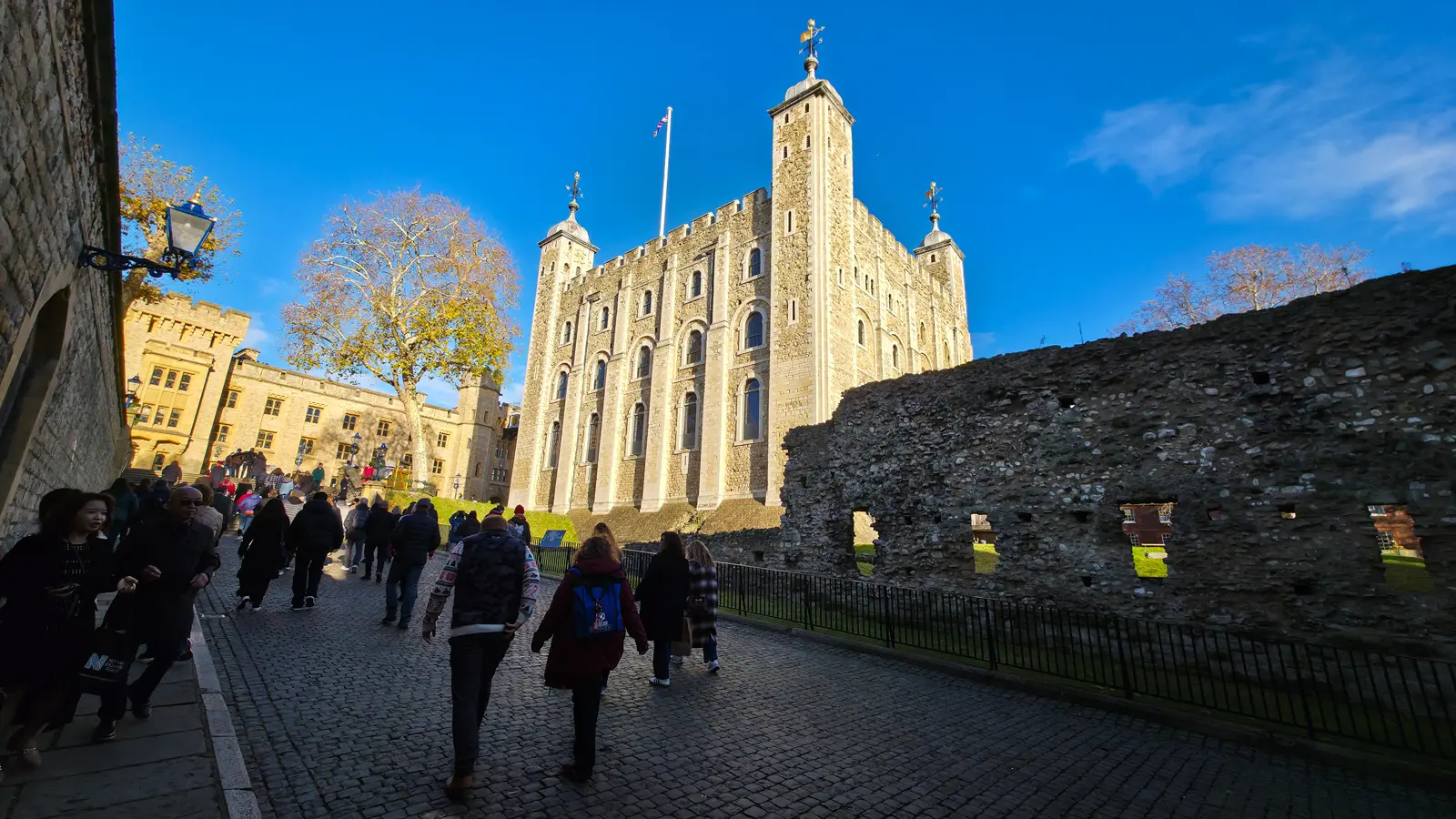
Modern London has risen around the White Tower (the Shard, the Walkie-Talkie, the City cluster), but on the approach from the south-east, with the Union Jack flying from the central flagpole and the four turret domes catching late afternoon light, the 1078 building still wins the frame.
Bubbly Tips for Visiting the White Tower
- Allow at least an hour inside the keep. The Royal Armouries displays absorb more time than people expect, especially the Henry VIII case and the Line of Kings.
- Start at the lower floor and work upwards. The Trophies display and the Military Depot are the least-crowded parts of the keep, and you’ll appreciate the climb to the chapel more after walking the rest first.
- Save St John’s Chapel for last. It’s the quietest space in the building, and stepping into it after the armouries gives you a stronger sense of the contrast Norman architects built it to create.
- Look up at the cushion capitals in the chapel. The scallop and leaf carvings on top of the columns are nearly 950 years old. The columns are so plain otherwise that the capitals are easy to miss.
- Photography is allowed throughout the White Tower. Unlike the Crown Jewels in the Waterloo Block, you can take photos of everything inside. The armouries, the chapel, the basement displays.
- Visit in winter for the courtyard decorations. The lamp posts get wreaths and the entrance gets a “Merry Christmas” sign at the base of the staircase. The contrast with 1078 stone photographs better than it has any right to.
- Spot the apsidal bulge from outside before going in. The semi-circular projection on the east face is the chapel pushing through the keep wall. Once you’ve seen it from outside, the interior layout makes immediate sense.
- Combine with the broader Tower of London visit. You’ll need the same ticket. Allow 3-4 hours total for the whole fortress complex if the White Tower is going to get its proper hour.
- Location: The White Tower sits at the centre of the Tower of London, on the north bank of the Thames in central London (EC3N 4AB).
Final Thoughts
The White Tower has been the centre of the Tower of London for 950 years. It was the largest building in London when it was finished. It is one of the most complete Norman keeps left in Europe. And it still holds the oldest complete church in the city on its upper floor.
What stays with most visitors isn’t a single object or fact. It’s the realisation, somewhere between the armouries and the chapel, that almost everything around you is original or near-original. The columns are 11th-century. The arches are 11th-century. The stone is 11th-century. The wooden horses in the Line of Kings are 17th-century, which makes them the new things in the room. That kind of layered antiquity is rare in a major capital city. It’s rarer still inside a working visitor attraction that processes millions of people every year and still leaves the actual building alone.
If you’ve been to the Tower and made it as far as the keep, I’d love to know which room held you longest: the chapel, the Henry VIII case, or the basement artillery?
Until next time!

🌟 Everything You Need to Plan Your Dream Trip in 2026
- 🌟 Luxury Hotels - Find premium stays with Booking.com & Hotels.com
- 🏡 Vacation Rentals - Discover unique properties on VRBO
- 🏞️ Guided Tours - Explore with Viator or GetYourGuide
- 🎫 Attraction Tickets - Skip the lines with Tiqets
- 🚢 Ocean Cruises - Set sail with Cruise Direct
- 📱 International SIMs - Stay connected with Saily
- 🚗 Car Rentals - Budget-friendly options from Discover Cars
- 🌐 Secure VPNs - Browse safely with NordVPN
- 💶 Currency Exchange - Best rates with Wise
- 🗣️ Learn Languages - Master the local language with Babbel and Rosetta Stone