
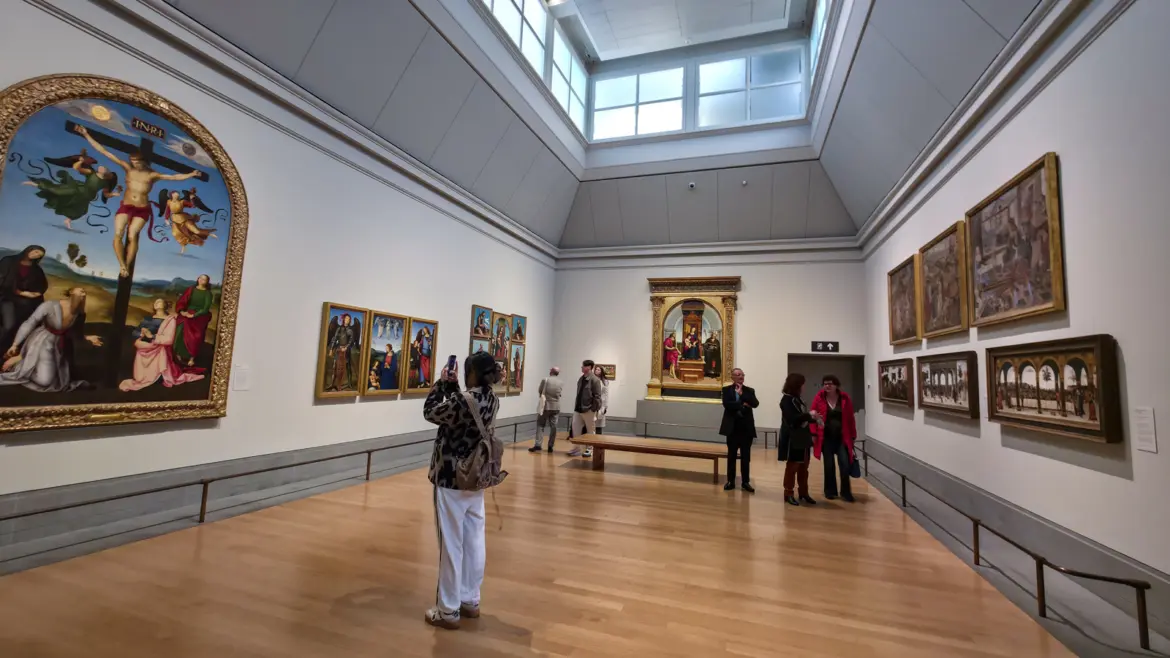
In my last post on the National Gallery I followed the Early Renaissance in Florence, and ended with three quiet workshop masters: Verrocchio, who trained Leonardo, Ghirlandaio, who trained Michelangelo, and Fra Filippo Lippi, who trained Botticelli. This post is what happened when those apprentices grew up.
I have been in awe of these painters for as long as I can remember. I have stood in front of their work in the Uffizi in Florence and under Michelangelo’s ceiling in the Sistine Chapel in Rome, and I am amazed every single time. The High Renaissance is the moment the rebirth reaches its peak: the classical ideal of balance and grace that artists had been reaching toward for a century finally arrives, in the hands of three men working at the same time. Leonardo had trained with Verrocchio, Michelangelo with Ghirlandaio, and a younger third, Raphael, with the Umbrian master Perugino. The National Gallery holds work by all three, hung within a few rooms of each other.
The High Renaissance Rooms at a Glance
📍 Where · Sainsbury Wing, National Gallery, Trafalgar Square, London WC2N 5DN. The early Italian rooms, a few steps on from the early Renaissance galleries.
💷 Entry · Free, like the rest of the permanent collection. Book a free timed ticket for fast-track entry.
⭐ The big three · Leonardo, Michelangelo and Raphael all hang within a few rooms of each other.
🖼️ Don’t miss · Leonardo’s Virgin of the Rocks in its own dim alcove, Michelangelo’s unfinished Manchester Madonna, and Raphael’s Mond Crucifixion and Ansidei Madonna.
🔍 Spot the teacher · Compare Raphael’s Mond Crucifixion with the Perugino works in the same room, and hunt his scratched signature at the foot of the cross.
🎓 Read it after the early rooms · Walk the teachers (Verrocchio, Ghirlandaio, Perugino) first, then the pupils here. The story lands harder in order.
🕙 Quieter than upstairs · Even the Leonardo is usually calmer than the Impressionist galleries.
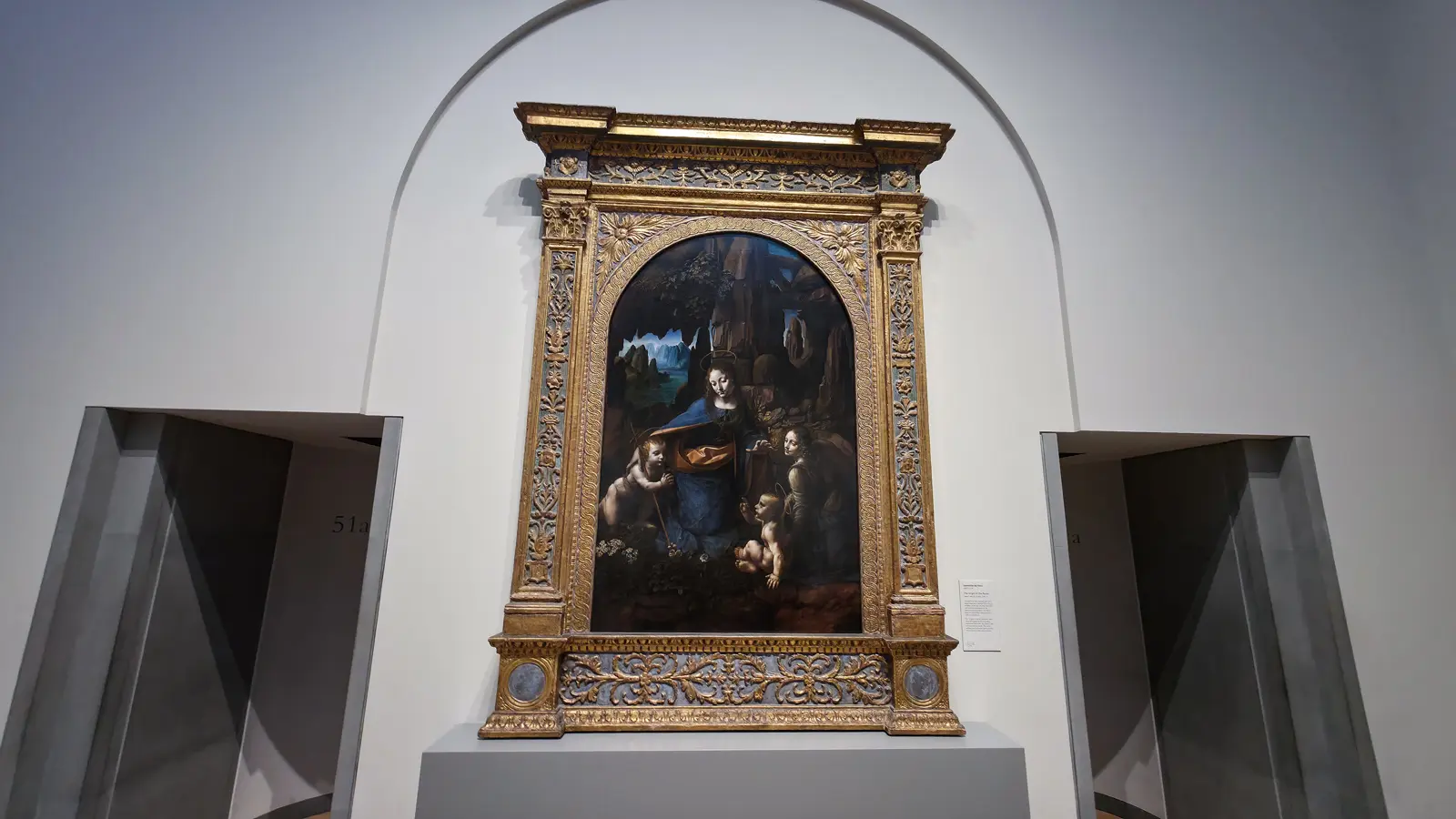
Leonardo and the cave
Leonardo’s Virgin of the Rocks is one of only a handful of his large paintings to survive anywhere. The Virgin kneels in a dark rocky grotto with the infant Saint John, the Christ Child and an angel, every edge softened by the smoky shading Leonardo perfected, which art historians call sfumato. The light is strange and low, the rocks are geologically precise, and the flowers, on a close look, are invented hybrids that match no real plant.
I have always suspected that Leonardo tucked his own ideas quietly into his pictures. He worked for the Church and for demanding patrons, but he rarely did exactly as he was told. This painting is a good example. There are two versions, the earlier one in the Louvre and this one in London, and they exist because of a long argument. The confraternity in Milan who commissioned it in 1483 fell into a dispute with Leonardo over money that dragged on for twenty-five years. He seems to have sold the first version elsewhere and painted a second for the church. Look at what changed between them: in the Louvre version the angel points a finger and stares out at us, and the holy figures have no haloes at all, which was a startling break with tradition. In the London version the pointing finger is gone and the haloes are restored, along with a slender reed cross for Saint John. Whether that was Leonardo bending to please conservative patrons or making his own theological point, the picture keeps its secrets.
Michelangelo, unfinished
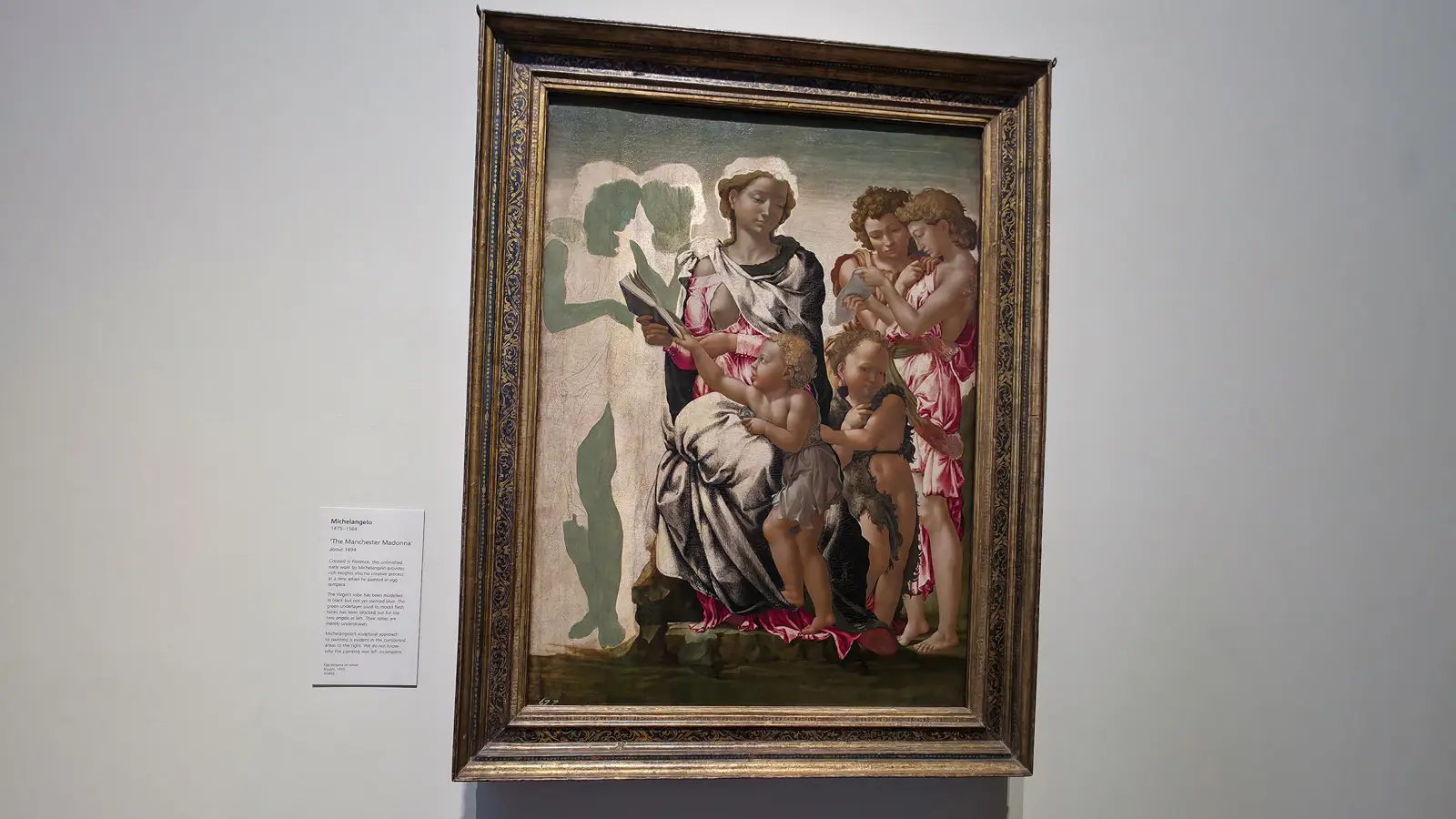
Next to Leonardo’s polish, Michelangelo’s Manchester Madonna comes as a surprise, because it was never finished. Painted around 1494, it is probably the earliest of his surviving paintings, and the two angels on the left are barely begun. They exist only as flat green shapes, because Michelangelo built his flesh tones up over a green underpaint and never got past that first layer. It is like seeing the scaffolding still up.
Even unfinished, the painting could only be by a sculptor. The figures are packed tight against the front of the panel like a carved marble relief, there is no landscape, just plain sky, and the Virgin’s form is cut out with hard, strong outlines. Michelangelo trained first as a painter in Ghirlandaio’s workshop, the same Ghirlandaio from my early Renaissance post, where he learned to draw a composition out before transferring it. Then, as a teenager, he was taken into the household of Lorenzo de’ Medici and learned to carve in the Medici sculpture garden. This small, pale, unfinished panel is the young man who would later cover the Sistine ceiling.
Raphael, the quick study
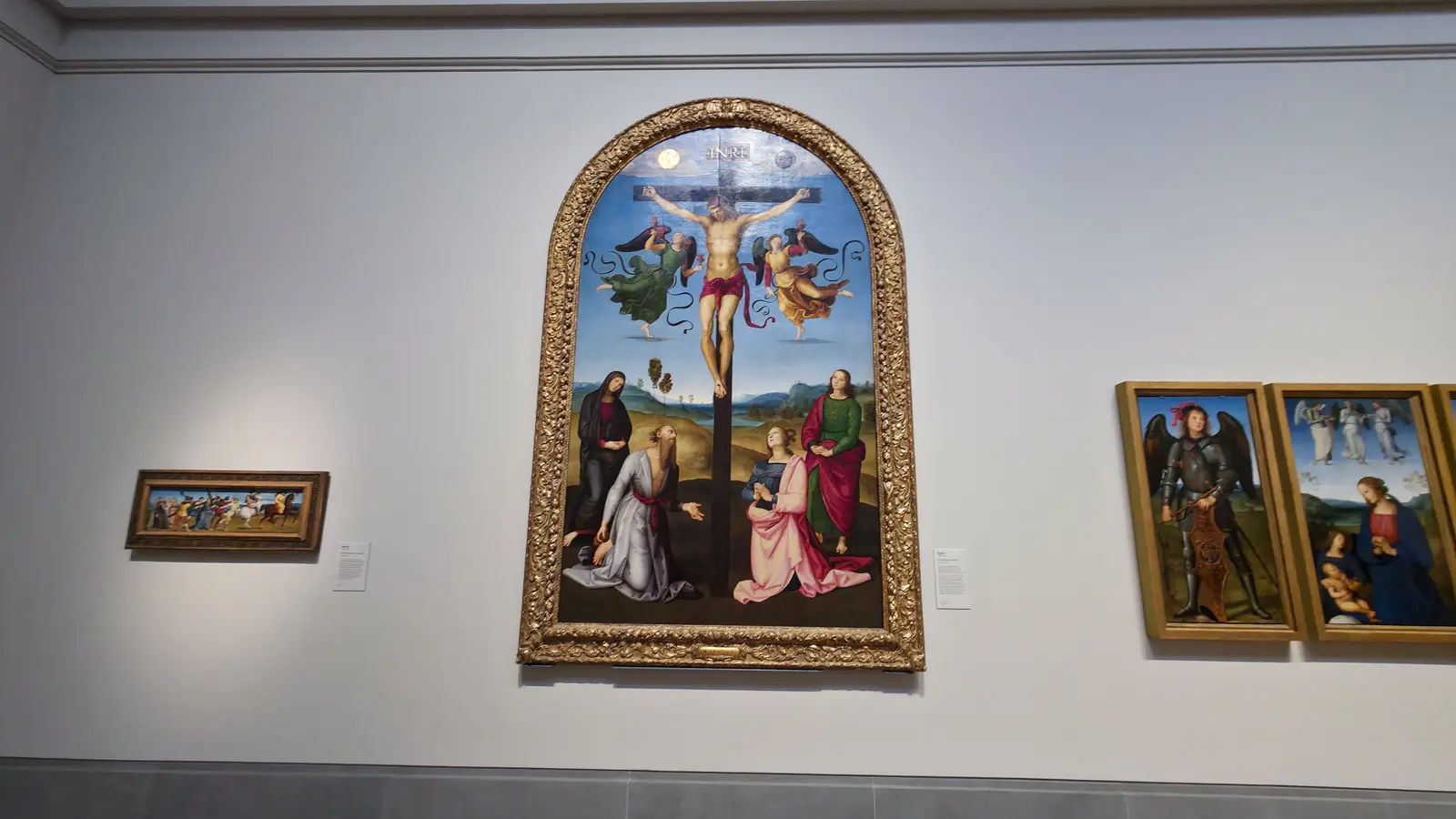
Raphael was the youngest of the three, and he learned faster than anyone. He came from Urbino and trained with Perugino, the leading painter of Umbria, and he absorbed his master’s style so completely that telling them apart is genuinely hard. His Mond Crucifixion, painted around 1502 to 03 when he was barely twenty, is the proof. Christ hangs on the cross with two angels balanced on slivers of cloud, catching his blood in golden chalices, the sun and moon in the sky above. It is calm, symmetrical and serene, exactly in Perugino’s manner. Vasari, the first art historian, wrote that if Raphael had not signed it, everyone would have taken it for a Perugino. And Raphael did sign it, scratching his name through the paint at the foot of the cross.
A few years later he was painting in his own voice. The Ansidei Madonna of 1505 was made for a family chapel in the church of San Fiorenzo in Perugia, and it is the grandest of his early altarpieces. The Virgin sits high on a wooden throne under a calm stone arch, with Saint John the Baptist on one side pointing toward the Christ Child and Saint Nicholas of Bari on the other, absorbed in his book. The whole thing is built on a careful grid, the figures and architecture spaced into thirds, so that everything sits in quiet balance. The Latin words above the throne read “Hail Mother of Christ”.
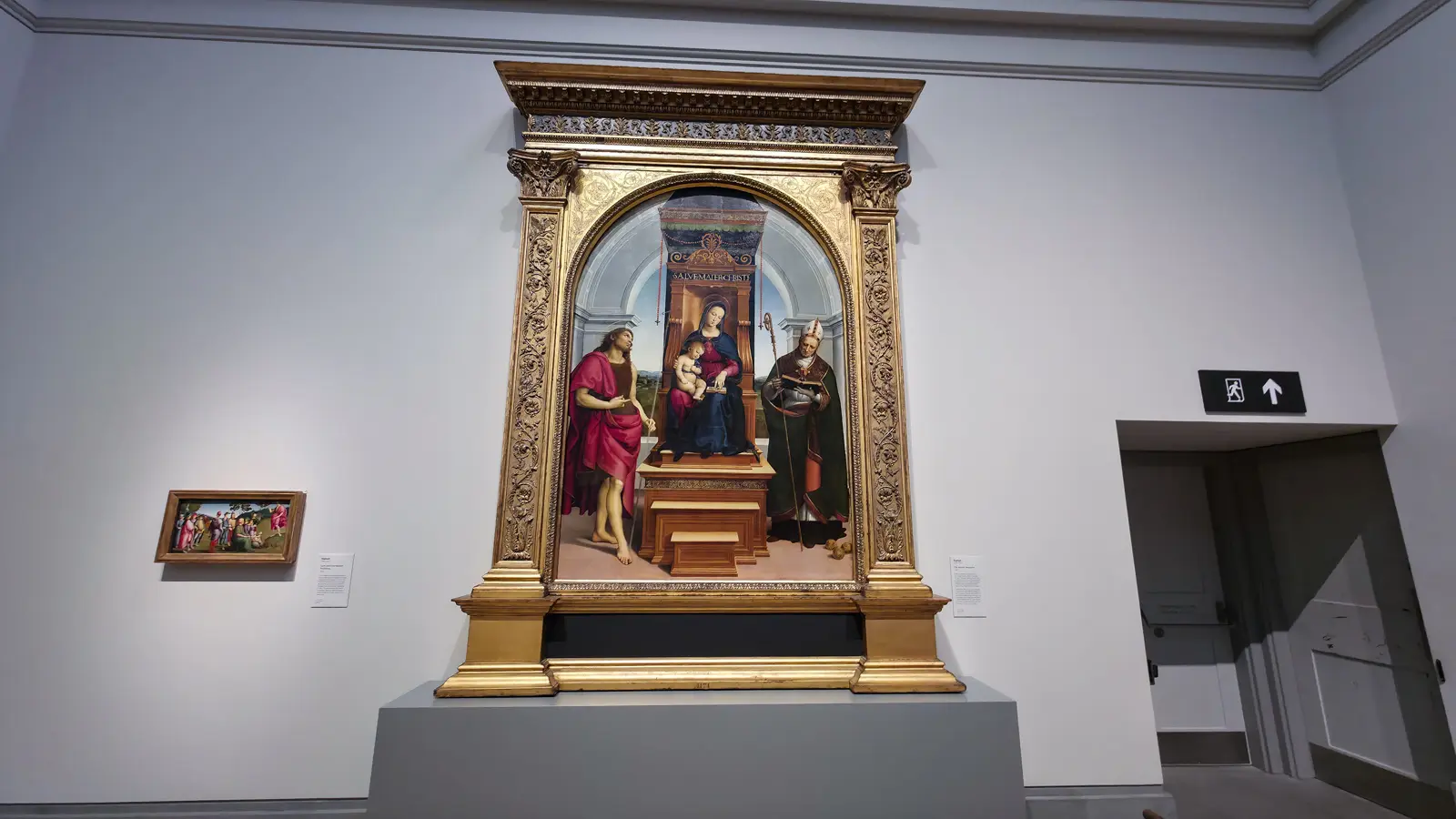
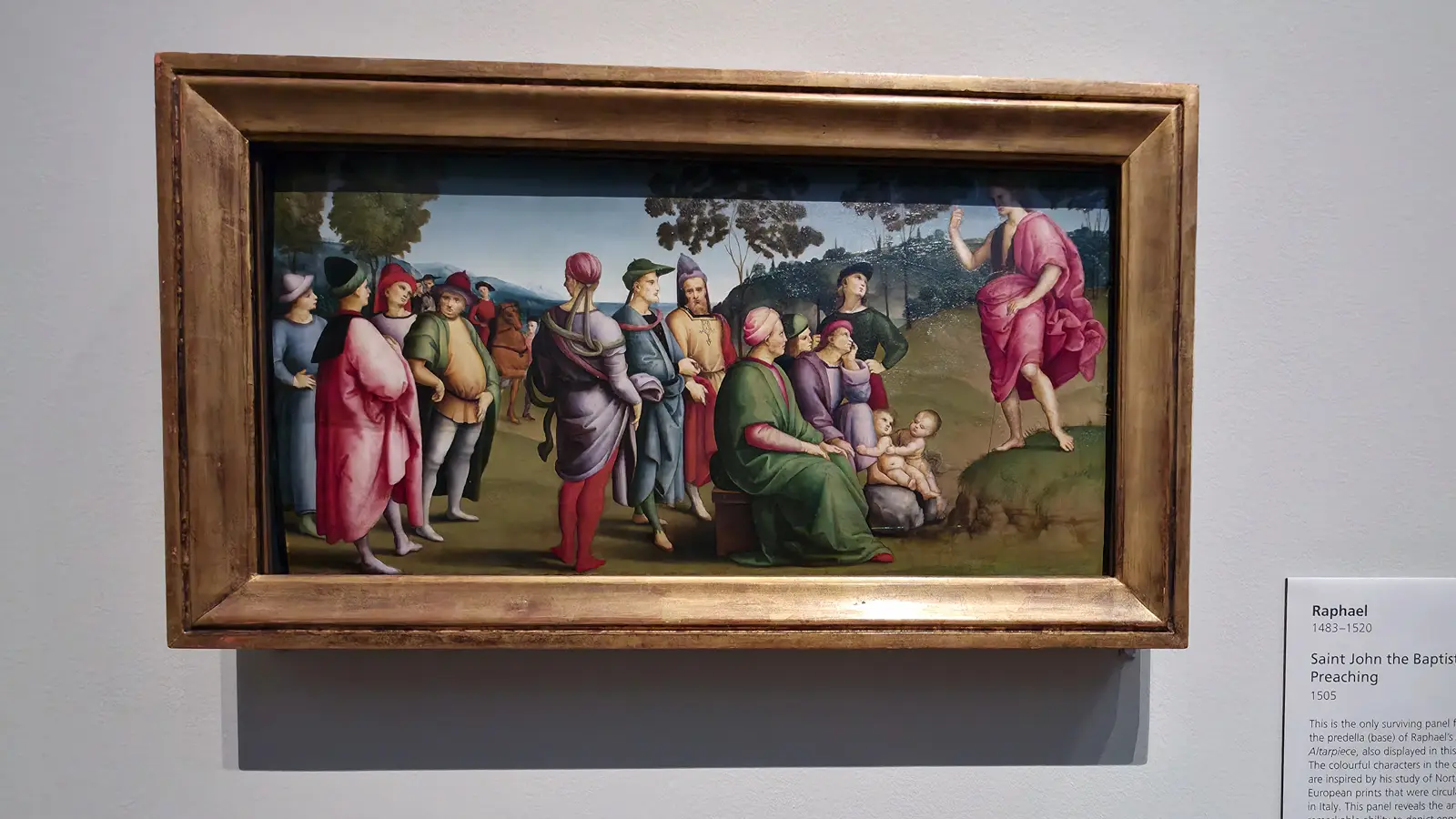
Hanging in the same room, lower down, is the one piece of the altarpiece’s base to survive: a small horizontal panel of Saint John the Baptist preaching to a crowd. Main panel and predella, reunited. It is worth slowing down for, because the little crowd is full of life, the figures in bright, oddly cut clothes that Raphael borrowed from Northern European prints then circulating in Italy.
From Perugia, Raphael moved to Florence, where he studied Leonardo and Michelangelo and absorbed them as quickly as he had absorbed Perugino, and then on to Rome. There the Medici pope Leo X, the son of the same Lorenzo who had nurtured the young Michelangelo, became his great patron. Which brings me to something my visits always leave me thinking about: none of this happened without money. The Milan confraternity, the Umbrian wool merchants who paid for the Raphaels, the popes, and above all the Medici, who took Michelangelo into their home and later, as popes, bankrolled Raphael in Rome. The masterpieces exist because someone chose to fund them.
Bubbly Tips for the High Renaissance rooms
- Find the Leonardo’s own little room. The Virgin of the Rocks hangs in a dim alcove of its own, kept dark to protect it. Give your eyes a minute to adjust before you decide it is too gloomy, and the grotto will come up out of the shadows.
- Play spot the teacher with the Mond Crucifixion. Compare Raphael’s crucifixion with the Perugino works in the same room. Seeing how alike the pupil and master are is the whole point of that wall.
- Hunt for Raphael’s signature. It is scratched into the paint at the very foot of the cross in the Mond Crucifixion. You have to lean in.
- Read the Manchester Madonna as a lesson, not a failure. Because it is unfinished, it shows you exactly how Michelangelo worked, from the green underpaint to the drawn lines of the barely started angels.
- Don’t miss the predella. Raphael’s Ansidei Madonna and the one surviving piece of its base hang together, the little Saint John panel close by. Most people walk straight past it
- Pair this with the early Renaissance rooms. If you have read my earlier National Gallery post, walk the teachers first, Verrocchio, Ghirlandaio and Perugino, then come here for the pupils. The story lands much harder in order.
- It is free, and quieter than you would expect. These rooms cost nothing, and even the Leonardo is usually calmer than the Impressionist galleries upstairs.
- Photography is allowed without flash, but the Leonardo’s low light and the glass on several works throw back reflections, so take your time with the angle.
Final Thoughts
Standing in these rooms, I keep thinking about how far painting travelled in a hundred years. In my early Renaissance post it was Masaccio giving a holy figure real weight for the first time. Here it has arrived: Leonardo dissolving every edge into shadow, Michelangelo carving figures in paint, Raphael balancing a whole altarpiece on a hidden grid. The rebirth that started with looking back to the ancient world ends in this generation, with three painters who matched the ideal and then made it look effortless.
It moves me that the apprentices of my last post became the masters of this one, and that a family of bankers in Florence helped make it possible. I have seen these artists in Florence and in Rome and been amazed every time, and a quiet weekday hour with them in London is no less of a gift.
Until next time!

🌟 Everything You Need to Plan Your Dream Trip in 2026
- 🌟 Luxury Hotels - Find premium stays with Booking.com & Hotels.com
- 🏡 Vacation Rentals - Discover unique properties on VRBO
- 🏞️ Guided Tours - Explore with Viator or GetYourGuide
- 🎫 Attraction Tickets - Skip the lines with Tiqets
- 🚢 Ocean Cruises - Set sail with Cruise Direct
- 📱 International SIMs - Stay connected with Saily
- 🚗 Car Rentals - Budget-friendly options from Discover Cars
- 🌐 Secure VPNs - Browse safely with NordVPN
- 💶 Currency Exchange - Best rates with Wise
- 🗣️ Learn Languages - Master the local language with Babbel and Rosetta Stone