
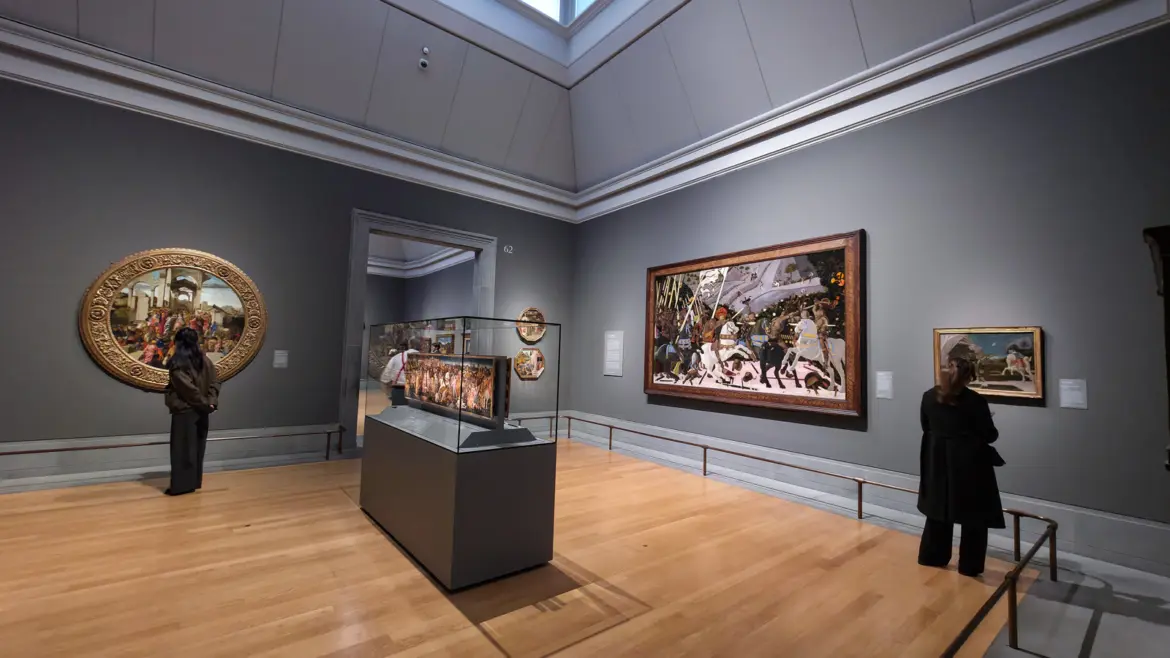
I have always loved the Renaissance, and not just the famous paintings but the idea inside the word itself: rebirth. After centuries in which European art had mostly served the church in flat gold and fixed pattern, artists in fifteenth-century Italy began looking back to the ancient Greeks and Romans, and out at the world in front of them, and started experimenting again. They rebuilt the human figure with real weight, real light, and in time an ideal of beauty borrowed from antiquity. Coming out of the Middle Ages into that has always thrilled me.
The National Gallery in London is a wonderful place to watch it happen, because its early rooms are hung more or less in order. They open in the medieval world of gold grounds and end on the edge of the High Renaissance. This post walks the early stretch of that story, the Italian and mostly Florentine 1400s, where the rebirth began.
The Early Renaissance Rooms at a Glance
📍 Where · Sainsbury Wing, National Gallery, Trafalgar Square, London WC2N 5DN. The early Italian rooms, hung in date order.
💷 Entry · Free, like the rest of the permanent collection. Book a free timed ticket for fast-track entry.
🧭 How to walk it · Forward in date order. Start in the gold-ground medieval rooms and follow the century towards Botticelli’s room.
⭐ The key pairing · Gentile da Fabriano’s gold Quaratesi Madonna of 1425 next to Masaccio’s solid, shadow-casting Virgin and Child of 1426.
🖼️ Don’t miss · Uccello’s Battle of San Romano, Pesellino’s David panels in their glass case, and the rooms of the teacher-painters Verrocchio, Ghirlandaio and Lippi.
🎓 Spot the teacher · Verrocchio taught Leonardo, Ghirlandaio taught Michelangelo, Fra Filippo Lippi taught Botticelli.
🕙 Quieter than upstairs · These rooms are far calmer than the Impressionist galleries.
The world before: all that glitters
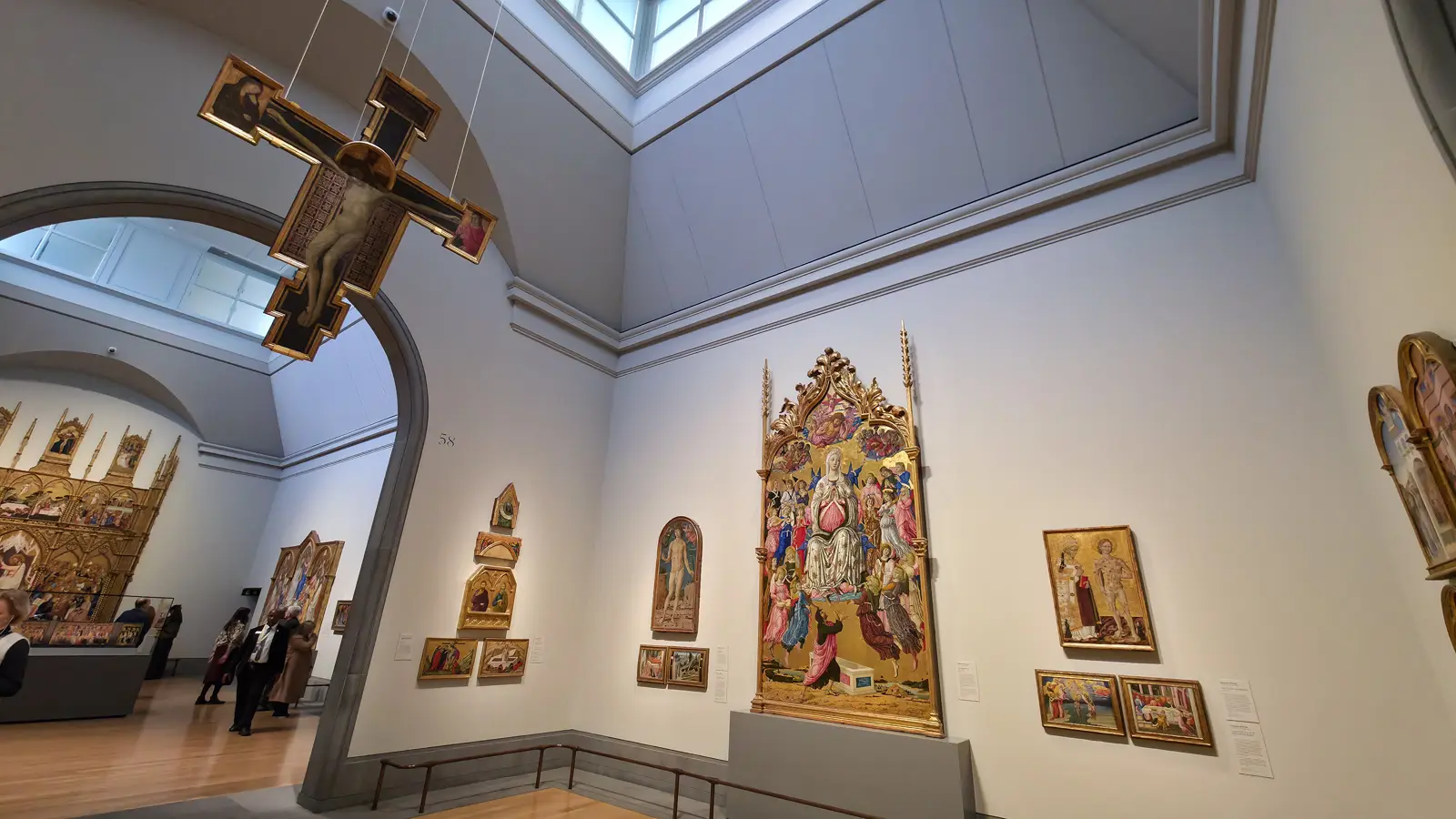
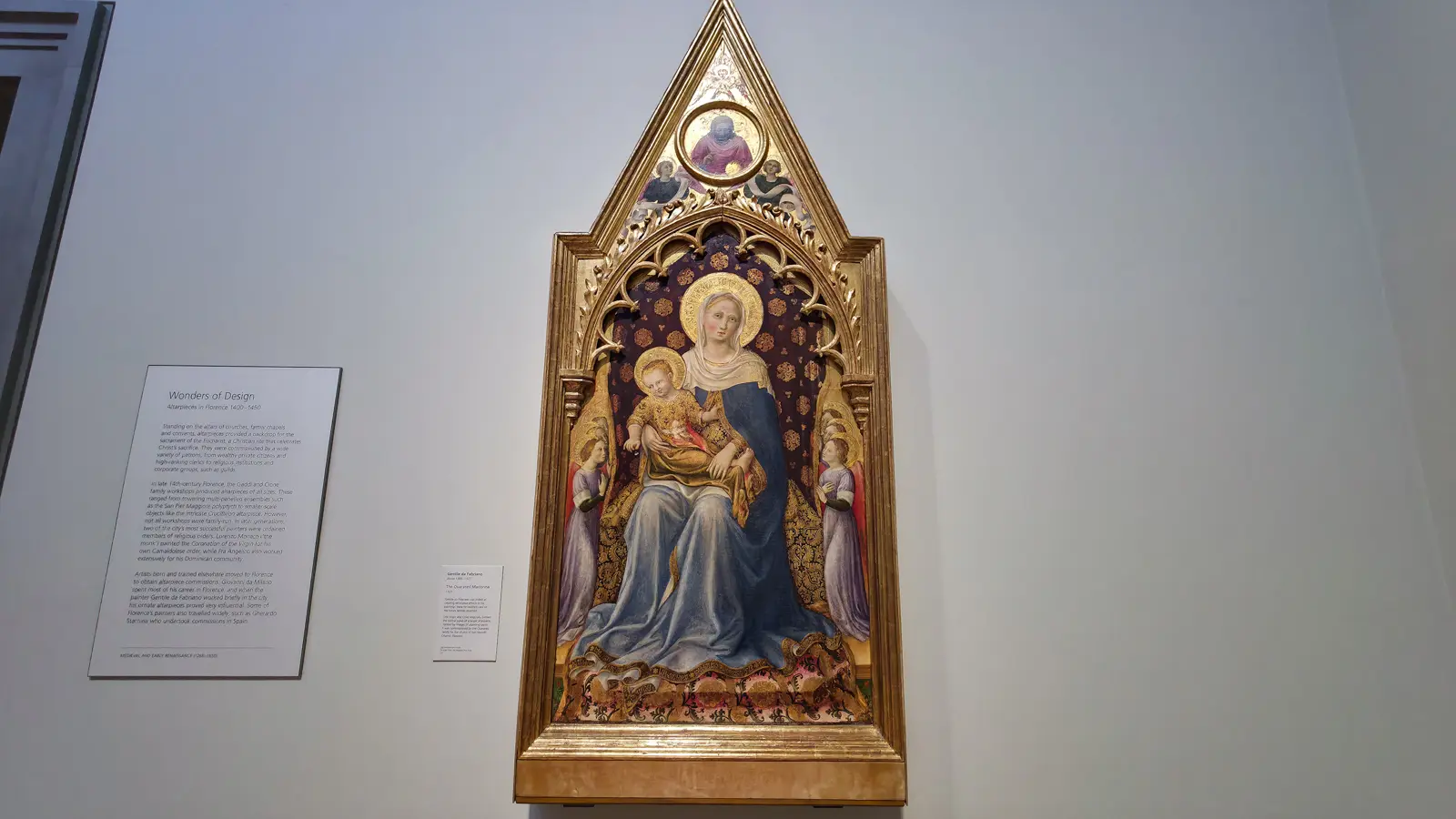
To see the change clearly, it helps to stand first in front of the world the Renaissance grew out of. Gentile da Fabriano’s Quaratesi Madonna, dated 1425, is a lovely example of the style called International Gothic: a gold-ground altarpiece glowing with tooled gilding, patterned silks and slender, delicate figures, the Virgin enthroned beneath a pointed Gothic arch with God the Father in a roundel above. It was the centre of a large altarpiece for a Florentine church, and it is courtly, expensive and serenely unreal.
It is worth keeping that picture in mind, because the next one was painted in the very same city just a year later, and steps into a different world.
The year it changed: Masaccio
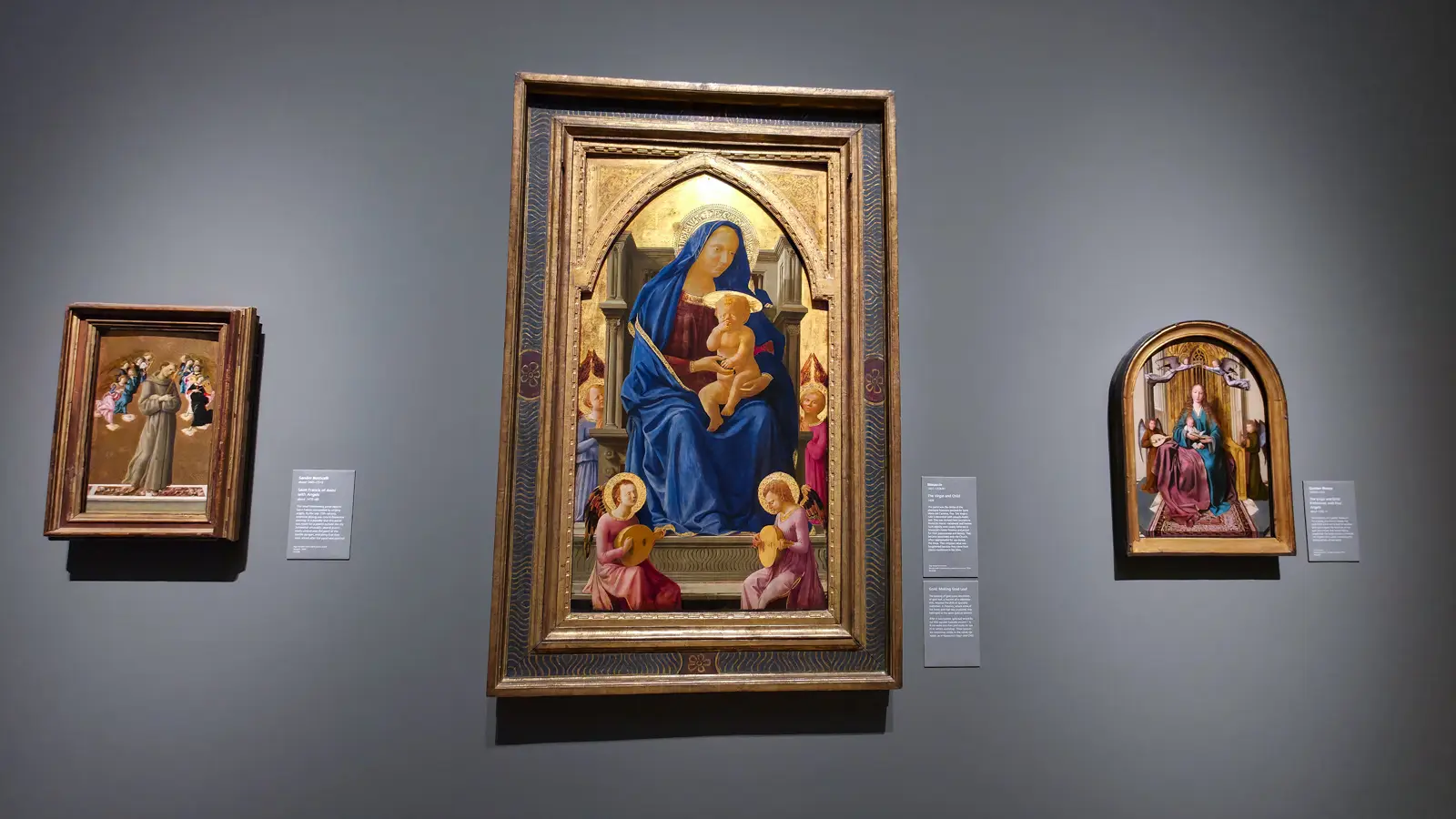
Masaccio’s The Virgin and Child was painted in 1426, one year after the Gentile, and it is the hinge of the whole story. The gold is still there, but everything in front of it has gained a body. The Virgin is heavy and sculptural, casting a real shadow against a stone throne built with classical columns. The Christ Child is a proper fleshy baby, sitting on her knee eating grapes. Two angels at the foot of the throne play lutes, and the angle of those lutes forms a clear V that pulls the eye back into space: this is single-point perspective, the new geometry, used to make a painted panel look deep and real.
This is exactly the moment that gets me. Masaccio looked back to ancient sculpture and to the solid figures of Giotto a century before, and gave holy figures the weight and presence of real people standing in real light. He died at about twenty-seven, with very little surviving work, yet he changed the course of European painting. Painters would spend the rest of the century building on what he did here.
Perspective as a passion: Uccello
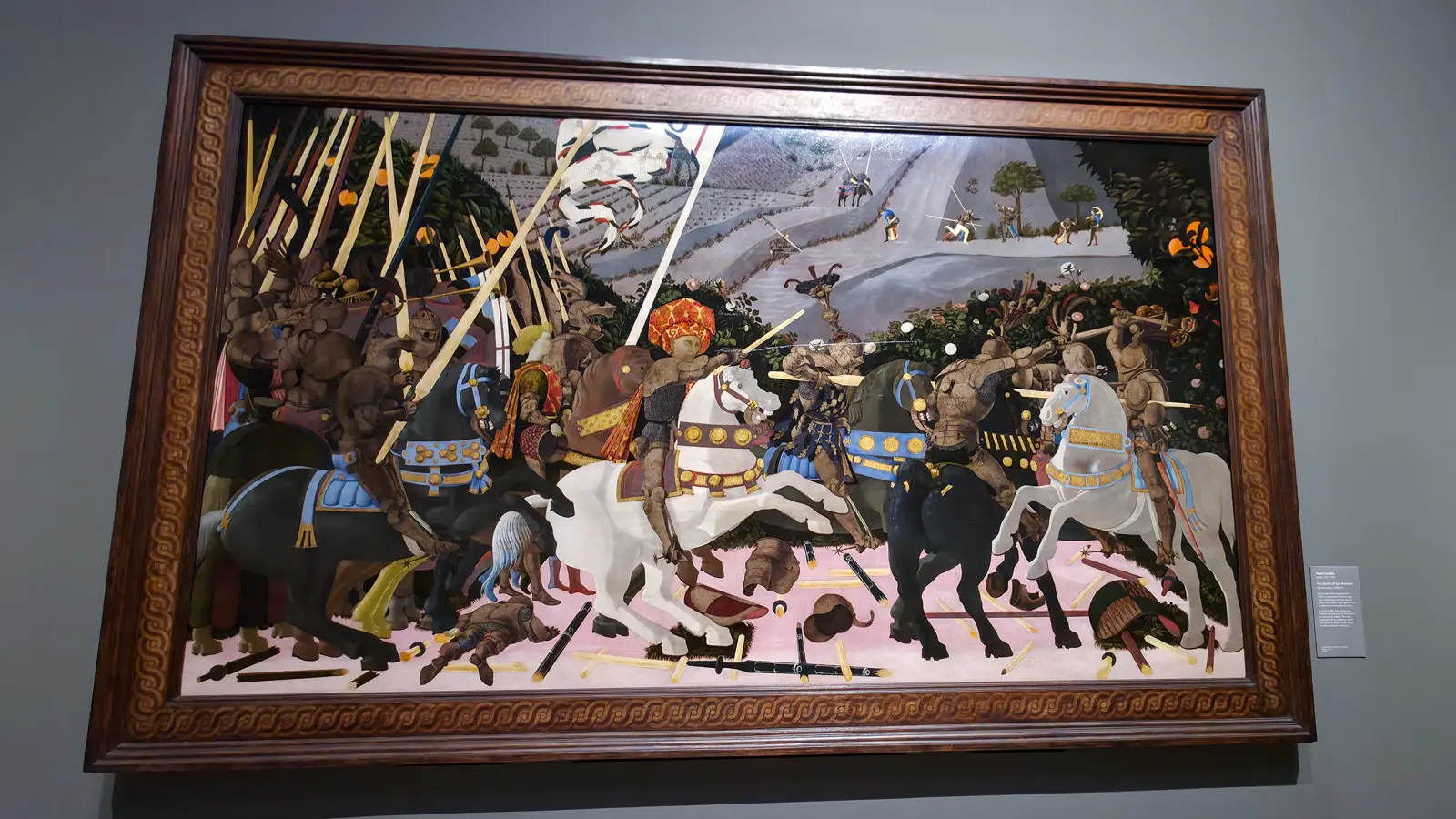
If Masaccio made perspective serious, Paolo Uccello made it an obsession. His Battle of San Romano is one of three huge panels he painted of a Florentine victory of 1432. The broken lances on the ground are laid out in careful lines that all run back toward a single point, turning the wreckage of battle into a geometry lesson. A fallen soldier lies foreshortened on the earth, shrunk by perspective, one of the earliest attempts to draw a body that way. Vasari later complained that Uccello cared more about perspective than about people, and the fun he is having with it is hard to miss. The horses look like carved rocking horses, the colours are dreamlike, and the silver leaf on the armour, once dazzling, has darkened to grey with age.
Storytelling on furniture: Pesellino
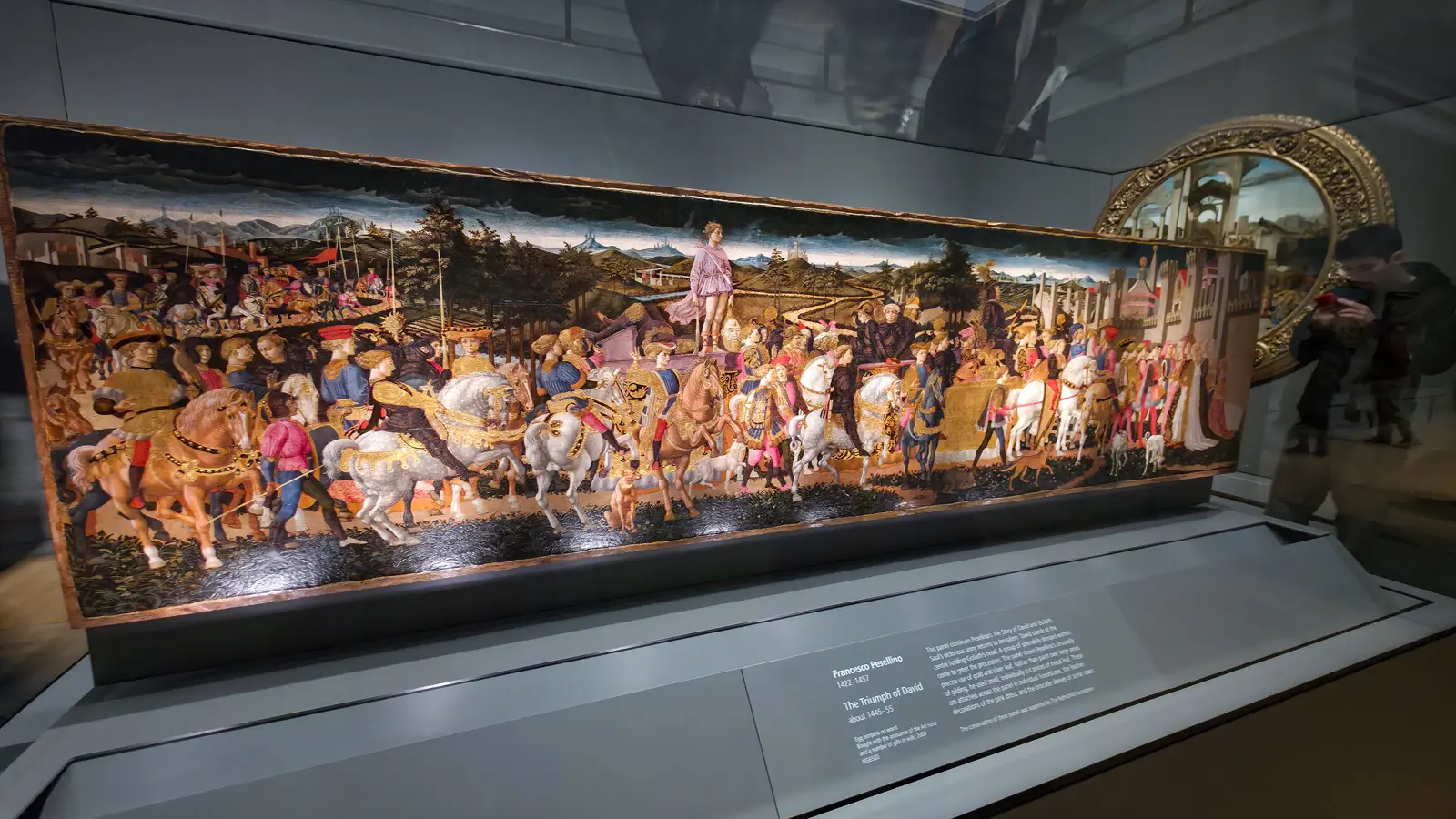
Not all of this new painting hung in churches. Francesco Pesellino’s The Triumph of David, about 1445 to 55, is one of a pair of long, low panels made to be set into the wood panelling of a Florentine bedchamber, probably to celebrate a wedding. It tells a Bible story as though it were a fairy-tale pageant in the Tuscan hills: David rides in triumph with the giant Goliath’s head, trumpeters play, and nobles parade on prancing horses through a landscape of walled towns. Pesellino clearly studied Uccello, and it shows in the doll-like, side-on, head-on, every-which-way horses. It is a glimpse of how richly decorated a wealthy Renaissance home could be, and how art had moved out of the church and into daily life.
The workshops behind the famous names
Here is the thread I find most touching. Before Leonardo, Michelangelo and Botticelli were the names everyone knows, they were teenage apprentices grinding pigments in someone else’s workshop. The masters who trained them are all here, in these same rooms, and they are wonderful painters in their own right.
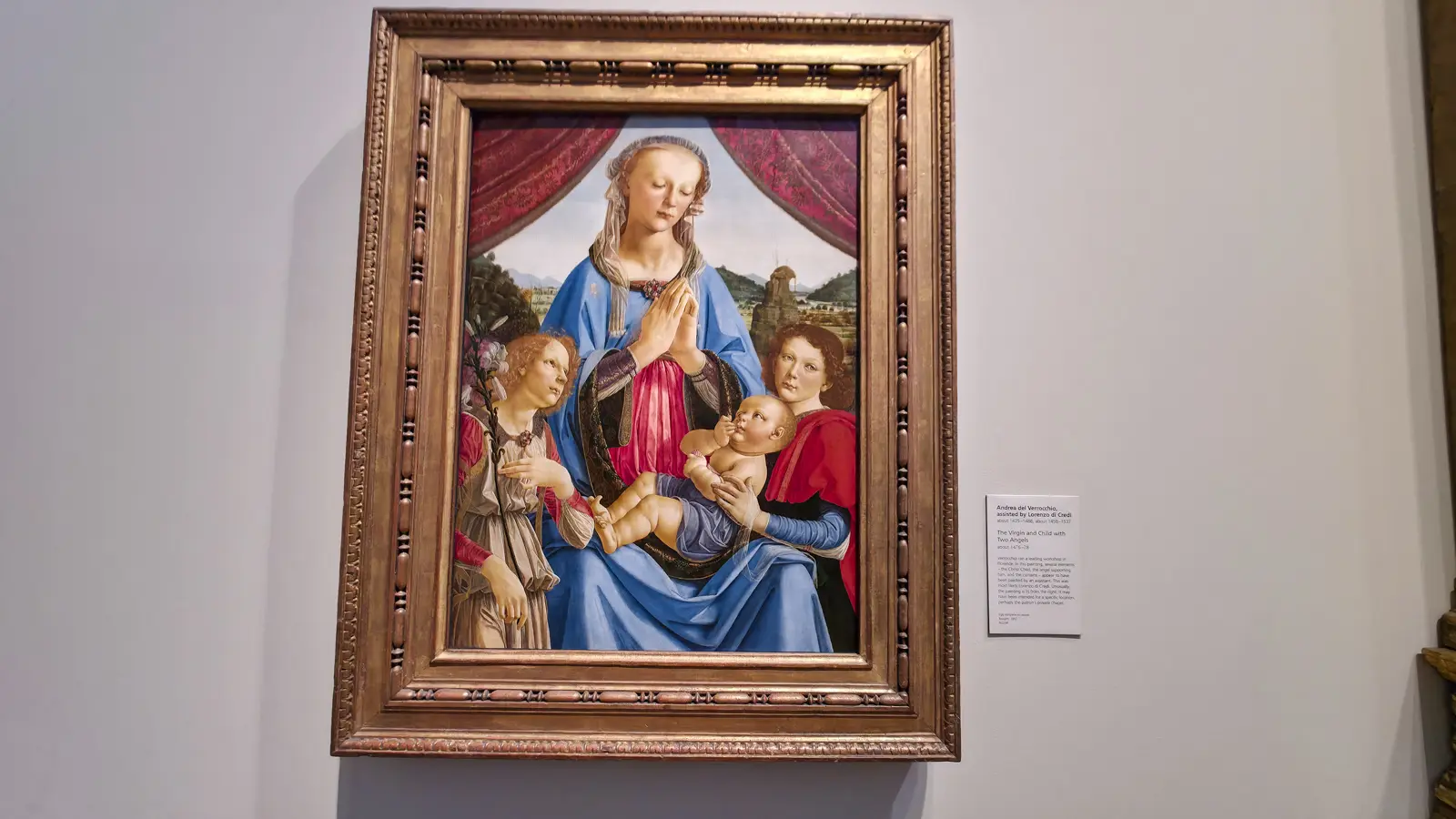
Andrea del Verrocchio ran the most prestigious workshop in Florence, and his label here says it plainly: the painter who trained Leonardo. His Virgin and Child with Two Angels, about 1476 to 78, was made with his pupil Lorenzo di Credi. Verrocchio was a sculptor as well as a painter, and the difference shows in the angels’ hands: the firmer, more anatomical one is the master’s, the softer one his student’s.
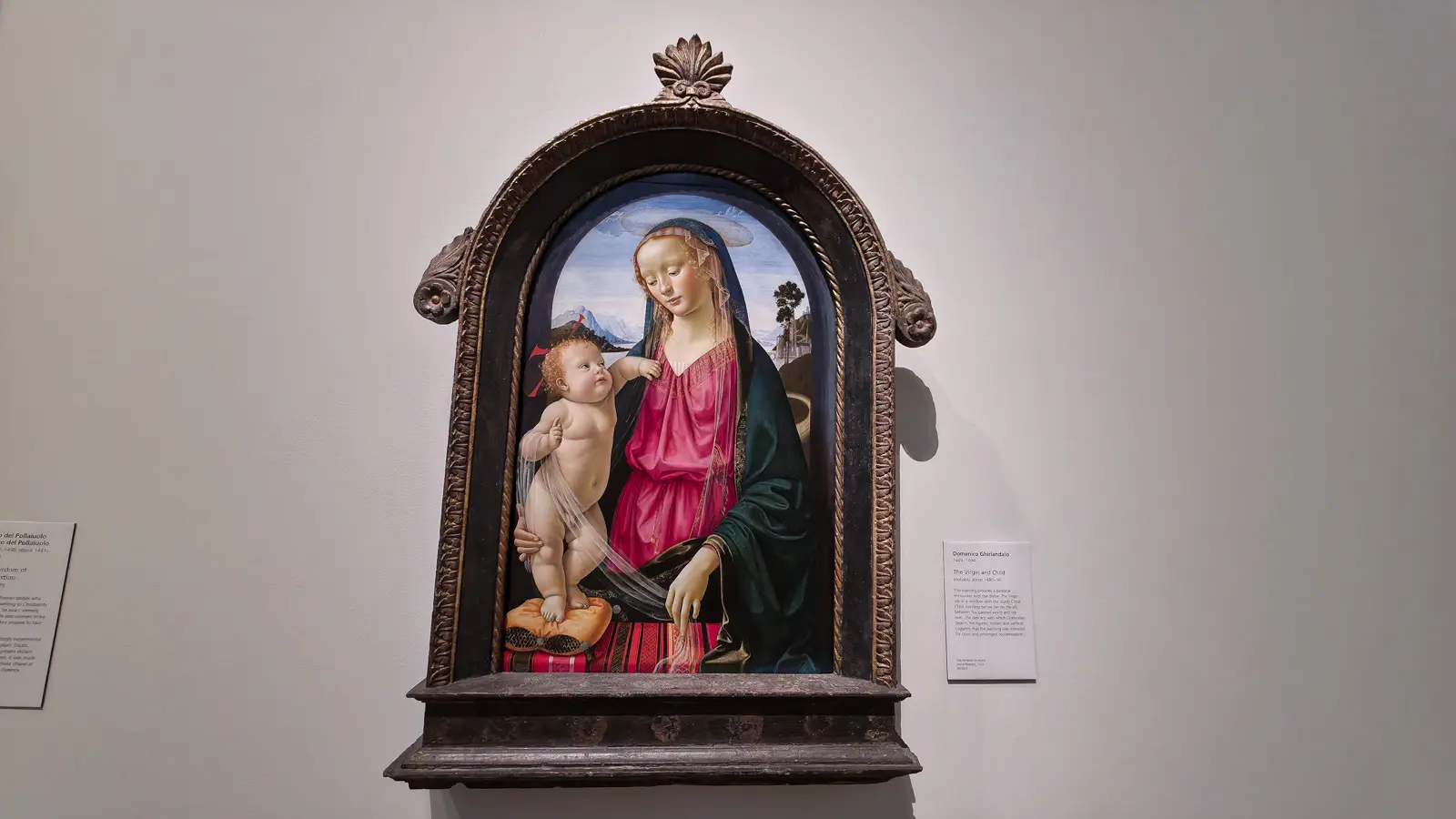
Domenico Ghirlandaio, the son of a goldsmith, ran the other great teaching workshop. His Virgin and Child, about 1480 to 90, shows the infant raising a finger as though already preaching. In the mid-1480s a boy of about ten or eleven joined his studio to learn fresco and drawing. That boy was Michelangelo, who learned the craft of painting in this man’s workshop long before he ever touched the Sistine ceiling.
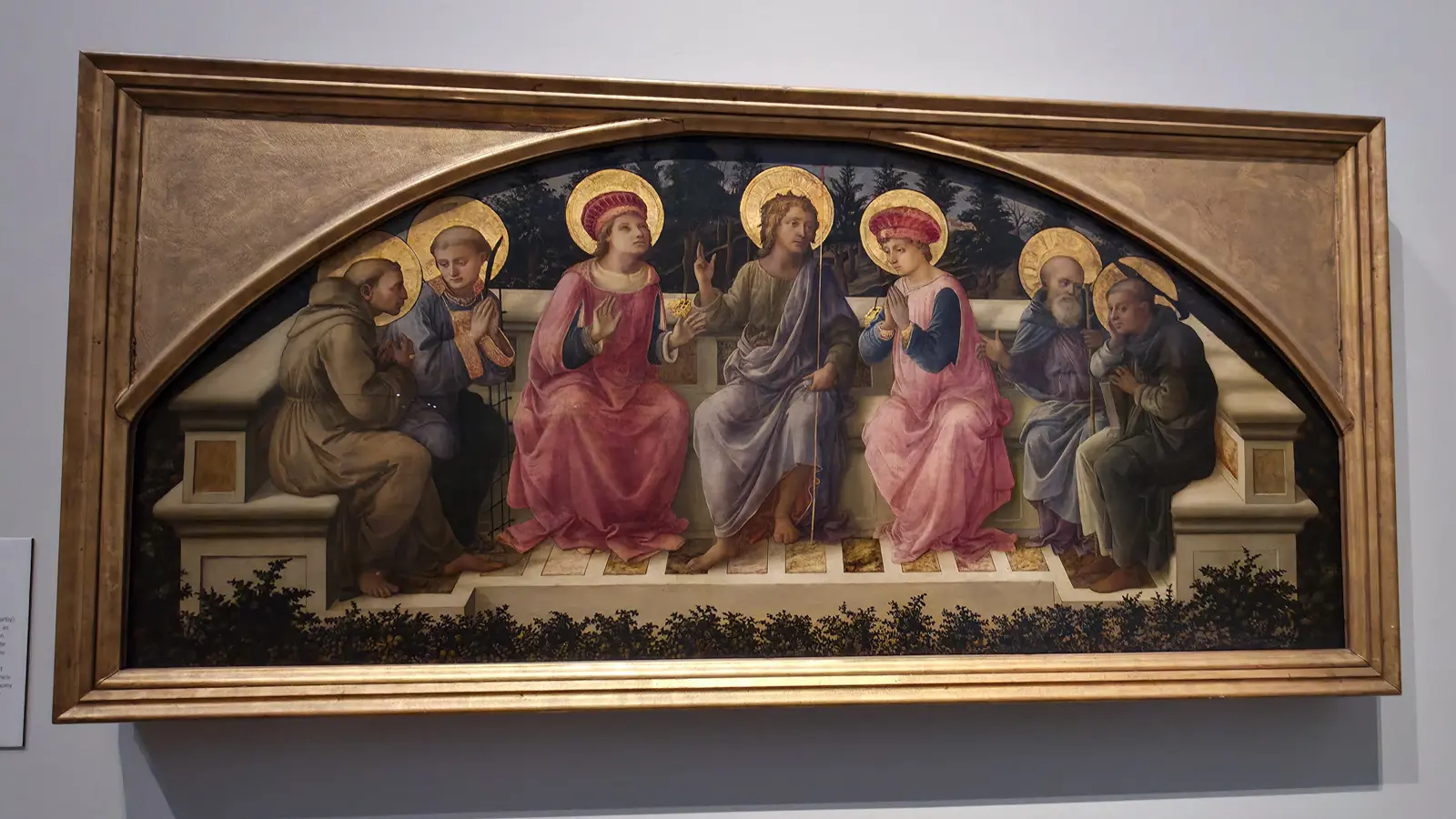
And Fra Filippo Lippi, a friar as well as a painter, trained Sandro Botticelli. His Seven Saints, about 1450 to 53, is a wide lunette of seven male saints seated together in a garden, painted for the Medici and showing the saints whose names the family carried. Botticelli, whose room is just along the way, took Lippi’s grace and made it unmistakably his own.
One more strand was arriving from outside Italy. The Sicilian painter Antonello da Messina brought the Netherlandish oil technique south, and Florentine artists began to learn what oil paint could do. That northern story has its own giants, and I will come back to them in a separate post.
Bubbly Tips for the early Renaissance rooms
- Start at the beginning and walk forward. The early rooms are in the Sainsbury Wing, which is now the main entrance on Trafalgar Square, and they run in date order. Walking them in sequence is the whole point: you watch painting change.
- Put Gentile and Masaccio side by side. The Quaratesi Madonna of 1425 and Masaccio’s Virgin and Child of 1426 were painted a year apart. Seeing the gold-ground world and the new naturalism together is the single best lesson in the room.
- Hunt the perspective tricks in the Uccello. Find the broken lances lined up on the ground and the tiny foreshortened fallen soldier. This is a painter teaching himself a new geometry in public.
- Check the angels’ hands in the Verrocchio. One hand is firmer and more anatomical than the other, the giveaway that master and pupil both worked on the picture.
- Get close to the Pesellino. It sits in a freestanding glass case so you can walk around it, and the detail, hounds, a cheetah, tiny walled cities, rewards a slow look.
- Play spot the teacher. Verrocchio taught Leonardo, Ghirlandaio taught Michelangelo, Lippi taught Botticelli. Reading the rooms this way makes the famous names seem a lot closer.
- It is all free. Like the rest of the permanent collection, these rooms cost nothing, and they are quieter than the Impressionist galleries upstairs.
- Photography is allowed without flash, though the gold grounds and glass cases throw back a lot of reflection, so take your angles carefully.
Final Thoughts
What I love about these rooms is that they let me watch painting wake up. One year there is Gentile da Fabriano’s gold and pattern, beautiful but frozen, and the next there is Masaccio giving a baby real flesh and a throne real depth. From there it is a steady climb: Uccello teaching himself perspective in public, Pesellino turning a Bible story into a parade for someone’s bedroom, and three quiet master-teachers raising the boys who would become Leonardo, Michelangelo and Botticelli.
That, for me, is the rebirth in a single set of rooms: artists turning back to the ancient world and to nature, and rebuilding the human figure from the ground up. The full flowering, the idealised beauty of the High Renaissance, comes next, and I will take that on in its own post. But it all starts here, in the gold and the grapes and the broken lances.
Until next time!

🌟 Everything You Need to Plan Your Dream Trip in 2026
- 🌟 Luxury Hotels - Find premium stays with Booking.com & Hotels.com
- 🏡 Vacation Rentals - Discover unique properties on VRBO
- 🏞️ Guided Tours - Explore with Viator or GetYourGuide
- 🎫 Attraction Tickets - Skip the lines with Tiqets
- 🚢 Ocean Cruises - Set sail with Cruise Direct
- 📱 International SIMs - Stay connected with Saily
- 🚗 Car Rentals - Budget-friendly options from Discover Cars
- 🌐 Secure VPNs - Browse safely with NordVPN
- 💶 Currency Exchange - Best rates with Wise
- 🗣️ Learn Languages - Master the local language with Babbel and Rosetta Stone