
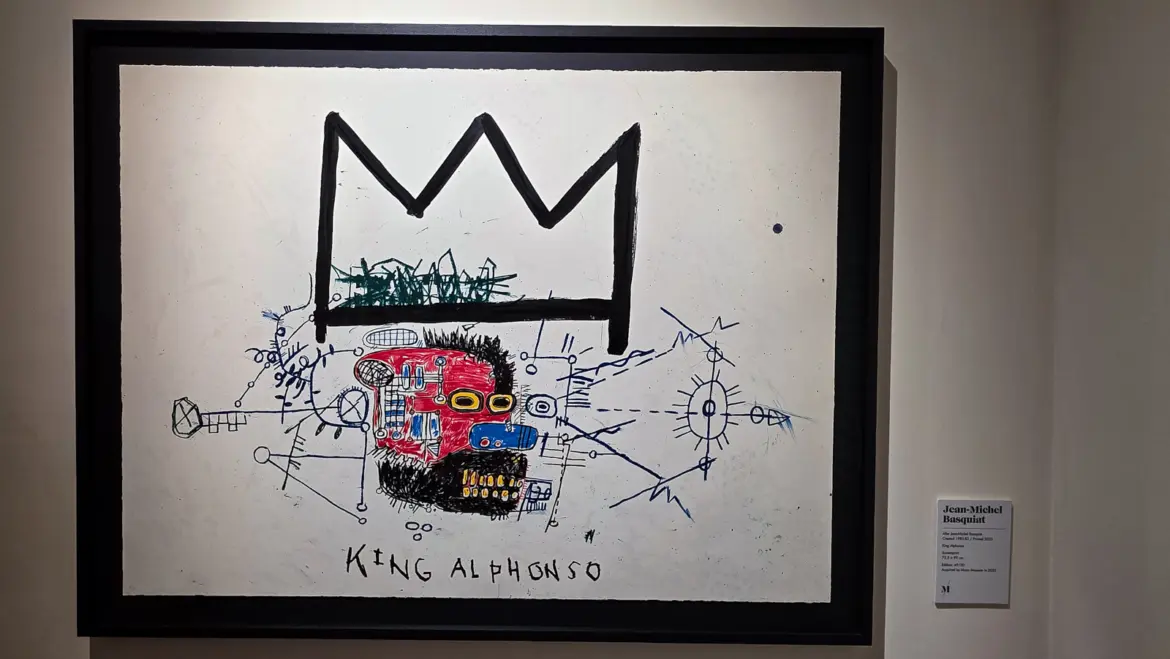
Here is what I knew about Jean-Michel Basquiat before I walked into that room: he went out with Madonna.
That was it. That was the whole of it. A man with work in every major museum in the world, and the only fact I had retained about him came from a magazine. It is a slightly humbling thing to admit while standing in a renowned art museum, and I am admitting it because I suspect I am not the only one.
The Madonna part is true, as it happens. They were together in 1982, in New York, before either of them was famous. She was recording her first album. He was two years out of writing on walls.
Everything else in this post I learned on 27 April, standing in a small room at the Moco Museum in Amsterdam, while King’s Day went on somewhere else entirely.
Basquiat at the Moco Museum at a Glance
👑 The signature · The three-point crown, used constantly and never explained, floating over heads that are often Black musicians, athletes and writers.
🖼️ What is here · King Alphonso and sheets from the 1982 Figure Portfolio, dense with writing, drawn in oil stick and crayon.
🎡 The connection · Downstairs hangs Banksquiat, Banksy’s ferris wheel of Basquiat crowns, from his 2017 Barbican murals.
📖 The trick · This is a collection where the wall text changes what you see. The work looks like scribbling until the vocabulary is in place.
💡 Tip · Do the Basquiat room and the Banksy room in one visit. The museum does not point out that they answer each other.
SAMO
Basquiat was born in Brooklyn in December 1960, to a Haitian father and a Puerto Rican mother. He never went to art school. He dropped out of high school a year before he would have finished, left home, and made money selling hand-painted sweatshirts and postcards on the street in New York.
Before any of the paintings, there was a tag. From about 1977 he and his school friend Al Diaz wrote short cryptic slogans around Lower Manhattan under the name SAMO, which the museum’s own wall text explains stands for same old shit. It ran for roughly three years. When Basquiat had finished with it, he ended it publicly by writing SAMO IS DEAD around the same streets.
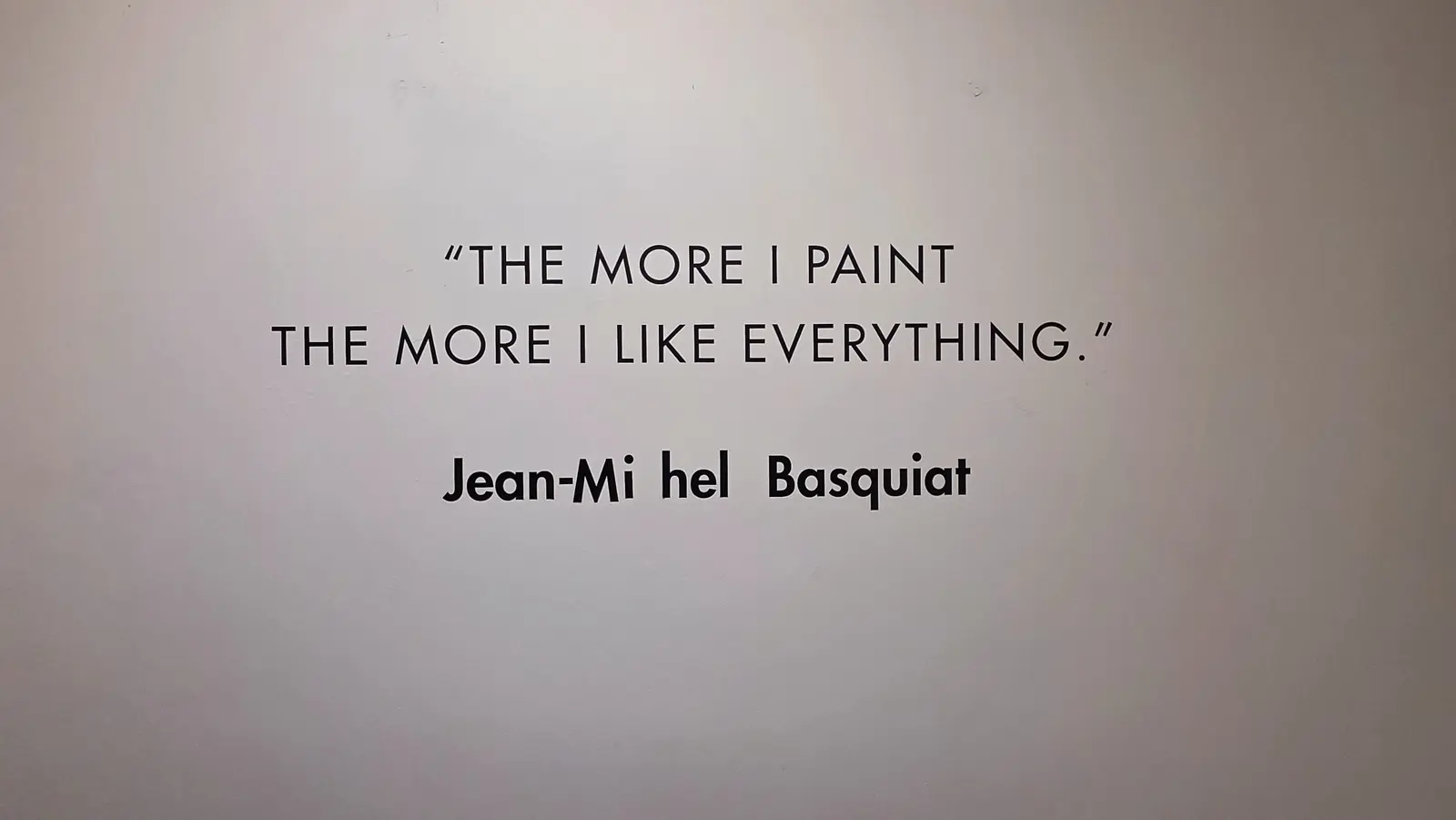
A letter is missing from his name on that wall. It reads Jean-Mi hel Basquiat, and I stood there long enough to wonder whether it had dropped off, been picked off, or simply never gone up, and to notice that nobody had put it back.
The line above it is his: the more he painted, the more he liked everything. It is the kind of remark that sounds like nothing until it is set against the biography, and then it sounds like someone who had found the one thing that worked.
By twenty he was in his first proper exhibition. By twenty-one he was the youngest artist ever to take part in Documenta in Kassel. By twenty-two he was in the Whitney Biennial.
My First Reaction, Which Was Wrong
I am going to be honest about this because pretending otherwise would make the rest of the post worthless.
My first thought, standing in front of these, was that a child had done them. Crayons. Someone had been given a box of Crayolas and had gone at a large sheet of paper without stopping. Wobbly figures, letters everywhere, scribbling over the top of scribbling.
I knew as I thought it that this was not a clever reaction, and that a man does not end up in the Whitney Biennial at twenty-two by scribbling. But it was the reaction, and I would rather record it than pretend I walked in with an art degree.
The Crown
The crown is the thing everyone recognises, and it is worth knowing that he used it constantly and never explained it.
Three points, drawn quickly, usually in black, usually floating above a head rather than sitting on it. Readings differ. Some take it as a claim of authority, an artist crowning his own subjects. Some read it as a statement of Black excellence, since the heads underneath are so often Black musicians, athletes and writers. Some read it as a nod to Andy Warhol, whom Basquiat idolised.
In King Alphonso, the hero image at the top of this post, the crown is enormous, drawn in the heaviest black in the picture, and it hovers over a red head with gold teeth and an aerial of scratched blue lines running off in every direction. The head is small. The crown is not.
He also crossed things out constantly. Words, names, whole passages, struck through so they can still be read. He is supposed to have said that he crossed words out so people would want to read them more.
The Figure Portfolio
Along one wall are sheets from what is known as the Figure Portfolio, which the museum dates to 1982, one of his most productive years.
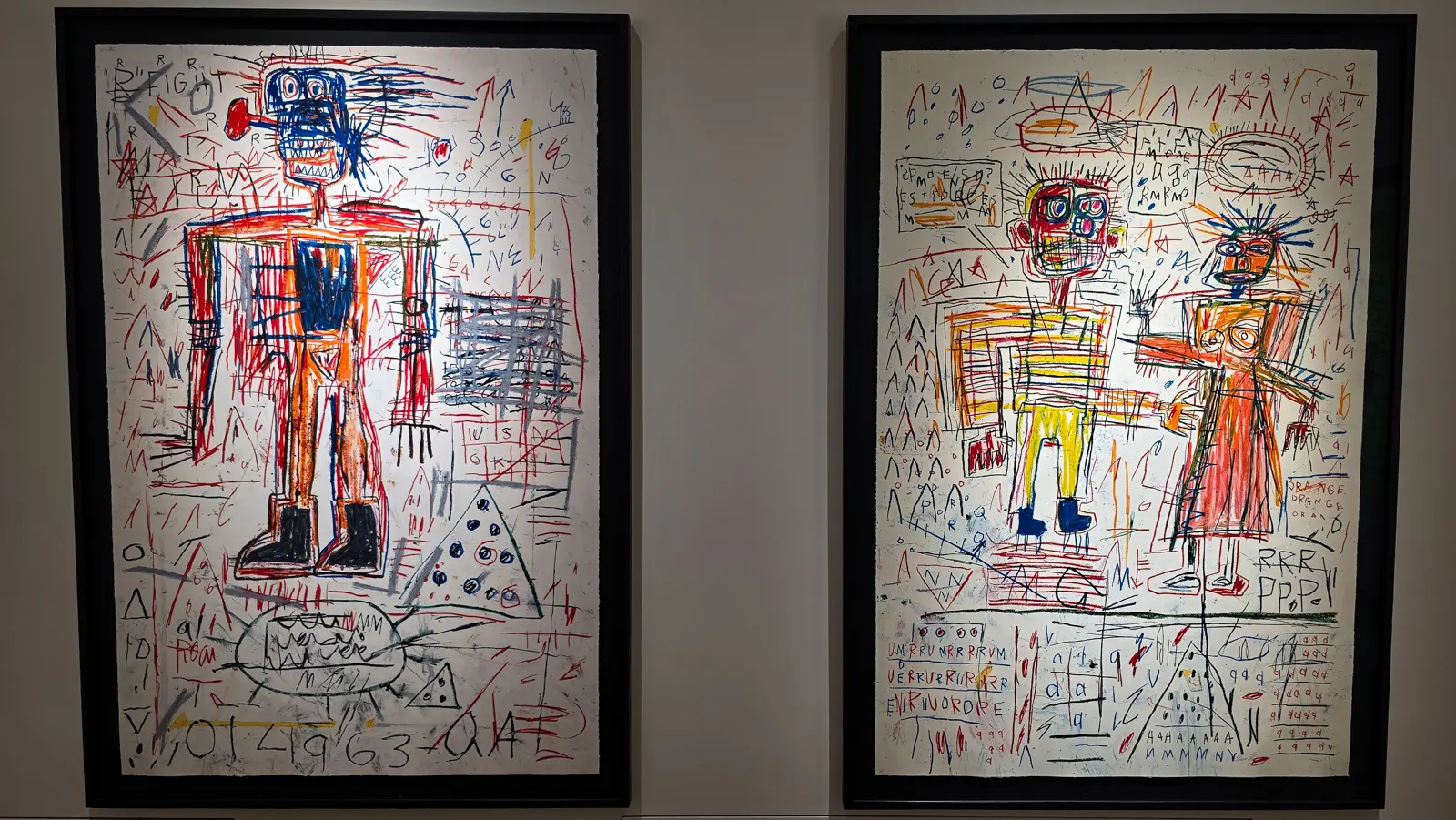
Standing in front of them, the first thing to register is how much writing there is. Letters, numbers, single repeated characters, whole columns of the same shape stacked down the margin. The figures are almost incidental to the noise around them.
The second thing is that they are drawn in oil stick and crayon on paper, quickly, with no attempt to hide a wrong line. Wrong lines stay. Additional lines go over them.
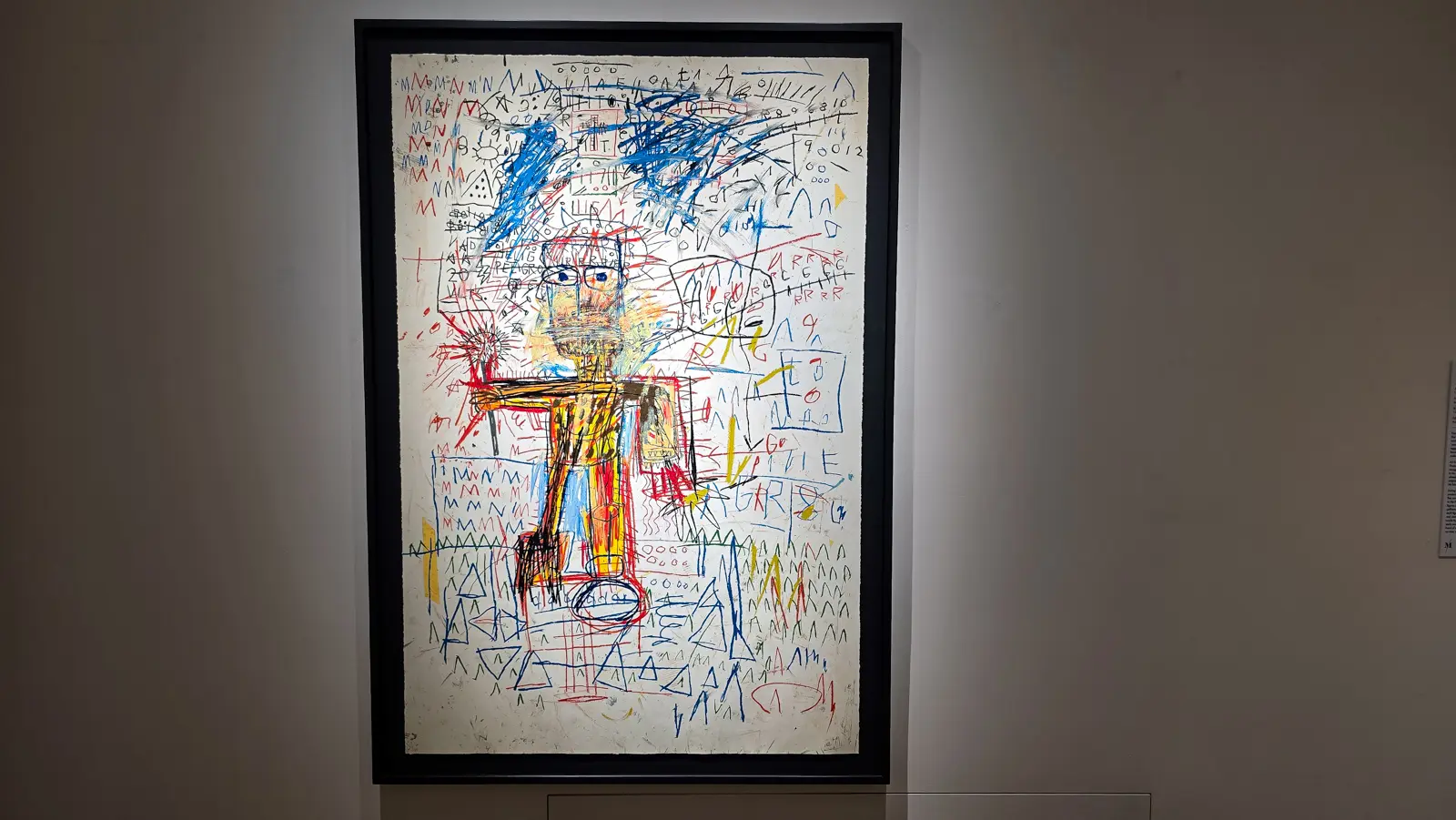
His borrowings were wide and deliberate. The museum quotes him on looking at a medieval painting or an African sculpture and seeing the life around the object rather than the object.
Which is where the crayon impression finally gave way, and it is worth being precise about how.
Nothing on those sheets changed. What changed was that I knew, by then, that the man drawing them had spent three years writing slogans on walls in a city where that was a crime. That he struck words out so they would be read. That the anatomy was borrowed from a medical textbook, the crown from nowhere anyone can agree on, the repeated letters from a habit he never explained.
Once that is in place, the marks stop being random and start being a vocabulary. Not a comfortable one, and I would not pretend I can read all of it. But the thing that looked like a child with a box of Crayolas at ten seconds does not look like that at twenty minutes, and the difference was entirely the wall text and the labels.
What Banksy Did With the Crown
Downstairs, in a different room, hangs a print by Banksy.
It shows a family queuing at a fairground for a ferris wheel, drawn in his usual stencilled monochrome. The wheel has eight carriages. Every one of them is Basquiat’s three-point crown.
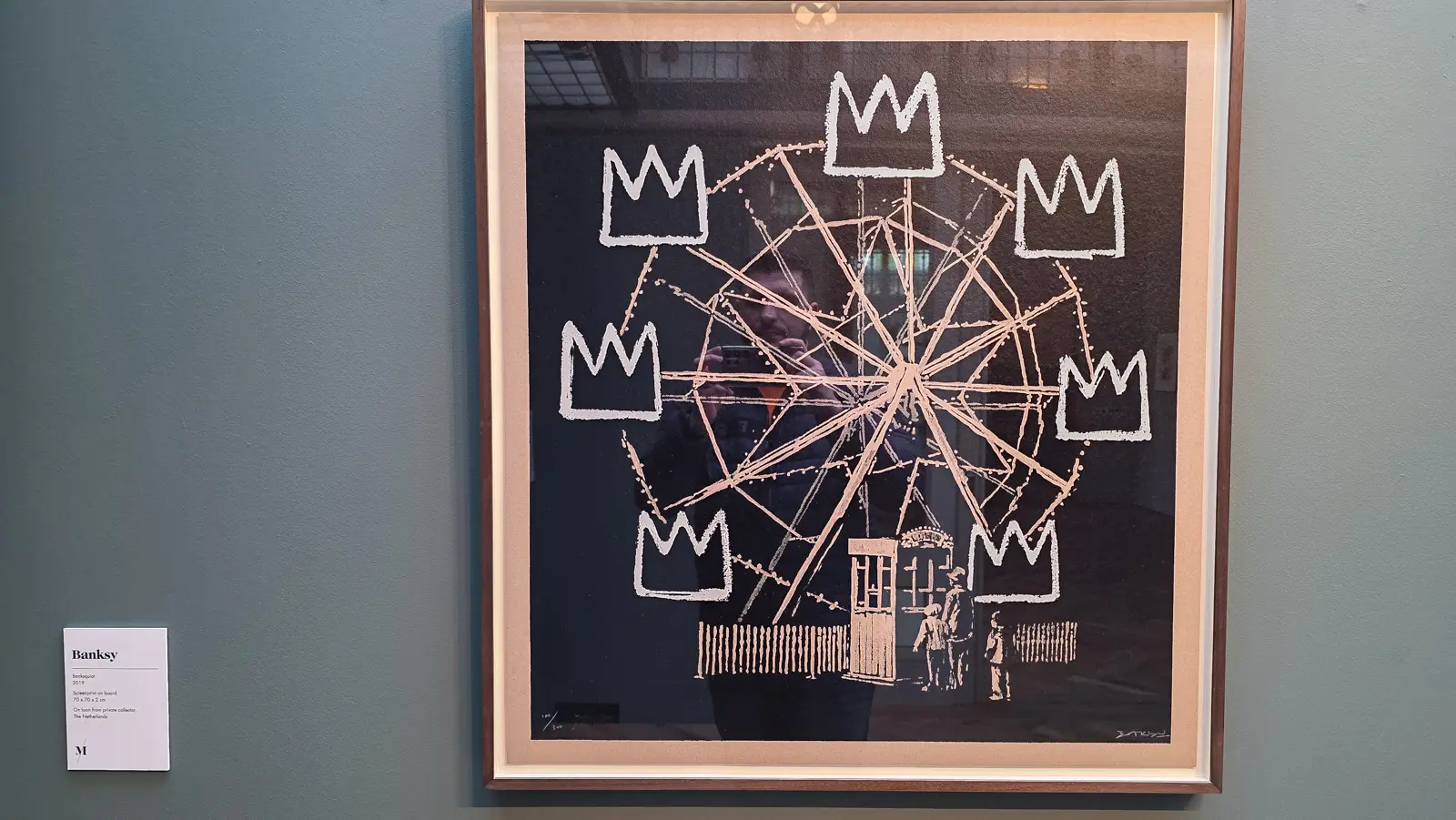
The print has a specific origin. In September 2017, days before the Barbican in London opened the first major British retrospective of Basquiat’s work, Banksy painted two murals on the outside of the building without permission. One showed a Basquiat figure being stopped and searched by two police officers. The other was this ferris wheel.
He announced them himself and pointed out, in effect, that the Barbican is an institution normally very keen to scrub graffiti off its walls.
That is the joke, and it is a serious one. An institution that would remove street art from its own exterior was at that moment celebrating a man who started out writing on walls. Banksy made the point by writing on the wall.
The print came two years later, sold through Banksy’s own online shop. Which sharpens it again, because a complaint about turning street art into merchandise arrived, this time, as merchandise.
Bubbly Tips
- The Banksquiat and the Basquiats are on different floors. The museum does not point out the connection, and the crowns read differently depending on which one is seen first. Worth doing both in one visit rather than assuming the Banksy room is separate.
- Read the object labels for the printing dates. Several of the Basquiat works here are screenprints made after his death, produced from earlier compositions, which the labels state plainly. It is worth knowing what is a print and when it was made.
- Read the wall text before looking properly. This is the rare collection where the labels change what is on the walls. Basquiat does not explain himself, and the work looks like scribbling until the vocabulary is in place. Twenty minutes of reading is the difference.
- Give the writing as much attention as the figures. The text in these works is not decoration. Names, numbers and struck-out words carry as much of the meaning as anything drawn.
- Look for the crossings-out. He struck words through so they would still be legible. Once noticed in one work, they turn up everywhere.
- The temporary exhibition rooms change. What hangs alongside the permanent collection rotates, so check what is running rather than travelling for one work.
- Photography is allowed, and the glass is the problem. Almost everything here is framed behind glass under directional lighting. Stand at an angle rather than square on, and turn the flash off.
- Allow more time on the upper floors than seems necessary. These are dense works and they do not read from across the room.
- Pair it with the Van Gogh Museum rather than the Rijksmuseum. Two moderate museums in a day works. Two large ones does not.
- Go on King’s Day if the dates ever line up. Amsterdam spends 27 April along the canals, which leaves the museum quarter unusually quiet. Moco stays open, and I had these rooms very nearly to myself in the late afternoon.
- The garden is included: do not skip it!
Final Thoughts
Basquiat died on 12 August 1988, aged twenty-seven, in a loft on Great Jones Street that Andy Warhol had rented him five years earlier for a nominal sum.
In 2017, one of his skull paintings sold for 110.5 million dollars, the most ever paid at auction for a work by an American-born artist, and more than any Warhol had made. The man who sold postcards on the street to eat now holds the record.
That is the story Banksy was pointing at with a fairground wheel. Not the paintings, which he plainly admires, but what happens to a body of work once the person who made it is no longer around to object. The crowns go round. Somebody sells the tickets.
I came in knowing one piece of gossip and came out understanding why there is a room for him at all. That did not happen by standing there waiting to be moved. It happened by reading everything on the walls, which is not a sophisticated technique, and which worked.
Go and see King Alphonso, and then go and find the wheel.
Until next time!

🌟 Everything You Need to Plan Your Dream Trip in 2026
- 🌟 Luxury Hotels - Find premium stays with Booking.com & Hotels.com
- 🏡 Vacation Rentals - Discover unique properties on VRBO
- 🏞️ Guided Tours - Explore with Viator or GetYourGuide
- 🎫 Attraction Tickets - Skip the lines with Tiqets
- 🚢 Ocean Cruises - Set sail with Cruise Direct
- 📱 International SIMs - Stay connected with Saily
- 🚗 Car Rentals - Budget-friendly options from Discover Cars
- 🌐 Secure VPNs - Browse safely with NordVPN
- 💶 Currency Exchange - Best rates with Wise
- 🗣️ Learn Languages - Master the local language with Babbel and Rosetta Stone