
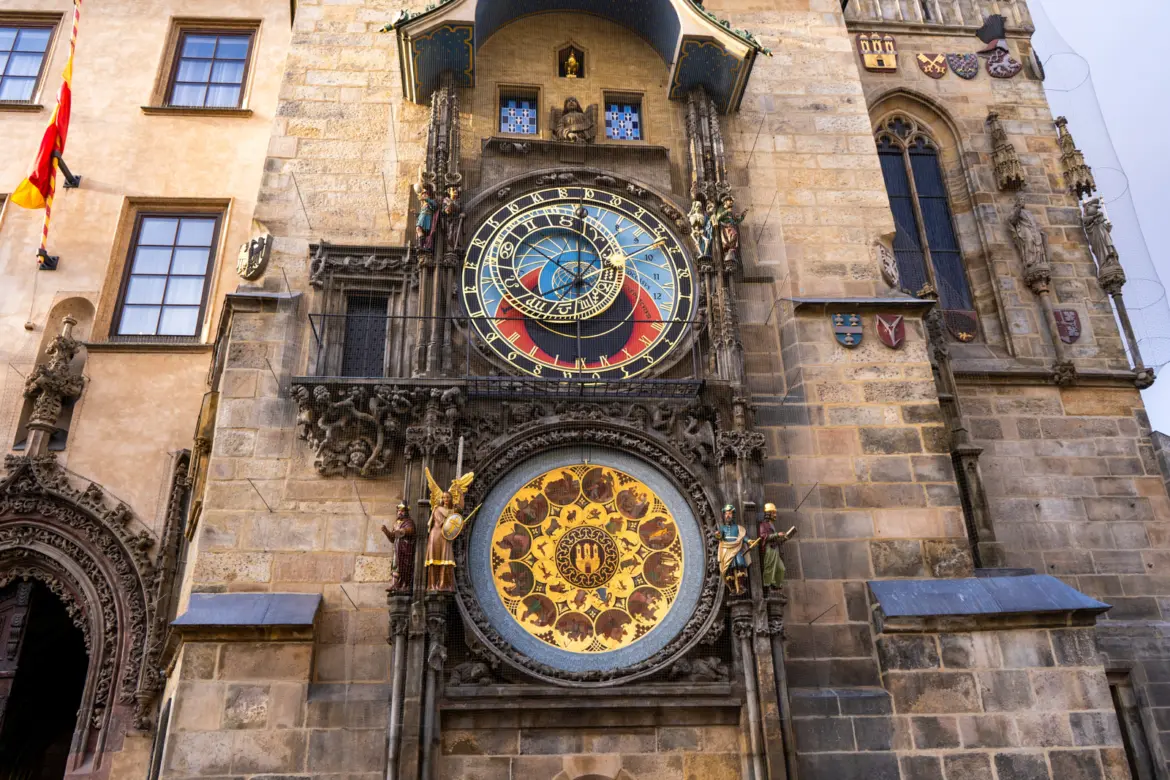
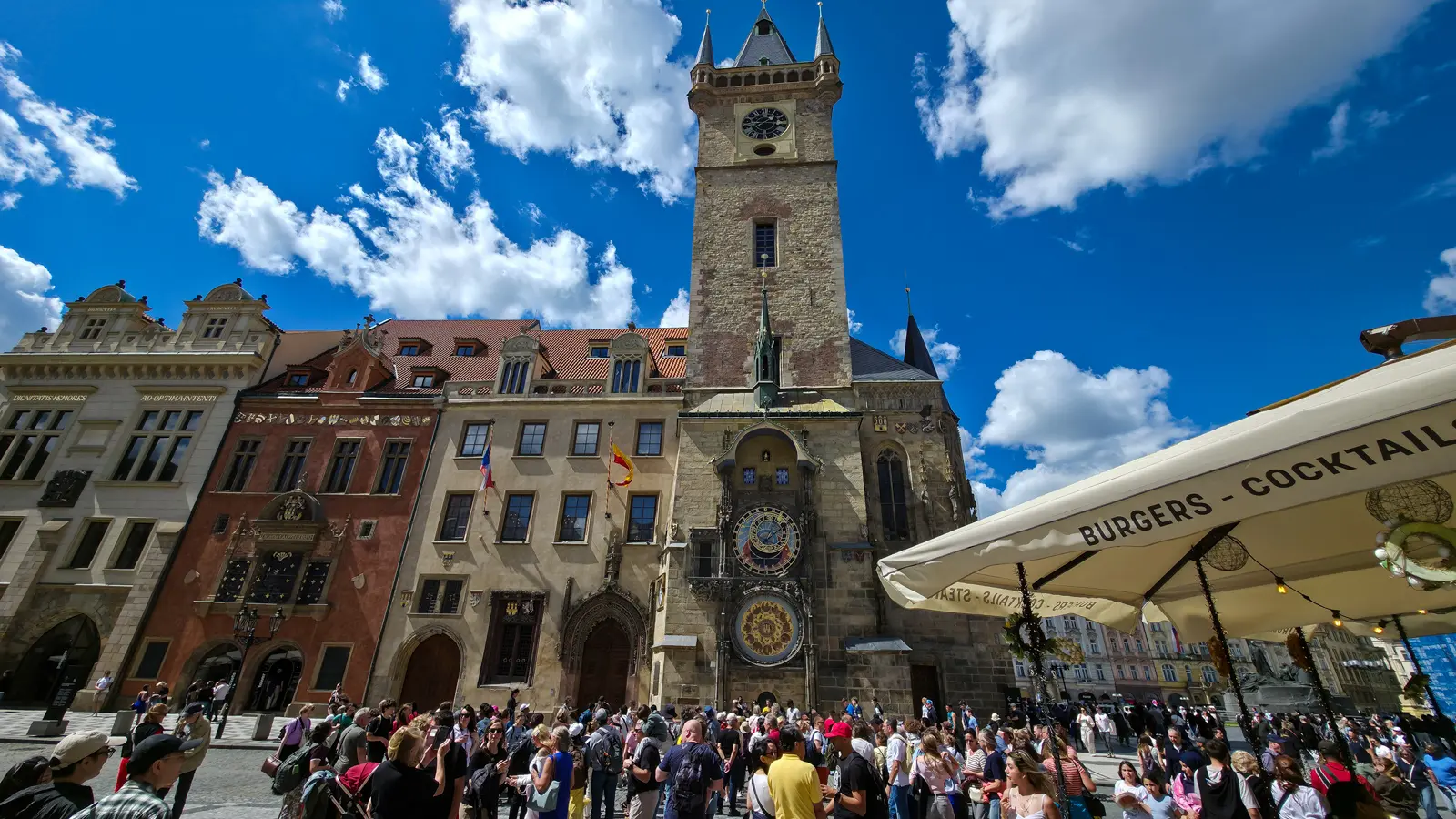
There is no avoiding Prague‘s astronomical clock. It hangs on the side of the Old Town Hall tower, on the corner of Old Town Square where the main routes through the Old Town meet, so sooner or later every walk towards Charles Bridge passes beneath it. Walking tours pause in front of it, and the crowd below always has its phones raised.
We stood right below the dials in the thick of that crowd, heads tilted back like everyone else. A calmer view takes an early start or an off-season visit.
The clock is more than 600 years old, and it comes with more than one dark legend. This is Prague, after all, so of course there is a mystery or two.
Prague’s Astronomical Clock at a Glance
🕰️ Over 600 years old · First recorded in 1410, it’s the third-oldest astronomical clock in the world and the oldest still running.
💀 Death rings the hour · On the hour, a skeleton turns his hourglass and the twelve Apostles parade past two windows, ending with a crowing rooster.
🔭 Three parts · An astronomical dial (Sun, Moon and zodiac), a gold calendar dial below, and the hourly Walk of the Apostles above.
📜 A dark legend · Master Hanuš was said to be blinded so he couldn’t repeat the work, then stopped the clock in revenge — and cursed the city.
🆓 Free to watch · The Walk of the Apostles runs every hour from 9 a.m. to 11 p.m., viewable from the square; go early to beat the crowds.
🎟️ Go inside · An Old Town Hall ticket (lift available) reaches the tower gallery and the chapel where the Apostles pass up close.
At the Heart of the Old Town
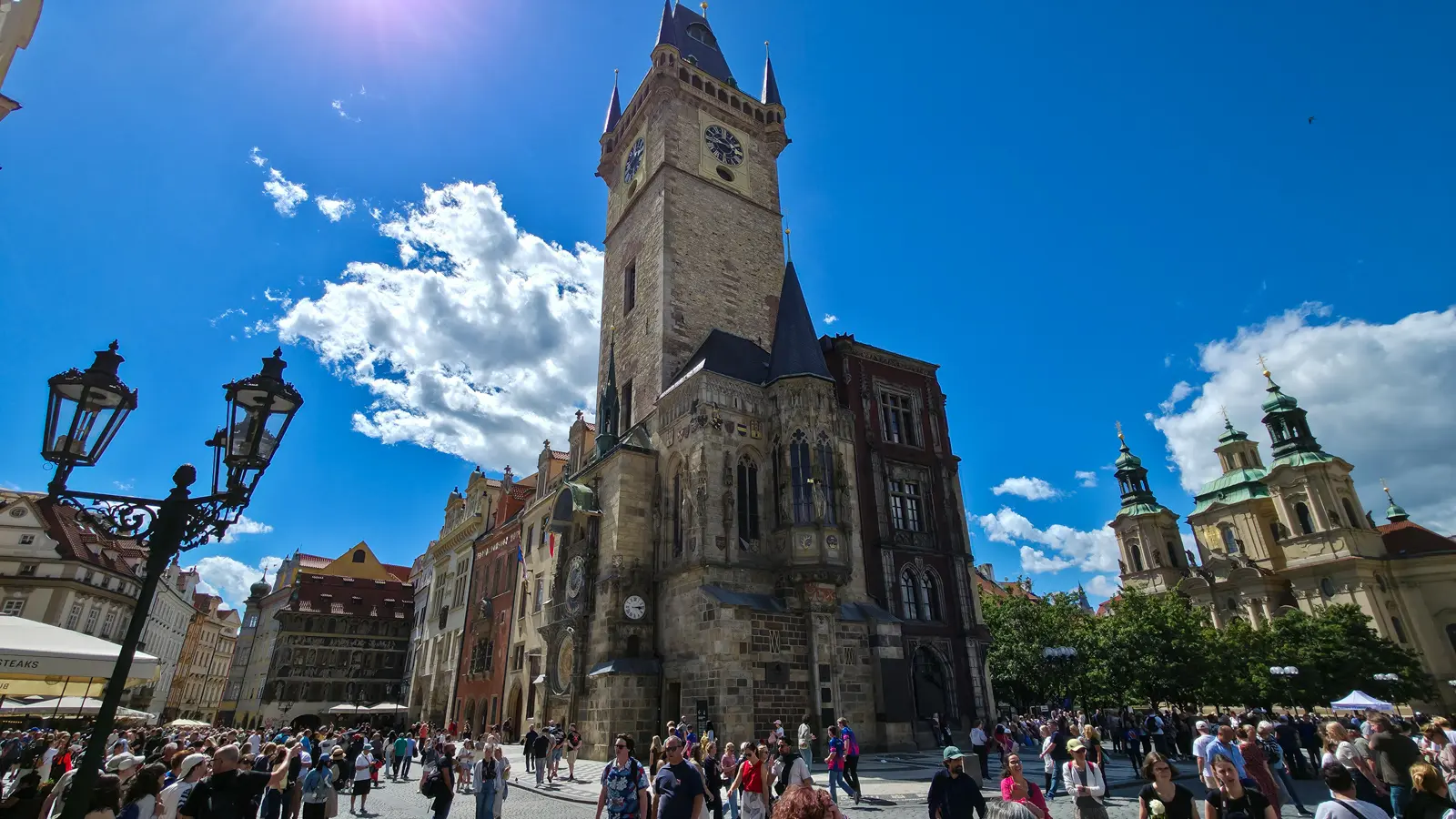
The Old Town Hall was established in 1338 as the seat of the Old Town’s administration. Its Gothic tower, almost 70 metres high, still dominates the whole square, and the clock faces the square from the tower’s southern wall. When the tower was completed in 1364, it was the tallest structure in the city.
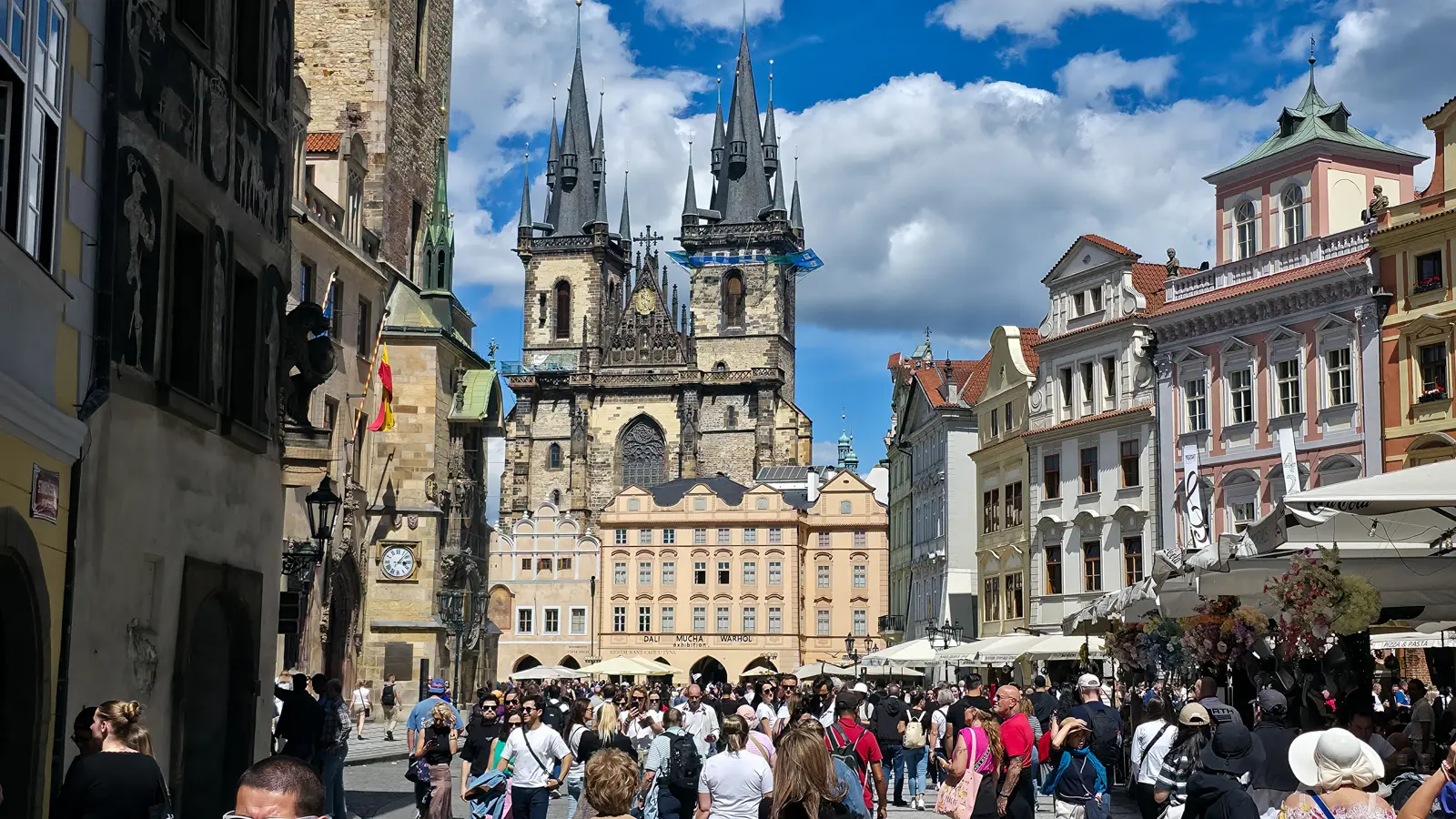
The lanes leading into the square fill up just as quickly, with café terraces on one side, the Old Town Hall tower on the other and the twin spires of Týn Church straight ahead.
How to Read the Clock
The clock has three main parts: the astronomical dial at the top, the calendar dial below it and the Walk of the Apostles, the hourly show above them both.
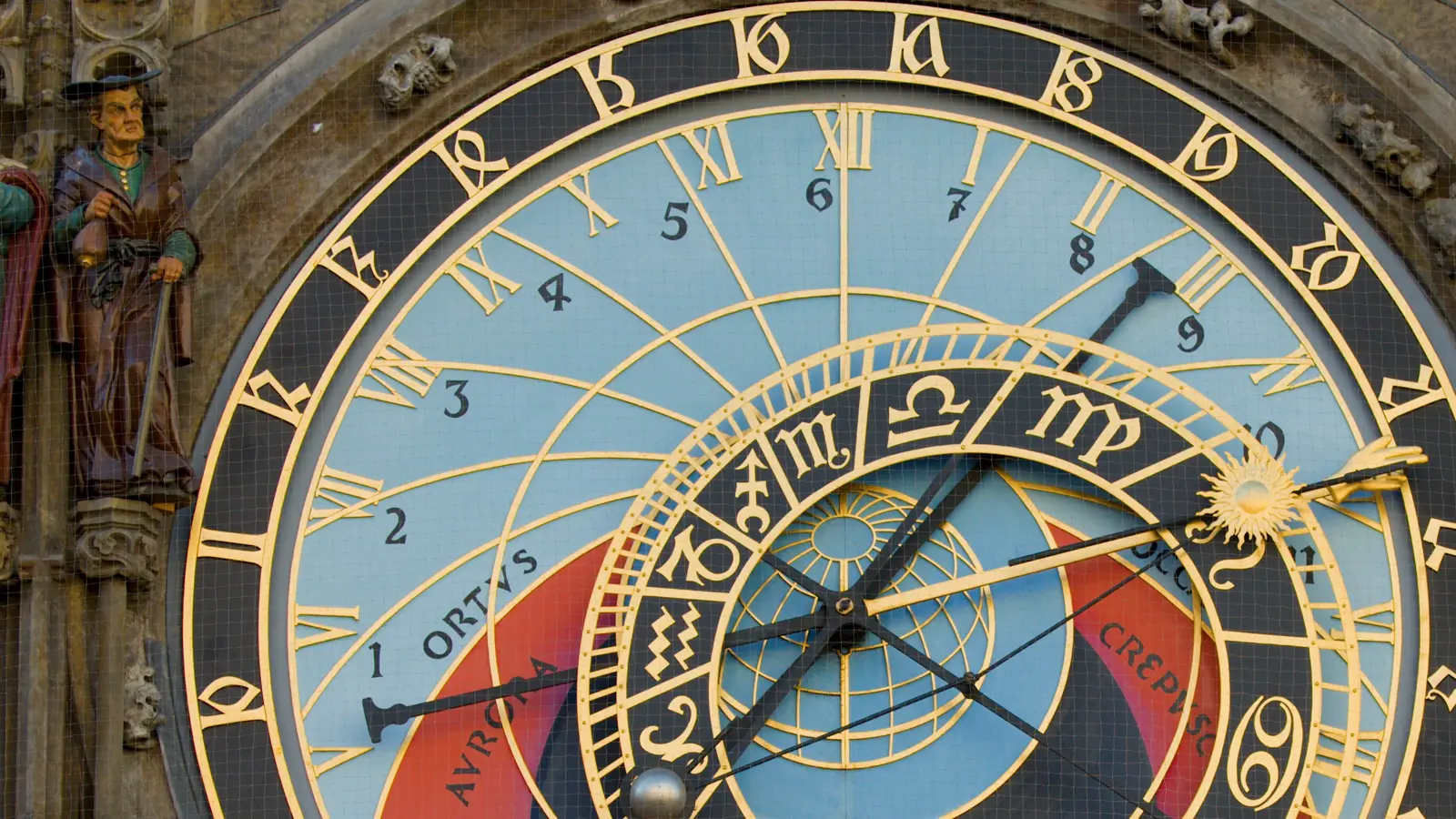
The astronomical dial is the oldest part. It shows the positions of the Sun and Moon in the sky, along with other astronomical details. At its centre is the Earth, painted as a globe. Around it, the sky is divided by colour: blue for daytime, red bands for dawn and dusk, and black at the bottom for night. A ring of gothic numerals runs around the outer edge, and a gilded zodiac ring sits inside it.
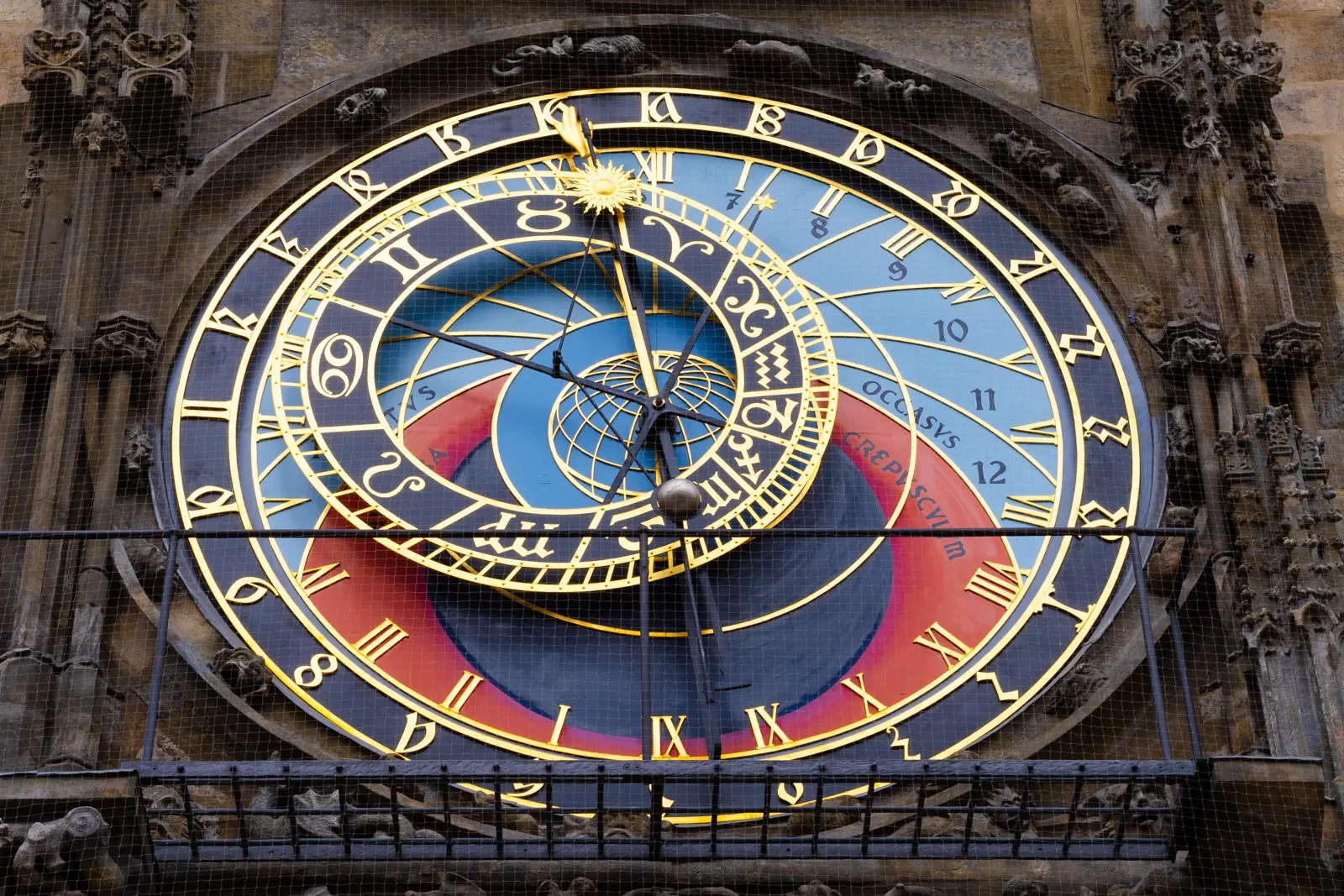
A small gold sun travels around the dial on its hand. Its position against the zodiac ring shows where the sun stands among the twelve signs.
Death and the Vices
Four painted figures flank the astronomical dial. On one side are Vanity, admiring himself in a hand mirror, and Greed, clutching a bag of money. On the other are Death, a skeleton holding an hourglass, and a man with a lute, described either as the Turk or as Lust.
On the hour, Death rings his bell and turns his hourglass, and the vices shake their heads. Two small windows open above the dial, and the twelve Apostles pass by one after another. A rooster crows to end the show. Death’s message is clear: every hour brings everyone a little closer to the end.
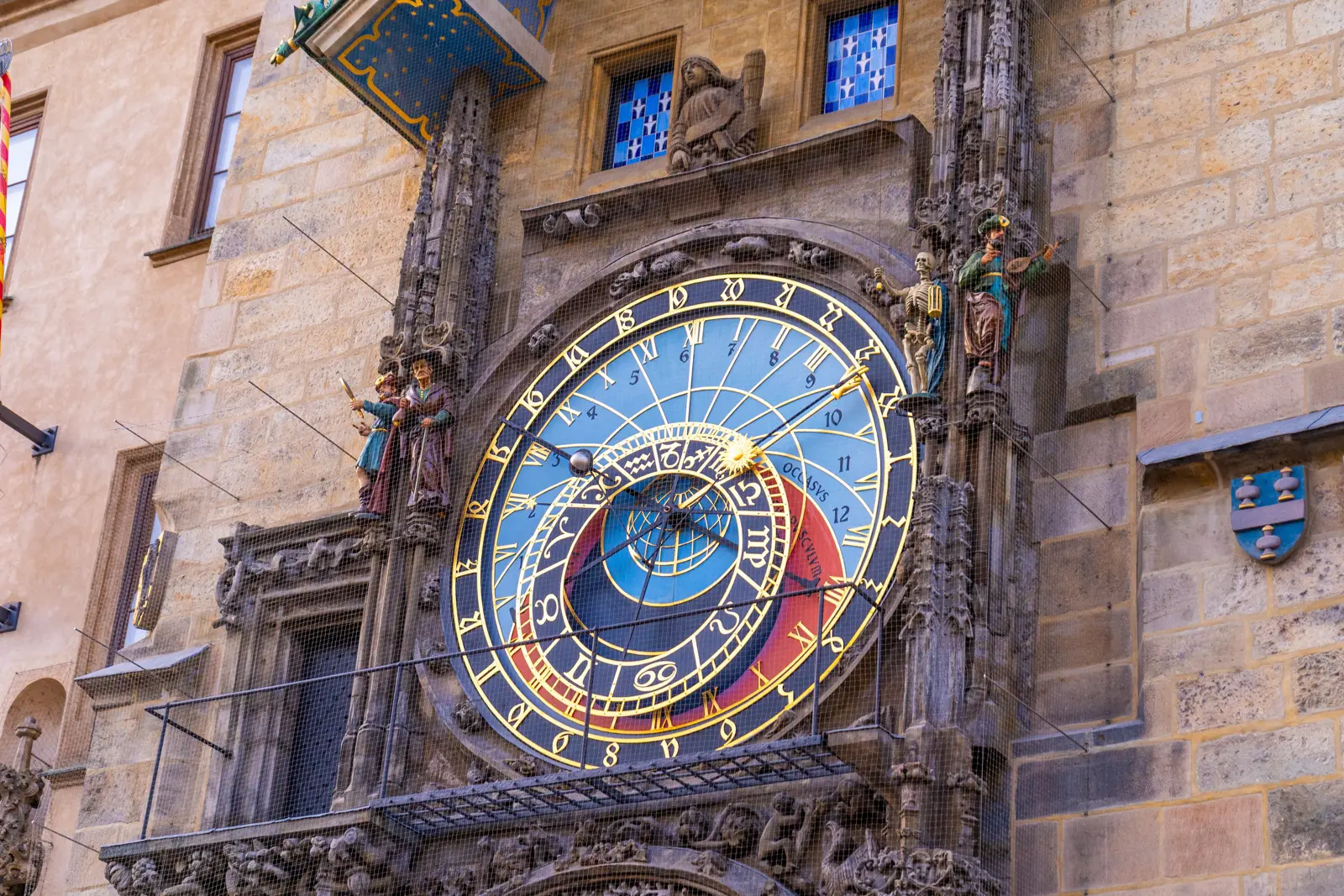
We didn’t stay for the show this time, so it is on my list for my next visit.
Master Hanuš and the Curse
According to legend, the clock was the work of a master clockmaker named Hanuš. The city councillors were so proud of it, and so afraid he would build an even finer one for another city, that they had him blinded. In revenge, the blind Hanuš asked to be led to his clock one last time, reached into the mechanism and stopped it. According to the story, no one could repair it for about a hundred years.
Another version adds a curse: whenever the clock stops working, misfortune falls on Prague.
The story was popularised by the writer Alois Jirásek, a great collector of Prague legends. In fact, the clock was first recorded on 9 October 1410, and historians credit it to the clockmaker Mikuláš of Kadaň and the mathematician Jan Šindel. The real Master Hanuš, Jan Růže, came later. He probably added the calendar dial around 1490, and he may also have created the figure of Death.
Six Centuries and Counting
The clock has survived a great deal since 1410. In the last days of the Second World War, on 7 and 8 May 1945, German forces fired on the south-west side of Old Town Square during the Prague Uprising. The Old Town Hall burned, and the clock’s wooden figures and calendar dial were destroyed. It took until 1948 to bring the clock fully back to life.
Most recently, the clock was restored again and started running at 6 pm on 28 September 2018. Today the tower stands at the corner of the square, with the green domes of St Nicholas Church nearby.
Bubbly Tips
- Go early or off season. The square is calmest first thing in the morning and outside the summer months. The first show of the day is at 9 am.
- Watch the show for free. The Walk of the Apostles runs every hour from 9 am to 11 pm, and you can watch it from the square without a ticket.
- Arrive a few minutes before the hour. The best spots in front of the clock fill up fast, especially in summer.
- See the Apostles from inside. A ticket to the Old Town Hall gets you into the Gothic chapel, where you can watch the Apostles pass by up close.
- Buy tickets from the official seller. Prague City Tourism is the only official seller of Old Town Hall tickets, at its own ticket offices and online.
- Use the lift if you need it. The Town Hall tower has a lift, so the view from the top is accessible without the stairs.
- Go underground too. The Old Town Hall tours include the Romanesque and Gothic vaults beneath the building.
- Watch your belongings. The crowd in front of the clock is dense, so keep bags zipped while you take photos.
Final Thoughts
For a clock that is more than 600 years old, Prague’s astronomical clock still draws a crowd every single hour. The legends of Master Hanuš and his curse may not be true, but they suit a city where even the timekeeping comes with a skeleton.
I stood in front of it this time. Next time, I want to be there at 9 am when Death rings his bell.
Until next time!

🌟 Everything You Need to Plan Your Dream Trip in 2026
- 🌟 Luxury Hotels - Find premium stays with Booking.com & Hotels.com
- 🏡 Vacation Rentals - Discover unique properties on VRBO
- 🏞️ Guided Tours - Explore with Viator or GetYourGuide
- 🎫 Attraction Tickets - Skip the lines with Tiqets
- 🚢 Ocean Cruises - Set sail with Cruise Direct
- 📱 International SIMs - Stay connected with Saily
- 🚗 Car Rentals - Budget-friendly options from Discover Cars
- 🌐 Secure VPNs - Browse safely with NordVPN
- 💶 Currency Exchange - Best rates with Wise
- 🗣️ Learn Languages - Master the local language with Babbel and Rosetta Stone