
I will be honest about my first impression, because it was wrong and it took an hour to correct.
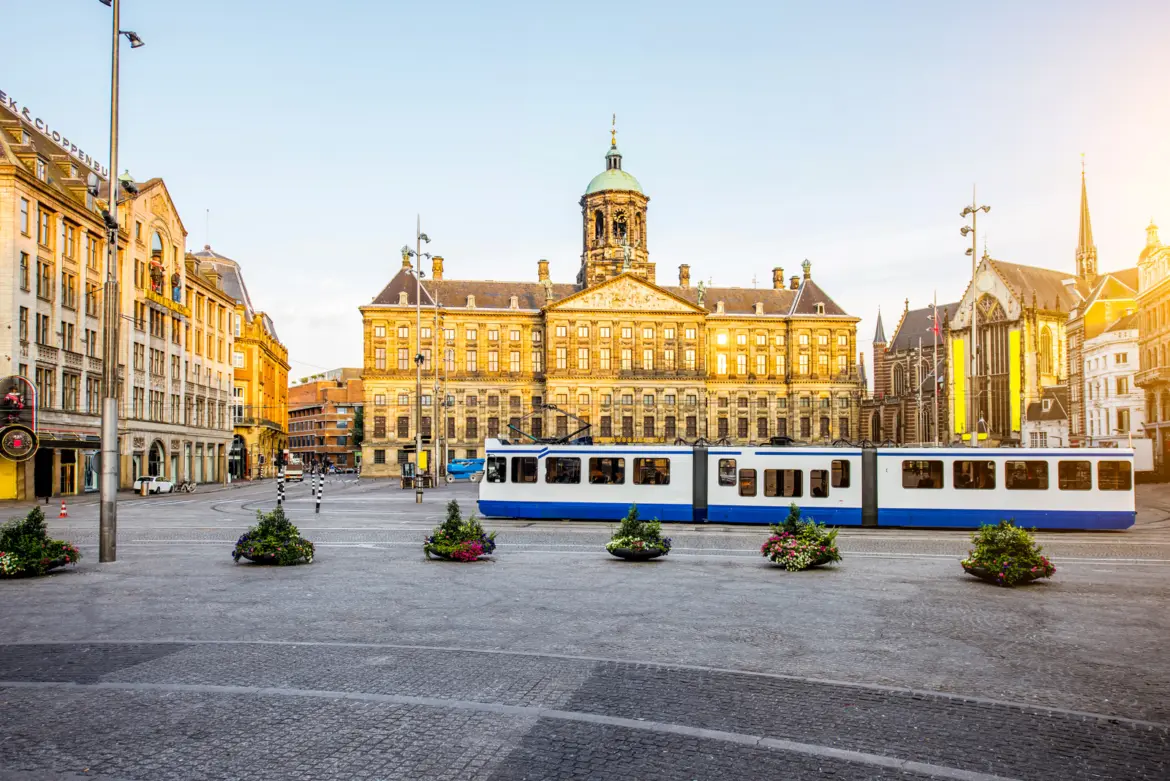
From the square, the Royal Palace underwhelmed me. I had come to Amsterdam off the back of years of looking at European palaces, and I have stood in front of Schönbrunn, the Belvedere, the Hofburg and Buckingham Palace. Next to those, this is a long grey block with a modest pediment and a small green cupola. There is no gate, no forecourt, no sweep of gravel, no wings reaching out to gather a visitor in. It looks like what it is to anyone who knows what it is, and like a bank to anyone who does not.
Then I went inside.
The Burgerzaal at a Glance
🌍 What it is · The Citizens’ Hall at the centre of the Royal Palace (former town hall), designed by Jacob van Campen as a model of the cosmos, freely open to every citizen when it was built.
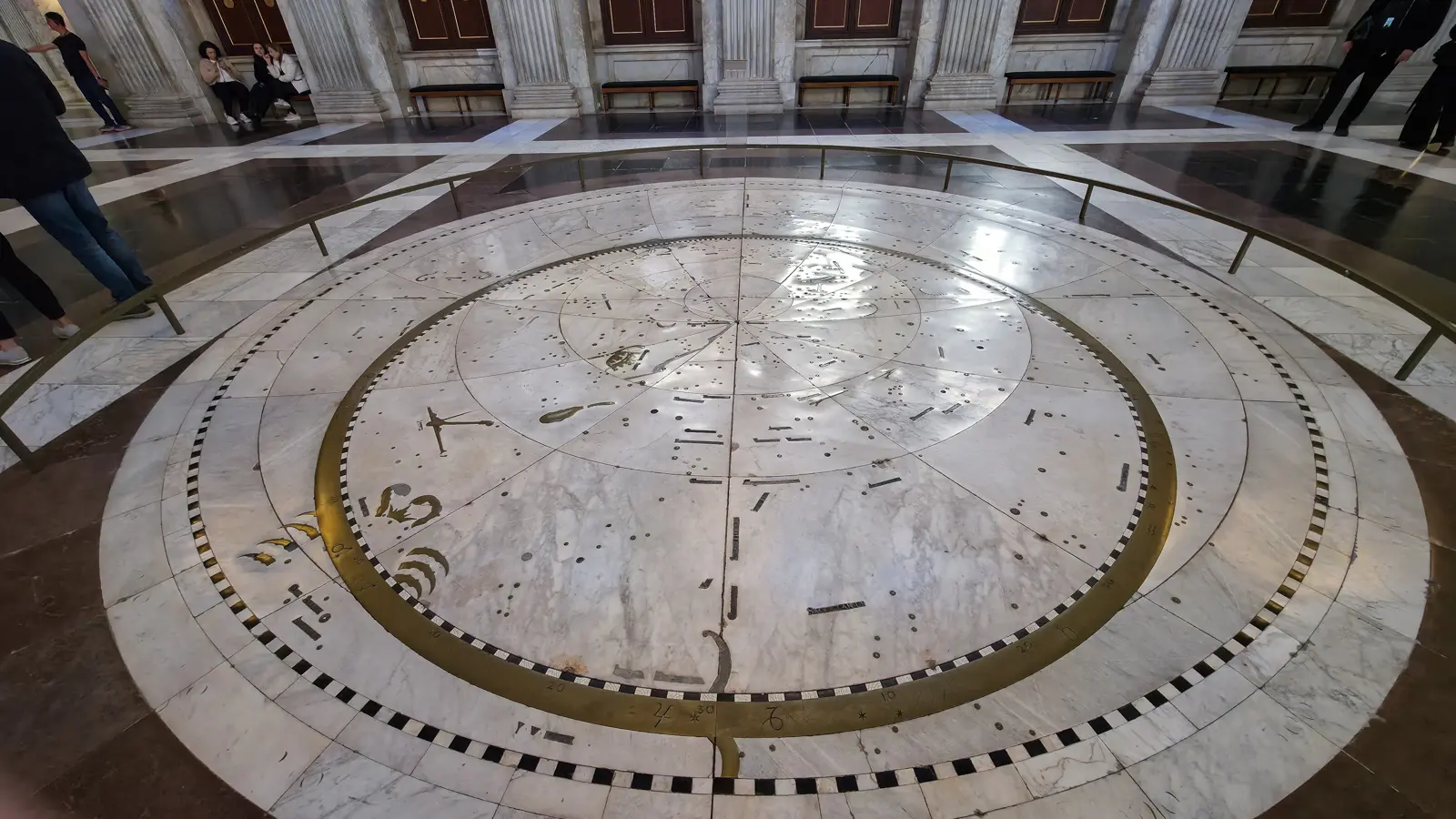
🗺️ The floor · Three inlaid marble circles, each 624 cm across (the eastern and western hemispheres and the northern sky), still the largest maps ever made, after cartography by the Blaeu firm.
🗿 Atlas · A six-metre marble Atlas carries the celestial globe, the night sky and not the earth, which most guidebooks get wrong.
⚖️ The other half · The same building housed the Society of Suriname; the hemispheres map where Dutch ships went, and why.
💡 Tip · Do not judge it from the square. The plain exterior gives nothing away; the hall is the entire point.
The building was never meant to be a palace
The thing I had missed on the square is that this was not built for a king. There was no king. The Dutch Republic had done away with that arrangement, and what stood here was a town hall, commissioned by a merchant city that had just come out of eighty years of war with Spain.
Construction began in 1648, the year the Peace of Münster was signed, and ran to 1665. Jacob van Campen designed it. It cost eight and a half million guilders, an enormous sum, and the Calvinist faction on the council fought it hard on the grounds that a secular building of this size would dwarf the Nieuwe Kerk next door. They were right. It does.
It only became a palace in 1808, when Louis Bonaparte was installed as King of Holland and took the building over. So the comparison I had been making on the square was the wrong one. Schönbrunn and the Hofburg were built to house a dynasty. This was built to house a city government, and every guilder of the difference went inside.
Walking in
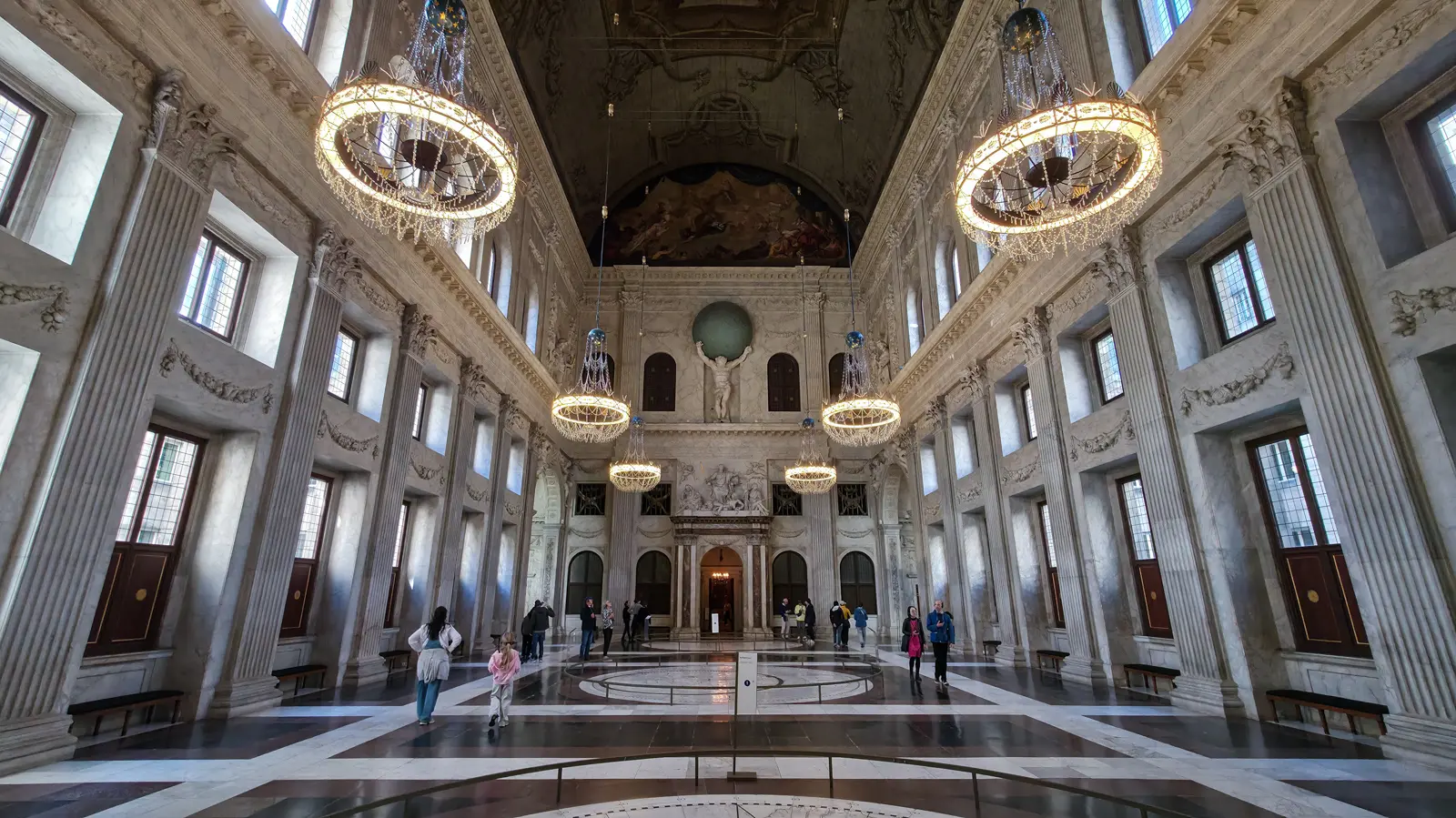
The Burgerzaal, the Citizens’ Hall, runs 34 metres long and about 25 metres up to the vault. Van Campen laid it out to the proportions of 120 by 60 by 90 Amsterdam feet, with two stacked orders of pilasters, on the model of a Roman basilica. Coming up the stairs into it after the dark of the entrance is the whole point of the design, and it still works.
Here is the part that changed how I understood the room. It was not a ceremonial hall that citizens were shown into on special occasions. It was freely accessible to every citizen of Amsterdam. People came in off the Dam and walked through it, met each other in it, did business in it. In the seventeenth century a covered public room on this scale that was not a church was close to unheard of in northern Europe.
So my instinct standing there, that people had gathered here and looked up, turns out to be the design brief rather than a guess.
A universe, in one room
Van Campen’s concept was the town hall as a model of the cosmos, and it is worked out with a thoroughness that borders on obsessive.
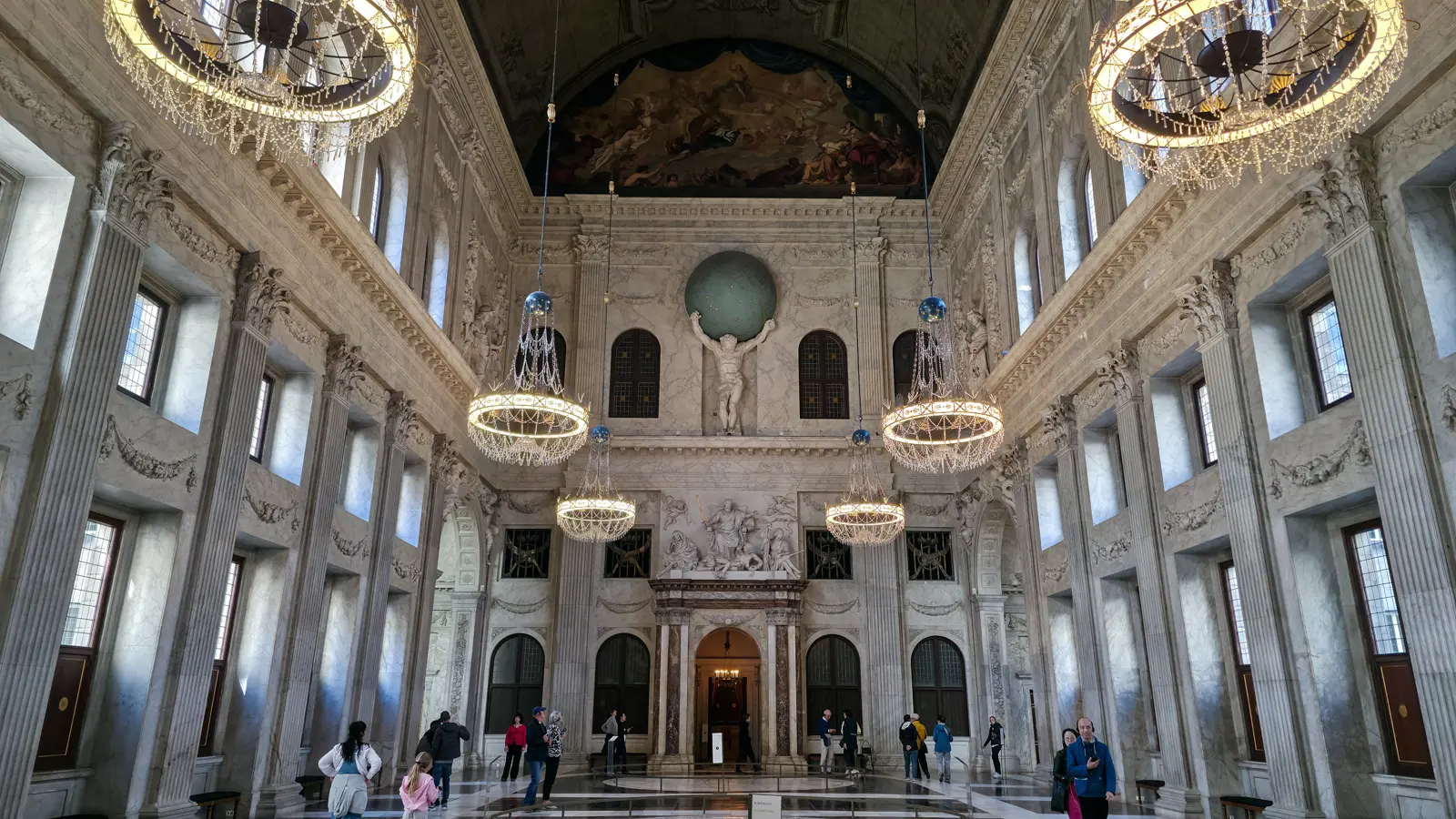
The four elements, Earth, Water, Fire and Air, are carved in relief above the arches, and together with the garlands of plants and animals they make up the terrestrial half of the scheme. Statues of Roman gods stand in the corners of the surrounding galleries, standing for the planets. Above the entrance sits the Maid of Amsterdam. The world and the night sky are spread out at her feet, in the floor.
The message is not subtle. Amsterdam is the centre of the universe.
The largest maps ever made
Three circles are set into the marble, each 624 centimetres across. The eastern hemisphere, the western hemisphere, and the northern night sky. They are still the largest maps ever made.
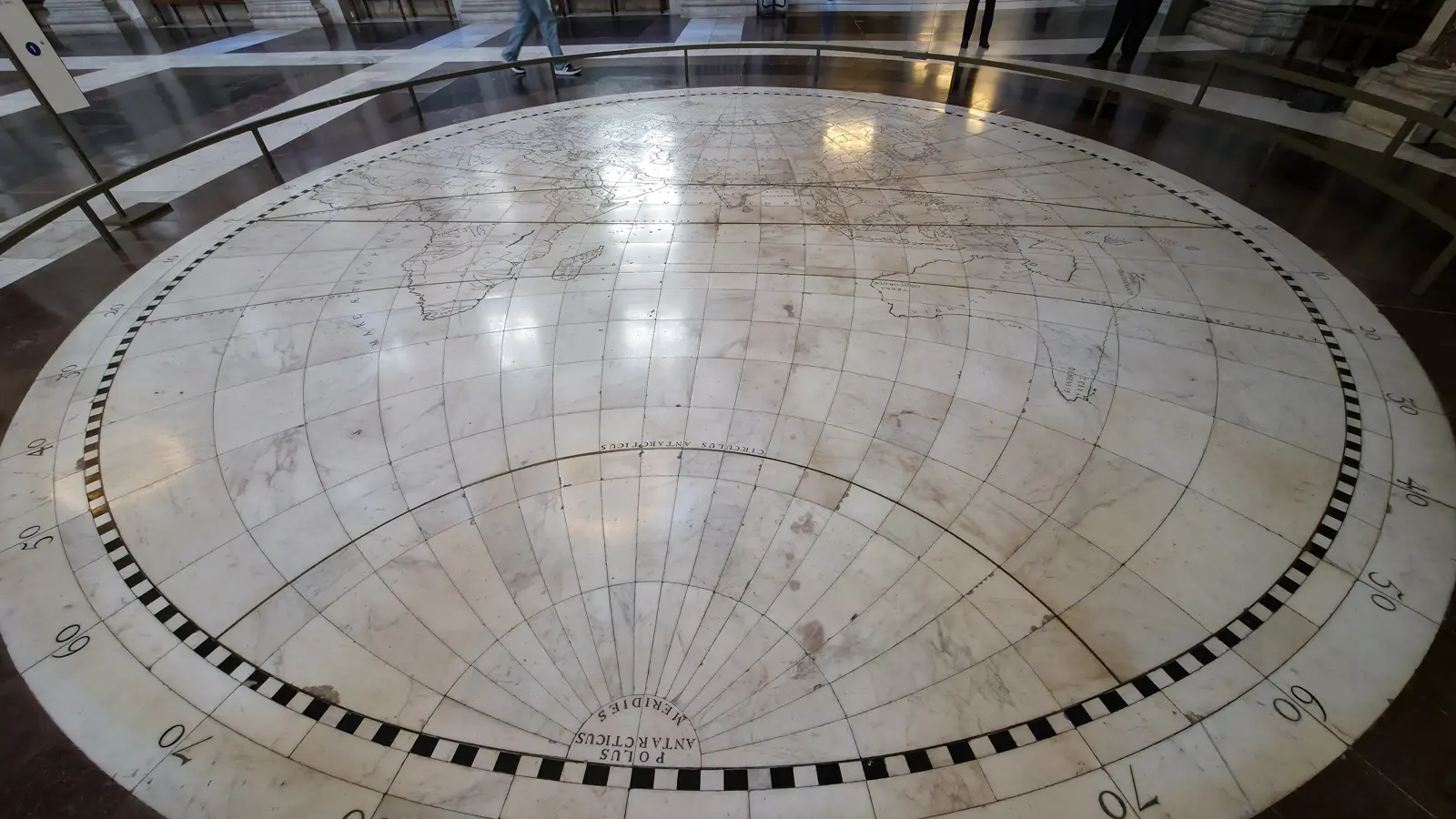
The cartography came from the Blaeu firm, whose premises stood a short walk away. This was not a decorative flourish. Amsterdam was the centre of European mapmaking at the time, the place where the best atlases in the world were being printed, and putting Blaeu’s data on the floor of the town hall was closer to a statement of technical supremacy than of taste.
A walk from one end of the hall to the other crosses the world and then goes out into the stars.
Atlas
At the far end, six metres of him, holding up the heavens.
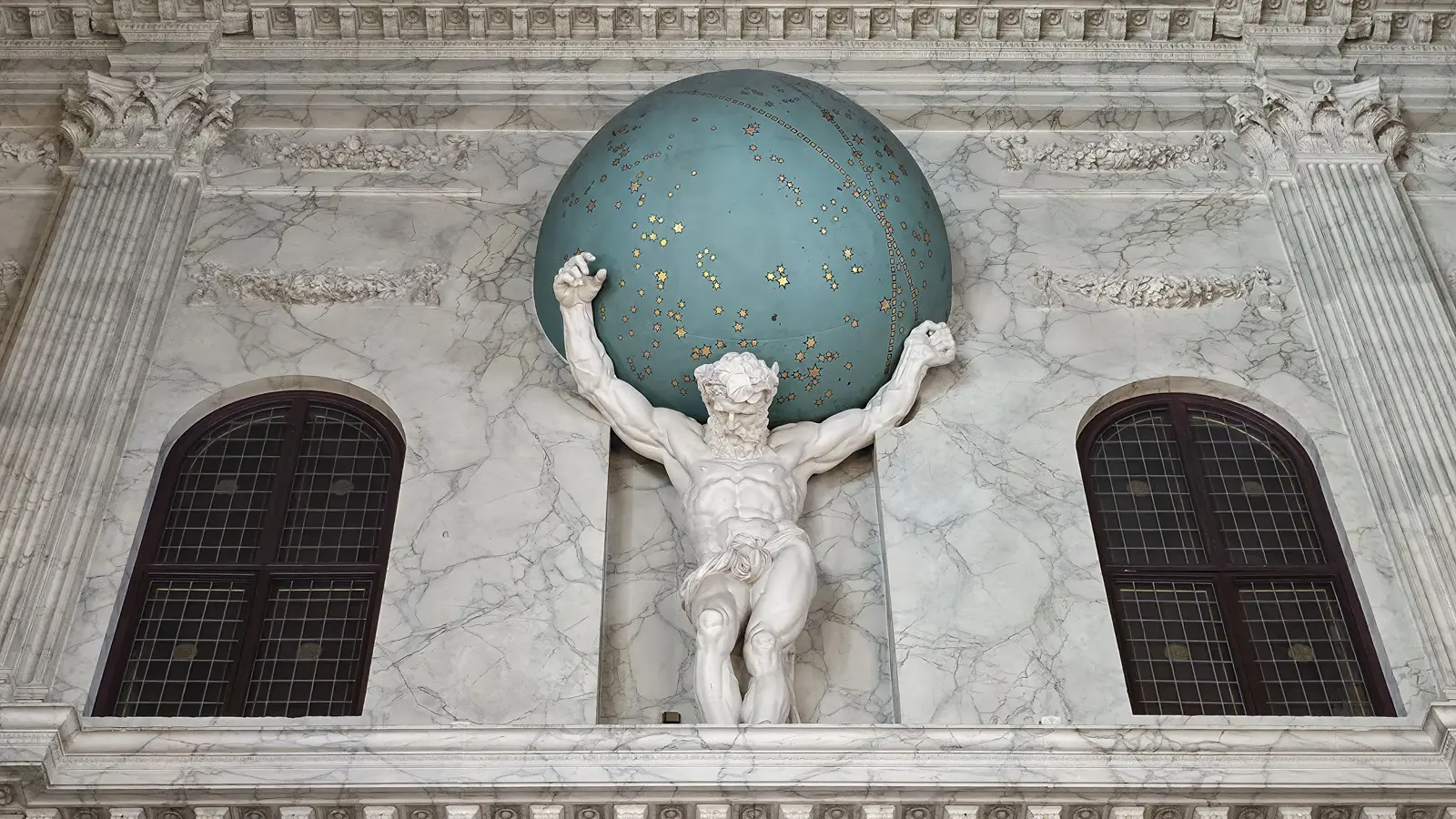
I want to correct something I had wrong for years, and that a great many guidebooks still print. Atlas is not carrying the world. Look at the sphere and it is pale green and covered in gold stars. He carries the celestial globe, the heavens, which is what the Titan carries in the Greek story and what the whole room is organised around.
The figure in the hall is the full-scale wooden model that the bronze on the outside of the building was cast from, by the Hemony brothers in 1663. So the Atlas indoors is, technically speaking, the pattern rather than the finished work, and it is the better of the two to stand under.
The clock that never moves
Turn round and the other end of the hall does something different.
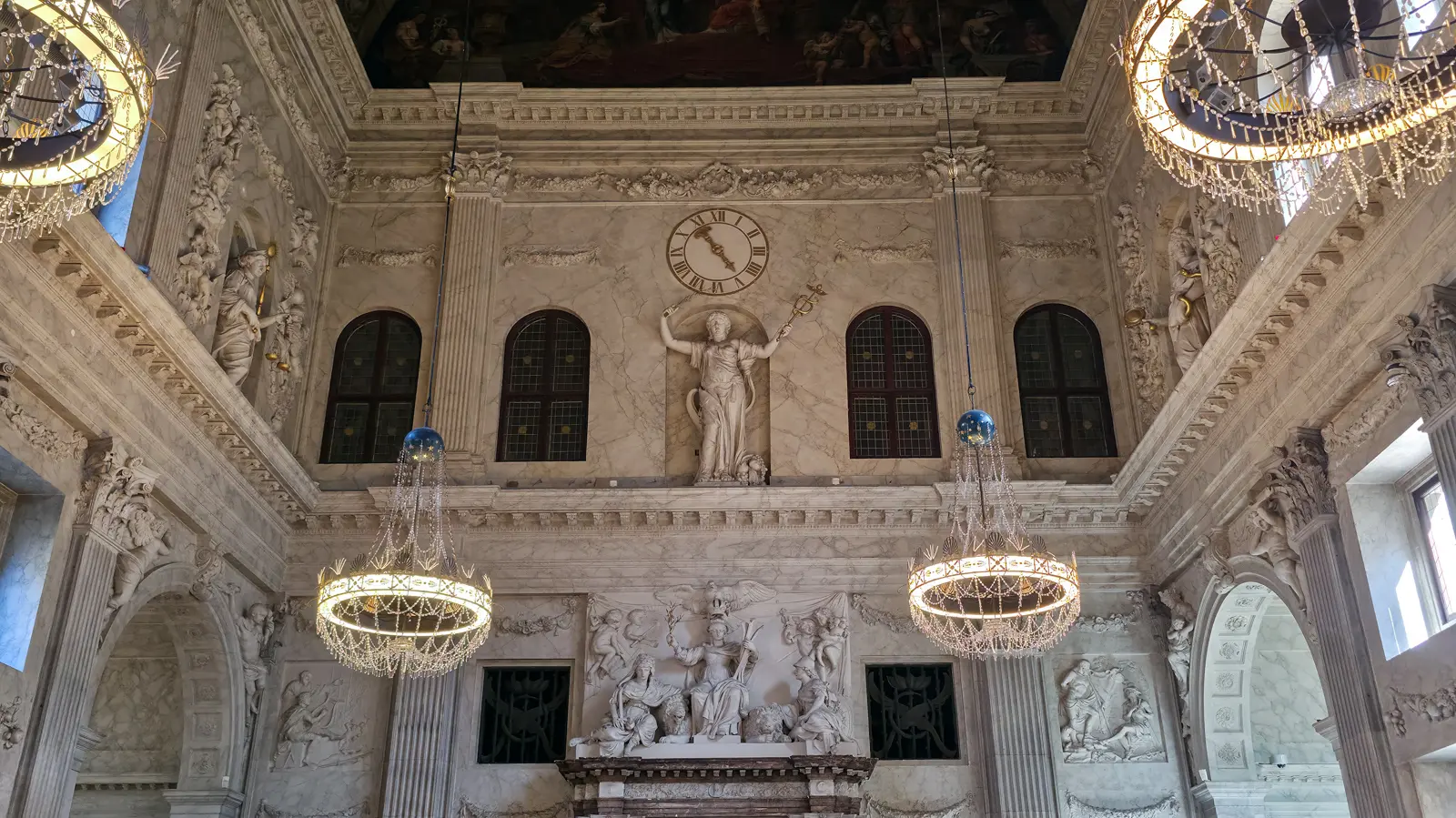
The seated woman over the doorway is the Maid of Amsterdam, two lions at her feet, holding an olive branch and a palm. Strength sits on one side of her with a lion skin, Wisdom on the other in Minerva’s helmet.
Higher up stands Peace, with an olive branch in one hand and the caduceus in the other, the winged staff with two snakes that belongs to Mercury and stands for trade, cornucopias heaped at her feet. She is also a casting model, the pattern for the bronze Peace that stands on the pediment outside facing the square, which means the figure most Dutch people see over the shoulder of the television camera at the national remembrance every May is a copy of this one.
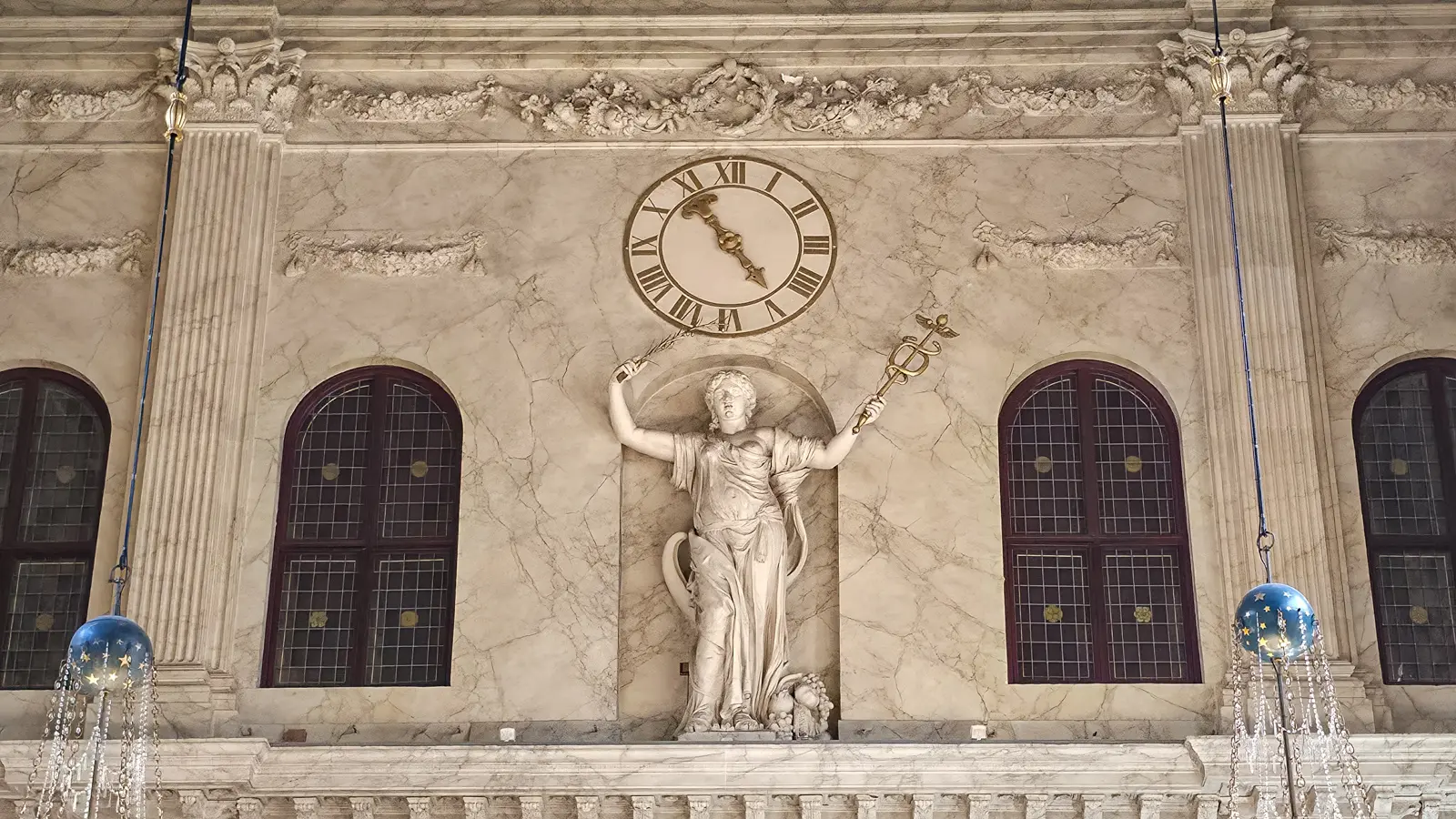
Olive branch in one hand for peace, trade in the other. That pairing is the argument the whole building makes. Amsterdam did not get rich by conquest, the sculpture says. It got rich by trading, and trade needs peace.
It is a good argument. It is also not the whole of what happened.
What else the floor is a map of
The hemispheres in that marble are not neutral geography. They trace where Dutch ships went, and Dutch ships went to those places to take things out of them.
For part of the seventeenth century this building housed the Society of Suriname, the body that governed the colony on behalf of its owners. The city of Amsterdam was one of those owners. It held a third of Suriname, and at one point two thirds. Representatives of the city met here to discuss those holdings. The decisions that made a municipal government an owner of enslaved people were taken inside the walls I had just spent an hour admiring, in the same building, under the same programme of carved virtues.
Roughly 600,000 Africans were shipped by the Dutch across the Atlantic. Slavery was abolished in the Dutch colonies on 1 July 1863, though a ten-year transition meant it did not truly end until 1873. Prime Minister Mark Rutte apologised on behalf of the Dutch state on 19 December 2022, calling it a crime against humanity. On 1 July 2023, at the national slavery monument in the Oosterpark, King Willem-Alexander apologised in person and asked forgiveness, saying that the rulers of the House of Orange had taken no steps against it. A study commissioned that year put the profits of the House of Orange from the colonies between 1675 and 1770 at around 600 million dollars in today’s money.
Vondel’s poem for the opening, all 1,369 lines of it, says where Dutch merchants go there is justice and everyone is rewarded according to merit. It says nothing about any of the above. That silence is as much a part of this room as the marble is, and standing on those hemispheres without knowing it is standing on half a map.
The galleries
Around the hall run the marble galleries, and the working rooms of the city government open off them.
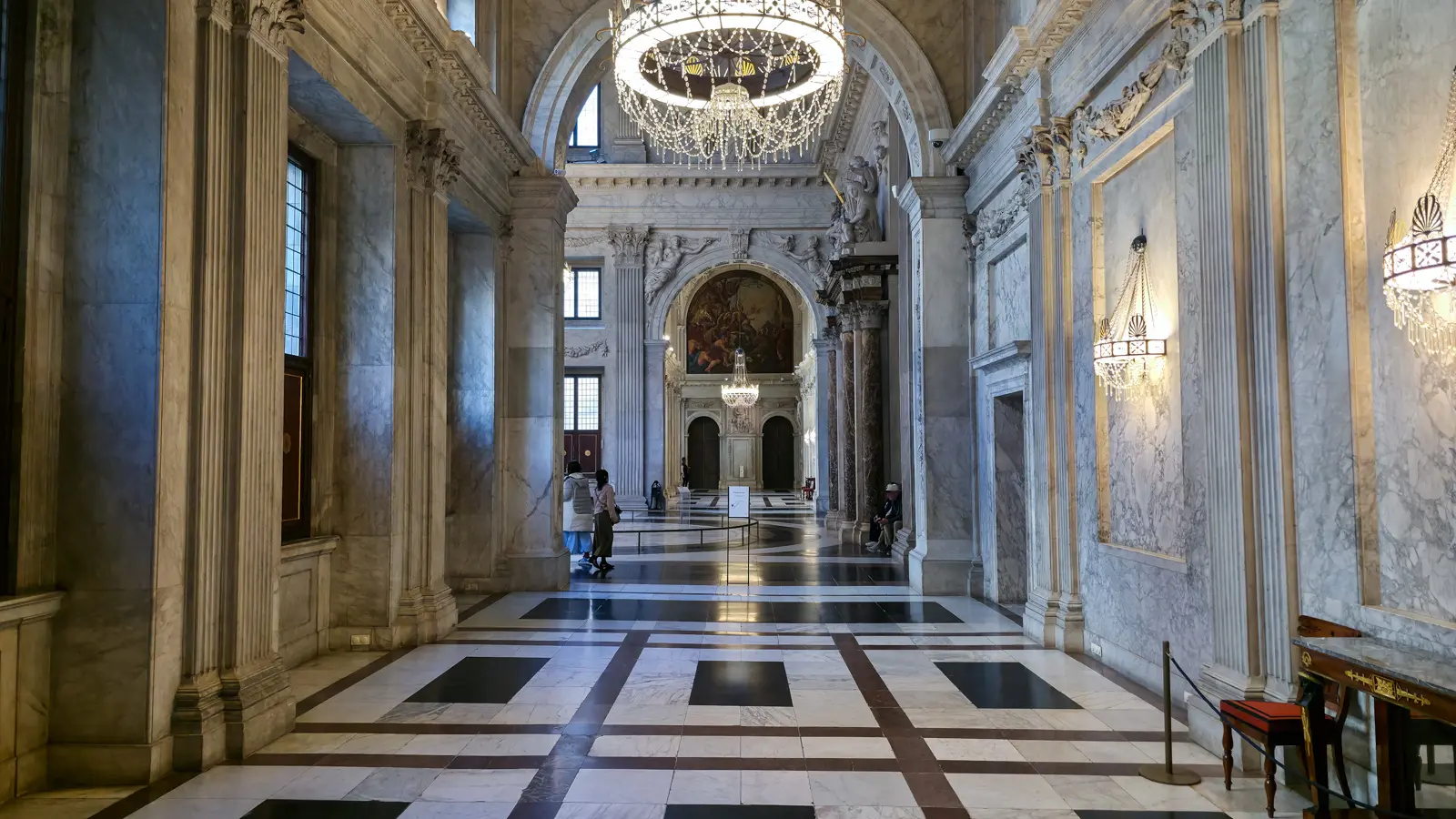
Each room was given sculpture matched to what happened inside it, which is a system I have not seen carried through so completely anywhere else. Apollo, who brings harmony, stands at the entrance to the chamber where small financial disputes were settled, with quarrelling cocks carved above the door. The wedding room has turtle doves and children’s heads in the architrave, because marriages were performed there twice a week.
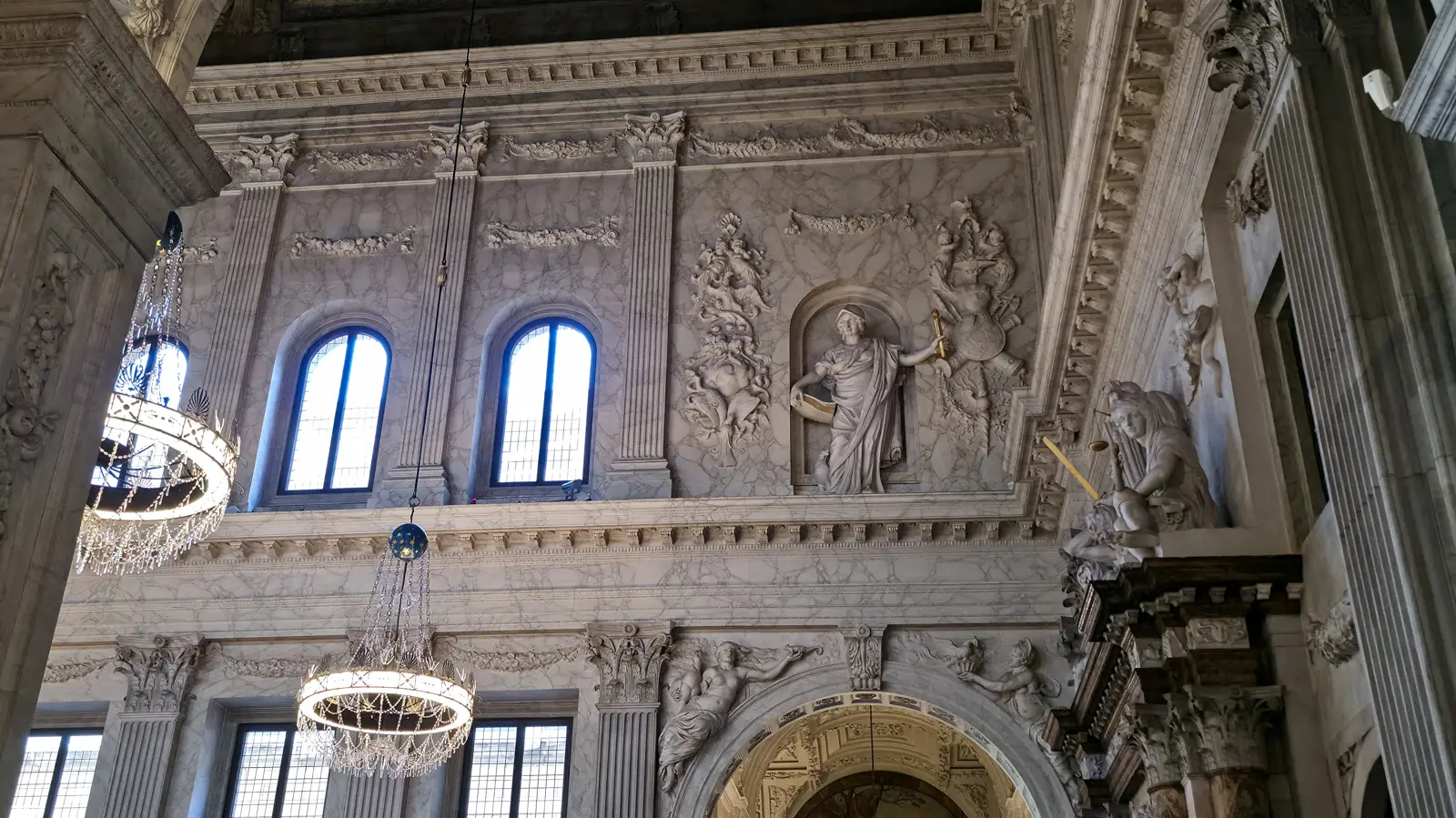
This is where my own bias showed up. I came to Europe through ancient history. Rome first, then Greece, and I lingered in Florence longer than I should have over the Renaissance. The Dutch kept turning up at the edges of all of it and I kept not looking properly. Standing in these galleries, with Minerva and Hercules and Mercury and Medusa and Midas all pressed into the service of a city council’s argument about good government, I understood that I had been treating Dutch history as a footnote to a story I already knew. It is not a footnote. It is the same story, told by people who had just invented a new way of being a country.
The missing half of the sky
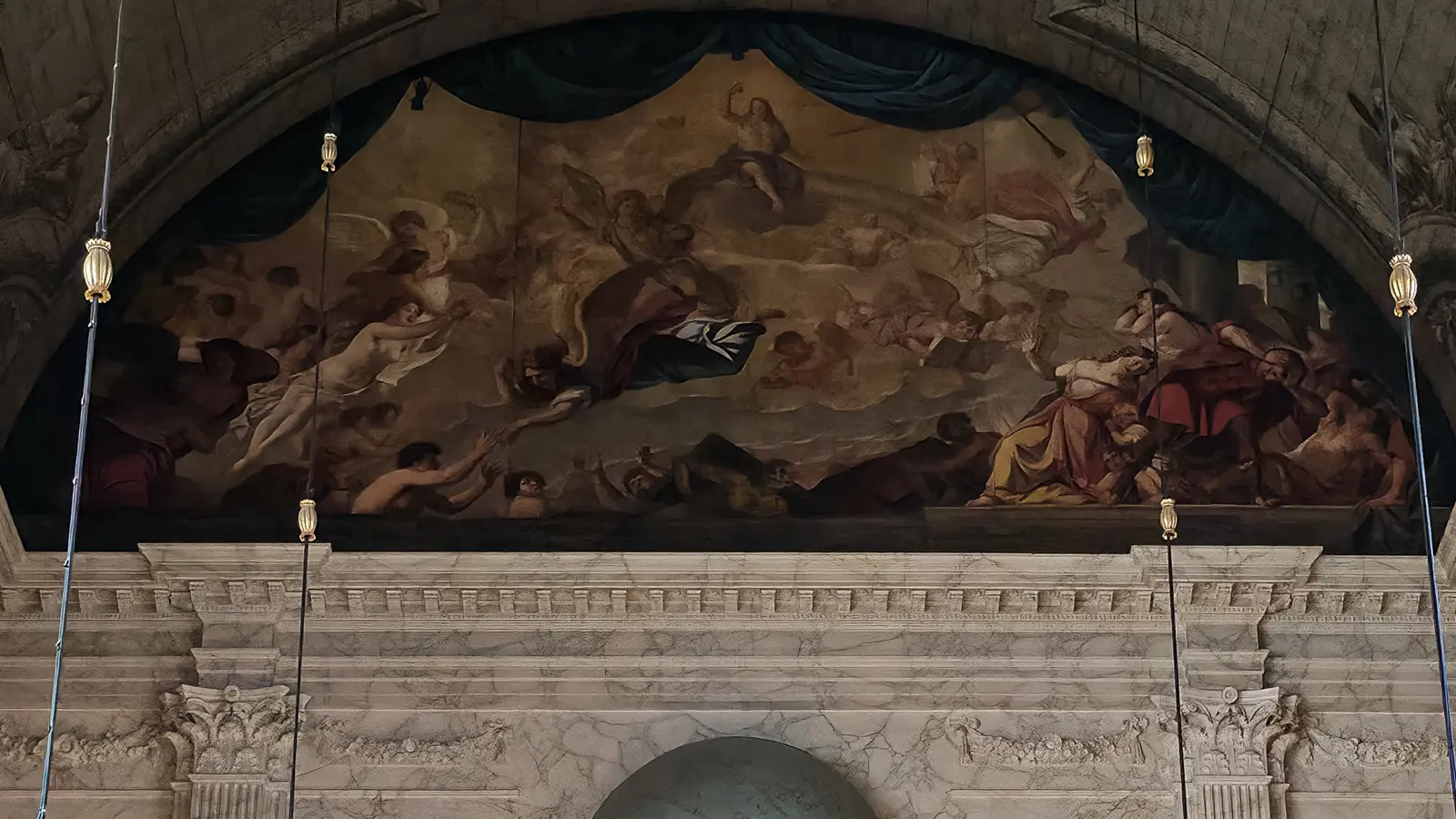
Look up and there is a barrel vault with a large painting in it, added roughly fifty years after the hall opened, and a great deal of plain surface.
That surface was supposed to hold the southern sky. The floor has the northern stars. The vault was to carry the southern half, so that anyone standing in the middle of the Burgerzaal stood inside a complete celestial sphere, the whole heavens closed around them and the world underfoot. It was never done.
Nor did the half they finished survive. Research by the palace established that the constellations were painted onto the marble as line drawings, copied from a star chart Willem Blaeu made in 1628, and that visitors’ feet took the paint off. What is left is the brass. The claws of Cancer are there. The club of Hercules is there. Hercules is not.
Amsterdam built the most ambitious interior in seventeenth-century northern Europe, at the top of its wealth and its nerve, and what stands there now is missing half its sky overhead and most of the other half underfoot.
Bubbly Tips
- Do not judge it from the square. The exterior gives away almost nothing and the interior is the entire point. If the outside puts you off, go in anyway.
- Take the audio tour. It is included in the ticket and runs in eight languages. The palace is not heavily labelled, and without it the sculpture is beautiful and mute.
- Look at the floor before you look at anything else. People walk straight across the maps without registering them. Find the celestial one and pick out the zodiac band in brass.
- Check the sphere Atlas is holding. It is the night sky, not the earth, and once you have seen the gold stars you will notice how many guidebooks get it wrong.
- Find the clock at the Dam end. It is set at eleven and never moves. Stand under it and read the figures beneath: Peace above, the Maid of Amsterdam below.
- Then turn around. The far end answers it, with Justice standing on Greed and Envy. The two ends of the hall are in conversation and most visitors only look one way.
- Check the calendar before booking. This is a working royal building. It opened more than 230 days in 2026 and can close at short notice for state use, with King’s Day and the days around it the most predictable closures.
- Hours in 2026 run 10.00 to 18.00 on open days, last admission 45 minutes before closing. The first hour is the quietest.
- Give it longer than an hour. Most visitors are through in under that. The Vierschaar on the ground floor is a separate world from the Citizens’ Hall, and rushing one to reach the other is a waste of both.
- There is no café inside. Dam Square has plenty, and the Nieuwe Kerk next door is worth pairing with the visit.
Final Thoughts
The room I walked into is not what the men who built it walked into. Theirs had a fresh floor nobody had worn through yet, no chandeliers, no Empire furniture, no ropes, no ticket desk. What it did have was the thing I responded to without being able to name it: an argument, made in marble, about what a city is for.
I do not think they were modest people. Putting the world and the stars in the floor and Atlas at one end is not modesty. But they put it in a room the public could walk into, which the emperors and kings whose palaces I had been comparing this to never did, and that difference is the whole of it.
I went in expecting to be underwhelmed. I came out with a notebook full of Greek names in a Dutch building and a much longer reading list than I arrived with.
Until next time!

🌟 Everything You Need to Plan Your Dream Trip in 2026
- 🌟 Luxury Hotels - Find premium stays with Booking.com & Hotels.com
- 🏡 Vacation Rentals - Discover unique properties on VRBO
- 🏞️ Guided Tours - Explore with Viator or GetYourGuide
- 🎫 Attraction Tickets - Skip the lines with Tiqets
- 🚢 Ocean Cruises - Set sail with Cruise Direct
- 📱 International SIMs - Stay connected with Saily
- 🚗 Car Rentals - Budget-friendly options from Discover Cars
- 🌐 Secure VPNs - Browse safely with NordVPN
- 💶 Currency Exchange - Best rates with Wise
- 🗣️ Learn Languages - Master the local language with Babbel and Rosetta Stone