
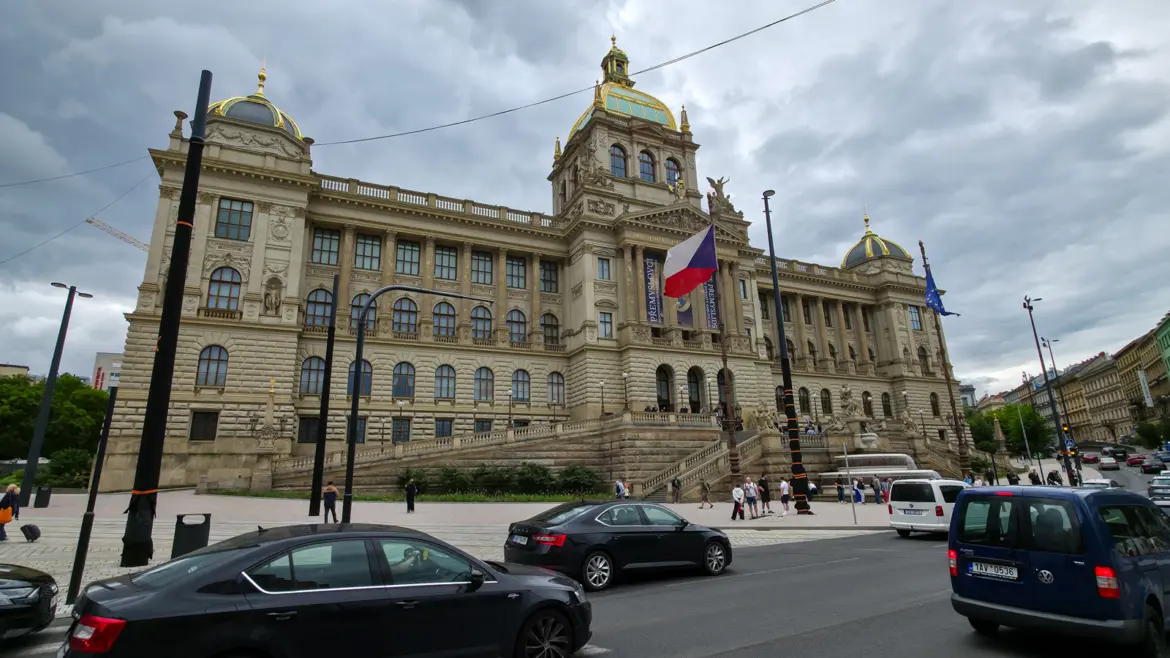
What a museum. The National Museum in Prague deserves a few days, and we had a few hours. What I loved most is how it carried us from prehistory to today: trilobites and Neanderthals in the old palace, then the 20th century in the new wing next door.
The museum complex has two halves. The Historical Building is the domed Neo-Renaissance palace at the top of Wenceslas Square. The New Building beside it was once the seat of Czechoslovakia’s Federal Assembly. A tunnel under the road links the two, and one ticket covers both, along with the cupola at the top. This post is the overview: what sits where, what to prioritise, and how it all connects.
Prague’s National Museum at a Glance
🏛️ A palace for the nation · The domed Neo-Renaissance Historical Building crowns the top of Wenceslas Square, opened in 1891 and reopened in 2018 after a full restoration.
🎟️ Two buildings, one ticket · The Historical Building and the New Building next door are linked by a tunnel, and one ticket covers both, plus the cupola.
👑 The Pantheon and the dome · Under the main dome, a hall of more than 50 bronze statues and busts of Czech figures, lit by a painted glass dome.
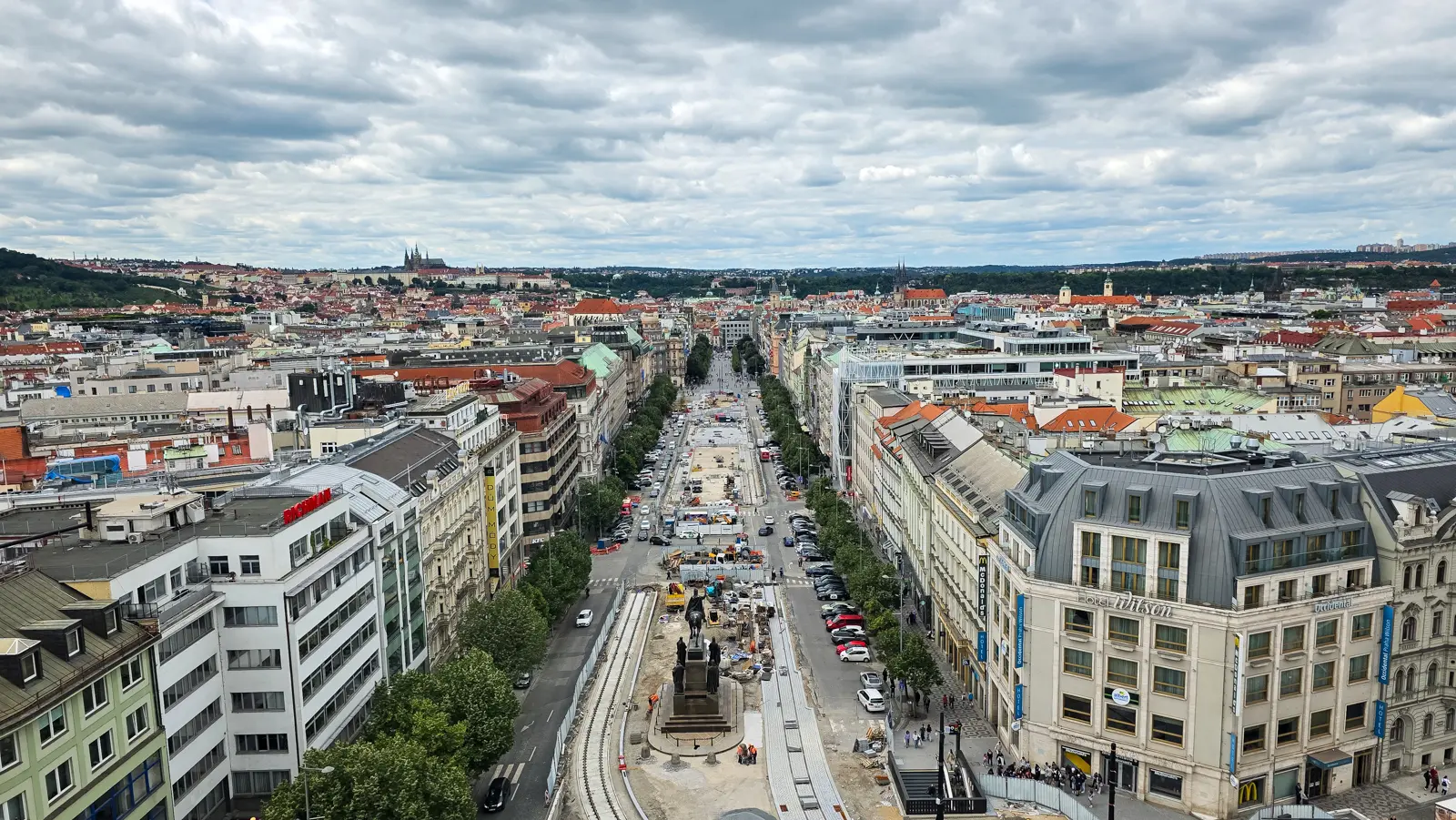
🔭 The cupola view · The viewing room at the top has a glass floor and looks straight down Wenceslas Square to Prague Castle.
🦣 Prehistory to today · Halls run from trilobites and a 22.5 m fin whale to minerals, the Přemyslid kings and the 20th century in the New Building.
🕒 Plan your time · Open daily 10 a.m.–6 p.m.; a few hours covers the highlights, but a full day does it justice.
A Palace for the Nation
The National Museum was founded in 1818, but its palace came much later. Josef Schulz, the architect who also worked on the National Theatre, designed the Historical Building, and it went up between 1885 and 1891. It opened on 18 May 1891. Schulz was responsible for the interiors as well as the exterior, and the heart of his plan was a pantheon celebrating Czech science and culture.
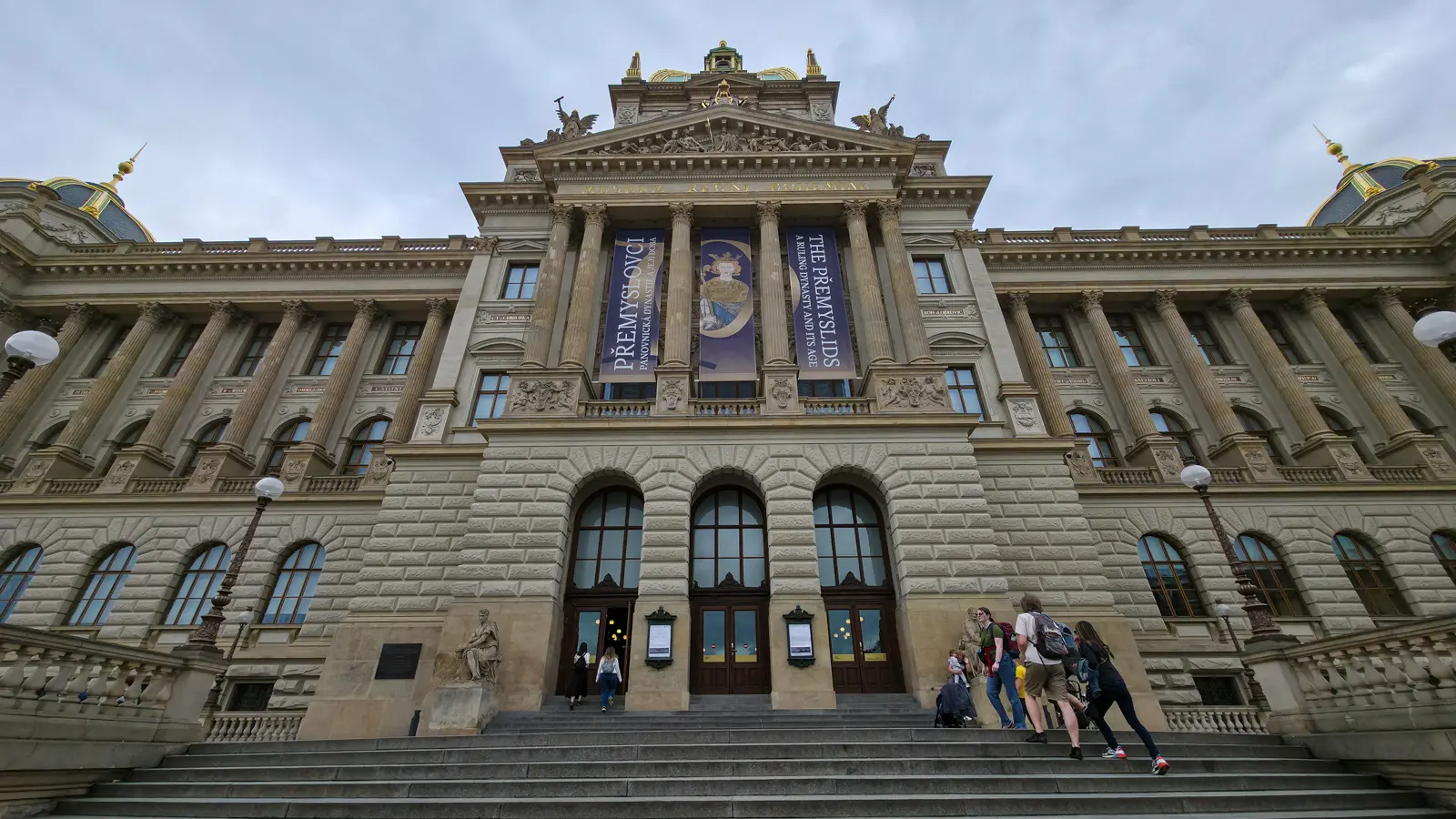
History has left its marks on the building. In August 1968, during the Soviet-led invasion, troops opened fire on the façade with machine guns, possibly mistaking it for a government building. The Historical Building then closed in 2011 for a full reconstruction, its first since 1891, and reopened on 28 October 2018. On our visit, banners for The Přemyslids, the year’s big exhibition, hung between the columns.
The Grand Staircase Hall
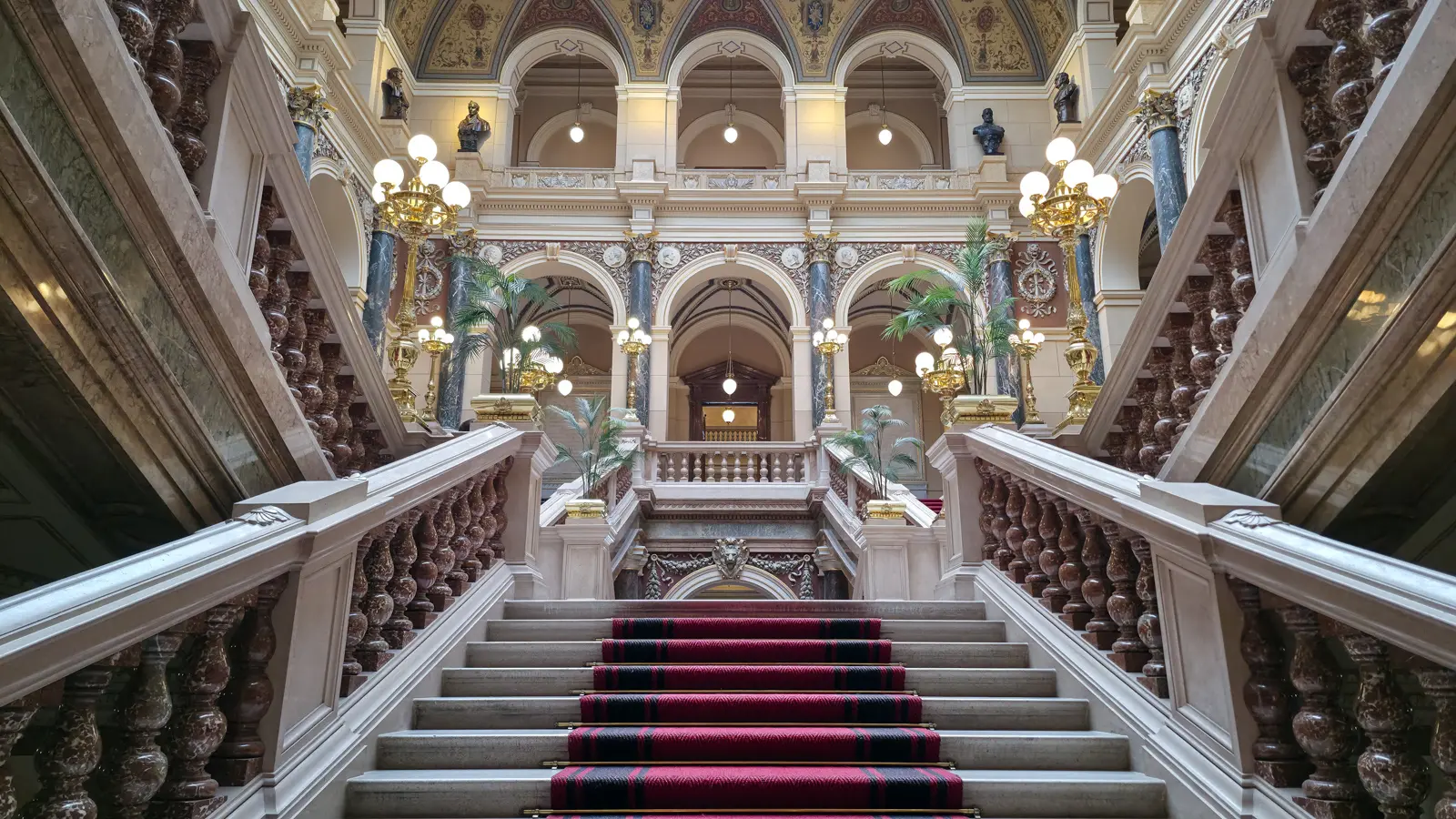
The architecture itself is stunning, starting with the grand staircase. It climbs from the entrance under a red runner, between marble balustrades and gilded candelabra, with palms in planters on every landing.
From the upper gallery, the whole hall opens up below: four flights of stairs, marble columns and bronze statues at the foot of the steps.
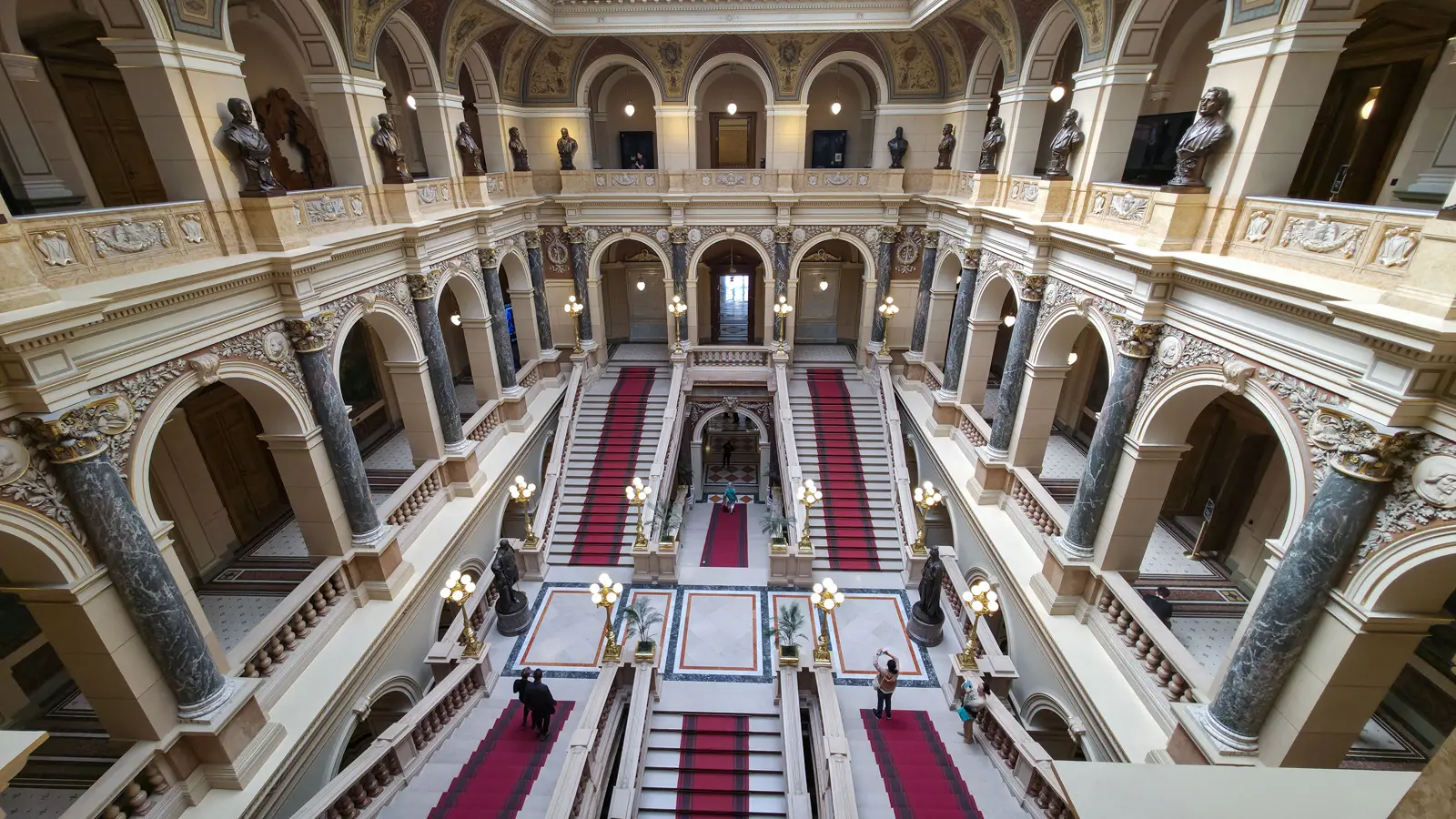
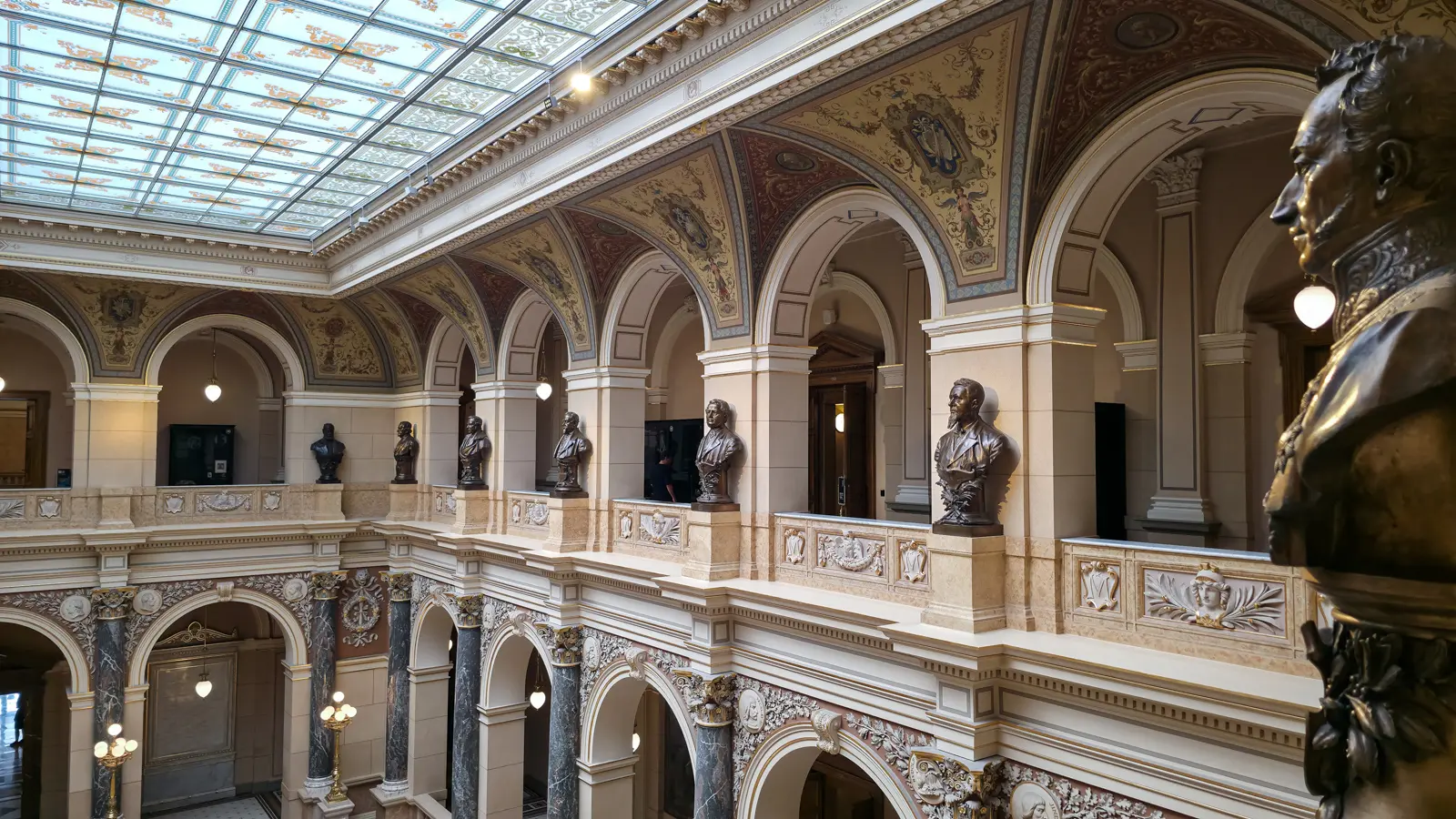
Bronze busts line the galleries on every side, under painted vaults and a glass ceiling that lights the hall by day.
The Pantheon
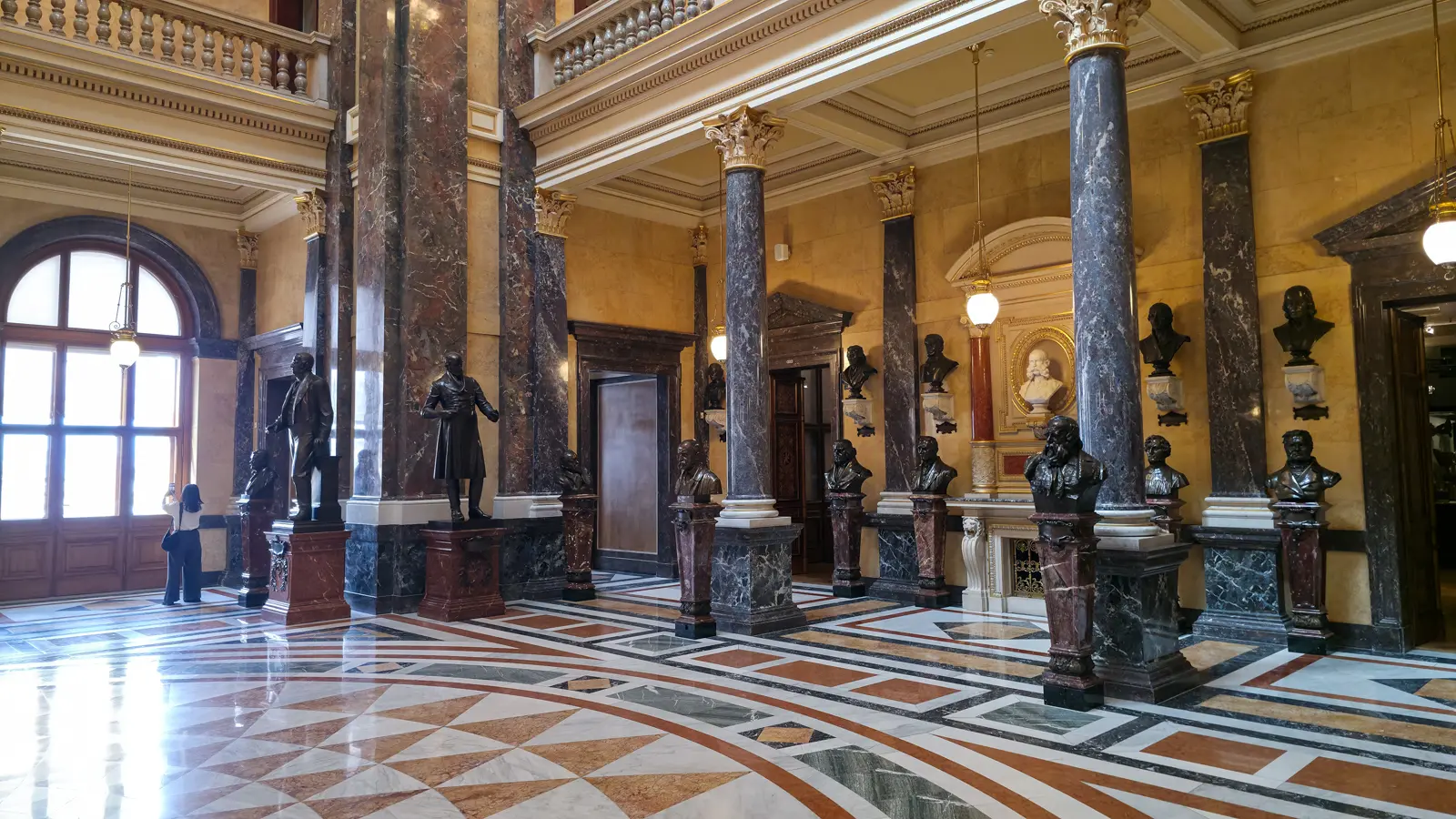
At the top of the stairs, under the main dome, is the Pantheon. It holds more than 50 bronze statues and busts of people who shaped Czech cultural and scientific life. The floor is laid in marble in a radial pattern, and the light comes from the painted glass dome above.
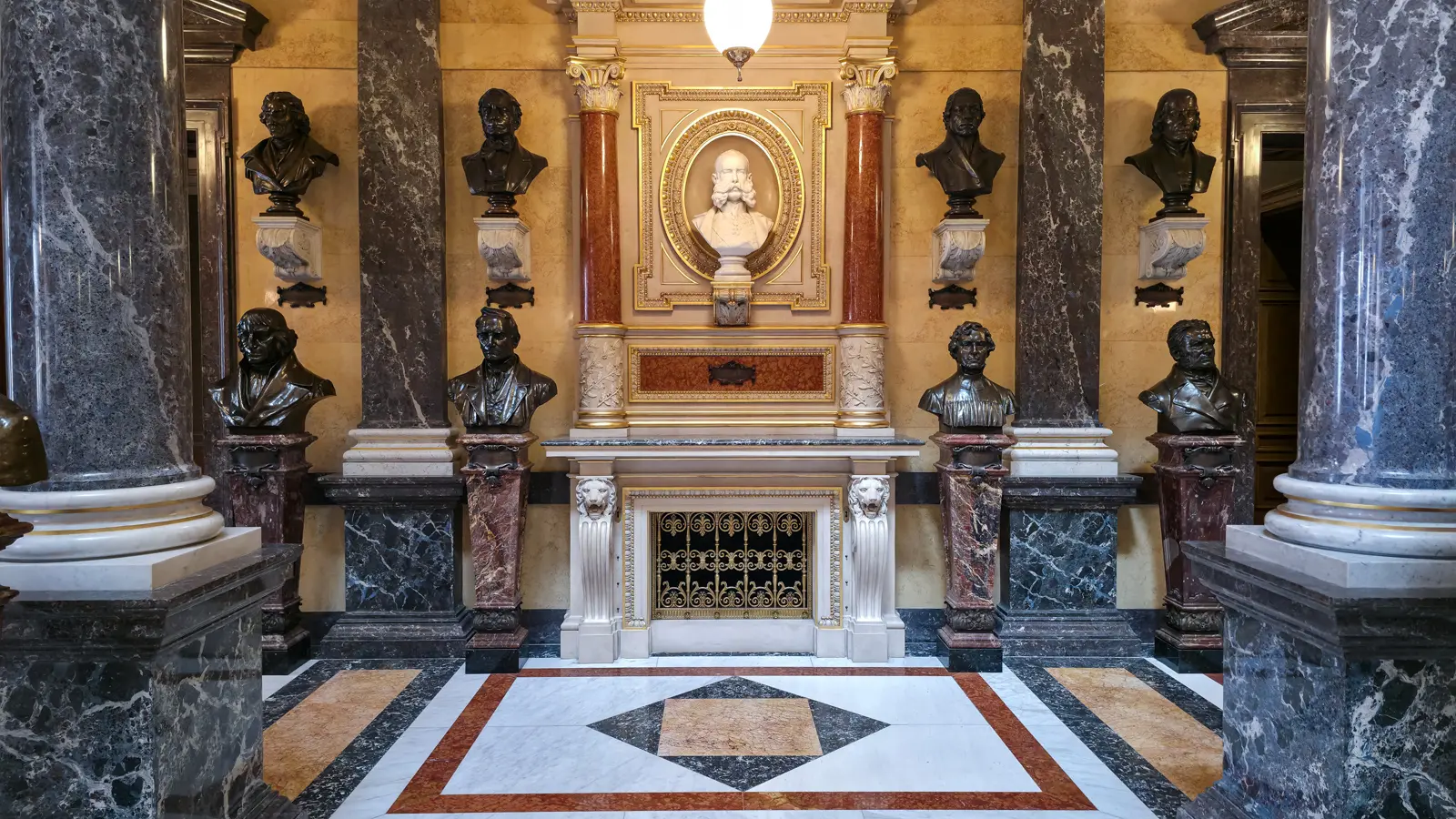
Two white marble busts stand out among the bronze: Emperor Franz Joseph I and Empress Elisabeth. They returned to the Pantheon after the reconstruction, after almost a century away.
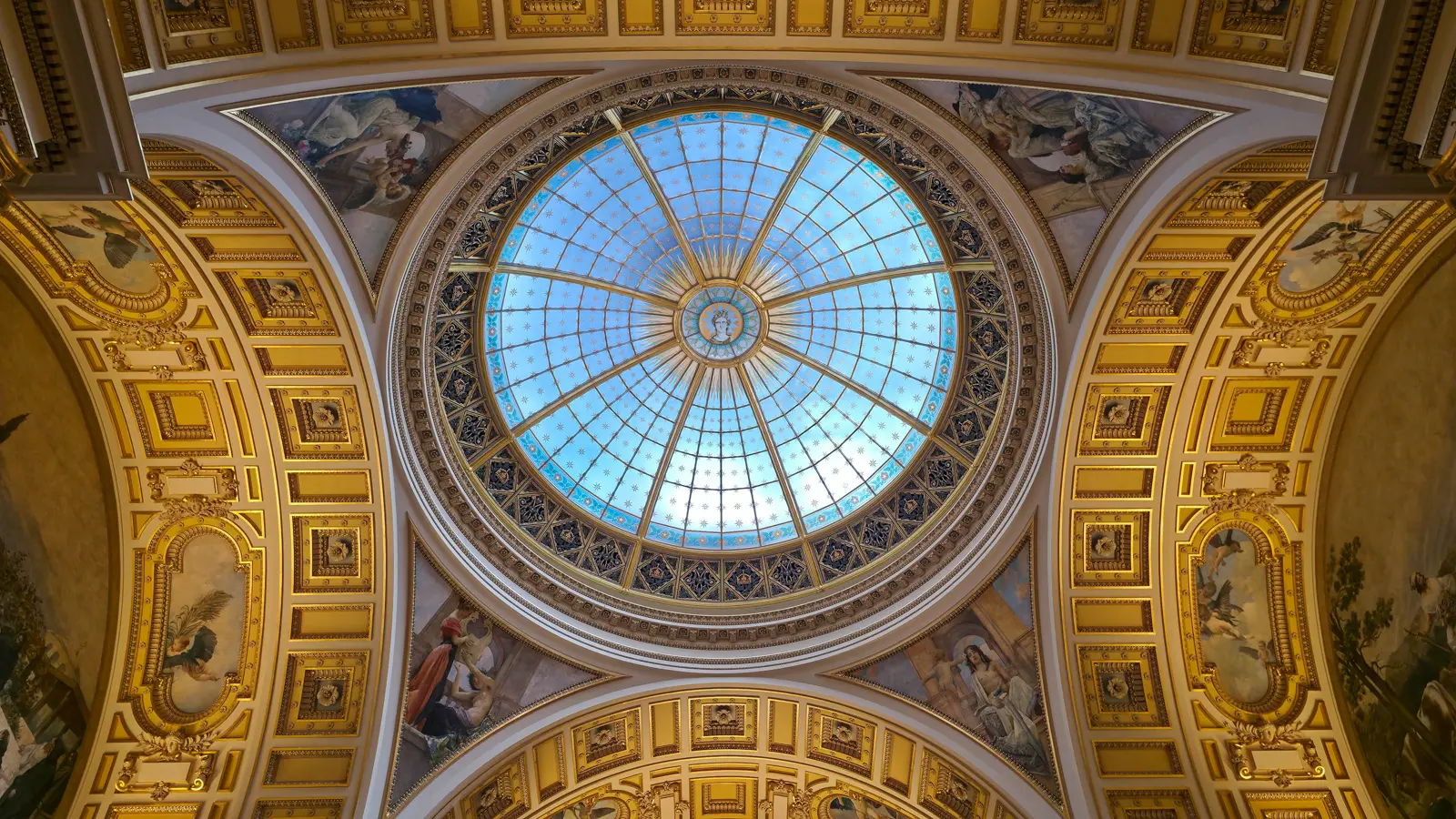
Standing in the centre of the floor and looking straight up is worth doing. The dome is glass, painted with stars and a sunburst, with the head of Bohemia at its centre.
The Cupola and the View down Wenceslas Square
The cupola at the very top was included in our ticket, and it is one of the best views in Prague. The viewing room has a glass floor and tall windows on every side.
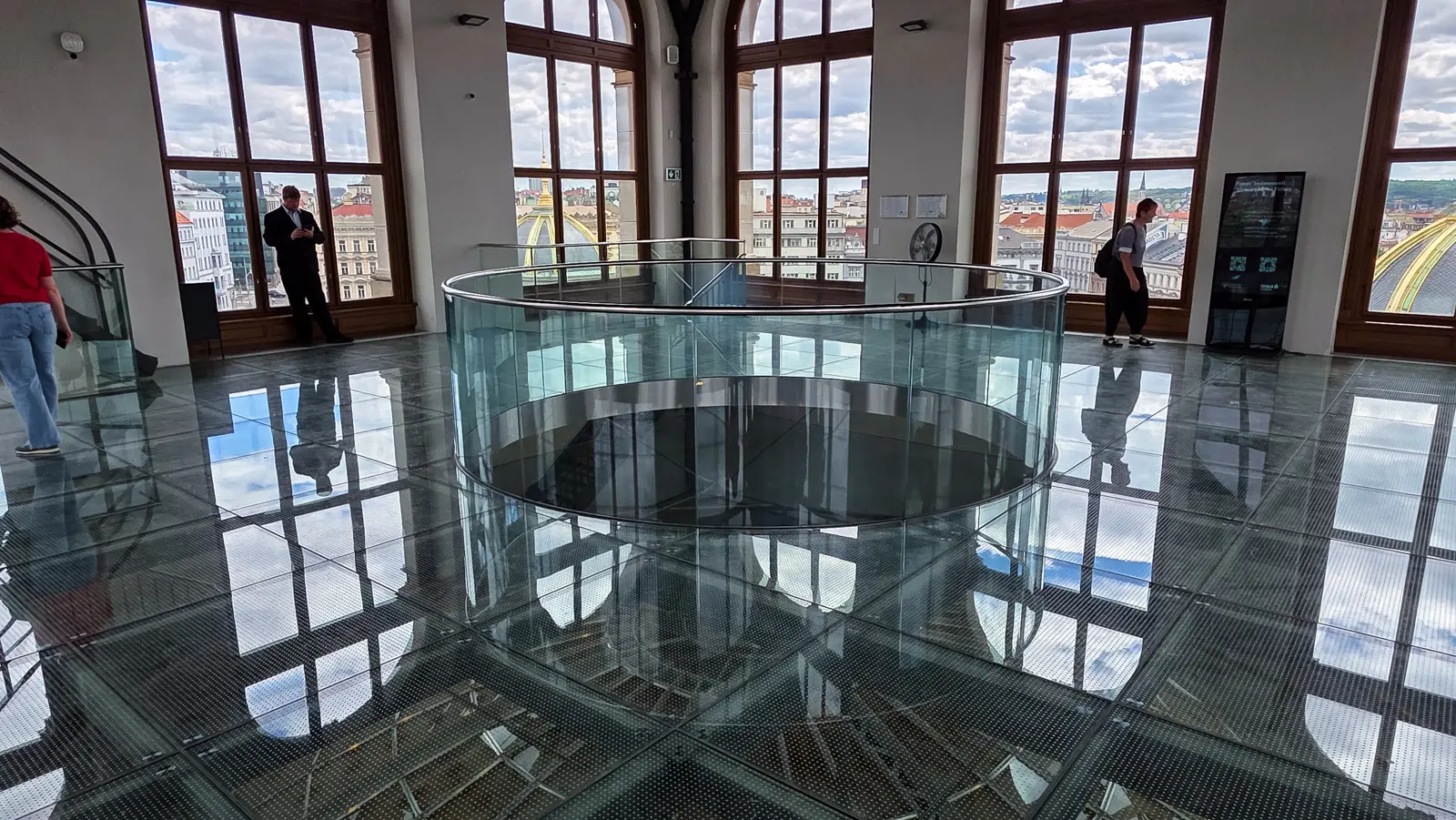
The front windows look straight down the length of Wenceslas Square to Prague Castle on the horizon. In our case, the upper square was a construction site. Trams are returning to it for the first time in decades, and the new line is due to open in June 2027. From up there, we could follow the progress below, with the new tracks curving around the St Wenceslas statue. I look forward to coming back when the work is over. The view will be spectacular.
The Miracles of Evolution
The Miracles of Evolution opened in September 2021 and covers 2,000 square metres in six halls, with around 1,500 exhibits. Animals are displayed without shelves and racks, in natural poses and settings. The scale runs from a Varroa mite under a millimetre long to a 22.5-metre fin whale skeleton. The insect, fish and mammal rooms were beautifully arranged, and they work for every age, families included.
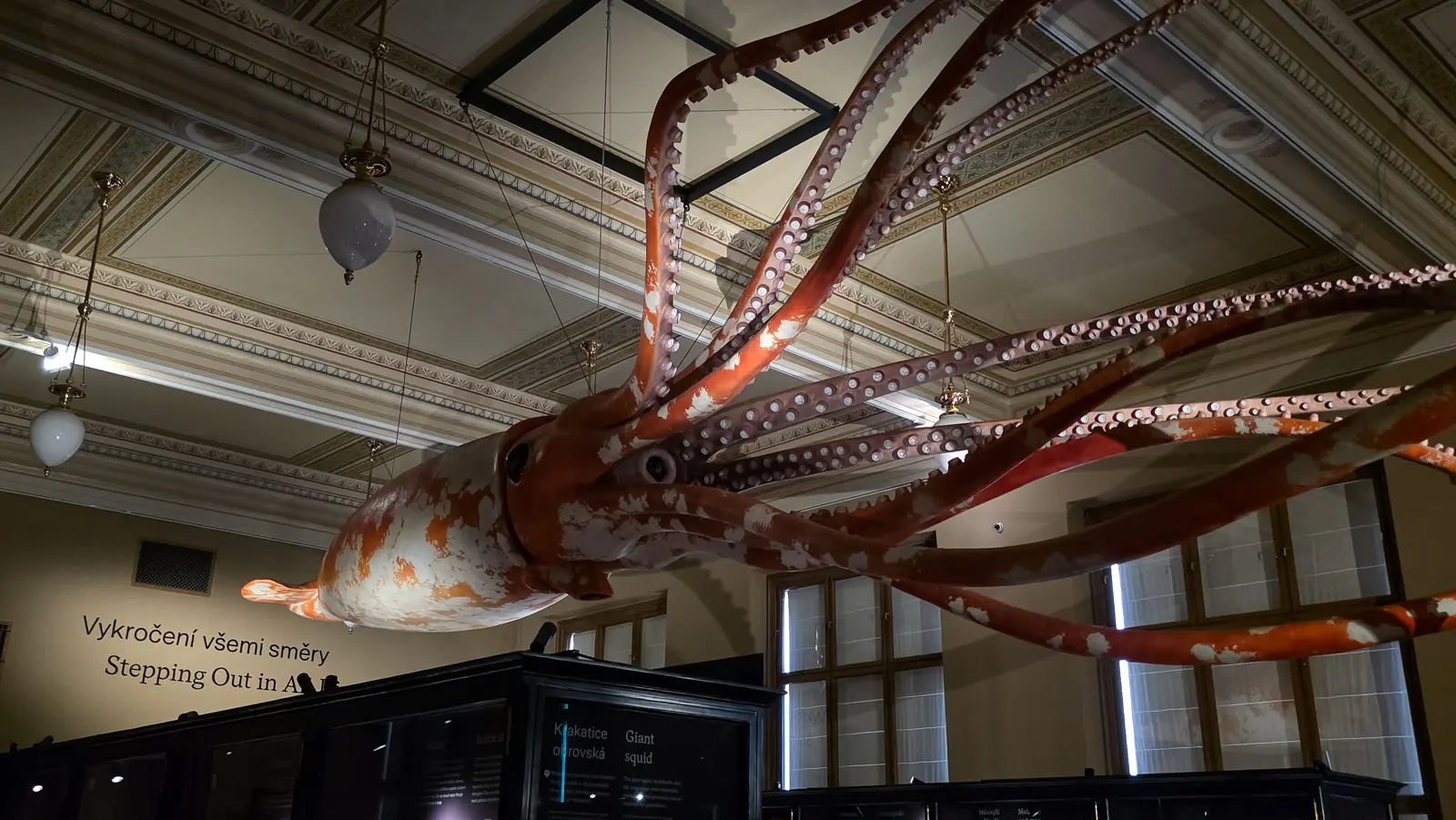
The first hall, Stepping Out in All Directions, starts with the invertebrates, and a giant squid hangs overhead.
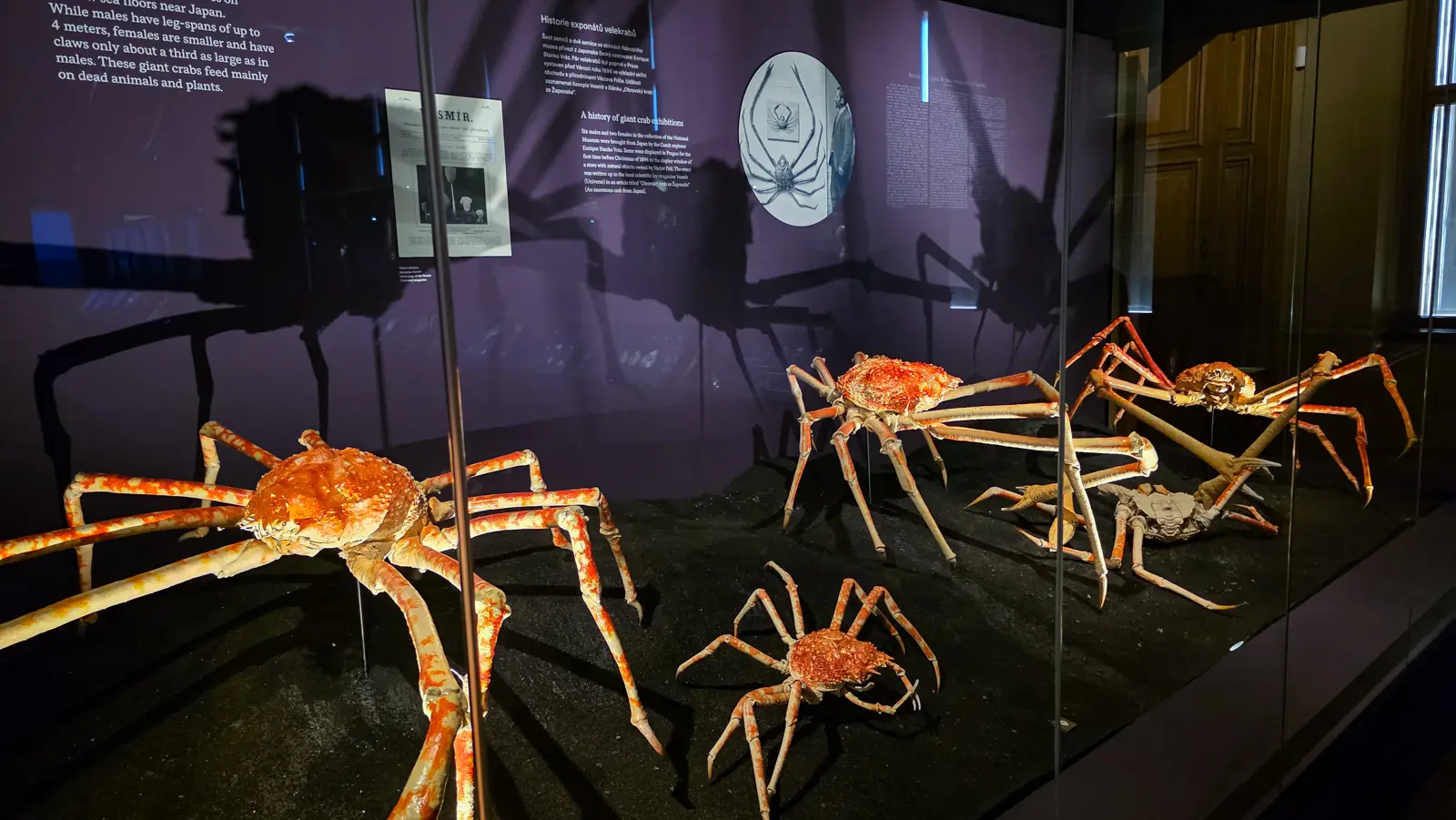
Nearby, a case of Japanese spider crabs throws long shadows across the wall. Many Czech visitors remember these crabs from before the museum closed in 2011.
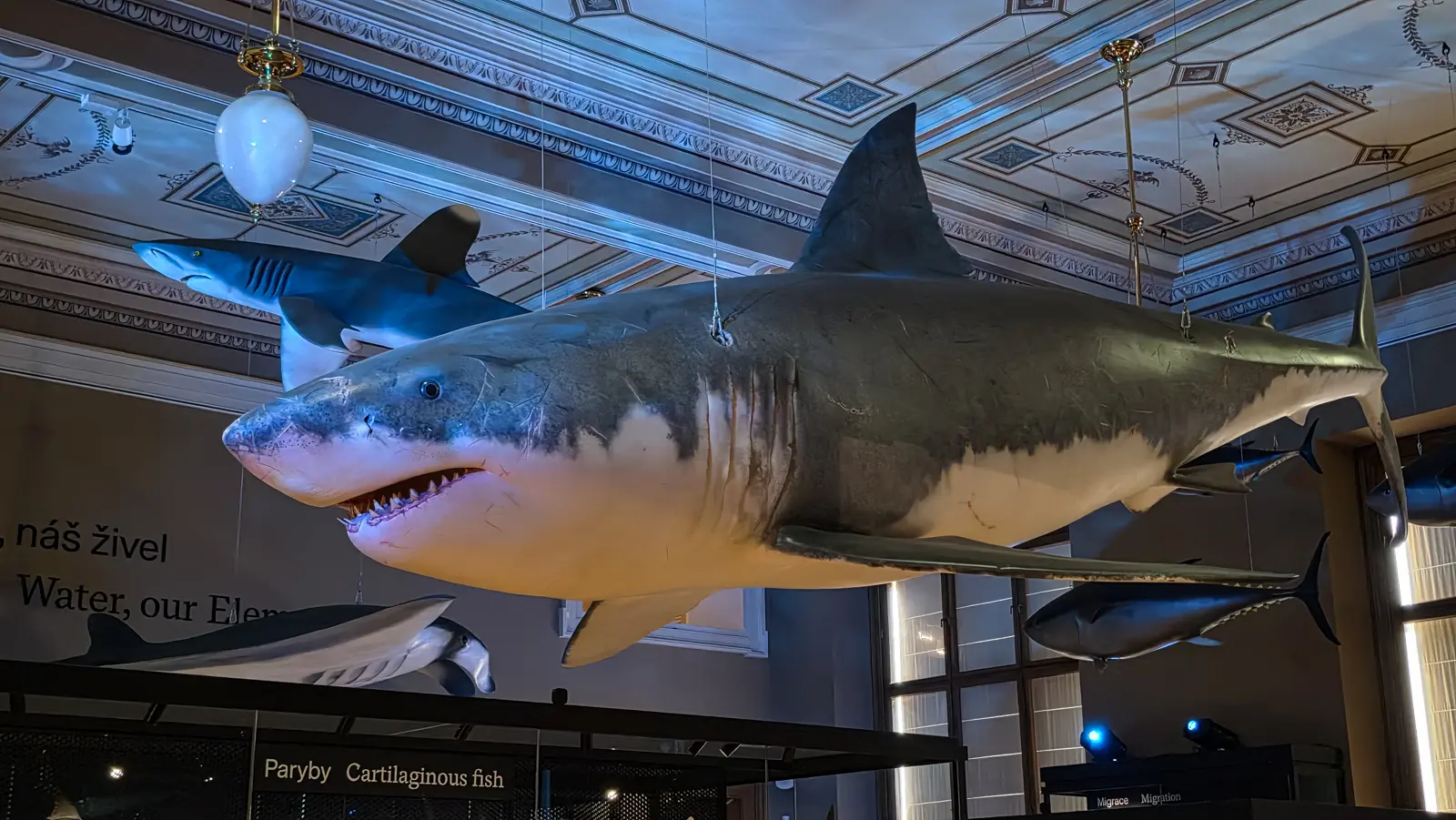
Water, Our Element is the fish hall. A great white shark hangs above the cases of cartilaginous fish, with more sharks and fish around it.
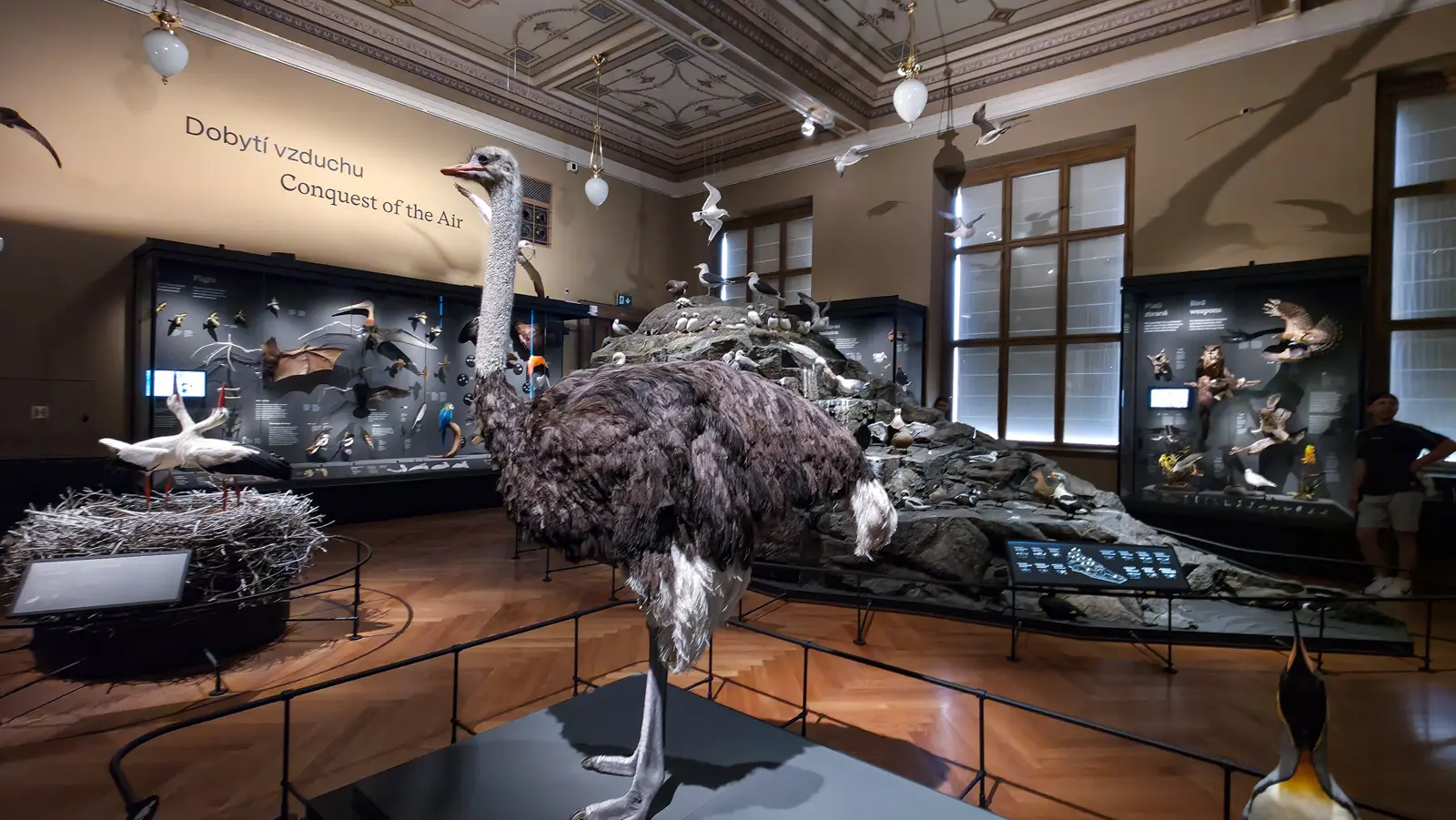
In Conquest of the Air, an ostrich stands at the front, white storks guard their nest, and seabirds crowd a rocky cliff.
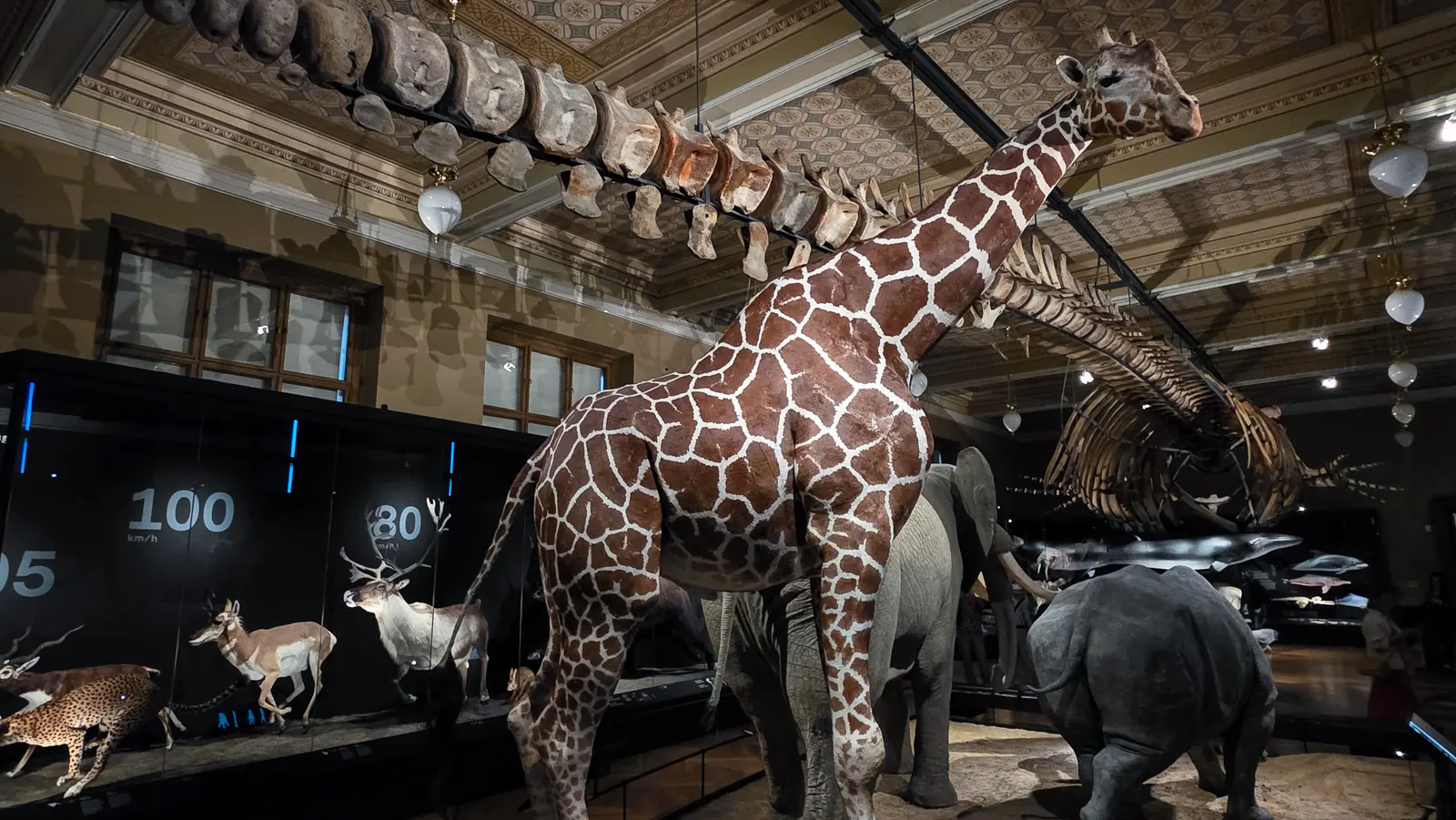
In the mammal hall, a giraffe, an elephant and a rhinoceros stand together, a case beside them ranks animals by running speed, and the fin whale skeleton stretches overhead.
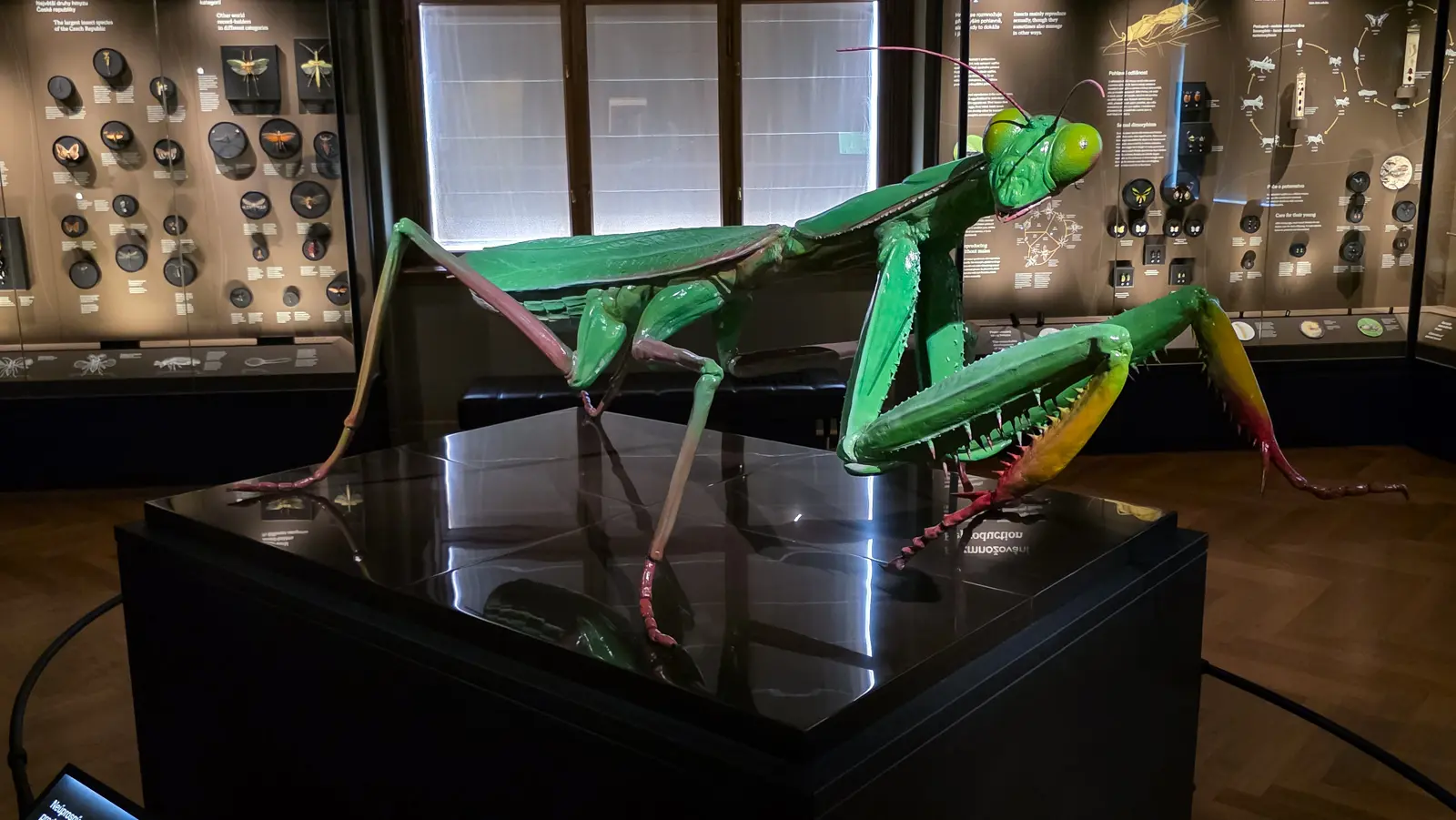
Insects have a hall of their own, A Tiny Majority, where a giant praying mantis presides over cases of beetles and butterflies.
Windows into Prehistory
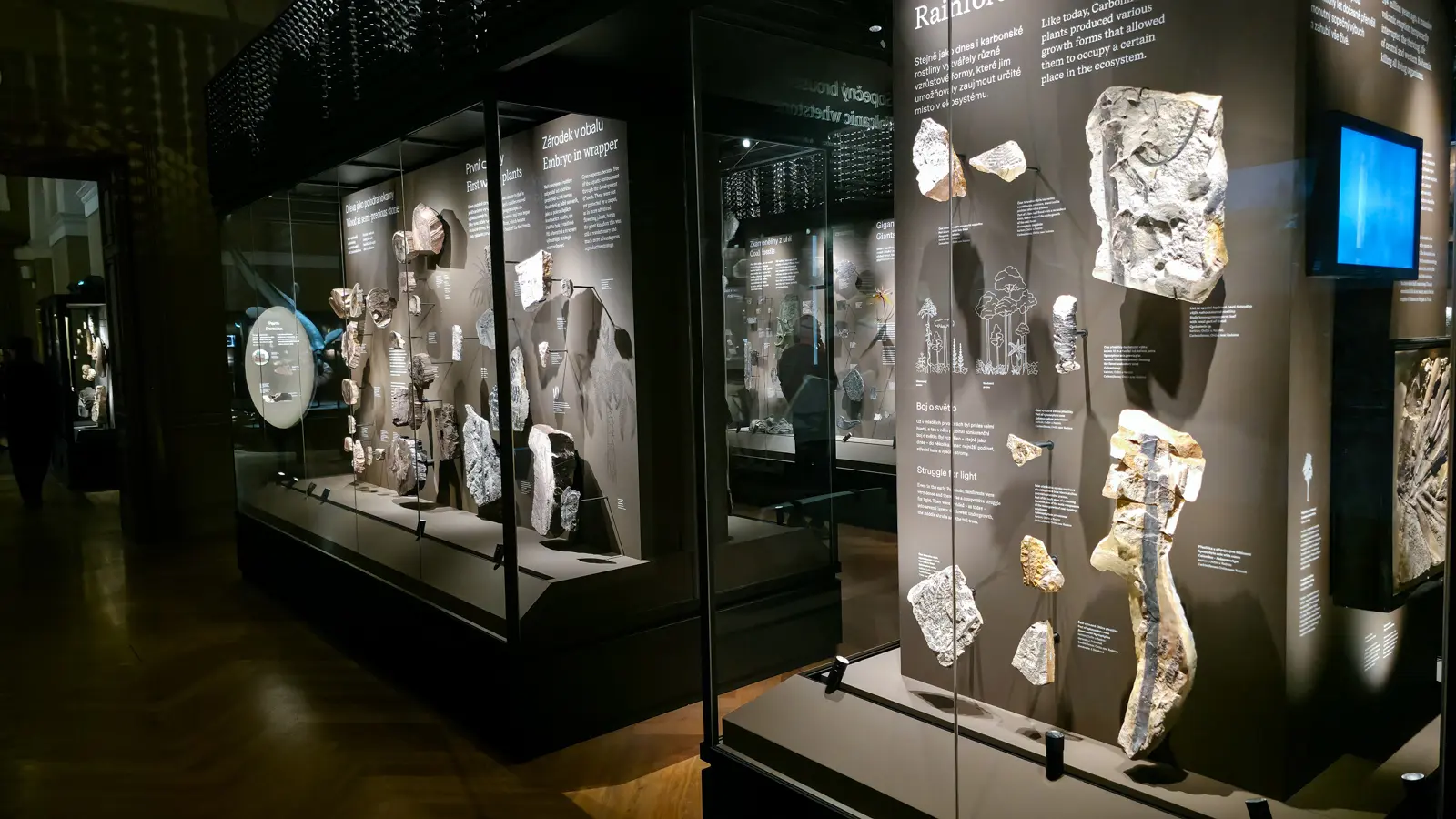
Windows into Prehistory tells the story of life in the Czech lands over millions of years, in four halls running from the Palaeozoic to the Quaternary. It holds about 2,000 exhibits, from tiny fossilised trilobite larvae to giant ammonites, alongside life-size models of prehistoric animals.
The Palaeozoic hall includes fossil plants from the Carboniferous, when dense coal-forming rainforests grew in Bohemia. The labels explain how those forests were layered, from low undergrowth to tall trees competing for light.
People and Their Ancestors
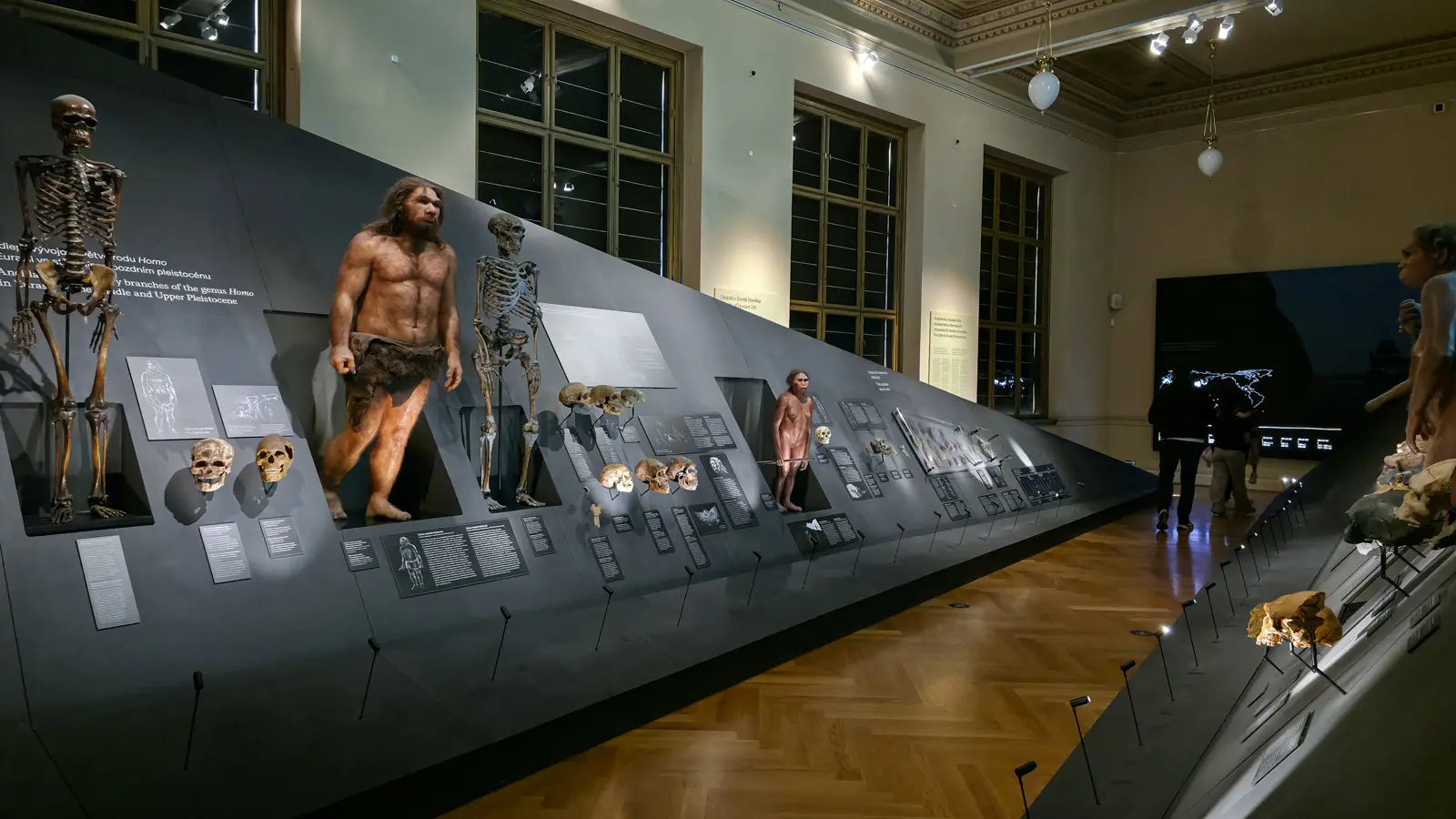
People and Their Ancestors follows the human story from the first hominins to modern humans. It opened in August 2025 with a coup: the original fossils of Lucy and Selam, on loan from Ethiopia for 60 days, their first time on show in Europe. By our visit they had gone home, but the rest of the exhibition is permanent. Skeletons and skulls line a long, slanted wall, with lifelike figures of early humans standing among them.
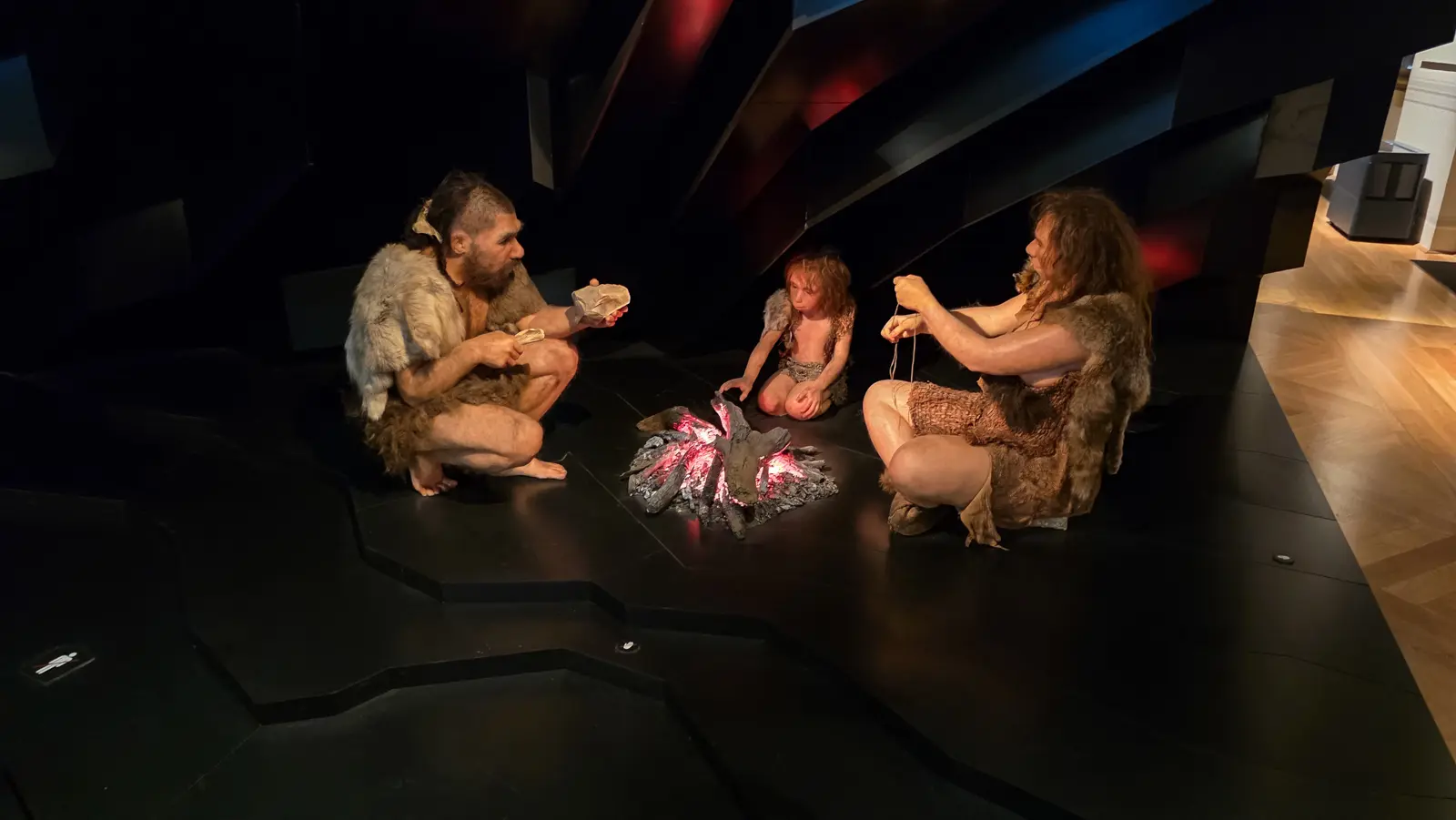
Further on, a prehistoric family sits around a glowing hearth. The figures are so realistic that it takes a second look to be sure they are not real.
The Minerals
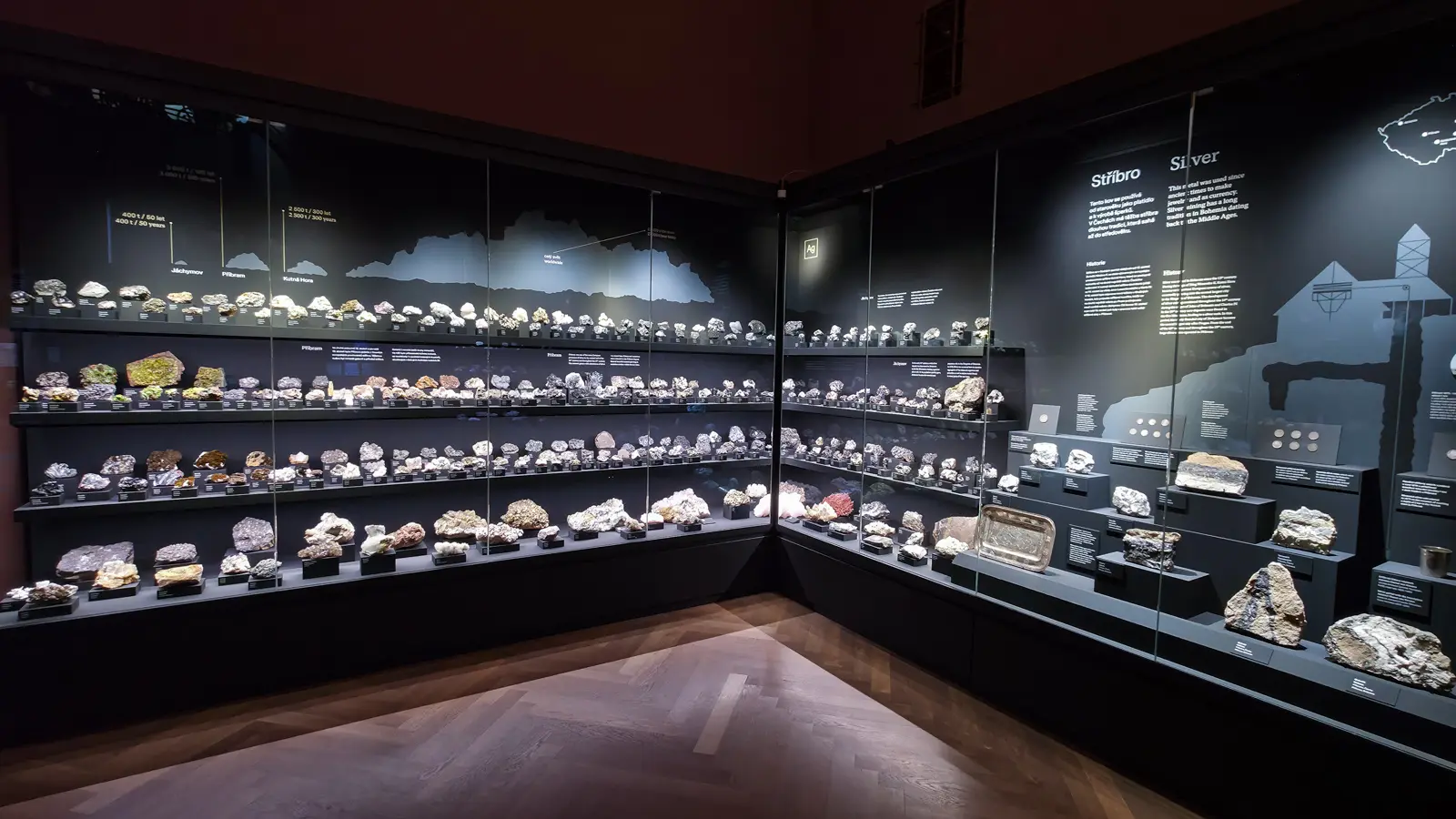
The mineral collection is outstanding. The historic Halls of Minerals display more than 4,000 minerals in cases designed by Karel Vrba, the mineralogist behind the first mineral exhibition here in 1892, together with Josef Schulz. The display is still organised the same way it was more than a century ago. Nearby are a Hall of Meteorites and a Hall of Luminescence, where some minerals glow under ultraviolet light. Not sure, but it looked bigger to me than the mineral gallery at the Natural History Museum in London.
A newer room focuses on the mineral resources of the Czech lands, setting the ores beside the objects made from them.
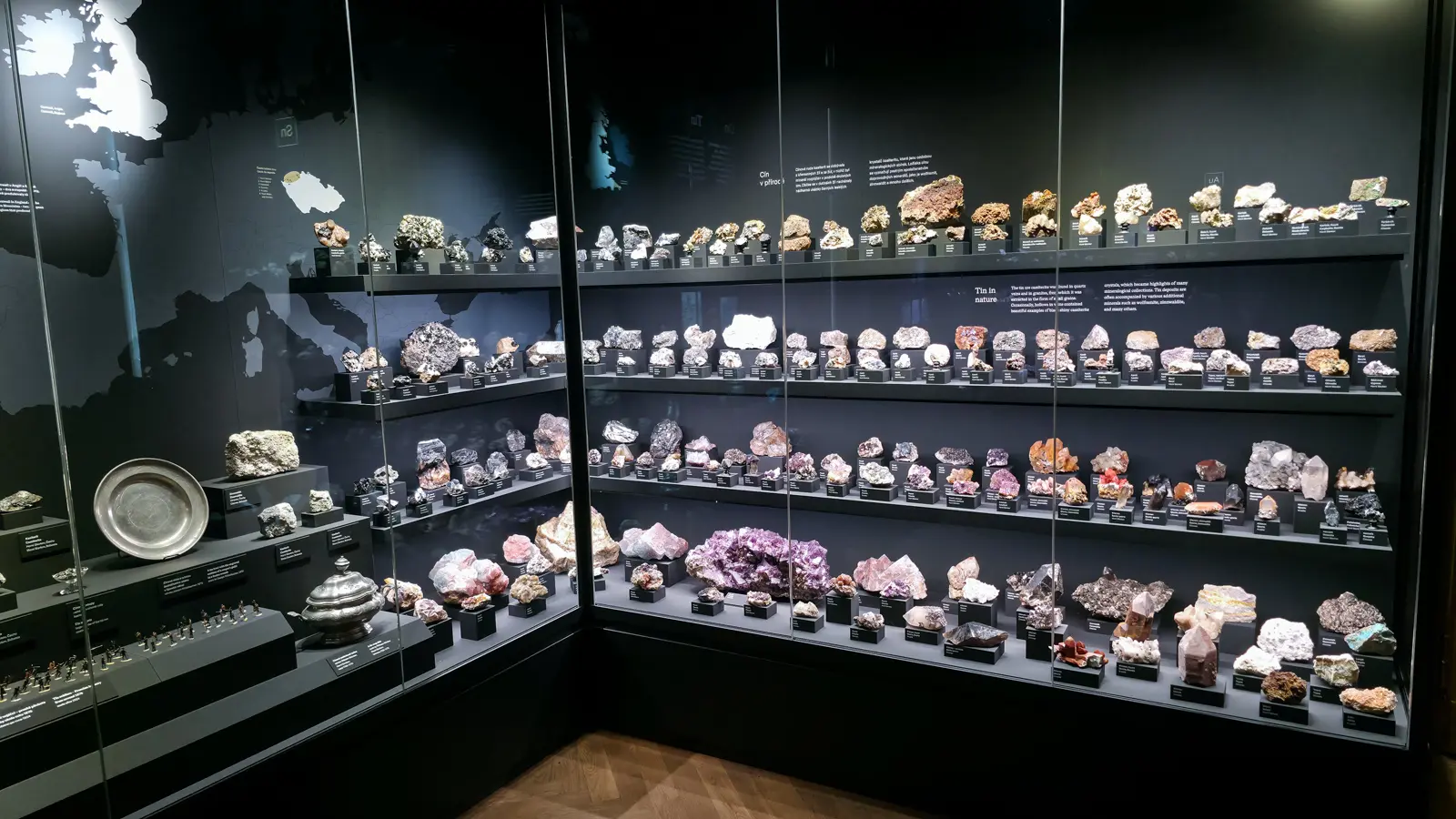
The silver case comes with maps of three historic mining towns: Jáchymov, Příbram and Kutná Hora.
History: The Czech Lands to the First World War
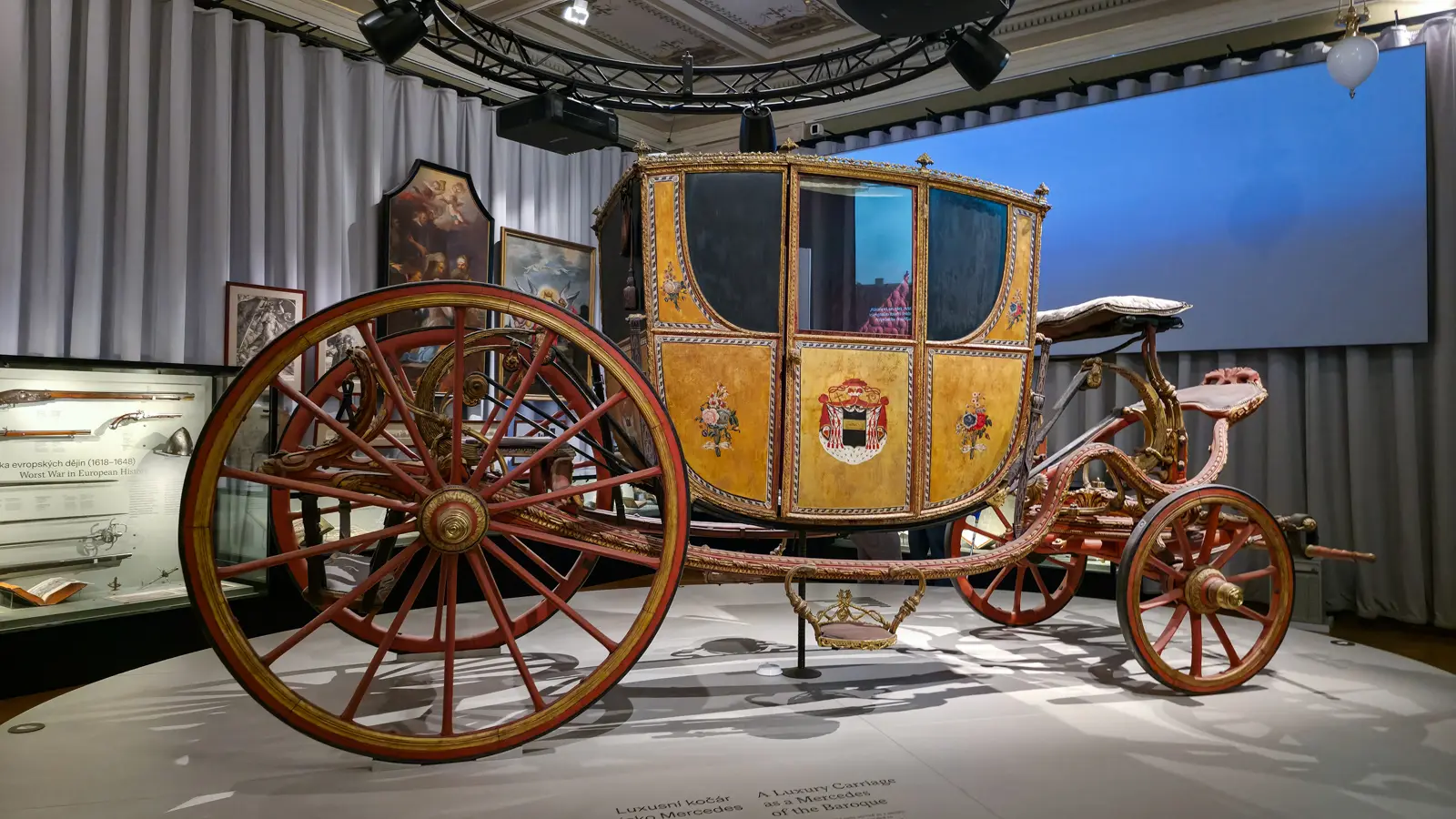
The History exhibition covers the Czech lands from the 8th century to the First World War, in seven halls with around 2,000 exhibits. Its objects run from the smallest pieces of medieval jewellery to the largest item in the building, an 18th-century archbishop’s carriage.
We also caught The Přemyslids, the major temporary exhibition of 2026, on the ground floor. It told the story of the first ruling dynasty of the Czech lands, from the legendary Libuše and Přemysl the Ploughman to the murder of Wenceslas III in 1306, with more than 900 artefacts from nearly 70 institutions. It ran from 24 April to 15 October 2026, so it has now closed.
Through the Tunnel: Moments of History
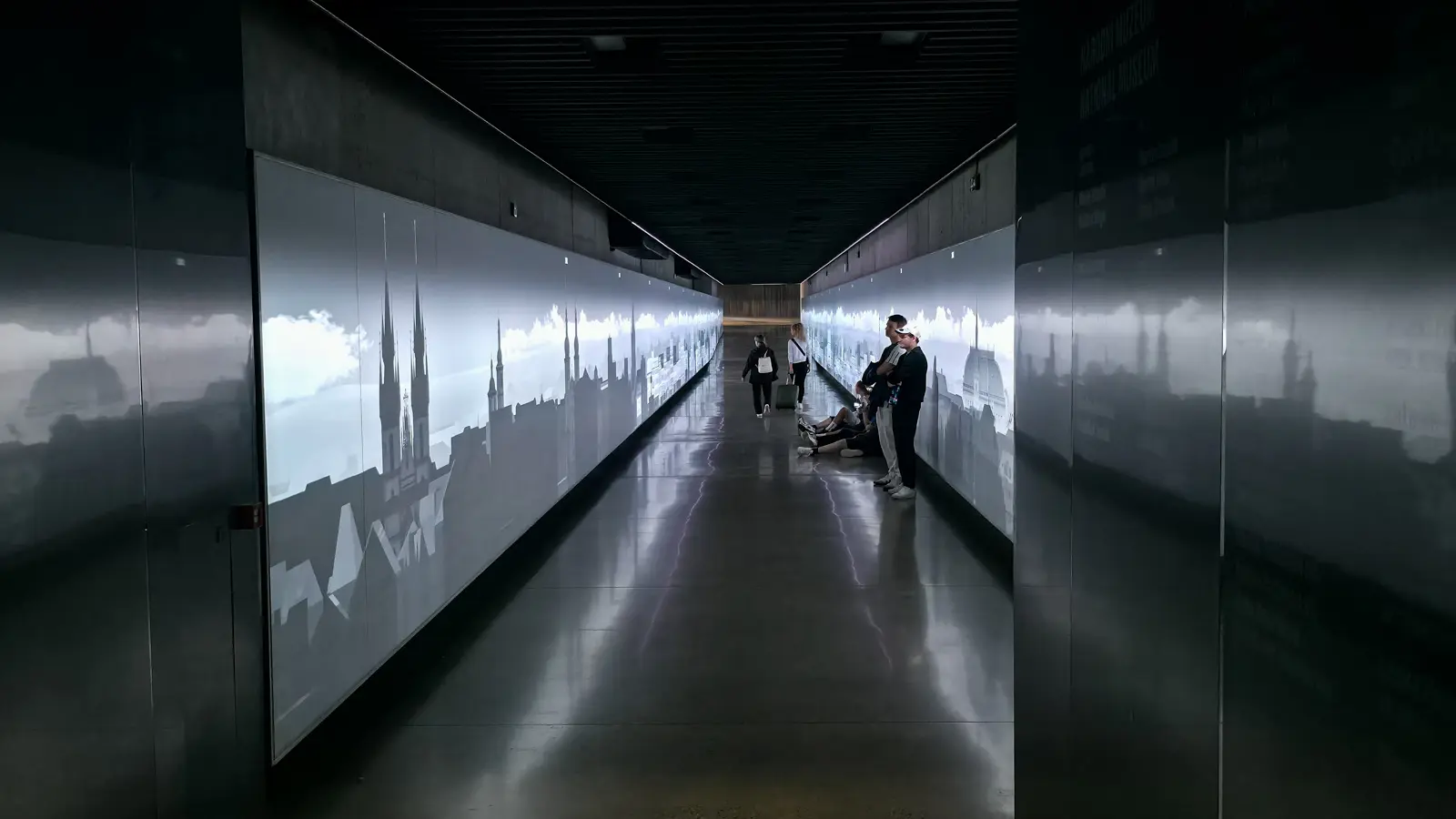
The underground corridor between the two buildings opened in November 2019, and it is an exhibition in its own right. Moments of History covers both walls with a continuous projection, run by 38 laser projectors and billed as the largest of its kind in Europe. It replays the story of Wenceslas Square, from its buildings changing over the decades to the crowds of the 20th century. It also makes the route between the two buildings step-free.
The New Building
The New Building is a striking contrast to the palace next door. Karel Prager, working with Jiří Kadeřábek and Jiří Albrecht, built it between 1966 and 1974 by raising two upper storeys on pillars above the interwar Prague Stock Exchange. Czechoslovakia’s Federal Assembly met here until 1992. Radio Free Europe moved in during the 1990s, and the museum took over the building in 2009.
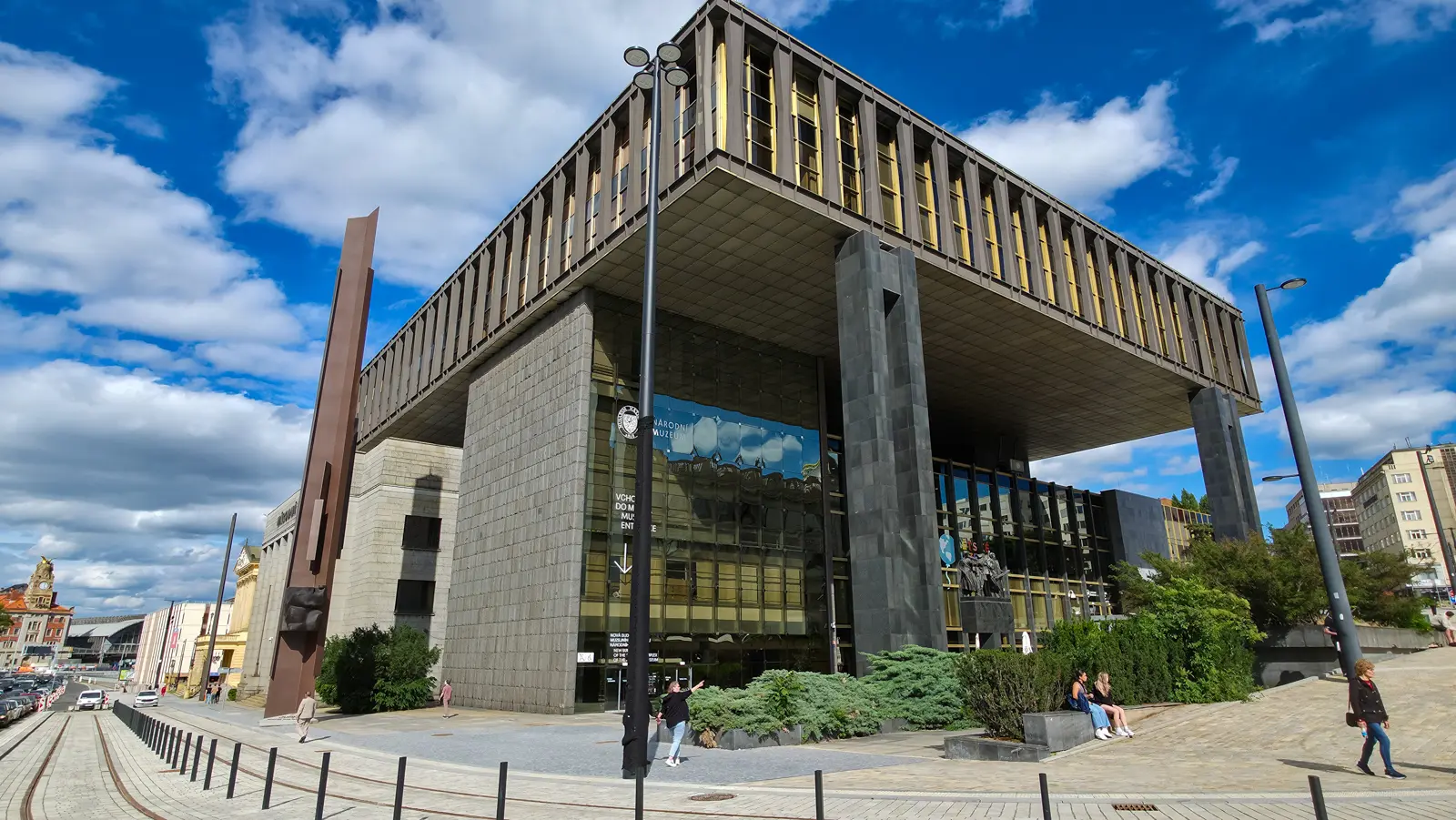
Inside, the History of the 20th Century exhibition picks up where the palace leaves off. It tells the story of the Czech lands from the First World War to the Czech Republic joining the European Union in 2004. The New Building also has the Children’s Museum, a café, and the ticket office.
Bubbly Tips
- Pick your priorities. A few hours covers the building, the Pantheon, the cupola and one or two exhibitions. For everything, plan for a full day or split it over two visits.
- Go up to the cupola. It was included in our ticket. Head up for the full view down Wenceslas Square to Prague Castle.
- Avoid weekend middays. The museum says it temporarily stops entry when the building is full, usually around noon at weekends and on holidays, with a typical wait of 30 to 45 minutes.
- Check opening hours before you go. The museum complex opens daily from 10 a.m. to 6 p.m.
- Use the step-free route if you need it. Barrier-free access to the Historical Building is through the New Building entrance, the café and the connecting corridor, with lifts at the Historical Building end.
- Download the museum app. National Museum in Your Pocket works on the free Wi-Fi and adds augmented reality to the Pantheon, identifying the figures as you point your phone at them.
- Budget separately for the Children’s Museum. The standard ticket covers the rest of the complex but not the Children’s Museum.
- Look for the temporary exhibitions. The big exhibitions change every year, so check the museum’s website for what is on before you go.
- Come back after June 2027. Once the tram line is finished, the view from the cupola should show a new upper Wenceslas Square instead of a construction site.
Final Thoughts
In a few hours, the National Museum took us from fossils and minerals to the Přemyslid kings, then through a tunnel into the 20th century. That journey from prehistory to today, with the new wing carrying the story on, is what I loved most.
A few hours was not enough, and a few days would be closer to right. I look forward to returning once the construction on Wenceslas Square is over, when the view from the cupola will be spectacular.
Until next time!

🌟 Everything You Need to Plan Your Dream Trip in 2026
- 🌟 Luxury Hotels - Find premium stays with Booking.com & Hotels.com
- 🏡 Vacation Rentals - Discover unique properties on VRBO
- 🏞️ Guided Tours - Explore with Viator or GetYourGuide
- 🎫 Attraction Tickets - Skip the lines with Tiqets
- 🚢 Ocean Cruises - Set sail with Cruise Direct
- 📱 International SIMs - Stay connected with Saily
- 🚗 Car Rentals - Budget-friendly options from Discover Cars
- 🌐 Secure VPNs - Browse safely with NordVPN
- 💶 Currency Exchange - Best rates with Wise
- 🗣️ Learn Languages - Master the local language with Babbel and Rosetta Stone