
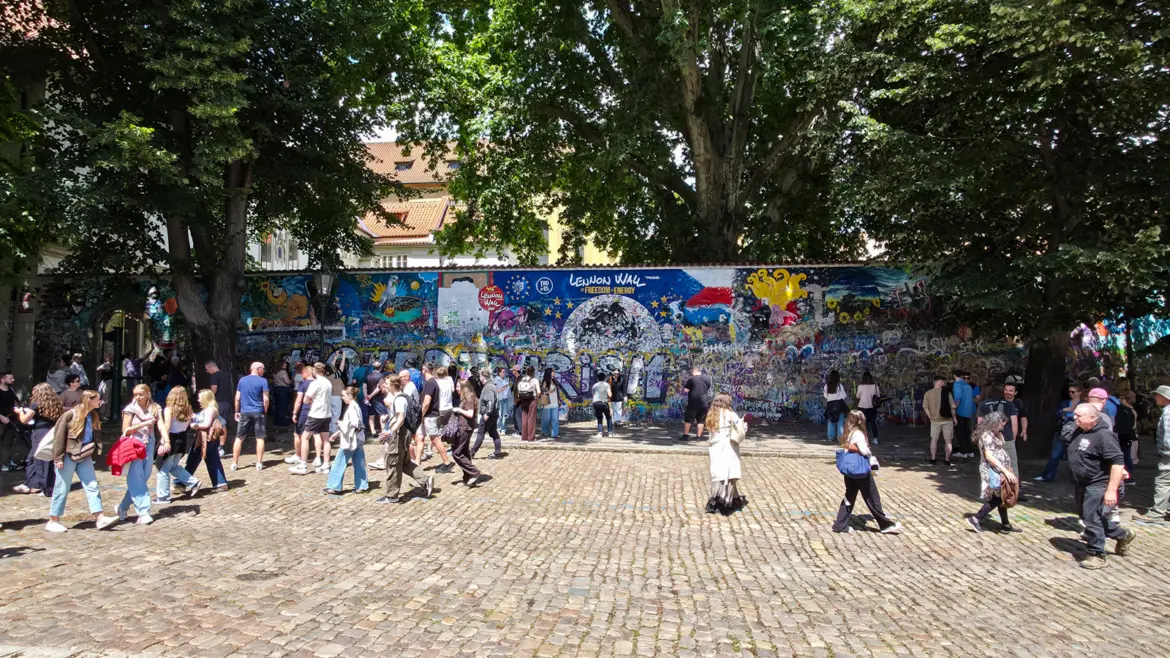
The Lennon Wall in Prague surprised me in the best way. It is tucked away on Grand Priory Square (Velkopřevorské náměstí) in Malá Strana, a short walk from the end of Charles Bridge. It is the kind of place that is easy to miss, and our guide took us there once we had crossed the bridge.
I expected a wall of graffiti. What I found was a long stretch of colour under tall shady trees, covered from top to bottom in murals, lyrics, names and messages in many languages. There was something peaceful about it, even with the crowds. People of all ages stopped to read it, take photos and add their own words. Some simply sat and looked. I didn’t write anything, but I took my time reading.
The Lennon Wall at a Glance
🕊️ A wall of peace · Covered top to bottom in murals, Lennon lyrics and messages in dozens of languages, on a quiet Malá Strana square.
✊ Born of protest · Under communism, young Czechs painted Lennon’s lyrics here; the secret police whitewashed it, and they repainted it by night.
🎨 Always changing · Reconstructed in 2019 as a semi-legal graffiti wall, it never looks the same twice.
🏛️ Owned by the Knights of Malta · The wall runs along the garden of the order’s Grand Priory, its Czech headquarters since the 12th century.
🖊️ Bring a marker · Spray paint is banned, but you can add your words to the sections open to the public.
🌉 Right by Charles Bridge · A short walk from the Malá Strana end of the bridge, easy to combine with a crossing.
A Wall Against the Regime
Before it was the Lennon Wall, this stretch is said to have been known as the Crying Wall, a place where people left messages against the government. After John Lennon was killed in December 1980, people began covering it with his lyrics, his portrait and messages of peace.
For many young Czechs, Lennon had become a pacifist hero. Much Western pop music was banned under the regime, and some Czech musicians were even imprisoned for playing it. In communist Czechoslovakia, painting his lyrics on a wall in the middle of Prague was more than a tribute.
The wall became a symbol of freedom and opposition to the regime. Young people met here to light candles and lay flowers. The authorities painted over it several times to stop what they saw as dangerous admiration for a Western musician. The secret police whitewashed it again and again, but young people kept slipping into the square at night to paint new messages, and the wall never stayed clean for long.
The authorities even had a name for it. They dismissed the movement as “Lennonism” and described its followers as alcoholics, mentally deranged, sociopaths and agents of Western capitalism.
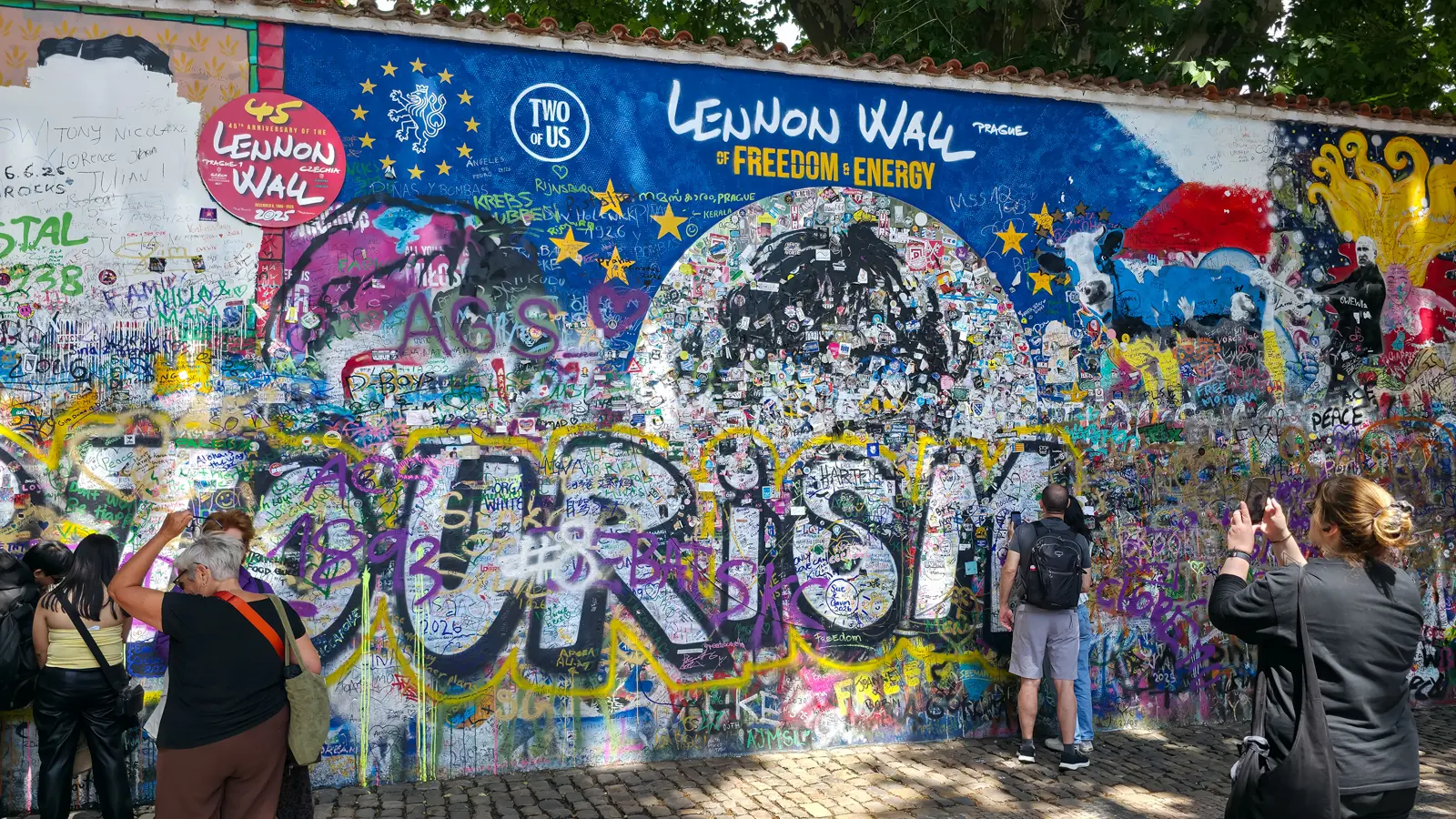
By 1988, the wall had become a real irritation for the communist government of Gustáv Husák. Young Czechs wrote their grievances on it, and reports from the time describe a clash involving hundreds of people. The following year, the Velvet Revolution brought communist rule to an end. Knowing that history, the words “freedom” and “peace” on the wall read very differently.
After 1989
Once the regime fell, the wall slowly turned from a place of protest into a tourist attraction. Its later chapters are just as interesting, and they involve its owners.
The wall belongs to the Sovereign Military Order of Malta, better known as the Knights of Malta or the Knights Hospitaller. The order has been in Prague since the 12th century, when it founded a monastery near the old Judith Bridge. The Lennon Wall runs along the garden of its Grand Priory, the order’s Czech headquarters, which sits right behind it.
On 17 November 2014, the 25th anniversary of the Velvet Revolution, a group of art students painted the entire wall white. They left only one line of black text: “wall is over”. Because the wall is their property, the Knights of Malta filed a criminal complaint for vandalism. They withdrew it after contacting the students and hearing their reasons. In the students’ view, the wall had lost its political meaning, and they wanted to give future artists a blank slate.
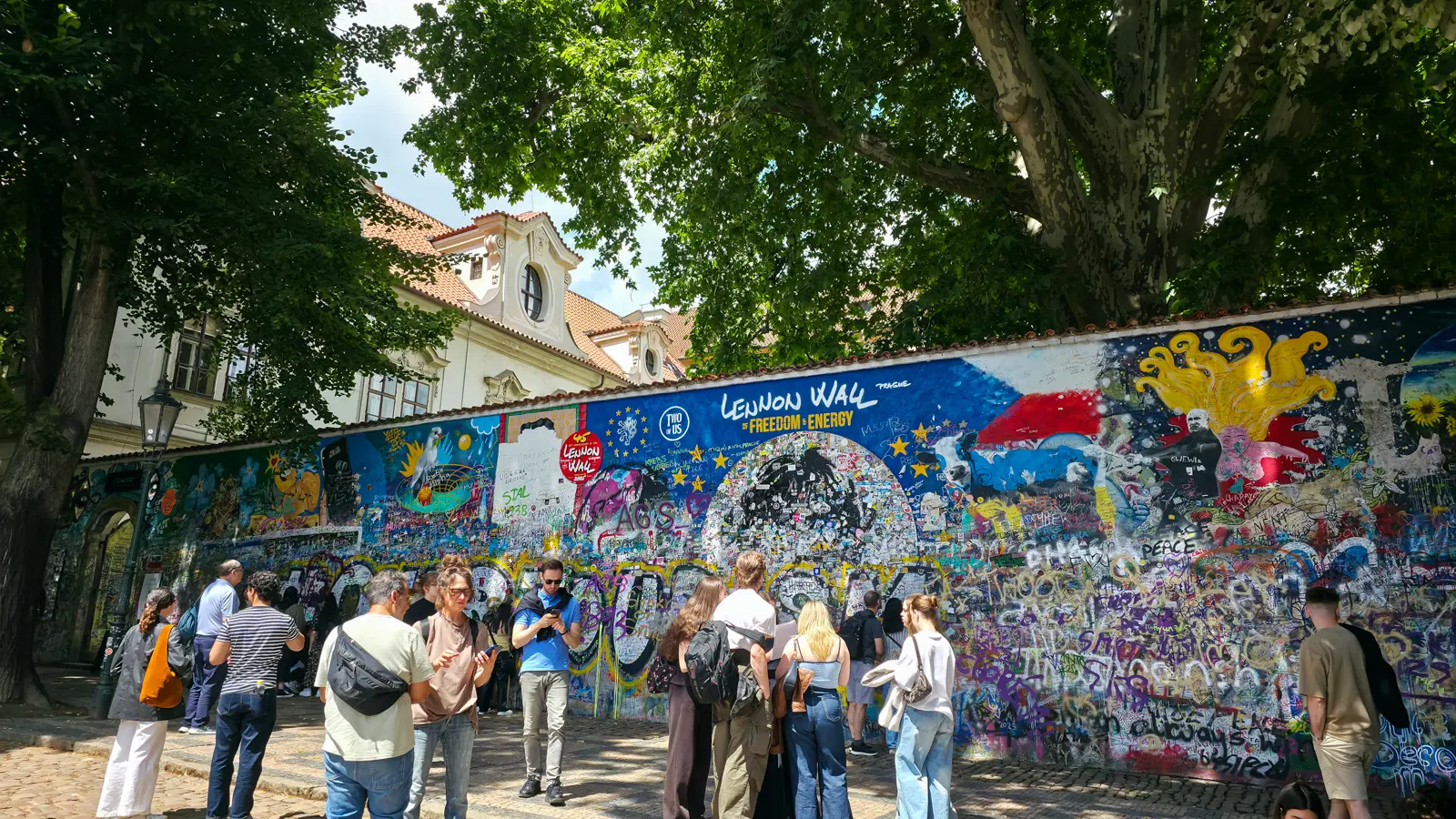
In October 2019, the Knights of Malta and the Prague 1 district began a reconstruction of the wall. It reopened as a semi-legal graffiti wall, with clearer rules about what visitors can and can’t do. The messages keep coming, though, and the wall never looks the same twice. Our guide told us it changes constantly, so when I go back, it will probably look completely different.
The Wall Today
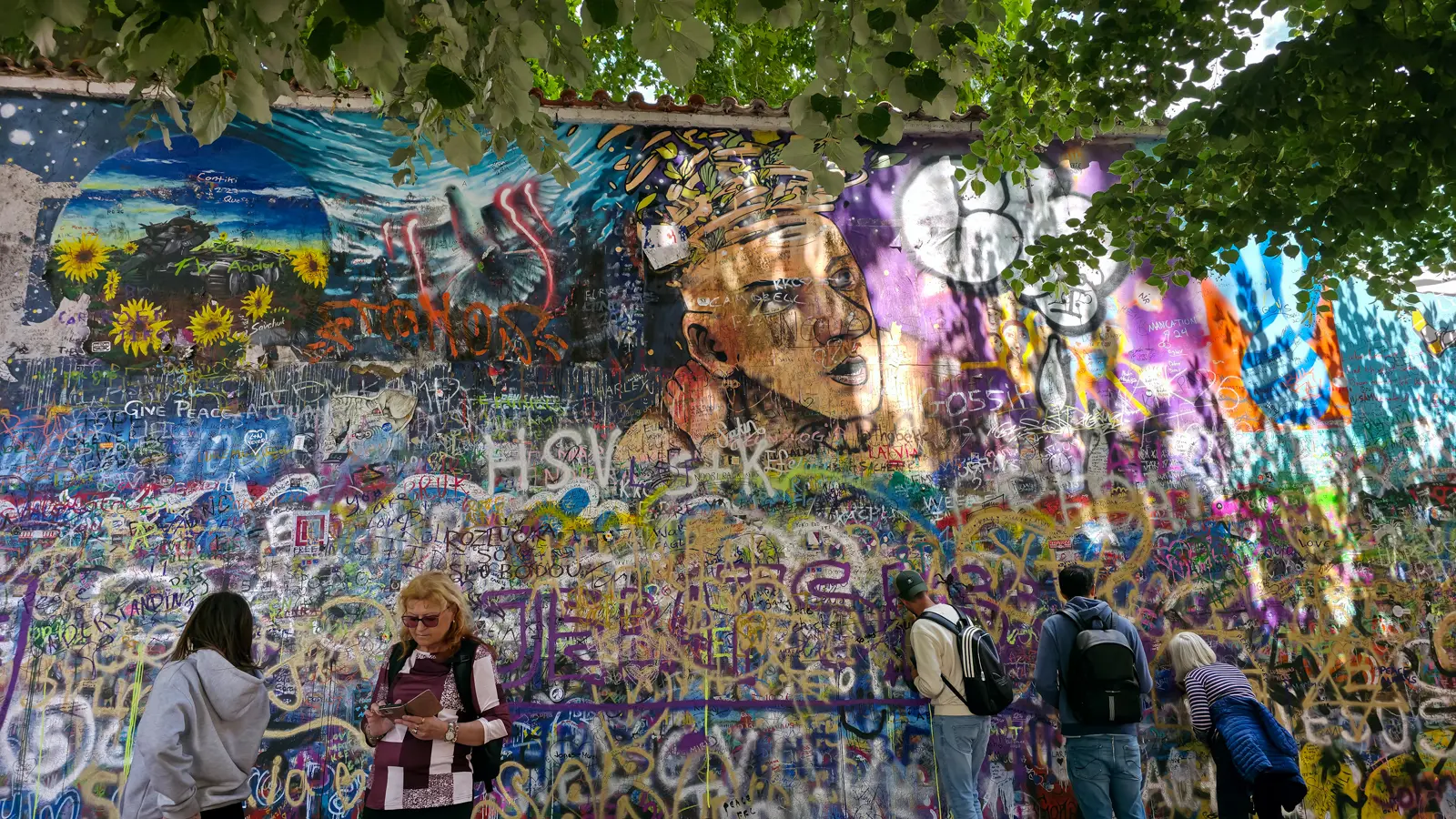
Standing in front of it, the layers are what stand out. Large murals sit above a dense patchwork of handwriting: names, dates, hearts, peace signs and short notes from all over the world. Some sections are freshly painted, while others are built up with years of ink and stickers.
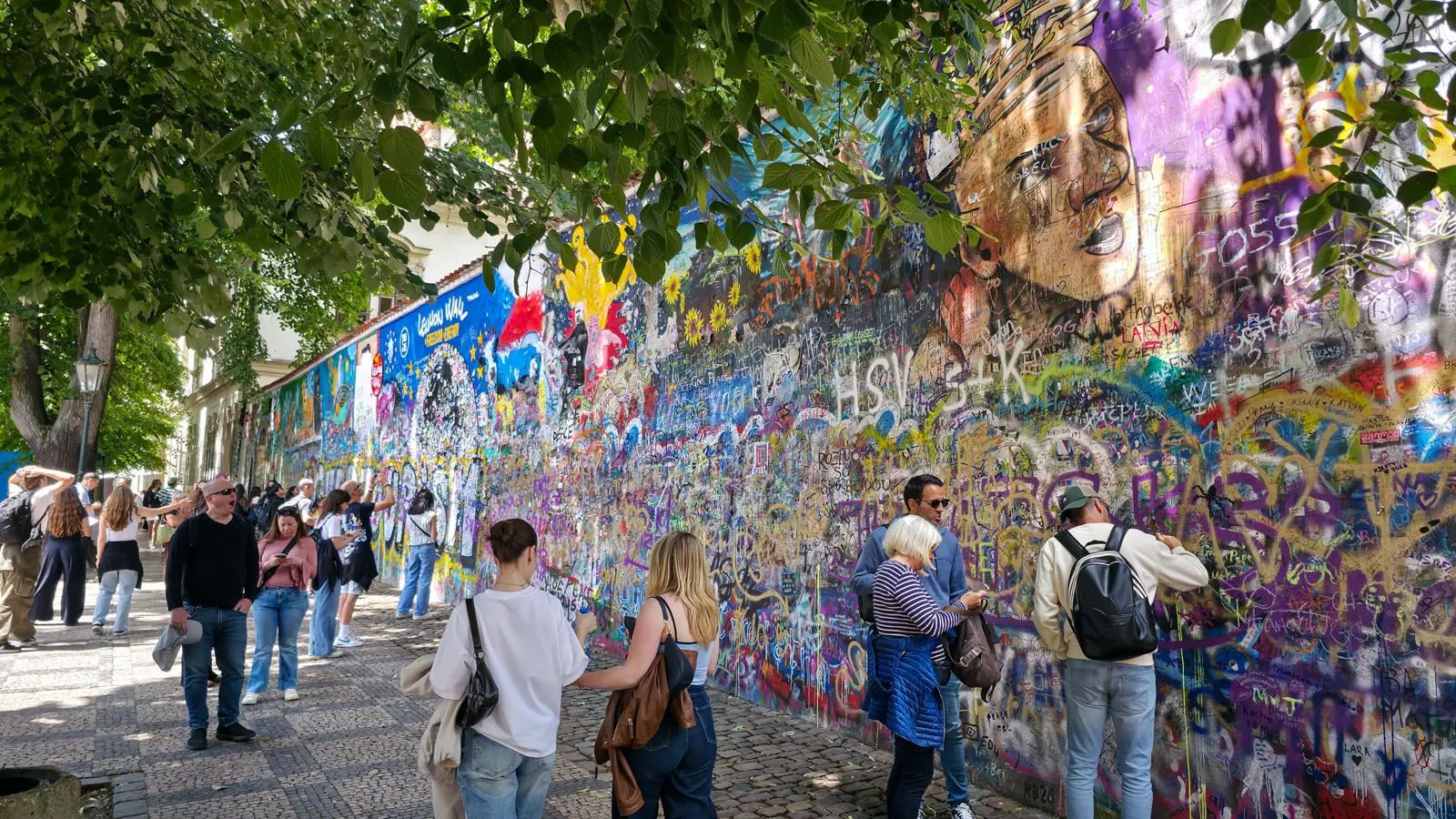
Further along, the wall changes style completely. Sunflowers, birds and a large painted face sit above a mass of handwritten messages, including “Give Peace” in white letters.
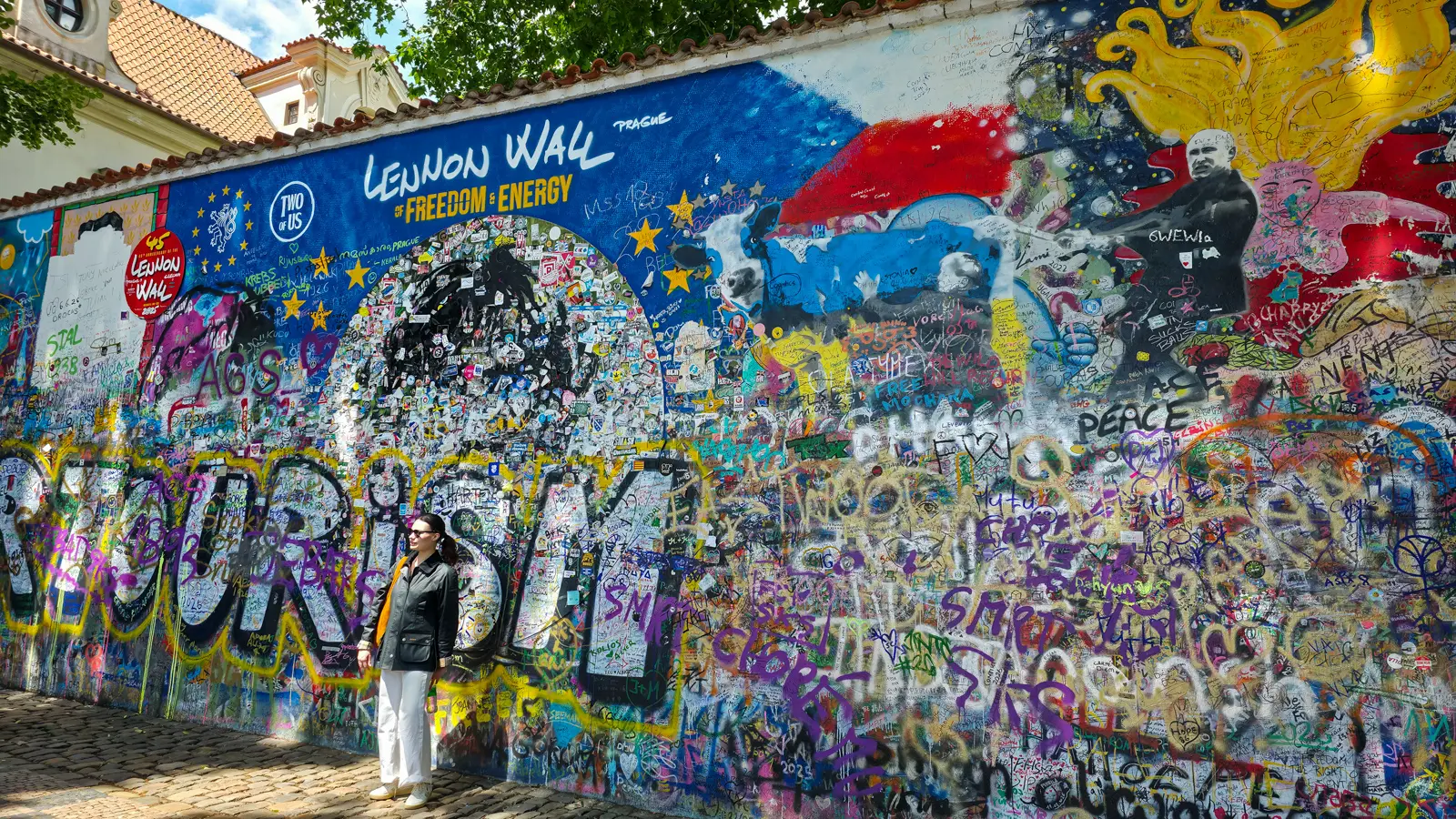
The central panel draws the biggest crowd. It is where most people stop for a photo, framed by the blue background, the big “Lennon Wall” lettering, a ring of EU stars around a Czech lion and the circle of stickers in the middle.
Bubbly Tips
- Bring a marker, not spray paint. Spray painting is now banned, and only some areas of the wall are open to the public for writing.
- Combine it with Charles Bridge. The wall is close to the Malá Strana end of the bridge, so it fits easily into a walk across.
- See the mill wheel next door. A few steps away, a small footbridge over the Čertovka gives a clear view of the Grand Priory Mill’s wooden wheel.
- Shoot the whole wall from across the square. Step back to the far side of the cobbled square to fit the full length of the wall into one frame.
- Look closer than the murals. The small handwritten notes, in many languages, are half the point. Give yourself time to read them.
- Use the shade. Big trees shade much of the square, which makes it a pleasant stop on a hot summer day.
- Take your photo and step aside. The central panel is the busiest spot, so be patient and leave space for others.
- Photograph it every time you visit. The wall changes constantly, so your photos will never match anyone else’s.
Final Thoughts
The Lennon Wall started as a quiet act of defiance in a country under communist rule. Today it is covered in messages from visitors all over the world, and it still carries that history underneath every new layer of paint.
It is not hidden, but it is easy to miss, and it was one of the most meaningful stops of my trip. Next time I visit, I fully expect it to look completely different.
Until next time!

🌟 Everything You Need to Plan Your Dream Trip in 2026
- 🌟 Luxury Hotels - Find premium stays with Booking.com & Hotels.com
- 🏡 Vacation Rentals - Discover unique properties on VRBO
- 🏞️ Guided Tours - Explore with Viator or GetYourGuide
- 🎫 Attraction Tickets - Skip the lines with Tiqets
- 🚢 Ocean Cruises - Set sail with Cruise Direct
- 📱 International SIMs - Stay connected with Saily
- 🚗 Car Rentals - Budget-friendly options from Discover Cars
- 🌐 Secure VPNs - Browse safely with NordVPN
- 💶 Currency Exchange - Best rates with Wise
- 🗣️ Learn Languages - Master the local language with Babbel and Rosetta Stone