
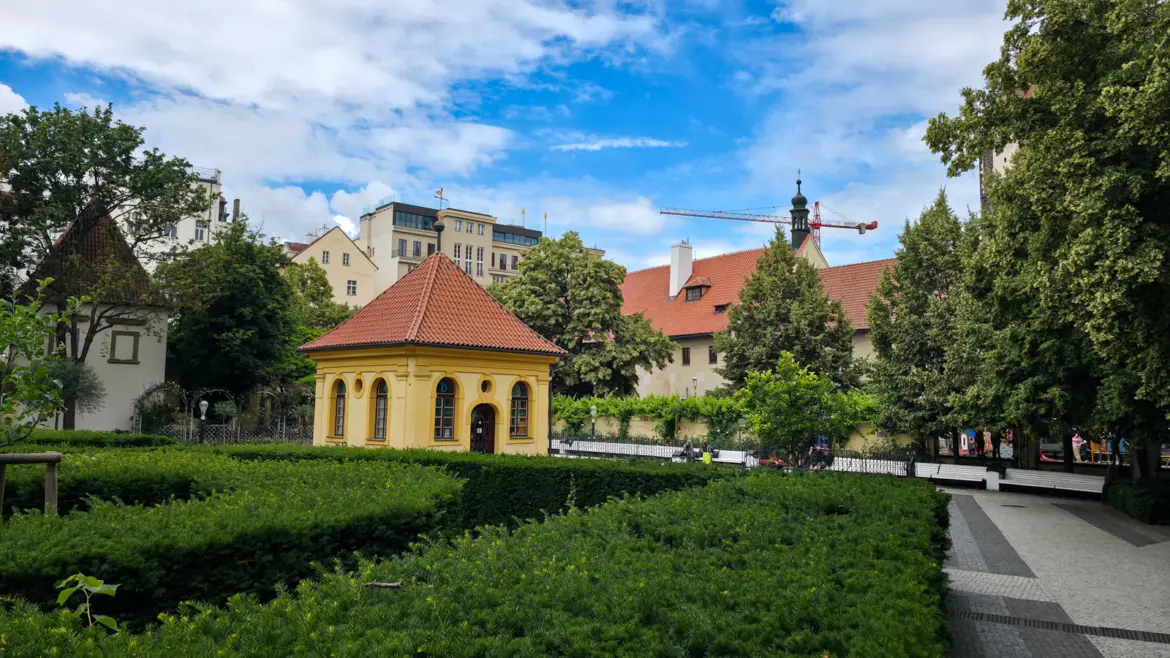
We would never have found the Franciscan Garden on our own. We were on a walking tour of Prague with a local historian, and just a few steps from the busy streets around Wenceslas Square, he led us into a garden that most people walk straight past. I’m so glad we went with him.
The Franciscan Garden is a peaceful oasis in the heart of the New Town. There are manicured hedges, neat flower beds, fruit trees and long rows of white benches, and it is open to the public. Locals stroll through it, and some simply pass through on their way somewhere else. We were there in June, so the roses and flower beds were in full bloom.
What I appreciated most, though, is how rooted in history this garden is. It has been a garden for almost seven centuries, and knowing what it has lived through makes it so much more symbolic than a pretty city park.
The Franciscan Garden at a Glance
🌳 A hidden oasis · A quiet, walled garden a few steps from Wenceslas Square, easy to walk straight past.
⛪ Almost seven centuries old · Carmelite monks planted it in 1348, beside Charles IV’s Church of Our Lady of the Snows.
🕊️ From monks to the public · The communists expelled the Franciscans in 1950 and opened the garden; it returned to the Church after 1989.
🌹 Roses and herb beds · Clipped yew hedges, rose-covered arches, fruit trees and herb beds recalling the monks who grew food here.
🆓 Free and open to all · Open year-round during the day and closed at night, with several entrances off the surrounding streets.
☕ Cafés around the edges · Hidden coffee courtyards line the garden — pick up a drink and find a bench under the roses.
From Carmelites to Franciscans
The story starts with Charles IV. In 1347, he founded the Church of Our Lady of the Snows to mark his coronation as King of Bohemia, alongside his wife, Blanche of Valois. A year later, as his New Town was being laid out, the Carmelite monks who ran the church created a garden beside it.
The church, whose tall Gothic chancel still towers over the garden, was meant to be enormous, big enough to rival St Vitus Cathedral at Prague Castle. It never got that far. During the Hussite Wars of the early 15th century, the complex was plundered and much of it was destroyed.
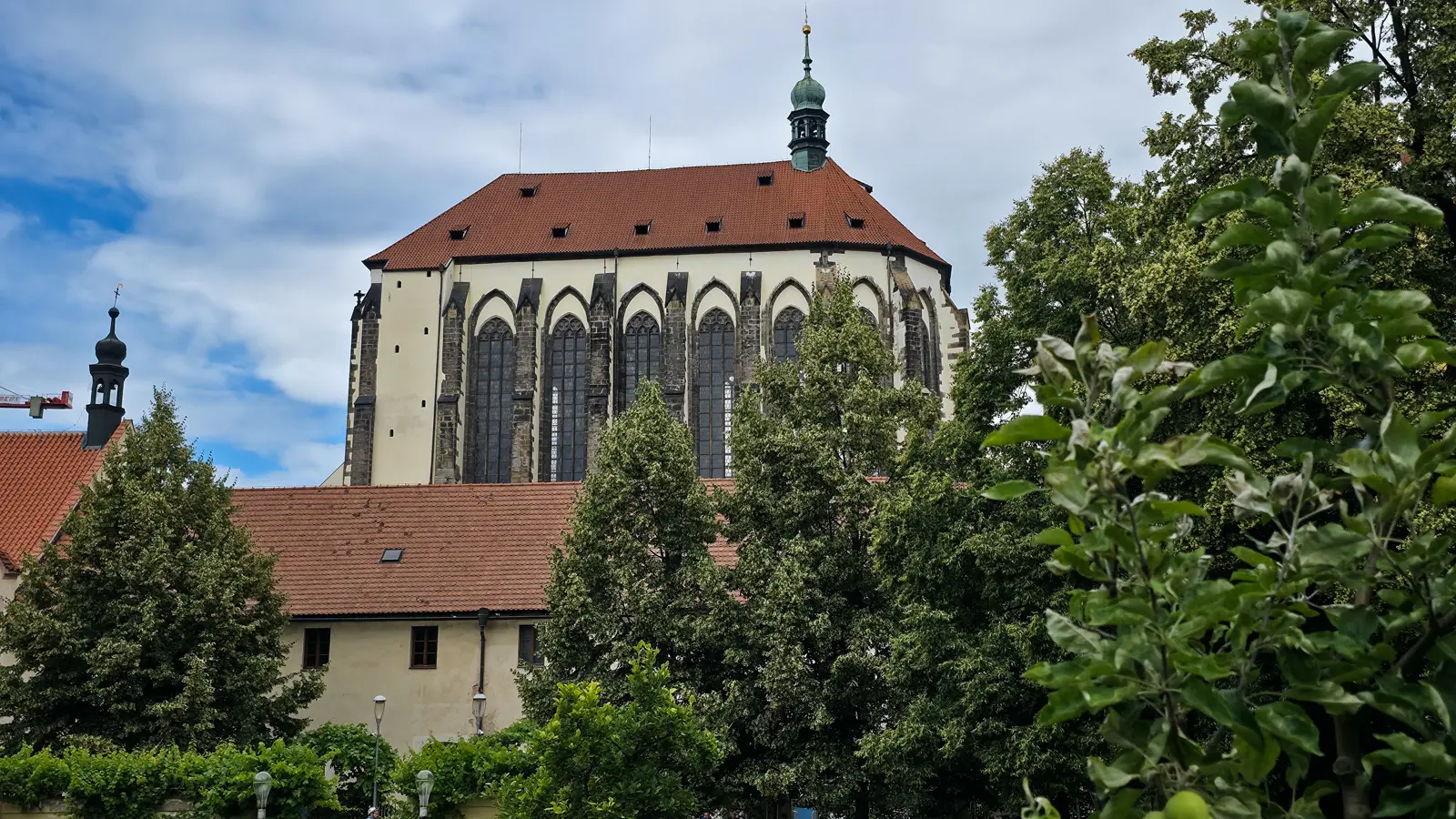
In 1604, the Franciscans took over the ruined monastery, repaired the church and gave the garden the name it still carries. Under both the Carmelites and the Franciscans, the monks used it to grow food, including herbs, fruit, vegetables and spices, as well as flowers to decorate the altars.
Then came the darkest chapter. In 1950, the communist regime expelled the Franciscans. Some of the friars were sent to prison and others to internment camps, and the garden was opened to the public. After the Velvet Revolution in 1989, the monastery was returned to the Catholic Church.
For me, this is what makes the garden so special. It was planted by monks, taken from them by the communists and handed to the people of Prague, and today anyone can walk in and sit down.
Our guide spoke openly about how difficult life under communism was, and it changed the way I saw the garden. This place carries its history, much of it dark, even if what greets visitors today is a sense of calm and peace.
A Baroque Garden Plan
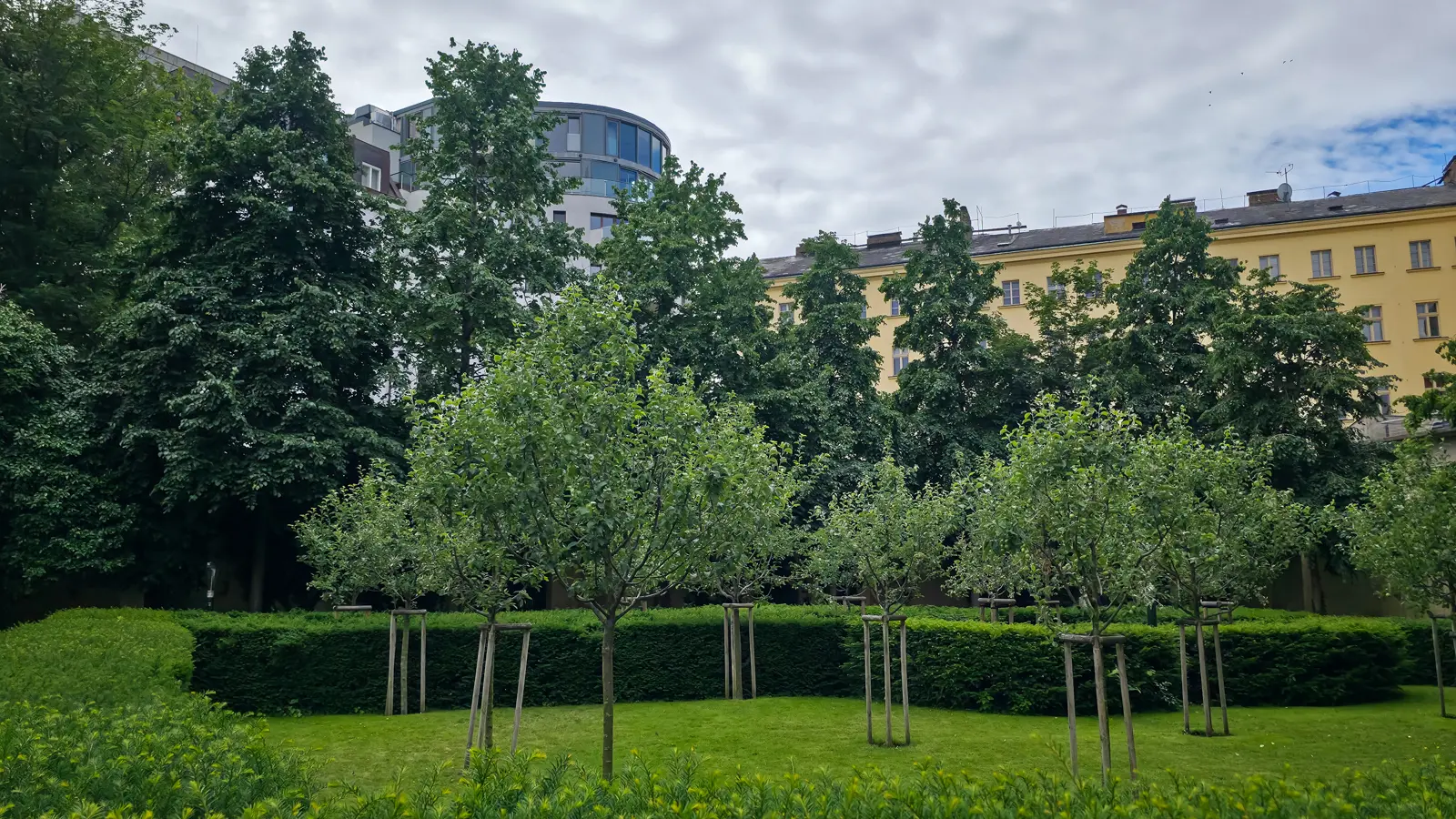
The layout is wonderfully geometric. Low yew hedges divide the lawns into neat sections, wide paths run between them, and at the centre stands a small yellow Baroque pavilion with an orange-tiled roof.
The hedges are tall enough for small children to get lost in. Children were running between them, disappearing behind one row and popping up again further along.
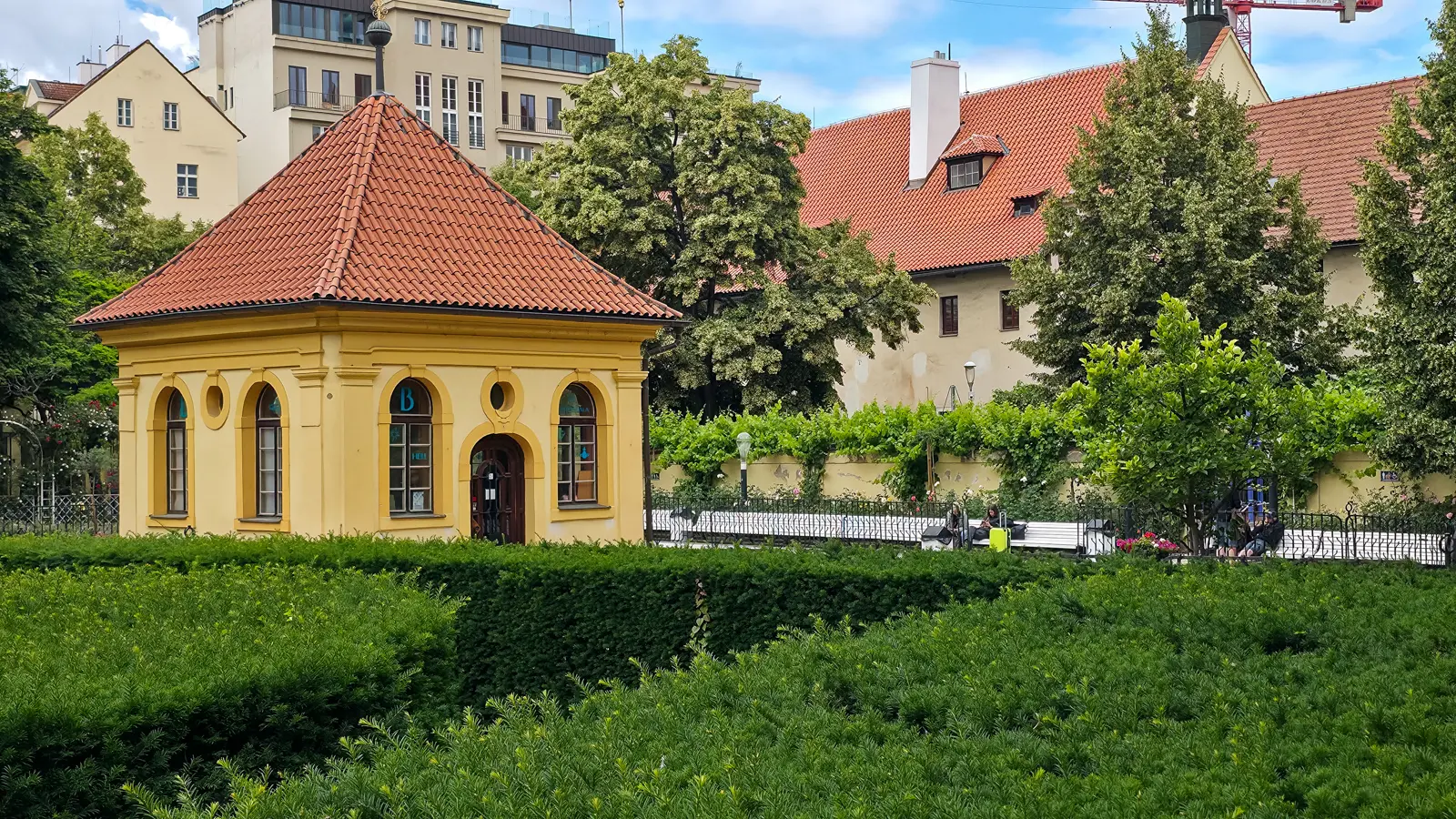
Around the edges, there is a mix of old houses, white walls and rose-covered arches, with more modern buildings rising behind them.
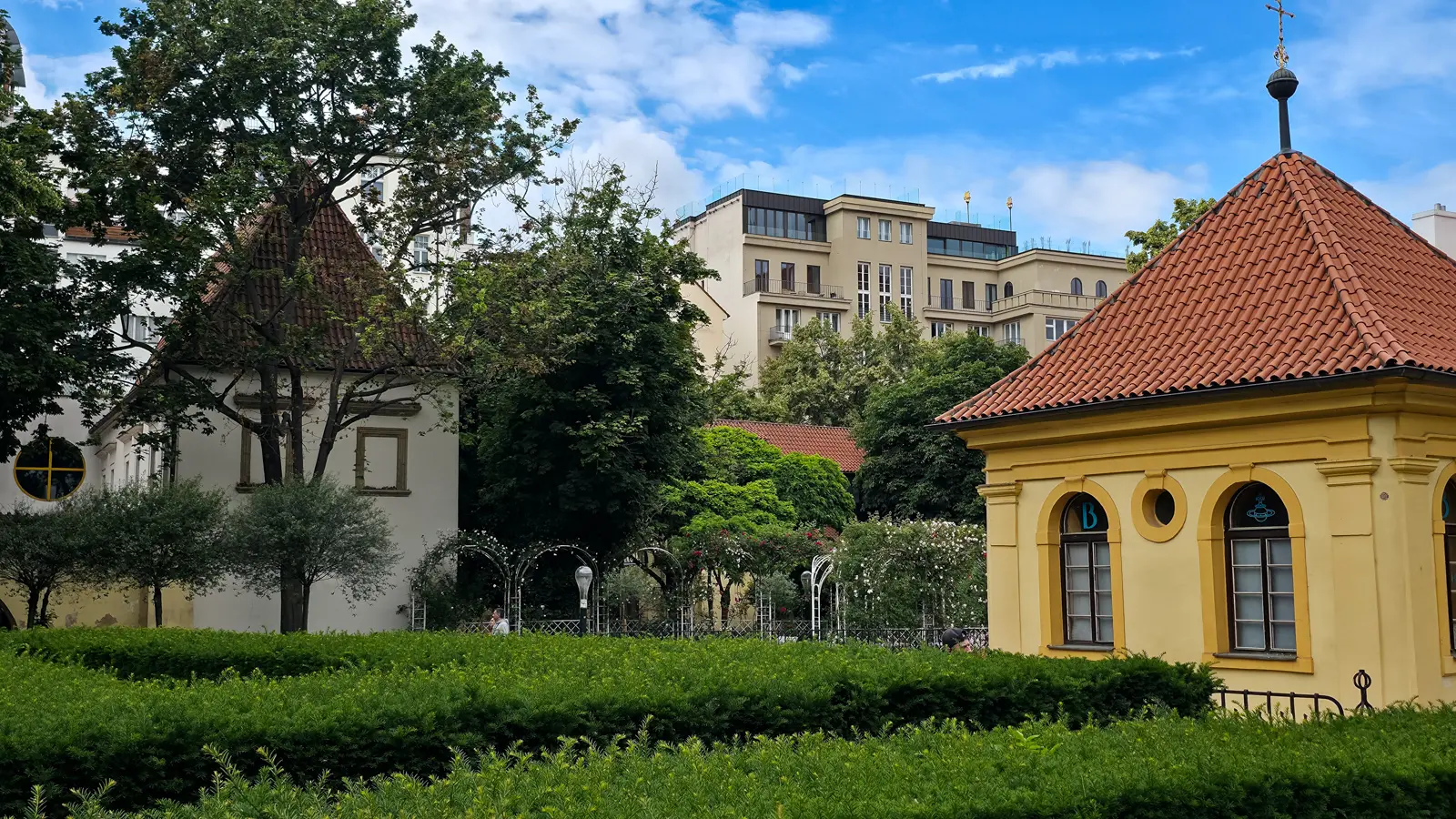
What surprised me is how completely the garden is enclosed. Apartment blocks and office buildings surround it on every side, yet once we stepped inside, it was much quieter. It was hard to believe that some of the busiest streets in Prague were just on the other side of those walls. Looking up, the contrast is striking: a modern office block with striped blue-green shutters on one side, and old mansard roofs and dormer windows on the other.
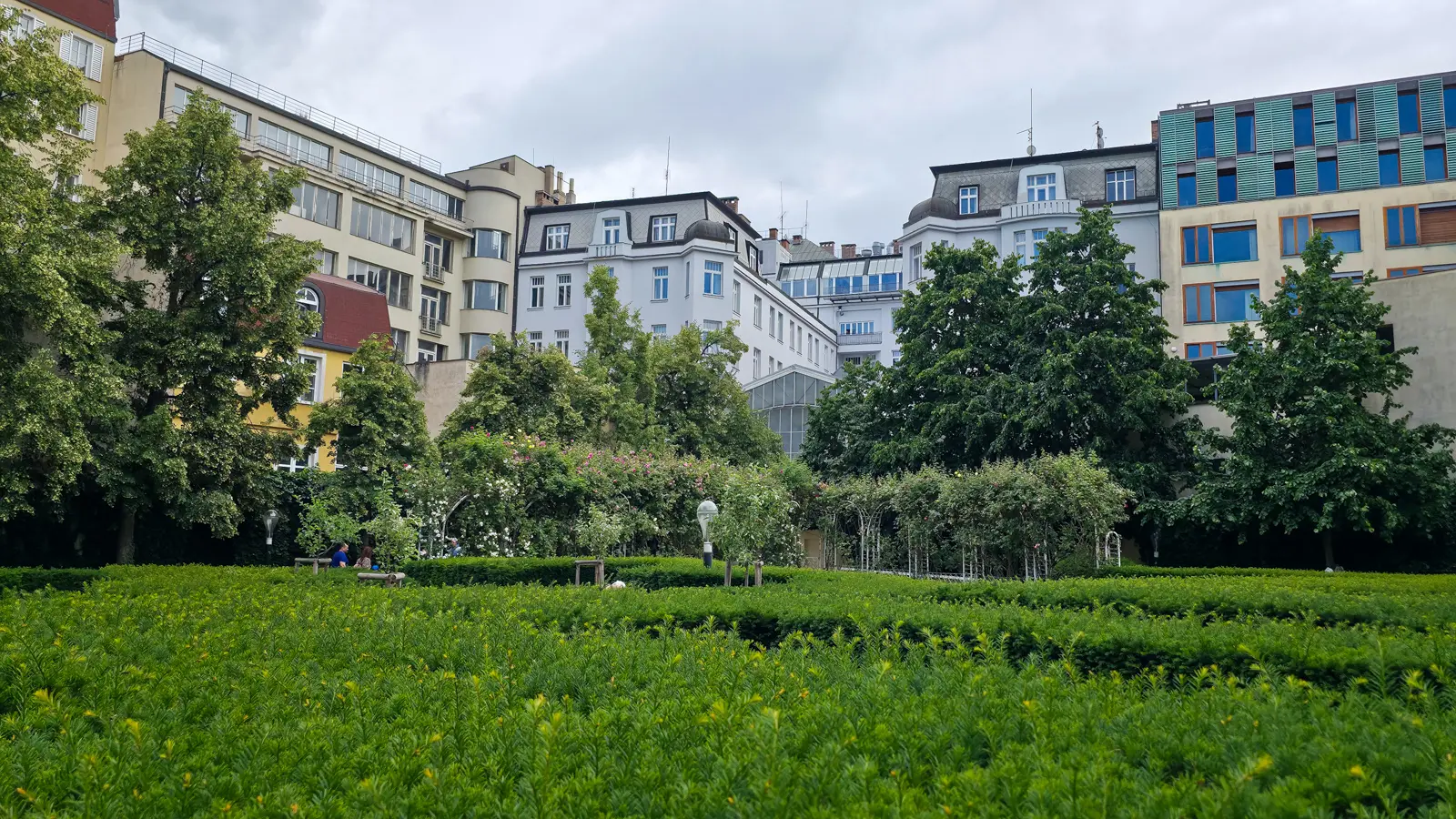
Fruit Trees, Herbs and June Blooms
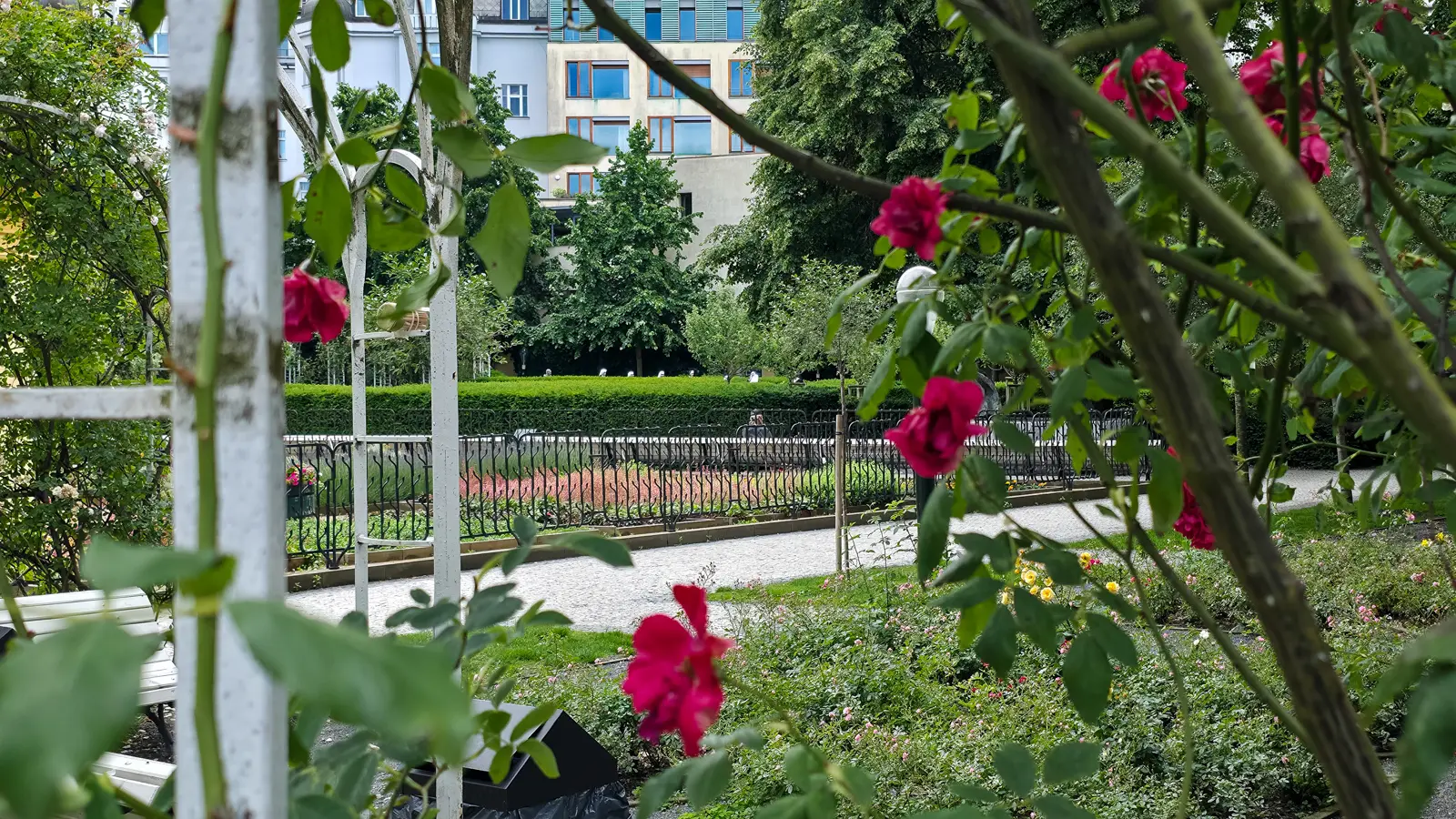
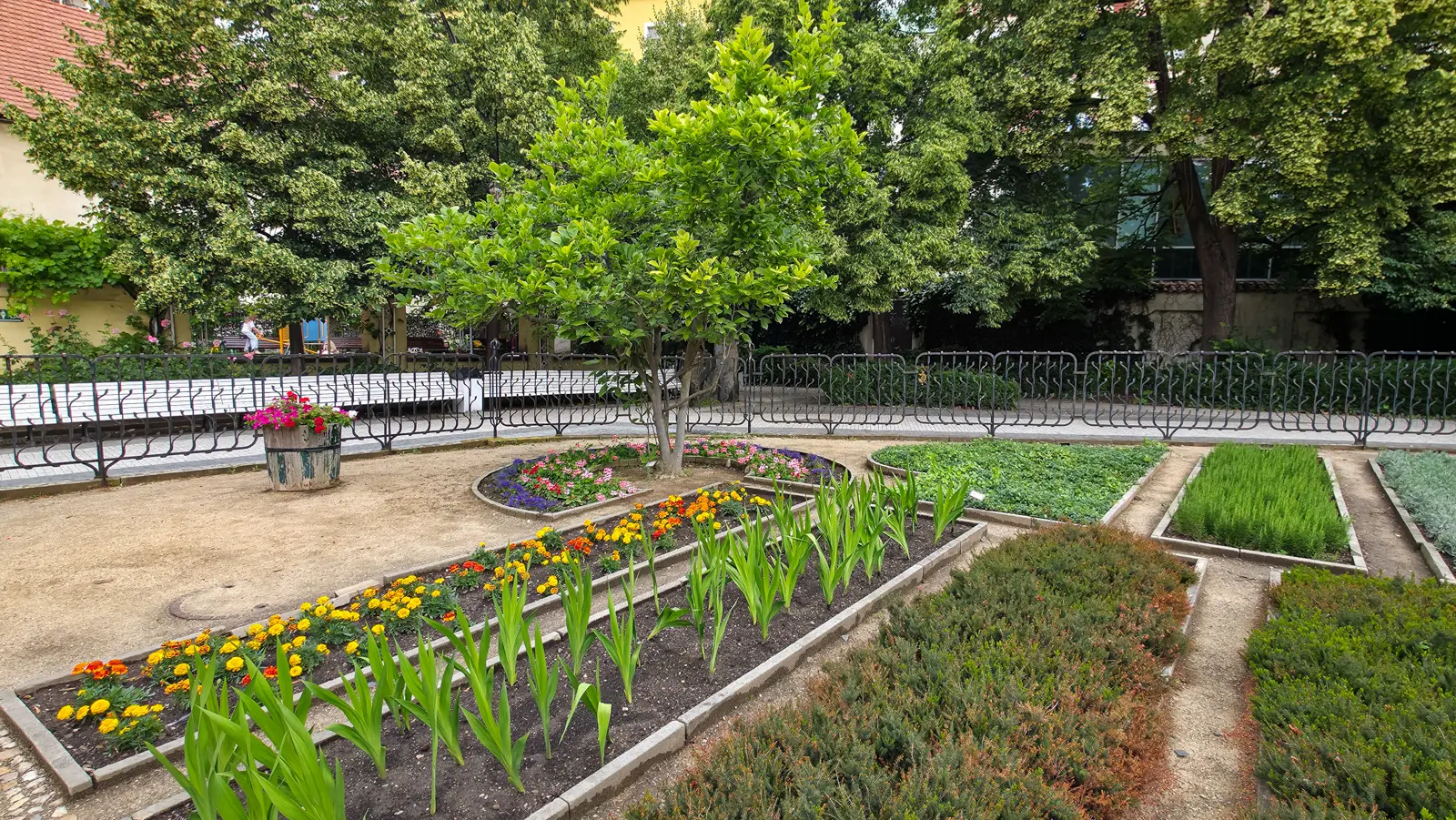
In June, the garden was full of colour. Roses climbed over white metal arches, the flower beds were packed with red and pink geraniums and orange marigolds, and the young fruit trees were heavy with leaves. The scent of the flowers was subtle, never overpowering. It was just perfect.
The roses were my favourite part. Through the arches, there are views across the whole garden, from the flower beds to the benches along the paths.
The flower and herb beds are laid out in neat raised rectangles edged in stone, each planted with something different: red and pink geraniums in one, a carpet of low green herbs in another, leafy plants in a third. An old wooden barrel overflowing with pink and red flowers stood at the edge of the gravel, and a pigeon wandered between the beds. The herb beds are a lovely nod to the monks who once tended this ground.
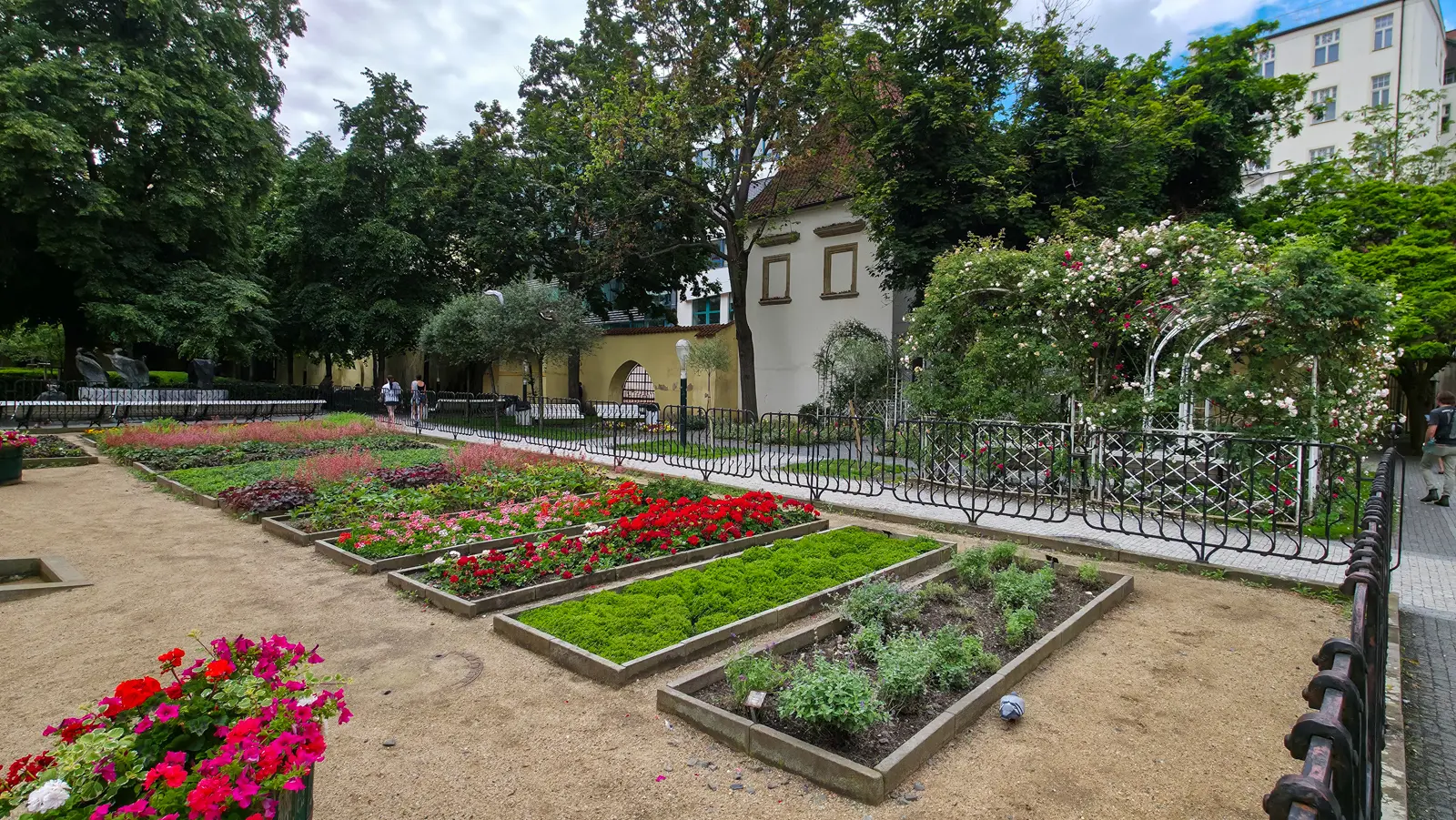
Further along, more beds were planted with marigolds, gladioli and heather, with a children’s playground just beyond the railings.
A Place to Stroll and Sit
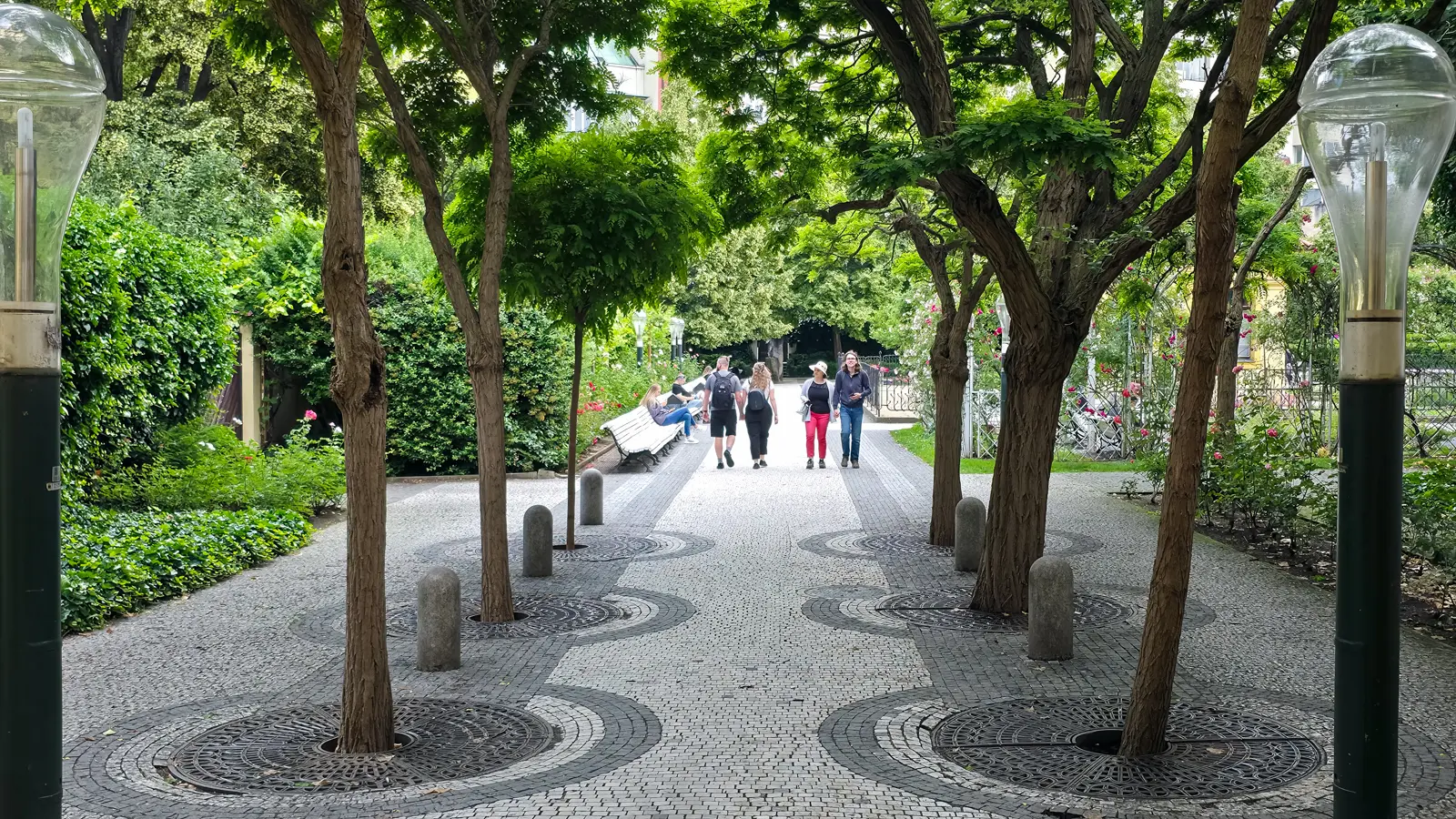
This is where locals come to unwind. People sat quietly on the long white benches, couples strolled hand in hand along the paths, and others simply took a break from the city for a few minutes. Some walk straight through, using the garden as a shortcut. One of the main paths runs under a row of trees, with swirling grey-and-white cobble patterns around each trunk, stone bollards and tall glass lamps like oversized light bulbs.
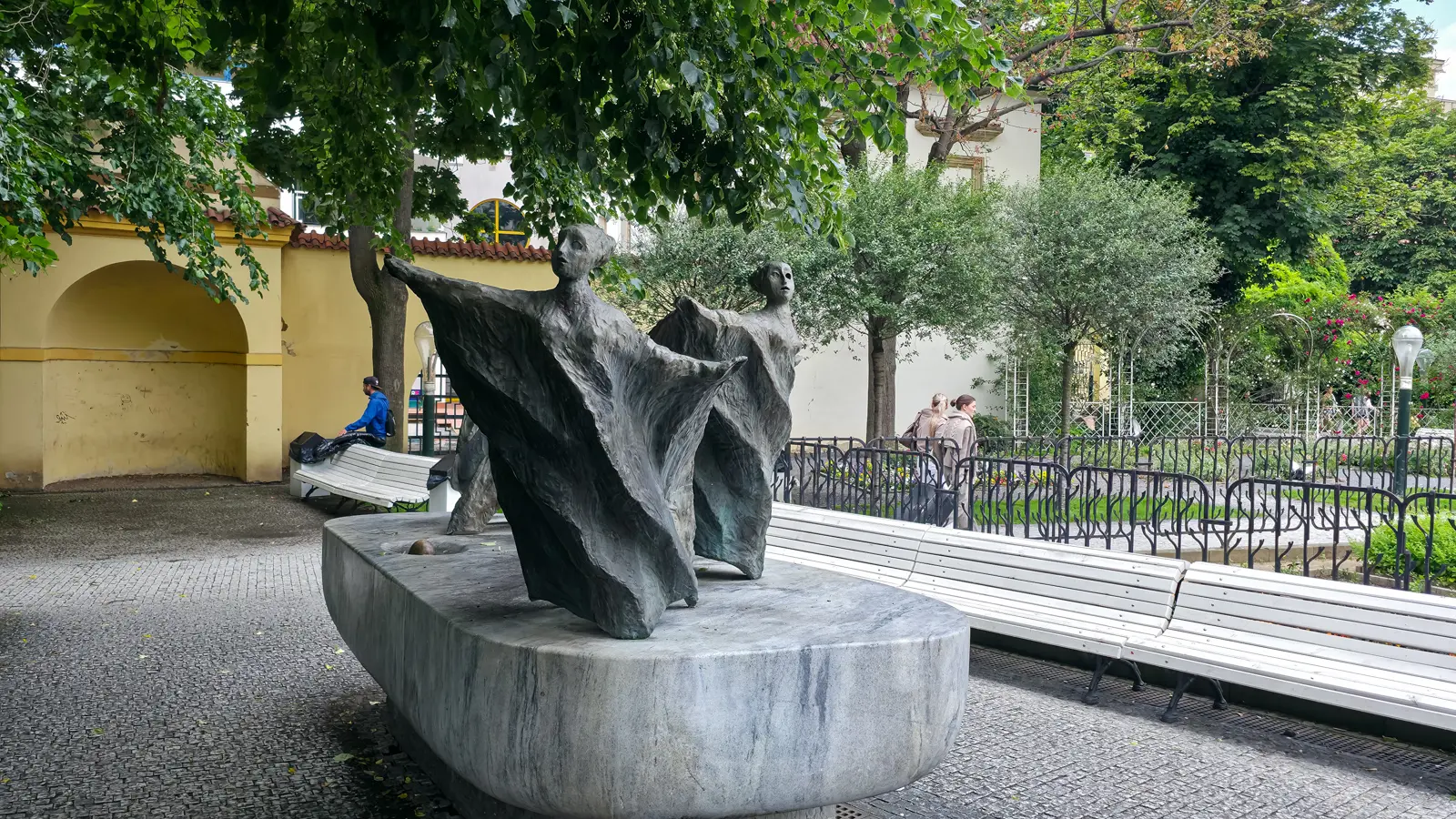
One detail is easy to miss. Behind the pavilion stands a bronze fountain of dancing female figures with hollow faces, their robes flaring out as if caught by the wind. It is the work of the Czech sculptor Josef Klimeš.
Cafés Tucked Around the Edges
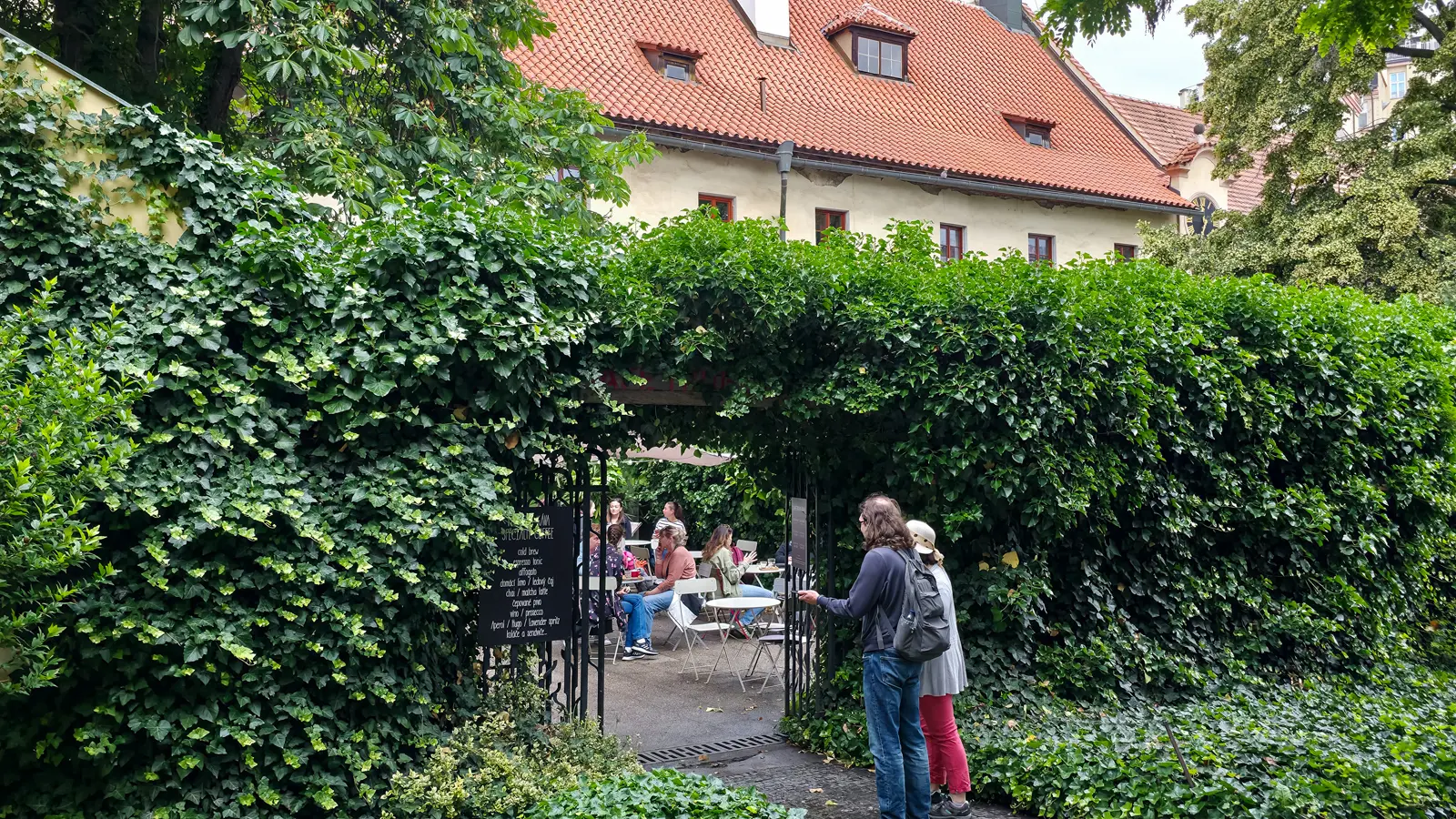
There are also hidden cafés and restaurants around the edges of the garden. We passed an ivy-covered gate with a chalkboard menu of specialty coffee, cold brew and homemade cakes, and people were relaxing at little tables in the courtyard behind it.
If we hadn’t been on a tour, I would have loved to stay longer with a coffee. It is a great place to unwind.
Bubbly Tips
- Find an entrance. The garden can be entered from Jungmannovo náměstí, through the Světozor passage from Vodičkova Street, or through a passage from Wenceslas Square.
- Look at the gate. The entrance from the Alfa passage off Wenceslas Square has a gate with 16 scenes from the life of St Francis, by the sculptor Karel Císařovský.
- Visit in June for the roses. When we went in June, the climbing roses over the benches and the flower beds were in full bloom.
- Bring a coffee. Pick up a drink from one of the cafés around the edges and find a bench under the roses.
- Go during the day. The garden is open year-round but closes at night.
- Look for the other sculptures. Stanislav Hanzík’s Boy with a Shell fountain and his sculpture of Aesop are also in the garden.
- Visit the church too. The Church of Our Lady of the Snows stands right next to the garden and can be combined with a visit.
- Book a historian-led tour. A walking tour with a local historian is how we found this garden, and it gave us the history behind what we were seeing.
Final Thoughts
The Franciscan Garden is one of those places that makes Prague so rewarding to explore. A few steps from Wenceslas Square, there is a garden that monks planted almost seven centuries ago, that the communists took away and that now belongs to everyone.
Next time, I’ll bring that coffee and stay a while.
Until next time!

🌟 Everything You Need to Plan Your Dream Trip in 2026
- 🌟 Luxury Hotels - Find premium stays with Booking.com & Hotels.com
- 🏡 Vacation Rentals - Discover unique properties on VRBO
- 🏞️ Guided Tours - Explore with Viator or GetYourGuide
- 🎫 Attraction Tickets - Skip the lines with Tiqets
- 🚢 Ocean Cruises - Set sail with Cruise Direct
- 📱 International SIMs - Stay connected with Saily
- 🚗 Car Rentals - Budget-friendly options from Discover Cars
- 🌐 Secure VPNs - Browse safely with NordVPN
- 💶 Currency Exchange - Best rates with Wise
- 🗣️ Learn Languages - Master the local language with Babbel and Rosetta Stone