
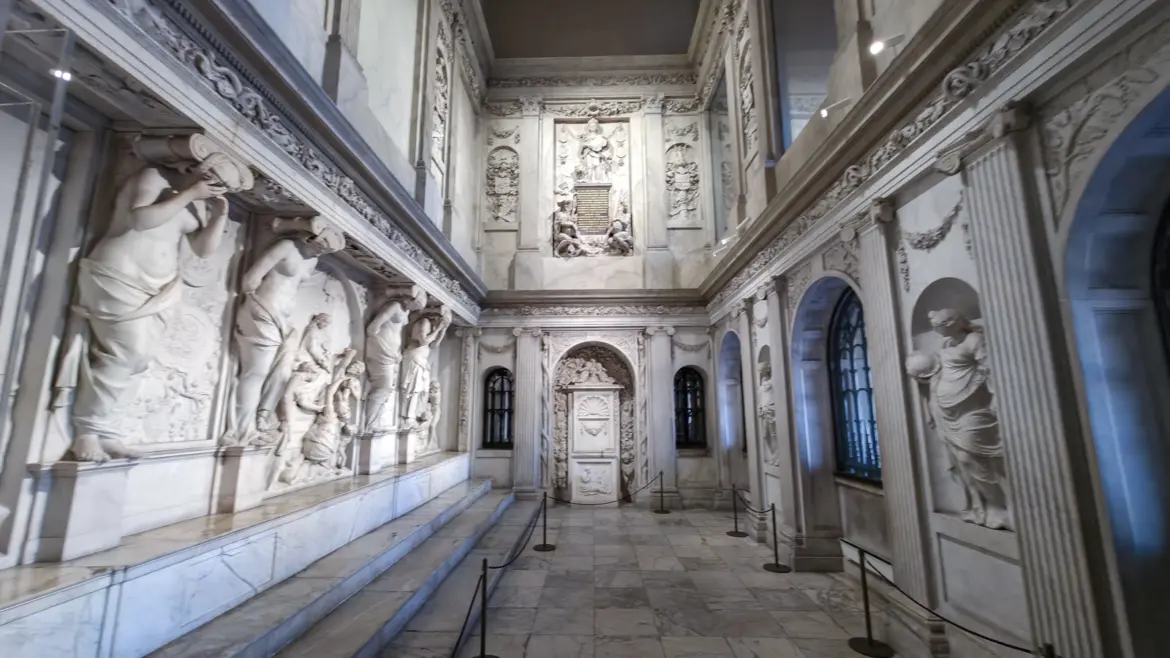
The Royal Palace on Dam Square has one room that most visitors walk straight past. It sits on the ground floor, on the Dam side, and it is numbered 21 on the palace route. The sign outside it carries two words, one Dutch and one English: Vierschaar, Tribunal. Neither of them tells a visitor what happened here.
I took the audio tour, and I am glad I did. Without it I would have registered a cold marble room with good carving in it and moved on to the Citizens’ Hall. What I would have missed is that this is where Amsterdam‘s magistrates pronounced sentences of death, in public, for a hundred and fifty years.
The room was also almost empty, which I had not expected in a building this busy. It sits late in the route. Most people go up to the state rooms, finish there, and leave without coming back down for it. At half past five on a late April afternoon I had it more or less to myself.
The Vierschaar at a Glance
⚖️ What it was · The marble tribunal on the ground floor of the Royal Palace (former town hall), where Amsterdam’s magistrates pronounced death sentences in public for about 150 years.
🗣️ How it worked · The trial and conviction happened elsewhere. Here the schout and nine schepenen spoke the sentence aloud, watched from Dam Square through barred windows.
🗿 The sculpture · By Artus Quellinus, called the “Night Watch of Dutch sculpture”: four caryatids of Remorse and Penance, and three reliefs of just judgement (Zaleucus, Solomon, Brutus).
🔇 The detail · The city secretary’s seat carries a figure of Silence, a rule cut into the marble.
💡 Tip · It is stop 21 on the route, near the entrance, and easy to walk past. Take the audio guide, or the room is beautiful and mute.
What a vierschaar was
The word is older than the building. A vierschaar was a court held in the open air, its ground marked out by four benches, or scharen, with the accused standing in the middle. The name stayed attached to the practice long after the practice moved indoors, and Jacob van Campen kept it when he designed the new town hall in the 1640s.
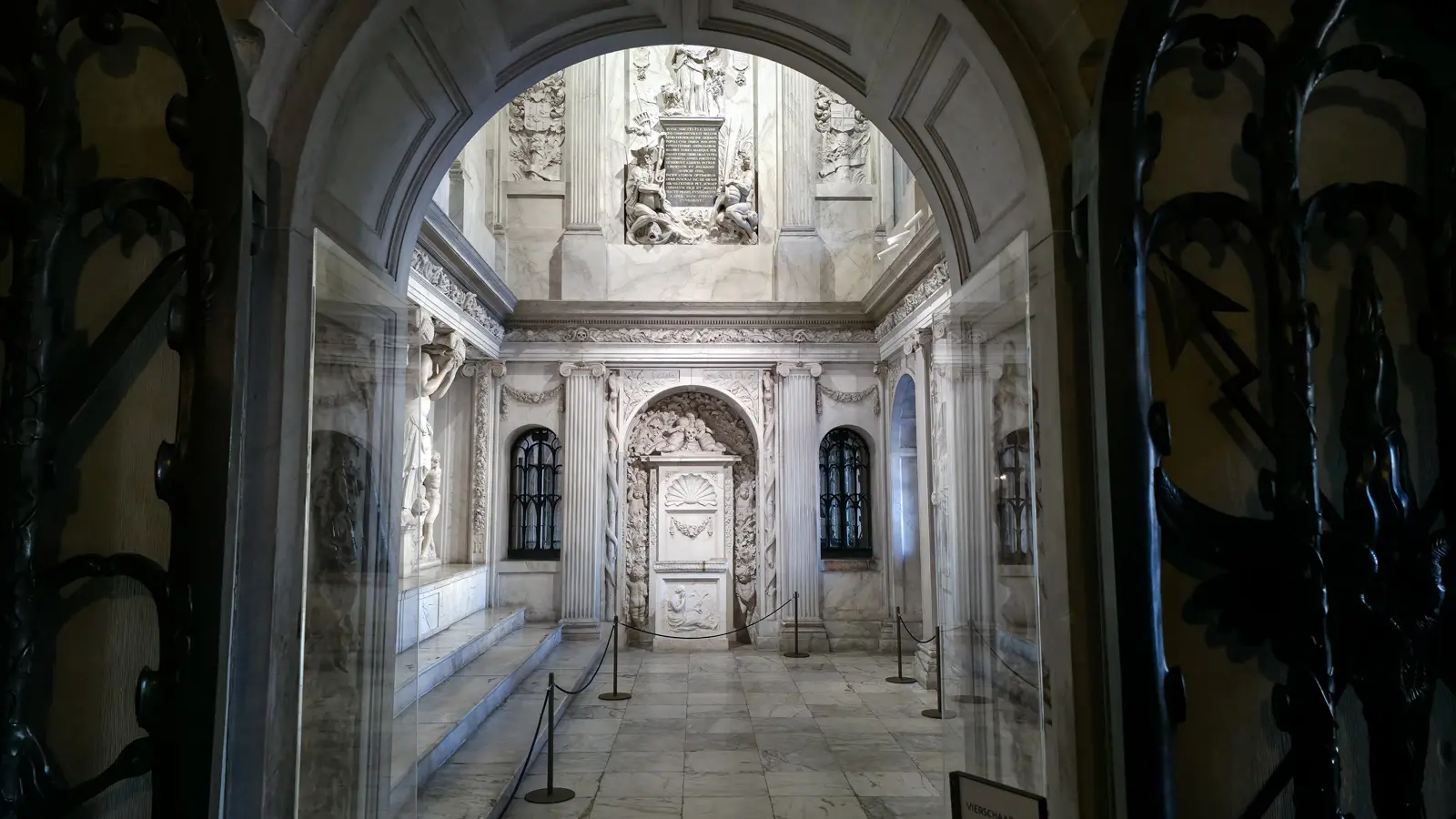
The room was not a courtroom in the working sense. The trial happened elsewhere in the building, and so did the conviction. A prisoner could only be condemned to death after confessing, and the torture chamber that produced confessions was on this same floor. What took place in the Vierschaar was the ceremony: the sentence, spoken aloud, where the city could hear it.
The schout, who was both chief prosecutor and head of the city’s police, sat with nine schepenen, the citizen magistrates who served as the city’s judges, on the long raised bench. The public watched from Dam Square through the barred openings, standing under the arcades outside. The room was designed to be looked into. It also looks out. Standing inside, Dam Square is right there through the grilles, which means whoever was hearing the sentence could see the square where the scaffold would be put up, and the people already gathering on it. The Royal Palace puts the average at three or four death sentences a year.
Quellinus and the marble
The sculptures are by Artus Quellinus the Elder (1609 to 1668) and his workshop. An Antwerp sculptor, he came to Amsterdam to run the workshop that decorated the whole building. The Vierschaar was his first work here. The poet Joost van den Vondel, writing at the time, compared him to Phidias. The palace today describes the room as the Night Watch of Dutch sculpture.
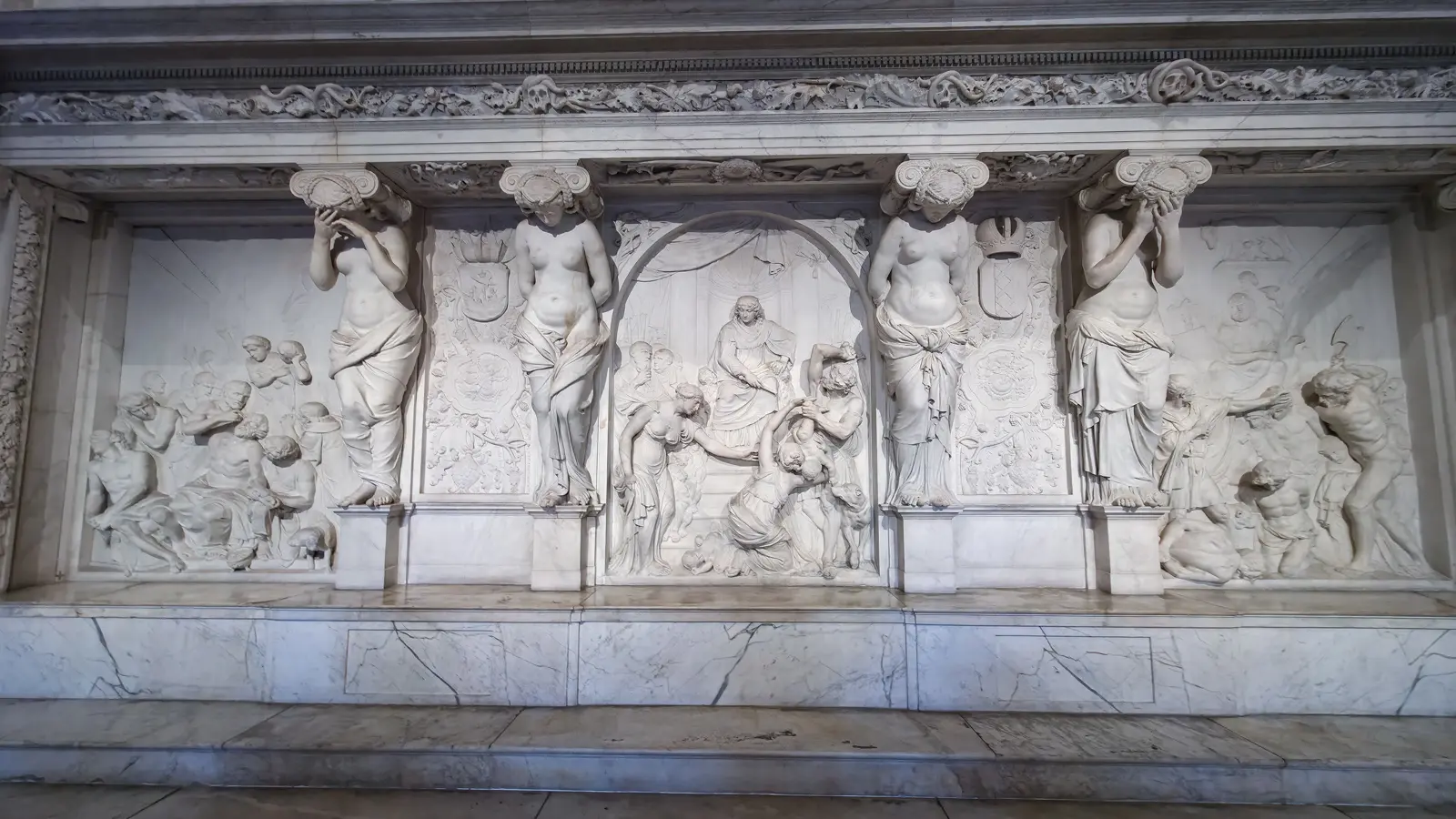
Reading the wall from left to right, the sequence runs: the judgement of Zaleucus, a caryatid, the seal of Amsterdam, a caryatid, the Judgement of Solomon, a caryatid, the arms of Amsterdam, a caryatid, and the judgement of Brutus. The three reliefs are examples of good judgement, chosen to steady the men on the bench beneath them.
The four women holding up the entablature are the part that stays with me. Two of them cover their faces with their hands. The other two have their hands bound. The marbles have never left this room, but Quellinus’s clay models for them did, and the Rijksmuseum, which holds those models, names the first pair Remorse and the second Penance. Dutch sources more often call all four of them Guilt and Remorse. Either way they are the only figures in the room addressed to the person being sentenced rather than to the men doing the sentencing.
Three judgements
Solomon holds the centre. The story is the one everyone knows, two women claiming the same infant, and the king proposing to divide it in order to find out which of them would rather give it up. It stands for wisdom.
Brutus holds the right-hand panel. Lucius Junius Brutus, consul of the young Roman republic, had his own sons beheaded for conspiring against it. It stands for justice, and it is a hard thing to hang above a bench of men about to condemn somebody else’s son.
The left-hand panel is the one I stood in front of longest.
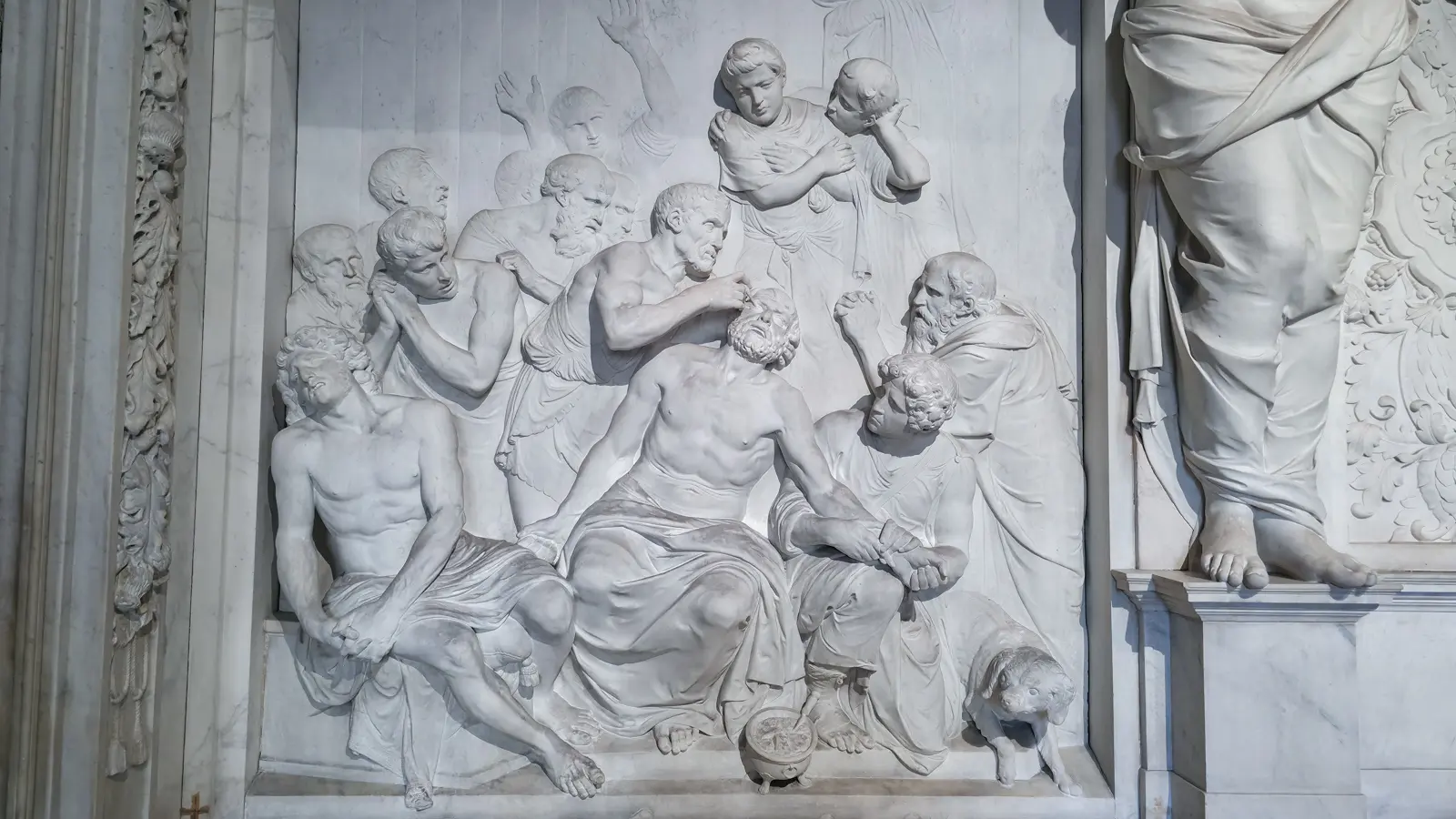
The three reliefs come from three different worlds. Solomon is biblical, Brutus is Roman, and Zaleucus is Greek. So, for that matter, is the word for the four women holding up the entablature. Caryatid comes from Karyai in Laconia, whose women danced at the festival of Artemis and lent their name to the draped stone figures of the Erechtheion. Medusa heads run through the frieze overhead. I grew up with these stories in Greek, long before I knew anything about Amsterdam, and I had not expected to meet them cut into the wall of a Dutch courtroom.
The sentence Zaleucus had written into his own law was the loss of both eyes. When his son fell under it, he took one of the two eyes himself so that the boy would keep one. The relief shows the moment his eye is put out, with his son beside him, already blinded in one. It stands for mercy, which in this room means a sentence carried out and shared rather than waived.
The seat that was told to say nothing
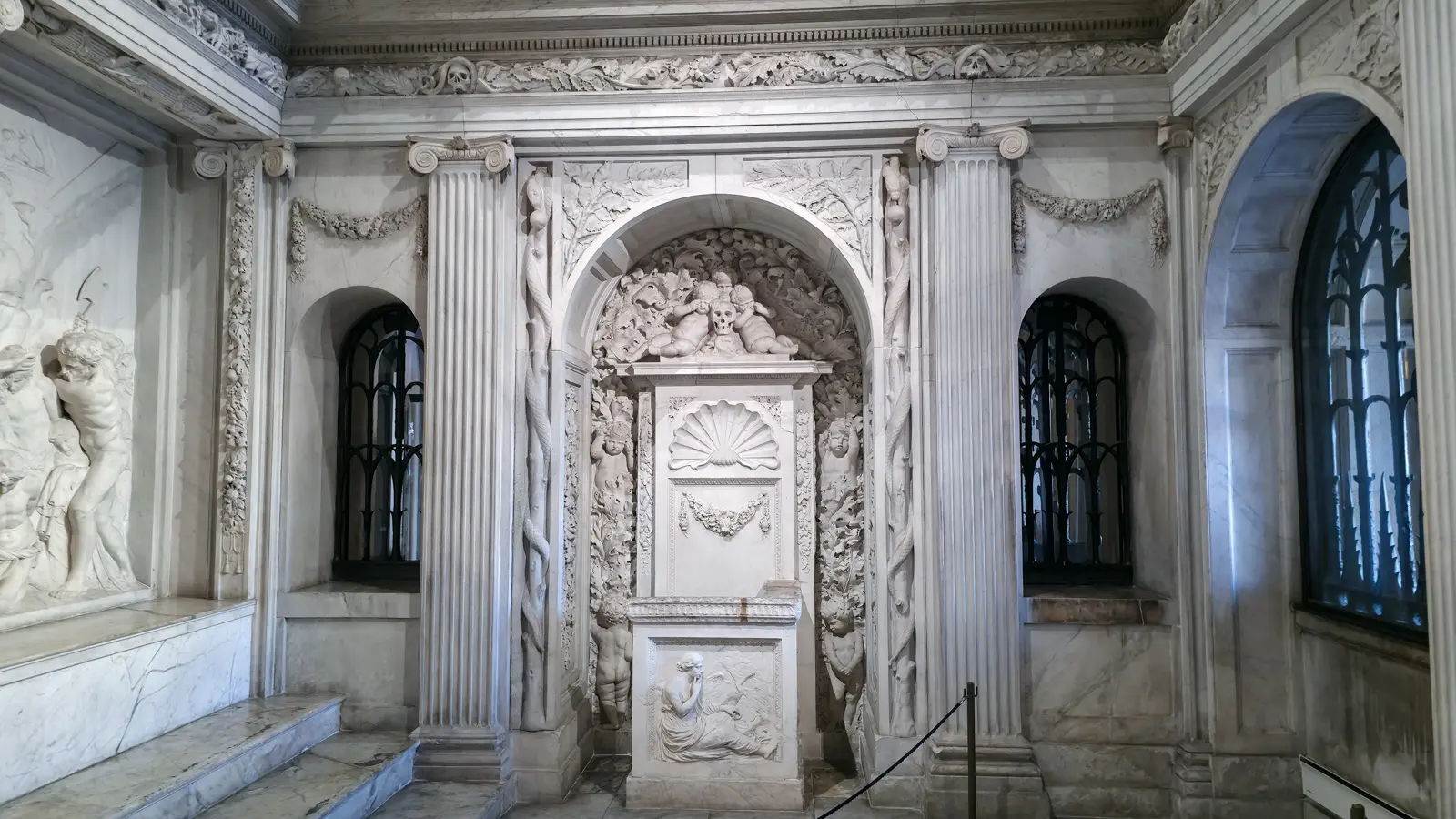
Under the arch at the end of the room stands the seat of the city secretary, the official who kept the record.
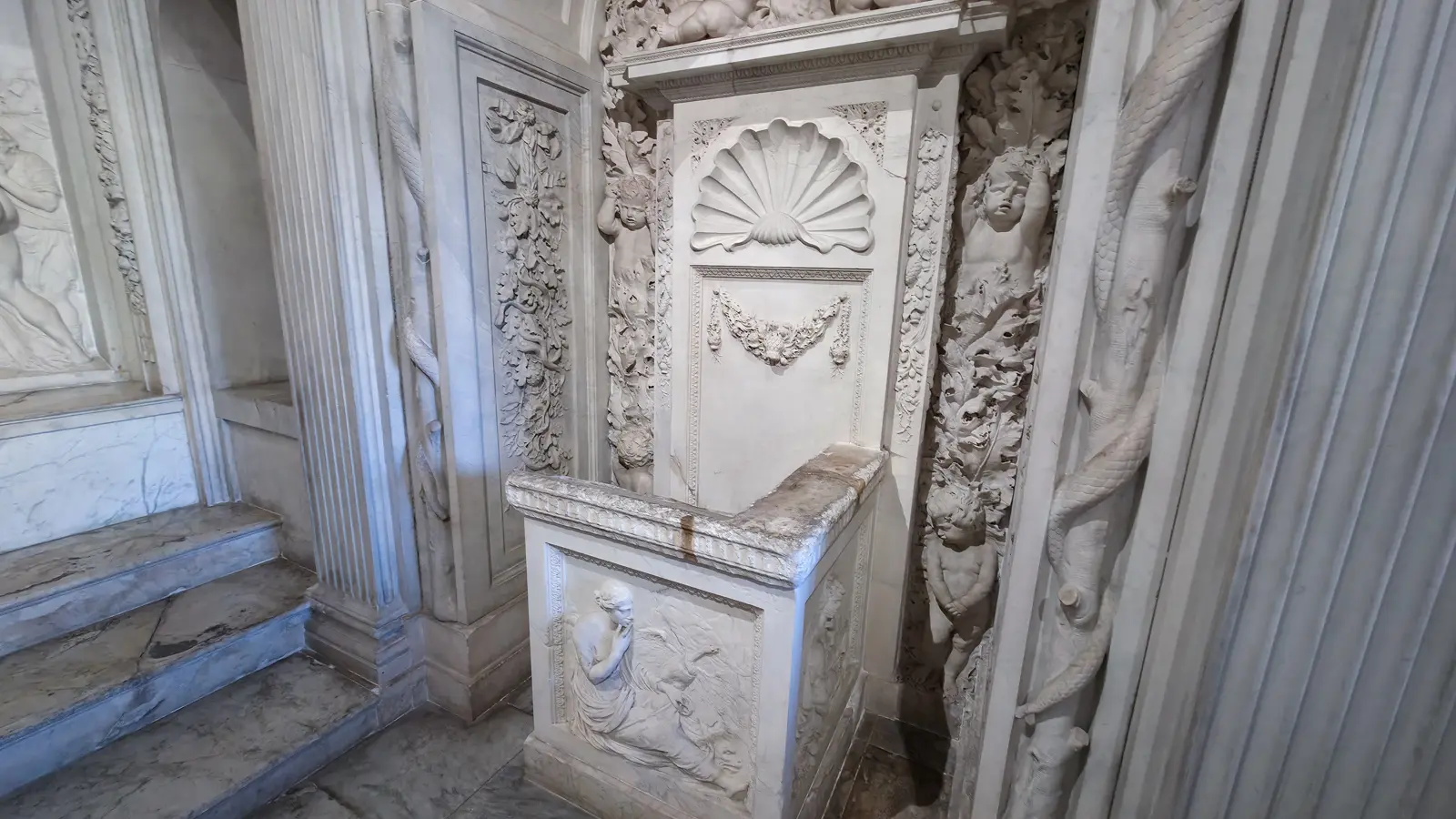
The carving around it does not let up. Cherubs hold a skull in the head of the arch, serpents wind through the oak leaves down both sides, and a seated woman with her hand raised towards her mouth is cut into the front panel of the desk itself. She is Silence. Anyone standing where the condemned stood was surrounded by it.
The politics above the bench
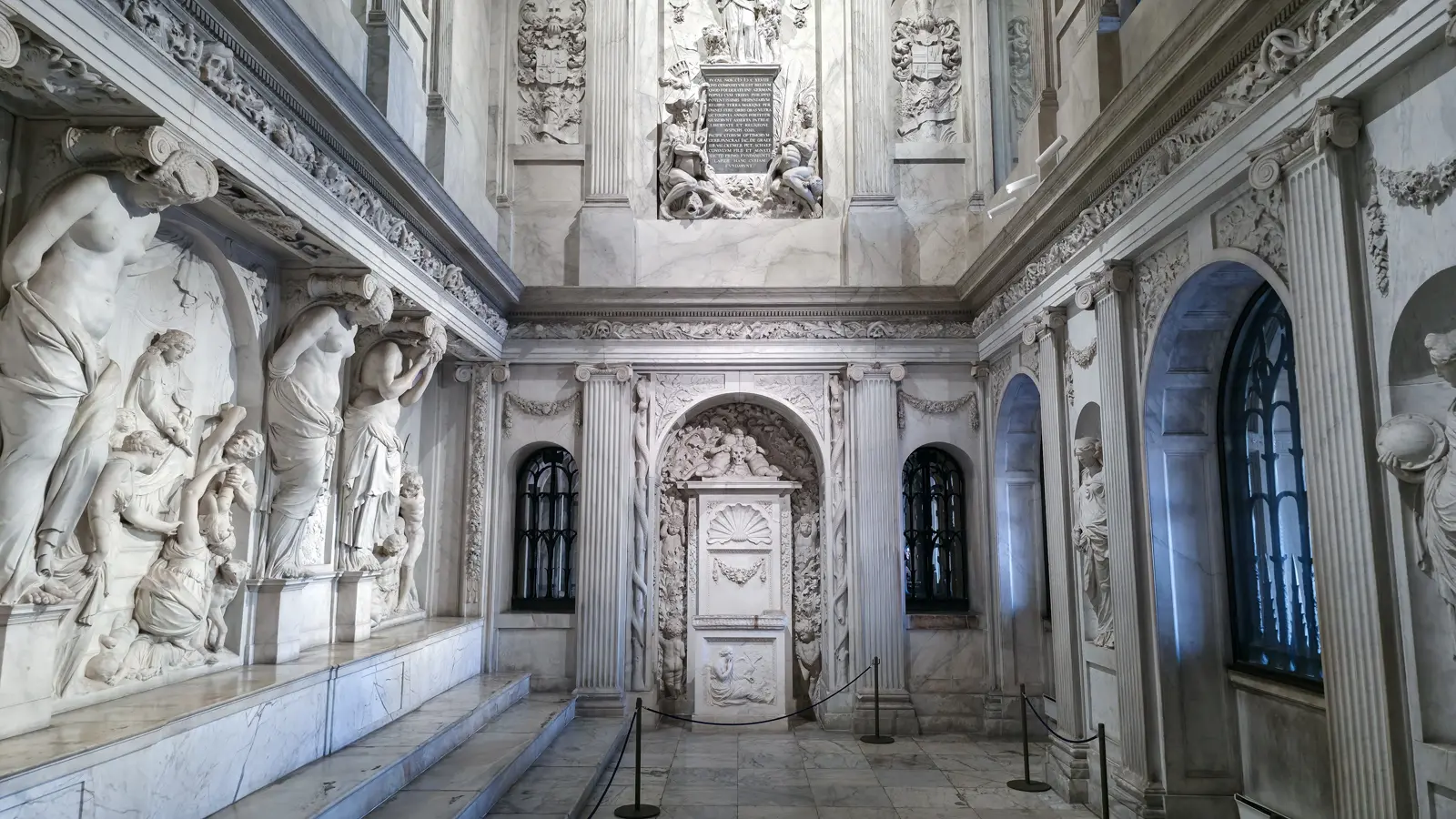
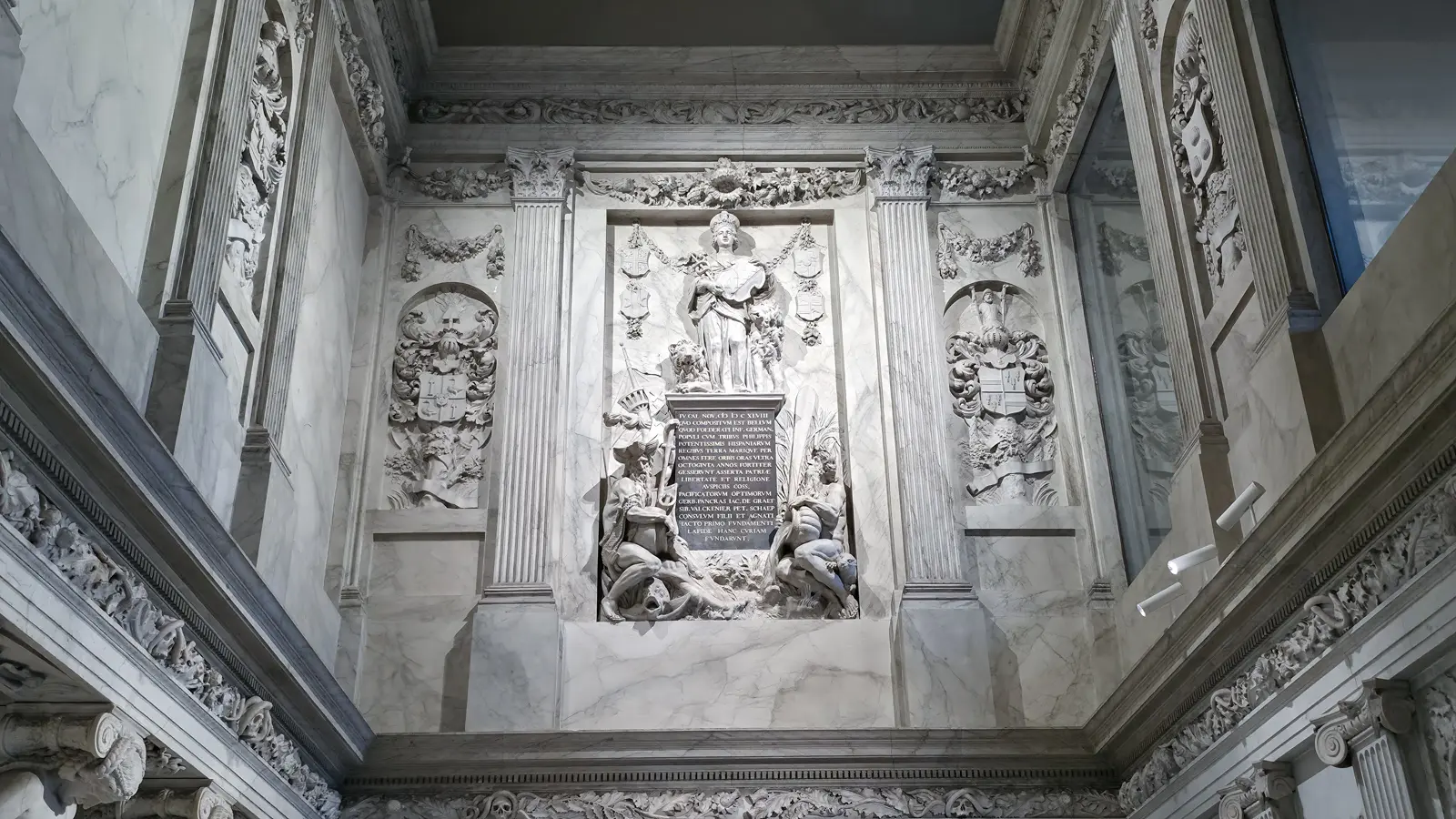
High on the wall, above the secretary’s seat, is a monument that has nothing to do with criminal justice and everything to do with why the building exists.
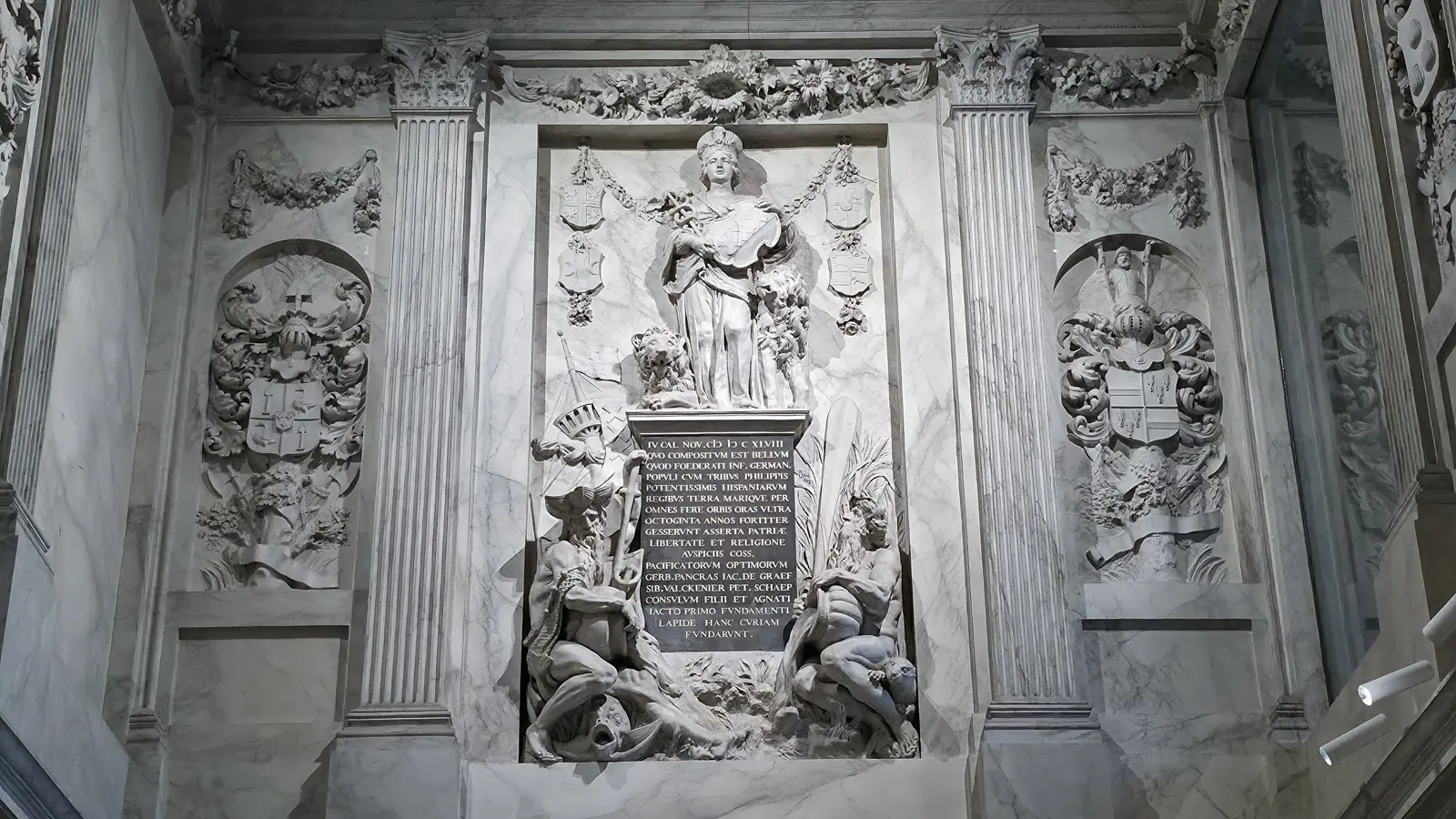
The black tablet is touchstone, with the letters gilded. The text was written by Cornelis de Graeff, one of the burgomasters, and it dates the laying of the first stone to 29 October 1648. It describes that year as the one in which the war ended that the United Netherlandish peoples had waged against three Philips, kings of Spain, by land and sea, across almost every part of the world, for more than eighty years. Then it names the four burgomasters in office, Pancras, De Graeff, Valckenier and Schaep, and records that it was their sons and kinsmen who laid the first stones.
The Peace of Münster had been signed on 30 January that year. The decision to build on this scale followed it directly. A city that had just come out of eighty years of war put its money into a town hall, and put the record of that war on the wall of the room where it killed people.
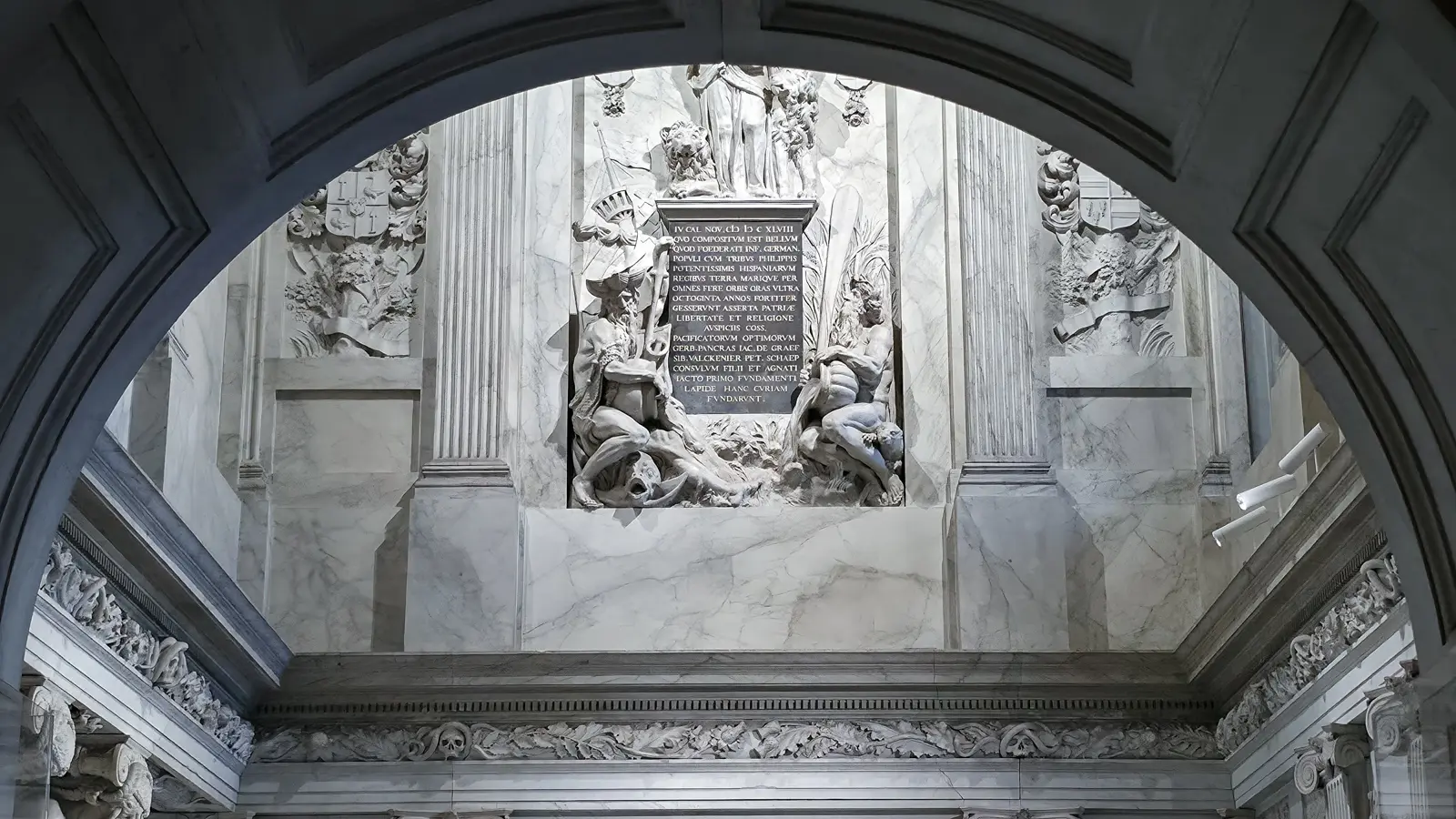
Carved coats of arms sit in arched niches on either side of the monument and around the upper walls, held up in cartouches with helmets above them. They are not decoration. Each one belongs to a named man who governed Amsterdam while this room was being cut.
The window nobody notices
Amsterdam was governed by four burgomasters, elected annually, one of whom presided. They were not part of the bench in the Vierschaar. They did not need to be.
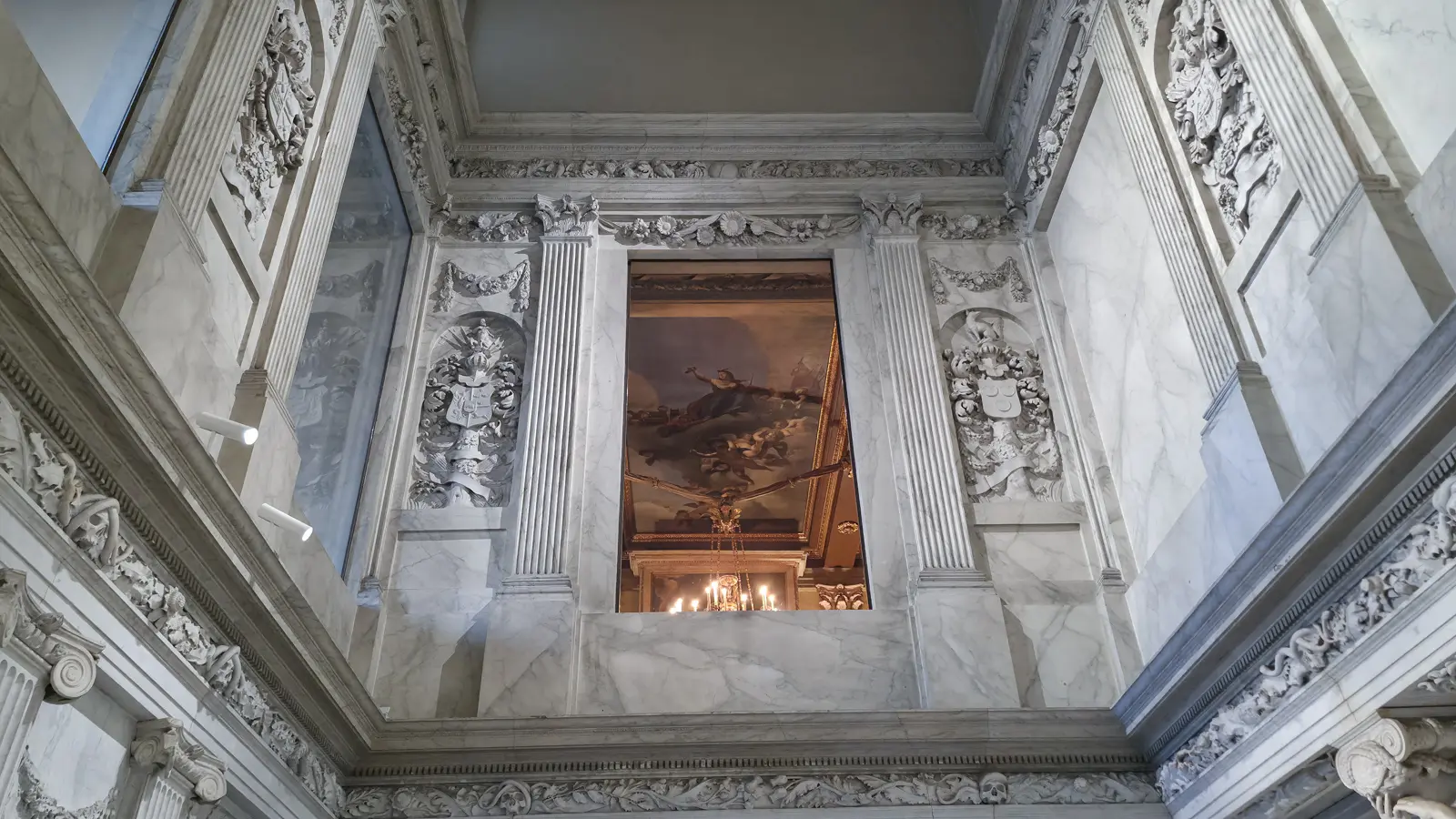
Their chamber on the floor above had a side window onto this room. Through it the four sitting burgomasters could follow the pronouncement of a death sentence from their own desks, seeing and hearing without being seen. The window is easy to miss from below, which is more or less the point of it.
What happened next
The Amsterdam City Archives hold the ceremony book that sets out the rest. After the sentence was spoken in the Vierschaar, the condemned person, referred to throughout that book as “the patient”, was taken up to the Justice Chamber on the first floor. There the city officials and the condemned knelt together around the arms of Amsterdam inlaid in the floor and said a prayer. Then the condemned stepped out of the window onto the scaffold, and the executioner did the rest, in front of whoever had gathered on the square.
One name from that sequence is still known, and only because of a drawing. Elsje Christiaens was eighteen, from Jutland, and had been in Amsterdam a fortnight looking for work as a maid when a row with her landlady over unpaid rent ended with the landlady dead. She confessed. She was sentenced by the city’s magistrates in May 1664 and strangled on Dam Square. Her body and the axe were then displayed at the Volewijck, the execution field across the IJ. Rembrandt hired a boat, rowed out, and drew her twice. Both sheets are now in the Metropolitan Museum of Art in New York. An Amsterdam archivist, I. H. van Eeghen, read through twenty-five years of confession books in the 1960s to work out who the woman in the drawings was.
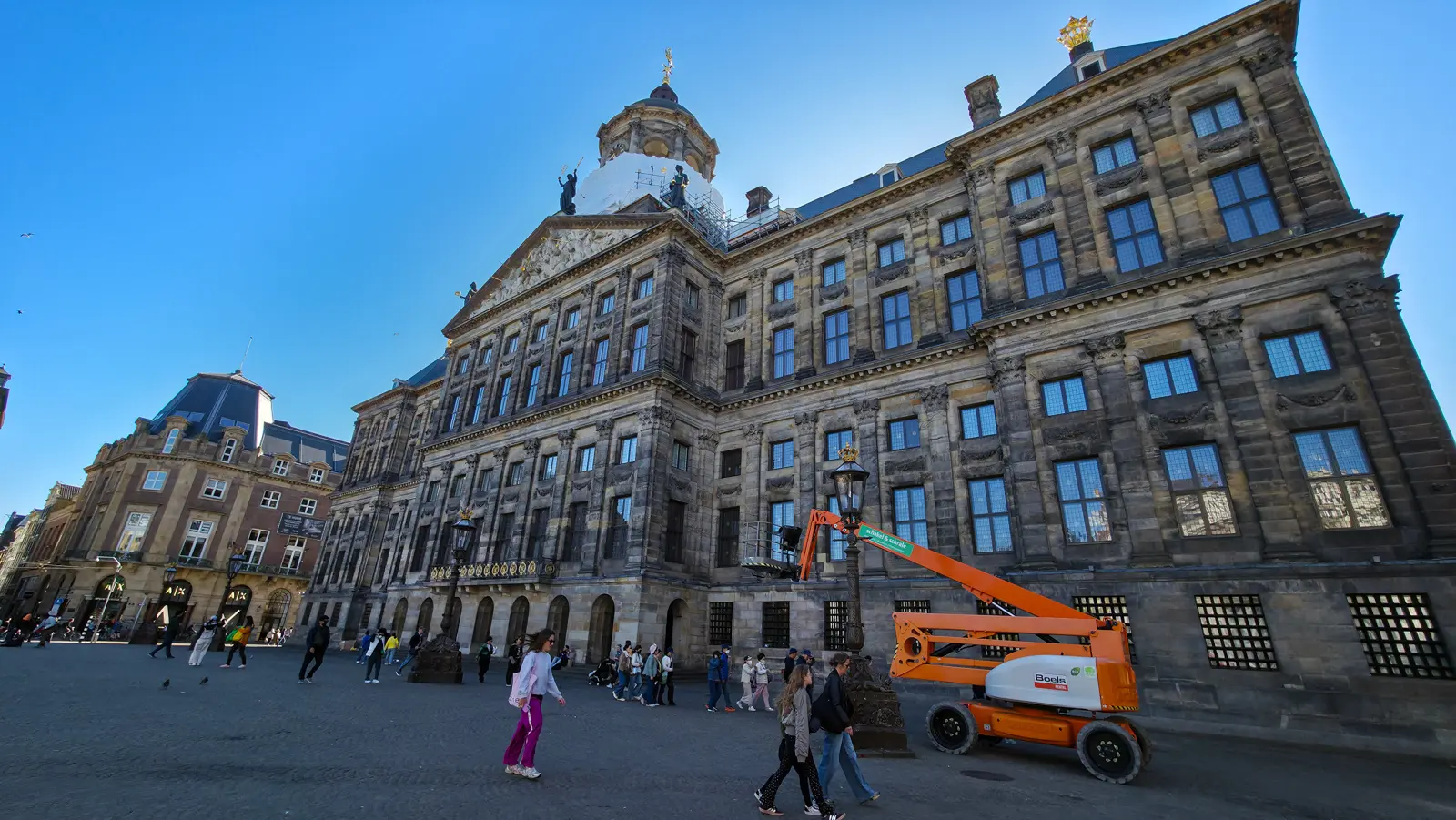
The square in front of the palace is now trams, pigeons, the national war memorial and a steady crossing of people on their way somewhere else. Standing on it in late April, with the cupola under wraps and a cherry picker parked against the facade, it takes a deliberate effort to place the scaffold.
The other end of the story
The Vierschaar stopped being used for its purpose long before the building stopped being a town hall. From 1808 Louis Bonaparte, installed as King of Holland, used the room as a court chapel. He did not remove the marble. He hung blue curtains over it. The story told in the palace is that the hand of Lady Justice stuck out through the curtains and was chopped off, scales and all.
The last death sentence carried out in Amsterdam was in 1854. The last civil execution anywhere in the Netherlands came six years later, when Johannes Nathan was hanged at Maastricht on 31 October 1860 for murder. Ten years after that, on 17 September 1870, the States General abolished capital punishment in Dutch criminal law, after a debate in which the punishment was called cruel and uncivilised. Life imprisonment took its place as a formal sentence in 1878.
It stayed on the books for military offences for another century. Article 114 of the Constitution of 1983 closed that door in six Dutch words that translate as: the death penalty cannot be imposed. The remaining references were stripped out of Dutch law in 1991.
I had not expected any of this. The Netherlands I had spent the previous fortnight is the one people describe as tolerant, liberal, near the front of the queue on human rights, and I had quietly assumed capital punishment was something it had never gone in for. It is the same country that built a marble chamber to announce executions and left the windows open so the neighbours could watch, a little over two hundred years before it decided the punishment was uncivilised.
Bubbly Tips
- Take the audio tour. It is included with admission and available in eight languages. The Vierschaar is one of the numbered stops. Without it, the room is beautiful and mute.
- Save it for last and you will have it to yourself. The Vierschaar sits late in the route and a lot of visitors finish in the state rooms upstairs and leave without coming back down. Late afternoon is the quietest run at it.
- Check the calendar before you book. The palace is a working royal building. It was scheduled to open more than 230 days in 2026, and it can close at short notice for state use. The official site publishes open days up to six months ahead.
- Opening hours in 2026 run 10.00 to 18.00 on open days, with last admission 45 minutes before closing. Going in the first hour gives you the quietest run at the ground floor.
- Look up before you look across. Most of the heraldry, the foundation monument and the burgomasters’ window sit well above head height, and the room is double height for that reason.
- Read the reliefs left to right: Zaleucus, Solomon, Brutus. Solomon sits in the middle because wisdom was the quality the men on the bench were meant to take from the wall.
- Check the caryatids’ hands. Two cover their faces, two are bound. That is the difference between Remorse and Penance, and it is the fastest way to tell them apart.
- Under-18s go free but still need a ticket, which you collect at the desk rather than book separately.
- Allow about an hour for the palace as a whole, then give the Vierschaar more of that hour than the route suggests. There is no café inside, but Dam Square is not short of options, and the Nieuwe Kerk is next door if you want to make an afternoon of it.
Final Thoughts
I went into the Royal Palace expecting the Citizens’ Hall, the marble maps and Atlas with the world on his shoulders. What I came out thinking about was a room the size of a large sitting room with four stone women holding up the ceiling and their eyes covered. Every surface in there is worked to the standard of a cathedral, and the purpose of all of it was to tell somebody they were going to be killed on the square visible through the window behind them.
The thing that keeps returning to me is not the cruelty, which is easy enough to condemn from a safe distance of three hundred and seventy years. It is the care. Somebody sat down and decided that the men passing this sentence should have Solomon behind them, that the secretary should be reminded in stone to hold his tongue, and that the person being sentenced should have to look at Remorse and Penance while it happened. That is a society taking the killing of a citizen extremely seriously. It is also, eventually, the same instinct that got the punishment abolished.
Until next time!

🌟 Everything You Need to Plan Your Dream Trip in 2026
- 🌟 Luxury Hotels - Find premium stays with Booking.com & Hotels.com
- 🏡 Vacation Rentals - Discover unique properties on VRBO
- 🏞️ Guided Tours - Explore with Viator or GetYourGuide
- 🎫 Attraction Tickets - Skip the lines with Tiqets
- 🚢 Ocean Cruises - Set sail with Cruise Direct
- 📱 International SIMs - Stay connected with Saily
- 🚗 Car Rentals - Budget-friendly options from Discover Cars
- 🌐 Secure VPNs - Browse safely with NordVPN
- 💶 Currency Exchange - Best rates with Wise
- 🗣️ Learn Languages - Master the local language with Babbel and Rosetta Stone