
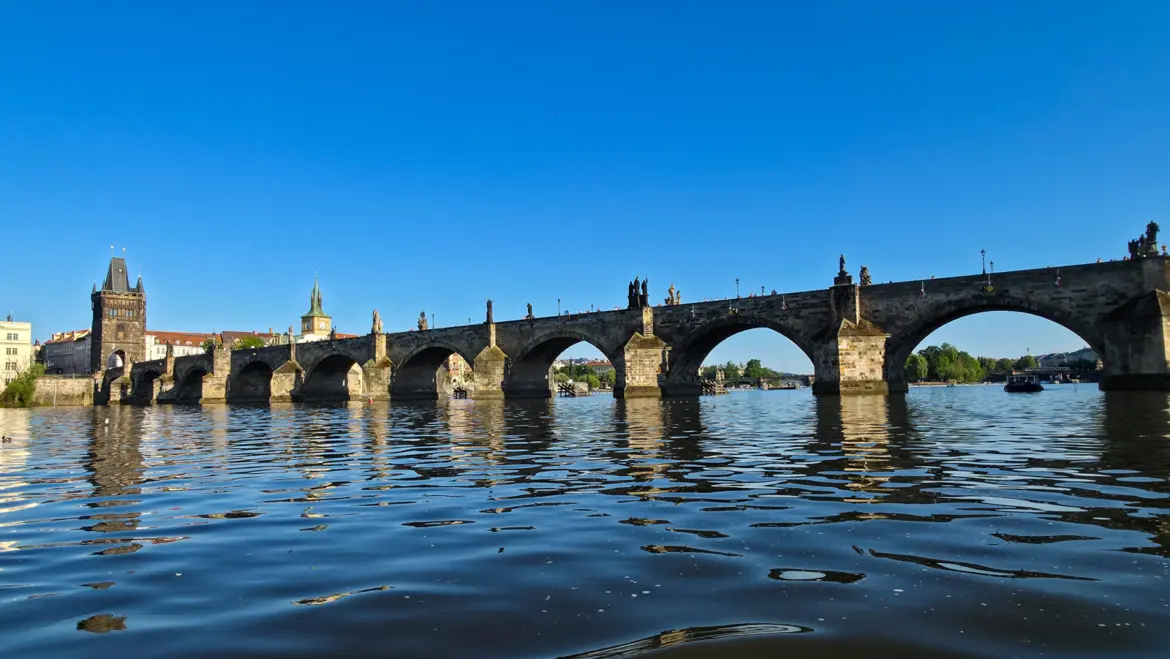
Charles Bridge is one of Prague‘s most famous landmarks, and it is busy at any time of day. It is also the loveliest way to get from one side of the Vltava to the other. The bridge is for pedestrians only, built of stone, lined with statues and full of history. It also gives some of the best views of the city, in both directions.
This is not a modern bridge. There is something eerie about it, with dark stone saints standing over the crowds and Gothic towers at either end. It adds to the medieval mystery that runs through the whole city.
Charles Bridge at a Glance
🌉 Six centuries old · Charles IV laid the first stone in 1357; the bridge runs about 516 metres on 16 stone arches.
🔢 Built by numerology · Legend puts the founding at 5:31 a.m. on 9 July 1357 — the odd-number palindrome 1 3 5 7 9 7 5 3 1.
🗿 Thirty statues · Mostly Baroque; the bronze St John of Nepomuk (1683) is the oldest and the most touched.
🏰 Views both ways · Prague Castle and St Vitus at one end, the Gothic Old Town Bridge Tower at the other.
🚤 See it from the water · A river cruise slips under the arches for angles you can’t get on the bridge.
🌙 Go back after dark · Gas lamps (returned in 2010), floodlit towers and statues as silhouettes make it a different bridge.
A Bridge Built by the Numbers
According to legend, Charles IV laid the foundation stone himself at 5:31 in the morning on 9 July 1357. Written out, the date and time form a palindrome of odd numbers: 1 3 5 7 9 7 5 3 1. Charles was a strong believer in numerology, and the timing was meant to give the bridge extra strength. For a city full of alchemists and legends, it is a fitting start.
The new bridge replaced the Romanesque Judith Bridge, which a flood had wrecked in 1342. Its designer was Peter Parler, and it runs about 516 metres across the river. The history of how it was built is told in the Charles Bridge Museum, which I visited and will cover in its own post.
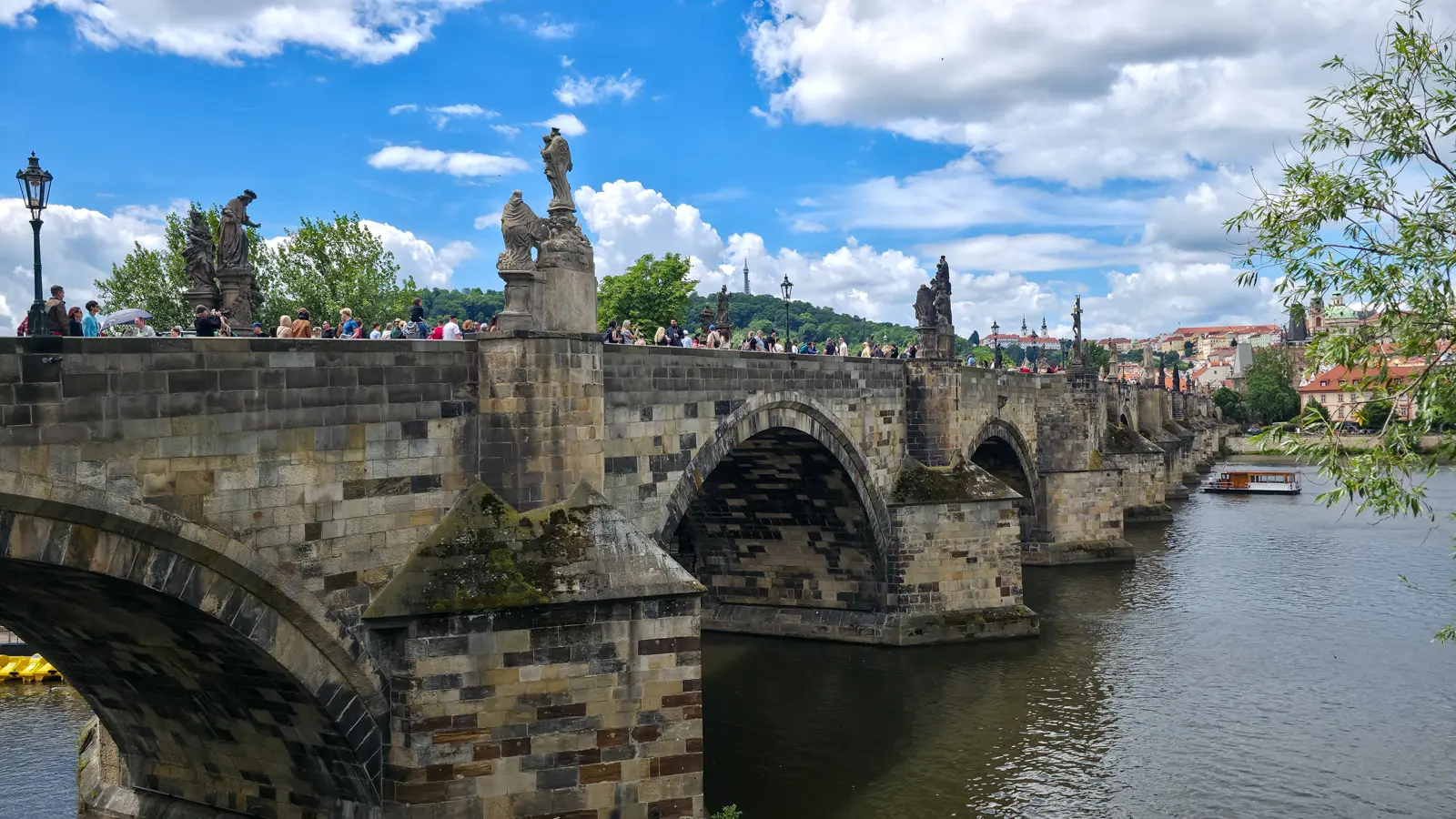
From the riverbank, the arches line up one behind the other, with rows of yellow pedal boats moored in the shade beneath them.
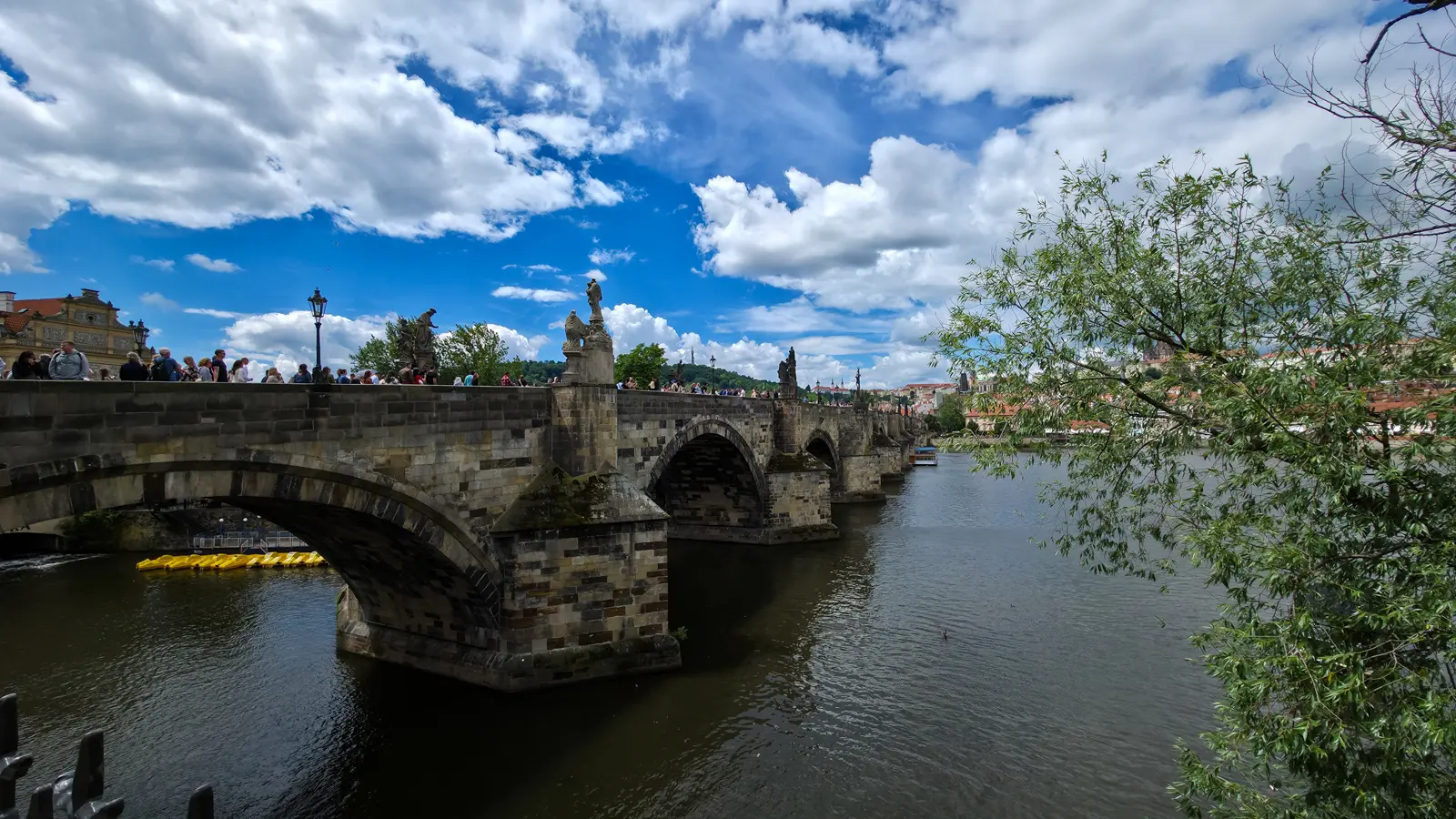
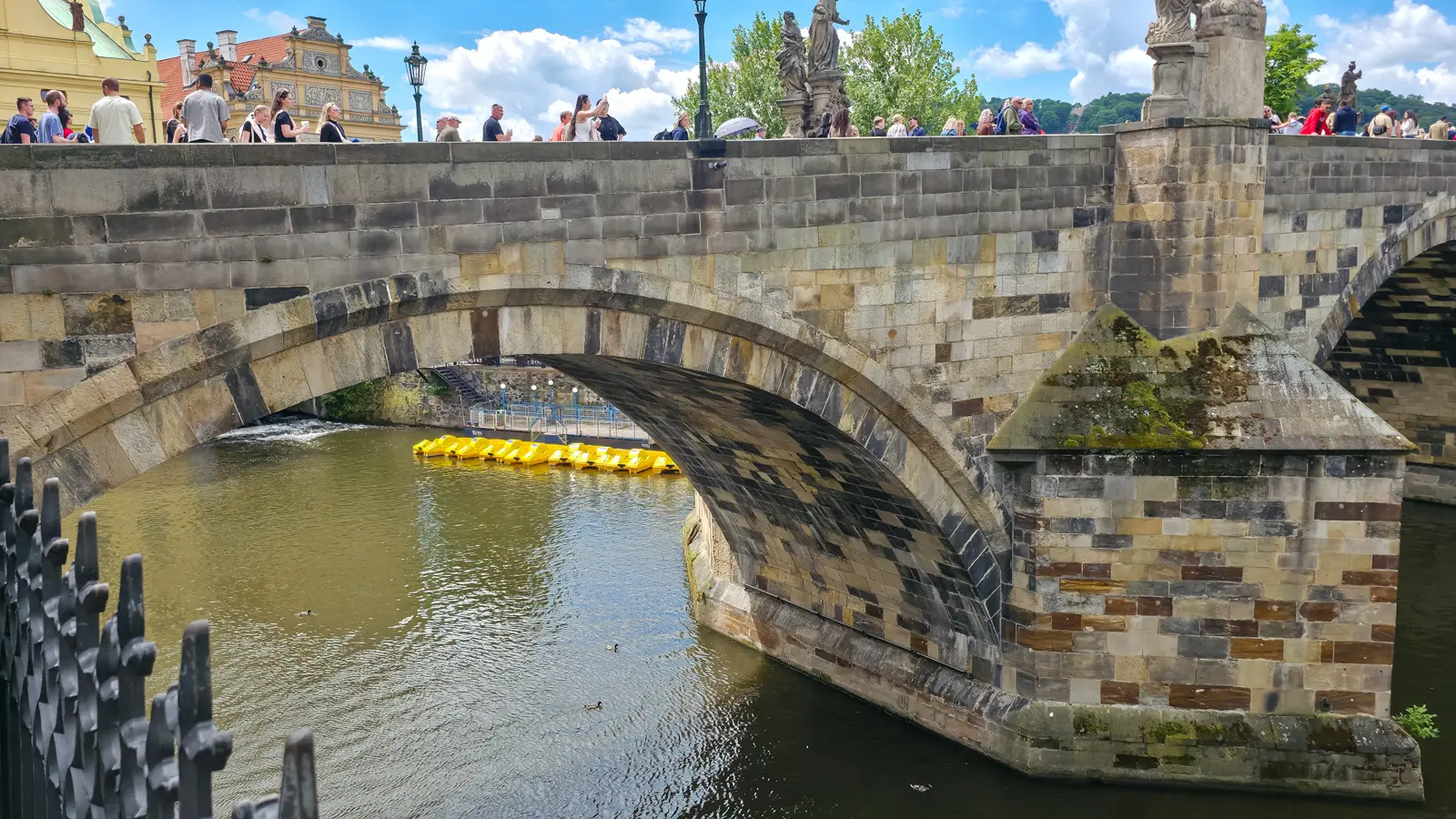
Up close, the stonework is a patchwork of pale and dark blocks, with moss growing on the sloping tops of the ice guards.
Walking Across
Most people start at the Old Town end, on Křižovnické náměstí, and walk through the arch of the Old Town Bridge Tower towards Malá Strana. It was busy every time we crossed, with portrait artists, silhouette cutters and print sellers set up along the parapets. The stalls start almost as soon as the bridge does, and one sign near the Old Town end promised a portrait or caricature in 15 to 20 minutes.
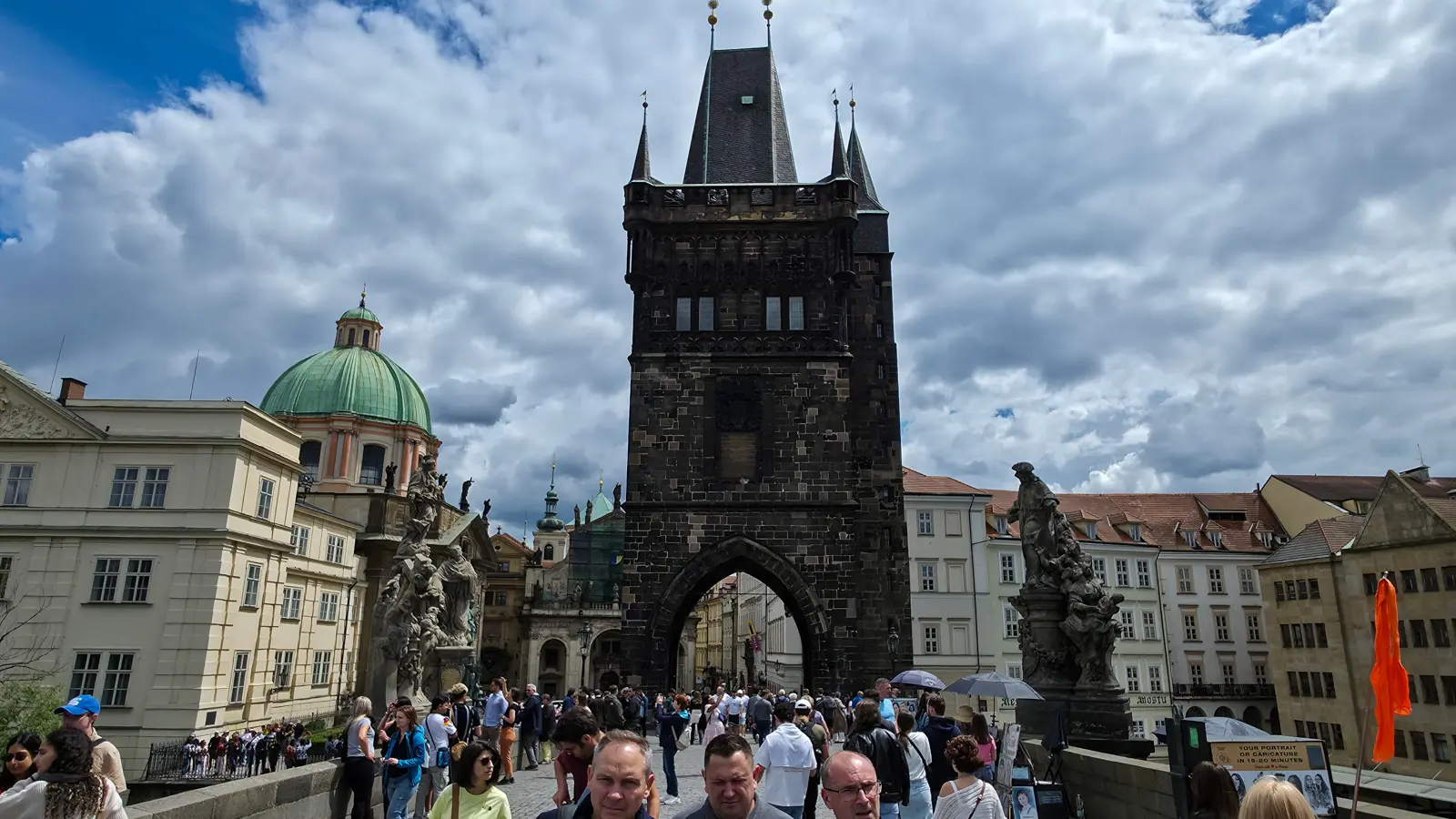
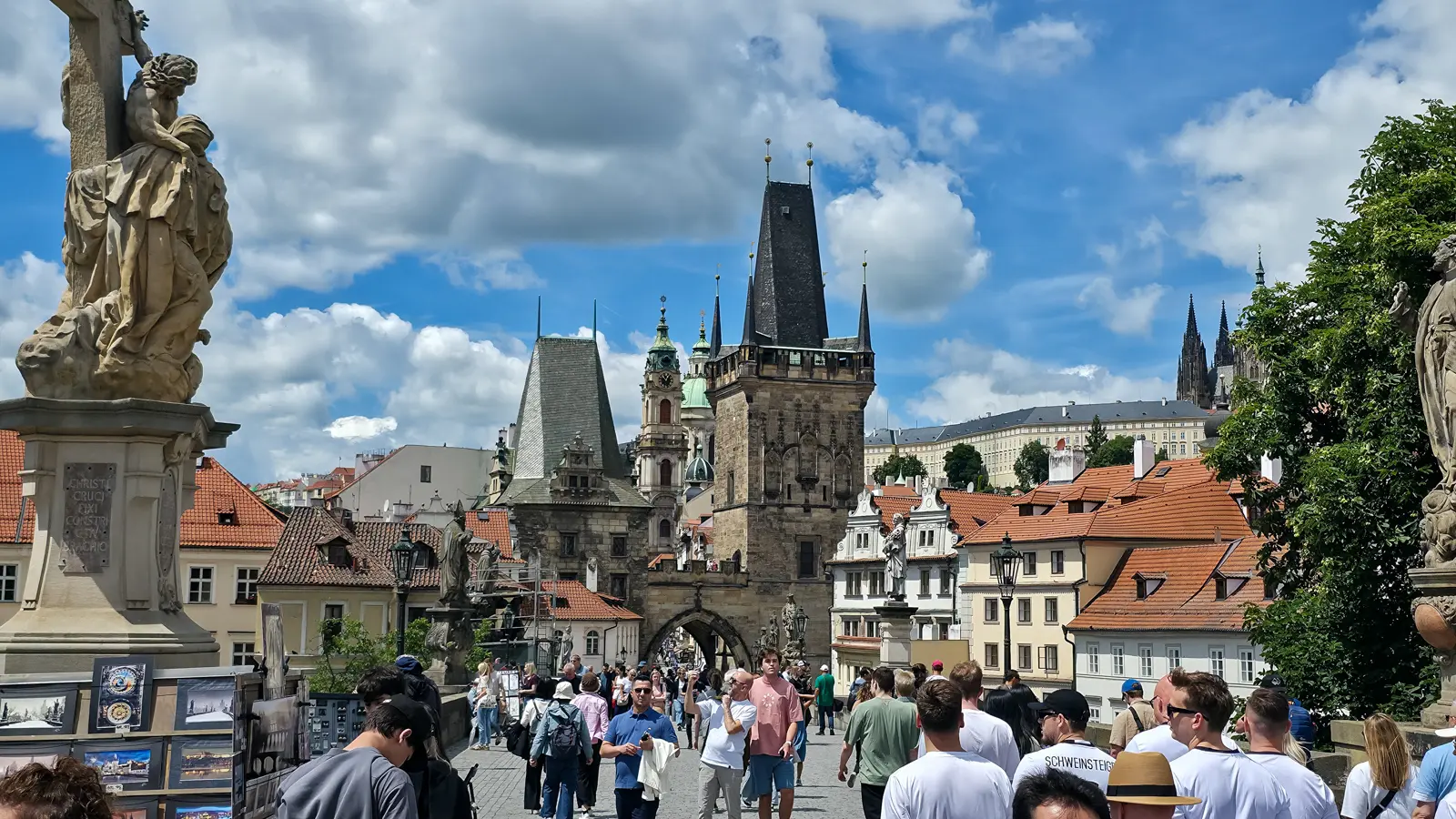
Turning around, the Old Town Bridge Tower closes the view at one end, with statues lined up on both parapets.
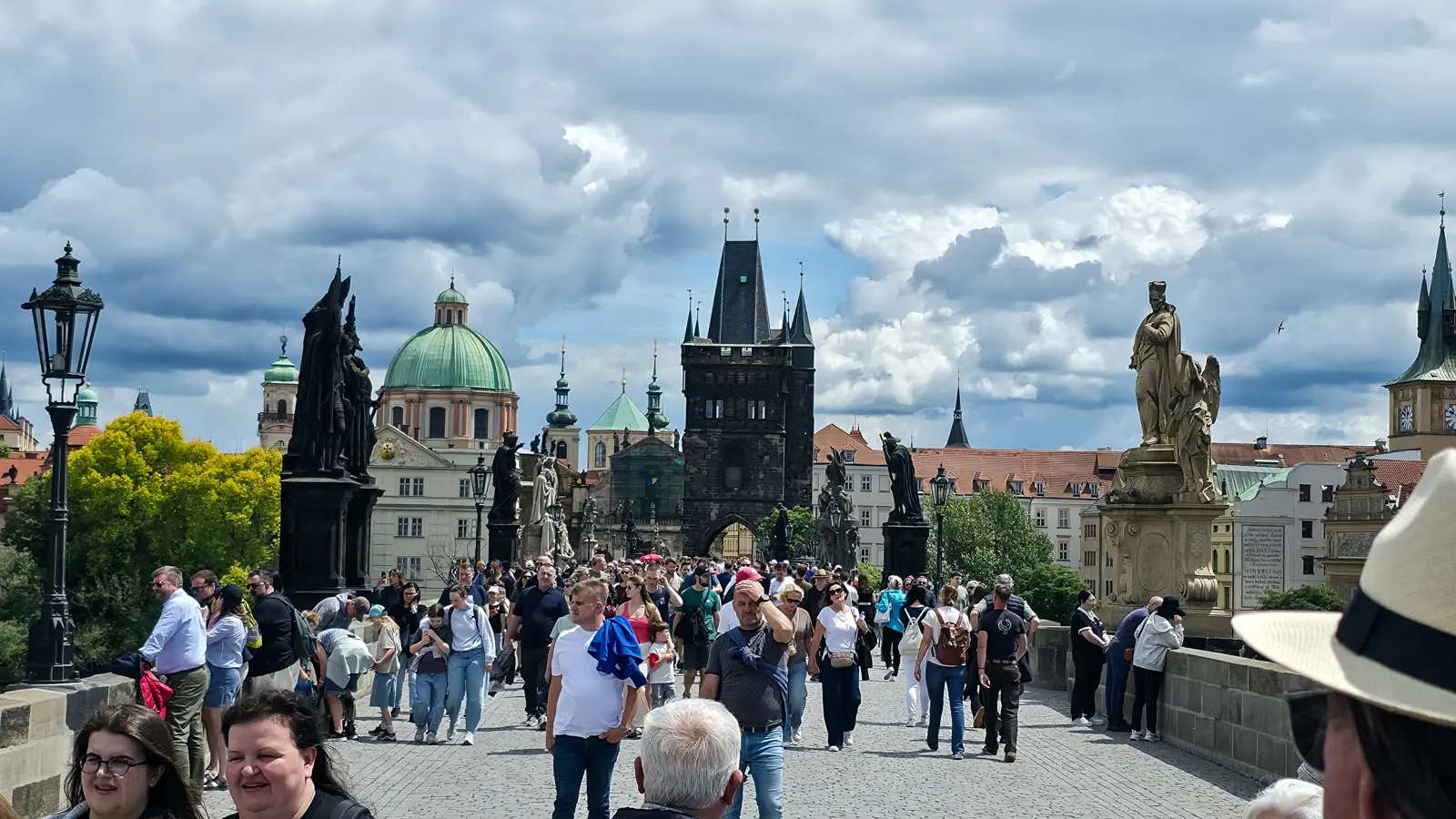
Facing the other way, the view opens up towards Prague Castle and the spires of St Vitus Cathedral on the hill ahead.
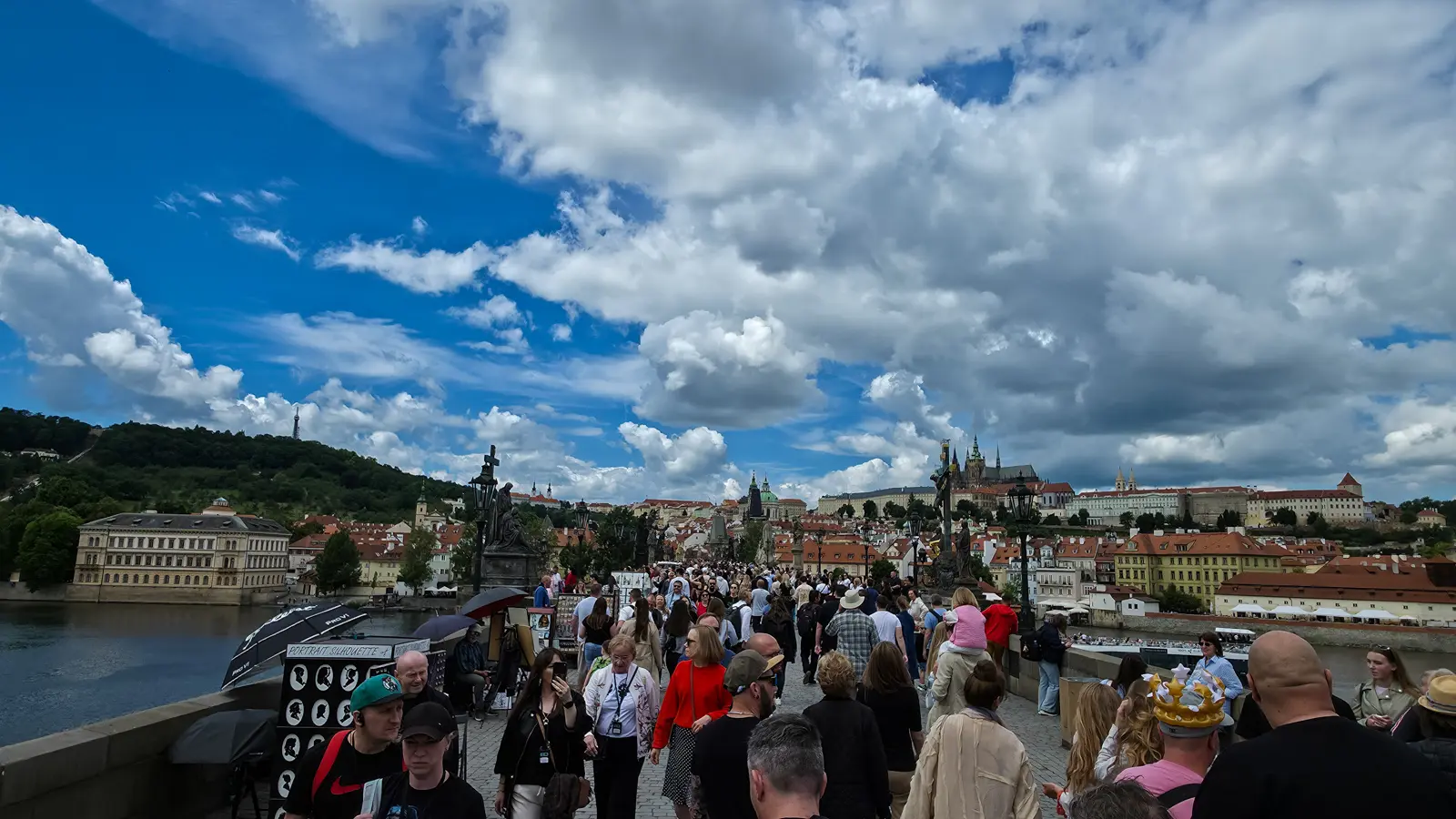
Closer to the Malá Strana end, the castle and St Vitus fill more and more of the skyline above the red roofs.
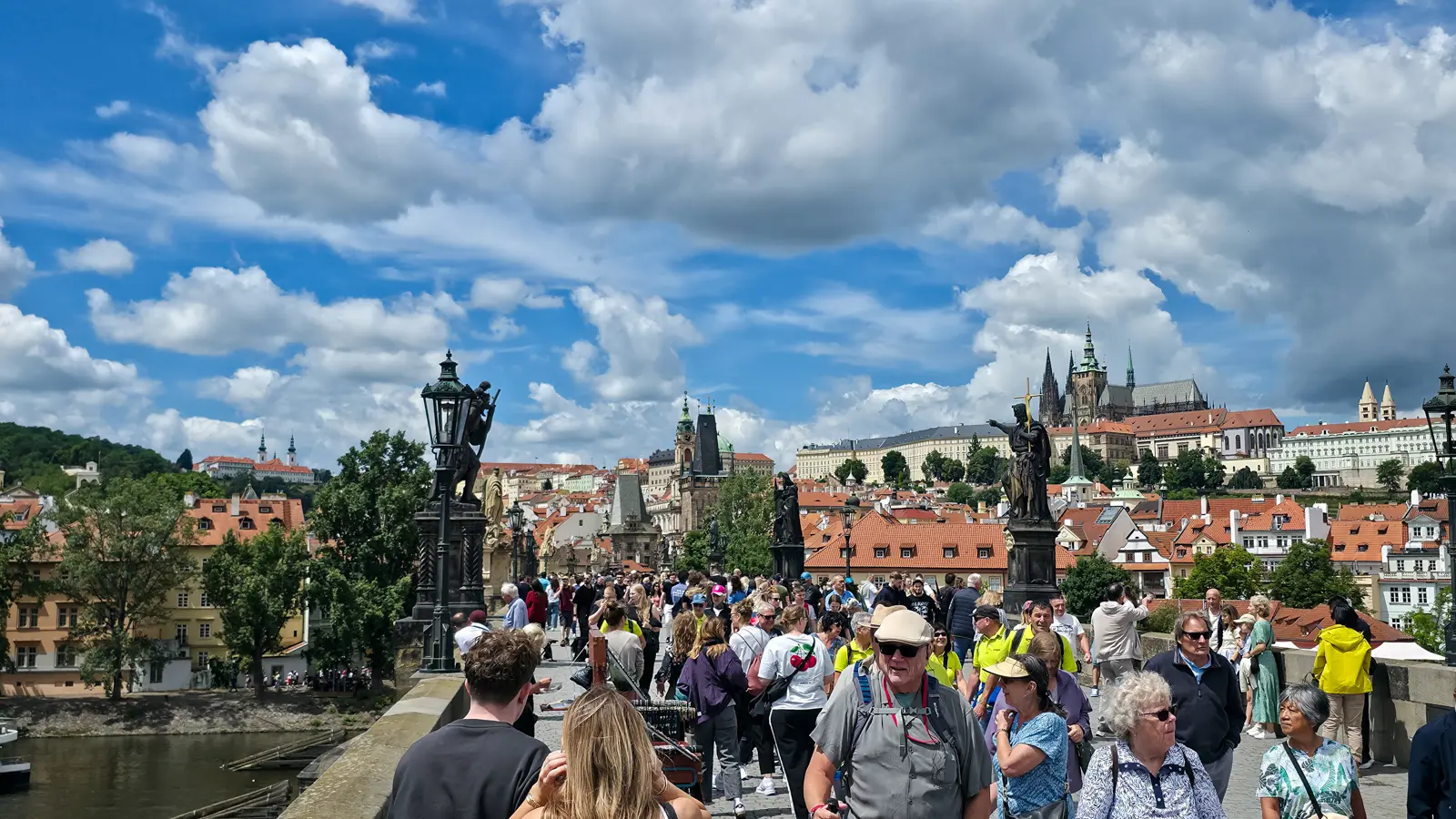
The Statues and the Lucky Plaque
Thirty statues line the parapets, most of them Baroque. The oldest is St John of Nepomuk, from 1683. The youngest is the group of Saints Cyril and Methodius by Karel Dvořák. It replaced a statue lost in 1890, when a flood washed away three of the bridge’s arches.
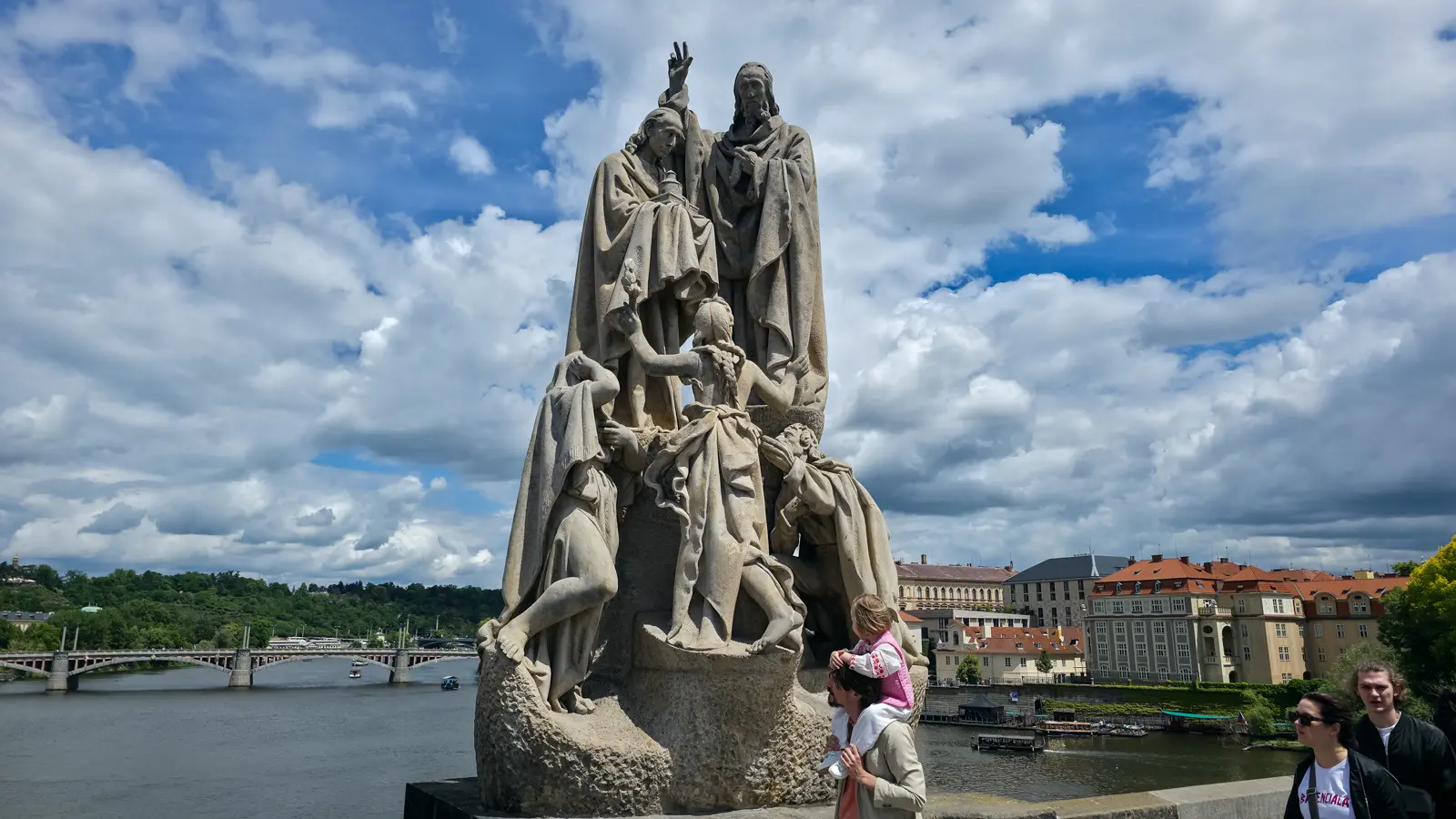
Many people rate the St Luitgard group by Matthias Braun as the finest work on the bridge.
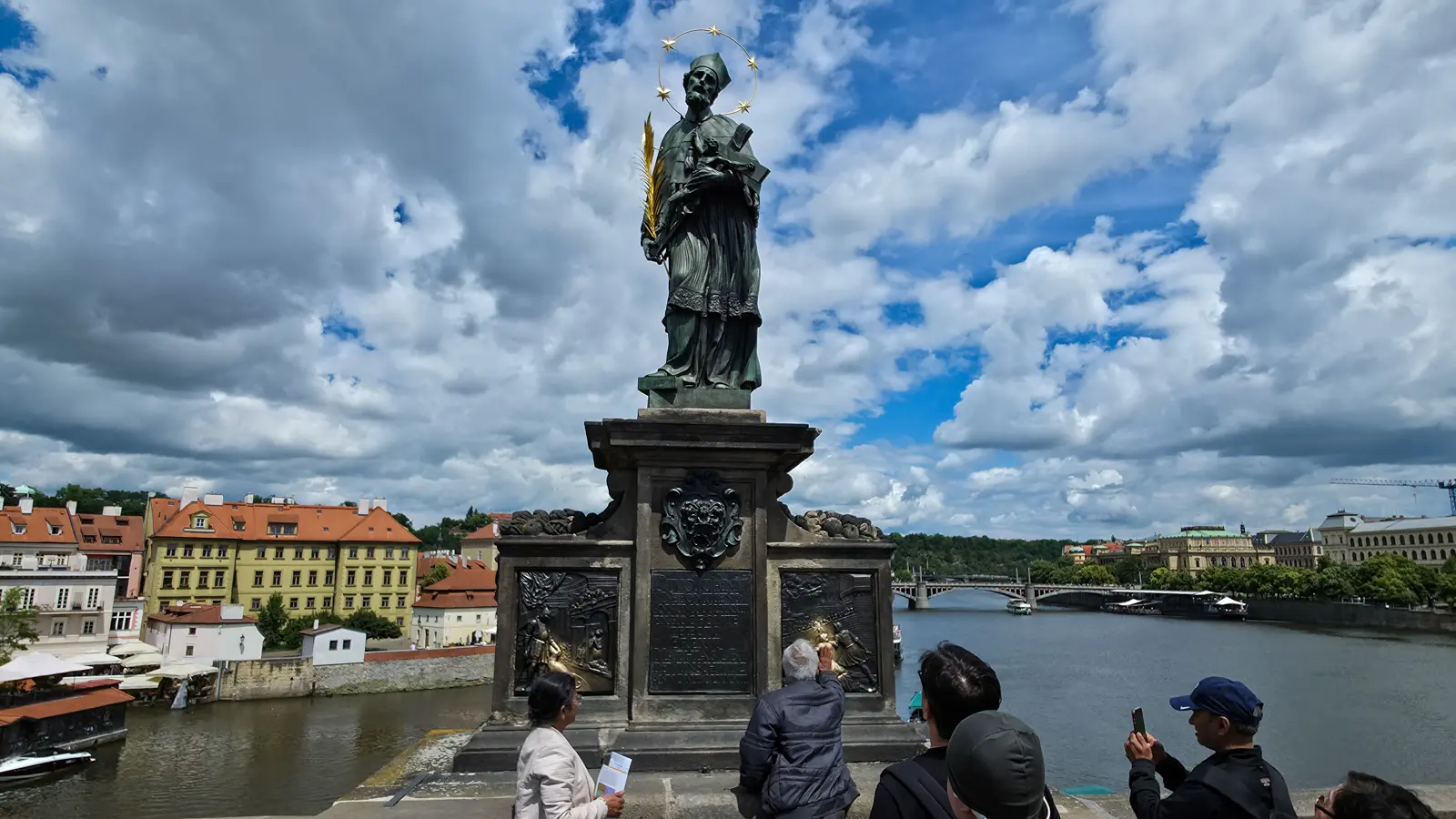
The statue with the crowd in front of it is St John of Nepomuk. According to legend, he was thrown from the bridge into the Vltava on the orders of King Wenceslas IV. People queue to rub the bronze plaques on its base, and the spots they touch are polished bright. Apparently the luck is a myth, and with so many hands on it, not the most hygienic one either. Rubbing the plaques is not even a Czech tradition. The local custom is a few steps away, at a small cross with five stars on the parapet that marks where he is believed to have gone over.
The Bridge Towers
The towers at either end are just as striking. On the Old Town side stands a single Gothic tower. At the Malá Strana end, two towers of different heights are joined by a gateway arch.
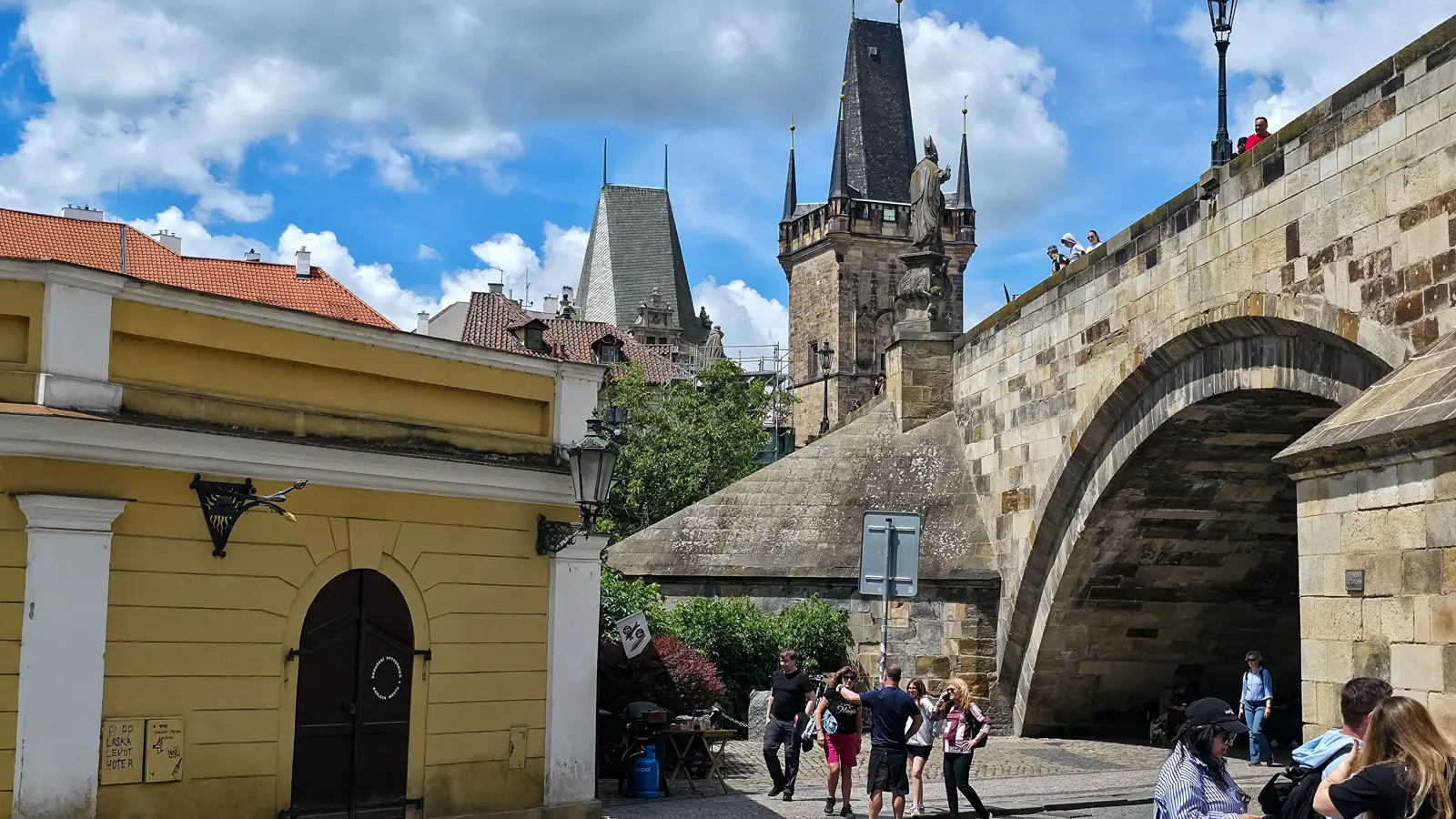
Both ends can be climbed. We didn’t this time because the towers were too crowded, but our guide said the views are beautiful and worth the climb. It is top of my list for next time.
From the Water
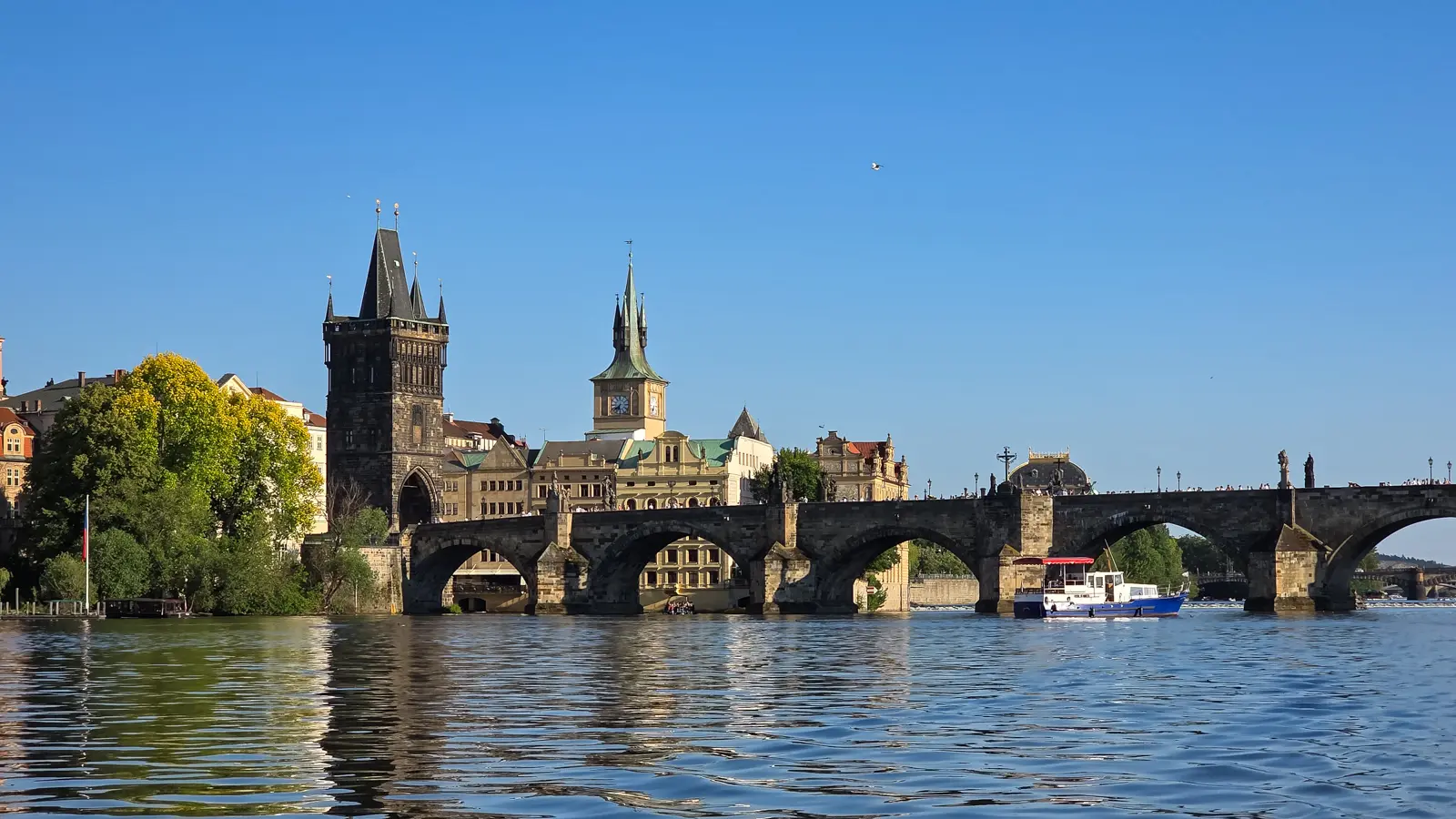
Some of the best angles on Charles Bridge are from the river itself. We took the Prague Venice cruise, which leaves from Křižovnické náměstí on the Old Town side, right beside the Charles Bridge Museum. The trip lasts about 45 minutes, and entry to the museum is included in the ticket.
From water level, the bridge looks completely different. The crowds shrink to a line of tiny figures along the parapet, and the statues stand out as dark shapes against the sky. The pointed ice guards on each pier are easy to pick out, and the Old Town Bridge Tower rises straight up from the bank at the end of the first arch.
One small detail at the Old Town end is easy to miss. Bradáč, the Bearded Man, is a carved stone head set into the riverside wall. He survives from the old Judith Bridge and served for centuries as a flood warning: if the water reached his beard, it was time to evacuate the Old Town. During the 2002 flood, the river rose more than two metres above him.
After Dark
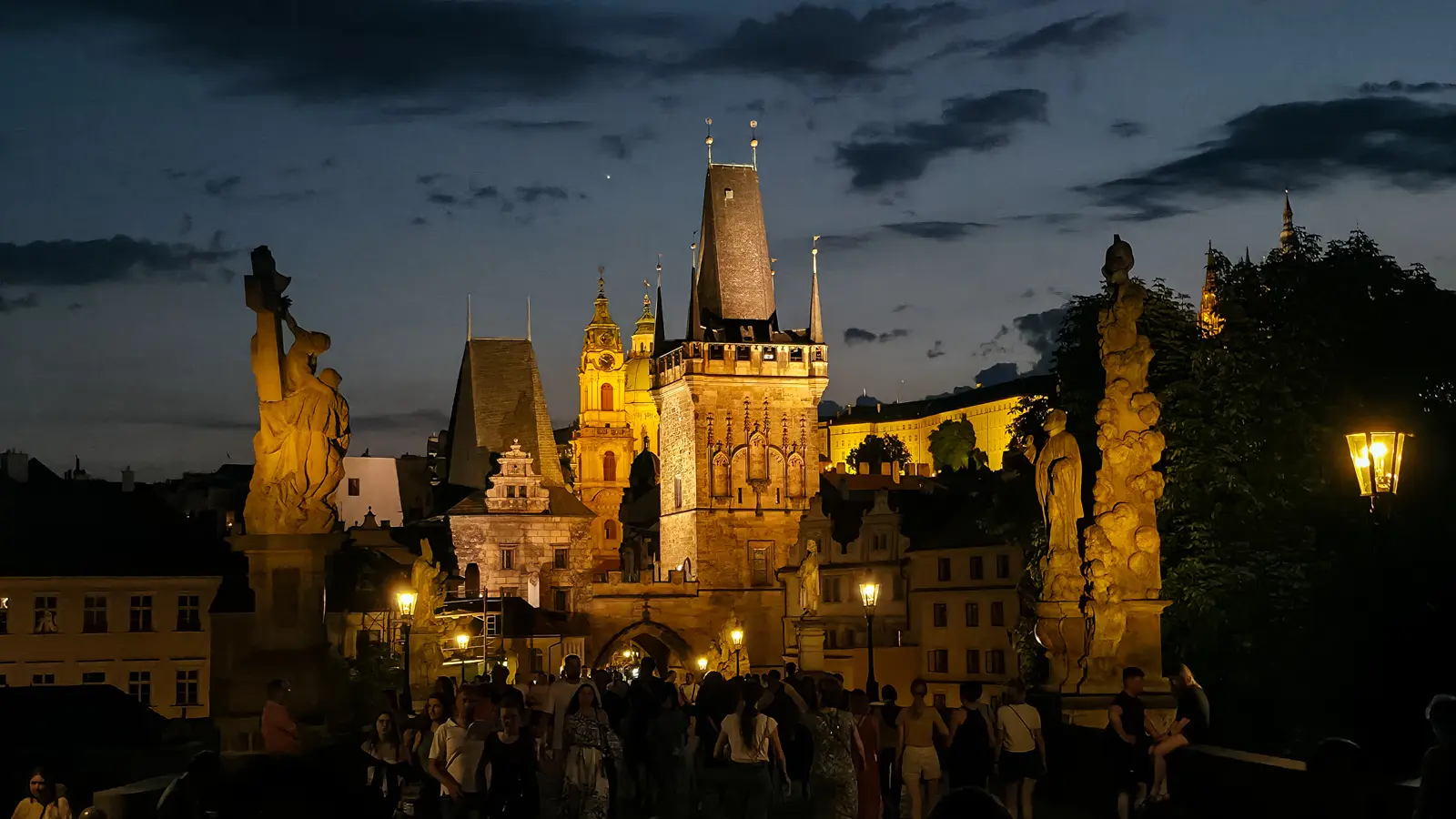
After dark, Charles Bridge changes completely. The lamps come on along the parapets, the statues turn into silhouettes, and the Malá Strana bridge towers glow gold against a deep blue sky, with the castle lit up on the hill behind them. The bridge was still busy late in the evening, but the views at night are stunning.
Those lamps are gas lamps. Gas lighting returned to Charles Bridge in 2010, and it is reputedly the only bridge in the world lit by gas. There are 46 gas lamps on the bridge and on Křižovnické náměstí at the Old Town end. Today they switch on automatically at dusk.
Bubbly Tips
- Touch the cross, not the plaque. The five-star cross set into the parapet a few steps from the St John of Nepomuk statue is the local tradition. Czechs place their fingers on the points of the cross and make a wish.
- Climb a bridge tower. The Old Town Bridge Tower has 138 steps up to an indoor viewing gallery, then a short climb to an outdoor terrace. At the Malá Strana end, only the taller tower is open. A combined ticket covers both ends.
- Find the Bearded Man. At the Old Town end, look over the downstream parapet at the riverside wall to spot Bradáč, the stone head that once warned of floods.
- Mark 9 July in your calendar. Every year at 5:31 on the morning of 9 July, the foundation stone is blessed again to mark the bridge’s founding.
- Shoot from the riverbank. For photos of the arches without crowds in the frame, head down to the riverbank and look up at the bridge from below.
- See it from the water. River cruises pass right beneath the arches, which gives you the low angles you can’t get from the bridge.
- Cross at least once after dark. The bridge stays busy late, but with the lamps lit and the towers floodlit it looks completely different.
- Catch the Advent lamplighter. During Advent, a lamplighter in traditional uniform walks across the bridge at dusk and lights the gas lamps by hand with a long pole.
- Wear comfortable shoes. The crossing is about half a kilometre of cobbles, and longer if you add a tower climb at either end.
Final Thoughts
Charles Bridge has carried people across the Vltava for more than six centuries. It is crowded, a little eerie and worth every slow step.
I didn’t make it up a tower this time, so the view from the top is saved for my next visit.
Until next time!

🌟 Everything You Need to Plan Your Dream Trip in 2026
- 🌟 Luxury Hotels - Find premium stays with Booking.com & Hotels.com
- 🏡 Vacation Rentals - Discover unique properties on VRBO
- 🏞️ Guided Tours - Explore with Viator or GetYourGuide
- 🎫 Attraction Tickets - Skip the lines with Tiqets
- 🚢 Ocean Cruises - Set sail with Cruise Direct
- 📱 International SIMs - Stay connected with Saily
- 🚗 Car Rentals - Budget-friendly options from Discover Cars
- 🌐 Secure VPNs - Browse safely with NordVPN
- 💶 Currency Exchange - Best rates with Wise
- 🗣️ Learn Languages - Master the local language with Babbel and Rosetta Stone