
Almost everyone walks straight past the outside of the Moco Museum in Amsterdam. Ticket in hand, timed slot ticking, up the steps and into the villa, because that is where the Banksys are.
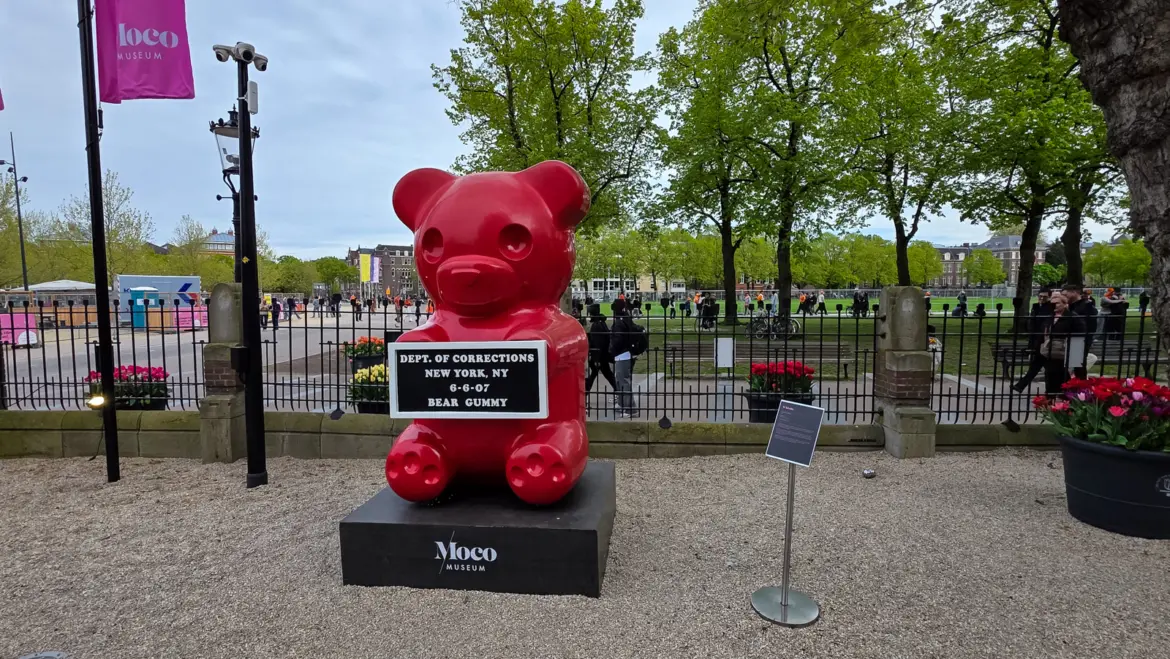
I nearly did the same. What stopped me was a cute red bear, sitting on the gravel by the railings, holding up a prison booking board.
I gave the garden twenty minutes on the way out and it turned out to be one of the better twenty minutes of the day. There are eight or nine works out there depending on what is on loan, several of them by names that would headline elsewhere, and a good number of them are visible from the pavement to anyone who has not bought anything at all.
The Moco Garden at a Glance
🌿 What it is · The outdoor sculpture garden wrapping the Moco villa on Museumplein, with eight or nine works depending on loans.
🎨 The highlights · Marc Ange’s pink Le Refuge, a Faile marble from Tate, Marcel Wanders’ wishpin egg, an Anthony James light-cube, and the Warhol quote wall.
👀 The free part · A good number of the works are visible through the railings from the pavement on Honthorststraat, no ticket needed.
📸 Photo spots · The Le Refuge daybed and the pink bench under the Warhol wall are both designed to be photographed.
💡 Tip · Do the garden last, when your timed slot is over and there is no clock running. Give it twenty minutes.
The Garden Is Not the Afterthought
The Moco Garden wraps around the villa, running from the forecourt at the front, where the gravel and the flowerbeds are, to an enclosed courtyard at the side with a brick herringbone floor.
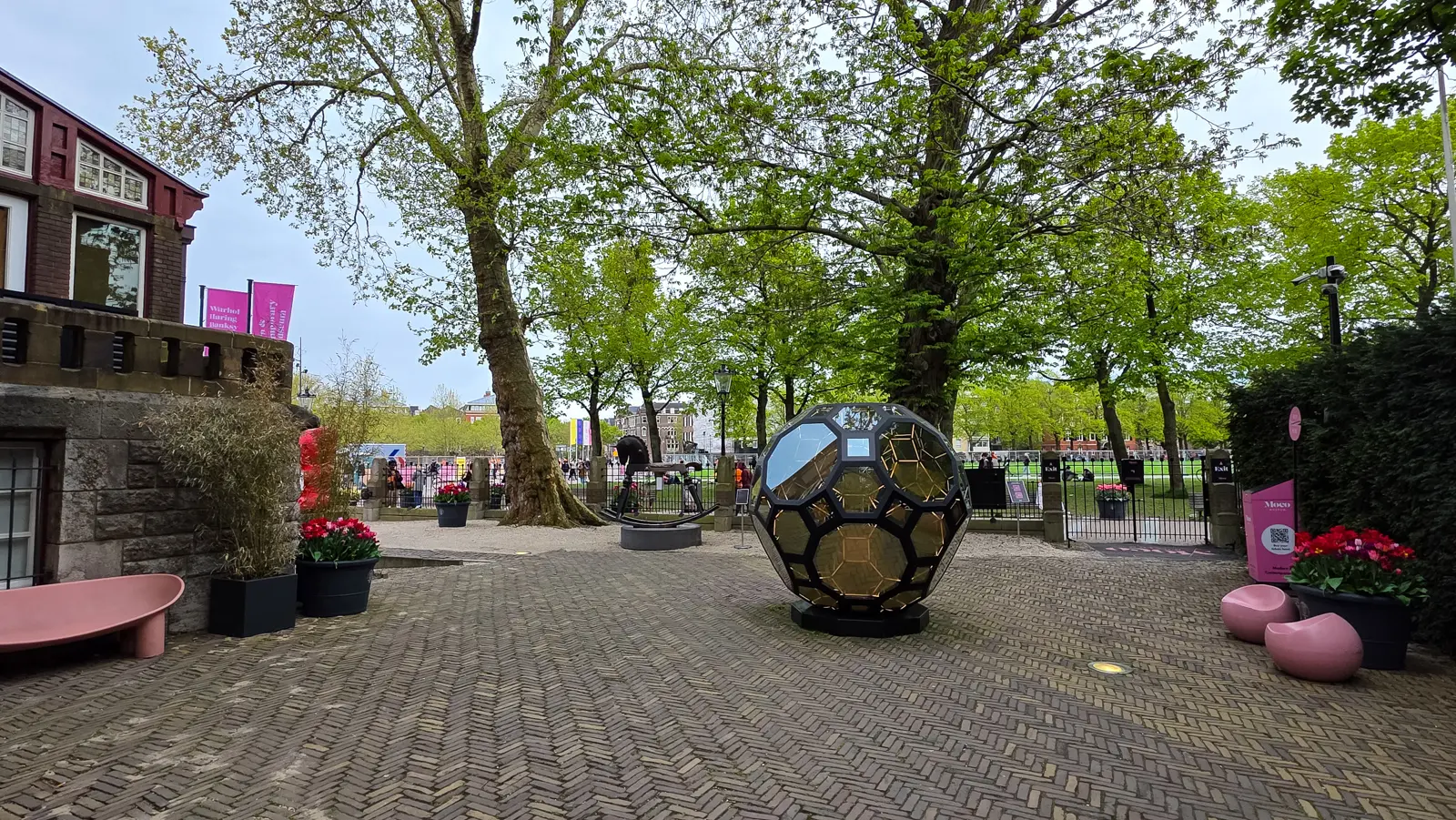
Standing on the brick, about the height of a person, is Snub Cube by Anthony James. It is a polyhedron built from steel and glass, and the glass is doing two jobs at once. From outside it reads as dark mirror, catching the trees and the sky and whoever is standing in front of it. Looking through it, the LED tubes inside repeat off the mirrored interior faces into a gold lattice that runs much further back than the object itself is deep.
It is the one work in the garden that changes completely depending on where a person stands, and the one most people walk past because from three paces it looks like a dark ball.
Everything out here is labelled properly, with dimensions, dates and provenance, which is more than some galleries manage indoors.
Le Refuge
Round the side, in the enclosed part, is the piece most people photograph: a stand of oversized metal palms in pale pink, arching over a pink daybed on a wooden deck.
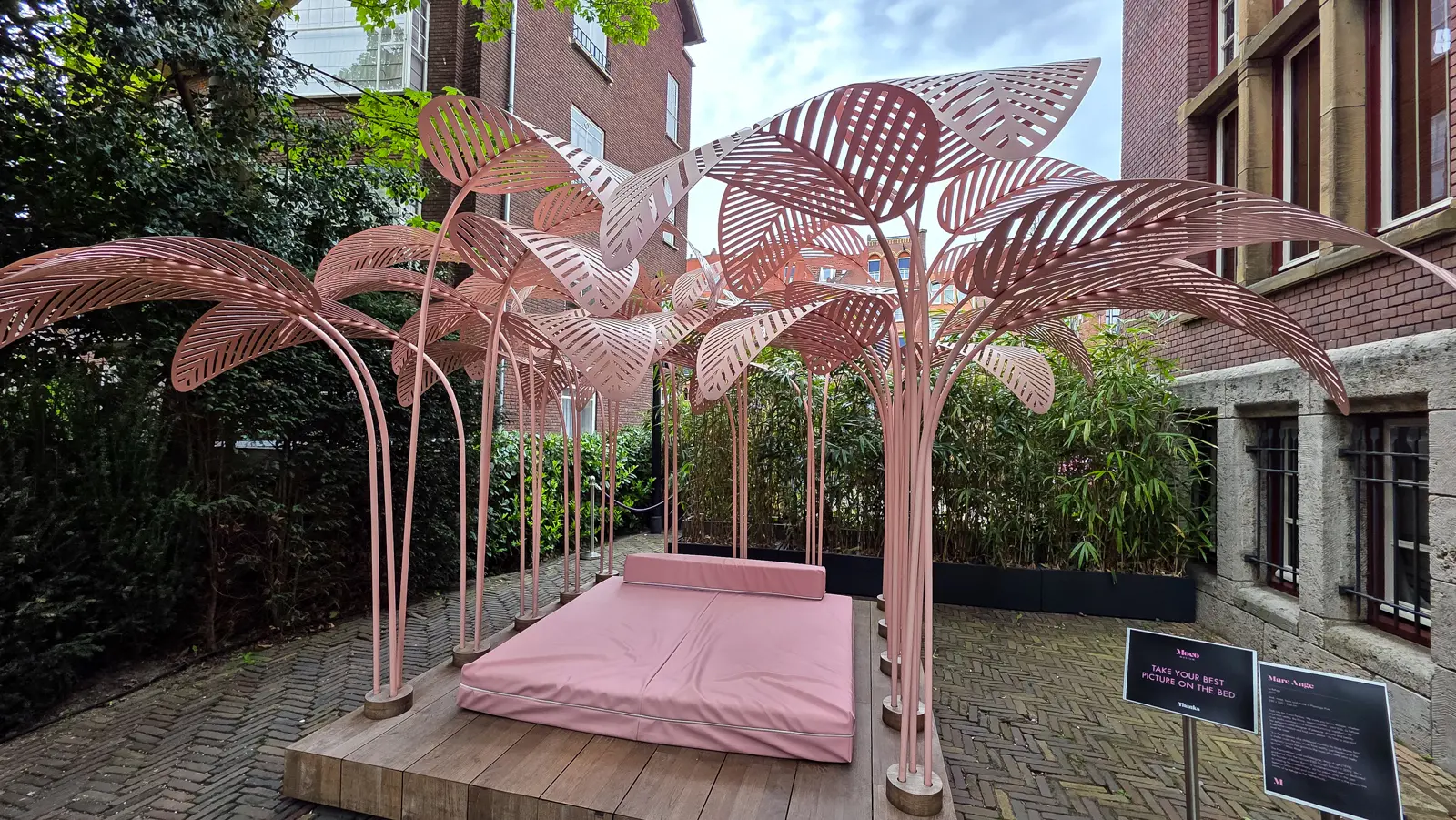
The perforations in the leaves are the point. Each one is cut with a pattern of slots, so on a bright day the canopy throws striped shadows down across the deck and across whoever is lying on it.
There is a small black sign propped beside it inviting visitors to take their best picture on the bed. It is doing what the whole museum does, which is to give permission for something other galleries treat as a nuisance.
Bunny Boy Black
Out on the gravel at the front, a grey marble boy sits cross-legged, hugging a stuffed rabbit up against his face. It is the strangest thing in the garden and it took me longest to work out.
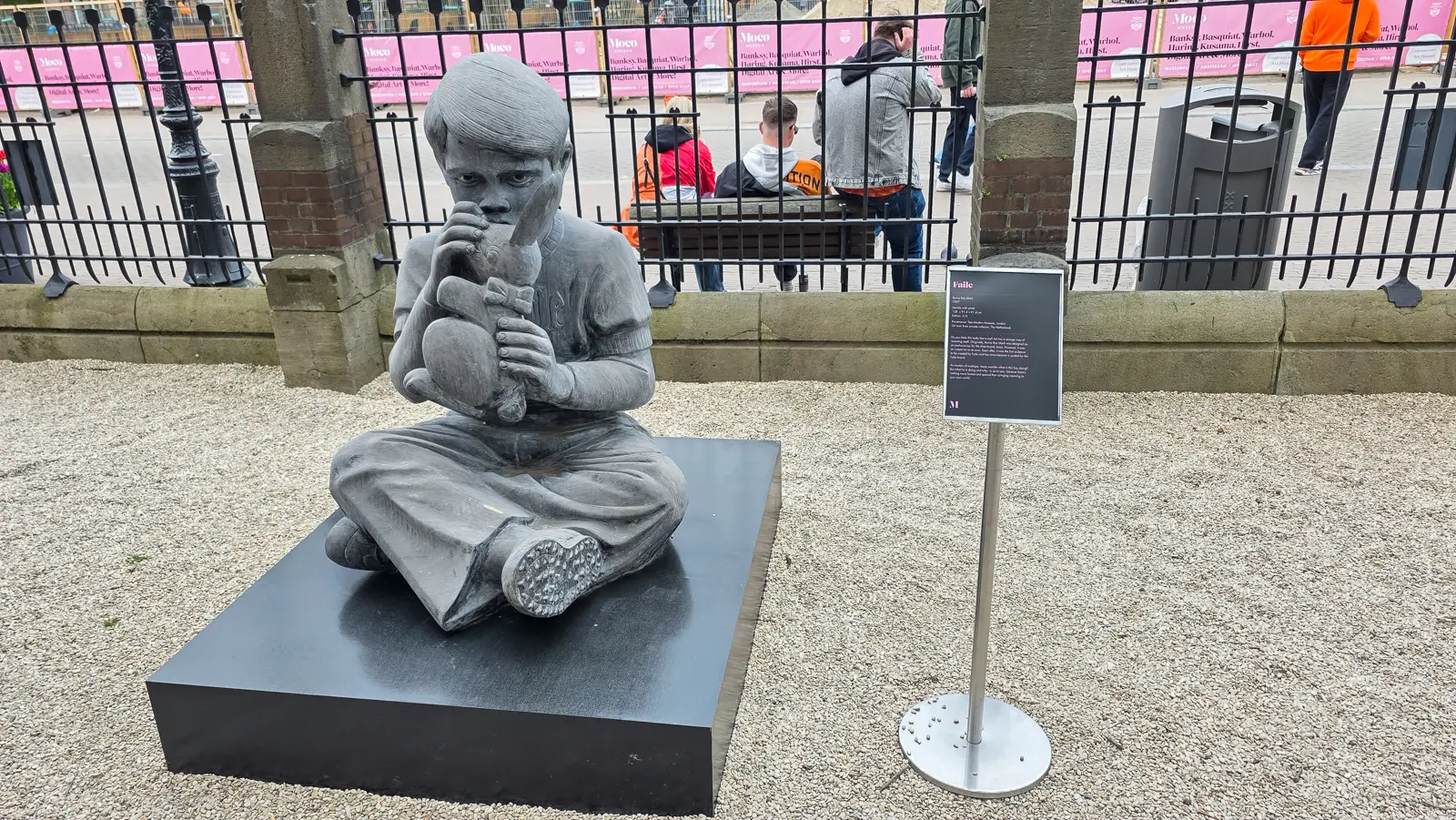
Its origin is better than its appearance suggests. Faile, the Brooklyn artist duo, first designed Bunny Boy as an exclusive toy for the shoe brand Asics. It became popular enough on its own that they made it as a sculpture, and it was the first sculpture the duo ever produced. It has been their emblem since.
The label declines to explain what the boy is doing, and says so outright: what he is doing and why is left to the visitor. After a building full of works that tell people exactly what to think, a label admitting it does not know is a small pleasure.
Portrait
Nearest the entrance steps stands an egg roughly two metres tall, made of cork, and studded all over with thousands of small gold pins arranged into letters.
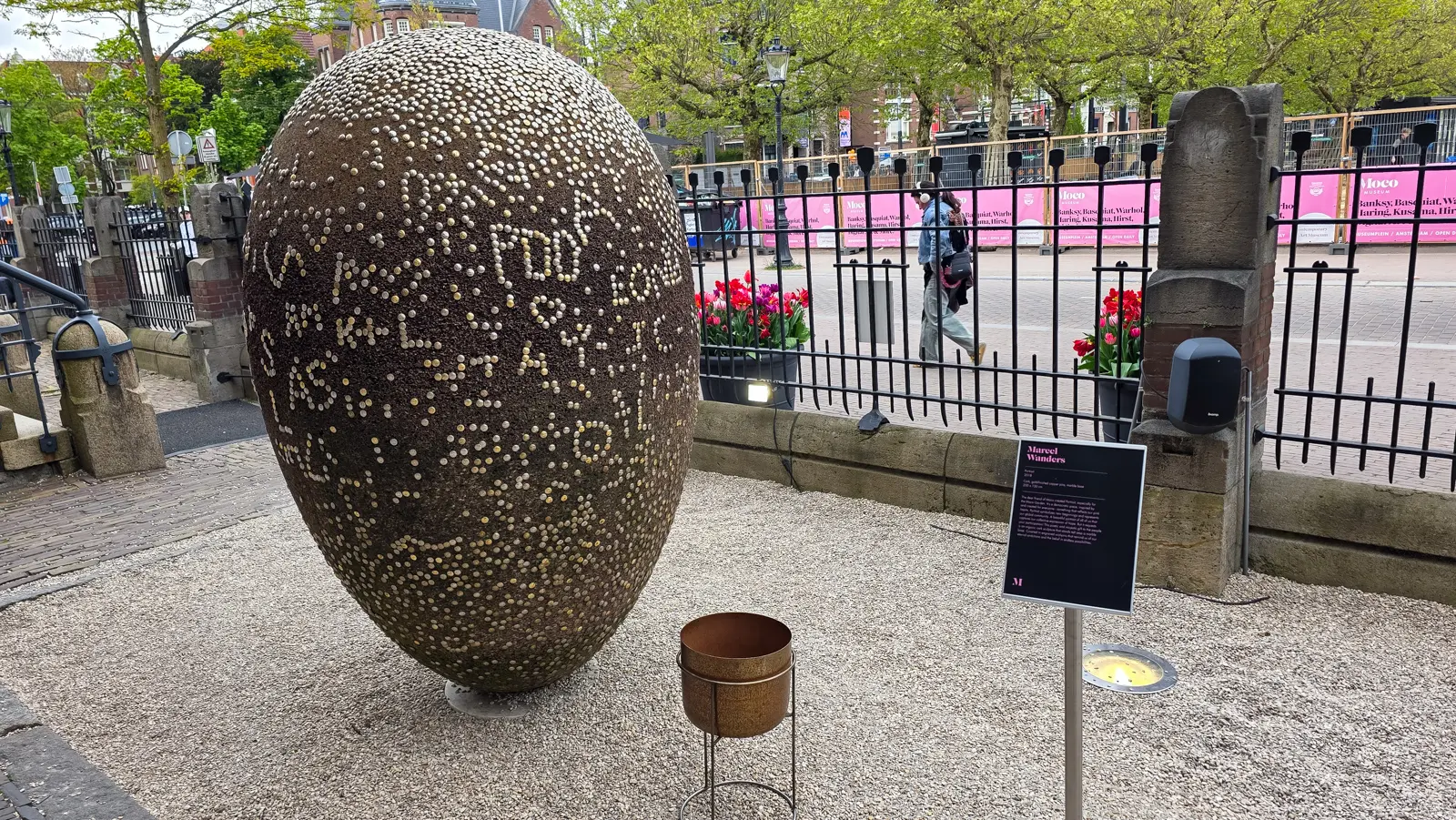
The words are hard to read up close and easier from a few paces back, which is presumably deliberate. Standing at the right distance, phrases start to surface out of the pin pattern.
Marcel Wanders is one of the best known designers working in the Netherlands, and the piece is described as a democratic one, made for everyone rather than for a collector. That description is not marketing. The pins are not the artist’s. Visitors make a wish, push a pin into the cork, and leave it there, so the words on the surface were put there by strangers over several years and the sculpture is not finished and will not be.
Reading the Game
The newest thing in the garden was also the biggest surprise, tucked against the wall by a barred window: a life-size white marble figure of a man in a tracksuit, sitting on a football with his chin on his hand.
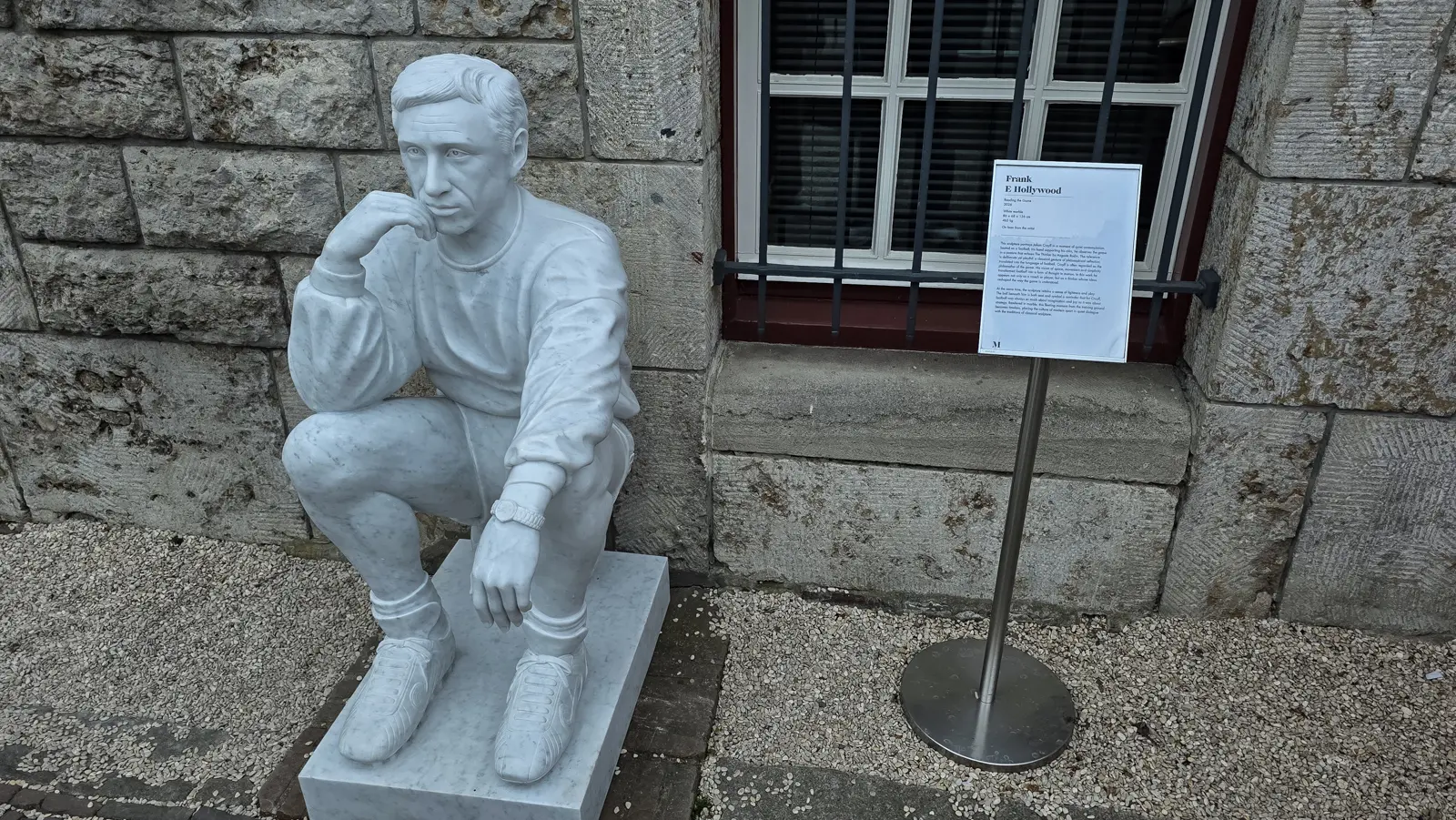
It is Johan Cruyff, and the sculptor is the Dutch artist Frank E Hollywood. The work belonged to Johan Cruyff: A Way of Thinking, which Moco ran for roughly five weeks in the spring of 2026, ten years after Cruyff’s death, and which his son Jordi opened. It gathered three Ballon d’Or trophies, the European Player of the Century award, worn shirts and golden boots, alongside new work by Dutch artists responding to how Cruyff thought rather than how he played.
I caught it in its last days without having planned to, and the part I actually remember is the marble outside in the gravel rather than anything in the cases. The exhibition has since closed, and the marble came on loan from the artist, so whether it is still standing by that window is anyone’s guess. A tracksuit rendered in stone, with the creases of the sleeves carved in, sitting on gravel under a grey Amsterdam sky.
Fifteen Minutes
By the side door there is a painted wall, white brick with a black panel on it, carrying in white capitals the line most people can finish for themselves: in the future, everyone will be world-famous for 15 minutes. It is signed Andy Warhol, and there is decent reason to think he never said it.
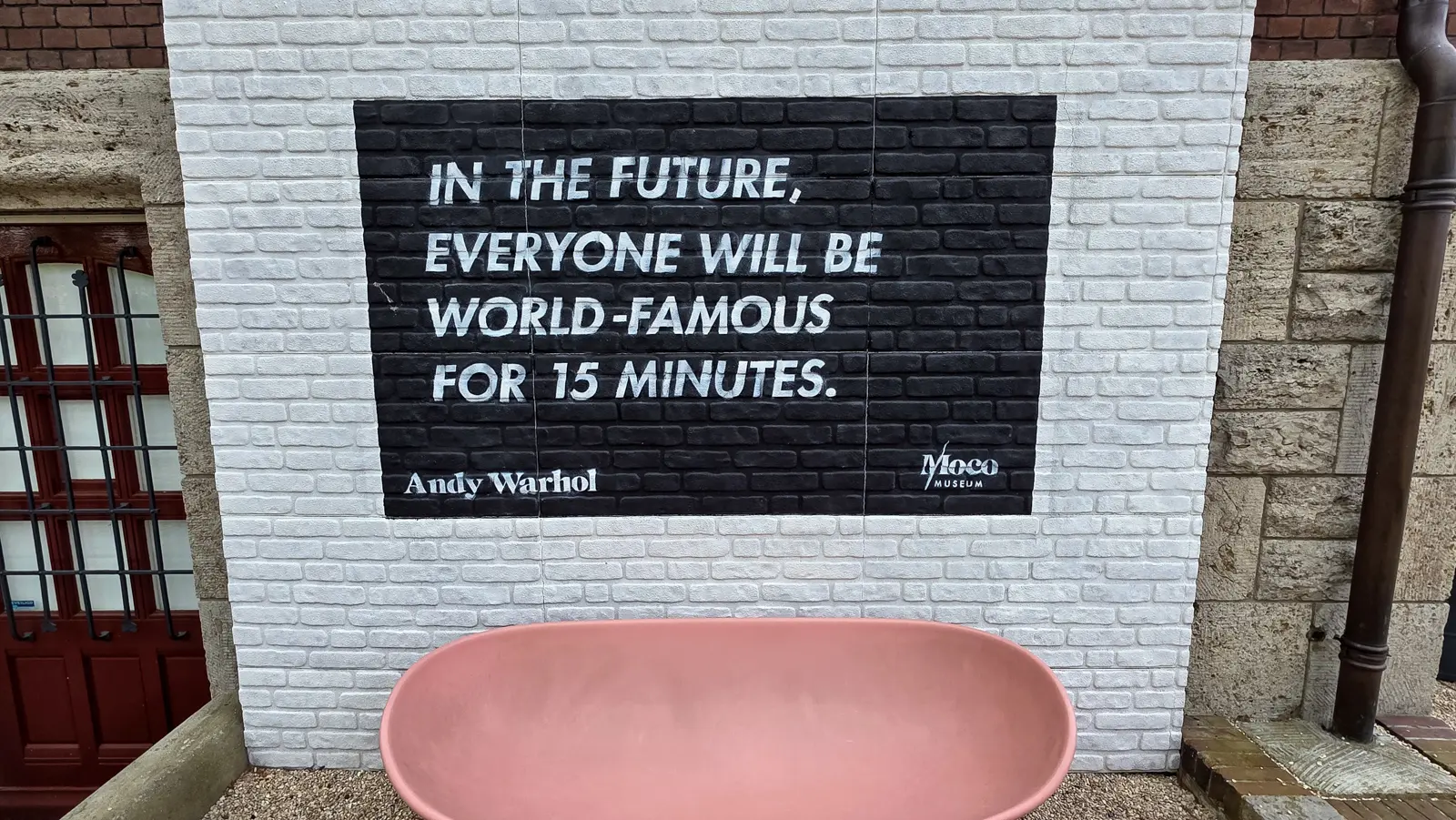
The line first reached print in the catalogue for Warhol’s 1968 retrospective at the Moderna Museet in Stockholm. Olle Granath, then a young assistant there and later the museum’s director, was handed a box containing everything written by and about Warhol and told to build the catalogue text out of it. When he delivered his manuscript, the show’s curator Pontus Hultén told him a quotation was missing and supplied this one. Granath answered that it was not in the box. Hultén’s reply, as Granath recounted it decades later, was that if Warhol had not said it he could easily have said it, so in it went.
Others have claimed it since. The photographer Nat Finkelstein said the line was his, coined in 1966 while he was shooting Warhol and a crowd gathered trying to get into the pictures. Warhol observed that everyone wanted to be famous, and Finkelstein says he supplied the time limit. A version had also appeared in Time magazine several months before the Stockholm show opened, with no source attached to it.
A curved pink bench sits under the wall, at exactly the height for someone to perch and be photographed against the words. Moco has understood something about how people use museums now, and rather than fighting it, has painted a backdrop and provided the seat. So the most photographed spot in the garden is a quotation about borrowed fame that its author may have borrowed.
Bubbly Tips
- Look through the railings before buying anything. A good part of the garden is visible from the pavement on Honthorststraat. Anyone deciding whether Moco is their sort of museum can see several works before spending a euro.
- Do the garden last, not first. Tickets are timed, so the sensible order is inside on the slot and outside afterwards, when there is no clock running.
- Allow twenty minutes for it. That is enough to read every label properly without hurrying. Most visitors give it two.
- Read the labels out here. The garden labels carry dimensions, dates, materials and provenance, and several are more informative than the wall text inside.
- Check what is on loan before travelling for one work. Several garden pieces are lent rather than owned, and the Cruyff marble arrived with a temporary exhibition. What is standing there changes.
- Go late in the day for the light. The enclosed courtyard is in shade for much of the morning. Late afternoon puts sun through the perforated leaves and gives the striped shadows their best showing.
- The pink bench is a designed photo spot, so use it. It sits under the Warhol wall at the right height, and there is no queue for it in the way there is for the mirrored rooms downstairs.
- Wheelchair users can reach the garden. The villa itself is a listed building with stairs and no lift, but the forecourt is at ground level. The museum admits wheelchair users to the ground floor free of charge.
- Combine it with the square. Moco sits on Museumplein with the Rijksmuseum and the Van Gogh Museum a short walk away, and the garden makes a decent decompression stop between two much larger collections.
Final Thoughts
The Moco Garden is the part of the museum nobody puts on a list, and it contains a Faile marble with a Tate provenance, a Marcel Wanders made for the site, a Cruyff carved this year, and a bear that says more about incarceration than most things hanging indoors.
It also happens to be the part a person can see without buying anything, standing on a public pavement in a city that charges for most of what is worth looking at.
Go inside. Obviously go inside. But leave the twenty minutes, and take the long way back to the gate.
Until next time!

🌟 Everything You Need to Plan Your Dream Trip in 2026
- 🌟 Luxury Hotels - Find premium stays with Booking.com & Hotels.com
- 🏡 Vacation Rentals - Discover unique properties on VRBO
- 🏞️ Guided Tours - Explore with Viator or GetYourGuide
- 🎫 Attraction Tickets - Skip the lines with Tiqets
- 🚢 Ocean Cruises - Set sail with Cruise Direct
- 📱 International SIMs - Stay connected with Saily
- 🚗 Car Rentals - Budget-friendly options from Discover Cars
- 🌐 Secure VPNs - Browse safely with NordVPN
- 💶 Currency Exchange - Best rates with Wise
- 🗣️ Learn Languages - Master the local language with Babbel and Rosetta Stone