
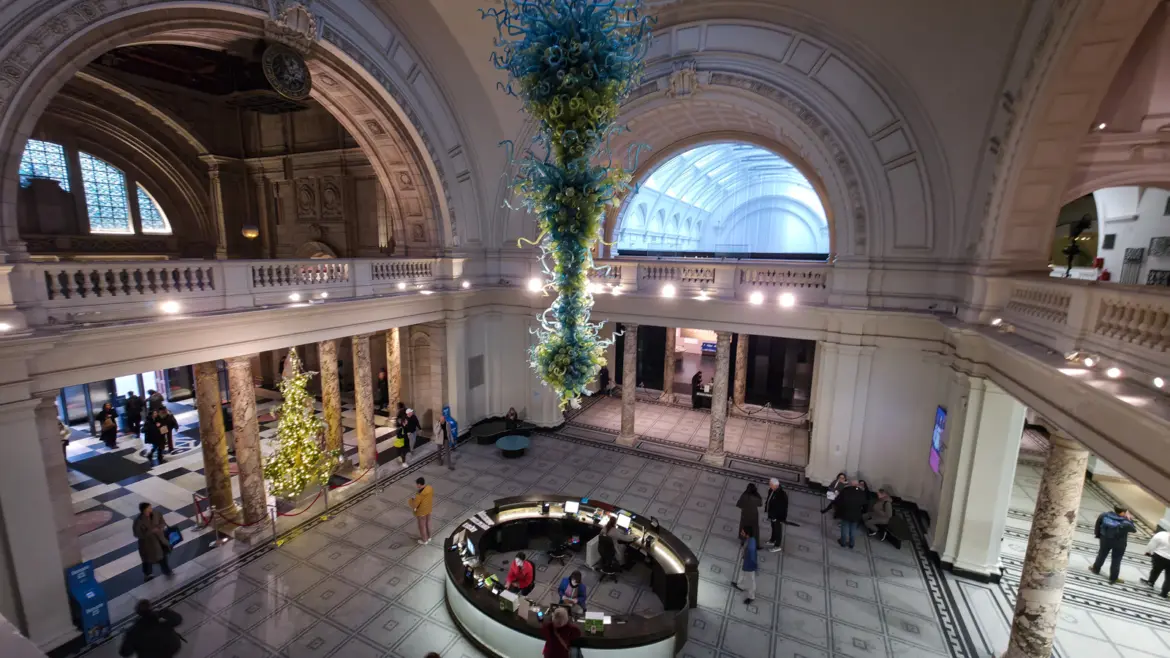
You walk into the V&A and the first thing above you is a storm of blue and green glass. The great Chihuly chandelier hangs in the domed entrance hall, eleven metres of blown glass, and it tells you straight away what kind of place this is. Then you start walking, and you do not stop, and somewhere in the second hour you accept the truth. You are not going to see this museum. Not today, not in one visit, maybe not in five.
The Victoria and Albert Museum, the V&A, is the world’s largest museum of art, design and decorative arts. It is free. It holds 145 galleries across 5,000 years, in a building that covers twelve and a half acres of South Kensington. It grew out of the Great Exhibition of 1851, opened in 1852, and took its name from Queen Victoria and Prince Albert. The museum’s own advice is that you cannot do it in one go. I did not believe them. They were right.
So this is not a complete tour. It is the honest account of one afternoon, the rooms that stopped me, and the advice I wish I had taken before I walked in.
The V&A at a Glance
🏛️ What it is · The Victoria and Albert Museum, the world’s largest museum of art, design and decorative arts, with 2.8 million objects across 145 galleries.
📍 Where · Cromwell Road, South Kensington, London SW7 2RL. South Kensington tube connects by a pedestrian tunnel, so you stay dry.
💷 Cost · Free. General admission costs nothing, so there is no pressure to see it all in one go. Special exhibitions are ticketed.
🗓️ History · Grew out of the 1851 Great Exhibition; opened 1852, renamed the V&A in 1899 when Queen Victoria laid the foundation stone of the Aston Webb front, her last public ceremony.
⭐ Don’t miss · The Cast Courts (Trajan’s Column and Michelangelo’s David in plaster), the marble sculpture galleries, the 1914 Rodin gift, and the Chihuly chandelier in the entrance.
🌳 Rest stop · The John Madejski Garden, the courtyard at the centre, is the place to sit and recover before the next push.
⏱️ Plan · You can’t see it all in one visit. Pick two or three galleries, see them properly, take the free highlights tour, and come back.
The building is the first exhibit
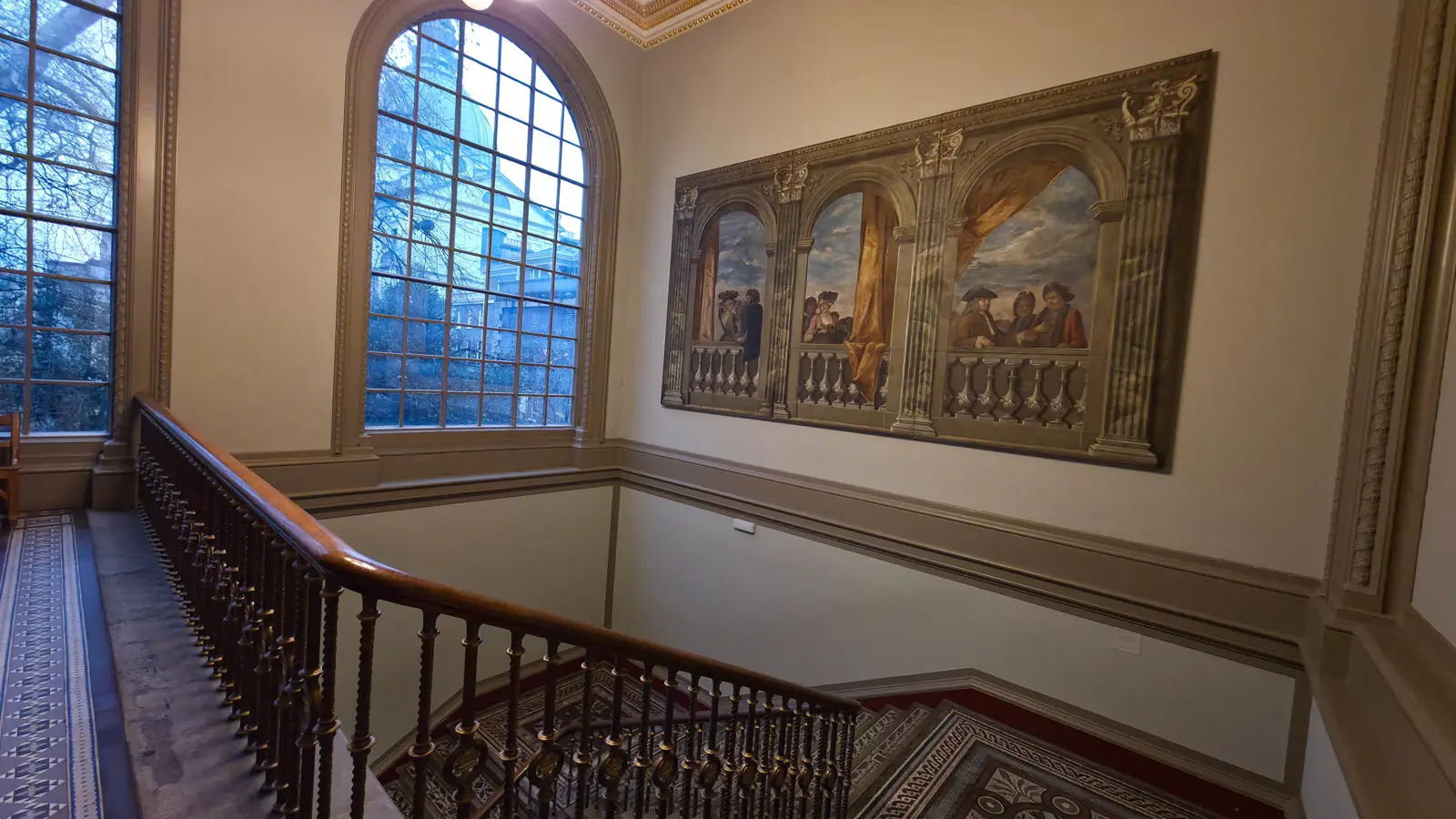
Before a single object, there is the building. The floors are mosaic. The staircases are painted and gilded. The grand halls have coffered ceilings and tall arched windows that look onto a courtyard garden in the middle of it all. The V&A was built by the Victorians to raise public taste, and they made the setting as much of a lesson as the contents.
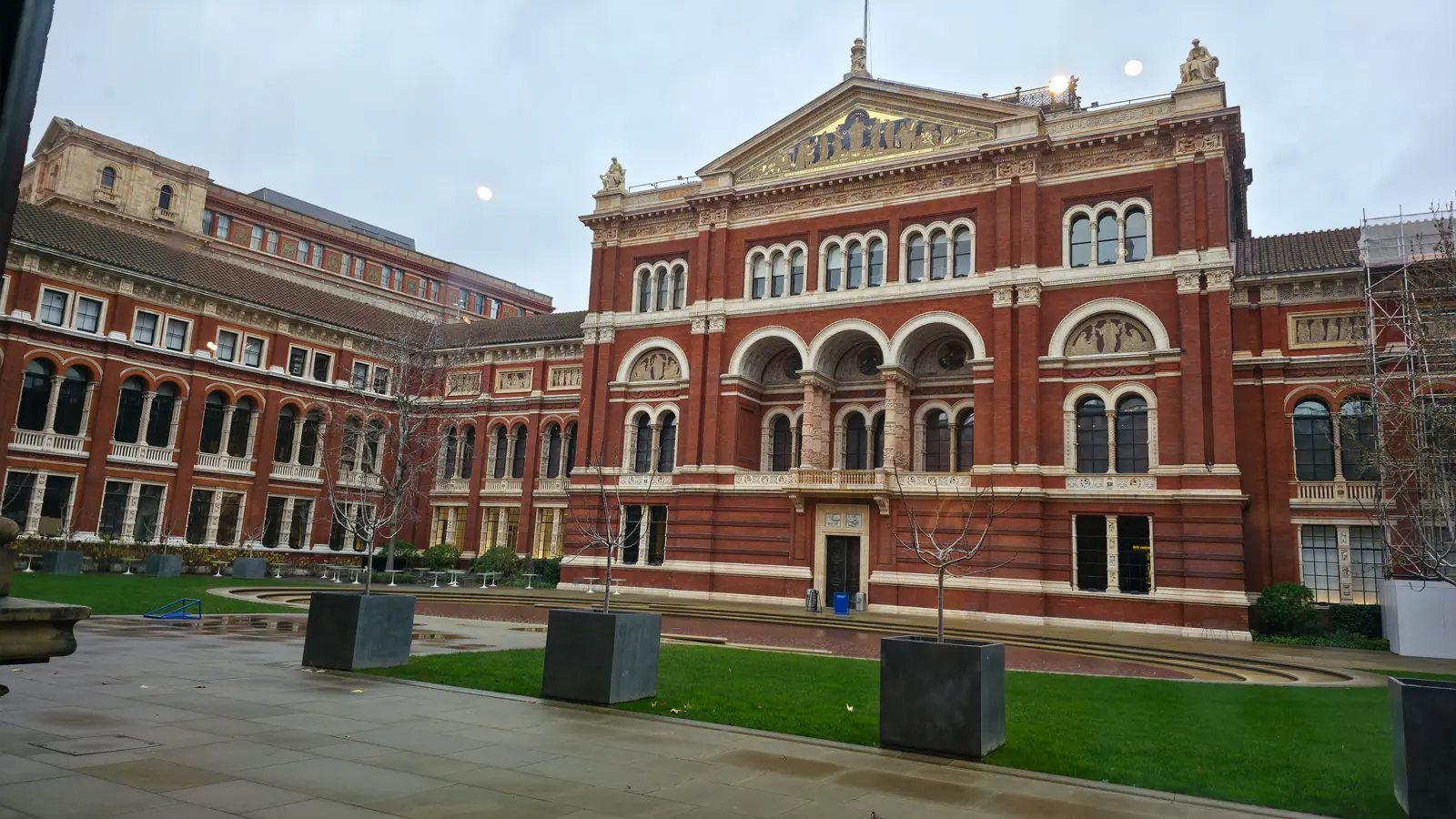
This was a museum built for ordinary people, not just scholars. The Victorians who founded it wanted working Londoners to come in, look at beautiful and well-made things, and carry higher standards back to their own workshops. The building itself was part of the argument.
The marble rooms
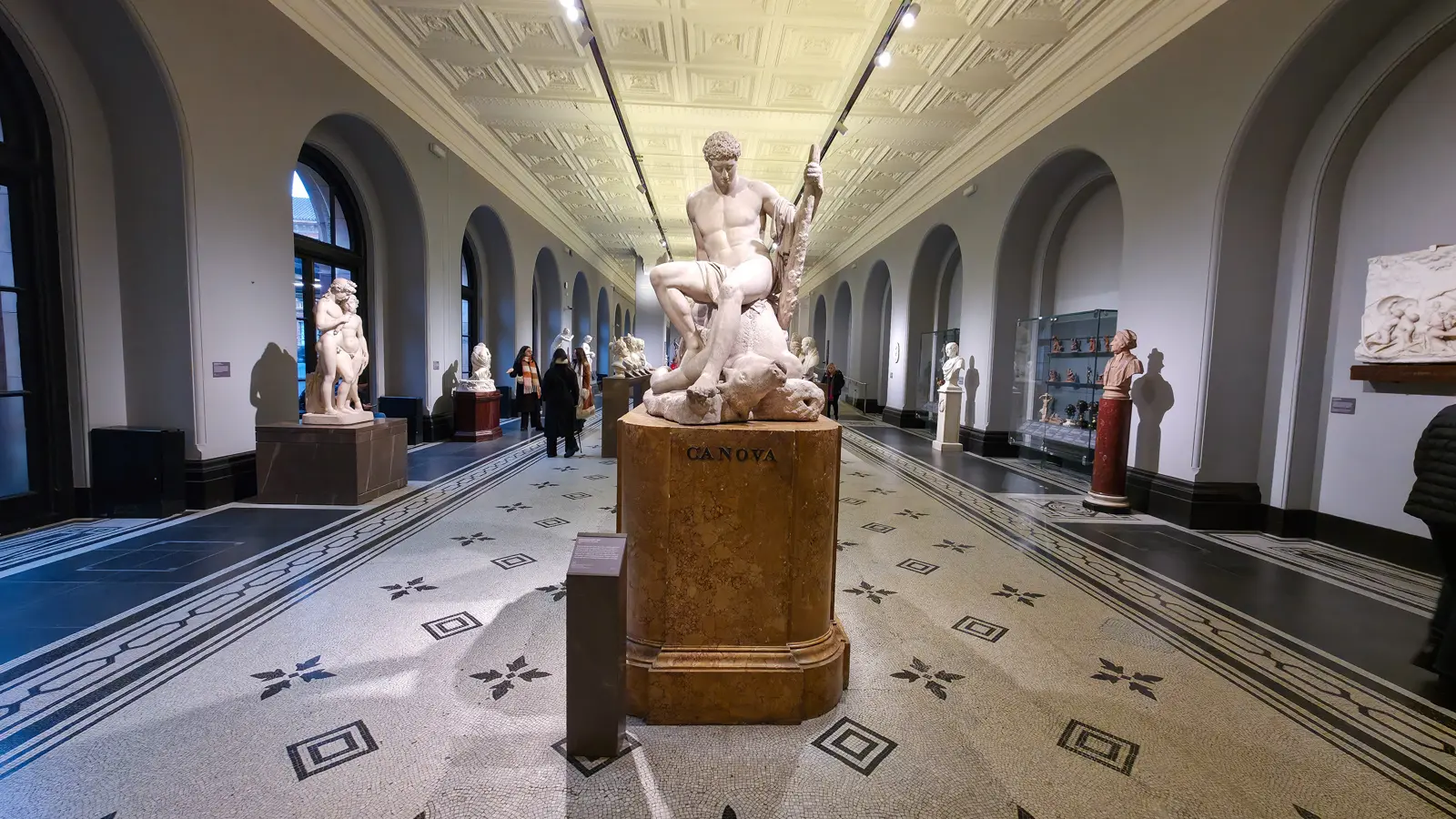
Then come the sculpture galleries, and for me this was the heart of it. Long halls of marble, lit from tall windows, with busts in rows and full figures on plinths down the centre. The carving is the thing. Hair, muscle, the fold of cloth, the catch of an expression. These are not cold white statues. There is real feeling in them, grief and strain worked into the stone.
Much of it draws on the ancient world. The marble on the Canova plinth is by Antonio Canova, who set out to bring back the calm, idealised beauty of ancient Greece and Rome. That classical root runs right through the room, and you can see why it pulls at you.
A few steps on is a violent twist of marble, two men locked together, one raising a jawbone of bone to strike. It is Giambologna’s Samson Slaying a Philistine, and it is built to be walked around, with no single front to it.
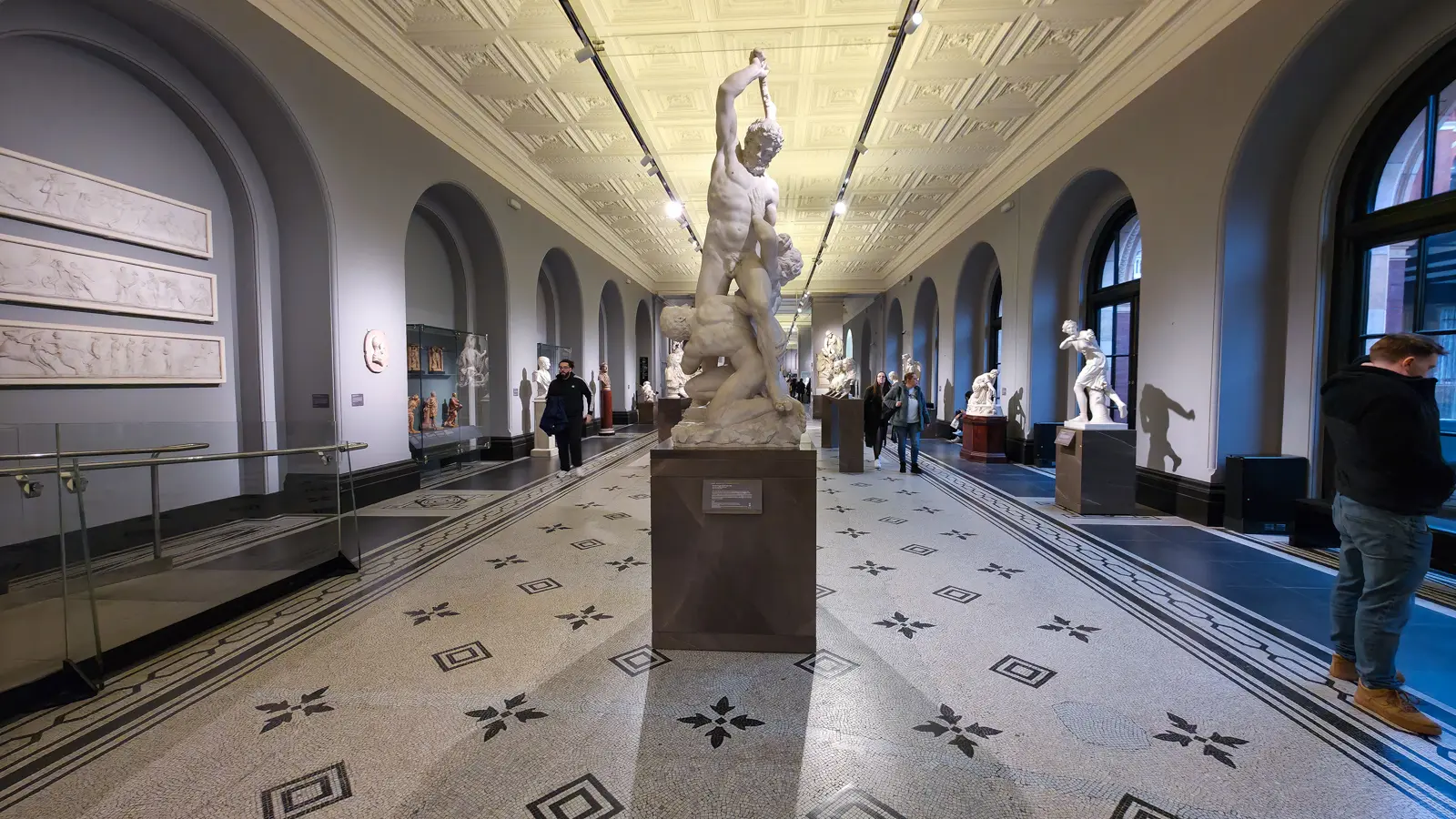
Along the windows run rows of portrait busts in marble and terracotta, the famous and the fashionable of their day, each one a face that someone once paid to keep.
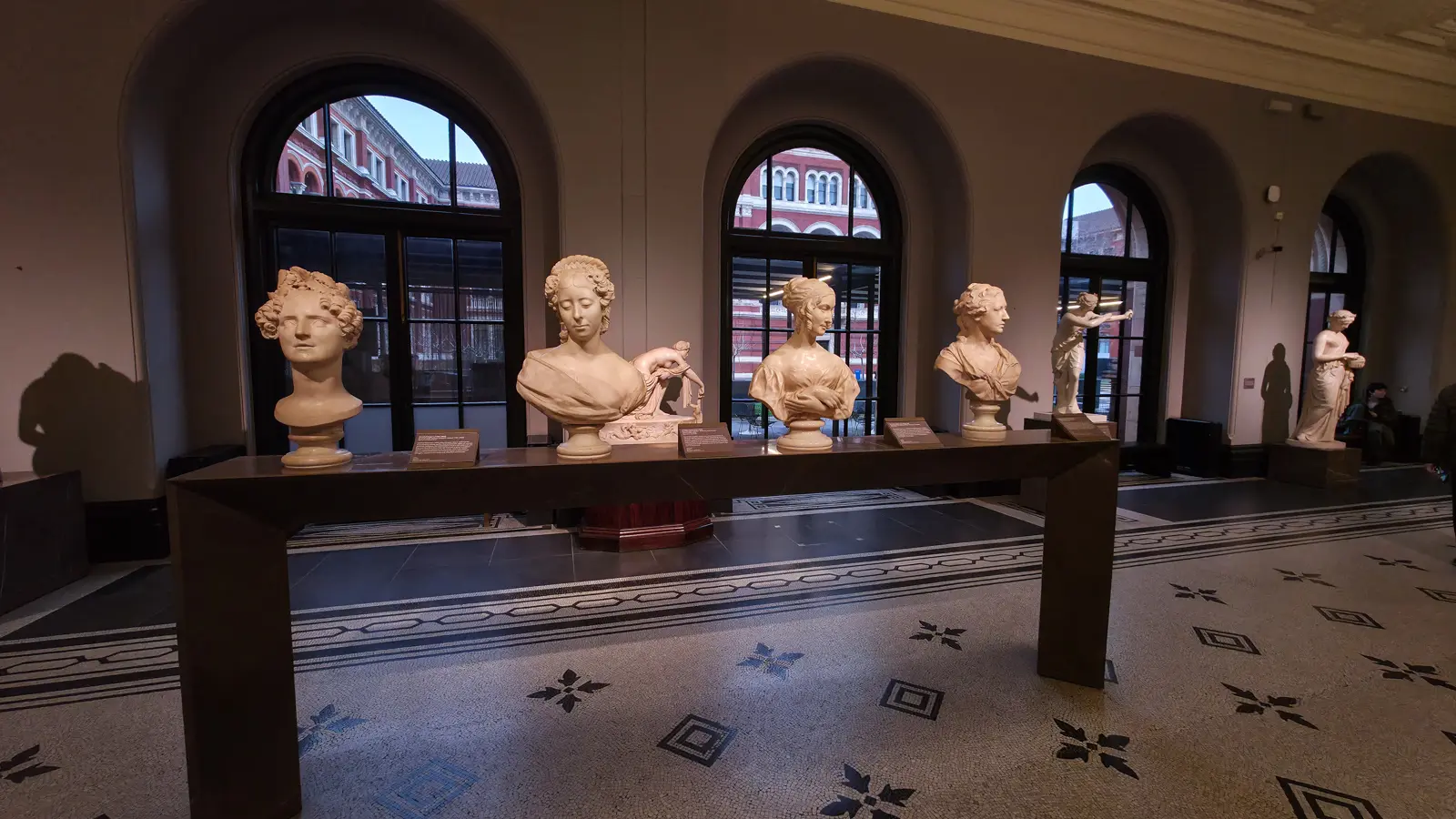
None of this is an accident of taste. The V&A holds the world’s largest collection of post-classical sculpture, with more Italian Renaissance sculpture than anywhere outside Italy. So the sense that the carving was the best of the place is not just my eye. It is the collection’s real strength.
The Rodins I did not expect
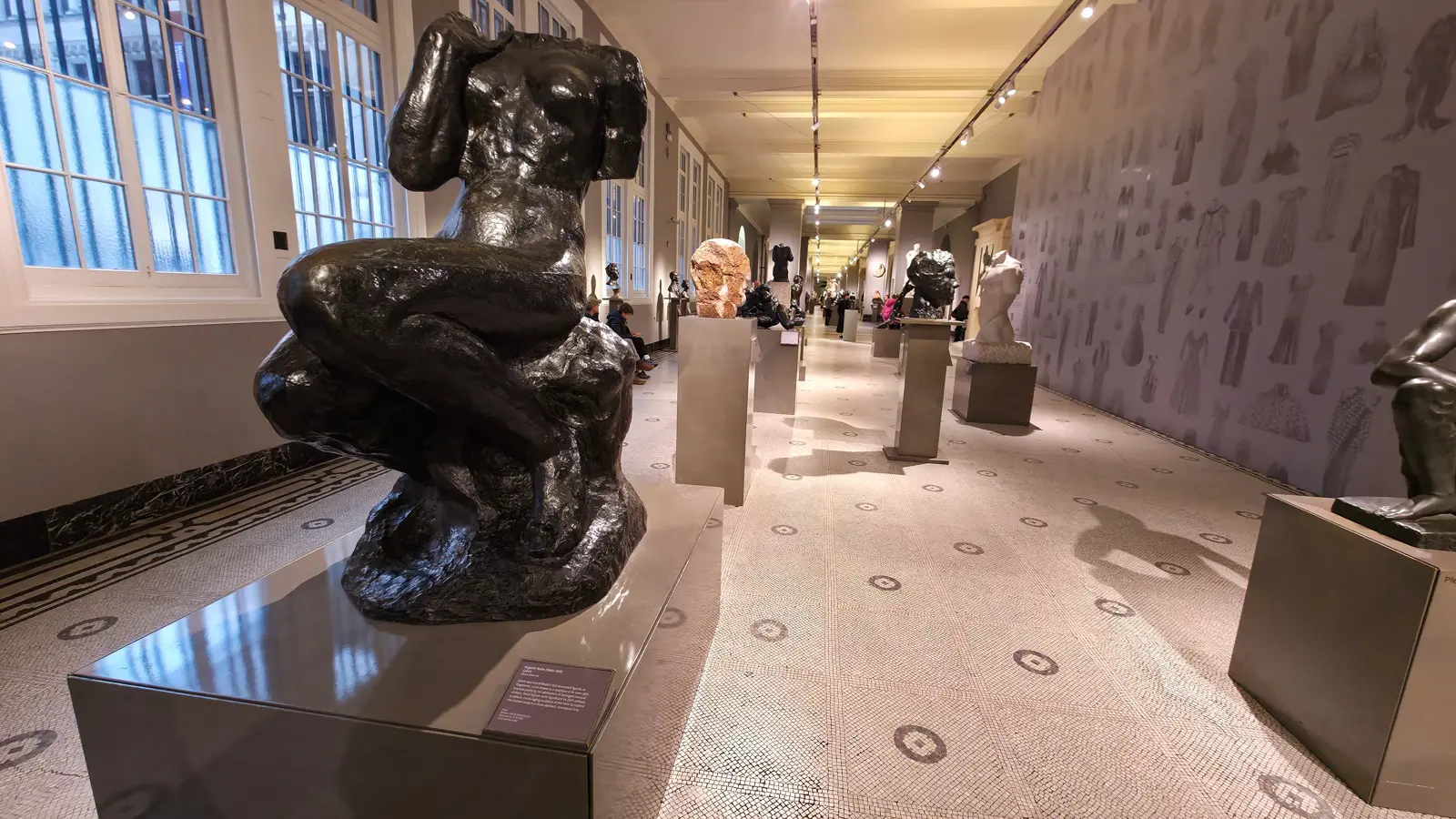
Then a surprise. In among the marble sat a group of dark bronzes, and the label said Rodin. I did not expect to meet Rodin in a London design museum, and there he was.
There is a reason, and it is a good one. In November 1914, with the First World War a few weeks old, Auguste Rodin gave the V&A eighteen of his own sculptures, in honour of the British and French soldiers fighting side by side. It remains the greatest gift the museum has ever had from a living artist. Rodin, often called the father of modern sculpture, was also the first living artist the V&A ever gave an exhibition. The bronzes I was looking at were a gesture of friendship between two countries at war.
The Cast Courts
If one room makes people stop dead, it is the Cast Courts. Two halls, two storeys high, packed with plaster casts of the world’s monuments. The first thing you see is Trajan’s Column, the Roman victory column, standing in full. It is so tall they had to cast it in two pieces and stand one beside the other, because even here the ceiling was not high enough. Around it are casts of doorways, tombs, pulpits and a full-size copy of Michelangelo’s David.
And here is the thing that matters. None of it is real, and that is the whole point.
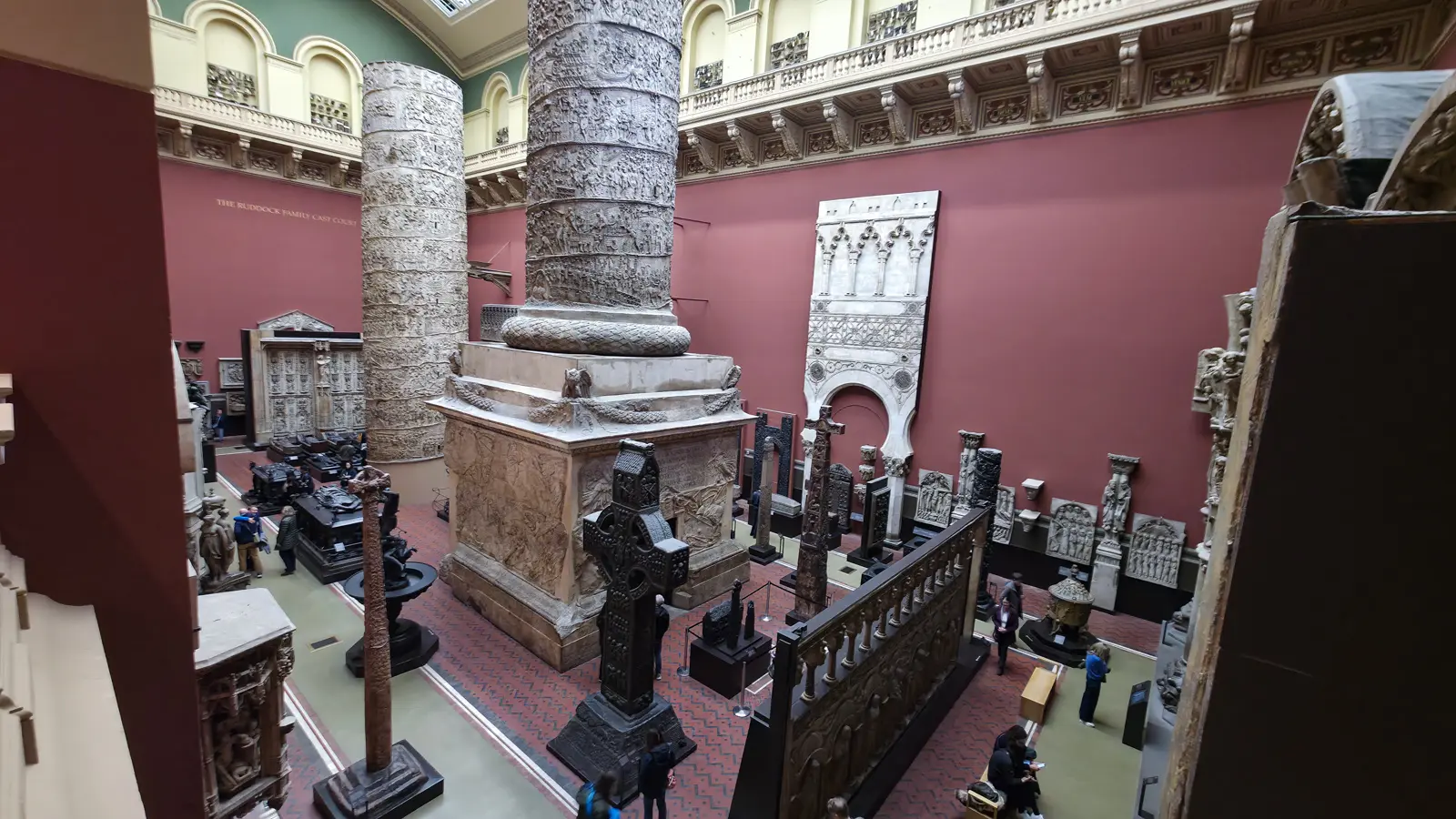
Step into the second hall and the mood shifts from imperial Rome to Renaissance Europe, with plaster copies of carved pulpits, soaring church doorways and tomb monuments standing where the originals never could. You can cross from a Roman column to a Spanish portal to an Italian doorway in a few minutes, which was exactly the idea.
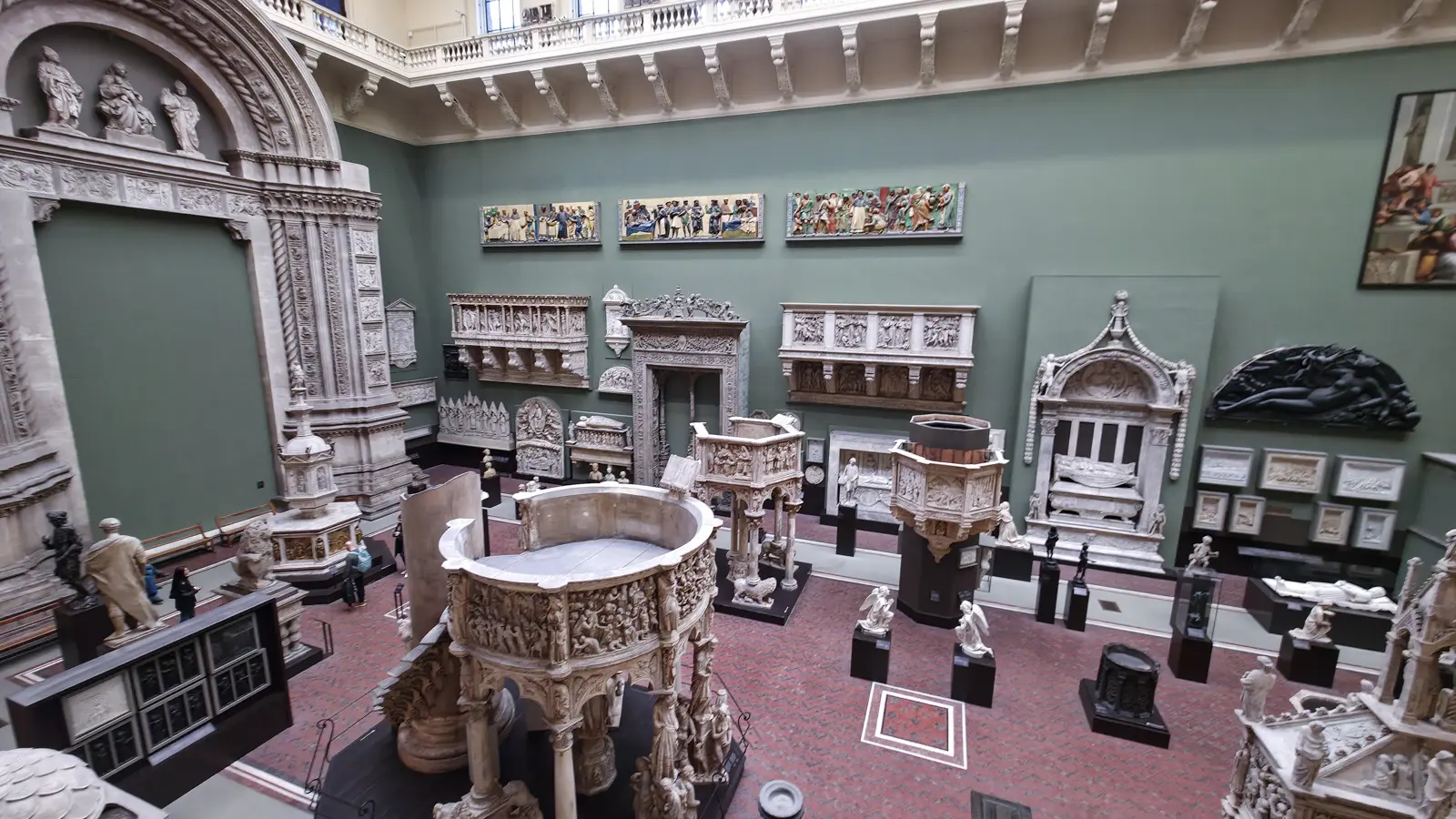
So how does one museum hold all this?
I stood in the Cast Courts and wondered the obvious thing. How does one museum come to own so much? After the long rows over the British Museum, the Parthenon marbles that Greece wants back, the Easter Island figure that Rapa Nui wants back, it is fair to ask how much of this was taken.
The honest answer is mixed, and worth knowing. A great deal of what I had just admired was not seized at all. The casts are copies by design. The Rodins were a gift from the artist himself. The Canova, the Giambologna and the Constable landscapes were bought, commissioned or donated, European works in a European museum.
But the V&A is a museum of the British empire, and parts of its collection did come out of colonial violence. It holds gold looted from Ethiopia in 1868 and gold regalia looted from the Asante kingdom, in what is now Ghana, in 1874. That is not in doubt, and the museum now says so plainly, with provenance research published on its own website. In 2024 the V&A sent seventeen of the looted Asante pieces back to Kumasi on a long-term loan, the first time they had been in Ghana for 150 years. It cannot simply hand them over, because a 1983 law stops national British museums from giving objects away, so for now any return takes the form of a loan. Whether that goes far enough is a live and genuine argument, with people of good faith on both sides.
The two most famous fights, though, the Parthenon marbles and the Easter Island moai, are not the V&A’s at all. They sit with the British Museum, a separate institution down the road. The V&A has its own reckoning, and it is a quieter and more recent one.
What I only glimpsed
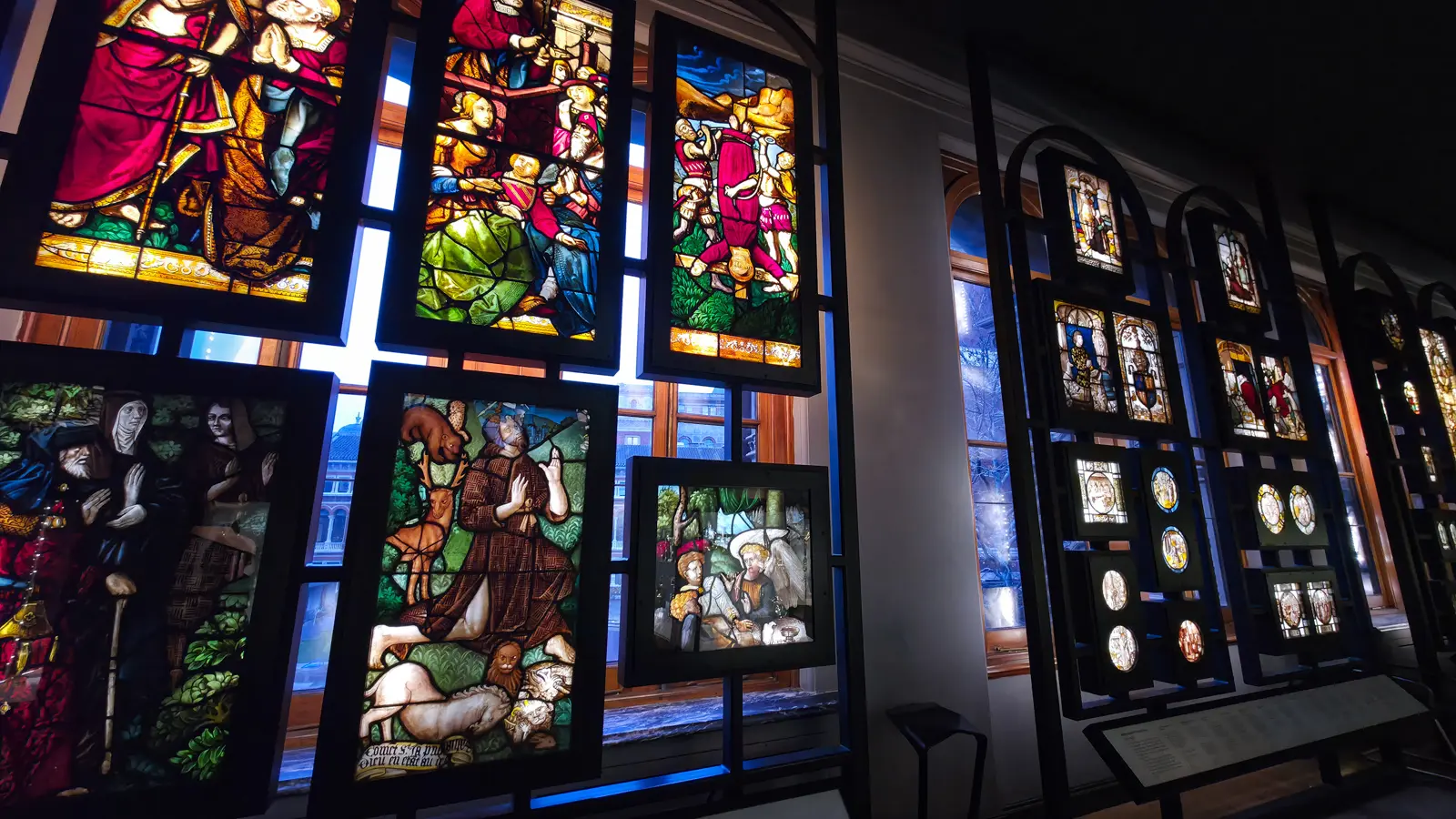
By this point I had been walking for hours and seen a fraction. I half-ran through the stained glass, a long wall of backlit medieval and Renaissance panels glowing red and gold and green, and wished I had an hour just for that.
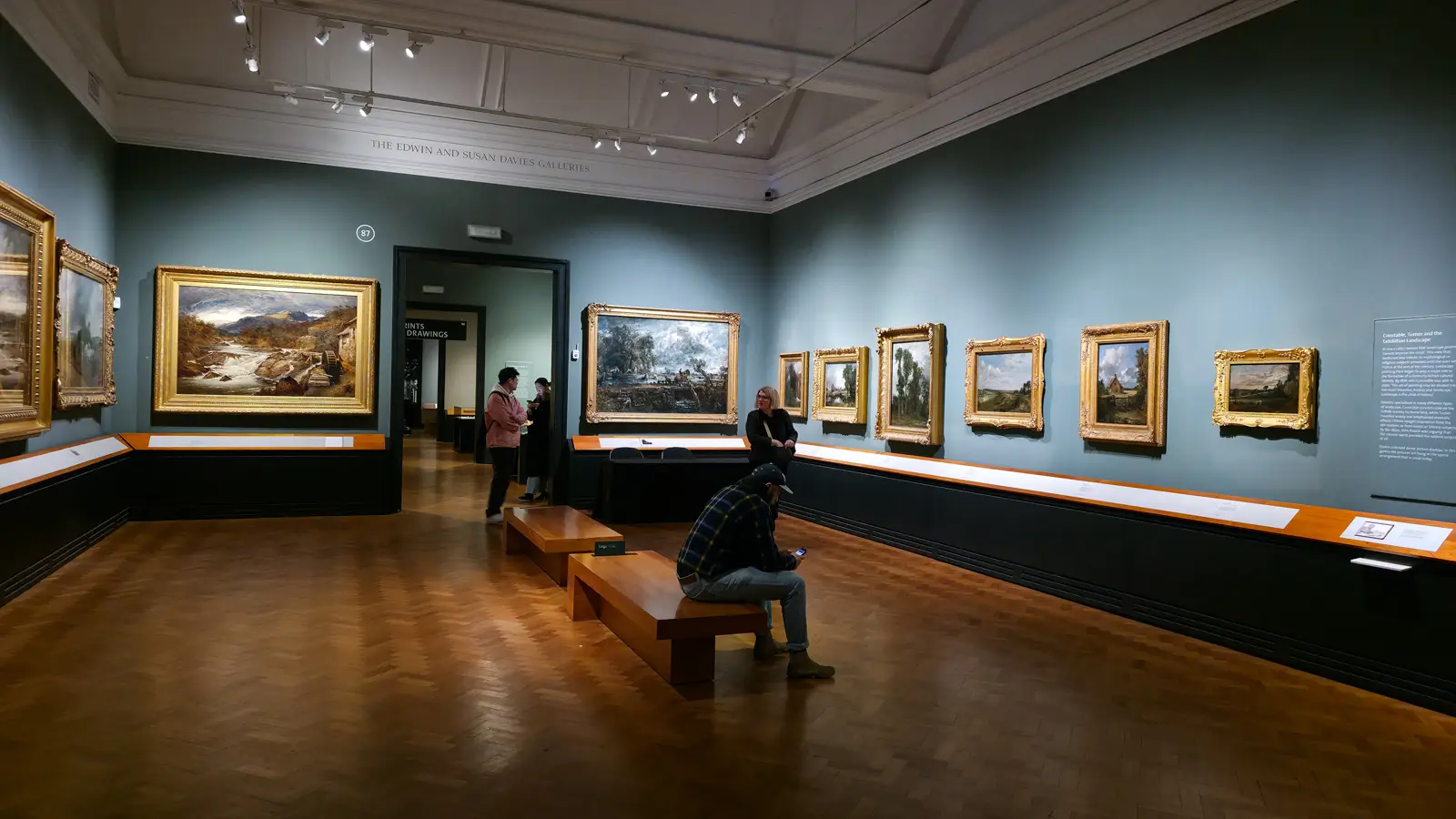
I passed through the British landscape rooms, where Constable and Turner hang together, and barely broke stride. On a calmer day that gallery alone would have held me for an hour.
And then it was closing time, and I had not seen the fashion, the jewellery, the ceramics, the furniture, the Asian galleries, the photography, or half the rest. I left a little dazed and a little defeated. The next morning I was still thinking about it.
Bubbly Tips
- It is free. General admission costs nothing, so there is no pressure to get your money’s worth in one marathon. Come back as often as you like.
- Do not try to see it all. You cannot. Pick two or three galleries you actually care about, see them properly, and let the rest wait for next time.
- Take the free tour. The V&A runs free guided highlights tours several times a day. I skipped it and regretted it, so next time I will start with one to get my bearings.
- Go for the Cast Courts and the Rodins. If you see nothing else, see those two. The Cast Courts are unlike anything else in London, and the Rodins come with a story.
- Quietest early or late. Weekday mornings and the last two hours before closing are the calmest, especially for the popular rooms.
- Rest in the garden. The John Madejski Garden in the courtyard is the place to sit down, get your energy back, and plan the next push.
- Arrive by tube. South Kensington station connects to the museum by a pedestrian tunnel, so you stay dry even in the rain. Driving is not worth the bother.
- Mind the neighbours. The Natural History Museum and the Science Museum are on the same street, but do not try to do all three properly in one day. One museum done well beats three done badly.
Final Thoughts
I went to the V&A expecting a nice afternoon and got something closer to a humbling. The building alone is worth the trip. The sculpture galleries are some of the best I have stood in anywhere, and finding Rodin’s wartime gift among them was the kind of surprise you remember. The Cast Courts made me laugh out loud at the sheer nerve of copying Trajan’s Column and sawing it in half to fit.
I also left with a better question than the one I came in with. Not only how they gathered all this, but what should happen to the parts that were taken. The V&A is starting to answer that out loud now, which is more than it once did. Either way, I am going back, and next time I am giving it a whole day and taking the tour. The museum won this round. I would like a rematch.
Until next time!

🌟 Everything You Need to Plan Your Dream Trip in 2026
- 🌟 Luxury Hotels - Find premium stays with Booking.com & Hotels.com
- 🏡 Vacation Rentals - Discover unique properties on VRBO
- 🏞️ Guided Tours - Explore with Viator or GetYourGuide
- 🎫 Attraction Tickets - Skip the lines with Tiqets
- 🚢 Ocean Cruises - Set sail with Cruise Direct
- 📱 International SIMs - Stay connected with Saily
- 🚗 Car Rentals - Budget-friendly options from Discover Cars
- 🌐 Secure VPNs - Browse safely with NordVPN
- 💶 Currency Exchange - Best rates with Wise
- 🗣️ Learn Languages - Master the local language with Babbel and Rosetta Stone