
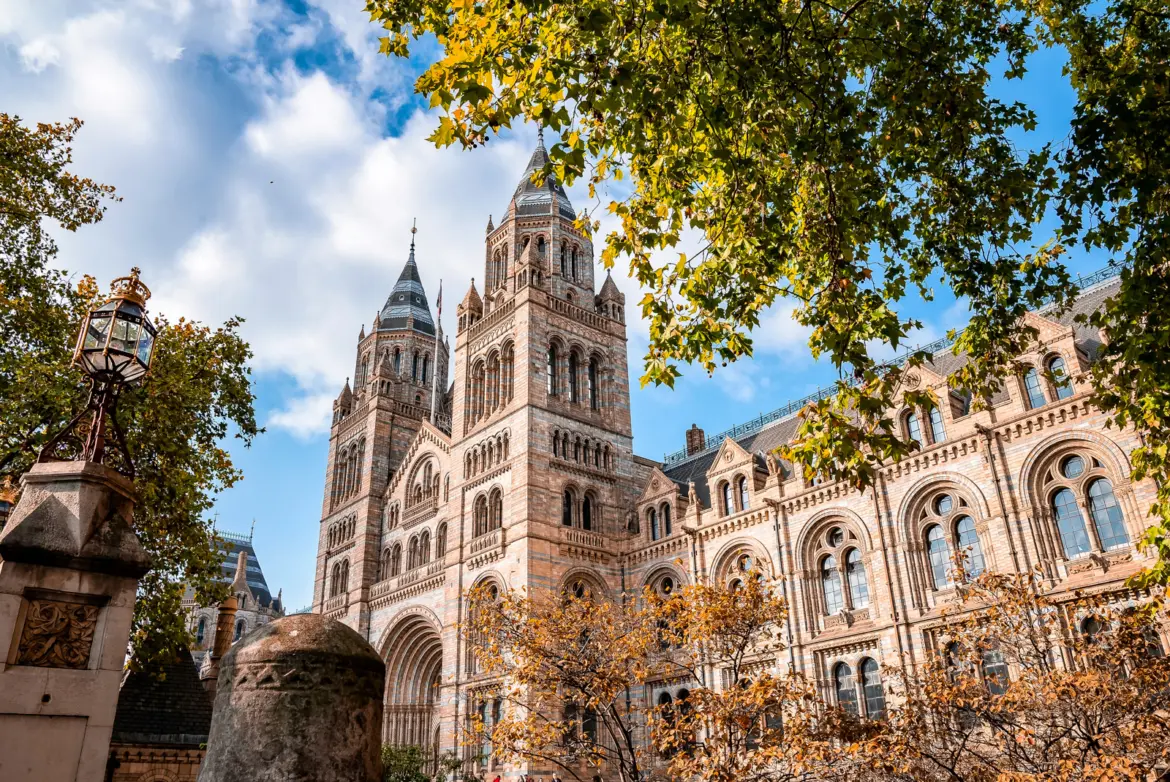
I walked into the Natural History Museum on a December afternoon expecting to see Dippy. I had forgotten that Dippy had been gone since 2017. What was hanging above the central staircase instead was something I wasn’t prepared for: a 25.2-metre blue whale skeleton, mouth open, mid-dive, suspended from the Victorian ceiling of Hintze Hall as if she were lunging at krill. Her name is Hope. She is genuinely enormous. The first thing I felt was a small flicker of disappointment that I’d missed Dippy. The second thing I felt was that Hope was the better choice.
I’ll come back to that. But first I want to mention something about coming through the door.
I didn’t pay anything to get in.
Natural History Museum at a Glance
📍 Location · Cromwell Road, London SW7 5BD. Nearest tube: South Kensington (Piccadilly, District, Circle lines), 5 minutes on foot through the pedestrian subway. Side entrance on Exhibition Road is usually quicker.
🎟️ Entry · Free. Has been since 2001 under the UK’s “Museums Free for All” policy. Special exhibitions usually charge £15–£25. The free permanent galleries alone are easily enough for a full visit.
🐋 The headline exhibit · Hope, a 25.2-metre blue whale skeleton, suspended above the grand staircase of Hintze Hall since July 2017. The skeleton is 4.5 tonnes and 221 bones, of a whale that beached at Wexford Harbour, Ireland in March 1891. She replaced Dippy the Diplodocus, who is now on long-term loan at the Herbert Art Gallery & Museum in Coventry through February 2026.
🏛️ The building · Designed by Alfred Waterhouse, completed in 1881. Romanesque Revival, clad entirely in terracotta to resist coal-smoke pollution, with carved animals on every column (east wing = extinct species, west wing = living ones). Grade I listed.
🦖 Don’t-miss galleries · Hintze Hall (Hope), Marine Reptiles (Mary Anning’s fossils, including the 1832 ichthyosaur she collected), Earth Hall (globe escalator + Sophie the Stegosaurus, the world’s most complete specimen at 85%), Minerals Gallery (one of the quietest and richest rooms in the museum), Dinosaurs (always packed but worth the queue).
🕐 Best time to visit · Tuesday or Wednesday morning just after the 10 am opening. Saturdays, school holidays, and the entire December–January season are very busy. Closes at 5:50 pm; last entry typically 5:30 pm.
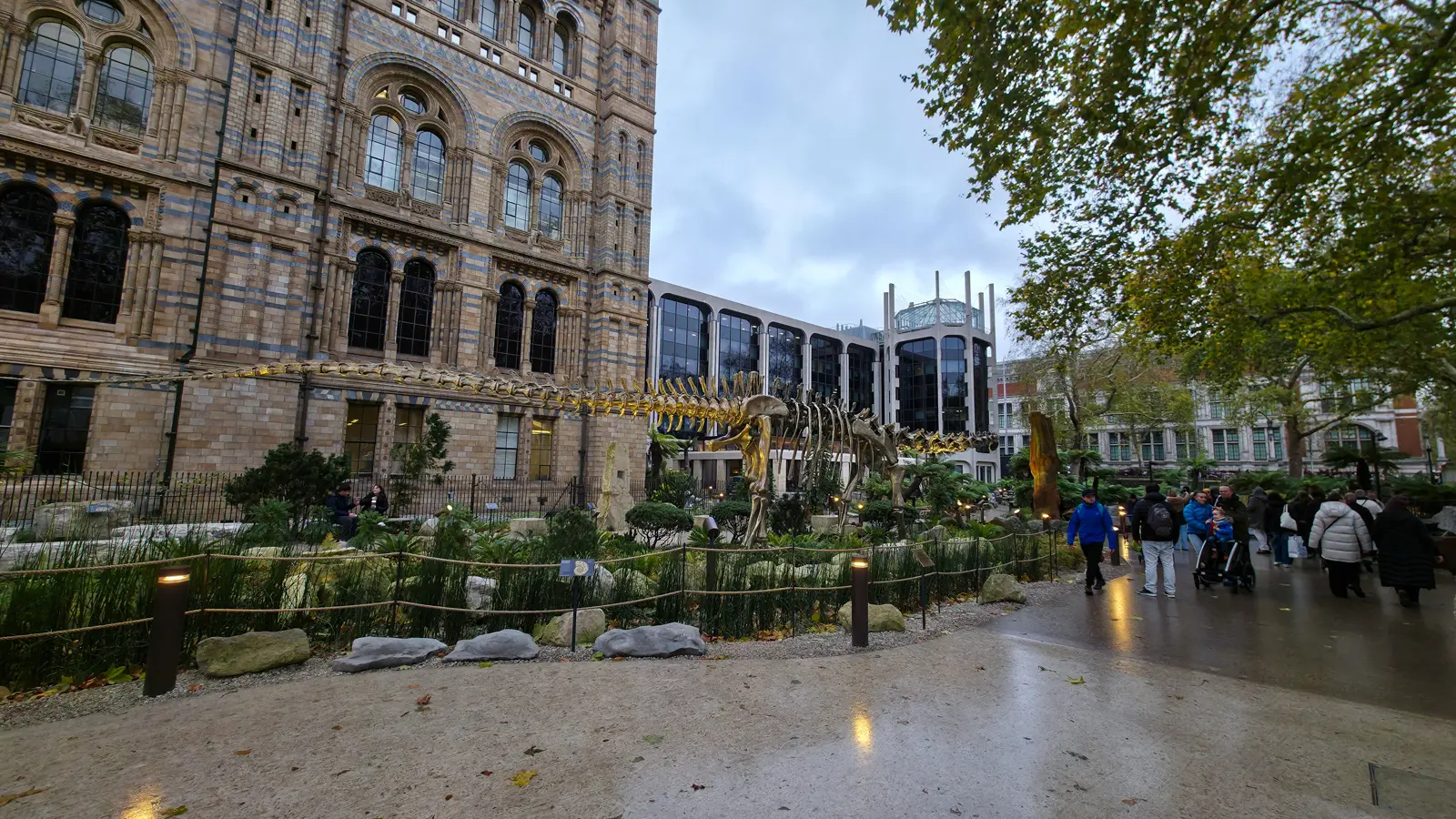
🌳 The gardens · The five-acre Wildlife Garden and Jurassic Garden reopened in July 2024 as part of the Urban Nature Project. Fern — a 26-metre bronze cast of Dippy, the world’s first fully self-supporting outdoor Diplodocus — stands in the Jurassic Garden.
💡 Tip · Use the Exhibition Road side entrance instead of the famous Cromwell Road one. Faster queue, and it brings you in through Earth Hall so you see the globe and escalator on the way in.
The Free Museums of London
Every major national museum in London is free to enter. The Natural History Museum, the British Museum, the National Gallery, the Tate Modern, the Tate Britain, the V&A, the Science Museum, the Imperial War Museum, the National Portrait Gallery, every one of them. You walk in. No ticket. No queue at a payment desk. There’s a small donation box if you want to leave something, and you should if you can, but you don’t have to.
This has been the case since 2001, when the UK government’s “Free for All” policy abolished entry charges for the national museums. It’s one of the genuinely remarkable things about London, and most visitors don’t realise quite how unusual it is. In Paris, the Louvre costs €22. In New York, the Met is technically pay-what-you-wish for state residents only, everyone else pays $30. In Madrid, the Prado is €15. In London, the Natural History Museum is free, and the V&A across the road is free, and the Science Museum next door is free. A London sandwich costs more than entry to all three combined.
It’s the kind of thing that, when you first encounter it, makes you understand the city slightly differently. London is expensive. The Tube is expensive. The food is expensive. The hotels are expensive. The museums, somehow, are not. They’re a gift the city gives you back.
The Building Itself
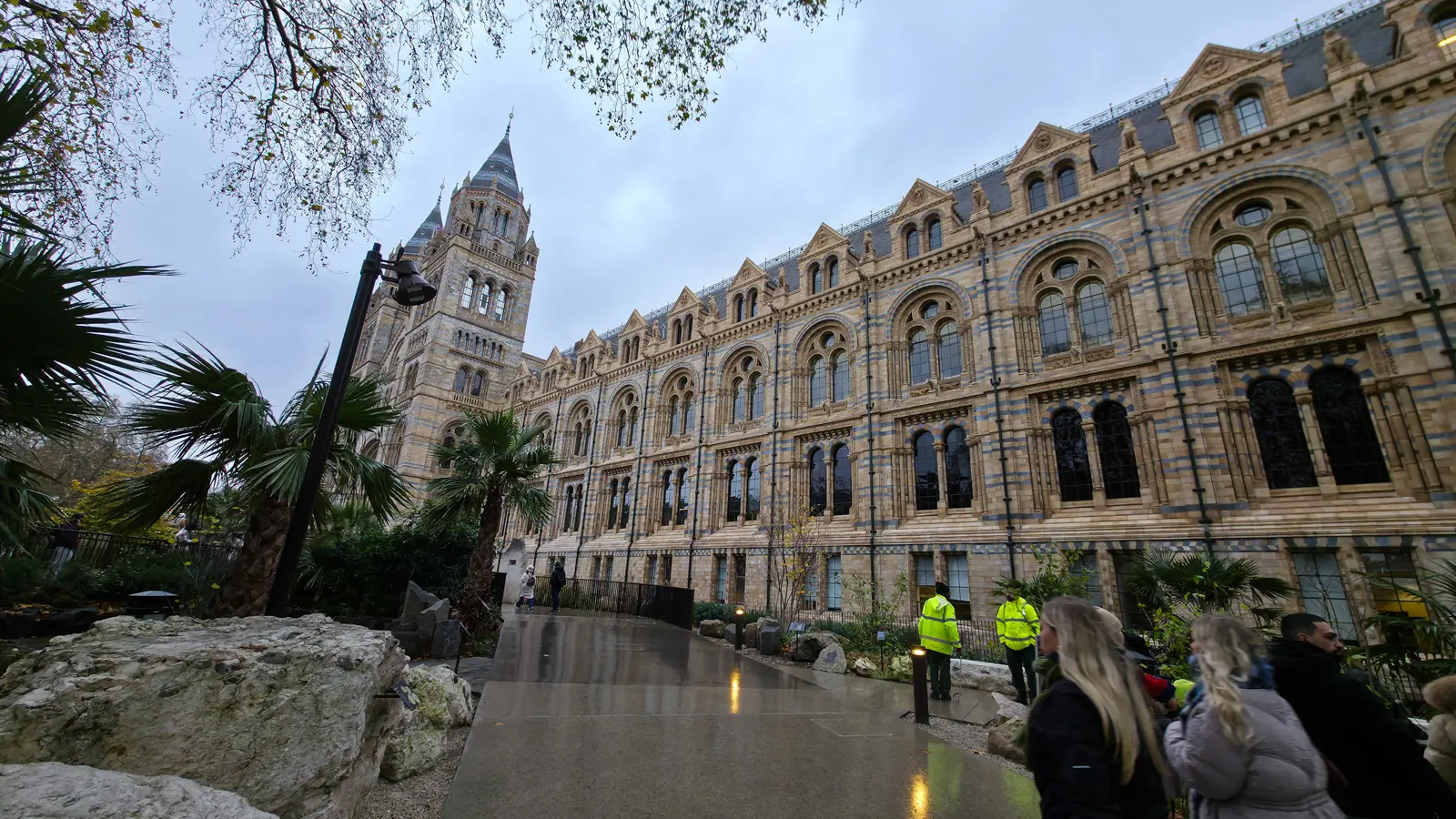
The Natural History Museum’s building is one of the great Victorian buildings of London. It was designed by Alfred Waterhouse, completed in 1881, and built in a Romanesque-revival style with twin towers, an enormous central nave, and an exterior clad entirely in terracotta. The terracotta was a deliberate choice. It resisted London’s coal-smoke pollution better than carved stone would have, and it allowed for the kind of intricate sculptural detail the museum’s architects wanted: carved animals everywhere, on every column, on every arch, integrated into the structure of the building itself.
The animal carvings follow a deliberate plan. On the east wing of the building, the carvings represent extinct species. On the west wing, they represent living ones. The architectural symbolism mirrors the scientific division of the museum’s original collection: fossils on one side, current zoology on the other. It’s a touch that nineteenth-century visitors would have understood immediately. Most modern visitors walk past it without noticing.
Inside, the same Romanesque ambition continues. Hintze Hall, the great central hall where Hope now hangs, is sometimes called a “cathedral of nature”, and the comparison is fair. The vaulted ceiling, the painted panels, the gold and blue colours, the columns, the staircase climbing to a balcony lined with arches, it was all designed to make natural history feel as important as faith.
Hintze Hall, Hope, and the Ghost of Dippy
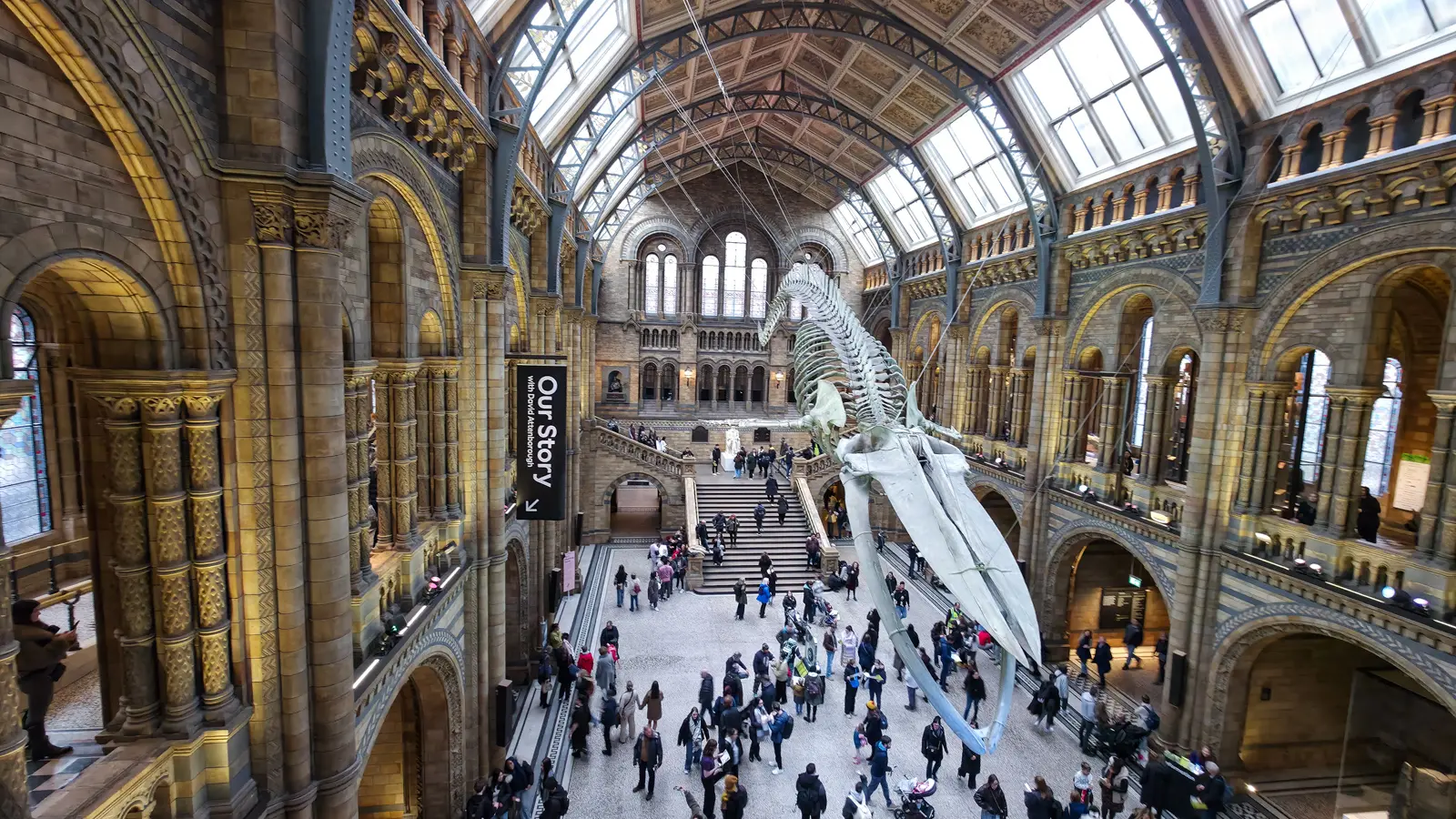
Hope arrived in Hintze Hall in July 2017, replacing Dippy after a six-month closure of the central space. Dippy had been the museum’s centrepiece since 1979, a 26-metre plaster cast of a Diplodocus carnegii skeleton given to the museum by Andrew Carnegie at the start of the twentieth century. Dippy had welcomed three generations of British children to the museum. When the museum announced in 2015 that Dippy would be replaced by a blue whale, the response was emotional. The hashtag #savedippy trended on Twitter. Over 14,000 people signed a petition to keep him.
The museum did it anyway.
Hope is real, where Dippy was a cast. She is the skeleton of an actual blue whale that stranded at Wexford Harbour in southeast Ireland in March 1891, over 130 years ago, then was killed by a lifeboat pilot named Ned Wickham. Her skeleton — 221 bones, 4.5 tonnes, 25.2 metres long — was bought by the museum for £250. From 1934 until 2017 she hung in the Mammals Gallery alongside other whale skeletons, where most visitors barely noticed her. The move to Hintze Hall in 2017 was a deliberate statement. The museum’s then-director said the blue whale was “a powerful reminder of the fragility of life and the responsibility we have towards our planet”. Blue whales were hunted to the brink of extinction in the twentieth century, with the global population dropping from around 250,000 in the 1800s to roughly 400 by the 1960s. The species was one of the first that humanity collectively decided to save. Conservation efforts since have brought the population back to around 25,000.
That’s the meaning of the name. Hope.
Dippy is fine, for the record. After leaving the museum in 2017, he went on a two-year tour of the UK that was seen by more than two million people. He came back briefly in 2022, then went on long-term loan to the Herbert Art Gallery and Museum in Coventry, where he stays through February 2026.
The museum also commissioned a permanent successor, in a way. When the gardens reopened in July 2024 as part of the Urban Nature Project, a 26-metre bronze cast of Dippy was installed in the new Jurassic Garden, surrounded by Wollemi pines, ginkgos, and ferns chosen to evoke a Jurassic landscape. The new cast was named Fern by local schoolchildren. Dippy himself is a plaster cast and could never survive outdoors in the British weather. Fern is made of bronze, specifically engineered as the world’s first fully self-supporting life-size Diplodocus cast, designed to stand outside in the rain for centuries. The children who come to see Dippy now find Hope above their heads in Hintze Hall, and Fern on the way out through the garden. That’s the whole afternoon, really.
What surprised me most about Hope is what she does to the room. Dippy was horizontal, low to the ground, more dinosaur-like in posture. Hope is diagonal, lunging downward from above, mouth wide enough to swallow a horse. She’s not standing in the room. She’s flying through it. Walking under her changes the experience of being in Hintze Hall. You’re suddenly aware of the volume of the air around you, of how high the ceiling actually is, of the fact that the largest animal that has ever lived on this planet is somehow above your head.
I stood under her for longer than I expected to. I came back twice.
Mary Anning in the Marine Reptiles Gallery
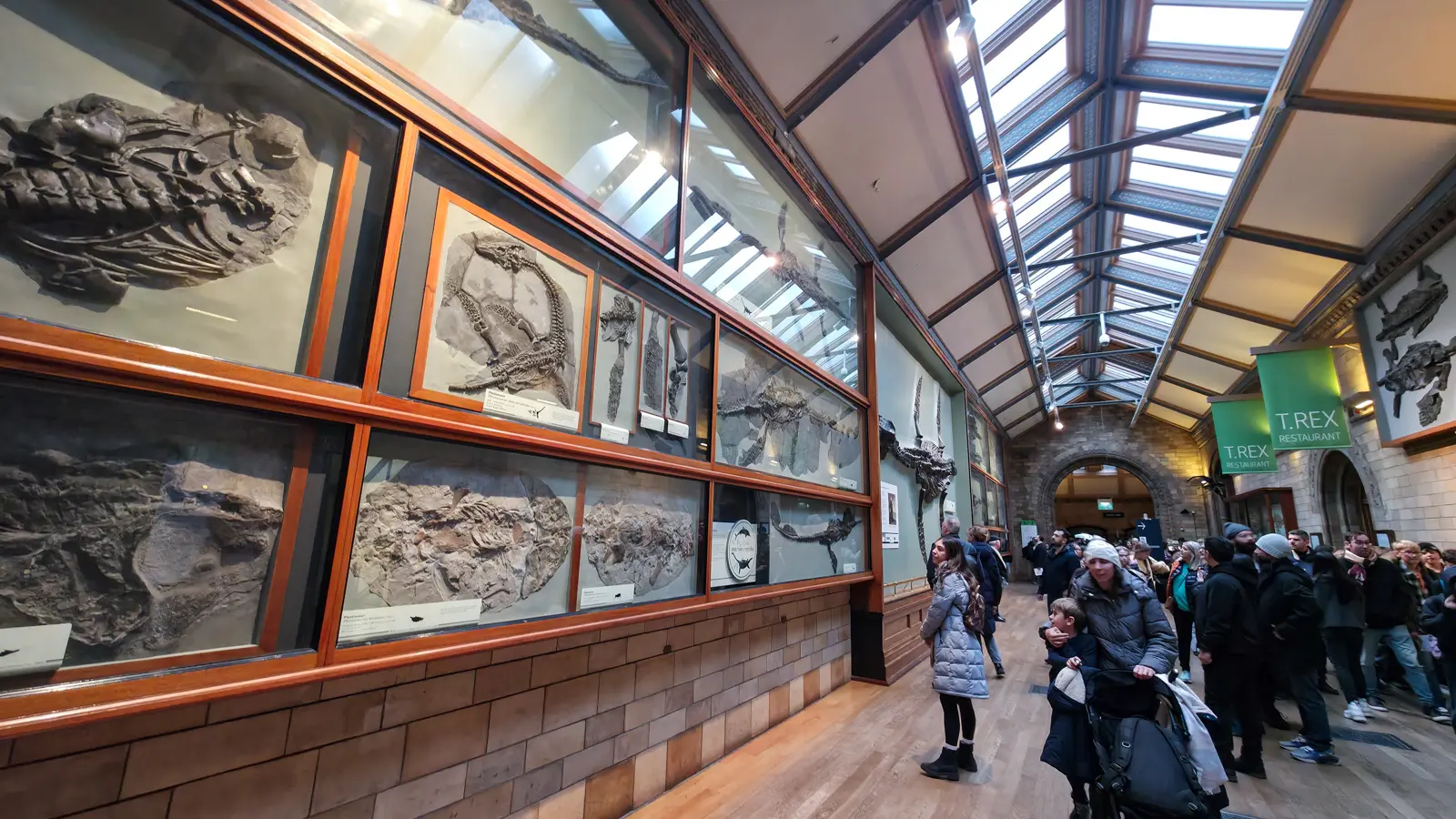
The marine reptiles gallery is where some of the most important fossils ever found in Britain are displayed. The cases are still in their original Victorian wooden frames, mounted high on the wall, the same way they would have looked to a nineteenth-century visitor in 1881. Many of the fossils inside were dug out of the cliffs at Lyme Regis on the Dorset coast by a woman named Mary Anning.
Anning was born in 1799 in Lyme Regis to a cabinetmaker who supplemented his income by collecting and selling fossils from the local cliffs to tourists. Her father died when she was eleven. To feed her family, she and her older brother Joseph kept collecting. In late 1811, when Mary was twelve, Joseph found a strange-looking skull eroding out of a cliff. Over the following year, Mary excavated the rest of the five-metre skeleton attached to it. They sold it to a local gentleman for £23.
It turned out to be the first complete ichthyosaur ever scientifically described. Mary had effectively just discovered a new branch of the tree of life. She was twelve!
She kept going. In 1823, at age 24, she found the first complete plesiosaur skeleton. In December 1828, she found the first pterosaur ever discovered outside Germany. She did all of this from the cliffs of one small town, on her own, with no formal scientific education. The leading geologists of England came to Lyme Regis to buy from her. Her fossils ended up in the collections of the British Museum and the Geological Society and what would become the Natural History Museum. The Geological Society of London did not admit women until 1904 — by then she had been dead for fifty-seven years. The Royal Society did not admit women until 1945. She received almost no scientific credit during her lifetime, died of breast cancer in 1847 aged 47, and was still in financial difficulty.
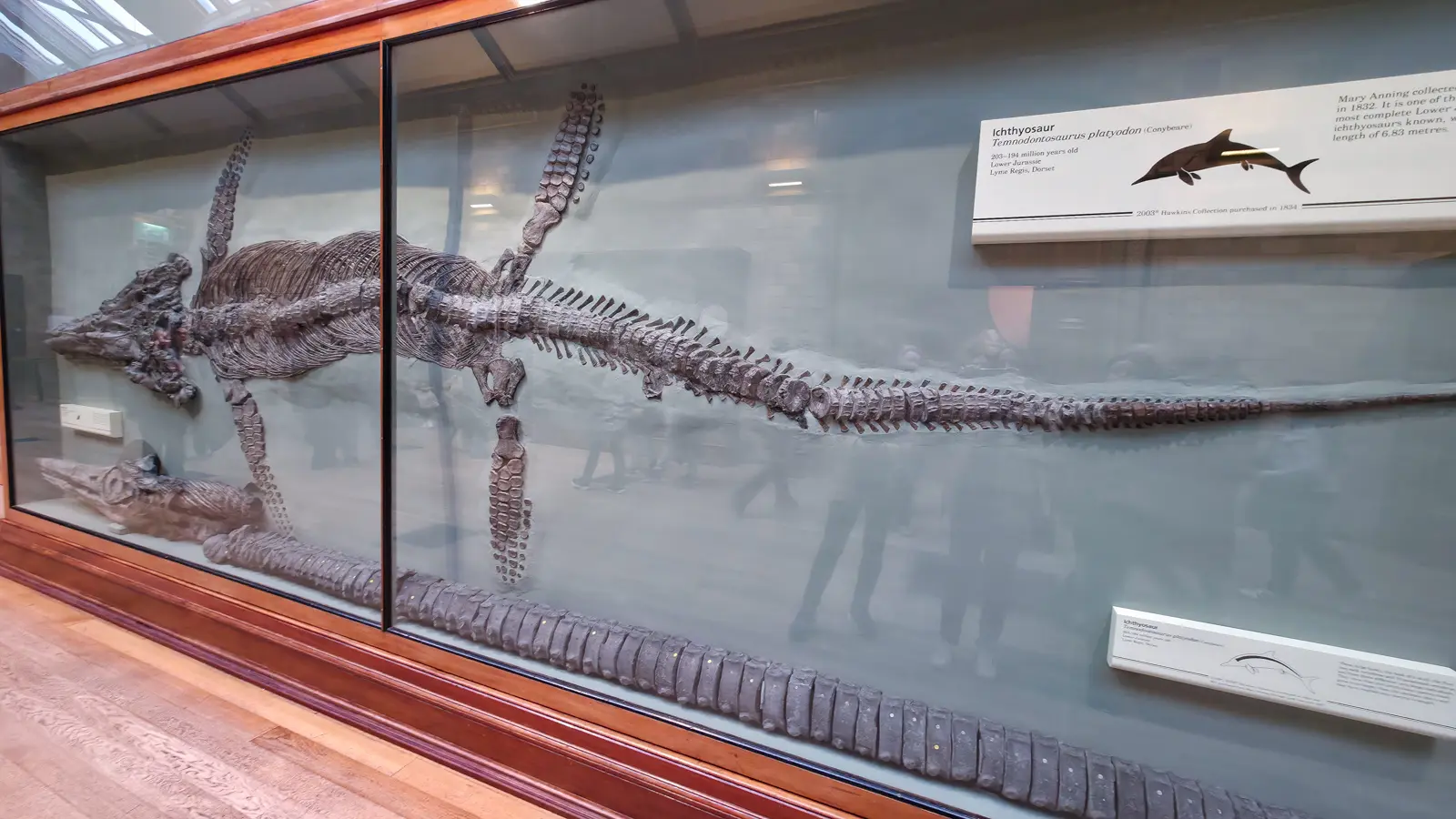
The ichthyosaur in this gallery, Temnodontosaurus platyodon from Lyme Regis, around 200 million years old, was collected by Mary Anning herself in 1832 and came to the museum as part of the Thomas Hawkins Collection, purchased in 1834. The display label confirms her hand: she found it; she prepared it; her labour got it from a Dorset cliff to a London case. At 6.83 metres, it’s one of the most complete Lower Jurassic ichthyosaurs known anywhere in the world. Standing in front of the case, that’s the thing worth slowing down for. You are looking at something a thirty-three-year-old woman pulled out of a cliff on the south coast, and at the time she did it, the world did not yet have the science to make sense of what she was holding.
In 2022, a statue of Mary Anning and her dog Tray was unveiled in Lyme Regis after a campaign led by an eleven-year-old girl named Evie Swire, who had been outraged that her hero had no monument. About time.
The Earth Hall Globe
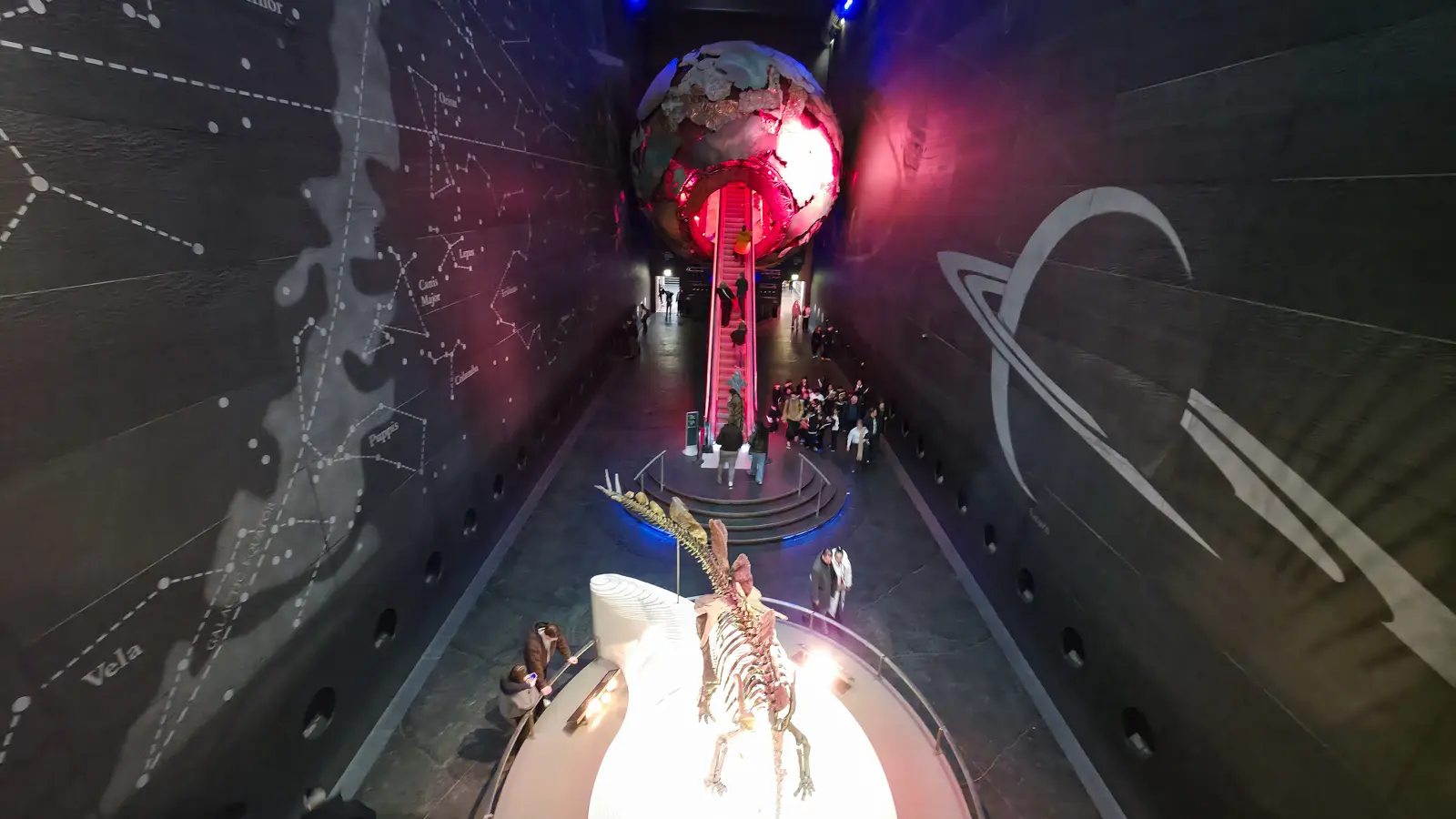
Through a different entrance, the side entrance on Exhibition Road rather than the main entrance on Cromwell Road, there is a separate hall called Earth Hall. At its centre is one of the museum’s most photographed features: an enormous metallic globe of the Earth, suspended above the floor, with an escalator running through the middle of it. The escalator carries you up into the upper galleries of the museum, where the Volcanoes and Earthquakes gallery, the Minerals collection, and the Earth Sciences exhibitions live. From below, the escalator appears to disappear into the globe. From above, it looks as if you have ridden through the centre of the planet itself.
The installation opened in 1996 as part of a major refurbishment of what had been a separate institution called the Geological Museum. The atrium and globe were designed by Neal Potter Design Associates. The globe itself is built from approximately 3,300 individual metal sheets and lit from inside. The escalator running through it is 22 metres long. When it first opened, the globe actually rotated around the escalator with coordinated lighting and sound effects, intended to convey the movement of the Earth’s interior. The rotation has since been retired, but the visual effect is still striking. The walls of the atrium are inscribed with the constellations of the southern sky, including Orion, Canis Major, Vela, and Eridanus, so you are travelling through stars on the way to the planet’s core.
Standing at the base of the escalator is Sophie the Stegosaurus, a 5.6-metre-long Stegosaurus stenops skeleton acquired by the museum in 2014. She is the world’s most complete stegosaurus specimen ever found, with around 85 percent of her bones intact. She was excavated in Wyoming and assembled in London with private funding from 70 donors, one of whom was a hedge fund manager whose daughter, Sophie, gave the dinosaur its name. Sophie the dinosaur was a juvenile when she died, not yet fully grown, which gives a small additional poignancy to standing in front of her now. The most complete stegosaurus on Earth is also a young one.
The whole atrium is one of the boldest pieces of late-twentieth-century museum design in London. Plates of stone, the constellations overhead, a stegosaurus at your feet, and an escalator rising into a glowing planet. It is a strange and excellent room.
The Minerals Gallery
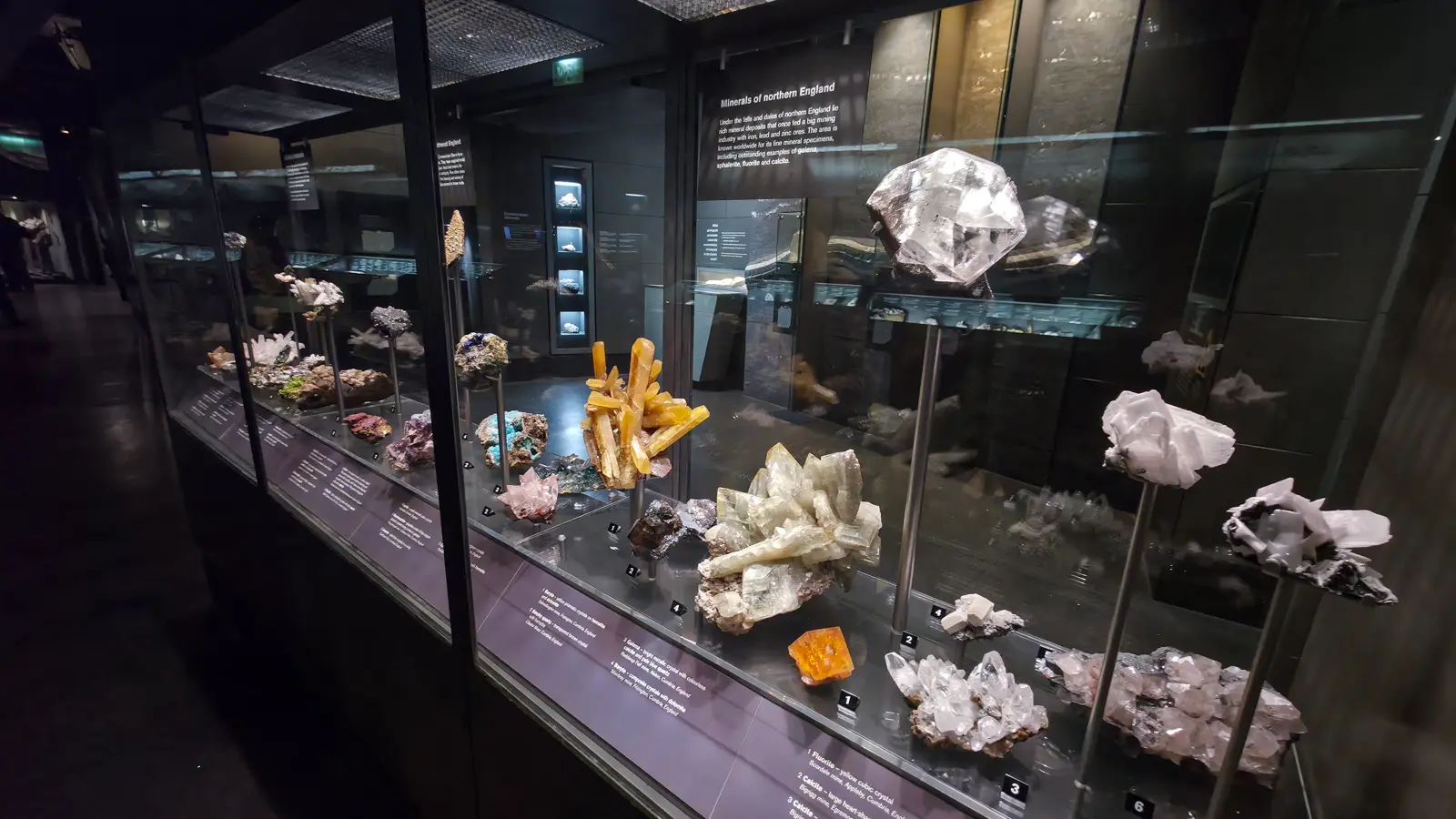
If you want to see the part of the Natural History Museum that almost no tourist looks at, walk past Hope, past the dinosaurs, and find the Minerals Gallery. It is one of the museum’s quieter rooms, and it is also one of its richest. Crystals, mineral specimens, and gemstones from every part of the world line the cases. The British section alone is a small history of the country’s industrial geology: baryte, smoky quartz, galena, fluorite, calcite from the Pennine mining regions of Cumbria and Durham. Most of these specimens were collected in the late nineteenth and early twentieth century, when British geological survey was at its peak.
The Minerals Gallery requires a different kind of attention than the dinosaur halls. There are no skeletons to gawk at, no enormous animals overhead. The objects are small, jewel-like, and you have to lean in to see what’s actually remarkable about each one. But once you do, the room slows you down. A baryte crystal cluster grown over centuries in a Cumbrian lead mine looks like nothing else on Earth. It probably is nothing else on Earth.
If you’re rushing through the museum because you’re with children pulling you toward the T. rex, this is the room to come back to on a return visit.
The Dinosaur Gallery
I should be honest. I didn’t get a chance to walk the dinosaur gallery properly. It was packed! December at the Natural History Museum is packed in a way I hadn’t expected, even though I should have known. Schools were on break. Families were on holiday. The dinosaur hall in particular was a slow-moving crush of children and pushchairs and parents trying to hold both.
But I stood outside the dinosaur hall and I watched for a while. The faces of the children walking out of the gallery, all of them, every single one, were lit up. Some of them were carrying small T. rex toys. Some of them were arguing about whether a Diplodocus or a Brachiosaurus would win a fight. Some of them were just looking up, with their mouths open, at the sheer scale of the skeletons inside.
That look on a small child’s face, the look that says I cannot believe this is real, is what natural history museums are for. The whole 1881 cathedral was built to produce exactly that look. Alfred Waterhouse, designing this place in the 1870s, must have known the people who would care about it most weren’t going to be scientists. They were going to be children meeting the past for the first time, and parents who would pay almost anything to see that look on their face.
Except no one paid anything. Because the museum is free.
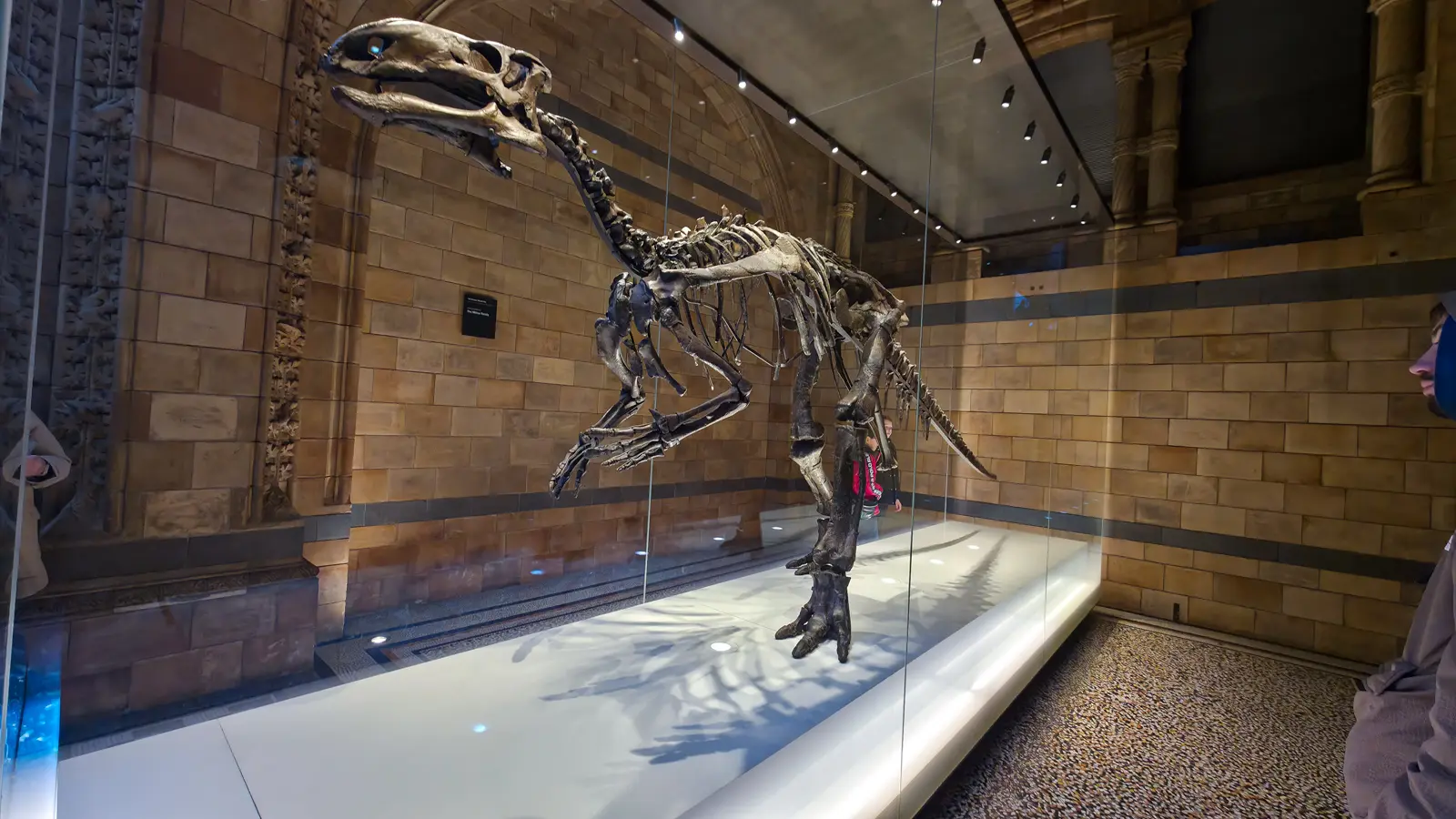
One specimen I did manage to spend time with sits just outside the main dinosaur hall, in its own glass case beside Hintze Hall. It is the skeleton of Mantellisaurus atherfieldensis — an iguanodont dinosaur about 5 metres long, posed bipedally, with the genus named in honour of the English surgeon and palaeontologist Gideon Mantell, who described the closely related Iguanodon from Sussex teeth in 1825. This particular skeleton, though, has nothing to do with Mantell himself. It was discovered on the Isle of Wight in 1914 by an amateur palaeontologist named Reginald Walter Hooley, near the village of Atherfield, after a section of cliff collapsed and exposed it. It is 85 percent complete and remains the most complete dinosaur skeleton ever found in the UK.
Bubbly Tips for Visiting
- Go on a weekday morning if you can. Saturdays, school holidays, and the entire December–January period are very busy. Lines for the entrance can stretch down Cromwell Road on the worst days. Tuesday or Wednesday morning, just after the 10 am opening, is the calmest you’ll find it.
- Use the Exhibition Road entrance, not Cromwell Road. The Cromwell Road entrance is the famous one but it’s also the most crowded. The Exhibition Road side entrance gets you in faster, and it brings you in through Earth Hall, where you can see the globe and escalator on your way in.
- Plan your route around what you actually want to see. The museum is huge, 80 million specimens across roughly 24,000 square metres of public space. Most visitors try to see everything and end up exhausted. Pick three or four galleries: Hintze Hall, Marine Reptiles, Dinosaurs, and one wildcard (Minerals, the Vault, or the Volcanoes Gallery). Skip the rest for next time.
- Leave the dinosaurs for last if you’re with children. The queue moves slowly, and if a child is already excited about T. rex they won’t want to see anything else afterwards. Save it as the day’s finale.
- The Hintze Hall is best photographed from the upper gallery. Walk up the central staircase and look back. Hope looks her best when seen from above, in front of the Charles Darwin statue at the top.
- Don’t skip the building itself. Look up at the terracotta arches and the carved animals. Most of what’s interesting about the Natural History Museum isn’t the exhibits, it’s the building that holds them.
- The museum is free but the special exhibitions usually aren’t. Currently most permanent galleries are free; rotating exhibitions (the Wildlife Photographer of the Year, special blockbuster shows) usually cost £15–£25. The free permanent galleries alone are easily enough for a full visit.
- Eat outside the museum. The on-site cafes are functional but expensive. Walking five minutes to South Kensington or Exhibition Road gets you better food at half the price. The T. Rex Grill inside the museum is for families who can’t leave the building.
Final Thoughts
I didn’t get to everything. I missed the Wildlife Garden, the Volcanoes Gallery, the Earth’s Treasury and most of the Mammals Hall. I didn’t make it through the dinosaur gallery properly. I didn’t see half of what I wanted to see in the Minerals Gallery. That is the kind of museum the Natural History Museum is. You can spend a full day there and walk out feeling like you’ve only scratched the surface.
That’s why you return.
What I did see was enough to make the day worth it. Hope. The Mary Anning ichthyosaur. The mastodon under Waterhouse’s arch. The minerals from the fells of northern England. The Mantellisaurus standing on its hind legs in its glass case, with a queue of children waiting their turn to see it. The faces of those children walking out of the dinosaur hall, all of them lit up the same way, as if they’d just touched something true.
I came expecting Dippy. I left with Hope, and with all the other things hanging from the Victorian ceiling that I hadn’t expected to find. The museum is free. The cathedral of natural history is right there. Walk in.
Until next time!

🌟 Everything You Need to Plan Your Dream Trip in 2026
- 🌟 Luxury Hotels - Find premium stays with Booking.com & Hotels.com
- 🏡 Vacation Rentals - Discover unique properties on VRBO
- 🏞️ Guided Tours - Explore with Viator or GetYourGuide
- 🎫 Attraction Tickets - Skip the lines with Tiqets
- 🚢 Ocean Cruises - Set sail with Cruise Direct
- 📱 International SIMs - Stay connected with Saily
- 🚗 Car Rentals - Budget-friendly options from Discover Cars
- 🌐 Secure VPNs - Browse safely with NordVPN
- 💶 Currency Exchange - Best rates with Wise
- 🗣️ Learn Languages - Master the local language with Babbel and Rosetta Stone