
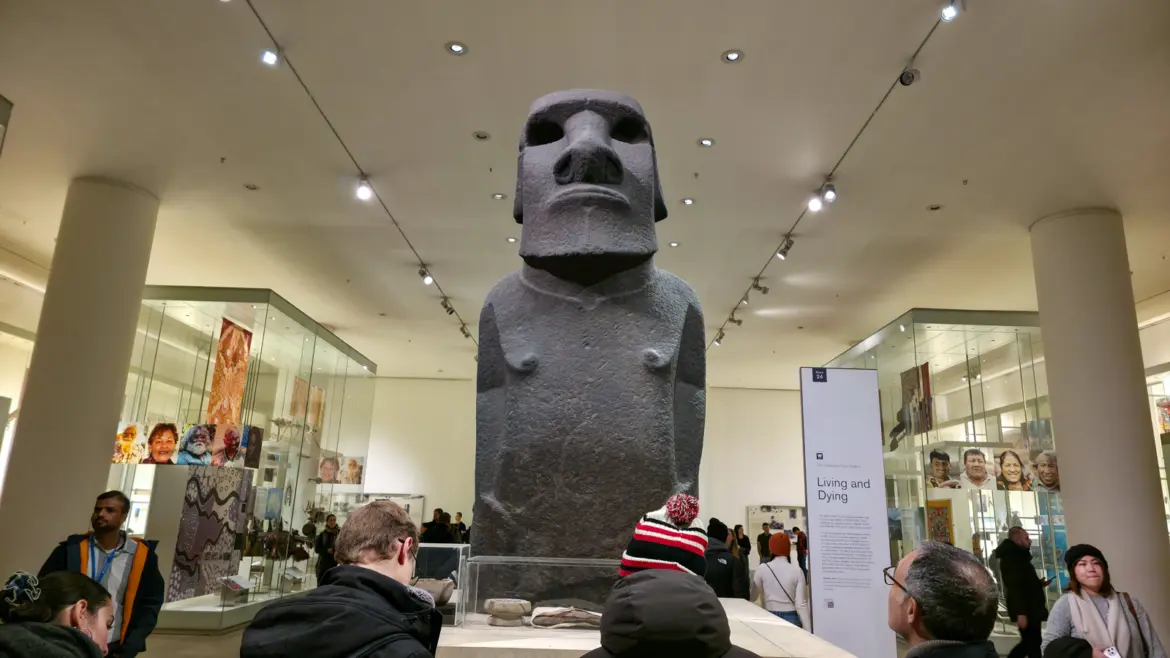
There is a figure on the upper floor of the British Museum that stops people in a way the labels never quite explain. It stands about two and a half metres tall, carved from grey basalt, with a heavy brow and a long straight nose, and it looks past you rather than at you. This is Hoa Hakananai’a, a moai from Rapa Nui, the island most of the world calls Easter Island. Its name is usually translated as “lost, hidden, or stolen friend”, which tells you, before you read a line of history, that something about it is unresolved. It is free to visit, like everything in the permanent galleries, and it is quietly one of the most contested objects in the building.
Hoa Hakananai’a at a Glance
📍 Location · Room 24, the Living and Dying gallery, on the upper floor of the British Museum. Free entry.
🗿 What it is · A moai, an ancestor figure from Rapa Nui (Easter Island), carved from hard basalt around 1000 to 1200. About 2.4 metres tall and 4.2 tonnes.
✨ The name · Usually translated as “lost, hidden, or stolen friend”, which carries the whole story in five words.
🐦 Don’t miss · The carved back. Birdman petroglyphs were added around 1400, when the figure was drawn into the island’s tangata manu cult at Orongo. Most visitors never walk round.
⚓ How it got here · Taken from a stone house at Orongo in 1868 by the crew of HMS Topaze, presented to Queen Victoria, and given by her to the museum in 1869.
⚖️ The dispute · Rapa Nui formally asked for it back in 2018 and talks continue. A 1963 Act of Parliament restricts the museum from giving away most of its collection.
⏰ Hours · Daily 10:00 to 17:00, with Friday late opening until 20:30. Room 24 is a busy through-route, so early or late is calmest.
💡 Tip · Pair it with Gebelein Man in the Egyptian rooms nearby. The two great upstairs encounters sit a short walk apart.
What a moai is
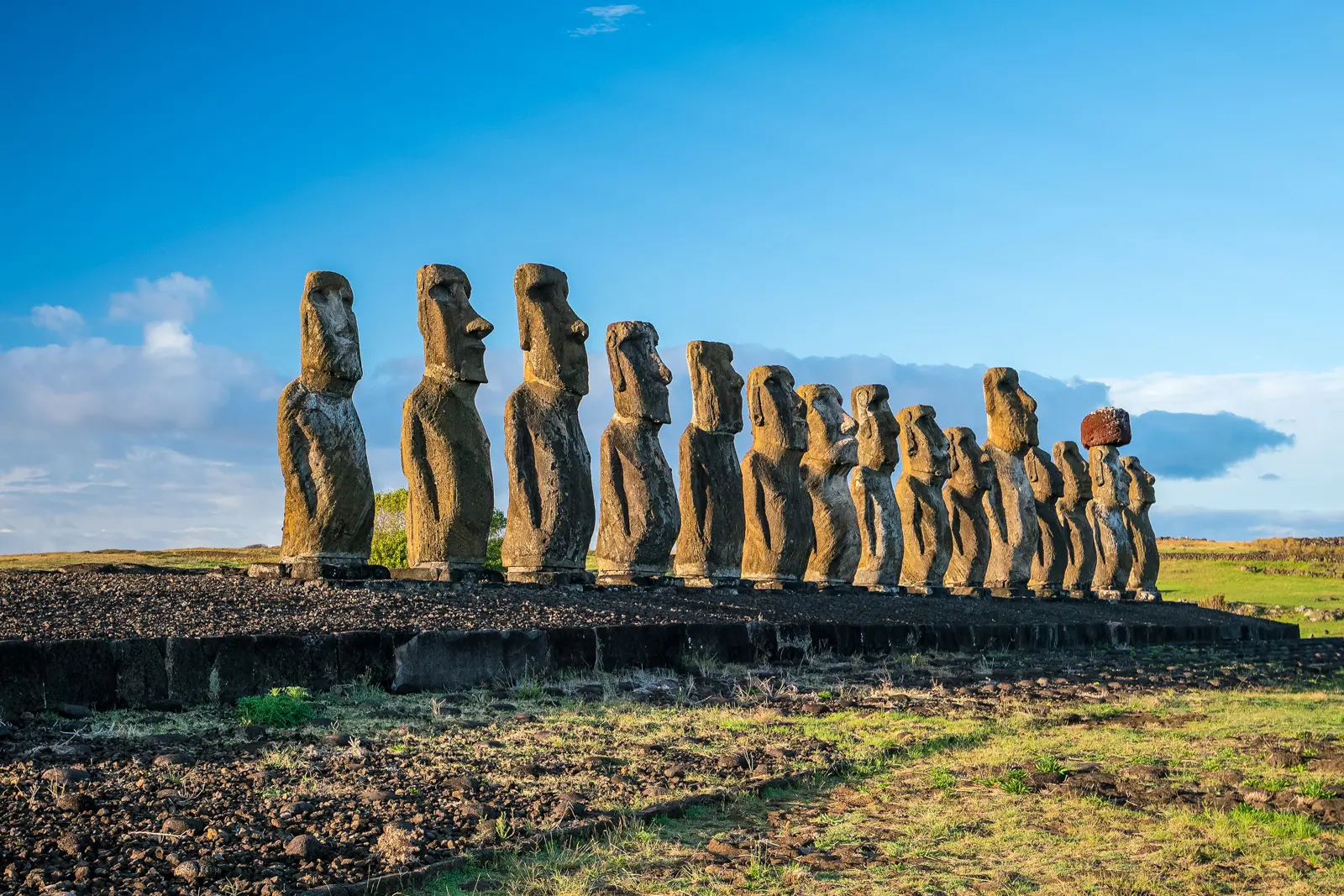
Moai are not statues in the way we usually mean the word. To the people who carved them, they were aringa ora, the living faces of the ancestors, a way of keeping the dead present among the living. A moai left the quarry blind. Only when it was raised on its platform were eyes of white coral, with pupils of dark obsidian or red stone, set into the carved sockets, and at that moment the figure was said to wake. They were carved in their hundreds and set up on stone platforms called ahu, usually facing inland to watch over the village and the descendants who built them. They are guardians, in other words, with their backs to the sea and their faces turned home.
This one
Hoa Hakananai’a was carved sometime around 1000 to 1200. It is one of only about fourteen moai cut from hard basalt rather than the softer volcanic tuff that almost all the rest were made from, part of why its features are still so sharp. For much of its life it stood as moai were meant to, but at some point its story changed. It was moved into a stone house at Orongo, a ceremonial village on the rim of the Rano Kau crater, and buried up to its shoulders, and there its meaning shifted into something new.
The carved back
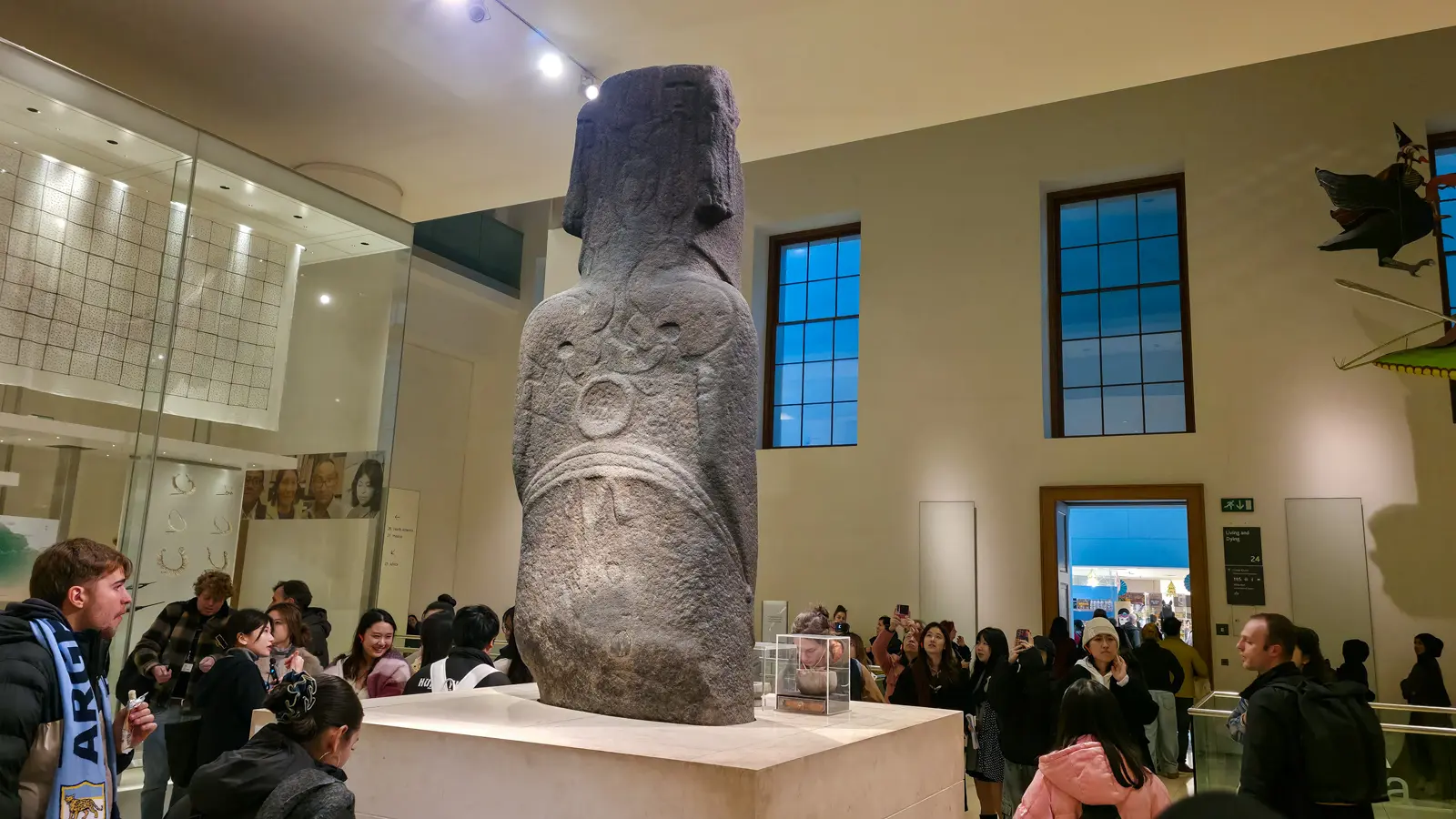
The thing most people miss is the back. While the front is the face you came to see, the back of Hoa Hakananai’a is covered in low carvings, added centuries after the figure was made, around 1400. Two birdmen face each other across it, a sea bird perched above their beaks, with ceremonial dance paddles and fertility symbols around them. They belong to the tangata manu, or birdman, religion that grew up at Orongo and centred on the creator god Makemake. Each year the clans competed to bring back the first egg of the sooty tern from a small islet offshore, and the man who won became the birdman, the sacred representative of the god for a year. So the figure carries two religions on one body: the ancestor cult it was carved for, and the bird cult that later claimed it. One thing the gallery lighting hides: when the British crew first saw it, these carvings were painted red and white. Most of the colour rubbed away as the figure was dragged on its back down the crater slope, rafted out to the ship, and left standing on deck through the long, wet voyage to England. Walk around it anyway. The back is the better half.
The island it came from
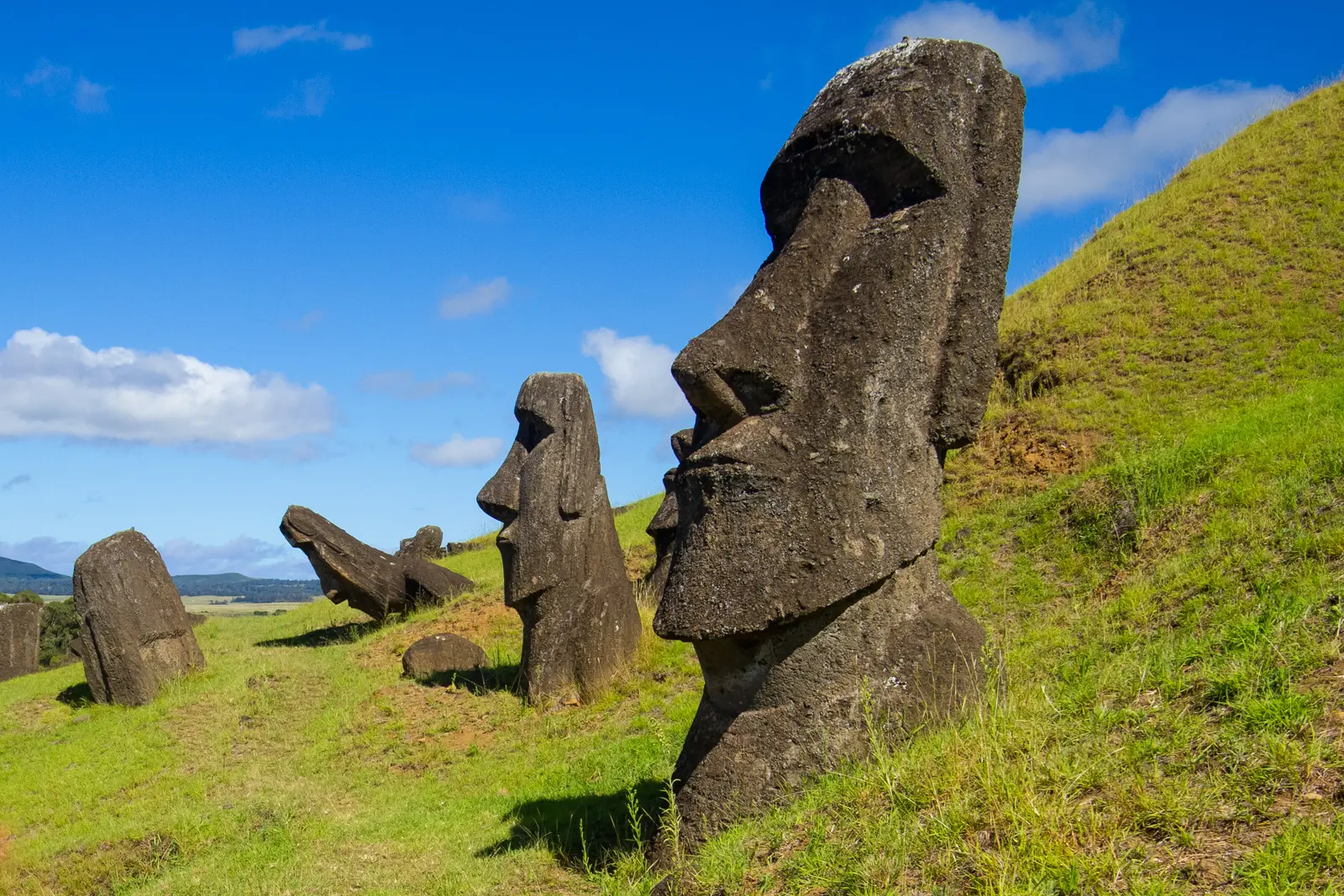
To understand the figure you have to picture where it is from. Rapa Nui is one of the most remote inhabited places on earth, settled by Polynesian navigators around a thousand years ago, who called it Te Pito o Te Henua, the navel of the world. Nearly nine hundred moai were carved there, almost all at a single volcanic quarry called Rano Raraku, then moved miles across the island without wheels or draft animals. Rapa Nui tradition always held that the moai walked to their platforms, and experiments bear it out: stood upright and rocked from side to side on ropes, a statue weighing several tonnes will step forward, and a recent study found the statues abandoned along the old roads were shaped with a forward lean to make exactly that possible. Hundreds were later pulled down during a long period of conflict between the clans. The ones standing on their platforms today were mostly raised again in modern times. It is a small island that built on an enormous scale, and then unbuilt much of it.
How it reached London
In 1868 a British survey ship, HMS Topaze, called at the island. Its crew were shown one moai, Moai Hava, near the coast and took it. Searching the village at Orongo, two of them then found Hoa Hakananai’a inside its stone house. The commander decided to take that one too. The house was pulled apart, the figure dragged down to the shore on a sledge and floated out to the ship on a raft. A Rapanui man later remembered a chief following the sailors down to the water that day, and afterwards having the whole scene tattooed onto his arm. Back in England in 1869, Hoa Hakananai’a was offered to Queen Victoria, who gave it to the British Museum, where it has stood ever since.
The question of home
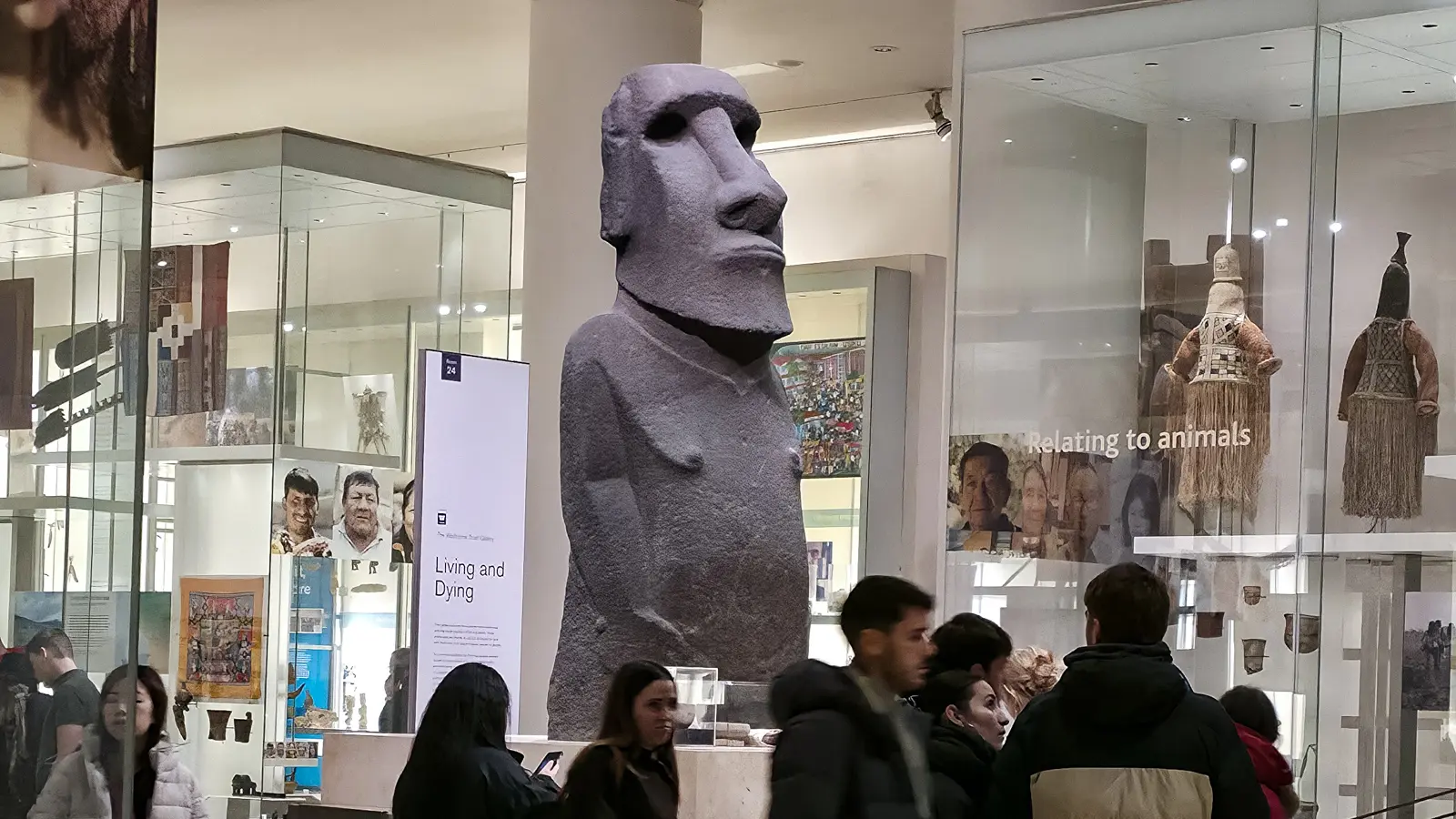
In 2018 the people of Rapa Nui formally asked for it back. A delegation came to London, museum staff travelled to the island, and the two sides have kept talking since, building a working relationship and even a sound piece recorded by Rapanui artists to play beside the figure. The museum acknowledges what its removal meant and points, as it does with the Parthenon marbles, to legal title, to preservation, and to the millions who see it for free. There is a legal knot too: a 1963 Act of Parliament bars the museum from giving away most of what it holds, so even a willing return would not be simple. The island points out that this is an ancestor, taken from a sacred house and carried off on a warship, and that ancestors belong at home. When the island’s governor came to London to see it, she told the museum’s staff that the islanders are only a body, and that the British hold their soul. Both sides are true at once, which is exactly what makes it hard.
I will be honest about how it left me. Of everything in the museum, this is the one that felt less like an object and more like a person. It is quiet and a little mournful, and it has a face, which most of what surrounds it does not. Standing in that bright, crowded room, between the glass cases and the foot traffic, I kept thinking it looked out of place, like a guest who has been waiting a very long time to go home. I am not Rapanui, and it is not my call to make. But the room said one thing and the figure said another, and the figure was the more convincing of the two.
Bubbly Tips
- Where it is: Room 24, the Living and Dying gallery on the upper floor. Free, like the rest of the permanent collection.
- Walk around the back: This is the one piece of advice that changes the visit. The carved back, with its birdman imagery, is the half almost everyone misses.
- Listen: There is a soundscape recorded by Rapanui artists meant to play near the figure. Ask at the gallery or check the museum’s audio guide.
- Timing: Room 24 sits on a busy through-route. Early or late in the day gives you a quieter moment with it.
- Photography: Allowed without flash. The low side light in the room catches the brow and nose well.
- Pair it: It is a short walk from the Egyptian rooms and Gebelein Man, so the two upstairs highlights can be seen together.
FAQ
Is it the only moai at the British Museum? No. The museum holds a second, smaller moai called Moai Hava, which is kept in the study collection rather than on permanent display.
Has the British Museum agreed to return it? Not as things stand. The Rapa Nui community has formally requested it and talks continue, but a 1963 Act of Parliament also restricts the museum from giving away most of what it holds.
Where else can I see moai? Around nine hundred remain on Rapa Nui itself. A handful of others are in museums abroad, including in Paris, Washington, Brussels and Santiago.
Final thoughts
Most of the British Museum asks you to admire. This figure asks you something harder, because it looks back. Hoa Hakananai’a has spent more than a century and a half a long way from the island it was carved to watch over, and the longer you stand with it, the more its name does the work the labels cannot. A lost, hidden, or stolen friend. Whichever of those three it turns out to be, it is worth meeting while it is here, and worth thinking about where it might one day be instead.
Until next time!

🌟 Everything You Need to Plan Your Dream Trip in 2026
- 🌟 Luxury Hotels - Find premium stays with Booking.com & Hotels.com
- 🏡 Vacation Rentals - Discover unique properties on VRBO
- 🏞️ Guided Tours - Explore with Viator or GetYourGuide
- 🎫 Attraction Tickets - Skip the lines with Tiqets
- 🚢 Ocean Cruises - Set sail with Cruise Direct
- 📱 International SIMs - Stay connected with Saily
- 🚗 Car Rentals - Budget-friendly options from Discover Cars
- 🌐 Secure VPNs - Browse safely with NordVPN
- 💶 Currency Exchange - Best rates with Wise
- 🗣️ Learn Languages - Master the local language with Babbel and Rosetta Stone