
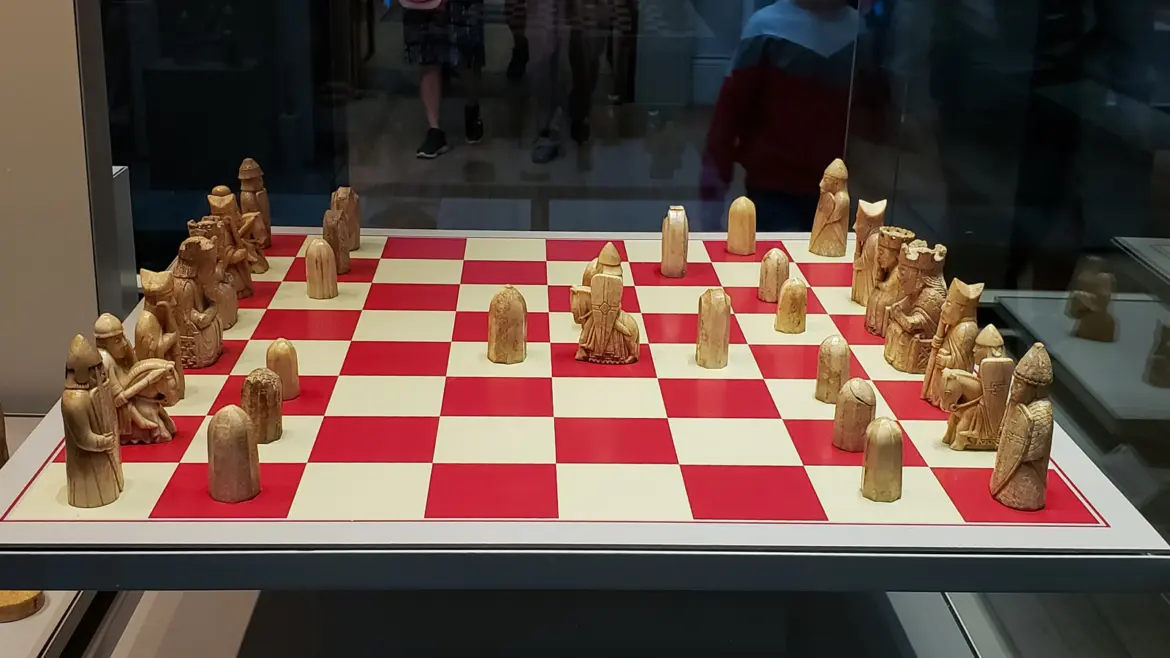
I have stood in front of the Lewis Chessmen more than once, and not one of them has ever looked pleased to see me. They are small, carved from walrus ivory, more than eight hundred years old, and a good many of them wear the look of a royal court that would rather be left alone.
They turned up on a Scottish island in 1831, nobody is quite sure how, and nobody is quite sure who carved them or why. That mix of fine carving and open questions is what keeps pulling me back. Here is what is known, what is only guessed, and what it is like to stand at the case in Room 40 of the British Museum in London.
The Lewis Chessmen at a Glance
🏝️ The find · A hoard of 93 carved ivory objects surfaced on the Isle of Lewis before April 1831; how and by whom is genuinely lost.
♟️ The pieces · 78 chessmen from at least four different sets, plus 14 gaming counters and one belt buckle; 82 pieces live in London, 11 in Edinburgh.
😠 The faces · Stern kings, hand-to-cheek queens and shield-biting berserker warders, every one of them looking thoroughly unimpressed.
🟥 The colours · Traces of mercury point to cinnabar red, so the sides were once red against plain ivory, not black and white.
🇳🇴 The maker · Norway, very likely Trondheim, is the scholarly favourite, with a minority case still argued for Iceland.
🆓 The visit · Room 40, upstairs near the Great Court, free — but the case draws a crowd, so go early on a weekday.
A hoard from a Hebridean sand dune
The story starts on the Isle of Lewis, in the Outer Hebrides off the northwest coast of Scotland. Some time before April 1831, a hoard of carved ivory came out of the sand near Uig, on the island’s west coast (some scholars now think a spot a little further south, near Mealista, is more likely). Beyond that, the details dissolve. Early accounts have the pieces surfacing after a storm, or hidden in a small stone chamber, or turned up by a grazing cow, or tangled in a darker local tale of a sailor robbed and murdered for his bag of treasure. The man usually named as the finder, Malcolm MacLeod of Pennydonald, appears in the record only decades later. The museum’s own panel is honest about the muddle, and so am I: the how and the who are lost.
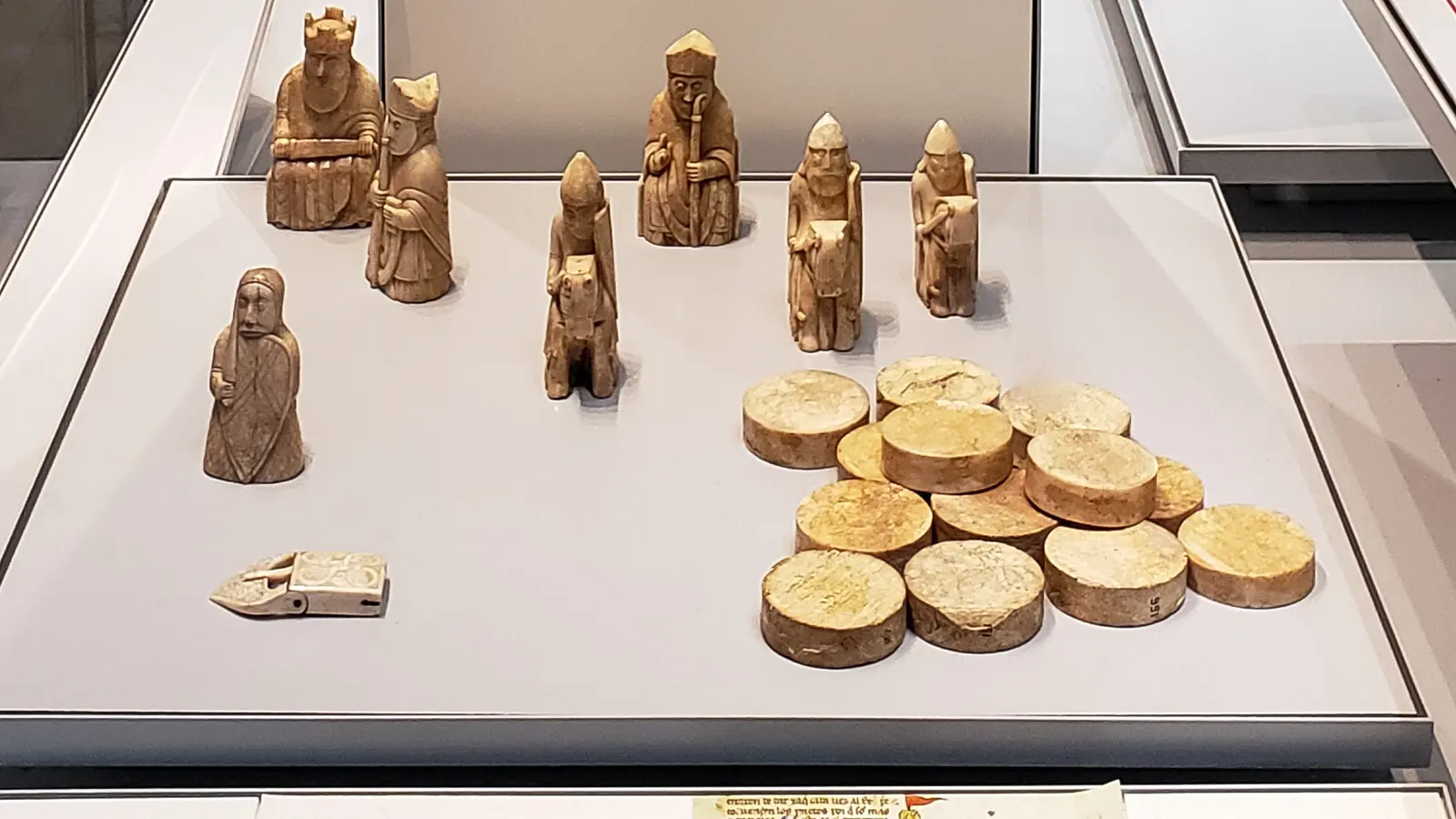
What came out of the ground was not one tidy chess set. The hoard held ninety-three objects: seventy-eight chess pieces, fourteen round gaming counters for another board game, and a single ornate belt buckle. Sorted by size and style of carving, the chess pieces are clearly the remains of more than one set, which is why no single complete set can be lifted out of the group. Today eighty-two of the pieces are at the British Museum and eleven are at the National Museum of Scotland in Edinburgh.
Kings, queens, and shield-biting warriors
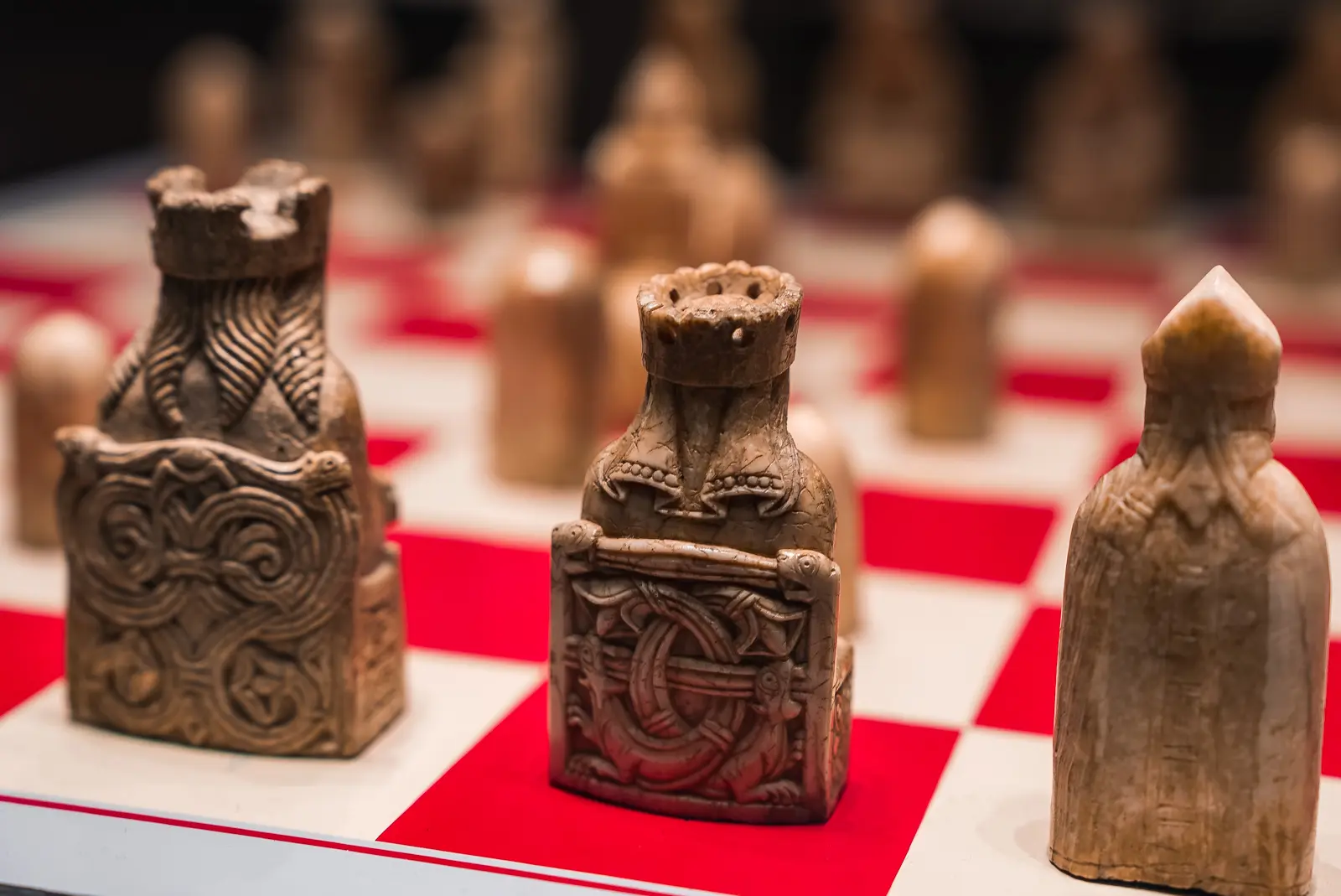
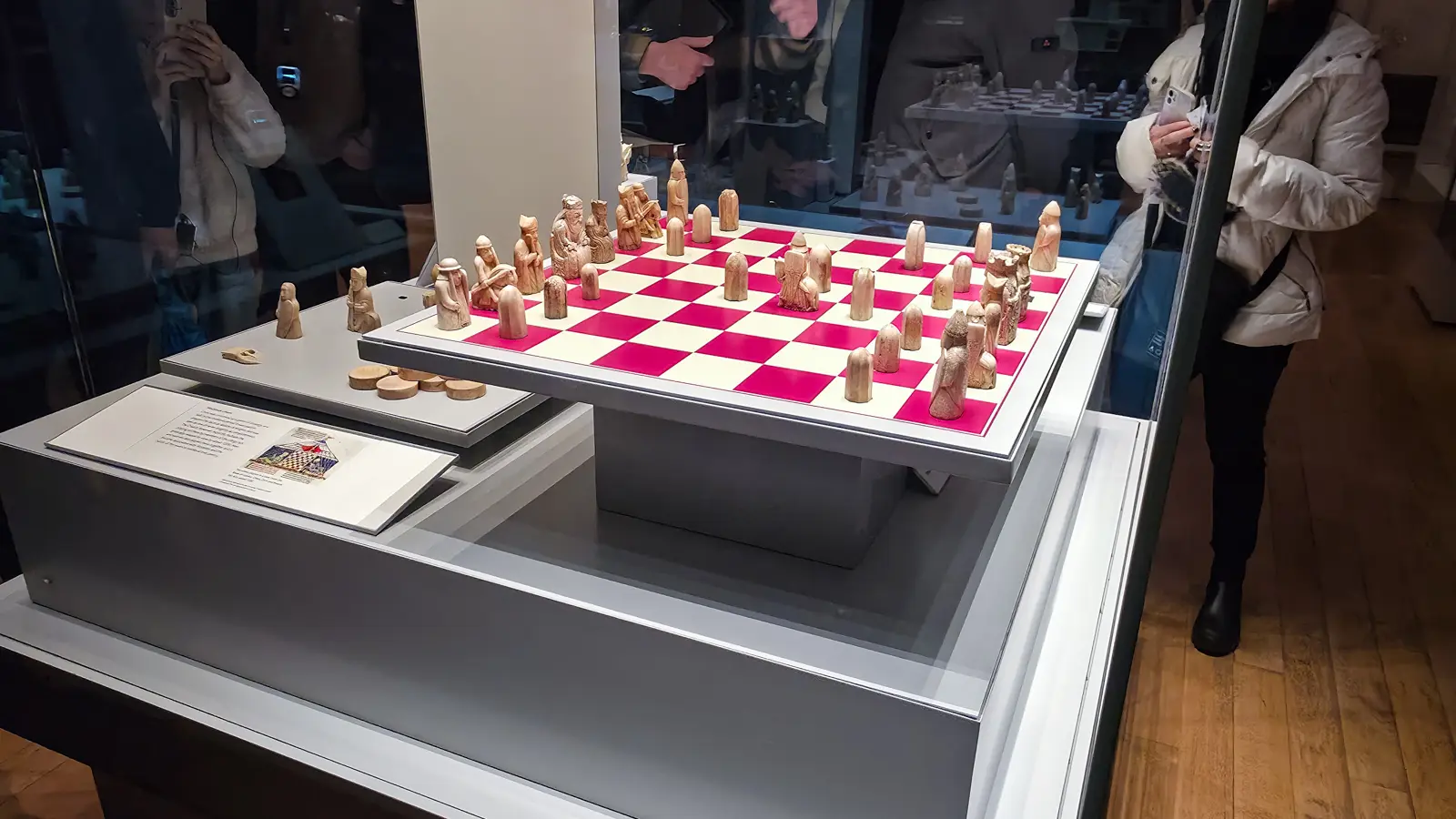
Up close, the cast sorts itself out. The kings sit upright with their swords laid flat across their knees. The queens sit too, each with her right hand pressed to her cheek. The bishops carry croziers and raise a hand in blessing, and they matter more than they look: these are among the earliest bishops known in any chess set, from a time when the piece was still turning from something else into the churchman we know. The knights ride stout little ponies. The warders, who stand in for the rooks, are foot soldiers with helmets, shields and swords. A few of them have their teeth sunk into the tops of their own shields. Those are the berserkers, the frenzied Norse warriors, and they are the pieces everyone photographs. The pawns are the plain ones, small and blunt, with no faces at all.
What I like about them is that they do not seem to enjoy any of this. The kings look stern, the bishops look faintly disapproving, and the queens, hand to cheek, look either deep in thought or thoroughly bored, depending on the day and the light. Scholars have read that pose as shock, or grief, or worry. I tend to read it as a queen who has heard all of this before. I imagine the carvers enjoyed themselves, giving each little face its own bad mood. Even the British Museum plays along, noting that people come to Room 40 mainly to peer at the expressions. The joke writes itself: the chessmen, glum and wide-eyed behind the glass, look thoroughly unimpressed by the visitors peering back.
Red squares, not black
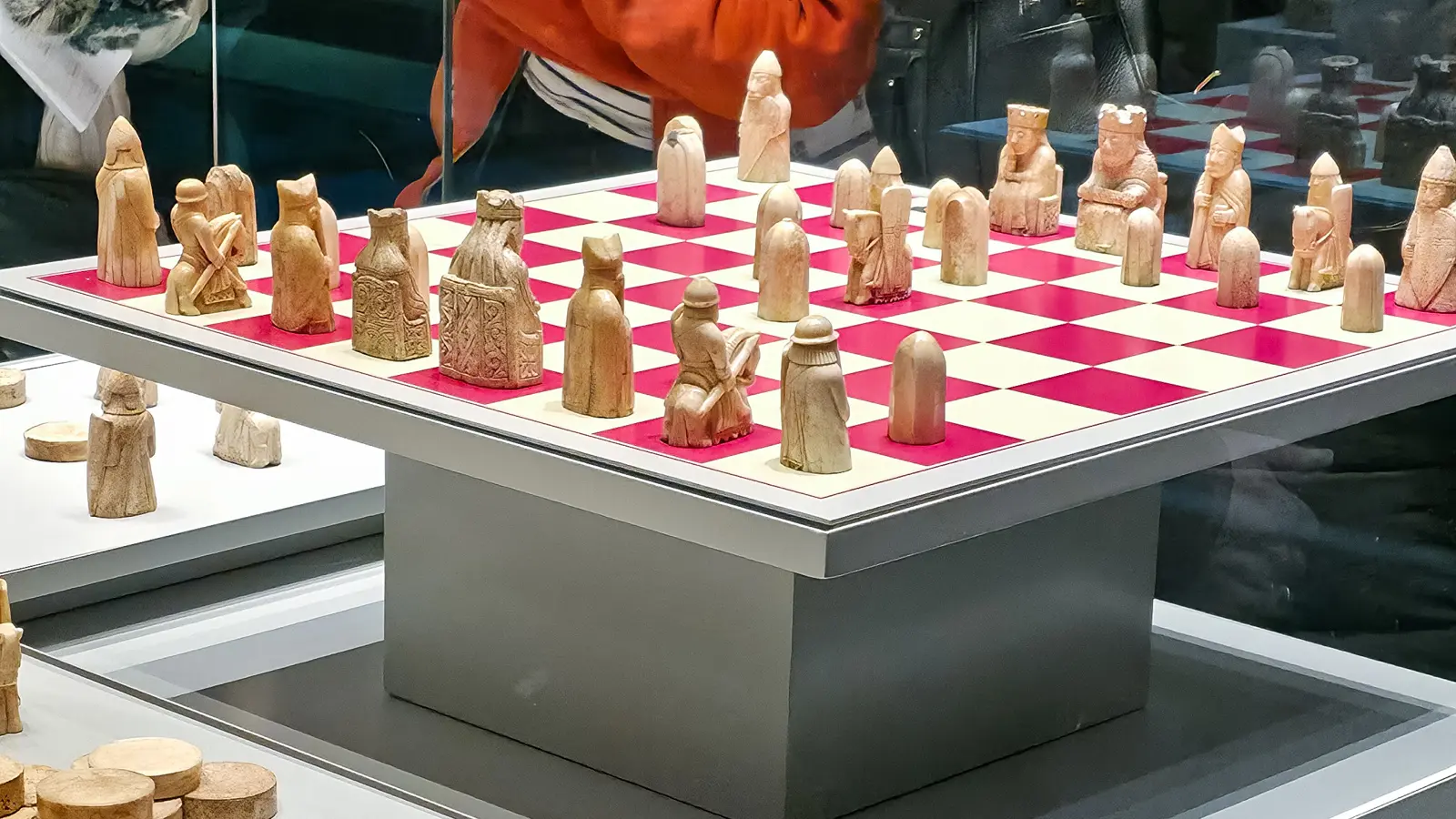
One thing surprises people who grew up on black-and-white boards. The Lewis Chessmen are set out on red and white. When the hoard was found, some of the pieces still carried traces of red stain, since faded, and later analysis picked up mercury on their surfaces, the signature of a red pigment called cinnabar. The likeliest reading is that the two sides were once told apart by colour, red against plain ivory, rather than the black and white we use now. So the red board in the case is not decoration. It is the museum’s best guess at how the sets first looked.
The game itself had travelled a long way to reach that island. Chess began in India well over a thousand years ago, moved through the Islamic world, and reached Europe by the tenth and eleventh centuries, where the eastern pieces were reshaped into a Christian royal court of kings, queens, bishops and knights. By the time these were carved, the game had a slightly racy reputation. The museum’s panel notes that clergy were once banned from playing, a ban the Church eased by about 1200, and that men and women played together, which is how chess ended up woven into the flirtation of medieval love poetry.
Seeing them today
My most recent visit was on a bright, cold afternoon in November. The British Museum sits behind a wide forecourt in Bloomsbury, its long columned front looking more like a Greek temple than a home for a Scottish chess set. Entry is free, as it has been throughout the Museum’s history, though at busy times a free timed ticket booked online saves a wait at the gate.
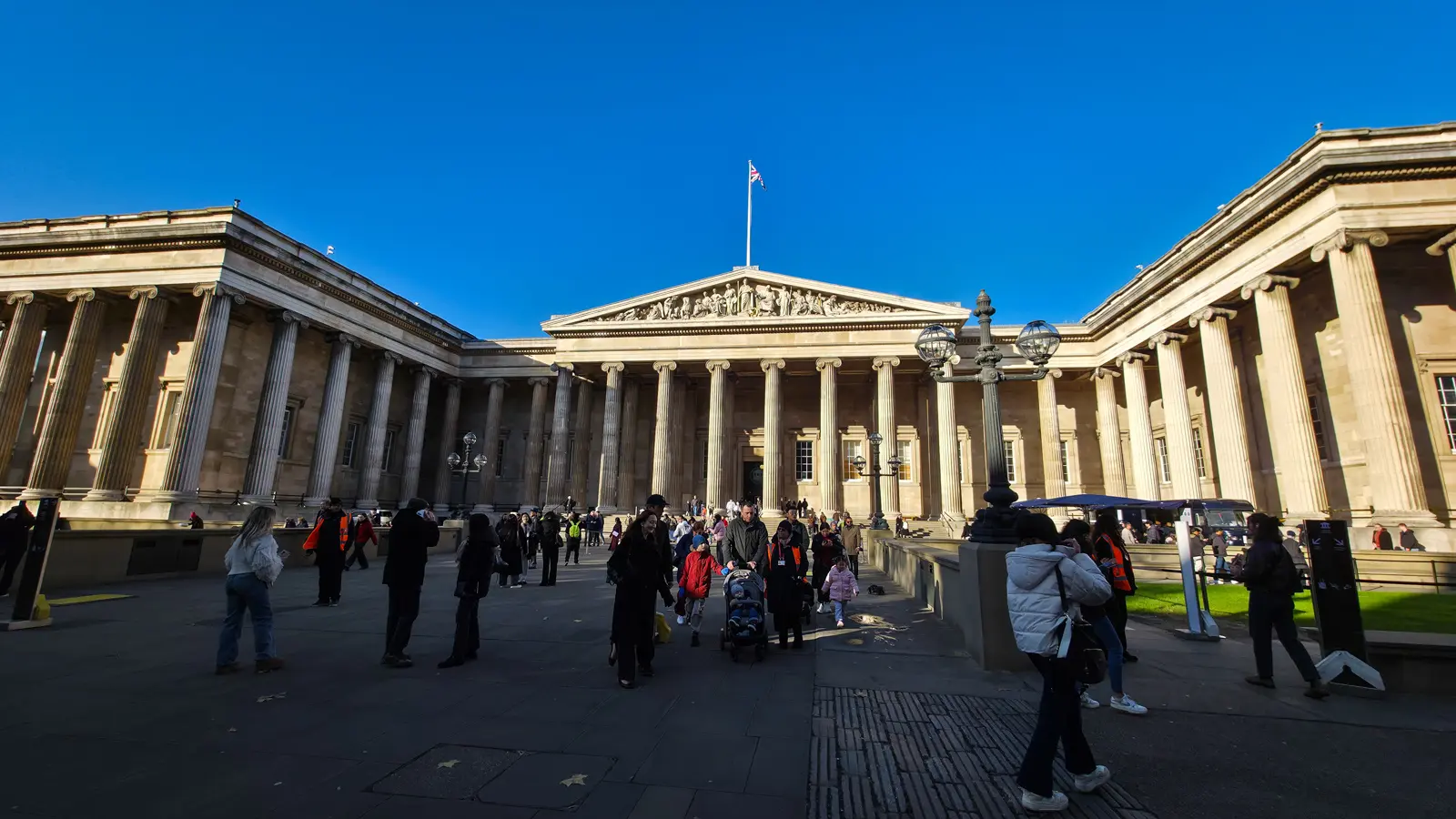
Room 40 is upstairs, near the south end of the Great Court, and the case is easy to find because there is almost always a small crowd around it. That crowd is part of the experience now. On my first visit, back in September 2019, I could lean right in. By 2025 I waited my turn behind a row of raised phones. It is worth knowing that the London display is not fixed. Pieces from the hoard travel constantly. Six are on long-term loan to a museum on the Isle of Lewis itself, close to where they were found, and another six were away in Trondheim, Norway, for an exhibition that ran until January 2026. So the number of chessmen in the case can change from one visit to the next.
Bubbly Tips
- Find Room 40 upstairs. The chessmen are in Room 40, the Medieval Europe gallery, on the upper floor near the south end of the Great Court. If the crowds downstairs turn you around, head up and follow the signs for the medieval rooms, or ask a member of staff.
- Go early on a weekday. The case draws a crowd from mid-morning. Arrive near opening on a weekday and you can reach the glass without queuing behind a wall of phones.
- Entry is free, but book a slot. General admission costs nothing, but at busy times a free timed ticket booked on the British Museum website saves you standing in the security queue. Check the site before you set out.
- Hunt for the berserkers and the bored queens. The pieces to find are the warders biting the tops of their shields and the queens with a hand pressed to the cheek. The faces are the whole point, so give them a minute.
- Look for the red tint. A few pieces still carry a faint, warm reddish tone. That is the ghost of the old staining that once told the two sides apart, and it is easiest to spot in good light.
- Photography is fine, but mind the glass. Non-flash photos are allowed. The case reflects badly, so shoot at a slight angle and get your lens close to the glass to cut the glare. Check the current photography rules on the day.
- Pair it with Sutton Hoo next door. Room 41, right beside Room 40, holds the Sutton Hoo treasures. The two rooms together make a strong hour of early medieval Britain.
- Spot the Harry Potter link. The giant wizard’s chess game in Harry Potter and the Philosopher’s Stone used a Lewis Chessmen replica. Children who know the film tend to recognise the pieces at once.
- Check what is actually on show. Pieces travel often, so if a particular chessman matters to you, look at the British Museum’s website first. Some are usually on loan, including a few on the Isle of Lewis itself.
Final Thoughts
What keeps the Lewis Chessmen interesting is how much they refuse to explain. We do not know for certain who carved them, though Trondheim in Norway is the strong favourite, with a minority case still made for Iceland. We do not know who buried them on that Hebridean beach, or why. We do not even have a firm story for how they came back out of the sand in 1831. For objects this famous, that is a lot of blank space.
Even so, they are not finished surprising anyone. In 2019 a single warder that had sat in an Edinburgh family’s drawer for fifty-five years, bought for five pounds in 1964, turned out to be one of the lost pieces and sold at auction for £735,000. Somewhere out there, a knight and a few more warders are still missing. I like that. It means the little bored-looking court in Room 40 is not quite complete, and the story is not quite over.
Until next time!

🌟 Everything You Need to Plan Your Dream Trip in 2026
- 🌟 Luxury Hotels - Find premium stays with Booking.com & Hotels.com
- 🏡 Vacation Rentals - Discover unique properties on VRBO
- 🏞️ Guided Tours - Explore with Viator or GetYourGuide
- 🎫 Attraction Tickets - Skip the lines with Tiqets
- 🚢 Ocean Cruises - Set sail with Cruise Direct
- 📱 International SIMs - Stay connected with Saily
- 🚗 Car Rentals - Budget-friendly options from Discover Cars
- 🌐 Secure VPNs - Browse safely with NordVPN
- 💶 Currency Exchange - Best rates with Wise
- 🗣️ Learn Languages - Master the local language with Babbel and Rosetta Stone