
I walked into this exhibition knowing nothing.
I could not have said what Johan Cruyff played, when, or for whom. I knew the name the way a person knows a name: something Dutch, something to do with football, a stadium somewhere with it written on the side.
Two rooms later I understood why a country would name its largest stadium after a man, and why the Dutch people around me were moving through those rooms differently from the way people move through the Banksys upstairs. Quieter. Reading everything.
This is not a post by someone who watched him play. It is a post by someone who arrived at his exhibition by accident, on a public holiday, three days before it closed.
Johan Cruyff: A Way of Thinking at a Glance
⚽ What it was · A one-month tribute exhibition at Moco Museum Amsterdam, ten years after Cruyff’s death, included with the standard ticket.
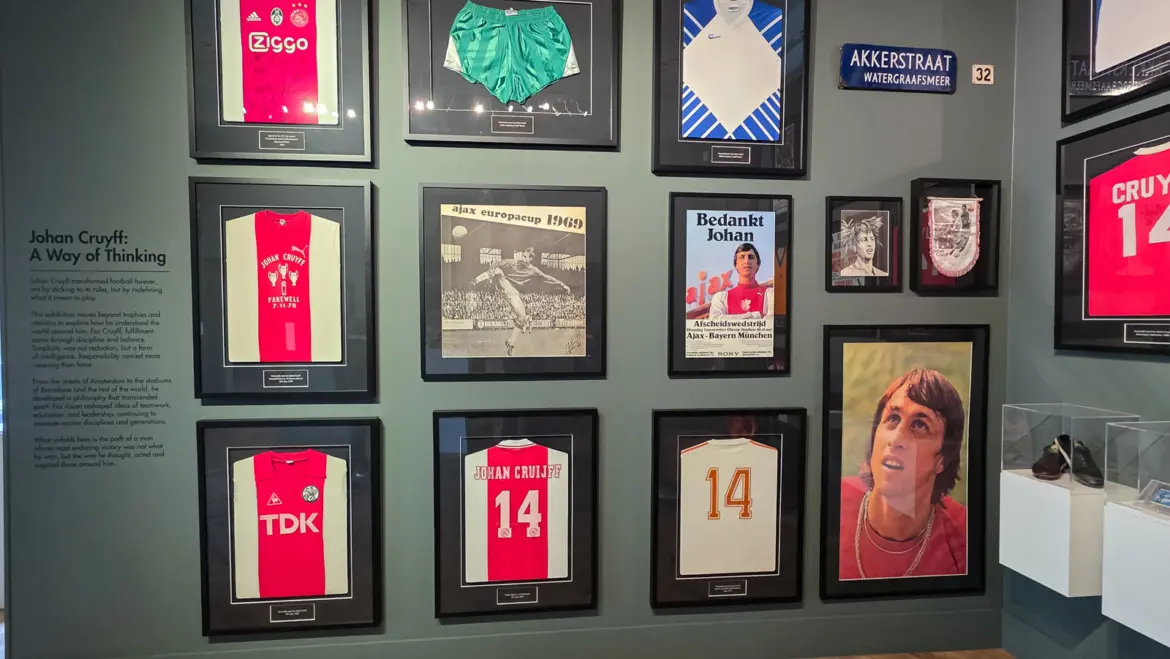
🏆 The objects · Three Ballon d’Or trophies, a gold Footballer of the Year boot, match-worn number 14 shirts, and a street sign from the road he grew up on.
🎨 The art · New work by Dutch artists, including a still-life of his boots and the white marble Reading the Game out in the garden.
📅 The catch · It closed on 29 April 2026. Moco rotates its temporary shows, so check what is on before booking.
💡 Tip · Arriving knowing nothing about football is not a disadvantage here. The show is built to explain.
Who He Was, for Anyone Else Arriving Cold
Here is what I did not know, set out for anyone in the same position.
Johan Cruyff was born in Amsterdam in April 1947 and died in Barcelona in March 2016, aged 68, of lung cancer. He played for Ajax, then for Barcelona, then in the United States, and for the Netherlands. He won the Ballon d’Or, the award for the best player in Europe, three times. He won three consecutive European Cups with Ajax and took the Dutch side to the 1974 World Cup final, which they lost to West Germany.
That is the ordinary version, and it is not why there is an exhibition.
The reason is a way of playing called Total Football, developed at Ajax under the coach Rinus Michels with Cruyff as the player who made it work. The principle is that positions are not fixed. If a defender moves forward, someone else fills the space behind him, and the shape of the team stays intact while every individual in it keeps moving. It requires players who can read a whole pitch rather than a role, and it was the opposite of the defensive football that dominated Europe at the time.
Then he did the harder thing, which almost no great player manages: he became a great coach. He managed Ajax, then Barcelona from 1988 to 1996, where he built the side that became known as the Dream Team, won four Spanish league titles in a row and the club’s first European Cup in 1992. He insisted the club develop its own players rather than buy them. One of the young midfielders he promoted was Pep Guardiola, who went on to manage Barcelona, Bayern Munich and Manchester City, and who has said he knew nothing about football before he knew Cruyff.
So the line of influence runs from a street in east Amsterdam through Ajax and Barcelona into a great deal of how football is played anywhere today. That is the claim, and it is not really contested.
The exhibition puts the older man at the front of the room, in a suit rather than a shirt, with one of his own sayings painted on the wall above him.
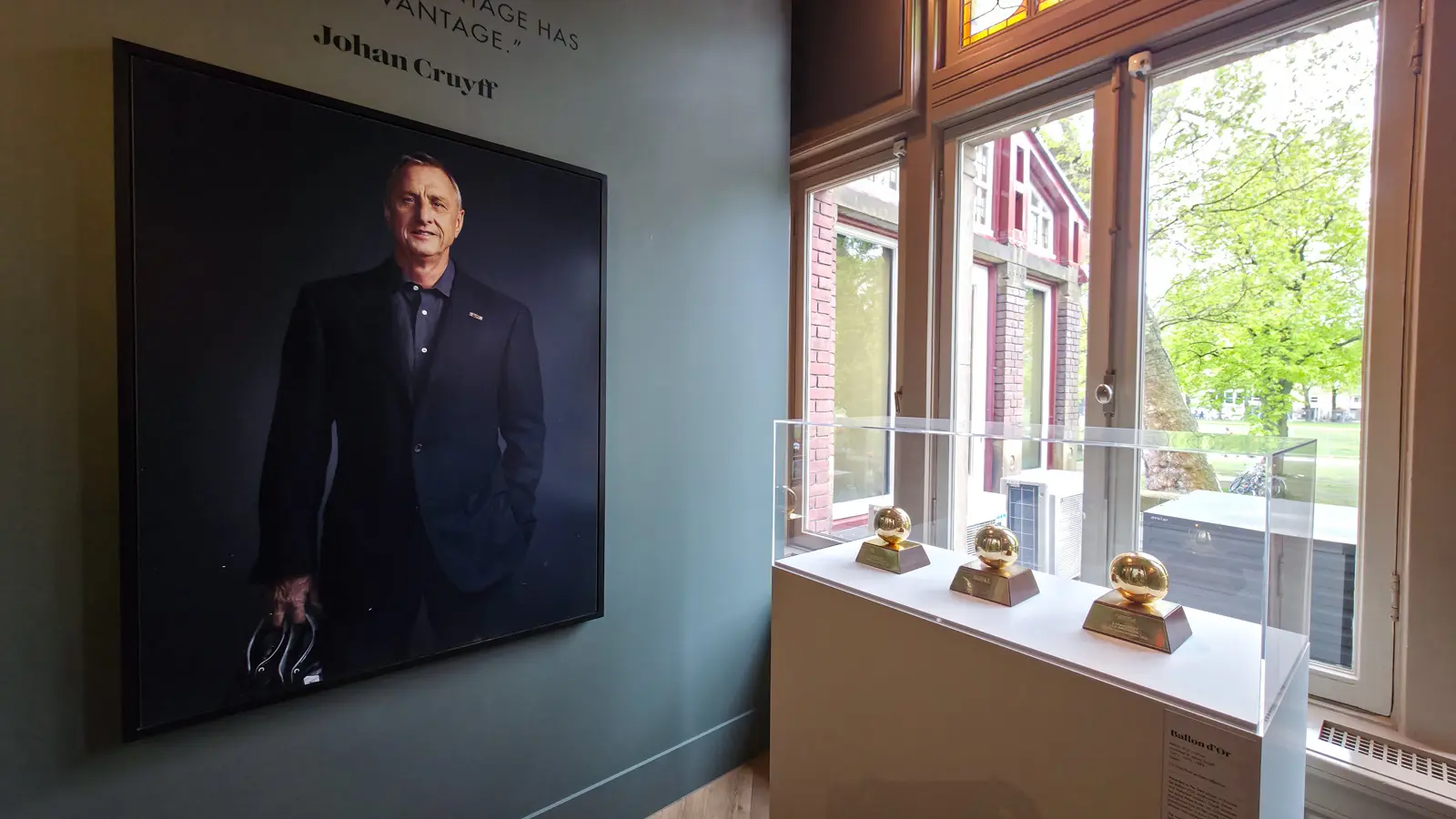
In the portrait he is in a dark suit, hands down at his sides, with a pair of black boots gripped in one of them.
A Way of Thinking
The exhibition was called Johan Cruyff: A Way of Thinking, and it ran at Moco from 23 March to 29 April 2026, ten years after his death. It was included with the standard museum ticket rather than sold separately.
Moco’s argument, which the wall text makes plainly, is that the trophies are the least interesting thing about him. The claim is that Cruyff developed a way of seeing that started in football and did not stay there: reading space before it opened up, deciding in the moment, treating simplicity as a form of intelligence rather than a lack of complication.
That is a large claim to hang on a footballer, and I arrived with no way of judging it. What I can report is that the room is arranged to make the case, and that the case is made mostly through objects rather than through explanation.
The panel that sets it up is titled Everything Starts with Play, and it hangs beside a painted portrait of him in the Barcelona shirt.
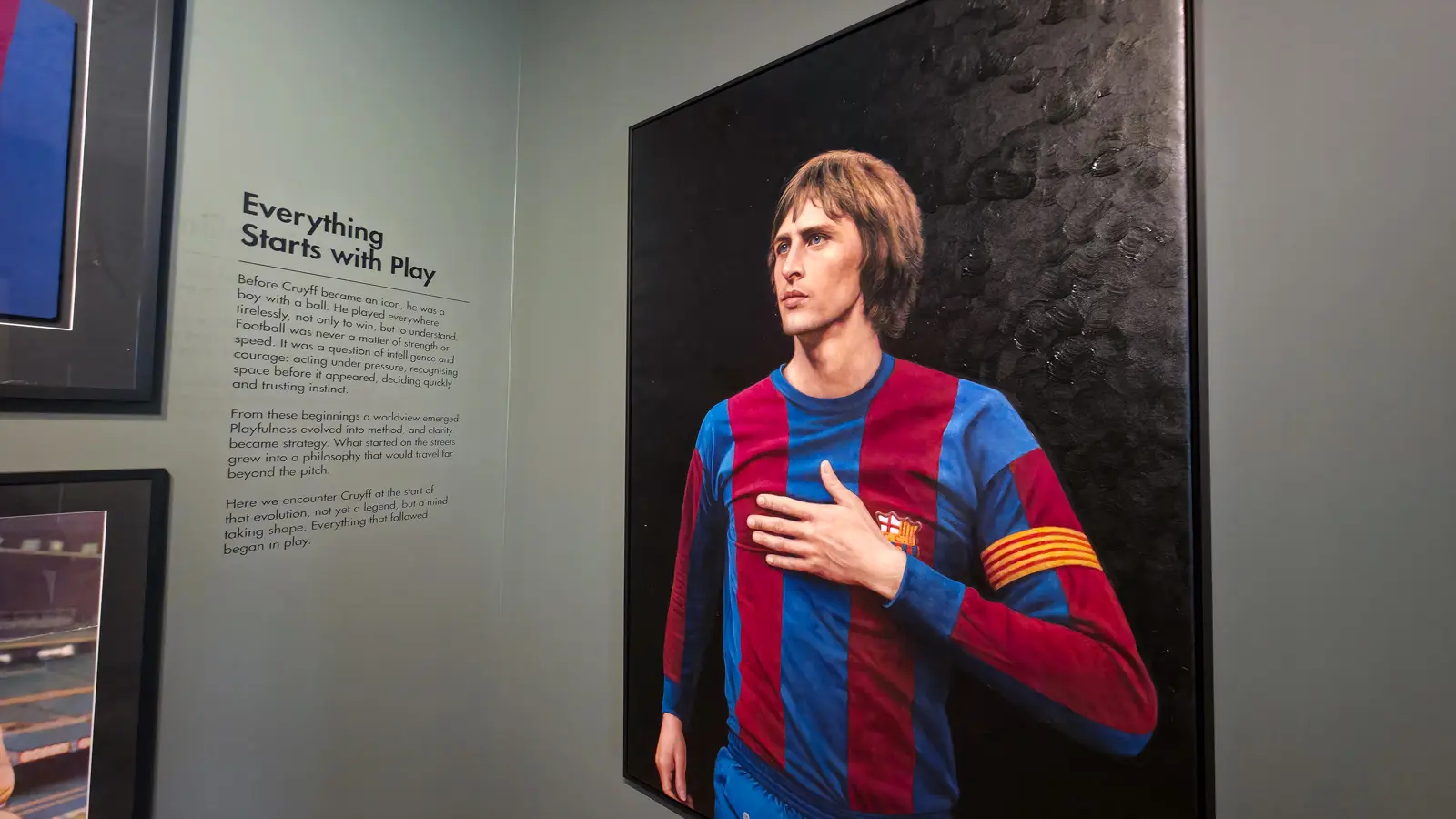
The panel’s line about recognising space before it appeared is the one that stayed with me, because it describes something that is not a physical skill at all.
Three Golden Balls
The first thing that stopped me was a low case in a window bay, holding three gilded footballs on plinths.
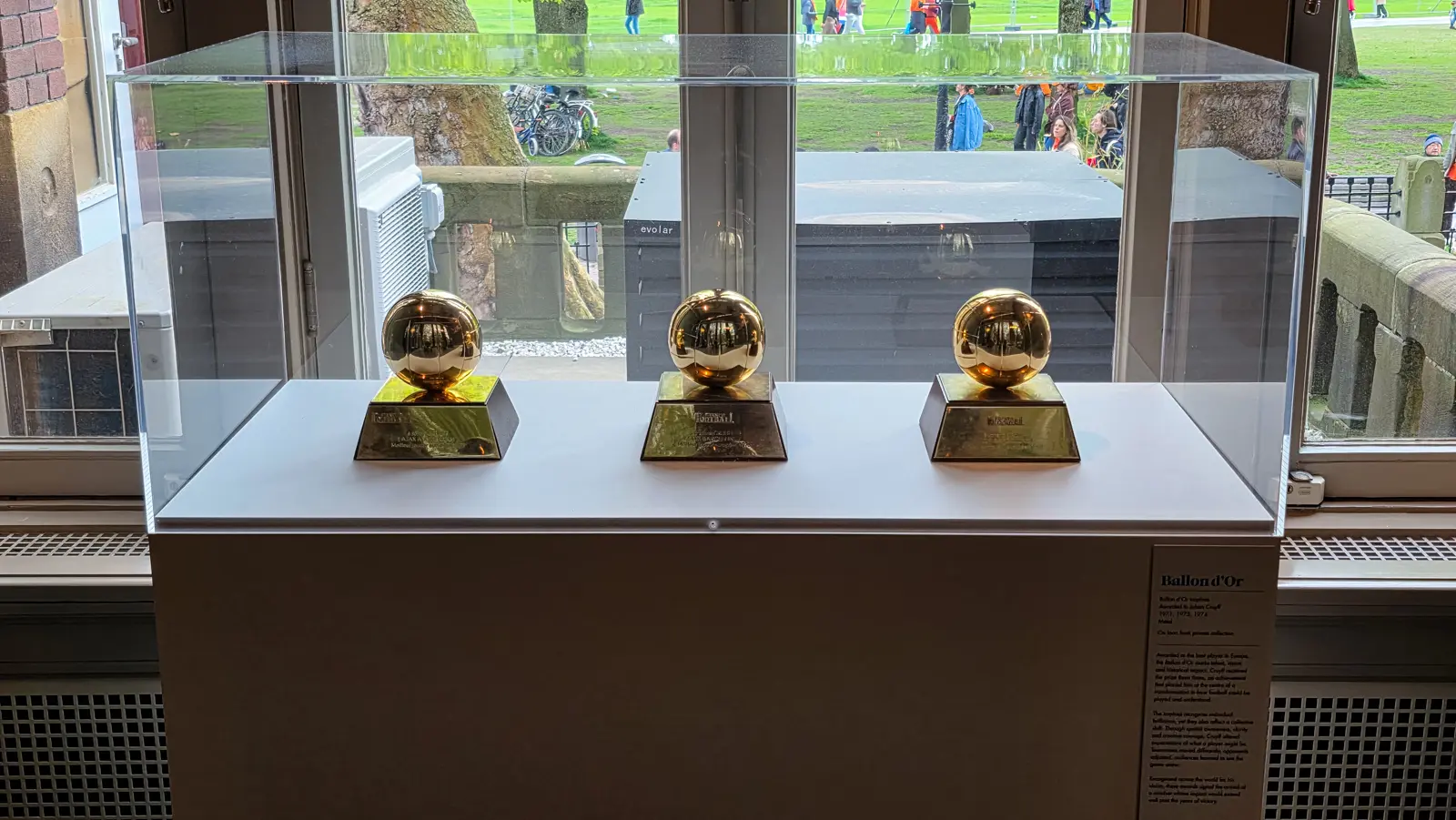
Three of them, side by side, in a case in a window looking out onto the grass of Museumplein where people in orange were walking past for King’s Day.
The label explains what the Ballon d’Or is, which I needed, and the years explain something else. 1971, 1973, 1974. Not a peak but a plateau, held across the years when the Dutch national side and Ajax were rebuilding what the game looked like.
The Boot
Nearby, in another case, is a gold football boot with three black stripes down the side, mounted on a block of dark stained wood.
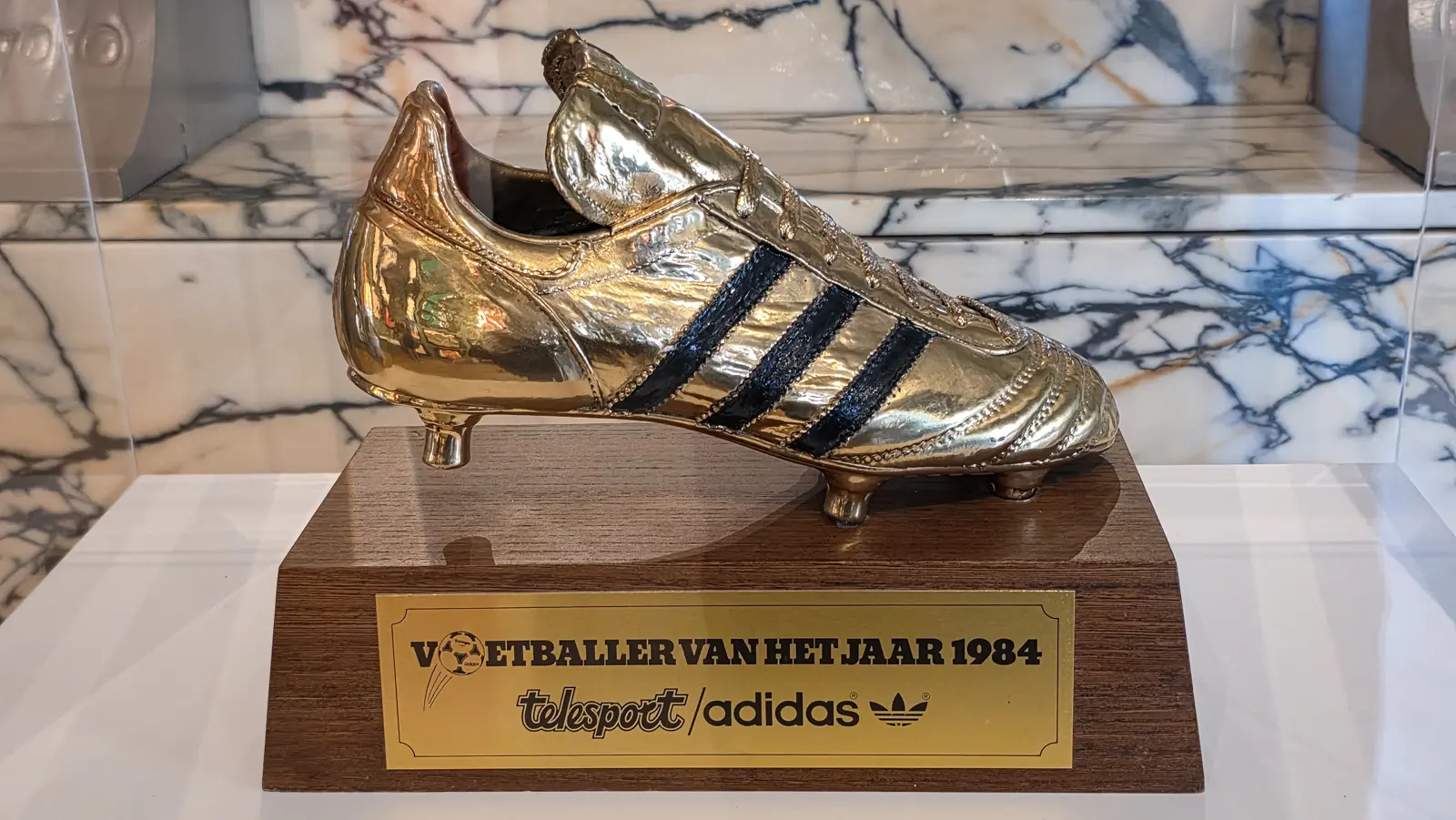
The date is the part worth sitting with. 1984. Ten years after the last of the Ballon d’Or trophies, when he was thirty-seven and had come back to the Dutch league after Barcelona and America, and the country voted him player of the year again.
It is also the least museum-like object in the building. A shoe, dipped in gold, screwed to a bit of stained wood, with a sponsor’s logo on the plate. Nobody designed it to end up behind glass on Museumplein.
Welkom Terug
On the wall is a black and white photograph, printed large, of a footballer walking away from the camera towards a fence.
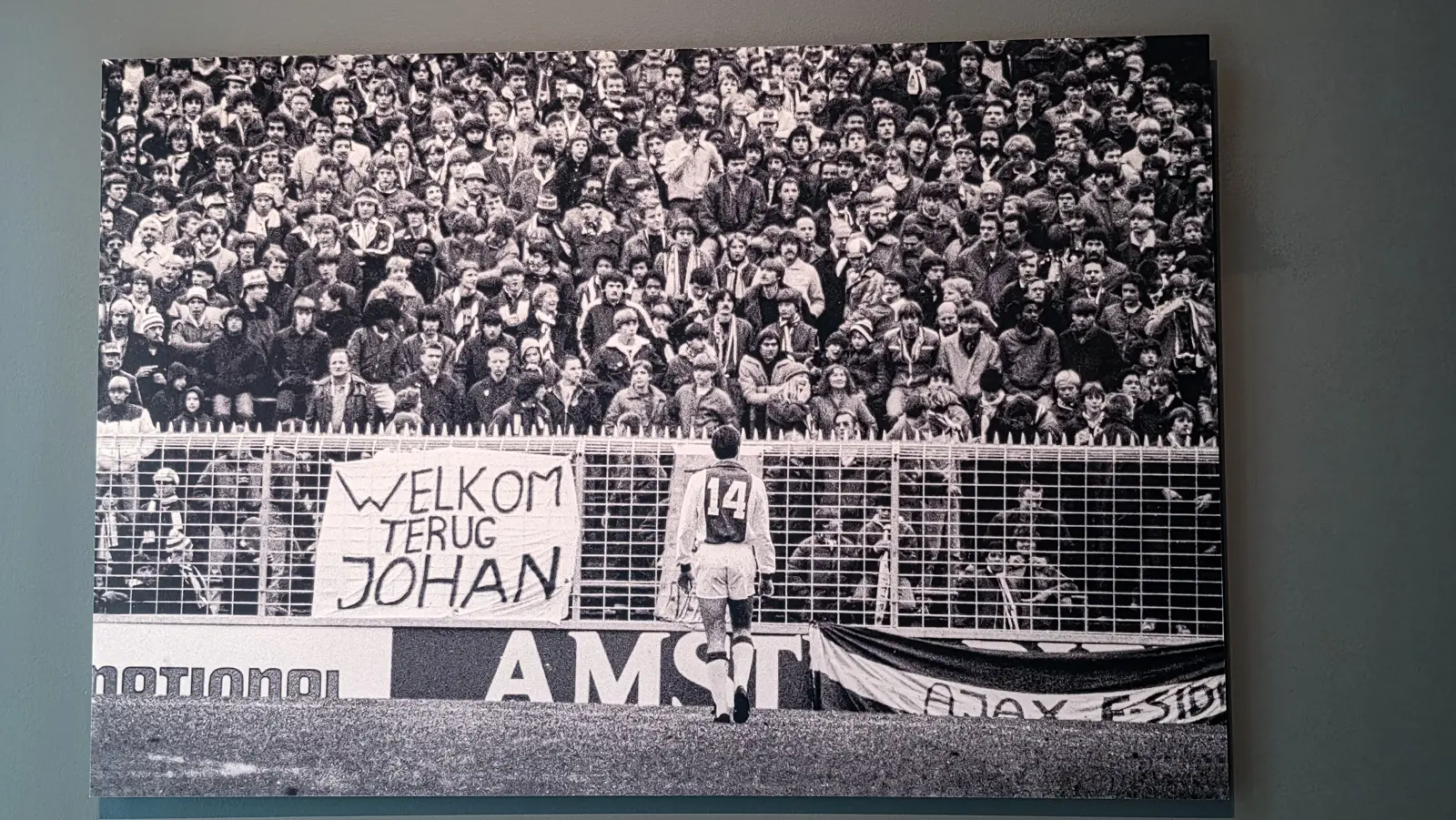
He is in the number 14 shirt. Beyond the fence, a stand packed shoulder to shoulder, several hundred faces in winter coats. Someone has made a banner out of a bedsheet and hung it on the fence in hand-drawn capitals: WELKOM TERUG JOHAN.
Welcome back, Johan. Somebody painted that at home and carried it to the ground.
That photograph did more to explain him to me than any wall text in the room. Not the three Ballon d’Or trophies in their case. A bedsheet, painted at home by somebody who wanted him to see it as he walked out.
What the Artists Made of Him
Moco set the objects alongside new work by Dutch artists, which is the part that makes it an art exhibition rather than a trophy cabinet.
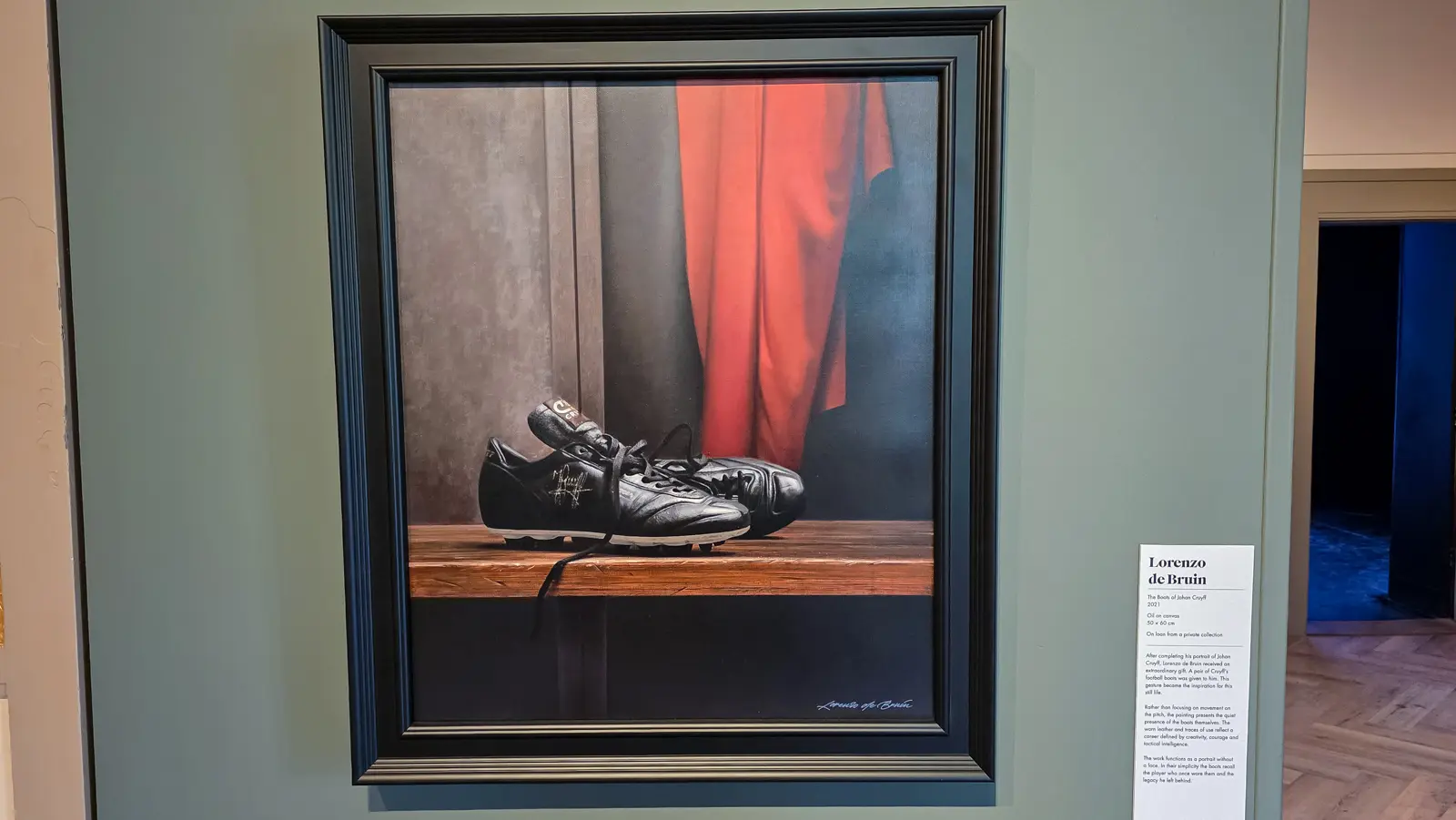
A pair of worn black boots on a wooden bench, laces trailing over the edge, a red shirt hanging behind them. No player, no pitch, no crowd. The label calls it a portrait without a face, and that is exactly right.
The painting is done in the manner of a seventeenth-century Dutch still life, which is a deliberate joke and a serious one. Boots on a bench, lit from one side against a dark ground, painted with the care a Golden Age artist would give to a lemon or a silver cup. A country with four hundred years of practice at painting ordinary objects seriously, turning that practice on a pair of football boots.
Outside in the garden stands the other artistic response, in white marble.
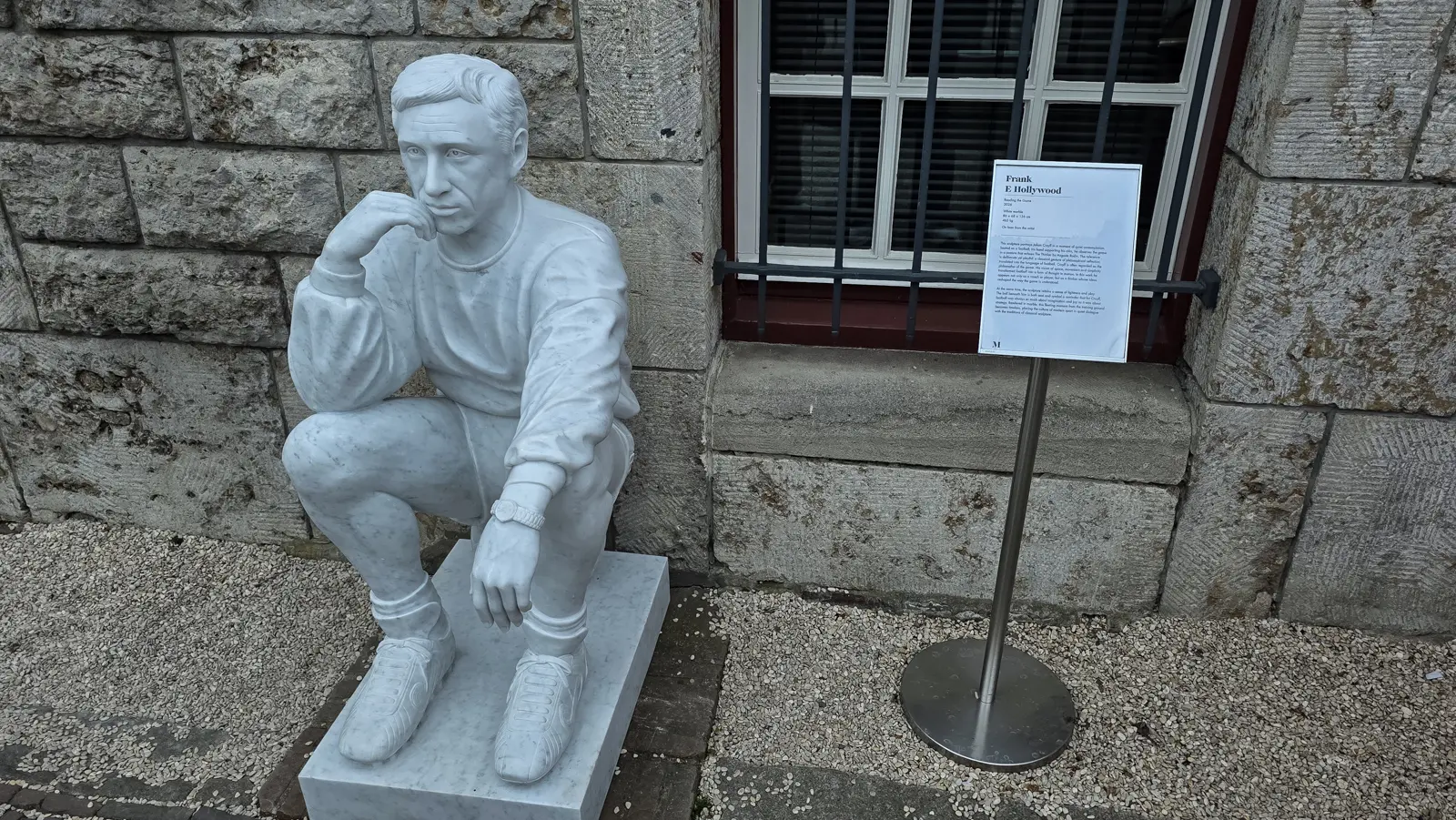
A man in a tracksuit, sitting on a football, chin on his hand. Rodin’s pose, in a sweatshirt and trainers, with a wristwatch carved into the marble.
Both works do the same thing from opposite directions. Neither shows him playing.
A Street Sign in a Museum
The object I keep coming back to is the smallest one on the wall, and it is not a trophy or an artwork.
It is an enamel street sign: AKKERSTRAAT, WATERGRAAFSMEER, with a house number plate beside it.
Cruyff was born in April 1947 and grew up on that street, in Betondorp in east Amsterdam, an estate built in the 1920s out of concrete because brick had become too expensive. Concrete Village, as the nickname translates. His parents kept a greengrocer’s shop in the corner house, which is why it has shop windows either side of the door. His father died when Johan was twelve and the family moved a few streets away.
Directly across the main road was De Meer, the stadium where Ajax played until 1996. He could see it from home.
So the arc the exhibition is describing runs from a two-bedroom house above a vegetable shop, across one road to a football ground, and eventually to a case on Museumplein between the Rijksmuseum and the Van Gogh Museum.
The sign hangs among the shirts at about eye level, small and blue and easy to walk past.
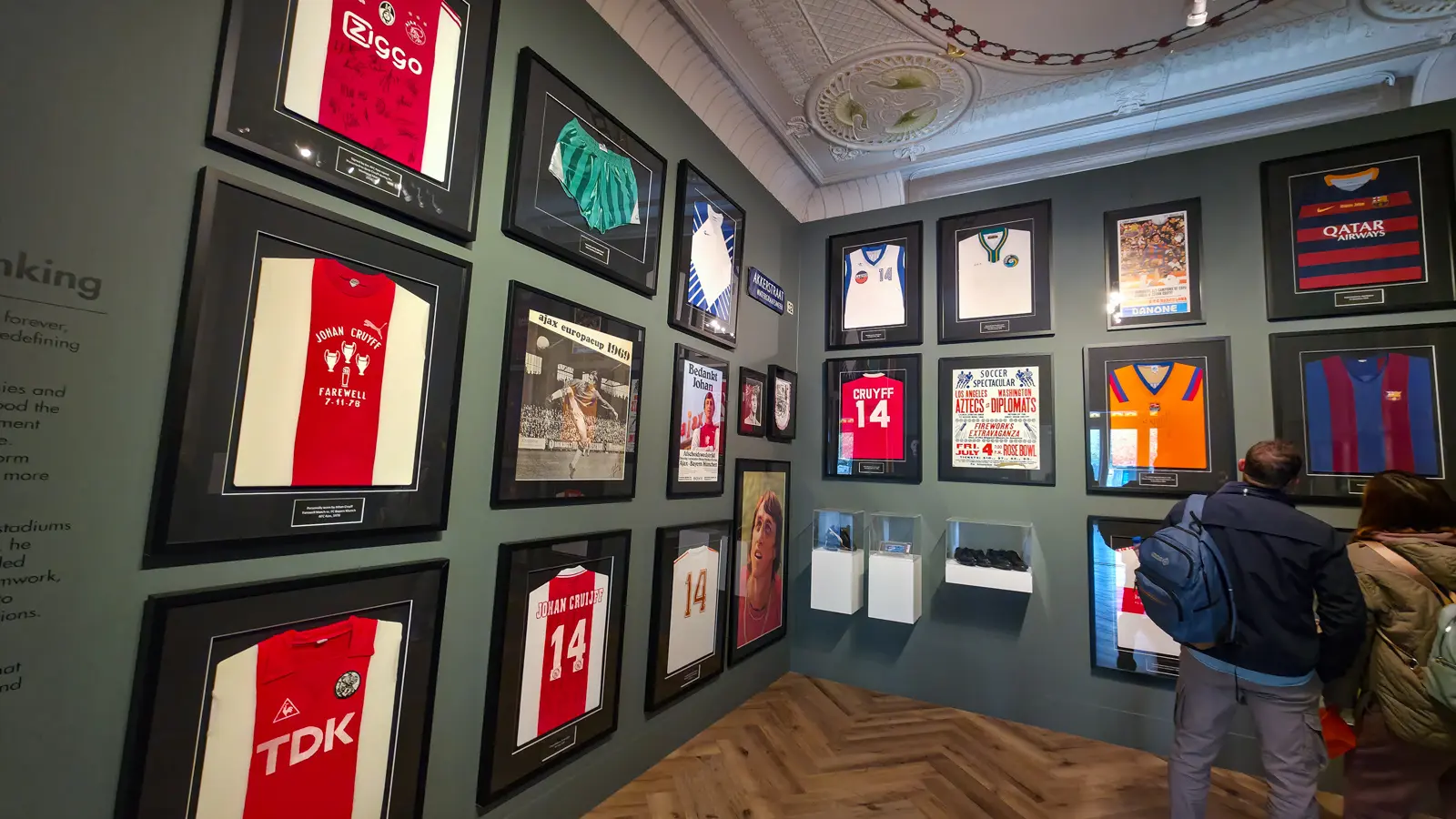
It is the only object in the room that says where any of it started.
Bubbly Tips
- Check what temporary exhibition is running before booking. Moco rotates these, and they are included with the standard ticket rather than charged separately. What is on when you go may be nothing like what was on when someone wrote about it.
- Read the object labels, not just the wall panels. The labels carry dimensions, dates, loans and credits, and in this exhibition they were doing most of the explaining.
- Arriving without knowledge is not a disadvantage. The exhibition is built for people who need the Ballon d’Or explained. Anyone who already knows the football history will get less out of the labels and more out of the objects.
- Public holidays are a good time for Moco. King’s Day put most of Amsterdam in the street and left the museum manageable.
- Give the temporary exhibition its own time. It is easy to treat a special exhibition as a corridor between the permanent rooms. This one needs half an hour on its own.
- Look for the small objects. The street sign, the boot, the pennants. The large framed shirts catch the eye first and say the least.
- Pair it with Betondorp if the interest takes hold. The neighbourhood is in Amsterdam east, reachable by tram, and the house is a private home rather than a museum, so it is a walk past rather than a visit.
- The garden sculpture belongs to the same exhibition. Reading the Game stood outside in the gravel, easy to miss on the way in.
- Assume the loans go home. Most of what was in these cases came from private collections and returned to them when the exhibition closed.
Final Thoughts
The exhibition closed on 29 April, two days after I saw it. Six weeks later the World Cup started, and for a month the football was everywhere: in bars, on flags, on the front of every newspaper I walked past.
Cruyff’s Netherlands reached the final in 1974 and lost it. The Dutch have never won a World Cup, which is the thing everyone told me at some point during that spring, usually with a shrug. In 2026 they went out in the Round of 32, to Morocco, on penalties. Spain won it in New Jersey on 19 July.
None of which he was here for, and none of which is really the point the exhibition was making. Moco’s argument was that the trophies mattered less than the thinking, which is a convenient argument for a man whose country kept not winning, and also, on the evidence of two rooms and a bedsheet banner, probably true.
I went in not knowing who he was. I came out understanding why a stadium carries his name, and why the sign from a street in Betondorp had been hung on the wall next to the golden balls.
Until next time!

🌟 Everything You Need to Plan Your Dream Trip in 2026
- 🌟 Luxury Hotels - Find premium stays with Booking.com & Hotels.com
- 🏡 Vacation Rentals - Discover unique properties on VRBO
- 🏞️ Guided Tours - Explore with Viator or GetYourGuide
- 🎫 Attraction Tickets - Skip the lines with Tiqets
- 🚢 Ocean Cruises - Set sail with Cruise Direct
- 📱 International SIMs - Stay connected with Saily
- 🚗 Car Rentals - Budget-friendly options from Discover Cars
- 🌐 Secure VPNs - Browse safely with NordVPN
- 💶 Currency Exchange - Best rates with Wise
- 🗣️ Learn Languages - Master the local language with Babbel and Rosetta Stone