
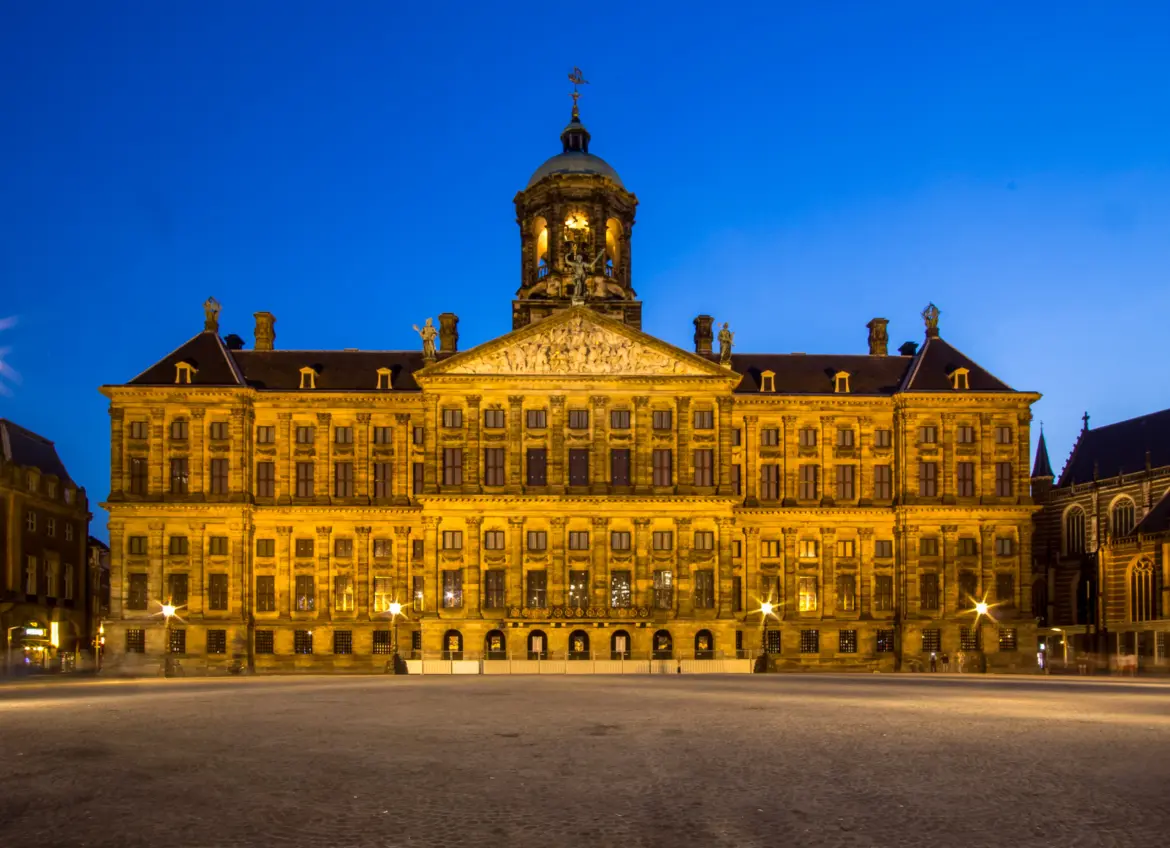
The building on the west side of Dam Square is called the Royal Palace, and it was not built for a king. It was built by a city that had grown rich enough to think it did not need one.
That contradiction runs through every room inside, and once it is pointed out, it is impossible to stop seeing. A room designed to humble a condemned man. A floor that puts the entire known world under the feet of ordinary citizens. A staircase widened by a French king so he could get his court up it comfortably.
I gave it three hours with the audio guide and could have used four.
The Royal Palace Amsterdam at a Glance
🏛️ What it is · A 17th-century town hall on Dam Square, built by a merchant republic, requisitioned as a palace by a French king in 1808. Still a working royal building.
🗺️ The highlights · The vast marble Citizens’ Hall, the world maps inlaid in its floor, the Atlas figure, and the Vierschaar tribunal where death sentences were pronounced.
👑 The upstairs · One of the largest collections of Empire furniture anywhere, left by Louis Bonaparte, arranged around austere 17th-century chimneypieces.
🎧 Do this · Take the included audio guide. It is what turns marble rooms into a legible argument about justice and trade.
💡 Tip · Book a timed slot ahead; it closes at short notice for state occasions.
A Town Hall, Not a Palace
Amsterdam in the seventeenth century had multiplied its population five times over in fifty years, and its old town hall was a medieval building that no longer said anything the city wanted said. The replacement was designed by Jacob van Campen, whose name now belongs to a street in De Pijp where I ate breakfast earlier in the week.
Construction began in 1648. Daniël Stalpaert handled the technical execution, and in 1654 a conflict between the two men ended with van Campen leaving the project. The building opened as a town hall in 1655, unfinished, and was not completed until 1665.
The engineering underneath is as impressive as anything above ground. Amsterdam is built on soft ground, so the whole structure stands on wooden piles driven down to firmer sand. The poet Joost van den Vondel wrote a poem for the opening and called it the eighth wonder of the world, which was partisan of him but not entirely unreasonable.
It stayed a town hall for over 150 years. Then, in 1808, Louis Bonaparte, installed by his brother Napoleon as King of Holland, decided Amsterdam suited him and requisitioned the building. Bartholomeus Ziesenis adapted it, partitioning galleries, fitting out rooms in Empire style, and widening the entrance stairs, which had originally been two narrow flights designed to be easy to defend.
The Citizens’ Hall
The Citizens’ Hall sits in the middle of the building and rises through its full height, from the floor to the top of the barrel vault. Everything else is arranged around it.
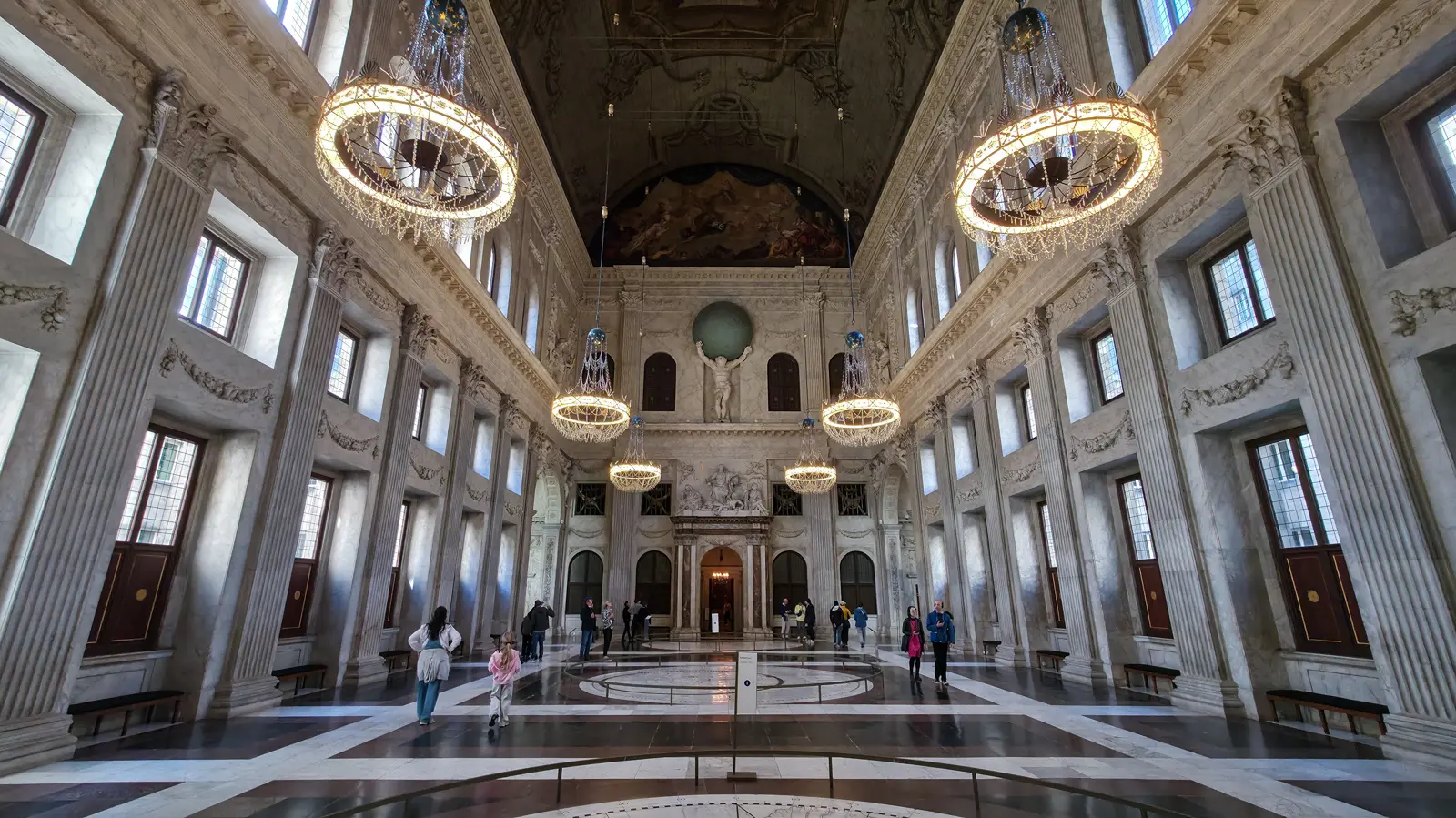
Marble from floor to cornice, a barrel vault overhead, and daylight coming in from windows set high on both long walls. It is a rare thing for its period: an enormous non-religious interior, built in a Protestant republic that had no cathedral tradition to draw on and no court to imitate.
The sculptural programme was overseen by Artus Quellinus, an Antwerp sculptor who ran workshops in both cities and worked with assistants including Rombout Verhulst. Every figure in the building belongs to a single scheme, and that scheme has a source: Cesare Ripa’s Iconologia, published in Italian in 1593 and translated into Dutch in 1644. It was a handbook prescribing how abstract ideas should be pictured, so that Justice, Prudence and Remorse each had an agreed set of attributes.
Knowing that changes the building. Nothing here is decoration. It is an argument about good government, written in marble, in a visual language the audience of 1655 could read.
Atlas
At the far end of the hall, a marble Atlas carries the heavens on his shoulders.
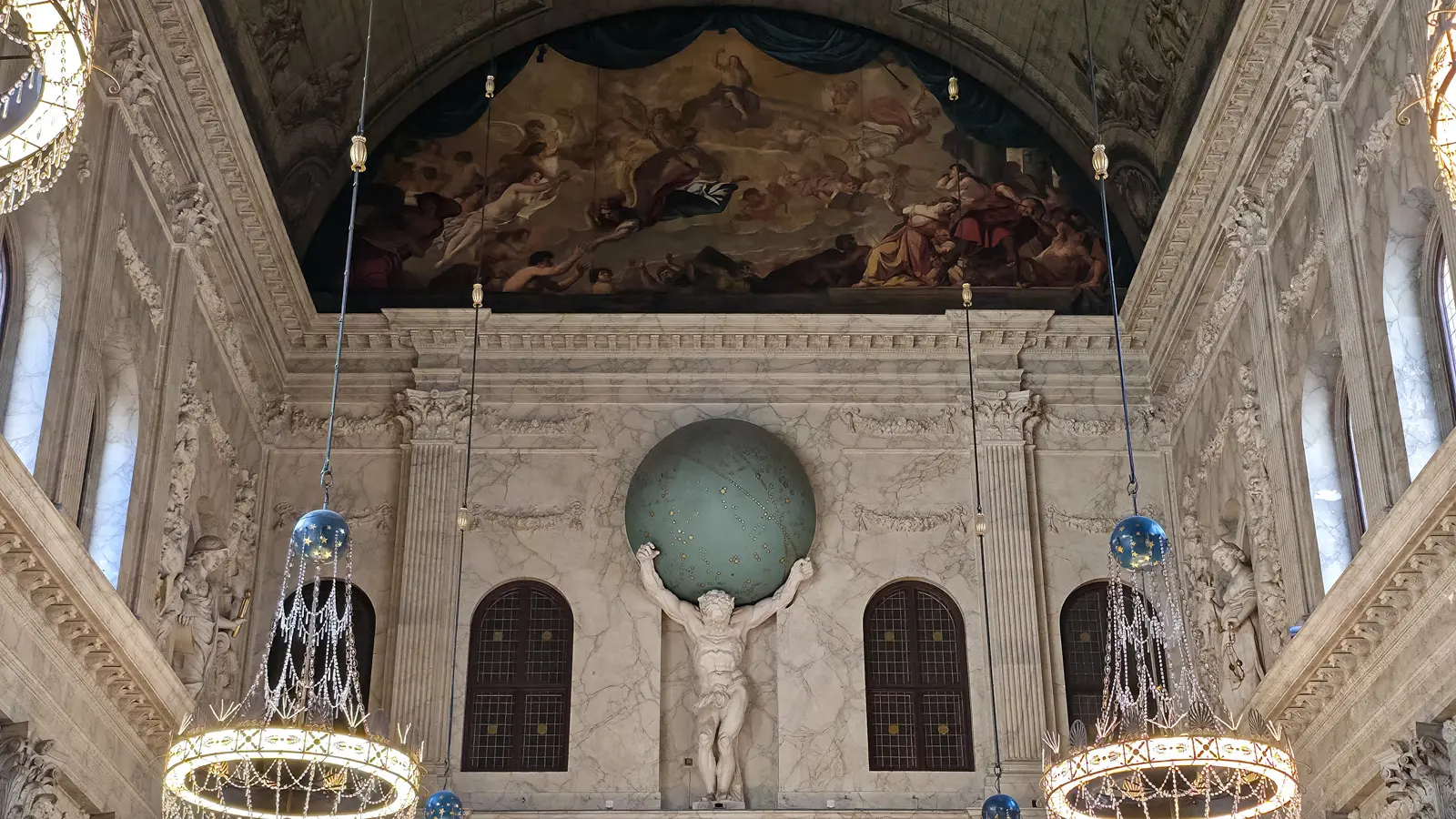
The globe on his shoulders is the celestial sphere rather than the earth, marked with constellations. Below him sits Justice, crushing Greed and Envy underfoot. The message is not subtle and was not meant to be.
Above, the barrel vault carries a painted scene added long after the sculpture, executed on canvas glued directly to the curved surface, which was the standard northern method for ceilings of this scale.
The two things do not quite match, and that is the interest of it. The marble below is republican, sober, and argued from Ripa’s handbook. The painting above is loose, theatrical and eighteenth century. A building put up over seventeen years, then decorated for another century afterwards, ends up carrying more than one taste at once.
The Floor That Claims the World
Then there is the floor, which is the thing I had not expected and the thing I keep thinking about.
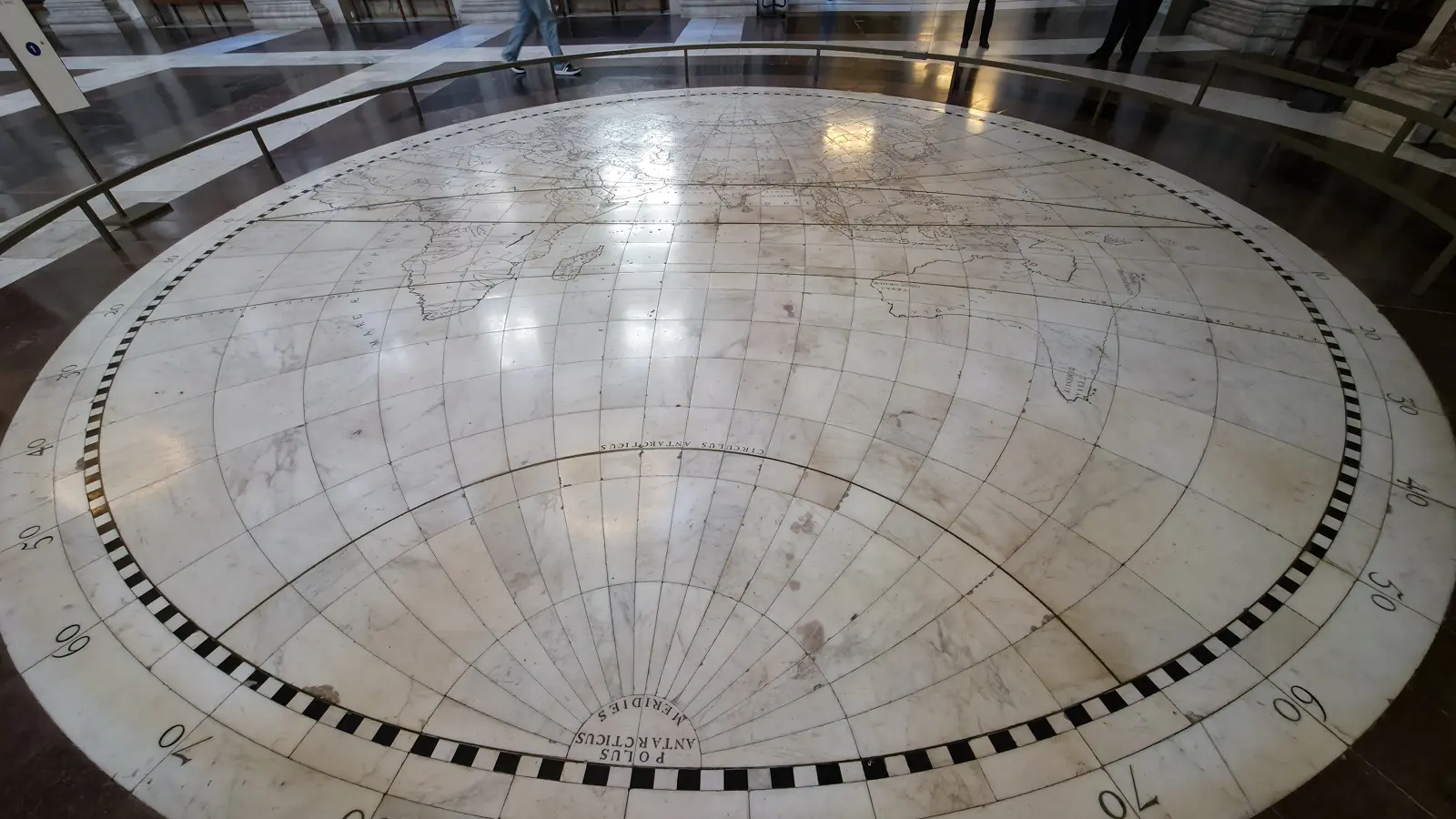
Three circles are set into the marble: the eastern hemisphere, the western hemisphere, and a map of the stars. The cartography came from the Blaeu firm, whose premises stood across the Dam, which is a short walk for a map and a very long reach for a city.
The point being made is straightforward. A citizen crossing this hall walked over the whole world and then over the sky. Amsterdam is not on the map as a place. Amsterdam is the floor the map is printed on.
What is on the floor now is not what was laid in the 1650s. Generations of feet wore the originals away, and the hemispheres were replaced in the eighteenth century.
The Vierschaar
On the ground floor, off the entrance, is a small marble room that changes the mood of the whole visit.
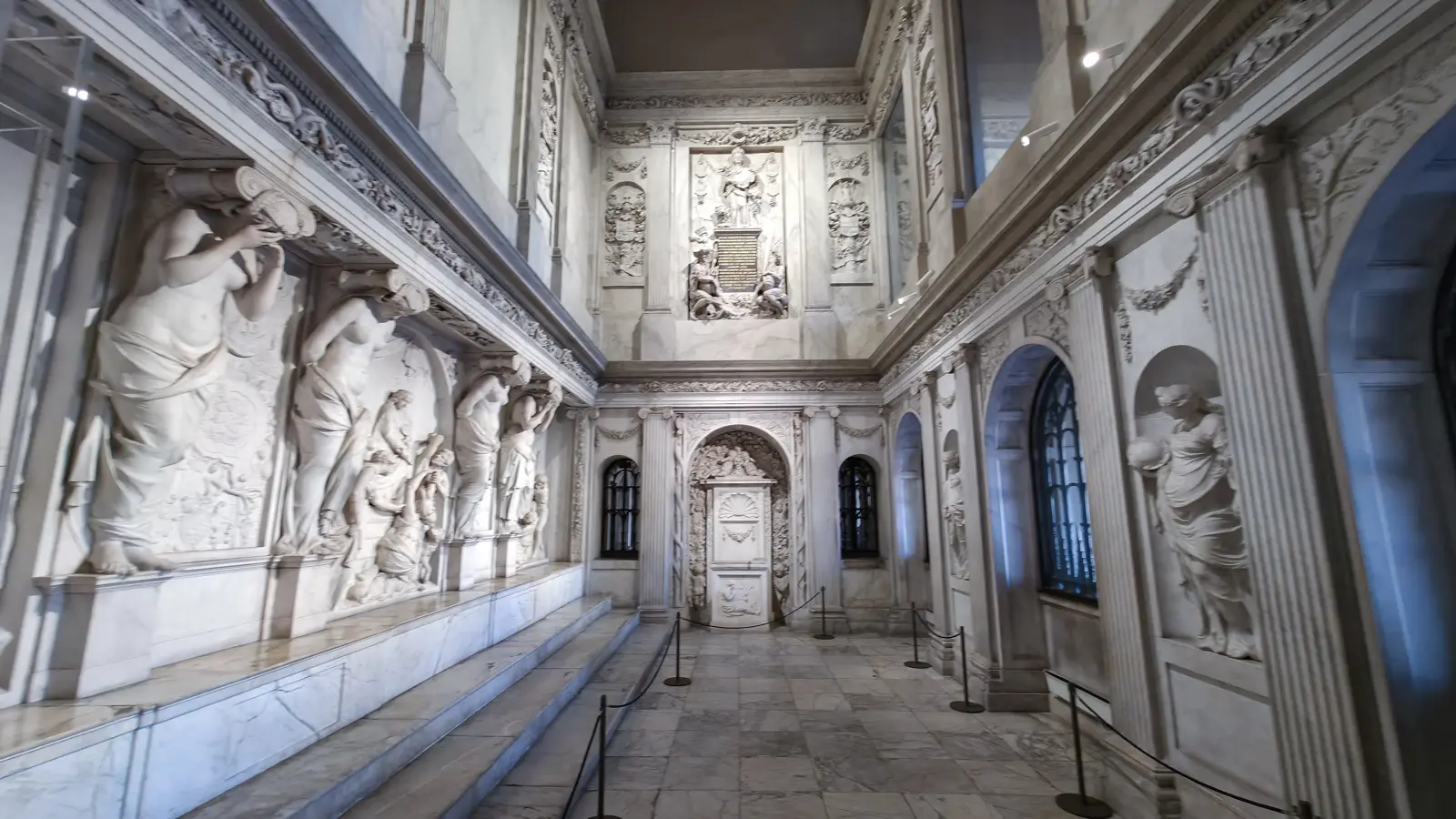
This is where death sentences were pronounced. According to the palace, that happened on average three or four times a year. The magistrates sat on the raised marble bench, the condemned person stood in front of them, and the public watched from Dam Square through gates in the outer wall, because a sentence was not considered properly delivered unless the city saw it delivered.
Everything in the room is aimed at the person standing in the middle of it. The caryatids bearing the weight of the entablature are figures of guilt and sorrow. Behind the judges are three reliefs of exemplary judgements: the Greek lawgiver Zaleucus, who gave up one of his own eyes so his son would only lose one, standing for compassion; King Solomon and the divided child, standing for wisdom; and the Roman consul Lucius Junius Brutus, who had his own sons executed for conspiracy, standing for impartial justice.
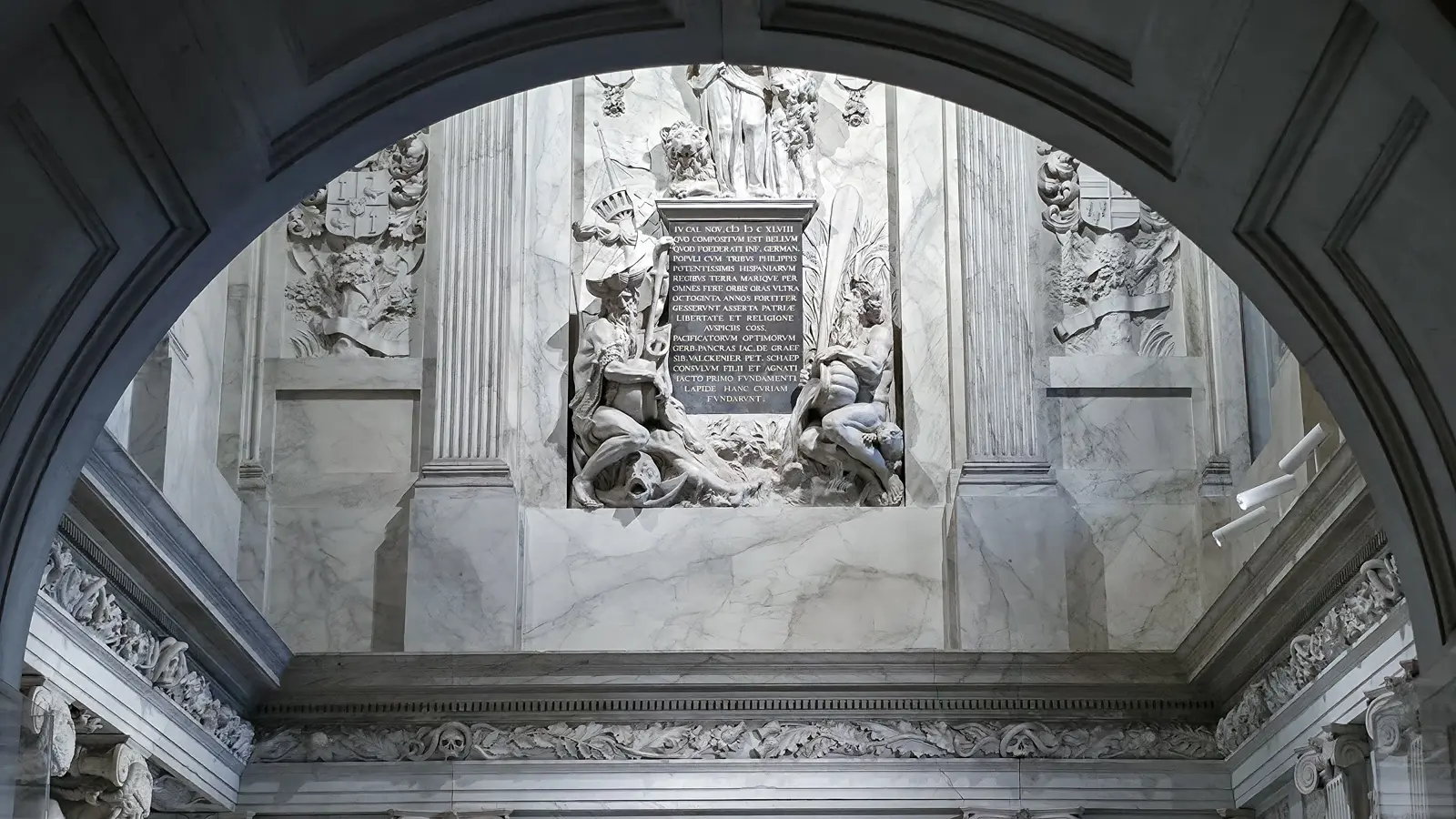
Two of those three stories are about men who punished their own children. That is the argument the room makes to the man about to be sentenced: this bench did not spare its own, and it will not spare him.
There is a detail I would have missed without the audio guide. The secretary’s writing chair carries a carved skull and weeping cherubs, in case anyone in the room had somehow failed to grasp what the proceedings were for.
Louis Napoleon could not live with it. He turned the Vierschaar into a chapel and hung blue curtains over the marble.
The Rooms Upstairs
Upstairs the building changes centuries. The galleries around the Citizens’ Hall were fitted out for a French king in a hurry, and what survives is one of the largest collections of Empire furniture anywhere.
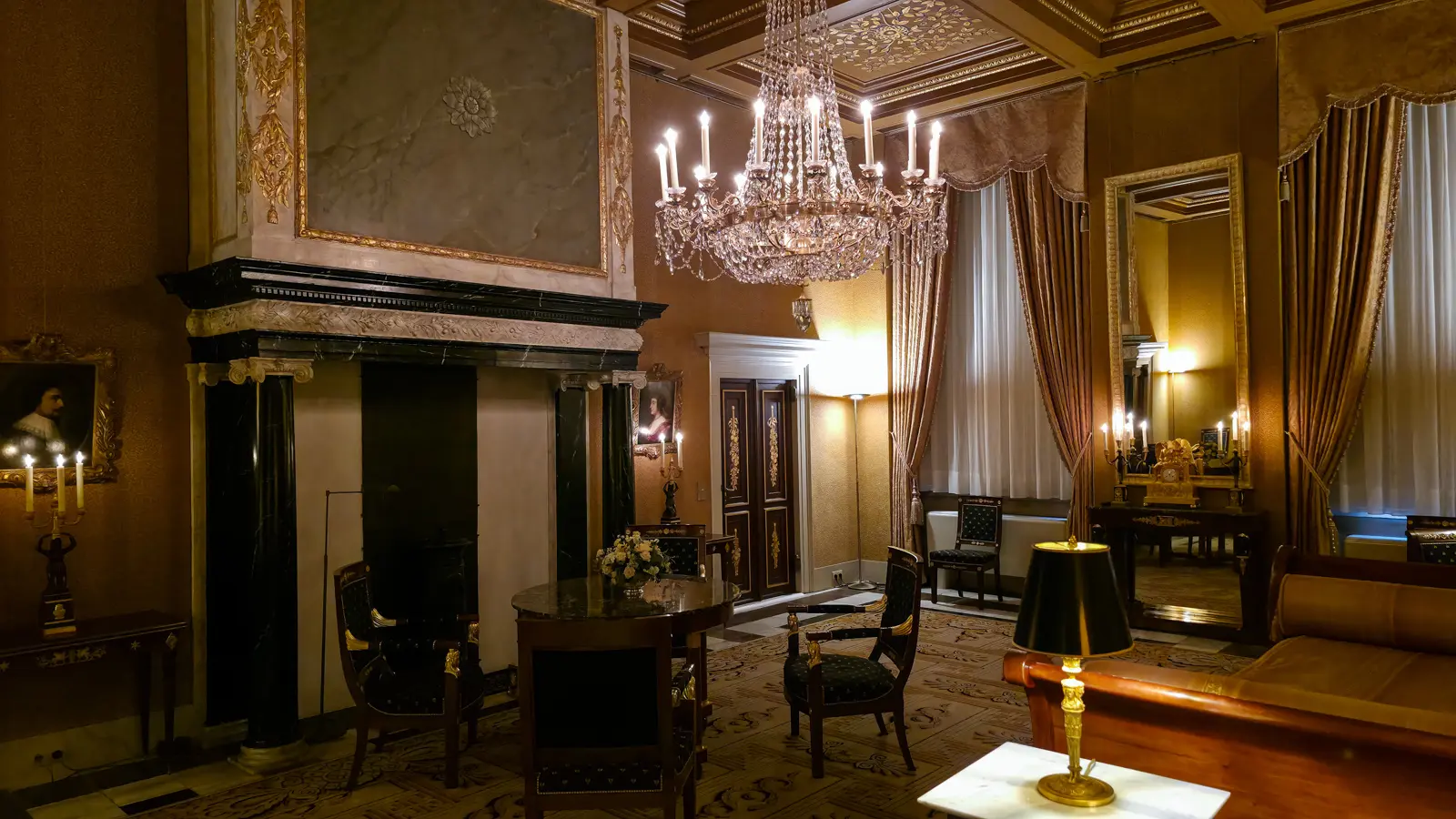
Each room takes a colour and commits to it entirely, walls and curtains and upholstery together. This one is gold, with a black marble chimneypiece and a portrait beside it lit by candle sconces.
The chimneypieces are the giveaway in every one of these rooms. They are seventeenth century, heavy and carved and far too austere for the furniture standing in front of them, because they were built for magistrates rather than for a court. The French fittings had to be arranged around them.
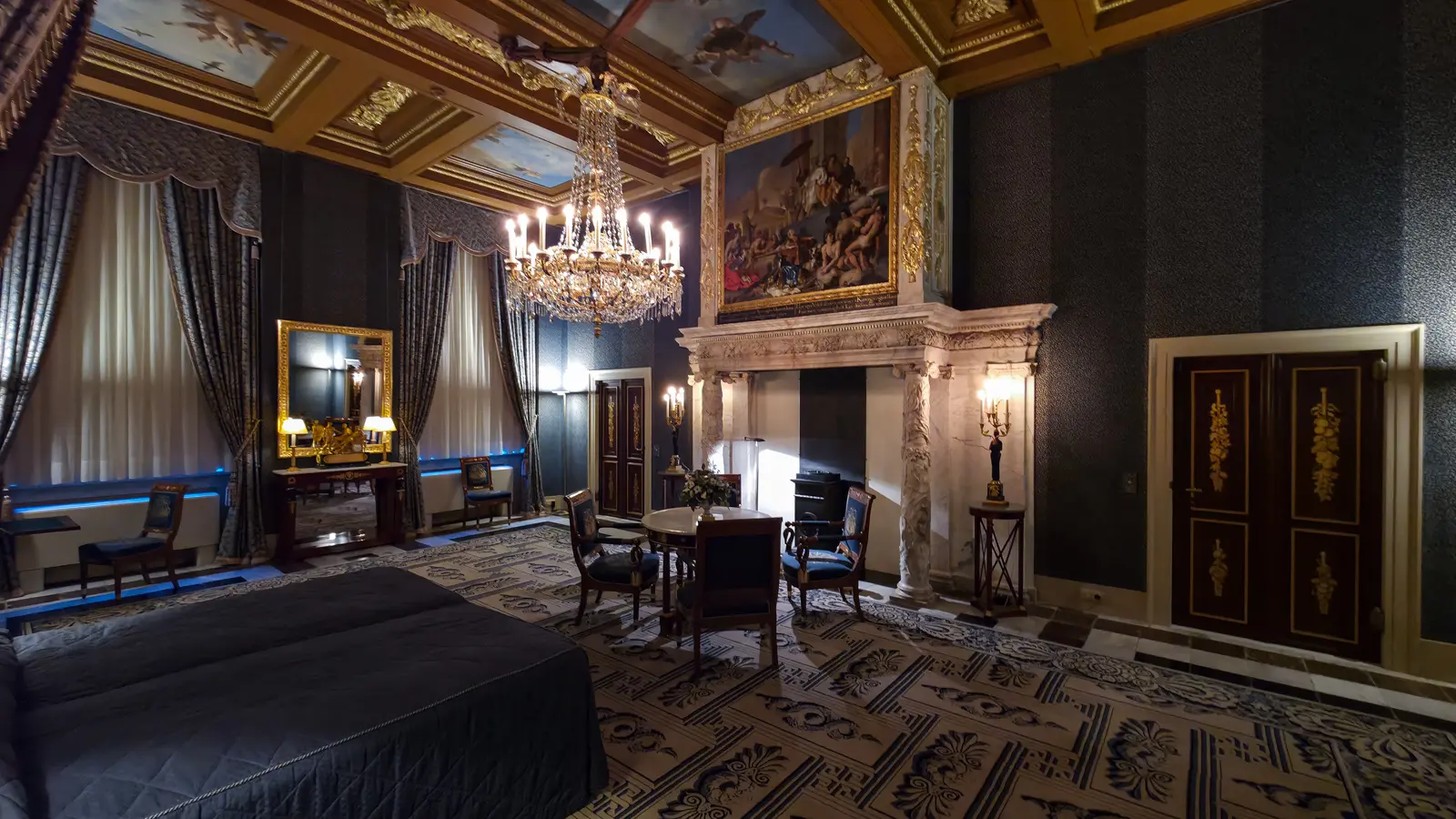
Then a red one, with a painting set into the chimney breast and a carpet in a repeating square pattern that runs the length of the floor. The chairs sit in a tight circle around a single round table, which is how these rooms were arranged for conversation rather than for audiences.
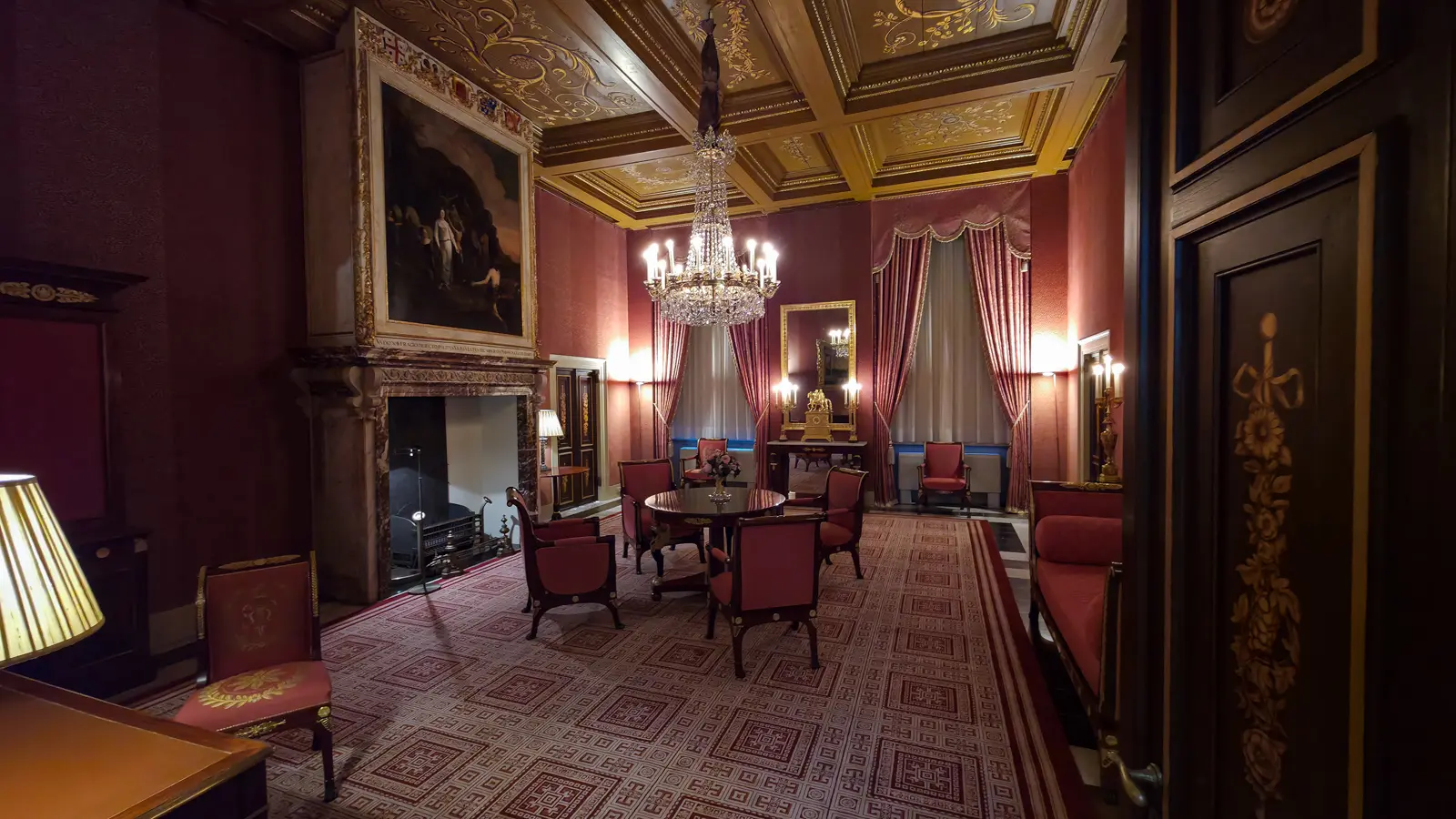
Standing in these rooms after the Vierschaar is a strange transition. The same building, roughly forty steps apart, doing two completely different jobs.
The Old Council Chamber
One room upstairs is labelled in both Dutch and English, and the label is worth reading.
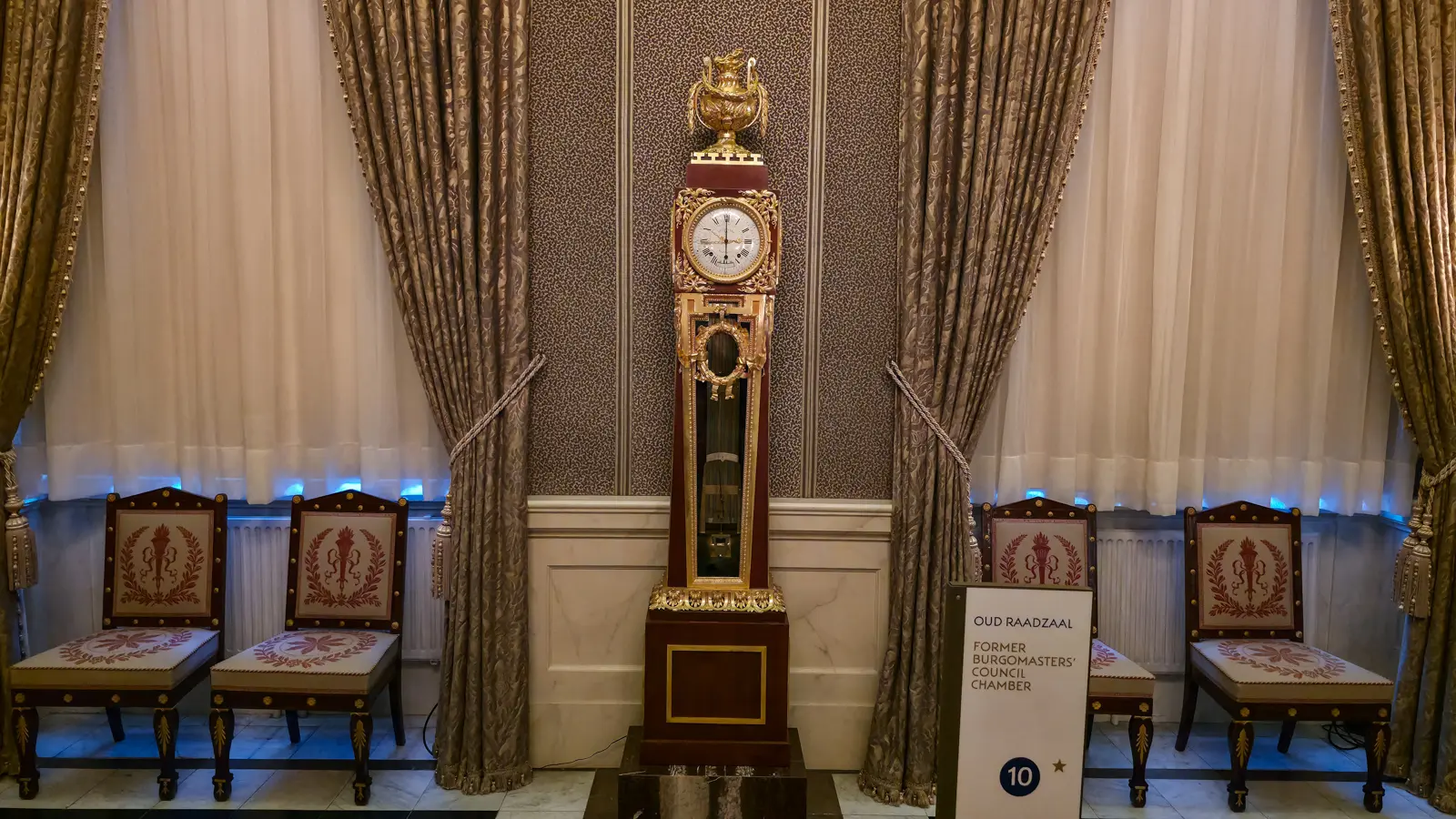
A longcase clock stands against the far wall in mahogany and gilt bronze, with an urn on top, flanked by chairs upholstered in a torch-and-laurel pattern. The torch and the laurel wreath are both Empire motifs, imported wholesale from Napoleonic France along with the furniture.
The room is decorated for a king and named for the merchants who ran the city before him. That pattern holds across the building. The great hall is still the Burgerzaal, the citizens’ hall. The courtroom is still the Vierschaar. The royal names never took, and the signage throughout uses the town hall ones.
A Window onto the Dam
The best thing in the building, for me, was not a sculpture.
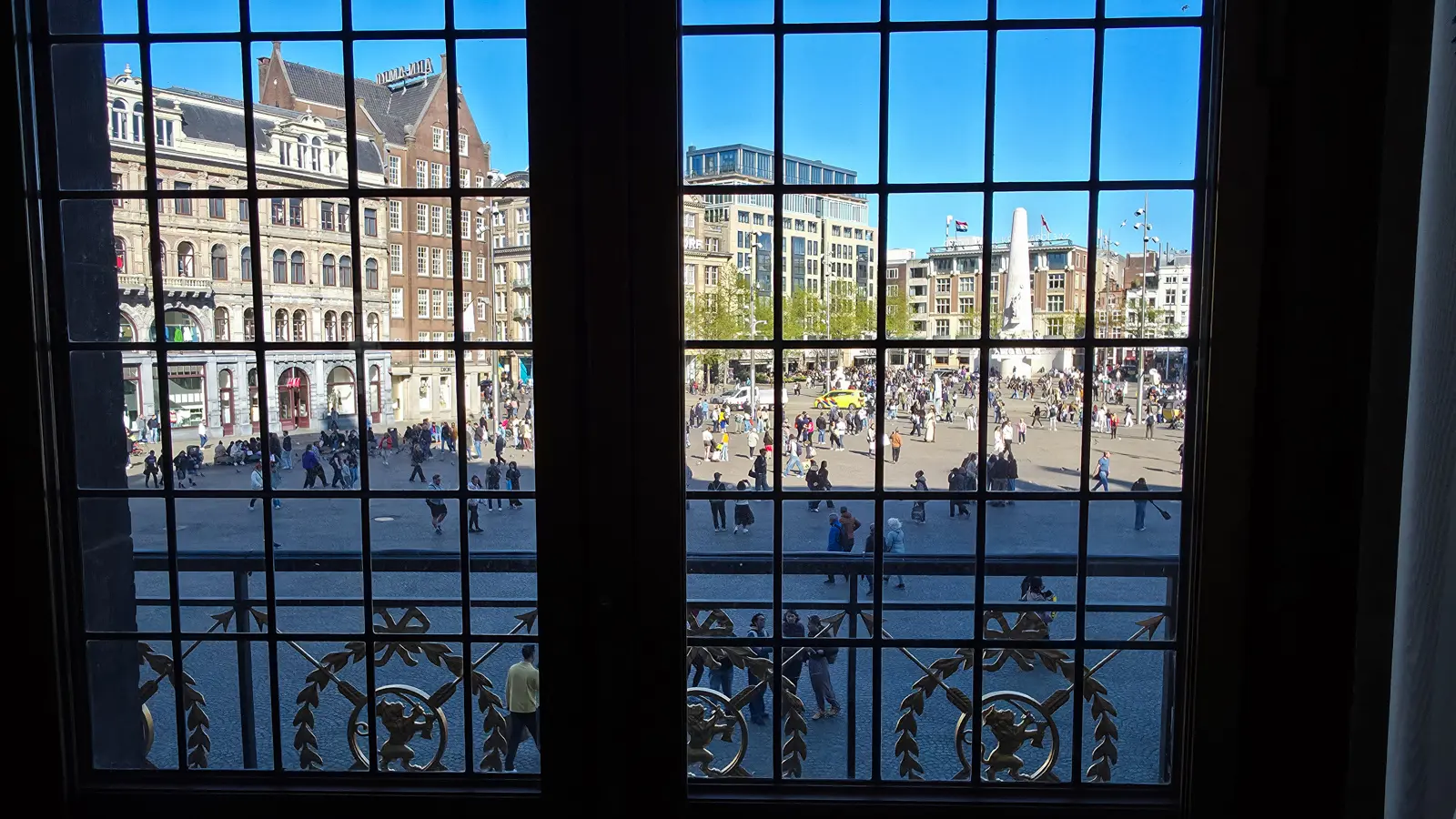
Leaded panes, gilded ironwork worked into arrows and laurel across the lower part, and beyond it Dam Square going about its business: crowds, a tram stop, the shopfronts on the far side, and the war memorial standing up white against the sky.
For three hundred and seventy years, people have been standing at these windows looking at that square. Magistrates, then a king, then a queen, then the several million of us who have bought a ticket. The view changes. The window does not.
It is also the only place in the building where the palace stops being a monument and becomes a vantage point. Everything else asks to be looked at. This asks to be looked out of.
Bubbly Tips
- Book a timed slot in advance. This is a working royal building. The Dutch monarchy uses it for state occasions, and when it does, it closes to visitors at short notice. Booking ahead means being told before travelling rather than at the door.
- Take the audio guide. It is included with admission and it is what makes the building legible. Without it, the Vierschaar is a pretty marble room rather than a courtroom designed to break a person’s composure.
- Choose your version by the time available. There is a highlights route for anyone with about an hour, and a longer version for a full visit. I took the extended one over roughly three hours and would happily have stayed longer.
- Give it more time than seems necessary. The building rewards standing still. The floor maps in particular need a slow circuit before the Latin starts making sense.
- Do the Vierschaar with the guide running. It is on the ground floor near the entrance, easy to walk past on the way in, and it is the room that gives the rest of the building its meaning.
- Look for the pairs. Almost every figure has a counterpart somewhere else in the building. Atlas appears twice, inside in marble and outside in bronze, facing opposite ways.
- Look down as well as up. Most visitors photograph the ceiling and miss the floor, which carries the entire argument of the room.
- Pair it with Dam Square itself. The Nieuwe Kerk is next door, the National Monument is opposite, and the whole square reads differently after seeing it from the palace windows.
- Check what is open on the day. Not all of the building is accessible to visitors, and which rooms are open varies with state use.
Final Thoughts
I went in expecting a palace and came out having visited a town hall that a king borrowed.
The rooms that stayed with me were not the gilded ones. They were the marble ones downstairs, built by a merchant city for its own use, at a moment when it had the money to build anything it liked and chose to build an argument about justice and trade and the reach of Dutch ships.
The audio guide is the difference between seeing that and not seeing it. Take the long version. Stand on the map.
Until next time!

🌟 Everything You Need to Plan Your Dream Trip in 2026
- 🌟 Luxury Hotels - Find premium stays with Booking.com & Hotels.com
- 🏡 Vacation Rentals - Discover unique properties on VRBO
- 🏞️ Guided Tours - Explore with Viator or GetYourGuide
- 🎫 Attraction Tickets - Skip the lines with Tiqets
- 🚢 Ocean Cruises - Set sail with Cruise Direct
- 📱 International SIMs - Stay connected with Saily
- 🚗 Car Rentals - Budget-friendly options from Discover Cars
- 🌐 Secure VPNs - Browse safely with NordVPN
- 💶 Currency Exchange - Best rates with Wise
- 🗣️ Learn Languages - Master the local language with Babbel and Rosetta Stone