
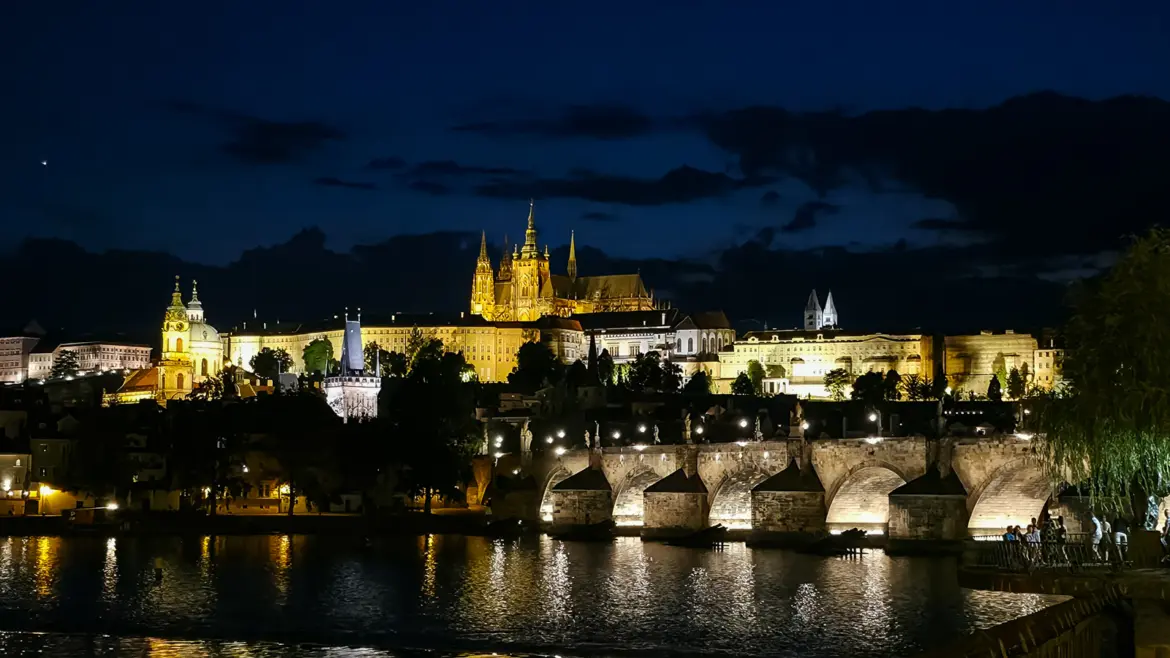
I went to Prague expecting a smaller Vienna. I had been to Vienna before, both cities spent centuries under the Habsburgs, and the comparison seemed safe. It wasn’t.
Vienna’s centre is formal. Much of it was rebuilt to impress after Emperor Franz Joseph ordered the old city walls torn down in 1857, and the Ringstrasse that replaced them is lined with grand 19th-century buildings in revival styles. Prague kept its medieval bones. UNESCO describes its Old Town, Lesser Town and New Town as built between the 11th and 18th centuries, and the street plan still shows it in the narrow lanes, the Gothic towers and the squares that open up at the end of an alley.
Prague is also far less formal. It is laid back, people were out at all hours of the day, and it is a city made for exploring with no fixed plan. This overview covers the places that shaped my first impression, from Old Town Square to the castle on the hill.
Prague at a Glance
🏛️ Not a mini Vienna · Where Vienna rebuilt to impress, Prague kept its medieval lanes, Gothic gates and crooked squares.
🕰️ Old Town Square · The astronomical clock (1410), the Týn Church spires and the Baroque St Nicholas Church in one square.
🌉 Charles Bridge · Cross it twice — busy and statue-lined by day, lamplit and silhouetted after dark.
🏰 The castle at night · Prague Castle and St Vitus floodlit above the Vltava is the view that stays with you.
🎨 Malá Strana · The Lennon Wall, the Devil’s Channel and the Grand Priory Mill wheel, a short walk from the bridge.
🚶 Made for wandering · Cobbled lanes, a buried medieval city underfoot, and a centre best explored with no fixed plan.
Old Town Square and the Astronomical Clock
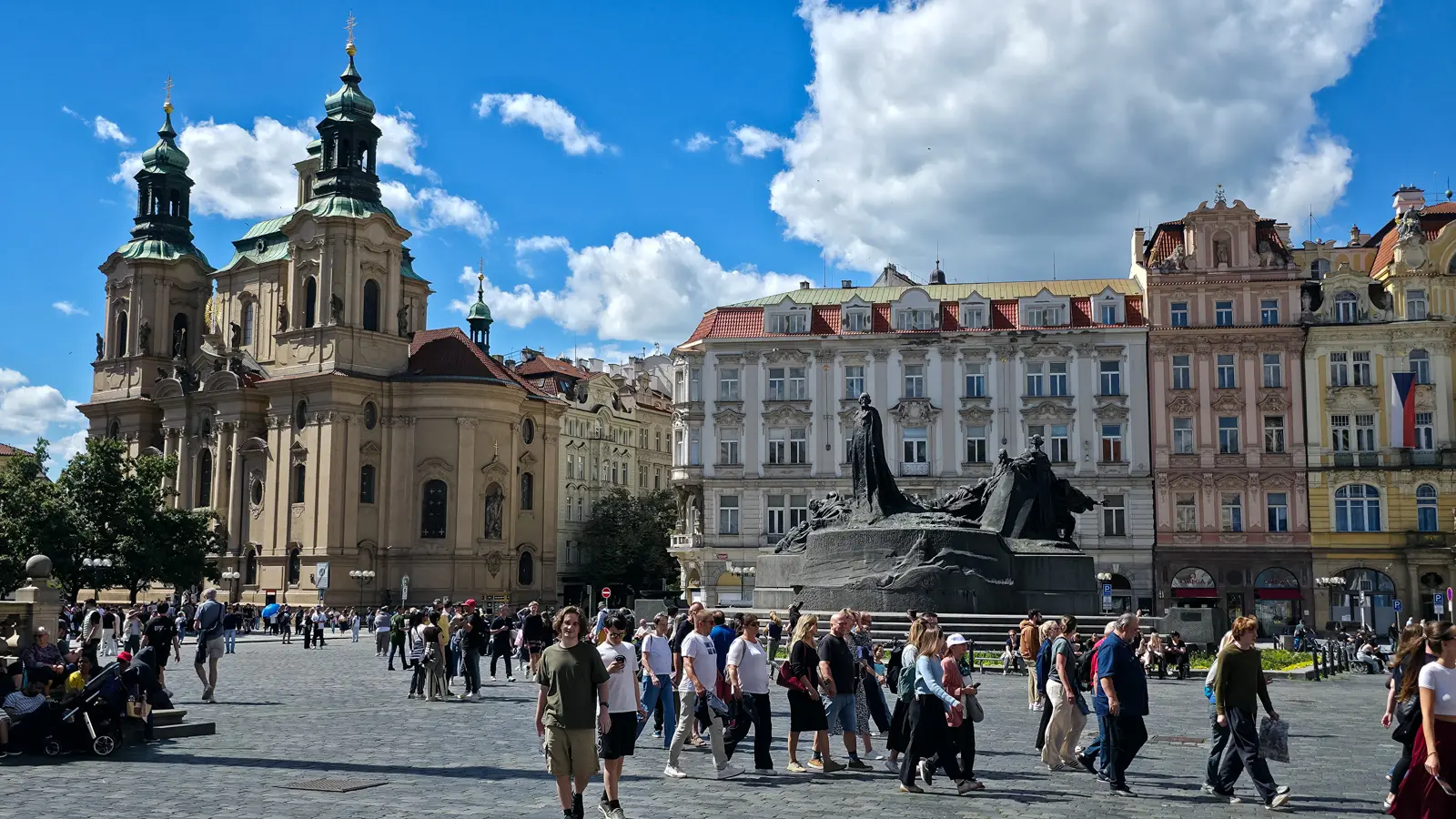
Old Town Square is where most first visits begin, and in June it was packed. The square is a lesson in Prague’s layers. The Baroque St Nicholas Church stands on one side with its green copper domes. The Gothic Týn Church rises behind a row of pastel houses on another. In the middle is the Jan Hus Memorial, unveiled in 1915 to mark 500 years since the reformer was burned at the stake.
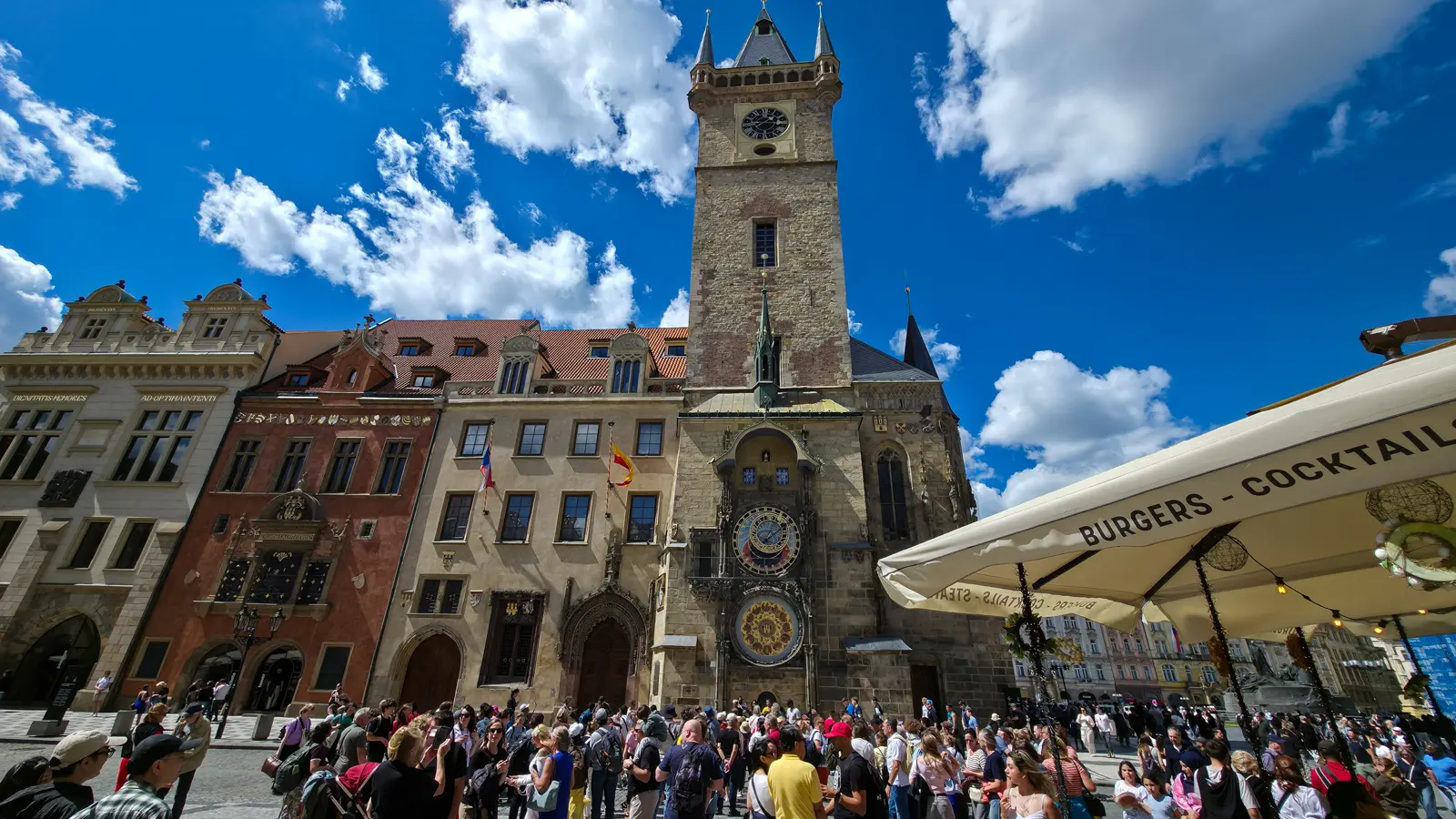
The biggest crowd in the square gathers in front of the Old Town Hall. Everyone is there for the astronomical clock, first installed in 1410.
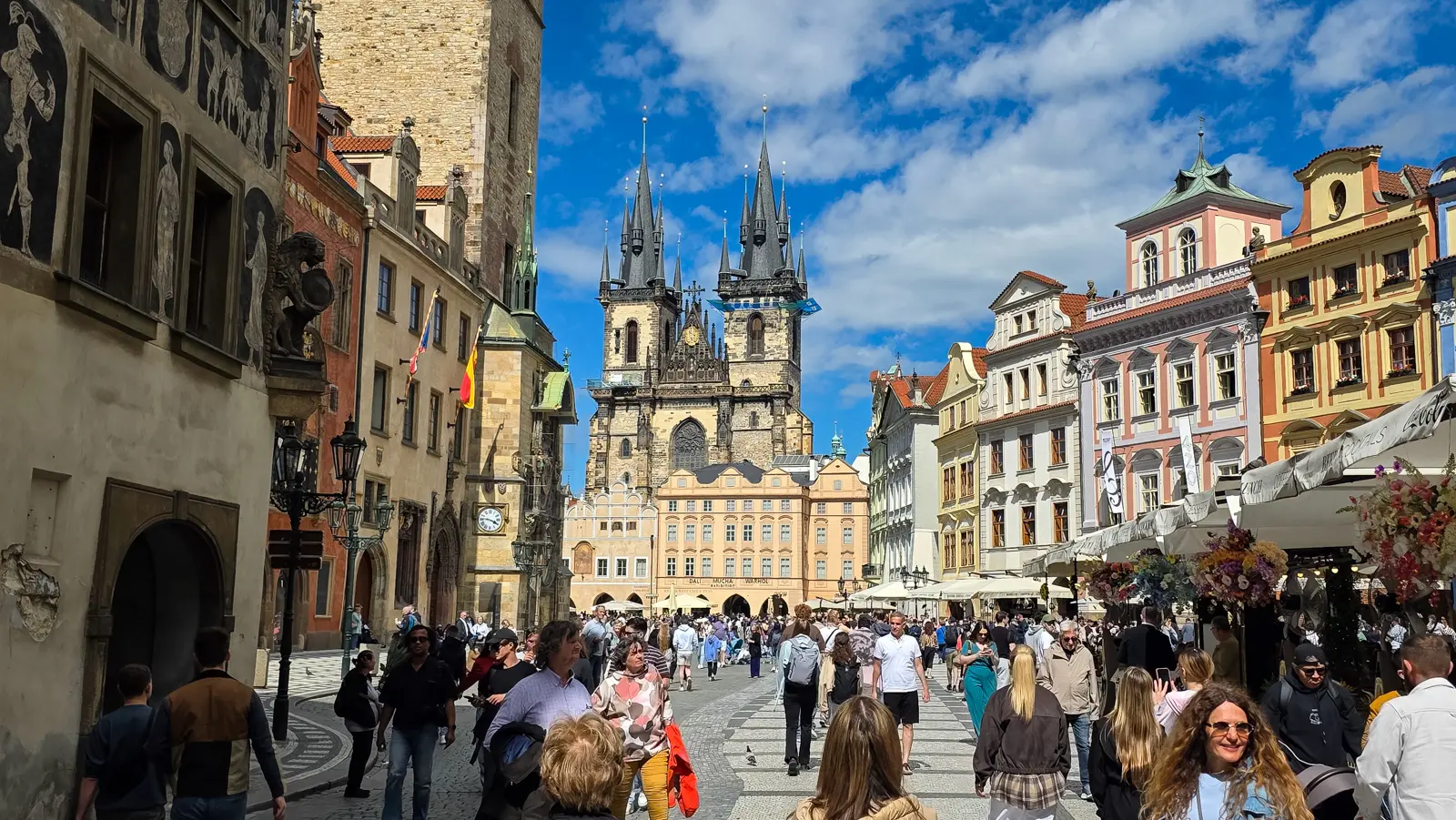
From beside the Old Town Hall, the view runs straight across the square to the two spiked towers of Týn Church, with café umbrellas lined up below them.
What surprised me most is what lies under the square. The Vltava flooded so often that the ground level was raised in the 13th century, and the old ground floors of Romanesque houses became cellars. About 70 of those buried houses survive beneath today’s streets. Under the Old Town Hall, the cellars also served as dungeons. Maybe that is part of why Prague struck me as mysterious. There is quite literally an older city underneath the one on the postcards.
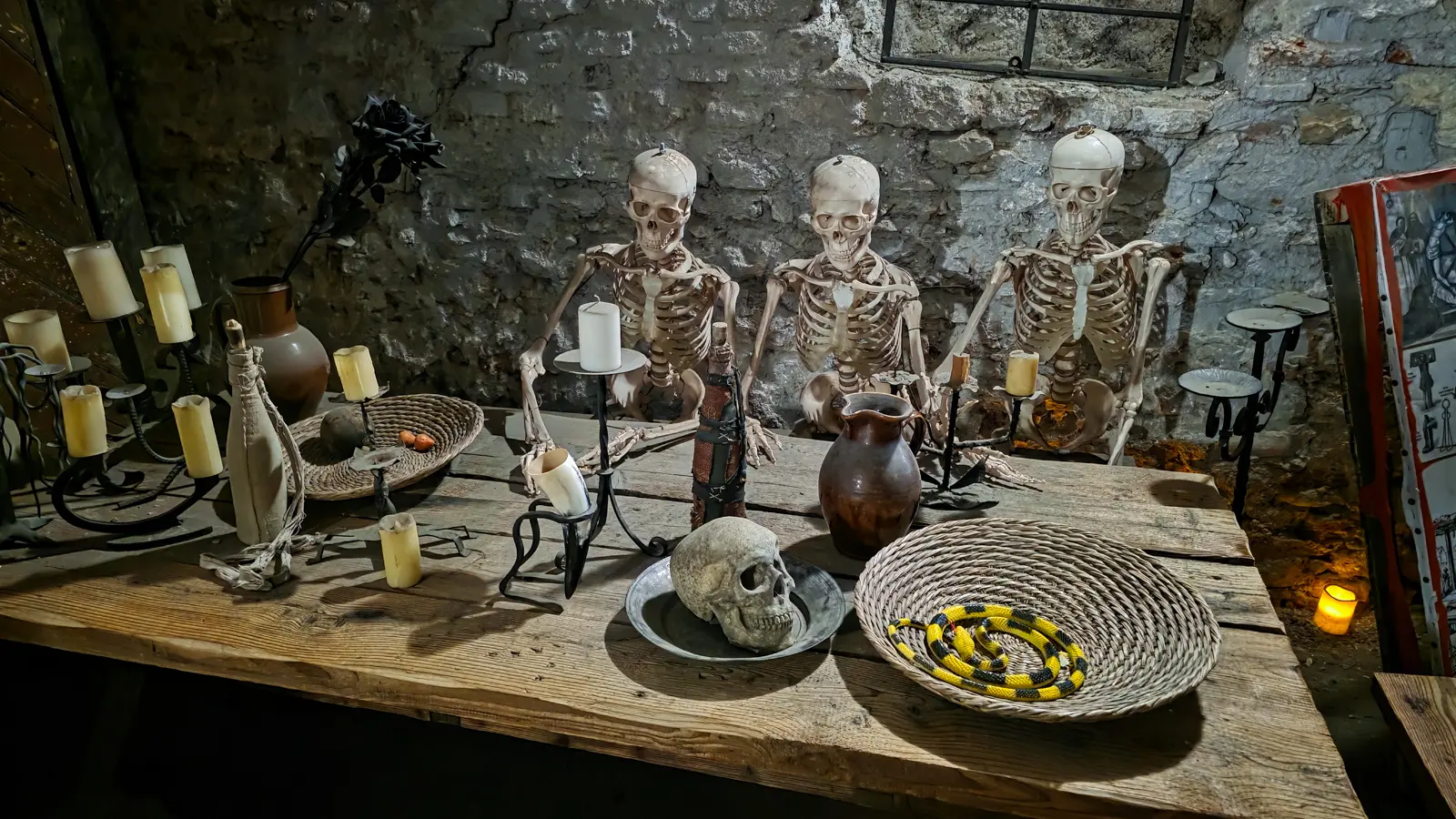
I went down into it on an underground dungeon tour. The stone cellars were dressed for the part, with iron candle holders, skeletons seated at a long wooden table and a skull served on a plate. It did nothing to talk me out of my dungeon theory.
The Powder Tower After Dark
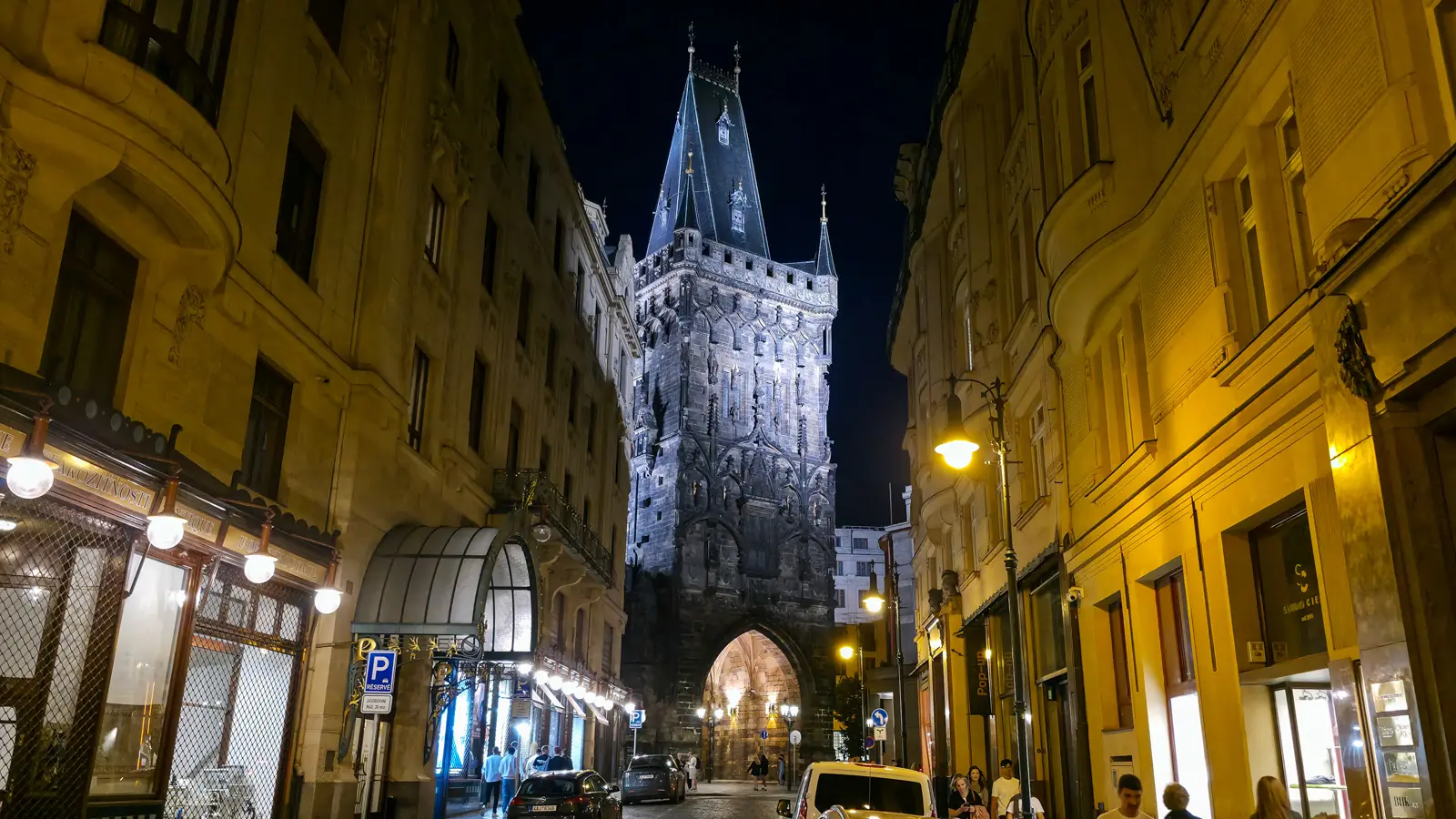
The Powder Tower is one of the old gateways into the Old Town, and I photographed it after dark. King Vladislav II laid its foundation stone in 1475. It marks the start of the Royal Route, the old coronation path that ran through the Old Town and over Charles Bridge to Prague Castle. Floodlit, its dark stone stands out against the warm light of the shopfronts on either side of the street.
Charles Bridge by Day and by Night
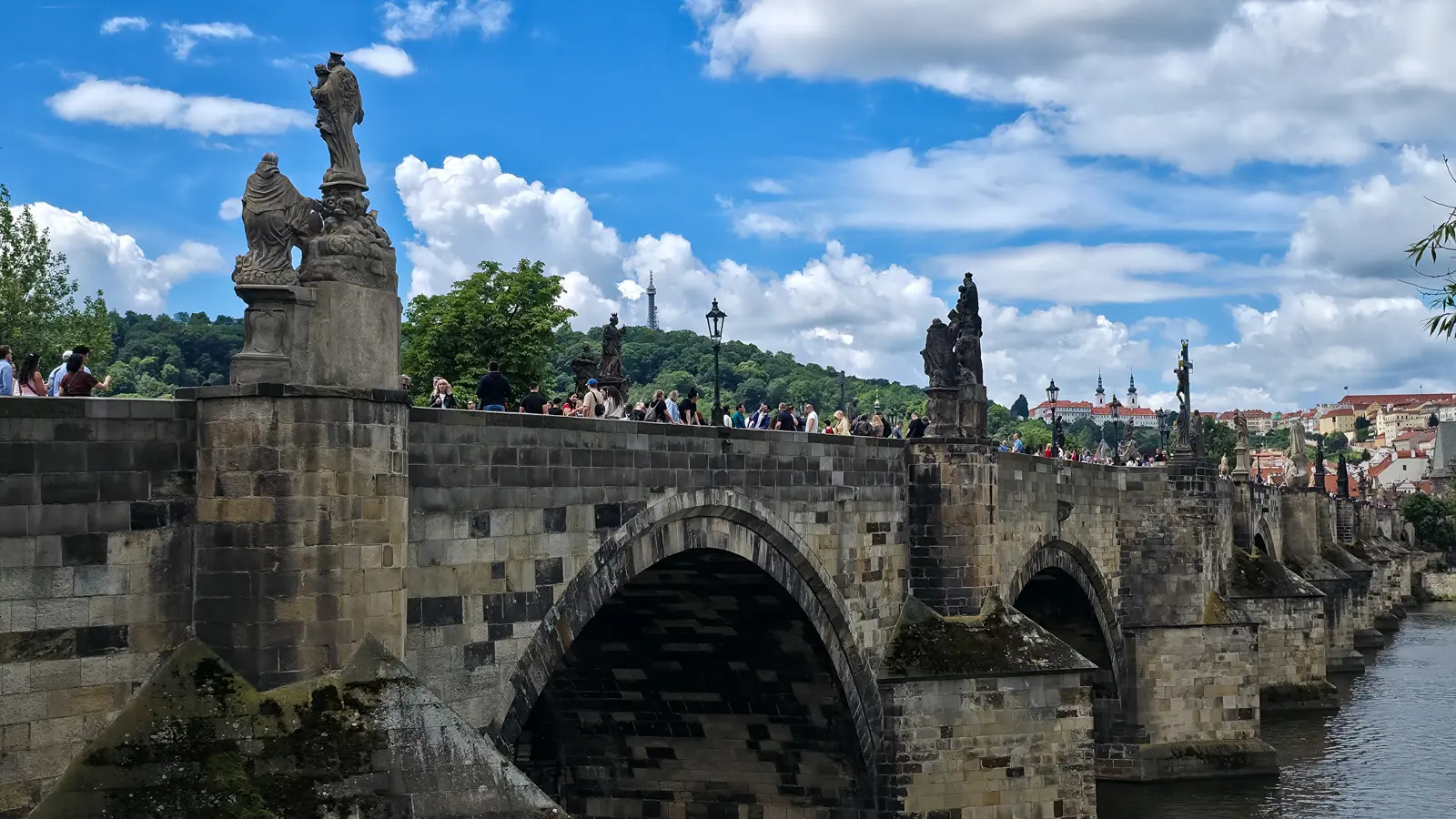
Charles Bridge is the postcard, and it is worth crossing more than once. Charles IV began it in 1357 to replace the Judith Bridge, which a flood had badly damaged in 1342. The designer was Peter Parler, and the bridge runs about 516 metres from the Old Town to Malá Strana. Thirty statues line the parapets, most of them Baroque and first put up around 1700.
By day the bridge was busy with walkers, and from the riverbank the statues stand out against the wooded slope of Petřín Hill.
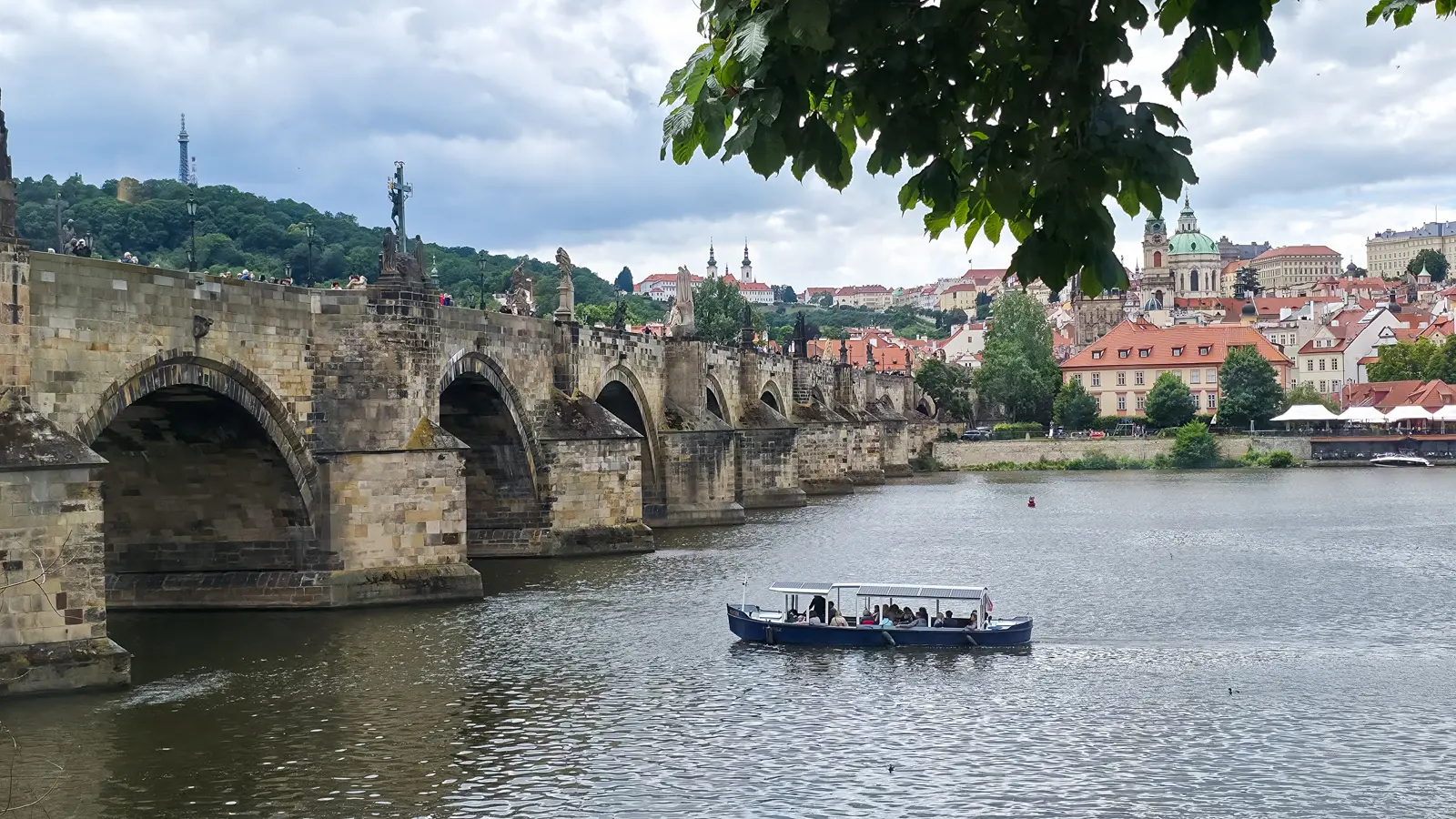
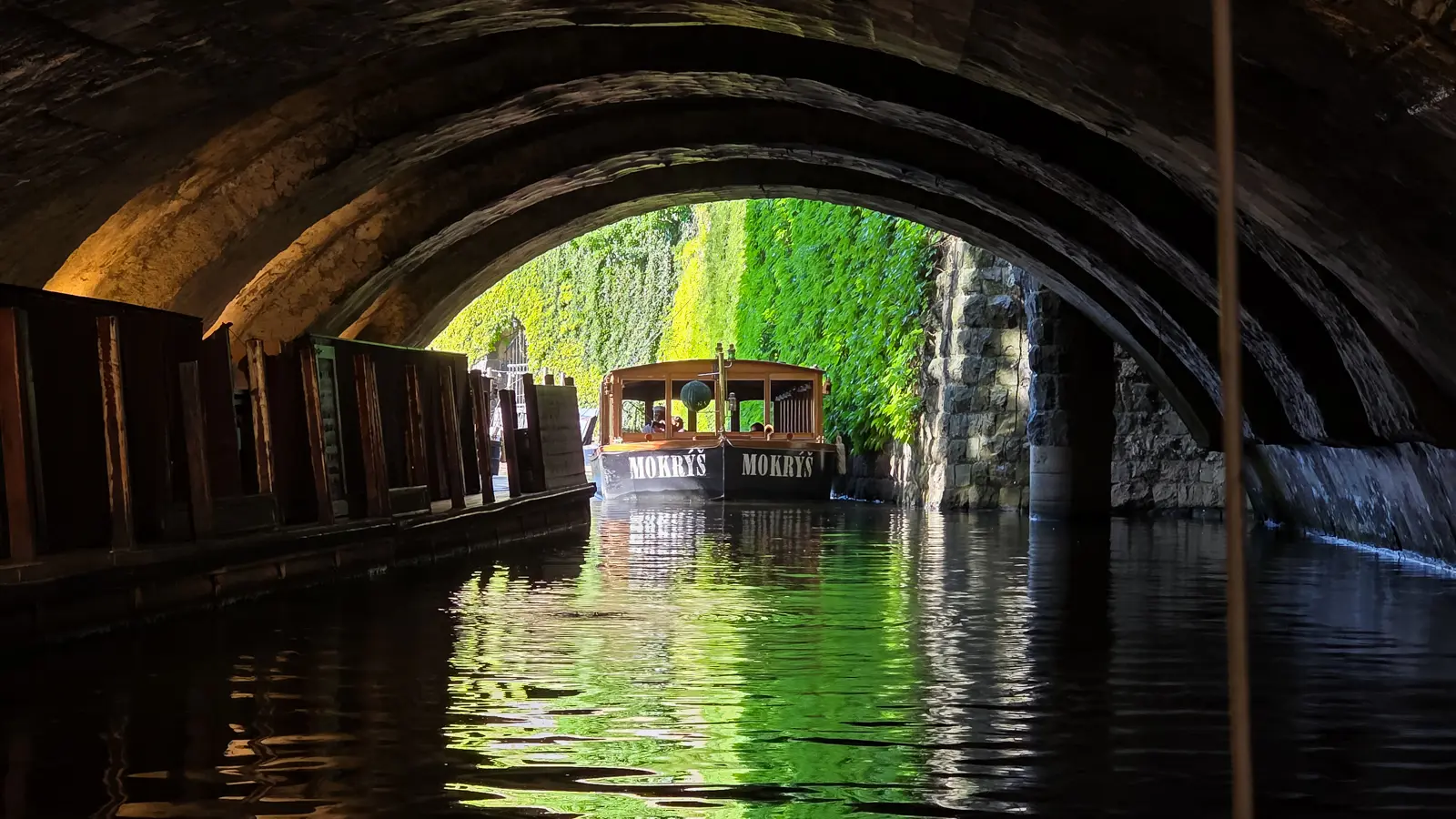
Down on the water, small sightseeing boats slip under the arches, and the red roofs of Malá Strana climb the hill on the far bank.
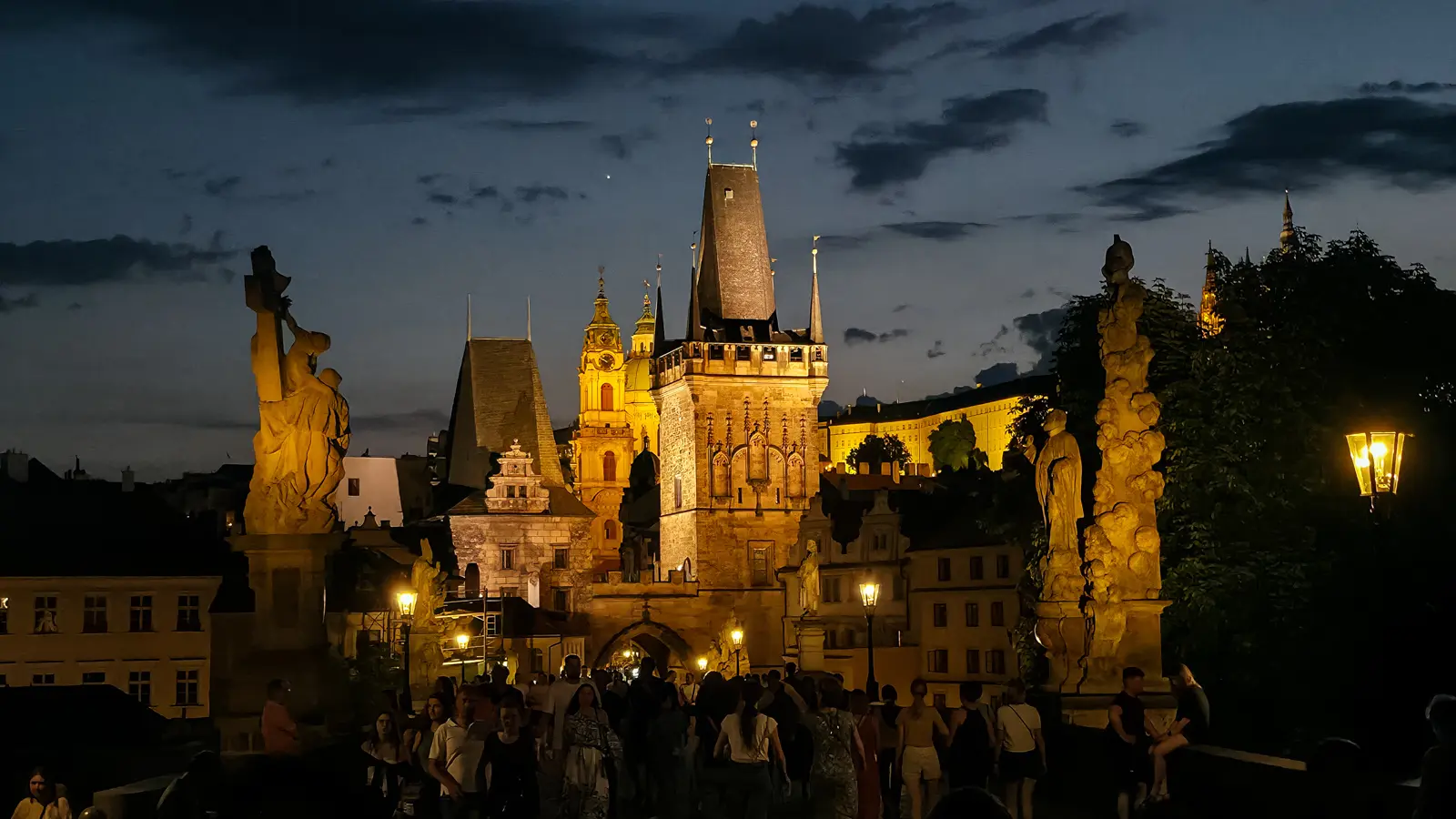
After dark the bridge changes completely. The lamps come on along the parapets, the statues turn into silhouettes, and the towers at the Malá Strana end glow gold against a dark blue sky. It was still busy late in the evening.
Malá Strana: The Lennon Wall and the Devil’s Channel
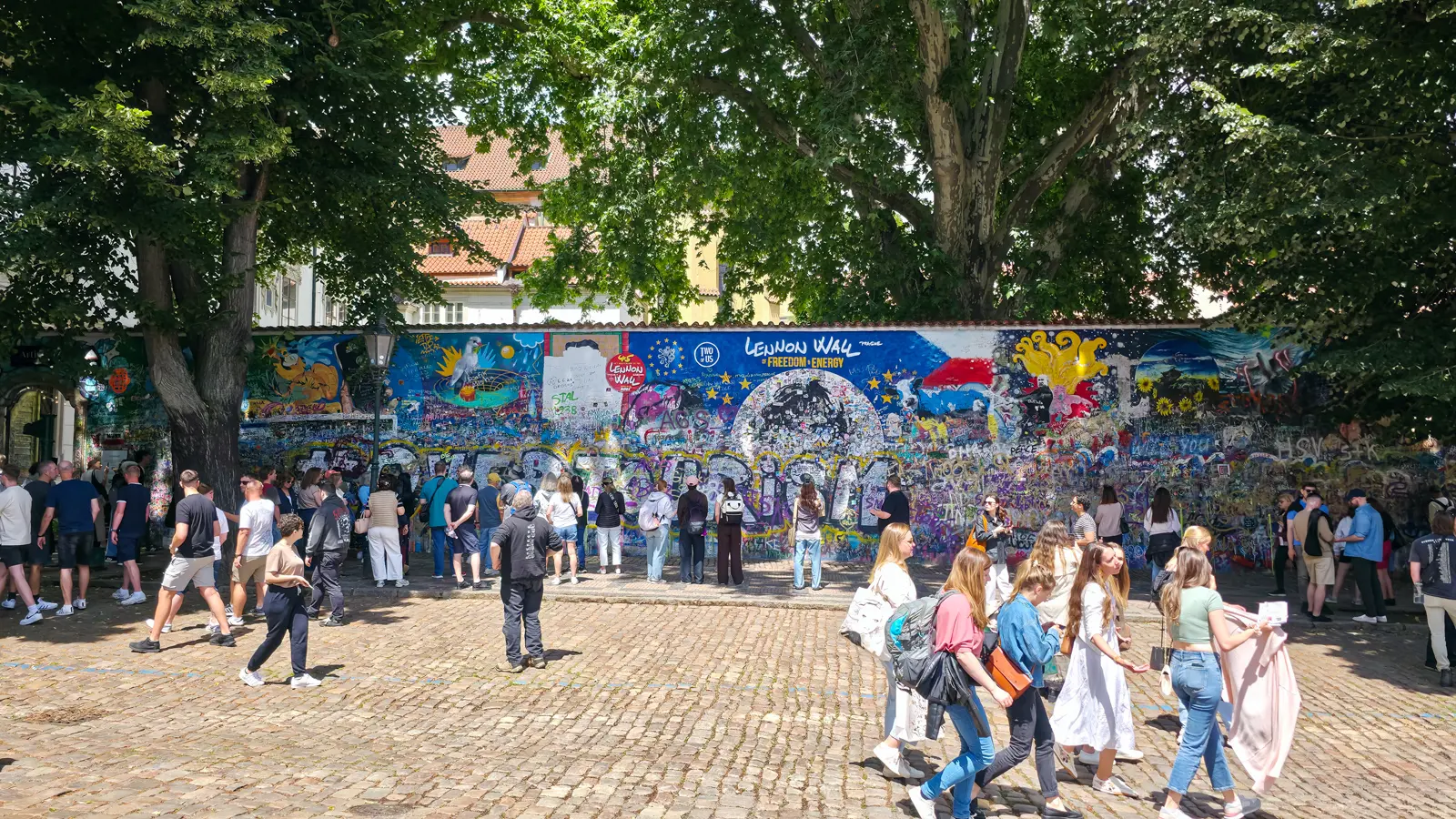
A short walk from the bridge, on Grand Priory Square, is the Lennon Wall. People began covering it with Lennon-inspired graffiti and Beatles lyrics after his death, and under communism it was an unusual place where young Czechs could write what they thought in public. Today it is layer upon layer of paint, and there was a crowd in front of it reading the messages.
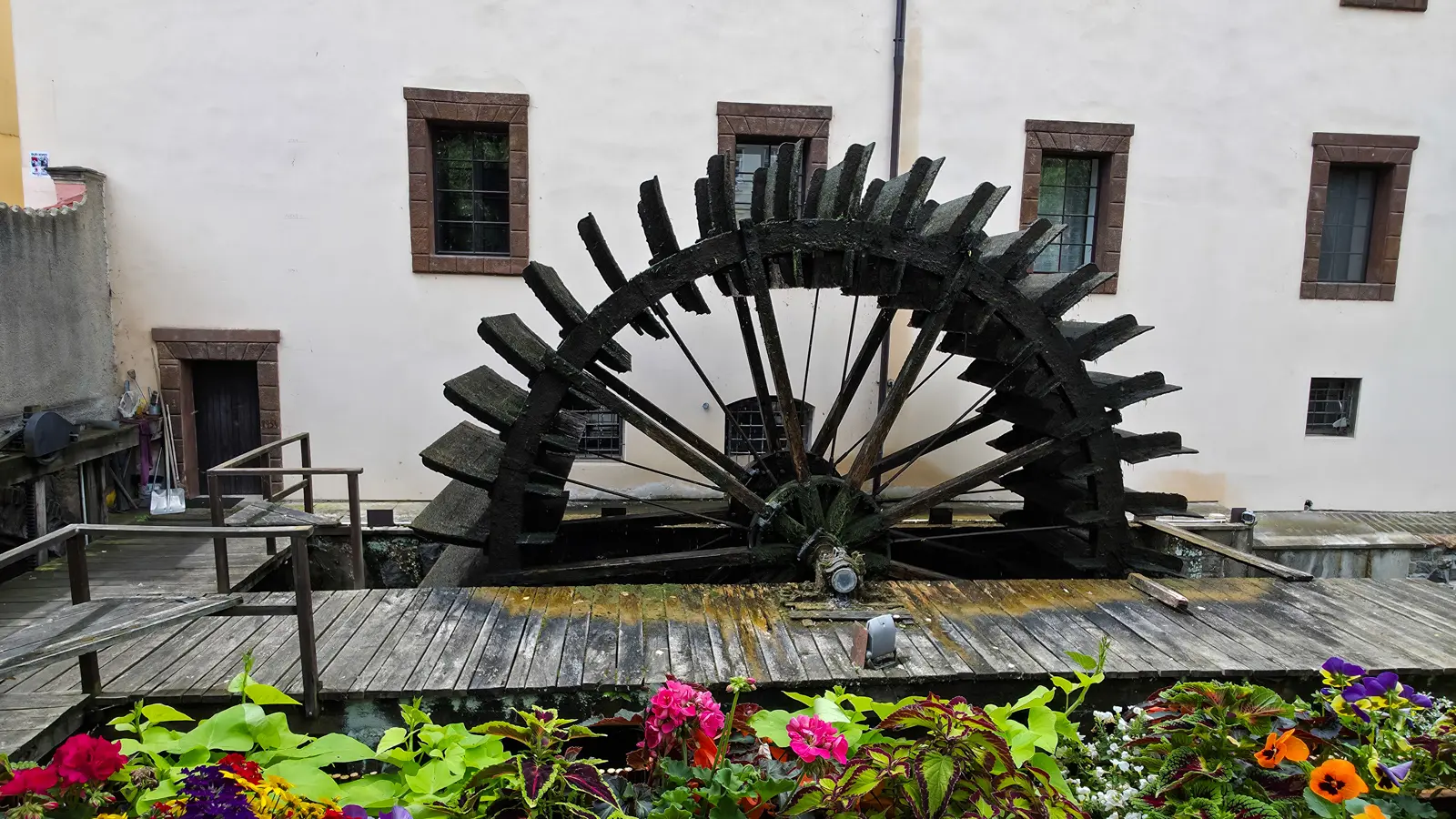
A few steps away, a small footbridge crosses the Čertovka, the narrow side channel known in English as the Devil’s Channel. From it there is a clear view of the big wooden wheel of the Grand Priory Mill, with a box of summer flowers in front.
I also saw the Čertovka from the water, on a Prague Venice cruise. The boats leave from Křižovnické náměstí, beside the Charles Bridge Museum on the Old Town side, setting off from under a low stone arch. The trip lasts about 45 minutes, and entry to the museum is included in the ticket. The route passes under Charles Bridge and crosses to the Malá Strana side, into the Čertovka and past the wheel of the Grand Priory Mill.
Prague Castle From Across the River
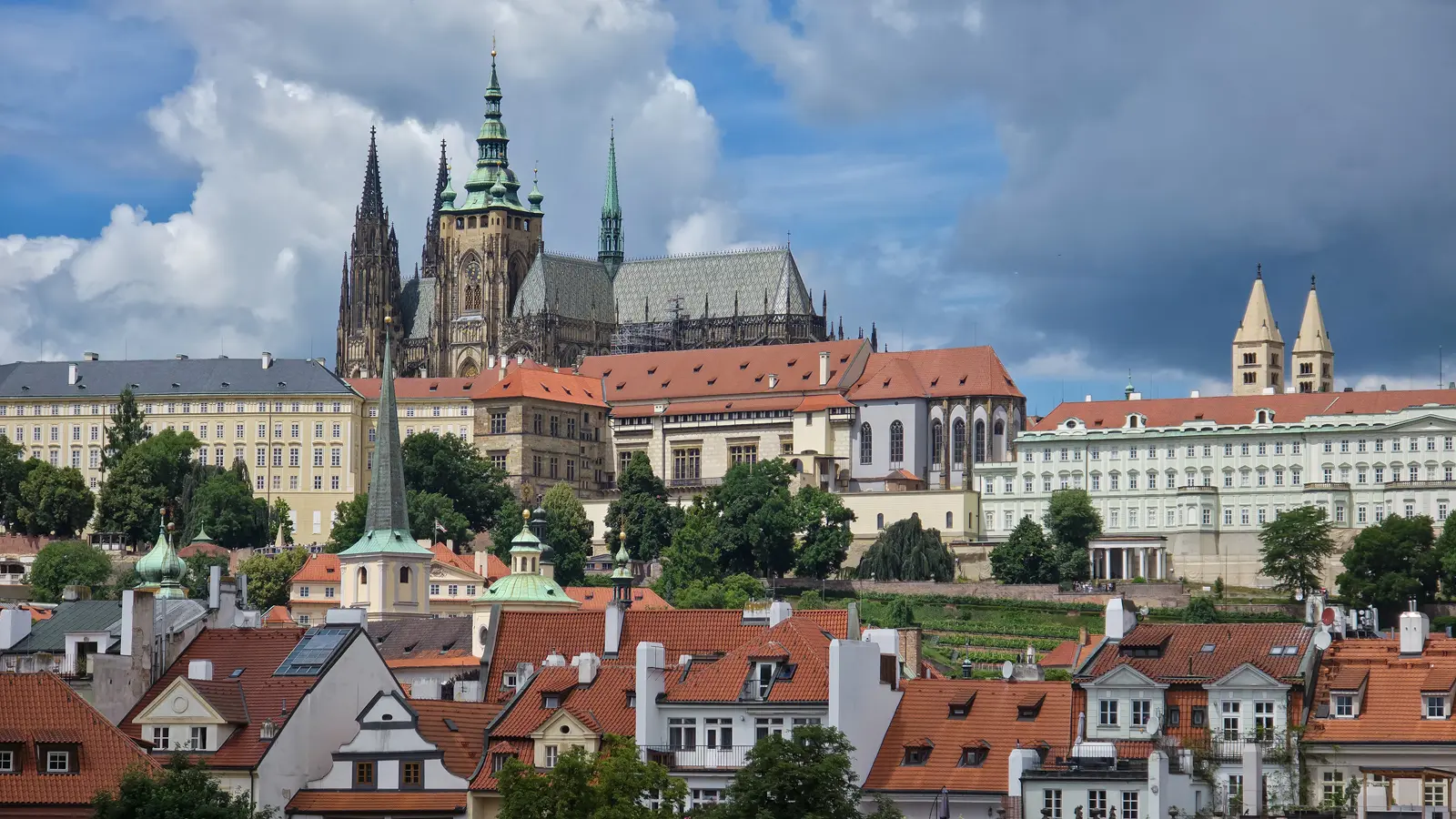
I visited Prague Castle on a separate tour, and it deserves its own post. I also admired it from the opposite bank, which is where the night view at the top of this post was taken. The castle walls and St Vitus Cathedral are floodlit above the Malá Strana rooftops, with Charles Bridge lit along the water below.
By day the castle stretches along the ridge above the red roofs of Malá Strana. St Vitus Cathedral sits at its centre, and to the right are the twin white towers of St George’s Basilica, a Romanesque church founded around 920.
Alchemists, Dungeons and Dan Brown
Prague’s mysterious reputation has a real source. From 1583 to 1611, Prague was the Habsburg capital under Emperor Rudolf II, who filled his court with artists, astronomers and alchemists. He had alchemical laboratories built near St Vitus Cathedral and the Deer Moat, where John Dee, Edward Kelley and others hunted for the Philosopher’s Stone.
That history still draws storytellers. Dan Brown set his Robert Langdon novel The Secret of Secrets in Prague. It came out on 9 September 2025, and Netflix is turning it into a series. Assassin’s Creed has passed through too. Its spin-off Project Legacy includes a storyline set in Rudolf’s Prague, with Kelley at work in a castle workshop around 1592. Maybe I had both in the back of my mind as I walked around. Either way, between the Gothic spires and the cellars under the streets, it was easy to believe the stories.
Wenceslas Square and the National Museum
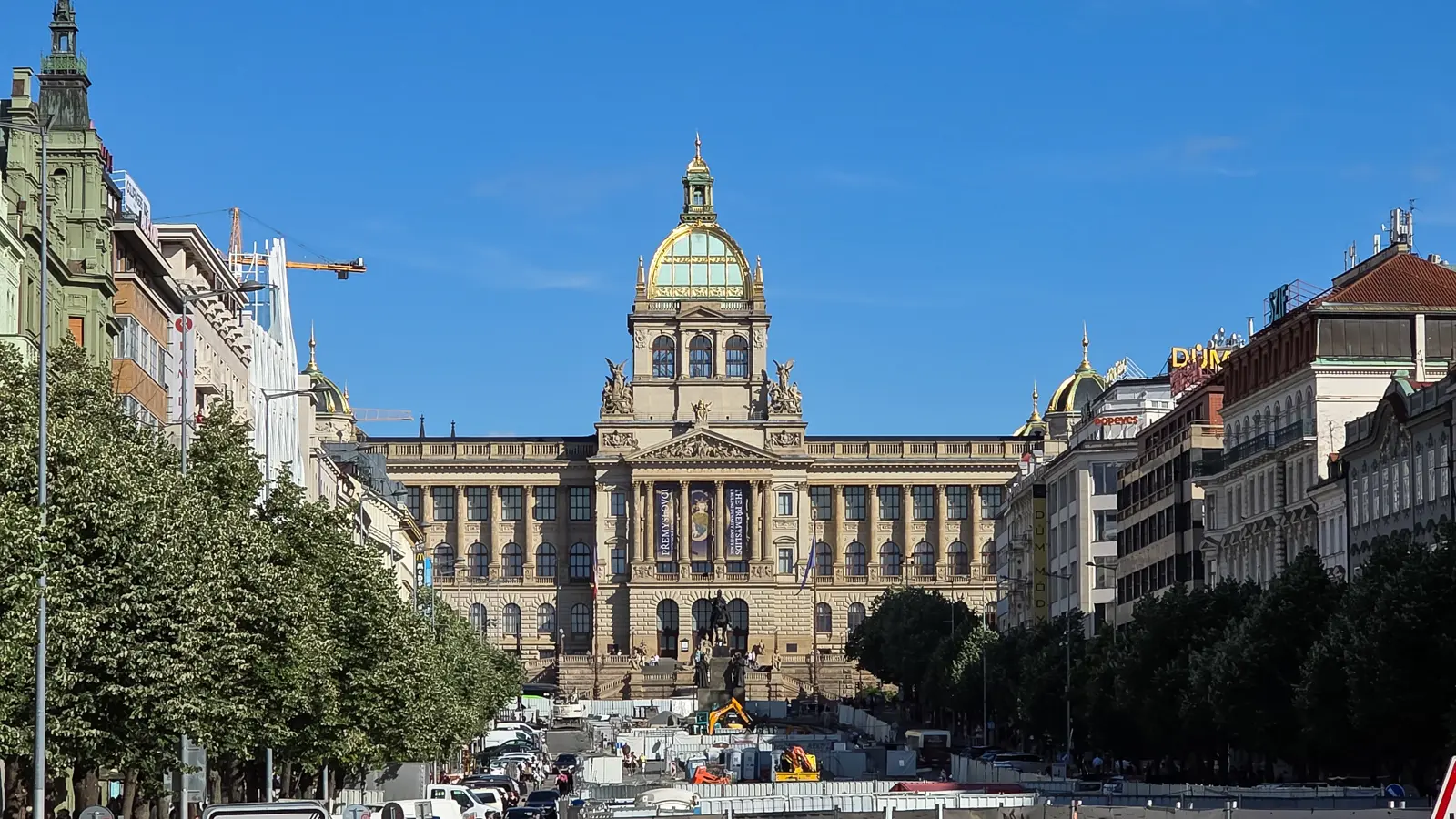
Wenceslas Square is a different Prague. It began in 1348 as a horse market in Charles IV’s New Town and is now a long, wide boulevard of shops and hotels climbing towards the National Museum. The museum building, by architect Josef Schulz, went up between 1885 and 1891, and the statue of St Wenceslas on horseback stands in front of it.
In June the upper half of the square was a building site. The diggers are bringing the trams back. Trams ran on the square for 96 years until they were removed in 1980, and passenger service on the new line is due to start in June 2027.
Getting Lost on Purpose
The best part of Prague was simply walking it. We walked almost everywhere. For all my talk of medieval streets, Google Maps worked wonders in the alleys. The lanes between the big sights are where Prague is easiest to get lost in, and happiest to be lost in. The public transport is excellent too, but we preferred to get our steps in.
The city stays lively late. People were out on café terraces in the afternoon and on Charles Bridge well after dark.
Bubbly Tips
- Buy transport tickets in the app. Since January 2026, tickets in the PID Lítačka app are cheaper than paper: 36 Kč instead of 39 Kč for 30 minutes, and 46 Kč instead of 50 Kč for 90 minutes. Activate an app ticket before you board, or before you enter the paid area in the metro.
- Consider a 24 or 72-hour ticket. They are transferable and cover the metro, trams, buses, suburban trains and city ferries, which makes them good value on days when you plan to hop around.
- Wear proper walking shoes. Most of the historic centre is cobbled, and you will cover a lot of ground on foot.
- Spot the mill wheel from Charles Bridge. Walking towards the castle, look down to your left: the Grand Priory Mill’s wheel is visible from the bridge, so you can see it even without detouring to the footbridge.
- Cross Charles Bridge after dark at least once. With the lamps on and the bridge towers lit, it photographs completely differently from the daytime crossing.
- Climb the Old Town Hall tower. It is open to the public and gives panoramic views over the Old Town, a good escape from the crowd waiting at the clock below.
- Go underground. The Old Town Hall’s Romanesque and Gothic cellars can be visited, and they show the medieval street level buried beneath Old Town Square.
- Climb the Powder Tower too. Its viewing gallery sits 44 metres up, reached by 186 stone steps.
- Book the Prague Venice cruise at the museum. Tickets are sold at the box office inside the Charles Bridge Museum on Křižovnické náměstí, and the dock is just to the left of the museum entrance, behind the statue of Charles IV.
Final Thoughts
I arrived expecting a smaller Vienna and found a different kind of city. Vienna rebuilt its centre to impress an empire. Prague kept its crooked lanes, its Gothic gates and a buried street level under its main square.
If Vienna is the city for dressing up, Prague is the city for wandering. Bring good shoes and let the alleys decide the route.
Until next time!

🌟 Everything You Need to Plan Your Dream Trip in 2026
- 🌟 Luxury Hotels - Find premium stays with Booking.com & Hotels.com
- 🏡 Vacation Rentals - Discover unique properties on VRBO
- 🏞️ Guided Tours - Explore with Viator or GetYourGuide
- 🎫 Attraction Tickets - Skip the lines with Tiqets
- 🚢 Ocean Cruises - Set sail with Cruise Direct
- 📱 International SIMs - Stay connected with Saily
- 🚗 Car Rentals - Budget-friendly options from Discover Cars
- 🌐 Secure VPNs - Browse safely with NordVPN
- 💶 Currency Exchange - Best rates with Wise
- 🗣️ Learn Languages - Master the local language with Babbel and Rosetta Stone