
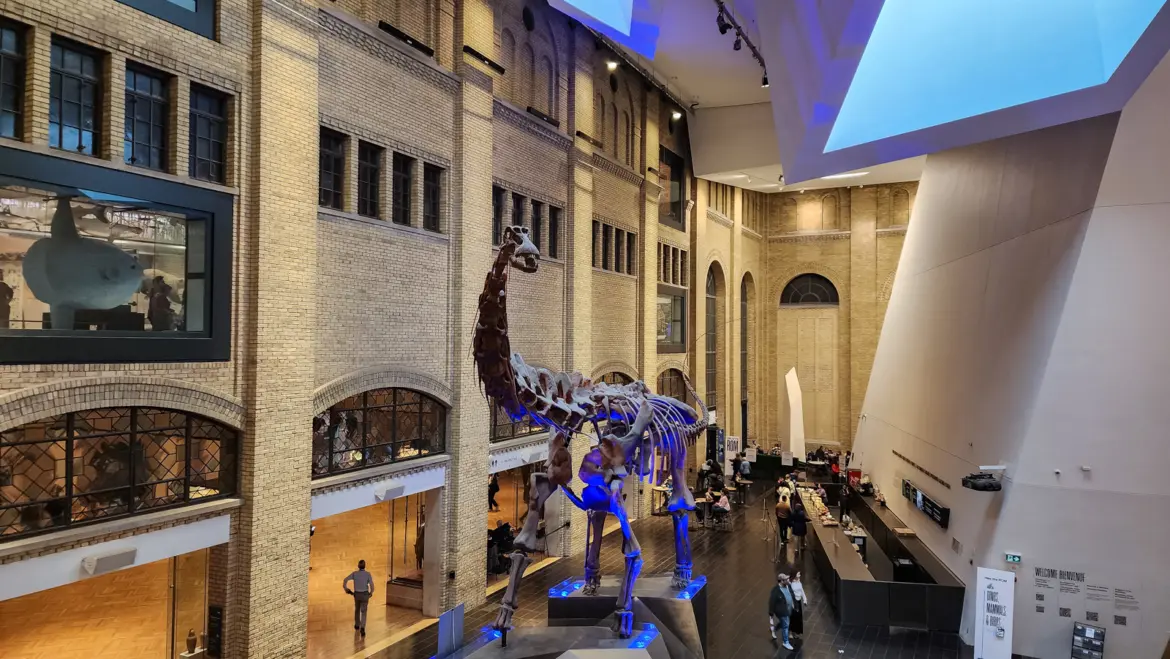
The first dinosaur at the Royal Ontario Museum in Toronto stands in Chen Court, before any of the galleries. Its neck rises past the windows of the old brick building, and it sets the tone for everything upstairs.
The ROM opened in 1914, and when I visited it was in the middle of another transformation. Plastic sheeting ran along one side of the mammal gallery, and one dinosaur was hidden behind a printed cover. Even half finished, the dinosaur and mammal galleries were some of the best displays I have seen.
A year later I walked into the Natural History Museum in London expecting something similar. Don’t get me wrong, it was great. But for display, the ROM won. Its galleries are airy and easy to follow, and the collection is stunning. I may be biased because I’m Canadian.
ROM Dinosaurs & Mammals at a Glance
🦕 What · The Royal Ontario Museum’s dinosaur and mammal galleries in Toronto — Dawn of Life, the Age of Dinosaurs in the Crystal, and the Age of Mammals.
🦴 Don’t miss · Futalognkosaurus towering over Chen Court, and Gordo the Barosaurus — one of the world’s only mounted Barosaurus built from real fossil bone.
🏗️ Renovation now · OpenROM (announced February 2024, targeted for 2027) is under way; some galleries and routes may be closed, and the museum stays open throughout.
🕙 Visiting · Open 10am–5:30pm, closed most Mondays; third Tuesday evenings are listed as free (open to 8:30pm — confirm on rom.on.ca).
💡 Tip · Walk it in time order — Dawn of Life, then the Age of Dinosaurs, then the Age of Mammals — and take the subway to Museum station.
Futalognkosaurus in Chen Court
Futalognkosaurus is a titanosaur, one of the long-necked giants, and it was discovered in Argentina in 2000. The ROM’s skeleton is a cast. Casting experts measured the original fossils and built a copy in plastic and fibreglass. According to the museum, the original is one of the most complete giant sauropods ever found.
Seen from above, the skeleton stands on a plinth lit blue at its feet, and the floor around it carries on as normal. People stand at the café counter below, and the long neck points up at the arched windows of the old building.
Dawn of Life: Before the Dinosaurs
On Level 2, the Willner Madge Gallery, Dawn of Life, opened in December 2021. It traces nearly four billion years of evolution, from the earliest evidence of life on Earth to the emergence of dinosaurs and mammals after the end-Permian mass extinction. This is where the story of life at the ROM begins.
The Permian room is built like a stage set. Skeletons sit on low platforms scattered with flat stones, in front of a painted forest of tree ferns that wraps around the real windows.
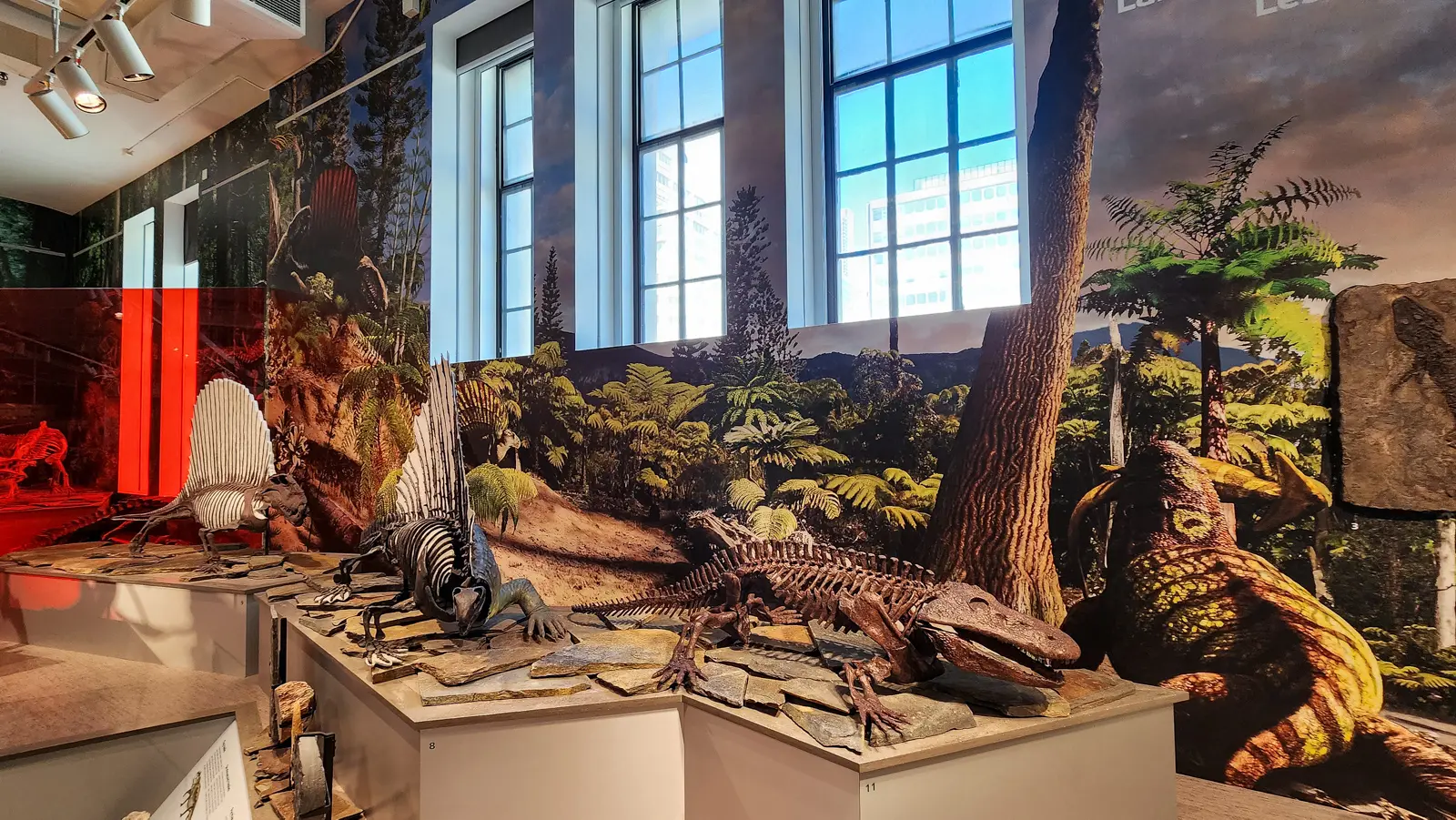
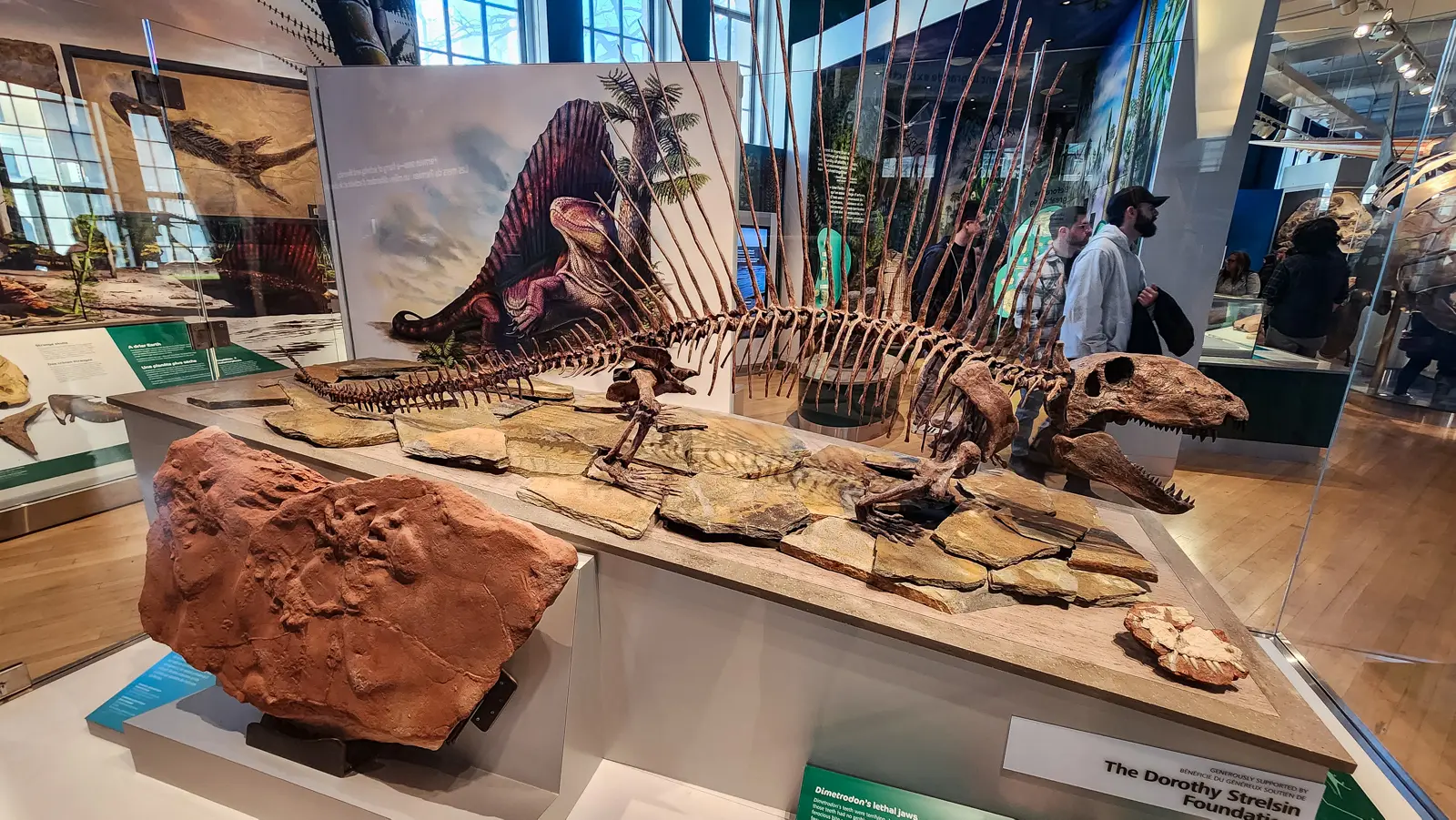
The sail-backed skeleton with the open jaws is Dimetrodon. It looks like a dinosaur and turns up in plenty of dinosaur books, but it isn’t one. Dimetrodon was a synapsid, on the branch of the family tree that leads to mammals. That makes it a closer relative of ours than of Tyrannosaurus rex. Its sign leads with the teeth: “Dimetrodon’s lethal jaws”.
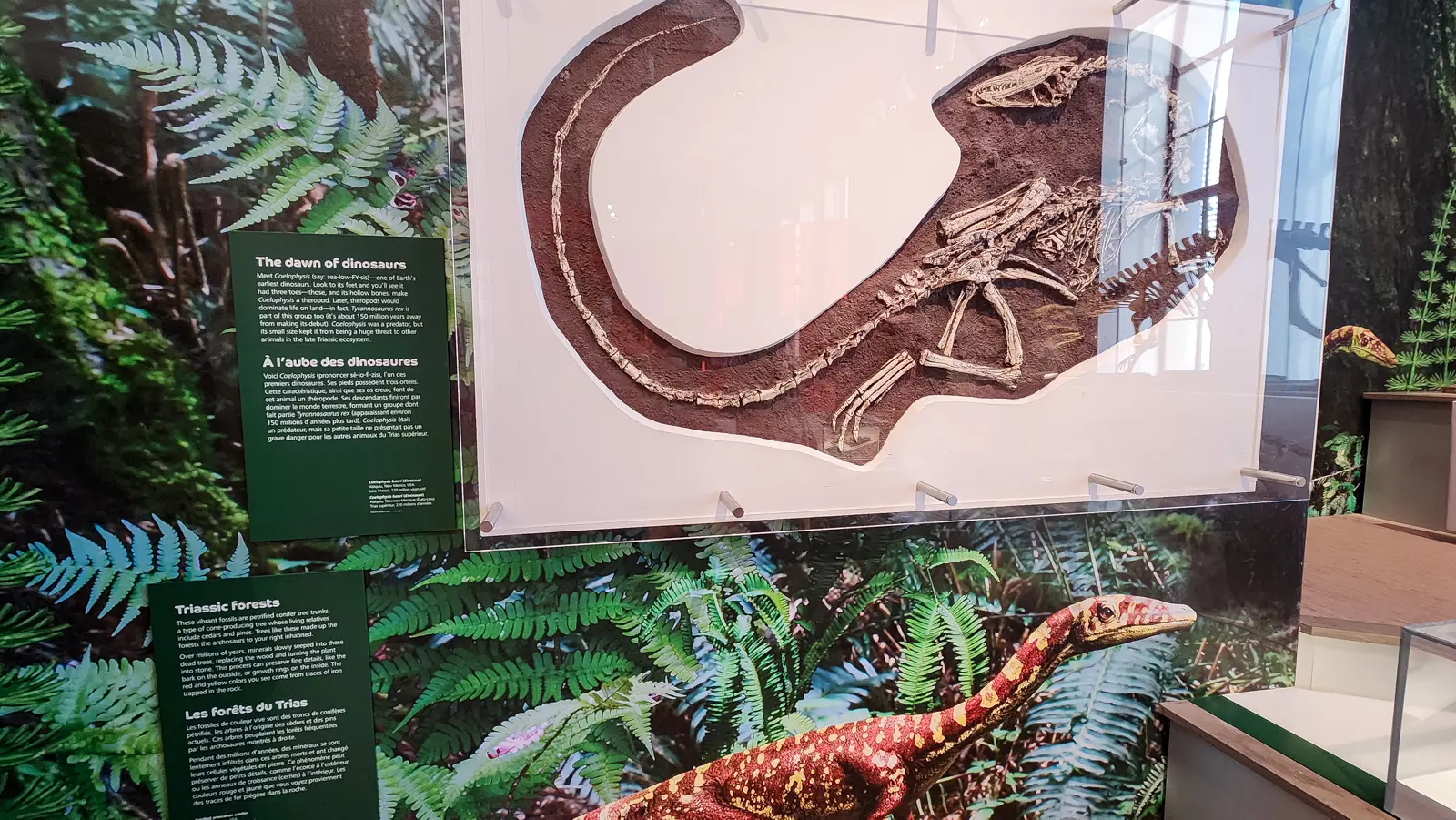
Then the dinosaurs arrive. Coelophysis lies on a wall mount, set in dark rock, its long tail curving in a wide loop. The label calls it one of Earth’s earliest dinosaurs and points to its three-toed feet, which, along with its hollow bones, make it a theropod, the same group as T. rex. This one came from Abiquiu, New Mexico, and dates to the late Triassic, about 220 million years ago.
Gordo and the Jurassic Under the Crystal
From Dawn of Life, the route continues into the James and Louise Temerty Galleries of the Age of Dinosaurs, inside the Michael Lee-Chin Crystal. Daniel Libeskind designed the Crystal, and its slanted walls of glass run behind the skeletons, so the dinosaurs stand against daylight and the buildings across the street.
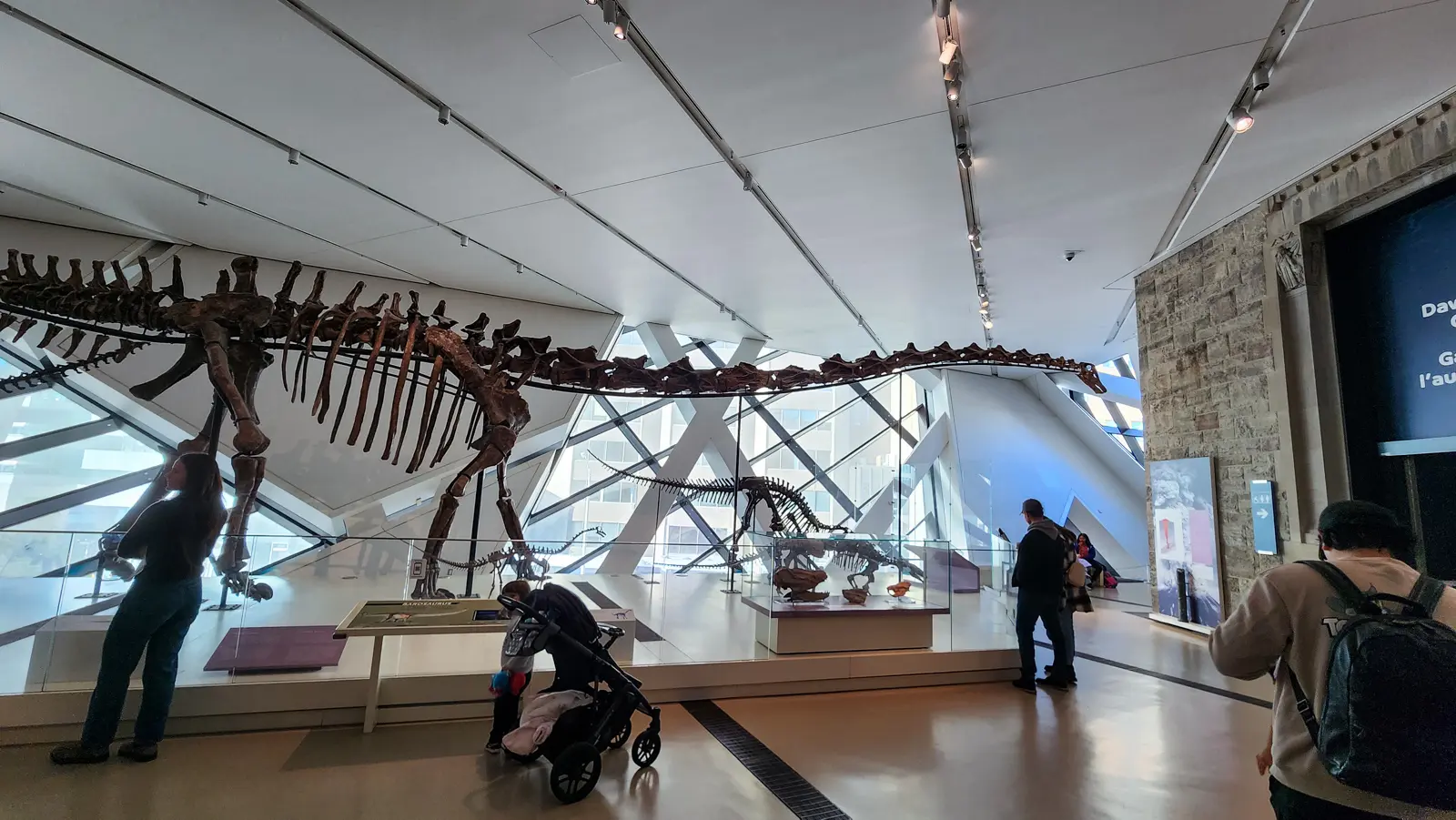
The longest skeleton here is a Barosaurus nicknamed Gordo, and unlike Futalognkosaurus downstairs, it is made largely of real fossil bone. Its story is a good one. The bones reached the ROM in 1962 from the Carnegie Museum of Natural History in Pittsburgh, then sat in storage, forgotten, for more than 40 years. In 2007 a new curator, David Evans, was asked to find a long-necked sauropod for the new dinosaur galleries. He came across a reference by the sauropod expert Jack McIntosh to a Barosaurus at the ROM and tracked the bones down in the museum’s own collection. Gordo is named after Gordon Edmund, the curator who brought the skeleton to Toronto.
Gordo’s head points towards the windows and its tail runs back over the people at the railing. A small child with a stuffed toy stood right underneath it, next to a stroller.
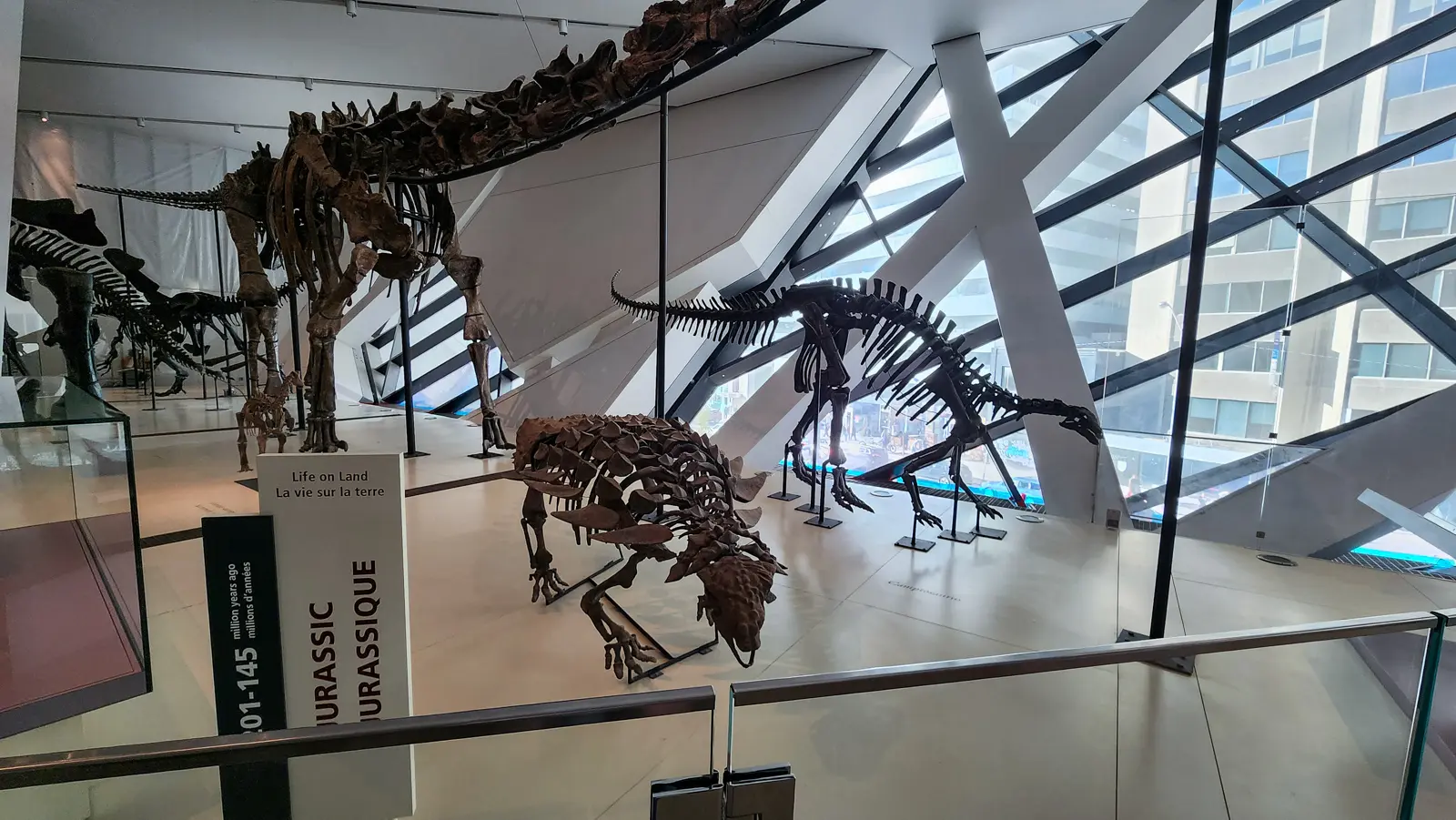
Beside Gordo, a Jurassic platform holds a smaller group under a sign giving the period as 201 to 145 million years ago. Camptosaurus, its name printed on the floor near its feet, leans forward with its head low. In front of it, a low, armour-plated skeleton crouches with its face almost on the ground.
Duck-Bills and a Dinosaur Under Wraps
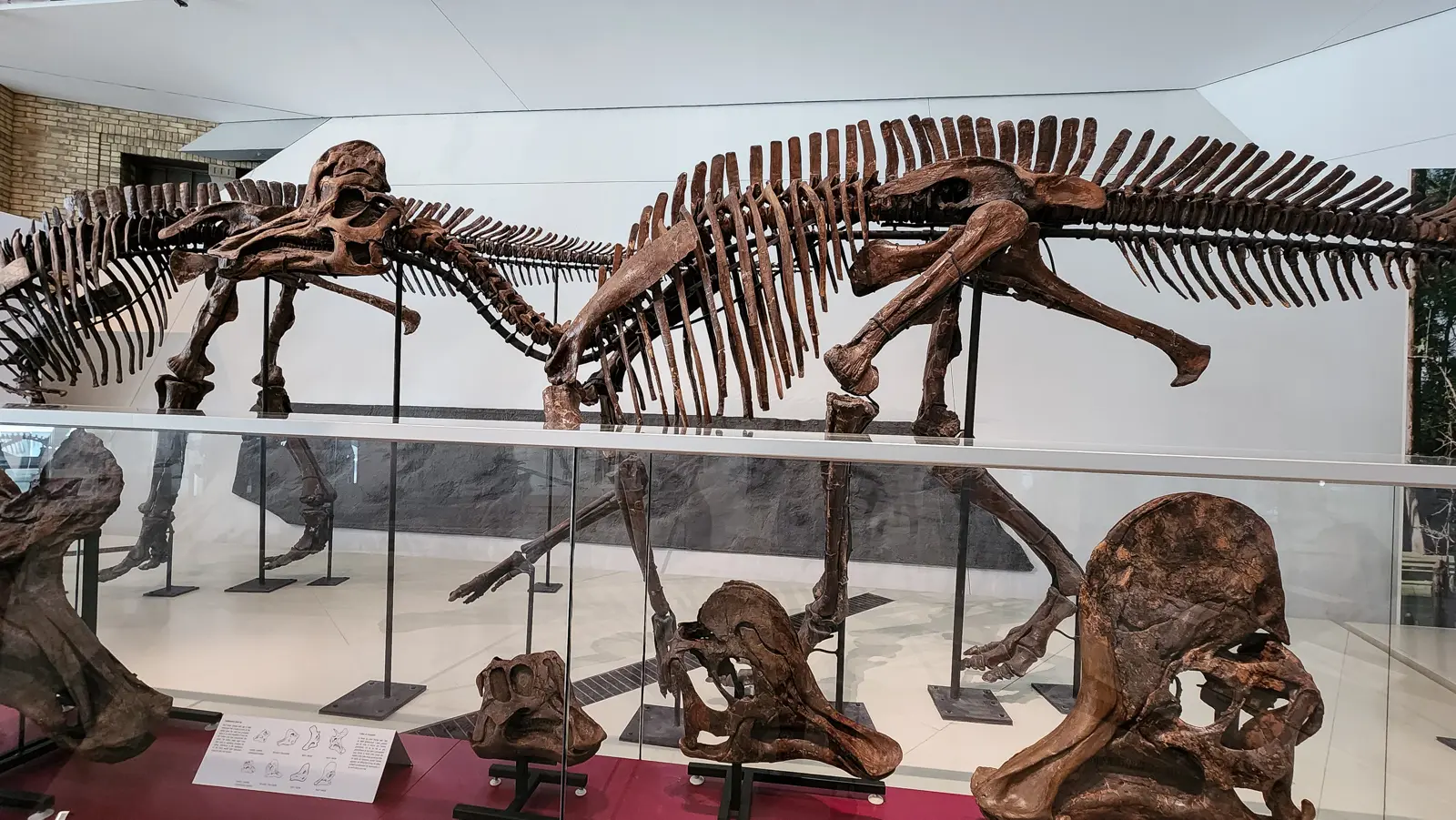
Further in, the Cretaceous hadrosaurs line up. These are the duck-billed dinosaurs. Their crested skulls sit in a case at the front, each crest a different shape, from a rounded helmet to a broad fan. A small diagram on the label sketches a series of crest shapes. The crests changed as the animals grew. Behind the case, two mounted skeletons line up nose to tail. Most of what stands in this part of the gallery is the real thing: the ROM has six complete hadrosaur skeletons on display, many of them collected in Alberta.
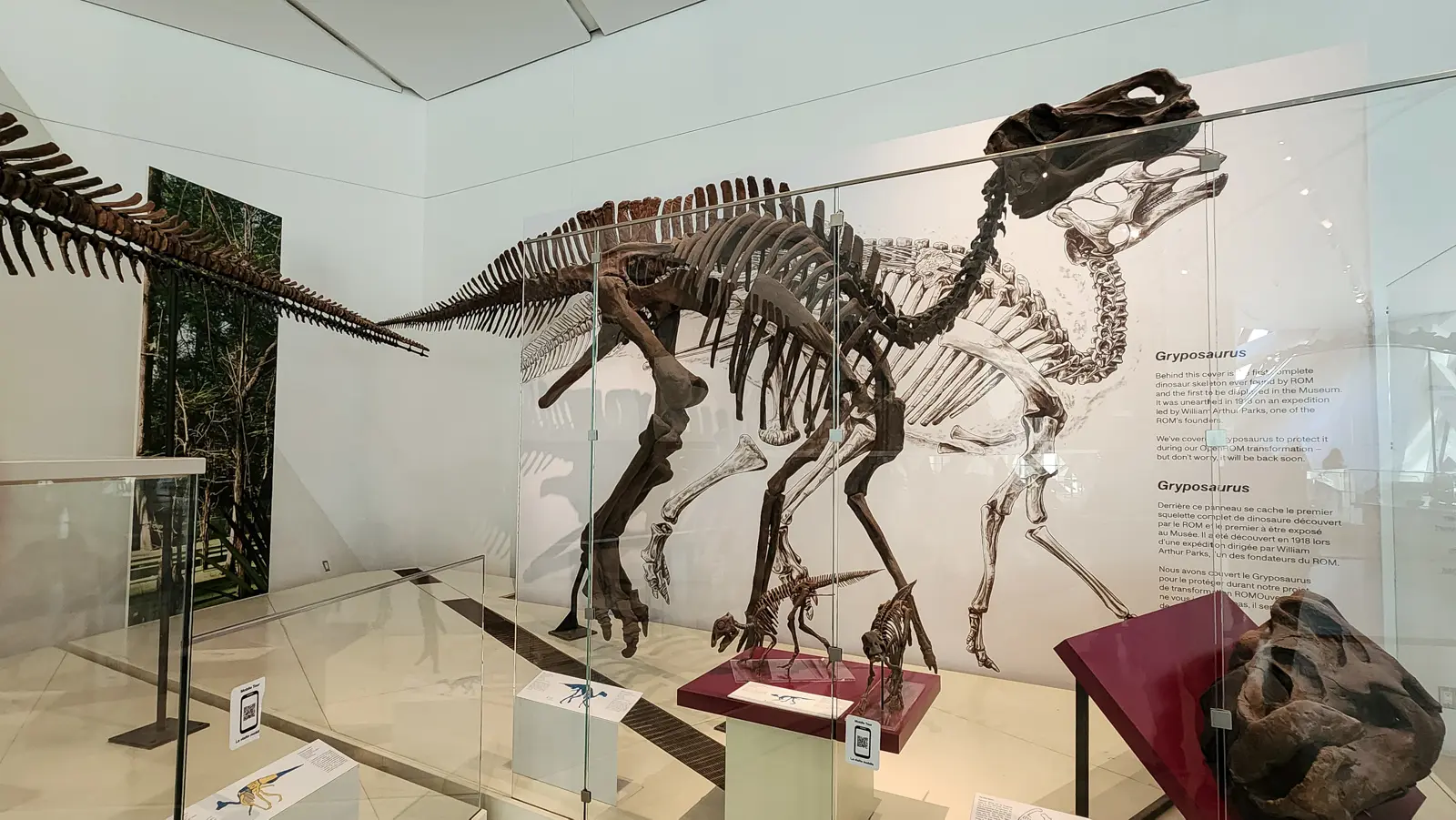
Next to them, one dinosaur was missing. A printed cover with a drawing of the skeleton stood in its place, and a panel explained that behind it was Gryposaurus, an original fossil skeleton and the first complete dinosaur skeleton the ROM ever found and the first one it put on display. According to the panel, it was dug up in 1918 on an expedition led by William Arthur Parks, one of the museum’s founders, and it was covered to protect it during the renovation. The panel promised it would be back soon.
The Age of Mammals, Behind the Plastic
The Reed Gallery of the Age of Mammals picks up where the dinosaurs leave off and follows mammals from the mass extinction to the present day. Its biggest skeleton is a mastodon, a relative of the mammoth, with long curved tusks and a mouthful of bumpy molars. In front of it stands an antlered deer skeleton, and beside that, a smaller skeleton stained a rusty orange.
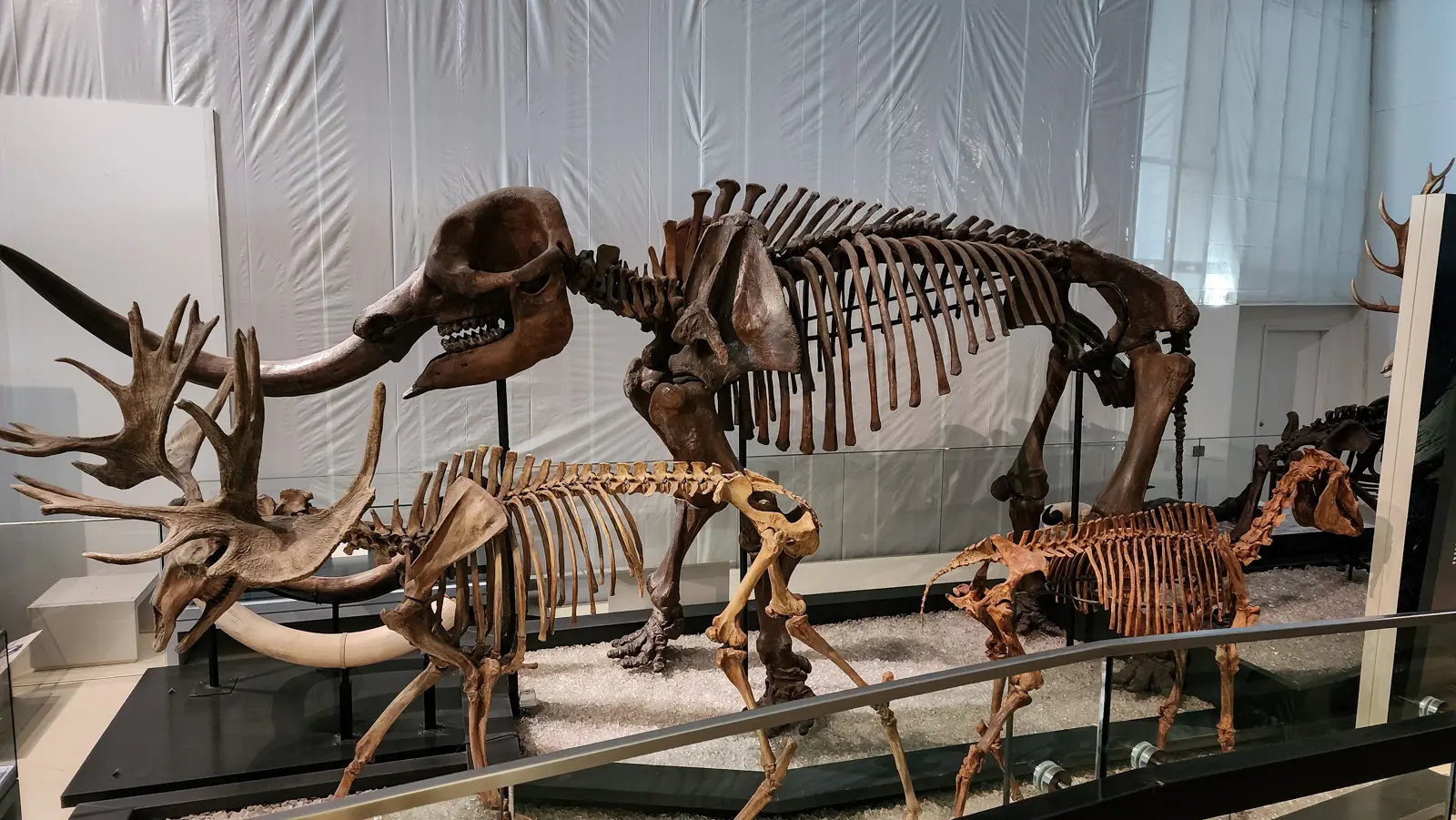
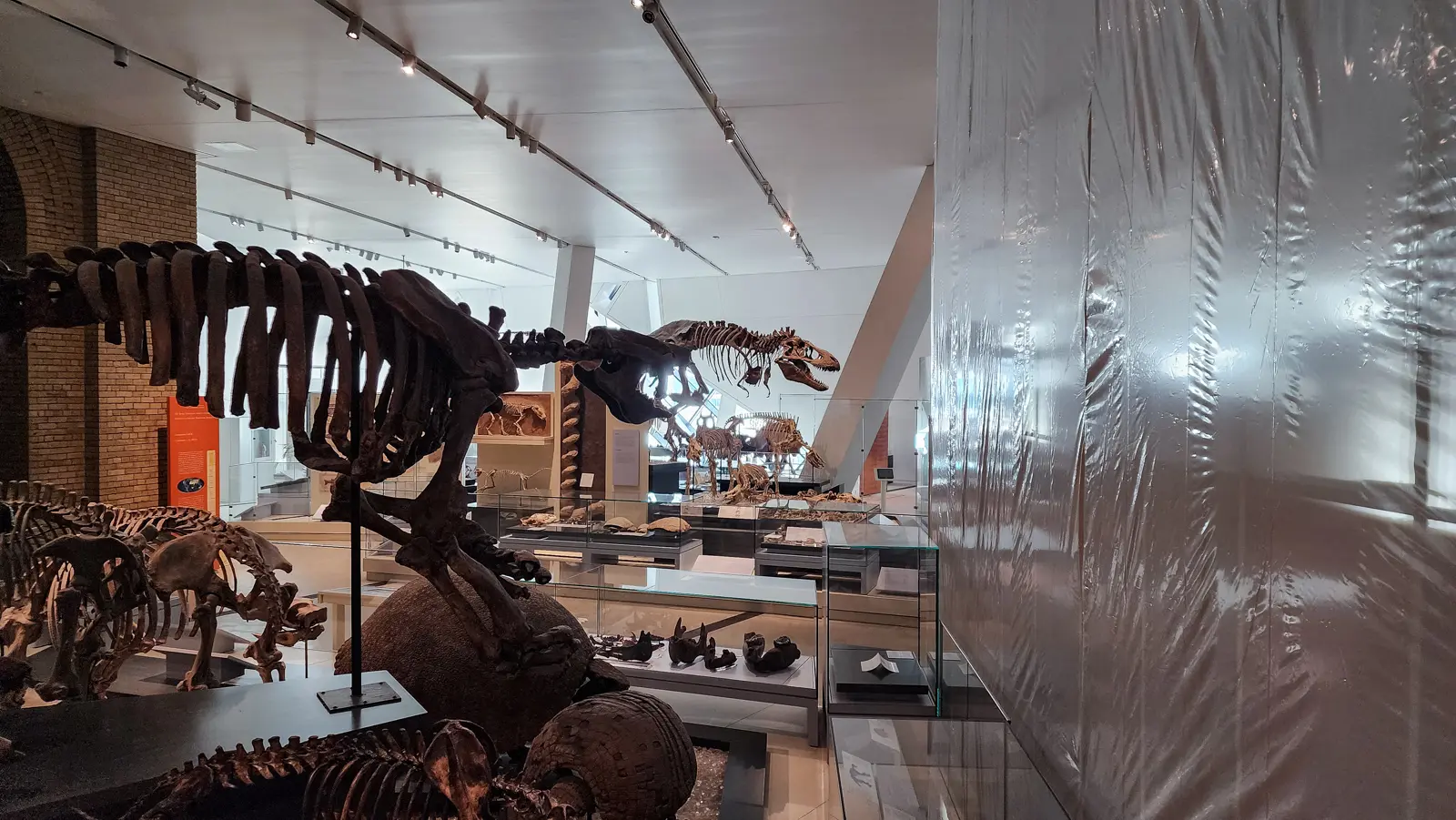
Plastic sheeting ran along one side of this gallery when I visited. The giant ground sloth still reared up on its stand beside two domed, armoured shells, and past it, across the floor, the ROM’s Tyrannosaurus rex, a full-skeleton cast, stood with its jaws open against the light from the Crystal’s windows.
The work under way was OpenROM, a renovation the ROM announced in February 2024. Siamak Hariri of Hariri Pontarini Architects designed it, and the plan reworks the main floor and the Bloor Street entrance. The museum stays open throughout, and the target for completion is 2027.
Bubbly Tips
- Start in Chen Court. Futalognkosaurus is on Level 1, and the ROM’s own dinosaur trail starts there before sending you up to Level 2.
- Walk the galleries in time order. Dawn of Life first, then the Age of Dinosaurs, then the Age of Mammals. Dawn of Life is laid out chronologically and ends where the dinosaurs begin, so the story runs in one direction.
- Pick up a Hike the ROM trail guide. The ROM publishes trail guides that string together its dinosaur, mammal and bird highlights. The trails include stairs, and accessible routes may mean an elevator or some backtracking.
- Check what’s open before you go. While OpenROM is under way, some galleries and routes may be temporarily closed. Gryposaurus was under wraps when I visited.
- Go on a third Tuesday night. The ROM’s schedule lists third Tuesday evenings as free, with the museum open until 8:30 p.m. Confirm the date on rom.on.ca before you go.
- Plan around Mondays. The ROM is closed on most Mondays and otherwise open from 10 a.m. to 5:30 p.m. Holiday Mondays such as Family Day can be exceptions.
- Take the subway to Museum station. It’s on Line 1, and its platform columns, redesigned in 2008 by Diamond Schmitt Architects, are based on artefacts from the ROM and the Gardiner Museum.
- Photograph with the windows in mind. In the Crystal galleries, the angled windows backlight the skeletons. Shoot towards the glass for silhouettes, or turn your back to it for detail.
- Pair it with the Gardiner Museum. It sits above the same subway station, so the two fit easily into the same day.
Final Thoughts
The ROM was mid-renovation when I visited, with Gryposaurus behind a printed cover and plastic down one side of the mammal gallery. It was still one of the best displays I have seen, and a year later, the Natural History Museum in London didn’t match it for layout.
My favourite part was the awe on people’s faces, children’s especially, as they explored the galleries. Gordo spent more than 40 years in storage before anyone put him on show, so a few years of renovation is nothing. I’ll be back once OpenROM is finished to see Gryposaurus uncovered and the new rooms.
Until next time!

🌟 Everything You Need to Plan Your Dream Trip in 2026
- 🌟 Luxury Hotels - Find premium stays with Booking.com & Hotels.com
- 🏡 Vacation Rentals - Discover unique properties on VRBO
- 🏞️ Guided Tours - Explore with Viator or GetYourGuide
- 🎫 Attraction Tickets - Skip the lines with Tiqets
- 🚢 Ocean Cruises - Set sail with Cruise Direct
- 📱 International SIMs - Stay connected with Saily
- 🚗 Car Rentals - Budget-friendly options from Discover Cars
- 🌐 Secure VPNs - Browse safely with NordVPN
- 💶 Currency Exchange - Best rates with Wise
- 🗣️ Learn Languages - Master the local language with Babbel and Rosetta Stone