
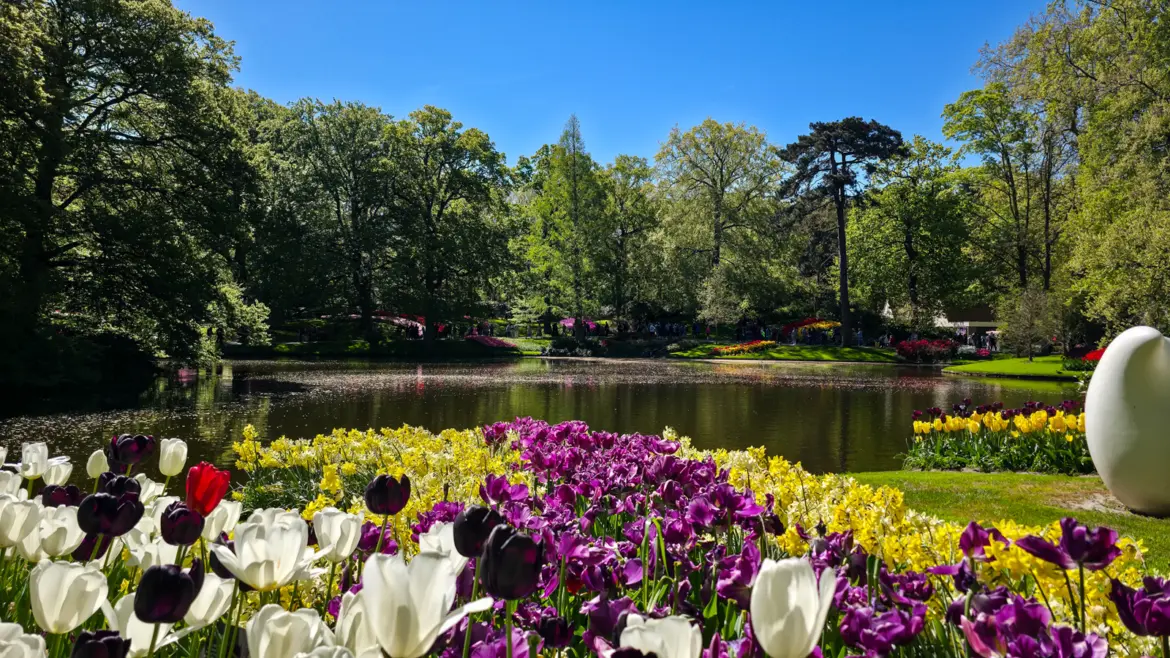
I came out of the Willem-Alexander Pavilion with a vague piece of information and no map sense whatsoever. Somebody had mentioned an orchid exhibition. I had no idea where it was, so I picked a direction and walked, on the theory that a park this size would eventually produce either orchids or something else worth the detour.
It produced something else. I never found the orchids at all, and the hour I spent not finding them turned out to be the best part of my day at Keukenhof.
The Keukenhof Lake at a Glance
🌊 What it is · The oldest part of Keukenhof: a 19th-century English landscape lake laid out by the Zochers in 1857, decades before the tulips arrived.
🌉 On the circuit · A low stone bridge, the Wilhelmina Pavilion (shop, food, toilets, no flowers), stepping stones across the water, and a four-jet fountain.
🔵 The overlooked bit · Ribbons of blue muscari, hyacinths, rhododendrons and azaleas do most of the compositional work, and almost nobody photographs them.
🏰 History · The estate’s manor (now Keukenhof Castle) dates to 1641; the name means “kitchen garden.” The flower show only opened in 1950.
💡 Tip · Walk the full lake circuit (~30–40 min), the quietest part of the park, and don’t look for the orchids in the Wilhelmina.
A Park Older Than the Flower Show
The first thing worth knowing is that the lake was here long before the tulips were.
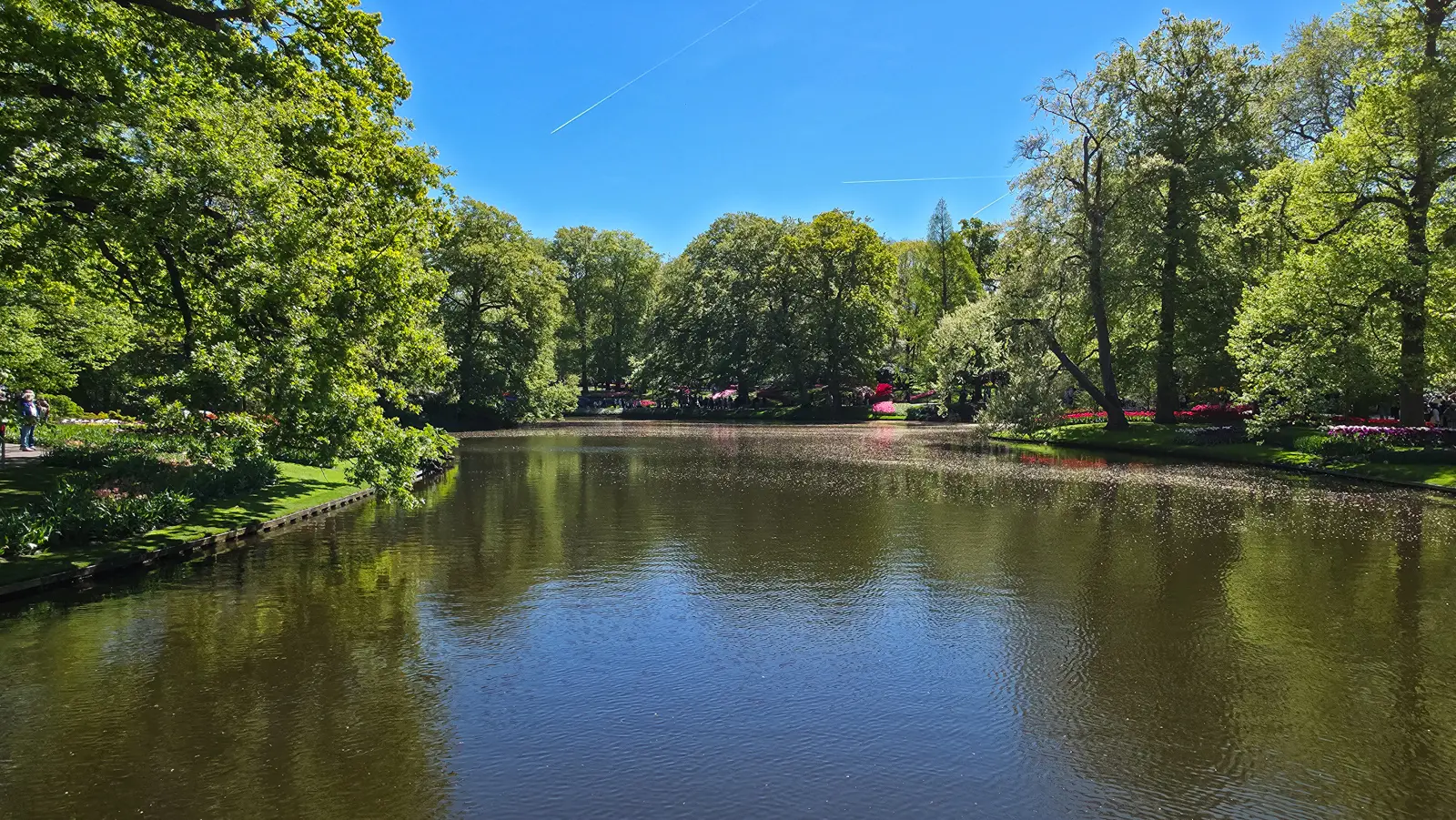
The manor house at the heart of the estate went up in 1641 for Adriaen Maertensz Block, a captain and governor of the Dutch East India Company. It still stands, as Keukenhof Castle, though it sits outside the flower park altogether, about five hundred metres to the south-west with its own grounds and its own gate. In 1857 the owners of the Keukenhof estate commissioned Jan David Zocher and his son Louis Paul Zocher to redesign the grounds around their castle in the English landscape style. That means curves rather than axes, long sightlines framed by trees, open lawns, and water shaped to look as though it happened on its own. The Zochers also laid out the Vondelpark in Amsterdam, which explains why both places handle their trees the same way.
The bulb growers only arrived in 1949, proposing an open-air exhibition to show off the Dutch trade, and the park opened to the public in 1950. So the flower displays are ninety-three years younger than the ground they sit on. What looks like a garden built around tulips is actually a nineteenth-century landscape park that gets dressed each spring.
The Bridge and the Pavilion That Sells Sandwiches
Walking north-west, the path arrives at a low stone bridge over the water, and on the far bank sits the Wilhelmina Pavilion, orange parasols out, a queue at the counter and a red tiled roof behind the trees.
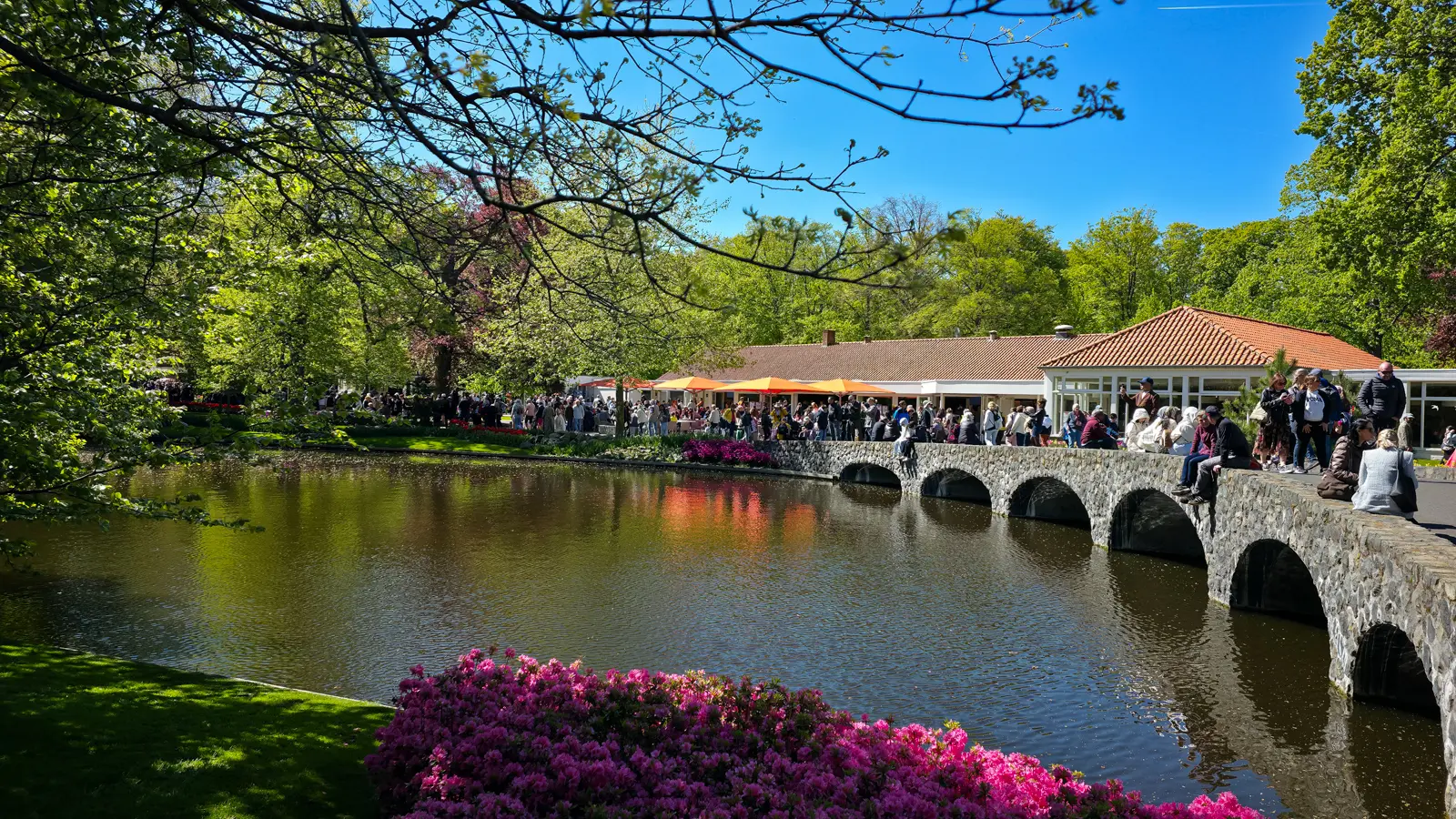
I did not go in, and it turns out there would have been no point looking for flowers there. The Wilhelmina is one of the only pavilions at Keukenhof with no floral displays at all. It has a shop, food and drink, and the toilets. That is the whole offer, and the building is honest about it.
Which is worth saying plainly, because a visitor hunting for a specific exhibition can lose twenty minutes to the assumption that every pavilion holds one. For the record, the orchid and anthurium show normally lives in the Beatrix Pavilion in the far north-east corner, and in the 2026 season it moved to the Juliana Pavilion. I was looking in the one building guaranteed not to have it.
Stepping Stones
Just along from the bridge, a line of flat discs runs out across the water towards the fountain, and people were crossing them one at a time.
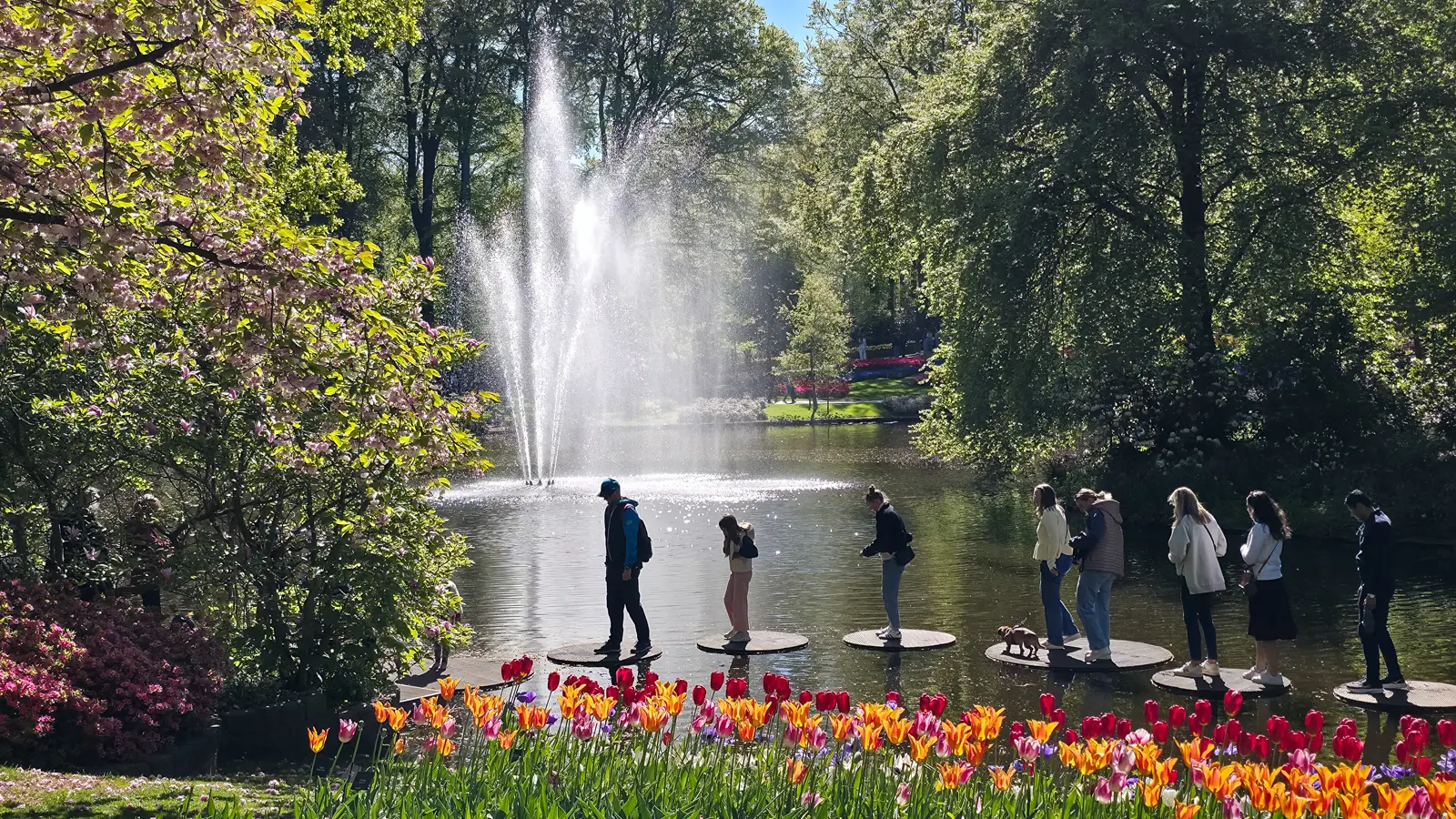
A man in a blue cap went first, then a girl in a pink jumper stopped in the middle to look down, then a queue formed on the bank. A dachshund crossed on a lead without breaking stride. I stayed on the grass and watched, which was the right call in the shoes I had on, and the view of it was better from the bank anyway.
The Fountain
The fountain sits out in the middle of the lake and throws four jets, and every path along that side of the water ends up pointing at it.
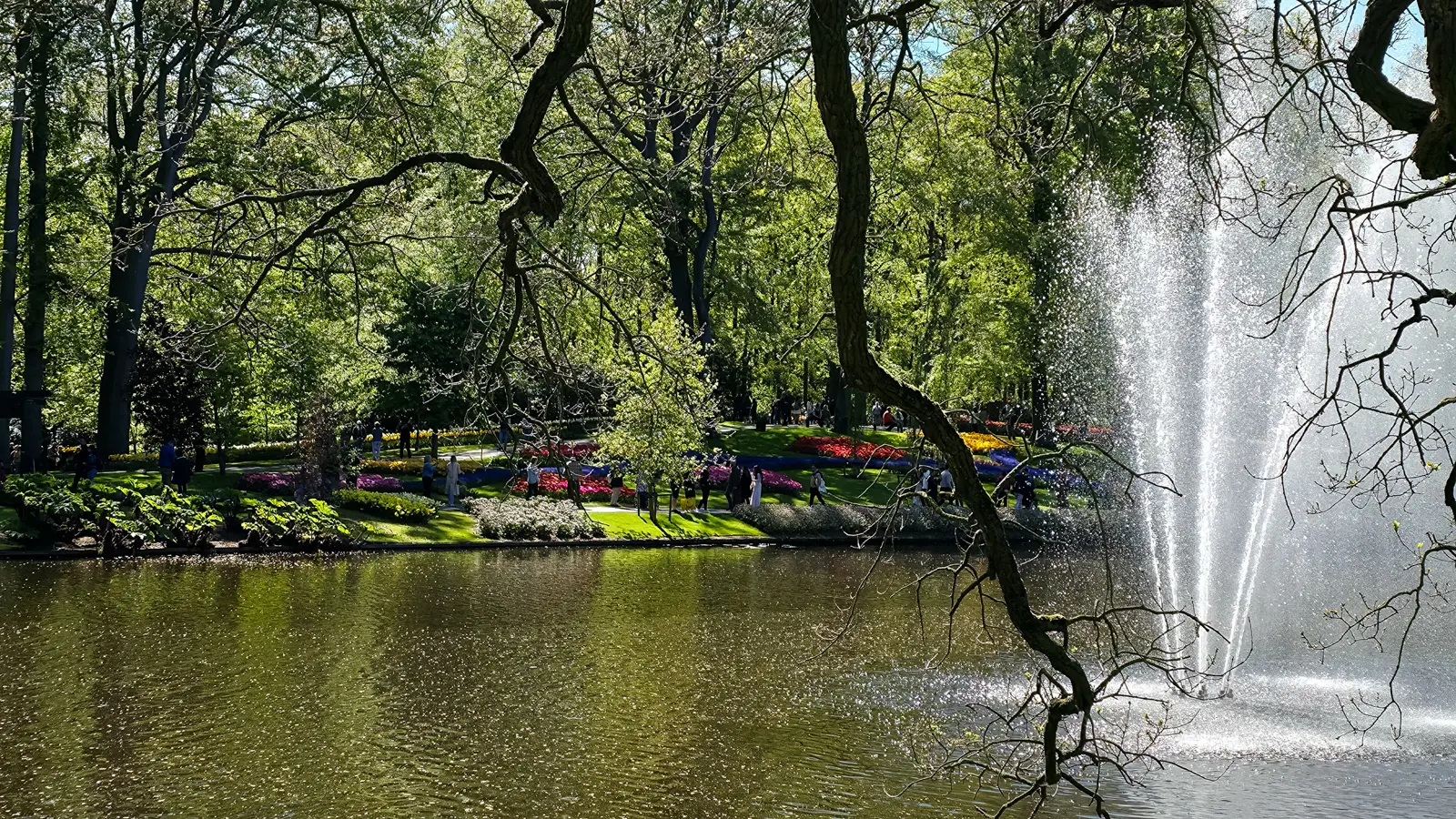
One oak on the bank has grown out almost horizontally over the water, all twisted bare limbs, and it frames the fountain from the path. The far shore reads as a long band of colour at that distance, the individual beds dissolving into stripes of red and yellow and blue.
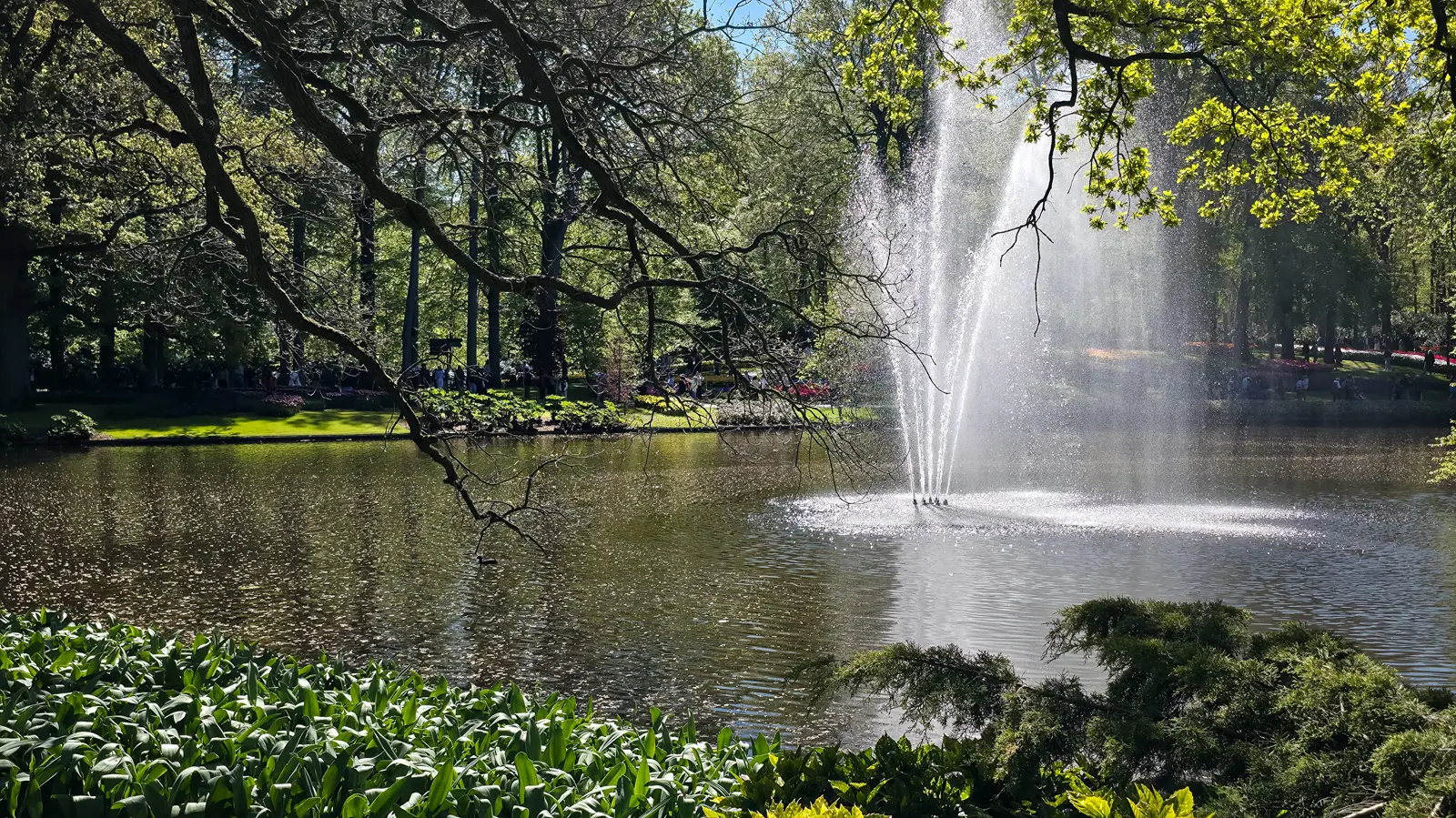
Standing still for a minute, the water noise takes over from the crowd noise. It is the only place in the park where that happens.
Not Only Tulips
The other correction the lake made to my thinking is that Keukenhof is not a tulip garden. It is a bulb garden, and the tulips are simply the loudest thing in it.
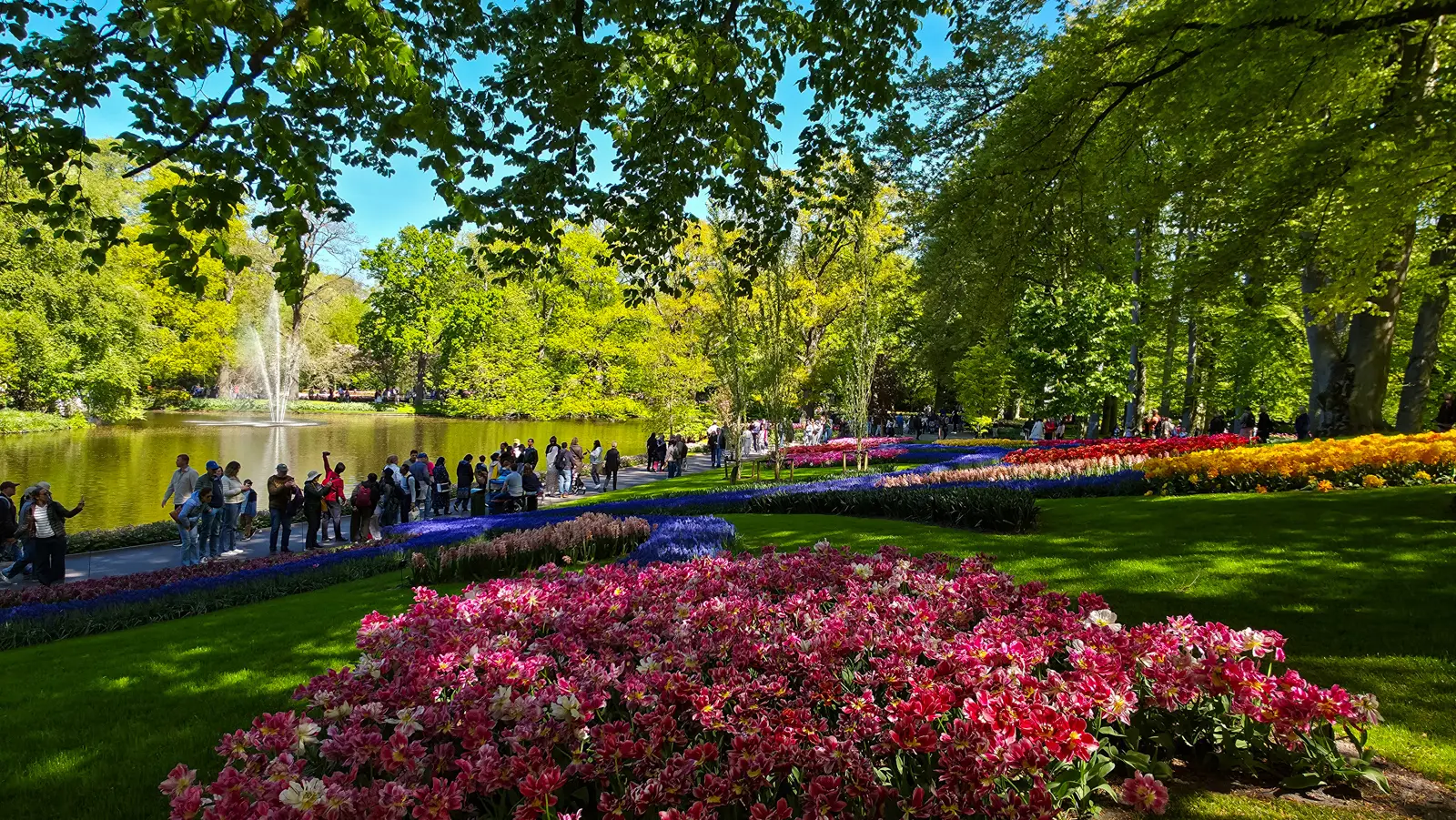
Ribbons of muscari, the small deep blue grape hyacinths, run in long curving bands through the grass, with paler pink and cream hyacinths beside them. Behind those come blocks of red, then orange, then a solid yellow mass. The blue is doing the work that gravel or box hedging would do in a formal garden: it draws the line the eye follows.
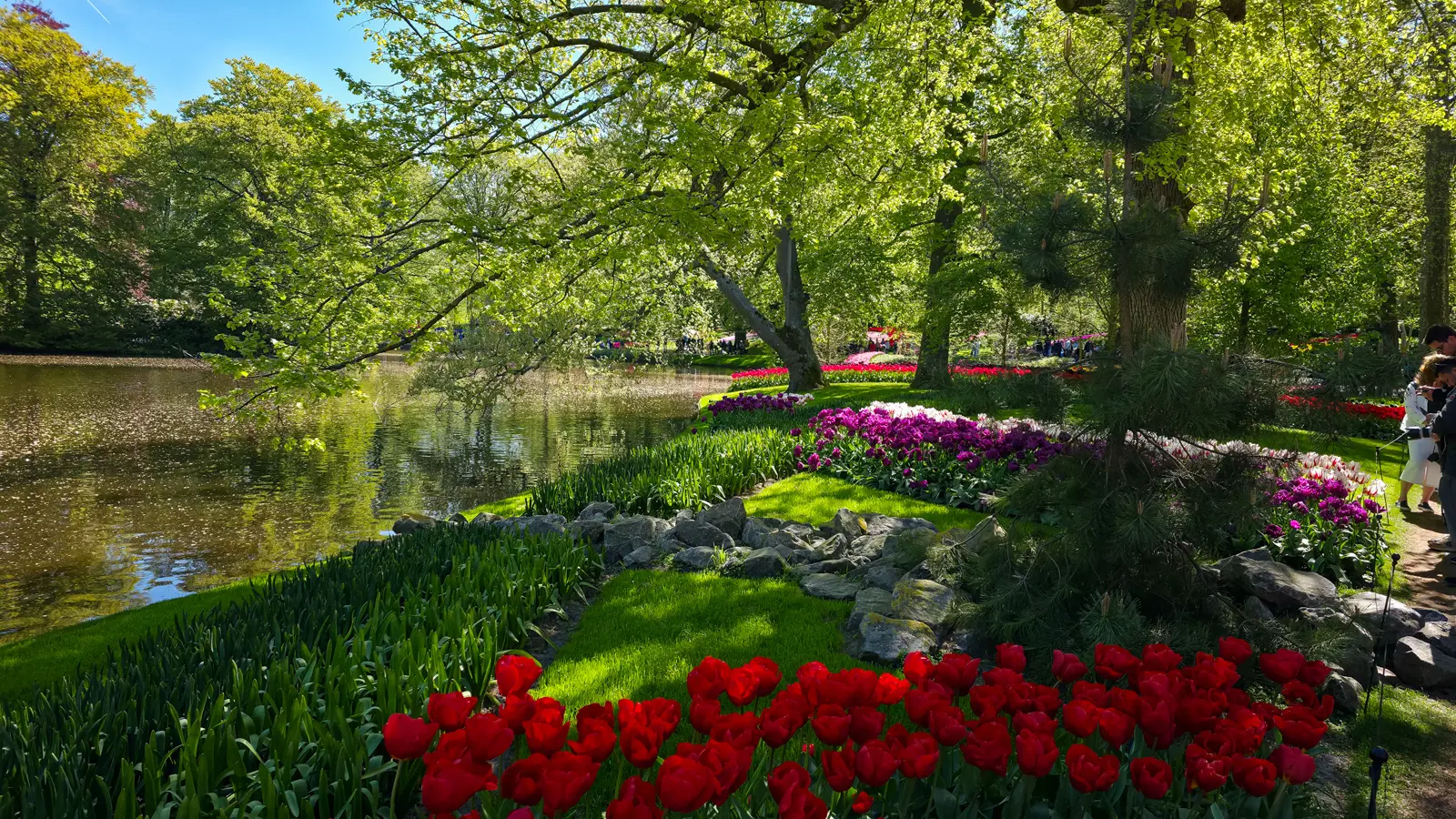
Along the wooded bank the planting changes again: magenta and white tulips in drifts under old trees, a low outcrop of grey rock, spears of foliage not yet in flower, and a pine hanging low over the whole arrangement. Rhododendrons and azaleas in hot pink sit at the water’s edge near the bridge. None of it is tulips, and all of it is the reason the lake looks better than the show beds.
The One Straight Line
Further round, the park drops its curves for a moment. A narrow formal water channel runs away between paved edges, borders of mixed tulips packed tight on both sides, blue muscari at the front, and the smooth grey trunks of mature beeches standing behind.
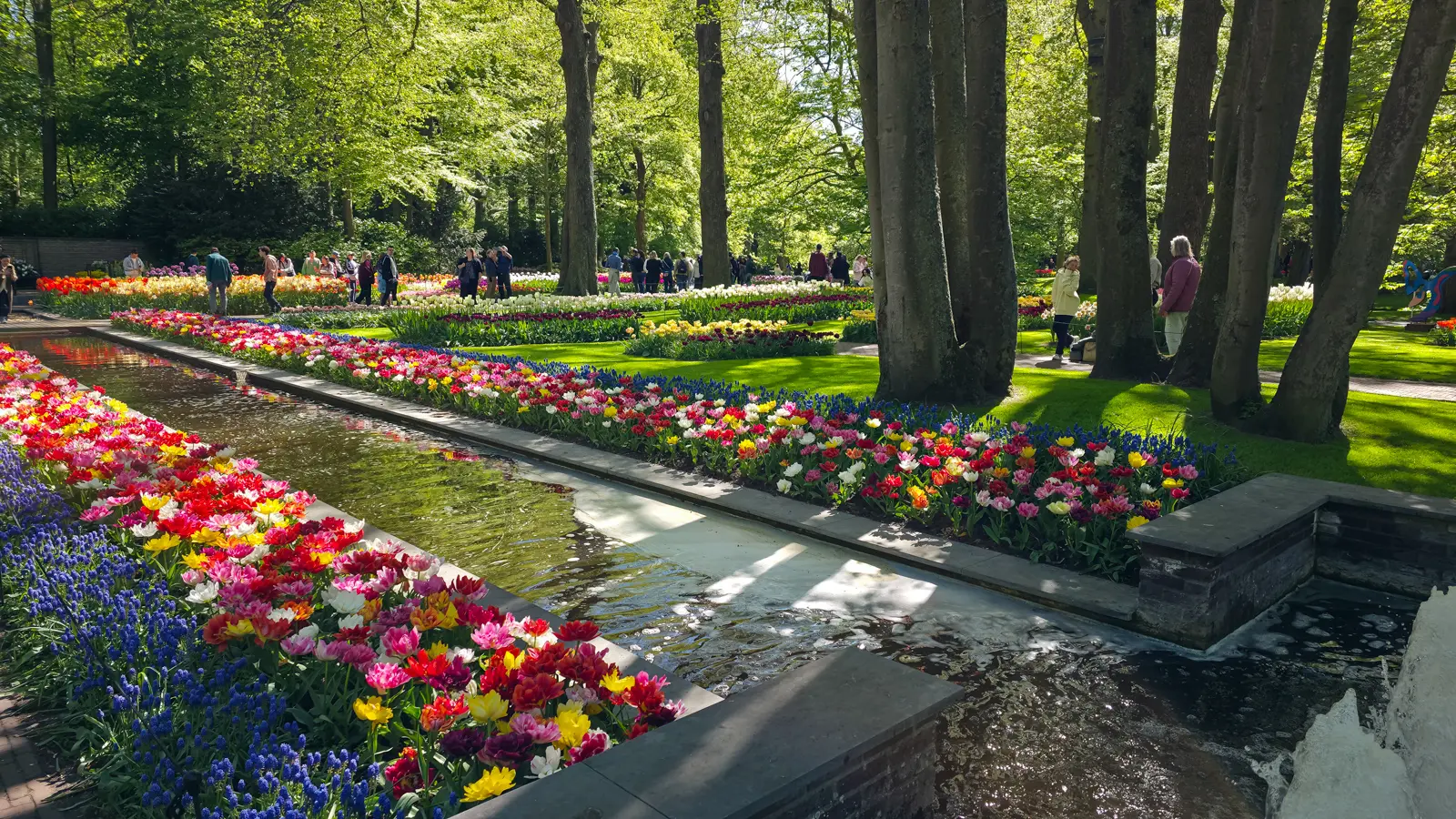
It is the one piece of straight-line geometry in a park built on the principle of not having any, and the contrast is what makes it work. The beeches do most of it. Their trunks are pale and branchless for the first several metres, so the eye reads them as columns, and the tulips at their feet look planted in a nave.
Watching People
What I actually did for the last stretch was stop walking.
There were families on the grass, children hanging over the edge of the water, dogs on leads, several couples taking the same photograph in turn, and a steady traffic of people going nowhere in particular. Nobody was queuing for anything. The paths are wide enough on that side that a park taking twenty-six thousand people a day stops pressing in on anybody.
I had come out of an exhibition hall looking for another exhibition hall, and the best hour of the visit turned out to be the bit between them.
Bubbly Tips
- Do not look for the orchids in the Wilhelmina Pavilion. It is one of the only pavilions with no floral display at all: shop, food, drinks and toilets. The orchid and anthurium show is normally in the Beatrix Pavilion in the north-east corner, but in 2026 it moved to the Juliana. Check the map at the gate rather than assuming, because the pavilions do swap shows between seasons.
- Use the Wilhelmina anyway. It is the natural stop on the lake circuit if you need a coffee, a toilet or twenty minutes off your feet, and the terrace outside has the best outlook of any food stop in the park.
- Walk the whole lake, not half of it. The circuit takes around thirty to forty minutes at a wandering pace and it is the quietest part of Keukenhof. Most visitors cut between pavilions and miss it entirely.
- The stone bridge is the reflection shot. Stand on the south bank looking across at the pavilion and the water does the rest. Earlier in the day gives you stiller water and fewer people sitting on the parapet.
- The stepping stones are more solid than they look. They are broad, flat and stable, and children and dogs were crossing without trouble. A queue builds at busy times, so either commit or watch from the bank.
- Look for the things that are not tulips. The muscari ribbons, the hyacinths, the daffodils, the rhododendrons and the azaleas around the lake are doing most of the compositional work, and almost nobody photographs them.
- Season and hours matter more here than at most attractions. The 2026 season ran 19 March to 10 May, daily from eight until seven. Outside those eight weeks the park is closed to the public entirely.
- Arrive early if you want the water calm. The classic still-reflection photographs happen in the first hour after opening, before the wind picks up and before the paths fill.
- Getting there without a car is straightforward. Buses run to Keukenhof from Haarlem, Leiden and Schiphol, and a combined bus and entry ticket is usually the cheaper option.
Final Thoughts
The lake is the oldest thing at Keukenhof and the least advertised. Everything in the brochures is a display: a pavilion, a show, a themed garden, seven million bulbs arranged by people who do this for a living. The lake is just a nineteenth-century landscape park doing what the Zochers designed it to do, with a spring’s worth of colour laid along its banks as a seasonal extra.
I went looking for a room full of orchids and did not find it. What I got instead was a stone bridge, a fountain, a line of people crossing water on stepping stones and a dachshund, and a bed of blue muscari running through grass like a river. If the orchids had been where I thought they were, I would have walked past all of it.
Until next time!

🌟 Everything You Need to Plan Your Dream Trip in 2026
- 🌟 Luxury Hotels - Find premium stays with Booking.com & Hotels.com
- 🏡 Vacation Rentals - Discover unique properties on VRBO
- 🏞️ Guided Tours - Explore with Viator or GetYourGuide
- 🎫 Attraction Tickets - Skip the lines with Tiqets
- 🚢 Ocean Cruises - Set sail with Cruise Direct
- 📱 International SIMs - Stay connected with Saily
- 🚗 Car Rentals - Budget-friendly options from Discover Cars
- 🌐 Secure VPNs - Browse safely with NordVPN
- 💶 Currency Exchange - Best rates with Wise
- 🗣️ Learn Languages - Master the local language with Babbel and Rosetta Stone