
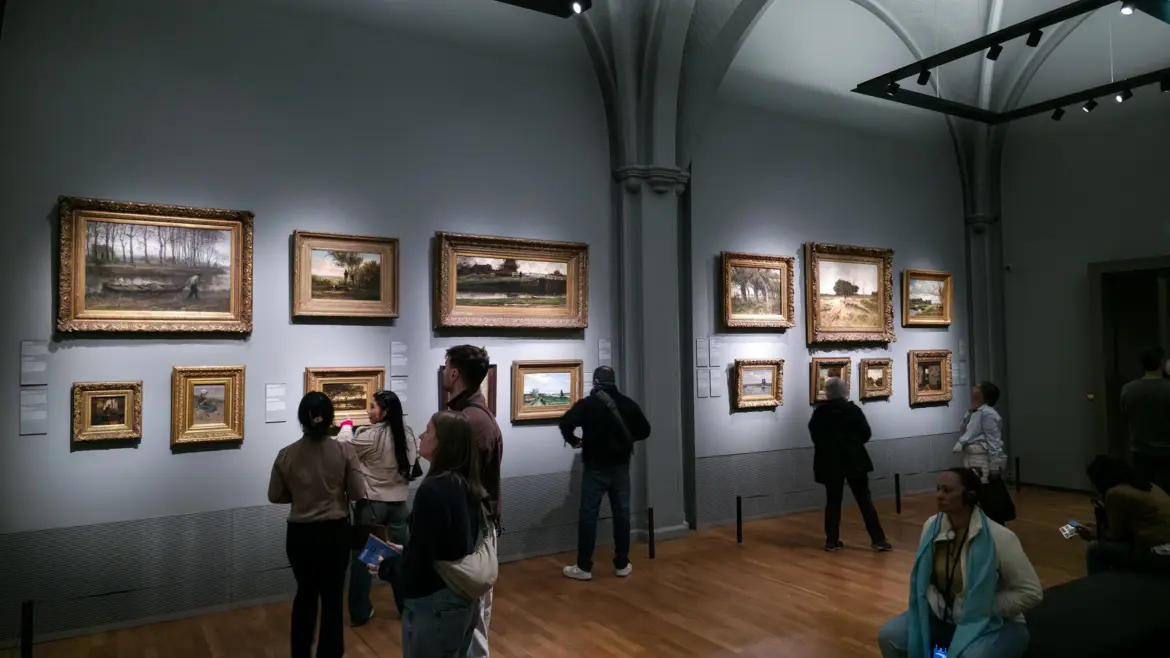
I was at the Rijksmuseum for the Night Watch, like almost everybody who books a ticket. That hangs at the far end of the Gallery of Honour, upstairs, and it is where the building puts its weight: the long corridor, the crowd, the painting in its glass chamber at the end of the axis.
What I had not planned for was the floor below it.
The Rijksmuseum is arranged chronologically, in loops, one century handing over to the next, which leaves the nineteenth at the quiet end of the sequence. I went down into the 1800 to 1900 rooms expecting a corridor of brown landscapes to pass through on the way out. I had spent the previous afternoon at the Van Gogh Museum, so when I came round a corner and found a Van Gogh self-portrait on a grey wall, my first thought was that I had got turned around and ended up back in the wrong building.
There are four of them. In a wing most visitors cross to reach somewhere else, with nobody standing in front of any of them.
The Rijksmuseum’s 19th-Century Wing at a Glance
🖼️ Four Van Goghs · A self-portrait (the museum’s own), plus three on long-term loan since 2024: the 1885 Amsterdam view, Riverbank with Trees (1887) and Wheatfield (1888). In gallery 1.18, Floor 1.
🚶 No queue · One floor below the Gallery of Honour, four minutes from the Night Watch crowd, and often nearly empty.
🎨 Plus a Monet · La Corniche near Monaco (1884), given to the museum in 1900 when Monet was still unknown in the Netherlands.
🇳🇱 The Hague School · The room that invented the mental image of the Dutch landscape: flat green polders under a grey-blue sky.
💡 Tip · See the Van Gogh Museum first, then these four the next morning; they’re a compressed version of the same story.
The One He Painted on the Doorstep
The best story in the room belongs to the smallest and darkest picture in it.
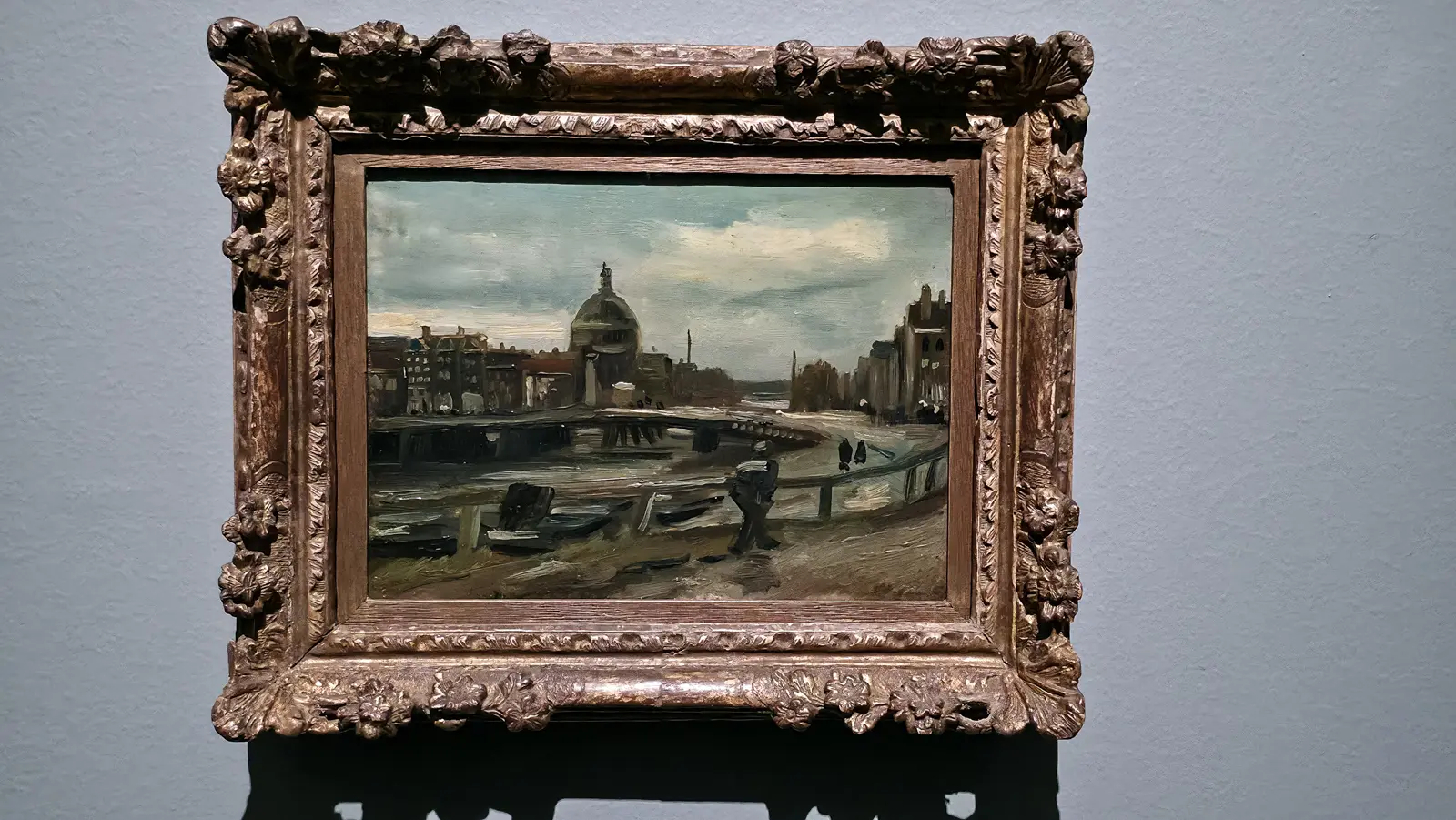
In October 1885 Van Gogh was living at his parents’ house in Nuenen and had been saving whatever money he could. What he was saving for was a trip to Amsterdam to see the Rijksmuseum, which had opened two years earlier. He brought his paint box with him.
On the morning of the visit, before going in, he stopped and painted the view across the Singel canal with the copper dome of the Koepelkerk behind it. A few colours, very fast, on a small panel. It is one of only a handful of city views he made in this period.
Then he went inside. He was impressed by Frans Hals. He was undone by Rembrandt’s The Jewish Bride, and wrote afterwards that he would give up ten years of his life to sit in front of it for a fortnight, eating nothing but stale bread.
The painting he made on the doorstep now hangs a few rooms from the Rembrandts he came to see.
Paris, and the Colour Arriving
Beside it, the development happens fast.
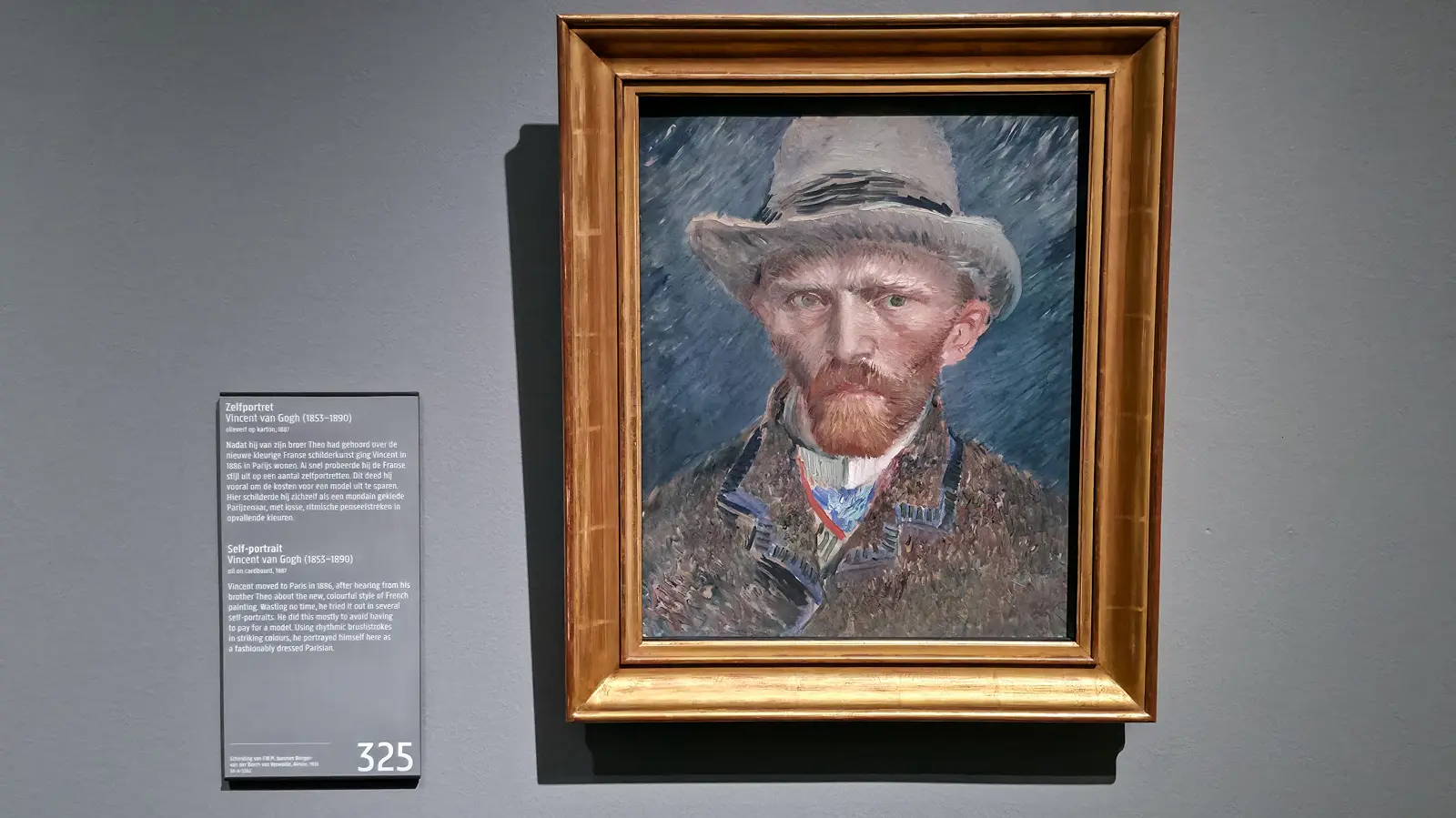
The 1887 self-portrait is painted on cardboard rather than canvas. He had moved to Paris the year before, after Theo wrote to him about what the French painters were doing with colour, and he began testing it on his own face almost at once. Part of the reason was money. A model charged by the sitting and he did not. The grey hat and the good coat are a decision as well: he has painted himself as a man who belongs in the city.
Two years after the dark little Singel panel, the same man is building a face out of orange and blue strokes laid side by side.
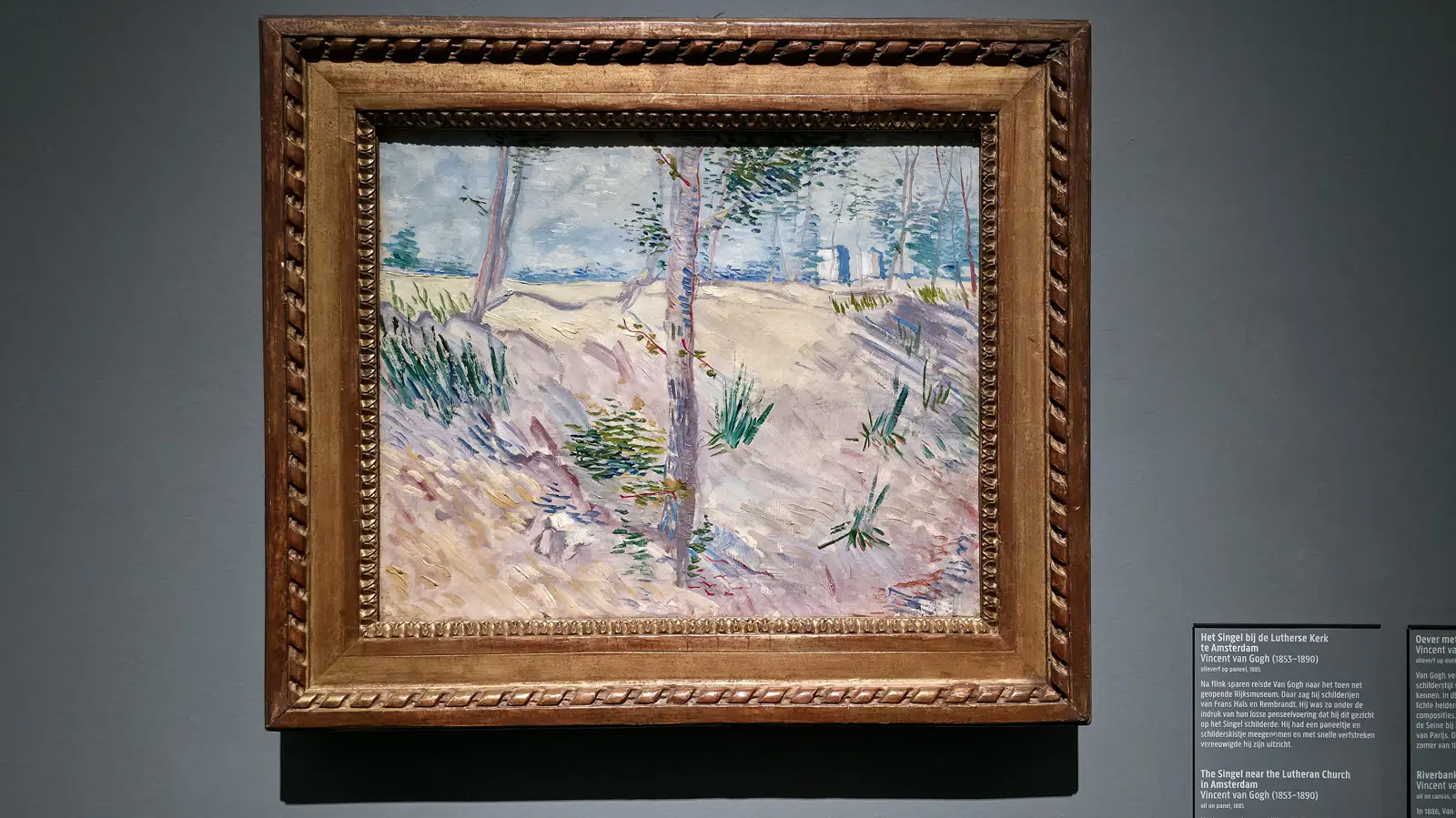
The riverbank is almost all sand and sky, pale pinks and creams with a few dashes of green stuck into it like pins. Nothing about it looks like the Netherlands, which is exactly what two years in Paris had done.
Arles
The fourth painting is the one that stops the sequence.
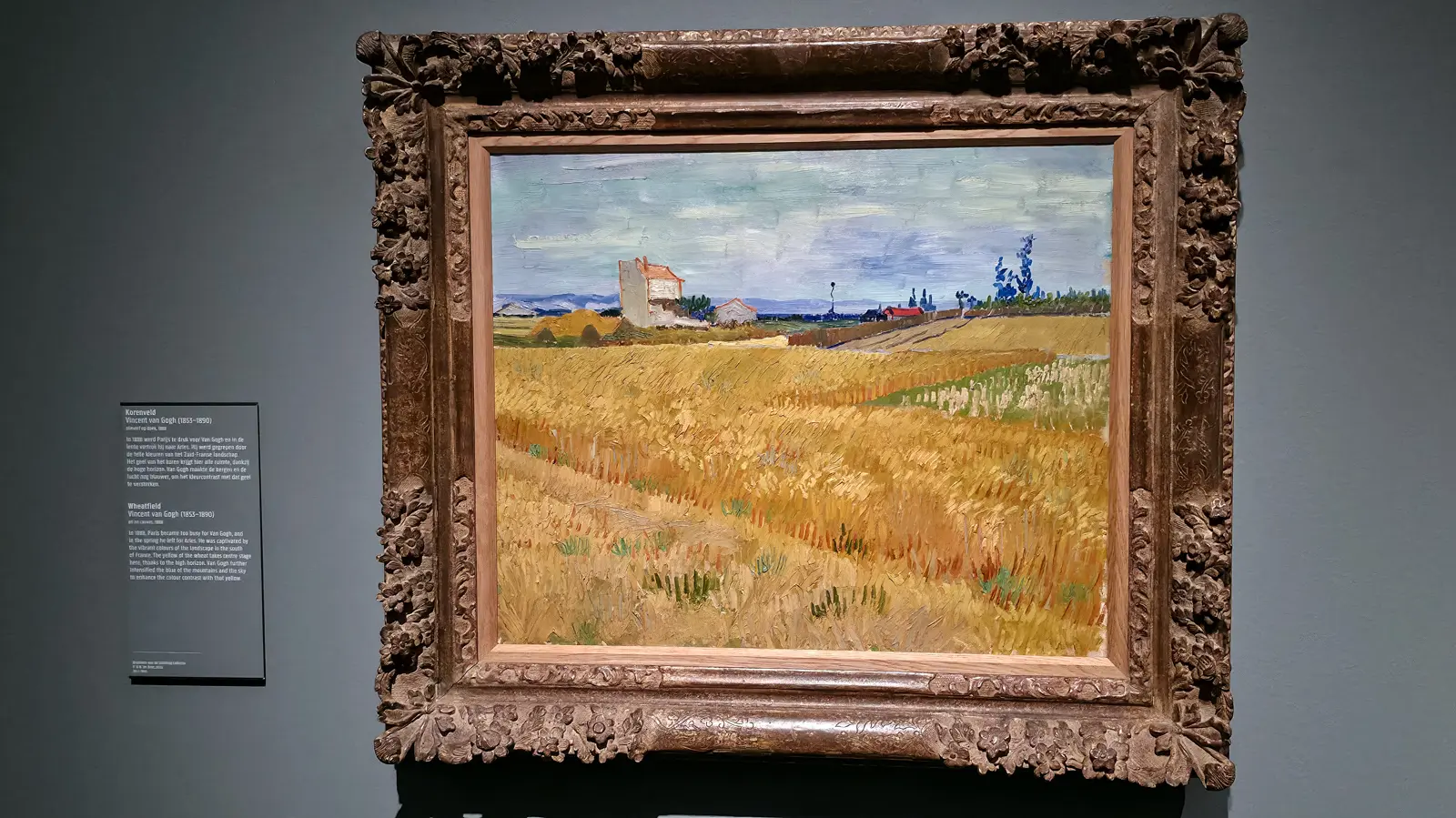
Paris had become too busy, so in the spring of 1888 he left for Arles, and the colours of the south took hold of him.
The wheat fills three quarters of the canvas because he pushed the horizon up near the top. Then he intensified the blue of the hills and the sky deliberately, to make the yellow fight harder. A white farmhouse sits on the left, a line of dark cypresses on the right, and the whole field is worked in short upright strokes going in slightly different directions.
Standing in front of it, in an empty room, on the morning after a full afternoon of him across the square, was the best twenty minutes I had in the building.
And a Monet
Round the corner from the Van Goghs, and entirely unexpectedly, there is a Monet.
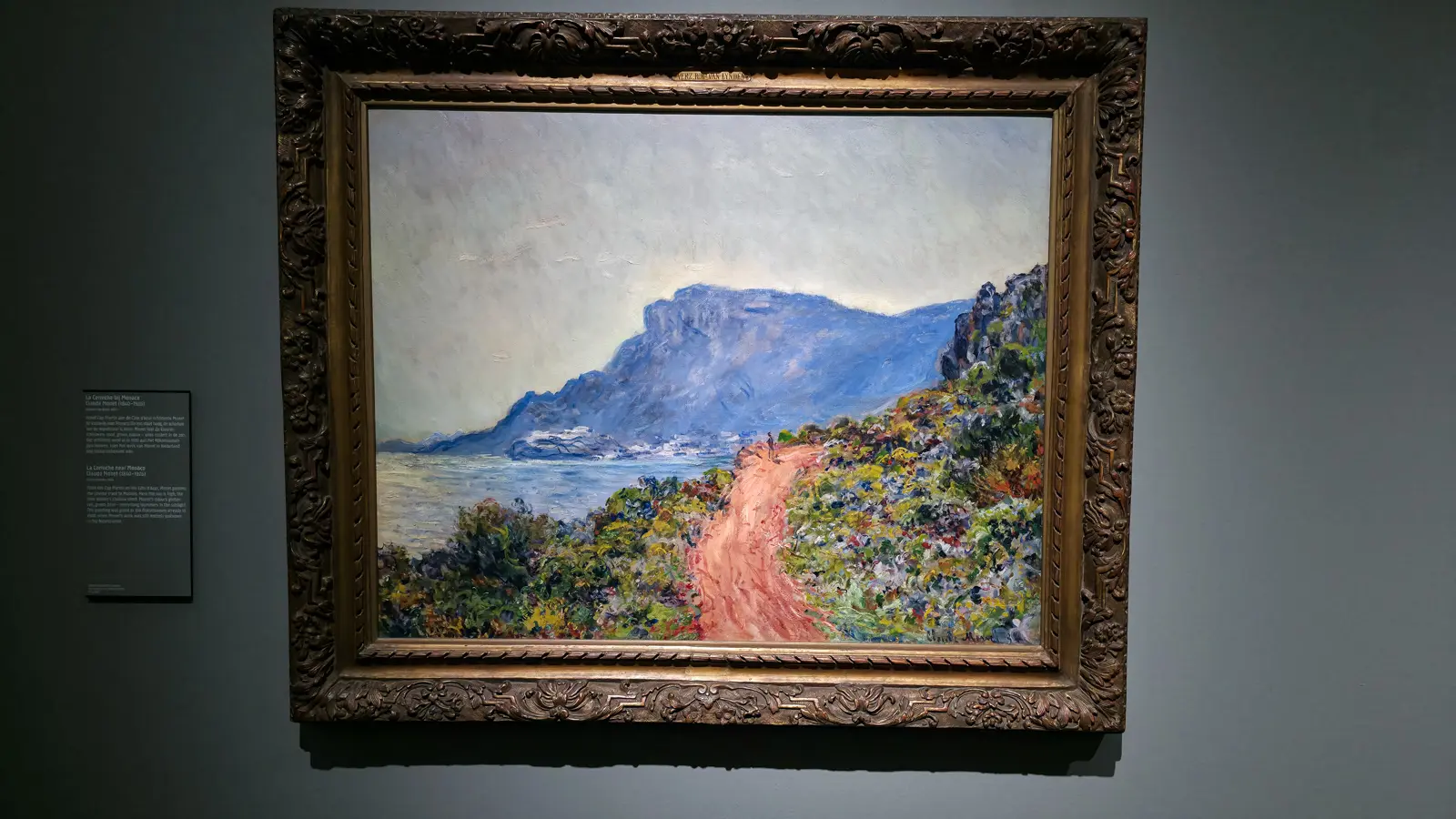
He painted it from Cap Martin on the Côte d’Azur, looking along the coast road towards Monaco, with the sun high enough that the walker on the path throws almost no shadow.
The track is pink. The scrub either side is red and green and blue all at once. The headland behind is a flat violet mass. It is the loudest thing in the wing and it is hanging in a national museum of Dutch art, which is part of why it is worth stopping for.
The Room That Invented the Dutch Landscape
The rooms next door are given over to the Hague School, the group of painters working around The Hague from roughly 1860, and there is an argument running through them that I had not expected.
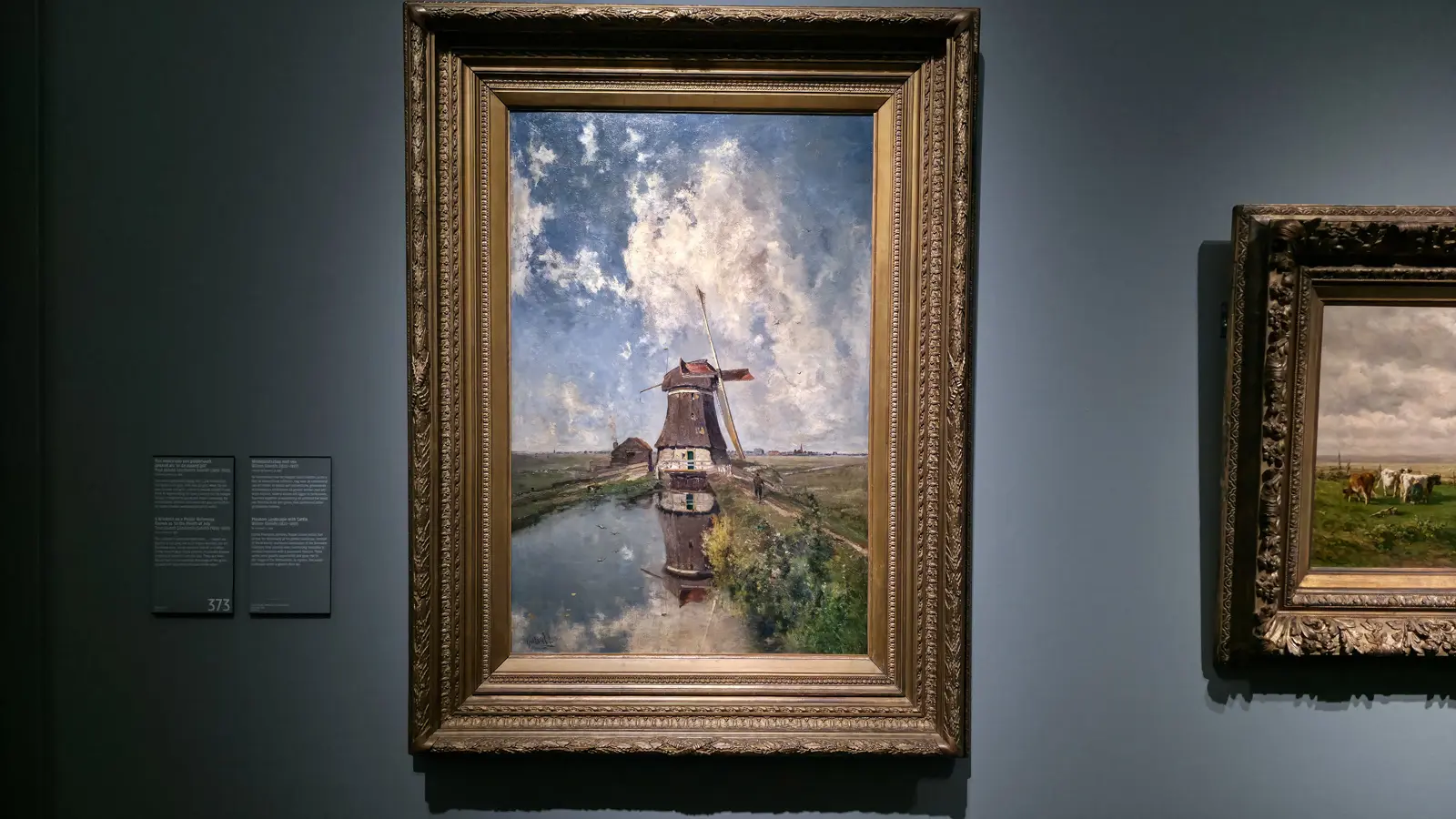
Gabriël’s picture is called A Windmill on a Polder Waterway, though everybody knows it by its nickname, ‘In the Month of July’. It is a summer scene, which was unusual for this group, and there are two of everything in it: the grass, the sky and the mill, and then all three again reflected in the still water of the polder ditch below.
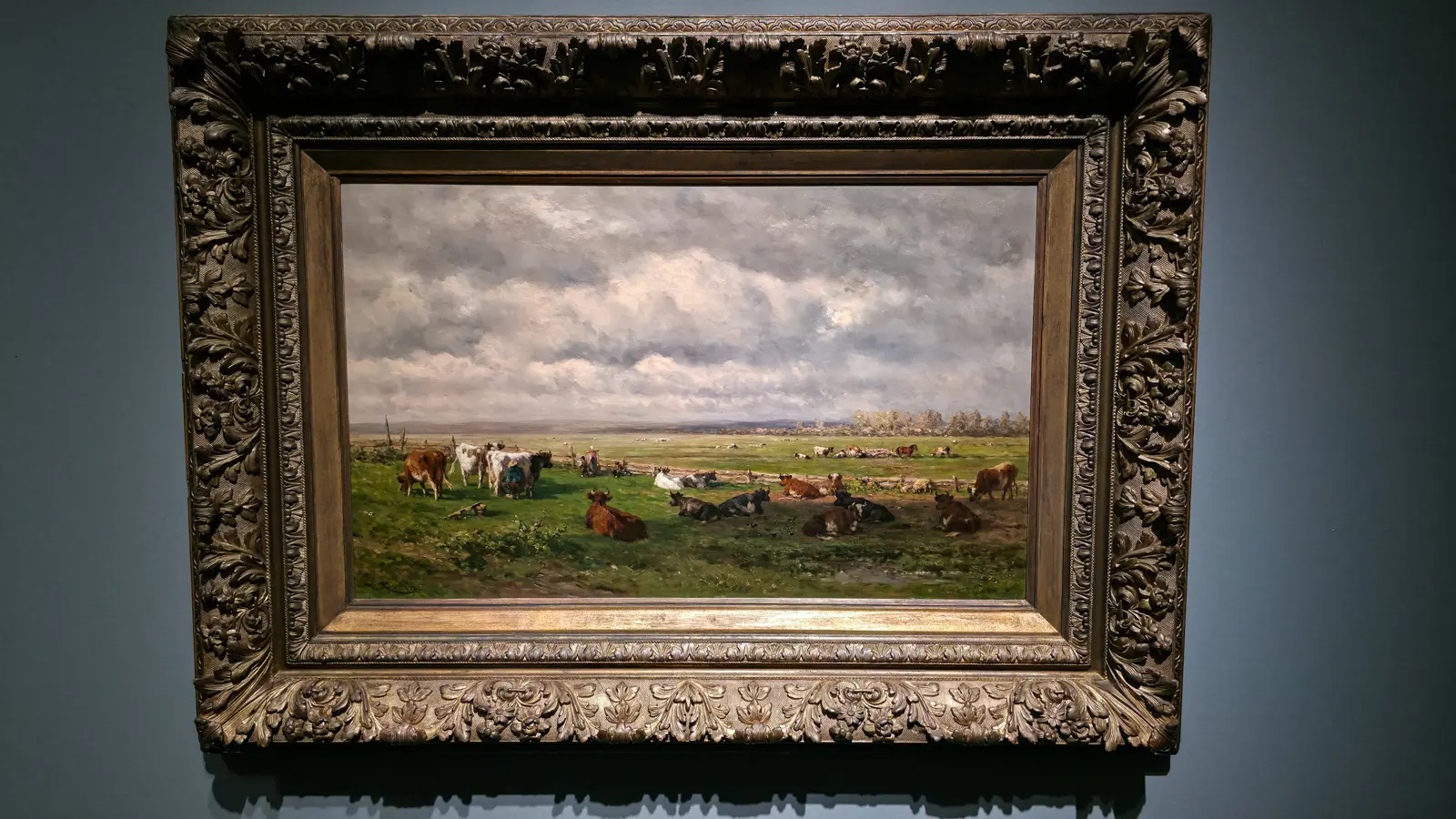
Roelofs gives the other half of the argument. Unlike the Romantics before them, who wanted drama and variety, the Hague School painters looked at the polder and found it beautiful as it was. So they painted cows ruminating in wet green fields under an enormous horizon, and did it well enough that the rest of the world took the picture as the country.
I had spent the previous days at Zaanse Schans and Keukenhof, photographing flat green fields under grey-blue skies. Which is to say photographing the thing a handful of painters in The Hague decided the country looked like, about a hundred and forty years before I got there.
Two Julys
Two rooms along hangs a second painting called July, and it could not be less like Gabriël’s.
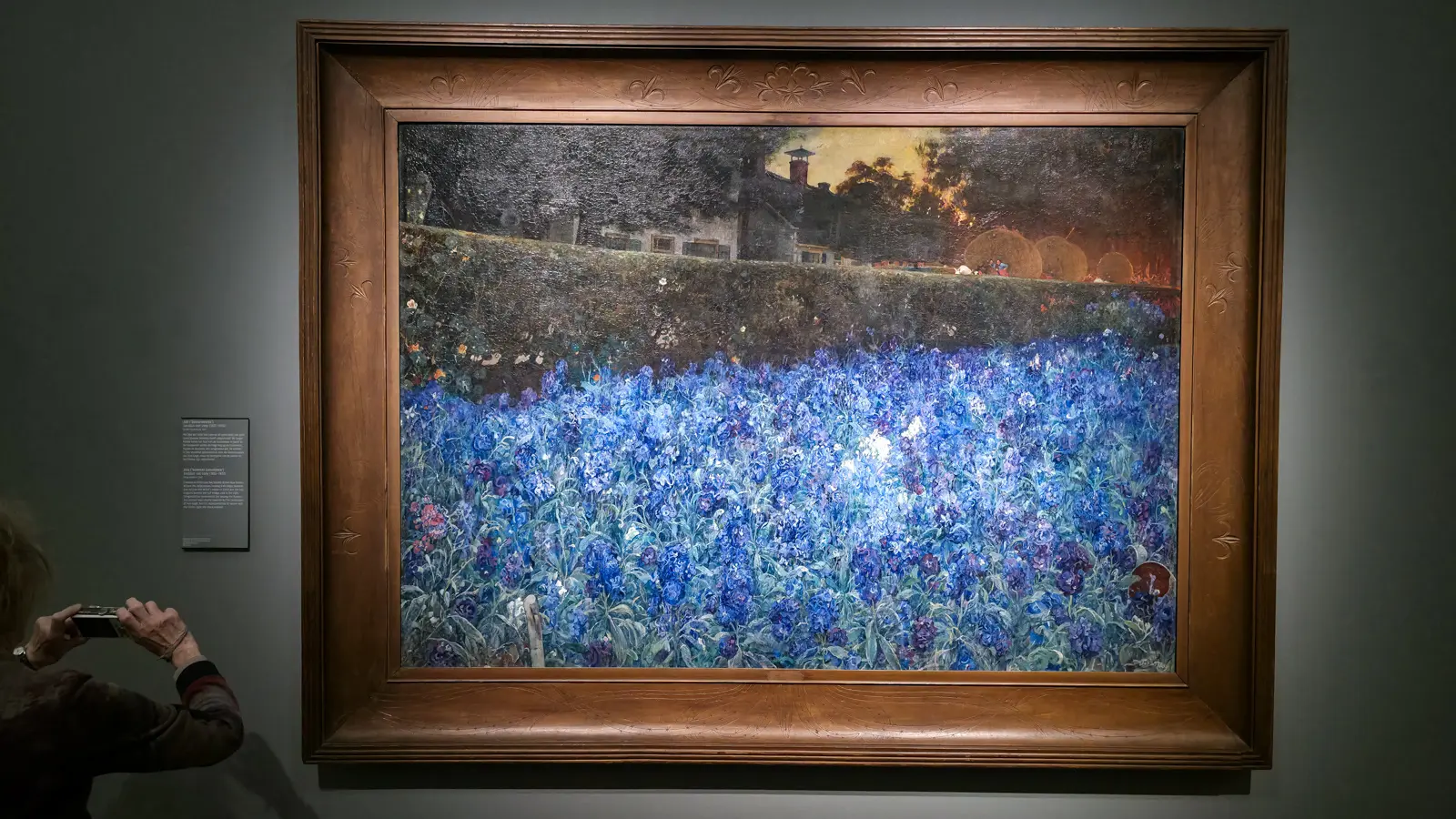
Jacobus van Looy fills the bottom two thirds of a large canvas with blue and purple flowers, packed so tight that no ground shows through, and lets the top third go almost black: a hedge, a farmhouse, a chimney, one patch of gold sky.
A woman was photographing it when I came in, standing where I wanted to stand, which was fair enough given how many people I had done that to the day before.
A Zaandam Painter in Brittany
One small portrait in these rooms caught me because of where its painter came from rather than what it shows.
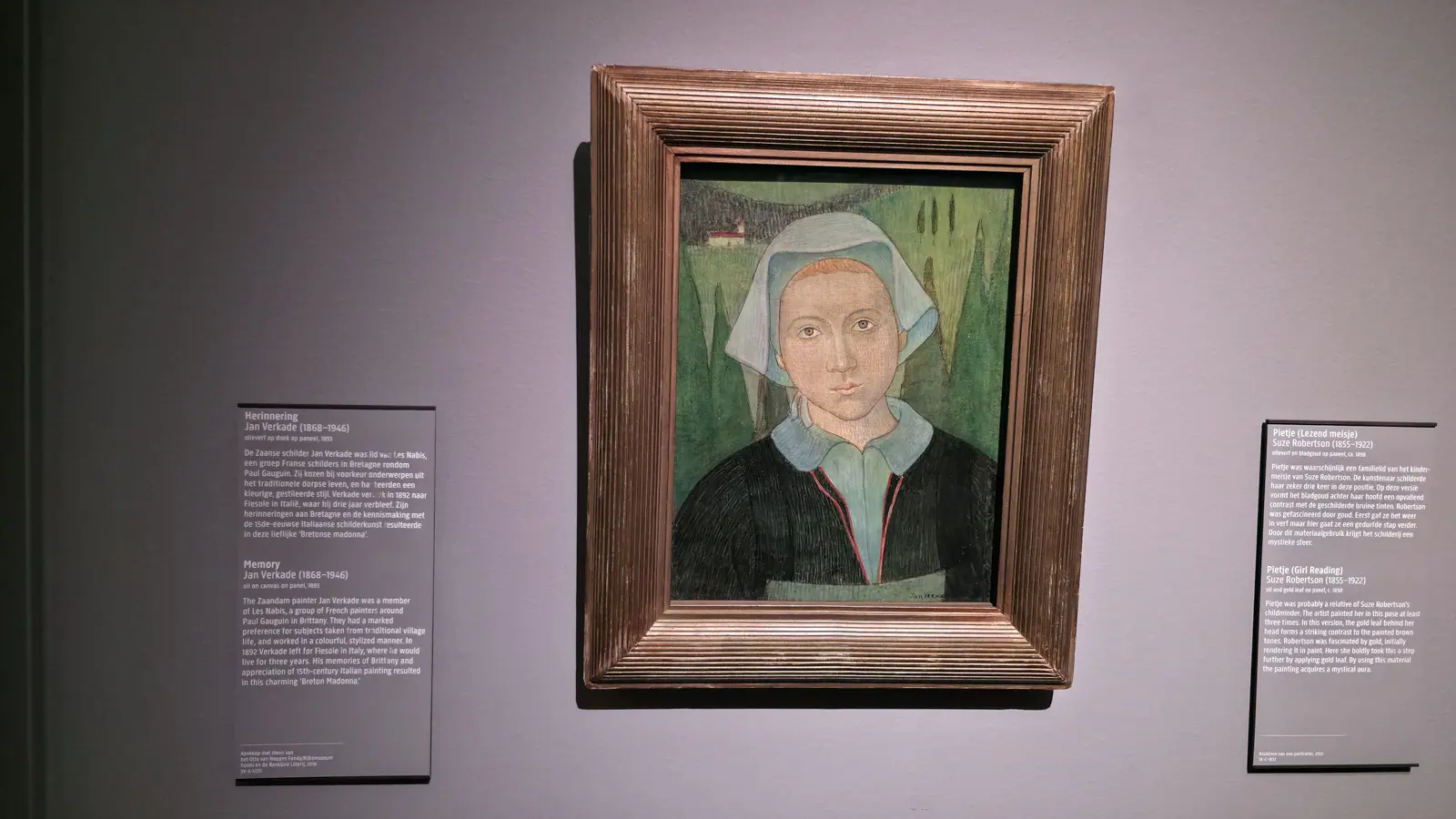
Jan Verkade was born in Zaandam, in the Zaan region I had been walking round the day before. He went to Brittany and joined Les Nabis, the group of French painters who formed around Paul Gauguin at Pont-Aven.
So the chain runs: Gauguin quarrels with Van Gogh in Arles in December 1888, goes back to France, gathers a circle of young painters around him in Brittany, and one of them is a boy from Zaandam whose picture of a Breton girl ends up two rooms from four Van Goghs in Amsterdam.
Isabella
The last painting I want to write about is a portrait of a girl of about twelve, and the story attached to it is the museum’s own.
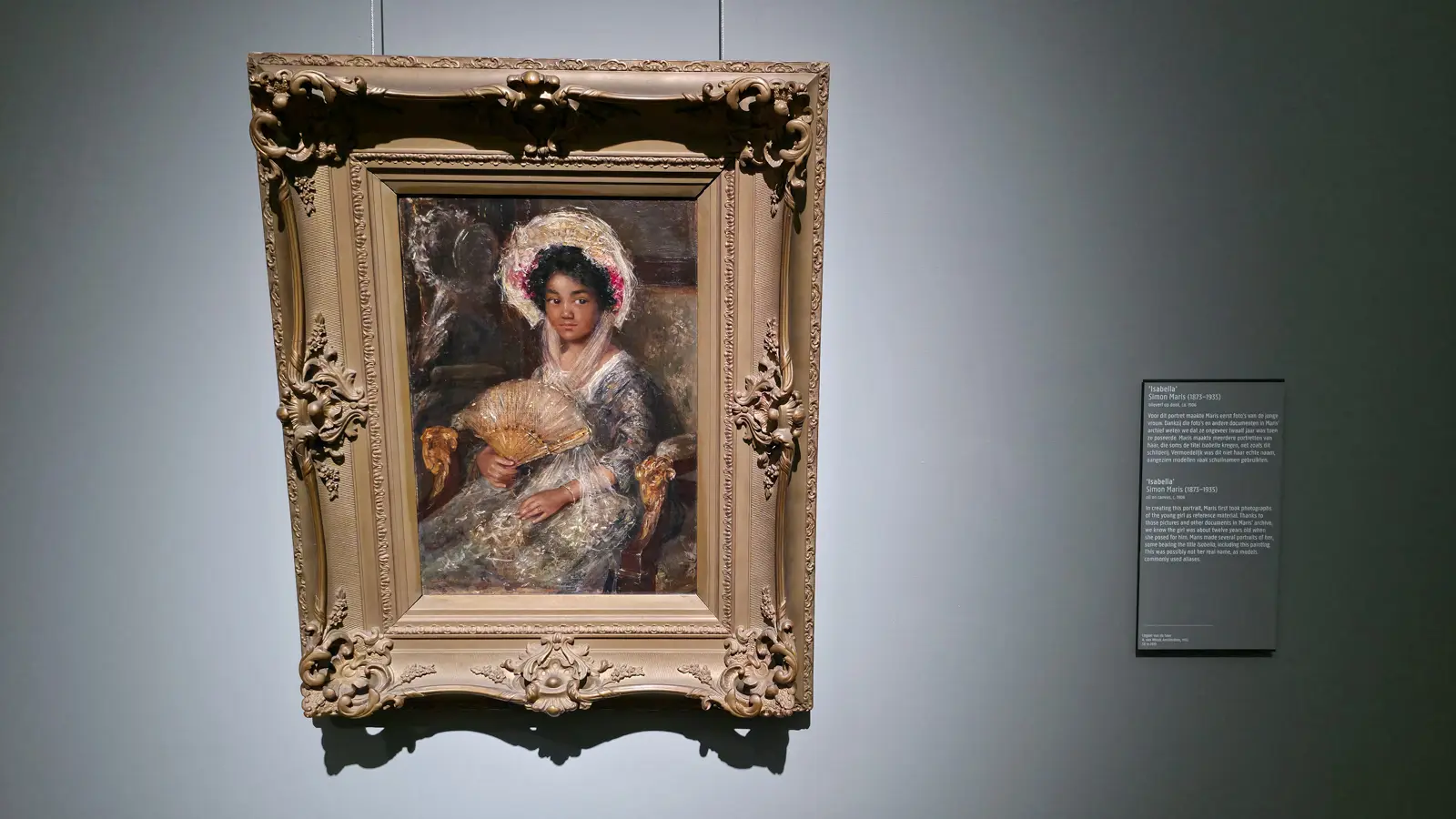
The painting entered the collection in 1922 as part of a bequest and was recorded in that year’s annual report as an East Indian type, an Oriental girl sitting in an armchair. In 1976 a curator gave it a title in the collection catalogue that used a racial diminutive. That title went unremarked for decades.
In 2015 it became the subject of public debate, and the museum set up a team to review the terminology it had been using across the whole collection. The team proposed calling the painting Young Woman with a Fan. At the same time, and this is the part that matters, research began into who the sitter actually was.
In 2020 the answer came out of Simon Maris’s own family archive: photographs and documents naming the girl as Isabella. So the museum changed the title a second time, this time to the one the artist had used himself. The current label adds a caveat rather than a flourish. Isabella was possibly not her real name, because models commonly worked under aliases.
The museum keeps every former title on record rather than deleting them, so that anyone can trace how the descriptions changed over time. That is the detail that makes it a method rather than an apology.
She sat for a painter on the Keizersgracht at about twelve years old, was hung in the national museum for ninety-eight years under other people’s descriptions of her, and now has a name on the wall that may or may not be hers. That is not a tidy ending, and the label does not pretend otherwise.
Bubbly Tips
- Go down a floor. The 1800 to 1900 galleries sit on Floor 1, below the Gallery of Honour, and most visitors never reach them. The museum’s own location codes put the Van Goghs in gallery 1.18 if you want to ask at the desk.
- Four Van Goghs, no queue. The self-portrait, the 1885 Amsterdam view, Riverbank with Trees and Wheatfield hang together. I had the room almost to myself on a Wednesday morning in late April, four minutes’ walk from a building where people queue for a timed slot.
- Do the two museums within a day or two of each other. Seeing the Van Gogh Museum first and these four the next morning is what makes them land. The four are arranged to show his development, so they work as a compressed version of what the bigger collection spells out.
- Read the Hague School labels. They are unusually blunt about the fact that these painters invented the mental image most of us carry of the Dutch countryside. If you have been photographing polders all week it reframes what you have been doing.
- Look for the two Julys. Gabriël’s windmill and Van Looy’s flower bed are both called July and could not be less alike. They are a few rooms apart and worth seeing back to back.
- Give Isabella five minutes. The label is short and the story behind it is not. It is the clearest example in the building of a museum correcting itself in public.
- Timed tickets apply here too. The Rijksmuseum runs on booked entry slots, and entry is free up to and including age eighteen, though under-eighteens still need a booked time.
- Photography is fine without flash, and these rooms are lit low enough that a phone will struggle. Brace against a wall rather than pushing the exposure.
- Budget an extra hour beyond what you planned. Most itineraries allow three hours for the Rijksmuseum and spend all of it on the Golden Age. The nineteenth century needs an hour of its own and almost nobody gives it one.
Final Thoughts
The wing is a leftover in the way most people use the building. It is on the way out, it has no single famous object, and the room I liked best had four people in it including me.
What it does have is the painting Vincent van Gogh made standing outside this museum in 1885, on the morning he came to see the Rembrandts, before he had been to Paris or Arles or anywhere else that made him into the person whose museum I had visited the day before. It is small, it is brown, and hardly anyone stops. Then three more of him on the same wall, ending in a wheatfield so yellow it looks lit from behind.
And a girl with a fan whose name took the institution ninety-eight years to find out, hanging quietly in a room people cross to get to the stairs.
Until next time!

🌟 Everything You Need to Plan Your Dream Trip in 2026
- 🌟 Luxury Hotels - Find premium stays with Booking.com & Hotels.com
- 🏡 Vacation Rentals - Discover unique properties on VRBO
- 🏞️ Guided Tours - Explore with Viator or GetYourGuide
- 🎫 Attraction Tickets - Skip the lines with Tiqets
- 🚢 Ocean Cruises - Set sail with Cruise Direct
- 📱 International SIMs - Stay connected with Saily
- 🚗 Car Rentals - Budget-friendly options from Discover Cars
- 🌐 Secure VPNs - Browse safely with NordVPN
- 💶 Currency Exchange - Best rates with Wise
- 🗣️ Learn Languages - Master the local language with Babbel and Rosetta Stone