
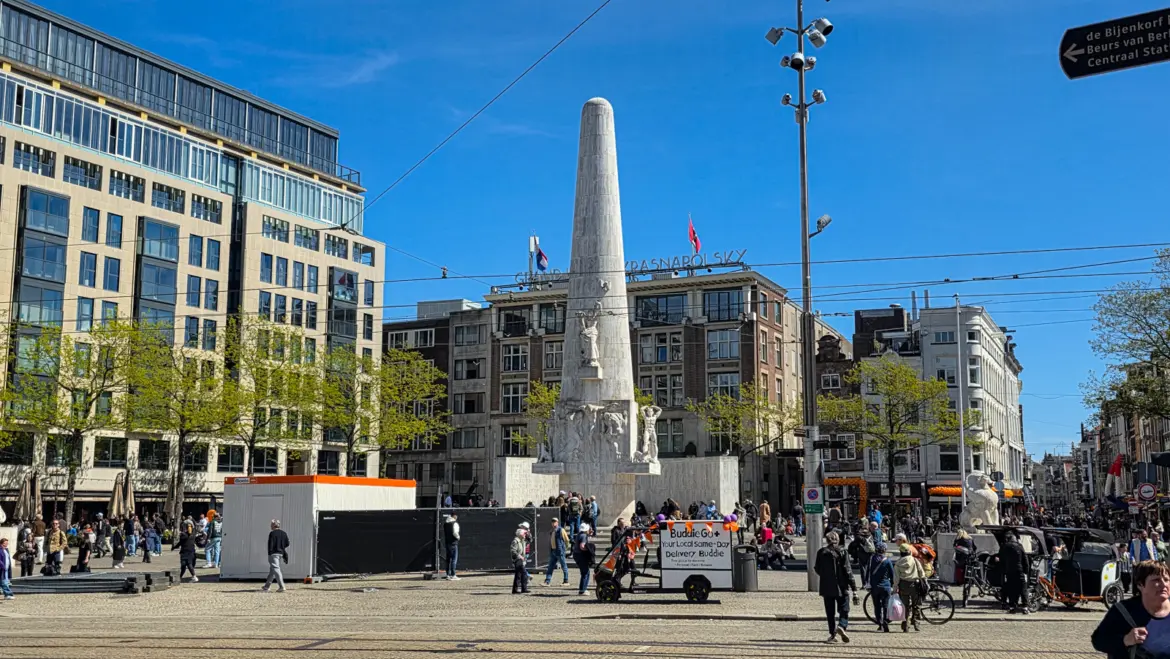
I crossed Dam Square four or five times over a week in Amsterdam and it never once impressed me.
That is not what the guidebooks say. This is the most important public space in the city and arguably in the country, the place the whole of Amsterdam is named after, and what is actually there is a large flat grey rectangle with a lot of people walking across it. There is a wax museum on one side and a department store on the other. No canal in sight. A white pillar in the middle. Part of it was fenced off both times I passed.
It took me until after I got home to work out that almost everything I disliked about it has a reason, and that the reasons are better than the square.
Dam Square at a Glance
🌊 Why no canal · The square is the dam. The Amstel runs beneath it in a culvert, passing right in front of the National Monument.
🏛️ Why so empty · A weigh house stood in the middle for centuries until Louis Bonaparte demolished it in 1808 to clear the view from his new palace.
🕊️ The white pillar · The National Monument, the country’s main WWII memorial, stands where German soldiers fired on a celebrating crowd on 7 May 1945.
🗣️ What it’s for · A working civic space kept clear to hold a crowd: King’s Day, the 4 May silence, and most of Amsterdam’s protests.
💡 Tip · Don’t stand in the middle. Sit on the Nieuwe Kerk terrace, in the sun, facing back in.
There is no canal because the square is the dam
Around 1270, the people living on either side of the Amstel built a dam across it to keep the Zuiderzee from flooding their land. It joined two settlements, one along what is now Warmoesstraat and one along Nieuwendijk. A document from 1275 grants a toll exemption to the residents apud Amestelledamme, at the dam in the Amstel. The city took its name from a piece of civil engineering.
As the dam was built up it grew wide enough to hold a market, and the market became the square. What is underfoot today was originally two spaces: the Middeldam, the dam itself, where a large fish market ran and ships tied up to unload; and the Plaetse, an adjoining plaza to the west where the civic buildings went.
Ships could still moor at the Dam until about 1840. Then the Damrak, the old mouth of the river, was partly filled in during the nineteenth century, and the square found itself surrounded by land on every side for the first time in its history.
The river did not go anywhere. It runs beneath the square in a culvert, passing directly in front of the National Monument. So the reason there is no water is that the water is under the paving, and standing in the middle of the Dam wondering where the canals are means standing on top of the Amstel.
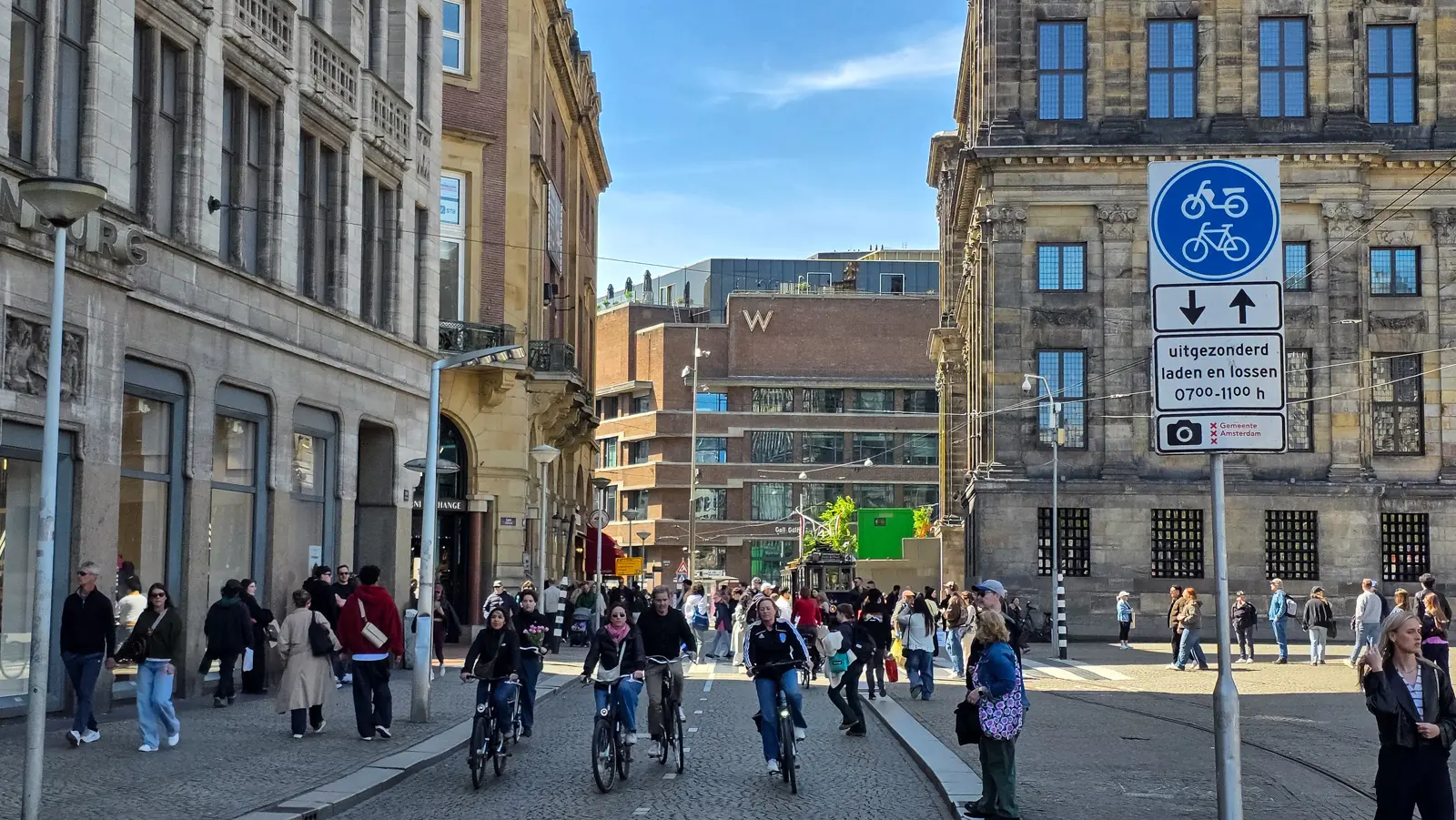
It is empty because a king wanted a view
The flatness has a culprit.
A weigh house stood on the square from 1341, replaced by a larger one in 1565, and for centuries it sat in the middle of the Dam weighing goods off the ships. It appears in the seventeenth-century paintings of the square, a solid Gothic block anchoring the middle distance.
In 1808 Louis Bonaparte moved into the town hall, converted it into a palace, looked out of his new windows, and found that the weigh house was in the way. He had it demolished.
That is the single decision that produced the space I walked across and found so unsatisfying. What reads today as a big empty rectangle is a room with the furniture taken out, and it was taken out so that one man who ruled the Netherlands for four years could see further from his drawing room.
The edges are honest about what they are
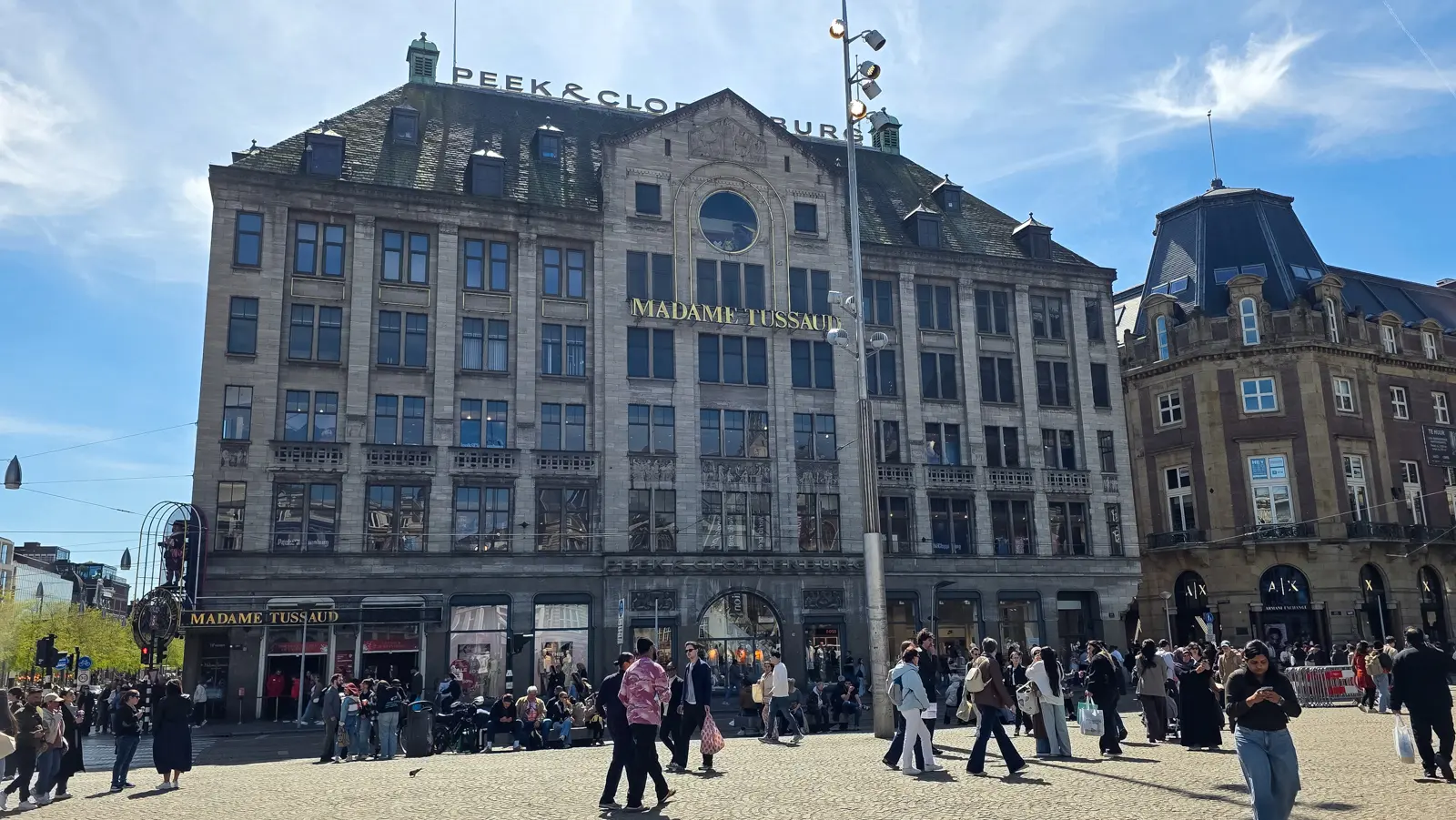
I will not pretend about this part. One long side of the square is a wax museum above a department store, and the wax museum is the newcomer: it moved in from Kalverstraat in 1991, into a building that had been selling clothes since 1917. The other has the Grand Hotel Krasnapolsky, a souvenir shop, a chain selling tulip bulbs and a Ripley’s. Kalverstraat and Nieuwendijk, two of the busiest shopping streets in the country, both empty into it.
Several people told me not to miss Madame Tussauds. I did not go in. There was a queue every time I crossed the square, and my reasoning was that a great many cities have one and I had not come to Amsterdam to look at wax. I still think that, and I am also aware it is the reasoning of somebody who never bought a ticket. Two things sit against me. The Amsterdam branch opened in 1970 and was the first outside the United Kingdom, and it has a Dutch Golden Age section the other branches do not. And on its top floor there is a large round window looking straight out over the square to the Royal Palace and the Nieuwe Kerk, which is very nearly the only place a visitor can see the shape of the Dam all at once.
None of that is a scandal. There has been a market on this square since the thirteenth century and a shopping street running off it for almost as long, and expecting a commercial space to stop being commercial is naive. But it does mean the two longest sides of the most important public square in the Netherlands give a visitor nothing whatever to look at.
The terrace by the Nieuwe Kerk
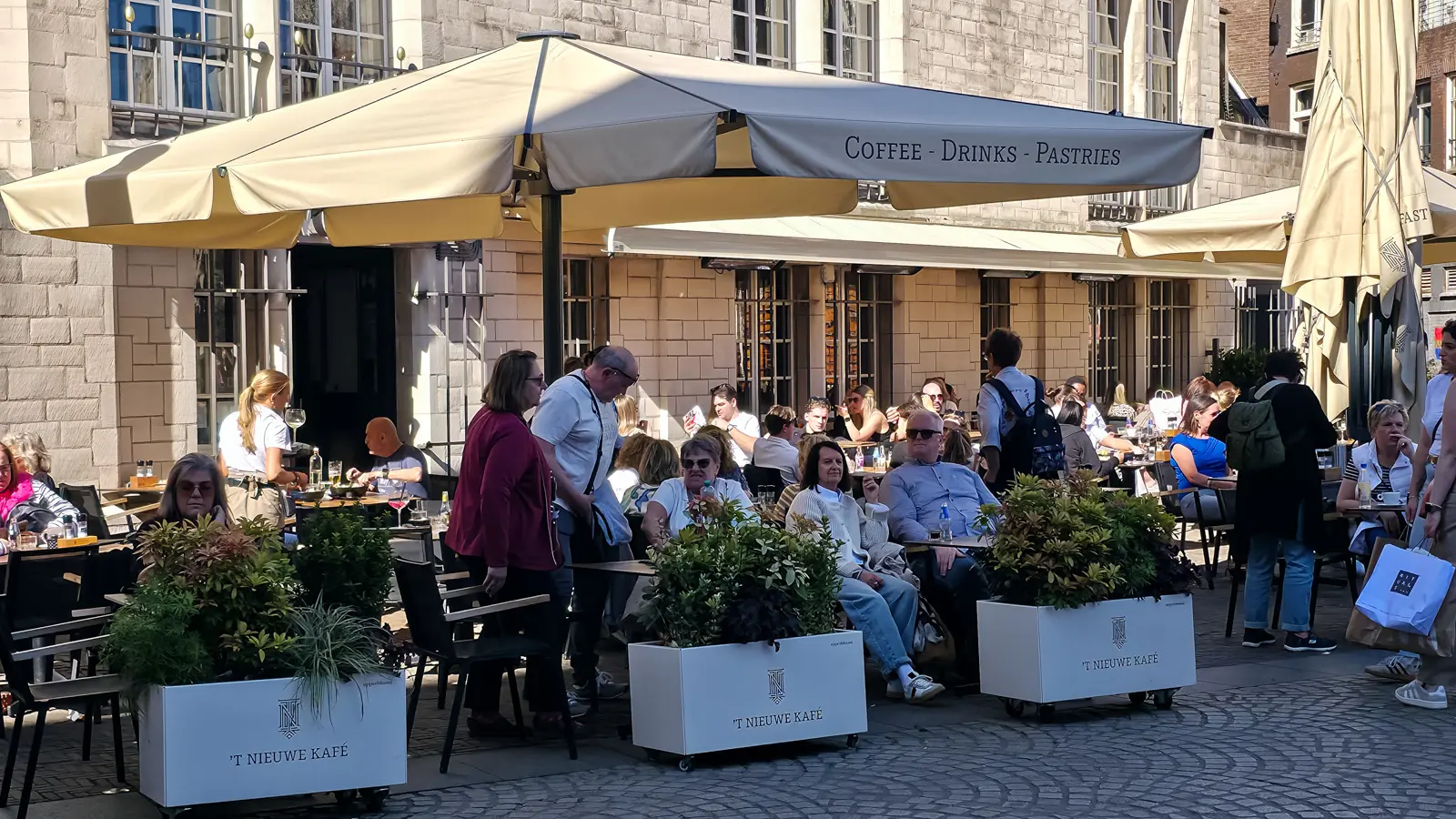
This is the corner where I was wrong.
On the first of May, late in the afternoon, the terrace outside the Nieuwe Kerk was completely full. Every table taken, umbrellas up, the sun coming in low across the cobbles, waiters moving between the plant boxes with their hands full. It was the only place on the Dam where people had stopped rather than crossed.
Which is the point I had been missing. The Dam is not enjoyable from the middle. It is enjoyable from the edge, facing back into it, in the sun, with a drink on the table. Standing in the centre and turning slowly around is the tourist behaviour, and the square punishes it.
The white pillar
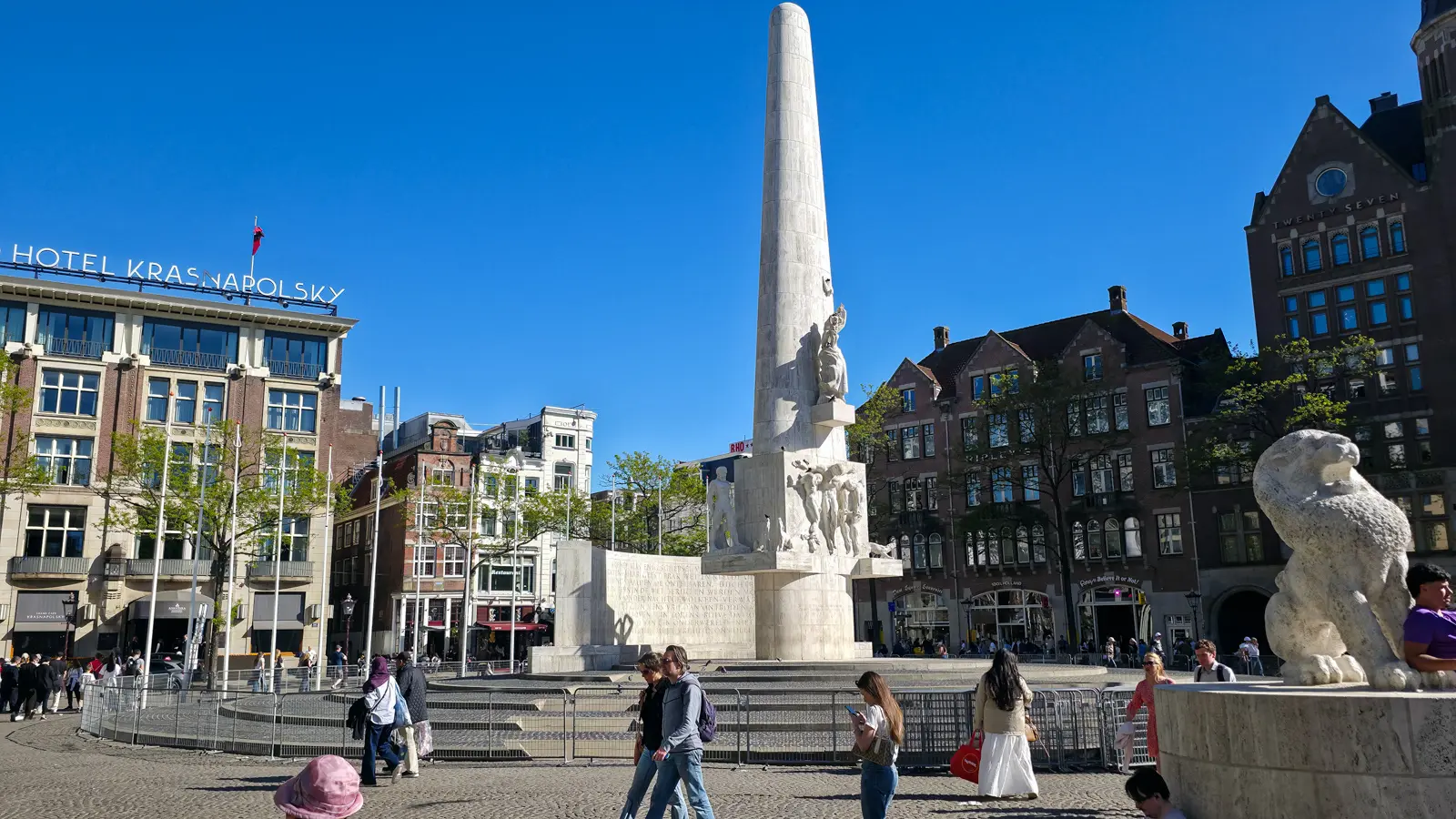
I had been walking past it for a week, registering it as a war memorial and not stopping.
On 5 May 1945 the German forces in the Netherlands surrendered. Two days later, on 7 May, thousands of people gathered on the Dam to wait for the Canadian troops and celebrate. German soldiers opened fire on them with machine guns from the balcony of the Groote Club, the building next to the palace. Thirty-two people were killed and more than a hundred injured, in a crowd that had come out to celebrate the end of the war, two days after it had ended.
The monument stands where that happened.
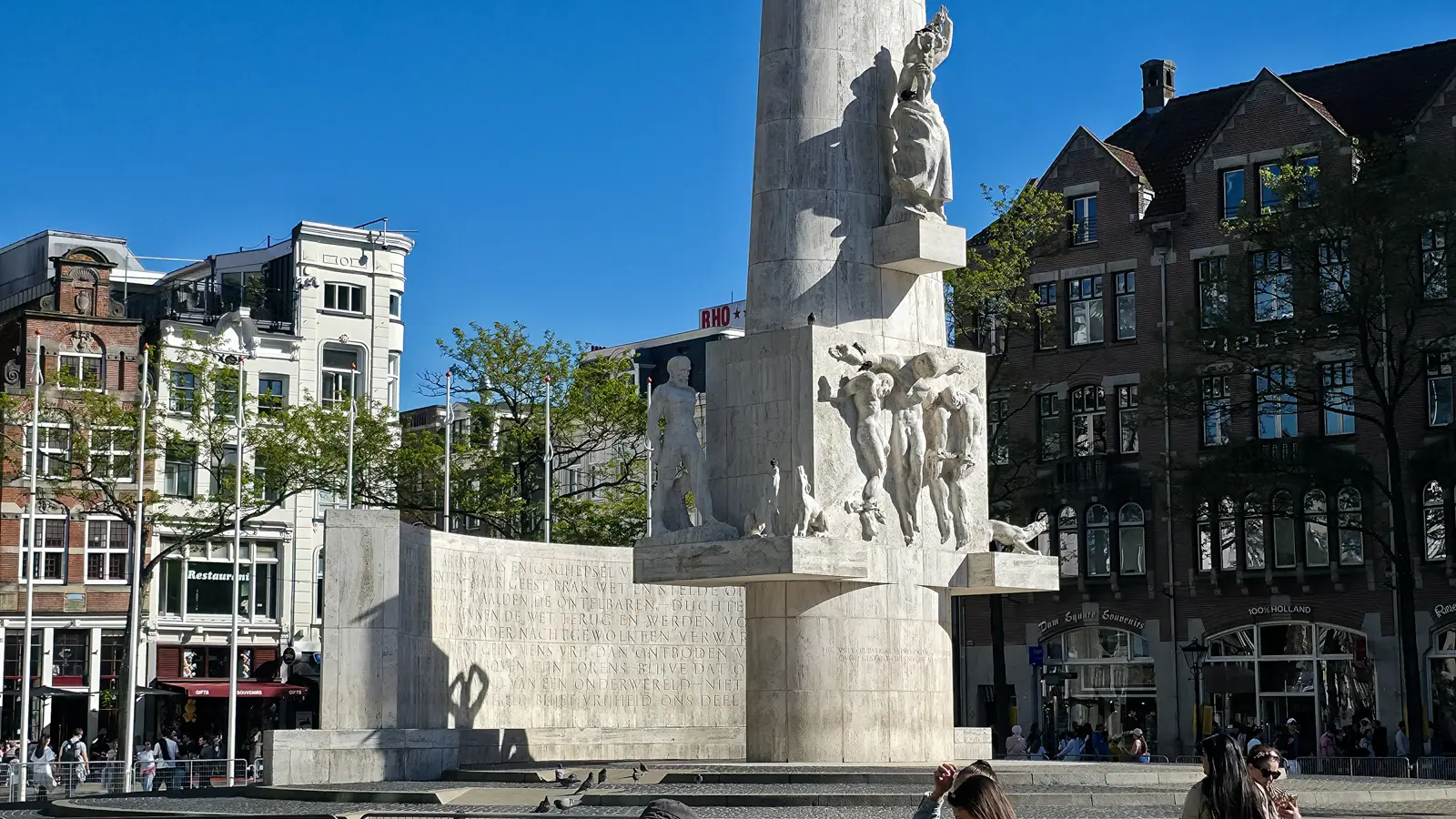
It was unveiled on 4 May 1956 by Queen Juliana. John Rädecker had died in January of that year, four months before it was finished, and his two sons completed the work.
The detail that stopped me is in one of those urns. The soil from Noord-Brabant was mixed with the ashes of cremated prisoners from the camp at Vught. That turns the wall from a symbolic gesture into something closer to a grave, and it is in a wall that several thousand people a day walk past without knowing.
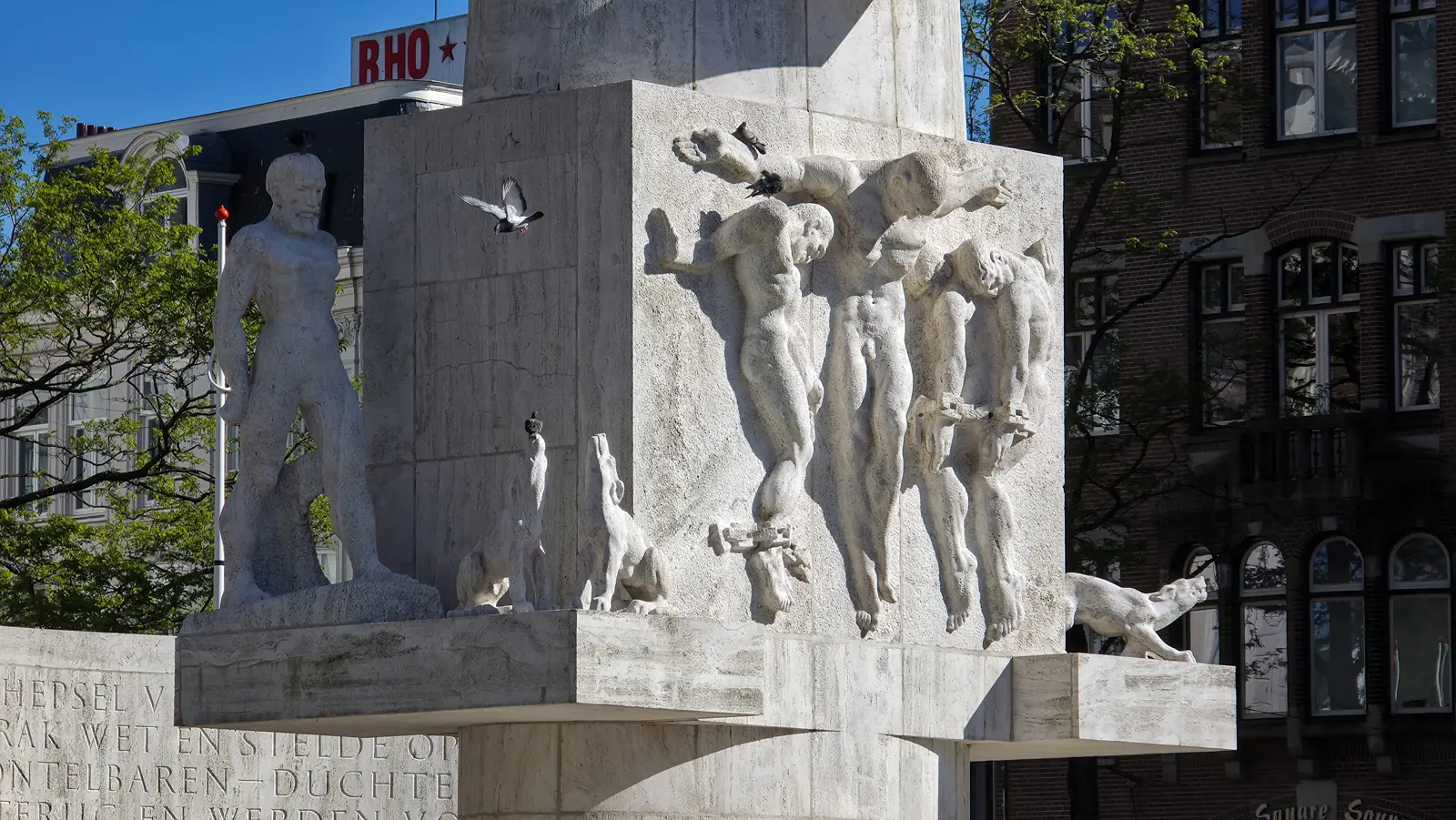
What the square is for
Here is what I got wrong, and it took the photographs on my own phone to show me.
Both times I crossed the Dam it was partly fenced off, and both times I read that as roadworks and mild annoyance. It was not. On 26 April there was a contractor’s container and black screening on the square, the day before King’s Day. On 1 May, there were crowd barriers ringed around the monument, three days before the fourth of May.
On the fourth of May every year, the whole country stops at eight in the evening for two minutes of silence. The King and Queen lay a wreath at that pillar. It is broadcast live and observed nationally, and this square is where it happens.
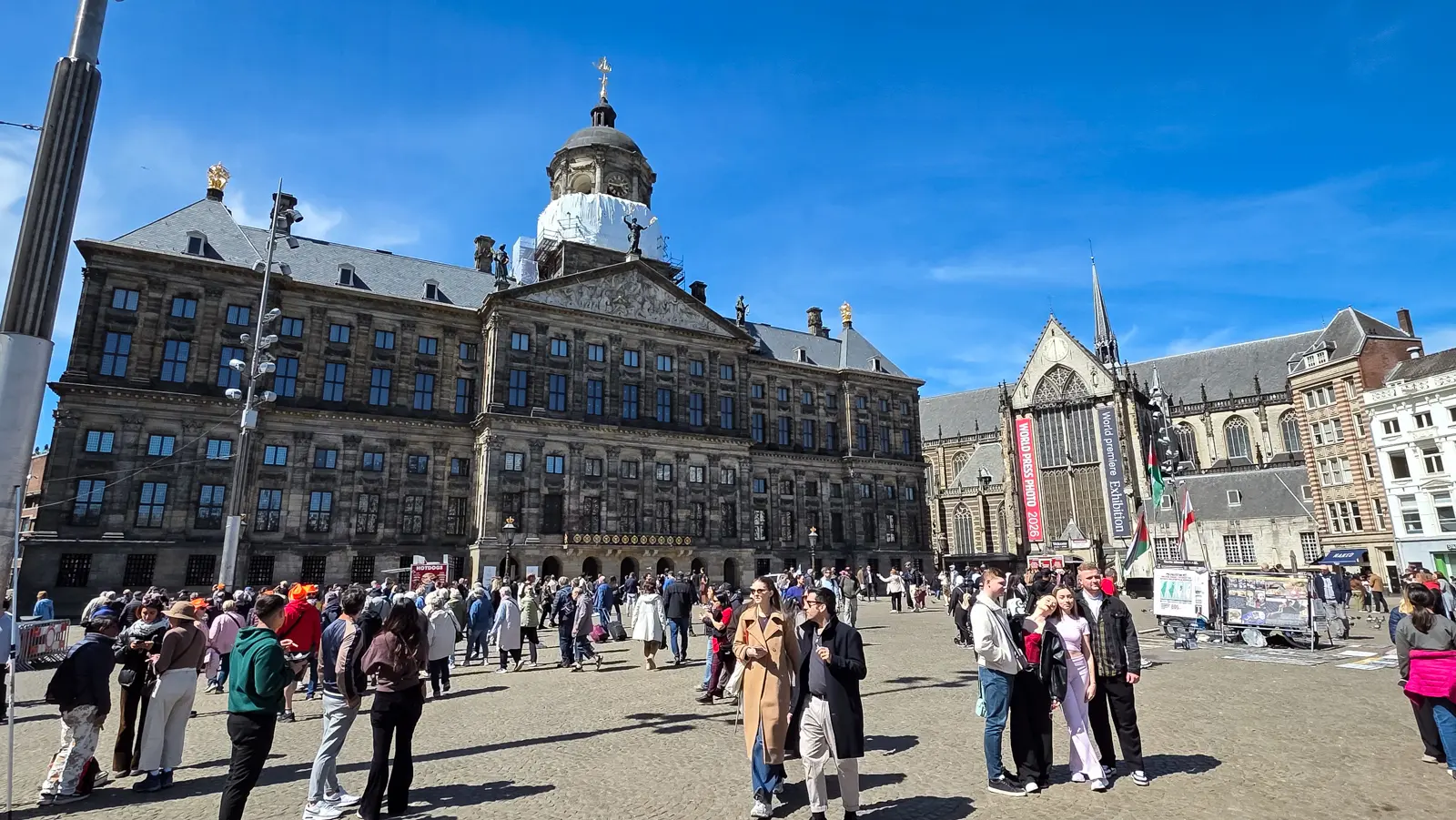
It is not only the state that uses it, either. Amsterdam sees more than three thousand demonstrations a year, and more than half of them take place on the Dam, most of those at weekends. The pressure has grown heavy enough that larger protests are now routinely redirected to Museumplein instead. The flat grey square I had been crossing and finding uninteresting is the default address for Dutch public argument.
So the Dam is not a badly designed piazza that fails to charm visitors. It is a working civic space kept deliberately clear because it has to be able to hold a crowd at short notice, whether that crowd has come for a king’s birthday, for two minutes of silence on the fourth of May, or on an ordinary Saturday with a cause and seventy-two hours’ notice.
The emptiness is the function. I had been treating it as a failure of decoration.
Bubbly Tips
- Do not plan a visit to Dam Square. It is not a destination. It is the place four routes cross, and you will be on it several times whether you intend to or not.
- Sit on the edge, not in the middle. The terraces on the Nieuwe Kerk side get the late afternoon sun and are the only part of the square anyone actually lingers on.
- Walk the monument’s back. Most people photograph the front. The doves on the reverse and the curved wall of urns behind are the parts that repay attention.
- Look for the wall of urns. Twelve of them, one per province plus the Dutch East Indies. There is no sign explaining it, so you have to know it is there.
- If you are in Amsterdam on 4 May, be here at eight. Two minutes of national silence at the monument, with the royal family present. It is the one evening the square makes complete sense.
- Avoid the last week of April if you want the square empty. King’s Day on 27 April turns the whole centre into a street party and the build-up starts days ahead.
- The palace is worth the ticket, the exterior is not the reason. Do not judge the Royal Palace from the square. The outside gives away nothing.
- Kalverstraat for shopping, Damrak for the walk to the station. Both leave the square. Damrak follows the old river course and takes about ten minutes to Centraal.
- On Madame Tussauds, I cannot review what I did not enter. The queue was long every time I passed, and plenty of cities have one. But the round window on the top floor gives the best view there is of the square, the palace and the Nieuwe Kerk together, which may be reason enough even if wax is not your thing.
- Give the square a few minutes. Read the monument, look at where the water used to be, and then go somewhere that rewards standing still.
Final Thoughts
There is a particular kind of disappointment that comes from a famous place refusing to perform, and Dam Square delivers it reliably. No canal, no grand vista, no obvious beauty, and a wax museum where a visitor might reasonably expect something older.
But a square named after a dam, sitting on a buried river, emptied out by a Bonaparte with a view to protect, holding a memorial built on the spot where soldiers shot into a crowd celebrating the end of a war, and closed off twice in the week I was there so that a country could use it properly. That is not nothing. It is just not arranged for looking at, and I had been standing in the middle of it doing exactly that.
Until next time!

🌟 Everything You Need to Plan Your Dream Trip in 2026
- 🌟 Luxury Hotels - Find premium stays with Booking.com & Hotels.com
- 🏡 Vacation Rentals - Discover unique properties on VRBO
- 🏞️ Guided Tours - Explore with Viator or GetYourGuide
- 🎫 Attraction Tickets - Skip the lines with Tiqets
- 🚢 Ocean Cruises - Set sail with Cruise Direct
- 📱 International SIMs - Stay connected with Saily
- 🚗 Car Rentals - Budget-friendly options from Discover Cars
- 🌐 Secure VPNs - Browse safely with NordVPN
- 💶 Currency Exchange - Best rates with Wise
- 🗣️ Learn Languages - Master the local language with Babbel and Rosetta Stone